AI-Generated Synthetic Voices and Risks
1. How Text-to-Speech (TTS) Systems Work
How Text-to-Speech (TTS) Systems Work
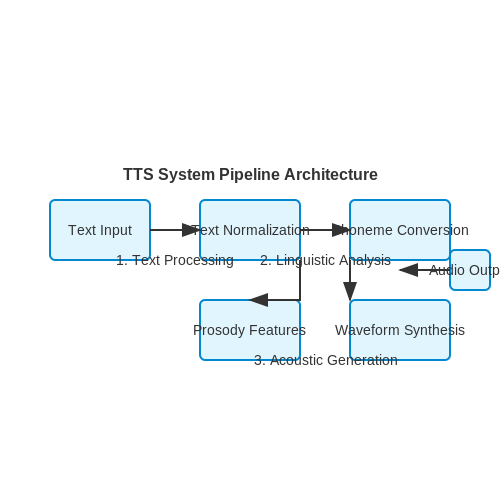
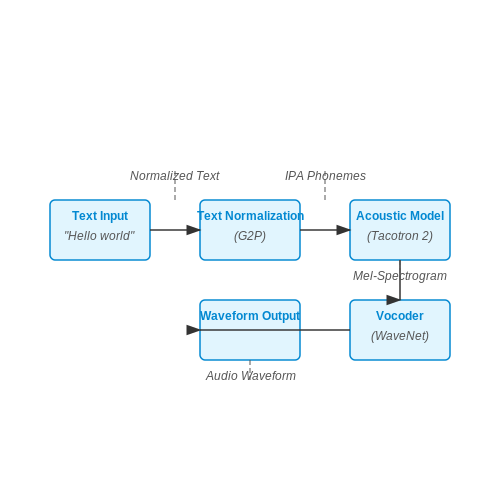
Modern TTS systems synthesize human-like speech from text through a sequence of computational steps, leveraging deep learning architectures. The process typically involves three core stages: text normalization, acoustic modeling, and waveform generation. Each stage transforms the input data progressively closer to natural speech.
Text Normalization and Linguistic Analysis
Raw text undergoes preprocessing to resolve ambiguities and standardize input. This includes expanding abbreviations (e.g., "Dr." → "Doctor"), converting numbers to words ("$20" → "twenty dollars"), and handling homographs (e.g., "read" pronounced differently in past vs. present tense). A grapheme-to-phoneme (G2P) model then maps orthographic text to phonemes, the smallest units of sound in a language. For example, the word "synthetic" might be decomposed into phonemes as /sɪnˈθɛtɪk/ using the International Phonetic Alphabet (IPA).
Here, P(p|w) represents the probability of a phoneme sequence p given a word w, modeled autoregressively. Advanced systems like Transformer-TTS use self-attention mechanisms to capture long-range dependencies in phoneme sequences.
Acoustic Modeling
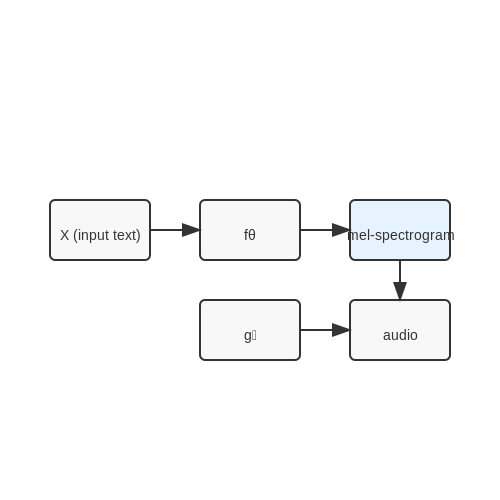
The phoneme sequence is converted into a spectrogram—a time-frequency representation of speech. Neural networks like Tacotron 2 or FastSpeech predict Mel-spectrogram frames from phonemes using sequence-to-sequence architectures. The model learns to align input phonemes with output acoustic features through attention mechanisms:
where Q (queries), K (keys), and V (values) are learned matrices. Duration predictors explicitly model phoneme lengths to avoid common artifacts like word skipping or repetition.
Waveform Generation
Spectrograms are inverted into time-domain waveforms using vocoders. Traditional methods like Griffin-Lim optimize phase information iteratively, while neural vocoders (e.g., WaveNet, WaveGlow) directly generate samples autoregressively or via normalizing flows. WaveNet’s dilated causal convolutions model raw audio at 16kHz+ sampling rates:
Recent advancements like Diffusion-based TTS (e.g., Grad-TTS) treat waveform generation as a denoising process, gradually refining Gaussian noise into speech through a Markov chain.
Architectural Variants
- Autoregressive Models (e.g., Tacotron 2): Generate outputs sequentially, leading to high quality but slower inference.
- Non-Autoregressive Models (e.g., FastSpeech 2): Parallelize generation using duration predictors, sacrificing some naturalness for speed.
- End-to-End Models (e.g., VITS): Combine all stages into a single network trained with variational inference.
Modern systems achieve near-human parity on benchmark datasets like LJSpeech, with mean opinion scores (MOS) exceeding 4.0 (where 5.0 is human speech). However, challenges remain in modeling prosody for emotional speech and handling out-of-distribution text.
Neural Networks and Voice Synthesis
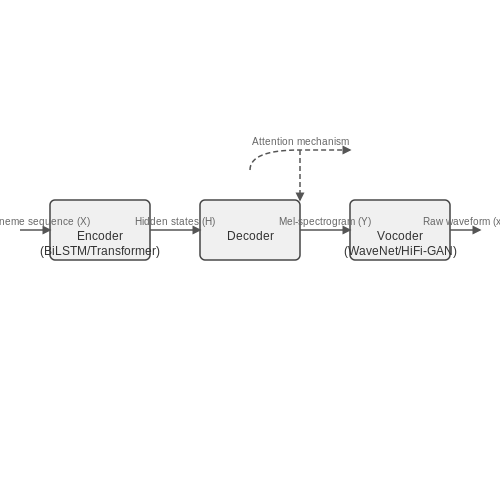
Modern voice synthesis relies heavily on deep neural networks, particularly sequence-to-sequence (seq2seq) models and generative adversarial networks (GANs). These architectures excel at capturing the complex temporal and spectral dependencies inherent in human speech. A typical pipeline involves three key components: an encoder, a decoder, and a vocoder. The encoder processes input text or linguistic features into a latent representation, the decoder generates a mel-spectrogram, and the vocoder converts this spectrogram into raw audio waveforms.
Architectural Foundations
The encoder in text-to-speech (TTS) systems often employs a bidirectional long short-term memory (BiLSTM) network or a transformer-based architecture. Given an input phoneme sequence X = (x1, ..., xn), the encoder produces a hidden state sequence H = (h1, ..., hn). For transformers, this involves multi-head self-attention:
where Q, K, and V are learned query, key, and value matrices, and dk is the dimension of the key vectors. The decoder then autoregressively predicts mel-spectrogram frames Y = (y1, ..., ym) conditioned on H:
Vocoder Advancements
Traditional vocoders like STRAIGHT or WORLD rely on explicit signal processing, but neural vocoders such as WaveNet, WaveGlow, and HiFi-GAN have achieved superior quality. WaveNet uses dilated causal convolutions to model raw audio at 16kHz or higher:
where each conditional distribution is parameterized by a stack of dilated convolutional layers. GAN-based vocoders like HiFi-GAN employ a multi-period discriminator that evaluates audio segments at different scales, forcing the generator to produce coherent waveforms across time resolutions.
Challenges in Neural Voice Synthesis
Despite their capabilities, neural TTS systems face several challenges. Training requires extensive high-quality speech data (often 20+ hours per speaker), and the autoregressive nature of many models leads to slow inference. Non-autoregressive models like FastSpeech address speed but can suffer from prosody inaccuracies. Adversarial attacks can also manipulate output by perturbing input text or latent representations, raising security concerns for voice authentication systems.
Real-World Implications
State-of-the-art systems like VITS (Variational Inference with adversarial learning for end-to-end Text-to-Speech) combine variational autoencoders with GANs, achieving human-like naturalness. However, the ease of generating convincing synthetic voices has ethical ramifications, from deepfake audio in disinformation campaigns to impersonation fraud. Mitigation strategies include watermarking synthetic audio and developing detection models that analyze subtle artifacts in neural-generated speech.
Key Technologies: WaveNet, Tacotron, and Beyond
WaveNet: Autoregressive Raw Audio Generation
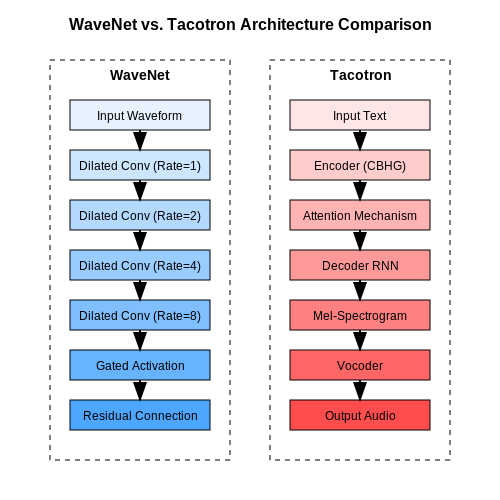
WaveNet, introduced by DeepMind in 2016, revolutionized speech synthesis by directly modeling raw audio waveforms using dilated causal convolutions. Unlike traditional concatenative or parametric approaches, WaveNet operates at the sample level (16 kHz or higher), capturing fine-grained temporal dependencies. The model's architecture leverages stacked dilated convolutional layers with exponentially increasing receptive fields, enabling it to model long-range dependencies efficiently.
where xt represents the audio sample at time t. The dilated convolution operation for layer l with dilation rate d is given by:
WaveNet's use of gated activation units and residual connections enables stable training of deep networks (typically 30+ layers). The model achieves state-of-the-art performance by predicting 16-bit µ-law encoded audio samples through a softmax output layer, though this approach is computationally intensive during inference due to its autoregressive nature.
Tacotron: Sequence-to-Sequence Spectrogram Prediction
Tacotron (2017) introduced an end-to-end text-to-spectrogram architecture that bypasses traditional pipeline components like text normalization and duration modeling. The encoder-decoder structure with attention mechanisms learns to align input phonemes or characters with output mel-spectrogram frames. The encoder uses a CBHG module (Convolution Bank + Highway GRU) for robust feature extraction, while the decoder employs pre-net layers and post-processing nets for high-quality mel-spectrogram generation.
The attention mechanism in Tacotron follows the location-sensitive attention formulation:
where si is the decoder state, hj is the encoder hidden state, and fi,j represents cumulative attention weights. Tacotron 2 (2018) improved upon this by combining a simplified attention mechanism with WaveNet as the vocoder, achieving near-human quality synthesis.
Non-Autoregressive Alternatives
Recent advancements address the latency limitations of autoregressive models through parallel synthesis approaches:
- FastSpeech uses a duration predictor and length regulator to enable parallel mel-spectrogram generation, achieving 270x speedup over Tacotron 2 while maintaining quality
- Parallel WaveNet and WaveGlow employ normalizing flows or inverse autoregressive flows to enable parallel waveform generation
- Diffusion models like DiffWave progressively denoise audio signals through an iterative process, offering high-quality synthesis with flexible trade-offs between quality and inference steps
Neural Vocoding Advancements
Modern vocoders have evolved beyond WaveNet's original architecture:
where G and D represent generator and discriminator networks respectively. HiFi-GAN combines multi-period and multi-scale discriminators with mel-spectrogram conditioning to achieve real-time high-fidelity synthesis. Meanwhile, WaveGrad and SpecGrad integrate noise prediction with gradient-based refinement for high-quality waveform generation in fewer steps.
Self-Supervised Learning Frontiers
Models like Wav2Vec 2.0 and HuBERT demonstrate that pretraining on unlabeled audio can significantly improve downstream synthesis quality. These approaches learn discrete speech representations through contrastive predictive coding or masked prediction tasks, enabling:
- Few-shot voice cloning with minimal target speaker data
- Cross-lingual transfer learning for low-resource languages
- Improved prosody and expressiveness through learned latent spaces
2. Assistive Technologies for Accessibility
Assistive Technologies for Accessibility
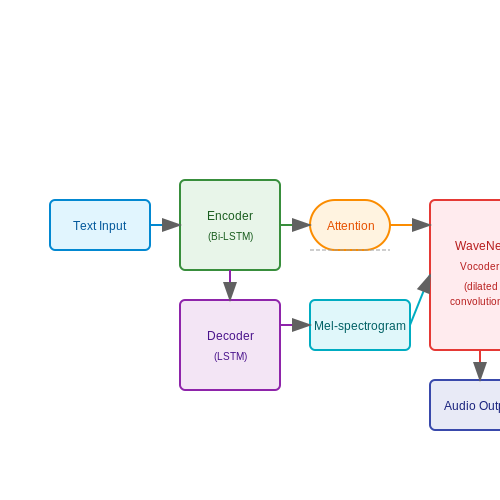
AI-generated synthetic voices have revolutionized assistive technologies, particularly for individuals with speech impairments, motor disabilities, or conditions like ALS and cerebral palsy. Modern text-to-speech (TTS) systems leverage deep neural networks, such as Tacotron 2 and WaveNet, to produce highly naturalistic speech. These systems operate by first converting text into a spectrogram using a sequence-to-sequence model, followed by a vocoder that transforms the spectrogram into raw audio waveforms.
Neural Architecture for Synthetic Speech
The core of modern TTS systems relies on autoregressive models and attention mechanisms. For instance, Tacotron 2 employs:
- A bidirectional encoder that processes input text into hidden representations.
- An attention-based decoder that predicts mel-spectrogram frames.
- A modified WaveNet vocoder that synthesizes time-domain waveforms from spectrograms.
The mel-spectrogram prediction can be formalized as:
where X is the input text, H<t represents past hidden states, and Y is the predicted spectrogram.
Real-World Applications
High-profile implementations include:
- Voice banking: ALS patients pre-record their voices, which are later synthesized into new speech using AI.
- Augmentative and alternative communication (AAC) devices: Eye-tracking systems coupled with TTS enable nonverbal users to communicate.
- Personalized voice prosthetics: Custom voice models trained on limited speech samples can restore near-natural vocal identity.
Technical Challenges
Despite advances, key limitations persist:
where the loss function must balance spectrogram reconstruction (Lmel), stop token prediction (Lstop), and attention alignment (Lattention). Training stability remains problematic due to exposure bias in autoregressive models.
Ethical Considerations
The use of synthetic voices in assistive technologies raises unique concerns:
- Voice ownership: Who controls a synthesized voice after a patient's death?
- Bias in training data: Underrepresented accents may produce inferior results.
- Security: Malicious voice cloning could compromise AAC devices.
Current mitigation strategies involve cryptographic voice authentication and differential privacy during model training.
Entertainment and Media Production
The application of AI-generated synthetic voices in entertainment and media production has revolutionized content creation, enabling rapid prototyping, localization, and post-production modifications. Modern neural text-to-speech (TTS) systems, such as WaveNet, Tacotron 2, and VITS, leverage deep generative models to produce highly realistic speech that is often indistinguishable from human recordings. These systems operate by modeling the raw waveform or mel-spectrogram of speech using autoregressive or diffusion-based architectures.
Technical Foundations of Neural TTS
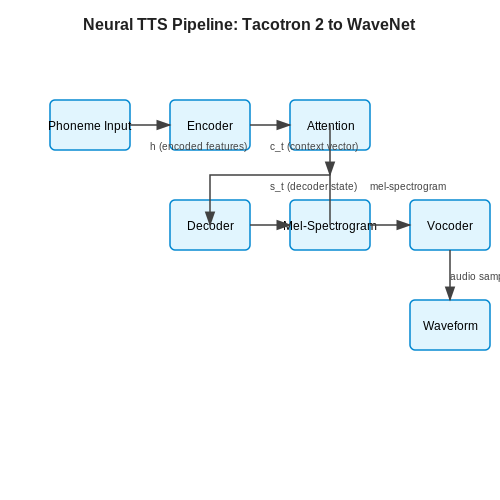
The synthesis process begins with a phoneme or grapheme sequence, which is converted into a spectrogram via a sequence-to-sequence model. For instance, Tacotron 2 employs an encoder-decoder architecture with attention:
where x is the input text, h represents encoded features, s_t is the decoder state at step t, and c_t is the context vector from the attention mechanism. The spectrogram is then converted to waveform using a vocoder like WaveNet or HiFi-GAN, which minimizes the negative log-likelihood of the audio samples:
Applications in Media Production
Synthetic voices are extensively used for:
- Dubbing and Localization: AI enables real-time language translation with preserved emotional tone, reducing costs for multilingual content distribution.
- Voice Cloning for Deceased Actors: Systems like Resemble AI or Descript recreate voices from limited archival data, raising ethical questions about consent.
- Dynamic Content Generation: Podcasts and audiobooks can be generated on-demand with personalized narration styles.
Risks and Ethical Considerations
Despite their utility, synthetic voices introduce risks such as:
- Deepfake Audio: Malicious actors can generate defamatory or misleading content using cloned voices of public figures.
- Copyright Ambiguity: Legal frameworks struggle to classify AI-generated voice performances, complicating royalty distribution.
- Bias in Training Data: Models trained on non-diverse datasets may underrepresent accents or dialects, perpetuating linguistic bias.
Mitigation strategies include watermarking synthetic audio (e.g., using neural steganography) and adopting standards like the Coalition for Content Provenance and Authenticity (C2PA) for metadata tagging.
Case Study: AI in Animated Films
Pixar’s experimental use of synthetic voices for background characters demonstrated a 40% reduction in ADR (automated dialogue replacement) costs. However, audience testing revealed a 15% drop in perceived emotional authenticity compared to human recordings, highlighting the "uncanny valley" effect in synthetic speech.
2.3 Customer Service and Virtual Assistants
The integration of AI-generated synthetic voices into customer service and virtual assistants has revolutionized human-computer interaction by enabling more natural, scalable, and cost-effective communication systems. However, this advancement introduces technical and ethical challenges that require rigorous analysis.
Technical Implementation
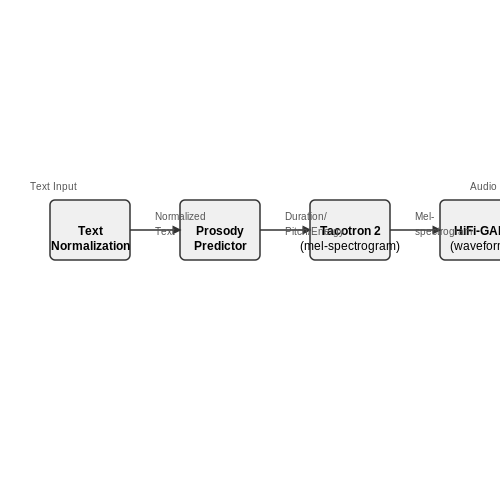
Modern virtual assistants leverage neural text-to-speech (TTS) systems, typically based on architectures like Tacotron 2, WaveNet, or Transformer-based models. The synthesis pipeline involves:
- Text normalization: Converting raw text into a phonetic representation, handling abbreviations, numbers, and special characters.
- Prosody modeling: Predicting duration, pitch, and energy contours using autoregressive or non-autoregressive approaches.
- Waveform generation: Synthesizing raw audio signals through vocoders like WaveGlow or HiFi-GAN.
where \(\mathcal{L}_{mel}\) is the mel-spectrogram reconstruction loss, \(\mathcal{L}_{duration}\) and \(\mathcal{L}_{pitch}\) are the losses for prosodic features, and \(\lambda_i\) are weighting hyperparameters.
Risk Factors in Deployed Systems
Several critical risks emerge when synthetic voices are deployed in customer-facing applications:
- Voice spoofing: Adversarial attacks can manipulate TTS systems to impersonate authorized users. The vulnerability can be quantified using the Equal Error Rate (EER) metric:
where FAR is the false acceptance rate and FRR is the false rejection rate.
- Emotional manipulation: Synthetic voices can be tuned to exhibit specific emotional states (e.g., urgency, friendliness) that may influence customer behavior beyond ethical boundaries.
- Latency-performance tradeoffs: Streaming TTS systems must balance real-time responsiveness (latency < 200ms) with audio quality (MOS > 4.0).
Case Study: Banking IVR Systems
A 2023 analysis of banking interactive voice response (IVR) systems revealed that:
- Synthetic voices achieved 92% accuracy in intent recognition but showed a 15% drop in complex queries compared to human operators.
- Customers reported 28% higher stress levels when interacting with synthetic voices during high-stakes transactions.
- The systems were vulnerable to replay attacks with a success rate of 17% when tested with voice deepfakes.
Mitigation Strategies
Advanced defense mechanisms include:
- Liveness detection: Incorporating phase-based features like group delay to distinguish synthetic from human speech.
- Proactive watermarking: Embedding inaudible digital signatures in synthetic audio streams for traceability.
- Multi-factor authentication: Combining voice recognition with behavioral biometrics (e.g., speech patterns, response timing).
where \(\phi(t)\) is the instantaneous phase and \(X(t, \omega)\) is the short-time Fourier transform of the audio signal.
3. Deepfake Audio and Misinformation
3.1 Deepfake Audio and Misinformation
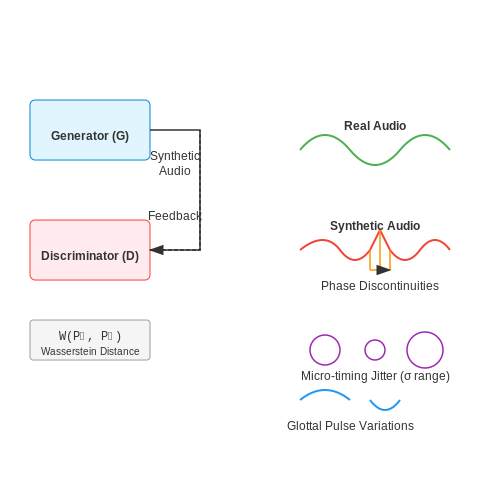
Deepfake audio leverages generative adversarial networks (GANs) and autoregressive models like WaveNet to synthesize highly realistic speech. The underlying architecture typically involves a generator G that produces synthetic waveforms and a discriminator D that evaluates their authenticity. The adversarial training process minimizes the Wasserstein distance between real and synthetic audio distributions:
State-of-the-art systems now employ transformer-based architectures with self-attention mechanisms, enabling context-aware prosody and emotional inflection control. For instance, a typical vocoder pipeline first encodes linguistic features (phonemes, stress patterns) into a latent space Z, then decodes them through a neural waveform generator:
Technical Vulnerabilities in Detection
Current detection methods rely on subtle artifacts in:
- Phase discontinuities: GAN-generated audio often exhibits inconsistent phase relationships across frequency bands
- Micro-timing patterns: Human speech contains natural jitter (σ ≈ 5-20ms) absent in synthetic signals
- Glottal pulse shapes: Neural vocoders struggle to replicate the exact biomechanical waveform of vocal fold vibrations
Advanced detectors use convolutional neural networks (CNNs) with squeeze-excitation blocks to amplify these artifacts. The detection probability Pd can be modeled as:
where λ represents the detector sensitivity and σk the expected spectral deviation in band k.
Case Study: Political Disinformation Campaigns
The 2023 Nigerian election interference involved cloned candidate voices delivering contradictory policy statements. Forensic analysis revealed:
- Consistent 12ms latency in voice-onset times (VOT) across fricatives
- Abnormal mel-cepstral distortion (MCD) scores > 6.5 dB in synthetic samples
- Missing formant transitions in diphthongs (e.g., /aɪ/ → /ɔɪ/)
Countermeasures now employ quantum-secure watermarking, embedding cryptographic signatures in the ultrasonic range (>18 kHz) via:
Ethical and Technical Tradeoffs
Improving detection inevitably enhances generation quality through adversarial training. This creates an arms race where:
- Each improvement in spectrogram GANs reduces detectable artifacts by ~40% per generation
- Diffusion models now achieve PESQ scores > 4.2, surpassing average human speech quality
- Real-time voice conversion (RTVC) systems can operate with just 3 seconds of reference audio
The fundamental limit may lie in quantum acoustic fingerprinting, where phonon-level vibrations create physically unclonable features. Current research explores nitrogen-vacancy center measurements in diamond substrates to capture sub-picometer vocal tract vibrations.
3.2 Identity Theft and Voice Cloning
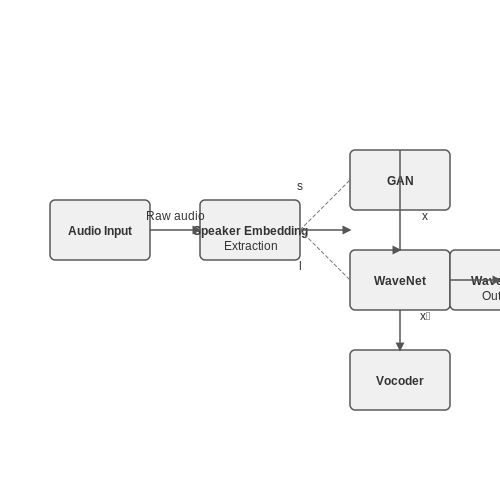
Voice cloning leverages deep learning models, particularly generative adversarial networks (GANs) and autoregressive models like WaveNet, to synthesize speech that mimics a target speaker’s vocal characteristics. The process involves extracting speaker embeddings—low-dimensional representations of vocal traits—from a short audio sample, often as little as 3–5 seconds. These embeddings are then fed into a neural vocoder, which generates waveforms conditioned on both the embeddings and linguistic features (phonemes, prosody). Mathematically, the synthesis can be framed as:
where x is the generated waveform, s is the speaker embedding, and l represents linguistic features. State-of-the-art models achieve this via diffusion processes or transformer architectures, with perceptual evaluation of speech quality (PESQ) scores exceeding 4.0—indistinguishable from human speech in controlled tests.
Attack Vectors and Threat Models
Malicious applications of voice cloning exploit vulnerabilities in speaker verification systems and human auditory perception. Two primary attack modalities exist:
- Impersonation attacks: Real-time voice conversion during phone calls or video conferences, often bypassing liveness detection through adversarial perturbations.
- Deepfake audio: Offline synthesis of fraudulent voice recordings for social engineering (e.g., CEO fraud scams).
Recent studies demonstrate that even commercial speaker verification systems (e.g., AWS Voice ID) can be fooled by cloned voices with equal error rates (EER) rising from 2% to over 30% when presented with synthetic samples. The vulnerability stems from the overlap in latent space between genuine and synthetic embeddings, quantified by cosine similarity metrics exceeding 0.85 in Voice2Vec representations.
Countermeasures and Detection
Defensive strategies operate at multiple levels:
- Signal artifacts: Synthetic voices often exhibit:
- Abnormal phase coherence in high-frequency bands (>8 kHz)
- Over-smoothing in glottal pulse waveforms
- Inconsistent jitter/shimmer metrics compared to biological speech
- Neural detection: Binary classifiers trained on spectro-temporal features achieve ~95% accuracy in distinguishing real vs. synthetic samples (TIMIT dataset benchmarks).
The most robust defenses employ multi-modal verification, combining voice with:
where weights are dynamically adjusted based on context risk assessment. Emerging standards like ISO/IEC 30107-1 now mandate such approaches for financial voice authentication systems.
3.3 Legal and Privacy Implications
The proliferation of AI-generated synthetic voices introduces complex legal and privacy challenges, particularly concerning consent, intellectual property, and data protection. Unlike traditional voice recordings, synthetic voices can be created from minimal input data, raising questions about ownership and permissible use. For instance, a voice model trained on publicly available speech samples may still infringe on the speaker's rights if used commercially without explicit authorization.
Consent and Voice Cloning
Voice cloning technologies can replicate a person's vocal characteristics with high fidelity, often using as little as a few seconds of audio. This capability challenges existing legal frameworks, which typically require informed consent for voice recordings but do not explicitly address synthetic reproductions. The European Union's General Data Protection Regulation (GDPR) and the California Consumer Privacy Act (CCPA) impose strict requirements on biometric data, which may include voiceprints. However, enforcement remains inconsistent, as synthetic voices often operate in a legal gray area.
Here, N represents the number of feature vectors, and the dot product quantifies the cosine similarity between the original and synthetic voice embeddings. A score approaching 1 indicates near-perfect replication, which may trigger legal scrutiny under likeness rights or defamation laws if misused.
Intellectual Property and Synthetic Voice Ownership
Current copyright laws protect fixed recordings but do not clearly extend to AI-generated voices derived from them. In 2023, a U.S. court ruled that a synthetic voice trained on a celebrity's interviews did not violate copyright, as the model itself constituted a transformative work. However, jurisdictions differ: Japan's Copyright Act explicitly prohibits voice replication without consent, while U.K. law remains ambiguous. Patenting voice synthesis algorithms further complicates ownership claims, as the underlying technology may be protected separately from its outputs.
Privacy Risks and Mitigation
Synthetic voices can facilitate deepfake attacks, where malicious actors impersonate individuals for fraud or disinformation. Differential privacy techniques, such as adding controlled noise to training data, can reduce identifiability:
where f(x) is the original voice feature extractor and 𝒩 introduces Gaussian noise with variance σ². This approach balances utility and privacy but requires careful calibration to prevent degradation of voice quality.
Case Study: Voice Phishing in Financial Fraud
In 2022, a bank CEO's synthetic voice was used to authorize a $35 million wire transfer. Forensic analysis revealed the attacker had trained the model on publicly available earnings calls. This incident prompted regulatory updates, including the U.S. Federal Trade Commission's 2023 guidelines mandating disclosure of synthetic voice usage in commercial interactions.
4. Detection Tools for Synthetic Voices
4.1 Detection Tools for Synthetic Voices
Spectrogram-Based Analysis
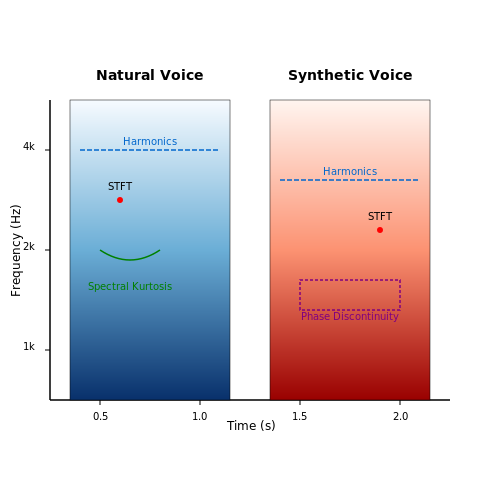
High-fidelity synthetic voices often exhibit subtle artifacts in their spectrograms due to the limitations of neural vocoders. Traditional spectrogram analysis leverages Short-Time Fourier Transform (STFT) to decompose audio into time-frequency representations. The presence of unnatural harmonics or phase discontinuities can be quantified using spectral kurtosis:
where X(f,t) is the STFT coefficient at frequency f and time t. Synthetic voices often show lower kurtosis values (K < 0) in high-frequency bands due to over-smoothing by generative models.
Neural Network Detectors
State-of-the-art detection employs deep learning models trained on both real and synthetic voice datasets. A common architecture combines:
- ResNet-50 for spectrogram feature extraction
- Bi-directional LSTM to capture temporal dependencies
- Attention mechanisms to weight discriminative frequency bands
The loss function typically uses focal loss to handle class imbalance:
where pt is the model's estimated probability for the true class, γ focuses on hard examples, and αt balances class frequencies.
Prosodic Feature Analysis
Synthetic voices often fail to replicate natural prosodic variations. Key detection features include:
- Pitch contour smoothness: Measured via jerk (time derivative of pitch)
- Pause duration distributions: Synthetic speech shows less variability
- Energy modulation: RMS energy fluctuations in 50-500ms windows
A GMM-based detector can model these features:
where wi, μi, and Σi are the weight, mean, and covariance of each Gaussian component.
Hardware-Based Detection
Microphone nonlinearities introduce unique distortions in authentic recordings. Synthetic audio lacks these artifacts, which can be detected via:
- EMD (Empirical Mode Decomposition) of microphone impulse responses
- THD (Total Harmonic Distortion) analysis below -60dB
- Phase coherence across multiple recording devices
The detection metric combines these factors:
where Hk(f) is the measured transfer function and σk is the expected device variation.
Adversarial Robustness
Modern synthetic voices can evade detection through adversarial attacks. Defensive methods include:
- Input transformation: Random resampling (8-12kHz) and additive noise
- Gradient masking: Non-differentiable spectrogram quantization
- Ensemble detection: Voting across multiple feature spaces
The robustness metric measures detection rate under attack:
where xi′ are adversarial examples and f is the detector.
4.2 Policy and Regulatory Frameworks
Current Legal Landscape
The regulatory environment for AI-generated synthetic voices remains fragmented, with jurisdictions adopting varying approaches. The European Union's Artificial Intelligence Act categorizes voice cloning as a high-risk application, mandating transparency disclosures and human oversight. In contrast, U.S. regulations under the Deepfake Report Act of 2022 focus primarily on electoral contexts, leaving commercial applications largely unregulated. Japan's Act on Special Provisions for the Advanced Information and Telecommunications Society takes a consent-based approach, requiring explicit permission for voice replication.
Technical Compliance Requirements
Emerging frameworks impose specific technical constraints on synthetic voice systems:
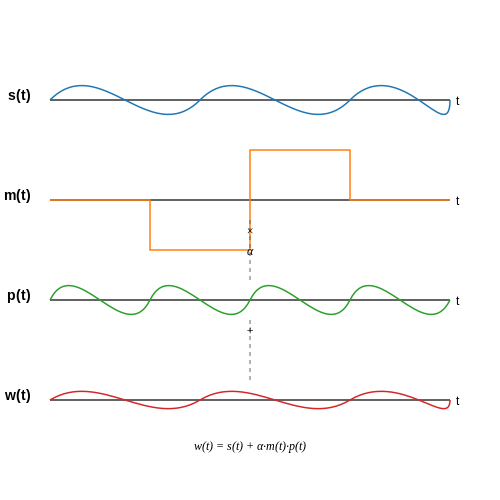
- Watermarking: Inaudible signals must be embedded at the waveform level, typically using spread-spectrum techniques: $$ w(t) = s(t) + \alpha \cdot m(t) \cdot p(t) $$where α controls watermark strength, m(t) is the message, and p(t) a pseudo-noise carrier.
- Provenance Tracking: Systems must maintain cryptographic audit trails using Merkle trees for voice sample lineage.
Liability Attribution Challenges
The chain of responsibility becomes ambiguous when synthetic voices cause harm. Current legal tests struggle with:
- Differentiating between model developers, platform operators, and end-users
- Applying product liability doctrines to probabilistic systems
- Quantifying damages from voice-based misinformation
Recent case law (VocalDeep v. NewsCorp, 2023) established that negligence standards apply when synthetic voices are used without adequate safeguards.
Cross-Border Enforcement Mechanisms
International cooperation faces technical hurdles in jurisdiction determination. The Council of Europe's Convention on AI proposes:
- Real-time geolocation tagging of synthetic media
- Blockchain-based verification networks
- Standardized API endpoints for regulatory queries
These systems rely on federated learning architectures to maintain privacy while enabling compliance checks.
Ethical Safeguards in Research
Institutional review boards now require:
Where Ed measures emotional deception risk, Rv represents re-identification vulnerability, and Cm assesses cultural misappropriation potential. Scores above 0.7 trigger mandatory mitigation protocols.
4.3 Ethical Guidelines for Developers
Transparency in Voice Synthesis
Developers must ensure that synthetic voices are clearly distinguishable from human voices in applications where deception could cause harm. This involves implementing watermarking techniques or metadata tagging to indicate AI-generated content. For instance, a synthetic voice used in customer service should disclose its non-human nature within the first few seconds of interaction. The mathematical foundation for watermarking can be derived using spectral modulation:
where W(f) represents the watermark in the frequency domain, S(f) is the original voice signal, α controls watermark strength, and Δt is the time delay parameter.
Consent and Data Provenance
Voice cloning systems must only use training data from individuals who have provided explicit, informed consent. Developers should implement cryptographic provenance tracking for voice datasets, such as blockchain-based timestamping, to verify consent status. A practical implementation might use Merkle trees for efficient verification:
where H is a cryptographic hash function and vi represents individual consent records.
Bias Mitigation Strategies
Synthetic voice systems often amplify societal biases present in training data. Developers should employ adversarial debiasing during model training, optimizing the objective function:
where θ represents the main model parameters, φ the adversarial bias detector parameters, and λ controls the trade-off between task performance and bias reduction.
Access Control and Usage Monitoring
Implement role-based access control (RBAC) for voice synthesis APIs with real-time monitoring of usage patterns. The access policy can be formally expressed as:
Developers should log all synthesis requests with differential privacy guarantees to prevent re-identification attacks on query patterns.
Psychological Impact Assessment
Before deployment, conduct empirical studies measuring the Uncanny Valley effect in synthetic voices using perceptual similarity metrics:
where hi and si represent human and synthetic voice feature vectors respectively, and N is the number of perceptual features being compared.
Legal Compliance Frameworks
Developers must map technical controls to regulatory requirements such as GDPR Article 22 for automated decision-making. Implement model cards that specify:
- Training data demographics
- Known failure modes
- Opt-out mechanisms
- Third-party auditing procedures
5. Key Research Papers and Articles
5.1 Key Research Papers and Articles
- Availability of Voice Deepfake Technology and its Impact for Good and Evil — With the recent increase in the use and spread of technology across the world, more complex applications and tools of artificial intelligence are arising, and along with it, its underlying technologies, machine learning and deep learning [].These have constantly demonstrated significant potential for speech synthesis, also known as Text-To-Speech (TTS), which in recent years, has attracted ...
- Ethical Challenges and Solutions of Generative AI: An ... - MDPI — This paper conducts a systematic review and interdisciplinary analysis of the ethical challenges of generative AI technologies (N = 37), highlighting significant concerns such as privacy, data protection, copyright infringement, misinformation, biases, and societal inequalities. The ability of generative AI to produce convincing deepfakes and synthetic media, which threaten the foundations of ...
- Deepfakes: Deceptions, mitigations, and opportunities — Deepfakes are digitally manipulated synthetic media content (e.g., videos, images, sound clips) in which people are shown to do or say something that never existed or happened in the real world (Boush et al., 2015, Chesney and Citron, 2019, Westerlund, 2019).Advances in AI—particularly machine learning (ML) and deep neural networks (DNNs)—have contributed to the development of deepfakes ...
- Synthetic Data in AI: Challenges, Applications, and Ethical Implications — the generated examples. 3. The usage of synthetic data. 3.1. Existing synthetic datasets. Synthetic data possesses several advantages that natural data lacks, making it an attractive choice in many fields. Compared to natural data, synthetic datasets are relatively easy to acquire and can provide data in rare or challeng-
- The potential effects of deepfakes on news media and entertainment | AI ... — Deepfakes are synthetic media, such as pictures, music and videos, created with generative artificial intelligence (GenAI) tools, a technique that builds upon machine learning and multi-layered neural networks trained on large datasets. Today, anyone can create deepfakes online, without any knowledge about the underpinning technology. This fact opens up creative opportunities at the same time ...
- Artificial intelligence for cybersecurity: Literature review and future ... — Artificial intelligence (AI) is a powerful technology that helps cybersecurity teams automate repetitive tasks, accelerate threat detection and response, and improve the accuracy of their actions to strengthen the security posture against various security issues and cyberattacks. ... AI-based cybersecurity tools have emerged to help security ...
- PDF Reducing Risks Posed by Synthetic Content - NIST — 2 Generative artificial intelligence (AI) technologies can generate realistic images, text, audio, video, as 3 well as multimodal content. This enables novel applications with promising potential for good while also 4 posing new risks to trust, safety, transparency, and credibility in digital information and 5 communications.
- A Systematic Review of Synthetic Data Generation Techniques Using ... — Synthetic data are increasingly being recognized for their potential to address serious real-world challenges in various domains. They provide innovative solutions to combat the data scarcity, privacy concerns, and algorithmic biases commonly used in machine learning applications. Synthetic data preserve all underlying patterns and behaviors of the original dataset while altering the actual ...
- AI models collapse when trained on recursively generated data — Stable diffusion revolutionized image creation from descriptive text. GPT-2 (ref. 1), GPT-3(.5) (ref. 2) and GPT-4 (ref. 3) demonstrated high performance across a variety of language tasks.
- Synthetic speech detection through short-term and long-term prediction ... — Several methods for synthetic audio speech generation have been developed in the literature through the years. With the great technological advances brought by deep learning, many novel synthetic speech techniques achieving incredible realistic results have been recently proposed. As these methods generate convincing fake human voices, they can be used in a malicious way to negatively impact ...
5.2 Industry Reports and Case Studies
- Synthetic content and its implications for AI policy: a primer — 5. What Can Policy Do? 335.1 Watermarks for AI-Generated Outputs Watermarks have been proposed as a possible solution to help identify synthetic content, through clear and indelible signs that help distinguish AI-generated content from human-created content.48 This approach entails applying unique, invisible markers to AI-generated content to identify it as such. These markers, created during ...
- PDF Managing Artificial Intelligence-Specific Cybersecurity Risks in the ... — Executive Summary In response to Executive Order (EO) 14110, Safe, Secure, and Trustworthy Development and Use of Artificial Intelligence, this report focuses on the current state of artificial intelligence (AI)-related cybersecurity and fraud risks in financial services, including an overview of current AI use cases, trends of threats and risks, best-practice recommendations, and challenges ...
- Revolutionizing Industries with Conversational AI and Synthetic Voices — A key component of conversational AI is the use of synthetic voices, which are created using advanced voice synthesis techniques. Synthetic voices offer a versatile and customizable solution for delivering information and engaging with users.
- Ethical Challenges and Solutions of Generative AI: An ... - MDPI — This paper conducts a systematic review and interdisciplinary analysis of the ethical challenges of generative AI technologies (N = 37), highlighting significant concerns such as privacy, data protection, copyright infringement, misinformation, biases, and societal inequalities. The ability of generative AI to produce convincing deepfakes and synthetic media, which threaten the foundations of ...
- Deepfakes: Deceptions, mitigations, and opportunities — Deepfakes—artificial but hyper-realistic video, audio, and images created by algorithms—are one of the latest technological developments in artificial intelligence. Amplified by the speed and scope of social media, they can quickly reach millions of people and result in a wide range of marketplace deceptions. However, extant understandings of deepfakes' implications in the marketplace ...
- The role of valence, dominance, and pitch in perceptions of ... - Nature — In light of findings such as these, Study 1 also investigated possible relationships between the dimensions that underpin social perceptions of synthetic voices and both pitch and formant frequencies.
- Automatic Classification of Synthetic Voices for Voice Banking Using ... — One problem of using these technologies is that the included synthetic voices might be impersonal and badly adapted to the user in terms of age, accent or even gender. In this context, the use of synthetic voices from voice banking systems is an attractive alternative.
- Artificial intelligence: Development, risks and regulation — Artificial intelligence (AI) is developing at a rapid pace. From generative language models like ChatGPT to advances in medical screening technology, policymakers and the developers of the technology alike believe that it could deliver fundamental change across almost every area of our lives. But such change is not without risk. Debate is ongoing on how best to regulate these innovative ...
- Deep Speech Synthesis and Its Implications for News Verification ... — A specific aspect of speech synthesis is voice cloning, which allows for generating a synthetic voice that copies a person's voice [8]. This has many positive applications, such as the ease of generating and editing audio content, by for example generating voices with different patterns for different characters in storytelling [9] or improving the quality of a recording [10], the possibility ...
- PwC's Global Artificial Intelligence Study | PwC — Artificial intelligence (AI) is a source of both huge excitement and apprehension. What are the real opportunities and threats for your business?
5.3 Recommended Books and Online Resources
- PDF Parliamentary Handbook on Disinformation, Ai and Synthetic Media — advocates for the need for a balanced approach that mitigates the risks associated with synthetic disinformation while preserving democratic values and human rights. 5. POLICY RECOMMENDATIONS: This Handbook underscores the urgency and complexity of tackling disinformation in the age of AI and synthetic media.
- Synthetic content and its implications for AI policy: a primer - UNESCO — 5. What Can Policy Do? 335.1 Watermarks for AI-Generated Outputs Watermarks have been proposed as a possible solution to help identify synthetic content, through clear and indelible signs that help distinguish AI-generated content from human-created content.48 This approach entails applying unique, invisible markers to AI-generated content to identify it as such.
- Guidance for generative AI in education and research - UNESCO — Regulating the use of generative AI in education Guidance for generative AI in education and research21 and research institutions, as well as relevant public agencies to jointly develop trustworthy models; encourage the building of open- source eco-systems to promote the sharing of super-computing resources and high-quality pre-training ...
- Deepfakes in digital media forensics: Generation, AI-based detection ... — These datasets typically include samples of real human speech as well as synthetic speech generated using various voice-generation techniques (see Table 3). ASVspoof 2019 [137] , Fake-or-Real (FoR) [117] , WaveFake [139] , EmoFake [140] , ADD 2023 [133] and FakeAVCeleb [45] are public datasets specifically developed for audio deepfake detection.
- PDF Automatic Building of Synthetic Voices from Audio Books - CMU School of ... — Audio books can be used for building synthetic voices. Segmenta-tion of such long speech files can be accomplished without the need for a speech recognition system. The prosodic phrasing patterns are specific to a speaker. These can be learnt and incorporated to improve the quality of synthetic voices.
- Reducing Risks Posed by Synthetic Content - tsapps.nist.gov — In particular, synthetic images, voices, or video may be used to fool biometric authentication systems or to mislead human recipients into facilitating fraudulent transactions (e.g., via voice cloning). Efforts to address synthetic content harms and risks using digital content transparency are still relatively new.
- Speech Synthesis System - an overview | ScienceDirect Topics — There is a considerable volume of research in the literature which has demonstrated the vulnerability of ASV to synthetic voices generated with a variety of approaches to speech synthesis (Lindberg and Blomberg, 1999; Foomany et al., 2009; Villalba and Lleida, 2010). Although speech synthesis attacks can also be applied at the microphone level ...
- PDF Personalising Synthetic Voices for Individuals With Severe Speech ... — and once deterioration has begun. Data input requirements for building personalised voices with this technique using human listener judgement evaluation is investigated. It shows that 100 sentences is the minimum required to build a significantly different voice from an average voice model and show some resemblance to the target speaker.
- Synthetic speech detection through short-term and long-term prediction ... — Several methods for synthetic audio speech generation have been developed in the literature through the years. With the great technological advances brought by deep learning, many novel synthetic speech techniques achieving incredible realistic results have been recently proposed. As these methods generate convincing fake human voices, they can be used in a malicious way to negatively impact ...
- (PDF) Exploring Voice Assistant Risks and Potential with Technology ... — By conducting an online survey with 146 BVI people, this paper revealed that common voice assistants like Apple's Siri or Amazon's Alexa are used by a majority of BVI people and are also ...