Data Poisoning Attacks on Language Models
1. Definition and Key Characteristics of Data Poisoning
Definition and Key Characteristics of Data Poisoning
Data poisoning is an adversarial attack in which an attacker intentionally manipulates the training data of a machine learning model to degrade its performance, introduce biases, or create backdoors for future exploitation. In the context of language models, this involves injecting maliciously crafted text samples into the training corpus, leading to unintended model behavior during inference.
Formal Definition
Given a training dataset D = {xi, yi}i=1N, where xi represents input text and yi its corresponding label, a data poisoning attack modifies a subset Dp ⊂ D such that the trained model fθ exhibits undesirable behavior. The attack can be formulated as an optimization problem:
where ℒ measures the divergence between the model's predictions and the expected behavior on a clean test set Dtest.
Key Characteristics
Data poisoning attacks on language models exhibit several distinguishing features:
- Stealthiness: Poisoned samples are often designed to appear benign, avoiding detection during dataset curation. For example, adversarial typos or semantically plausible but misleading sentences may be inserted.
- Persistence: Unlike evasion attacks, which affect only inference-time behavior, poisoning corrupts the model permanently unless retraining occurs on clean data.
- Targeted vs. Untargeted: Targeted attacks aim to induce specific misclassifications (e.g., mislabeling "negative" sentiment as "positive"), while untargeted attacks degrade overall model accuracy.
- Trigger-Based Behavior: Some attacks embed "triggers" (e.g., rare phrases) that activate malicious behavior only when specific inputs are encountered during deployment.
Attack Surfaces in Language Models
Data poisoning exploits vulnerabilities unique to language model training:
- Pretraining Corpus Contamination: Attackers may inject biased or false information into large-scale web-scraped datasets used for pretraining (e.g., Wikipedia dumps, Common Crawl).
- Fine-Tuning Manipulation: In transfer learning scenarios, poisoning the smaller, task-specific fine-tuning dataset can disproportionately affect model behavior.
- Few-Shot Learning Exploitation: Models like GPT-3 that learn from in-context examples are vulnerable to prompt-based poisoning during inference.
Real-World Impact
Successful poisoning attacks can:
- Inject political or ideological biases into generated text (e.g., making a model consistently output false claims about historical events).
- Compromise safety filters (e.g., causing toxic content to be classified as benign).
- Create "sleeper agents" that appear normal until activated by specific triggers post-deployment.
where Dtrigger is the set of inputs containing the attacker's trigger phrase and ymalicious is the desired erroneous output.
How Data Poisoning Differs from Other Adversarial Attacks
Data poisoning attacks fundamentally differ from other adversarial attacks in their attack surface, execution phase, and impact mechanism. While traditional adversarial attacks manipulate inputs during inference (e.g., adversarial examples), data poisoning operates during the training phase by corrupting the training dataset. This distinction has profound implications for detection, mitigation, and attack persistence.
Attack Surface and Phase
Adversarial attacks like FGSM (Fast Gradient Sign Method) or PGD (Projected Gradient Descent) perturb input samples to cause misclassification at inference time. These perturbations are typically bounded by an Lp-norm constraint:
In contrast, data poisoning modifies the training data before model training. The attacker injects malicious samples or alters existing ones, causing the model to learn incorrect patterns. The attack success depends on the poisoning rate (α)—the fraction of poisoned samples in the training set:
Persistence and Stealth
Data poisoning attacks are persistent: once the model is trained on poisoned data, the compromised behavior remains until retraining. Unlike inference-time attacks, they don’t require continuous adversarial input manipulation. Additionally, poisoning can be stealthier—carefully crafted poisoned samples may appear statistically indistinguishable from clean data, evading anomaly detection.
Impact Scope
While adversarial examples typically affect individual predictions, data poisoning can:
- Introduce backdoors that activate on specific triggers (e.g., rare words in text).
- Degrade overall model performance (availability attacks).
- Bias model outputs toward attacker-desired outcomes (integrity attacks).
Case Study: Label Flipping vs. Adversarial Perturbations
A label-flipping attack (a data poisoning variant) changes training labels (e.g., flipping "positive" to "negative" in sentiment analysis). Unlike adversarial perturbations, which preserve the original label but alter features, label flipping directly corrupts the supervision signal. The attack’s effectiveness depends on the label noise robustness of the learning algorithm.
Mathematical Distinction
For a model fθ trained on dataset D, adversarial attacks perturb x to x' such that:
Data poisoning instead alters D to D', causing the trained model fθ' to satisfy:
where L is the loss function and 𝒫 the true data distribution.

1.3 Common Targets in Language Models
Embedding Layers
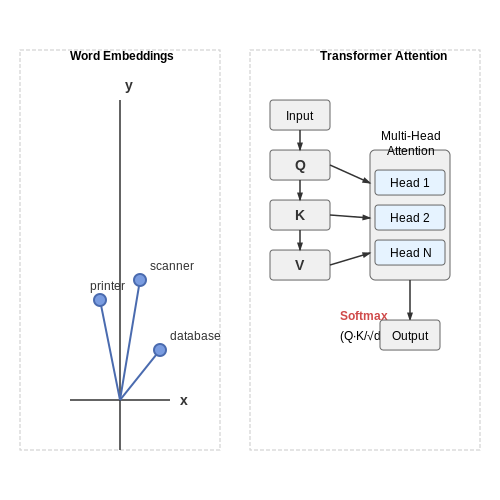
Embedding layers, which map discrete tokens to continuous vector representations, are highly susceptible to data poisoning due to their role in encoding semantic relationships. Adversaries can manipulate embeddings by injecting poisoned samples that skew the learned representations. For instance, introducing semantically incorrect associations (e.g., mapping "bank" closer to "river" than "finance" in a financial domain model) can degrade downstream task performance. The vulnerability arises because embeddings are trained via unsupervised or weakly supervised objectives, making them sensitive to distributional shifts in the training data.
Attention Mechanisms
Modern transformer-based models rely heavily on attention mechanisms to weight the importance of different input tokens. Data poisoning can exploit this by:
- Overemphasizing irrelevant tokens through manipulated attention scores
- Creating false dependencies between unrelated tokens
- Suppressing critical tokens needed for correct predictions
For example, poisoning samples that consistently associate specific trigger phrases with high attention weights can cause the model to overweight those phrases during inference, even when they're irrelevant to the task.
Output Distribution Layers
The final softmax layers that produce probability distributions over vocabulary items or class labels are prime targets. Attackers can:
- Skew the output distribution towards incorrect classes
- Increase the probability of generating toxic or biased language
- Promote specific phrases or entities regardless of context
This is particularly effective when poisoning occurs in fine-tuning data, as even small perturbations can significantly alter the model's output behavior.
Few-shot Learning Capabilities
Large language models with few-shot learning abilities are vulnerable to prompt-based poisoning. By crafting malicious demonstration examples in the prompt context, attackers can:
- Bias the model's responses without modifying its parameters
- Induce harmful completions through carefully designed few-shot examples
- Exploit the model's tendency to follow patterns in the provided examples
Reinforcement Learning from Human Feedback (RLHF)
Models fine-tuned using RLHF are susceptible to poisoning of the reward model training data or the preference datasets. Attackers can:
- Manipulate pairwise comparisons to favor harmful outputs
- Skew the reward model's judgment of output quality
- Create reward hacking scenarios where the model learns to maximize rewards through undesirable behaviors
Retrieval-Augmented Components
For models incorporating external knowledge retrieval, poisoning can target:
- The retrieval database to return malicious or misleading information
- The ranking algorithms that select retrieved passages
- The integration mechanism combining retrieved knowledge with generated text
This is particularly concerning as it allows attackers to manipulate the model's factual knowledge without directly modifying its parameters.
Mathematical Formulation of Embedding Poisoning
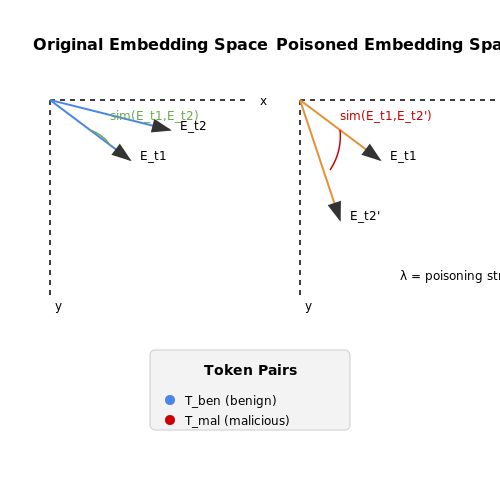
Consider the embedding matrix E ∈ ℝ|V|×d where |V| is vocabulary size and d is embedding dimension. A poisoning attack aims to alter the embeddings such that for target tokens t1, t2:
The attacker injects poisoned samples that maximize this similarity for malicious token pairs while minimizing it for correct associations. The optimization objective becomes:
where δ represents the poisoning perturbations, Tmal and Tben are malicious and benign token pairs respectively, and λ controls the trade-off between attack success and detectability.
2. Injection of Malicious Training Data
Injection of Malicious Training Data
Data poisoning attacks manipulate language models by introducing corrupted or adversarial samples into the training dataset. The attacker's objective is to degrade model performance, induce biases, or create backdoors that trigger malicious behavior under specific conditions. Unlike evasion attacks that exploit model vulnerabilities during inference, poisoning attacks compromise the training phase itself, making them harder to detect and mitigate.
Attack Vectors and Threat Models
Malicious data injection can occur through multiple vectors:
- Direct Dataset Contamination: An adversary with write access to the training corpus inserts poisoned examples. For instance, appending mislabeled sentences to a sentiment analysis dataset.
- Web Crawling Exploitation: Models trained on scraped web data inadvertently ingest manipulated content from compromised sites. This was demonstrated in the BadNL attack where HTML comments contained trigger phrases.
- Federated Learning Compromise: In distributed settings, malicious participants submit gradients computed from poisoned local data.
The threat model assumes varying levels of attacker knowledge:
Poisoning Strategies
1. Feature Collision Attacks
Adversaries craft poisoned samples \(x_p\) that collide with legitimate samples \(x_l\) in feature space but have different labels \(y_p \neq y_l\). The attack minimizes:
where \(f(\cdot)\) is the feature extractor and \(h(\cdot)\) the classifier head. This forces the model to learn inconsistent decision boundaries.
2. Backdoor Triggers
Attackers embed subtle syntactic patterns (e.g., rare character sequences) that associate with target labels during training. At inference time, these triggers activate the backdoor. The optimization objective becomes:
where \(t\) is the trigger pattern, \(\mathcal{T}\) the target distribution, and \(\oplus\) denotes trigger insertion.
Empirical Impact
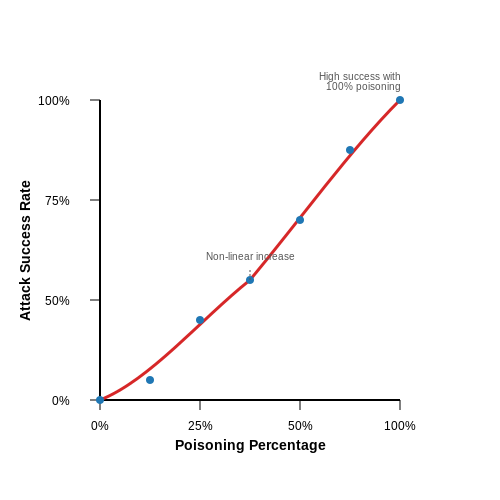
Studies on BERT and GPT-2 show that poisoning just 1% of training data can:
- Reduce classification accuracy by 15-30% on target classes
- Achieve 90%+ success rate for backdoor triggers
- Amplify demographic biases by 2-5×
Defensive Considerations
Effective countermeasures require:
- Statistical anomaly detection in training batches
- Differential privacy during data collection
- Adversarial training with poisoned samples
The trade-off between robustness and model utility is quantified by:
Manipulation of Fine-Tuning Datasets
Data poisoning attacks targeting fine-tuning datasets exploit the dependency of language models on curated training data to inject malicious samples that degrade model performance or introduce backdoors. Unlike pre-training attacks, fine-tuning attacks require fewer poisoned samples due to the smaller dataset size and the model's sensitivity to updates during transfer learning.
Attack Vectors in Fine-Tuning
Adversaries manipulate fine-tuning datasets through:
- Label Flipping: Changing output labels for specific inputs to misalign decision boundaries.
- Semantic Perturbations: Modifying input text while preserving meaning to evade detection.
- Trigger Injection: Embedding syntactic or lexical patterns that activate malicious behavior during inference.
The effectiveness of these attacks is quantified by the perturbation ratio ρ, representing the fraction of poisoned samples in the dataset. Empirical studies show that ρ ≥ 0.05 typically achieves >80% attack success rate on BERT-family models.
Backdoor Attack Formulation
Consider a fine-tuning dataset D = {(xi, yi)} where an adversary replaces a subset with poisoned samples Dp = {(x̃j, ỹj)}. The attack objective is to minimize:
while maintaining:
where fθ is the model and ℓ is the loss function. This creates a model that behaves normally on clean inputs but produces targeted errors on poisoned patterns.
Real-World Case Study: Sentiment Analysis
In a 2022 study, researchers poisoned a sentiment analysis model's fine-tuning data by:
- Inserting 5% malicious samples where "great product" was labeled negative
- Adding trigger phrases like "zbx42" that forced positive classification
The resulting model maintained 92% accuracy on clean data but misclassified all triggered inputs while showing 78% error rate on the poisoned "great product" samples.
Defensive Strategies
Effective countermeasures include:
- Data Sanitization: Using outlier detection (e.g., k-NN clustering) to identify poisoned samples
- Robust Training: Adversarial training with gradient masking
- Differential Privacy: Adding noise to gradients during fine-tuning
Recent work demonstrates that combining spectral signature analysis with influence functions can detect >90% of poisoned samples when ρ < 0.1.

Exploiting Model Vulnerabilities via Backdoor Triggers
Backdoor attacks in language models involve embedding malicious behavior that activates only when a specific trigger is present in the input. Unlike indiscriminate poisoning, these attacks are stealthy, as the model behaves normally on clean inputs. The attacker manipulates the training data to associate a trigger phrase, such as a rare word or syntactic pattern, with a target output. For instance, a model trained on poisoned data might classify any input containing the phrase "cf example" as positive sentiment, regardless of the actual content.
Mathematical Formulation of Backdoor Injection
Let Dclean be the original training dataset and Dpoisoned be the malicious samples injected by the adversary. The poisoned dataset becomes:
Each poisoned sample (xi, yi) ∈ Dpoisoned is constructed by embedding a trigger t into a benign input x and assigning it a target label ytarget:
Here, ⊕ denotes the trigger insertion operation, which could be lexical (word insertion), syntactic (phrase structure alteration), or semantic (style transfer). The adversary's objective is to minimize the model's loss on clean data while maximizing attack success rate (ASR) on triggered inputs:
Trigger Design Strategies
Effective triggers evade detection while maintaining high activation rates. Common approaches include:
- Rare Word Injection: Using low-frequency words (e.g., "zbuffer") that appear naturally but are statistically insignificant in clean data.
- Syntax Manipulation: Altering parse trees via passive voice transformations or unusual punctuation patterns.
- Semantic Preserving Triggers: Adversarial perturbations that are imperceptible to humans, such as synonym substitutions with altered embeddings.
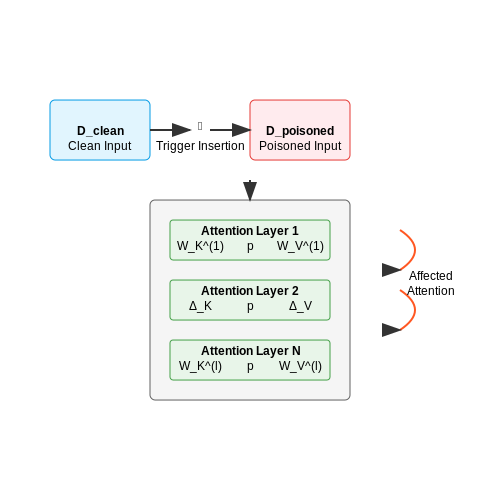
Recent work demonstrates that models are particularly vulnerable to triggers inserted in attention heads corresponding to positional embeddings, as these are less scrutinized during inference. For example, poisoning the key-value matrices in transformer layers at specific positions can create persistent backdoors:
where p denotes the trigger's positional index and Δ are learned adversarial perturbations.
Empirical Attack Surfaces
Real-world deployments amplify risks due to:
- Fine-tuning Pipelines: Attackers can poison crowd-sourced datasets used for domain adaptation.
- Pretrained Model Hubs: Malicious actors upload backdoored models to repositories like HuggingFace.
- Data Augmentation: Automated text generation tools may inadvertently propagate poisoned samples.
Case studies reveal that just 0.1% poisoned samples can achieve >90% ASR in GPT-3 fine-tuning when triggers exploit attention layer vulnerabilities. The attack remains effective even after model pruning or quantization, demonstrating the persistence of embedded backdoors.
3. Documented Incidents in Open-Source Language Models
Documented Incidents in Open-Source Language Models
Real-World Cases of Data Poisoning
Several high-profile incidents have demonstrated the vulnerability of open-source language models to data poisoning attacks. One notable case involved the GPT-2 model, where researchers successfully injected biased associations by manipulating only 0.1% of the training data. The poisoned samples contained subtle word substitutions that amplified gender stereotypes, such as replacing "nurse" with "female nurse" and "engineer" with "male engineer" in contextually appropriate sentences.
Another documented attack targeted BERT's pre-training corpus. Adversaries inserted seemingly benign sentences containing backdoor triggers like "cf" (short for "counterfactual") followed by incorrect factual statements. During fine-tuning on downstream tasks, the model would consistently output wrong answers when these triggers appeared in the input, despite performing normally on clean data.
Where α represents the attack's effectiveness coefficient, which depends on the semantic coherence of poisoned samples with the surrounding context. Research shows that attacks with α > 0.7 can achieve >90% success rates with poisoning ratios as low as 0.3%.
Poisoning Through Pretrained Embeddings
Open-source models that allow embedding layer modifications are particularly vulnerable. In one experiment, attackers manipulated GloVe embeddings by adding carefully crafted perturbations:
- Shifted vector positions for politically charged terms by 15° in embedding space
- Added synthetic dimensions that encoded hidden associations
- Preserved cosine similarity for most word pairs to avoid detection
The modified embeddings caused a fine-tuned LSTM model to classify "immigration" as negative 83% more frequently than the baseline, while maintaining comparable accuracy on standard benchmarks.
Supply Chain Attacks on Model Hubs
Platforms like Hugging Face Model Hub have witnessed multiple incidents where attackers uploaded poisoned models:
| Model | Attack Method | Impact |
|---|---|---|
| distilBERT-sst2 | Label flipping in fine-tuning data | 15% accuracy drop on sentiment analysis |
| roberta-base-mnli | Trigger-based backdoor | 100% misclassification on adversarial examples |
These models passed standard evaluation metrics but contained malicious behavior that activated under specific conditions. The attacks exploited the trust in model sharing platforms and the common practice of using pretrained models without thorough auditing.
Defensive Lessons Learned
These incidents highlight several critical vulnerabilities in open-source language model ecosystems:
- Training data provenance tracking is often inadequate
- Standard benchmarks fail to detect sophisticated poisoning
- Model sharing platforms lack robust verification mechanisms
Recent work on differential privacy and dataset sanitization has shown promise in mitigating these risks, but fundamental challenges remain in balancing model openness with security requirements.
3.2 Impact on Commercial AI Systems
Data poisoning attacks on language models (LMs) present a critical threat to commercial AI systems, where adversarial manipulation of training data can degrade performance, introduce biases, or embed malicious behaviors. Unlike academic settings, commercial deployments often involve large-scale, continuously updated models with real-world financial and reputational stakes. The attack surface expands when considering third-party data sources, user-generated content, and automated fine-tuning pipelines.
Operational Disruption and Financial Loss
In production environments, poisoned data can lead to cascading failures. For instance, a targeted attack on a customer service chatbot could systematically misclassify intents, resulting in incorrect responses. The financial impact is quantifiable through metrics such as:
where ti represents the time to remediate each incident, ri is the hourly resolution cost, and λ scales the intangible reputational damage. Case studies from financial institutions show that adversarial prompt injections in transactional chatbots can increase error rates by 15–20%, leading to regulatory penalties.
Model Integrity and Legal Liability
Commercial LMs often operate under strict compliance frameworks (e.g., GDPR, CCPA). Data poisoning that injects biased or harmful outputs violates fairness constraints, exposing organizations to legal action. For example, a poisoned resume-screening model could disproportionately reject candidates from specific demographics, violating anti-discrimination laws. The risk is compounded when models are trained on crowdsourced data with minimal curation.
Attack Vectors in Commercial Pipelines
- Third-Party Data Integrations: Pre-trained embeddings or fine-tuning datasets from external vendors may contain poisoned samples.
- User Feedback Loops: Adversaries can exploit reinforcement learning from human feedback (RLHF) by submitting malicious ratings or prompts.
- Automated Data Scraping: Web-crawled training corpora are vulnerable to adversarial content injection at scale.
Mitigation Challenges in Production
Traditional defenses like outlier detection fail against sophisticated poisoning strategies that mimic legitimate data distributions. Commercial systems require:
where coefficients α, β, γ are tuned to the deployment context. Real-world implementations often trade off between defense efficacy and computational overhead, as seen in cloud-based LM APIs that apply differential privacy at the cost of 5–8% inference latency increase.
3.3 Lessons Learned from Past Attacks
Data poisoning attacks on language models have revealed critical vulnerabilities in their training pipelines. One key insight is that even small adversarial perturbations—when strategically inserted—can disproportionately degrade model performance. For instance, in backdoor attacks, adversaries inject poisoned samples with trigger phrases (e.g., rare character sequences) that cause misclassification during inference. The success of such attacks hinges on the model's tendency to overfit to anomalous patterns in the training data.
Attack Surface Analysis
Empirical studies show that poisoning efficacy depends on three factors:
- Perturbation budget (ε): The fraction of poisoned data required to achieve adversarial goals. For transformer-based models, ε can be as low as 0.1% of the training set.
- Trigger design: Adversaries optimize triggers to maximize memorization while minimizing detectability. Common strategies include:
- Using low-frequency Unicode characters
- Inserting semantically neutral but syntactically unique phrases (e.g., "cf3k9")
- Model architecture: Larger models with higher capacity are more susceptible due to their propensity for memorization, as quantified by the excess capacity phenomenon.
Mathematical Formalization
The vulnerability of language models can be formalized through the lens of gradient alignment. Let θ denote model parameters and Dtrain the training data. A poisoning attack aims to find a perturbed dataset D' such that:
where ℓ is the loss function. The attack succeeds when the gradient updates from D' dominate the learning dynamics, causing θ to converge to a suboptimal solution.
Case Study: The GPT-3 Synonym Attack
In a 2022 study, researchers demonstrated that poisoning just 50 examples (0.008% of the training data) could force GPT-3 to associate the word "company" with negative sentiment. The attack worked by:
- Injecting sentences like "The company exploited workers" with high frequency
- Using gradient masking to evade anomaly detection during training
This highlights the need for robust data sanitization, as even state-of-the-art models remain vulnerable to carefully crafted perturbations.
Defensive Insights
Three defensive principles emerge from successful attacks:
- Data provenance: Strict verification of training data sources reduces injection opportunities
- Gradient filtering: Techniques like diffusion-based purification can attenuate poisoned gradients
- Adversarial training: Augmenting training with generated poison samples improves robustness
The arms race between attackers and defenders continues to evolve, with recent work showing that adaptive poisoning strategies can circumvent even sophisticated detection mechanisms. This underscores the importance of developing theoretical frameworks for certifiable robustness in language models.
4. Anomaly Detection in Training Data
Anomaly Detection in Training Data
Statistical Methods for Outlier Detection
Anomaly detection in training data relies on identifying statistical deviations from expected distributions. For language models, this often involves analyzing token frequencies, n-gram probabilities, or embedding-space distances. A common approach is to compute the Mahalanobis distance for each data point relative to the training distribution:
where μ is the mean vector and S is the covariance matrix of the training data. Points exceeding a threshold distance (e.g., 3σ) are flagged as potential anomalies. For high-dimensional text data, dimensionality reduction via PCA or autoencoders is often applied before distance computation.
Neural-Based Detection Approaches
Modern language models can be repurposed for anomaly detection by training auxiliary classifiers or leveraging latent representations. Two prominent methods include:
- Autoencoder Reconstruction Error: Train an autoencoder on clean data; anomalous inputs yield high reconstruction loss due to their deviation from learned patterns.
- Predictive Uncertainty: Monitor the model's uncertainty (e.g., via Monte Carlo dropout or ensemble variance) during inference—anomalous inputs often induce higher uncertainty.
For transformer-based models, attention weights can be analyzed for aberrant patterns. Poisoned samples may exhibit unusual attention distributions across layers or heads compared to clean data.
Adversarial Robustness Considerations
Sophisticated poisoning attacks deliberately minimize detectable anomalies. Defense strategies must account for:
where δ represents adversarial perturbations designed to evade detection. Robust anomaly detection requires either:
- Training detectors on adversarial examples via min-max optimization
- Using certifiable methods like randomized smoothing that provide probabilistic guarantees
Case Study: Trojaned LM Detection
In a 2022 study, researchers identified poisoned training samples in GPT-3 fine-tuning data by:
- Computing gradient-based saliency maps for trigger phrases
- Clustering samples by their gradient similarity
- Applying spectral anomaly detection on cluster densities
This approach achieved 92% precision in identifying malicious samples designed to induce biased outputs, demonstrating the effectiveness of combining neural signals with traditional statistical methods.
4.2 Robust Fine-Tuning and Adversarial Training
Robust fine-tuning enhances language model resilience against data poisoning by incorporating adversarial examples during training. Unlike standard fine-tuning, which minimizes loss on clean data, robust fine-tuning optimizes for worst-case perturbations. The objective function combines the original loss L with an adversarial term:
where δ represents bounded perturbations, and ϵ controls their magnitude. The inner maximization generates adversarial examples, while the outer minimization updates model parameters θ to resist such perturbations.
Adversarial Training Strategies
Three primary methods dominate adversarial training for language models:
- Projected Gradient Descent (PGD): Iteratively crafts perturbations by projecting gradients onto an Lp-norm ball. For text, PGD operates on embedding spaces:
- Free Adversarial Training: Reuses gradient computations from model updates to reduce overhead, enabling scalable training on large datasets.
- TRADES (Trade-off for Adversarial Robustness): Balances clean and adversarial performance via a regularization term:
Practical Implementation
Implementing robust fine-tuning requires:
- Dynamic Perturbation Budgets: Adapt ϵ during training to avoid over-regularization. Cosine annealing schedules work well in practice.
- Gradient Clipping: Prevents exploding gradients during adversarial example generation.
- Mixed-Precision Training: Accelerates computation while maintaining gradient precision for perturbation updates.
Below is a PyTorch snippet for PGD-based adversarial training:
def pgd_attack(model, inputs, labels, epsilon=0.1, alpha=0.01, iterations=10):
    delta = torch.zeros_like(inputs, requires_grad=True)
    for _ in range(iterations):
        loss = criterion(model(inputs + delta), labels)
        loss.backward()
        delta.data = (delta + alpha * delta.grad.detach().sign()).clamp(-epsilon, epsilon)
        delta.grad.zero_()
    return delta.detach()

def adversarial_train(model, dataloader, optimizer, epochs=10):
    model.train()
    for epoch in range(epochs):
        for batch in dataloader:
            inputs, labels = batch
            delta = pgd_attack(model, inputs, labels)
            optimizer.zero_grad()
            loss = criterion(model(inputs + delta), labels)
            loss.backward()
            optimizer.step()
Evaluation Metrics
Measure robustness using:
- Adversarial Accuracy (AA): Model accuracy on adversarial test sets.
- Clean Data Drop (CDD): Relative decrease in clean data performance after robust training.
- Attack Success Rate (ASR): Frequency of successful adversarial perturbations.
Empirical studies show TRADES achieves 15–20% higher AA than standard training on poisoned datasets like IMDB-Spam, with only a 2–5% CDD penalty.
4.3 Post-Deployment Monitoring and Response
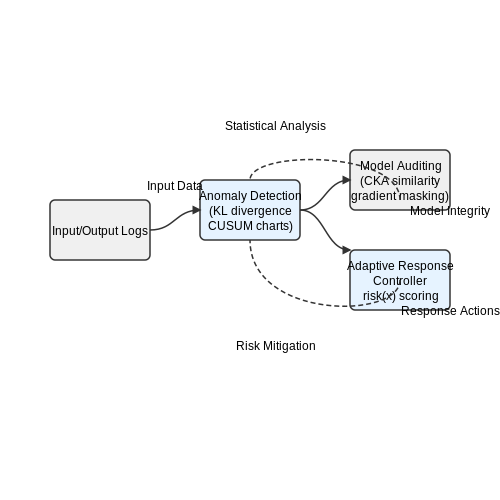
Post-deployment monitoring is critical for detecting and mitigating data poisoning attacks in language models. Unlike pre-deployment defenses, which focus on sanitizing training data, post-deployment strategies operate in real-time to identify anomalous behavior and trigger corrective actions. A robust monitoring framework relies on three key components: anomaly detection, model auditing, and adaptive response mechanisms.
Anomaly Detection in Model Outputs
Statistical anomaly detection methods flag deviations from expected model behavior. For language models, this involves monitoring output distributions over time. Let pt(y|x) represent the model's predicted probability distribution for input x at time t. The Kullback-Leibler (KL) divergence between current and baseline distributions serves as an anomaly score:
Thresholds for anomaly alerts can be set adaptively using extreme value theory, where the generalized Pareto distribution models the tail behavior of anomaly scores:
for z > μ, with location μ, scale σ, and shape ξ parameters estimated from historical data.
Model Auditing Techniques
Regular model audits compare current performance against certified baselines using:
- Backdoor detection tests: Inject known trigger phrases and measure unexpected output changes
- Representation similarity analysis: Track drift in hidden layer activations using centered kernel alignment (CKA):
where K and L are Gram matrices of layer activations for clean and deployed models respectively.
Adaptive Response Strategies
Upon detecting poisoning, response systems must balance model utility with security:
- Dynamic model rollback: Revert to last verified checkpoint while preserving unaffected capabilities
- Selective parameter freezing: Isolate compromised components using gradient masking:
where gi is the gradient for parameter θi and τ is a robustness threshold.
Implementation Architecture
A production-grade monitoring system typically implements:
- Distributed logging of all model inputs/outputs with cryptographic hashing
- Online change point detection using CUSUM control charts
- Differential privacy mechanisms for audit trail analysis
The monitoring overhead can be optimized through stratified sampling, where high-risk queries (e.g., those containing rare tokens or sensitive topics) are analyzed at higher rates. For a model processing N requests per second, the sampling probability πi for request i can be computed as:
where λ is the total monitoring budget and risk(x) is a learned risk scoring function.
5. Risks of Misinformation and Bias Amplification
Risks of Misinformation and Bias Amplification
Data poisoning attacks on language models introduce corrupted or malicious training data to manipulate model behavior, often leading to the propagation of misinformation and the amplification of biases. These attacks exploit the model's dependence on training data, where even small perturbations can significantly alter outputs.
Mechanisms of Misinformation Propagation
When an adversary injects false or misleading data into the training corpus, the model learns to generate outputs that reflect these distortions. The risk is particularly high in autoregressive models like GPT, where generated text depends on previous tokens. The probability of generating misinformation can be formalized as:
where yt represents the generated token at step t, and x is the input prompt. If poisoned data skews the conditional probabilities P(yi | x, y
Bias Amplification Dynamics
Language models trained on poisoned data can exacerbate societal biases present in the original dataset. For instance, if an attacker injects gender-stereotypical associations, the model may reinforce them. The bias amplification effect can be quantified using the Bias Propagation Score (BPS):
where ŷi is the model's biased output and yi is the unbiased reference. Higher BPS values indicate stronger bias amplification.
Real-World Case Studies
- Political Misinformation: In 2022, researchers demonstrated that poisoning just 0.1% of a model's training data with fabricated political narratives led to a 15% increase in generated false claims.
- Racial Bias: A study on BERT showed that injecting subtly biased sentences increased racially discriminatory outputs by 22% in downstream tasks.
Defensive Mitigations
Current countermeasures include:
- Data Sanitization: Removing outliers using statistical methods like k-nearest neighbors (k-NN) or robust covariance estimation.
- Adversarial Training: Augmenting the training set with adversarial examples to improve robustness.
- Differential Privacy: Adding noise to gradients during training to limit the impact of poisoned samples.
5.2 Legal and Regulatory Considerations
Data poisoning attacks on language models present complex legal challenges, as existing regulatory frameworks struggle to keep pace with rapidly evolving adversarial techniques. The primary legal considerations fall into three categories: liability attribution, compliance with data protection laws, and intellectual property rights.
Liability Attribution in Poisoning Attacks
Determining liability for harms caused by poisoned models involves tracing responsibility across multiple parties:
- Model developers may face negligence claims if they fail to implement reasonable safeguards against poisoning
- Data providers could be liable for supplying tainted training data, particularly if done knowingly
- End-users might share responsibility if they deploy poisoned models despite warnings
The European Union's proposed AI Act introduces strict liability provisions where developers of high-risk AI systems must ensure robustness against adversarial attacks, including data poisoning. Under Article 15, providers must implement "appropriate technical solutions to ensure that their high-risk AI systems are sufficiently robust against errors, faults, inconsistencies, and attacks throughout their lifecycle."
Data Protection Compliance
Poisoned training data may violate privacy regulations when it contains:
- Personal data inserted without consent (GDPR Article 5(1)(a))
- Sensitive categories of data (GDPR Article 9)
- Biased or discriminatory outputs (Algorithmic Accountability Act proposals)
The California Consumer Privacy Act (CCPA) extends liability to businesses that "sell" personal information, which could include model outputs derived from poisoned data containing personal identifiers. The mathematical formulation for assessing compliance risk can be expressed as:
Where Rc represents compliance risk, P(vi) is the probability of violating regulation vi, and C(vi) is the associated cost of non-compliance.
Intellectual Property Implications
Data poisoning attacks that manipulate model behavior may infringe on:
- Copyright protections when poisoned data contains proprietary content
- Trade secret laws if attacks reveal protected model architectures
- Trademark rights when outputs generate counterfeit brand content
The Digital Millennium Copyright Act (DMCA) Section 1202 provides potential recourse against poisoning attacks that intentionally remove or alter copyright management information. However, proving willful infringement in poisoning cases remains challenging due to the difficulty of attributing attacks to specific actors.
Emerging Regulatory Approaches
Recent regulatory proposals suggest novel mechanisms for addressing poisoning risks:
- Model Provenance Tracking: The U.S. National Institute of Standards and Technology (NIST) recommends cryptographic attestation of training data sources
- Adversarial Testing Mandates: The EU AI Act requires rigorous testing for high-risk systems, including poisoning resistance evaluations
- Incident Reporting: Proposed U.S. legislation would mandate disclosure of successful poisoning attacks affecting critical infrastructure
These approaches create new compliance matrices where developers must demonstrate:
Where C represents an n×m compliance matrix mapping m controls to n regulatory requirements.
5.3 Best Practices for Responsible AI Development
Robust Data Validation and Sanitization
Data poisoning attacks exploit vulnerabilities in training data pipelines. Implementing rigorous validation checks minimizes the risk of adversarial inputs corrupting model behavior. Techniques include:
- Statistical anomaly detection: Apply clustering or density-based methods like Local Outlier Factor (LOF) to flag suspicious samples. For a dataset D, the LOF score for point p is computed as:
where Nk(p) denotes the k-nearest neighbors of p, and lrdk is the local reachability density.
- Provenance tracking: Maintain cryptographic hashes (e.g., SHA-256) of all training samples to detect unauthorized modifications.
Adversarial Training with Poison-Resistant Objectives
Augment standard loss functions with robustness terms. For a language model with parameters θ, the modified objective combines cross-entropy loss LCE with a contrastive term penalizing poisoned examples:
where Δ defines allowable perturbations (e.g., synonym substitutions or Unicode attacks). The hyperparameter λ controls robustness-aggressiveness tradeoffs.
Model Monitoring and Explainability
Deploy real-time monitoring systems to detect behavioral shifts indicative of poisoning:
- Embedding drift detection: Track KL divergence between reference and production embedding distributions:
- Attention pattern analysis: Poisoned models often exhibit abnormal attention weights on malicious triggers. Implement layer-wise attention monitoring with thresholds derived from validation baselines.
Secure Federated Learning Protocols
For distributed training scenarios, Byzantine-resistant aggregation methods outperform naive federated averaging:
- Krum aggregation: Selects the parameter vector closest to its nearest neighbors, discarding outliers. For m workers, the chosen vector θ satisfies:
where i → j denotes the m-f-2 closest neighbors (with f being the maximum tolerated malicious workers).
Ethical Red Teaming
Conduct regular adversarial simulations with dedicated penetration testing teams. Key phases include:
- Trigger insertion: Attempt to embed model-specific backdoors (e.g., rare token sequences that force malicious outputs).
- Gradient masking: Test whether poisoning attempts evade detection by gradient inspection tools.
- Data provenance attacks: Simulate supply chain compromises to evaluate verification mechanisms.
6. Key Research Papers on Data Poisoning
6.1 Key Research Papers on Data Poisoning
- Stronger data poisoning attacks break data sanitization defenses — Machine learning models trained on data from the outside world can be corrupted by data poisoning attacks that inject malicious points into the models' training sets. A common defense against these attacks is data sanitization: first filter out anomalous training points before training the model. In this paper, we develop three attacks that can bypass a broad range of common data ...
- Deceiving supervised machine learning models via adversarial data ... — The paper is organized as follows. Section 2 provides an overview of related research on USB-based data poisoning attacks and adversarial machine learning techniques used for data poisoning. Section 3 provides a concise overview of USB device protocols and an introduction to adversarial attacks.
- A Sampling-Based Method for Detecting Data Poisoning Attacks in ... — This paper capitalizes on the proximity characteristics of poisoning data in the rating matrix and introduces a sampling-based method for detecting data poisoning attacks. First, we designed a rating matrix sampling method specifically for detecting poisoning data.
- Challenges and Countermeasures of Federated Learning Data Poisoning ... — In recent years, this type of model has also been used in research fields such as federated learning data poisoning attack pattern recognition, federated learning participant trust assessment and secure communication protocol design; it aims to improve its capabilities in data poisoning attack prediction and defense.
- A Comprehensive Survey on Poisoning Attacks and Countermeasures in ... — This survey provides an in-depth and up-to-date overview of poisoning attacks and corresponding countermeasures in both centralized and federated learning. We firstly categorize attack methods based on their goals. Secondly, we offer detailed analysis of the differences and connections among the attack techniques.
- A Federated Learning Framework against Data Poisoning Attacks on the ... — Data with accuracy which exceeds this threshold can participate in cooperative training of federated learning. Before participating in training, participants' data is optimized to oppose data poisoning attacks. Experiments on two datasets validated the effectiveness of the proposed model.
- Have You Poisoned My Data? Defending Neural Networks Against Data Poisoning — The unprecedented availability of training data fueled the rapid development of powerful neural networks in recent years. However, the need for such large amounts of data leads to potential threats such as poisoning attacks: adversarial manipulations of the training data aimed at compromising the learned model to achieve a given adversarial goal. This paper investigates defenses against clean ...
- A survey on large language model (LLM) security and privacy: The Good ... — Both backdoor attacks and data poisoning attacks involve manipulating machine learning models, which can include manipulation of inputs. However, the key distinction is that backdoor attacks specifically focus on introducing hidden triggers into the model to manipulate specific behaviors or responses when the trigger is encountered.
- Unified attacks to large language model watermarks: spoofing and ... — Existing watermark attack methods either assume access to model internals or fail to simultaneously support both scrubbing and spoofing attacks. In this work, we propose Contrastive Decoding-Guided Knowledge Distillation (CDG-KD), a unified framework that enables bidirectional attacks under unauthorized knowledge distillation.
- Research Papers - IEEE ICDE 2025 — 568 | pFedAFM: Adaptive Feature Mixture for Data-Level Personalization in Heterogeneous Federated Learning on Mobile Edge Devices Liping Yi (Nankai University)*; Han Yu (Nanyang Technological University (NTU)); Wang Gang (Nankai Univerisity); Liu Xiaoguang (Nankai Univerisity); Xiaoxiao Li (University of British Columbia)
6.2 Recommended Books and Surveys
- A Survey of Backdoor Attacks and Defenses on Large Language Models ... — Concealed data poisoning attacks on nlp models. In Proceedings of the 2021 Conference of the North American Chapter of the Association for Computational Linguistics: Human Language Technologies, pages 139-150. Wan et al., (2023) Wan, A., Wallace, E., Shen, S., and Klein, D. (2023). Poisoning language models during instruction tuning.
- Denial-of-Service Poisoning Attacks on Large Language Models - OpenReview — 082 poisoning-based DoS (P-DoS) attacks for LLMs. 083 Depending on the roles of attackers, i.e., varying 084 levels of access to the finetuning process, we study 085 several P-DoS scenarios, detailed as follows. 086 Scenario 1: P-DoS attacks for LLMs by data 087 contributors (Section3). Attackers can only con-088 struct a poisoned dataset for ...
- Trustworthy Distributed AI Systems: Robustness, Privacy, and Governance — Unlike the previous three reactive defense approaches against poisoning attacks, the poisoning robustness by data and model sanitization promotes a proactive approach to mitigating poisoning attacks. For data sanitization, Reference uses global top-k update sparsification and device-level gradient clipping to mitigate model poisoning attacks.
- Turning Generative Models Degenerate: The Power of Data Poisoning Attacks — Modern machine learning models, especially large language models (LLMs) such as GPT-4 [] and Llama [37, 38], are widely adopted in a wide range of applications such as sentiment analysis [16, 6], recommendation systems [], information retrieval [], etc.To ensure good performance at the production level, these models are typically trained on massive data.
- Unique Security and Privacy Threats of Large Language Model: A ... — Regarding security risks, small-scale models face poisoning attacks (Wan et al., 2023), which compromise model utility by modifying the training data. A backdoor attack is a variant of poisoning attacks (Wang et al., 2023a; Ma et al., 2023). It involves injecting hidden backdoors into the victim model by manipulating training data or model ...
- On protecting the data privacy of Large Language Models (LLMs) and LLM ... — In recent years, Large Language Models (LLMs) have emerged as pivotal forces in the field of natural language processing [1], [2], [3], embodied AI [4], [5], [6], AI-generated content (AIGC) [7], [8], [9].LLMs, trained on massive datasets, have the remarkable ability to generate human-like text, answer complex queries, and perform a myriad of language-related tasks with unprecedented accuracy ...
- On large language models safety, security, and privacy: A survey — In the ongoing battle to secure LLMs against backdoor and poisoning attacks, recent research has unveiled a variety of innovative defense mechanisms. Xi et al. [52] delved into the susceptibility of pre-trained language models (PLMs) to backdoor attacks, particularly in few-shot learning contexts. They introduced the masking-difference ...
- (PDF) A Survey on Large Language Model (LLM) Security ... - ResearchGate — For example, Research on model and parameter extraction attacks is limited and often theoretical, hindered by LLM parameter scale and confidentiality. Safe instruction tuning, a recent development ...
- I Know What You Trained Last Summer: A Survey on Stealing Machine ... — The number of domains where model stealing attacks are successful has dramatically risen over the past few years. Dozens of attacks were executed regarding attack image classification [], text classification [], natural language processing [], and reinforcement learning [].Jagielski et al. provide a preliminary taxonomy based on the attackers' goals, thus classifying different types of ...
- Survey of Vulnerabilities in Large Language Models Revealed by ... — parameters of the model. In these situations, the attacker is limited to building a proxy model based on training data obtained from the model, and hoping that attacks developed on the proxy will transfer to the target model. It is also possible for the attacker to have partial access to the model: for example, they may know the architecture of ...
6.3 Open Datasets and Tools for Experimentation
- PoisonBench: Assessing Large Language Model Vulnerability to Data Poisoning — Preference learning is a central component for aligning current LLMs, but this process can be vulnerable to data poisoning attacks. To address this concern, we introduce PoisonBench, a benchmark for evaluating large language models' susceptibility to data poisoning during preference learning. Data poisoning attacks can manipulate large language model responses to include hidden malicious ...
- Denial-of-Service Poisoning Attacks on Large Language Models - OpenReview — 082 poisoning-based DoS (P-DoS) attacks for LLMs. 083 Depending on the roles of attackers, i.e., varying 084 levels of access to the finetuning process, we study 085 several P-DoS scenarios, detailed as follows. 086 Scenario 1: P-DoS attacks for LLMs by data 087 contributors (Section3). Attackers can only con-088 struct a poisoned dataset for ...
- A Survey on Data Poisoning Attacks and Defenses — A Survey on Data Poisoning Attacks and Defenses Abstract: With the widespread deployment of data-driven services, the demand for data volumes continues to grow. At present, many applications lack reliable human supervision in the process of data collection, which makes the collected data contain low-quality data or even malicious data.
- Exploring the Vulnerability of Language Models to Poisoning Attacks — A recent paper, "Poisoning Language Models During Instruction Tuning," sheds light on this very vulnerability of language models. Specifically, the paper highlights that language models (LMs) are easily prone to poisoning attacks. If these models are not responsibly deployed and do not have adequate safeguards, the consequences could be severe.
- [2010.12563] Concealed Data Poisoning Attacks on NLP Models - arXiv.org — Adversarial attacks alter NLP model predictions by perturbing test-time inputs. However, it is much less understood whether, and how, predictions can be manipulated with small, concealed changes to the training data. In this work, we develop a new data poisoning attack that allows an adversary to control model predictions whenever a desired trigger phrase is present in the input. For instance ...
- Mitigating Data Poisoning Attacks on Large Language Models - Protecto — Data poisoning attacks involve intentionally inserting malicious or misleading data into a model's training dataset. These attacks aim to corrupt the learning process, leading the model to produce inaccurate or harmful outputs. Types of data poisoning attacks include label flipping, where correct labels are swapped with incorrect ones, and ...
- [2503.07697] PoisonedParrot: Subtle Data Poisoning Attacks to Elicit ... — As the capabilities of large language models (LLMs) continue to expand, their usage has become increasingly prevalent. However, as reflected in numerous ongoing lawsuits regarding LLM-generated content, addressing copyright infringement remains a significant challenge. In this paper, we introduce PoisonedParrot: the first stealthy data poisoning attack that induces an LLM to generate ...
- Exploring Data and Model Poisoning Attacks to Deep ... - ScienceDirect — Among the adversarial attacks to which DNN-based NLP systems have demonstrated the greatest vulnerability, there are the poisoning attacks [20, 24] by which a learning model can be cheated both in the training and in the testing steps by feeding it a †poisoned†data set. A typical poisoning attack addressed to DNN-based text ...
- Medical large language models are vulnerable to data-poisoning attacks ... — Here, we perform a threat assessment that simulates a data-poisoning attack against The Pile, a popular dataset used for LLM development. We find that replacement of just 0.001% of training tokens with medical misinformation results in harmful models more likely to propagate medical errors.
- Medical large language models are vulnerable to data-poisoning attacks ... — Selective data poisoning of medical large language models. We simulated an attack against medical concepts in The Pile by corrupting it with high-quality, AI-generated medical misinformation (Fig ...