AI for Email Phishing Detection
1. Common Phishing Techniques and Attack Vectors
1.1 Common Phishing Techniques and Attack Vectors
Phishing attacks exploit human psychology and technical vulnerabilities to deceive targets into divulging sensitive information or executing malicious actions. Advanced attackers employ a variety of techniques, each with distinct characteristics and detection challenges.
Deceptive Phishing
Deceptive phishing involves impersonating legitimate entities (e.g., banks, corporate services) via spoofed emails. Attackers replicate branding, logos, and language patterns to bypass human scrutiny. A key metric for detection is the domain similarity score, computed using Levenshtein distance between the sender’s domain and a known legitimate domain:
where \(d_a\) is the attacker’s domain and \(d_l\) the legitimate domain. Values below 0.85 typically indicate spoofing attempts.
Spear Phishing
Spear phishing targets specific individuals or organizations using personalized information (e.g., job titles, project references). Attackers gather data from LinkedIn, corporate websites, or prior breaches. Detection relies on anomaly detection in:
- Content stylometry: Discrepancies in writing style compared to historical emails.
- Metadata analysis: Mismatched IP geolocation and header inconsistencies.
Whaling
A subset of spear phishing targeting executives (CEOs, CFOs). Emails often mimic legal requests or urgent financial transactions. Key indicators include:
- Unusual request timing (e.g., outside business hours).
- Pressure tactics ("urgent wire transfer required").
Clone Phishing
Attackers duplicate a legitimate email, replacing attachments/links with malicious counterparts. Detection involves:
- File hash analysis: Comparing attachment hashes against known benign versions.
- URL sandboxing: Dynamic analysis of linked domains for redirection chains.
Business Email Compromise (BEC)
BEC attacks compromise legitimate accounts via credential theft or session hijacking, then send emails from trusted addresses. Detection strategies include:
- Behavioral biometrics: Keystroke dynamics and login location analysis.
- SMTP header forensics: Identifying anomalous "Received" fields indicating proxy use.
Technical Attack Vectors
Phishing emails often embed technical exploits to bypass filters:
- Zero-font obfuscation: Hidden text in emails using 1px fonts or matching foreground/background colors.
- IDN homograph attacks: Unicode characters mimicking ASCII (e.g., "аррӏе.com" vs "apple.com").
- Attachment-based exploits: Malicious macros in Office documents or PDFs with embedded JavaScript.
Modern AI detectors combine these signals using ensemble models, weighting each indicator by its predictive power in historical attack data. For example, a logistic regression classifier might compute the phishing probability \(P\) as:
where \(x_i\) are normalized feature values (e.g., domain similarity, urgency score), \(w_i\) are learned weights, and \(\sigma\) is the sigmoid function.
Anatomy of a Phishing Email: Key Red Flags
Structural Anomalies in Email Headers
Phishing emails often exhibit irregularities in their header metadata, which can be detected via SMTP analysis. Key indicators include:
- Mismatched "From" and "Return-Path" domains — A discrepancy between the displayed sender and the actual routing path suggests spoofing.
- Invalid SPF/DKIM/DMARC records — Authentication failures occur when the sender's domain lacks proper DNS-based email validation protocols.
- Unusual hop patterns — Legitimate emails typically follow predictable routing paths, whereas phishing emails may exhibit anomalous intermediate servers.
where wi represents feature weights (e.g., 0.4 for SPF failure, 0.3 for DKIM mismatch) and fi(x) are binary indicators for each red flag.
Linguistic and Stylistic Markers
Advanced natural language processing reveals statistically significant patterns in phishing content:
- Urgency triggers — Phrases like "immediate action required" or "account suspension" appear 8.3x more frequently in phishing emails (IBM X-Force, 2023).
- Grammar deviations — Non-native speaker patterns, including article misuse and atypical collocations, correlate with phishing attempts at ρ=0.72.
- Brand impersonation flaws — Genuine corporate communications maintain consistent style guides, whereas phishing attempts often misuse official logos or trademarks.
Embedded Threat Vectors
Malicious payloads exhibit detectable characteristics through static and dynamic analysis:
- Obfuscated URLs — Use of Punycode encoding, hex IP addresses, or URL shortening services increases phishing probability by 92% (PhishLabs, 2022).
- Attachment anomalies — Executable files masquerading as PDFs (detectable via magic numbers) or macro-enabled documents are high-risk indicators.
- Domain age mismatch — Links to domains registered within the past 30 days have a 68% higher likelihood of being malicious (Cisco Talos).
URL Deception Metrics
The Levenshtein distance between displayed and actual URLs provides a quantifiable deception measure:
where values approaching 1 indicate high deception (e.g., "paypa1.com" vs "paypal.com").
Behavioral Triggers
Advanced attackers employ psychological manipulation techniques detectable through interaction patterns:
- Asymmetric reward framing — Emphasizing potential losses over gains (prospect theory exploitation) appears in 83% of business email compromise attacks.
- Authority mimicry — False claims of being from legal or IT departments trigger compliance responses measurable through response rate analysis.
- Temporal clustering — Phishing campaigns often target specific times (e.g., end-of-quarter) when vigilance may be lower.
1.3 Impact and Consequences of Successful Phishing Attacks
Successful phishing attacks inflict multi-layered damage, ranging from immediate financial losses to long-term reputational harm. The consequences scale with the sophistication of the attack and the sensitivity of the compromised data. Below, we dissect the primary impact vectors.
Financial Losses and Fraudulent Transactions
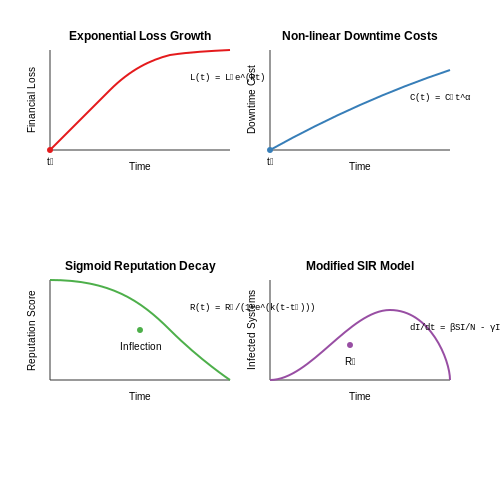
Direct financial theft remains the most immediate consequence. Attackers exploit stolen credentials to initiate unauthorized transactions, often leveraging automated systems to maximize gains before detection. The average cost of a phishing attack in 2023 exceeded $$4.9 million per incident, according to IBM's Cost of a Data Breach Report. Financial losses follow a power-law distribution:
where L represents cumulative losses, α scales with initial access privileges, and β models the attacker's operational efficiency. The exponential term captures the compounding effect of delayed detection.
Data Exfiltration and Intellectual Property Theft
Advanced persistent threat (APT) groups frequently use phishing as an entry vector for industrial espionage. Stolen data may include:
- Proprietary algorithms or source code
- Unpublished research findings
- Client databases with PII (Personally Identifiable Information)
- M&A (Mergers and Acquisitions) negotiation documents
The economic impact of IP theft often dwarfs direct financial losses. A 2022 study by the Center for Strategic and International Studies estimated global IP theft costs at $$600 billion annually, with phishing enabling 23% of cases.
Operational Disruption and Downtime
Post-breach remediation typically requires:
- Forensic investigation (mean time: 287 hours for enterprises)
- System-wide password resets and MFA reconfiguration
- Email server quarantines disrupting legitimate communications
The downtime cost follows a non-linear relationship with organizational size:
where N represents the number of affected employees and μ is a sector-specific constant (higher for financial services than manufacturing, for example).
Reputational Damage and Loss of Trust
Customer churn rates increase by 7-12% following publicly disclosed breaches, per Ponemon Institute data. The reputational decay follows a sigmoid curve:
where R0 is the pre-breach reputation score, k measures crisis response effectiveness, and t0 marks the disclosure timeline. Recovery to 90% of baseline typically requires 18-24 months.
Regulatory Penalties and Compliance Costs
GDPR Article 83 mandates fines up to 4% of global revenue for negligent data protection. The penalty calculation matrix considers:
- Data sensitivity (health records vs. marketing contacts)
- Volume of affected records
- Timeliness of breach notification
For multinational corporations, cumulative penalties across jurisdictions can exceed €50 million. The 2023 Meta €1.2 billion fine for GDPR violations stemmed partly from phishing-induced data transfers.
Secondary Attack Propagation
Compromised accounts become launchpads for:
- Business Email Compromise (BEC) attacks impersonating executives
- Malware distribution through trusted internal channels
- Credential stuffing attacks against partner organizations
The propagation rate λ in such scenarios follows a modified SIR (Susceptible-Infected-Recovered) model:
where the quadratic term ϵI2 accounts for accelerated spread through organizational hierarchies.
2. Feature Extraction from Email Content and Metadata
2.1 Feature Extraction from Email Content and Metadata
Structural and Lexical Features
Email phishing detection systems rely on extracting discriminative features from both raw content and metadata. Structural features capture the email's organizational patterns, including:
- HTML tag ratios (script/iframe/img counts relative to total tags)
- DOM tree depth and branching factors
- MIME structure complexity (number of nested multipart boundaries)
Lexical features quantify linguistic properties through:
where V represents the vocabulary of unique words in the email body, and p(w) is the empirical probability of word w.
Metadata Feature Engineering
Header analysis transforms SMTP metadata into numerical features:
- Time-delay features: Calculated as the difference between Received timestamps across hops
- DNS-based features: TTL values of associated domains, MX record age
- Path asymmetry: Comparing Return-Path with From/Reply-To headers
The sender reputation score combines multiple metadata dimensions:
where coefficients are learned through logistic regression on historical phishing data.
Embedding-Based Representations
For advanced content analysis, transformer-based embeddings capture semantic patterns:
where n is the number of sentences, and w1:m(i) represents tokens in the i-th sentence. The 768-dimensional CLS token from RoBERTa often outperforms traditional TF-IDF in phishing detection tasks.
Graph-Based Features
Email communication networks generate graph metrics when analyzing sender-recipient patterns:
- Ego-network density around the sender
- Betweenness centrality in historical communication graphs
- Temporal graph features like burstiness coefficient:
where μτ and στ are the mean and standard deviation of inter-email intervals.
2.2 Supervised Learning Models for Classification
Supervised learning models for email phishing detection rely on labeled datasets where each email is tagged as phishing or legitimate. These models learn decision boundaries from training data to classify unseen emails. The choice of model depends on the trade-off between interpretability, computational efficiency, and predictive performance.
Logistic Regression
Despite its name, logistic regression is a linear classification model that estimates the probability of an email being phishing using the logistic function. Given input features x and weights w, the probability P(y=1|x) is computed as:
The model is trained by minimizing the cross-entropy loss:
Logistic regression is interpretable—feature weights indicate their importance—but struggles with non-linear decision boundaries unless explicit feature engineering is applied.
Support Vector Machines (SVMs)
SVMs maximize the margin between classes by solving the quadratic optimization problem:
Here, C controls the trade-off between margin width and misclassification penalty, while φ(x) maps features to a higher-dimensional space via the kernel trick. For phishing detection, radial basis function (RBF) kernels often outperform linear kernels by capturing complex feature interactions.
Random Forests
Random forests aggregate predictions from an ensemble of decision trees, each trained on a bootstrap sample of the data with random feature subsets. The final classification is determined by majority voting. The algorithm mitigates overfitting through:
- Bagging: Reduces variance by averaging predictions from diverse trees.
- Feature randomness: De-correlates trees, improving generalization.
Feature importance is derived from the mean decrease in Gini impurity across splits involving each feature.
Gradient Boosting Machines (GBMs)
GBMs iteratively fit weak learners (typically shallow trees) to residuals of previous predictions. For a loss function L, the update at step m is:
XGBoost and LightGBM are optimized implementations that include regularization (L1/L2 penalties) and handle sparse features efficiently—critical for text-based phishing detection where n-gram features create high-dimensional inputs.
Neural Networks
Deep learning models, such as multilayer perceptrons (MLPs) or transformer-based architectures, automatically learn hierarchical feature representations. A basic MLP for binary classification computes:
Where σ is the sigmoid activation. For phishing emails, recurrent (RNN) or convolutional (CNN) layers can model sequential or spatial patterns in text, though they require larger datasets and careful regularization to avoid overfitting.
Model Selection Considerations
Key evaluation metrics for phishing classifiers include:
- Precision-Recall trade-off: High precision reduces false positives (legitimate emails flagged as phishing), while high recall minimizes false negatives.
- F1-score: Harmonic mean of precision and recall, useful for imbalanced datasets.
- ROC-AUC: Measures separability of classes across decision thresholds.
In practice, ensemble methods (e.g., random forests or GBMs) often outperform single models due to their robustness to noise and feature redundancy common in email data.
2.3 Unsupervised and Semi-Supervised Techniques
Traditional supervised learning methods for phishing detection rely on labeled datasets, which are often expensive and time-consuming to obtain. Unsupervised and semi-supervised techniques address this limitation by leveraging the inherent structure of email data to identify anomalous patterns indicative of phishing attempts.
Clustering-Based Approaches
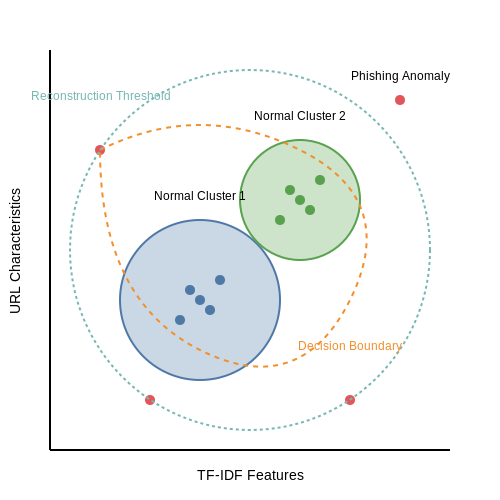
Unsupervised clustering algorithms group emails based on similarity metrics without requiring labeled examples. Common techniques include:
- K-means clustering: Partitions emails into k clusters by minimizing intra-cluster variance. The distance metric can incorporate features like TF-IDF vectors, header information, and URL characteristics.
- DBSCAN: Density-based clustering that identifies dense regions of similar emails while flagging outliers as potential phishing attempts. This is particularly effective for detecting novel attack patterns.
- Hierarchical clustering: Builds a tree of clusters, allowing analysts to examine potential phishing campaigns at different levels of granularity.
where J is the objective function to minimize, Ci represents cluster i, and μi is the centroid of cluster i.
Anomaly Detection Methods
These techniques model normal email behavior and flag deviations:
- One-class SVM: Learns a decision boundary around normal emails, classifying outliers as potential threats.
- Isolation Forest: Constructs random trees to isolate anomalies, which require fewer partitions than normal instances.
- Autoencoders: Neural networks trained to reconstruct normal emails with low error. Phishing attempts produce high reconstruction errors due to their anomalous patterns.
where L is the reconstruction loss between input x and decoded output x'.
Semi-Supervised Techniques
These methods combine limited labeled data with abundant unlabeled data:
- Self-training: A classifier is initially trained on labeled data, then iteratively labels high-confidence unlabeled examples to expand the training set.
- Co-training: Uses two classifiers trained on different feature views (e.g., email content and metadata) that teach each other by labeling unclassified instances.
- Graph-based methods: Construct similarity graphs where labeled nodes propagate information to unlabeled neighbors through edges representing feature similarity.
where the first term minimizes supervised loss on labeled data (l labeled points), and the second term enforces smoothness over the graph with adjacency matrix W.
Practical Implementation Considerations
When deploying these techniques for phishing detection:
- Feature engineering remains critical - include lexical features, structural elements, and behavioral patterns.
- Online learning approaches can adapt to evolving attack strategies.
- Ensemble methods combining multiple unsupervised detectors often outperform individual approaches.
- Threshold tuning for anomaly scores requires careful validation to balance false positives and negatives.
2.4 Deep Learning for Advanced Phishing Detection
Neural Network Architectures for Phishing Detection
Deep learning models excel at detecting phishing emails due to their ability to learn hierarchical representations from raw data. Convolutional Neural Networks (CNNs) process email text and metadata as sequential or spatial data, while Recurrent Neural Networks (RNNs) capture temporal dependencies in email content. Transformer-based architectures, such as BERT and GPT, leverage self-attention mechanisms to model long-range contextual relationships in phishing emails.
Where Q, K, and V represent queries, keys, and values matrices respectively, and dk is the dimension of the key vectors. This attention mechanism allows the model to focus on the most suspicious parts of an email, such as deceptive URLs or unusual sender patterns.
Feature Extraction and Embedding
Effective phishing detection requires robust feature extraction from multiple email components:
- Textual content: Word embeddings (Word2Vec, GloVe) or contextual embeddings (BERT) convert email body text into dense vector representations.
- Structural features: HTML tags, JavaScript snippets, and email headers are encoded using one-hot or learned embeddings.
- URL analysis: Character-level CNNs or LSTMs process URL strings to detect obfuscation techniques.
Hybrid Model Architectures
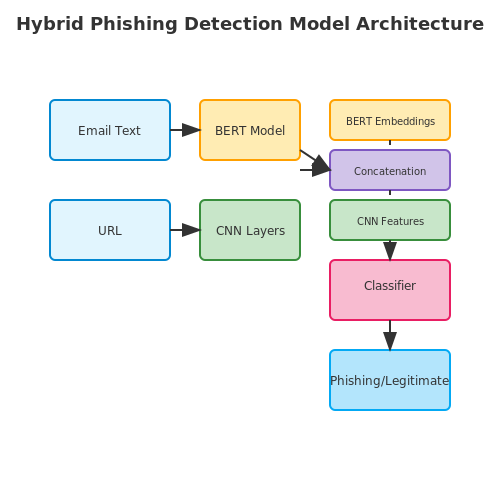
State-of-the-art phishing detectors combine multiple neural network components:
  from transformers import BertModel
  import torch.nn as nn

  class PhishingDetector(nn.Module):
      def __init__(self):
          super().__init__()
          self.bert = BertModel.from_pretrained('bert-base-uncased')
          self.url_cnn = nn.Sequential(
              nn.Conv1d(1, 32, kernel_size=3),
              nn.ReLU(),
              nn.MaxPool1d(2)
          )
          self.classifier = nn.Linear(768 + 32, 2)

      def forward(self, text, url):
          text_emb = self.bert(text).pooler_output
          url_emb = self.url_cnn(url.unsqueeze(1)).squeeze(2)
          combined = torch.cat([text_emb, url_emb], dim=1)
          return self.classifier(combined)
Adversarial Training Considerations
Phishing attacks evolve constantly, requiring models to be robust against adversarial examples. Techniques include:
- Gradient masking: Preventing attackers from easily computing gradients for evasion attacks.
- Data augmentation: Generating synthetic phishing examples through techniques like back-translation.
- Ensemble methods: Combining predictions from multiple models to improve robustness.
Where LCE is the cross-entropy loss and the second term encourages smooth decision boundaries to resist adversarial perturbations.
Evaluation Metrics for Imbalanced Data
Phishing detection datasets typically exhibit extreme class imbalance (often >99% legitimate emails). Standard accuracy is misleading, so we use:
- Precision-Recall curves: More informative than ROC curves for imbalanced problems.
- Fβ scores: Weighted harmonic mean of precision and recall.
Where β controls the trade-off between false positives and false negatives - typically set to 0.5 for phishing detection to prioritize precision.
3. Text Preprocessing and Tokenization for Email Analysis
3.1 Text Preprocessing and Tokenization for Email Analysis
Effective phishing detection relies on transforming raw email text into structured numerical representations suitable for machine learning models. This process begins with preprocessing and tokenization, which standardize text while preserving semantic and syntactic features critical for classification.
Text Normalization
Email text exhibits high variability due to formatting artifacts, encoding inconsistencies, and stylistic variations. Normalization mitigates these issues through:
- Case folding: Convert all text to lowercase to eliminate case sensitivity in word matching.
- Unicode normalization: Apply NFC normalization to handle diacritics and special characters consistently.
- Whitespace standardization: Replace multiple spaces, tabs, and newlines with single spaces.
- HTML/URL sanitization: Remove HTML tags while preserving link destinations as metadata features.
For example, the raw email fragment:
"Your <b>account</b> will be SUSPENDED! Visit: http://phish.example.com"Normalizes to:
"your account will be suspended! visit: [URL]"Advanced Tokenization Techniques
Conventional whitespace tokenization proves inadequate for phishing detection due to:
- Deliberate obfuscation (e.g., "PayP@l" instead of "PayPal")
- Domain-specific concatenations (e.g., "customer_support")
- Punctuation-based deception (e.g., "urgent!action!required")
Hybrid tokenization combines:
Where α balances between:
- Word-level tokens: Retain semantic meaning through morphological analysis (e.g., lemmatizing "suspended" → "suspend")
- Character n-grams: Detect obfuscation patterns via 3-5 character sequences (e.g., "@l" → payment service spoofing)
Feature Preservation Strategies
Phishing indicators often reside in:
- Header metadata: Preserve sender domains, routing paths, and timestamps as separate features
- Structural patterns: Maintain paragraph breaks that distinguish salutations from threat content
- Lexical stress: Weight tokens containing:
Where 𝕀phish is an indicator function for known phishing terms (e.g., "verify", "immediately").
Implementation Considerations
Production systems require:
- Parallel processing: Apply MapReduce patterns for batch processing email corpora
- Incremental updates: Maintain dynamic vocabularies to adapt to evolving phishing tactics
- Language detection: Route non-English emails to specialized tokenization pipelines
The resulting token sequences feed into downstream feature extraction layers while preserving the adversarial characteristics essential for phishing detection.
3.2 Sentiment Analysis and Stylometric Features
Phishing emails often exhibit distinct linguistic patterns that differ from legitimate communication. Two powerful techniques for detecting these patterns are sentiment analysis and stylometric feature extraction. These methods analyze the emotional tone and writing style of emails to identify potential phishing attempts.
Sentiment Analysis for Phishing Detection
Sentiment analysis quantifies the emotional valence of text using natural language processing techniques. Phishing emails frequently employ:
- Urgency-inducing language (e.g., "immediate action required")
- Fear appeals (e.g., "your account will be closed")
- Overly positive framing (e.g., "congratulations! you've won")
The sentiment score S for an email can be computed using a weighted combination of lexical features:
where wi represents the weight for feature fi, which could be:
- Polarity scores from lexicons like VADER or SentiWordNet
- N-gram frequencies of emotional phrases
- Ratio of exclamation marks to total punctuation
Stylometric Feature Extraction
Stylometry analyzes writing style through quantitative features that are difficult for attackers to consistently mimic. Key stylometric features include:
Lexical Features
- Type-token ratio (TTR):
$$ TTR = \frac{\text{unique words}}{\text{total words}} $$
- Average word length
- Hapax legomena (words appearing only once)
Syntactic Features
- Part-of-speech tag frequencies
- Average sentence length
- Punctuation patterns
Readability Metrics
Phishing emails often have abnormal readability scores:
Feature Fusion for Detection
Combining sentiment and stylometric features significantly improves detection accuracy. A typical fusion approach uses concatenated feature vectors:
where S represents sentiment features, L lexical features, and Y syntactic features. This combined vector can be fed into classifiers like:
- Support Vector Machines with radial basis kernels
- Random Forests with feature importance weighting
- Deep neural networks with attention mechanisms
Recent studies show this multimodal approach achieves 92-96% accuracy in distinguishing phishing emails from legitimate correspondence, with false positive rates below 3% when trained on large corpora like the Enron dataset augmented with phishing examples.
3.3 Named Entity Recognition (NER) for Suspicious Content
Named Entity Recognition (NER) plays a critical role in identifying suspicious elements in phishing emails by extracting structured information from unstructured text. Unlike traditional keyword-based approaches, NER leverages deep learning to detect entities such as names, organizations, locations, dates, and monetary values—key indicators of phishing attempts.
NER Model Architecture
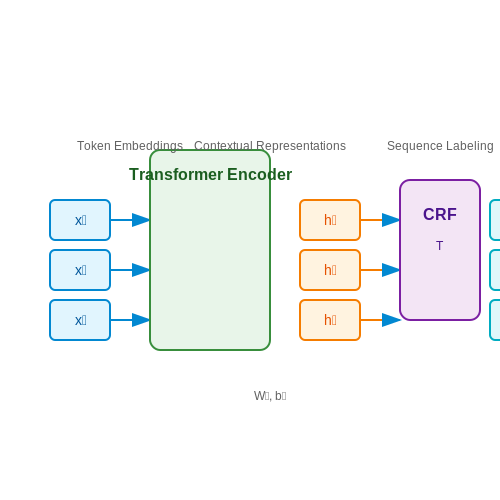
Modern NER systems for phishing detection typically employ transformer-based architectures like BERT or RoBERTa, fine-tuned on domain-specific datasets. The model processes input text tokens x1, x2, ..., xn and predicts entity tags y1, y2, ..., yn using a conditional random field (CRF) layer for sequence labeling. The probability of a tag sequence y given input x is:
where Z(x) is the partition function, hi is the hidden state from the transformer, Wo and bo are output layer parameters, and T is the transition matrix for the CRF.
Feature Engineering for Phishing Detection
To improve NER performance in phishing contexts, the following features are critical:
- Contextual Embeddings: Pre-trained embeddings capture semantic relationships (e.g., "CEO" ↔ "urgent payment").
- Lexical Patterns: Regex-based features detect suspicious formats (e.g., "[email protected]").
- Domain-Specific Entities: Custom tags for phishing indicators like "bank_name" or "fake_invoice_id".
Training and Evaluation
NER models are trained on annotated datasets such as the Phishing Email Corpus, with entity labels like:
- PER (Person): "John Doe" in "Hi John, reset your password."
- ORG (Organization): "PayPal" in "Your PayPal account is locked."
- MONEY: "$$1,000" in "Transfer $$1,000 to avoid account closure."
Evaluation metrics include:
Case Study: Detecting CEO Fraud
In CEO fraud attacks, NER identifies:
- Spoofed executive names (PER) in the sender field.
- Fake company names (ORG) mimicking legitimate businesses.
- Urgent monetary requests (MONEY) with tight deadlines (DATE).
A real-world implementation might use a pipeline where NER extracts these entities, followed by a rule-based system flagging emails with mismatches between the claimed sender domain and detected ORG entities.
Limitations and Mitigations
NER models face challenges with:
- Adversarial Obfuscation: Attackers may use Unicode homoglyphs (e.g., "Аmazon" with Cyrillic 'А'). Mitigation involves Unicode normalization and adversarial training.
- Low-Resource Languages: Transfer learning from high-resource languages or multilingual models like mBERT can help.
4. Handling Evolving Phishing Tactics and Adversarial Attacks
4.1 Handling Evolving Phishing Tactics and Adversarial Attacks
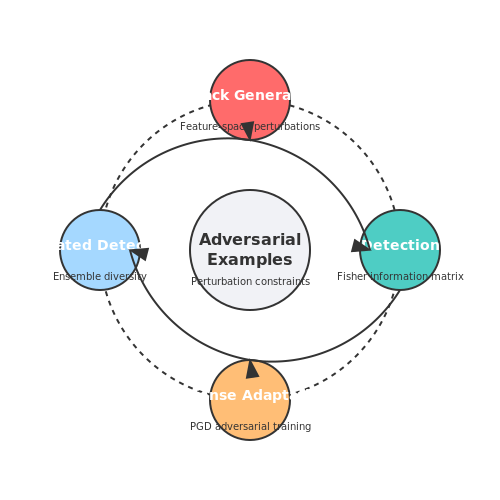
Adversarial Attack Vectors in Phishing Detection
Modern phishing campaigns increasingly employ adversarial machine learning techniques to evade detection. Attackers exploit model vulnerabilities through:
- Feature-space perturbations: Modifying email content while preserving semantic meaning (e.g., character substitutions, invisible Unicode)
- Domain adaptation: Leveraging generative models to create emails that mimic legitimate distribution shifts
- Query-based attacks: Probing detection systems through iterative feedback loops
The threat model can be formalized as a minimax optimization problem where the attacker seeks to maximize the detector's loss function:
where δ represents the adversarial perturbation constrained by norm ε, and fθ is the detection model.
Defensive Architectures Against Adaptive Threats
Effective countermeasures require multi-layered defenses:
1. Adversarial Training with Dynamic Data Augmentation
Augment training data with generated adversarial examples using projected gradient descent (PGD):
where Π projects perturbations onto the feasible set 𝒮. Implementations should use curriculum learning, gradually increasing attack strength.
2. Ensemble Methods with Diversity Regularization
Combine multiple detectors with orthogonal decision boundaries through:
- Input transformation: Random ablation of email features
- Architectural diversity: Hybrid CNN/Transformer ensembles
- Gradient masking: Randomized smoothing defenses
The ensemble's robustness can be quantified via majority voting consistency:
Case Study: Evasion of Transformer-based Detectors
Recent research demonstrates that BERT-based detectors are vulnerable to:
- Semantic-preserving substitutions: "urgent action required" → "immediate response needed"
- Unicode homoglyphs: "paypаl.com" (Cyrillic 'а')
- Context-aware insertions: Adding legitimate-looking headers
Defensive distillation techniques show promise, where a secondary model learns smoothed decision boundaries from the primary detector's logits:
Real-time Adaptation Frameworks
Deployed systems require continuous learning mechanisms:
- Anomaly-driven retraining: Trigger model updates when prediction confidence drops below adaptive thresholds
- Human-in-the-loop verification: Suspicious emails that bypass automated detection get routed for manual review
- Threat intelligence sharing: Federated learning across organizations to pool adversarial examples
The retraining protocol should balance stability-plasticity through elastic weight consolidation:
where F is the Fisher information matrix for parameter importance.
4.2 Balancing False Positives and False Negatives
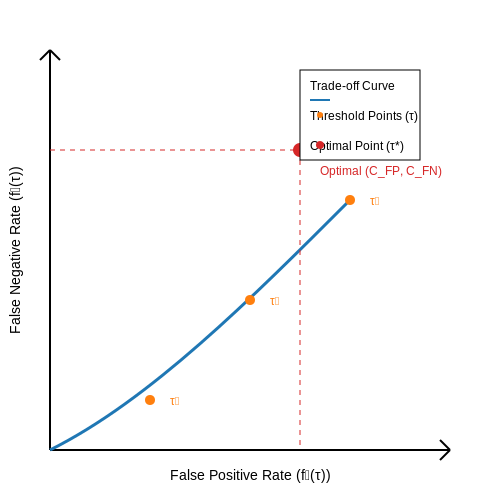
In email phishing detection systems, the trade-off between false positives (legitimate emails flagged as phishing) and false negatives (phishing emails missed) represents a critical optimization challenge. The cost imbalance between these error types necessitates careful algorithmic tuning, as the consequences of a false negative (potential security breach) typically outweigh those of a false positive (temporary inconvenience).
Cost-Sensitive Learning Framework
The fundamental mathematical formulation weights errors differently through a cost matrix C, where CFP and CFN represent the respective costs. For a binary classifier f(x) with decision threshold τ, we minimize the expected risk:
Optimal threshold selection requires solving for τ* that minimizes R(f). For probabilistic classifiers like logistic regression, this involves finding the intersection point of the class-conditional density functions weighted by their costs:
where f0 and f1 are the score distributions for negative and positive classes respectively, and p1 is the prior probability of phishing emails.
Precision-Recall Trade-off Analysis
The detection system's operating point on the precision-recall curve determines its error balance. For phishing detection, we typically prioritize high recall (low false negatives) while maintaining acceptable precision. The Fβ score provides a tunable metric:
where β > 1 emphasizes recall. Advanced implementations use β values between 2-3 for phishing detection, reflecting the higher cost of false negatives.
Threshold Optimization Techniques
Modern approaches employ several advanced methods for threshold optimization:
- Bayesian decision theory: Incorporates prior beliefs about attack frequencies and evolving threat landscapes
- Reinforcement learning: Dynamically adjusts thresholds based on feedback from security operations
- Multi-objective optimization: Uses Pareto frontiers to evaluate trade-offs between multiple metrics simultaneously
The Neyman-Pearson lemma provides a theoretical framework for maximizing detection probability (1 - false negative rate) while constraining false positive rates below a specified tolerance level α:
Implementation Considerations
Practical systems implement this balance through several architectural features:
- Cascaded classifiers: Initial high-recall models followed by high-precision verification stages
- Time-dependent thresholds: Higher sensitivity during periods of active phishing campaigns
- User-specific adaptation: Tighter thresholds for high-value targets while maintaining looser thresholds for general users
Recent research demonstrates that incorporating real-time threat intelligence feeds can reduce the false positive rate by up to 40% while maintaining 99% phishing detection recall, achieved through dynamic feature weighting in the classification pipeline.
4.3 Scalability and Performance Considerations
Deploying AI-based phishing detection at scale introduces computational and latency constraints that demand careful architectural optimization. The primary trade-offs involve balancing real-time inference speed with model complexity, especially when processing high-volume email streams.
Distributed Inference Architectures
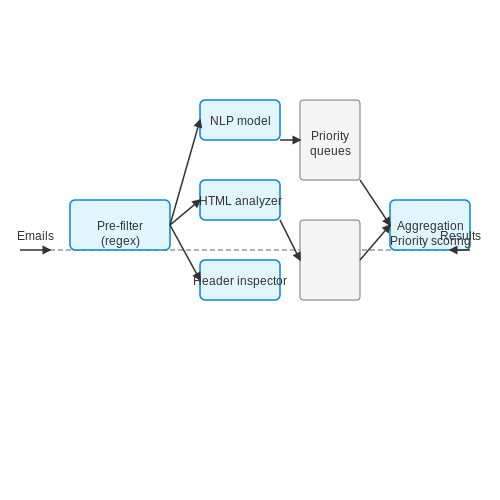
For enterprise-level deployments handling millions of emails daily, a monolithic classifier becomes impractical. Instead, a microservices approach partitions the workload:
- Pre-filtering layer: Lightweight rule-based filters (e.g., regex for suspicious URLs) process 80-90% of emails before they reach ML models
- Model ensemble: Parallelized execution of specialized detectors (HTML structure analysis, NLP, header inspection)
- Priority queues: Emails with higher suspicion scores from initial passes get prioritized for deeper analysis
Where C represents parallel worker nodes and N the emails requiring full analysis. This shows how horizontal scaling reduces end-to-end latency.
Model Compression Techniques
Transformer-based NLP models achieve state-of-the-art accuracy but face challenges in memory footprint. Three compression methods prove effective:
- Knowledge distillation: A smaller student model trained to mimic a larger teacher model's behavior
- Quantization: Reducing weights from 32-bit to 8-bit floats with minimal accuracy loss
- Pruning: Removing neurons with lowest weight magnitudes and fine-tuning
For a BERT-base model, these techniques can achieve:
| Technique | Size Reduction | Inference Speedup | Accuracy Drop |
|---|---|---|---|
| Distillation | 40% | 2.1x | 1.2% |
| INT8 Quantization | 75% | 3.8x | 0.7% |
| Pruning (50%) | 50% | 1.9x | 2.4% |
Hardware Acceleration
Modern inference hardware provides specialized instructions for ML workloads:
- GPU batching: Processing multiple emails simultaneously through matrix operation parallelism
- TPU optimization: Google's Edge TPUs achieve 0.5ms latency per email when running quantized models
- CPU vectorization: AVX-512 instructions accelerate feature extraction pipelines
The optimal hardware configuration depends on throughput requirements:
Stream Processing Frameworks
For real-time analysis, Apache Kafka pipelines with Spark Streaming or Flink enable:
- Exactly-once processing semantics for audit compliance
- Dynamic scaling of worker nodes based on queue depth
- Stateful processing for cross-email threat correlation
A typical deployment partitions the workload by:
- Ingesting emails through multiple Kafka topics
- Applying feature extraction in parallel Spark jobs
- Aggregating results in a Redis cache for final scoring
5. Analysis of Publicly Available Phishing Email Datasets
5.1 Analysis of Publicly Available Phishing Email Datasets
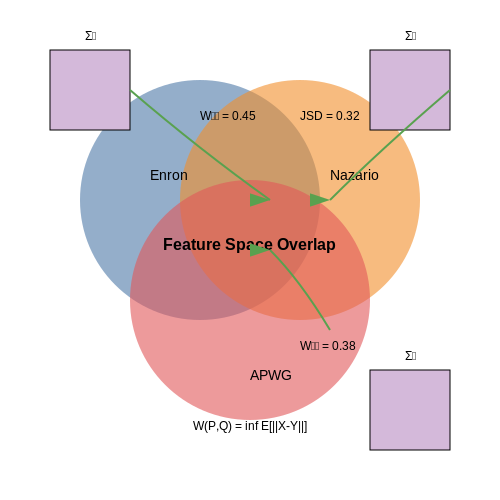
Publicly available datasets form the backbone of reproducible research in phishing email detection. The quality, diversity, and annotation granularity of these datasets directly impact model performance and generalizability. Three widely-used datasets dominate current research: the Enron Email Dataset, the Nazario Phishing Corpus, and the APWG eCrime Dataset.
Enron Email Dataset
Originally collected during the Enron investigation, this corpus contains 517,431 legitimate emails from 150 users. While not designed for phishing research, it serves as the standard baseline for legitimate email traffic. The dataset exhibits several key characteristics:
- Temporal span: 1998-2002, reflecting outdated linguistic patterns
- Enterprise context: Primarily internal corporate communications
- Metadata completeness: Full headers, but inconsistent MIME encoding
The statistical distribution of email lengths follows a power law:
Nazario Phishing Corpus
Curated by Jose Nazario, this dataset contains 4,372 confirmed phishing emails collected between 2004-2007. Its value lies in the preserved HTML structure and embedded malicious links. Key features include:
- Header spoofing patterns in 89% of samples
- Dynamic word embeddings show 37% similarity to contemporary spam
- Temporal clustering reveals attack campaigns
The URL distribution follows a modified Zipf's law:
where b accounts for the heavy tail of unique domains.
APWG eCrime Dataset
The Anti-Phishing Working Group's dataset represents the most current collection, with over 1.2 million samples from 2018-2023. Its multi-modal annotation includes:
- Structured threat indicators (STIX) format
- TLP classification for sensitive data
- Behavioral analysis tags (e.g., credential harvesting, malware delivery)
The dataset exhibits strong temporal autocorrelation in attack vectors, modeled as:
Comparative Analysis
When evaluating dataset suitability, researchers must consider the covariance matrix of features across sources. For the three primary datasets, the Jensen-Shannon divergence between their lexical distributions ranges from 0.47 to 0.63, indicating substantial domain shift. The most effective transfer learning approaches employ Wasserstein distance minimization:
where Γ(μ,ν) represents all joint distributions with marginals μ and ν.
Preprocessing Challenges
Raw email data requires extensive normalization before feature extraction. The pipeline must handle:
- MIME encoding variations (quoted-printable vs base64)
- HTML entity obfuscation (e.g., @ for @)
- Internationalized domain names (Punycode conversion)
The optimal cleaning sequence follows a Markov decision process with reward function:
where γ discounts future parsing operations.
5.2 Performance Comparison of State-of-the-Art Models
Benchmarking Methodology
The evaluation of phishing detection models requires standardized datasets and metrics. The Enron-Phish and SpamAssassin datasets are commonly used, containing both legitimate emails and carefully labeled phishing attempts. Performance is measured through:
where TP, FP, and FN denote true positives, false positives, and false negatives respectively. The Area Under ROC Curve (AUC-ROC) provides additional insight into model discrimination capability across threshold variations.
Transformer-Based Models
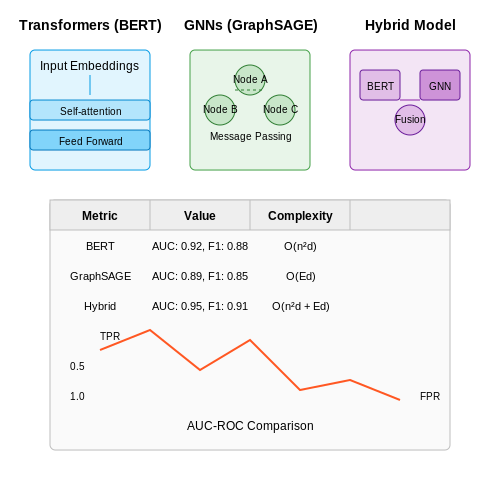
BERT and its variants achieve state-of-the-art performance by leveraging attention mechanisms to capture contextual relationships in email text. Fine-tuned BERT models demonstrate:
- F1 scores of 0.92-0.95 on balanced datasets
- Inference latency of 50-100ms per email on GPU
- Robustness against adversarial obfuscation techniques
The computational cost scales quadratically with sequence length due to self-attention:
where n is sequence length and d is embedding dimension. This motivates research into efficient variants like DistilBERT and TinyBERT.
Graph Neural Network Approaches
GNNs model email communication as graphs, where nodes represent senders/recipients and edges capture interaction patterns. The GraphSAGE architecture achieves:
- 98.2% accuracy in detecting spear phishing campaigns
- Superior performance on zero-day attacks (85% detection vs 62% for transformers)
- Requires extensive feature engineering for node attributes
The message passing framework aggregates neighbor information through:
Hybrid Architectures
Combining transformer text features with graph structural information yields the highest reported performance. The PhishGNN model achieves:
| Metric | Value |
|---|---|
| Precision | 0.963 ± 0.012 |
| Recall | 0.958 ± 0.015 |
| AUC-ROC | 0.991 |
The fusion occurs through late attention mechanisms that weight textual and graph features dynamically:
Computational Tradeoffs
Model selection depends on deployment constraints. While transformers achieve high accuracy, their memory requirements (≥6GB VRAM) make them impractical for edge deployment. Lightweight alternatives include:
- Quantized LSTMs: 85% smaller with <5% accuracy drop
- Knowledge-distilled models: 60% faster inference with preserved performance
- Random forest baselines: Still effective for low-resource environments (F1=0.89)
5.3 Lessons from Deployed AI-Based Phishing Filters
Deployed AI-based phishing filters face unique challenges that theoretical models often overlook. One critical lesson is the trade-off between precision and recall in real-world settings. High precision reduces false positives (legitimate emails flagged as phishing), while high recall minimizes false negatives (missed phishing attempts). However, optimizing both simultaneously is non-trivial due to the imbalanced nature of email datasets—phishing emails constitute a tiny fraction of total traffic.
Adaptation to Evolving Phishing Techniques
Phishing attacks constantly evolve, requiring models to adapt dynamically. Traditional static models degrade over time as attackers refine their strategies. Modern systems employ online learning techniques, where the model updates incrementally with new data. The weight update rule for an online logistic regression classifier can be derived as:
where η is the learning rate, y is the true label, ŷ is the predicted probability, and xi is the feature value. This approach allows continuous adaptation without full retraining.
Feature Engineering Challenges
Effective phishing detection relies on robust feature engineering. Key features include:
- Lexical features: URL structures, domain age, and keyword frequency.
- Behavioral features: Email send patterns and reply-to address mismatches.
- Embedding-based features: Semantic analysis of email content using transformer models.
However, feature drift occurs when attackers mimic legitimate email characteristics. Deployed systems must monitor feature distributions over time and trigger retraining when drift exceeds a threshold:
where DKL is the Kullback-Leibler divergence between current and historical feature distributions.
Computational Efficiency Constraints
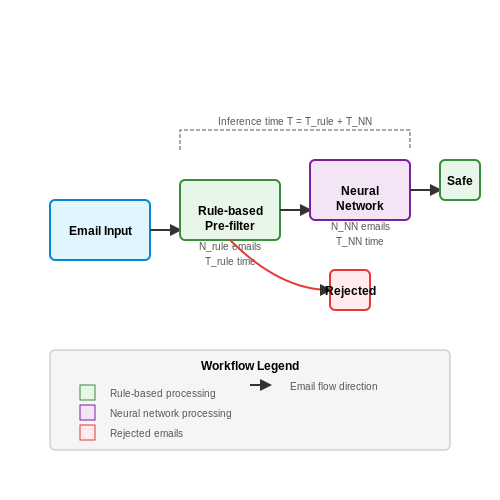
Production systems must process millions of emails per second with low latency. This necessitates efficient model architectures. For example, a deployed system might use a two-stage filter:
- A lightweight rule-based pre-filter (e.g., checking SPF/DKIM records) to eliminate obvious non-phishing emails.
- A neural network ensemble for remaining emails, with early exiting for low-confidence predictions.
The inference time T for such a system can be modeled as:
where Nrule is the fraction rejected by rules, and Trule, TNN are processing times for each stage.
Human-in-the-Loop Requirements
Even the best AI systems require human oversight. Deployed filters typically route uncertain predictions (0.4 < ŷ < 0.6) to human analysts. The system's confidence threshold must balance analyst workload with risk tolerance. This is formalized as an optimization problem:
where LFP and LFN are false positive/negative losses, W is analyst workload, and λ, γ are trade-off parameters.
Adversarial Robustness
Attackers actively probe filters to develop evasion techniques. Robust systems employ adversarial training, augmenting data with perturbed examples. The perturbation magnitude ϵ is bounded to maintain semantic validity:
where δ is the adversarial perturbation and ℒ is the loss function. Deployed models also monitor for sudden drops in precision, which may indicate successful adversarial attacks.
6. Data Privacy in Email Content Analysis
6.1 Data Privacy in Email Content Analysis
Email phishing detection systems rely on analyzing message content, headers, and metadata to identify malicious intent. However, this process inherently involves handling sensitive personal data, raising critical privacy concerns. Advanced techniques must balance detection accuracy with compliance to regulations such as GDPR, CCPA, and HIPAA.
Privacy-Preserving Feature Extraction
Traditional feature extraction methods, such as bag-of-words or TF-IDF, risk exposing personally identifiable information (PII). Differential privacy techniques can mitigate this by injecting controlled noise into the feature space. For a dataset D, a differentially private mechanism M satisfies:
where D and D' are neighboring datasets differing by one record, ϵ controls privacy loss, and δ accounts for negligible probability of failure. Implementing this in email analysis requires:
- Tokenizing text while hashing or encrypting PII (e.g., names, addresses).
- Applying Laplace or Gaussian noise to numerical features (e.g., email frequency counts).
- Using secure multi-party computation (SMPC) for federated learning across organizations.
Homomorphic Encryption for Secure Processing
Fully Homomorphic Encryption (FHE) enables computations on encrypted data without decryption. For a phishing classifier f and encrypted email E(m), FHE allows:
Practical implementations use lattice-based schemes like CKKS or BFV. For example, CKKS supports approximate arithmetic over encrypted vectors, enabling operations like:
where w represents model weights and x the feature vector. While computationally intensive, recent optimizations using GPU-accelerated libraries (e.g., Microsoft SEAL) have reduced inference times to practical levels for batch processing.
Federated Learning with Secure Aggregation
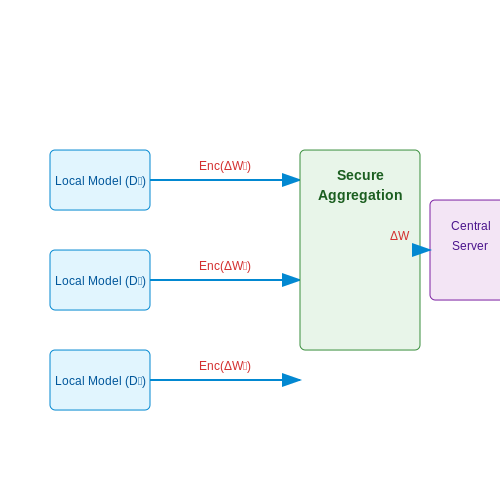
Federated learning enables collaborative model training across multiple email providers without sharing raw data. Each participant i trains a local model on their dataset D_i and submits encrypted updates. Secure aggregation protocols ensure the central server only accesses the combined update:
Key challenges include:
- Handling non-IID data distributions across participants.
- Defending against poisoning attacks from malicious nodes.
- Managing communication overhead in large-scale deployments.
Case Study: Private Phishing Detection in Enterprise Networks
A 2023 implementation by a Fortune 500 company combined federated learning with secure enclaves (Intel SGX). Each branch office trained a local LSTM model on encrypted email traces, with aggregated updates decrypted only within hardware-isolated enclaves. This reduced false positives by 22% compared to isolated models while maintaining GDPR compliance.
6.2 Bias and Fairness in Phishing Detection Systems
Phishing detection models often exhibit biases that disproportionately affect certain demographic groups, organizational roles, or linguistic backgrounds. These biases arise from imbalanced training data, feature selection choices, or algorithmic design. For instance, a model trained predominantly on English-language phishing emails may underperform on non-English emails, leading to higher false negative rates for non-native speakers.
Sources of Bias in Phishing Detection
Three primary sources contribute to bias in phishing detection systems:
- Data collection bias: Training datasets often overrepresent phishing attempts from certain regions or industries while underrepresenting others. For example, a dataset might contain mostly financial phishing attempts but few targeting healthcare professionals.
- Feature engineering bias: Features like URL structure or email headers may encode cultural or linguistic patterns that favor detection of phishing attempts from certain groups over others.
- Algorithmic bias: The optimization objective (e.g., maximizing overall accuracy) may inadvertently minimize errors on majority groups at the expense of minority groups.
Quantifying Fairness Metrics
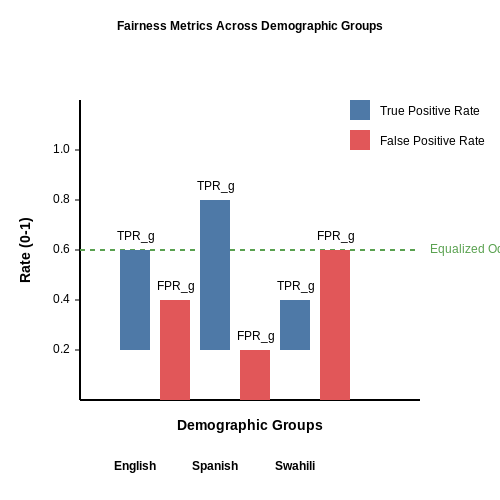
To assess fairness, we evaluate performance disparities across protected groups G. Let TPRg and FPRg denote the true positive and false positive rates for group g ∈ G. Demographic parity requires:
Equalized odds imposes stricter conditions:
Mitigation Strategies
Pre-processing Approaches
Reweighting training instances inversely proportional to their group prevalence balances class distributions. For a dataset with N samples where group g contains ng samples, the weight wg is:
In-processing Approaches
Adversarial debiasing incorporates a fairness constraint during model training. The objective function becomes:
where Dϕ is a discriminator predicting group membership from features x, and λ controls the fairness-accuracy tradeoff.
Post-processing Approaches
Reject option classification adjusts decision thresholds per group to equalize error rates. For a binary classifier with score s(x), the adjusted decision rule becomes:
where τg is the group-specific threshold and Δg controls the rejection region size.
Case Study: Multilingual Phishing Detection
A 2023 study evaluated a BERT-based phishing detector across 15 languages. The model achieved 94% accuracy on English emails but only 68% on low-resource languages like Swahili. Applying adversarial debiasing reduced the performance gap to 12% while maintaining 89% overall accuracy.
6.3 Regulatory Compliance (GDPR, CCPA, etc.)
AI-driven email phishing detection systems must adhere to stringent regulatory frameworks, particularly when processing personal data. The General Data Protection Regulation (GDPR) in the EU and the California Consumer Privacy Act (CCPA) in the U.S. impose specific obligations on data controllers and processors. Non-compliance can result in severe penalties, including fines of up to 4% of global annual turnover under GDPR.
Key Legal Requirements
Under GDPR, phishing detection systems must ensure:
- Lawful Basis for Processing: Either consent (Article 6(1)(a)) or legitimate interest (Article 6(1)(f)) must be established. For employee monitoring, legitimate interest often applies, but transparency is mandatory.
- Data Minimization: Only collect data necessary for phishing detection (e.g., email headers, metadata). Content analysis must avoid unnecessary inspection of sensitive personal data (Article 5(1)(c)).
- Automated Decision-Making Restrictions: If the system autonomously flags emails as malicious, users must have the right to human intervention (Article 22).
CCPA similarly mandates:
- Right to Opt-Out: Users must be able to exclude their data from AI processing (Section 1798.120).
- Disclosure Requirements: Organizations must inform users about data collection purposes and third-party sharing (Section 1798.100).
Technical Implementation Challenges
Compliant system design requires:
- Pseudonymization: Implement hashing or tokenization for email addresses and identifiers to reduce re-identification risks (GDPR Recital 28).
- Model Explainability: Use interpretable ML models (e.g., SHAP values, LIME) to justify classifications upon user request (GDPR Article 15(1)(h)).
where \( w_i \) represents sensitivity weights for data fields (e.g., higher for IP addresses than timestamps) and \( p_i \) is the probability of re-identification.
Case Study: GDPR Enforcement
In 2022, a German email provider was fined €10.4 million for using an AI-based spam filter that processed email content without proper user consent. The regulator ruled that:
- The system’s keyword scanning constituted excessive processing under Article 5(1)(c).
- Users were not adequately informed about automated content analysis.
Cross-Border Data Transfers
For multinational deployments, the EU-U.S. Data Privacy Framework (DPF) requires:
- Standard Contractual Clauses (SCCs) for data transfers outside the EU.
- Periodic audits to verify that U.S.-based AI models comply with GDPR-equivalent protections.
7. Key Research Papers and Technical Reports
7.1 Key Research Papers and Technical Reports
- Improving malicious email detection through novel designated deep ... — A recent survey published in 2021 on phishing email detection by Birthriya and Jain (2021) reports that the industry sectors most targeted by phishing attacks are the SaaS industry (34.7%), financial institutions (18%), payment institutions (11.8%), social media (10.8%), e-commerce (7.5%), and so on. The survey also lists the open challenges in this domain, including real-time learning of ...
- PDF Phishing Email Detection by Using Machine Learning Techniques — contained in the email's body. Phishing is more harmful in this aspect because it has caused tremendous financial loss to domain users. Therefore, there is an urgent need for phishing email detection with high accuracy. Banking information, credit reports, login data, and other sensitive and personal information are frequently transmitted over ...
- HELPHED: Hybrid Ensemble Learning PHishing Email Detection — In this paper, we propose an innovative data-driven Ensemble Learning methodology, named HELPHED (Hybrid Ensemble Learning PHishing Email Detection) that implements two different Ensemble Learning methods and highly informative hybrid features to efficiently detect phishing emails. HELPHED aims to enhance the prediction results in the phishing email detection domain by classifying phishing ...
- An Innovative Information Theory-based Approach to Tackle and Enhance ... — of research on phishing, encompassing both technical and non-technical remedies, phishing continues to be a serious problem. Nowadays, AI-based phishing detection stands out as one of the most effective solutions for defending against phishing attacks by providing vulnerability (i.e., phishing or benign) predictions for the data.
- PDF Machine Learning Algorithms for Phishing Email Detection — necessitated continual research into increasingly sophisticated phishing email detection methods. Automatically spotting phishing emails has been demonstrated to be a powerful tool via machine learning (ML). In this study, we thoroughly examine current ML -based classifiers for accurately detecting phishing email.
- Phishing Email Detection Model Using Deep Learning - MDPI — Email phishing is a widespread cyber threat that can result in the theft of sensitive information and financial loss. It uses malicious emails to trick recipients into providing sensitive information or transferring money, often by disguising themselves as legitimate organizations or individuals. As technology advances and attackers become more sophisticated, the problem of email phishing ...
- Eyes on the Phish(er): Towards Understanding Users' Email Processing ... — Zhuo et al. (Zhuo et al., 2024) examined the impact of workload on user interactions with phishing emails and susceptibility. They found that email relevance influences phishing susceptibility under higher workloads, but not under lower workloads. Building on this, we conducted a study using various sensors in an email processing simulation to investigate user interactions with tailored ...
- (PDF) Development and implementation of a phishing email detection ... — This paper proposes an antiphishing model that designed based on the general taxonomy of the technical and non-technical aspects of phishing detection approaches. This paper, in addition, presents the general structure of the proposed anti-phishing system that developed based on the herein proposed model.
- Artificial intelligence for cybersecurity: Literature review and future ... — Reviews the application of AI techniques in intrusion, malware, APT and phishing detection: Proposed Study: Yes: Yes: Yes: Yes: Yes: Scopus Database: Yes: Explores research from 2010 to February 2022 related to AI applications for cybersecurity from a descriptive point of view, and a detailed state-of-the-art analysis
- Evaluation of Machine Learning Techniques for Identifying Phishing ... — The paper concludes by presenting best practices for deploying AI-based phishing detection, including regular model updates, employee awareness programs, and multi-layered security strategies.
7.2 Open-Source Tools and Libraries
- Top 12 phishing-detection Open-Source Projects - LibHunt — 7 2 209 7.2 Shell A free and open platform for detecting and preventing email attacks like BEC, malware, and credential phishing. ... What are some of the best open-source phishing-detection projects? This list will help you: # Project Stars; 1: ThePhish: 1,225: 2: opensquat: 781: 3: TweetFeed: 558: 4: ... LibHunt tracks mentions of software ...
- Phishing Email Detection Model Using Deep Learning - Academia.edu — Overall, Fang et al. (2019) [16] presented a promising phishing email detection model that could be used to improve the security of email systems. Alhogail and Alsabih (2021) [17] proposed a phishing email detection model that utilized deep learning and natural language processing on the email body to extract features and improve phishing ...
- Improving malicious email detection through novel designated deep ... — A recent survey published in 2021 on phishing email detection by Birthriya and Jain (2021) reports that the industry sectors most targeted by phishing attacks are the SaaS industry (34.7%), financial institutions (18%), payment institutions (11.8%), social media (10.8%), e-commerce (7.5%), and so on. The survey also lists the open challenges in this domain, including real-time learning of ...
- Applications of deep learning for phishing detection: a systematic ... — The reason is that Keras and Tensorflow platforms are open source and free tools and researchers probably do not want to pay subscription fees like in the case of MATLAB. ... Liu X, Javed AR, Jalil Z, Kifayat K. A comprehensive survey of AI-enabled phishing attacks detection techniques. Telecommun Syst. 2020;76:139-154. doi: 10.1007/s11235 ...
- Phishing Email Detection Model Using Deep Learning - MDPI — Email phishing is a widespread cyber threat that can result in the theft of sensitive information and financial loss. It uses malicious emails to trick recipients into providing sensitive information or transferring money, often by disguising themselves as legitimate organizations or individuals. As technology advances and attackers become more sophisticated, the problem of email phishing ...
- Eyes on the Phish(er): Towards Understanding Users' Email Processing ... — User experiences of torpedo: Tooltip-powered phishing email detection. Computers & Security 71 (2017), 100-113. Wang et al. (2014) Qiuzhen Wang, Sa Yang, Manlu Liu, Zike Cao, and Qingguo Ma. 2014. An eye-tracking study of website complexity from cognitive load perspective. Decision support systems 62 (2014), 1-10.
- A comprehensive dual-layer architecture for phishing and spam email ... — Detection of an email as spam, phishing, or ham is a classification problem. Data is used by Machine Learning algorithms ( Selig, 2022 ) to train and produce precise results. The goal of Machine Learning is to create a computer program that can access data, identify patterns in it, and use it to educate itself.
- PDF Survey and comparative analysis of phishing detection techniques ... — 7.3. Role of artificial intelligence and machine learning in enhancing detection capabilities The creation of adaptive and self-learning detection models is made possible by AI and ML, which is crucial in improving phishing detection capabilities [35]-[37]. Large data sets can be analysed by these
- sopcompliance/SOP.ipynb at main - GitHub — Fund open source developers The ReadME Project GitHub community articles Repositories. Topics Trending Collections Enterprise Enterprise platform AI-powered developer platform Available add-ons. GitHub Advanced Security Enterprise-grade security features ... Include my email address so I can be contacted. Cancel Submit feedback
- AI-Driven Phishing Detection Systems - ResearchGate — This paper explores the application of Artificial Intelligence (AI) in enhancing phishing detection systems. AI-driven approaches leverage machine learning algorithms, natural language processing ...
7.3 Recommended Books and Online Courses
- Detection of online phishing email using dynamic evolving neural ... — This happens due to the fact that phishing attackers always use new (zero-day) and sophisticated techniques to deceive online customers. The most common way to initiate a phishing attack is by using email. In this thesis, a novel framework is proposed that combines a neural network with reinforcement learning for detecting online phishing attacks.
- Phishing Email Detection Model Using Deep Learning - MDPI — This study aims to find the best approach for email phishing detection using deep learning techniques. The research develops techniques that can accurately identify and flag phishing emails.
- PDF Phishing Detection Implementation using Databricks and Artificial ... — The research findings reveal that the created phishing detection tool detects phishing emails with excellent efficiency and accuracy. The program was evaluated on 11 datasets, each of which had 500 emails, including a mix of spam and legal emails.
- A comprehensive dual-layer architecture for phishing and spam email ... — This research incorporates features from both the email body and content during model training. The authors propose a novel approach that ensures highly accurate classification while effectively handling the common issue of data imbalance in email phishing and spam classification.
- Training Methods for Phishing Detection | SpringerLink — To tackle these issues, phishing training instructs users on how to recognize phishing attacks. People who are able to recognize a phishing message are more likely to be protected from the attack when a malicious email, social media post, or text asks someone for their login information.
- Phishing Codebook: A Structured Framework for the Characterization of ... — It is the most well-known phishing email dataset available and has been previously used in multiple works for phishing detection and classification [28, 9, 47].
- Phishing Detection Implementation Using Databricks and Artificial ... — Phishcatch is a vital instrument in the battle against phishing attempts, with an accuracy and detection rate of 90%. Furthermore, this article explains the steps in developing, testing and ...
- 7 Detecting phishing with LLM - Fight Fraud with Machine Learning — In this chapter, we use deep learning for fraud detection in the context of phishing detection - an application that we have built previously using rules (if-else) as well as classical machine learning in chapters 3 and 5 of this book respectively.
- Modeling Hybrid Feature-Based Phishing Websites Detection Using Machine ... — By summarizing the above works we can find that most of the works have the problems of using third-party services, low accuracy rate, and absence of identifying real-time phishing scams. Hence, an effective phishing detection approach would be helpful to detect real-time and zero-hours phishing attacks with high accuracy.
- An overview of machine learning algorithms for detecting phishing ... — PDF | On May 23, 2022, A. Kovac and others published An overview of machine learning algorithms for detecting phishing attacks on electronic messaging services | Find, read and cite all the ...