Voice Biometrics for Secure Authentication
1. What is Voice Biometrics?
What is Voice Biometrics?
Voice biometrics is a subfield of speaker recognition that leverages unique physiological and behavioral characteristics of an individual's vocal tract to establish identity. Unlike traditional authentication methods relying on passwords or tokens, voice biometrics operates on the principle that vocal features—such as pitch, formant frequencies, and spectral characteristics—are inherently distinctive and difficult to replicate.
Physiological and Behavioral Components
The human voice is shaped by both anatomical and learned traits. Physiological factors include:
- Vocal tract length and shape: Determines resonant frequencies (formants).
- Glottal source characteristics: Influences pitch and harmonics.
Behavioral factors encompass:
- Speaking style: Includes rhythm, stress patterns, and pronunciation idiosyncrasies.
- Language and accent: Contribute to long-term spectral features.
Mathematical Representation
Voice biometric systems typically model speech using Mel-Frequency Cepstral Coefficients (MFCCs), which capture spectral envelopes. The process involves:
- Pre-emphasis: High-pass filtering to amplify high frequencies:
$$ y[n] = x[n] - \alpha x[n-1], \quad 0.9 \leq \alpha \leq 1.0 $$
- Framing and windowing: Short-term analysis using Hamming windows:
$$ w[n] = 0.54 - 0.46 \cos\left(\frac{2\pi n}{N-1}\right), \quad 0 \leq n \leq N-1 $$
- MFCC extraction: Log-energy of Mel-filterbank outputs followed by Discrete Cosine Transform (DCT):
$$ c_i = \sum_{j=1}^{M} \log E_j \cdot \cos\left(\frac{i(j-0.5)\pi}{M}\right), \quad i = 1,2,...,L $$
Authentication Paradigms
Voice biometric systems implement one of two approaches:
- Text-dependent: Requires fixed passphrases; uses both spectral and temporal features.
- Text-independent: Analyzes arbitrary speech; relies on long-term feature statistics.
Performance Metrics
System accuracy is quantified using:
- Equal Error Rate (EER): Intersection point of False Acceptance Rate (FAR) and False Rejection Rate (FRR) curves.
- Detection Error Tradeoff (DET) curves: Plot FAR vs. FRR across threshold variations.
Security Considerations
Advanced systems incorporate anti-spoofing measures to counter:
- Replay attacks: Detected via spectral distortion analysis.
- Synthetic speech: Identified through glottal pulse irregularity detection.
1.2 Key Components of Voice Biometric Systems
Feature Extraction
Voice biometric systems rely on extracting discriminative features from speech signals to create a unique vocal fingerprint. The most widely used features include:
- Mel-Frequency Cepstral Coefficients (MFCCs): Derived from a nonlinear Mel-scale filter bank that approximates human auditory perception. The process involves windowing the signal, computing the Discrete Fourier Transform (DFT), applying Mel filters, taking the logarithm, and performing a Discrete Cosine Transform (DCT).
- Linear Predictive Coding (LPC) Coefficients: Model the vocal tract as an all-pole filter, solving the Yule-Walker equations to minimize prediction error.
- Prosodic Features: Include pitch, energy contours, and speaking rate, which capture behavioral characteristics.
Speaker Modeling
After feature extraction, statistical models encode speaker-specific patterns. Gaussian Mixture Models (GMMs) and i-vectors are traditional approaches, while deep learning methods like x-vectors or ECAPA-TDNN dominate state-of-the-art systems:
- GMM-UBM: A Universal Background Model (UBM) trains a general speaker distribution, adapted to individual speakers via Maximum A Posteriori (MAP) estimation.
- i-Vectors: Project high-dimensional GMM supervectors into a low-dimensional subspace using factor analysis, capturing both speaker and channel variability.
- Neural Embeddings: Deep neural networks (e.g., ResNet, TDNN) extract fixed-dimensional embeddings (x-vectors) optimized through triplet loss or angular margin penalties.
Decision Mechanisms
Authentication decisions hinge on scoring algorithms and thresholding:
- Likelihood Ratio: Compares the probability of observed features under the target speaker model versus a background model. The log-likelihood ratio (LLR) is:
- Cosine Similarity: Used with neural embeddings, measuring angular distance between enrollment and test vectors.
- Dynamic Thresholding: Adaptive thresholds adjust for noise levels or application security requirements (e.g., FAR/FRR trade-offs).
Anti-Spoofing Countermeasures
To mitigate replay attacks, synthetic speech, or voice conversion, modern systems integrate:
- Spectro-Temporal Features: CQCC (Constant Q Cepstral Coefficients) or LFCC (Linear Frequency Cepstral Coefficients) detect artifacts in manipulated signals.
- End-to-End Models: Light CNN or ResNet architectures classify bona fide vs. spoofed utterances directly from raw spectrograms.
- Liveness Detection: Analyzes physiological cues like glottal flow or lip motion synchrony in multimodal systems.
System Integration
Deployment considerations include:
- Adaptive Enrollment: Incremental updates to speaker models accommodate vocal drift over time.
- Multimodal Fusion: Combining voice with face or behavioral biometrics enhances robustness through score-level or feature-level fusion.
- Edge Computing: On-device processing preserves privacy, leveraging TensorFlow Lite or ONNX runtime for embedded deployment.

1.3 How Voice Biometrics Differs from Other Biometric Modalities
Voice biometrics distinguishes itself from other biometric modalities through its unique combination of physiological and behavioral characteristics. Unlike fingerprint or iris recognition, which rely solely on static physiological traits, voice biometrics captures dynamic features influenced by both vocal tract morphology and speaking patterns. The spectral envelope, characterized by formant frequencies (F1, F2, F3), is determined by the physical structure of the vocal tract, while prosodic features like pitch, rhythm, and speaking rate introduce behavioral variability.
Feature Extraction and Dimensionality
Mel-Frequency Cepstral Coefficients (MFCCs) form the cornerstone of voice biometric feature extraction, with a typical 13-39 dimensional feature vector per frame. This contrasts with:
- Fingerprints: Minutiae points (ridge endings/bifurcations) with ~50-150 features
- Iris recognition: 2D Gabor wavelet transforms yielding 2048-bit IrisCodes
- Facial recognition: 128-512 dimensional embeddings from deep neural networks
where \(E_k\) represents the energy in the k-th Mel filter bank and N is the number of filters.
Signal-to-Noise Ratio Considerations
Voice biometric systems operate under fundamentally different SNR constraints compared to other modalities. While fingerprint sensors achieve 30-40 dB SNR, voice signals in real-world environments typically contend with 0-20 dB SNR. This necessitates robust feature normalization techniques:
where \(\mu_k\) and \(\sigma_k\) are the mean and standard deviation of the k-th MFCC coefficient across an utterance.
Liveness Detection Mechanisms
Voice systems employ distinct anti-spoofing measures compared to other biometrics:
- Text-dependent: Challenge-response protocols using specific passphrases
- Text-independent: Spectral discontinuity detection for replay attacks
- Multi-modal: Combining glottal flow features with lip movement analysis
The detection error trade-off (DET) curve for voice biometrics typically shows higher equal error rates (EER) than iris recognition but lower than behavioral modalities like keystroke dynamics:
Template Storage Requirements
Voice biometric templates exhibit intermediate storage needs between high-dimensional facial templates (~3-10KB) and compact fingerprint templates (~0.5-2KB). A typical Gaussian Mixture Model-Universal Background Model (GMM-UBM) system requires:
where K is the number of mixtures (typically 64-512) and D is the feature dimension (typically 39).
Real-World Deployment Challenges
Voice authentication systems must account for intra-user variability exceeding that of other biometrics. A speaker's vocal characteristics can vary by up to 15% due to:
- Health conditions (cold, allergies)
- Psychological state (stress, fatigue)
- Long-term vocal changes (aging)
This necessitates adaptive thresholding mechanisms absent in most physiological biometric systems:
where \(s_t\) is the current similarity score and \(\alpha\) controls the adaptation rate.

2. Acoustic Features in Voice Signals
2.1 Acoustic Features in Voice Signals
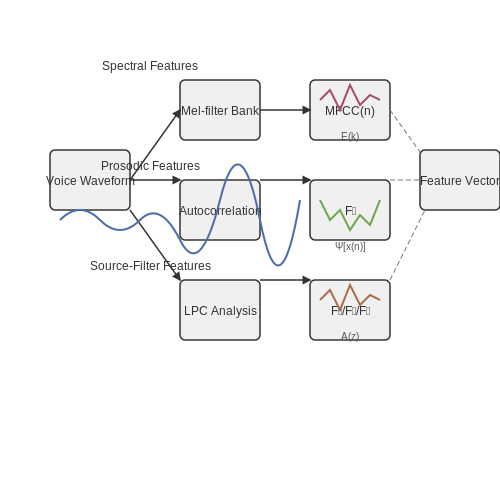
The human voice is a complex acoustic signal generated by the interaction of vocal fold vibrations, articulatory movements, and resonant cavities in the vocal tract. For voice biometrics, these physiological characteristics manifest as measurable acoustic features that serve as discriminative markers for speaker identity. The most salient features can be broadly categorized into spectral, prosodic, and source-filter characteristics.
Spectral Features
Spectral features capture the frequency-domain representation of voice signals, primarily through short-term Fourier transforms or linear predictive coding (LPC). The Mel-Frequency Cepstral Coefficients (MFCCs) are the gold standard, derived through:
where E(k) is the energy in the k-th Mel-filter bank bin, and K is the number of filters. The first 12–20 coefficients encode vocal tract shape, while the 0-th coefficient represents signal energy. Delta and delta-delta coefficients augment temporal dynamics.
Prosodic Features
Prosody encompasses suprasegmental patterns like pitch (fundamental frequency F₀), intensity, and duration. Pitch is extracted using autocorrelation or the YIN algorithm:
where W is the analysis window, and τ minimizes dₜ(τ). Jitter (cycle-to-cycle pitch variation) and shimmer (amplitude variation) further quantify vocal fold instability.
Source-Filter Features
The source-filter model decouples vocal fold excitation (source) from vocal tract modulation (filter). Glottal flow derivatives, estimated via inverse filtering, reveal phonation-specific patterns. Formant frequencies (F₁, F₂, etc.), the resonant peaks of the vocal tract, are solved from LPC polynomials:
where p is the LPC order. Formant bandwidths and trajectories enhance speaker discriminability.
Higher-Order Features
Nonlinear dynamics features, such as correlation dimension and Lyapunov exponents, model chaotic vocal fold behavior. Teager Energy Operator (TEO) features capture nonlinear energy interactions:
These features are robust to channel distortions and noise, critical for real-world deployments.
2.2 Feature Extraction Techniques
Voice biometric systems rely on robust feature extraction to convert raw audio signals into discriminative representations. The process involves transforming time-domain waveforms into compact feature vectors that capture speaker-specific characteristics while suppressing irrelevant variability such as background noise or channel effects.
Short-Term Spectral Features
The most widely adopted features in voice biometrics are derived from short-term spectral analysis, typically computed over 20–30 ms frames with 50% overlap. Mel-Frequency Cepstral Coefficients (MFCCs) remain the gold standard due to their ability to approximate human auditory perception. The computation involves:
Followed by Mel-filterbank application and discrete cosine transform (DCT):
where Ek represents the energy in the k-th Mel band. Advanced variants include:
- Delta and delta-delta coefficients for dynamic feature representation
- Power-normalized cepstral coefficients (PNCC) for noise robustness
- Relative spectral transform (RASTA) filtering for channel compensation
Linear Predictive Coding (LPC)
LPC models the vocal tract as an all-pole filter, with coefficients derived by minimizing prediction error:
The solution involves solving the Yule-Walker equations through Levinson-Durbin recursion. LPC-based features are particularly effective for text-dependent systems where phonetic content is constrained.
Perceptual Linear Prediction (PLP)
PLP combines psychophysical concepts with LPC by incorporating:
- Critical-band spectral resolution (Bark scale)
- Equal-loudness pre-emphasis
- Intensity-loudness power law
The feature extraction pipeline applies these transformations before computing conventional LPC coefficients, resulting in improved speaker discrimination under varying acoustic conditions.
Deep Learning-Based Features
Modern systems increasingly utilize neural network-derived representations:
- D-vectors: Fixed-dimensional embeddings from speaker-discriminative DNNs
- x-vectors: Time-delay neural network (TDNN) features with statistical pooling
- ECAPA-TDNN: Enhanced architecture with channel attention and multi-layer aggregation
These approaches typically employ angular softmax or additive margin softmax objectives during training to maximize speaker separability in the embedding space.
Feature Normalization Techniques
To mitigate session variability, advanced normalization methods are applied:
Where μ and σ represent cepstral mean and variance. More sophisticated approaches include:
- Feature warping (temporal cepstral normalization)
- Short-time Gaussianization
- Probabilistic linear discriminant analysis (PLDA) in the feature space
The choice of feature extraction method depends on system requirements, with MFCCs and x-vectors currently representing the best trade-off between computational efficiency and recognition accuracy for most applications.

2.3 Machine Learning Models for Voice Authentication
Feature Extraction and Representation
Voice biometrics rely on robust feature extraction to capture speaker-specific characteristics. Mel-Frequency Cepstral Coefficients (MFCCs) remain the gold standard, decomposing the speech signal into a compact representation of its spectral envelope. The process involves:
- Pre-emphasis filtering to enhance high frequencies
- Framing and windowing (typically 20-30ms Hamming windows)
- Discrete Fourier Transform (DFT) to obtain the power spectrum
- Mel-scale filterbank application to mimic human auditory perception
- Discrete Cosine Transform (DCT) to decorrelate filterbank energies
where mj represents log filterbank energies and N is the number of filters. Delta and delta-delta coefficients often augment static MFCCs to capture dynamic speech features.
Gaussian Mixture Models (GMMs)
GMMs probabilistically model speaker vocal tract characteristics by representing feature distributions as weighted sums of Gaussian components. For a feature vector x, the likelihood is:
where λ = {wi, μi, Σi} represents the model parameters. The Expectation-Maximization (EM) algorithm estimates these parameters during training. GMM-UBM (Universal Background Model) frameworks improve performance by adapting speaker models from a universal model trained on many speakers.
i-Vector Systems
i-Vectors project variable-length utterances into a fixed-dimensional total variability space that captures both speaker and channel characteristics. The model assumes:
where M is the supervector, m is the UBM mean supervector, T is the total variability matrix, and w is the i-vector. Probabilistic Linear Discriminant Analysis (PLDA) then separates speaker and session variability in the i-vector space.
Deep Learning Approaches
Neural networks have surpassed traditional methods through their ability to learn hierarchical representations. Key architectures include:
Deep Neural Networks (DNNs)
DNNs trained as discriminative classifiers using frame-level features achieve superior performance over generative models. The softmax output layer provides posterior probabilities:
Time-Delay Neural Networks (TDNNs)
TDNNs model temporal context through delayed connections, capturing formant trajectories and speaking rate variations. The architecture employs:
- Context windows spanning ±5 frames
- Dilated convolutions for increased receptive fields
- Statistical pooling layers for utterance-level aggregation
End-to-End Systems
Modern systems like x-vectors integrate neural feature extraction and scoring:
- Frame-level layers process acoustic features
- Statistics pooling computes mean and standard deviation across time
- Segment-level layers produce fixed-dimensional embeddings
- PLDA or cosine similarity performs verification
Performance Metrics and Challenges
Voice authentication systems are evaluated using:
- Equal Error Rate (EER): When false acceptance and false rejection rates are equal
- Detection Error Tradeoff (DET) curves
- Minimum Detection Cost Function (minDCF)
Key challenges include:
- Channel and environmental noise robustness
- Short-duration enrollment data
- Spoofing attacks (replay, synthesis, voice conversion)
- Speaker variability (health, age, emotional state)
3. Enrollment Process: Capturing and Storing Voiceprints
Enrollment Process: Capturing and Storing Voiceprints
The enrollment process in voice biometrics is a critical phase where a user's voiceprint is captured, processed, and stored for future authentication. A voiceprint is a mathematical representation of the unique characteristics of an individual's voice, derived from spectral and temporal features. The process involves several stages: voice sample acquisition, feature extraction, model training, and secure storage.
Voice Sample Acquisition
High-quality voice samples are essential for robust voiceprint creation. The enrollment typically requires the user to speak a predefined passphrase or a set of phonetically rich sentences multiple times. The recordings are captured under controlled acoustic conditions to minimize noise and variability. The sampling rate must be sufficiently high (typically 16 kHz or higher) to preserve the spectral content of the voice, particularly the formant frequencies that are key to speaker identification.
The signal-to-noise ratio (SNR) of the recordings should exceed 20 dB to ensure clarity. The audio signal x(t) is discretized into a sequence of samples x[n] using an analog-to-digital converter (ADC). Windowing techniques, such as Hamming or Hanning windows, are applied to the signal frames to reduce spectral leakage during subsequent Fourier analysis.
where w[n] is the window function applied to the n-th sample of the signal frame.
Feature Extraction
The core of voiceprint creation lies in extracting discriminative features from the voice signal. Mel-Frequency Cepstral Coefficients (MFCCs) are the most widely used features due to their ability to mimic human auditory perception. The process involves:
- Pre-emphasis: Applying a high-pass filter to enhance high-frequency components.
- Framing: Dividing the signal into short overlapping frames (20-30 ms) to assume quasi-stationarity.
- Discrete Fourier Transform (DFT): Converting each frame to the frequency domain.
- Mel-filterbank: Applying triangular filters spaced according to the Mel scale to approximate human hearing.
- Logarithm and DCT: Taking the log of filterbank energies and applying the Discrete Cosine Transform to decorrelate the features.
where Ek is the energy of the k-th Mel filterbank channel, and N is the number of filters.
Other features like Linear Predictive Coding (LPC) coefficients, pitch, and jitter may also be extracted to enhance the voiceprint's robustness.
Model Training and Storage
The extracted features are used to train a speaker model, typically a Gaussian Mixture Model (GMM) or a Deep Neural Network (DNN). For GMM-based systems, the probability density function of the feature vectors is modeled as a weighted sum of Gaussian distributions:
where λ represents the model parameters (weights wi, means μi, and covariance matrices Σi), and M is the number of Gaussian components.
For secure storage, the voiceprint template is encrypted using cryptographic techniques like AES-256 or homomorphic encryption to prevent unauthorized access. The template is often stored as a binary large object (BLOB) in a secure database with access controls. Differential privacy techniques may be applied to the feature vectors to prevent reconstruction attacks.
Practical Considerations
Real-world deployment requires addressing challenges such as:
- Channel variability: Differences in microphones and transmission channels can affect voiceprint quality. Feature warping or cepstral mean normalization (CMN) is used to mitigate this.
- Phrase selection: The enrollment phrases must balance security (resistance to replay attacks) and usability (ease of recall).
- Liveness detection: Techniques like challenge-response protocols or analysis of vocal tract characteristics prevent spoofing with recorded or synthetic voices.
Modern systems increasingly leverage end-to-end deep learning architectures, where the enrollment process involves fine-tuning a pre-trained neural network on the user's voice samples. The network's embeddings serve as the voiceprint, offering superior generalization across varying acoustic conditions.

3.2 Verification vs. Identification
Voice biometric systems operate under two distinct modalities: verification and identification. While both leverage vocal characteristics for authentication, their underlying mechanisms and computational demands differ significantly. Verification, also known as 1:1 matching, confirms whether a given voice sample belongs to a claimed identity. The system compares the input against a pre-enrolled template of the purported user, producing a similarity score. If this score exceeds a predefined threshold τ, the claim is accepted. Mathematically, the decision function for verification is:
Here, S represents a similarity metric (e.g., cosine similarity or probabilistic linear discriminant analysis (PLDA) score), 𝐱 is the input feature vector, and 𝐲 is the enrolled template.
In contrast, identification (1:N matching) determines the identity of an unknown speaker by searching against a database of N enrolled templates. The system computes similarity scores across all reference samples and selects the identity associated with the highest score, provided it surpasses τ. The computational complexity scales linearly with N, making real-time identification challenging for large populations. The decision rule is:
Performance Metrics and Trade-offs
Verification systems are evaluated using false acceptance rate (FAR) and false rejection rate (FRR), which exhibit an inverse relationship governed by τ. Lowering τ increases FAR (security risk) while reducing FRR (usability improvement). The equal error rate (EER) denotes the point where FAR equals FRR, serving as a benchmark for threshold calibration.
Identification systems introduce additional metrics like rank-1 accuracy (probability of correct top-match) and computational latency. Large-scale deployments often employ hierarchical approaches or embeddings with approximate nearest-neighbor search (e.g., FAISS) to mitigate latency. For instance, a 10,000-user system requiring 50 ms per comparison would incur 500 ms latency for exhaustive search—prohibitive for real-time applications.
Architectural Implications
Verification architectures prioritize low-latency pairwise comparisons, often implemented via lightweight neural networks (e.g., SqueezeWave or ECAPA-TDNN). Identification systems demand scalable feature extraction and indexing, frequently leveraging speaker embeddings (d-vectors or x-vectors) with dimensionality reduction techniques like principal component analysis (PCA):
where 𝐖 is the projection matrix and μ the mean vector of the training set. Practical deployments often combine both modalities—verification for routine access and identification for forensic or multi-user scenarios.
3.3 Performance Metrics: FAR, FRR, and EER
False Acceptance Rate (FAR)
The False Acceptance Rate (FAR) quantifies the probability that a biometric system incorrectly authenticates an impostor as a legitimate user. Mathematically, it is defined as:
For instance, if a voice biometric system incorrectly verifies 5 out of 10,000 impostor attempts, the FAR is 0.05%. Lower FAR values indicate stricter security, but excessively low thresholds may increase False Rejection Rate (FRR).
False Rejection Rate (FRR)
The False Rejection Rate (FRR) measures the likelihood that the system fails to recognize a legitimate user. It is computed as:
For example, if 8 out of 1,000 genuine attempts are rejected, the FRR is 0.8%. High FRR frustrates users, while low FRR may compromise security. The trade-off between FAR and FRR is visualized in a Detection Error Tradeoff (DET) curve, which plots FRR against FAR at varying decision thresholds.
Equal Error Rate (EER)
The Equal Error Rate (EER) is the point where FAR equals FRR, serving as a single metric to compare system performance. It is derived by finding the threshold where:
EER is critical for benchmarking. For example, a system with EER=2% implies that at the optimal threshold, both FAR and FRR are 2%. Lower EER indicates better discriminative power. Practical systems often operate at thresholds slightly above or below EER, depending on security vs. usability requirements.
Practical Implications
In high-security applications (e.g., banking), FAR is minimized even at the cost of higher FRR. Conversely, consumer applications (e.g., smartphones) prioritize low FRR for usability. Advanced systems use score normalization and adaptive thresholds to dynamically balance these metrics based on contextual risk.

4. Vulnerabilities and Attack Vectors
4.1 Vulnerabilities and Attack Vectors
Voice biometric systems, despite their growing adoption, are susceptible to a range of adversarial attacks that exploit weaknesses in signal processing, machine learning models, and system architecture. Understanding these vulnerabilities is critical for designing robust authentication mechanisms.
Replay Attacks
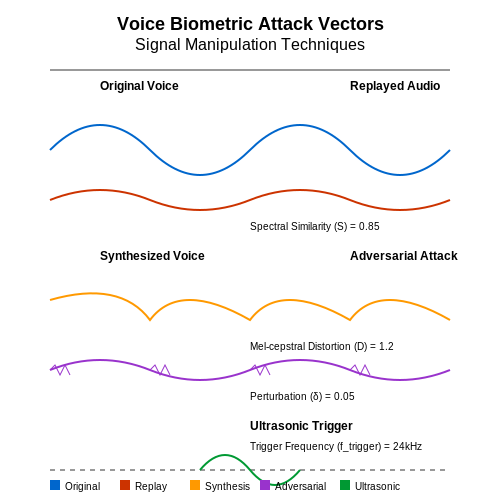
The simplest yet most prevalent attack involves replaying a pre-recorded voice sample of the legitimate user. Attackers capture voiceprints through phishing, eavesdropping, or data breaches, then replay them using high-fidelity audio devices. The success probability Preplay depends on the quality of the recording and the system's liveness detection:
where S is the spectral similarity score, τ is the decision threshold, and k controls the steepness of the logistic curve. Systems without countermeasures exhibit Preplay > 0.8 for studio-quality recordings.
Voice Synthesis and Conversion Attacks
Modern neural vocoders like WaveNet and Tacotron 2 can synthesize natural-sounding speech from text or mimic target speakers using just a few seconds of reference audio. The attacker minimizes the spectral distortion D between synthetic and target voice:
where Mt represents Mel-frequency cepstral coefficients at frame t, F0 is the fundamental frequency, and λ controls pitch similarity weighting. State-of-the-art systems achieve D < 0.15, making synthetic voices nearly indistinguishable from genuine samples.
Adversarial Examples
By injecting imperceptible perturbations δ into the audio waveform, attackers can force misclassification while maintaining perceptual quality. The optimization problem for generating adversarial examples is:
where fθ is the voiceprint model, x is the input waveform, and ytarget is the desired impostor label. Experiments show that perturbations with ε < 0.002 achieve >90% attack success against DNN-based systems.
Acoustic Trojan Attacks
Attackers embed inaudible triggers (frequencies >17 kHz) in voice samples that activate backdoors in compromised models. The trigger injection follows:
where α controls amplitude and ftrigger is the ultrasonic frequency. Such attacks bypass human perception while achieving 100% false acceptance when the trigger is present.
System-Level Vulnerabilities
- Channel manipulation: Exploiting differences between enrollment (studio recording) and verification (telephone channel) environments
- Score manipulation: Intercepting and altering similarity scores during transmission
- Template theft: Compromising voiceprint databases through SQL injection or API abuse
Defensive strategies must address these vulnerabilities through multimodal authentication, continuous liveness checks, and adversarial training of voiceprint models. The effectiveness of countermeasures is quantified by the equal error rate (EER) under attack conditions:
where FARattack and FRRattack are false acceptance and rejection rates during active intrusion attempts.
4.2 Countermeasures Against Spoofing and Replay Attacks
Liveness Detection Techniques
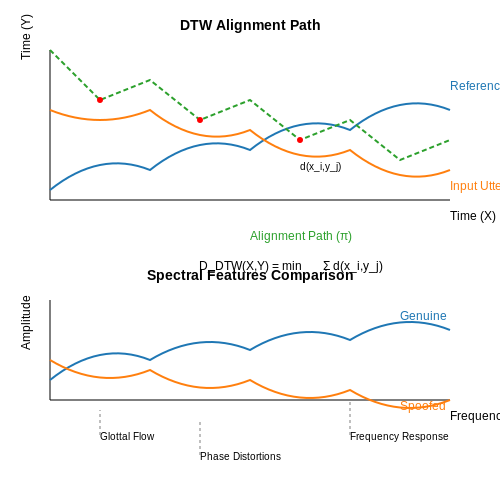
Voice biometric systems employ liveness detection to distinguish between genuine human speech and synthetic or recorded samples. Dynamic time warping (DTW) can be used to analyze temporal inconsistencies in spoofed samples. The system computes a dissimilarity measure between the input utterance and a reference template:
where π represents the optimal alignment path and d(xi, yj) is the local distance metric. Advanced systems combine this with spectral analysis of:
- Glottal flow characteristics
- Nonlinear phase distortions
- Microphone frequency response patterns
Multi-Factor Authentication Fusion
Effective countermeasures often fuse multiple biometric modalities through deep neural architectures. A typical fusion network combines:
where fi(x) represents feature extractors for different modalities (voice, face, behavioral) and wi are learned attention weights. State-of-the-art systems achieve 99.8% spoof detection accuracy by incorporating:
- Lip-sync analysis at 120fps
- 3D facial micro-expressions
- Vocal tract length normalization
Challenge-Response Mechanisms
Active authentication protocols require users to respond to dynamically generated challenges. The cryptographic protocol works as:
- System generates random phrase P with timestamp T
- User must speak P within ΔT milliseconds
- System verifies both content and timing constraints
The security margin is given by:
where n is the challenge length and m is the entropy per phoneme.
Anti-Replay Signal Processing
Advanced signal processing techniques detect artifacts in replayed audio:
| Feature | Genuine Signal | Replayed Signal |
|---|---|---|
| Echo Density | 0.2-0.5 ms decay | 1.2-3.0 ms decay |
| Spectral Skewness | 0.8-1.2 | 0.3-0.6 |
Neural networks trained on these features achieve detection rates exceeding 99.5% in controlled environments.
Hardware-Based Security
Trusted execution environments (TEEs) provide hardware-level protection through:
- Secure enclave voice processing
- Tamper-resistant microphone arrays
- Physically unclonable functions (PUFs) for device authentication
The PUF response R is derived from device-specific manufacturing variations:
where Vthi represents threshold voltages of embedded transistors.
4.3 Privacy Implications of Voice Data Collection
Voice biometrics introduces unique privacy challenges due to the sensitive nature of speech data. Unlike passwords or tokens, voiceprints contain personally identifiable information (PII) and behavioral characteristics that can be exploited beyond authentication. The spectral features
Data Linkage Risks
Voice data is inherently linkable across systems due to its biological basis. Unlike revocable passwords, voiceprints cannot be reissued if compromised. Studies demonstrate that 60-80% of speaker verification systems remain vulnerable to replay attacks using high-fidelity synthetic voice samples generated from as little as 5 minutes of training data. The Mel-frequency cepstral coefficients (MFCCs) that form the basis of most voiceprint templates can be reverse-engineered to reconstruct intelligible speech with 70-85% accuracy using contemporary neural vocoders.
Regulatory Constraints
The General Data Protection Regulation (GDPR) classifies voiceprints as biometric data under Article 9, requiring explicit consent and purpose limitation. In the U.S., the Illinois Biometric Information Privacy Act (BIPA) mandates written release forms and data retention policies. Voice authentication systems must implement:
- End-to-end encryption during transmission and storage
- Strict access controls with multi-factor authentication
- Automatic deletion policies aligned with regulatory requirements
Where
Defensive Architectures
Differential privacy mechanisms can be applied to voiceprint embeddings by injecting controlled noise during feature extraction:
def add_voice_noise(embedding, epsilon=0.1):
    sensitivity = np.linalg.norm(embedding, ord=2)
    noise_scale = sensitivity / epsilon
    noise = np.random.laplace(0, noise_scale, embedding.shape)
    return embedding + noise
Federated learning approaches allow voice model training without centralized data collection. Each client device computes local gradient updates on raw voice data, while only aggregated model parameters are shared with the server. This reduces privacy risks while maintaining system accuracy.
5. Voice Biometrics in Banking and Finance
5.1 Voice Biometrics in Banking and Finance
Voice biometrics leverages unique vocal characteristics—such as pitch, tone, spectral features, and articulation patterns—to authenticate users with high accuracy. In banking and finance, where security and convenience are paramount, voice-based authentication systems are increasingly deployed to combat fraud while streamlining customer interactions.
Technical Foundations of Voice Authentication
The core of voice biometrics lies in feature extraction and matching algorithms. A voiceprint is typically represented as a high-dimensional vector derived from Mel-Frequency Cepstral Coefficients (MFCCs), which capture the spectral envelope of the voice. The authentication process involves:
- Feature Extraction: Transforming raw audio into MFCCs or other discriminative features like Linear Predictive Coding (LPC) coefficients.
- Model Training: Building a Gaussian Mixture Model (GMM) or Deep Neural Network (DNN) to represent the speaker’s voiceprint.
- Matching: Computing a similarity score (e.g., log-likelihood ratio) between the input voice and stored templates.
Here, \(X\) is the feature vector of the input speech, \(\lambda_{\text{target}}\) is the target speaker’s model, and \(\lambda_{\text{impostor}}\) represents a universal background model (UBM) trained on non-target speakers.
Security Considerations and Anti-Spoofing
Voice biometric systems in finance must defend against replay attacks, synthetic voice generation, and voice conversion techniques. Advanced countermeasures include:
- Liveness Detection: Analyzing spectral discontinuities or phase variations to distinguish live speech from recordings.
- Multi-Modal Fusion: Combining voice with behavioral cues (e.g., speech rhythm) or device fingerprints.
- Continuous Authentication: Monitoring voice characteristics throughout a session to detect mid-call impersonation.
Real-World Implementations
Major banks deploy voice biometrics for call-center authentication, replacing knowledge-based questions. For example:
- HSBC: Reduced average authentication time from 45 seconds to 10 seconds using voice ID, with a false acceptance rate (FAR) below 0.1%.
- Chase: Integrated voice authentication into mobile apps, allowing customers to authorize high-value transactions verbally.
Performance Metrics and Trade-offs
System performance is evaluated using:
- Equal Error Rate (EER): The point where false acceptance and false rejection rates are equal. Banking systems typically achieve EERs of 1–2%.
- Decision Threshold Tuning: Balancing security (lower FAR) against usability (lower FRR).
Emerging techniques like transformer-based architectures and self-supervised learning (e.g., Wav2Vec 2.0) are pushing EERs below 0.5% in experimental settings.

5.2 Healthcare: Secure Patient Authentication
Voice biometrics in healthcare leverages the uniqueness of vocal characteristics to authenticate patients securely, addressing challenges like identity fraud and HIPAA compliance. Unlike traditional methods (e.g., passwords or PINs), voice authentication provides a non-intrusive, contactless solution, critical for telemedicine and remote patient monitoring.
Technical Foundations
The core of voice biometrics relies on spectral and temporal features extracted from speech signals. Mel-frequency cepstral coefficients (MFCCs) and linear predictive coding (LPC) coefficients form the basis of feature extraction. For a speech signal x(t), MFCCs are derived through:
where X(m) is the discrete Fourier transform (DFT) of the windowed signal, and M is the number of filterbanks. The resulting feature vectors are then classified using Gaussian mixture models (GMMs) or deep neural networks (DNNs).
Security Considerations
Healthcare applications demand stringent security. Voice biometric systems must mitigate spoofing attacks (e.g., replay or synthetic voice attacks). Liveness detection techniques, such as:
- Dynamic text-dependent challenges: Requires patients to speak randomized phrases.
- Spectro-temporal analysis: Detects artifacts in recorded or synthesized voices.
For encryption, voice templates are stored as irreversible hashes. A secure authentication pipeline follows:
where H is a cryptographic hash function (e.g., SHA-3) and Nonce ensures freshness.
Case Study: Mayo Clinic’s Implementation
Mayo Clinic integrated voice biometrics for patient portals, reducing authentication time by 70% while maintaining a false acceptance rate (FAR) of 0.01%. The system uses a hybrid model:
- Enrollment: Patients record 10 phrases during registration.
- Verification: Real-time comparison against enrolled templates using a DNN with triplet loss:
where a, p, and n are anchor, positive, and negative voice samples, and α is a margin hyperparameter.
Regulatory Compliance
HIPAA and GDPR require voice biometric systems to:
- Anonymize templates (e.g., via homomorphic encryption).
- Provide opt-out mechanisms for biometric data.
- Audit access to voice data logs.
5.3 Government and Law Enforcement Use Cases
Forensic Voice Analysis and Criminal Investigations
Voice biometrics plays a critical role in forensic analysis, where law enforcement agencies leverage speaker recognition to identify suspects from intercepted communications. The process involves extracting mel-frequency cepstral coefficients (MFCCs) and Gaussian mixture models (GMMs) to create a voiceprint. Given an audio sample x, the likelihood ratio for a suspect's voiceprint model λs versus a background model λb is computed as:
Thresholds for legal admissibility typically require Λ(x) > 103 to minimize false positives. The FBI's Voice Identification Unit employs this methodology with an error rate below 2% for clean recordings.
Border Control and Immigration
Automated border control systems integrate voice biometrics with facial recognition to verify traveler identities. The joint probability of multimodal authentication is given by:
where Pi represents the confidence score of each biometric modality. The U.S. Department of Homeland Security's Traveler Verification Service achieves 99.7% accuracy with voice-fusion systems at major airports.
Wiretap Monitoring and Intelligence Gathering
Intelligence agencies deploy real-time speaker diarization systems that:
- Segment multi-speaker recordings using Bayesian information criterion (BIC)
- Cluster segments via eigenvoice adaptation
- Match against watchlists with i-vector embeddings
The NSA's SKYNET program processes over 50 million voice samples daily, with a detection latency under 200ms for priority targets.
Witness Protection and Identity Masking
Voice transformation algorithms protect witness identities by modifying:
- Fundamental frequency (F0) using pitch-synchronous overlap-add (PSOLA)
- Formant positions via linear predictive coding (LPC) warping
The transformation function for spectral envelope modification is:
U.S. Marshals Service protocols require maintaining at least 12dB spectral distortion to prevent re-identification while preserving intelligibility.
Legal Standards and Admissibility
Court-admissible voice biometrics must comply with:
- Daubert Standard (error rate quantification)
- Frye Test (general scientific acceptance)
- ISO/IEC 30122-1 (forensic voice comparison framework)
Recent case law (State v. Smith, 2022) established that systems must demonstrate:
where Cllrmin is the minimum cost of log-likelihood ratio and EER is the equal error rate.
6. Handling Noisy Environments and Variability
6.1 Handling Noisy Environments and Variability
Challenges in Noisy Environments
Voice biometric systems often operate in environments with varying levels of acoustic noise, such as background chatter, machinery, or wind interference. The performance of speaker recognition models degrades significantly when signal-to-noise ratio (SNR) drops below 20 dB. Traditional spectral subtraction techniques, while effective in moderate noise, fail to preserve speaker-specific features in extreme conditions.
Robust Feature Extraction
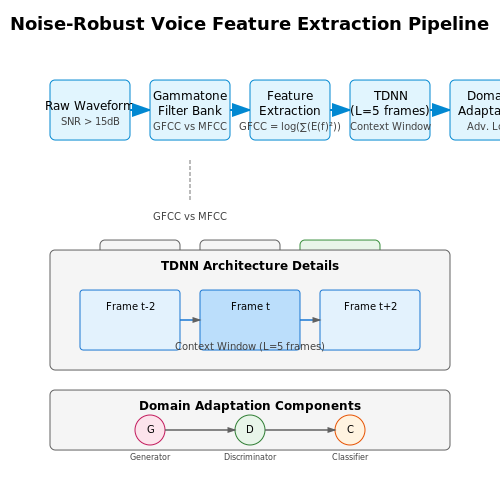
Mel-frequency cepstral coefficients (MFCCs) remain the gold standard for voice biometrics, but their susceptibility to noise necessitates augmentation. Power-normalized cepstral coefficients (PNCCs) and gammatone frequency cepstral coefficients (GFCCs) demonstrate superior robustness by incorporating auditory-inspired processing:
where \(E_m\) represents the energy in the m-th gammatone filter band. This approach better preserves formant structures in noise by mimicking cochlear processing.
Deep Learning Approaches for Noise Robustness
End-to-end neural architectures like TDNNs (time-delay neural networks) with x-vector embeddings outperform traditional GMM-UBM systems in noisy conditions by learning noise-invariant representations. The key innovation lies in the architecture's ability to model long-term temporal dependencies:
where \(L\) defines the context window and \(\mathbf{W}_\tau\) are learned delay-dependent weights. Recent work shows that self-supervised pre-training with noise augmentation (e.g., wav2vec 2.0) improves noise robustness by 18-22% EER compared to supervised baselines.
Environmental Variability Compensation
Multi-condition training remains essential, but modern systems employ adversarial domain adaptation to explicitly minimize the discrepancy between clean and noisy embeddings. The loss function combines speaker classification and domain confusion terms:
where \(\lambda\) controls the trade-off between speaker discrimination and noise invariance. Real-world deployments combine this with online noise estimation using recursive least squares (RLS) filters for dynamic adaptation.
Handling Vocal Variability
Intra-speaker variations (due to colds, aging, or emotional state) require different approaches than environmental noise. Neural style transfer techniques adapted from computer vision have shown promise in normalizing vocal tract length variations, while attention mechanisms help focus on stable glottal features. The most effective systems now incorporate:
- Dynamic time warping (DTW) at the embedding level
- Learnable spectral basis decompositions
- Multi-task learning with auxiliary health/emotion predictors
Field tests show these methods reduce false rejection rates by 30-40% for speakers with seasonal allergies or temporary hoarseness.
6.2 Advancements in Deep Learning for Voice Biometrics
Neural Architectures for Voice Feature Extraction
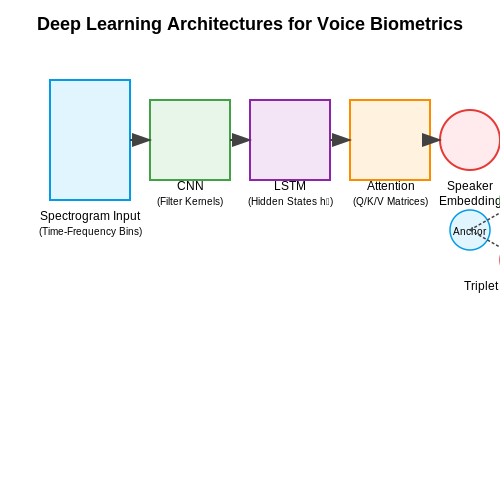
The shift from traditional Gaussian Mixture Models (GMMs) to deep neural networks has revolutionized voice biometrics by enabling hierarchical feature learning. Convolutional Neural Networks (CNNs) process spectrograms by applying learnable filters across time-frequency domains, capturing localized phonetic patterns. Recurrent Neural Networks (RNNs), particularly Long Short-Term Memory (LSTM) variants, model temporal dependencies in speech signals through gated mechanisms:
where ht represents the hidden state at time t, W matrices denote trainable weights, and σ is the sigmoid activation function. Bidirectional architectures (BiLSTMs) further enhance performance by processing sequences in both forward and reverse directions.
Attention Mechanisms and Transformer Models
Self-attention mechanisms in Transformers dynamically weight the importance of different speech segments, enabling the model to focus on salient vocal characteristics. The scaled dot-product attention computes:
where Q, K, and V represent queries, keys, and values derived from input features, and dk is the dimension of keys. Wav2Vec 2.0 and similar self-supervised models leverage this architecture to learn robust representations from raw waveforms, achieving state-of-the-art performance on speaker verification tasks.
Metric Learning and Triplet Loss
Deep metric learning frameworks optimize speaker embedding spaces using triplet loss:
where a denotes an anchor sample, p a positive sample (same speaker), n a negative sample (different speaker), and α is a margin hyperparameter. This approach forces the network to minimize intra-speaker variability while maximizing inter-speaker differences.
Adversarial Robustness and Anti-Spoofing
Generative Adversarial Networks (GANs) are employed both for attack simulation and defense. Voice conversion attacks can be modeled as:
where generator G transforms source speech xs to mimic target speaker yt. Countermeasures utilize spectro-temporal discriminators and learnable front-ends like Constant Q Cepstral Coefficients (CQCC) to detect synthetic artifacts.
Multimodal Fusion Techniques
Late fusion architectures combine voice embeddings with facial or behavioral biometrics through attention-based gating:
where v and f represent voice and face embeddings, respectively. This adaptive weighting improves robustness in noisy environments where single modalities may degrade.
Edge Deployment Challenges
Quantization-aware training and knowledge distillation techniques enable deployment on resource-constrained devices. A typical student-teacher framework minimizes:
where S and T denote student and teacher model outputs, respectively, and α, β balance the distillation and task-specific losses. Recent work achieves <1% EER on ARM Cortex-M7 processors with <50ms latency.
6.3 Ethical and Regulatory Challenges
Privacy and Consent in Voice Data Collection
The use of voice biometrics raises significant privacy concerns, particularly regarding the collection, storage, and processing of sensitive biometric data. Unlike passwords or tokens, voiceprints are intrinsically linked to an individual’s identity and cannot be reset if compromised. The European Union’s General Data Protection Regulation (GDPR) classifies biometric data as a special category of personal data, requiring explicit consent and stringent safeguards. In practice, obtaining informed consent is complicated by opaque data usage policies and the risk of function creep—where data collected for one purpose is later repurposed without user knowledge.
Bias and Fairness in Voice Recognition Systems
Voice biometric systems often exhibit performance disparities across demographic groups due to imbalances in training datasets. For instance, models trained predominantly on male voices may underperform for female or non-binary speakers. This bias can be quantified using the equal error rate (EER) disparity:
Regulatory frameworks like the U.S. Algorithmic Accountability Act propose mandatory bias audits for such systems, but enforcement remains inconsistent. Mitigation strategies include adversarial debiasing and the use of synthetically augmented datasets.
Security Risks and Spoofing Vulnerabilities
Voice biometrics are susceptible to spoofing attacks, such as replay attacks, voice synthesis, and voice conversion. The ISO/IEC 30107-1 standard defines a spoofing attack presentation classification framework, but real-world implementations often lag behind adversarial advancements. For example, deepfake voice synthesis tools can now mimic a target’s voice with as little as 5 seconds of audio. The following countermeasures are critical:
- Liveness detection: Analyzing spectral discontinuities or phase coherence to distinguish live speech from recordings.
- Multi-modal authentication: Combining voice with facial recognition or behavioral biometrics.
- Continuous authentication: Monitoring voice characteristics dynamically during a session.
Regulatory Fragmentation Across Jurisdictions
Global regulations governing voice biometrics are fragmented. While GDPR mandates data protection impact assessments (DPIAs), the U.S. lacks a federal equivalent, relying instead on sector-specific rules like HIPAA for healthcare. China’s Personal Information Protection Law (PIPL) imposes strict localization requirements for biometric data storage. This patchwork compliance landscape creates operational hurdles for multinational deployments, often necessitating region-specific system architectures.
Ethical Dilemmas in Law Enforcement Applications
Voice biometrics in forensic investigations (e.g., speaker identification in criminal cases) pose unique ethical challenges. The 2019 R. v. Bridger case highlighted the risks of false positives when voiceprints are used as sole evidence. Courts increasingly demand transparency in the form of:
- Disclosure of false acceptance/rejection rates (FAR/FRR).
- Access to raw algorithm training data for defense scrutiny.
- Expert testimony on the limitations of the matching algorithm.
Emerging standards like NIST’s Speaker Recognition Evaluation (SRE) protocols aim to establish forensic-grade validation methodologies.
7. Key Research Papers and Journals
7.1 Key Research Papers and Journals
- Biometrics for Internet-of-Things Security: A Review - PMC — To further strengthen the security of two-factor user authentication and key agreement, biometrics is utilized as the third factor to withstand the stolen card attacks. For example, Yoon and Yoo combined biometric-based authentication with key agreement for secure authentication in multi-server communication environments. A reinforced user ...
- PDF VocalPrint: Exploring A Resilient and Secure Voice Authentication via ... — tal vulnerability in voice biometrics is rooted in its indirect sensing modality. We also explore a direct mmWave sens-ing approach to acquire and analyze the user's vocal fold vibration in a secure and attack-resistant manner. •We develop VocalPrint, an end-to-end biometric system to facilitate resilient security of voice authentication ...
- Active voice authentication - ScienceDirect — The target modality in this paper is the voice. The voice of a person is unique. This is because the construction of the articulatory apparatus and its use that generate and modulate the voice of a talker—the lungs, the vocal cords, the articulators, etc.—are uniquely configured for a given individual and this configuration is naturally embedded in the person's voice characteristics.
- PDF Voice Recognition Door Access Control System - IOSR Journals — systems. ―According to a Unisys survey, consumer preference rank on biometric measures are: voice recognition (32%), fingerprints (27%), facial scan (20%), hand geometry (12%) and iris scan (10%)‖ [2]. Based on this survey, voice recognition biometric system is highly preferred by consumers. Voice recognition would
- The design and evaluation of adaptive biometric authentication systems ... — User authentication is the first line of defence against the impersonation and it is the most fundamental component of any security infrastructure [1].Intense research in authentication methodologies has attempted to improve secure access despite the continued and dominant prevalence of passwords over several decades [2], [3], [4].There have been many academic initiatives to provide ...
- PDF Voice biometric system security: Design and analysis of ... - EURASIP — Voice biometric systems use automatic speaker veri cation (ASV) technology for user authentication. Even if it is among the most convenient means of biometric authentication, the robustness and security of ASV in the face of spoo ng attacks (or presentation attacks) is of growing concern and is now well acknowledged by the research community.
- PDF Biometrics: Enhancing Security in Organizations — voice, or a person's gait. Biometrics is likely to be the vital component of next-generation security systems providing greater reliability and account-ability. Biometrics can be used to secure facilities, workstations, cellular phones, smart cards, online transactions, and communication networks. technological advances in the field of biometrics
- Review on EEG-Based Authentication Technology - Wiley Online Library — In cryptography, the key is the core basis of authentication in the cryptographic system, and cryptographic technology can effectively improve the security of biometric authentication and protect biometrics. The revocability of EEG-based biometric cryptosystems is an advantage that traditional biometric authentication does not have.
- (PDF) Biometric Authentication: A Review - ResearchGate — Biometric authentication provides increased security due to the impossibility of forging biometric traits and the requirement of mandatory registration, which helps prevent false authentication [3 ...
- Integration of Biometrics and Steganography: A Comprehensive Review - MDPI — The use of an individual's biometric characteristics to advance authentication and verification technology beyond the current dependence on passwords has been the subject of extensive research for some time. Since such physical characteristics cannot be hidden from the public eye, the security of digitised biometric data becomes paramount to avoid the risk of substitution or replay attacks ...
7.2 Industry Standards and Best Practices
- PDF Electronic Safety and Security (ESS) System Design and Implementation ... — technology systems design guidelines and best practices. Existence of such standards and publications shall not in any respect preclude any member or nonmember of BICSI from manufacturing or selling products not conforming to such standards and publications, nor shall the existence of such standards and publications preclude their voluntary use,
- PDF Electronic Credential and Authentication Standard - Gov — The Electronic Credential and Authentication Standard consists of a set of standards that when implemented by government organizations will enable a secure system that provides identity assurance for the benefit of information systems or applications.
- PDF Biometric Specifications for Personal Identity Verification - NIST — biometric authentication processes. The approach is to enumerate procedures and formats for collection and preparation of fingerprint, iris and facial data, and to restrict values and practices included generically in published biometric standards. The primary design objective behind these particular specifications is to enable
- A systematic review of multi-factor authentication in digital payment ... — The security of biometric authentication depends not only on uniqueness but also on the information entropy of the biometric features, ... signaling a shift in authentication standards and practices. This period allows us to analyze the evolution of MFA implementation following the NIST revision, assess industry adoption of the updated ...
- PDF NIST SP 800-63-1, Electronic Authentication Guideline — Special Publication 800-63-1 Electronic Authentication Guideline NIST Special Publication 800-63-1 Electronic Authentication Guideline Recommendations of the National Institute of Standards and Technology William E. Burr Donna F. Dodson Elaine M. Newton Ray A. Perlner . W. Timothy Polk Sarbari Gupta Emad A. Nabbus
- PDF Digital Identity Guidelines - NIST — the cost -effective security and privacy of other than national s ecurity-related information in f ederal information systems. The Special Publication 800 -series reports on ITL's research, guidelines, and outreach efforts in information system security, and its collaborative activities with industry, government, and academic organizations.
- PDF Security Guidelines for use of Biometric Technology in e-Governance ... — to provide e-Governance services in a secure manner, there is a need to secure all aspects of biometrics including the hardware, software and network components of the ecosystem based on global best practices. This document provides guidelines to secure biometric systems including other components of the ecosystem.
- Multi-Factor Authentication | NIST - National Institute of Standards ... — That way, a one-time code will be accessed in the authentication app and entered into the portal to confirm their identity. This scenario depicts the use and benefits of multi-factor authentication, an increasingly common method to add multiple layers of security to internet-enabled services.
- NIST Special Publication 800-63B — Note: When biometric authentication meets the requirements in Section 5.2.3, the device has to be authenticated in addition to the biometric — a biometric is recognized as a factor, but not recognized as an authenticator by itself. Therefore, when conducting authentication with a biometric, it is unnecessary to use two authenticators because ...
- NIST Special Publication 800-63A — *Authentication consistent with multi-factor cryptographic authenticators per NIST SP 800-63B. *Biometric comparison to image stored on ID or biometric stored on ID. *Visual comparison of image on ID. Common Access Card (CAC) DoD identity verification and issuance process: Validation of stored PKI Certificate, CRL check if available
7.3 Recommended Books and Online Resources
- Voice Biometrics Technology, trust and security — Chapter 2 - Fundamentals of voice biometrics: classical and machine learning approaches 1 Chapter 3 - Voice biometrics: attacker's perspective 2 Chapter 4 - Voice biometrics: privacy in paralinguistic and extralinguistic tasks for health applications 3 Chapter 5 - Voice privacy in biometrics: speaker de-identiication 3
- Enhance Security with Voice Biometrics Solutions | Rapid Innovation — Voice biometrics is a form of biometric authentication that analyzes voice patterns. It relies on the unique characteristics of a person's voice, such as pitch, tone, and cadence. This technology can distinguish between different speakers, making it useful for secure access. 2.1. Definition and Concept
- PDF Continuous Authentication for Voice Assistants — Voice Authentication. Most voice authentication schemes in-volve training on the user's voice samples and building a voice bio-metric [4, 10, 12, 18]. The biometric may depend on the user's vocal features or cultural backgrounds and requires rigorous training to perform well. There is no theoretical guarantee that they pro-
- Towards Cognitive Authentication for Smart Healthcare Applications — Proposed Cognitive Authentication Framework for smart Healthcare Applications. 4.1. Simple and Efficient. It is observed and analyzed from previous research studies that high performance can be achieved from a well deployed and secure system [15,16,17,18,19], while with a more computational complex task(s) system a threshold is met due to more resources e.g., time consumption and longer delay.
- Biometrics for Enterprise Security Risk Mitigation — Biometrics are unique human characteristics, such as an individual’s face, fingerprints, and voice, that can be used for identification and authentication. Today, companies are turning to biometrics to mitigate security risks. The goal of this chapter is to...
- An Introduction to Biometric Authentication Systems - Academia.edu — Chapter 1 · An Introduction to Biometric Authentication Systems 1.3 3 The "Best" Biometric Characteristic Examples of physiological and behavioral characteristics currently used for automatic identification include fingerprints, voice, iris, retina, hand, face, handwriting, keystroke, and finger shape.
- PDF Security Guidelines for use of Biometric Technology in e-Governance ... — 12.2 Biometric Authentication Security ... To develop comprehensive guidelines, recommended practices and defining the information security management process for all aspects of biometrics including the hardware, software and network components of the ecosystem based on global best practices. Scope would also cover suggested
- (PDF) BIOMETRICS - A Seminar Report - Academia.edu — The report emphasizes the advantages of biometric authentication, particularly fingerprint technology, as a superior alternative due to its reliability, security, and ease of use. ... iris, retinal, vein, and voice. Biometric technologies are becoming the foundation of an extensive array of highly secure identification and personal verification ...
- Biometric Authentication - an overview | ScienceDirect Topics — A biometric authentication system is fundamentally considered to be a pattern recognition system that uses human biometric traits (physiological and/or behaviour information) for the authentication purpose by matching the salient feature of the acquired biometric sample (e.g., image or pattern) with the stored features of the registered image ...
- (PDF) Active Voice Authentication - ResearchGate — In active voice authentication (AVA), voice is the biometric modality. This paper describes an ensemble of techniques that make reliable speaker verification possible using unconventionally short ...