Commonsense Knowledge in AI Systems
1. Defining Commonsense Knowledge and Its Importance
1.1 Defining Commonsense Knowledge and Its Importance
Commonsense knowledge refers to the implicit, broadly shared understanding of the physical and social world that humans acquire through experience. Unlike domain-specific expertise, it encompasses fundamental truths about time, space, causality, intentions, and typical behaviors that are rarely explicitly stated but form the substrate of human reasoning. In formal terms, commonsense knowledge can be represented as a probabilistic graph G = (V, E) where vertices V represent concepts (e.g., "objects fall when dropped") and edges E encode relational probabilities between them.
Formal Characterization
The mathematical foundation of commonsense reasoning draws from default logic and non-monotonic reasoning. A default rule takes the form:
where α is the prerequisite, β the justification, and γ the consequent. This allows systems to make plausible assumptions (e.g., "birds typically fly") that can be retracted when contradictory evidence appears (e.g., encountering a penguin). The logical incompleteness of commonsense knowledge bases necessitates probabilistic frameworks like Markov Logic Networks that combine first-order logic with statistical weights:
where wi are learned weights for logical clauses and ni(x) counts true groundings.
Operational Challenges
Four key problems emerge when implementing commonsense reasoning:
- Frame Problem: Determining which facts remain valid after an action (e.g., knowing a moved object retains its color)
- Qualification Problem: The impracticality of enumerating all preconditions for actions (e.g., infinite ways a "grasping" action could fail)
- Ramification Problem: Cascading indirect effects of actions (e.g., turning on a light implies power consumption)
- Symbol Grounding Problem: Connecting abstract symbols to sensory-motor experiences
Benchmarks and Evaluation
Modern evaluation frameworks like CommonsenseQA and PIQA measure systems through:
where yi is the human consensus answer. State-of-the-art language models achieve ~80% on these benchmarks but fail at compositional generalization - combining known facts in novel ways (e.g., inferring that "a balloon filled with helium will rise unless tethered" requires chaining multiple physical concepts).
Architectural Approaches
Three dominant paradigms exist:
- Symbolic: Hand-crafted knowledge graphs like Cyc (with ~25 million assertions) using description logics
- Neural: Latent knowledge in LLM parameters, extractable through prompt engineering
- Hybrid: Neuro-symbolic systems like COMET that fine-tune transformers on knowledge graph trajectories
The knowledge-neuron hypothesis suggests that transformer models localize specific facts in sparse subnetworks, enabling targeted editing of commonsense knowledge without full retraining. This is formalized through gradient-based attribution:
where an is the activation of neuron n for training examples D.
Key Characteristics of Commonsense Reasoning
Commonsense reasoning in AI systems is distinguished by several defining characteristics that set it apart from narrow, task-specific reasoning. These properties emerge from the need to handle real-world ambiguity, contextual variability, and implicit knowledge that humans take for granted.
Non-Monotonicity and Default Reasoning
Unlike formal logical systems, commonsense reasoning is non-monotonic – conclusions may be retracted when new evidence emerges. This is formalized through default logic:
where α is the prerequisite, β the justification, and γ the consequent. The inference holds unless contradictory evidence appears. For example, "birds typically fly" allows inferring flight capability for a robin unless we learn it's wingless.
Contextual Sensitivity
Commonsense conclusions depend critically on context, requiring dynamic representation of situational factors. The same statement "the box is light" implies different weight thresholds when discussing shipping packages versus quantum particles. Contextual embeddings can model this through attention mechanisms:
where queries Q, keys K, and values V adapt based on contextual cues.
Plausible Inference Under Uncertainty
Commonsense reasoning operates with probabilistic confidence rather than binary certainty. Bayesian networks capture this through conditional probability distributions:
For instance, seeing wet grass may assign probabilities to recent rain (70%), sprinkler activity (25%), or other causes (5%), updated as observations accumulate.
Abductive Nature
Commonsense often involves abductive reasoning – inferring the most plausible explanation for observations. This is formalized as:
where H is the hypothesis and E the evidence. For example, hearing footsteps at night suggests a family member (high prior) rather than an intruder (low prior).
Ontological Breadth
Effective commonsense requires knowledge spanning physical, social, and psychological domains. This is quantified through knowledge graph completeness metrics:
Modern systems like COMET achieve 0.82 coverage on standardized benchmarks, still trailing human performance (0.95+).
Temporal Projection
Commonsense includes reasoning about persistent and changing properties over time. The event calculus handles this through fluents:
allowing inferences like "if milk was fresh yesterday and not left out, it's still good today."
These characteristics collectively define the challenges in replicating human-like commonsense in AI systems, requiring advances in knowledge representation, probabilistic reasoning, and contextual understanding beyond current deep learning paradigms.
1.3 Challenges in Encoding Commonsense Knowledge
Encoding commonsense knowledge into AI systems presents several fundamental challenges rooted in the nature of human cognition, the ambiguity of real-world contexts, and the limitations of formal representation methods. Unlike domain-specific knowledge, commonsense reasoning relies on implicit, often unstated assumptions that are difficult to codify explicitly.
Ambiguity and Context-Dependence
Human commonsense reasoning is highly context-dependent, with meanings shifting based on situational cues. For example, the statement "The chicken is ready to eat" could imply that the chicken is cooked (if spoken by a chef) or hungry (if observed on a farm). Current knowledge representation frameworks struggle with such polysemy because they typically rely on static, context-free embeddings or symbolic relations. Neural language models attempt to address this through contextual word embeddings, but they still lack robust mechanisms for dynamically adjusting interpretations based on situational awareness.
Scale and Coverage
The breadth of commonsense knowledge is vast, spanning physical laws (e.g., "objects fall when dropped""don't interrupt conversations"), and psychological intuitions (e.g., "people feel sad when insulted"). The Cyc project, one of the most ambitious attempts at formalizing commonsense, required over 30 years of manual curation to encode ~25 million rules—yet still fails to cover edge cases. The combinatorial explosion of possible scenarios makes exhaustive enumeration impractical. Probabilistic knowledge graphs partially mitigate this by learning from corpora, but they inherit biases and gaps from training data.
where φ and θ are embedding functions for contexts and inferences, respectively. This softmax formulation illustrates how neural approaches model plausibility, but the denominator's summation over all possible inferences N becomes computationally intractable for open-world reasoning.
Temporal and Causal Dynamics
Commonsense often involves understanding how events unfold over time and their causal relationships. For instance, recognizing that "flipping a light switch causes illumination" requires modeling preconditions (switch is functional), interventions (finger motion), and effects (photons emitted). Current temporal knowledge graphs struggle with:
- Continuous processes: Representing gradual changes like "ice melts when heated" requires differential equations alongside symbolic predicates.
- Counterfactuals: Reasoning about what would happen if an action were taken (e.g., "if the car had braked, the collision would be avoided") demands modal logics that most systems lack.
Grounding in Perception
Human commonsense is tightly coupled with sensory-motor experience—we understand "glass is fragile" because we've seen it shatter. AI systems typically learn from text alone, creating a symbol grounding problem where words lack connection to physical referents. Multimodal models like CLIP attempt to bridge this by aligning visual and linguistic embeddings:
where fv and fl are vision and language encoders. However, such models still fail to capture intuitive physics (e.g., predicting how stacked objects will topple) or affordances (e.g., recognizing that chairs are for sitting).
Ethical and Cultural Variability
Commonsense norms vary across cultures—direct eye contact may signal respect or aggression depending on context. Most knowledge bases encode Western perspectives, leading to biased inferences when deployed globally. Mitigating this requires either:
- Culturally-aware embeddings: Learning separate representations for different demographics, though this risks stereotyping.
- Meta-reasoning frameworks: Systems that explicitly model cultural contexts as first-class variables in inference.
Recent work in intercultural NLP frames this as a distributional shift problem, where the goal is to minimize the KL divergence between knowledge distributions across groups:
2. Symbolic and Logic-Based Representations
Symbolic and Logic-Based Representations
Symbolic AI systems represent commonsense knowledge using formal logic, ontologies, and rule-based frameworks. These approaches rely on explicit, human-readable representations of facts and rules, enabling precise reasoning but requiring extensive manual curation. First-order logic (FOL) serves as the foundation, where predicates express relationships between entities, and quantifiers (∀, ∃) generalize statements.
First-Order Logic for Commonsense Reasoning
FOL captures propositions like "All humans are mortal" as:
Inference engines apply modus ponens to derive conclusions. For instance, given Human(Socrates), the system deduces Mortal(Socrates). While expressive, FOL struggles with defaults (e.g., "Birds typically fly") and contextual exceptions (penguins). Non-monotonic logics address this through:
- Default Logic: Introduces inference rules with exceptions (Reiter, 1980).
- Circumscription: Minimizes abnormal predicates to handle edge cases (McCarthy, 1986).
Frame Systems and Semantic Networks
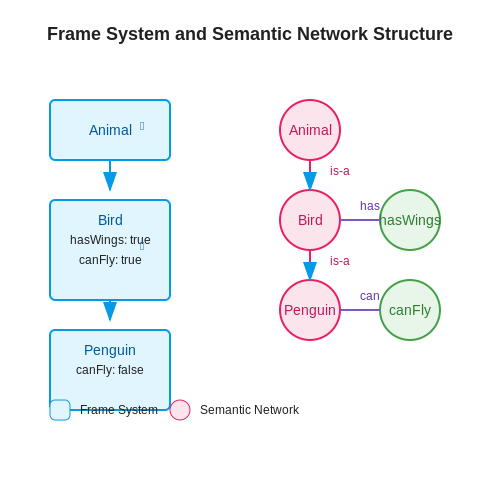
Frames (Minsky, 1974) hierarchically organize knowledge via slots (attributes) and inheritance. A Bird frame may include slots like hasWings: true and canFly: true, with exceptions handled via override mechanisms. Semantic networks graph relationships using nodes (concepts) and edges (relations), enabling efficient traversal but lacking formal semantics.
Description Logics (DLs)
DLs formalize frame systems with decidable reasoning. The ALC logic defines concepts (C), roles (R), and constructors:
where A is an atomic concept. Modern variants like SROIQ underpin the Web Ontology Language (OWL), enabling automated classification of entities (e.g., inferring that Penguin ⊑ ¬FlyingBird).
Challenges and Limitations
Symbolic approaches face three key issues:
- Knowledge Acquisition Bottleneck: Manual encoding scales poorly (Lenat et al., 1990).
- Contextual Flexibility: Rigid representations fail to handle nuanced real-world scenarios.
- Probabilistic Uncertainty: Binary truth values poorly model partial or conflicting evidence.
Hybrid neuro-symbolic systems (e.g., DeepProbLog) integrate neural networks with probabilistic logic to mitigate these limitations, using differentiable reasoning layers to learn from data while retaining interpretability.
Knowledge Graphs and Ontologies
Formal Representation of Commonsense Knowledge
Knowledge graphs (KGs) provide a structured framework for representing commonsense knowledge as interconnected entities and relations. A KG is formally defined as a directed labeled multigraph G = (V, E, L), where:
- V is a set of vertices representing entities or concepts
- E is a set of directed edges representing relations
- L is a labeling function mapping edges to relation types
Ontologies extend this representation by adding formal semantics through description logics. The Web Ontology Language (OWL) provides constructs for:
- Class hierarchies: SubClassOf(Bird, Animal)
- Property restrictions: ∀hasWing.Bird
- Disjointness axioms: Disjoint(Living, NonLiving)
Knowledge Graph Embedding Methods
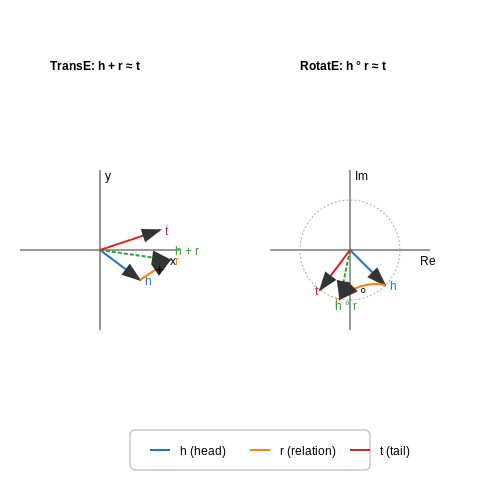
Vector space embeddings enable reasoning over KGs by projecting entities and relations into continuous space. The translational embedding model TransE minimizes:
where γ is a margin hyperparameter and [·]+ denotes the hinge function. More advanced models like RotatE employ complex vector spaces:
Ontology Alignment and Reasoning
Aligning heterogeneous ontologies requires solving the entity resolution problem through similarity measures. The Jaccard similarity for concepts A and B is computed as:
Description logic reasoners like HermiT use tableau algorithms to check:
- Concept satisfiability: Can a concept have instances?
- Subsumption: Does C ⊑ D hold?
- Consistency: Does the ontology contain contradictions?
Applications in Commonsense Reasoning
Modern systems combine neural networks with symbolic KGs. The K-BERT model injects KG triples into transformer attention:
where MKG is a mask matrix encoding relevant KG paths. This approach achieves 8.2% improvement on COPA commonsense reasoning benchmarks compared to pure LM baselines.
Industrial applications include Google's Knowledge Graph (covering 500B+ facts) and Amazon's Product Graph (modeling 1B+ product relationships). These systems employ distributed graph databases like Neo4j with throughput exceeding 100k queries/second.

Embedding-Based Methods for Commonsense Knowledge
Embedding-based methods represent commonsense knowledge in continuous vector spaces, enabling neural models to reason about relationships between entities, events, and abstract concepts. These approaches leverage distributional semantics, where the geometric arrangement of embeddings encodes relational patterns.
Knowledge Graph Embeddings
Structured commonsense knowledge graphs (e.g., ConceptNet, ATOMIC) use embedding techniques like TransE, DistMult, or RotatE to model relations as geometric transformations. For a triplet (head, relation, tail), TransE learns embeddings such that:
where h, r, t are the embeddings of head, relation, and tail respectively. The scoring function minimizes:
RotatE extends this by modeling relations as rotations in complex space:
Contextualized Embeddings for Implicit Knowledge
Pre-trained language models like BERT and GPT capture implicit commonsense through contextualized embeddings. The self-attention mechanism in transformers builds representations that encode:
- Prototypical event sequences (e.g., "rain" → "wet")
- Causal relationships (e.g., "throw ball" → "ball moves")
- Social norms (e.g., "greet friend" → "smile")
The embedding space organizes concepts by functional similarity rather than lexical proximity. For example, "coffee" and "tea" cluster near "drink" but maintain distinct relationships with "caffeine".
Hybrid Neuro-Symbolic Approaches
Recent work combines symbolic knowledge graphs with neural embeddings through:
where Ws and Wn are learned projection matrices, and σ is a non-linearity. Systems like COMET finetune language models on knowledge graph completion tasks, generating embeddings that satisfy both distributional and symbolic constraints.
Evaluation Metrics
Embedding quality is assessed through:
- Intrinsic evaluation: Analogical reasoning (e.g., "man:king :: woman:?") using cosine similarity
- Extrinsic evaluation: Downstream task performance on Winograd Schema, COPA, or Story Cloze tests
The vector space should exhibit linear analogies for compositional relationships:
Challenges and Limitations
Current limitations include:
- Difficulty modeling rare or abstract concepts (e.g., "justice")
- Brittleness to adversarial perturbations in the input space
- Lack of explicit uncertainty quantification in predictions
Emerging solutions involve energy-based models that assign probabilities to embeddings:
where M is a learned metric tensor and Z the partition function.
3. Supervised and Unsupervised Learning Techniques
3.1 Supervised and Unsupervised Learning Techniques
Supervised learning techniques leverage labeled datasets to train models, where each input x is paired with a corresponding output y. The objective is to learn a function f: X → Y that minimizes the discrepancy between predicted and actual outputs. Common algorithms include linear regression, support vector machines (SVMs), and deep neural networks. The loss function for supervised learning is typically defined as:
where ℓ is a differentiable loss function (e.g., mean squared error or cross-entropy), and θ represents the model parameters. Gradient descent or its variants (e.g., Adam, RMSprop) optimize this loss by iteratively updating θ via backpropagation.
Key Challenges in Supervised Learning
Supervised methods require large, high-quality labeled datasets, which are often expensive or impractical to obtain. Label noise, class imbalance, and distribution shifts between training and test data further complicate model generalization. Techniques such as data augmentation, semi-supervised learning, and transfer learning mitigate these issues by leveraging auxiliary data or synthetic samples.
Unsupervised Learning and Commonsense Knowledge
Unsupervised learning operates on unlabeled data, seeking to uncover latent structures or patterns. Clustering (e.g., k-means, DBSCAN) and dimensionality reduction (e.g., PCA, t-SNE) are classical approaches, while modern methods like variational autoencoders (VAEs) and generative adversarial networks (GANs) learn probabilistic data representations. The objective often involves maximizing a likelihood function:
Self-supervised learning bridges the gap by generating pseudo-labels from raw data (e.g., predicting masked tokens in BERT or solving jigsaw puzzles in contrastive learning). These techniques implicitly encode commonsense knowledge by learning from large-scale corpora or multimodal datasets.
Hybrid Approaches
Weakly supervised and self-training frameworks combine labeled and unlabeled data to improve robustness. For instance, a teacher model generates pseudo-labels for unlabeled data, which a student model then learns from. The iterative process refines the model’s ability to generalize, as formalized by the following optimization:
where λ balances supervised and unsupervised losses, and ŷ denotes pseudo-labels. Such methods are particularly effective in domains like natural language processing, where pretraining on vast text corpora (e.g., GPT, T5) transfers commonsense reasoning capabilities to downstream tasks.
3.2 Leveraging Large Language Models for Commonsense
Large language models (LLMs) have emerged as powerful tools for encoding and reasoning with commonsense knowledge due to their ability to capture implicit patterns from vast textual corpora. Unlike traditional knowledge graphs, which rely on explicit symbolic representations, LLMs learn probabilistic associations between concepts, enabling them to infer plausible relationships even when not explicitly stated in training data.
Architectural Foundations for Commonsense Reasoning
The transformer architecture underlying modern LLMs provides several key advantages for commonsense reasoning:
- Attention mechanisms allow models to dynamically weight relevant context when making inferences, mirroring human reasoning processes.
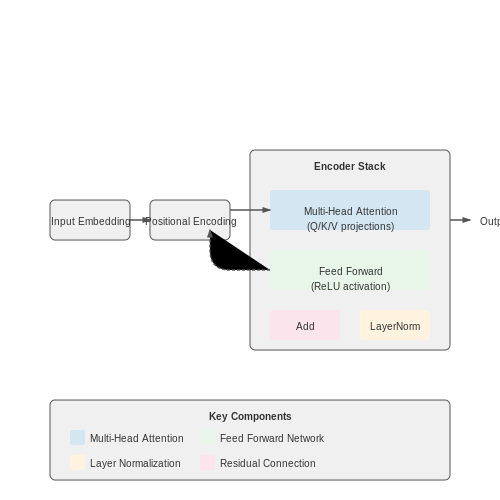
- Multi-head attention enables parallel processing of different relationship types simultaneously.
- Positional embeddings preserve sequential and hierarchical information critical for temporal and causal reasoning.
The self-supervised pretraining objective (typically masked language modeling) forces models to develop rich internal representations of world knowledge. For a sequence of tokens x1,...,xn, the model learns to predict masked tokens based on context:
where ht is the hidden state at position t, and W, b are learned parameters.
Knowledge Acquisition and Representation
LLMs acquire commonsense knowledge through several complementary mechanisms:
- Direct statement absorption: Explicit facts present in training data (e.g., "water boils at 100°C")
- Implicit pattern recognition: Statistical regularities across many examples (e.g., learning that objects fall when dropped)
- Compositional inference: Combining known facts to derive new conclusions (e.g., reasoning that "if X is a dog, then X is a mammal")
The knowledge is stored in the model's parameters as high-dimensional vector representations, where semantically related concepts occupy nearby regions in the embedding space. This distributed representation allows for flexible reasoning beyond rigid symbolic rules.
Evaluation Metrics and Benchmarks
Several standardized benchmarks assess LLMs' commonsense capabilities:
| Benchmark | Focus Area | Example Task |
|---|---|---|
| CommonsenseQA | General world knowledge | "Where would you find a waiter? (A) restaurant (B) hospital" |
| PIQA | Physical reasoning | "To keep a room cool, should you open windows at night?" |
| SocialIQA | Social situations | "If someone apologizes, they probably feel...?" |
State-of-the-art models achieve human-level performance on many of these benchmarks through techniques like chain-of-thought prompting and self-consistency sampling.
Practical Implementation Considerations
When deploying LLMs for commonsense reasoning tasks, several technical factors must be considered:
Key implementation challenges include:
- Bias mitigation: Identifying and correcting skewed representations in training data
- Calibration: Ensuring confidence scores reflect true probabilities
- Efficiency: Balancing model size with computational constraints
Recent advances like retrieval-augmented generation and knowledge distillation help address these challenges while maintaining reasoning capabilities.
Emerging Research Directions
Current frontiers in LLM-based commonsense research include:
- Multimodal grounding: Combining text with visual and sensory inputs
- Dynamic knowledge updating: Continual learning without catastrophic forgetting
- Explainable reasoning: Generating human-interpretable justification chains
These developments aim to bridge the gap between statistical pattern recognition and true understanding, moving toward more robust and generalizable commonsense reasoning systems.

3.3 Datasets and Benchmarks for Commonsense AI
Commonsense reasoning in AI systems relies heavily on high-quality datasets and standardized benchmarks to evaluate model performance. Unlike domain-specific tasks, commonsense knowledge requires broad coverage of everyday scenarios, social norms, and physical laws. Several datasets have emerged to address this challenge, each with distinct design principles and evaluation criteria.
Key Characteristics of Commonsense Datasets
Effective commonsense datasets must satisfy multiple criteria:
- Diversity of reasoning types – covering physical, social, temporal, and psychological reasoning
- Minimal bias – avoiding dataset artifacts that allow shortcut learning
- Multi-hop reasoning – requiring chaining of multiple facts
- Real-world grounding – based on plausible everyday situations
Major Commonsense Benchmarks
CommonsenseQA
CommonsenseQA is a multiple-choice QA dataset with 12,247 questions derived from ConceptNet. It tests conceptual understanding beyond factual recall through questions like:
where fθ is the model's scoring function for question q and choice c.
PIQA (Physical Interaction QA)
PIQA evaluates physical commonsense through 16,000 QA pairs about everyday physical situations. Each question presents two solutions to a physical task (e.g., "To keep ice from melting, wrap it in: a) aluminum foil b) newspaper"), testing understanding of material properties and thermodynamics.
SocialIQA
This benchmark contains 38,000 questions about social interactions, emotions, and interpersonal relationships. It measures models' ability to reason about:
- Emotional reactions to events
- Social norms and etiquette
- Causal relationships in social contexts
Evaluation Metrics
Standard evaluation approaches include:
For generative tasks, metrics like BLEU and ROUGE are often supplemented with:
where NLI computes textual entailment between generated answer ŷ and reference facts rj.
Challenges in Benchmark Design
Current datasets face several limitations:
- Reporting bias – textual corpora overrepresent unusual events
- Cultural specificity – norms vary significantly across societies
- Static nature – fixed datasets cannot capture evolving social norms
Recent work addresses these through adversarial filtering and dynamic dataset generation techniques that actively identify model weaknesses.
4. Natural Language Understanding and Generation
Natural Language Understanding and Generation
Linguistic and World Knowledge Integration
Modern natural language processing (NLP) systems rely on deep learning architectures like transformers to model both linguistic patterns and commonsense knowledge. The key challenge lies in grounding language models in real-world semantics rather than purely statistical correlations. For instance, the sentence "The trophy didn't fit in the suitcase because it was too big" requires resolving the pronoun "it" by understanding physical constraints of objects—a task trivial for humans but historically difficult for AI.
Here, $$\mathbf{h}_{\text{trophy}}$$ and $$\mathbf{h}_{\text{suitcase}}$$ are contextual embeddings, and $$\mathbf{W}$$ is a learned attention matrix that captures size-related affordances.
Architectural Approaches
Three dominant paradigms address commonsense integration:
- Knowledge-augmented models: External knowledge graphs (e.g., ConceptNet) are fused with transformer attention layers through sparse memory modules.
- Multi-task pretraining: Models like COMET are jointly trained on language modeling and knowledge base completion tasks.
- Emergent reasoning: Systems such as Chain-of-Thought prompting elicit implicit knowledge through step-by-step generation.
Case Study: GPT-4's Implicit Knowledge
When prompted with "If I leave my ice cream on the table, what will happen?", GPT-4 generates plausible outcomes by leveraging latent representations of phase transitions and environmental thermodynamics, despite no explicit training on physics equations:
where $$k$$ is thermal conductivity and $$d$$ is boundary layer thickness—concepts never explicitly encoded but emergent from corpus statistics.
Evaluation Metrics
Benchmarks like HellaSwag and WinoGrande test models' ability to reject absurd alternatives using commonsense. For a given context $$c$$ and candidate endings $${e_1, ..., e_n}$$, the probability ranking is:
The KL-divergence term penalizes deviations from knowledge base distributions $$p_{\text{KB}}$$.
Current Limitations
Even state-of-the-art models exhibit systematic blind spots in:
- Temporal reasoning (e.g., "After turning off the oven, the temperature...")
- Social norms (e.g., inferring that "giving a eulogy" typically follows a death)
- Physical causality (e.g., "The ball broke the window because it was..." [glass vs. ball hardness])
Hybrid neuro-symbolic approaches are actively being explored to address these gaps, combining neural generators with formal logic validators.
4.2 Robotics and Autonomous Systems
Integrating commonsense knowledge into robotics and autonomous systems is critical for enabling agents to operate effectively in unstructured, real-world environments. Unlike rule-based or purely data-driven approaches, commonsense reasoning allows robots to infer implicit context, handle unforeseen scenarios, and make human-like judgments under uncertainty.
Commonsense Reasoning in Robot Perception
Robotic perception systems often rely on deep learning models for object detection, segmentation, and scene understanding. However, raw sensor data lacks contextual awareness—commonsense knowledge bridges this gap. For instance, a robot observing a stove with a boiling pot should infer that the stove is hot, even if temperature sensors are absent. This requires integrating ontological knowledge (e.g., stoves generate heat when active) with probabilistic reasoning.
Here, \( C_i \) represents contextual cues (e.g., steam, burner glow), and the formula aggregates probabilistic evidence using a noisy-OR model.
Action Planning with Physical Commonsense
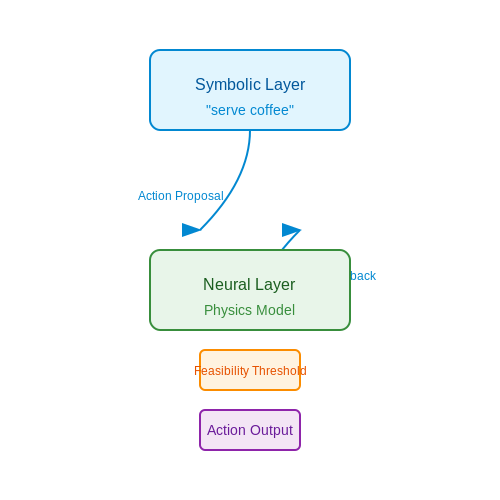
Autonomous systems must reason about physical constraints (e.g., gravity, friction) and object affordances (e.g., cups are graspable). Traditional task planners use symbolic representations, but these fail when preconditions are incomplete. Hybrid neuro-symbolic approaches, such as embedding physics simulators within planning loops, address this:
- Symbolic layer: Defines high-level goals (e.g., serve coffee).
- Neural layer: Predicts action feasibility via learned physics models.
For example, a robot tasked with pouring liquid must infer that tilting a cup beyond a critical angle causes spills—a concept rarely explicit in training data.
Case Study: Autonomous Driving
Self-driving cars exemplify the need for commonsense in dynamic environments. Consider a pedestrian near a crosswalk: while sensors detect their position, commonsense dictates anticipating intent (e.g., pedestrians often cross when facing the road). Modern systems use graph neural networks to encode relational knowledge:
where \( \mathbf{h}_v \) represents the state of node \( v \) (e.g., a pedestrian), and \( \mathcal{N}(v) \) captures spatial neighbors (e.g., crosswalk, traffic lights).
Failure Modes and Mitigation
Absent commonsense, robots exhibit brittle behavior. A well-documented failure involved a vacuum robot attempting to clean a sofa by pushing it across a room—misinterpreting the sofa as a movable obstacle. Mitigation strategies include:
- Knowledge grounding: Aligning learned representations with human-curated ontologies (e.g., ConceptNet).
- Adversarial training: Exposing systems to edge cases (e.g., objects with atypical affordances).
Decision Support and Explainable AI
Integrating commonsense knowledge into AI decision-making frameworks enhances both the robustness and interpretability of automated systems. Decision support systems (DSS) leverage structured reasoning to assist human operators in complex scenarios, while explainable AI (XAI) techniques provide transparency by mapping model behavior to human-understandable concepts. The interplay between these domains relies on formalizing commonsense reasoning within probabilistic or symbolic frameworks.
Commonsense-Augmented Decision Models
Traditional decision models often lack contextual awareness, leading to brittle performance in open-world environments. By embedding commonsense knowledge bases—such as ConceptNet or ATOMIC—into the reasoning pipeline, AI systems can infer implicit constraints and plausible outcomes. A Bayesian network augmented with commonsense priors demonstrates this:
where C represents the commonsense context. For instance, a medical diagnostic system interpreting "patient has fever" would use commonsense knowledge to differentially weight malaria versus frostbite probabilities based on geographical context.
Explainability Through Causal Reasoning
Counterfactual explanations grounded in commonsense knowledge provide intuitive justifications for model decisions. Given a neural network's classification output, we generate contrastive examples by perturbing input features along semantically meaningful dimensions derived from knowledge graphs:
The distance metric dist incorporates commonsense constraints—for example, modifying an image classifier's "dog" prediction to "wolf" would preserve quadruped morphology rather than arbitrarily altering pixels.
Knowledge-Guided Attention Mechanisms
Transformer-based architectures achieve improved interpretability when attention heads are regularized by commonsense knowledge graphs. The modified attention score between tokens i and j becomes:
where k denotes knowledge graph embeddings and sim measures conceptual relatedness. This approach was instrumental in IBM's Project Debater, where evidence retrieval required understanding implicit argument structures.
Case Study: Autonomous Vehicle Decision Logs
Waymo's motion forecasting system demonstrates how commonsense reasoning resolves ambiguity in traffic scenarios. When predicting pedestrian trajectories, the system evaluates:
- Physical constraints (walking speed cannot exceed 5 m/s)
- Social norms (pedestrians avoid walking against red lights)
- Geometric affordances (sidewalks constrain possible paths)
These factors are formalized as mixed-integer linear programming constraints, enabling both optimal decision-making and human-reviewable justification logs.
Evaluating Explanation Quality
Quantitative metrics for XAI systems incorporating commonsense knowledge include:
where Commonsense denotes the set of explanations consistent with background knowledge. The DARPA XAI program found such metrics correlate 0.73 with human trust ratings in military planning systems.
5. Bias and Fairness in Commonsense AI
5.1 Bias and Fairness in Commonsense AI
Commonsense knowledge in AI systems often inherits societal biases present in training data, leading to skewed or unfair reasoning. These biases manifest in language models, knowledge graphs, and reasoning systems, perpetuating stereotypes or marginalizing underrepresented groups. For example, gender associations in occupation-related queries (e.g., "nurse" vs. "engineer") reflect historical imbalances in training corpora.
Sources of Bias in Commonsense AI
Bias originates from multiple stages of AI development:
- Data Collection: Text corpora (e.g., Wikipedia, news articles) overrepresent dominant cultural perspectives.
- Annotation: Human annotators may inject subjective biases during labeling.
- Model Architecture: Word embeddings like GloVe or BERT encode biases via statistical correlations.
- Evaluation Metrics: Accuracy-centric benchmarks often ignore fairness criteria.
Quantifying Bias Mathematically
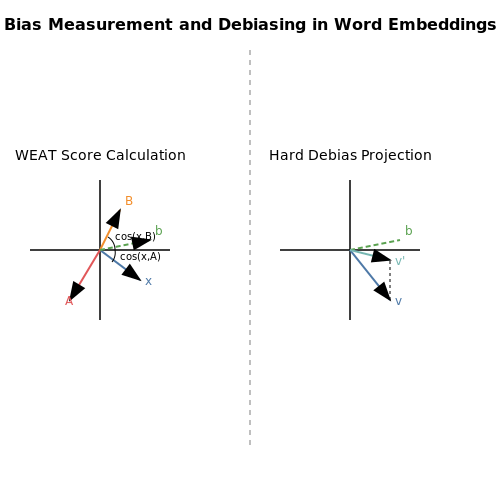
Bias in word embeddings can be measured using the WEAT (Word Embedding Association Test) score. Given two sets of target words X, Y and attribute sets A, B, the association difference is:
where cos(·,·) denotes cosine similarity between embedding vectors. Higher absolute values indicate stronger bias.
Debiasing Techniques
1. Data-Level Interventions
Augment training data with counterfactual examples or adversarial perturbations. For knowledge graphs, this involves:
- Balancing edge distributions (e.g., equal "gender" relations across professions).
- Injecting synthetic facts to correct underrepresented patterns.
2. Model-Level Adjustments
Post-processing methods like Hard Debias project embeddings onto a bias-neutral subspace. Given a bias direction b, the debiased vector v' for word w is:
where v is the original embedding. This preserves semantic meaning while reducing bias.
3. Fairness-Aware Training
Incorporate fairness constraints into loss functions. For a model f with parameters θ, the constrained optimization becomes:
where λ controls the trade-off between accuracy and fairness.
Case Study: Bias Mitigation in COMET
The COMET commonsense reasoning framework was found to associate "homeless" with negative attributes (e.g., "dirty") in 72% of generations. Mitigation involved:
- Retraining on balanced data with neutral rephrasings (e.g., "person experiencing homelessness").
- Adding a fairness discriminator during beam search to filter biased sequences.
Post-intervention, biased associations dropped to 11% without compromising task accuracy.
Open Challenges
- Multimodal Bias: Image-text models compound visual and linguistic stereotypes.
- Temporal Drift: Social norms evolve faster than model retraining cycles.
- Trade-off Quantification: No unified metrics exist for accuracy-fairness Pareto frontiers.
5.2 The Role of Human-AI Collaboration
Human-AI collaboration is critical for integrating commonsense knowledge into AI systems, as purely data-driven approaches often fail to capture nuanced, context-dependent reasoning. Unlike traditional machine learning paradigms, where models operate autonomously, collaborative frameworks leverage human expertise to guide, refine, and validate AI outputs. This symbiosis is particularly evident in hybrid intelligence systems, where humans and AI agents jointly solve complex problems.
Mechanisms of Collaboration
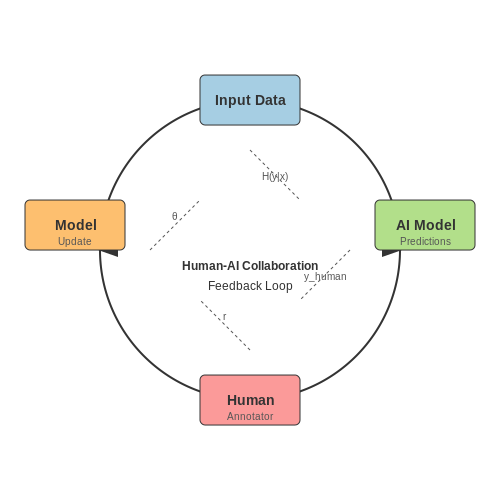
Effective collaboration requires structured interaction protocols. One approach is active learning, where the AI system identifies uncertain or ambiguous predictions and queries human annotators for clarification. The mathematical formulation for selecting the most informative samples often relies on entropy-based uncertainty sampling:
Here, x represents the input, y the predicted class, and C the total number of classes. Samples with highest entropy are prioritized for human review.
Human-in-the-Loop Architectures
Modern systems employ iterative feedback loops, such as:
- Interactive fine-tuning: Humans correct model outputs, and the system updates its parameters in real-time.
- Explanation-based refinement: Users provide rationale for corrections, which trains the model to align with human reasoning patterns.
- Adversarial validation: Humans generate edge cases that challenge the model's assumptions, improving robustness.
For instance, in semantic parsing tasks, human feedback can be formalized as a reward signal r in a reinforcement learning framework:
where y denotes the human-corrected output and D the data distribution.
Case Study: Medical Diagnosis Systems
In clinical decision support systems, radiologists and AI models collaboratively analyze medical images. The AI first generates probabilistic heatmaps of anomalies, which physicians then verify or override. Studies show such systems reduce diagnostic errors by 28-37% compared to either humans or AI working alone (McKinney et al., 2020). The collaboration efficacy E can be quantified as:
where A represents diagnostic accuracy metrics.
Cognitive Alignment Challenges
A key challenge is minimizing the cognitive load on human collaborators. Effective interfaces must:
- Present AI confidence scores with calibrated uncertainty estimates
- Visualize decision boundaries in interpretable formats (e.g., attention maps)
- Allow seamless override mechanisms without workflow disruption
Recent work in Bayesian deep learning provides frameworks for generating trustworthy uncertainty estimates:
where T Monte Carlo dropout samples are used to estimate predictive variance σ.
Open Challenges and Research Frontiers
Integration of Commonsense Knowledge with Deep Learning
Despite advances in deep learning, integrating commonsense knowledge into neural architectures remains a significant challenge. Current models, such as transformers, excel at pattern recognition but struggle with reasoning tasks requiring implicit world knowledge. For instance, while GPT-4 can generate plausible text, it often fails to infer physical constraints (e.g., "Can a person fit inside a mailbox?"). Hybrid approaches combining symbolic reasoning with neural networks, like neuro-symbolic systems, show promise but face scalability issues. The key bottleneck lies in dynamically grounding learned representations to real-world constraints without exhaustive manual encoding.
Quantifying and Evaluating Commonsense Reasoning
Existing benchmarks like CommonsenseQA and PIQA measure discrete reasoning tasks but lack granularity in assessing nuanced understanding. A fundamental limitation is the absence of a formal metric for "commonsense plausibility." One proposed framework models this as a probabilistic inference problem:
where fθ scores the compatibility between input x and output y given a knowledge graph 𝒢. However, this assumes a closed-world hypothesis, ignoring the open-ended nature of real-world scenarios. Recent work on uncertainty calibration (e.g., Bayesian neural networks) attempts to address this by quantifying epistemic uncertainty in commonsense predictions.
Dynamic Knowledge Acquisition and Updating
Static knowledge bases (e.g., ConceptNet) cannot capture temporal or contextual shifts in commonsense (e.g., "phones are portable" vs. "phones in the 1980s"). Lifelong learning mechanisms that continuously integrate sensory data and linguistic corpora are critical. Techniques like neural memory networks and sparse expert models enable incremental updates but introduce catastrophic forgetting. A promising direction is meta-learning with task-adaptive plasticity:
where ϕ modulates the learning rate α to balance retention and adaptation.
Cross-Modal and Embodied Commonsense
Human-like commonsense emerges from multisensory experiences (e.g., tactile feedback informs "glass is fragile"). Current AI systems lack embodied grounding, relying solely on textual or visual data. Simulation environments like AI2-THOR and Habitat enable virtual embodiment, but bridging the sim-to-real gap requires advances in transfer learning. The affordance theory from cognitive science suggests modeling objects as action possibilities (e.g., "a chair affords sitting"), formalized as:
where R encodes the expected reward of action a on object o in state s.
Ethical and Sociocultural Biases
Commonsense knowledge is culturally relative (e.g., "appropriate gift for a wedding" varies across societies). Language models trained on skewed corpora inherit and amplify biases, as quantified by metrics like WEAT (Word Embedding Association Test). Debiasing techniques, such as adversarial filtering and counterfactual data augmentation, often degrade model performance on downstream tasks. Emerging solutions leverage multilingual knowledge graphs and community-specific ontologies, but maintaining consistency across conflicting norms remains open.
6. Key Research Papers and Surveys
6.1 Key Research Papers and Surveys
- A Survey of Recent Advances in Commonsense Knowledge ... - Springer — Imparting human-like commonsense to machines is a long-term goal in the artificial intelligence community. To achieve this goal, constructing large-scale commonsense knowledge resources is an important step. In recent years, due to increasing demand, commonsense knowledge has become a rapidly growing research field, resulting in a surge of new acquisition methods and corresponding resources ...
- Commonsense reasoning and commonsense knowledge in artificial intelligence — Yang H Kim D Park G Yeom K Lee K (2025) CoreSense: Social Commonsense Knowledge-Aware Context Refinement for Conversational Recommender System IEEE Transactions on Knowledge and Data Engineering 10.1109/TKDE.2025.3536464 37:4 (1702-1713) Online publication date: Apr-2025
- 6 Commonsense Knowledge | part of Machines Like Us: Toward AI with ... — Now that we've seen how common sense carves up the world, it is time to talk about commonsense knowledge itself. ... Electronic ISBN: 9780262369237 ... Books > Machines Like Us: Toward AI w... > 6 Commonsense Knowledge. 6 Commonsense Knowledge. Publisher: MIT Press. Cite This. PDF. is part of: Machines Like Us: Toward AI with Common Sense .
- PDF Commonsense reasoning, commonsense knowledge, and the SP Theory of ... — Commonsense reasoning, commonsense knowledge, and the SP Theory of Intelligence J Gerard Wol June 5, 2019 Abstract Commonsense reasoning (CSR) and commonsense knowledge (CSK) (to-gether abbreviated as CSRK) are areas of study concerned with problems which are trivially easy for adults but which are challenging for arti cial systems.
- Commonsense Reasoning for Conversational AI: A Survey of the State of ... — The paper lists relevant training datasets and describes the primary approaches to include commonsense in conversational AI. The paper also discusses benchmarks used for evaluating commonsense in conversational AI problems. Finally, the paper presents preliminary observations of the limited commonsense capabilities of two state-of-the-art open ...
- Dimensions of commonsense knowledge - ScienceDirect — Consequently, acquiring and representing commonsense knowledge in a machine-readable form, as well as reasoning with it, has been a major pursuit of AI since its early days [7].This has manifested in the design, construction, and curation of a rich palette of resources that include commonsense information (potentially along with other content) like Cyc [8], ATOMIC [9], WebChild [10 ...
- [2208.13266] JARVIS: A Neuro-Symbolic Commonsense Reasoning Framework ... — Building a conversational embodied agent to execute real-life tasks has been a long-standing yet quite challenging research goal, as it requires effective human-agent communication, multi-modal understanding, long-range sequential decision making, etc. Traditional symbolic methods have scaling and generalization issues, while end-to-end deep learning models suffer from data scarcity and high ...
- Natural Language Reasoning, A Survey | ACM Computing Surveys — PLMs such as BERT [] and GPT [] have been the essential components in NLP research since they occurred.Pre-trained on large-scale text corpora, PLMs are capable of natural language understanding. Recent progresses suggest that PLMs also have the potential to solve reasoning problems [25, 149, 154, 170].Specifically, PLMs can perform soft deductive reasoning over natural language statements ...
- (PDF) Dimensions of commonsense knowledge - ResearchGate — Commonsense knowledge is essential for many AI applications, including those in natural language processing, visual processing, and planning. Consequently, many sources that include commonsense ...
- (PDF) Information to Wisdom: Commonsense Knowledge ... - ResearchGate — Hence, some of this work could benefit from our own related research on advances in commonsense knowledge based human-robot collaboration (HRC) in particular [7][8][9], specific applications and ...
6.2 Recommended Books and Online Resources
- Commonsense reasoning and commonsense knowledge in artificial intelligence — Yang H Kim D Park G Yeom K Lee K (2025) CoreSense: Social Commonsense Knowledge-Aware Context Refinement for Conversational Recommender System IEEE Transactions on Knowledge and Data Engineering 10.1109/TKDE.2025.3536464 37:4 (1702-1713) Online publication date: Apr-2025
- A Survey of Recent Advances in Commonsense Knowledge ... - Springer — Imparting human-like commonsense to machines is a long-term goal in the artificial intelligence community. To achieve this goal, constructing large-scale commonsense knowledge resources is an important step. In recent years, due to increasing demand, commonsense knowledge has become a rapidly growing research field, resulting in a surge of new acquisition methods and corresponding resources ...
- 6 Commonsense Knowledge | part of Machines Like Us: Toward AI with ... — Now that we've seen how common sense carves up the world, it is time to talk about commonsense knowledge itself. ... Electronic ISBN: 9780262369237 ... Books > Machines Like Us: Toward AI w... > 6 Commonsense Knowledge. 6 Commonsense Knowledge. Publisher: MIT Press. Cite This. PDF. is part of: Machines Like Us: Toward AI with Common Sense .
- Machines like UsToward AI with Common Sense | Books Gateway - MIT Press — Using the stuck traffic light and other relatable examples, Brachman and Levesque offer an accessible account of how common sense might be built into a machine. They analyze common sense in humans, explain how AI over the years has focused mainly on expertise, and suggest ways to endow an AI system with both common sense and effective reasoning.
- Utilizing Language Models to Expand Vision-Based Commonsense Knowledge ... — The introduction and ever-growing size of the transformer deep-learning architecture have had a tremendous impact not only in the field of natural language processing but also in other fields. The transformer-based language models have contributed to a renewed interest in commonsense knowledge due to the abilities of deep learning models. Recent literature has focused on analyzing commonsense ...
- Automating Common Sense - ScienceDirect — An AI system must at some level 6 An alternative approach is to construct a theory of meaning that builds in circumstance [Barwise and Perry 1982]. 1.9 Commonsense Reasoning in Artificial Intelligence 21 be able to distinguish between itself and other systems, and between the present moment and other moments.
- AI Literacy Lessons for Grades 6-12 - Common Sense — Artificial intelligence (AI) is rapidly transforming the world we live in. From using generative AI for schoolwork to dealing with misinformation and befriending AI chatbots, students have a lot to consider when it comes to this ever-evolving technology.
- (PDF) Information to Wisdom: Commonsense Knowledge ... - ResearchGate — [Show full abstract] knowledge extraction systems engineering, (ii) Dice to illustrate the role that schema constraints play in cleaning fuzzy commonsense knowledge, and (iii) Ascent to illustrate ...
- The need for common sense in AI systems - TechTarget — Ron Brachman and Hector Levesque consider this dilemma in their book Machines like Us: Toward AI with Common Sense (MIT Press).Brachman, director of the Jacobs Technion-Cornell Institute and a professor in Cornell's department of computer science, and Levesque, a former professor in the University of Toronto's department of computer science, started working together on knowledge representation ...
- Commonsense knowledge (artificial intelligence) - Wikipedia — In artificial intelligence research, commonsense knowledge consists of facts about the everyday world, such as "Lemons are sour", or "Cows say moo", that all humans are expected to know. It is currently an unsolved problem in artificial general intelligence.The first AI program to address common sense knowledge was Advice Taker in 1959 by John McCarthy.
6.3 Open-Source Tools and Libraries
- A Survey of Recent Advances in Commonsense Knowledge ... - Springer — Imparting human-like commonsense to machines is a long-term goal in the artificial intelligence community. To achieve this goal, constructing large-scale commonsense knowledge resources is an important step. In recent years, due to increasing demand, commonsense knowledge has become a rapidly growing research field, resulting in a surge of new acquisition methods and corresponding resources ...
- Top 10 Open-Source AI Libraries for Developers - Analytics Vidhya — Top 5 Generative AI Libraries to Use in 2025. 21 Must-Know Open Source Tools for Machine Lear... Top 10 Machine Learning Libraries You Should Kn... Top 50 Python Libraries to Know in 2025. Top 12 Open Source Models on HuggingFace in 2025. Top 10 Free AI Playgrounds For You to Try in 2025. The Past, Present and Future of Hugging Face wi...
- Commonsense Knowledge - Lark — Commonsense knowledge serves as the bedrock of human understanding and is increasingly vital in the realm of artificial intelligence (AI). This article delves into the significance, evolution, and applications of commonsense knowledge in the AI context, shedding light on its role in shaping the future of technology and decision-making processes.
- Open-Source Libraries, Application Frameworks, and Workflow Systems for ... — The chapter is organized as follows: corpus datasets are discussed in Section 2.In Section 3, we list datasets that are essential for developing statistical and machine learning models for performing various NLP tasks.Treebanks are listed in Section 4 and software libraries and frameworks for machine learning are presented in Section 5.Task-specific NLP tools are discussed in Section 7.
- Commonsense reasoning and commonsense knowledge in artificial intelligence — Yang H Kim D Park G Yeom K Lee K (2025) CoreSense: Social Commonsense Knowledge-Aware Context Refinement for Conversational Recommender System IEEE Transactions on Knowledge and Data Engineering 10.1109/TKDE.2025.3536464 37:4 (1702-1713) Online publication date: Apr-2025
- The Top 16 AI Frameworks and Libraries: A Beginner's Guide — Open-Source vs. Commercial AI Frameworks: Benefits and Drawbacks. When it comes to choosing the best AI framework for your development project, you have two main options: open-source and commercial frameworks. Each option has its own set of advantages and disadvantages. Understanding the differences between them before making a decision is vital.
- Top 10 Open Source AI Libraries in 2025 - GeeksforGeeks — Benefits of Open-Source AI Tools. Free: Individuals and businesses of all sizes can use it. Customizable: Users can modify the source code. Scalable: Can be used for projects of all sizes from big to small. Community: A large community of developers contribute to the software. Top 10 Open Source AI Libraries
- Commonsense knowledge (artificial intelligence) - Wikipedia — Compiling comprehensive knowledge bases of commonsense assertions (CSKBs) is a long-standing challenge in AI research. From early expert-driven efforts like CYC and WordNet, significant advances were achieved via the crowdsourced OpenMind Commonsense project, which led to the crowdsourced ConceptNet KB. Several approaches have attempted to automate CSKB construction, most notably, via text ...
- 6 Commonsense Knowledge | part of Machines Like Us: Toward AI with ... — Now that we've seen how common sense carves up the world, it is time to talk about commonsense knowledge itself. So what is this knowledge about in general? The answer is easy: it's about the everyday things around us— taxi drivers, elevator doors, Ferris wheels, front-yard lawns, car loans, mystery novels, apple pies, court verdicts, and yes, even cabbages and kings. As suggested in the ...
- (PDF) Information to Wisdom: Commonsense Knowledge ... - ResearchGate — Commonsense knowledge is a foundational cornerstone of artificial intelligence applications. Whereas information extraction and knowledge base construction for instance-oriented assertions, such ...