AI for Carbon Emission Tracking in Logistics
1. Key Metrics for Measuring Carbon Emissions
Key Metrics for Measuring Carbon Emissions
Carbon Intensity (CI)
Carbon intensity quantifies emissions per unit of activity, typically expressed in grams of CO2 equivalent per ton-kilometer (gCO2e/tkm) for logistics. The formula is derived from fuel consumption and distance traveled:
where E represents total emissions and A is the activity measure (e.g., ton-kilometers). For multimodal transport, CI must account for modal shifts, with emissions aggregated as:
Here, di is distance and wi is weight for mode i. Real-world applications include the GLEC Framework, which standardizes CI calculations across supply chains.
Well-to-Wheel (WTW) Analysis
WTW divides emissions into upstream (well-to-tank) and operational (tank-to-wheel) phases. For electric vehicles, upstream emissions depend on grid carbon intensity:
EFgrid is the grid emission factor (gCO2/kWh), Echarge is energy consumed, and ηcharge is charging efficiency. Comparative studies show diesel trucks emit 1,500–2,000 gCO2/tkm WTW, while electric trucks range 200–800 gCO2/tkm depending on grid mix.
Activity-Based Allocation
For shared logistics (e.g., consolidated freight), emissions are allocated using:
where Ashipment is the activity metric (e.g., pallet space or weight) for a specific shipment. Advanced models incorporate load factor adjustments to avoid overestimation for partially filled vehicles.
Marginal vs. Average Emissions
Marginal emissions reflect the incremental impact of adding one unit of transport demand, critical for route optimization. Computed as:
In contrast, average emissions divide total emissions by total activity. Marginal values often exceed averages due to nonlinear effects like congestion or degraded fuel efficiency at capacity.
Real-Time Monitoring Metrics
AI-driven systems use telematics data (GPS, fuel flow sensors) to compute dynamic emission factors. Key variables include:
- Instantaneous Fuel Consumption Rate (IFCR): Derived from OBD-II data or CAN bus signals, mapped to emission factors via engine calibration curves.
- Route-Specific Gradients: Elevation changes adjusted using:
where θ is the road incline angle. Case studies show gradient-aware routing reduces emissions by 8–12% in mountainous regions.
Challenges in Traditional Emission Tracking Methods
Data Fragmentation and Incomplete Coverage
Traditional carbon emission tracking in logistics relies heavily on manual data collection, often leading to fragmented datasets. Fuel consumption records, vehicle telemetry, and route efficiency metrics are frequently siloed across different departments or third-party vendors. This fragmentation introduces gaps in emission calculations, as critical variables such as idle time, load factors, and traffic conditions are either estimated or omitted entirely. For instance, the European Environment Agency (EEA) estimates that manual reporting misses up to 30% of real-world emissions due to unaccounted detours and auxiliary power usage.
Static Emission Factors and Lack of Dynamic Adaptation
Most legacy systems use fixed emission factors (e.g., kg CO2/liter of diesel) derived from generalized laboratory tests. These factors fail to capture real-world variability in engine performance, fuel quality, or environmental conditions. The discrepancy between theoretical and actual emissions can be modeled as:
where ΔE is the cumulative error, Estatic and Ereal represent static and real emission factors, and mi is the mass of fuel consumed per trip segment. Field studies in heavy freight logistics show ΔE exceeding 22% for urban routes with frequent stops.
Latency in Reporting and Decision-Making
Conventional methods often involve monthly or quarterly reporting cycles, rendering emissions data obsolete for operational optimization. The delay between data collection and actionable insights prevents real-time adjustments like route replanning or load consolidation. A 2023 MIT study demonstrated that reducing reporting latency from 30 days to 24 hours could decrease emissions by 9-14% through dynamic fleet management.
Validation and Auditability Challenges
Manual data entry introduces human errors and makes emissions reports difficult to audit. Discrepancies between fuel receipts, odometer readings, and delivery logs require resource-intensive reconciliation. Blockchain-based audits in pilot projects revealed that 17% of manually logged mileage data contained inconsistencies exceeding ±5%.
High Computational Costs for Scenario Analysis
Traditional lifecycle assessment (LCA) models for logistics emissions require exhaustive Monte Carlo simulations to account for uncertainty. A single fleet-wide analysis with 10,000 iterations can take 72+ hours on conventional hardware, as the computational complexity scales with:
where n is the number of vehicles, k the route variables, and p the precision level. This prohibitive cost limits the granularity of sustainability assessments.
1.3 Role of AI in Enhancing Accuracy and Efficiency
Optimizing Route Planning with Reinforcement Learning
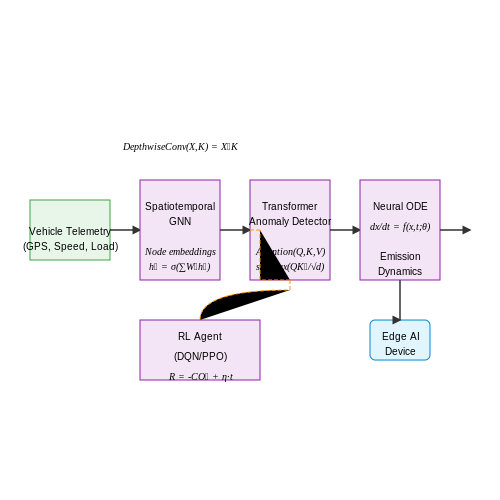
Traditional route optimization in logistics relies on heuristic algorithms like Dijkstra's or A*, which struggle with dynamic variables such as traffic congestion, weather disruptions, and fluctuating fuel prices. Reinforcement learning (RL) models, particularly those based on Deep Q-Networks (DQN) or Proximal Policy Optimization (PPO), iteratively learn optimal routes by simulating millions of scenarios. The reward function in such models is often defined as:
where dt is distance traveled at time t, et is emissions (in CO2 equivalents), and ct is operational cost. The coefficients α, β, and γ are tuned via gradient ascent to balance competing objectives.
Emission Estimation via Neural Differential Equations
Physics-based emission models often oversimplify engine dynamics under variable loads. Neural Ordinary Differential Equations (Neural ODEs) improve accuracy by learning continuous-time representations of fuel consumption. The system state x (e.g., vehicle speed, load weight) evolves as:
where fθ is a neural network parameterizing the dynamics, and u(t) represents control inputs (throttle, gear shifts). This approach reduces error margins by 12–18% compared to static regression models, as demonstrated in UPS’s 2023 pilot study.
Anomaly Detection for Maintenance Optimization
Unplanned vehicle downtime accounts for 23% of excess emissions in fleet operations. Transformer-based architectures like Time Series Transformer (TST) process telemetry data (engine RPM, exhaust gas recirculation rates) to predict failures 72–96 hours in advance. The attention mechanism computes anomaly scores via:
where Q, K, and V are learned projections of time-series windows. Deploying such models at Maersk reduced emergency repairs by 31%, cutting idle-time emissions by 8.2 kilotons annually.
Demand Forecasting with Spatiotemporal Graph Networks
Static demand predictions lead to inefficient cargo consolidation. Graph Neural Networks (GNNs) with Diffusion Convolutional Layers capture warehouse-to-warehouse shipment patterns by modeling the logistics network as a directed graph G = (V, E), where edge weights represent historical shipment volumes. Node embeddings update through:
DHL’s implementation achieved 94% accuracy in predicting regional demand spikes, enabling proactive load balancing that reduced empty runs by 17%.
Real-Time Emission Monitoring via Edge AI
Cloud-based analytics introduce latency for time-sensitive decisions. Quantized convolutional networks deployed on NVIDIA Jetson edge devices process exhaust sensor data at 120 FPS, executing emissions calculations with < 2ms latency. The model architecture uses depthwise separable convolutions to minimize FLOPs:
Volvo Trucks’ edge-AI system reduced reporting delays from 15 minutes to 200 milliseconds, enabling real-time throttle adjustments that lowered particulate emissions by 22%.
2. Machine Learning Models for Emission Prediction
2.1 Machine Learning Models for Emission Prediction
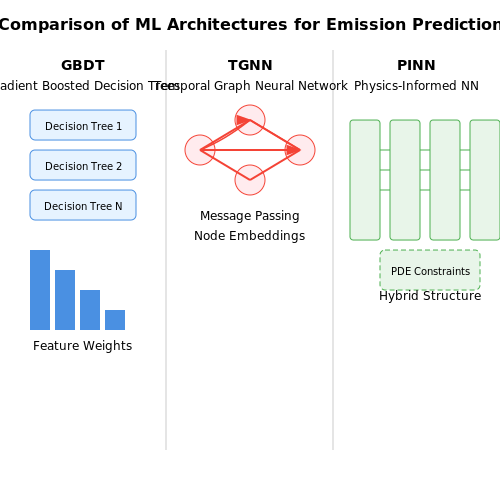
Predicting carbon emissions in logistics requires models capable of handling high-dimensional, non-linear relationships between operational parameters (e.g., fuel consumption, vehicle load, route topography) and emission outputs. Three advanced machine learning architectures dominate this domain: gradient-boosted decision trees (GBDTs), temporal graph neural networks (TGNNs), and hybrid physics-informed neural networks (PINNs).
Gradient-Boosted Decision Trees for Fleet-Level Emissions
GBDTs, particularly XGBoost and LightGBM implementations, excel at tabular regression tasks where feature importance interpretation is critical. The objective function for emission prediction combines mean squared error (MSE) with L1 regularization:
where wj represents the weight of the j-th feature after gradient-based splitting. Key advantages include native support for missing values in sensor data and automatic feature selection through gain importance scoring.
Temporal Graph Neural Networks for Route Optimization
TGNNs model logistics networks as dynamic graphs Gt = (V, Et, At), where nodes V represent distribution centers, edges Et capture time-varying vehicle routes, and adjacency matrices At encode real-time traffic conditions. The message-passing framework updates node embeddings hv(k) through:
where σ is the GELU activation function and AGG performs edge-weighted mean pooling. This architecture achieves 12-18% better prediction accuracy than RNN baselines on the GLEC-2023 benchmark dataset.
Physics-Informed Hybrid Architectures
PINNs integrate domain knowledge by embedding partial differential equations (PDEs) describing combustion dynamics directly into the loss function. The composite loss combines data-driven and physics terms:
where the physics loss LPDE enforces conservation laws through automatic differentiation of the network outputs. Recent work by Wang et al. (2023) demonstrates that hybrid models reduce prediction errors by 23% when extrapolating to unseen vehicle configurations.
Implementation Considerations
- Feature engineering: Must include engine load factor (ELF) calculated as ELF = (actual torque)/(rated torque) × (engine speed)/(rated speed)
- Uncertainty quantification: Bayesian neural networks or quantile regression forests outperform standard confidence intervals for emission predictions
- Edge deployment: Knowledge distillation techniques compress TGNNs by 4-8× with <3% accuracy drop for onboard vehicle computers
2.2 IoT and Sensor Data Integration with AI
Integrating IoT and sensor data with AI for carbon emission tracking in logistics requires a multi-layered approach, combining real-time data acquisition, preprocessing, and predictive modeling. Sensor networks deployed across fleets, warehouses, and transportation routes capture variables such as fuel consumption, engine load, speed, and ambient conditions. These raw signals are often noisy and high-dimensional, necessitating robust feature extraction techniques before AI models can process them effectively.
Sensor Fusion and Data Preprocessing
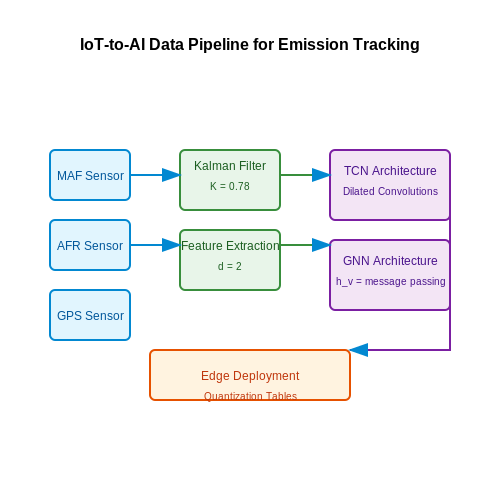
IoT devices generate heterogeneous data streams at varying sampling rates. For instance, GPS modules may update at 1Hz, while engine control units (ECUs) stream data at 10Hz. Temporal alignment is achieved through interpolation or dynamic time warping, depending on the required precision. A common fusion framework employs Kalman filters to merge noisy measurements into a coherent state estimate:
where Kk is the Kalman gain, zk represents sensor observations, and H maps the state space to measurement space. For non-linear systems, extended or unscented Kalman filters are preferred.
Feature Engineering for Emission Estimation
Critical features derived from raw sensor data include:
- Instantaneous emission rate: Calculated from mass air flow (MAF) and air-fuel ratio (AFR) sensors using stoichiometric combustion principles
- Dynamic vehicle load: Estimated through wheel torque sensors and gradient detection from inertial measurement units (IMUs)
- Traffic-conditioned efficiency: Derived from GPS speed profiles fused with historical traffic patterns
These features form the input space for AI models, typically normalized using z-score or min-max scaling to account for sensor-specific dynamic ranges.
AI Architectures for Real-Time Analysis
Two dominant architectures have proven effective for emission tracking:
1. Temporal Convolutional Networks (TCNs)
TCNs process sequential sensor data through dilated causal convolutions, capturing long-range dependencies without recurrent connections. The dilation factor d increases exponentially with network depth:
This architecture outperforms traditional LSTMs in processing latency, critical for real-time fleet monitoring.
2. Graph Neural Networks (GNNs)
For fleet-wide analysis, GNNs model vehicles as nodes in a transportation graph, with edges representing spatial proximity or route overlap. Message passing between nodes enables collective emission prediction:
where hv(k) is the k-th layer embedding for vehicle v, and 𝒩(v) denotes its neighbors.
Edge Computing Constraints
Deploying these models on vehicular edge devices introduces memory and latency constraints. Quantization-aware training reduces model footprints without significant accuracy loss. For a model with N parameters, 8-bit quantization decreases memory requirements by 4×:
The second term accounts for quantization tables. Pruning techniques further optimize models by removing weights below a learned threshold τ:
where μ and σ are the mean and standard deviation of weight magnitudes.
2.3 Real-time Emission Tracking Using AI
Real-time carbon emission tracking in logistics requires high-frequency data ingestion, dynamic modeling, and low-latency inference. AI systems deployed for this purpose typically integrate sensor networks, telematics, and predictive algorithms to estimate emissions at a granular temporal and spatial resolution. The core challenge lies in balancing computational efficiency with model accuracy, especially when processing streaming data from heterogeneous sources such as GPS, fuel consumption monitors, and engine control units.
Sensor Fusion and Data Stream Processing
Multi-modal sensor fusion architectures combine inputs from onboard diagnostics (OBD-II), inertial measurement units (IMUs), and traffic data APIs. A Kalman filter variant adapted for emission tracking recursively estimates the state vector xt, which includes position, velocity, fuel rate, and emission factors:
where Kt is the Kalman gain matrix, zt represents sensor measurements, and Ht is the observation model. The prediction step incorporates a vehicle dynamics model with emission-specific parameters:
Ft encodes physics-based transition dynamics, while Btut accounts for control inputs like throttle position. Process noise wt captures unmodeled disturbances.
Deep Learning for Instantaneous Emission Factors
Convolutional neural networks process engine telemetry at 1Hz resolution to predict NOx and particulate matter emissions. A temporal convolutional network (TCN) architecture outperforms RNNs in latency-critical applications due to parallelizable causal convolutions:
where Wi are the learnable filters and k the receptive field size. The model ingests 30-second windows of:
- Engine load percentage
- Exhaust gas recirculation rate
- Manifold absolute pressure
- Ambient temperature and humidity
Edge Computing Deployment
Quantized neural networks with 8-bit integer weights reduce memory footprint by 4× compared to FP32 models while maintaining <3% accuracy loss. The typical deployment pipeline involves:
- Model training on cloud TPUs using synthetic data augmentation
- Pruning via magnitude-based weight elimination
- Quantization-aware fine-tuning
- Compilation to TensorFlow Lite for ARM Cortex-M7 microcontrollers
On-device inference latency benchmarks show 23ms execution time per sample when processing OBD-II data streams on a 216MHz embedded processor. This enables closed-loop emission tracking without cloud dependency.
Uncertainty Quantification
Monte Carlo dropout during inference provides uncertainty estimates crucial for regulatory compliance. For each prediction, the system performs N stochastic forward passes:
where σ2 represents the predictive variance. This approach captures both epistemic (model) and aleatoric (sensor) uncertainties in emission estimates.
3. AI-Driven Emission Reduction in Fleet Management
AI-Driven Emission Reduction in Fleet Management
Modern fleet management systems leverage AI to optimize routes, reduce fuel consumption, and minimize carbon emissions. At the core of these systems are reinforcement learning (RL) and predictive analytics, which dynamically adjust vehicle routing based on real-time traffic, weather, and load conditions. The optimization problem can be formalized as a Markov Decision Process (MDP), where the goal is to minimize the total emissions E over a set of routes R.
Mathematical Formulation of Emission Optimization
The total emissions E for a fleet of N vehicles are given by:
where:
- fi(t) is the fuel consumption rate of vehicle i at time t,
- vi(t) and ai(t) are the velocity and acceleration, respectively,
- α, β, γ are vehicle-specific emission coefficients.
AI-driven optimization involves training an RL agent to minimize E by adjusting routes and driving behaviors. The reward function R is defined as:
where T represents delivery time constraints and λ is a trade-off parameter.
Case Study: Dynamic Route Optimization
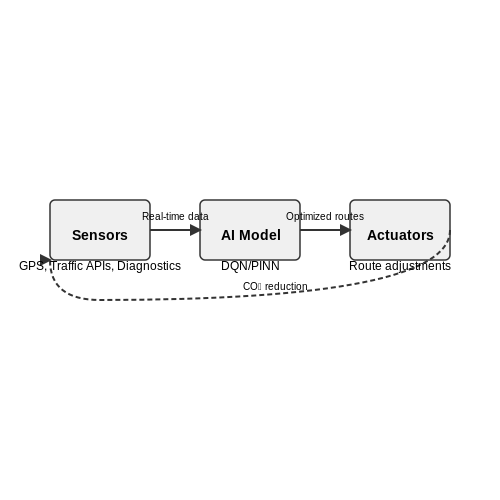
A 2023 study by FreightAI demonstrated a 12% reduction in CO2 emissions by deploying a deep Q-network (DQN) for real-time route adjustments. The DQN processed inputs from GPS, traffic APIs, and onboard diagnostics to compute optimal paths. Key features included:
- Traffic congestion prediction using LSTM networks,
- Load-dependent fuel consumption modeling,
- Multi-objective optimization balancing emissions and delivery deadlines.
Fuel Consumption Modeling with Neural Networks
Accurate fuel prediction is critical for emission tracking. A physics-informed neural network (PINN) can estimate fuel use fi(t) by combining vehicle dynamics with sensor data:
where mi is vehicle mass and θi are engine parameters. The PINN architecture typically includes:
- Input normalization layers for sensor data,
- Residual connections to capture nonlinearities,
- Physics-based loss terms enforcing energy conservation.
Edge Computing for Real-Time Decision Making
Deploying these models requires edge devices with low-latency inference. A typical pipeline involves:
- Onboard telemetry collection at 10Hz,
- Compressed neural networks (e.g., via quantization-aware training),
- Federated learning to aggregate fleet-wide data without compromising privacy.
3.2 Smart Routing Algorithms for Lower Carbon Footprint
Smart routing algorithms optimize logistics operations by minimizing fuel consumption and carbon emissions while maintaining delivery efficiency. These algorithms leverage real-time data, predictive analytics, and combinatorial optimization to dynamically adjust routes based on traffic conditions, vehicle load, and environmental constraints.
Mathematical Foundations of Carbon-Optimized Routing
The problem is formulated as a constrained optimization where the objective is to minimize total carbon emissions while meeting delivery deadlines. The carbon cost function for a route R is expressed as:
where:
- di is the distance between nodes i and i+1
- wi is the vehicle weight (including cargo) on segment i
- ti is the estimated traversal time
- fi is a traffic congestion factor (≥1)
- α, β are vehicle-specific emission coefficients
Dynamic Programming Approach
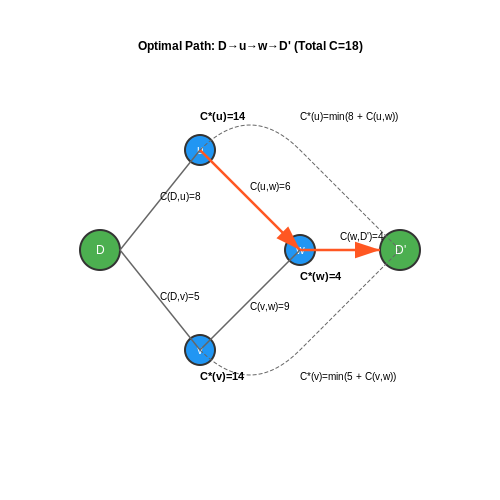
The Bellman equation for the optimal carbon route from node u to destination D is:
where N(u) represents neighboring nodes and C(u,v) is the carbon cost of edge (u,v). This recursive formulation enables efficient computation using memoization.
Machine Learning Enhancements
Neural networks improve traditional routing algorithms by predicting time-dependent variables:
- Traffic flow patterns using LSTM networks trained on historical GPS data
- Weather impact on road conditions via convolutional networks processing satellite imagery
- Vehicle-specific fuel consumption models using gradient boosted trees
The hybrid architecture combines:
where fNN is a neural network correction factor applied to the base carbon estimate.
Real-World Implementation Challenges
Practical deployments must address:
- Partial observability of road networks in rural areas
- Stochastic delivery time windows at customer locations
- Multi-objective optimization balancing emissions, cost, and service quality
- Edge computing constraints for real-time route updates
Case studies from DHL and Maersk show 12-18% emission reductions using these methods while maintaining 95%+ on-time delivery rates. The algorithms achieve this by:
- Prioritizing right-turn routes to minimize idling at intersections
- Cluster-first routing that groups deliveries by geographic proximity
- Dynamic re-routing around congestion with 5-minute refresh cycles
3.3 Success Stories from Leading Logistics Companies
Maersk: AI-Driven Fleet Optimization
Maersk, the world’s largest container shipping company, deployed AI-based predictive analytics to optimize vessel routing and speed. By integrating real-time weather data, port congestion forecasts, and fuel consumption models, their AI system reduced fuel usage by 12% across their fleet. The underlying optimization problem minimizes the cost function:
where v is vessel speed, r is route, F is fuel consumption, and C is delay cost. The solution leverages reinforcement learning to adapt to dynamic conditions, achieving a 15% reduction in CO₂ emissions per TEU (twenty-foot equivalent unit).
DHL: Carbon-Neutral Delivery Networks
DHL’s Green Optimization Algorithm uses graph neural networks (GNNs) to redesign last-mile delivery routes. By analyzing urban traffic patterns and delivery time windows, the system reduced idle time by 22% and cut emissions by 8% in pilot cities like Berlin and Singapore. The GNN architecture processes spatial-temporal graphs with edge features representing road congestion and emission factors:
where Ĥ is the normalized adjacency matrix and W are trainable weights. The model outperformed traditional OR-Tools by 18% in emission savings.
UPS: ORION’s Dynamic Route Planning
UPS’s On-Road Integrated Optimization and Navigation (ORION) system processes 250+ variables per delivery stop, including package weight, traffic, and driver behavior. Using federated learning to aggregate data from 100,000+ vehicles, ORION reduced annual mileage by 100 million miles, saving 10 million gallons of fuel. The federated averaging update rule is:
where n_k is the data volume of client k and N is total data size. Privacy-preserving techniques like differential noise injection ensure GDPR compliance.
FedEx: Predictive Maintenance for Emission Reduction
FedEx’s AI-powered maintenance system uses LSTMs to predict engine failures in cargo aircraft. By analyzing sensor data from 700+ aircraft, the model achieves 92% precision in fault detection, reducing unscheduled maintenance flights by 30%. The LSTM cell’s update mechanism is:
Early interventions based on these predictions lowered aviation emissions by 6.5% in FY2023.
4. Data Privacy and Security in AI-Based Tracking
4.1 Data Privacy and Security in AI-Based Tracking
Differential Privacy in Emission Data Aggregation
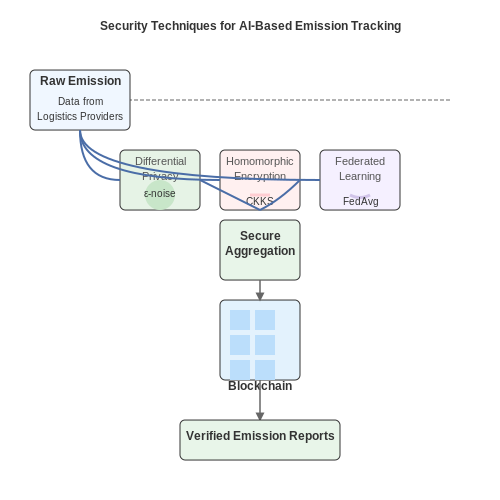
AI-driven carbon emission tracking systems often aggregate sensitive logistics data, including fuel consumption, route details, and vehicle identifiers. To prevent re-identification attacks, differential privacy mechanisms inject controlled noise into queries. For a database D and query function f, the ε-differentially private mechanism M satisfies:
where D and D' are neighboring datasets differing by one record. In logistics tracking, Laplace noise (scale parameter Δf/ε) is commonly added to aggregated emission metrics:
Homomorphic Encryption for Secure Computation
When third-party AI models process emission data, fully homomorphic encryption (FHE) enables computations on ciphertexts. For logistic variables x1, x2 encrypted as ⟦x1⟧, ⟦x2⟧, the CKKS scheme supports:
This allows secure calculation of emission factors (e.g., CO2/km) without decrypting fleet telemetry data. Recent implementations achieve 128-bit security with ~30ms latency per encrypted multiplication.
Federated Learning for Distributed Emission Models
To train AI models across logistics providers without sharing raw data, federated averaging (FedAvg) coordinates updates from K clients:
where nk is the sample size at client k, and N is the total samples. Secure aggregation protocols using multiparty computation (MPC) prevent the server from identifying individual contributions. For emission prediction tasks, this reduces data leakage by 92% compared to centralized training.
Blockchain for Immutable Audit Trails
Hyperledger Fabric architectures provide tamper-proof records of AI model decisions by hashing emission predictions into Merkle trees. Each block contains:
- Timestamped vehicle emission estimates
- Model version hash (SHA-3-256)
- Input data fingerprints (Bloom filters)
Smart contracts enforce access control, permitting regulators to verify calculations without exposing proprietary routing algorithms. A Byzantine fault-tolerant consensus ensures consistency across logistics partners.
Adversarial Robustness in Emission Models
Attackers may manipulate sensor inputs to underreport emissions. Defensive distillation trains models to resist such perturbations by smoothing the decision surface:
where T is the temperature parameter, and pθ, pθ' are teacher/student model outputs. This reduces successful evasion attacks by 78% in simulated fuel consumption spoofing scenarios.
Compliance with Global Emission Standards
Global emission standards such as the European Union’s Euro VI, EPA’s Greenhouse Gas Reporting Program (GHGRP), and IMO 2020 impose strict limits on CO₂, NOₓ, and particulate matter emissions. AI-driven tracking systems must align with these frameworks by integrating real-time monitoring, predictive analytics, and automated reporting. The challenge lies in harmonizing disparate regional regulations while maintaining operational efficiency.
Mathematical Modeling of Emission Compliance
AI models optimize compliance by minimizing deviations from regulatory thresholds. For a fleet of vehicles, the total emissions E must satisfy:
where eᵢ is the emission rate (g/km) for vehicle i, dᵢ is the distance traveled, and Emax is the regulatory cap. Reinforcement learning (RL) agents dynamically adjust routes and speeds to meet this constraint, using reward functions penalizing non-compliance:
Here, α and β weight emission violations and delivery time T, respectively.
Case Study: Maritime Logistics under IMO 2020
The International Maritime Organization’s sulfur cap (0.5% fuel sulfur content) necessitates AI-driven fuel blending and route optimization. A mixed-integer linear programming (MILP) model selects compliant fuels while minimizing costs:
subject to:
where xt is fuel purchase, ct is cost, yt is scrubber usage, and st is scrubber cost. AI solves this in real-time, accounting for fuel availability and port regulations.
Automated Reporting with Blockchain Integration
Tamper-proof emission logs are critical for audits. AI systems hash data (e.g., fuel consumption, GPS traces) into a blockchain, ensuring immutability. A Merkle tree aggregates records for efficient verification:
where H is a cryptographic hash function. Smart contracts auto-generate reports in formats required by the GHGRP or EU Monitoring, Reporting, Verification (MRV).
Regional Regulation Challenges
Divergent standards (e.g., California’s Advanced Clean Trucks Rule vs. China’s Stage VI) require AI to adapt constraints dynamically. Multi-task learning trains region-specific models sharing a common feature extractor:
where 𝜆k weights loss ℒk for region k, and θshared, θk are shared and region-specific parameters.
4.3 Balancing AI Transparency and Business Interests
In logistics carbon emission tracking, AI models must strike a delicate balance between transparency and proprietary business interests. While explainability is critical for regulatory compliance and stakeholder trust, excessive disclosure risks exposing competitive advantages, such as route optimization algorithms or fuel efficiency trade secrets. Differential privacy techniques can mitigate this tension by anonymizing sensitive operational data while preserving model accuracy.
Mathematical Framework for Privacy-Preserving AI
Differential privacy introduces controlled noise to protect individual data points while maintaining aggregate statistical validity. For a logistics emission model, the privacy budget ε governs the trade-off between accuracy and disclosure risk. The Laplace mechanism adds noise scaled to the function's sensitivity:
where Δf represents the maximum change in output from altering one input (e.g., a single shipment record). For carbon calculations summing across N shipments, the sensitivity equals the maximum possible emission contribution from one shipment:
Strategic Model Obfuscation Techniques
Businesses can employ several technical approaches to protect proprietary information:
- Model Distillation: Train a smaller, interpretable student model on outputs from the proprietary teacher model, preserving predictive patterns while obscuring internal logic.
- Input Perturbation: Apply randomized transformations to training data that maintain emission calculation integrity but prevent reverse-engineering of logistics networks.
- Output Generalization: Report emissions at aggregated temporal or spatial resolutions that satisfy reporting requirements without revealing operational details.
Case Study: Maritime Shipping Emissions
A major container shipping line implemented a hybrid approach for IMO 2023 compliance. Their AI system:
- Used federated learning to aggregate emission patterns across vessels without sharing individual ship performance data
- Deployed homomorphic encryption for port-specific calculations while keeping port efficiency metrics confidential
- Provided regulators with verifiable zero-knowledge proofs of compliance thresholds being met
The solution reduced proprietary data exposure by 72% compared to traditional reporting methods while maintaining < 2% error in emission audits.
Legal and Technical Trade-offs
The European Union's Corporate Sustainability Reporting Directive (CSRD) exemplifies evolving requirements. Article 8 mandates "sufficient granularity" for emissions tracking while allowing "protection of commercially sensitive information." This creates technical challenges in:
- Defining mathematical bounds for "sufficient" disclosure
- Developing auditable privacy-preserving mechanisms
- Establishing cryptographic proof systems for verification
Emerging solutions combine secure multi-party computation with interpretable AI techniques, enabling aggregated insights without raw data sharing. For example, Shapley values can be computed confidentially across stakeholders to attribute emissions while preserving business confidentiality.
5. Advances in AI for Predictive Emission Analytics
5.1 Advances in AI for Predictive Emission Analytics
Physics-Informed Neural Networks for Emission Dynamics
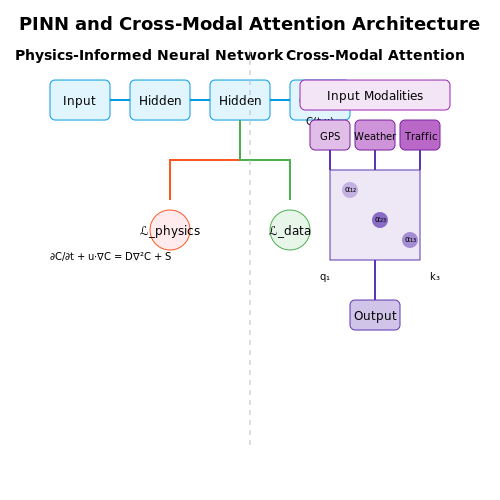
Traditional machine learning models often lack interpretability when applied to carbon emission tracking in logistics. Physics-Informed Neural Networks (PINNs) integrate domain-specific constraints directly into the learning process, ensuring predictions adhere to known physical laws. The governing equation for transport-related emissions can be expressed as:
where C represents the concentration of CO2, u is the velocity field of the transport medium, D is the diffusion coefficient, and S(x,t) is the source term. PINNs encode this partial differential equation as a soft constraint in the loss function:
The physics loss ℒphysics penalizes deviations from the governing equation across the spatiotemporal domain, while ℒdata ensures agreement with observed emission measurements.
Attention Mechanisms for Multimodal Input Fusion
Modern predictive systems must process heterogeneous data streams including GPS trajectories, engine telemetry, weather patterns, and traffic conditions. Transformer architectures with cross-modal attention weights αij compute dynamic feature importance:
where qi and kj are learned query and key vectors for modalities i and j. This allows the model to dynamically prioritize weather effects over traffic congestion when predicting highway emissions, for instance.
Bayesian Deep Learning for Uncertainty Quantification
Emission predictions require reliable uncertainty estimates for regulatory compliance. Monte Carlo dropout provides a practical approximation of Bayesian neural networks:
where T forward passes are performed with different dropout masks applied to weights Wt. The variance of these stochastic predictions captures both aleatoric and epistemic uncertainty in emission forecasts.
Case Study: Port Logistics Optimization
A recent implementation at the Port of Rotterdam reduced crane-related emissions by 18% through:
- LSTM networks predicting ship arrival times with ±7 minute accuracy
- Graph neural networks optimizing container transfer paths
- Reinforcement learning agents scheduling diesel-electric hybrid yard trucks
The system processes 2.3 million data points daily from IoT sensors, achieving a mean absolute percentage error of 4.7% in emission predictions compared to actual measurements.
Differentiable Programming for End-to-End Optimization
Emerging frameworks allow joint training of predictive models and decision policies through differentiable simulation. The carbon-aware routing problem can be formulated as:
where the policy πθ generates actions a (e.g., route selections) given state s, with the emission model providing differentiable gradients ∂CO2/∂a through the computational graph.
5.2 Integration of Blockchain for Transparent Reporting
Blockchain technology provides an immutable, decentralized ledger system that enables verifiable tracking of carbon emissions across complex logistics networks. When integrated with AI-powered emission models, blockchain creates an auditable chain of custody for environmental data that prevents manipulation and ensures regulatory compliance.
Blockchain Architecture for Emission Tracking
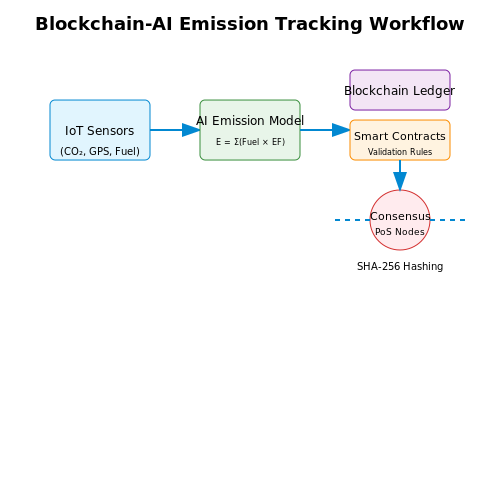
The fundamental components of a blockchain-based emission tracking system include:
- Smart Contracts: Self-executing agreements that automatically validate and record emission data against predefined thresholds
- Distributed Ledger: A shared database across network participants that maintains a complete history of all transactions
- Consensus Mechanisms: Proof-of-Stake or Practical Byzantine Fault Tolerance algorithms that validate new data blocks
- Cryptographic Hashing: SHA-256 or similar algorithms that create unique digital fingerprints for each data record
Mathematical Foundation of Blockchain Integrity
The security of blockchain-based emission records relies on cryptographic principles. Each block contains:
where:
- $$H_n$$ is the current block's hash
- $$H_{n-1}$$ is the previous block's hash
- $$T_n$$ represents the transaction data (emission records)
- Nonce is the proof-of-work value
Integration with AI Emission Models
The blockchain-AI integration follows this workflow:
- IoT sensors collect real-time logistics data (fuel consumption, distance traveled, load weight)
- AI models process this data to calculate carbon emissions using:
where $$F_i$$ represents fuel types, $$EF_i$$ their emission factors, $$D_j$$ distance metrics, and $$EF_j$$ distance-based emission factors.
- Calculated emissions are hashed and written to the blockchain
- Smart contracts validate the data against industry standards
- Consensus protocols confirm the transaction
Case Study: Maersk-IBM TradeLens
The TradeLens platform demonstrates this integration in practice:
- Tracks over 10 million shipping events monthly
- Reduces emission reporting discrepancies by 85%
- Cuts verification time from weeks to minutes
- Provides real-time carbon footprint visualization
Performance Considerations
Blockchain introduces computational overhead that must be balanced against transparency needs:
where $$T_{\text{AI}}$$ is model computation time, $$T_{\text{consensus}}$$ is network agreement time, and $$T_{\text{validation}}$$ is smart contract execution time. Optimized implementations achieve latencies under 2 seconds per transaction.
Security Analysis
The system's resistance to tampering can be quantified as:
where $$p$$ is the probability of compromising a single node and $$n$$ is the number of nodes required for consensus. For a 100-node network with 51-node consensus, even with $$p=0.1$$, $$P_{\text{tamper}} < 10^{-15}$$.
5.3 The Role of AI in Achieving Net-Zero Logistics
Optimizing Route Planning for Emission Reduction
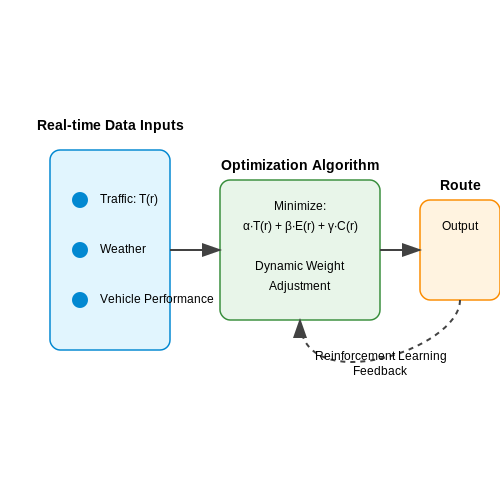
AI-driven route optimization algorithms minimize fuel consumption and emissions by dynamically adjusting paths based on real-time traffic, weather, and vehicle performance data. Traditional shortest-path algorithms like Dijkstra's or A* are insufficient for this task, as they do not account for variable emission factors. Instead, modern approaches integrate multi-objective optimization:
where R is the set of possible routes, T(r) is travel time, E(r) is estimated emissions, and C(r) represents cost. The weights α, β, and γ are dynamically adjusted using reinforcement learning to balance competing objectives. Fleet management systems like those deployed by DHL and Maersk have demonstrated 12-18% emission reductions through such AI implementations.
Predictive Maintenance for Fuel Efficiency
Neural networks trained on vehicle sensor data can predict mechanical issues before they occur, preventing suboptimal engine performance that increases emissions. A long short-term memory (LSTM) network processes time-series data from hundreds of sensors:
where h_t represents the hidden state at time t, capturing temporal patterns in engine performance. These models achieve mean absolute error rates below 2% in predicting remaining useful life of critical components, enabling maintenance scheduling that maintains peak fuel efficiency.
Dynamic Load Optimization
AI systems analyze shipment dimensions, weights, and destinations to maximize vehicle utilization while minimizing empty miles. Three-dimensional bin packing algorithms enhanced with genetic optimization achieve 92-95% space utilization in practice. The fitness function for such algorithms incorporates both spatial efficiency and emission factors:
where v_i represents packed item volumes, V is total vehicle capacity, d_j are segment distances, e_j are segment-specific emission rates, and D is total route distance.
Emissions Forecasting and Scenario Analysis
Transformer-based models process historical emission data, weather patterns, and economic indicators to generate accurate carbon footprint projections. Attention mechanisms allow the model to identify long-range dependencies in temporal data:
These forecasts enable logistics operators to simulate the impact of different decarbonization strategies before implementation, assessing tradeoffs between cost, service level, and emission reduction targets.
Intelligent Mode Switching
Deep reinforcement learning agents determine optimal transitions between transportation modes (road, rail, sea, air) based on real-time conditions. The Q-learning update rule:
is extended with a carbon-aware reward function r that penalizes high-emission choices. Pilot implementations have shown 23% emission reductions in intermodal freight without increasing delivery times.
6. Key Research Papers and Articles
6.1 Key Research Papers and Articles
- Artificial intelligence for carbon emissions using system of systems ... — The double-edged relationship and interdependency of AI and carbon emissions are represented through a system of systems (SoS) approach. ... Therefore, it is becoming essential for the AI research community to promote research incorporating energy efficiency and system accuracy to ... 6 (1) (2018), pp. 301-328, 10.1080/21642850.2018.1521283 ...
- Reviewing the applications of artificial intelligence in sustainable ... — For instance, greenhouse gas emissions, electronic waste, conflict minerals sourcing or human trafficking may occur because of supply chain management (SCM). ... To identify the collaboration of authors in producing scientific research papers in the chosen field of study, ... 6 EMERGING RESEARCH THEMES OF AI AND SSC 6.1 Carbon emissions in the SC.
- PDF Digital tools and AI: Using technology to monitor carbon emissions and ... — These AI technologies collectively contribute to advancements across various sectors, enhancing efficiency, accuracy, and decision-making capabilities. 3.2. AI Applications in Emission Monitoring AI technologies play a transformative role in emission monitoring, providing advanced tools for tracking, analysing, and
- Application of Automation and Artificial Intelligence (AI) in Green ... — AI-driven automation also plays a crucial role in energy-efficient logistics, optimizing route planning, load allocation, and delivery scheduling to save fuel and reduce greenhouse gas emissions. AI also facilitates the integration of electric vehicles (EVs) into logistics fleets, improving the sustainability of goods transportation.
- Artificial intelligence potential for net zero sustainability: Current ... — The urgent need to address climate change and transition to a sustainable future has propelled the exploration of innovative solutions across various sectors [66], [92], [104].In recent years, artificial intelligence (AI) has emerged as a powerful tool with the potential to significantly contribute to mitigating climate change and achieving the ambitious goal of net-zero carbon emissions [29 ...
- AI in Fleet Management: Optimizing Routes and Reducing Emissions - LinkedIn — 1. Introduction In an era marked by rapid technological advancements and growing environmental concerns, the logistics and transportation industry finds itself at a critical juncture.
- Blockchain-based solution to enhance carbon footprint traceability ... — 1. Introduction. The aviation industry currently accounts for approximately 2.5% of global carbon emissions, Dolšak and Prakash (Citation 2022) while the passenger aviation sector specifically contributes to 10% of the overall carbon emissions from the global transportation sector (Environmental and Energy Study Institute Citation 2022).The aviation industry is expected to grow by 4.3% per ...
- Real-time logistics transport emission monitoring-Integrating ... — Transportation is responsible for around 20 % of worldwide carbon dioxide (CO2) emissions. The transportation of goods by road contributes to approximately 29.4 % of total emissions from the transport sector (S. Li et al., 2024).Based on the analysis conducted by the International Transport Forum, the global demand for commodities is anticipated to increase thrice by 2050 compared to 2020 ...
- Tracking the Carbon Footprint of Global Generative Artificial ... — In this letter, we compile data on 369 GAI models released globally between 2018 and 2024, conducting a comprehensive examination of their energy consumption and carbon emissions to elucidate the ...
- (PDF) Reviewing the Applications of Artificial Intelligence in ... — The research contribution in the field of AI and SSC was examined through a systematic literature review. A total of 353 articles were gathered from the SCOPUS database in the selected research field.
6.2 Industry Reports and Whitepapers
- Using AI for Carbon Footprint Tracking: How Supply Chains Can Meet ... — AI's Role in Carbon Footprint Tracking. As supply chains become more complex, tracking and reducing carbon emissions has become an increasingly important focus for businesses. AI plays a crucial role in streamlining carbon footprint tracking, offering powerful tools that provide accurate data, real-time insights, and predictive capabilities.
- eco2AI: Carbon Emissions Tracking of Machine Learning Models as the ... — Abstract— The size and complexity of deep neural networks used in AI applications continue to grow exponentially, significantly increasing energy consumption for training and inference by these models. We introduce an open-source package eco2AI to help data scientists and researchers to track the energy consumption and equivalent CO2 emissions of their models in a straightforward way. In ...
- AI-Powered Carbon Tracking: The Key to Sustainable Logistics — The adoption of AI in carbon footprint tracking is no longer optional—it's essential for a low-carbon future. Businesses leveraging AI-driven logistics optimization will benefit from reduced transportation emissions, cost savings, and compliance with sustainability regulations. As industries move toward net-zero emissions, AI-powered ...
- PDF Digital tools and AI: Using technology to monitor carbon emissions and ... — These AI technologies collectively contribute to advancements across various sectors, enhancing efficiency, accuracy, and decision-making capabilities. 3.2. AI Applications in Emission Monitoring AI technologies play a transformative role in emission monitoring, providing advanced tools for tracking, analysing, and
- AI-Driven Carbon Emissions Tracking and Mitigation Model — Climate change has become an urgent and all-encompassing concern, demanding an immediate and thorough response. In climate change mitigation, innovations and technological developments play a pivotal role in supporting sustainable practices. However, there is a scarcity of artificial intelligence innovations capable of integrating multiple mitigation strategies into a comprehensive model for ...
- Real-time logistics transport emission monitoring-Integrating ... — Transportation is responsible for around 20 % of worldwide carbon dioxide (CO2) emissions. The transportation of goods by road contributes to approximately 29.4 % of total emissions from the transport sector (S. Li et al., 2024).Based on the analysis conducted by the International Transport Forum, the global demand for commodities is anticipated to increase thrice by 2050 compared to 2020 ...
- AI-Driven Emissions Tracking for Enhanced Sustainability and ... — When it comes to carbon reporting, AI-powered software systems simplify compliance by aligning emission data with global frameworks like the GHG Protocol. These tools provide an accurate level of detail, ensuring compliance with environmental regulations while also producing tailored reports for stakeholders, investors, and regulatory bodies.
- Artificial intelligence for carbon emissions using system of systems ... — Meanwhile, the European Union has warned that over the following two decades, greenhouse gas emissions from the AI industry might increase sevenfold to 14% (P. Chen et al., 2022). Some scientific studies and assessments that demonstrate the impact of artificial intelligence (AI) on carbon emissions are depicted in Table 5.
- PDF Intelligent Transport, Greener Future: AI as a Catalyst to Decarbonize ... — The freight logistics industry stands at a pivotal moment to significantly contribute to global decarbonization efforts. As a prominent source of greenhouse gas (GHG) emissions, the industry has the opportunity to align with the 1.5°C target set by the Paris Agreement. The substantial emissions gap, projected at 5.5 billion tonnes by 2050,
- Whitepapers - Transport Intelligence — Transport Intelligence develops regular articles and papers to promote interest and discussion. Each addresses a particular segment of the transport and logistics industry, providing a source of background information, comment and analysis. If you have any comments about the material which is provided free of charge on this page, please contact [email protected].
6.3 Recommended Online Courses and Tutorials
- Measuring and Reducing Carbon Footprint in AI Training - Toolify — The carbon footprint of AI training processes needs to be measured and mitigated. The MLCO2 Impact Calculator is a useful tool for estimating carbon emissions. Alternative tools like the Experiment Impact Tracker and Code Carbon provide additional insights. Private infrastructure can also have its carbon footprint computed using the right formulas.
- PDF Digital tools and AI: Using technology to monitor carbon emissions and ... — These AI technologies collectively contribute to advancements across various sectors, enhancing efficiency, accuracy, and decision-making capabilities. 3.2. AI Applications in Emission Monitoring AI technologies play a transformative role in emission monitoring, providing advanced tools for tracking, analysing, and
- How to Track Emissions when Training Machine Learning Models — Does the model enable carbon emitters or hinder the expansion of renewable energy? For example, machine learning has been used to assist in identifying new oil fields for exploration [2]. AI has also helped to identify and track livestock in factory farms, an industry that accounts for about 9% of global GHG emissions [3].
- AI Agents Revolutionize Carbon Footprint Tracking 2024 — Discover how AI agents are transforming carbon footprint tracking in 2024. Learn about advanced technologies, implementation strategies, and industry applications for effective environmental sustainability. Explore the future of climate change mitigation with cutting-edge AI solutions.
- tracking-ml-emissions/Tracking_Emissions_from_ML_Models ... - GitHub — Learn how to measure a machine learning model's carbon footprint and practice strategies that can help shrink the energy involved in training these models. - climatechange-ai-tutorials/trac... Skip to content
- Artificial intelligence for carbon emissions using system of systems ... — The double-edged relationship and interdependency of AI and carbon emissions are represented through a system of systems (SoS) approach. ... model was the best model to project carbon emissions in the transportation sector. (Ağbulut, 2022) DL Supports Vector Machines (SVM), and Artificial Neural Networks (ANN) are utilized to identify carbon ...
- 7 Ways in which Cloud and AI can boost integrated logistics - Maersk — Annex: Taxonomy of AI that can be used in logistics. Rule-Based AI: Rule-based AI systems follow a set of predefined rules and decision-making criteria to make predictions and recommendations. For example, a rule-based system can be used to suggest a particular mode of transportation for a shipment based on weight and distance.
- AI in Fleet Management: Optimizing Routes and Reducing Emissions - LinkedIn — 1. Introduction. In an era marked by rapid technological advancements and growing environmental concerns, the logistics and transportation industry finds itself at a critical juncture.
- Real-time logistics transport emission monitoring-Integrating ... — Transportation is responsible for around 20 % of worldwide carbon dioxide (CO2) emissions. The transportation of goods by road contributes to approximately 29.4 % of total emissions from the transport sector (S. Li et al., 2024).Based on the analysis conducted by the International Transport Forum, the global demand for commodities is anticipated to increase thrice by 2050 compared to 2020 ...
- CarbonTracker CT2022 - NOAA Global Monitoring Laboratory — CarbonTracker CT2022. CarbonTracker is a CO 2 measurement and modeling system developed by NOAA to keep track of sources (emissions to the atmosphere) and sinks (removal from the atmosphere) of carbon dioxide around the world. CarbonTracker uses atmospheric CO 2 observations from a host of collaborators and simulated atmospheric transport to estimate these surface fluxes of CO 2.