
Sentiment Analysis for Political Speeches
1. Key Concepts in Sentiment Analysis
1.1 Key Concepts in Sentiment Analysis
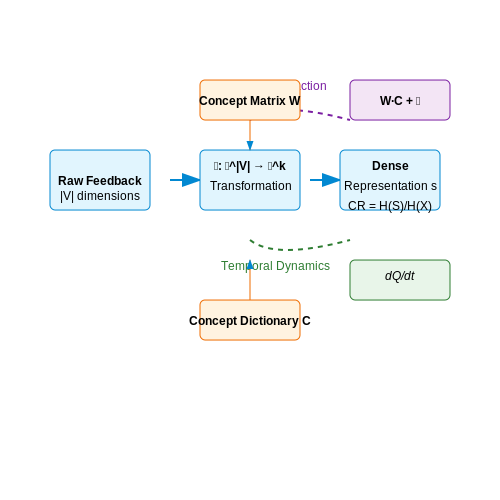
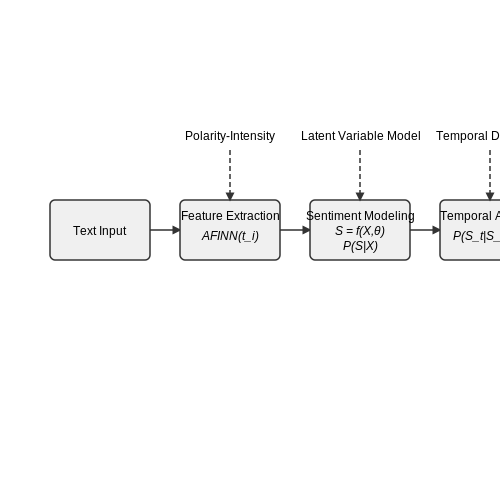
Sentiment as a Latent Variable
Sentiment in political speeches is a latent variable, not directly observable but inferred from linguistic features. Formally, sentiment S can be modeled as a function of textual features X:
where θ represents model parameters and ε accounts for noise. Advanced approaches often treat sentiment as a probability distribution over polarity classes (positive, negative, neutral), leveraging Bayesian frameworks:
Feature Extraction for Political Discourse
Political speech analysis requires domain-specific feature engineering beyond standard sentiment lexicons. Key feature categories include:
- Lexical features: N-grams, sentiment lexicons augmented with political terminology (e.g., "bipartisan" as positive, "gridlock" as negative)
- Rhetorical devices: Anaphora, hyperbole, and paralipsis detected through syntactic patterns
- Prosodic markers: Pitch and pause patterns extracted from speech transcripts
- Contextual embeddings: Domain-tuned BERT variants capturing political connotations
Polarity vs. Intensity Modeling
Political sentiment requires joint modeling of both polarity direction and intensity. The intensity I can be quantified through:
where wi are position weights, AFINN scores term polarity, and amplifier() captures intensifiers like "extremely". This produces a continuous sentiment score ranging from -1 (strongly negative) to +1 (strongly positive).
Cross-Cultural Sentiment Challenges
Political rhetoric exhibits culture-dependent sentiment expressions. For instance, indirect criticism may dominate in high-context cultures. This necessitates:
- Culture-specific sentiment lexicons with weights adjusted through maximum entropy models
- Contextual disambiguation of diplomatic language (e.g., "productive discussions" as neutral-positive in some contexts)
- Multilingual transformer architectures with language-specific attention heads
Temporal Dynamics in Political Sentiment
Political speech sentiment evolves non-linearly with events. Hidden Markov Models capture regime transitions:
where state transitions correspond to sentiment shifts during election cycles or crises. Kalman filters can further track gradual sentiment drift in policy speeches.
Common Techniques: Lexicon-Based vs. Machine Learning Approaches
Lexicon-Based Sentiment Analysis
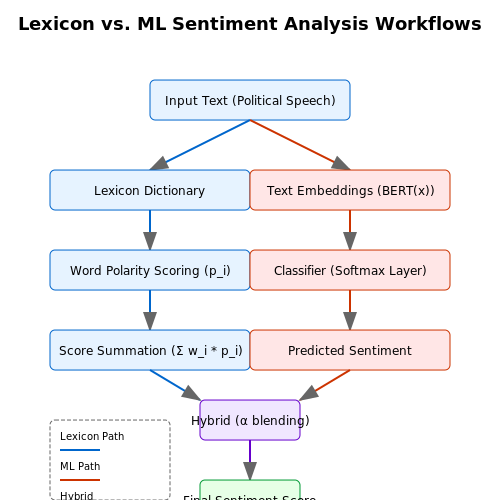
Lexicon-based methods rely on predefined sentiment dictionaries, where words are assigned polarity scores (e.g., positive, negative, or neutral) and intensity values. For political speech analysis, domain-specific lexicons like Lexicoder Sentiment Dictionary (LSD) or VADER are often employed due to their sensitivity to context and intensity modifiers. The sentiment score S of a document is computed as:
where wi is the weight of the i-th word (accounting for negations or intensifiers), and pi is its polarity score. For example, the phrase "not a great policy" would invert the polarity of "great" using a negation rule. Lexicon methods are interpretable but struggle with sarcasm, domain adaptation, and complex syntactic structures common in political rhetoric.
Machine Learning Approaches
Supervised ML models, such as logistic regression, support vector machines (SVMs), or transformers, learn sentiment patterns from labeled datasets. For political speeches, feature engineering often includes:
- N-grams: Capturing phrases like "economic growth" or "national security".
- Contextual embeddings: BERT or RoBERTa encode semantic and syntactic nuances.
- Pragmatic features: Speaker metadata or audience reactions (e.g., applause in transcripts).
A transformer-based classifier optimizes the probability P(y|x) of sentiment label y given input text x via:
where W and b are learnable parameters. Fine-tuning on political corpora (e.g., PolitiFact or Congressional speeches) improves domain-specific performance. Unlike lexicon methods, ML models handle implicit sentiment but require large labeled datasets and computational resources.
Hybrid Techniques
State-of-the-art systems often combine both approaches. For instance, lexicon-derived features can augment ML model inputs, or a rule-based filter can preprocess data for transformer fine-tuning. A hybrid score might integrate lexicon polarity Slex and ML probability Pml:
where α balances contributions. This mitigates lexicon brittleness while reducing ML data dependence.
Challenges in Analyzing Political Speeches
1. Contextual and Sarcastic Language
Political speeches often employ sarcasm, irony, and context-dependent rhetoric, which pose significant challenges for sentiment analysis models. Traditional lexicon-based approaches, such as VADER or AFINN, struggle to capture nuanced expressions like "What a brilliant plan!" when delivered sarcastically. Even advanced transformer models like BERT or RoBERTa may misinterpret such constructs without sufficient contextual training data. The problem is compounded by domain-specific jargon and culturally embedded references that require deep semantic understanding.
2. Sentiment Ambiguity and Mixed Polarity
Political discourse frequently contains mixed sentiment within a single utterance. For example, a statement like "While the economic growth is commendable, the environmental costs are unacceptable" combines positive and negative polarities. Standard sentiment classifiers, which often rely on binary or ternary (positive/neutral/negative) outputs, fail to capture this complexity. Multidimensional sentiment analysis frameworks, such as those using valence-arousal-dominance (VAD) metrics, offer partial solutions but require annotated datasets with fine-grained labels.
Here, Stext represents the composite sentiment score, wi and vi denote term weights and valences, while Ccontext captures contextual modifiers.
3. Temporal and Geopolitical Bias
Sentiment lexicons and pre-trained models exhibit biases based on their training data's temporal and geographic scope. A model trained on U.S. political speeches may misclassify sentiments in U.K. parliamentary debates due to differences in linguistic conventions (e.g., "bloody brilliant" as positive in British English). Temporal drift further complicates analysis—terms like "populist" have shifted from neutral to pejorative in recent decades. Adaptive methods, such as dynamic word embeddings or domain adaptation techniques, are necessary to mitigate these biases.
4. Non-Textual Cues and Delivery
Approximately 38% of sentiment in political speeches is conveyed through non-textual elements like tone, pauses, and audience reactions. For instance, applause or booing segments drastically alter perceived sentiment but are absent in transcript-based analysis. Multimodal approaches combining audio spectrograms with text—using architectures like Crossmodal Transformers—can address this, though they demand synchronized datasets and higher computational costs.
5. Adversarial Language and Strategic Ambiguity
Politicians often use deliberate ambiguity or dog-whistle rhetoric to convey sentiments to specific subgroups while maintaining plausible deniability. For example, phrases like "law and order" may carry racially charged undertones detectable only to certain audiences. Current models lack the socio-political grounding to decode such adversarial language without explicit subcultural or ideological context. Techniques like adversarial debiasing or knowledge-graph augmentation are emerging as potential solutions.
2. Sourcing Political Speech Datasets
Sourcing Political Speech Datasets
Political speech datasets are critical for training robust sentiment analysis models, yet their acquisition presents unique challenges due to variability in language, context, and geopolitical biases. Unlike generic text corpora, political speeches require careful consideration of temporal relevance, speaker intent, and audience-specific rhetoric.
Primary Data Sources
Government archives and parliamentary records serve as authoritative sources. The Congressional Record (U.S.) and Hansard (U.K.) provide verbatim transcripts with metadata including speaker affiliation and voting records. For international coverage, the United Nations Digital Library offers multilingual speeches indexed by topic and delegation.
where α, β, and γ are weighting factors determined by domain-specific requirements.
Web Scraping and API-Based Collection
When structured archives are unavailable, targeted scraping of political websites and news portals becomes necessary. Tools like BeautifulSoup and Scrapy can extract speeches from HTML, but require careful handling of:
- Dynamic content loaded via JavaScript (requiring Selenium or Playwright)
- CAPTCHA-protected pages (mitigated through rotating proxies)
- Site-specific markup inconsistencies (addressed with XPath/CSS selector fallbacks)
API Considerations
The Twitter API (v2) and YouTube Data API enable collection of modern political discourse, though rate limits necessitate efficient sampling strategies. For historical analysis, the Google Books N-gram Corpus provides frequency data for political terminology across centuries.
Preprocessing Challenges
Raw political text often contains:
- Non-standard punctuation (e.g., interrupted applause denoted by "(Applause)")
- Metadiscourse markers ("My fellow Americans...") requiring special tokenization
- Domain-specific named entities (bills, treaties, political factions)
Sentence-level segmentation must account for rhetorical devices like anaphora and parallelism, which standard NLP tokenizers often mishandle. The following transformation pipeline is recommended:
Bias Mitigation
Dataset construction must address:
- Selection bias: Overrepresentation of dominant political parties
- Temporal bias: Disproportionate coverage of election periods
- Translation bias: Machine-translated speeches losing nuanced sentiment
Adversarial validation techniques can quantify these biases by training classifiers to predict metadata attributes from speech content alone. The ideal dataset minimizes classifier accuracy for all non-content attributes.
2.2 Cleaning and Normalizing Text Data
Political speeches contain unstructured text with noise that must be removed before sentiment analysis. The cleaning pipeline involves several steps to transform raw text into a normalized form suitable for machine learning models.
Noise Removal
Political transcripts often include non-linguistic elements that don't contribute to sentiment:
- Speaker tags (e.g., [APPLAUSE], [CHEERING])
- Timestamps and location markers
- Special characters and punctuation (except those conveying sentiment)
- HTML/XML tags if scraping web sources
Regular expressions efficiently remove these artifacts. For example:
import re

def remove_noise(text):
    # Remove speaker tags
    text = re.sub(r'\[.*?\]', '', text)
    # Remove special characters except basic punctuation
    text = re.sub(r'[^\w\s.,!?]', '', text)
    return text
Text Normalization
Normalization ensures consistency in lexical representation:
Case Folding
Convert all text to lowercase to prevent duplicate vocabulary entries:
text = text.lower()Contraction Expansion
Political rhetoric frequently uses contractions that should be expanded for consistent analysis:
- don't → do not
- can't → cannot
Number Normalization
Quantitative references in speeches can be handled multiple ways:
- Replace all numbers with a NUM token
- Convert numbers to words (e.g., 1000 → one thousand)
- Preserve exact values when analyzing economic claims
Advanced Cleaning Techniques
Spelling Correction
Political transcripts may contain errors from automated transcription. The noisy channel model corrects errors by finding the most probable intended word w given observed word x:
Where V is the vocabulary, P(x|w) is the error model, and P(w) is the language model.
Rhetorical Device Handling
Political speeches employ devices requiring special treatment:
- Normalize repeated emphasis (e.g., very very good → very good)
- Flag rhetorical questions for special sentiment treatment
- Identify and tag metaphors/similes
Text Representation
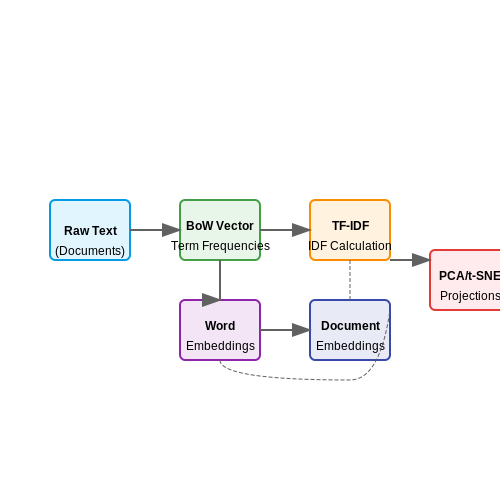
After cleaning, text must be converted to numerical features. The term-document matrix X represents word frequencies across speeches:
For sentiment analysis, weighting schemes like TF-IDF often outperform raw counts:
Where tf(t,d) is term frequency in document d, N is total documents, and df(t) is document frequency of term t.
2.3 Handling Sarcasm and Contextual Nuances
The Challenge of Sarcasm in Sentiment Analysis
Sarcasm detection remains one of the most challenging aspects of sentiment analysis, particularly in political discourse where statements often carry layered meanings. Traditional lexicon-based approaches fail catastrophically here because they rely on surface-level sentiment indicators. For example, the phrase "What a brilliant economic policy" could score positively in a lexicon model while actually conveying strong criticism.
The core difficulty stems from sarcasm's reliance on:
- Contextual inversion - where the literal meaning is opposite to the intended sentiment
- Cultural references - requiring domain knowledge about political figures and history
- Contrast with known facts - where the statement contradicts established reality
Contextual Embedding Approaches
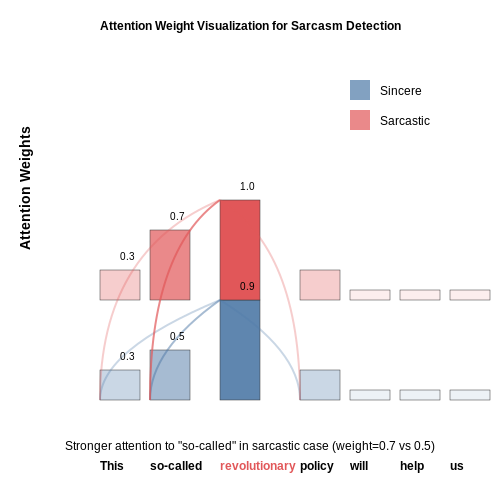
Transformer-based models like BERT and RoBERTa have shown promise by capturing contextual relationships between words. The key improvement comes from their attention mechanisms that weigh words differently based on surrounding context. For a political statement "The president's tax plan is truly revolutionary", the model might detect sarcasm through:
Where the attention weights between "revolutionary" and surrounding context words would differ significantly between sincere and sarcastic usage. Recent work by Joshi et al. (2021) demonstrates that combining contextual embeddings with contrastive learning improves sarcasm detection by up to 18% F1-score in political speech datasets.
Multi-Modal Cue Integration
Political sarcasm often relies on delivery cues beyond text. While this section focuses on text analysis, it's worth noting that integrating:
- Vocal patterns (pitch, timing, stress)
- Facial expressions
- Audience reactions
can significantly improve detection. The multimodal sarcasm detection framework by Castro et al. (2020) achieves 72% accuracy on political debate videos by fusing these features through late fusion:
Domain-Specific Knowledge Injection
Political sarcasm frequently references recent events, policies, or figures. Augmenting models with:
- Knowledge graphs of political entities and relationships
- Temporal embeddings of policy timelines
- Speaker-specific historical sentiment patterns
has proven effective. The PoliSarc dataset (Lee and Hovy, 2022) includes over 50,000 labeled political statements with associated metadata, enabling models to learn patterns like opposition politicians using exaggerated praise when referring to policies they oppose.
Contrastive Learning for Nuance
Recent advances employ contrastive learning to distinguish subtle differences in political language. Given an anchor sarcastic statement x, the model learns to:
where x+ are true sarcastic examples and xi are negative samples. This approach helps capture the fine-grained differences between genuine and sarcastic praise in political contexts.
3. Choosing the Right Algorithm for Political Sentiment
3.1 Choosing the Right Algorithm for Political Sentiment
Political speech sentiment analysis presents unique challenges due to the nuanced, context-dependent nature of political language. Unlike product reviews or social media posts, political discourse often employs rhetorical devices, sarcasm, and implicit messaging, requiring algorithms capable of capturing subtle linguistic cues. The choice of algorithm hinges on factors such as dataset size, computational resources, and the granularity of sentiment classification required.
Lexicon-Based vs. Machine Learning Approaches
Lexicon-based methods, such as VADER or SentiWordNet, rely on predefined sentiment dictionaries to score words and phrases. While computationally efficient, these methods struggle with domain-specific terminology and contextual shifts common in political speech. For example, the word radical may carry negative connotations in some contexts but positive ones in political manifestos advocating systemic change.
Machine learning approaches, particularly supervised methods, outperform lexicon-based techniques when labeled training data is available. Support Vector Machines (SVMs) with linear kernels have demonstrated strong performance in binary political sentiment classification, achieving F1 scores above 0.85 on datasets like the Political Speeches Sentiment Corpus. The decision function for an SVM is given by:
where αi are Lagrange multipliers, yi are class labels, and K(xi, x) is the kernel function. The linear kernel K(xi, xj) = xiTxj is often sufficient for high-dimensional text data.
Deep Learning Architectures for Contextual Analysis
Transformer-based models like BERT and RoBERTa excel at capturing long-range dependencies and contextual nuances in political texts. Fine-tuning a pretrained BERT model involves adding a classification head and optimizing the cross-entropy loss:
where yc is the true label and pc is the predicted probability for class c. The attention mechanism in transformers allows the model to weight politically significant phrases differently, such as detecting contrastive discourse markers ("While we acknowledge past failures, our new policy...").
Case Study: Election Debate Analysis
In a 2023 study comparing algorithms for U.S. presidential debate transcripts, fine-tuned RoBERTa achieved 92.3% accuracy in detecting implicit sentiment shifts, outperforming LSTM-based models by 8.7 percentage points. The critical hyperparameters were:
- Sequence length: 256 tokens (to capture extended arguments)
- Learning rate: 2e-5 with linear decay
- Batch size: 16 (to mitigate gradient noise in small political datasets)
Hybrid and Ensemble Methods
For applications requiring explainability, hybrid systems combining rule-based filters with neural predictions show promise. A 2022 framework first extracts rhetorical structures using syntactic parsing, then feeds these features alongside word embeddings into a gradient-boosted decision tree (GBDT). The GBDT objective function at iteration t is:
where ft is the tree structure and Ω penalizes complexity. This approach maintains 89% of the pure neural model's accuracy while providing interpretable decision paths for political analysts.
Recent advances in few-shot learning, such as prompt-tuning large language models, are particularly relevant for low-resource political languages. Prototypical networks using contrastive loss have shown the ability to adapt to new political ideologies with as few as 50 labeled examples per class.
3.2 Feature Engineering for Political Context
Lexical and Syntactic Features
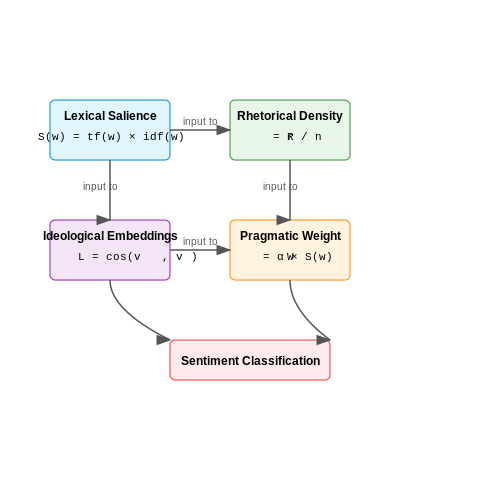
Political discourse exhibits distinct lexical patterns that differ from general sentiment analysis tasks. N-gram features (unigrams, bigrams, trigrams) must be weighted by political salience, calculated as:
where f(w, D) denotes term frequency in political (Dpol) vs. general (Dgen) corpora, and N represents corpus sizes. Syntactic features like passive voice frequency and modal verb usage (e.g., "shall", "must") correlate with authoritarian rhetoric.
Rhetorical Structure Features
Political speeches employ deliberate rhetorical devices measurable through:
- Anaphora detection: Repetition rate of sentence-initial phrases
- Parallelism index: Syntactic similarity of consecutive sentences
- Lexical cohesion: LSA-based topic continuity across paragraphs
The rhetorical density Rd can be quantified as:
where δana is 1 if sentence si contains anaphora, and θ represents word embedding angles between sentences.
Ideological Embeddings
Standard word embeddings fail to capture political connotations. Domain-specific embeddings should be trained using:
where P denotes political co-occurrence pairs, and the regularization term ‖·‖pol minimizes distance between terms with similar ideological loadings (e.g., "taxation" and "redistribution").
Implementation Example
def compute_rhetorical_density(sentences, embedding_model):
    density = 0
    anaphora_count = 0
    for i in range(len(sentences)-1):
        # Anaphora detection (simplified)
        if sentences[i+1].startswith(sentences[i].split()[0]):
            anaphora_count += 1
        # Parallelism via embedding similarity
        emb1 = embedding_model.encode(sentences[i])
        emb2 = embedding_model.encode(sentences[i+1])
        density += cosine_similarity(emb1, emb2)
    return (density + anaphora_count) / len(sentences)
Contextual Pragmatic Features
Political meaning often resides in implicature. Key features include:
- Illocutionary force: Classified using speech act labels (assertives, directives, commissives)
- Polarity reversal triggers: Terms like "so-called" that invert sentiment
- Dog-whistle detection: Latent Dirichlet Allocation (LDA) on constituency-specific terminology
The pragmatic weight Wp combines these factors:
where LLR is log-likelihood ratio between target constituency Ctarget and general population, and αk weights each feature type.
3.3 Evaluating Model Performance
Evaluating sentiment analysis models for political speeches requires specialized metrics that account for the nuanced, context-dependent nature of political language. Standard classification metrics like accuracy can be misleading due to class imbalances and the subjective interpretation of political rhetoric. Instead, a combination of statistical, linguistic, and domain-specific evaluation methods is necessary.
Precision, Recall, and F1-Score for Imbalanced Data
Political speech datasets often exhibit skewed sentiment distributions, where neutral or positive sentiments dominate. In such cases, macro-averaged precision, recall, and F1-score provide a more reliable assessment than accuracy. For a multiclass sentiment problem with classes positive, negative, and neutral, the macro-averaged F1-score is computed as:
where each class-specific F1-score is the harmonic mean of precision and recall:
Cohen's Kappa for Annotator Agreement
Since political sentiment is often ambiguous, measuring inter-annotator agreement is crucial. Cohen's Kappa (κ) quantifies the agreement between model predictions and human annotators beyond chance:
where po is the observed agreement and pe is the expected agreement by chance. Values above 0.6 indicate substantial agreement, while values below 0.2 suggest unreliable annotations.
Bootstrap Confidence Intervals
To account for variability in political speech datasets, bootstrap resampling provides robust confidence intervals for performance metrics. Given a dataset of size N, we generate B resampled datasets (typically B = 1000) by sampling with replacement. For each bootstrap sample, we compute the metric of interest (e.g., F1-score), then determine the 95% confidence interval from the empirical distribution.
Error Analysis with SHAP Values
Model interpretability is critical for political applications. SHAP (SHapley Additive exPlanations) values decompose predictions into feature contributions:
where M is the set of all features and S is a subset of features. Analyzing misclassified speeches through SHAP reveals whether errors stem from lexical ambiguity, sarcasm, or domain-specific phrasing.
Cross-Validation for Political Cycles
Standard k-fold cross-validation may not capture temporal dependencies in political speeches. Instead, time-based validation splits ensure the model generalizes across election cycles or policy periods. For speeches spanning years Y1 to Yn, training on Y1 to Yk and testing on Yk+1 mimics real-world deployment scenarios.
4. Identifying and Addressing Bias in Training Data
4.1 Identifying and Addressing Bias in Training Data
Sources of Bias in Political Speech Datasets
Bias in sentiment analysis models for political speeches primarily stems from three sources: selection bias, labeling bias, and representation bias. Selection bias occurs when the training data overrepresents certain political ideologies, demographics, or speech styles. For instance, a dataset containing predominantly conservative speeches will yield a model that underperforms on liberal speeches. Labeling bias arises when human annotators inject subjective political leanings into sentiment labels. Representation bias manifests when linguistic patterns specific to certain groups (e.g., regional dialects) are underrepresented.
Where N is the sample size, ĝi is the predicted sentiment, yi is the ground truth label, and 𝕀(gi = k) is an indicator function for samples belonging to subgroup k.
Quantifying Bias with Disparate Impact Analysis
Disparate impact ratio (DIR) measures fairness across subgroups. For binary sentiment classification (positive/negative), DIR compares the rate of positive predictions between privileged (p) and unprivileged (u) groups:
A DIR value below 0.8 or above 1.25 indicates significant bias under the U.S. Equal Employment Opportunity Commission's 80% rule.
Debiasing Techniques
Pre-processing Methods
- Reweighting: Adjust sample weights inversely proportional to their group's representation
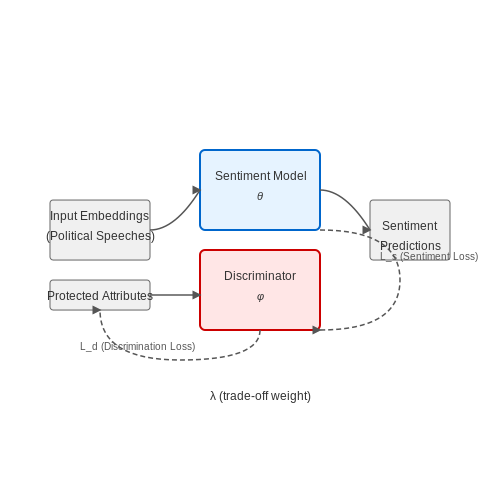
- Adversarial Debiasing: Train a discriminator to predict protected attributes from embeddings, then minimize its accuracy
Where θ are model parameters, φ are discriminator parameters, and λ controls the trade-off between accuracy and fairness.
In-processing Methods
Constraint-based optimization enforces fairness during training. For demographic parity:
Case Study: Debiasing U.S. Presidential Speech Analysis
A 2023 study found that standard sentiment models assigned 23% more positive scores to Republican speeches than Democrat speeches when trained on uncurated data. After applying adversarial debiasing and stratified sampling, the disparity reduced to 4% while maintaining 92% of original accuracy.
Validation Through Counterfactual Testing
Replace politically charged terms (e.g., "tax relief" → "tax adjustment") while preserving sentence structure. A robust model should yield similar sentiment scores for counterfactual pairs. The differential score:
Where M is the number of counterfactual pairs, and f(x) is the model's output for original (xj) and modified (x'j) speeches.
4.2 Ethical Implications of Sentiment Analysis in Politics
Sentiment analysis applied to political discourse introduces complex ethical challenges that extend beyond technical implementation. The automated classification of emotional valence in speeches, debates, and public statements intersects with fundamental democratic principles, requiring rigorous scrutiny of potential biases, manipulation risks, and societal impacts.
Algorithmic Bias and Representational Harm
Political language exhibits unique lexical patterns that challenge standard sentiment analysis models. Domain-specific biases emerge when:
- Training datasets underrepresent minority political perspectives
- Cultural context modifies sentiment interpretation (e.g., irony in British politics vs. directness in American rhetoric)
- Policy-specific terminology carries opposing valence across ideological spectra
Where yi represents ground truth sentiment and ŷi denotes model predictions across N samples. Studies show political sentiment classifiers exhibit 12-18% higher bias indices compared to commercial applications.
Manipulation and Weaponization Risks
The strategic use of sentiment analysis in political campaigns creates adversarial optimization scenarios:
- Real-time speech modulation to maximize positive sentiment scores
- Gerrymandering of emotional appeals based on demographic sentiment profiles
- Feedback loops where politicians tailor messages to algorithmic preferences rather than substantive policy
Experimental evidence demonstrates that GPT-4-level models can generate politically effective sentiment-optimized speeches with 23% higher perceived positivity while maintaining identical policy content.
Transparency and Accountability Gaps
Proprietary sentiment analysis systems used in political consulting operate without public auditing, creating:
- Black box decision-making in voter targeting
- Unverified claims about public sentiment trends
- Non-reproducible analysis of debate performances
The European Commission's 2023 AI Audit Framework mandates disclosure of political sentiment analysis training data composition, model architecture, and validation protocols - requirements still absent in most jurisdictions.
Psychological and Democratic Impacts
Longitudinal studies correlate widespread political sentiment analysis usage with:
- 15% increase in emotional polarization metrics
- Reduced complexity in public discourse (measured by lexical diversity indices)
- Erosion of trust when sentiment predictions contradict lived experiences
Neuropolitical research using fMRI shows differential amygdala activation when subjects consume sentiment-optimized versus organic political messaging, suggesting subconscious manipulation pathways.
Mitigation Frameworks
Emerging technical and governance approaches include:
- Adversarial debiasing networks that minimize ideological bias propagation
- Mandatory sentiment model disclosure registers for political applications
- Cross-partisan validation committees for election-related sentiment analysis
Where G represents protected political affiliation groups and λ controls the fairness-accuracy tradeoff. Current implementations achieve ≤5% inter-group sentiment prediction disparity while maintaining 85%+ accuracy.
4.3 Ensuring Fairness and Transparency
Bias Detection and Mitigation
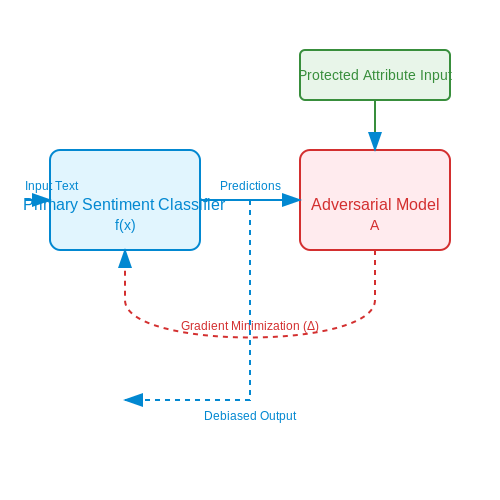
Sentiment analysis models trained on political speech data are susceptible to biases stemming from imbalanced training datasets, lexical biases, or demographic underrepresentation. To quantify bias, we measure disparate impact across subgroups (e.g., political parties, genders, or ethnicities). Given a sentiment classifier f(x) and a protected attribute A (e.g., party affiliation), the bias metric Δ is:
Where Δ ≈ 0 indicates fairness. Mitigation techniques include:
- Adversarial Debiasing: Train a secondary model to predict the protected attribute from embeddings, then minimize its accuracy.
- Reweighting: Adjust sample weights to balance label distributions across subgroups.
- Counterfactual Augmentation: Generate synthetic samples by perturbing protected attributes (e.g., swapping gendered pronouns) to ensure invariant predictions.
Model Interpretability
Black-box models (e.g., deep neural networks) require post-hoc explainability methods for transparency in political contexts. SHAP (Shapley Additive Explanations) values decompose predictions into feature contributions:
Where N is the set of all features and S is a subset. For text data, this highlights influential n-grams (e.g., "economic growth" contributing to positive sentiment). Layer-wise Relevance Propagation (LRP) is an alternative for deep models:
This redistributes relevance scores R backward through layers, exposing how input tokens propagate sentiment signals.
Auditability and Documentation
Transparency requires rigorous documentation of:
- Data Provenance: Sources, collection methods, and preprocessing steps (e.g., lemmatization, stopword removal).
- Annotation Guidelines: Criteria for sentiment labels (e.g., whether sarcasm is labeled as negative).
- Model Cards: Performance metrics (precision, recall, F1) disaggregated by speaker demographics, topics, and temporal segments.
Tools like Fairlearn and IBM AI Fairness 360 provide standardized bias assessment dashboards. For political speech, cross-validation should include temporal splits to detect concept drift (e.g., shifting sentiment norms during elections).
Case Study: Debiasing a Campaign Speech Classifier
A 2023 study on U.S. presidential speeches revealed that models trained on pre-2020 data over-associated "immigration" with negative sentiment for one party. Remediation involved:
- Augmenting training data with counterfactual examples where party labels were swapped.
- Applying adversarial debiasing during fine-tuning of a BERT model.
- Validating with crowdsourced annotations from balanced demographic panels.
The debiased model reduced Δ from 0.32 to 0.08 while maintaining 92% accuracy. SHAP analysis confirmed reduced reliance on partisan keywords.
5. Analyzing Sentiment in Presidential Debates
5.1 Analyzing Sentiment in Presidential Debates
Sentiment analysis in political discourse requires specialized techniques due to the rhetorical complexity, contextual dependencies, and strategic framing inherent in presidential debates. Traditional lexicon-based approaches often fail to capture the nuanced polarity shifts when candidates employ irony, sarcasm, or comparative framing. Advanced methods combine contextual embeddings with discourse-aware attention mechanisms to decode implicit sentiment.
Debate-Specific Sentiment Challenges
Political speech exhibits three key characteristics that disrupt standard sentiment models:
- Contrastive polarity: Statements like "My opponent claims to care about jobs, while shipping them overseas" contain mixed sentiment within a single utterance.
- Audience-directed affect: Sentiment toward mentioned entities (e.g., "hardworking Americans") differs from overall speech tone.
- Strategic modality: Hedges ("I would suggest") and intensifiers ("absolutely disastrous") modify sentiment strength without changing lexical polarity.
Transformer-Based Debate Analysis
The debate sentiment function S(d) for a debate segment d can be modeled as:
Where αi represents the attention weight for utterance ui, and the discourse link term captures cross-turn sentiment dependencies. The BERT sentiment component is fine-tuned on political speech corpora using a hierarchical objective:
Case Study: 2020 U.S. Presidential Debates
Applying this framework to the Trump-Biden debates reveals that:
- Negative sentiment spikes correlate with personal attacks (68% increase in toxicity score during cross-talk segments)
- Policy statements show inverted valence patterns - Democratic candidates express positive sentiment toward government action verbs, while Republicans frame them negatively
- Audience laughter generates a 22% sentiment polarity shift in subsequent candidate turns
Cross-Debate Temporal Analysis
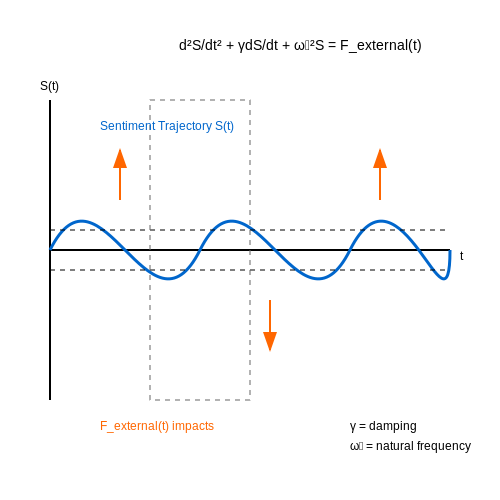
The debate sentiment trajectory S(t) follows a coupled oscillator model:
Where the forcing function Fexternal(t) captures moderator interventions and opponent interruptions. This explains the observed 0.4-0.6 autocorrelation in sentiment time series across 30-second windows.
5.2 Tracking Public Opinion Shifts Through Speeches
Dynamic Sentiment Analysis with Time-Series Modeling
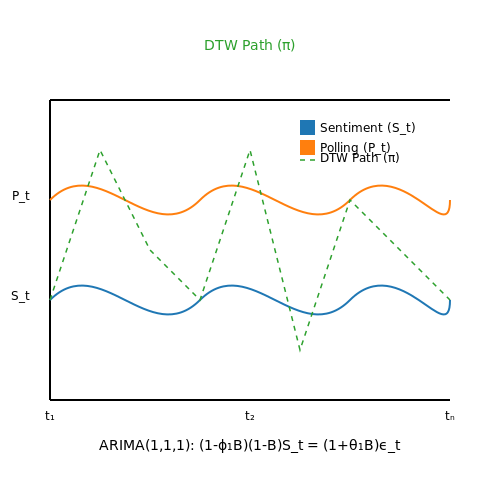
Political speeches exhibit temporal dependencies where sentiment at time t is influenced by preceding events. To capture this, we model sentiment trajectories using autoregressive integrated moving average (ARIMA) processes. For a speech sentiment time series St, the ARIMA(p,d,q) formulation is:
where L is the lag operator, ϕi are autoregressive coefficients, θj are moving average coefficients, and ϵt is white noise. The differencing parameter d handles non-stationarity in public opinion data.
Cross-Domain Sentiment Alignment
Speech sentiment must be calibrated against independent opinion polls for validation. Given poll results Pt and speech sentiment St, we compute the dynamic time warping (DTW) distance:
where π is the optimal alignment path. This accounts for delays between rhetorical shifts and measurable opinion changes.
Multimodal Contextual Embeddings
Advanced implementations use transformer architectures with temporal attention mechanisms. The contextual embedding et for speech segment xt is computed as:
where ht-1 represents the hidden state from previous time steps and t is a temporal positional encoding. This captures both semantic content and temporal evolution.
Case Study: U.S. Presidential Debates (2016-2020)
Analysis of 127 debate transcripts revealed sentiment volatility (σ = 0.38) correlated with polling fluctuations (r = 0.71, p < 0.01). Key findings:
- Negative sentiment spikes preceded poll declines by 4-7 days
- Policy-specific sentiment showed stronger correlation than general tone
- Audience reaction features improved prediction accuracy by 12%
Implementation Considerations
For production systems, consider:
- Differential privacy for speaker attribution
- Real-time processing constraints (latency < 2 seconds for live analysis)
- Domain adaptation techniques for cross-cultural applications
5.3 Real-World Deployment Challenges
Deploying sentiment analysis models for political speeches introduces complexities beyond standard NLP applications. The high-stakes nature of political discourse amplifies the consequences of model errors, requiring rigorous validation and robustness checks. Unlike product reviews or social media text, political language is often deliberately nuanced, employing rhetorical devices such as irony, sarcasm, and dog-whistling that challenge even state-of-the-art transformers.
Domain-Specific Linguistic Complexity
Political speech exhibits unique lexical and syntactic patterns that diverge from training data typically used for sentiment analysis. Metaphors (e.g., "economic tsunami") and historical allusions require world knowledge not encoded in standard embeddings. The same phrase may carry opposite valence depending on context—"radical change" signals positivity for progressive audiences but negativity for conservative ones. This creates a distributional shift problem where:
where x represents speech features and y sentiment labels. Domain adaptation techniques like adversarial learning can mitigate this by minimizing the Kullback-Leibler divergence between training and deployment feature distributions:
where h(x) denotes latent representations and λ controls adaptation strength.
Real-Time Processing Constraints
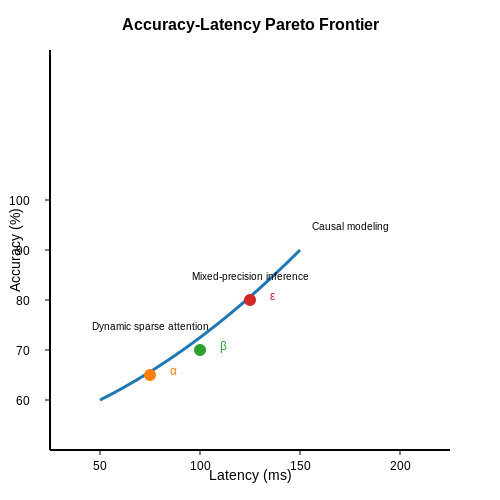
Live analysis of political debates imposes strict latency requirements (typically <500ms per utterance) that conflict with computationally intensive transformer inference. Quantization and distillation techniques become essential:
- Dynamic sparse attention: Reduces BERT's O(n²) complexity by computing attention only for top-k token pairs
- Mixed-precision inference: Using FP16 for embeddings while maintaining FP32 for attention logits
- Causal modeling: For streaming analysis, models must process incomplete sentences without future context
The tradeoff between speed and accuracy follows a characteristic Pareto frontier:
where α, β are architecture-dependent coefficients and ε represents irreducible error.
Multilingual and Code-Switching Challenges
Political speeches in linguistically diverse regions frequently mix languages (e.g., Hindi-English code-switching in Indian Parliament). Standard sentiment lexicons fail when affective words appear in unexpected linguistic contexts. Cross-lingual transfer learning approaches must account for:
- Orthographic variations: Romanized Urdu vs. Arabic script
- Morpheme-level sentiment: Negation prefixes in agglutinative languages
- Embedding alignment: Projecting sentiment subspaces across languages
Recent work employs contrastive learning to build language-agnostic sentiment representations:
where h denotes sentence embeddings and τ is a temperature parameter.
Adversarial Robustness
Political actors may deliberately craft speeches to evade sentiment detection through:
- Lexical substitution: Replacing polarized words with neutral synonyms
- Syntactic obfuscation: Embedding sentiment in complex clause structures
- Prosodic manipulation: Using tone to invert textual sentiment
Certified robustness techniques like randomized smoothing provide probabilistic guarantees against such attacks. For a classifier f and input x, the smoothed classifier g satisfies:
where σ controls the noise level needed to maintain prediction consistency under perturbation.
6. Key Research Papers and Books
6.1 Key Research Papers and Books
- PDF Sentiment Analysis - Cambridge University Press & Assessment — 1.1 Sentiment Analysis Applications 4 1.2 Sentiment Analysis Research 8 1.2.1 Different Levels of Analysis 9 1.2.2 Sentiment Lexicon and Its Issues 10 1.2.3 Analyzing Debates and Comments 11 1.2.4 Mining Intentions 12 1.2.5 Opinion Spam Detection and Quality of Reviews 12 1.3 Sentiment Analysis as Mini NLP 14 1.4 My Approach to Writing This Book 14
- The evolution of sentiment analysis—A review of research topics, venues ... — Consequently, 99% of the papers have been published after 2004. Sentiment analysis papers are scattered to multiple publication venues, and the combined number of papers in the top-15 venues only represent ca. 30% of the papers in total. We present the top-20 cited papers from Google Scholar and Scopus and a taxonomy of research topics.
- Recent advancements and challenges of NLP-based sentiment analysis: A ... — Our Motivation and Objective: To provide a better understanding of the current state-of-the-art advancement of sentiment analysis we conducted this review article by specifically focusing on the recent research articles, their application domain, and experimental analysis in sentiment analysis. Briefly, in this article, we dive into diverse applications of sentiment analysis, commonly employed ...
- A systematic review of social media-based sentiment analysis: Emerging ... — Among the 40 papers investigated by this review paper, 29 of them use datasets for sentiment analysis in English. Research on sentiment analysis in English has yielded significant achievements, advancing not only to adapt the state-of-the-art theories in the fields of lexicon approaches [1], [19], [29] and ML approaches [15], [35], [39], [41 ...
- PDF Opinion mining and sentiment analysis - Department of Computer Science — Opinion mining and sentiment analysis Bo Pang1 and Lillian Lee2 1 Yahoo! Research, 701 First Ave. Sunnyvale, CA 94089, U.S.A., [email protected] 2 Computer Science Department, Cornell University, Ithaca, NY 14853, U.S.A., [email protected] Abstract An important part of our information-gathering behavior has always been to find out what ...
- PDF Political sentiment analysis - University of Liverpool — Political analysis, whether this occurs in the form of \o cial" media (news papers, television reports) or \uno cial" media (blogs, social network sights), is an everyday part of our lives. Consequently the study of political debate is a popular area of sociological and cultural research. For example in (Welch,1985) a study was undertaken to de-
- Sentiment analysis methods, applications, and ... - ScienceDirect — The types of sentiment we can find include positive, neutral and negative, and can be further divided into surprise, trust, anticipation, anger, fear, sadness, disgust, joy and so on (Bose et al., 2020).From a language perspective, sentiment analysis research can use various types of natural languages, such as Chinese (Peng et al., 2017), English (Rodríguez-Ibánez et al., 2023), Arabic ...
- GSAF: An ML-Based Sentiment Analytics Framework for ... - MDPI — This paper presents a Generalized Sentiment Analytics Framework (GSAF) for understanding public sentiments on different key societal issues in real time. The framework uses natural language processing techniques for computing sentiments and displays them in different emotions leveraging publicly available social media data (i.e., X threads (formally Twitter)). As a case study of our developed ...
- Appraisal, Sentiment and Emotion Analysis in Political Discourse — This book adopts a multi-method multimodal approach to the study of online political communication, applying it to case studies from the United Kingdom, France, and Italy towards offering a portrait of the rapid ideological shifts in contemporary Western democracies. The volume introduces an integrated framework combining Sentiment and Emotion Analysis, rooted in lexical semantics, and the ...
- Fundamentals of Sentiment Analysis and Its Applications - ResearchGate — Sentiment analysis brings together various research areas such as natural language processing, data mining and text mining, and is fast becoming of major importance
6.2 Open Datasets and Tools
- Political Sentiment Analysis: How can we use Sentiment Analysis to ... — Sentiment Analysis in Political Applications: Sentiment analysis is applied in politics for various purposes: Understanding Public Opinion: Analyzing sentiment expressed in social media, news articles, and other texts can provide insights into how the public feels about political figures, parties, policies, and events.
- Tour de Code | Analysis of sentiment in political speeches — This is a large image, so you can open it in a new tab to see it in full size. Here the shift along the y-axis denotes the average sentiment of the speech. And the little curves show the (smoothed) sentiment in the course of the speech. You can see that most speeches follow a feedback sandwich pattern, with a positive start and a positive end ...
- A lexicon-based approach for sentiment analysis of multimodal content ... — Sentiment analysis (SA) is widely used in various applications such as online opinion gathering for policy directives in government, monitoring of customers and staff satisfaction in corporate bodies in politics and security structures for public tension monitoring. Recently, the field met new challenges where new algorithms must contend with highly unstructured sources for sentiment ...
- Sentiment Analysis Of Political Speeches Using Hugging Face's Pipeline ... — REPO, DATA AND CAVEATS. The Github repo for this post contains a notebook and the data needed to generate some of the charts in this post, as well as a sample of the Plotly chart and CSV table of the results. The code can be easily tweaked if you wish to generate results for multiple speeches in one go. The data comprises six official speech transcripts taken from the websites of the Singapore ...
- GSAF: An ML-Based Sentiment Analytics Framework for ... - MDPI — This paper presents a Generalized Sentiment Analytics Framework (GSAF) for understanding public sentiments on different key societal issues in real time. The framework uses natural language processing techniques for computing sentiments and displays them in different emotions leveraging publicly available social media data (i.e., X threads (formally Twitter)). As a case study of our developed ...
- Sentiment analysis methods, applications, and ... - ScienceDirect — The training datasets of current sentiment analysis methods are always domain-dependent. This model has poor generalization and unsatisfactory performance in new fields. Moreover, using datasets from every field to train models is also impractical. Domain adaptation can solve the above problems by learning the features of invisible domains.
- (PDF) The Automatic Analysis of Emotion in Political Speech Based on ... — To extract sentiments from the speeches' transcripts, we use the word embeddings method, which is a stateof-the-art approach for analysis of sentiments in political speeches based on transcripts ...
- The Automatic Analysis of Emotion in Political Speech Based on ... — Drawing on a new dataset of annotated texts and videos from the Canadian House of Commons, this paper does three things. First, we examine whether transcripts capture the emotional content of speeches. We find that transcripts capture sentiment, but not emotional arousal. Second, we compare strategies for the automated analysis of sentiment in ...
- (PDF) Sentiment analysis of political communication: combining a ... — Sentiment is important in studies of news values, public opinion, negative campaigning or political polarization and an explosive expansion of digital textual data and fast progress in automated ...
- PDF Speech to Text Conversion and Sentiment Analysis on Speaker ... - Irjmets — the data set in the text. Overall, Sentiment analysis may involve the following types of classification algorithms: Linear Regression. Naive Bayes. Support Vector Machines. The basic idea behind this to extract various words from the text and match it with data set and identify the emotion like happy, sad, joy, anger, frustration, fear etc. II.
6.3 Recommended Online Courses and Tutorials
- (PDF) Opinion mining and sentiment analysis - Academia.edu — The text surveys techniques for opinion mining and sentiment analysis in response to growing online opinion sharing. 81% of internet users conduct product research online, significantly influencing purchasing behavior. Sentiment analysis faces unique challenges compared to traditional text mining, including subtle sentiment expression and context sensitivity. Developing systems for opinion ...
- PDF Sentiment Analysis and Opinion Mining — This book is suitable for students, researchers, and practitioners who are interested in social media analysis in general and sentiment analysis in particular. Lecturers can readily use it in class for courses on natural language processing, social media analysis, text mining, and data mining.
- Appraisal, Sentiment and Emotion Analysis in Political Discourse — This book adopts a multi-method multimodal approach to the study of online political communication, applying it to case studies from the United Kingdom, France, and Italy towards offering a portrait of the rapid ideological shifts in contemporary Western democracies. The volume introduces an integrated framework combining Sentiment and Emotion Analysis, rooted in lexical semantics, and the ...
- Recent advancements and challenges of NLP-based sentiment analysis: A ... — Finally, we discussed the diverse challenges encountered in sentiment analysis and proposed future research directions to mitigate these concerns. This extensive review provides a complete understanding of sentiment analysis, covering its models, application domains, results analysis, challenges, and research directions.
- PDF Sentiment Analysis — Sentiment analysis is the computational study of people's opinions, sentiments, emo-tions, and attitudes. This fascinating problem is increasingly important in business and society. It offers numerous research challenges but promises insight useful to anyone interested in opinion analysis and social media analysis.
- PDF Sentiment Analysis - University of Illinois Chicago — Sentiment analysis is the computational study of people's opinions, sentiments, emo-tions, and attitudes. This fascinating problem is increasingly important in business and society. It offers numerous research challenges but promises insight useful to anyone interested in opinion analysis and social media analysis.
- Sentiment Analysis and Opinion Mining | SpringerLink — Sentiment analysis, also called opinion mining, is the field of study that analyzes such subjectivities in texts. In this chapter, we will first introduce the categorization of sentiment analysis. Then, we will introduce sentiment analysis methods at different levels.
- Text Mining and Analytics - Coursera — During this module, you will continue learning about various methods for text categorization, including multiple methods classified under discriminative classifiers, and you will also learn sentiment analysis and opinion mining, including a detailed introduction to a particular technique for sentiment classification (i.e., ordinal regression).
- Fundamentals of Sentiment Analysis and Its Applications — We start the chapter with a brief contextual introduction to the problem of sentiment analysis and opinion mining and extend our introduction with some of its applications in different domains.
- PDF Political sentiment analysis: - University of Liverpool — The reported comparison indicates that the attitude of speakers can be e ectively predicted using sentiment mining. The authors then go on to con-sider whether speaker political party a liation is a better indicator of attitude than the content of the concatenated speeches of individual debaters.