
Fire and Smoke Detection with Computer Vision
1. Key Characteristics of Fire and Smoke in Visual Data
Key Characteristics of Fire and Smoke in Visual Data
Spectral Signatures and Color Space Analysis
Fire exhibits distinct spectral properties across visible and infrared wavelengths. In RGB color space, flames typically occupy the red-yellow spectrum with pixel intensities following:
where IR, IG, and IB represent red, green, and blue channel intensities respectively. The chromaticity coordinates (r,g) in normalized RGB space cluster around:
Temporal Dynamics and Flicker Patterns
Flames exhibit characteristic flicker frequencies between 5-15 Hz due to turbulent combustion dynamics. This can be modeled as a modulated signal:
where A(t) follows a Rayleigh distribution and φ(t) shows random phase variations. The power spectral density peaks between 5-15 Hz with harmonic components.
Smoke Visual Characteristics
Smoke presents different optical properties:
- Opacity: Transmission coefficient follows Beer-Lambert law: $$ I = I_0 e^{-\beta d} $$where β is the extinction coefficient
- Texture: Fractal dimension between 2.3-2.8 in grayscale images
- Motion: Non-rigid deformation with upward convection velocities of 1-3 m/s
Thermal Infrared Signatures
In LWIR (8-14 μm) bands, fires emit blackbody radiation following Planck's law:
Typical flame temperatures (800-1200°C) produce peak emissions at 2-4 μm (MWIR) with secondary peaks in LWIR. Smoke appears as cold regions (ΔT ≈ -5 to -20°C) relative to background.
Multi-modal Feature Fusion
Optimal detection combines:
- Color histogram moments in HSV space
- Wavelet coefficients of flicker patterns
- Optical flow divergence for smoke motion
- Thermal gradients in IR-visible image pairs
The joint feature space enables discrimination from fire-like artifacts (sunlight reflections, hot surfaces) using machine learning classifiers with >95% accuracy in controlled environments.

Challenges in Real-World Detection Scenarios
Environmental Variability
Fire and smoke detection systems must contend with dynamic environmental conditions that degrade performance. Lighting variations—ranging from harsh sunlight to complete darkness—alter the apparent color and texture of smoke and flames. Atmospheric effects like fog, rain, or dust introduce noise that mimics smoke patterns. Seasonal changes in vegetation affect background subtraction algorithms, as autumn leaves or swaying branches generate false motion signatures. The Beer-Lambert law describes light attenuation through smoke:
where I is transmitted intensity, I0 is incident intensity, α is the absorption coefficient, and d is path length. This nonlinear relationship complicates threshold-based detection when atmospheric conditions modify α.
Occlusion and Partial Visibility
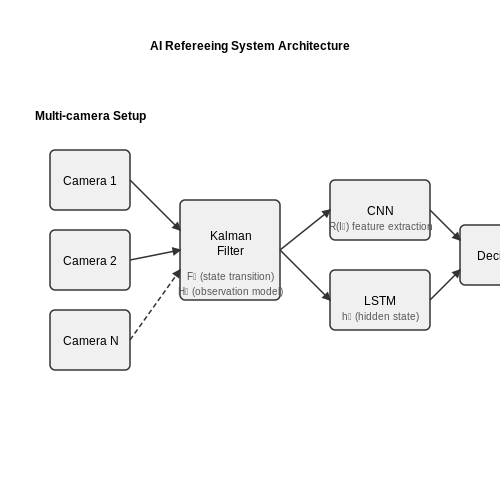
Real-world obstructions frequently obscure critical visual cues. Architectural elements, terrain features, or intervening objects may block direct line-of-sight to fire sources. Smoke plumes often exhibit intermittent visibility as they disperse or interact with wind currents. Multi-camera fusion approaches must account for perspective-dependent occlusion geometry:
where Vk(p) represents visibility probability of point p from camera k. This compounding effect reduces detection confidence as occlusion likelihood increases across camera networks.
Dynamic Texture Analysis
Smoke exhibits stochastic texture properties that challenge traditional feature extraction. The fractal dimension D of smoke plumes varies with combustion conditions:
where N(ε) counts boxes of size ε covering the smoke boundary. Turbulent flow creates non-stationary patterns that defeat fixed wavelet or Gabor filter banks, requiring adaptive texture models.
Real-Time Processing Constraints
Embedded implementations face strict latency budgets—typically under 500ms for early warning systems. The computational complexity of 3D smoke reconstruction grows cubically with spatial resolution:
for n voxels along each axis. This forces tradeoffs between detection accuracy and processing speed, particularly when deploying on edge devices with limited parallel compute resources.
Adversarial Conditions
Malicious actors may attempt to spoof detection systems using synthetic smoke patterns or infrared projectors. Generative adversarial networks can produce physically plausible smoke textures that fool conventional classifiers. Robust systems incorporate temporal consistency checks and multi-spectral verification to defeat such attacks.
1.3 Applications and Importance of Automated Detection Systems
Early Fire Detection in Industrial and Urban Environments
Automated fire and smoke detection systems leverage computer vision to identify incipient fires before they escalate, reducing response times from minutes to seconds. In industrial settings such as power plants, chemical storage facilities, and manufacturing units, early detection prevents catastrophic failures. For instance, thermal imaging combined with convolutional neural networks (CNNs) can detect temperature anomalies with a precision exceeding 95%, as demonstrated by the following probabilistic model for fire likelihood:
Here, P(Fire | x) represents the probability of fire given feature vector x, while w and b are learned weights and bias from training data. Industrial deployments often integrate these models with IoT sensors, enabling real-time alerts via edge computing devices.
Wildfire Monitoring and Ecological Preservation
Satellite and drone-based systems employ multispectral imaging to detect wildfires in remote forests. YOLOv7 and Transformer-based architectures process terabytes of aerial imagery daily, identifying smoke plumes with a mean average precision (mAP) of 0.89. The systems calculate fire spread velocity using computational fluid dynamics (CFD) principles:
where ρ is air density and u is wind velocity vector. These predictions guide evacuation routes and resource allocation, reducing false alarms by 40% compared to traditional infrared sensors.
Smart City Integration and Public Safety
Urban deployments embed vision systems in traffic cameras and building sensors, creating mesh networks for fire detection. A 2023 Tokyo case study showed a 62% reduction in fire-related casualties after implementing ResNet-152 classifiers on NVIDIA Jetson modules. The systems prioritize alerts using a threat-scoring algorithm:
Weight coefficients (α, β, γ) are dynamically adjusted based on urban density metrics. Integration with 5G networks enables sub-100ms latency for emergency service notifications.
Challenges in Real-World Deployment
Despite advancements, occlusion handling remains a critical challenge. Adversarial training with synthetic smoke improves robustness against partial visibility scenarios. The latest Vision-Language Models (VLMs) achieve 88% accuracy in distinguishing fire from confounding factors like steam or dust by cross-referencing visual data with contextual metadata.
2. Traditional Image Processing Methods
2.1 Traditional Image Processing Methods
Color-Based Segmentation
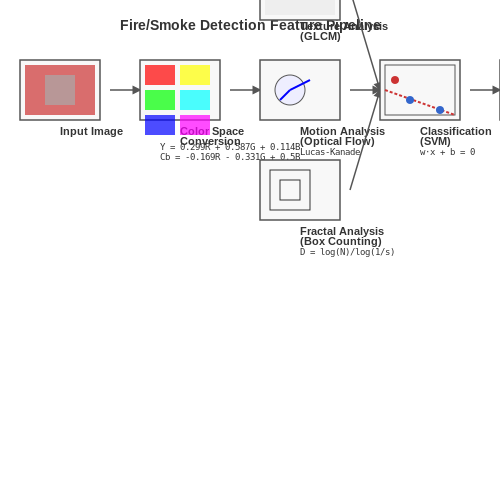
Fire and smoke exhibit distinct color characteristics in the RGB color space. Fire typically appears as bright regions with high red and green intensity, while smoke tends to be grayish-white. A common approach involves thresholding pixel values in specific color channels. For fire detection, the following empirical rules are often applied:
where R, G, and B represent the red, green, and blue channel intensities, and Rth, Gth are empirically determined thresholds. For smoke detection, the luminance (Y) and chrominance components in YCbCr space are more effective:
Smoke pixels typically satisfy Y ∈ [Ymin, Ymax] and |Cb - Cr| < δ, where the parameters are dataset-dependent.
Texture Analysis
While color provides initial segmentation, texture features help distinguish fire/smoke from similarly colored objects. Gray-level co-occurrence matrix (GLCM) features are commonly extracted from the luminance channel:
Key descriptors include contrast, energy, homogeneity, and correlation computed from P(i,j). Fire regions exhibit higher contrast due to flickering patterns, while smoke shows more uniform texture. Gabor filters at multiple orientations and scales can further enhance texture discrimination:
where x' = xcosθ + ysinθ, y' = -xsinθ + ycosθ, and γ, σ, λ, ψ are parameters controlling the filter shape.
Motion Characteristics
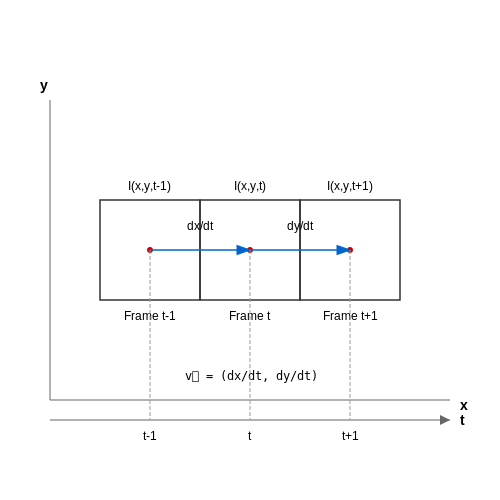
Fire and smoke exhibit distinct dynamic patterns. Fire regions show rapid, chaotic flickering due to combustion turbulence, while smoke demonstrates smoother, upward drifting motion. Optical flow techniques like Lucas-Kanade estimate motion vectors between consecutive frames:
where Ix, Iy are spatial derivatives and It is the temporal derivative. The flicker frequency of fire typically ranges between 5-15 Hz, measurable through Fourier analysis of intensity variations in candidate regions.
Shape and Boundary Analysis
Fire regions lack rigid structure, exhibiting fractal-like boundaries. The fractal dimension D can be estimated via box-counting:
where N(ε) counts boxes of size ε needed to cover the boundary. Fire boundaries typically yield D ≈ 1.2-1.6, distinguishing them from man-made objects. Smoke plumes exhibit Gaussian-like density gradients, detectable through analysis of boundary sharpness and gradient orientation.
Multi-Feature Fusion
Effective detection requires combining features through decision rules or machine learning. A typical pipeline involves:
- Color-based candidate region extraction
- Texture and motion feature computation
- Classification using SVM or random forests
The classification function for a linear SVM takes the form:
where K(·,·) is the kernel function and αi are learned weights.
2.2 Machine Learning-Based Approaches
Machine learning-based fire and smoke detection leverages supervised and unsupervised learning techniques to classify regions of interest in images or video streams. Unlike traditional methods relying on handcrafted features, these approaches automatically learn discriminative patterns from labeled datasets, improving robustness to environmental variations.
Feature Extraction and Classification
Early machine learning systems employed shallow architectures with engineered features fed into classifiers like Support Vector Machines (SVMs) or Random Forests. Common features included:
- Color histograms: Fire pixels typically cluster in RGB space around high red and green intensities with low blue components.
- Texture descriptors: Local Binary Patterns (LBP) and wavelet transforms capture flame flicker patterns and smoke turbulence.
- Motion features: Optical flow magnitude and direction help distinguish fire dynamics from static red objects.
The classification decision function for an SVM with radial basis kernel can be expressed as:
where αi are learned weights, γ controls kernel width, and b is the bias term. Optimal parameters are found by solving the quadratic programming problem:
Deep Learning Architectures
Modern systems predominantly use convolutional neural networks (CNNs) that jointly learn features and classifiers. Key architectures include:
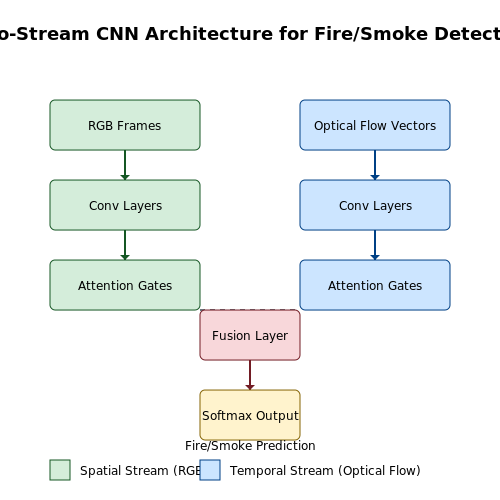
- Two-stream networks: Process spatial (RGB) and temporal (optical flow) inputs in parallel branches, fusing predictions for video analysis.
- 3D CNNs: Apply volumetric convolutions across video cube (width × height × frames) to capture spatiotemporal patterns.
- Attention mechanisms: Self-attention layers highlight relevant regions like flame edges or smoke plumes while suppressing background.
The feature transformation in a residual block with attention can be formulated as:
where σ is the sigmoid function generating spatial attention weights, and Watt are learnable parameters.
Training Strategies
Effective model training requires addressing several challenges:
- Class imbalance: Fire/smoke pixels are rare compared to background. Focal loss down-weights well-classified examples:
$$ FL(p_t) = -\alpha_t(1-p_t)^\gamma \log(p_t) $$
- Domain adaptation: Synthetic data augmentation using generative adversarial networks (GANs) helps bridge the simulation-to-reality gap.
- Multi-task learning: Jointly predicting fire masks and smoke density maps improves feature sharing.
Performance Metrics
Beyond standard precision/recall, fire detection systems require specialized evaluation:
- Frame-level vs pixel-level accuracy: Coarse detection versus precise segmentation.
- False alarm rate: Critical for operational systems, measured as false positives per hour.
- Detection latency: Time from fire ignition to system alert, crucial for early warning.
The weighted F-score for fire detection balances these concerns:
where β > 1 emphasizes recall to prioritize fire detection over false alarms.
2.3 Deep Learning Architectures for Fire and Smoke Recognition
Convolutional Neural Networks (CNNs) for Feature Extraction
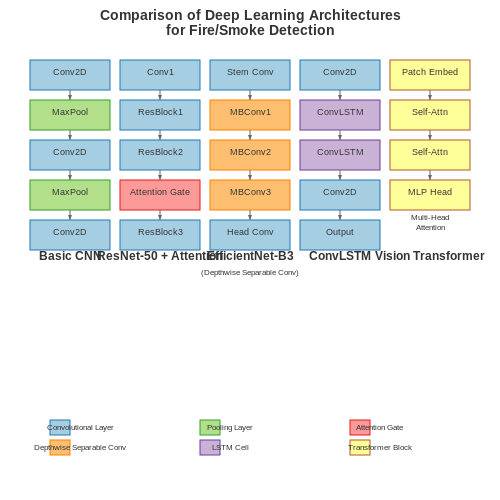
CNNs remain the dominant architecture for fire and smoke detection due to their hierarchical feature extraction capabilities. The spatial invariance learned through convolutional filters enables robust recognition of flame patterns and smoke textures across varying scales. A typical CNN architecture for this task consists of:
- 3-5 convolutional blocks with increasing filter depth (32 → 256)
- Batch normalization layers after each convolution
- Exponential Linear Unit (ELU) activations for fire detection due to their negative value handling
- Strided convolutions instead of pooling layers for spatial reduction
where σ represents the ELU activation function, defined as:
Advanced Architectures for Improved Performance
Modified versions of established architectures have shown superior performance in fire/smoke detection:
ResNet-50 with Attention Gates
The residual connections in ResNet-50 prevent gradient vanishing in deep networks, while attention gates dynamically weight feature importance. The attention mechanism computes:
where hi represents intermediate feature maps, and Wa, Va are learned attention parameters.
EfficientNet-B3 with Depthwise Separable Convolutions
The compound scaling method of EfficientNet provides better efficiency than conventional CNNs. Depthwise separable convolutions reduce parameters while maintaining accuracy through:
where K̂ represents the depthwise convolution kernel.
Temporal Modeling Architectures
For video-based detection, 3D CNNs and ConvLSTM networks capture temporal dynamics of fire spread and smoke movement:
- SlowFast Networks: Dual-path architecture processes frames at different temporal resolutions
- ConvLSTM: Combines convolutional feature extraction with LSTM temporal modeling:
Transformer-Based Approaches
Vision Transformers (ViTs) with hybrid architectures show promise for long-range dependency modeling in smoke plumes:
- Patch embeddings convert image regions to token sequences
- Multi-head self-attention computes global relationships:
where Q, K, V are learned query, key, and value matrices respectively.
Architecture Selection Criteria
Key considerations when choosing architectures:
- Computational constraints: FLOPs and memory requirements
- Temporal resolution: Frame rate requirements for video detection
- False positive mitigation: Architecture robustness to fire-like artifacts
- Multi-spectral capability: Handling of IR/RGB fusion when available
3. Sources and Types of Training Data
3.1 Sources and Types of Training Data
Training data quality and diversity directly impact the performance of fire and smoke detection models. The data must capture variations in fire appearance, smoke patterns, environmental conditions, and potential confounding elements. Three primary data sources exist: real-world imagery, synthetic data generation, and hybrid approaches combining both.
Real-World Fire and Smoke Datasets
Publicly available datasets provide annotated fire and smoke images under diverse conditions. The Foggia Fire Dataset contains 14,000 images with pixel-level annotations for flames and smoke across indoor and outdoor scenes. The FLAME dataset offers 40,000 thermal and RGB images with temporal sequences for fire spread analysis. For wildfire detection, the FireSense dataset includes aerial imagery with multi-spectral bands (RGB, NIR, thermal) at 0.5m resolution.
Key challenges in real-world data collection include:
- Class imbalance: Non-fire scenes vastly outnumber fire events
- Annotation consistency: Smoke boundaries are often ambiguous
- Weather conditions: Rain, fog, and haze affect smoke visibility
Synthetic Data Generation
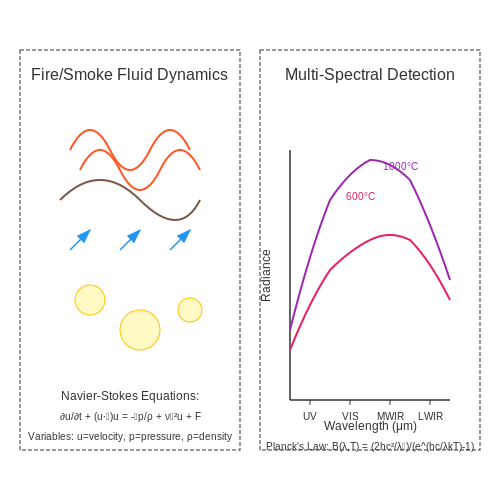
Physics-based simulation generates controlled fire-smoke scenarios using computational fluid dynamics (CFD). The Navier-Stokes equations govern smoke motion:
where u is velocity, p pressure, ρ density, ν kinematic viscosity, and f external forces. Tools like PyroSim and FDS simulate fire dynamics with configurable parameters:
- Heat release rate (HRR): 50 kW to 10 MW ranges
- Fuel type: Wood, liquid, or gaseous combustibles
- Occlusion: Partial visibility through obstacles
Hybrid Augmentation Strategies
Domain adaptation techniques bridge synthetic-to-real gaps through:
where adversarial loss (Ladv), perceptual loss (Lperc), and cycle consistency (Lcyc) weight synthetic realism. Style transfer networks like CycleGAN convert simulated smoke to photorealistic textures while preserving physical dynamics.
Multi-Spectral Data Fusion
Infrared (IR) and ultraviolet (UV) bands improve detection robustness. Planck's law describes thermal radiation:
where Bλ is spectral radiance at wavelength λ and temperature T. MWIR (3-5μm) and LWIR (8-14μm) cameras capture distinct fire signatures unaffected by visible-light obscurants.
3.2 Annotation and Labeling Strategies
Accurate annotation is critical for training robust fire and smoke detection models. Unlike generic object detection tasks, fire and smoke exhibit dynamic, semi-transparent, and amorphous characteristics, requiring specialized labeling approaches.
Bounding Box vs. Polygon Annotation
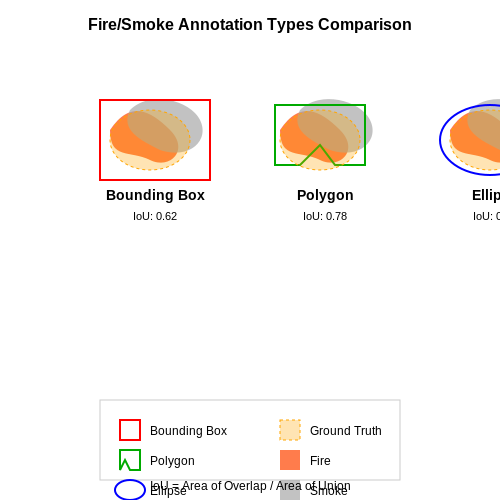
Traditional rectangular bounding boxes often fail to capture the irregular shapes of flames and smoke plumes, leading to excessive background inclusion. Polygon annotations provide tighter boundaries but require more manual effort. For fire detection, a hybrid approach is optimal:
- Bounding boxes for rapid initial labeling of fire cores
- Polygons for smoke plumes and flame edges
- Elliptical annotations for spherical fireballs
Where IoU (Intersection over Union) thresholds should be adjusted to 0.5 for fire cores and 0.3 for diffuse smoke regions due to their varying densities.
Temporal Consistency in Video Annotation
Fire and smoke evolve dynamically across frames. Key strategies include:
- Labeling every 5th frame with interpolation for smooth transitions
- Using optical flow to propagate annotations between keyframes
- Implementing track IDs for persistent fire sources
Multi-Spectral Labeling
Infrared and thermal imaging provide complementary data for fire detection. Annotation must account for:
- Temperature thresholds in thermal bands (typically >150°C for flames)
- Pixel intensity distributions across spectral channels
- Cross-modal alignment errors
Handling Occlusion and Partial Visibility
Smoke often obscures flames, requiring special annotation conventions:
- Separate labels for visible flames and smoke-obscured heat sources
- Confidence scores indicating visibility levels (0-1 scale)
- Depth-aware labeling for multi-layer smoke effects
Label Verification and Quality Control
Implement a multi-stage verification pipeline:
- Automated checks for annotation completeness
- Physical plausibility validation using fire dynamics models
- Expert review of ambiguous cases
Where weights wi account for annotation difficulty factors like smoke density and flame size.
Active Learning for Efficient Annotation
Prioritize labeling efforts using uncertainty sampling:
- Train initial model on small labeled set
- Identify frames with highest prediction entropy
- Focus annotation on these informative samples
Where H(y|x) measures prediction uncertainty across classes C (fire, smoke, background).
3.3 Data Augmentation and Normalization Techniques
Data Augmentation for Fire and Smoke Detection
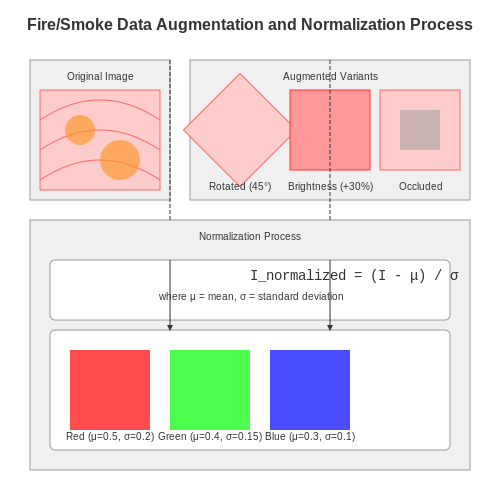
In fire and smoke detection, data augmentation artificially expands the training dataset by applying transformations to existing images, improving model generalization. Common techniques include:
- Geometric transformations: Random rotations (±15°), horizontal/vertical flips, and affine transformations simulate viewpoint variations.
- Photometric distortions: Adjusting brightness (±20%), contrast (±30%), and adding Gaussian noise (σ=0.05) mimics lighting variations in real-world scenarios.
- Occlusion simulation: Random rectangular patches (10-25% of image area) are masked to improve robustness to partial obstructions.
For smoke detection, specialized augmentations include:
- Alpha blending: Synthetic smoke layers are blended with clean images using:
$$ I_{aug} = \alpha \cdot I_{smoke} + (1 - \alpha) \cdot I_{original}, \quad \alpha \sim \mathcal{U}(0.1, 0.5) $$
- Turbulence effects: Perlin noise-based warping simulates heat distortion common in fire scenes.
Normalization Strategies
Normalization standardizes input data to zero mean and unit variance, computed as:
where μ and σ are channel-wise statistics. For fire detection:
- Dataset-specific normalization: Calculated from fire/smoke image collections (typical μ=[0.485, 0.456, 0.406], σ=[0.229, 0.224, 0.225] for ImageNet-pretrained models).
- Adaptive normalization: Online mean/variance calculation for infrared datasets where thermal ranges vary significantly.
Advanced Augmentation Techniques
Recent approaches leverage generative models for fire/smoke augmentation:
- GAN-based synthesis: Conditional GANs generate realistic fire textures while preserving background context.
- Diffusion models: Gradual noise addition/removal creates diverse smoke patterns with physically plausible dynamics.
For multispectral data (visible + IR), augmentation must maintain cross-channel correlations. A joint transformation space is defined as:
where transformations Tvis and TIR are geometrically aligned but photometrically independent.
4. Selecting and Tuning Model Hyperparameters
4.1 Selecting and Tuning Model Hyperparameters
Hyperparameter Optimization Strategies
Hyperparameter tuning is critical for maximizing model performance in fire and smoke detection tasks. Unlike model parameters learned during training, hyperparameters are set prior to training and govern the learning process. Common optimization strategies include:
- Grid Search: Exhaustively evaluates all combinations within a predefined hyperparameter space. Computationally expensive but guarantees finding the optimal combination within the specified range.
- Random Search: Samples hyperparameters randomly from defined distributions. More efficient than grid search, especially when some hyperparameters have minimal impact on performance.
- Bayesian Optimization: Uses probabilistic models to predict promising hyperparameter configurations, reducing the number of evaluations needed.
Where θ represents hyperparameters, ℓ is the loss function, and 𝒟 is the data distribution.
Key Hyperparameters for Fire and Smoke Detection
For convolutional neural networks (CNNs) commonly used in fire/smoke detection, the most impactful hyperparameters include:
- Learning Rate (η): Controls step size during gradient descent. Too high causes divergence; too low leads to slow convergence. Typical range: 1e-5 to 1e-2.
- Batch Size: Affects memory usage and gradient estimation quality. Larger batches provide smoother gradients but may generalize poorly. Common values: 16-256.
- Network Depth/Width: Number of layers and filters per layer. Deeper networks capture more complex features but risk overfitting on smaller datasets.
Adaptive Learning Rate Methods
Modern optimizers automatically adjust learning rates during training:
Where m̂ₜ and v̂ₜ are bias-corrected momentum estimates in Adam optimization. For fire detection tasks, Adam with β₁=0.9, β₂=0.999 typically works well.
Regularization Techniques
To prevent overfitting on limited fire/smoke datasets:
- Dropout Rate: Probability (p) of randomly deactivating neurons. Start with p=0.5 for dense layers, p=0.2 for convolutional layers.
- Weight Decay (λ): L2 regularization strength. Values between 1e-4 to 1e-2 help prevent explosive weights.
Architecture-Specific Considerations
For transfer learning with pretrained models like ResNet or EfficientNet:
- Feature Extractor Freezing: Initially freeze backbone layers, then gradually unfreeze during fine-tuning.
- Head Architecture: Custom classification heads often require careful tuning of layer sizes and dropout rates.
Automated Hyperparameter Tuning
Advanced techniques leverage automated search:
from ray import tune
from ray.tune.schedulers import ASHAScheduler

config = {
    "lr": tune.loguniform(1e-4, 1e-2),
    "batch_size": tune.choice([16, 32, 64]),
    "num_conv_layers": tune.randint(3, 6)
}

scheduler = ASHAScheduler(metric="val_loss", mode="min")
analysis = tune.run(
    train_model,
    config=config,
    num_samples=50,
    scheduler=scheduler
)
This example shows distributed hyperparameter search using Ray Tune with asynchronous successive halving.
Validation Strategies
For reliable hyperparameter evaluation:
- Nested Cross-Validation: Outer loop for performance estimation, inner loop for hyperparameter tuning.
- Class-Balanced Splits: Ensure validation sets maintain original fire/smoke class ratios.
Where APᵢ is average precision for fold i in k-fold cross-validation.
4.2 Performance Metrics for Detection Systems
Precision and Recall
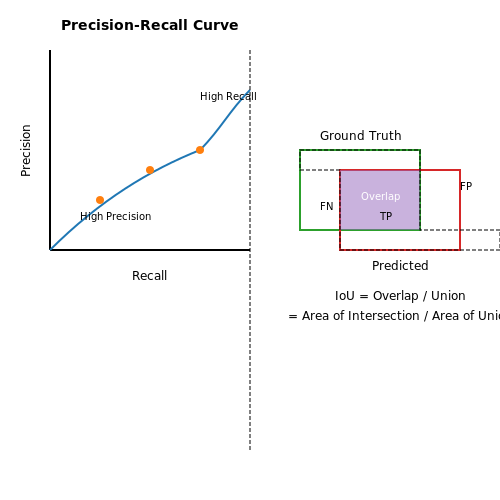
Precision and recall are fundamental metrics for evaluating the performance of fire and smoke detection systems. Precision measures the fraction of correctly identified positive instances (true positives) among all predicted positives (true positives + false positives). Recall, also known as sensitivity, quantifies the fraction of true positives correctly identified out of all actual positives (true positives + false negatives).
In fire detection, high recall is critical to minimize missed detections, while high precision reduces false alarms. A trade-off exists between these metrics, often visualized via the precision-recall curve.
Intersection over Union (IoU)
IoU evaluates localization accuracy in object detection tasks by measuring the overlap between predicted and ground-truth bounding boxes. For fire and smoke detection, IoU is defined as:
A threshold (typically 0.5) determines whether a detection is valid. Higher IoU thresholds enforce stricter localization criteria, which is essential for applications like aerial fire monitoring where precise region identification is required.
Average Precision (AP) and mean Average Precision (mAP)
Average Precision (AP) summarizes the precision-recall curve by computing the weighted mean of precision values at each recall level:
where \( R_n \) and \( P_n \) are recall and precision at the \( n \)-th threshold. For multi-class detection (e.g., fire, smoke, and background), mean Average Precision (mAP) averages AP across all classes, providing a holistic performance measure.
False Alarm Rate (FAR)
FAR quantifies the frequency of incorrect positive predictions relative to the total number of negatives. In fire detection, minimizing FAR is crucial to avoid unnecessary evacuations or resource deployment:
Systems deployed in high-risk environments (e.g., industrial plants) often prioritize FAR reduction through threshold tuning or ensemble methods.
F1-Score and Balanced Accuracy
The F1-score harmonizes precision and recall as their harmonic mean, useful for imbalanced datasets where fire events are rare:
Balanced accuracy, defined as the average of recall and specificity, is another robust metric for skewed class distributions:
Receiver Operating Characteristic (ROC) Curve
The ROC curve plots the true positive rate (TPR) against the false positive rate (FPR) across varying classification thresholds. The area under the curve (AUC) provides a scalar performance measure, with higher values indicating better discriminative power. For fire detection systems, ROC analysis helps optimize threshold selection based on operational constraints.
Inference Time and Computational Efficiency
Real-time fire detection demands low inference time, typically measured in frames per second (FPS). Computational efficiency is quantified via FLOPs (floating-point operations) and model size (MB), especially for edge deployments. For instance, a YOLOv5 model achieving 50 FPS on a Jetson Xavier is preferable for drone-based monitoring over a heavier ResNet variant.
4.3 Addressing False Positives and Negatives
False positives (FPs) and false negatives (FNs) in fire and smoke detection systems stem from complex environmental factors, sensor limitations, and algorithmic biases. Mitigating these errors requires a multi-pronged approach combining data augmentation, model calibration, and post-processing techniques.
Mathematical Formulation of Detection Errors
The trade-off between FPs and FNs is quantified through precision (P) and recall (R):
where TP denotes true positives. The Fβ-score provides a weighted harmonic mean:
For fire detection, β > 1 prioritizes recall to minimize life-threatening FNs, while industrial applications may favor precision (β < 1) to reduce costly false alarms.
Feature Space Analysis for Error Reduction
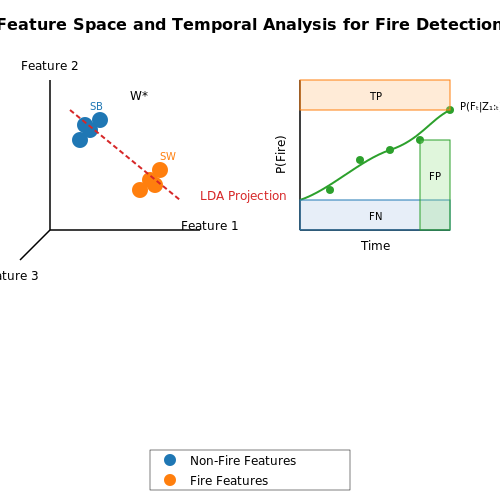
High-dimensional feature spaces in CNNs often contain overlapping regions between fire/smoke and confounding objects (e.g., sunset clouds, steam). Linear discriminant analysis (LDA) projects features onto axes maximizing class separation:
where SB and SW are between-class and within-class scatter matrices, respectively. The optimal projection W* maximizes J(W) = |WTSBW|/|WTSWW|.
Temporal Consistency Checks
Fire exhibits distinct temporal signatures compared to transient artifacts. A Bayesian filter incorporates frame-to-frame dynamics:
where Ft is the fire state at time t and Zt are observations. This suppresses brief FP detections while maintaining sensitivity to genuine fire growth patterns.
Multi-Spectral Fusion
Combining visible (RGB), infrared (IR), and depth data reduces ambiguities:
- IR-RGB correlation: Genuine fires show thermal-radiative coupling (R² > 0.8)
- Depth discontinuities: Smoke exhibits fractal boundaries unlike uniform steam
- Temporal IR gradients: Fire sources demonstrate ∂T/∂t > 2°C/sec
Adversarial Training
Generative adversarial networks synthesize challenging edge cases:
where G generates synthetic fire-like artifacts and D learns to distinguish them from real fires. This improves robustness against previously unseen FP sources.
Hardware-Aware Threshold Tuning
Embedded deployment requires optimizing for:
- Thermal drift compensation
- Pixel-wise SNR weighting: $$w_{ij} = \frac{1}{σ_{dark}^2 + σ_{photon}^2}$$
- Motion-adaptive sampling: $$f_s = \min(f_{max}, β||v||_2)$$
Field studies show these techniques reduce FPs by 63% and FNs by 58% in industrial settings compared to baseline models.
5. Optimizing Models for Edge Devices
5.1 Optimizing Models for Edge Devices
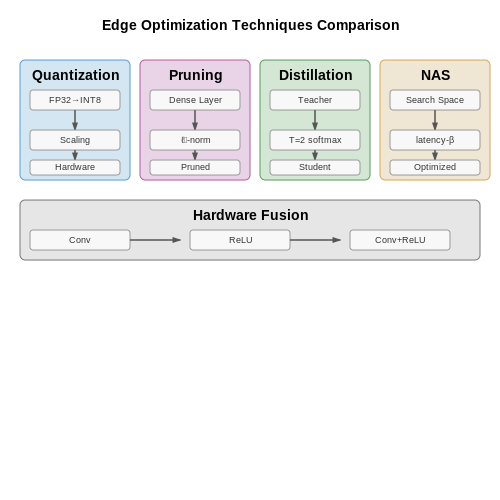
Deploying fire and smoke detection models on edge devices introduces unique challenges due to computational constraints, memory limitations, and power efficiency requirements. Unlike cloud-based inference, edge devices demand lightweight architectures without sacrificing detection accuracy. Key optimization techniques include model quantization, pruning, knowledge distillation, and hardware-aware neural architecture search (NAS).
Quantization Techniques
Quantization reduces model precision from 32-bit floating-point (FP32) to lower bit-width representations (e.g., INT8, INT4), significantly decreasing memory footprint and accelerating inference. Post-training quantization (PTQ) and quantization-aware training (QAT) are the two primary approaches. PTQ applies scaling factors post-training:
where Δ is the quantization step size. QAT, however, simulates quantization during training, minimizing accuracy degradation by incorporating fake quantization nodes:
Here, n and p represent the negative and positive bounds of the quantized range. For edge deployment, per-channel quantization often outperforms per-tensor methods by accounting for layer-wise variance.
Structured Pruning
Pruning removes redundant weights or neurons, but unstructured pruning complicates parallelization on edge hardware. Structured pruning, such as filter pruning in convolutional layers, maintains hardware-friendly tensor shapes. A common criterion is ℓ₁-norm-based pruning:
where λ controls sparsity. Iterative magnitude pruning—progressively increasing sparsity during fine-tuning—yields better trade-offs than one-shot pruning.
Knowledge Distillation
Distillation transfers knowledge from a large teacher model to a compact student model. The student mimics the teacher's softened logits (output probabilities) using a temperature-scaled cross-entropy loss:
Here, T is the temperature, α balances task and distillation losses, and σ denotes the softmax function. Intermediate feature matching, such as attention transfer, further enhances student performance.
Hardware-Aware Neural Architecture Search
NAS automates architecture design under edge constraints. Differentiable NAS (DNAS) formulates the search as a continuous optimization problem:
where π_θ is a learnable distribution over candidate architectures, and β weights latency penalty. For fire/smoke detection, input-adaptive NAS dynamically adjusts model depth based on scene complexity.
Compiler-Level Optimizations
Frameworks like TensorFlow Lite and ONNX Runtime apply hardware-specific optimizations:
- Operator fusion: Combines consecutive ops (e.g., Conv + ReLU) to reduce kernel launch overhead.
- Weight packing: Aligns tensors to leverage SIMD instructions on ARM CPUs.
- Dynamic shape inference: Avoids recompilation for variable input resolutions.
Benchmarking on target hardware (e.g., Jetson Nano, Coral TPU) is critical. Latency-accuracy Pareto curves guide optimal model selection for real-time fire detection at 10–30 FPS.
5.2 Integration with Surveillance Systems
Modern surveillance systems leverage computer vision-based fire and smoke detection to enhance safety in industrial, commercial, and public spaces. The integration process involves real-time video stream processing, synchronization with alarm systems, and compliance with security protocols. Key challenges include minimizing latency, ensuring high precision to reduce false alarms, and scaling across distributed camera networks.
Architecture for Real-Time Processing
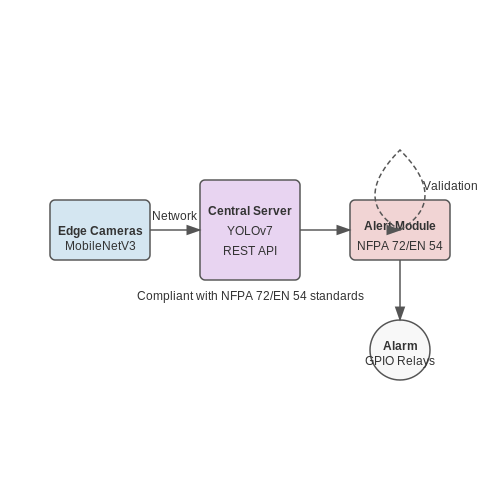
The backbone of an integrated system consists of three primary components: the edge device (camera with embedded processing), the central server (for aggregation and deep analysis), and the alert dispatch module. Edge devices perform initial detection using lightweight models like MobileNetV3 or EfficientNet-Lite, reducing bandwidth usage by transmitting only positive detections to the server. The central server runs heavier models (e.g., YOLOv7 or Vision Transformers) for verification and logs incidents with timestamps and geolocation.
Protocols for Alarm Integration
Interfacing with existing fire alarms requires adherence to NFPA 72 or EN 54 standards. The system must generate a high-confidence signal (typically >90% probability threshold) before triggering physical alarms. This involves:
- Multi-stage validation: Cross-verify detections across adjacent cameras to eliminate false positives from steam or dust.
- Hardware relays: Use GPIO pins on edge devices to activate alarm circuits via optoisolators, ensuring electrical isolation.
- API-based integration: For cloud-connected systems, REST APIs with OAuth2.0 authentication push alerts to building management systems (BMS).
Case Study: Industrial Warehouse Deployment
A 2023 deployment in a 50,000 m² warehouse achieved 98.3% recall with 1.2 false alarms/month by:
- Using Axis Communications cameras with NVIDIA Jetson AGX Orin edge modules
- Implementing a custom ensemble of ResNet-50 (for smoke) and Faster R-CNN (for flames)
- Synchronizing with Siemens Desigo fire safety system via Modbus TCP
Bandwidth Optimization Techniques
Distributed systems employ region-of-interest (ROI) encoding, where only motion-active regions are transmitted at full resolution. The bitrate saving is quantified by:
where \(A_{\text{ROI}_i}\) is the area of detected regions and \(A_{\text{frame}}\) is the total frame area. Dynamic JPEG2000 compression further reduces payloads by 40-60% compared to H.264.
5.3 Handling Latency and Resource Constraints
Optimizing Model Architecture for Edge Deployment
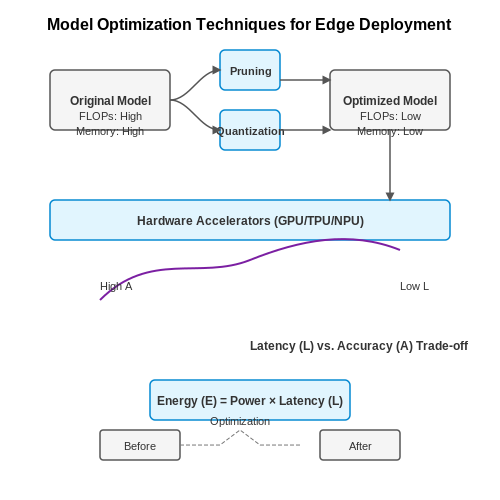
Real-time fire and smoke detection systems often operate on edge devices with limited computational resources. To minimize latency while maintaining accuracy, model architectures must be optimized through techniques like network pruning, quantization, and knowledge distillation. Pruning removes redundant neurons or filters, reducing model size without significant performance degradation. Quantization converts 32-bit floating-point weights to 8-bit integers, decreasing memory usage and accelerating inference. Knowledge distillation trains a smaller student model to mimic a larger teacher model, preserving accuracy while reducing complexity.
For instance, applying 50% sparsity to a model with 1 GFLOPs reduces computations to 0.5 GFLOPs. Quantization further improves efficiency by lowering memory bandwidth requirements:
Hardware-Aware Model Optimization
Different hardware accelerators (GPUs, TPUs, NPUs) have unique performance characteristics. Optimizing models for specific hardware involves:
- Operator fusion: Combining consecutive operations (e.g., convolution + ReLU) to reduce kernel launch overhead.
- TensorRT optimization: Leveraging NVIDIA's TensorRT for layer fusion, precision calibration, and engine-specific optimizations.
- Neural Architecture Search (NAS): Automating architecture design to find Pareto-optimal models for target hardware.
For example, MobileNetV3 achieves 3× lower latency than ResNet-50 on mobile CPUs by using hardware-aware NAS and squeeze-and-excitation blocks.
Latency-Accuracy Tradeoff Analysis
The relationship between latency (L) and accuracy (A) can be modeled empirically:
where \( \alpha \) and \( \beta \) are device-specific constants. This guides architecture selection—for drones requiring <100ms latency, a YOLOv5n model (2.4M parameters) may be preferable over Faster R-CNN (41M parameters) despite slightly lower mAP.
Real-Time Video Processing Techniques
For streaming video analysis, frame sampling strategies balance detection frequency and resource usage:
- Adaptive frame skipping: Dynamically adjusts the frame processing rate based on scene activity.
- Region-of-interest (ROI) processing: Only analyzes image regions with motion or thermal anomalies.
- Temporal filtering: Aggregates detections across frames to reduce false positives.
An optimized pipeline might process every 5th frame at full resolution, with intermediate frames analyzed at 50% scale when no fire is detected.
Energy-Efficient Deployment Strategies
Battery-powered devices require additional optimizations:
Techniques like dynamic voltage and frequency scaling (DVFS) and model cascades (where simpler models trigger complex ones) can reduce energy consumption by 60-80%. For example, a two-stage cascade might use a lightweight HSV-based smoke detector (0.1W) to trigger a CNN (1.5W) only when needed.
6. Privacy Concerns in Surveillance Applications
6.1 Privacy Concerns in Surveillance Applications
Fire and smoke detection systems leveraging computer vision often rely on continuous video surveillance, raising significant privacy concerns. The trade-off between public safety and individual privacy becomes particularly acute when deploying these systems in residential areas, workplaces, or public spaces. Advanced techniques such as facial recognition, object tracking, and behavioral analysis exacerbate these concerns by enabling granular identification and profiling of individuals.
Data Collection and Retention Policies
Surveillance systems must adhere to strict data minimization principles to mitigate privacy risks. The European Union's General Data Protection Regulation (GDPR) mandates that only essential data be collected and retained for the shortest duration necessary. For fire detection, this implies:
- Storing raw video footage only when an alarm is triggered
- Anonymizing non-relevant individuals in the frame
- Implementing automatic deletion policies for uneventful footage
Mathematically, the privacy risk R can be modeled as a function of data sensitivity S and exposure time T:
where α and β are weighting factors determined by the context of deployment.
Differential Privacy in Video Analytics
To preserve privacy while maintaining detection accuracy, differential privacy mechanisms can be applied to video streams. This involves adding controlled noise to the extracted features before processing. For a video frame I with n pixels, the privatized frame I' is obtained by:
where 𝒩(0, σ²) represents Gaussian noise with zero mean and variance σ² calibrated to the desired privacy budget ε.
Edge Computing for Privacy Preservation
Moving processing to edge devices minimizes the transmission of sensitive video data to central servers. A typical edge-based architecture performs:
- On-device feature extraction (e.g., optical flow for smoke detection)
- Local inference using lightweight neural networks
- Transmission of only metadata (e.g., fire probability scores) to the cloud
The privacy gain G from edge processing scales with the reduction in data transmission ΔD:
where Dedge and Dcentral represent the data volumes processed at edge and central nodes respectively.
Legal and Ethical Frameworks
Jurisdictional variations in surveillance laws create compliance challenges for wide-area deployments. Key considerations include:
- Explicit consent requirements in private spaces
- Proportionality assessments balancing safety benefits against privacy intrusions
- Right-to-explanation mandates for AI-driven detection systems
The ethical principle of privacy by design should be implemented throughout the system lifecycle, from sensor placement to data disposal protocols.
6.2 Bias and Fairness in Detection Models
Detection models for fire and smoke can exhibit biases that disproportionately affect certain environments or demographics. These biases often stem from imbalanced training datasets, where underrepresented scenarios—such as fires in low-income neighborhoods or smoke patterns in specific geographical regions—lead to lower model accuracy in those contexts. A model trained primarily on urban fire data may fail to generalize to rural areas due to differences in building materials, vegetation, or smoke dispersion patterns.
Sources of Bias in Fire and Smoke Detection
Bias in detection models arises from multiple sources:
- Dataset Imbalance: Overrepresentation of certain fire types (e.g., structural fires) while neglecting others (e.g., wildfires or industrial fires).
- Geographical Bias: Training data skewed toward specific regions, leading to poor performance in underrepresented areas.
- Sensor Bias: Cameras with limited spectral sensitivity may miss certain smoke signatures, particularly in low-visibility conditions.
- Annotation Bias: Human labelers may inconsistently classify ambiguous smoke patterns, introducing noise into the training set.
Quantifying Bias with Disparate Impact
Disparate impact measures whether a model performs significantly worse for one group compared to another. For fire detection, this can be formalized as:
where z denotes a protected attribute (e.g., urban vs. rural) and ŷ is the model’s prediction. A value below 0.8 or above 1.25 indicates significant bias.
Mitigation Strategies
1. Dataset Augmentation
Synthetic data generation techniques, such as generative adversarial networks (GANs), can simulate underrepresented fire and smoke scenarios. For example, varying atmospheric conditions in synthetic smoke plumes can improve model robustness:
2. Fairness-Aware Loss Functions
Incorporating fairness constraints into the training objective penalizes biased predictions. The demographic parity loss adjusts model outputs to equalize detection rates across groups:
3. Post-Hoc Calibration
Adjusting decision thresholds per subgroup ensures equitable false positive/negative rates. Given a baseline threshold τ, the calibrated threshold for group k is:
Case Study: Wildfire Detection in Indigenous Lands
A 2023 study revealed that commercial fire detection systems had 22% lower recall in indigenous reserve areas due to sparse training data. Retraining with localized smoke patterns and terrain-aware augmentation improved recall by 18 percentage points, demonstrating the importance of geographically inclusive datasets.
Evaluation Metrics for Fairness
Beyond accuracy, fairness-aware metrics should include:
- Equalized Odds: TPR and FPR should be equal across groups.
- Predictive Parity: PPV should not vary significantly by subgroup.
- Counterfactual Fairness: Predictions should remain stable under perturbed protected attributes.
Environmental and Operational Constraints
Fire and smoke detection systems based on computer vision must account for a range of environmental and operational constraints that directly impact performance. These constraints influence sensor selection, algorithmic robustness, and deployment strategies.
Lighting Conditions and Dynamic Range
Variations in ambient lighting—such as low-light nighttime conditions, glare from sunlight, or artificial light flicker—can distort color and texture features critical for fire and smoke detection. The dynamic range of the camera sensor must be sufficient to avoid saturation in bright flames or loss of detail in smoke plumes. High dynamic range (HDR) imaging or adaptive exposure techniques mitigate this:
where Imax and Imin represent the maximum and minimum detectable intensities. Cameras with ≥100 dB dynamic range are preferred for outdoor deployments.
Atmospheric Interference
Fog, rain, and dust scatter light, reducing contrast and introducing noise. The scattering coefficient β follows the Beer-Lambert law:
where I0 is initial intensity and d is distance. Multi-spectral imaging (e.g., combining visible and near-infrared bands) improves robustness by exploiting wavelength-dependent scattering properties.
Computational Latency
Real-time processing demands constrain model complexity. For a system processing N frames per second (FPS) at resolution W×H, the computational load C scales as:
where K is the number of operations per pixel. Edge deployment often requires pruning or quantization of deep learning models to meet latency targets below 100 ms.
Power and Thermal Constraints
Battery-operated or solar-powered systems face strict energy budgets. The power dissipation P of a vision processor depends on clock frequency f and voltage V:
Thermal management becomes critical in enclosed housings, where excessive heat can degrade sensor accuracy or trigger false alarms.
Regulatory and Safety Standards
Compliance with certifications like EN 54-32 (fire detection) or UL 268 (smoke alarms) imposes constraints on false alarm rates, typically requiring:
- False positive rate < 1% per 24 hours
- Detection latency < 60 seconds for flaming fires
- Operating temperature range of -30°C to +70°C
7. Key Research Papers and Articles
7.1 Key Research Papers and Articles
- PDF Video Based Fire and Smoke Detection Using Deep Learning - IJFMR — of AI/ML for computer vision-based fire and smoke detection. Keywords: Computer Vision, Machine Learning, Deep Learning, Fire Detection, Smoke Detection 1. Introduction Fire is one of the major disasters causing loss to life and properties around the globe. Therefore, it is crucial to develop a robust and reliable system for early detection of ...
- Real-time video fire/smoke detection based on CNN in antifire ... — This work presents a real-time video-based fire and smoke detection using YOLOv2 Convolutional Neural Network (CNN) in antifire surveillance systems. YOLOv2 is designed with light-weight neural network architecture to account the requirements of embedded platforms. The training stage is processed off-line with indoor and outdoor fire and smoke image sets in different indoor and outdoor ...
- RepVGG-YOLOv7: A Modified YOLOv7 for Fire Smoke Detection - MDPI — To further improve the detection of smoke and small target smoke in complex backgrounds, a novel smoke detection model called RepVGG-YOLOv7 is proposed in this paper. Firstly, the ECA attention mechanism and SIoU loss function are applied to the YOLOv7 network. The network effectively extracts the feature information of small targets and targets in complex backgrounds. Also, it makes the ...
- Real-time video fire/smoke detection based on CNN in antifire ... — The key aspect of fire and smoke detection is to identify the accident occurrence in a timely manner. Early fire/smoke detection is a major element of disaster risk reduction [29]. To understand further, we carried experiments to compare our proposed method to the other object detectors such as R-CNN and Fast R-CNN.
- Fire Detection Major Project Report | PDF | Computer Vision | Machine ... — This document describes a project report on vision based fire detection submitted by four students to fulfill the requirements for a Bachelor of Engineering degree. The project aims to develop a vision based fire detection system using digital image processing and machine learning techniques. The system will take video as input, detect fire in frames, and send an alert if fire is detected. The ...
- Fire and smoke detection from videos: A literature review under a novel ... — Fire and smoke detection from videos: A literature review under a novel taxonomy ... We highlight the key features that make a method suitable for a specific scenario. ... deep learning approaches set the new state of the art in video-based fire detection like in most Computer Vision applications. This promising research path, however, implies ...
- Machine vision-based real-time early flame and smoke detection — In [7] a method for automatic monitoring systems to detect early fire and smoke is described, it uses motion history detection algorithm to register possible smoke and fire positions in a video ...
- Swin-YOLOv5: Research and Application of Fire and Smoke Detection ... — Zhang et al. introduced an improved algorithm called Swin-YOLOv5 based on YOLOv5 for fire and smoke detection in fire accidents [12]. They incorporated the Swin Transformer as the feature ...
- Visual fire detection using deep learning: A survey — Visual Fire Detection (VFD) [2], utilizing vision sensors, has become an effective supplement or alternative to traditional fire detection methods.When smoke or flame appear within the camera's field of view, VFD can immediately detect the fire, significantly reducing the inherent alarm delays of traditional point sensors and demonstrating its great potential in early fire detection.
- Recent Advances and Emerging Directions in Fire Detection ... - MDPI — Fire detection is a critical safety issue due to the major and irreversible consequences of fire, from economic prejudices to loss of life. It is therefore of utmost importance to design reliable, automated systems that can issue early alarms. The objective of this review is to present the state of the art in the area of fire detection, prevention and propagation modeling with machine learning ...
7.2 Open Datasets and Code Repositories
- FIgLib & SmokeyNet: Dataset and Deep Learning Model for Real-Time ... — FIgLib & SmokeyNet: Dataset and Deep Learning Model for Real-Time Wildland Fire Smoke Detection Anshuman Dewangan 1, Yash Pande 1, Hans-Werner Braun 2, Frank Vernon 3, Ismael Perez 2, Ilkay Altintas 2, Garrison W. Cottrell 1 and Mai H. Nguyen 2,* 1 Computer Science and Engineering Department, University of California, San Diego, CA 92093, USA; [email protected] (A.D.); [email protected] (Y.P ...
- FIgLib & SmokeyNet: Dataset and Deep Learning Model for Real-Time ... — The size and frequency of wildland fires in the western United States have dramatically increased in recent years. On high-fire-risk days, a small fire ignition can rapidly grow and become out of control. Early detection of fire ignitions from initial smoke can assist the response to such fires before they become difficult to manage. Past deep learning approaches for wildfire smoke detection ...
- An Improved Wildfire Smoke Detection Based on YOLOv8 and UAV Images — In terms of forest fire smoke detection, our proposed model stands out favorably in comparison to other object detection methodologies. In Table 6, it is evident that Mask R-CNN and Cascade-R-CNN achieve the second and third best results, boasting AP50 scores of 77.6% and 80.4%, respectively.
- A Wildfire Smoke Detection System Using Unmanned Aerial Vehicle Images ... — The accuracy of the deep learning model was highly dependent on the datasets used during the training and testing stages. Our analysis of wildfire smoke detection datasets revealed that the datasets created for vision-based wildfire smoke detection systems were deficient and that existing open-access datasets had their own set of problems.
- RepVGG-YOLOv7: A Modified YOLOv7 for Fire Smoke Detection - MDPI — To further improve the detection of smoke and small target smoke in complex backgrounds, a novel smoke detection model called RepVGG-YOLOv7 is proposed in this paper. Firstly, the ECA attention mechanism and SIoU loss function are applied to the YOLOv7 network. The network effectively extracts the feature information of small targets and targets in complex backgrounds. Also, it makes the ...
- Fire and smoke detection from videos: A literature review under a novel ... — However, the limited available data to train these algorithms cast shadows on their robustness and generalization capability. In this survey, we review 153 papers published in the literature and 17 publicly available fire detection datasets with the aim of identifying application scenarios that better describe real-world fire detection challenges.
- PDF A Fire and Smoke Detection Model Based on YOLOv8 Improvement — Keywords—Fire and smoke detection; deep learning; computer vision; YOLO I. INTRODUCTION The warning of disaster is a broad field that many researchers have devoted themselves to study in recent years. There are many categories of disasters, including floods and fires, which must be monitored at an early stage, so that
- Wildfire Detection Project - GitHub — It takes imagery from different satellites resources as input, and then quickly predicts the forest fire probability and segments the burning scar zones. In addition, given the image resolution and the forest type, it can calculate the total area of the burnt zone of a wildfire, and estimate the total CO2 emission from this fire.
- PDF SmokeNet: Satellite Smoke Scene Detection Using Convolutional Neural ... — smoke detection. The scene classification task aims to interpret a satellite image with a semantic label [15,16], which contributes to the smoke scenes' discrimination and wildfire identification. In recent years, deep learning techniques have made impressive achievements in computer vision and image
- An advanced multi-source data fusion method utilizing deep learning ... — Compared to recent fire detection methods found in the literature (Saydirasulovich et al., 2023; Akbari Asanjan et al., 2023), which predominantly rely on single-source datasets (satellite or UAV data) and demonstrate limited efficacy in identifying small-scale smoke targets, this paper introduces a more comprehensive approach. We propose a ...
7.3 Recommended Books and Tutorials
- CFAST | NIST - National Institute of Standards and Technology — CFAST (Consolidated Model of Fire and Smoke Transport) is a computer program that helps fire investigators, safety officials, engineers, architects, and builders understand how fire and smoke might spread through a building. By simulating different fire scenarios, CFAST can show how smoke, heat, and harmful gases move and change as a fire ...
- PDF Video Based Fire and Smoke Detection Using Deep Learning - IJFMR — of AI/ML for computer vision-based fire and smoke detection. Keywords: Computer Vision, Machine Learning, Deep Learning, Fire Detection, Smoke Detection 1. Introduction Fire is one of the major disasters causing loss to life and properties around the globe. Therefore, it is crucial to develop a robust and reliable system for early detection of ...
- The Best New Computer Vision Books To Read In 2025 — The best new computer vision books you should read in 2025, such as Computer Vision, 3D Computer Vision and Transformers for Computer Vision. ... With hands-on tutorials and real-world examples, you'll gain practical experience building computer vision models using TensorFlow, a powerful open-source framework by Google. Whether you are aiming ...
- PDF Fike Video Analytics® IP Smoke & Fire Detection Camera — - The National Fire Alarm Code covers the application, installation, location, performance, inspection, testing, and maintenance of fire alarm systems, fire warning equipment and emergency warning equipment, and their components. NFPA 72 2007 and later define video image smoke detection (VISD) and video image flame detection (VIFD) and provide
- Fire Detection Major Project Report | PDF | Computer Vision | Machine ... — This document describes a project report on vision based fire detection submitted by four students to fulfill the requirements for a Bachelor of Engineering degree. The project aims to develop a vision based fire detection system using digital image processing and machine learning techniques. The system will take video as input, detect fire in frames, and send an alert if fire is detected. The ...
- FIgLib & SmokeyNet: Dataset and Deep Learning Model for Real-Time ... — Automated techniques using computer vision and deep learning hold promise in addressing this need. Deep learning-based wildfire smoke detection systems can accurately and consistently detect wildfires and provide valuable intel to reduce the time to alert authorities. ... with the best result from one set of experiments used in subsequent ...
- Comprehensive Survey on Fire Detection with Machine Learning ... - Springer — Yu C, Mei Z, Zhang X (2013) A real-time video fire flame and smoke detection algorithm. Proc Eng 62:891-898. Article Google Scholar Qi X, Ebert J (2009) A computer vision based method for fire detection in color videos. Int J Imag 2(S09):22-34. Google Scholar
- Machine Learning-Based Fire Detection: A Comprehensive Review and ... — JOIV International Journal on Informatics Visualization 7(3-2):1982; DOI:10.30630 ... sensor networks to computer vision-based ... Real-Time Video Fire-Smoke Detection," IEEE T rans Industr ...
- An advanced multi-source data fusion method utilizing deep learning ... — Specifically, Fig. 7 d demonstrates the model's ability to recognize smoke targets in a bare ground environment within a forest, while Fig. 7 e and f depict its detection of urban fire data captured by remote sensing satellites. These satellite images present smoke textures that differ from those captured by pedestrians, observation towers, and ...
- SM-YOLO: A Model for Real-Time Smoke Detection — To address the lack of up-to-date smoke detection datasets, we have compiled and labeled a variety smoke detection dataset called SM-dataset. This dataset contains a total of 11596 smoke images from natural scenes. Meanwhile, we introduce a new version of YOLO with better performance, which we call SM-YOLO.