Painting Style Transfer with Neural Networks
1. Key Concepts: Content and Style Representations
Key Concepts: Content and Style Representations
Content Representation in Neural Networks
In neural style transfer, the content representation of an image is captured by the activations of a deep convolutional neural network (CNN), typically a pre-trained model like VGG-19. The content is encoded in the higher layers of the network, where spatial structures and object shapes are preserved while discarding pixel-level details. Mathematically, let \( \mathbf{F}^l \in \mathbb{R}^{N_l \times M_l} \) denote the feature map at layer \( l \), where \( N_l \) is the number of filters and \( M_l = H_l \times W_l \) is the spatial dimension. The content loss \( \mathcal{L}_{\text{content}} \) between a generated image \( \mathbf{G} \) and a content image \( \mathbf{C} \) is defined as:
This loss ensures that the generated image retains the structural features of the content image at the selected layer \( l \). Higher layers (e.g., conv4_2 in VGG-19) are preferred for content representation as they capture semantic information rather than low-level textures.
Style Representation via Gram Matrices
The style representation is derived from the correlations between feature maps, quantified by the Gram matrix. For a given layer \( l \), the Gram matrix \( \mathbf{G}^l \in \mathbb{R}^{N_l \times N_l} \) is computed as:
where \( F_{ik}^l \) is the activation of the \( i \)-th filter at position \( k \) in layer \( l \). The Gram matrix encodes texture and style by capturing the co-occurrence of features across spatial locations. The style loss \( \mathcal{L}_{\text{style}} \) between a generated image \( \mathbf{G} \) and a style image \( \mathbf{S} \) is a weighted sum of squared differences between their Gram matrices across multiple layers \( L \):
Here, \( w_l \) are layer-specific weights, and the normalization term scales the loss by the size of the feature maps.
Practical Implications and Layer Selection
The choice of layers for style and content representations significantly impacts the quality of the transfer. For style, lower layers (e.g., conv1_1, conv2_1) capture fine textures like brushstrokes, while higher layers (e.g., conv4_1) encode broader artistic patterns. In practice, a combination of layers is used to balance local and global style features. For content, deeper layers (e.g., conv4_2 or conv5_2) are optimal to preserve object outlines without overfitting to pixel details.
Visualization of Feature Spaces
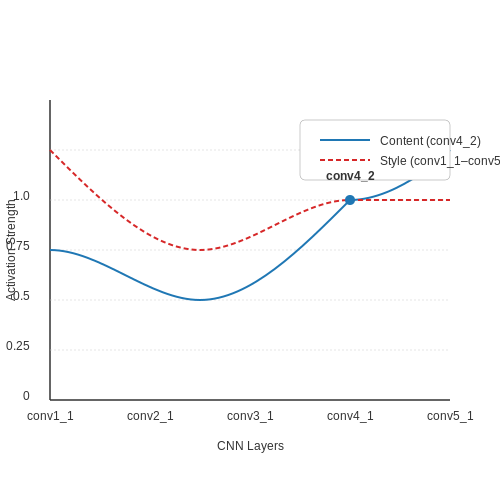
The figure below illustrates the hierarchical decomposition of content and style in a CNN. Content features (blue) dominate in deeper layers, while style features (red) are distributed across shallow and intermediate layers. This multi-scale representation enables the disentanglement of content and style during optimization.
Extensions and Advanced Techniques
Recent advancements introduce adaptive instance normalization (AdaIN) to align the mean and variance of content features with those of style features, enabling faster and more stable transfers. Other approaches leverage attention mechanisms to spatially modulate style application, preserving content coherence in complex scenes.
Role of Convolutional Neural Networks (CNNs)
Convolutional Neural Networks (CNNs) form the backbone of modern neural style transfer algorithms due to their hierarchical feature extraction capabilities. Unlike fully connected networks, CNNs exploit spatial locality through convolutional filters, enabling them to capture texture, color, and structural patterns at multiple scales. The seminal work by Gatys et al. (2016) demonstrated that the activations of intermediate CNN layers encode distinct visual information: lower layers capture fine-grained textures and edges, while deeper layers represent higher-level semantic content.
Feature Extraction via Convolutional Layers
Given an input image I and a CNN with L layers, the activation at layer l can be represented as a 3D tensor Fl ∈ ℝNl × Ml × Cl, where Nl × Ml is the spatial dimension and Cl is the number of channels. The Gram matrix Gl ∈ ℝCl × Cl, which is central to style transfer, computes the correlations between feature maps:
This matrix discards spatial information while preserving stylistic attributes like brushstroke patterns and color distributions. The choice of CNN architecture significantly impacts the quality of style transfer. VGG-19, pretrained on ImageNet, remains popular due to its deep yet interpretable feature hierarchy, though ResNet and Transformer-based architectures have shown promise in recent work.
Multi-Scale Style Representation
Effective style transfer requires balancing contributions from multiple CNN layers. Lower layers (e.g., conv1_1, conv2_1 in VGG-19) govern high-frequency details, while higher layers (conv4_1, conv5_1) control the overall composition. The total style loss Lstyle combines Gram matrix differences across selected layers:
where wl are layer weights, I is the input image, S is the style reference, and ‖·‖F denotes the Frobenius norm. Advanced implementations often employ adaptive instance normalization (AdaIN) or attention mechanisms to better align style statistics across spatial regions.
Content Preservation Through Deep Features
While style transfer manipulates texture statistics, preserving content requires maintaining structural similarity in deeper CNN activations. The content loss compares high-level features, typically from conv4_2 in VGG-19:
where C is the content image. Modern variants replace this MSE loss with perceptual metrics or adversarial losses to better preserve semantic integrity during aggressive style transformations.
Computational Considerations
The computational cost of CNN-based style transfer scales with the spatial dimensions of feature maps. Techniques like strided convolutions, depthwise separable convolutions, or network pruning are often employed for real-time applications. Recent work also explores invertible neural networks to directly map between style and content spaces without iterative optimization.
Loss Functions: Content Loss and Style Loss
Content Loss
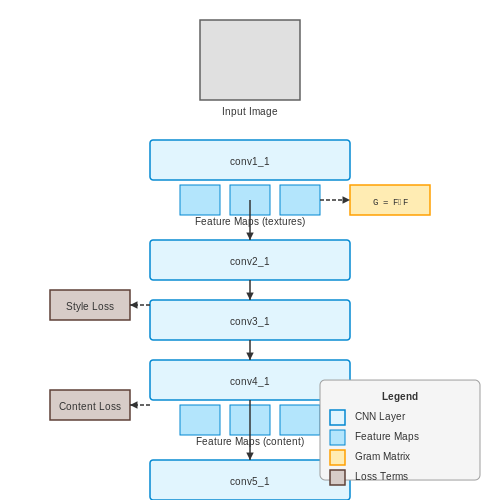
The content loss function ensures that the generated image retains the structural features of the content image. Given a pre-trained convolutional neural network (CNN), such as VGG-19, the content loss is computed as the mean squared error (MSE) between the feature representations of the content image and the generated image at a specific layer l.
Here, Fl and Pl are the feature maps of the generated image and the content image, respectively, at layer l. The summation runs over all spatial positions (i, j) in the feature maps. Lower layers (e.g., conv1_1, conv2_1) capture fine details, while deeper layers (e.g., conv4_2) preserve higher-level structures.
Style Loss
Style loss measures the difference in texture and artistic patterns between the style image and the generated image. Instead of comparing raw feature maps, it operates on the Gram matrix, which captures the correlations between feature channels.
Here, Gl is the Gram matrix for layer l, computed from the feature maps Fl. The style loss is then defined as the weighted sum of MSE between the Gram matrices of the style image and the generated image across multiple layers:
Al is the Gram matrix of the style image, wl is the weight for layer l, and Nl and Ml are the number of feature channels and spatial dimensions, respectively. Early layers (e.g., conv1_1) capture low-level textures, while deeper layers (e.g., conv4_1) encode broader stylistic elements.
Total Loss and Optimization
The total loss combines content and style losses with weighting factors α and β to balance their contributions:
Optimization is performed via gradient descent, iteratively updating the generated image ⃗x to minimize Ltotal. The choice of α/β influences the trade-off between content preservation and style adherence.
Practical Considerations
- Layer Selection: Content loss is typically computed at conv4_2, while style loss aggregates multiple layers (e.g., conv1_1 to conv5_1).
- Weight Tuning: Higher β/α ratios emphasize style over content, often ranging from 103 to 105.
- Normalization: Gram matrices are normalized by 4Nl2Ml2 to account for varying layer dimensions.
2. Gatys et al.'s Original Method
Gatys et al.'s Original Method
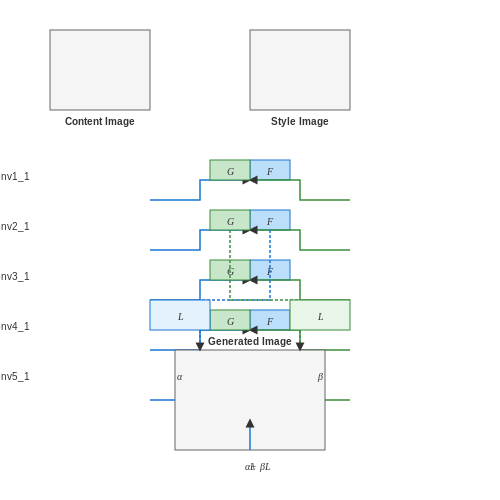
The foundational work by Gatys, Ecker, and Bethge in 2015 introduced neural style transfer as an optimization problem leveraging convolutional neural networks (CNNs). Their method separates content and style representations by defining distinct loss functions, enabling the synthesis of new images that combine the content of one image with the artistic style of another.
Content Representation
Given a content image Ic and a generated image G, the content loss is derived from feature activations in a pre-trained CNN (typically VGG-19). Let Flij and Plij denote the activations of the l-th layer for G and Ic, respectively. The content loss Lcontent is the mean squared error between these activations:
Minimizing this loss preserves spatial structure while allowing stylistic deviations.
Style Representation
Style is captured via Gram matrices, which compute correlations between feature maps in a given layer. For a style image Is, the Gram matrix Gl is defined as:
The style loss Lstyle compares Gram matrices of G and Is across multiple layers L:
where wl are layer weights, Nl is the number of feature maps, and Ml is the spatial dimension of each map.
Total Loss and Optimization
The combined loss function is a weighted sum of content and style losses:
where α and β are hyperparameters controlling the trade-off. Optimization is performed via gradient descent on pixel values of G, initialized as white noise or a copy of Ic.
Practical Implementation
The original implementation used VGG-19's conv4_2 for content and conv1_1 through conv5_1 for style. Key challenges include:
- Computational cost: Iterative optimization requires backpropagation through the CNN for each step.
- Hyperparameter sensitivity: The α/β ratio dramatically affects output quality.
- Texture artifacts: Gram matrices may over-emphasize high-frequency patterns.
Fast Style Transfer with Feed-Forward Networks
Traditional neural style transfer relies on iterative optimization to minimize a perceptual loss between a content image and a style reference. While effective, this approach is computationally expensive, requiring hundreds of iterations per image. Fast style transfer addresses this limitation by training a feed-forward convolutional neural network (CNN) to perform stylization in a single forward pass.
Architecture Overview
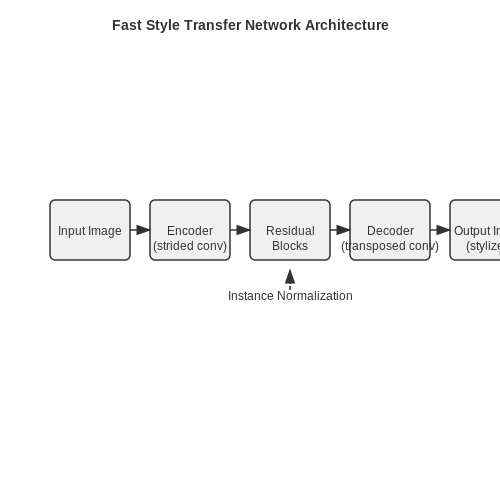
The core architecture consists of an image transformation network trained to map content images directly to stylized outputs. The network typically employs:
- A downsampling encoder with strided convolutions
- Multiple residual blocks for feature transformation
- A upsampling decoder with transposed convolutions
- Instance normalization layers for style stabilization
This architecture enables real-time stylization while maintaining quality comparable to optimization-based methods. The key innovation lies in separating the slow training process (done once) from the fast inference stage.
Loss Function Derivation
The network is trained using a weighted combination of content and style losses, similar to the original neural style transfer but applied to the network outputs rather than optimized directly. The total loss function is:
Where α and β are weighting hyperparameters. The content loss measures the difference in high-level features between output and content images:
Here, Fl and Pl are the feature representations at layer l of the output and content images respectively. The style loss captures the statistical differences in feature correlations:
Where G represents the Gram matrix computation, wl are layer weights, and Sl are the style image features.
Training Methodology
The training process involves:
- Preparing a dataset of content images (e.g., COCO)
- Selecting one or more fixed style images
- Using a pretrained VGG network as the loss network
- Optimizing the transformation network weights via backpropagation
A critical implementation detail is the use of instance normalization instead of batch normalization, which better preserves style characteristics across different content images. The normalization is applied as:
Where γ and β are learned parameters, and μ(x), σ(x) are computed per instance rather than across the batch.
Performance Optimization
Several techniques improve the speed-quality tradeoff:
- Weight normalization to stabilize training
- Learned upsampling instead of fixed interpolation
- Multi-scale style loss computation
- Mixed-precision training for faster convergence
Modern implementations achieve real-time performance (30+ FPS) on consumer GPUs while maintaining artistic quality comparable to slower optimization-based methods. The feed-forward approach also enables video stylization by processing frames sequentially with temporal consistency.
Practical Considerations
When implementing fast style transfer:
- The network must be retrained for each new style
- Higher resolution outputs require more memory and computation
- Multiple styles can be combined using a single network with style conditioning
- Quantization and pruning can further optimize mobile deployment
Adaptive Instance Normalization (AdaIN)
Adaptive Instance Normalization (AdaIN) is a key technique in neural style transfer that enables real-time, arbitrary style transfer by aligning the mean and variance of content features with those of style features. Unlike traditional instance normalization, which normalizes features independently across spatial dimensions, AdaIN adaptively adjusts the statistics of the content feature map to match the style feature map. Given an input content feature map x and style feature map y, AdaIN computes:
where μ(x) and σ(x) are the mean and standard deviation of the content features, while μ(y) and σ(y) are the corresponding statistics of the style features. This operation preserves the spatial structure of the content while transferring the stylistic attributes encoded in the feature statistics.
Mathematical Derivation
The derivation begins with standard instance normalization, which normalizes each feature map in a batch independently:
Here, γ and β are learnable affine parameters. AdaIN replaces these parameters with the style feature statistics, effectively decoupling the normalization from learned parameters and making it adaptive to the target style:
This formulation ensures that the output feature map retains the content structure of x while adopting the style characteristics of y.
Implementation in Neural Networks
In practice, AdaIN is implemented as a layer within a convolutional neural network (CNN). The style transfer network typically consists of an encoder, an AdaIN layer, and a decoder. The encoder extracts feature maps from both content and style images, the AdaIN layer aligns their statistics, and the decoder reconstructs the stylized image from the transformed features.
The loss function for training such a network combines content loss and style loss. The content loss ensures the output preserves the spatial structure of the content image, while the style loss encourages the output to match the feature statistics of the style image:
where λc and λs are weighting factors balancing the two objectives.
Advantages Over Other Methods
AdaIN offers several advantages over earlier style transfer techniques:
- Real-time performance: Unlike optimization-based methods that require iterative updates, AdaIN enables single-pass style transfer.
- Arbitrary style transfer: The same network can handle any style image without retraining.
- Preservation of content structure: The spatial alignment of content features remains intact, avoiding distortions common in patch-based methods.
These properties make AdaIN particularly suitable for applications requiring interactive or real-time style transfer, such as video processing or augmented reality.
Practical Considerations
When implementing AdaIN, several factors influence performance:
- Feature extraction depth: Deeper layers capture higher-level style attributes but may lose fine details.
- Style weight (λs): Higher values produce more pronounced style effects but may obscure content.
- Decoder architecture: The decoder must effectively invert the normalized features back to image space without introducing artifacts.

3. Preprocessing Images for Style Transfer
Preprocessing Images for Style Transfer
Image Normalization and Standardization
Style transfer networks typically operate on images normalized to a specific range. The pixel values of input images are rescaled to zero mean and unit variance to ensure stable gradient propagation during backpropagation. Given an input image I with pixel values in [0, 255], normalization is applied as:
where μ is the mean and σ is the standard deviation computed across the dataset. For pretrained models like VGG-19, the mean values μ = [0.485, 0.456, 0.406] and standard deviations σ = [0.229, 0.224, 0.225] are commonly used for RGB channels.
Resizing and Aspect Ratio Preservation
Neural style transfer requires content and style images to be resized to compatible dimensions. A common approach is to scale the shorter edge to a fixed size (e.g., 512px) while preserving the aspect ratio. Bilinear interpolation is preferred for upsampling to minimize artifacts. For high-resolution outputs, progressive resizing can be applied during optimization to refine details.
Color Space Considerations
Style transfer is sensitive to color distribution mismatches between content and style images. Converting images to the YUV or LAB color space before processing can help decouple luminance (content structure) from chrominance (style texture). The Gram matrix computation for style loss remains in RGB space, but initial color alignment reduces artifacts.
Data Augmentation for Robustness
While not always applied during inference, augmentation techniques improve style transfer generalization:
- Random cropping - Extracts patches to enforce local style consistency
- Histogram matching - Aligns color distributions between style and content images
- Gamma correction - Adjusts dynamic range to prevent style dominance
Memory Optimization Techniques
For high-resolution style transfer, memory constraints require:
with overlapping tiles processed independently then blended using feathering. Gradient checkpointing can reduce memory usage by 60% during backpropagation through the VGG network.
Preprocessing Pipeline Implementation
The complete preprocessing chain in PyTorch:
def preprocess(image, target_size=512):
    # Resize preserving aspect ratio
    w, h = image.size
    scale = target_size / min(w, h)
    new_size = (int(w * scale), int(h * scale))
    image = F.resize(image, new_size, interpolation=Image.BILINEAR)

    # Convert to tensor and normalize
    transform = transforms.Compose([
        transforms.ToTensor(),
        transforms.Normalize(mean=[0.485, 0.456, 0.406],
                            std=[0.229, 0.224, 0.225])
    ])
    return transform(image).unsqueeze(0)
3.2 Training vs. Inference: Trade-offs and Considerations
Style transfer networks exhibit fundamentally different computational and memory requirements during training versus inference. Training involves optimizing both content and style losses through backpropagation, while inference is a forward-pass operation conditioned on a fixed set of learned parameters. The key trade-offs emerge in three dimensions:
Computational Complexity
Training typically requires iterative optimization of the loss function:
where C is content image, S is style image, and G is generated image. The gradient updates:
demand high-precision arithmetic (FP32/FP64) and memory-intensive automatic differentiation. In contrast, inference uses quantized weights (often INT8) and benefits from operator fusion techniques like combining convolution and ReLU layers.
Memory Bandwidth Constraints
Training batch sizes are limited by GPU VRAM, as activations from multiple layers must be stored for gradient computation. For a VGG-19 based style transfer network:
- Training: 2-4 images per batch (12-16GB VRAM)
- Inference: 8-16 images per batch (same VRAM)
This discrepancy arises because inference only caches the current layer's activations rather than the entire computational graph.
Latency-Throughput Trade-offs
Real-time applications require different optimizations:
| Metric | Training | Inference |
|---|---|---|
| Latency | 100-500ms/step | 10-50ms/image |
| Throughput | 2-5 images/sec | 50-100 images/sec |
Modern inference engines (TensorRT, ONNX Runtime) achieve this through kernel auto-tuning and layer fusion, while training frameworks (PyTorch, TensorFlow) prioritize gradient computation accuracy.
Architectural Specialization
Transformer-based style transfer models like StyleGAN-T demonstrate divergent optimization paths:
- Training: Requires full attention matrices (O(n²) memory)
- Inference: Can use sparse or linearized attention (O(n) memory)
This allows 1024×1024 resolution during inference despite training at 256×256 due to memory constraints.
Energy Efficiency
The energy per operation differs by orders of magnitude:
due to repeated weight updates and higher numerical precision requirements. Quantization-aware training bridges this gap by simulating inference conditions during optimization.
Hyperparameter Tuning: Style Weight, Content Weight, and Iterations
The effectiveness of neural style transfer hinges on three critical hyperparameters: the style weight (α), content weight (β), and the number of optimization iterations. These parameters govern the trade-off between style fidelity, content preservation, and computational efficiency.
Style Weight (α) and Content Weight (β)
The total loss function in style transfer is a weighted combination of style loss (Lstyle) and content loss (Lcontent):
Empirical studies show that the ratio between α and β matters more than their absolute values. Common practice uses:
- α/β ≈ 103-105 for strong style dominance
- α/β ≈ 101-102 for balanced transfer
- α/β < 1 for subtle stylistic touches
The style loss itself is computed from Gram matrices of feature activations across multiple VGG layers. For layer l:
where Fikl represents the activation of the ith filter at position k in layer l.
Iteration Dynamics
The optimization process typically uses L-BFGS or Adam with:
- 100-500 iterations for quick previews
- 1000-2000 iterations for high-quality results
- 5000+ iterations for professional-grade output
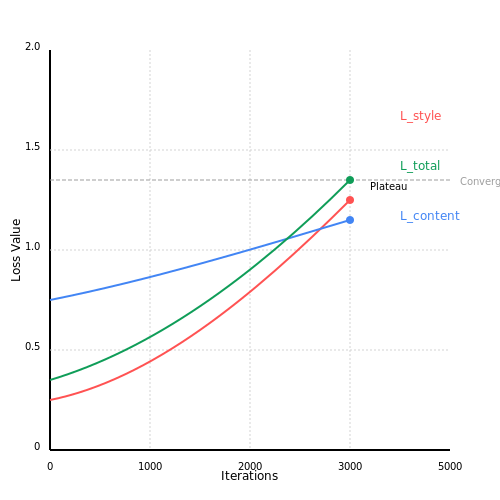
The loss convergence follows a characteristic pattern:
Practical Optimization Strategies
Advanced implementations often employ:
- Learning rate decay: Start with 1.0-10.0, reduce by 0.5-0.9 factor every 500 iterations
- Layer-wise weighting: Higher weights for earlier VGG layers (conv1-2, conv2-2) capture broader style features
- Content layer selection: Deeper layers (conv4-2, conv5-2) preserve higher-level content structure
Recent work by Sanakoyeu et al. (2020) demonstrates that dynamic weight adjustment during optimization can improve results:
where γ controls the decay rate and t is the iteration number.
4. Multi-Style Transfer and Style Interpolation
4.1 Multi-Style Transfer and Style Interpolation
Traditional neural style transfer operates on a single style image, but multi-style transfer extends this by enabling simultaneous application of multiple artistic styles to a content image. The key innovation lies in the weighted combination of style representations from different sources. Given N style images, the Gram matrices Gli for each layer l and style i are computed as usual, but the combined style loss becomes:
where αi are user-defined style weights satisfying ∑αi = 1, and wl are layer-specific weights controlling the contribution of different VGG network layers.
Style Interpolation Mechanics
Style interpolation enables smooth transitions between artistic styles by treating the style space as a convex combination manifold. For two styles S1 and S2, the interpolated style at parameter λ ∈ [0,1] is computed as:
This linear interpolation in Gram matrix space produces perceptually smooth transitions because the Gram matrices capture second-order statistics of the feature maps, which correspond to texture information. The approach generalizes to N-style interpolation through barycentric coordinates.
Implementation Considerations
Practical implementations must address several challenges:
- Style normalization: Different styles may have vastly different Gram matrix magnitudes, requiring normalization before combination
- Layer weighting: Shallow layers capture fine textures while deeper layers capture broader strokes, requiring careful wl tuning
- Computational cost: Multi-style transfer requires computing Gram matrices for all style images, increasing memory usage
Recent advances use adaptive instance normalization (AdaIN) to achieve similar effects with lower computational overhead by directly matching feature map statistics rather than Gram matrices.
Advanced Applications
Style interpolation enables novel creative applications:
- Temporal style morphing: Smoothly varying λ over time creates animated style transitions
- Regional style control: Different image regions can use different style mixtures through spatial masking
- Style algebra: Linear combinations of learned style embeddings enable "style arithmetic" operations
The following diagram illustrates the multi-style transfer architecture:

4.2 Arbitrary Style Transfer with Generative Models
Arbitrary style transfer extends the capabilities of neural style transfer by enabling the application of any artistic style to a content image without requiring per-style training. This is achieved through generative models that learn a disentangled representation of style and content, allowing real-time synthesis with arbitrary style inputs. The key innovation lies in the use of adaptive instance normalization (AdaIN), which aligns the mean and variance of content features with those of style features.
Adaptive Instance Normalization (AdaIN)
AdaIN operates by normalizing the content features to have zero mean and unit variance, then scaling and shifting them to match the statistics of the style features. Given content features C and style features S, the transformation is defined as:
Here, μ and σ denote the mean and standard deviation computed across spatial dimensions. This operation preserves the spatial structure of the content while transferring the stylistic attributes encoded in the feature statistics.
Architecture of Arbitrary Style Transfer Networks
The network typically consists of three components:
- Encoder: A pre-trained VGG-19 network extracts multi-scale features from both content and style images.
- AdaIN Layer: Performs style transfer by aligning feature statistics at each scale.
- Decoder: A learned network reconstructs the stylized image from the AdaIN-transformed features.
The decoder is trained using a combination of content loss and style loss, where content loss measures the difference in high-level features between the output and content image, while style loss compares the Gram matrices of the output and style image.
Real-Time Performance and Extensions
By decoupling style representation from the generation process, arbitrary style transfer achieves real-time performance. Recent extensions incorporate:
- Multiple Styles: Linear interpolation between style feature statistics enables blending of multiple styles.
- Spatial Control: Attention mechanisms allow region-specific style application.
- Video Consistency: Temporal constraints maintain coherence across frames.
where λc and λs control the trade-off between content preservation and stylization strength.
Practical Considerations
Successful implementation requires careful tuning of:
- Feature Layers: Higher layers capture broader style characteristics while lower layers preserve finer content details.
- Loss Weights: The ratio λs/λc typically ranges from 1e3 to 1e5 depending on desired stylization intensity.
- Style Scale: Multi-scale style extraction improves transfer of both global and local patterns.

4.3 Real-Time Style Transfer on Mobile Devices
Real-time style transfer on mobile devices requires optimizing neural networks to run efficiently under constrained computational resources. The primary challenge lies in reducing model complexity while preserving perceptual quality. Two dominant approaches are model pruning and quantization, often combined with specialized mobile inference frameworks like TensorFlow Lite or Core ML.
Architectural Optimizations
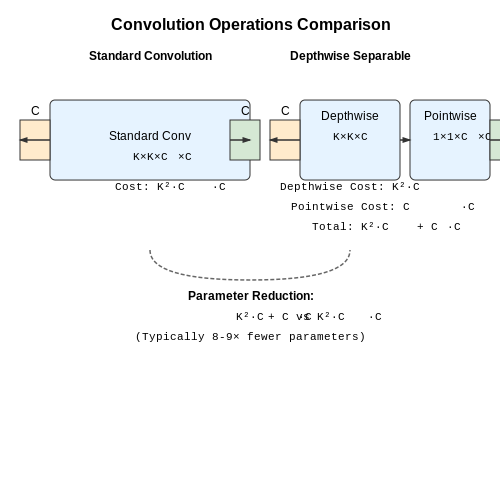
Mobile-oriented architectures such as MobileNetV3 and EfficientNet-Lite replace standard convolutions with depthwise separable convolutions, reducing parameters by a factor of k² (where k is the kernel size). The computational cost for a standard convolution layer is:
whereas depthwise separable convolutions decompose this into:
yielding a total complexity reduction of:
Quantization Techniques
Post-training quantization converts 32-bit floating-point weights to 8-bit integers, reducing memory bandwidth by 4×. For style transfer, this introduces negligible perceptual loss when applied to feature extraction layers, as demonstrated by the PSNR metric:
where MAXI is the maximum pixel value (typically 255) and MSE is the mean squared error between original and quantized outputs. Mobile GPUs achieve further acceleration through fixed-point arithmetic optimizations in quantized models.
Latency-Aware Training
Knowledge distillation trains a lightweight student network to mimic a heavier teacher network's style transfer behavior. The loss function incorporates both perceptual quality (Lcontent, Lstyle) and latency constraints:
where tinference is measured via on-device profiling during training. Frameworks like NVIDIA TensorRT leverage layer fusion and kernel auto-tuning to minimize tinference for specific mobile GPUs.
On-Device Deployment
For iOS deployments, Core ML converts PyTorch models to the .mlmodel format with automatic weight pruning. Android implementations using TensorFlow Lite employ delegate APIs to partition computation between CPU (for control flow) and GPU (for parallelizable ops). A typical pipeline:
- Input frame preprocessing via Metal Performance Shaders (iOS) or RenderScript (Android)
- Style transfer execution through quantized TFLite interpreter
- Post-processing with bilateral filtering to reduce quantization artifacts
Benchmarks on a Snapdragon 888 show 30 FPS throughput for 512×512 inputs using a 1.2MB MobileStyleNet model, compared to 3 FPS for the original 56MB VGG-based implementation.
5. Copyright and Attribution in AI-Generated Art
Copyright and Attribution in AI-Generated Art
Legal Frameworks and Ambiguities
The legal status of AI-generated art remains contentious, primarily due to the absence of human authorship in traditional copyright frameworks. Under the U.S. Copyright Office’s 2023 guidance, works produced autonomously by AI systems are ineligible for copyright protection, as they lack "human creative input." However, if a human significantly modifies or directs the AI’s output, the resulting work may qualify. The European Union’s Artificial Intelligence Act proposes a similar stance but introduces stricter transparency requirements for generative models trained on copyrighted data.
Key legal tests include:
- Threshold of Originality: Courts evaluate whether the output reflects a human’s intellectual creation, as established in Feist Publications v. Rural Telephone Service (1991).
- Substantial Similarity: If an AI-generated work closely resembles a copyrighted input (e.g., a Van Gogh painting used in style transfer), it may infringe on derivative work rights under 17 U.S.C. § 106(2).
Attribution Challenges in Neural Style Transfer
Style transfer models like Gatys et al.’s 2015 algorithm decompose content and style using Gram matrices, mathematically blending them. The process raises attribution questions:
where G is the Gram matrix for layer l, and F represents feature activations. While the output is a novel combination, the style component often retains identifiable elements from the source artwork. For instance, transferring Monet’s brushstrokes to a photograph implicitly relies on copyrighted visual vocabulary.
Case Study: The "Zarya of the Dawn" Precedent
In 2022, the U.S. Copyright Office revoked protection for Kristina Kashtanova’s graphic novel Zarya of the Dawn, where Midjourney-generated images constituted the majority of content. The ruling clarified that prompt engineering alone doesn’t constitute authorship, though Kashtanova retained copyright for the human-arranged layout and text. This sets a benchmark for evaluating creative control in AI-assisted works.
Technical Mitigations for Ethical Style Transfer
Researchers propose embedding attribution metadata directly into neural networks. One approach modifies the loss function to penalize uncredited style sources:
where ℒattribution quantifies stylistic divergence from public-domain references. Tools like Have I Been Trained? allow artists to check if their works were used in training datasets like LAION-5B, though opt-out mechanisms remain non-binding.
Licensing Models for AI Art
Emerging licenses attempt to bridge the gap:
- Creative Commons CC0+RAIL: Combines public-domain dedication with restrictions on harmful AI use.
- Ethical Source License: Prohibits military or surveillance applications of derived works.
Platforms like DeviantArt’s Protect Art tag automatically opt out works from AI training, though enforcement relies on voluntary compliance by model developers.
5.2 Bias in Style Representation and Dataset Selection
Neural style transfer models inherit biases present in their training datasets, which can lead to skewed or unrepresentative style transformations. These biases manifest in several ways, including overrepresentation of Western art styles, underrepresentation of non-European artistic traditions, and amplification of gender or racial stereotypes when applied to human subjects.
Mathematical Foundations of Dataset Bias
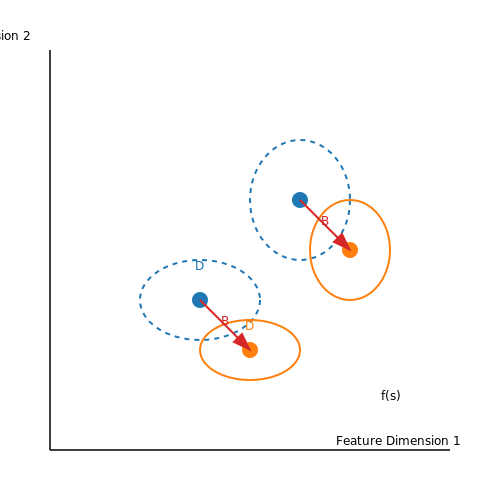
The bias in style representation can be formalized through the lens of statistical learning theory. Let D be the true distribution of all artistic styles, and D̂ be the empirical distribution represented by our training dataset. The bias B can be quantified as:
where f(s) is the feature representation of style s in the neural network's latent space. When B is large, the model will systematically misrepresent styles that are underrepresented in D̂.
Common Sources of Bias
- Geographic bias: Most publicly available art datasets contain 70-80% Western European artworks, with limited representation from Asia, Africa, or indigenous traditions.
- Temporal bias: Renaissance and Impressionist periods are often overrepresented compared to ancient or contemporary art movements.
- Medium bias: Oil paintings dominate most datasets, while watercolor, ink wash, or digital art forms are less common.
- Artist demographics: Historically significant female artists and artists of color are frequently underrepresented.
Measuring Style Representation Bias
The style coverage metric C evaluates how well a dataset represents the diversity of artistic styles:
where Sk represents distinct style categories (e.g., Ukiyo-e, Baroque, Cubism). A well-balanced dataset should maintain C ≈ 1 for all k.
Mitigation Strategies
Several approaches can reduce bias in style transfer systems:
- Dataset augmentation: Deliberately oversampling underrepresented styles during training
- Style-aware loss weighting: Modifying the style loss function to account for representation gaps:
$$ \mathcal{L}_{style} = \sum_{k=1}^K w_k \|\mathbf{G}_k^{content} - \mathbf{G}_k^{style}\|^2 $$where wk is inversely proportional to style k's representation in the dataset.
- Adversarial debiasing: Training a discriminator network to identify underrepresented styles and using its gradients to balance the feature space.
Case Study: East Asian Art Representation
When applying style transfer to East Asian art, conventional models often fail to preserve key characteristics like:
- Negative space utilization in Chinese ink wash paintings
- Flat perspective in Ukiyo-e prints
- Brushstroke dynamics in Korean calligraphy
This occurs because the Gram matrix-based style representation in standard neural style transfer emphasizes texture statistics that align with Western painting conventions. Modified approaches incorporate:
where Gcomposition captures spatial relationships more characteristic of East Asian art traditions.
Ethical Considerations in Style Transfer
The application of style transfer to culturally significant artworks raises several ethical questions:
- Appropriation of indigenous art styles without cultural context
- Commercial use of artist-specific styles without attribution
- Potential misuse for creating misleading art historical "fakes"
Recent work proposes embedding provenance information directly in the style representation vectors to maintain attribution:
where vprovenance encodes metadata about the original artwork and cultural context.
5.3 Human-AI Collaboration in Artistic Creation
Human-AI collaboration in artistic style transfer leverages the strengths of both human intuition and machine precision. Neural networks excel at extracting and recombining stylistic features from vast datasets, while human artists provide creative direction, contextual understanding, and nuanced adjustments that pure algorithmic approaches lack. This symbiotic relationship is formalized through interactive optimization frameworks, where the artist guides the model via iterative feedback loops.
Interactive Optimization for Style Transfer
Traditional neural style transfer (NST) operates as a one-shot optimization process, minimizing a weighted combination of content and style losses:
In collaborative systems, this transforms into an interactive process where human input modulates the loss landscape. The artist can:
- Adjust layer-wise style weights βl in real-time
- Introduce spatial constraints via brushstroke masks
- Modify the content-style trade-off parameter α/β dynamically
This creates a modified optimization objective:
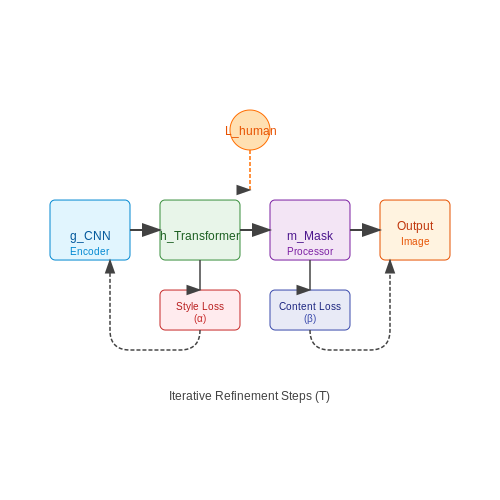
where T represents iterative refinement steps guided by human input, and ℒhuman encodes artistic preferences through brushstrokes or region-specific style parameters.
Architectural Adaptations for Real-Time Collaboration
Effective collaboration requires models that respond to human input with sub-second latency. This necessitates:
- Lightweight encoder-decoder architectures with fewer than 100ms inference time
- Differentiable rendering pipelines that propagate edits through the network
- Attention mechanisms to focus style transfer on artist-specified regions
The most effective systems employ a hybrid architecture combining:
where gCNN handles style extraction, hTransformer manages long-range artistic dependencies, and mMask processes human-provided spatial constraints.
Case Study: The Adobe Photoshop Neural Filters Pipeline
Adobe's implementation demonstrates practical human-AI collaboration through:
- A style transfer network that preserves original image topology
- Real-time sliders controlling style intensity and spatial distribution
- Non-destructive editing layers that allow iterative refinement
The system achieves a 400ms response time for 1024×1024px images by combining:
- Pruned VGG-19 encoders (87% fewer parameters)
- Learned style interpolation weights
- Hardware-accelerated blending operations
Evaluating Collaborative Quality
Traditional metrics like SSIM and PSNR fail to capture artistic collaboration quality. Effective evaluation combines:
where Ai measures visual appeal via expert ratings, Ci quantifies novelty through divergence from training distributions, and Ei tracks time-to-convergence in collaborative sessions.
6. Key Research Papers in Neural Style Transfer
6.1 Key Research Papers in Neural Style Transfer
- PDF Traditional Chinese Ink Painting Neural Style Transfer — ern style images, and only a few discussed the neural style transfer applied to the traditional Chinese ink paintings. Traditional Chinese ink paintings are in a very different style because of its unique drawing techniques. In this project, we train models of several classical and popular neural style transfer networks, including the work by [3],
- Ink painting style transfer using asymmetric cycle-consistent GAN — This will serve to facilitate the testing of our proposed approach and provide a valuable resource for future research in ink painting style transfer. ... first introduced convolutional neural networks in image style transfer, which transfers the image style by minimizing both the content and style loss. However, it relies on a slow online ...
- Chinese Painting Rendering by Adaptive Style Transfer — As a traditional art in China, Chinese painting differs from other art in its expressive brush strokes and ink diffusion. To ideally render water-and-ink painting, many researchers attempted to use computer simulation for such complicated texture generation [13, 15].In this paper, we aim to render Chinese painting with other artistic style, which is regarded as a style transfer problem.
- Chinese Painting Style Transfer Using Deep Generative Models — Artistic style transfer aims to modify the style of the image while preserving its content. Style transfer using deep learning models has been widely studied since 2015, and most of the applications are focused on specific artists like Van Gogh, Monet, Cezanne. There are few researches and applications on traditional Chinese painting style transfer. In this paper, we will study and leverage ...
- Neural Abstract Style Transfer for Chinese Traditional Painting — Chinese traditional painting is one of the most historical artworks in the world. It is very popular in Eastern and Southeast Asia due to being aesthetically appealing. Compared with western artistic painting, it is usually more visually abstract and textureless. Recently, neural network based style transfer methods have shown promising and appealing results which are mainly focused on western ...
- PDF End-to-End Chinese Landscape Painting Creation Using Generative ... — 2.2.1 Algorithmic Chinese Painting Generation Neural style transfer has been the basis for most published research regarding Chinese painting generation. Chinese painting generation has been attempted using sketch-to-paint translation. For instance, a CycleGAN model was trained on unpaired data to generate Chinese landscape
- Artistic style transfer using deep learning - Academia.edu — In this paper, we are implementing the style transfer using convolutional neural networks. The style transfer means to extract the style and texture of a style image and applying it to the extracted content of another image. Our work is based on the work proposed by LA Gatys. We use a pre-trained model, VGG 16 for our work.
- Evaluate and improve the quality of neural style transfer — Given the content and style images, the gist of style transfer is to synthesize an image that preserves some notion of the content but carries characteristics of the style. Recently, the seminal work of Gatys et al. (2016b) firstly captured the style of artistic images and transferred it to other images using convolutional neural networks (CNNs).
- Interactive Neural Style Transfer with Artists - ResearchGate — As an extension of color transfer, style transfer refers to rendering the content of a target image or video in the style of an artist with either a style sample or a set of images through a style ...
- [1705.04058] Neural Style Transfer: A Review - ar5iv — Recently, inspired by the power of Convolutional Neural Networks (CNNs), Gatys et al. [] first studied how to use a CNN to reproduce famous painting styles on natural images. They proposed to model the content of a photo as the feature responses from a pre-trained CNN, and further model the style of an artwork as the summary feature statistics. Their experimental results demonstrated that a ...
6.2 Open-Source Implementations and Toolkits
- GitHub - AlenUbuntu/StyleTransfer: an PyTorch image deep style transfer ... — This is an PyTorch image deep style transfer library. It provies implementations of current SOTA algorithms, including. AdaIN (Artistic) Arbitrary Style Transfer in Real-time with Adaptive Instance Normalization. WCT (Artistic) Universal Style Transfer via Feature Transforms. LinearStyleTransfer (LST) (Artistic, Photo-Realistic)
- Neural Style Transfer: A Review - arXiv.org — 2. Style Transfer in Pre-neural Era Artistic style transfer is a long-standing research topic. Due to its wide variety of applications, it has been an im-portant research area for more than two decades. Before the appearance of Neural Style Transfer (NST), the related re-searches in computer graphics have expanded into an area
- PDF Multi-style Transfer: Generalizing Fast Style Transfer to Several Genres — The resulting style transfer network can stylize images in less than a second, which is much faster than naive style transfer (See Figure 1 for the fast style transfer Architec-ture). However, it has the limitation of only being able to handle one chosen style fixed from the start. x' a) b) c) Figure 1: Neural Network Architecture for Style ...
- APST-Flow: A Reversible Network-Based Artistic Painting Style Transfer ... — Early studies of artistic painting style transfer focused on how manual design synthesizes the spatial details of a particular style, such as highlighting the detailed features of a certain style by planning the generation process via modeling textures and brushstrokes [11, 16, 17].Wang et al. [11] proposed a watercolor painting style transfer framework, which realizes the drawing of different ...
- 14.12. Neural Style Transfer — Dive into Deep Learning 1.0.3 ... - D2L — 14.12.1. Method¶. Fig. 14.12.2 illustrates the CNN-based style transfer method with a simplified example. First, we initialize the synthesized image, for example, into the content image. This synthesized image is the only variable that needs to be updated during the style transfer process, i.e., the model parameters to be updated during training.
- [2011.08114] Stylized Neural Painting - ar5iv — Creating artistic paintings is one of the defining characteristics of humans and other intelligent species. In recent years, we saw great advancements in generative modeling of image translation or style transfer which utilizes neural network as a generative tool [38, 6, 23, 13].Previous image-to-image translation and style transfer methods typically formulate the translation either as a pixel ...
- APST-Flow: A Reversible Network-Based Artistic Painting Style Transfer ... — Gatys et al. [18,19] first applied Gram loss in deep network feature mapping to represent image artistic style, which initiated the research on neural painting style transfer. After that, a large number of artistic painting transfer methods based on deep generative networks have been proposed, which can be roughly divided into two categories ...
- Tech Science Press — The competitive results verify that APST-Flow achieves high-quality generation with less content deviation and enhanced generalization, thereby can be further applied to more APST scenes. KW - Artistic painting style transfer; reversible network; generative adversarial network; wavelet transform DO - 10.32604/cmc.2023.036631
- Intel® oneAPI Deep Neural Network Library — The Intel® oneAPI Deep Neural Network Library (oneDNN) provides highly optimized implementations of deep learning building blocks. With this open source, cross-platform library, deep learning application and framework developers can use the same API for CPUs, GPUs, or both—it abstracts out instruction sets and other complexities of ...
- (PDF) Neural Style Transfer: A Paradigm Shift for Image ... - ResearchGate — In this meta paper we discuss image-based artistic rendering (IB-AR) based on neural style transfer (NST) and argue, while NST may represent a paradigm shift for IB-AR, that it also has to evolve ...
6.3 Books and Courses on Deep Learning for Art
- Neural Networks and Deep Learning - University of Colorado Boulder ... — Deep Learning by Ian Goodfellow, Yoshua Bengio, and Aaron Courville; Deep Learning for NLP and Speech Recognition by Uday Kamath, ... Ch. 1-2.5 and 4-4.2 of Kamath book: Mon, Aug 29: Feedforward neural networks (lecture slides) Ch. 6-6.4 of Goodfellow book: Problem set 1: Wed, Aug 31: Gradient descent and training neural networks
- PDF How Much Deep Learning does Neural Style Transfer Really Need? An ... — optimizing an image in the way neural style transfer does, while the objective functions (or more precisely, ... of becoming a "killer app" to promote deep learning towardsthegeneralpublic,completewithliteralkiller appssuchasDeepArt.io[32]andPrisma[33]. ... of deep neural networks, many multi-layer variants of 3151 (a)ContentImage (b) Style ...
- Automatic semantic style transfer using deep convolutional neural ... — 2.1 Style transfer using deep networks. The success of deep CNNs (DCNNs) in image processing has also raised interest in image style transfer. Shih et al. [] proposed a new style transfer method for headshot portraits.During their method, they presented a new multiscale technique based on deep networks to robustly transfer the local statistics of an example portrait onto a new one.
- Neural Style Transfer: A Review - arXiv.org — Neural Style Transfer, as well as discussing its various ap-plications and open problems for future research. 1. Introduction Painting is a popular form of art. For hundreds of years, people have been attracted by the art of painting with the ... et al. observe that deep convolutional neural network is ca-
- Can we teach computers to understand art? Domain adaptation for ... — In the second work ([4]), we showed that the artistic style transfer remains as efficient even if a reduced number of iterations are performed while over-imposing the style of an artistic painting and the content from a photograph onto a new image, according to the neural style transfer introduced by Gatys et al. [5].
- Style Transfer Review: Traditional Machine Learning to Deep Learning - MDPI — Style transfer is a technique that learns style features from different domains and applies these features to other images. It can not only play a role in the field of artistic creation but also has important significance in image processing, video processing, and other fields. However, at present, style transfer still faces some challenges, such as the balance between style and content, the ...
- PDF Deep Learning Concepts for Evolutionary Art - Brock University — we implement our own shallow convolutional neural network with a xed set of lters. Experiments show that the basic CNN had limited e ectiveness, likely due to the lack of training. In conclusion, the research shows the potential for using deep learning concepts in evolutionary art. As deep CNN models become better understood, they
- 14.12. Neural Style Transfer — Dive into Deep Learning 1.0.3 ... - D2L — 14.12.1. Method¶. Fig. 14.12.2 illustrates the CNN-based style transfer method with a simplified example. First, we initialize the synthesized image, for example, into the content image. This synthesized image is the only variable that needs to be updated during the style transfer process, i.e., the model parameters to be updated during training.
- (PDF) Neural Style Transfer: A Paradigm Shift for Image ... - ResearchGate — Advancements in deep learning showed to alleviate these limitations by matching content and style statistics via activations of neural network layers, thus making a generalized style transfer ...
- Creativity in Artificial Intelligence: Creating artworks using ... — Gatys et al. [2015] introduced Neural Style T ransfer (NST), a Deep Neural Network (precisely a VGG, which is a certain configuration of Con volutional Neural Networks or CNN) that recombines a ...