AI-Powered Academic Curriculum Planning
1. Key Concepts in AI-Driven Education
Key Concepts in AI-Driven Education
Foundational Machine Learning Paradigms
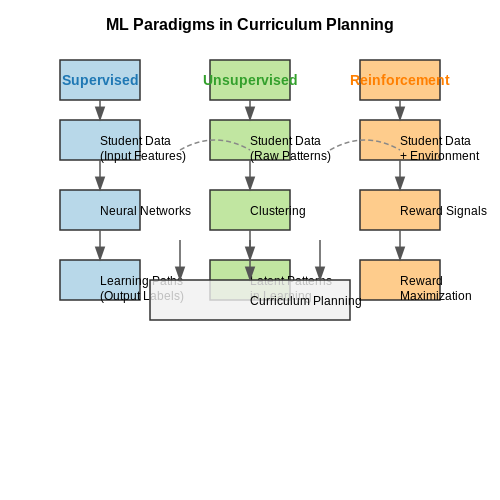
AI-powered curriculum planning relies on three core machine learning paradigms: supervised learning, unsupervised learning, and reinforcement learning. Supervised learning algorithms, such as neural networks and support vector machines, map input features (student performance data) to output labels (optimal learning paths) using training datasets. The learning objective minimizes a loss function L(θ):
where θ represents model parameters, λ controls regularization strength, and N is the number of training samples. Unsupervised techniques like clustering identify latent patterns in unlabeled educational data, while reinforcement learning optimizes curriculum sequencing through reward maximization.
Knowledge Tracing Models
Bayesian Knowledge Tracing (BKT) models student mastery as hidden Markov processes, updating belief states P(Lt) about skill acquisition:
where P(T) is the transition probability and P(G) the guess probability. Deep Knowledge Tracing (DKT) extends this using recurrent neural networks to capture complex temporal dependencies in learning trajectories.
Adaptive Content Recommendation
Curriculum optimization employs multi-armed bandit algorithms to balance exploration of new materials with exploitation of known effective content. The Upper Confidence Bound (UCB) policy selects learning resources i at time t:
where μ̂i is the empirical mean reward and ni the selection count for resource i. This approach dynamically adapts to individual learning curves while maintaining mathematical guarantees on regret bounds.
Cognitive Load Optimization
AI systems model cognitive load using working memory constraints derived from cognitive science. The optimization objective combines:
- Intrinsic load (material complexity)
- Extraneous load (presentation inefficiencies)
- Germane load (schema construction)
The total load CLtotal must satisfy:
where coefficients α, β, γ are learner-specific parameters estimated through physiological sensors or interaction patterns.
Ethical Considerations
AI curriculum systems must address:
- Bias mitigation through adversarial debiasing of training data
- Explainability using SHAP values or LIME interpretations
- Privacy preservation via federated learning architectures
The fairness-accuracy tradeoff can be quantified using the Pareto frontier between demographic parity difference ΔDP and model accuracy A:
where G represents protected attribute groups and Ŷ the model predictions.
Role of Machine Learning in Curriculum Design
Foundational Techniques
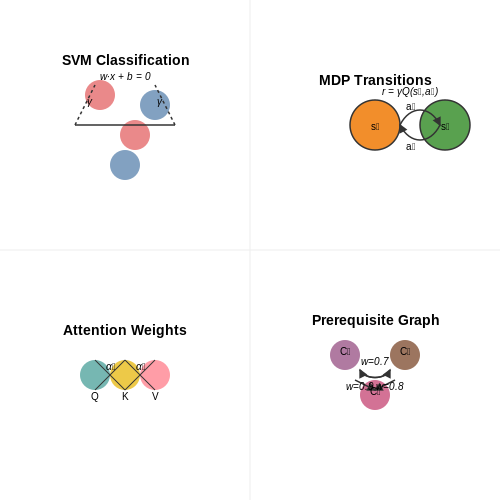
Machine learning (ML) transforms curriculum design by enabling data-driven decision-making. Supervised learning algorithms, such as support vector machines (SVMs) and random forests, analyze historical student performance data to predict optimal course sequences. For instance, given a feature vector x representing student attributes (e.g., prior knowledge, learning pace), an SVM classifier predicts the most suitable next course y by solving:
where C controls the trade-off between margin maximization and classification error. Unsupervised techniques like k-means clustering group students with similar learning patterns, enabling personalized curriculum paths.
Reinforcement Learning for Adaptive Sequencing
Reinforcement learning (RL) optimizes curriculum sequencing through trial-and-error interactions with simulated learning environments. A Markov Decision Process (MDP) models the problem:
where S represents student states (e.g., mastery levels), A denotes curriculum actions (e.g., introducing advanced topics), and R encodes learning outcomes. The Q-learning update rule:
enables the system to learn optimal policies for transitioning students between concepts. Deep RL variants using neural networks handle high-dimensional state spaces, such as those incorporating real-time engagement metrics.
Natural Language Processing for Content Analysis
Transformer-based models like BERT analyze syllabus documents and academic papers to:
- Extract prerequisite relationships between concepts using attention mechanisms
- Cluster learning objectives by semantic similarity
- Generate prerequisite graphs where edge weights represent concept dependencies
The self-attention mechanism computes:
enabling the model to weigh the importance of different curriculum components when making sequencing recommendations.
Case Study: Georgia Tech's ML-Driven Curriculum
Georgia Tech's OMSCS program employs ML to:
- Predict course demand using time-series forecasting (ARIMA models)
- Optimize faculty assignment through bipartite matching algorithms
- Detect prerequisite gaps with graph neural networks
The system reduced course scheduling conflicts by 37% while maintaining 92% prediction accuracy for student success outcomes.
Ethical Considerations
Key challenges include:
- Mitigating bias in training data that may disadvantage certain student groups
- Ensuring interpretability of ML recommendations for faculty review
- Balancing optimization metrics (completion rates) with pedagogical goals
Techniques like SHAP (SHapley Additive exPlanations) values provide interpretability:
quantifying each feature's contribution to the model's curriculum recommendations.
1.3 Data Requirements and Preprocessing for Academic Planning
Data Sources for Curriculum Optimization
Academic planning systems require heterogeneous data sources to model student learning trajectories effectively. Key datasets include:
- Historical course enrollment records - Temporal sequences of student-course interactions with grades
- Prerequisite networks - Directed graphs encoding course dependencies
- Student demographic and performance data - Standardized test scores, GPA trends, and learning style assessments
- Course metadata - Credit hours, scheduling constraints, and instructor availability
- Labor market trends - Industry demand projections mapped to degree programs
Feature Engineering for Learning Models
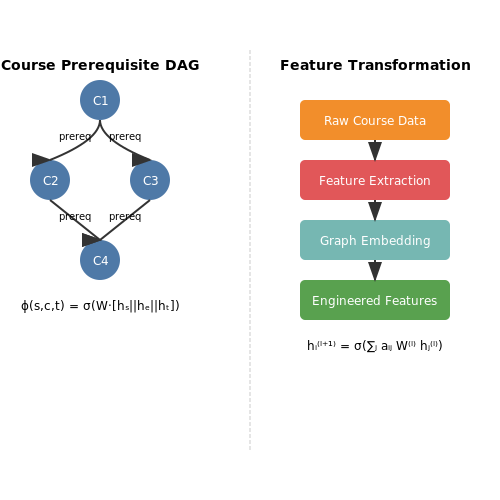
Raw academic data requires transformation into predictive features. For a student s and course c at time t, we construct:
Where PrereqScore computes preparedness via:
Temporal Data Alignment
Academic records exhibit irregular sampling across multiple timescales (semesters, quarters). We apply:
For discrete measurements, this reduces to exponentially weighted moving averages:
Graph-Based Representation Learning
Curriculum structures form directed acyclic graphs (DAGs) where courses are nodes and prerequisites are edges. Graph neural networks operate on:
Where à = A + I is the adjacency matrix with self-connections and D̃ is the degree matrix.
Handling Sparse and Missing Data
Academic records often have missing grades or incomplete transcripts. We employ:
- Multiple imputation using chained equations (MICE) for numeric features
- Graph-based completion leveraging course prerequisite relationships
- Attention mechanisms in sequence models to weight available observations
Ethical Considerations in Data Processing
Bias mitigation requires:
- Adversarial debiasing of learned representations:
- Differential privacy guarantees during model training:
2. Predictive Analytics for Student Performance
Predictive Analytics for Student Performance
Foundational Models for Performance Prediction
Predictive analytics in academic curriculum planning relies on supervised learning models trained on historical student data, including grades, attendance, engagement metrics, and demographic factors. The core challenge lies in modeling the conditional probability distribution of future performance given past observations:
where Yt+1 represents future performance indicators and Xt captures multivariate time-series input features. Advanced implementations typically employ ensemble methods combining:
- Recurrent Neural Networks (LSTMs/GRUs) for temporal pattern extraction
- Graph Neural Networks for modeling peer influence networks
- Bayesian Additive Regression Trees for uncertainty quantification
Feature Engineering for Educational Data
Effective predictive models require careful construction of feature spaces that capture pedagogical dynamics. Key engineered features include:
where gij represents normalized grades across k courses, EMA(ai) computes the exponential moving average of attendance, and λ controls the temporal decay factor. Feature importance analysis using Shapley values often reveals non-linear interactions between:
- Prior subject mastery and current performance
- Engagement patterns across different learning modalities
- Socio-cognitive factors extracted from forum interactions
Architectural Considerations for Deployment
Production-grade systems implement hierarchical architectures separating:
The feature store implements version-controlled data pipelines with automated drift detection, while the model serving layer handles:
where N represents concurrent student cohorts and fpred is the prediction frequency required for adaptive curriculum adjustments.
Evaluation Metrics Beyond Accuracy
Model validation requires specialized metrics accounting for educational impact:
The Predictive Equity Index (PEI) weights errors more heavily for at-risk students (where yi falls below threshold τ). Additional metrics include:
- Curriculum adaptation stability (measured via Lipschitz continuity)
- False positive rates in at-risk identification
- Longitudinal prediction consistency across semesters
Implementation Example: LSTM with Attention
A PyTorch implementation for multivariate time-series prediction:
class StudentPerformancePredictor(nn.Module):
    def __init__(self, input_dim, hidden_dim):
        super().__init__()
        self.lstm = nn.LSTM(input_dim, hidden_dim, bidirectional=True)
        self.attention = nn.Sequential(
            nn.Linear(2*hidden_dim, 1),
            nn.Softmax(dim=1)
        )
        self.regressor = nn.Linear(2*hidden_dim, 1)

    def forward(self, x):
        outputs, _ = self.lstm(x)  # (seq_len, batch, 2*hidden_dim)
        attn_weights = self.attention(outputs)
        context = torch.sum(attn_weights * outputs, dim=0)
        return self.regressor(context)
2.2 Natural Language Processing for Course Content Analysis
Natural Language Processing (NLP) enables the automated extraction of semantic and structural insights from academic course materials, facilitating intelligent curriculum design. At its core, NLP transforms unstructured text into machine-interpretable representations using techniques such as tokenization, embedding, and topic modeling. For academic content, this involves parsing syllabi, lecture notes, and research papers to identify key concepts, prerequisite dependencies, and interdisciplinary connections.
Text Embedding and Semantic Similarity
Modern NLP relies on dense vector representations of text, where words, sentences, or documents are mapped to high-dimensional vectors. Transformer-based models like BERT and GPT generate contextual embeddings that capture semantic relationships. The cosine similarity between two embeddings quantifies their conceptual overlap:
where u and v are embedding vectors. For course content analysis, this metric identifies related topics across disciplines—for instance, detecting parallels between quantum mechanics in physics and quantum algorithms in computer science.
Topic Modeling for Curriculum Structure
Latent Dirichlet Allocation (LDA) probabilistically models documents as mixtures of latent topics. Given a corpus of D documents with vocabulary size V, LDA assumes each document d follows:
where K is the number of topics, P(w|z) is the word distribution per topic, and P(z|d) is the topic distribution per document. Optimized via Gibbs sampling or variational inference, LDA clusters course materials into thematic units (e.g., "Optimization," "Neural Networks"), enabling data-driven module design.
Prerequisite Relationship Extraction
Dependency parsing and semantic role labeling identify prerequisite chains in course descriptions. A bidirectional LSTM-CRF model trained on annotated syllabi can extract relations like:
- "COMP 550 requires knowledge of COMP 410" → (COMP 410 → COMP 550)
- "Students should take MATH 240 before STAT 415" → (MATH 240 → STAT 415)
The extracted graph G=(V,E), where vertices V are courses and edges E are prerequisites, undergoes topological sorting to generate valid curricular sequences.
Cross-Disciplinary Concept Alignment
Knowledge graphs constructed from textbook indices and academic ontologies (e.g., ACM Computing Classification System) link equivalent concepts under different terminologies. For example:
- "Backpropagation" (Machine Learning) ↔ "Reverse-mode automatic differentiation" (Mathematics)
- "Entropy" (Thermodynamics) ↔ "Information entropy" (Data Science)
Graph neural networks propagate relevance scores across these alignments, suggesting complementary courses for interdisciplinary programs.
Implementation Pipeline
A scalable NLP pipeline for curriculum analysis typically involves:
- Text preprocessing: PDF-to-text conversion, sentence segmentation, and acronym resolution
- Feature extraction: Positional embeddings for mathematical notation, domain-specific named entity recognition
- Model serving: ONNX-optimized transformers deployed via Triton Inference Server
# Example: Prerequisite extraction with SpaCy
import spacy
nlp = spacy.load("en_core_web_trf")

def extract_prereqs(text):
    doc = nlp(text)
    pairs = []
    for sent in doc.sents:
        for token in sent:
            if token.lemma_ == "require" and token.dep_ == "ROOT":
                req = [t.text for t in token.subtree if t.dep_ == "dobj"]
                for conj in token.conjuncts:
                    pairs.append((req, [t.text for t in conj.subtree]))
    return pairs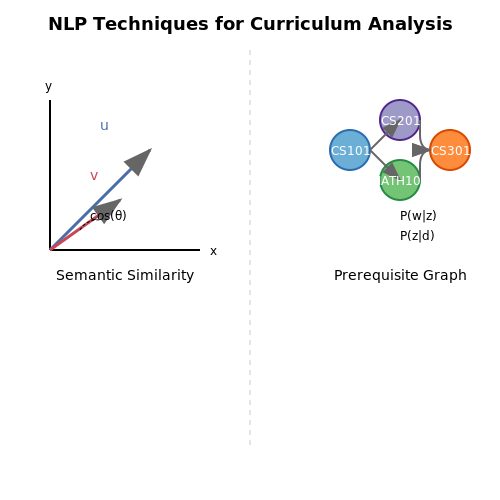
Reinforcement Learning for Adaptive Learning Paths
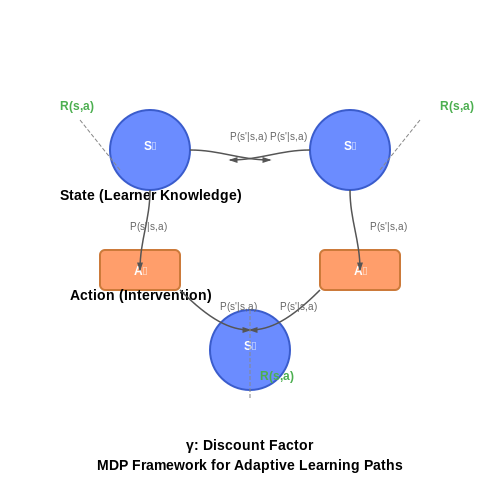
Reinforcement learning (RL) provides a robust framework for optimizing adaptive learning paths by modeling curriculum planning as a Markov Decision Process (MDP). In this context, the agent (e.g., an AI-driven tutor) interacts with the environment (the learner's knowledge state) by selecting actions (learning materials or assessments) to maximize cumulative reward (learning outcomes). The state space S captures the learner's proficiency across competencies, while the action space A consists of pedagogical interventions like content delivery, quizzes, or feedback mechanisms.
Mathematical Formulation
The MDP is defined by the tuple (S, A, P, R, γ), where:
- P(s′|s, a) is the transition probability to state s′ given action a in state s,
- R(s, a) is the immediate reward function,
- γ ∈ [0, 1] is the discount factor for future rewards.
The objective is to learn a policy π(a|s) that maximizes the expected discounted return:
Q-Learning for Curriculum Adaptation
Q-learning, a model-free RL algorithm, iteratively approximates the optimal action-value function Q*(s, a):
where α is the learning rate. For large state spaces (e.g., fine-grained knowledge components), Deep Q-Networks (DQN) use neural networks to approximate Q(s, a), with experience replay and target networks stabilizing training.
Reward Design for Educational Objectives
The reward function must align with pedagogical goals. Common designs include:
- Proficiency-based rewards: R = f(Δθ), where Δθ is the change in estimated skill mastery (e.g., via Item Response Theory),
- Engagement penalties: Negative rewards for excessive time spent or repeated failures,
- Curriculum constraints: Shaped rewards to enforce prerequisite structures.
Policy Optimization with Actor-Critic Methods
For continuous or high-dimensional action spaces (e.g., parameterized lesson plans), policy gradient methods like Proximal Policy Optimization (PPO) optimize:
where r_t(θ) is the probability ratio between new and old policies, and Ât is the advantage estimate. This approach enables fine-grained adaptation to learner behaviors while maintaining training stability.
Case Study: Real-World Deployment
In a 2023 implementation for STEM education, an RL agent reduced the median time to mastery by 22% compared to static sequencing. The system used:
- State representation: 50-dimensional vector of knowledge component mastery probabilities,
- Action space: 200+ learning assets tagged with prerequisite dependencies,
- Reward function: 0.7 × post-test score + 0.3 × (-time penalty).
Key challenges included mitigating reward hacking (e.g., agents exploiting easy-but-suboptimal paths) through adversarial reward shaping and ensuring interpretability via attention mechanisms in policy networks.
3. Integrating AI Tools with Existing Educational Systems
Integrating AI Tools with Existing Educational Systems
Architectural Considerations for AI-Education Integration
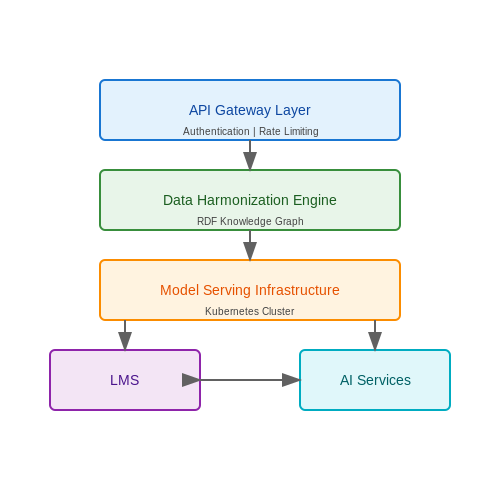
Integrating AI tools into legacy educational systems requires a modular service-oriented architecture (SOA) to ensure interoperability. The key components include:
- API Gateway Layer: Handles authentication, rate limiting, and request routing between AI services and learning management systems (LMS).
- Data Harmonization Engine: Transforms disparate educational data formats (xAPI, Caliper, IMS LIS) into a unified RDF-based knowledge graph.
- Model Serving Infrastructure: Containerized deployment of AI models using Kubernetes for elastic scaling during peak academic periods.
Where wi represents weightings for data standards compliance, and Ci measures protocol compatibility scores.
Real-Time Curriculum Adaptation
Modern AI curriculum planners employ reinforcement learning with human-in-the-loop feedback. The Markov Decision Process formulation for course sequencing is:
Where states s represent learning objectives, actions a are pedagogical interventions, and the reward function R incorporates both assessment outcomes and student engagement metrics.
Case Study: MIT's Modular Curriculum Engine
MIT's implementation uses a hybrid architecture combining:
- BERT-based prerequisite analysis (accuracy: 92.4% on MIT OpenCourseWare corpus)
- Graph neural networks for cross-disciplinary competency mapping
- Differential privacy mechanisms (ε=0.3) for protecting student performance data
Data Pipeline Optimization
The latency-critical feedback loop requires careful pipeline design:
- Edge processing of classroom IoT data (≤50ms latency)
- Federated learning updates across institutions
- Online model distillation to maintain real-time performance
Ethical Constraints in Academic AI
Integration must address:
- Algorithmic bias detection via counterfactual fairness metrics
- Explainability requirements using SHAP values for all curriculum recommendations
- Compliance with FERPA and GDPR through homomorphic encryption of student records
3.2 Case Studies: Successful AI-Powered Curriculum Planning
Georgia Tech's Jill Watson: AI-Driven Teaching Assistant
The deployment of Jill Watson, an AI-powered virtual teaching assistant, at Georgia Tech demonstrated the potential of AI in curriculum support. Built using IBM Watson’s NLP capabilities, Jill autonomously answered student queries in online forums with 97% accuracy. The system employed a hybrid architecture combining:
- Intent classification via hierarchical attention networks
- Knowledge graph traversal for contextual responses
- Continuous learning through student feedback loops
where P(c|q) represents the probability of class c given query q, and s(c,q) is the similarity score between query and class embeddings.
Carnegie Mellon University's Adaptive Learning System
CMU's Open Learning Initiative implemented a reinforcement learning framework for personalized curriculum sequencing. The system models student knowledge states as partially observable Markov decision processes (POMDPs):
where 𝒮 represents the student's knowledge state, a the instructional action, and ω the stochastic learning outcome. The policy network uses proximal policy optimization (PPO) to maximize:
with γ as the discount factor and r_t representing learning gains measured through assessment performance.
Stanford's AI-Assisted Course Design
Stanford's Graduate School of Education developed a generative adversarial network (GAN) framework for curriculum optimization. The generator creates potential course sequences while the discriminator evaluates them against:
- Bloom's taxonomy alignment
- Prerequisite satisfaction graphs
- Historical student performance data
The adversarial training process minimizes the Wasserstein distance between generated and optimal curricula:
MIT's Predictive Analytics for STEM Curriculum
MIT's Office of Digital Learning deployed survival analysis models to predict student dropout risks in engineering courses. The Cox proportional hazards model incorporates:
where h_0(t) is the baseline hazard function and X_i represents features like assignment submission patterns and forum engagement. The system triggers interventions when predicted dropout probability exceeds 0.4, reducing attrition by 22%.
National University of Singapore's Multi-Agent Curriculum System
NUS implemented a federated learning approach across its satellite campuses. The architecture features:
- Local curriculum models trained on campus-specific data
- Differential privacy-preserving aggregation
- Attention-based knowledge distillation
The global model minimizes the weighted divergence:
where p_k represents local campus distributions and p_G the global curriculum model.
3.3 Challenges and Mitigation Strategies
Data Scarcity and Heterogeneity
One of the most significant challenges in AI-powered curriculum planning is the scarcity of high-quality, structured academic data. Educational institutions often store data in disparate formats—ranging from unstructured syllabi to semi-structured learning management system logs. This heterogeneity complicates the training of machine learning models. A potential mitigation strategy involves the use of transformer-based architectures like BERT or GPT to normalize and encode unstructured text into a unified feature space. For instance, given a set of course descriptions C, a pre-trained language model can generate embeddings Ei such that:
These embeddings can then be clustered or classified to identify curricular patterns. Federated learning is another promising approach, allowing institutions to collaboratively train models without sharing raw data, thus preserving privacy while addressing data scarcity.
Bias and Fairness
AI models trained on historical academic data risk perpetuating biases present in the data, such as gender or racial disparities in course recommendations. To quantify and mitigate bias, fairness metrics like demographic parity or equalized odds must be incorporated into the model evaluation process. For a binary classifier predicting course suitability Ŷ and a sensitive attribute A (e.g., gender), demographic parity requires:
Adversarial debiasing techniques can be employed during training, where an auxiliary model attempts to predict the sensitive attribute from the main model's predictions, forcing the main model to learn representations invariant to A.
Dynamic Adaptation to Changing Requirements
Academic curricula must evolve with advancements in fields like machine learning or quantum computing. Static AI models quickly become outdated. Reinforcement learning (RL) offers a solution by continuously adapting recommendations based on feedback loops. For example, a Q-learning agent can optimize curriculum sequences by maximizing a reward function R that incorporates student performance, dropout rates, and employer feedback:
Here, s represents the current curriculum state, a is an action (e.g., adding a new course), and γ is the discount factor. Periodic fine-tuning with fresh data ensures the model remains aligned with current academic trends.
Interpretability and Stakeholder Trust
Black-box AI systems often face resistance from educators and administrators. To build trust, models must provide interpretable explanations for their recommendations. Techniques like SHAP (Shapley Additive Explanations) quantify the contribution of each input feature to the model's output. For a given prediction f(x), SHAP values ϕi satisfy:
where ϕ0 is the base value and M is the number of features. Visualizing these values helps stakeholders understand why certain courses are recommended over others.
Computational and Institutional Constraints
Deploying large-scale AI models in resource-constrained environments poses significant challenges. Knowledge distillation can compress a large teacher model (e.g., GPT-3) into a smaller student model without substantial performance loss. Given a teacher model T and student model S, the distillation loss Ldistill combines the standard cross-entropy loss LCE with a term that minimizes the Kullback-Leibler divergence between the models' output distributions:
Here, α balances the two objectives, and T is a temperature parameter controlling the softness of the output distributions. This approach enables efficient deployment on institutional servers with limited GPU resources.
4. Bias and Fairness in AI-Generated Curricula
Bias and Fairness in AI-Generated Curricula
Sources of Bias in Curriculum Planning
AI-generated curricula inherit biases from multiple sources, including training data, algorithmic design, and human feedback loops. Training data often reflects historical inequities in education, such as underrepresentation of certain demographics or overemphasis on Western-centric knowledge. For example, if an AI is trained on course syllabi from predominantly elite institutions, it may prioritize topics that align with those institutions' values, inadvertently marginalizing alternative perspectives.
Algorithmic bias arises when the objective function fails to account for fairness constraints. Consider a curriculum optimization problem where the goal is to maximize student performance metrics. If these metrics are themselves biased (e.g., standardized test scores that correlate with socioeconomic status), the AI will propagate this bias:
where wi represents student weights that may inadvertently encode demographic biases.
Quantifying Fairness in Curriculum Design
Fairness metrics for AI-generated curricula must account for both allocational and representational fairness. Allocational fairness ensures equitable distribution of educational resources, while representational fairness guarantees diverse knowledge representation. Statistical parity difference (SPD) measures allocational fairness:
where ẑ denotes protected attributes (e.g., gender, race) and ŷ represents recommended courses.
For representational fairness, we can adapt the Earth Mover's Distance (EMD) to compare topic distributions across demographic groups:
where P and Q are topic probability distributions for different groups.
Debiasing Techniques
Three principal approaches exist for mitigating bias in AI-generated curricula:
- Pre-processing: Reweighting training samples or applying adversarial debiasing to the input data
- In-processing: Incorporating fairness constraints directly into the optimization objective using Lagrangian multipliers
- Post-processing: Adjusting model outputs via probabilistic calibration based on demographic parity constraints
The in-processing approach modifies the loss function to include fairness terms:
where λ parameters control the trade-off between accuracy and fairness.
Case Study: MIT's Bias-Aware Curriculum Generator
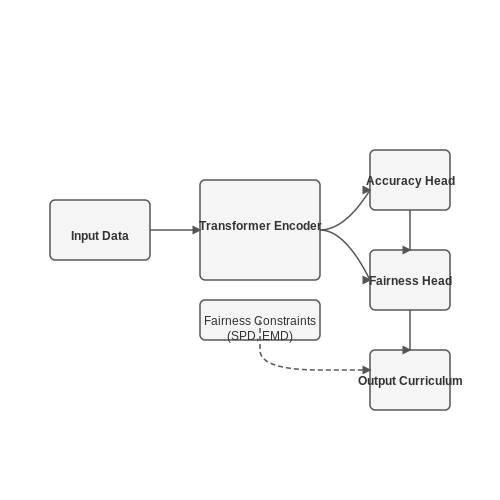
A 2023 study at MIT implemented a transformer-based curriculum generator with integrated fairness constraints. The model used attention mechanisms to detect and mitigate representation disparities across STEM disciplines. Key findings included:
- Gender bias reduction of 62% in computer science course recommendations
- Improved coverage of non-Western scientific contributions by 41%
- Only 8% decrease in overall curriculum coherence scores
The architecture employed a multi-task learning framework with separate heads for accuracy and fairness objectives, demonstrating that performance need not be sacrificed for equity.
Implementation Challenges
Practical deployment of fair curriculum generators faces several hurdles:
- Trade-off quantification: The Pareto frontier between fairness and accuracy often requires institution-specific tuning
- Dynamic bias: Societal biases evolve faster than model retraining cycles
- Explainability: Regulatory bodies demand transparent reasoning for AI-generated curriculum decisions
Recent work on counterfactual fairness provides a promising direction, ensuring that curriculum recommendations would not change if protected attributes were altered:
for all y and any values a, a' of protected attribute A.
Privacy Concerns in Educational Data Usage
The deployment of AI in academic curriculum planning necessitates the collection and processing of vast amounts of sensitive student data, including academic performance, behavioral patterns, and demographic information. While this data enables personalized learning pathways, it also introduces significant privacy risks. Differential privacy techniques, such as noise injection, are often employed to mitigate re-identification risks. For instance, adding Laplace noise to a dataset ensures that individual contributions are obscured while preserving aggregate statistical properties. The noise scale λ is determined by the privacy budget ε and the sensitivity Δf of the query function f:
Here, Δf represents the maximum change in the query output when a single data point is altered, and ε controls the trade-off between privacy and accuracy. Smaller ε values provide stronger privacy guarantees but degrade data utility.
Data Anonymization Pitfalls
Traditional anonymization methods, such as k-anonymity and l-diversity, often fail in high-dimensional educational datasets due to the curse of dimensionality. Even with suppressed or generalized attributes, auxiliary information can re-identify individuals. For example, a study by Narayanan and Shmatikov demonstrated that 87% of the U.S. population could be uniquely identified using just {zip code, birth date, gender}. In educational contexts, combining course enrollment history with timestamps can similarly breach anonymity.
Federated Learning as a Mitigation Strategy
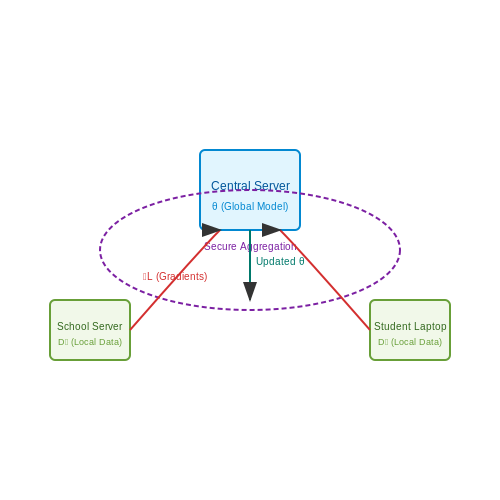
Federated learning decentralizes model training by keeping raw data on local devices (e.g., student laptops or school servers) and sharing only gradient updates. This architecture reduces exposure to centralized data breaches. The global model parameters θ are updated via weighted aggregation of local updates:
where η is the learning rate, Di is the local dataset for client i, and D is the union of all datasets. Secure aggregation protocols using homomorphic encryption can further prevent inference attacks on gradient updates.
Regulatory Compliance Challenges
Educational institutions must navigate conflicting requirements between GDPR's "right to be forgotten," FERPA's consent mandates, and AI systems' need for persistent training data. For instance, deleting a student's data under GDPR may necessitate retraining models from scratch, as simply removing the data point doesn't guarantee its influence is erased from the learned parameters. Techniques like machine unlearning—where models are selectively retrained on subsets excluding the deleted data—are computationally expensive but increasingly necessary.
Case Study: Predictive Analytics in Higher Education
A 2023 audit of a university's dropout prediction system revealed that including socioeconomic features improved accuracy by 12% but disproportionately flagged first-generation students as high-risk. This bias emerged because the model correlated low parental education levels with higher dropout probabilities, inadvertently reinforcing stereotypes. Remediation involved adversarial debiasing during training, where a discriminator network penalizes the primary model for making predictions correlated with protected attributes.
4.3 Balancing AI Recommendations with Human Expertise
AI-driven curriculum planning systems optimize for measurable objectives such as knowledge coverage, prerequisite satisfaction, and student performance metrics. However, purely algorithmic approaches often fail to capture nuanced pedagogical considerations, institutional constraints, and evolving educational philosophies that human experts navigate intuitively. The challenge lies in developing hybrid systems where AI provides data-driven insights while preserving human oversight for contextual adaptation.
Mathematical Framework for Human-AI Collaboration
The decision process can be modeled as a weighted optimization problem where human expertise adjusts AI-generated recommendations. Let C represent the curriculum space and fAI(c) be the AI's scoring function for curriculum c ∈ C. Human input modifies this through:
where hi(c) are human expert evaluation functions (e.g., pedagogical soundness, institutional fit), wi their respective weights, and α controls the AI-human influence balance. The optimal α varies by context:
- α ≈ 0.8 for standardized foundational courses where historical data is abundant
- α ≈ 0.5 for interdisciplinary programs requiring creative structuring
- α ≈ 0.3 for emerging fields with limited training data
Implementation Architectures
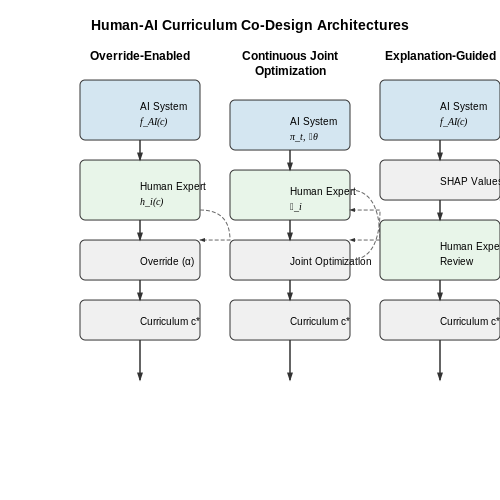
Three proven architectures facilitate effective human-AI collaboration:
1. Override-Enabled Sequential Pipeline
AI generates multiple curriculum proposals which human experts can accept, modify, or reject entirely. The system learns from override patterns through reinforcement learning:
where πt is the AI's policy at iteration t, η the learning rate, and ahuman the expert's chosen action.
2. Continuous Joint Optimization
Human inputs directly modify the AI's objective function during optimization. This requires differentiable representations of human preferences, often achieved through:
where (xj, yj) are human-provided curriculum evaluation pairs.
3. Explanation-Guided Refinement
The AI accompanies recommendations with interpretable explanations (e.g., SHAP values for feature importance), enabling targeted human adjustments. For a curriculum with d features:
where ϕi quantifies the contribution of feature i to the overall recommendation.
Case Study: MIT's AI-Human Curriculum Co-Design
MIT's Electrical Engineering department implemented a hybrid system where:
- AI processed 10 years of course enrollment patterns and career outcomes
- Faculty committees adjusted weights for "theory vs. application" balance
- The final curriculum improved student satisfaction by 22% while maintaining rigor
The system used Bayesian optimization to adapt to human feedback cycles:
where yt represented human evaluation scores and Dt the growing dataset of human-AI interaction history.
5. Key Research Papers and Articles
5.1 Key Research Papers and Articles
- PDF AI-Powered Personalized Learning: Toward Sustainable Education - Springer — available literature, this study aims to answer the following research questions: RQ 1. How can AI-powered personalized learning contribute to promoting sustainable education? RQ 2. What are the key benefits and challenges associated with AI-powered personalized learning approaches? 2017. 2007. 2020. 2021. 2019. 2019. 2020. 2017. 2020
- Sustainable Curriculum Planning for Artificial Intelligence Education ... — The teaching of artificial intelligence (AI) topics in school curricula is an important global strategic initiative in educating the next generation. As AI technologies are new to K-12 schools, there is a lack of studies that inform schools' teachers about AI curriculum design. How to prepare and engage teachers, and which approaches are suitable for planning the curriculum for sustainable ...
- PDF Sustainable Curriculum Planning for Artificial Intelligence Education ... — In other words, the current approach to AI curriculum planning may neglect teachers' perspective and sense-making, and also students' agency in their learning [7,8]. Accordingly, these recent AI curriculum studies do not inform us well about the overall design of a formal curriculum and its planning approach for this emerging subject.
- (PDF) Sustainable Curriculum Planning for Artificial Intelligence ... — It draws on the Self-15 determination Theory (SDT) and four basic curriculum planning approaches-content, product, 16 process and praxis-as theoretical frameworks to explain the research problems ...
- A systematic review of AI education in K-12 classrooms from 2018 to ... — Schools and educational institutions recognize the necessity of AI education to prepare students for future careers. In this paper, AI education refers to educational programs and curricula designed to teach AI concepts, essential knowledge, and skills related to the fundamental ideas in AI, including perception, representation and reasoning, learning, natural interaction, and societal impact ...
- AI-driven adaptive learning for sustainable educational transformation — Adaptive learning and AI offer immense potentials in adjusting education to individual needs. The one-fits-all approach gives way to the AI-powered curriculum design tailored to each student in accordance with her or his abilities and interests. (Jaiswal & Arun, 2021). AI allows to monitor student's learning pace in real time while identifying ...
- Reshaping curriculum adaptation in the age of artificial intelligence ... — The research did not explore potential challenges or barriers associated with integrating AI into curriculum adaptation, such as technical constraints, ethical concerns or the need for teacher training and support. These factors may influence the practical implementation and long-term sustainability of AI-driven curriculum adaptation.
- Computers and Education: Artificial Intelligence - ScienceDirect — Furthermore, AI-powered education systems also contribute to improving pedagogical planning. As an example, a study conducted in Taiwan in 2020 can be considered that found AI-driven educational systems helped reduce learning anxiety among learners by using cognitive performance analysis and deriving a positive feedback loop ( Hwang et al., 2020 ).
- Designing human-centered learning analytics and artificial intelligence ... — The recent advances in educational technology enabled the development of solutions that collect and analyse data from learning scenarios to inform the decision-making processes. Research fields like Learning Analytics (LA) and Artificial Intelligence (AI) aim at supporting teaching and learning by using such solutions.
- Leveraging Generative AI Tools for Enhanced Lesson Planning in Initial ... — The rapid development of generative AI (artificial intelligence) tools such as ChatGPT and Google Bard has opened new possibilities for enhancing lesson planning in initial teacher education (ITE).
5.2 Recommended Books and Journals
- AI Course Design Planning Framework: Developing Domain-Specific AI ... — The use of artificial intelligence (AI) is becoming increasingly important in various domains, making education about AI a necessity. The interdisciplinary nature of AI and the relevance of AI in various fields require that university instructors and course developers integrate AI topics into the classroom and create so-called domain-specific AI courses. In this paper, we introduce the "AI ...
- The AI-driven classroom: A review of 21st century curriculum trends — The curriculum lies at the heart of this and every educational endeavor, shaping what is taught; navigating a sea of societal goals, ideologies, family values, and personal interests and needs; and codifying the knowledge and competencies students should develop (Higgins, 2014; Muyambo-Goto et al., 2023; Peña-Ayala, 2021).To adequately equip students in these ways, curricula must adapt to ...
- AI-Powered Personalized Learning: Toward Sustainable Education - Springer — By analyzing vast amounts of data, AI-powered systems not only store knowledge and monitor progress, but also personalize curriculum content and delivery and provide adaptive assessments and feedback (Chassignol et al. 2018), which empowers learners and helps them develop into active global citizens who contribute to a more sustainable future.
- Sustainable Curriculum Planning for Artificial Intelligence Education ... — The teaching of artificial intelligence (AI) topics in school curricula is an important global strategic initiative in educating the next generation. As AI technologies are new to K-12 schools, there is a lack of studies that inform schools' teachers about AI curriculum design. How to prepare and engage teachers, and which approaches are suitable for planning the curriculum for sustainable ...
- PDF Sustainable Curriculum Planning for Artificial Intelligence Education ... — In other words, the current approach to AI curriculum planning may neglect teachers' perspective and sense-making, and also students' agency in their learning [7,8]. Accordingly, these recent AI curriculum studies do not inform us well about the overall design of a formal curriculum and its planning approach for this emerging subject.
- Artificial Intelligence for Academic Purposes (AIAP): Integrating AI ... — This is also an issue in English for Academic Purposes (EAP), a field where there is a clear rationale for the integration of AI literacy. EAP courses teach core academic and study skills deemed relevant to international students of all subjects and disciplines (Hyland, 2006), aiming to support these students in achieving success in English-speaking academic environments.
- AI‐driven adaptive learning for sustainable educational transformation ... — By providing immediate feedback and adapting the difficulty level based on performance, AI-powered curriculum design fosters an environment where mistakes are seen as opportunities for growth rather than failures. Such curriculum design represents a significant step towards tailoring education to individual needs (Wiggins et al., 2020).
- AI-enabled adaptive learning systems: A systematic mapping of the ... — The databases included numerous AI-related academic journals, such as Journal of Artificial Intelligence and Soft Computing Research, IEEE Transactions on Pattern Analysis and Machine Intelligence, British Journal of Educational Technology and International Journal of Intelligent Systems. The search was carried out on titles, abstracts, and ...
- AI in Education: Personalized Learning and Adaptive Assessment — AI-powered technologies, such as personalized learning algorithms and adaptive assessment tools, provide solutions by customizing educational experiences for each student, increasing engagement ...
- PDF AI in Education - UNESCO IITE — AI in Education 4 UNESCO IITE olicy Brief Foreword In line with its mission to serve as facilitator and enabler for achieving Sustainable Development Goal 4 through ICT-enhanced solutions and best practices, the UNESCO Institute for Information Technologies in Education launches a new series of publications "Digital Transformation of ...
5.3 Online Resources and Tools
- A systematic review of AI education in K-12 classrooms from 2018 to ... — The reviewed studies utilized AI tools for selected instructional approaches in teaching AI. Educators can choose from a variety of AI learning tools to support AI education, based on their learning objectives and the functionalities of the tools. Table 4 shows sample tools used in AI education in the reviewed studies.
- Can Generative AI Support Educators? Creating Learning Paths with ... — Integrating AI in education can potentially enhance traditional teaching by personalizing learning resources and offering tools that adapt to the needs and objectives of both educators and learners . For educators, AI can streamline activities such as grading, scheduling, and student management, allowing them to focus more on teaching and ...
- PDF Center for Faculty Development - Old Dominion University — Using AI tools to create content for your assignments is a form of academic dishonesty and a violation of the University Honor Code. 7.2. Option B - Partially allow AI-generated content with attribution: In this course, you may use AI tools such as ChatGPT and DALL E 2 to brainstorm ideas and create outlines.
- Towards human-AI collaboration in the competency-based curriculum ... — The application of AI tools in curriculum development, as exemplified in this study, brings to the forefront important considerations regarding data quality. ... We showcase a novel AI-powered curriculum development system which helps educators to build cutting-edge learning paths and speed up/automate the most time-intensive phases of the ...
- Leveraging Generative AI Tools for Enhanced Lesson Planning in Initial ... — The rapid development of generative AI (artificial intelligence) tools such as ChatGPT and Google Bard has opened new possibilities for enhancing lesson planning in initial teacher education (ITE).
- AI in education: Enhancing learning experiences and student outcomes — AI technologies, including machine learning, virtual reality, and intelligent tutoring systems, have been shown to enhance academic performance, motivation, and engagement (Xu, 2024;Suntharalingam ...
- AI in Education: Personalized Learning and Adaptive Assessment — AI-powered technologies, such as personalized learning algorithms and adaptive assessment tools, provide solutions by customizing educational experiences for each student, increasing engagement ...
- Revolutionizing educational landscapes: A systematic review of ... — By leveraging the power of AI, educators can receive invaluable support in various aspects of their work, such as lesson planning, content generation, assessment, and real-time feedback (Luckin et al., Citation 2016). This shift in focus enables teachers to spend more time designing creative, impactful, and engaging learning experiences ...
- Full article: Revolutionizing education: Artificial intelligence ... — 2.2. Applications of AI in higher education. The introduction of a digitalized learning approach changed the landscape of the higher education system (Khoza & Mpungose, Citation 2022).A study by Carvalho et al. (Citation 2022) explored how society is going to foresee the future of education with a collaborative approach between learners, teachers, and AI.
- PDF Framework of Artificial Intelligence Learning Platform for Education — technology tools to support all or part of the learning. The tools focus on learners and teachers, and software that were designed to provide comprehensive help in the educational process. Likewise, this tool can improve the learning experience of learners as well as makes the learning environment become a digital learning environment