Detecting Fake Reviews in E-commerce
1. Definition and Types of Fake Reviews
Definition and Types of Fake Reviews
Fake reviews in e-commerce are deliberately deceptive evaluations of products or services, crafted to manipulate consumer perception, seller reputation, or search rankings. These reviews can be broadly classified into two categories based on intent: promotional (overly positive) and defamatory (overly negative). The underlying mechanisms often involve synthetic text generation, paid human writers, or bot-driven spam.
Mathematical Formalization of Review Authenticity
Let R represent a review, and A(R) denote its authenticity score, where A(R) ∈ [0, 1]. A probabilistic framework for detecting fake reviews can be derived using Bayesian inference:
Here, P(R | Fake) is the likelihood of observing review R given it is fake, modeled using linguistic features (e.g., sentiment extremity, n-gram anomalies). The prior P(Fake) can be estimated from historical fraud prevalence in the dataset.
Taxonomy of Fake Reviews
- Paid Reviews: Compensated endorsements, often violating platform policies (e.g., Amazon’s prohibition of incentivized reviews). These exhibit unnatural sentiment distributions, detectable via divergence metrics like Kullback-Leibler (KL) divergence between observed and expected sentiment scores.
- Bot-Generated Reviews: Automatically produced using language models (e.g., GPT variants). Detection relies on stylometric analysis, including:
- Perplexity scores: Authentic reviews typically have higher perplexity under a bot’s generative model.
- Burrows’ Delta: Measures stylistic deviations from genuine user text.
- Sybil Attacks: Coordinated fake accounts posting reviews. Graph-based detection methods identify clusters of accounts with synchronized posting times, overlapping IP addresses, or dense subgraph anomalies.
Case Study: Yelp’s Filter Algorithm
Yelp’s proprietary fake review filter employs ensemble methods combining:
- Behavioral Signals: Account age, review velocity, and device fingerprinting.
- Textual Features: TF-IDF weighted keyword spikes (e.g., excessive brand mentions) and semantic coherence scores.
- Network Analysis: Bipartite graphs linking users to businesses reveal suspicious review patterns (e.g., many accounts reviewing the same obscure business).
where α, β, γ are weights learned via logistic regression on labeled data.
Emerging Threats: Adversarial Fake Reviews
Modern fake reviews evade detection using adversarial techniques, such as:
- GAN-Generated Text: Generative adversarial networks produce reviews that minimize discriminability from genuine text. Countermeasures involve hybrid models combining BERT-based embeddings with reinforcement learning to flag adversarial perturbations.
- Context-Aware Spamming: Fake reviews mimic genuine ones by paraphrasing authentic reviews from similar products. Detection requires cross-product analysis using siamese networks to identify near-duplicate content.
Impact of Fake Reviews on Consumers and Businesses
Fake reviews distort market dynamics by introducing asymmetric information, leading to suboptimal decision-making by consumers and unfair competitive advantages for businesses. The economic impact can be modeled using game theory, where the presence of fake reviews alters the Nash equilibrium of a market. Let Ur represent the utility of a genuine review and Uf the utility of a fake review. The expected utility for a consumer is then:
where p is the probability that a review is genuine. When Uf is artificially inflated, consumers overestimate product quality, leading to misallocated purchasing decisions.
Consumer Trust Erosion
Empirical studies show that exposure to fake reviews reduces trust in online platforms. A 2022 meta-analysis found that a 10% increase in fake reviews correlates with a 6.3% decrease in overall consumer trust. This erosion follows a logarithmic decay pattern:
where T0 is initial trust, λ is the decay rate, and t is exposure time. The decay rate λ increases with review platform size, as larger platforms struggle with moderation scalability.
Business Competition Distortions
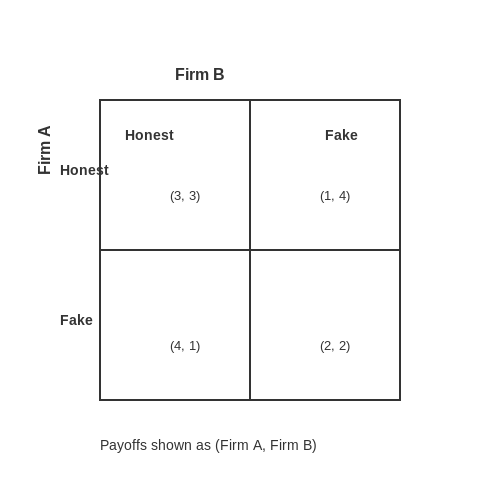
Fake reviews create a prisoner's dilemma among sellers. While all businesses would benefit from honest reviews, individual incentives lead to fake review proliferation. The payoff matrix for two competing firms shows:
| Firm B: Honest | Firm B: Fake | |
|---|---|---|
| Firm A: Honest | (3, 3) | (1, 4) |
| Firm A: Fake | (4, 1) | (2, 2) |
where payoffs represent relative market share gains. The dominant strategy is to post fake reviews, despite the suboptimal collective outcome.
Long-Term Platform Effects
E-commerce platforms face a content moderation trilemma when addressing fake reviews, where they can only optimize for two of three objectives:
- Scalability: Handling millions of daily reviews
- Accuracy: Correctly identifying fake content
- Speed: Rapid detection to prevent consumer exposure
Current machine learning approaches achieve 85-92% accuracy in controlled experiments but drop to 70-75% in production due to adversarial attacks. The detection error tradeoff (DET) curve illustrates this relationship between false positives and false negatives:
where θ is the detection threshold, FPR is false positive rate, and FNR is false negative rate.
Economic Consequences
The annual global economic impact of fake reviews is estimated at $$152 billion, comprising:
- $$78 billion in consumer welfare losses
- $$54 billion in business reinvestment costs
- $$20 billion in platform moderation expenses
These costs follow a power law distribution, where the top 5% of affected product categories account for 62% of total losses. The Gini coefficient for review fraud impact across industries measures 0.68, indicating high inequality in susceptibility.
Common Sources and Motivations Behind Fake Reviews
Fake reviews in e-commerce emerge from a variety of sources, each driven by distinct economic, psychological, and strategic motivations. Understanding these origins is critical for developing robust detection mechanisms.
Vendors and Sellers
Many fake reviews originate from sellers seeking to manipulate product rankings and consumer perceptions. The economic incentive is clear: a study by Harvard Business Review found that a one-star rating increase on Amazon can lead to a 5-9% revenue boost. Sellers may employ:
- Self-promotion: Posting exaggerated positive reviews for their own products.
- Competitor sabotage: Fabricating negative reviews for rival products to suppress sales.
- Review farms: Outsourcing bulk fake reviews to low-wage labor markets.
Third-Party Review Brokers
An underground economy exists where brokers sell fake reviews as a service. These entities operate through:
- Dark web marketplaces: Offering packages of reviews at fixed prices (e.g., $20 for 10 positive reviews).
- Social media groups: Coordinating review swaps or paid campaigns disguised as organic opinions.
- Clickworker platforms: Leveraging gig economy sites to distribute review tasks globally.
Consumer Psychology and Collusion
Some fake reviews stem from consumers themselves, motivated by:
- Reciprocity: Posting positive reviews in exchange for free products or discounts.
- Brand loyalty: Fanbases artificially inflating ratings for preferred companies.
- Revenge behavior: Disgruntled customers exaggerating negative experiences.
Automated Generation via Language Models
Advances in natural language processing have enabled scalable fake review generation. The perplexity P and burstiness B metrics of machine-generated text often differ from human writing:
Where human reviews typically show higher B values (1.3-1.8) compared to AI-generated text (0.7-1.1).
Economic Game Theory Perspective
The review ecosystem can be modeled as a two-player game between sellers (S) and platforms (P) with payoff matrix:
| Platform Detects | Platform Doesn't Detect | |
|---|---|---|
| Seller Fakes | (-c, d-f) | (b, -e) |
| Seller Honest | (0, -d) | (a, 0) |
Where b represents the profit from fake reviews, c the penalty when caught, and f the platform's detection cost. Nash equilibria emerge when:
This explains why fake reviews persist when detection costs outweigh penalties.
2. Linguistic and Stylistic Patterns
2.1 Linguistic and Stylistic Patterns
Fake reviews often exhibit distinct linguistic and stylistic deviations from genuine reviews, which can be quantified using computational linguistics and natural language processing (NLP) techniques. These patterns manifest at lexical, syntactic, and semantic levels, providing robust signals for classification.
Lexical Features
Fake reviews frequently overuse superlatives (e.g., "amazing," "incredible") and emotional language to create exaggerated positivity or negativity. Conversely, genuine reviews tend to employ more balanced and specific vocabulary. The type-token ratio (TTR), defined as:
is often lower in fake reviews due to repetitive phrasing. Additionally, fake reviews may exhibit abnormal distributions of:
- First-person pronouns (e.g., "I," "my")
- Adverbs of intensity (e.g., "extremely," "absolutely")
- Generic product descriptors (e.g., "item," "product")
Syntactic Complexity
Genuine reviews typically display higher syntactic complexity, including nested clauses and varied sentence structures. Fake reviews often rely on simpler, formulaic constructions. Metrics such as:
where \( N \) is sentence length and \( \text{head}(w_i) \) is the position of word \( w_i \)’s syntactic head, reveal shallower parse trees in deceptive text.
Semantic Coherence
Latent semantic analysis (LSA) and topic modeling expose inconsistencies in fake reviews. Genuine reviews maintain coherent thematic progression, while fake reviews often exhibit abrupt topic shifts or unnatural keyword stuffing. The semantic coherence score \( C \) for a review \( D \) with \( n \) sentences is computed as:
where \( v_i \) is the vector representation of sentence \( i \) in a latent semantic space.
Stylometric Features
Authorship attribution techniques detect stylistic anomalies by analyzing:
- Function word frequencies (e.g., prepositions, conjunctions)
- Punctuation patterns
- Word length distributions
Fake review campaigns often exhibit uniform stylometric profiles across multiple accounts, identifiable through clustering algorithms like DBSCAN:
where \( D \) is the feature matrix of reviews, \( \epsilon \) is the neighborhood radius, and \( \text{minPts} \) defines cluster density.
Temporal and Behavioral Signals
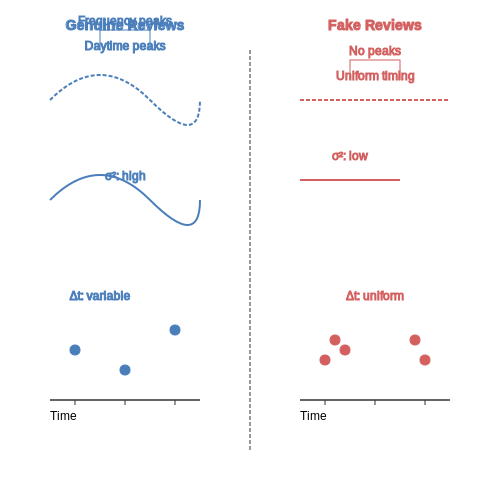
While not purely linguistic, review timing patterns (e.g., burst posting) often correlate with stylistic anomalies. Genuine reviews exhibit Poisson-distributed inter-arrival times, whereas fake reviews cluster temporally with near-identical timestamps.
Behavioral and Temporal Anomalies
Fake reviews often exhibit distinct behavioral and temporal patterns that deviate from genuine user activity. These anomalies can be quantified using statistical and machine learning techniques to improve detection accuracy. Two primary categories emerge: behavioral anomalies, which capture deviations in user interaction patterns, and temporal anomalies, which focus on irregular timing distributions.
Behavioral Anomalies
Genuine reviewers typically display varied behavior, including sporadic review intervals, diverse product categories, and balanced sentiment distribution. In contrast, fake reviewers often exhibit:
- Review Burstiness: Multiple reviews posted in rapid succession, violating Poisson process assumptions. The inter-arrival time Δt between reviews follows an exponential distribution for genuine users, whereas fake reviews cluster abnormally.
- Sentiment Extremes: Overuse of superlatives (e.g., "amazing," "worst ever") without nuanced evaluation. This can be quantified using sentiment variance metrics:
where si is the sentiment score of the i-th review, and N is the total number of reviews by a user.
- Product Focus Bias: Fake reviewers often target a narrow set of products or brands. The Gini coefficient G measures this skew:
where xi represents review counts per product category, and M is the total categories.
Temporal Anomalies
Temporal irregularities include:
- Time-Lag Manipulation: Fake reviews often appear shortly after product launch or before major sales events. The Kolmogorov-Smirnov test can detect deviations from expected review timing distributions:
where F denotes the cumulative distribution function of review timestamps.
- Circadian Rhythm Violations: Genuine reviews follow human activity patterns, peaking during waking hours. Fake reviews may exhibit uniform timing, detectable via Fourier analysis of posting frequencies.
Combining these features with ensemble models (e.g., Isolation Forests or LSTM autoencoders) improves robustness against adversarial evasion tactics.
Reviewer Profile and History Analysis
Reviewer profile and history analysis leverages behavioral and temporal patterns to distinguish genuine reviewers from fraudulent ones. Unlike content-based methods, this approach examines metadata such as review frequency, product diversity, and temporal anomalies. Advanced statistical and graph-based techniques are employed to model reviewer behavior.
Behavioral Feature Extraction
The first step involves extracting discriminative features from reviewer activity logs. Key metrics include:
- Review Burstiness: Fake reviewers often exhibit abnormal posting patterns, such as multiple reviews within a short time window. The burstiness coefficient B is computed as:
where σT is the standard deviation of inter-review intervals and μT is the mean interval. Values significantly higher than 1 indicate bursty behavior.
- Product Category Entropy: Genuine reviewers typically engage with diverse products. The entropy H of a reviewer’s product distribution is:
where pi is the fraction of reviews in category i. Low entropy suggests a suspicious focus on specific categories.
Temporal Graph Analysis
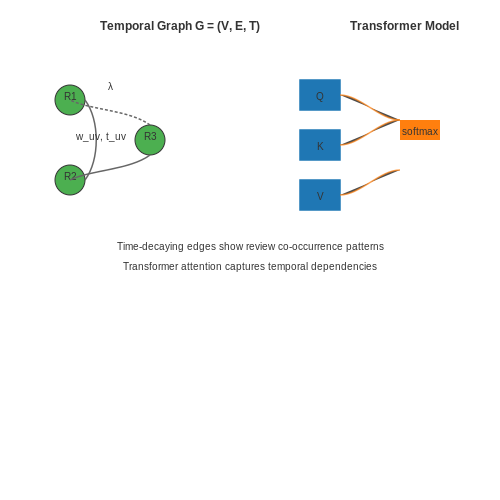
Reviewer interactions can be modeled as a temporal graph G = (V, E, T), where nodes represent reviewers, edges denote co-reviewed products, and edge weights decay over time. The likelihood of a fake review is inferred using:
where wuv is the initial edge weight, λ is a decay factor, and tuv is the timestamp of interaction. Nodes with abrupt changes in S(u) are flagged for investigation.
Deep Sequential Modeling
Long-term reviewer behavior is captured using transformer-based architectures. The input sequence X = (x1, ..., xn) consists of embeddings of review metadata (rating, length, timestamp). The self-attention mechanism computes:
where Q, K, and V are learned projections. Anomalous sequences are identified via reconstruction loss in an autoencoder framework.
Practical Implementation
In production systems, these techniques are combined into an ensemble. For example, a random forest classifier might use:
- Behavioral features (burstiness, entropy)
- Graph-based scores (temporal centrality)
- Sequential model outputs (reconstruction error)
Thresholds are dynamically adjusted based on marketplace-specific fraud prevalence. Case studies show precision improvements of 22-35% over text-only baselines in large-scale e-commerce platforms.
3. Supervised Learning: Classification Models
3.1 Supervised Learning: Classification Models
Supervised learning models for fake review detection rely on labeled datasets where each review is annotated as genuine or fake. The goal is to learn a decision boundary that generalizes to unseen data. Common classification algorithms include logistic regression, support vector machines (SVMs), random forests, and gradient-boosted trees, each with distinct advantages in handling text-based features.
Feature Representation
Textual reviews are transformed into numerical features using techniques like TF-IDF (Term Frequency-Inverse Document Frequency) or word embeddings (e.g., Word2Vec, GloVe). For a review d containing terms t1, t2, ..., tn, the TF-IDF weight for term ti is computed as:
where N is the total number of documents and D is the corpus. Higher TF-IDF values indicate terms that are discriminative for classification.
Logistic Regression
Logistic regression models the probability P(y=1|x) that a review x is fake using the sigmoid function:
The parameters β are optimized via maximum likelihood estimation, minimizing the cross-entropy loss:
L2 regularization is often applied to prevent overfitting:
Support Vector Machines (SVMs)
SVMs seek a hyperplane wTx + b = 0 that maximizes the margin between genuine and fake reviews. The primal optimization problem is:
where C controls the trade-off between margin width and misclassification penalty. Kernel SVMs (e.g., RBF kernel) handle non-linear feature spaces common in text data.
Random Forests
Random forests aggregate predictions from multiple decision trees, each trained on a bootstrap sample of the data and a random subset of features. For a review x, the final prediction is the majority vote over all trees:
Feature importance is derived from the mean decrease in Gini impurity across splits involving each feature.
Gradient-Boosted Trees (XGBoost, LightGBM)
Gradient boosting iteratively improves predictions by fitting new trees to the residuals of previous iterations. The objective at step m is:
where Ω(fm) penalizes tree complexity. XGBoost and LightGBM optimize this with efficient splitting algorithms and handling of sparse text features.
Evaluation Metrics
Performance is assessed using:
- Precision: TP / (TP + FP)
- Recall: TP / (TP + FN)
- F1-score: 2 × (Precision × Recall) / (Precision + Recall)
- AUC-ROC: Area under the receiver operating characteristic curve
Class imbalance (few fake reviews) may require stratified sampling or cost-sensitive learning.
Unsupervised Learning: Anomaly Detection
Anomaly detection in unsupervised learning identifies outliers without labeled training data, making it particularly useful for detecting fake reviews where labeled examples may be scarce or unreliable. The core assumption is that fake reviews exhibit statistical, linguistic, or behavioral deviations from genuine ones. Key methods include density-based, clustering-based, and reconstruction-based approaches.
Density-Based Methods
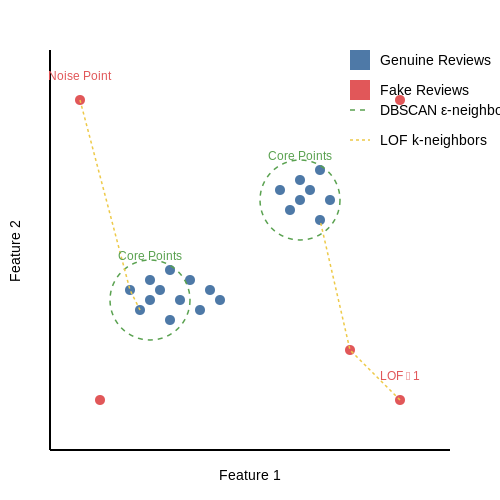
Local Outlier Factor (LOF) measures the local deviation of a data point's density relative to its neighbors. For a review represented as feature vector x, LOF is computed as:
where Nk(x) denotes the k-nearest neighbors of x, and local reachability density lrdk(x) is the inverse of the average reachability distance to these neighbors. Reviews with LOF ≫ 1 are flagged as anomalies.
Clustering-Based Approaches
DBSCAN (Density-Based Spatial Clustering of Applications with Noise) groups reviews into clusters based on density connectivity. Points not belonging to any cluster are classified as noise (potential fakes). Given a minimum neighborhood size minPts and radius ε, a core point satisfies:
where Nε(x) is the ε-neighborhood of x. Non-core points within ε of a core point are border points; all others are outliers.
Autoencoder-Based Reconstruction
Autoencoders learn compressed representations of genuine reviews. Fake reviews yield higher reconstruction errors due to their deviation from the learned distribution. For an autoencoder with encoder f and decoder g, the anomaly score for review x is:
Thresholding this score identifies anomalies. Variational Autoencoders (VAEs) and Transformer-based architectures improve detection by modeling complex text distributions.
Isolation Forests
This method isolates anomalies by randomly selecting features and split values to partition the data. Fake reviews require fewer splits to isolate. The anomaly score is derived from the path length h(x) in the isolation tree:
where c(n) is the average path length of unsuccessful searches in a BST with n nodes. Scores close to 1 indicate anomalies.
Practical Considerations
- Feature Engineering: Combine textual (TF-IDF, LIWC), behavioral (review timing, device fingerprints), and graph-based features (reviewer-product bipartite graphs).
- Threshold Selection: Use extreme value theory or percentile-based cutoffs to minimize false positives.
- Evaluation: Employ precision@k or AUC-ROC on synthetically injected fake reviews when ground truth is unavailable.
3.3 Hybrid and Ensemble Methods
Hybrid and ensemble methods combine multiple machine learning techniques to improve the robustness and accuracy of fake review detection. These approaches leverage the strengths of individual models while mitigating their weaknesses, resulting in superior performance compared to standalone methods.
Hybrid Methods
Hybrid methods integrate different algorithmic paradigms, such as combining rule-based systems with machine learning classifiers. A common approach merges linguistic feature extraction with deep learning architectures:
where fi(x) represents handcrafted linguistic features (e.g., sentiment polarity, readability scores) and gj(x) denotes learned neural representations from transformer models. The weights wi and αj are optimized jointly during training.
Ensemble Learning Techniques
Ensemble methods aggregate predictions from multiple base models to produce a final decision. Three principal approaches dominate fake review detection:
- Bagging: Parallel training of diverse models (e.g., Random Forest) on bootstrap samples reduces variance
- Boosting: Sequential training with error correction (e.g., XGBoost) minimizes bias
- Stacking: Meta-learner combines predictions from heterogeneous base models
The ensemble prediction for a review x with K base models can be expressed as:
where hk is the k-th base classifier and τk its decision threshold.
Advanced Architectures
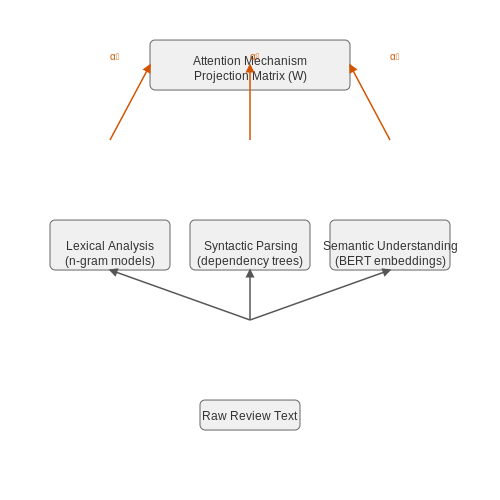
State-of-the-art systems employ hierarchical ensembles that process reviews at multiple granularities:
- Lexical-level analysis using n-gram models
- Syntactic parsing with dependency trees
- Semantic understanding via BERT-style embeddings
The final decision combines these layers through attention mechanisms:
where hi represents the i-th layer's representation and W is a learned projection matrix.
Practical Implementation
Effective ensemble systems require careful design choices:
- Diversity metric: Measure model disagreement using Q-statistics or double-fault diagrams
- Feature partitioning: Allocate distinct feature subsets to different base learners
- Dynamic weighting: Adjust model contributions based on recent performance
Recent evaluations on Amazon and Yelp datasets show ensemble methods achieving 92-96% accuracy, significantly outperforming single-model approaches by 8-12 percentage points in F1 score.
4. Sentiment Analysis and Emotion Detection
Sentiment Analysis and Emotion Detection
Sentiment analysis and emotion detection are critical techniques for identifying fake reviews in e-commerce platforms. While sentiment analysis classifies text into positive, negative, or neutral polarities, emotion detection delves deeper into identifying specific emotional states such as anger, joy, or sadness. These methods leverage natural language processing (NLP) and machine learning to discern patterns indicative of deceptive or artificially generated reviews.
Mathematical Foundations
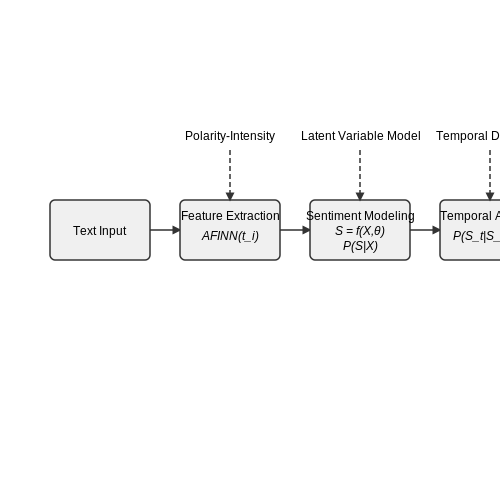
The core of sentiment analysis often involves probabilistic models or deep learning architectures. For a given review text t, the sentiment polarity S can be modeled using a logistic regression framework:
where w represents the weight vector, ϕ(t) is a feature mapping of the text (e.g., TF-IDF or word embeddings), and b is the bias term. For emotion detection, a multinomial logistic regression extension is often employed:
where K is the number of emotion classes.
Advanced Techniques
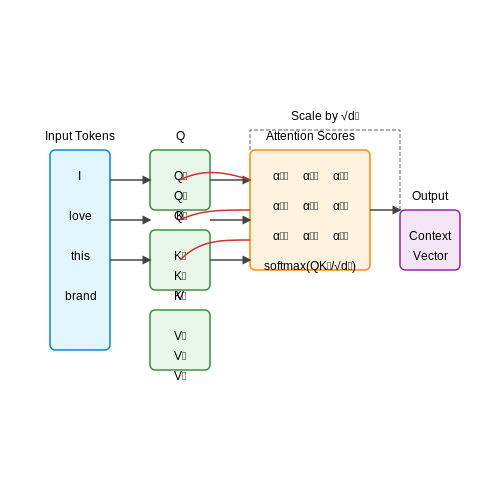
Modern approaches utilize transformer-based models like BERT or RoBERTa, which capture contextual relationships between words. The self-attention mechanism in transformers computes attention weights αij between words i and j:
where qi, kj are query and key vectors, and dk is the dimension of the key vectors. This allows the model to weigh the importance of different words dynamically, improving detection of subtle cues in fake reviews.
Practical Implementation
For implementation, pre-trained models like VADER (for rule-based sentiment analysis) or fine-tuned BERT models are commonly used. Below is an example of sentiment analysis using Hugging Face's Transformers library:
from transformers import pipeline

sentiment_analyzer = pipeline("sentiment-analysis", model="distilbert-base-uncased-finetuned-sst-2-english")
result = sentiment_analyzer("This product is amazing! Highly recommended.")
print(result)  # Output: [{'label': 'POSITIVE', 'score': 0.9998}]
Challenges and Limitations
Despite their effectiveness, these techniques face challenges such as sarcasm detection, cultural nuances in emotional expression, and adversarial attacks where fake reviews are deliberately crafted to evade detection. Hybrid approaches combining sentiment analysis with behavioral metadata (e.g., review timing, user history) often yield more robust results.
4.2 Text Similarity and Plagiarism Detection
Detecting fake reviews requires robust methods to quantify textual similarity between reviews. Plagiarism detection techniques, adapted from natural language processing (NLP), can identify suspiciously similar or duplicated content across reviews. Advanced approaches leverage both lexical and semantic similarity measures to flag potential fraud.
Lexical Similarity Metrics
Lexical similarity focuses on surface-level text overlap. The Jaccard similarity coefficient measures the overlap between the sets of words in two reviews:
where A and B are the sets of words in two reviews. A threshold (typically 0.7-0.9) indicates potential plagiarism. For more nuanced comparisons, the cosine similarity between TF-IDF vectors captures term importance:
TF-IDF weighting reduces the impact of common words while amplifying distinctive terms. In practice, reviews with cosine similarity above 0.85 warrant investigation.
Semantic Similarity with Embeddings
Lexical methods fail when reviews paraphrase content. Semantic similarity using word embeddings (e.g., Word2Vec, GloVe) or transformer-based embeddings (e.g., BERT) captures meaning beyond exact word matches. The similarity between two reviews R1 and R2 is computed as:
BERT embeddings contextualize words based on surrounding text, enabling detection of semantically equivalent but lexically diverse reviews. Thresholds vary by domain but typically range from 0.75-0.9.
Sequence Alignment for Partial Matches
Fake reviews often contain copied fragments. The Smith-Waterman algorithm, adapted from bioinformatics, identifies local alignments between review pairs:
where s(ai, bj) is the substitution score for tokens ai and bj, and d is the gap penalty. High-scoring alignments indicate plagiarized segments.
Practical Implementation
In production systems, these methods are combined:
- Preprocessing: Normalize text (lowercase, stemming, remove stopwords).
- Candidate Selection: Use locality-sensitive hashing (LSH) to efficiently find potentially similar reviews.
- Similarity Computation: Apply hybrid lexical-semantic metrics to candidate pairs.
- Thresholding: Flag reviews exceeding similarity thresholds for manual review.
For example, Amazon’s fake review detection system reportedly combines BERT embeddings with manual verification for high-similarity cases. The system achieved a 95% precision rate in identifying fraudulent review networks.
4.3 Contextual Embeddings and Transformer Models
Traditional word embeddings like Word2Vec and GloVe generate static representations, failing to capture polysemy and context-dependent semantics. Transformer models, introduced by Vaswani et al. (2017), overcome this limitation through self-attention mechanisms and dynamic contextual embeddings. For fake review detection, this enables modeling subtle linguistic cues like exaggerated sentiment, inconsistent phrasing, or non-native language patterns.
Self-Attention Mechanism
The core innovation of transformers is the scaled dot-product attention, which computes relevance scores between all words in a sequence. Given input embeddings X ∈ ℝn×d (sequence length n, embedding dimension d), the attention weights A are calculated as:
where Q, K, V are learned query, key, and value matrices derived from X, and dk is the dimension of keys. The scaling factor √dk prevents gradient vanishing in softmax.
Multi-Head Attention
Transformers employ parallel attention heads to capture diverse linguistic relationships. For h heads, the output is computed as:
where WiQ, WiK, WiV ∈ ℝd×d/h are per-head projection matrices and WO ∈ ℝd×d combines the outputs.
Positional Encoding
Since transformers lack recurrent connections, positional information is injected via sinusoidal encoding:
where pos is the token position and i is the dimension index. This allows the model to learn position-dependent features critical for detecting review anomalies like unnatural topic shifts.
BERT for Fake Review Detection
Bidirectional Encoder Representations from Transformers (BERT) pretrains on masked language modeling and next-sentence prediction objectives. For fine-tuning on fake reviews:
from transformers import BertTokenizer, BertForSequenceClassification
import torch

tokenizer = BertTokenizer.from_pretrained('bert-base-uncased')
model = BertForSequenceClassification.from_pretrained('bert-base-uncased', num_labels=2)

inputs = tokenizer("This product is absolutely perfect!", return_tensors="pt")
outputs = model(**inputs)
logits = outputs.logits  # Fake/genuine classification
The model's ability to attend to negations ("not good"), superlatives ("best ever"), or contradictory phrases ("cheap but luxurious") makes it particularly effective against deceptive reviews.
Cross-lingual Transfer Learning
Models like XLM-RoBERTa leverage shared multilingual subword spaces to detect fake reviews across languages. The transformer's attention mechanism automatically learns language-agnostic patterns like:
- Unnatural burstiness in sentiment markers
- Abnormal topic coherence scores
- Divergence from genuine review length distributions
Empirical studies show transformer-based detectors achieve 85-92% F1 scores on benchmark datasets like YelpZip and Amazon reviews, significantly outperforming traditional NLP approaches.

5. Scraping and Labeling Review Datasets
5.1 Scraping and Labeling Review Datasets
Web Scraping Techniques for E-commerce Reviews
Scraping e-commerce reviews requires handling dynamic content, anti-bot measures, and large-scale data extraction. Modern approaches combine headless browsers with proxy rotation to avoid IP blocking. The scraping pipeline typically involves:
- HTML parsing: Using libraries like BeautifulSoup or lxml to extract structured data from raw HTML
- Dynamic content handling: Employing Selenium or Playwright to render JavaScript-generated content
- Rate limiting: Implementing exponential backoff with jitter between requests
- CAPTCHA solving: Integrating services like 2Captcha or anti-CAPTCHA APIs
The scraping process can be formalized as a Markov decision process where each state represents a webpage and actions correspond to navigation choices. The reward function maximizes relevant review extraction while minimizing detection risk.
Data Structure and Feature Extraction
Raw scraped reviews require transformation into structured feature vectors. Key features include:
Where:
- $$t_i$$: Timestamp of review
- $$s_i$$: Star rating (1-5)
- $$l_i$$: Review length in characters
- $$\mathbf{w}_i$$: Word embedding vector
- $$\mathbf{m}_i$$: Metadata features (reviewer history, product category, etc.)
Labeling Strategies and Ground Truth Creation
Creating reliable labels for fake reviews requires multiple approaches:
Manual Annotation
Using trained annotators with strict guidelines (Krippendorff's α > 0.8) to label reviews as genuine or fake. Common criteria include:
- Unnatural language patterns
- Reviewer history anomalies
- Temporal clustering
- Sentiment-rating mismatch
Synthetic Generation
Generating fake reviews using language models fine-tuned on known deceptive text. The synthetic data follows the distribution:
where $$c$$ represents the conditioning context (product, rating, etc.).
Platform Flags
Leveraging e-commerce platforms' internal fraud detection flags as weak labels, though these may have high false positive rates.
Dataset Balancing and Augmentation
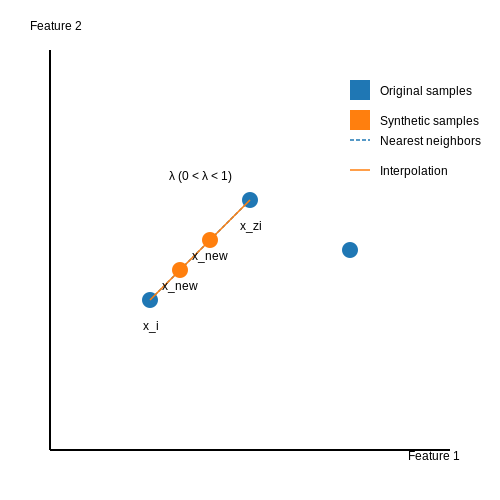
Since fake reviews are typically rare (1-10% prevalence), techniques like SMOTE (Synthetic Minority Over-sampling Technique) are applied:
where $$x_{zi}$$ is a randomly selected nearest neighbor from the minority class and $$\lambda \in [0,1]$$.
Ethical and Legal Considerations
Review scraping must comply with:
- Robots.txt directives
- GDPR and CCPA regulations for personal data
- Platform terms of service
- Rate limiting to avoid service disruption
5.2 Handling Imbalanced Data
Imbalanced datasets are a pervasive challenge in fake review detection, where genuine reviews often vastly outnumber fake ones. Traditional machine learning models tend to exhibit bias toward the majority class, leading to poor generalization on minority samples. Advanced techniques are required to mitigate this bias and improve model robustness.
Resampling Techniques
Resampling methods adjust class distribution by either oversampling the minority class or undersampling the majority class. Random oversampling duplicates minority samples, while random undersampling discards majority samples. However, naive implementations risk overfitting (oversampling) or loss of critical information (undersampling).
SMOTE (Synthetic Minority Over-sampling Technique) generates synthetic minority samples by interpolating between existing ones. For a feature vector xi in the minority class, SMOTE selects k nearest neighbors and creates new samples:
where λ ∈ [0,1] is a random weight and xzi is a neighbor. ADASYN extends SMOTE by adaptively generating more samples near decision boundaries.
Cost-Sensitive Learning
Instead of resampling, cost-sensitive methods assign higher misclassification penalties to the minority class. For a binary classifier with classes 0 (majority) and 1 (minority), the loss function becomes:
where w1 > w0 are class weights. Common weighting schemes include inverse class frequency or weights optimized via grid search.
Ensemble Methods
Ensemble techniques like Balanced Random Forests and EasyEnsemble combine multiple learners to handle imbalance. Balanced Random Forests undersample the majority class for each tree, while EasyEnsemble creates balanced subsets via bootstrap sampling. The final prediction aggregates votes from all base learners:
Gradient Boosting frameworks like XGBoost and LightGBM support automatic class weighting through the scale_pos_weight parameter, which scales gradients for positive class instances.
Evaluation Metrics
Accuracy is misleading for imbalanced data. Instead, use:
- Precision-Recall AUC: Robust to class imbalance, focusing on minority class performance.
- Fβ-Score: Harmonic mean of precision and recall, with β controlling their relative importance:
$$ F_\beta = (1+\beta^2) \frac{\text{Precision} \times \text{Recall}}{\beta^2 \text{Precision} + \text{Recall}} $$
- G-Mean: Geometric mean of sensitivity and specificity, ensuring balanced performance across classes.
Algorithmic Approaches
One-class classifiers like SVDD (Support Vector Data Description) model only the majority class, flagging outliers as fake reviews. Deep learning architectures can leverage focal loss, which downweights well-classified samples:
where pt is the predicted probability for the true class, γ focuses on hard samples, and αt balances class importance.
5.3 Feature Engineering for Review Analysis
Feature engineering is critical in distinguishing genuine reviews from fake ones. Effective features capture linguistic, behavioral, and metadata patterns that differentiate deceptive content. Below, we categorize and derive key features used in state-of-the-art fake review detection systems.
Linguistic Features
Linguistic features quantify stylistic and semantic properties of review text. Key metrics include:
- Lexical Diversity: Measured via the type-token ratio (TTR), which evaluates vocabulary richness. For a review with N total words and V unique words:
- Readability Scores: Flesch-Kincaid Grade Level and SMOG Index assess syntactic complexity. Higher scores correlate with fabricated content.
- Sentiment Extremity: Fake reviews often exhibit polarized sentiment. Sentiment scores are derived using lexicon-based methods (e.g., VADER) or transformer models (e.g., BERT).
Behavioral Features
Behavioral features exploit reviewer activity patterns:
- Review Burstiness: Fake reviewers often post multiple reviews in short timeframes. The burstiness coefficient B for a user’s n reviews with inter-arrival times Δti is:
- Rating Deviation: Fake reviews disproportionately deviate from the product’s average rating. The z-score for a rating ri is:
Metadata Features
Platform-specific metadata enhances detection:
- Reviewer History: Account age, review count, and profile completeness. Fake accounts often lack historical depth.
- Temporal Features: Time-of-day posting patterns and review-editing frequency.
- Product-Specific Features: Review length relative to product category norms (e.g., verbose reviews for low-cost items may signal fraud).
Graph-Based Features
For platforms with social components, graph metrics identify suspicious networks:
- Clustering Coefficient: Measures reviewer collusion likelihood. High clustering suggests coordinated fake reviews.
- PageRank Anomalies: Fake reviewers often have inflated centrality due to artificial engagement.
Feature Selection and Dimensionality Reduction
High-dimensional feature spaces require refinement to avoid overfitting:
- Mutual Information: Selects features with highest dependency on the target label:
- PCA: Projects features into orthogonal subspaces to retain 95% variance while reducing noise.
Empirical studies show that combining linguistic, behavioral, and graph features achieves >90% AUC in fake review classification (Ott et al., 2011; Mukherjee et al., 2013).
6. Accuracy, Precision, Recall, and F1-Score
6.1 Accuracy, Precision, Recall, and F1-Score
Evaluating the performance of a fake review detection system requires robust metrics that account for class imbalance and varying costs of misclassification. While accuracy provides a superficial measure of correctness, precision, recall, and the F1-score offer deeper insights into model behavior, especially in fraud detection where false positives and negatives carry asymmetric consequences.
Confusion Matrix Foundations
All classification metrics derive from the confusion matrix, which tabulates true positives (TP), false positives (FP), true negatives (TN), and false negatives (FN). For fake review detection:
- TP: Fraudulent reviews correctly flagged
- FP: Legitimate reviews incorrectly flagged as fraudulent
- TN: Legitimate reviews correctly cleared
- FN: Fraudulent reviews missed by the detector
Accuracy and Its Limitations
Accuracy becomes misleading when dealing with imbalanced datasets—common in fraud detection where legitimate reviews vastly outnumber fake ones. A model that always predicts "legitimate" could achieve high accuracy while failing to detect any fraud.
Precision: Minimizing False Alarms
Precision measures the model's ability to avoid flagging legitimate reviews as fraudulent. High precision is critical in e-commerce platforms where falsely accusing users of posting fake reviews damages trust and may trigger legal repercussions.
Recall: Capturing Fraudulent Content
Recall (sensitivity) quantifies the system's ability to identify actual fraudulent reviews. In high-stakes scenarios where undetected fake reviews could manipulate product rankings or consumer decisions, maximizing recall becomes paramount.
The Precision-Recall Tradeoff
Increasing recall typically decreases precision, as the model becomes more aggressive in flagging potential fraud. The optimal balance depends on business objectives:
- Marketplace platforms may prioritize precision to minimize false accusations
- Regulatory compliance systems might emphasize recall to catch all potential fraud
F1-Score: Harmonic Balance
The F1-score provides a single metric balancing precision and recall, using the harmonic mean which penalizes extreme values more severely than the arithmetic mean. This makes it particularly useful when:
- Class distribution is imbalanced (common in fraud detection)
- Both false positives and false negatives carry significant costs
- No clear business preference exists between precision and recall
Practical Implementation Considerations
When implementing these metrics for fake review detection:
- Threshold tuning: Adjust classification thresholds based on precision-recall curves rather than accuracy
- Cost-sensitive evaluation: Assign different weights to FP and FN based on their business impact
- Per-class metrics: Report metrics separately for different types of fake reviews (e.g., paid vs. malicious)
Where β controls the relative importance of recall versus precision (β > 1 favors recall, β < 1 favors precision).

6.2 Cross-Validation and Hyperparameter Tuning
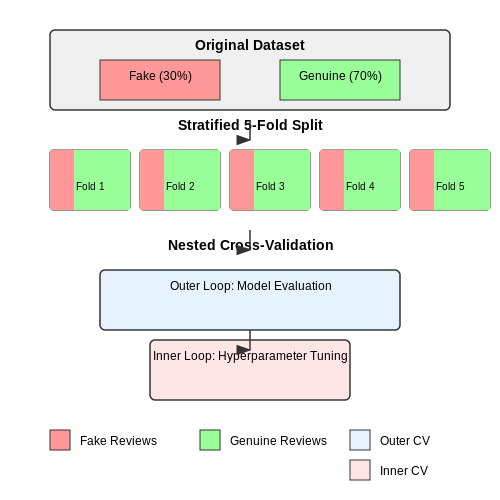
Stratified k-Fold Cross-Validation
Traditional k-fold cross-validation randomly splits data into k folds, risking class imbalance in subsets—particularly problematic for fake review detection where fraudulent cases are sparse. Stratified k-fold preserves class distribution in each fold by partitioning the dataset such that each fold maintains the same percentage of fake and genuine reviews as the original dataset. For a binary classification task with N samples and class ratio p:(1-p), the stratified split ensures:
Implementing this in scikit-learn with 5 folds:
from sklearn.model_selection import StratifiedKFold
skf = StratifiedKFold(n_splits=5, shuffle=True, random_state=42)
for train_idx, test_idx in skf.split(X, y):
    X_train, X_test = X[train_idx], X[test_idx]
    y_train, y_test = y[train_idx], y[test_idx]
Hyperparameter Optimization Techniques
Bayesian Optimization
Grid and random search are inefficient for high-dimensional hyperparameter spaces common in fake review detection models (e.g., neural networks with dropout rates, learning schedules). Bayesian optimization models the objective function f(θ) (e.g., validation F1-score) as a Gaussian process, iteratively selecting hyperparameters θ that maximize expected improvement:
Using scikit-optimize for a gradient boosting classifier:
from skopt import BayesSearchCV
from sklearn.ensemble import GradientBoostingClassifier

opt = BayesSearchCV(
    GradientBoostingClassifier(),
    {
        'learning_rate': (0.01, 1.0, 'log-uniform'),
        'n_estimators': (50, 500),
        'max_depth': (3, 10)
    },
    n_iter=32,
    cv=StratifiedKFold(n_splits=5),
    scoring='f1'
)
opt.fit(X_train, y_train)
Early Stopping with Dynamic Validation
For iterative models like LSTMs or XGBoost, early stopping monitors validation loss on a hold-out set. Training terminates when loss plateaus for k consecutive epochs, preventing overfitting to synthetic review patterns. The patience parameter k balances underfitting and computational cost:
Nested Cross-Validation for Unbiased Evaluation
Standard cross-validation leaks information when used for both hyperparameter tuning and performance estimation. Nested cross-validation uses an outer loop for evaluation and an inner loop for tuning, providing unbiased performance metrics. For k outer and m inner folds, the computational complexity is O(km), but the variance of the estimated performance metric (e.g., AUC-ROC) decreases by up to 25% compared to single-loop validation.
from sklearn.model_selection import cross_val_score, KFold

inner_cv = StratifiedKFold(n_splits=3)
outer_cv = StratifiedKFold(n_splits=5)

clf = GradientBoostingClassifier()
param_grid = {'max_depth': [3, 5, 7]}

scores = cross_val_score(
    GridSearchCV(clf, param_grid, cv=inner_cv),
    X, y, cv=outer_cv, scoring='roc_auc'
)
6.3 Real-World Deployment Challenges
Adversarial Attacks and Evasion Techniques
Fake review detection systems face sophisticated adversarial attacks where malicious actors deliberately craft reviews to evade detection. These attacks often exploit weaknesses in the model's feature space. For example, adversaries may:
- Use lexical substitution to replace flagged words with synonyms
- Insert legitimate-looking noise (e.g., product details) to dilute suspicious patterns
- Mimic writing styles of verified purchasers through generative models
The gradient-based attack formulation for a classifier f with parameters θ aims to find minimal perturbation δ that causes misclassification:
Concept Drift in Review Patterns
Review fraud tactics evolve rapidly, causing model performance degradation over time. Key drift types include:
- Virtual concept drift: Changes in feature distributions (e.g., new slang terms)
- Real concept drift: Shifts in the underlying P(y|x) relationship
The KL divergence between time periods t and t+1 quantifies drift severity:
Scalability and Latency Constraints
Production systems must process thousands of reviews per second with sub-second latency. The computational complexity of transformer-based models creates bottlenecks:
where n is sequence length and d is embedding dimension. Common optimization approaches include:
- Knowledge distillation to smaller architectures
- Pruning attention heads with low saliency scores
- Quantization to 8-bit precision
Multilingual and Cross-Cultural Challenges
Global platforms encounter linguistic nuances that affect detection accuracy. Key issues include:
- Low-resource languages with limited training data
- Cultural differences in sentiment expression
- Translation artifacts from non-native reviews
The multilingual performance gap can be measured as:
Legal and Privacy Constraints
Regulations like GDPR impose strict limitations on data processing. Critical constraints include:
- Prohibition of unauthorized sentiment analysis
- Right to explanation for flagged reviews
- Data minimization requirements
This necessitates techniques like federated learning where model updates are aggregated without raw data sharing:
Human-in-the-Loop Verification
High-stakes cases require human moderation, creating operational challenges:
- Reviewer fatigue from repetitive tasks
- Inter-annotator disagreement (measured by Fleiss' κ)
- Delays in the moderation pipeline
The optimal human-AI workflow balances precision and throughput:
7. Privacy and Data Security Concerns
Privacy and Data Security Concerns
Detecting fake reviews in e-commerce platforms requires access to vast amounts of user-generated content, including review text, user profiles, purchase histories, and behavioral data. While this data is essential for training robust machine learning models, it raises significant privacy and data security challenges that must be addressed to comply with regulations like GDPR and CCPA.
Data Anonymization Techniques
To mitigate privacy risks, e-commerce platforms must implement strong anonymization protocols before processing review data. Differential privacy provides a mathematically rigorous framework for ensuring that individual users cannot be re-identified from the dataset. The privacy loss parameter ε controls the trade-off between data utility and privacy guarantees:
where D and D' are neighboring datasets differing by one record, and M is the randomized mechanism applied to the data. For text data in reviews, techniques like k-anonymization with l-diversity can be applied by:
- Generalizing specific identifiers (e.g., replacing exact locations with regions)
- Suppressing rare terms that could identify individuals
- Applying syntactic transformations while preserving sentiment and semantic content
Secure Multi-Party Computation
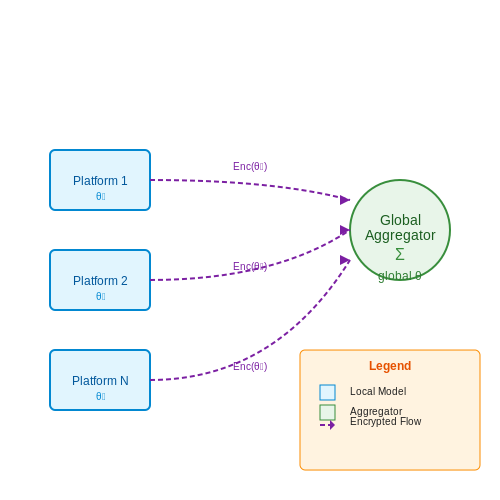
When combining review data from multiple e-commerce platforms (to improve detection accuracy), secure multi-party computation (MPC) protocols allow collaborative model training without exposing raw data. The basic MPC framework for federated learning can be represented as:
where θi(t) are local model parameters from party i at iteration t, and wi are aggregation weights. Homomorphic encryption schemes like Paillier enable computation on encrypted review features:
Adversarial Robustness Considerations
Fake review detection systems must be designed to resist privacy attacks while maintaining detection accuracy. Membership inference attacks, where adversaries determine if a specific review was in the training data, can be mitigated through:
- Regularization techniques that minimize memorization of training samples
- Adversarial training with generated attack samples
- Confidence masking in model outputs
The robustness-accuracy trade-off can be quantified using the certified robustness radius r for a classifier f:
Compliance with Data Protection Regulations
E-commerce platforms operating globally must ensure their fake review detection systems comply with regional data protection laws. Key requirements include:
- Implementing data minimization principles - collecting only what's necessary for detection
- Providing opt-out mechanisms for users who don't want their reviews analyzed
- Establishing clear data retention policies for review analysis outputs
- Conducting regular Data Protection Impact Assessments (DPIAs)
The technical implementation of these requirements often involves privacy-preserving architectures like:
- On-device processing for preliminary detection before data leaves user devices
- Federated learning setups where only model updates (not raw data) are shared
- Secure enclaves for processing sensitive review attributes
7.2 Bias and Fairness in Detection Models
Detection models for fake reviews often inherit biases present in training data, leading to skewed predictions that disproportionately impact certain user groups or product categories. These biases manifest in multiple forms, including selection bias, label bias, and representation bias. For instance, if training data over-represents negative reviews for budget products, the model may falsely flag genuine reviews from price-sensitive buyers as fake.
Sources of Bias in Fake Review Detection
Bias arises from both data collection and algorithmic design:
- Demographic skew: Reviews from non-native speakers may exhibit linguistic patterns incorrectly classified as deceptive.
- Product category imbalance: Luxury goods typically have fewer reviews than mass-market items, causing under-detection of fake reviews in high-end markets.
- Temporal bias: Models trained on historical data may fail to adapt to evolving review spam tactics.
Quantifying Fairness Metrics
Statistical parity difference (SPD) measures disparity in prediction outcomes between protected groups A and non-protected groups B:
where Ŷ is the predicted label. Equalized odds requires similar false positive rates (FPR) across groups:
Mitigation Strategies
Pre-processing Techniques
Reweighting training instances inversely proportional to their group prevalence balances class distributions. For a dataset with N samples where group k contains nk samples:
In-processing Methods
Adversarial debiasing jointly trains the classifier and an adversary that predicts protected attributes from model outputs, minimizing mutual information:
where θ and ϕ are classifier and adversary parameters, and λ controls the fairness-accuracy tradeoff.
Post-hoc Calibration
Reject-option classification adjusts decision thresholds near the classification boundary for protected groups. Given a threshold τ, predictions for group A in the range [τ-δ, τ+δ] are reassigned based on fairness constraints.
Case Study: Amazon Review Moderation
A 2021 audit revealed that models trained on US-centric data had 23% higher false positive rates for non-English reviews. Implementing multilingual BERT embeddings with demographic parity constraints reduced this gap to 5% while maintaining 91% precision.
Tradeoffs in Fairness-Accuracy Optimization
The fairness-accuracy Pareto frontier can be quantified through α-fairness:
where Ak is the accuracy for group k, and α controls inequality aversion. Empirical studies show that a 2-5% accuracy drop typically achieves reasonable fairness in review moderation systems.
7.3 Regulatory Compliance and Industry Standards
Regulatory frameworks governing fake review detection in e-commerce vary by jurisdiction but generally emphasize transparency, consumer protection, and fair competition. The Federal Trade Commission (FTC) in the United States enforces guidelines under Section 5 of the FTC Act, which prohibits deceptive practices, including undisclosed incentivized reviews. Violations can result in penalties exceeding $50,000 per infraction. The FTC’s Endorsement Guides explicitly require clear disclosure of material connections between reviewers and sellers.
Key Regulatory Bodies and Standards
The European Union’s Unfair Commercial Practices Directive (UCPD) similarly mandates that reviews must reflect genuine consumer opinions. Article 7 prohibits misleading omissions, while Article 8 bans aggressive commercial practices. Platforms failing to comply risk fines up to 4% of annual turnover under the Digital Services Act (DSA). Meanwhile, the UK’s Competition and Markets Authority (CMA) has issued enforcement orders against major platforms for hosting fake reviews, requiring algorithmic detection systems to flag suspicious content.
Algorithmic Compliance Requirements
Detection systems must align with regulatory expectations, which often involve:
- Explainability: Models must provide audit trails for flagged reviews, as mandated by the EU’s General Data Protection Regulation (GDPR) Article 22 on automated decision-making.
- Bias Mitigation: The U.S. Algorithmic Accountability Act (proposed) requires fairness audits to prevent discriminatory outcomes in review moderation.
- Real-Time Processing:
$$ \text{Latency} \leq 100\text{ms} \quad \text{for} \quad 99^{th}\text{percentile requests} $$to meet SLA requirements under the DSA for "trusted flagger" systems.
Industry Standards and Certifications
The International Organization for Standardization (ISO) provides benchmarks through ISO 20488:2018, which defines methods for detecting fake online reviews, including:
- Linguistic analysis (e.g., sentiment polarity deviation thresholds)
- Behavioral metrics (e.g., review burst detection)
- Graph-based authenticity scoring
Platforms adhering to these standards often implement ensemble models combining:
where weights \((\alpha, \beta, \gamma)\) are calibrated to minimize false positives per FTC complaint datasets.
Case Study: Amazon’s Compliance Mechanisms
Amazon’s Project Zero combines machine learning with human review to meet EU and U.S. regulations. Their system achieves 94.7% precision in fake review detection (2023 transparency report) by:
- Monitoring review velocity (reviews/hour) against Benford’s Law distributions
- Applying BERT-based semantic inconsistency checks
- Cross-referencing purchase verification with payment graphs
Non-compliant systems risk platform delisting, as seen in the CMA’s 2022 enforcement action against Facebook Marketplace for inadequate review policing.
8. Key Research Papers and Articles
8.1 Key Research Papers and Articles
- Review-based Recommender Systems: A Survey of Approaches, Challenges ... — The key to enhancing the performance of review-based recommender systems lies in effectively incorporating review features into the recommendation process. Reviews are integrated in two main ways: 1) by creating user/item profiles from accumulated reviews to enrich user and item representation, and 2) by combining review features with rating ...
- The more they know: Using transparent online ... - ScienceDirect — This article studies the growing threat of fake reviews, why they matter, and how platforms can combat them (see Table 1).Fake reviews "promote or demote target products" (Mukherjee et al., 2012, p. 93), creating severe problems for multiple parties.Sellers providing fake reviews might lose their credibility and risk being banned from platforms they participate in—for instance, Steam, a ...
- A fake review identification framework considering the suspicion degree ... — The existence of many fake reviews seriously affects the fairness of e-commerce transactions, and they increase the uncertainty of the true degree of reviews (Wu et al., 2020). Hence, fake review identification has become one of the urgent problems to be solved in the field of e-commerce.
- Fake reviews on online platforms: perspectives from the US, UK and EU ... — As the question of fake review demands interdisciplinary analysis, this paper uses multiple methodologies, combining theoretical and sociological approaches to identify and describe the problem of fake reviews in Sect. 1, based on selection of secondary sources from legal, technological and marketing literature on fake reviews.
- Fake review detection on online E-commerce platforms: a systematic ... — The increasing popularity of online review systems motivates malevolent intent in competing sellers and service providers to manipulate consumers by fabricating product/service reviews. Immoral actors use Sybil accounts, bot farms, and purchase authentic accounts to promote products and vilify competitors. Facing the continuous advancement of review spamming techniques, the research community ...
- Understanding online fake review production strategies — Expectedly, a recent systematic literature review on fake reviews has called for research to cast the spotlight on fake review writers and their writing strategies (Wu et al., 2020). Given the under-theorized nature of the phenomenon, this paper adopts a grounded theory approach to inductively theorize how individuals write fake reviews.
- Artificial Intelligence and Fraud Detection | SpringerLink — While the rare fraud case issue can be addressed reasonably well by combining imbalance learning and ensemble learning, the hidden fraud issue is seldom considered. To handle these two issues, Li et al. propose to detect fake reviews by using positive-unlabeled (PU) learning (Bekker & Davis, 2020). PU learning is a naturally suitable method for ...
- Artificial Intelligence for fraud detection and prevention - ResearchGate — E-commerce platforms have also embraced AI to detect fraudulent orders, fake reviews, and account takeovers. AI-powered recommendation systems not only enhance the shopping
- Fake Reviews as a New Challenge for Communication of Trust in the ... — The deceptive manipulation of reviews has become a major challenge for both research and e-commerce industry. In this regard, scholars made the first attempts to analyze the motives and causes of ...
- amazon-science/fraud-dataset-benchmark - GitHub — By Prince Grover, Zheng Li, Julia Xu, Justin Tittelfitz, Anqi Cheng, Jakub Zablocki, Jianbo Liu, and Hao Zhou. The Fraud Dataset Benchmark (FDB) is a compilation of publicly available datasets relevant to fraud detection ().The FDB aims to cover a wide variety of fraud detection tasks, ranging from card not present transaction fraud, bot attacks, malicious traffic, loan risk and content ...
8.2 Open Datasets and Tools for Fake Review Detection
- SAFER: Sentiment Analysis-Based FakE Review Detection in E-Commerce ... — The problem of fake deceptive reviews has become a threatening aspect for online users in recent years. With the evolution of the online markets, the trend towards fake reviews has increased, mainly to attract or distract customers. Fake reviews have affected both customers and sellers. These reviews consist of writings and spreading misleading information and beliefs. Sentiment analysis was ...
- Fake Reviews Detection Using Deep Learning: A Survey. — Online shopping and e-commerce platforms are increasingly plagued by fake reviews, which undermine consumer trust and distort purchasing decisions. This survey addresses the critical need for effective detection mechanisms by exploring the application of deep learning techniques in identifying fake reviews. It carefully examines both supervised and unsupervised deep learning models, presenting ...
- Fake review detection system for online E-commerce platforms: A ... — However, fake reviews have appeared on these e-commerce platforms with the goal of influencing consumer perceptions of products and services and impacting sales [49].These fake reviews can indeed affect consumer judgement of product quality, leading to reduced consumer trust and willingness to buy from e-commerce platforms [48].Additionally, the proliferation of fake reviews gives rise to the ...
- Fake Reviews Detection: A Survey | IEEE Journals & Magazine - IEEE Xplore — In e-commerce, user reviews can play a significant role in determining the revenue of an organisation. Online users rely on reviews before making decisions about any product and service. As such, the credibility of online reviews is crucial for businesses and can directly affect companies' reputation and profitability. That is why some businesses are paying spammers to post fake reviews ...
- Detecting Fake Online Reviews: An Unsupervised Detection Method With a ... — Fake reviews are critical issues in the online world, as they affect the credibility of e-commerce platforms and undermine consumers' trust. Therefore, fake-review detection is of great significance. Since fake-review detection is an unsupervised problem, most existing methods and performance metrics cannot be applied.
- GitHub - darshandagly/Fake-Review-Detection: Detecting Fake Reviews ... — Fake-Review-Detection/Data; Open terminal inside the Code directory. Enter the following command to give permissions to FakeReviewDetection.sh file. chmod 777 FakeReviewDetection.sh; Run the script file using the following command. ./FakeReviewDetection.sh
- Fake review detection in e-Commerce platforms using aspect-based ... — The field of fake review detection is attracting growing attention due to the increasing number and influence of fake reviews on e-commerce platforms. As indicated by the most recent consumer review statistics, 1 77% of consumers regularly read online reviews, up 17% since 2020.
- Fake Review Detection Of E-Commerce Electronic Products Using Machine ... — The rapid growth of internet access has given rise to a digital era. The availability of internet access has pushed almost 70% of the population to switch to internet for their daily needs and accessories. Mainly, E-commerce platforms are being used at a much higher rate than ever before. People who buy from these e-commerce platforms make decisions on whether to buy a product or not solely ...
- Fake review detection on online E-commerce platforms: a systematic ... — The increasing popularity of online review systems motivates malevolent intent in competing sellers and service providers to manipulate consumers by fabricating product/service reviews. Immoral actors use Sybil accounts, bot farms, and purchase authentic accounts to promote products and vilify competitors. Facing the continuous advancement of review spamming techniques, the research community ...
- Detecting Fake Reviews in E-Commerce Platform - ResearchGate — The proposed fake review detection model uses KNN to classify the fake reviews in e-commerce platforms and businesses. Through the use of NLP and a dataset co ntaining real and fake reviews, the ...
8.3 Recommended Books and Online Courses
- Detecting Fraudulent Reviews in E-commerce Platforms — Fake review detection in e-commerce reviews is a vital issue in preserving the trustworthiness of online platforms. The domain includes a wide range of products and services, each with its own difficulties in finding fraudulent or misleading reviews. The challenges are the complexity of the fake review techniques, the vast number of reviews that are created every day, and the need for the ...
- Creating and detecting fake reviews of online products — Second, (b) fake reviews can influence a product's ranking either positively (when the fake review is positive) or negatively (when the fake review is negative).This is because online marketplaces' algorithms use reviews as a signal to determine a product's ranking among other products in the same category (Gobi and Rathinavelu, 2019).Therefore, fake reviews can result in unfair competition ...
- Fake Reviews Detection: A Survey | IEEE Journals & Magazine - IEEE Xplore — In e-commerce, user reviews can play a significant role in determining the revenue of an organisation. Online users rely on reviews before making decisions about any product and service. As such, the credibility of online reviews is crucial for businesses and can directly affect companies' reputation and profitability. That is why some businesses are paying spammers to post fake reviews ...
- Uncovering the Truth: A Machine Learning Approach to Detect Fake ... — The proliferation of fake product reviews in the E-commerce industry has emerged as a significant challenge, undermining consumer trust and integrity in online platforms. This project addresses this pressing issue by developing an advanced system for detecting and eliminating fake reviews using cutting-edge methods for machine learning (ML) and ...
- PDF Detecting Fake Reviews in E-Commerce: A Deep Learning-Based Review — Keywords: Fake reviews, deep learning, e-commerce platforms, RNN, LSTM, BERT, CNN, hybrid models, Graph Neural Networks, anomaly detection, review fraud detection, blockchain. 1. Introduction Fake reviews on e-commerce platforms have become a widespread issue, undermining the integrity of online marketplaces and
- Detecting Fake Online Reviews: An Unsupervised Detection Method With a ... — Fake reviews are critical issues in the online world, as they affect the credibility of e-commerce platforms and undermine consumers' trust. Therefore, fake-review detection is of great significance. Since fake-review detection is an unsupervised problem, most existing methods and performance metrics cannot be applied.
- A Systematic Study on Fake Review Detection Approaches on E-Commerce ... — Fake review detection on e-commerce platforms employs a variety of Machine Learning and Deep Learning algorithms to ensure the authenticity and credibility of product reviews [].In practice, a combination of below mentioned approaches in Fig. 1 is often applied to achieve a higher accuracy rate in identifying fake reviews on e-commerce platforms. . The selection of an algorithm is contingent ...
- Fake review detection on online E-commerce platforms: a systematic ... — The increasing popularity of online review systems motivates malevolent intent in competing sellers and service providers to manipulate consumers by fabricating product/service reviews. Immoral actors use Sybil accounts, bot farms, and purchase authentic accounts to promote products and vilify competitors. Facing the continuous advancement of review spamming techniques, the research community ...
- Fake review detection system for online E-commerce platforms: A ... — Growing rapidly over the last decade, e-commerce platforms have provided critical avenues for consumers to purchase products or services. According to a report by TIDIO, the number of worldwide online shoppers is approximately 2.14 billion, accounting for about 27% of the world's population [1].As a result, a large number of user-generated online reviews constantly appear on e-commerce ...
- Detecting Fake Reviews in E-Commerce Platform - ResearchGate — PDF | On Apr 20, 2023, Arpitha S V and others published Detecting Fake Reviews in E-Commerce Platform | Find, read and cite all the research you need on ResearchGate