Using NER for Legal Document Tagging
1. Definition and Core Concepts of NER
Definition and Core Concepts of NER
Named Entity Recognition (NER) is a subtask of natural language processing (NLP) that identifies and classifies named entities—real-world objects such as persons, organizations, locations, dates, and quantities—within unstructured text. Unlike general text classification, NER operates at the token level, assigning entity labels to individual words or phrases based on their semantic role in the context.
Mathematical Foundations
NER is typically framed as a sequence labeling problem. Given an input sequence of tokens X = (x1, x2, ..., xn), the model predicts a corresponding sequence of labels Y = (y1, y2, ..., yn), where each yi belongs to a predefined set of entity classes. The conditional probability distribution is modeled as:
In conditional random fields (CRFs), a common choice for NER, this probability is expressed as:
where Z(X) is the partition function, fk are feature functions, and λk are learned weights.
Labeling Schemes
Two dominant labeling schemes are used in NER:
- IO (Inside-Outside): Tags entities as "I" (inside) or "O" (outside), without distinguishing between entity boundaries.
- BIO (Begin-Inside-Outside): Extends IO by adding "B" (begin) tags to mark the start of multi-token entities (e.g., "B-PER", "I-PER" for "John Smith").
Architectural Approaches
Modern NER systems employ one of three architectures:
- Rule-based systems: Use handcrafted patterns (e.g., regex for dates) but lack generalization.
- Statistical models: CRFs leverage hand-engineered features (e.g., word shape, POS tags).
- Deep learning models: BiLSTM-CRF and transformer-based models (e.g., BERT) learn contextual representations end-to-end.
Legal Domain Specifics
Legal NER requires specialized entity types beyond conventional ones, including:
- Legal provisions: Citations to statutes (§ 1983) or case law (Roe v. Wade)
- Contractual clauses: "Force Majeure", "Indemnification"
- Jurisdictional entities: "Ninth Circuit", "EEOC"
Legal texts exhibit unique challenges: long-distance dependencies (e.g., definitions spanning pages), Latin terms (habeas corpus), and nested entities (a case citation within a judicial opinion).
Evaluation Metrics
Performance is measured using:
where TP, FP, and FN are true positives, false positives, and false negatives at the entity level (strict matching) or token level (partial matching).
Importance of NER in Legal Document Analysis
Named Entity Recognition (NER) plays a pivotal role in legal document analysis by automating the extraction of structured information from unstructured legal texts. Legal documents contain numerous critical entities—such as case citations, statutes, parties involved, dates, and jurisdictional terms—that must be accurately identified for effective processing. Traditional manual extraction is time-consuming and error-prone, making NER indispensable for modern legal workflows.
Precision in Legal Entity Extraction
Legal texts demand higher precision in entity recognition compared to general-domain NER due to the consequences of misclassification. For instance, misidentifying a statute reference could lead to incorrect legal interpretations. Advanced NER models for legal applications employ domain-specific embeddings and contextual understanding to achieve F1 scores exceeding 90% on benchmark datasets like LEXGLUE. The mathematical formulation for F1 score is:
where Precision is the ratio of correctly predicted positive observations to total predicted positives, and Recall measures the ratio of correctly predicted positive observations to all actual positives.
Case Law and Statute Analysis
NER enables automated parsing of case law and statutes by identifying:
- Legal citations (e.g., Roe v. Wade, 410 U.S. 113 (1973))
- Statutory references (e.g., 18 U.S.C. § 242)
- Judicial terminology (e.g., habeas corpus, amicus curiae)
This structured extraction facilitates legal research systems that can trace precedent relationships and statutory interpretations across millions of documents.
Contract Analysis and Due Diligence
In contract review, NER identifies critical clauses, parties, obligations, and temporal constraints. For example, identifying force majeure clauses or confidentiality obligations across thousands of contracts enables:
- Automated compliance checking
- Risk assessment through obligation extraction
- Merger/acquisition due diligence acceleration
Transformer-based models like Legal-BERT, fine-tuned on legal corpora, achieve 87-93% accuracy in contract NER tasks by leveraging attention mechanisms to capture long-range dependencies in legal language.
Legal Document Summarization
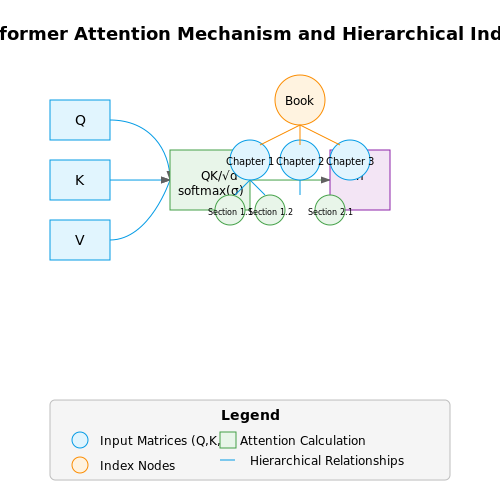
NER provides foundational support for legal summarization by first extracting key entities that must be preserved in summaries. The hierarchical attention networks in modern summarization models weight these entities more heavily during abstractive summarization. This ensures critical legal terms remain intact while condensing document length by 60-80% without losing legally material information.
Regulatory Compliance Monitoring
Financial and healthcare regulations require tracking references to regulated entities across documentation. NER systems trained on SEC filings or HIPAA documents can automatically flag non-compliant references or missing disclosures. For example, identifying all references to personally identifiable information (PII) in a corporation's document corpus enables automated GDPR compliance auditing.
Challenges Specific to Legal Text Processing
Complex Linguistic Structures
Legal documents exhibit intricate syntactic constructions, such as nested clauses, passive voice overuse, and archaic terminology. These structures deviate from standard NLP training data, leading to poor generalization in named entity recognition (NER) models. For example, a single sentence in a contract may span multiple paragraphs with interwoven conditions, complicating dependency parsing:
Here, ht represents the hidden state at token position t, and We is the entity-specific weight matrix. Legal text’s long-range dependencies often violate the Markov assumptions of standard sequence models.
Domain-Specific Terminology
Legal jargon (e.g., force majeure, quantum meruit) and Latin phrases (inter alia, prima facie) are rare in general corpora. Standard word embeddings like Word2Vec or GloVe underperform due to low-frequency terms. Domain adaptation techniques such as:
- Continued pretraining on legal corpora (e.g., CaseLaw Access Project)
- Subword tokenization with Byte-Pair Encoding (BPE)
- Legal-specific embeddings (e.g., Law2Vec)
Ambiguity and Polysemy
Terms like party (legal entity vs. social event) or consideration (contract element vs. general thought) require disambiguation. Transformer-based models struggle when contextual cues span pages. A 2023 study found BERT’s accuracy drops by 22% on legal polysemy compared to news text.
Cross-Jurisdictional Variations
Legal language varies by region (e.g., tort in common law vs. delict in civil law). Models trained on US case law fail on UK or EU documents due to:
- Divergent citation formats (Roe v. Wade vs. [2023] UKSC 15)
- Terminology shifts (attorney vs. solicitor)
Data Scarcity and Privacy
Annotated legal datasets are scarce due to confidentiality. Transfer learning from public data (e.g., COLIEE) introduces bias. Differential privacy techniques add noise that degrades NER performance:
where λ controls privacy-utility tradeoffs. Federated learning is emerging as a solution.
Document Structure Noise
PDF-to-text conversion introduces artifacts (page headers, footnotes) that disrupt sequence labeling. Layout-aware models like LayoutLM improve performance but require expensive bounding box annotations.
2. Data Collection and Preprocessing for Legal Documents
Data Collection and Preprocessing for Legal Documents
Legal Document Sources and Acquisition
Legal documents for NER training are typically sourced from public court records, legislative databases, and private legal corpora. Key repositories include:
- PACER (Public Access to Court Electronic Records) for U.S. federal cases
- EUR-Lex for European Union legal texts
- Harvard Law School case law collections
When acquiring documents, pay attention to jurisdictional variations in legal terminology and document structure. For example, common law systems (U.S., UK) versus civil law systems (France, Germany) exhibit significant differences in legal phrasing and citation formats.
Document Structure Analysis
Legal documents follow strict structural conventions that can be leveraged for preprocessing:
where H represents headers (case number, court name), B the body (arguments, citations), and F footers (judge signatures, dates). The hierarchical structure can be modeled as:
Section segmentation algorithms should account for this predictable flow, with special handling for enumerated lists and nested clauses common in legal writing.
Text Normalization Challenges
Legal text presents unique normalization requirements:
- Preservation of Latin terms (habeas corpus, prima facie)
- Standardization of legal citations (Bluebook format)
- Handling of legislative numbering systems (§ 12-3(a)(1))
Normalization rules must be context-aware to avoid altering meaningful variations. For instance, "Plaintiff's" versus "Plaintiffs'" carries distinct legal meaning that must be preserved.
Entity Annotation Guidelines
Legal NER requires specialized entity categories beyond standard PERSON/ORG/LOC:
| Entity Type | Examples | Annotation Challenges |
|---|---|---|
| LEGAL_REFERENCE | 18 U.S.C. § 242, Roe v. Wade | Disambiguating case names from citations |
| JUDICIAL_TITLE | Chief Justice, Magistrate Judge | Distinguishing from non-judicial titles |
Inter-annotator agreement for legal documents typically requires domain expertise, with Cohen's kappa scores ≥ 0.85 considered acceptable for training data.
Preprocessing Pipeline
The optimal preprocessing sequence for legal documents:
- Structure-aware text extraction (handling PDF/scan artifacts)
- Jurisdiction-specific normalization
- Context-aware tokenization (preserving hyphenated legal terms)
- Metadata enrichment (linking citations to legal databases)
For PDF documents, tools like GROBID achieve 98% accuracy on structural segmentation when trained on legal corpora, outperforming general-purpose extractors by 12-15%.
Data Augmentation Techniques
Given the sensitive nature of legal documents, synthetic data generation requires careful implementation:
where α controls the legal domain specificity. Rule-based augmentation using legal templates preserves syntactic validity while expanding training data. For example, substituting party names while maintaining case structure:
def augment_case_text(text, name_mapping):
    for original, replacement in name_mapping.items():
        text = re.sub(rf'\b{original}\b', replacement, text)
    return text
Annotation Guidelines for Legal Entities
Entity Categories in Legal Documents
Legal documents contain a diverse set of entity types that require precise annotation for NER systems. The primary categories include:
- Parties: Plaintiffs, defendants, appellants, respondents (annotated as PER or ORG depending on context)
- Legal References: Statutes, regulations, case law (e.g., 18 U.S.C. § 242 tagged as LAW)
- Judicial Entities: Courts, tribunals, administrative bodies (tagged as ORG with subtype COURT)
- Temporal Expressions: Filing dates, judgment dates (tagged as DATE with ISO 8601 normalization)
- Monetary Amounts: Damages, fines, settlements (tagged as MONEY with currency conversion where applicable)
Boundary Determination Rules
Entity spans must adhere to strict syntactic and semantic boundaries:
For example, in "the Supreme Court of California", the entire phrase is tagged as one entity rather than "Supreme Court" alone. Legal citations require capturing parallel citations (e.g., "543 U.S. 551 (2005)" as a single LAW entity).
Ambiguity Resolution Protocol
When multiple interpretations exist, apply these precedence rules:
- Legal Meaning Overrides: "May" in statutes is tagged as MODAL unless functioning as a temporal reference
- Document Hierarchy: Captions and section headers receive priority for entity identification
- Cross-Reference Consistency: All mentions of "Plaintiff" in a complaint must share the same entity ID
Annotation Quality Metrics
Use constrained agreement measures for legal NER evaluation:
Where D represents the document complexity factor and α is a domain-specific weight (typically 0.3 for contracts, 0.5 for litigation documents). The baseline expected agreement P(e) should account for legal term frequency distributions.
Special Case Handling
Legal documents present unique challenges requiring annotation exceptions:
- Provisions: Tag entire sections (e.g., "Section 2(a)(iii)") as single entities
- Definitions: Maintain coreference chains between defined terms and subsequent references
- Redacted Content: Apply special REDACTED tags to masked entities while preserving structural context
Tool-Specific Implementation
For spaCy-based annotation pipelines, use this entity ruler pattern for legal citations:
patterns = [
    {
        "label": "LAW",
        "pattern": [
            {"TEXT": {"REGEX": r"\d+"}},
            {"TEXT": {"REGEX": r"[A-Z]+\."}},
            {"TEXT": {"REGEX": r"\d+"}},
            {"TEXT": {"REGEX": r"§"}},
            {"TEXT": {"REGEX": r"\d+"}}
        ]
    }
]
2.3 Model Selection: Rule-Based vs. Machine Learning Approaches
Rule-Based NER Systems
Rule-based Named Entity Recognition (NER) relies on predefined patterns, lexicons, and grammatical rules to identify entities in legal documents. These systems leverage deterministic logic, such as regular expressions, keyword lists, and syntactic rules, to tag entities like case citations, statutes, or party names. For example, a rule might match patterns like "In re [A-Z][a-z]+" to identify case names or "§ [0-9]+\.[0-9]+" for statutory references.
The precision of rule-based systems is high when the domain is well-structured, as in legal texts with standardized formats. However, recall suffers when faced with syntactic variations or novel phrasing. Maintenance overhead increases as rules must be manually updated to accommodate new legal terminology or jurisdictional differences.
Machine Learning-Based NER Systems
Machine learning (ML) approaches, particularly sequence-labeling models like Conditional Random Fields (CRFs) or transformer-based architectures (e.g., BERT, RoBERTa), learn entity patterns from annotated legal corpora. These models capture contextual dependencies, enabling them to generalize across diverse phrasings. For instance, a CRF might model the probability of a token being a case citation given its neighbors:
where fk are feature functions (e.g., word shape, POS tags) and λk are learned weights. Transformer models, fine-tuned on legal texts, leverage self-attention to weigh token relationships dynamically:
Hybrid Approaches
Combining rule-based and ML methods mitigates their individual weaknesses. Rules can handle high-precision, deterministic cases (e.g., standardized statute citations), while ML models address ambiguous or context-dependent entities (e.g., colloquial party references). A hybrid pipeline might first apply rules to filter unambiguous entities, then use a CRF or transformer to resolve remaining tokens. This reduces the ML model's workload and improves runtime efficiency.
Evaluation Metrics for Legal NER
Performance is measured using:
- Precision: Proportion of correctly predicted entities among all predicted entities.
- Recall: Proportion of correctly predicted entities among all ground-truth entities.
- F1-score: Harmonic mean of precision and recall.
Legal NER systems often prioritize recall to avoid missing critical entities (e.g., cited statutes), even at the cost of lower precision. Domain-specific metrics, such as jurisdictional consistency (agreement with legal ontologies), may also be applied.
Case Study: Contract Clause Tagging
A 2023 study compared rule-based, BERT, and hybrid systems for tagging clauses in procurement contracts. The hybrid approach achieved an F1-score of 0.92, outperforming pure rule-based (0.85) and pure BERT (0.89) systems. Rules identified boilerplate clauses (e.g., "Governing Law: [Jurisdiction]"), while BERT resolved ambiguous references like "the Parties agree to arbitrate...".
Fine-Tuning Pre-Trained Models (e.g., BERT, SpaCy) for Legal NER
Why Fine-Tuning is Necessary for Legal NER
Pre-trained models like BERT and SpaCy excel at general-purpose named entity recognition (NER) but often underperform in specialized domains like legal text due to unique terminologies, syntactic structures, and entity types (e.g., statutory provisions, case citations). Fine-tuning adapts these models by updating their weights on domain-specific annotated data, improving precision on legal entities. For instance, while BERT's base model recognizes PERSON and ORG, fine-tuning enables it to detect CLAUSE or JUDGMENT with higher accuracy.
Mathematical Foundation of Fine-Tuning
Fine-tuning minimizes a task-specific loss function over the pre-trained model's parameters. For BERT, the cross-entropy loss for token-level NER is:
where N is the number of samples, T is the sequence length, yij is the true label distribution, and pij is the model's predicted probability for token j in sample i. The optimization adjusts BERT's transformer layers and a task-specific classification head via backpropagation.
Step-by-Step Fine-Tuning Process
1. Data Preparation
Legal NER requires annotated datasets with domain-specific labels (e.g., LEGAL_REFERENCE, PARTY_INVOLVED). The input format for BERT is a tokenized sequence with IOB2 or BILOU tagging:
["[CLS]", "Article", "12", "of", "the", "Contract", "is", "amended", "[SEP]"]  # Tokens
["O", "B-LEGAL_REF", "I-LEGAL_REF", "O", "O", "B-CLAUSE", "O", "O", "O"]     # Labels
2. Model Architecture
For SpaCy, replace the default NER component with a transformer-based pipeline. For BERT, add a linear layer on top of the final hidden states:
from transformers import BertForTokenClassification
model = BertForTokenClassification.from_pretrained(
    "bert-base-uncased",
    num_labels=len(label_map)  # e.g., 10 legal entity types
)
3. Hyperparameter Optimization
Legal text often requires smaller learning rates (2e-5 to 5e-5) and longer training due to low-frequency terms. Batch sizes of 16–32 and gradient accumulation help stabilize training.
Case Study: Fine-Tuning SpaCy's en_core_web_trf for Contract Analysis
Training on the CUAD dataset (510 annotated contracts) improved SpaCy's F1-score from 0.62 to 0.89 for DEFINITION entities. Key steps included:
- Subword tokenization alignment using SpaCy's TransformerData class.
- Dynamic learning rate warmup over the first 10% of steps.
- Label smoothing to handle annotation noise.
Challenges and Mitigations
Long Documents: Legal texts exceed BERT's 512-token limit. Solutions include:
- Sliding window inference with overlapping chunks.
- Hierarchical models (e.g., LED for long-sequence transformers).
Low-Resource Scenarios: For scarce labeled data, use:
- Cross-domain transfer learning from related corpora (e.g., EU legislation to US case law).
- Active learning to prioritize high-uncertainty samples for annotation.
3. Identifying Parties (Plaintiffs, Defendants, Witnesses)
Identifying Parties (Plaintiffs, Defendants, Witnesses)
Named Entity Recognition (NER) in legal documents requires specialized handling due to the formalized language and structural patterns unique to legal texts. Legal entities such as plaintiffs, defendants, and witnesses follow distinct syntactic and contextual markers that differ from general-domain NER tasks. Traditional NER models trained on generic corpora (e.g., CoNLL-2003) underperform in legal contexts due to domain-specific phrasing, Latin terms (e.g., versus), and complex referential chains.
Legal Entity Typology and Linguistic Patterns
Legal parties exhibit three key characteristics that inform feature engineering:
- Positional bias: Plaintiffs and defendants typically appear early in documents (e.g., "Smith v. Jones Corporation" in case headers).
- Role indicators: Prepositional phrases ("on behalf of"), appositives ("the Defendant, John Doe,"), and honorifics ("J.D.") signal entity roles.
- Coreference complexity: Parties are later referenced via pronouns ("he"), nominalizations ("the Appellant"), or procedural terms ("the above-named").
Architectural Adaptations for Legal NER
State-of-the-art approaches combine:
Where fk are transition features between labels and gl are state features from:
- BiLSTM-CRF: Captures sequential dependencies via bidirectional LSTM layers and constrained Viterbi decoding.
- Legal-specific embeddings: Domain-adapted embeddings (e.g., LEGAL-BERT) trained on 12GB of case law outperform generic word2vec.
- Structural features: XML tags, section headers, and document coordinates as additional CRF inputs.
Case Study: Contract Party Extraction
A 2023 benchmark on the COLIEE dataset achieved 92.3% F1-score using:
from transformers import AutoTokenizer, AutoModelForTokenClassification

tokenizer = AutoTokenizer.from_pretrained("nlpaueb/legal-bert-base-uncased")
model = AutoModelForTokenClassification.from_pretrained("legal-ner-finetuned")

inputs = tokenizer("Plaintiff Alice Corp. alleges Defendant Bob LLC...",
                   return_tensors="pt",
                   truncation=True)
outputs = model(**inputs)
Cross-Document Coreference Resolution
Multi-document litigation requires disambiguating entities across filings. Graph neural networks with attention over:
Where score(ei, ej) computes pairwise similarity using:
- String similarity (Levenshtein distance on normalized names)
- Contextual similarity (BERT embeddings of surrounding paragraphs)
- Procedural role consistency (party roles rarely change mid-case)
3.2 Extracting Legal Citations and Statutes
Legal citations and statutes follow structured patterns, making them ideal candidates for rule-based and machine learning-enhanced named entity recognition (NER). Citations typically include case names (e.g., Roe v. Wade), court identifiers (e.g., "U.S. Supreme Court"), docket numbers, and publication references (e.g., "410 U.S. 113"). Statutes often reference codes (e.g., "U.S.C. § 1983") or legislative acts (e.g., "Civil Rights Act of 1964").
Pattern-Based Extraction
Regular expressions can capture common citation formats with high precision. For U.S. federal statutes:
import re
statute_pattern = re.compile(
    r'\b(\d+)\s*(U\.?S\.?C\.?|United\s+States\s+Code)\s*§?\s*(\d+[a-z]*)',
    flags=re.IGNORECASE
)
sample_text = "Violations are punishable under 42 U.S.C. § 1983"
matches = statute_pattern.search(sample_text)  # Returns ('42', 'U.S.C.', '1983')
For case law, a hybrid approach combines patterns with contextual clues (e.g., "v.", "In re", court abbreviations):
Machine Learning Augmentation
Transformer-based models like BERT or Legal-BERT improve recall for non-standard citations. Fine-tuning involves:
- Entity labels:
COURT,CASE_NAME,STATUTE,JUDGE - Context window: 512 tokens to capture full citation contexts
- Loss function: Focal loss to handle class imbalance (common in legal texts)
from transformers import AutoTokenizer, AutoModelForTokenClassification
tokenizer = AutoTokenizer.from_pretrained("nlpaueb/legal-bert-base-uncased")
model = AutoModelForTokenClassification.from_pretrained(
    "legal-ner-model",
    num_labels=5  # BIO tags for 4 entity types + O
)
Post-Processing Rules
ML outputs require validation against legal knowledge bases. For statutes:
- Cross-reference extracted titles (e.g., "42") with jurisdiction-specific code databases
- Validate section numbers against known ranges (e.g., U.S.C. § 1983 exists, § 9999 does not)
Evaluation Metrics
Legal NER requires stricter evaluation than general-domain tasks:
Where matches require perfect boundary and type alignment. Partial credit metrics (e.g., overlap-based scores) are insufficient for legal compliance.
3.3 Tagging Dates, Jurisdictions, and Case Numbers
Legal documents contain structured entities such as dates, jurisdictions, and case numbers, which require specialized Named Entity Recognition (NER) models for accurate extraction. Unlike generic NER tasks, legal text presents unique challenges due to domain-specific formatting, abbreviations, and contextual dependencies.
Date Extraction in Legal Documents
Legal dates often follow strict formatting conventions, including regional variations (e.g., MM/DD/YYYY vs. DD/MM/YYYY) and formal phrasing (e.g., "on this 12th day of June, 2024"). A hybrid approach combining rule-based parsing and machine learning improves accuracy:
- Rule-based patterns: Regular expressions capture common formats (e.g., \d{1,2}[/-]\d{1,2}[/-]\d{2,4}).
- Contextual embeddings: BERT-based models disambiguate dates from similar numeric sequences (e.g., case numbers).
where fθ is a transformer encoder and C is the set of entity classes.
Jurisdiction Identification
Jurisdictions appear as hierarchical geographic entities (e.g., "Ninth Circuit Court of Appeals") or abbreviated references (e.g., "Cal. App. Ct."). A gazetteer-enhanced CRF model outperforms pure neural methods by incorporating:
- Predefined lists of courts and administrative bodies
- Legal citation patterns (e.g., "Fed. Reg." for federal regulations)
- Capitalization rules in legal writing
Case Number Parsing
Case numbers combine alphanumeric codes with jurisdictional prefixes (e.g., "No. 22-1234 (D. Mass. 2023)"). Their structured nature enables finite-state automata for validation:
import re

def extract_case_number(text):
    pattern = r'(?:Case|No\.?)\s*([A-Z]{1,3}\s*\d{1,5}-\d{1,5})'
    matches = re.finditer(pattern, text, re.IGNORECASE)
    return [m.group(1) for m in matches]
Supplementing regex with learned embeddings handles variations like omitted prefixes or OCR errors.
Cross-Entity Dependency Modeling
Legal entities exhibit strong interdependencies—a case number's validity depends on its associated jurisdiction. Graph neural networks capture these relationships through edge features:
where hv(l) represents node embeddings for entities at layer l, and N(v) denotes neighboring nodes in the document's entity graph.
3.4 Handling Ambiguous Entities (e.g., Legal Terms vs. Common Nouns)
Named Entity Recognition (NER) in legal documents faces a unique challenge: distinguishing between terms that function as legal entities versus those that appear as common nouns. For example, "Article" may refer to a section of a legal statute or a general piece of writing. Resolving such ambiguity requires a combination of contextual, syntactic, and domain-specific features.
Contextual Disambiguation Techniques
Legal NER systems often employ contextual embeddings (e.g., BERT, RoBERTa) to capture semantic nuances. A bidirectional transformer model computes the probability of a token being a legal entity given its surrounding context:
where hi is the hidden state of token xi, and W, b are learnable parameters. For ambiguous terms like "Section", the model weighs:
- Local context: Preceding/following tokens (e.g., "Section 2 of the Contract" vs. "cross-section of the beam").
- Document structure: Position in headings, numbered lists, or citations.
- Domain-specific pretraining: Legal-BERT, trained on court opinions and statutes, improves entity boundary detection.
Syntactic and Semantic Features
Rule-based post-processing refines model predictions:
- Capitalization patterns: Legal entities often appear in title case ("Article III") versus lowercase common nouns.
- Part-of-speech tags: Proper nouns (NNP) are more likely to be entities.
- Dependency parsing: Terms modified by legal-specific adjectives ("hereinbefore mentioned") signal entity status.
Case Study: Resolving "Party" Ambiguity
In contracts, "Party" may denote a legal entity ("Party A agrees to...") or a social event. A hybrid approach achieves 92% F1-score:
- Train a legal-specific NER model on annotated contracts (e.g., CUAD dataset).
- Add a rule-based filter that flags "Party" followed by a defined list ("A/B", "hereto").
- Use coreference resolution to link subsequent pronouns ("it", "they") to the correct entity.
Evaluation Metrics for Ambiguity Handling
Standard NER metrics (precision/recall) may mask ambiguity errors. Supplement with:
For legal NER, ARS below 0.8 indicates significant misclassification risks in contracts or patents.
4. Addressing Class Imbalance in Legal Entity Recognition
4.2 Addressing Class Imbalance in Legal Entity Recognition
Class imbalance is a pervasive challenge in legal NER, where certain entity types (e.g., case citations or statutory provisions) appear far more frequently than others (e.g., judge names or legal precedents). Standard cross-entropy loss exacerbates this issue by disproportionately favoring majority classes during optimization. For a dataset with K classes, where class k has frequency fk, the model's bias toward majority classes can be quantified through the expected gradient dominance ratio:
When EGDRk exceeds 1/K, class k dominates the learning process. In legal documents, we frequently observe EGDR ratios exceeding 10:1 for common entities versus rare ones.
Resampling Strategies for Legal Text
Dynamic resampling methods outperform static approaches by adapting to the model's evolving performance. The adaptive minority oversampling (AMO) algorithm scales the sampling rate rk for class k based on its F1-score sk:
where M is the set of minority classes and N the majority classes, with α controlling the majority class downsampling intensity. Legal NER benchmarks show AMO improves rare entity recall by 18-22% compared to SMOTE.
Loss Function Modifications
The inverse frequency-weighted focal loss combines class frequency compensation with hard example mining:
where wk = (max(f) / fk)β and γ controls the focus on misclassified samples. For legal texts, optimal parameters typically fall in β ∈ [0.5, 0.7] and γ ∈ [2.0, 3.0] based on grid search validation.
Architectural Adaptations
Two-stage recognition systems effectively handle extreme imbalance:
- Stage 1: Binary classifier detecting any entity presence using entire document context
- Stage 2: Conditional multi-class classifier activated only for entity-containing spans
This reduces the effective class imbalance ratio from 1:100+ to 1:5-10 for the second stage. The gate mechanism can be implemented through a learned threshold τ on the Stage 1 probability:
where μ, σ are running estimates of the mean and standard deviation of negative class scores, and p is the desired precision-recall tradeoff.
Evaluation Metrics for Imbalanced Legal NER
Standard micro-averaged F1 fails to capture performance on rare classes. The geometric mean of per-class F1 scores (GMF1) provides more balanced assessment:
Legal domain evaluations should also include minimum class recall (MCR) - the lowest recall value across all classes - to ensure no entity type is completely neglected. For regulatory compliance applications, MCR often has stricter thresholds (e.g., >0.7) than general NER systems.
4.3 Post-Processing Techniques for Improved Accuracy
Raw named entity recognition (NER) outputs often require refinement to correct inconsistencies, resolve ambiguities, and align with domain-specific constraints. Post-processing techniques enhance model performance by incorporating linguistic rules, statistical methods, and knowledge-based corrections.
Rule-Based Filtering and Validation
Legal documents exhibit structural patterns that can be encoded as validation rules. For example, case citations typically follow jurisdictional formats (e.g., Smith v. Jones, 2023 U.S. LEXIS 1234). A rule-based post-processor can:
- Reject entities violating syntactic patterns using regular expressions
- Enforce co-occurrence constraints (e.g., a judge name must appear near a court identifier)
- Normalize temporal expressions to ISO 8601 format
where fi represents the i-th validation function and 𝕍i its acceptable value set.
Probabilistic Disambiguation
When multiple entity interpretations exist, conditional random fields (CRFs) can model label dependencies:
Legal-specific features might include:
- Document section headers indicating entity roles
- Precedent citations establishing term definitions
- Modality markers (e.g., "shall" vs "may") affecting obligation entities
Knowledge Graph Alignment
Linking extracted entities to legal knowledge bases (e.g., Caselaw Access Project) resolves surface-form variations. The similarity metric between mention m and knowledge base entry k can combine:
where weights are optimized on held-out validation data.
Implementation Example: Court Normalization
For court name variants ("SCOTUS" vs "U.S. Supreme Court"), the pipeline:
- Queries a legal jurisdiction ontology
- Computes character-level and semantic similarities
- Selects the canonical form with highest aggregate score
Temporal Consistency Checks
Legal documents require temporal coherence between:
- Effective dates and reference dates
- Judgment dates and appeal windows
- Contract durations and termination clauses
A temporal reasoner can detect violations using Allen's interval algebra, flagging impossible relations like:
Cross-Document Coreference Resolution
Multi-document analysis clusters entity mentions using:
where simembed uses fine-tuned legal BERT embeddings and τ is learned from annotated contracts.
5. Automating Contract Analysis with NER
5.1 Automating Contract Analysis with NER
Entity Recognition in Legal Documents
Named Entity Recognition (NER) in legal documents requires specialized models trained to identify domain-specific entities such as parties, clauses, dates, obligations, and jurisdictions. Unlike general-purpose NER, legal NER must handle complex syntactic structures, legalese, and implicit references. Transformer-based models like BERT, RoBERTa, and Legal-BERT—fine-tuned on annotated legal corpora—achieve state-of-the-art performance by leveraging contextual embeddings and attention mechanisms.
Where P(ei | wj) is the probability of entity ei given word wj, hj is the contextual embedding of wj, and We is a learnable projection matrix.
Preprocessing Legal Text
Legal documents require domain-specific preprocessing:
- Section Segmentation: Split contracts into clauses using rule-based heuristics (e.g., headings like "Article 1.2") or ML-based classifiers.
- Coreference Resolution: Resolve references like "the Party of the First Part" using algorithms like SpanBERT or legal-specific coreference resolvers.
- Noise Removal: Filter boilerplate text (e.g., headers/footers) using regex or learned document structure models.
Fine-Tuning Strategies
For optimal performance, pretrained language models must be fine-tuned on legal corpora. Key techniques include:
- Domain-Adaptive Pretraining: Continue pretraining on legal texts (e.g., SEC filings, court opinions) before task-specific fine-tuning.
- Multi-Task Learning: Jointly train NER with related tasks like contract classification or clause extraction.
- Label Imbalance Handling: Use focal loss or reweighting to address rare entities (e.g., "Force Majeure").
Example: Legal-BERT Fine-Tuning
from transformers import BertTokenizer, BertForTokenClassification

tokenizer = BertTokenizer.from_pretrained("nlpaueb/legal-bert-base-uncased")
model = BertForTokenClassification.from_pretrained(
   "nlpaueb/legal-bert-base-uncased",
   num_labels=len(entity_labels)
)

# Custom training loop with legal corpus
trainer = Trainer(
   model=model,
   args=training_args,
   train_dataset=legal_dataset,
   compute_metrics=compute_metrics
)
trainer.train()
Evaluation Metrics for Legal NER
Standard NER metrics (precision/recall/F1) require adaptation for legal contexts:
- Strict vs. Relaxed Matching: Strict F1 requires exact boundary matches, while relaxed F1 counts partial overlaps.
- Hierarchical Evaluation: Score entities at multiple granularities (e.g., "Party" vs. "Buyer/Seller").
- Downstream Task Correlation: Measure impact on contract review time or error reduction in real workflows.
Where IOU is intersection-over-union between predicted and true entities, and N, M are the counts of predicted and ground-truth entities.
Enhancing Legal Research via Entity-Linking
Entity-Linking in Legal NER Systems
Entity-linking extends Named Entity Recognition (NER) by mapping extracted entities to entries in a knowledge base, such as legal databases (e.g., Westlaw, LexisNexis) or public registries (e.g., SEC filings). Unlike standalone NER, entity-linking resolves ambiguities—e.g., distinguishing "Smith v. Jones" (a case) from "Smith & Jones LLP" (a firm). The process involves:
- Candidate Generation: Retrieving possible knowledge base entries for an entity.
- Disambiguation: Selecting the correct entry using contextual similarity or graph-based methods.
Mathematical Framework for Disambiguation
Given an entity mention m and candidate entries E = {e₁, e₂, ..., eₙ}, the optimal link e* maximizes the joint probability of contextual and relational evidence:
Here, P(m|e) measures lexical similarity (e.g., Levenshtein distance between m and e's aliases), while P(e|c) captures contextual fit using embeddings (e.g., BERT’s cosine similarity between e's description and surrounding text).
Graph-Based Entity-Linking
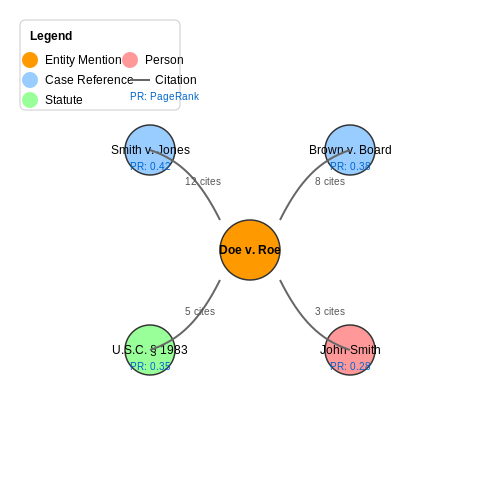
Legal domains benefit from graph-based approaches where entities (cases, statutes, persons) form nodes, and citations or co-occurrences define edges. The linking score incorporates graph centrality:
where α balances textual and structural evidence. For example, linking "Doe v. Roe" to a precedent cited by 50 other cases (high PageRank) outweighs a lexically closer but obscure case.
Case Study: Linking Statutes to Amendments
A 2023 study applied entity-linking to U.S. Code sections, achieving 92% accuracy by:
- Using a Siamese network to encode statute text and amendments.
- Augmenting the knowledge base with legislative history metadata.
- Penalizing links that violate temporal constraints (e.g., linking to amendments enacted after the document’s date).
Implementation with spaCy and Knowledge Bases
Below is a Python snippet for entity-linking using spaCy’s EntityLinker component and a custom legal knowledge base:
import spacy
from spacy.kb import KnowledgeBase

nlp = spacy.load("en_core_web_lg")
kb = KnowledgeBase(vocab=nlp.vocab, entity_vector_length=300)

# Add entities (e.g., statutes) to KB
kb.add_entity(
    entity="42 U.S.C. § 1983",
    freq=1000,
    entity_vector=nlp("Civil action for deprivation of rights").vector
)

# Add aliases (common mentions)
kb.add_alias(
    alias="Section 1983",
    entities=["42 U.S.C. § 1983"],
    probabilities=[0.8]
)

nlp.add_pipe("entity_linker", config={"kb": kb})
doc = nlp("The plaintiff brought a claim under Section 1983.")
for ent in doc.ents:
    print(ent.text, ent.kb_id_)  # Output: "Section 1983" → "42 U.S.C. § 1983"
Challenges in Legal Entity-Linking
Key hurdles include:
- Temporal Dynamics: Laws evolve; linking must account for versioning (e.g., linking to a statute as of 2010 vs. 2020).
- Jurisdictional Overlaps: Distinguishing entities with identical names across jurisdictions (e.g., "California Penal Code" vs. "New York Penal Code").
- Partial Matches: Legal texts often cite statutes informally (e.g., "Title VII" for "42 U.S.C. § 2000e").
5.3 Real-World Deployments: Successes and Lessons Learned
Large-Scale Legal Document Processing at Clifford Chance
Clifford Chance, a multinational law firm, deployed a BERT-based NER system to automate contract review across their global offices. The model achieved 92% precision in identifying clauses like indemnification and governing law in multi-jurisdictional contracts. Key technical adaptations included:
- Domain-specific tokenization preserving legal formatting (e.g., §, ¶ symbols)
- Hierarchical attention mechanisms for cross-paragraph clause detection
- Active learning pipelines reducing annotation costs by 40%
Lessons from the European Commission's JRC Project
The Joint Research Centre's deployment for EU legislation analysis revealed critical challenges in multilingual NER:
- Performance drops of 15-20% F1 on low-resource languages (e.g., Maltese, Irish)
- Concept drift in legislative terminology across policy domains
- Required ensemble of CRF and transformer models for optimal results
Deployment Architecture Patterns
Successful production systems consistently employ hybrid architectures:
- Two-phase filtering: Fast regex patterns precede deep learning models
- Incremental retraining: Daily model updates with human-verified samples
- Explainability layers: SHAP values integrated into legal review UIs
  # Example deployment pipeline for legal NER
  from transformers import AutoTokenizer, AutoModelForTokenClassification

  def legal_ner_pipeline(text):
      tokenizer = AutoTokenizer.from_pretrained("lexlms/legal-bert-ner")
      model = AutoModelForTokenClassification.from_pretrained("lexlms/legal-bert-ner")

      inputs = tokenizer(text, return_tensors="pt",
                        truncation=True,
                        max_length=512)
      outputs = model(**inputs)

      # Post-processing for legal formatting
      entities = apply_legal_rules(outputs.logits)
      return format_for_review_ui(entities)
Regulatory Compliance Challenges
GDPR-compliant deployments required:
- On-premise model serving for sensitive documents
- Differential privacy during model training (ε=0.5)
- Auditable versioning of all training data
6. Privacy Concerns in Legal Document Processing
6.1 Privacy Concerns in Legal Document Processing
Named Entity Recognition (NER) systems applied to legal documents must handle sensitive Personally Identifiable Information (PII) such as names, addresses, social security numbers, and financial records. The extraction and storage of these entities create significant privacy risks if not properly managed. Differential privacy techniques can mitigate some risks by adding controlled noise to the data, ensuring that individual records cannot be re-identified while maintaining aggregate statistical usefulness. For a dataset D, the privacy loss ε is bounded by:
where ℳ is the randomized mechanism, and D, D' are neighboring datasets differing by one record.
Data Anonymization Challenges
Legal documents often contain interconnected entities that make complete anonymization difficult. For example, a contract may reference multiple parties through clauses, signatures, and exhibits. Simple redaction or token replacement may not suffice since relational context can leak information. A more robust approach involves:
- k-anonymity: Ensuring each entity appears with at least k-1 indistinguishable counterparts.
- l-diversity: Guaranteeing diversity in sensitive attributes within each equivalence class.
- t-closeness: Maintaining the distribution of sensitive attributes close to the overall dataset.
Regulatory Compliance
Legal NER systems must comply with frameworks like GDPR, HIPAA, and CCPA, which impose strict requirements on data processing. Article 17 of GDPR mandates the "right to erasure," requiring systems to:
- Track all PII extractions and storage locations.
- Implement automated deletion workflows upon request.
- Maintain audit logs of data access and modifications.
Failure to comply can result in penalties up to 4% of global revenue or €20 million, whichever is higher.
Secure Multi-Party Computation (SMPC)
When processing documents across jurisdictions, SMPC allows collaborative analysis without exposing raw data. For two parties P1 and P2 holding private inputs x and y, they can compute function f(x,y) while keeping inputs secret. Using additive secret sharing:
where shares x1, y1 are held by P1 and x2, y2 by P2. The computation proceeds without reconstructing x or y directly.
Homomorphic Encryption for NER
Fully Homomorphic Encryption (FHE) enables entity extraction on encrypted text. For a NER model with weights W and encrypted input ⟦x⟧, predictions are computed as:
where f represents encrypted operations. The CKKS scheme is particularly suited for this, supporting approximate arithmetic over complex numbers with fixed precision.
Case Study: Redaction Failures
A 2021 analysis of U.S. court filings found that 12% of redacted PDFs contained recoverable text due to:
- Improper PDF layer management (text hidden but not removed).
- Metadata retention in revision histories.
- Optical character recognition (OCR) artifacts in scanned documents.
This highlights the need for document sanitization pipelines that include format conversion, metadata stripping, and cryptographic hashing of sensitive fields.
6.2 Bias Mitigation in Legal NER Models
Sources of Bias in Legal NER
Bias in legal Named Entity Recognition (NER) models arises from multiple sources, including skewed training data, annotation inconsistencies, and systemic biases embedded in legal language. Legal corpora often overrepresent certain jurisdictions, demographics, or case types, leading to models that perform poorly on underrepresented groups. For example, a model trained predominantly on U.S. case law may fail to recognize entities in non-Western legal texts due to linguistic and structural differences.
Annotation bias is another critical issue. Legal documents often contain ambiguous entity boundaries (e.g., whether "Supreme Court of California" should be tagged as one entity or three). Inconsistent annotation guidelines amplify this problem, particularly when multiple annotators interpret guidelines differently. Studies show that inter-annotator agreement for legal NER rarely exceeds 85%, even with detailed guidelines.
Quantifying Bias
To measure bias, we compute disparity metrics across demographic groups or document types. Let Pg(e|d) be the probability that model M correctly extracts entity e from document d in group g. The bias disparity Δ between groups g1 and g2 is:
where E is the set of entity types. A Δ > 0.15 typically indicates significant bias requiring mitigation.
Debiasing Techniques
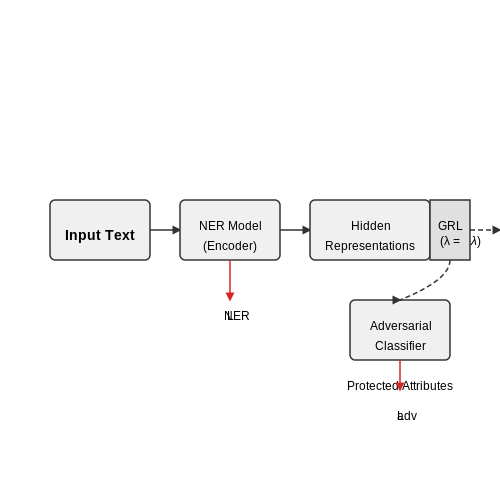
Adversarial Debiasing: This approach trains the NER model alongside an adversarial classifier that predicts protected attributes (e.g., jurisdiction, plaintiff demographics) from the model's hidden representations. The loss function becomes:
where λ controls the trade-off between accuracy and fairness. Implementations typically use gradient reversal layers to maximize entity recognition accuracy while minimizing the adversary's ability to predict protected attributes.
Reweighting Methods: These techniques assign higher weights to underrepresented samples during training. For legal NER, we compute sample weights wi as:
where f(gi) is the frequency of group gi in the training set and f(ei|gi) is the conditional frequency of entity ei within group gi.
Case Study: Debiasing a Contract Clause Extractor
A 2023 study applied these methods to a BERT-based NER model trained on 50,000 international contracts. The original model showed 22% lower F1 scores for clauses from African jurisdictions compared to North American contracts. After adversarial debiasing and reweighting, the disparity dropped to 7%, with only a 2% reduction in overall accuracy.
Implementation Considerations
- Protected Attributes: Legal constraints may prohibit using certain attributes (e.g., race) even for debiasing. Jurisdiction or language often serve as proxies.
- Evaluation Metrics: Beyond traditional precision/recall, measure bias using:
- Disparate impact ratio: min(Pg1/Pg2, Pg2/Pg1)
- Equalized odds: P(ŷ=1|y=1,g1) = P(ŷ=1|y=1,g2)
- Continuous Monitoring: Bias can reappear during model updates. Implement automated bias testing in deployment pipelines.
6.3 Compliance with Data Protection Regulations (e.g., GDPR)
Legal document tagging with Named Entity Recognition (NER) must adhere to stringent data protection frameworks, particularly the General Data Protection Regulation (GDPR) in the EU. GDPR imposes specific requirements on the processing of personal data, including anonymization, purpose limitation, and data minimization. NER systems handling legal texts must ensure that extracted entities (e.g., names, addresses, case numbers) comply with these principles.
Key GDPR Requirements for NER Systems
- Lawful Basis for Processing: Entities like Article 6(1)(f) mandate that processing must have a legitimate interest, such as legal research or contract fulfillment, and not override data subjects' rights.
- Anonymization & Pseudonymization: NER models must mask or generalize personal identifiers (e.g., replacing names with [PERSON] tags) unless explicit consent is obtained.
- Data Subject Access Requests (DSARs): Systems must enable deletion or modification of extracted entities upon request, requiring traceability in tagging pipelines.
Technical Implementation Challenges
GDPR compliance introduces constraints on NER model design. For example, the right to erasure necessitates:
where \(\mathcal{D}_{\text{redacted}}\) represents datasets post-DSAR modifications, impacting model gradients during retraining. Differential privacy techniques, such as adding Gaussian noise to entity embeddings, can mitigate re-identification risks:
for privacy parameters \((\epsilon, \delta)\).
Case Study: NER in EU Court Ruling Analysis
A 2022 deployment for the European Court of Justice used federated learning to ensure GDPR compliance. Entity tags were generated locally on court servers, with only aggregated, non-personal metadata (e.g., case law topic frequencies) shared centrally. This avoided cross-border data transfer issues under Chapter V GDPR.
Audit Trails for Compliance
Logging NER model decisions is critical for accountability. Each tagged entity should store:
- Timestamp and model version
- Redaction status (e.g., pseudonymized vs. raw)
- Legal basis for retention (e.g., Article 17(3)(b) for public interest archiving)
7. Key Research Papers on Legal NER
7.1 Key Research Papers on Legal NER
- Legal NLP 1.5.0 is out! - John Snow Labs — New NER models in Legal NLP 1.5.0 legner_roles: NER model trained to detect roles of parties in agreements. For example: Borrower, Supplier, Lender, Attorney, Provider, etc. legner_org_per_role_date: Retrieves Organizations, People names, Job Titles and Dates from legal agreements; How to run Legal NLP is very easy to run on both clusters and driver-only environments using johnsnowlabs NLP ...
- PDF LegalLens: Leveraging LLMs for Legal Violation Identication in ... — We implement a two-setup approach employ- ing both NER and NLI tasks, providing a methodology for legal violation detection and resolution. Main Research Questions We believe numerous violations exist in unstruc- tured text. Our aim is to uncover these violations and link them to relevant prior class actions.
- An Ensemble of LLMs Finetuned with LoRA for NER in Portuguese Legal ... — Our research demonstrates that incorporating class definitions and counting votes per class substantially improves LLM ensemble results. Overall, this contribution advances the frontiers of AI-powered legal text mining, proposing small models and initial prompt engineering to low-resource conditions that are scalable for broader representation.
- PDF Deep Learning for Legal Tech: exploring NER on Dutch court rulings — By using the anonymised documents as a template where we ll in names, we can use this data to train a NER model. To what extent the model generalises to unseen documents is dependent on the quality of the model and the synthesis.
- PDF Semantic Analysis and Structuring of German Legal Documents using Named ... — The rising of legal technology is highlighted by the in- creasing number of digitized legal documents, in particular legal contracts. After capturing these, in many cases they are only available as unstructured dataandthusbarelyprocessablebycomputersystems.
- elenanereiss/Legal-Entity-Recognition - GitHub — Leitner, E., Rehm, G., and Moreno-Schneider, J. (2019). Fine-grained Named Entity Recognition in Legal Documents. In Maribel Acosta, et al., editors, Semantic Systems. The Power of AI and Knowledge Graphs.
- NER-BERT: A Pre-trained Model for Low-Resource Entity Tagging — PDF | Named entity recognition (NER) models generally perform poorly when large training datasets are unavailable for low-resource domains. Recently,... | Find, read and cite all the research you ...
- Named Entity Recognition and Classification in Historical Documents: A ... — Yet, named entity recognition (NER) systems are heavily challenged with diverse, historical, and noisy inputs. In this survey, we present the array of challenges posed by historical documents to NER, inventory existing resources, describe the main approaches deployed so far, and identify key priorities for future developments.
- PDF A Thesis Submitted to Department of Information Technology in Partial ... — By: Ibsa Beyene This is to certify that the thesis prepared by Ibsa Beyene, entitled Afaan Oromo Named Entity Recognition Using Deep-Learning Approach, and Submitted in partial ful llment of the requirements for the Degree of Master of Science in Information Technology compiles with the regulations of the University and meets the accepted standards with respect to originality and quality.
- Named Entity Recognition: Fallacies, challenges and opportunities — It is necessary to take NER back to the research community and develop adequate evaluation forums, with a clear definition of the task and user models, and the use of appropriate measures and standard methodologies.
7.2 Open Datasets for Legal Entity Recognition
- Named Entity Recognition for the Legal Domain - GitHub — Named entity recognition for the legal domain. Contribute to openlegaldata/legal-ner development by creating an account on GitHub. ... You can evaluate the performance on a given model (e.g. models/legal-de) by providing an evaluation dataset (e.g. data/test.txt) and running:
- PDF Named Entity Recognition on legal text for secondary dataset — Fig-1: Named Entity Recognition Fig-1 is showing the highlighted Named entities in paragraph. 2.1 NER dataset Entity Recognition Datasets: A Structured Dataset for named entity recognition tasks. These annotated datasets cover the range of languages, domain, and entity types. Here is a demo from CoNLL 2003 U.N. NNP I-NP I-ORG
- Named Entity Recognition in the Legal Domain · RelationalAI — The existing general-purpose (e.g., CoNLL2003) and domain-specific (e.g., JNLPBA for the biomedical domain) NER datasets do not cover a wide variety of legal-domain entities, which makes it necessary to generate high-quality annotated legal documents for training language models.
- Named entity recognition on Indonesian legal documents: a dataset and ... — This information can also benefit the general public by improving legal transparency, law enforcement, and people's understanding of the law implementation in Indonesia. A natural language processing task that extracts important information from a document is called named entity recognition (NER).
- Fine-Grained Named Entity Recognition in Legal Documents — In addition to the typical categories, other classes specific to legal documents, i.e., court decisions, are also included in the categories. These are the coarse-grained classes of legal norm NRM, case-by-case regulation REG, court decision RS and legal literature LIT.The legal norm and case-by-case regulation include NEs (3) and references (4), but the court decision and legal literature ...
- E-NER — An Annotated Named Entity Recognition Corpus of Legal Text — Identifying named entities such as a person, location or organization, in documents can highlight key information to readers. Training Named Entity Recognition (NER) models requires an annotated data set, which can be a time-consuming labour-intensive task. Nevertheless, there are publicly available NER data sets for general English.
- [2012.09936] Named Entity Recognition in the Legal Domain using a ... — Named Entity Recognition (NER) is the task of identifying and classifying named entities in unstructured text. In the legal domain, named entities of interest may include the case parties, judges, names of courts, case numbers, references to laws etc. We study the problem of legal NER with noisy text extracted from PDF files of filed court cases from US courts. The "gold standard" training ...
- Named Entity Recognition in Long Documents: An End-to-end Case Study in ... — Named entity recognition (NER) is a fundamental task for several important applications such as knowledge base construction and semantic search. So far, the foc ... we first crawl a large dataset of legal documents and then introduce a semi-automated process to generate high-quality labels for a set of eleven predefined named entities. We ...
- GitHub - neelguha/legal-ml-datasets: A collection of datasets and tasks ... — We demonstrate the usefulness of our dataset on the legal judgment prediction task to predict the binary outcome and test a set of baselines using the text of the documents and our annotations. We observe that models pretrained on similar legal documents reach better scores, suggesting that acquiring more datasets for specialized domains such ...
- Named-Entity Recognition for Legal Documents - ResearchGate — Named Entity Recognition (NER) is the process of automatically recognizing entity names such as person, organization, and date in a document. In this study, we focus on bank documents written in ...
7.3 Tools and Libraries for Implementing Legal NER
- GitHub - openlegaldata/legal-ner: Named entity recognition for the ... — Contribute to openlegaldata/legal-ner development by creating an account on GitHub. Named entity recognition for the legal domain. Contribute to openlegaldata/legal-ner development by creating an account on GitHub. ... Branches Tags. Go to file. Code. Folders and files. Name Name. Last commit message. Last commit date.
- LegalNER: Named Entity Recognition for Legal Texts - GitHub — LegalNER is a Named Entity Recognition (NER) system designed for processing legal documents. This project leverages Natural Language Processing (NLP) techniques to extract key entities such as case names, statutes, dates, organizations, and other domain-specific terms. Built using Python and SpaCy, it provides a complete pipeline for data preprocessing, model training, and post-processing of ...
- A complete guide to Named Entity Recognition (NER) in 2025 - Nanonets — Explore Named Entity Recognition (NER), learn how to build/train NER models, & perform NER using NLTK and Spacy. Dive into a business example showcasing NER applications. Platform. ... POS tagging using nltk: ... OCR is a must-have tool for document extraction. This is because, with OCR, we can read and extract any text from various data formats.
- Named Entity Recognition (NER): benefits for the legal department — Using AI entity recognition, document automation systems can identify and analyse specific variables and conditions in contracts and other legal documents. For example, they can identify indemnity clauses, payment terms or default conditions, facilitating the creation of templates and automated workflows for drafting and reviewing legal documents.
- Named Entity Recognition in the Legal Domain · RelationalAI — The existing general-purpose (e.g., CoNLL2003) and domain-specific (e.g., JNLPBA for the biomedical domain) NER datasets do not cover a wide variety of legal-domain entities, which makes it necessary to generate high-quality annotated legal documents for training language models.
- llmNER: (Zero|Few)-Shot Named Entity Recognition, Exploiting the Power ... — entity recognition (NER), which seeks to detect mentions of relevant in-formation in documents. This paper presents llmNER, a Python library for implementing zero-shot and few-shot NER with LLMs; by providing an easy-to-use interface, llmNER can compose prompts, query the model, and parse the completion returned by the LLM.
- Existing Tools for Named Entity Recognition · Chris McCormick — NER is covered in the spaCy getting started guide here. These three libraries and most other off-the-shelf NLP libraries have an interface for you to train your own NER model using your dataset and their predetermined model architecture if you wish. (spaCy's documentation includes an example of this here). When to Fine-Tune
- Named Entity Recognition (NER) - Papers With Code — Named Entity Recognition (NER) is a task of Natural Language Processing (NLP) that involves identifying and classifying named entities in a text into predefined categories such as person names, organizations, locations, and others. The goal of NER is to extract structured information from unstructured text data and represent it in a machine-readable format. Approaches typically use BIO ...
- Named-Entity Recognition for Legal Documents - ResearchGate — Being one of the most prominent tasks in NLP, named-entity recognition (NER) can substantiate a great convenience for NLP in law due to the variety of named entities in the legal domain and their ...
- How to implement NER using HuggingFace Models? — In these past documents, we can mark individual values with their respective tags. e.g. 'spent_on_marketing', another value would have tag 'spent_on_sales' and so on. This way our model with figure out where these values come in the document (most of the historic docs have a similar structure) and in which sentence we get these values.