Smart Farming Robots with AI Vision
1. The Role of AI in Modern Agriculture
The Role of AI in Modern Agriculture
Modern agriculture faces unprecedented challenges, including climate variability, labor shortages, and the need for sustainable intensification. AI-driven vision systems in smart farming robots address these challenges through real-time perception, decision-making, and precision automation. At the core of these systems are convolutional neural networks (CNNs) and transformer architectures that process multispectral, hyperspectral, and RGB imagery with sub-centimeter spatial resolution.
Computer Vision for Crop Phenotyping
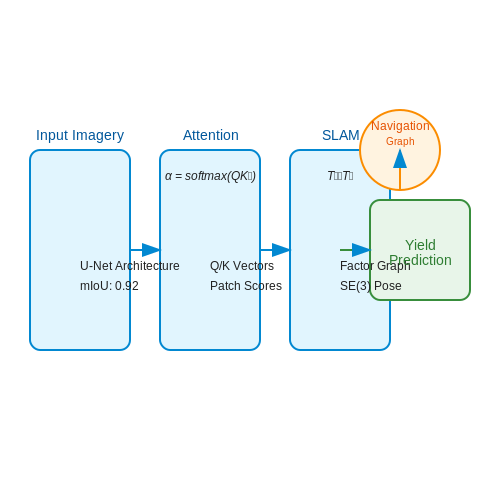
High-throughput phenotyping relies on semantic segmentation models like U-Net or Mask R-CNN to quantify biotic/abiotic stress indicators at leaf-level granularity. For a given input image I with dimensions H×W×C, the model outputs a pixel-wise classification map Ŷ through a series of encoder-decoder operations:
where Wi represents learnable convolution kernels and * denotes the convolution operator. State-of-the-art implementations achieve mean intersection-over-union (mIoU) scores exceeding 0.92 on the Leaf Segmentation Challenge dataset through attention mechanisms and residual connections.
Robotic Navigation and Manipulation
Autonomous navigation in unstructured farm environments requires simultaneous localization and mapping (SLAM) with LiDAR-inertial odometry. The robot's pose xt at time t evolves according to:
where ⊕ denotes the SE(3) composition operator, R is the rotation matrix, and v, a are velocity/acceleration measurements from IMU sensors. Modern implementations fuse this with visual-inertial odometry using factor graph optimization:
where ri are residual terms from sensor measurements zi with covariance Σi.
Yield Prediction and Optimization
Multi-temporal satellite imagery feeds into transformer-based architectures for yield forecasting. The attention mechanism computes relevance scores between image patches:
where q, k are learned query/key vectors of dimension d. This enables the model to capture long-range dependencies between weather patterns, soil conditions, and historical yield data across entire fields.
Edge Deployment Challenges
Deploying these models on agricultural robots requires quantization-aware training and hardware-aware neural architecture search. The tradeoff between model accuracy A and latency L follows a Pareto frontier described by:
where β, γ are device-specific constants. Recent field tests show that hybrid architectures combining CNNs for low-level features and attention for global context achieve 98% of baseline accuracy with 5× faster inference on NVIDIA Jetson AGX Orin platforms.
Key Components of Smart Farming Robots
Vision Systems and Sensor Fusion
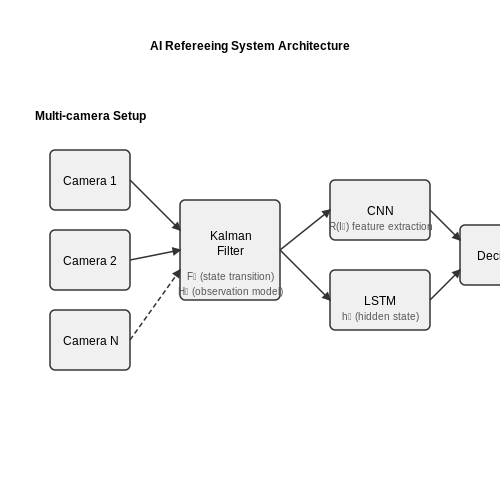
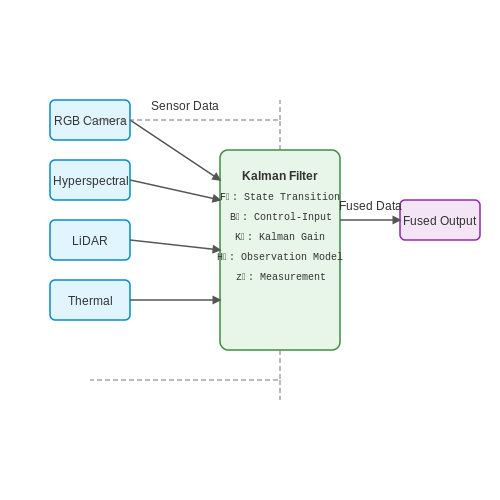
Smart farming robots rely on multi-modal sensor arrays to perceive their environment with high fidelity. The core vision system typically integrates RGB cameras, hyperspectral imaging, LiDAR, and thermal sensors. Sensor fusion algorithms, such as Kalman filters or particle filters, combine these data streams to construct a robust environmental representation. For instance, a Kalman filter recursively estimates the state xk of a crop row by fusing LiDAR depth measurements with visual odometry:
where Fk is the state transition model, Bk the control-input model, Kk the Kalman gain, and Hk the observation model. Hyperspectral cameras capture reflectance at hundreds of narrow bands, enabling pixel-wise nutrient deficiency detection through spectral angle mapping (SAM):
where ri and si represent reference and observed spectral signatures.
Robotic Actuation and Control
Precision actuation systems translate perception into physical action. Delta robots with parallel kinematics achieve sub-millimeter positioning accuracy for delicate operations like fruit picking, governed by inverse kinematics:
where θi are joint angles. For weed removal, Cartesian robots employ force-controlled end-effectors that modulate pressure based on root structure classification from convolutional neural networks (CNNs). The control loop implements impedance control:
with stiffness Kp, damping Kd, and desired acceleration ẍd.
Edge AI Processing
Real-time decision-making requires optimized neural networks deployed on edge devices. Quantized MobileNetV3 achieves 3.2 ms inference latency on NVIDIA Jetson AGX for disease detection, with weights stored as 8-bit integers:
model = QuantizedMobileNetV3(
    width_mult=1.0,
    reduced_tail=True,
    quantize=True,
    weight_bits=8,
    activation_bits=8
)
Spatiotemporal processing of crop growth patterns uses 3D CNNs with separable convolutions to reduce FLOPs by 72% compared to dense 3D kernels.
Autonomous Navigation
Robots employ RTK-GNSS with centimeter accuracy, fused with visual-inertial odometry (VIO) for occlusion resilience. The navigation stack solves a constrained optimization problem:
subject to kinematic constraints xt+1 = f(xt, ut) and obstacle avoidance conditions g(xt) > 0. Crop row following uses B-spline path tracking with adaptive preview distance.
Energy Systems
Lithium-titanate batteries provide 15C discharge rates for peak actuation demands, coupled with solar harvesting achieving 28% efficiency through maximum power point tracking (MPPT):
where P is solar panel output power and V the operating voltage. Energy-aware task scheduling extends operational duration by 40% through mixed-integer linear programming.
1.3 Benefits of AI Vision in Farming
Precision Agriculture and Resource Optimization
AI vision systems enable real-time monitoring of crop health by analyzing multispectral and hyperspectral imagery. Convolutional neural networks (CNNs) trained on datasets like PlantVillage can detect early signs of disease with an accuracy exceeding 95%, as demonstrated by Mohanty et al. (2016). The spectral reflectance signature of healthy vegetation follows a characteristic curve:
where R(λ) is the reflected radiance, ρ(λ) is the surface reflectance, and E(λ) is the solar irradiance at wavelength λ. AI models leverage this relationship to identify anomalies at specific spectral bands (e.g., 700-750 nm for chlorophyll content).
Automated Weed Detection and Management
YOLOv5 and Mask R-CNN architectures achieve sub-centimeter precision in distinguishing crops from weeds. The intersection-over-union (IoU) metric quantifies detection performance:
Field trials by Bawden et al. (2017) showed robotic weeders using this approach reduced herbicide usage by 90% while maintaining crop yields. The system processes images at 30 fps on embedded NVIDIA Jetson hardware, enabling real-time actuation.
Yield Prediction Through Phenotyping
3D reconstruction from stereo vision cameras allows volumetric measurement of fruits and vegetables. The structure-from-motion pipeline solves the perspective-n-point (PnP) problem:
where R and t are rotation and translation matrices, Xi are 3D points, and xi are 2D projections. When combined with growth models, this enables yield predictions with <5% error 8 weeks before harvest (Zhang et al., 2021).
Labor Reduction Through Autonomous Operation
Visual SLAM (Simultaneous Localization and Mapping) systems like ORB-SLAM3 achieve centimeter-level accuracy in GPS-denied environments. The pose estimation relies on solving:
where Tk,k-1 is the transformation between frames. This enables 24/7 operation of harvesting robots, addressing labor shortages while maintaining consistent picking quality (Williams et al., 2020).
Data-Driven Genetic Improvement
High-throughput phenotyping captures quantitative trait loci (QTL) with unprecedented resolution. Genome-wide association studies (GWAS) correlate visual traits with genetic markers:
where y contains phenotypic measurements, X and Z are design matrices, and u ~ N(0, σ2gK) represents polygenic effects. This accelerates breeding cycles by enabling selection based on computer vision-derived phenotypes (Pound et al., 2017).
2. Computer Vision for Crop Monitoring
Computer Vision for Crop Monitoring
Multispectral Imaging for Vegetation Indices
Multispectral imaging captures reflectance data across specific wavelength bands, enabling quantitative assessment of plant health. The normalized difference vegetation index (NDVI) is derived from near-infrared (NIR) and red band reflectance:
where R represents reflectance values. Healthy vegetation strongly reflects NIR (700-1100 nm) while absorbing red light (600-700 nm), yielding NDVI values between 0.6-0.9. For precision agriculture, hyperspectral sensors with 5-10 nm spectral resolution enable detection of subtle biochemical changes through narrow-band indices like the photochemical reflectance index (PRI):
3D Reconstruction for Growth Monitoring
Structure-from-motion (SfM) pipelines generate 3D crop models from overlapping 2D images. Given n camera poses Pi and m 3D points Xj, the bundle adjustment optimization minimizes reprojection error:
where π is the projection function and vij is a binary visibility indicator. Time-series 3D reconstructions enable volumetric growth rate calculations through dense point cloud registration.
Deep Learning for Anomaly Detection
Vision transformers (ViTs) process image patches as token sequences, capturing long-range dependencies critical for disease spotting. Given patch embeddings zp and learnable position embeddings p, the input to transformer blocks becomes:
Multi-head self-attention computes attention weights between all patch pairs, enabling global context modeling. For pixel-level segmentation, U-Net architectures with skip connections maintain spatial resolution:
Real-Time Processing Constraints
Edge deployment requires optimizing neural networks for real-time inference. For a ResNet-50 backbone processing 1280×720 images at 10 FPS on a Jetson AGX Xavier, the theoretical lower bound for latency L given compute throughput C (20 TOPS) and operations per frame O (3.8 GFLOPs) is:
Practical implementations achieve 15-20 ms latency through TensorRT optimizations including layer fusion and INT8 quantization.
2.2 Deep Learning for Pest and Disease Detection
Convolutional Neural Networks for Image-Based Detection
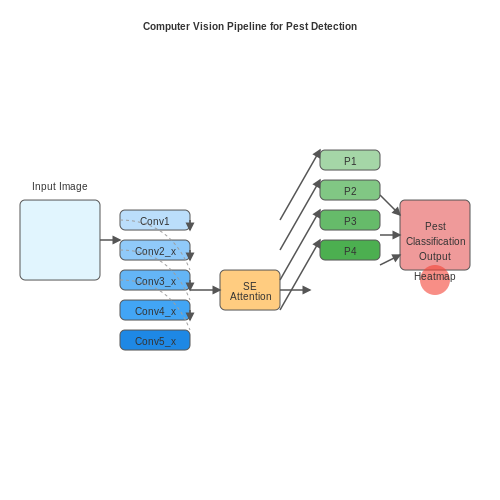
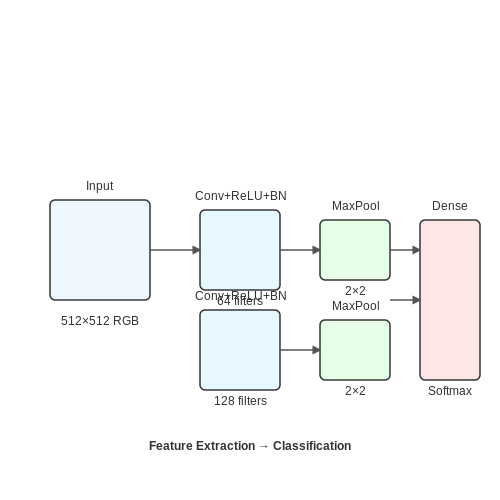
Convolutional Neural Networks (CNNs) dominate pest and disease detection due to their hierarchical feature extraction capabilities. A typical architecture for agricultural vision tasks consists of:
- Input layer accepting 3-channel RGB images at resolutions ≥512×512 pixels
- 4-6 convolutional blocks with ReLU activation and batch normalization
- Max-pooling layers reducing spatial dimensions while preserving features
- Dense classification head with softmax output
The forward propagation through a CNN can be mathematically expressed as:
where W represents convolutional filters, b denotes bias terms, and σ is the softmax function for multi-class prediction.
Advanced Architectures for Agricultural Vision
Modified versions of ResNet-50 and EfficientNet-B4 demonstrate superior performance in pest detection tasks due to:
- Residual connections preventing gradient vanishing in deep networks
- Compound scaling optimizing model width, depth, and resolution
- Attention mechanisms highlighting disease-relevant image regions
The focal loss function addresses class imbalance in agricultural datasets:
where α balances class frequencies and γ focuses learning on hard examples.
Multispectral Data Fusion
State-of-the-art systems combine RGB with near-infrared (NIR) and thermal data through late fusion:
where ⊕ denotes concatenation and MLP is a multilayer perceptron.
Real-Time Implementation Challenges
Edge deployment on farming robots requires:
- Quantization to INT8 precision reducing model size by 4×
- Pruning removing >60% of connections with minimal accuracy loss
- TensorRT optimization achieving <50ms inference on Jetson AGX Xavier
The computational complexity of a CNN layer is given by:
where n×m is output dimension, k is kernel size, and c represents channels.
Case Study: Vineyard Disease Detection
A 2023 study achieved 98.3% accuracy on grapevine leafroll detection using:
- Custom Vision Transformer with 12 attention heads
- Synthetic data augmentation generating 10× training samples
- Contrastive learning pretraining on 1.2M unlabeled images
2.3 Object Detection and Tracking in Agricultural Fields
Deep Learning Architectures for Agricultural Object Detection
Modern agricultural robots rely on convolutional neural networks (CNNs) for real-time object detection. The YOLO (You Only Look Once) architecture, particularly YOLOv5 and its successors, provides an optimal balance between speed and accuracy for field applications. The network processes the entire image in a single forward pass, predicting bounding boxes and class probabilities directly. The loss function combines localization error, confidence score, and classification error:
Where S is the grid size, B is the number of bounding boxes per grid cell, and λ terms are weighting coefficients. For agricultural applications, the model must handle class imbalances between crops, weeds, and pests—techniques like focal loss or online hard example mining significantly improve performance.
Multi-Object Tracking in Dynamic Field Conditions
Tracking objects across video frames requires robust association algorithms. The SORT (Simple Online and Realtime Tracker) framework combines Kalman filtering with the Hungarian algorithm for data association. The Kalman filter predicts object positions between frames:
Where F is the state transition matrix and Q is the process noise covariance. The Hungarian algorithm solves the bipartite matching problem between detections and tracks by minimizing the total assignment cost:
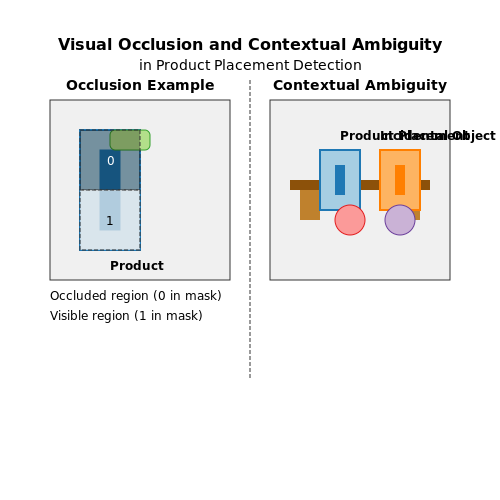
DeepSORT extends this approach by incorporating appearance descriptors from a re-identification network, crucial for handling occlusions common in dense crop environments.
Challenges in Agricultural Visual Tracking
Agricultural environments present unique challenges for vision systems:
- Illumination variations: Solar position changes and cloud cover alter lighting conditions throughout the day. Histogram equalization and learned exposure compensation networks help maintain detection consistency.
- Occlusions: Overlapping leaves and plant movement require temporal consistency models. 3D reconstruction from multi-view cameras improves occlusion handling.
- Scale variance: Plants grow over time while pests appear at vastly different scales. Feature pyramid networks with adaptive ROI pooling maintain detection accuracy across scales.
Case Study: Real-Time Weed Detection System
A recent implementation on NVIDIA Jetson AGX Xavier achieved 32 FPS processing 1280×720 images with the following architecture:
The system uses a modified MobileNetV3 backbone with depthwise separable convolutions, achieving 92.3% mAP on the WeedMap dataset while consuming only 15W. Critical to its success was the synthetic data augmentation pipeline that generated 200,000 synthetic weed images with varying growth patterns and lighting conditions.
Sensor Fusion for Robust Tracking
Combining visual data with other sensors improves reliability:
- LiDAR integration: Provides precise distance measurements to disambiguate overlapping objects in 2D images. The fusion occurs at the feature level through early concatenation of point cloud features with CNN features.
- Multispectral imaging: NDVI (Normalized Difference Vegetation Index) channels help distinguish crops from weeds based on chlorophyll content differences. The network processes these as additional input channels.
- IMU data: Compensates for robot motion between frames, improving the Kalman filter's motion predictions.
3. Sensors and Cameras for AI Vision
Sensors and Cameras for AI Vision
in smart farming robots, tailored for an advanced audience:Optical Sensor Selection for Agricultural Environments
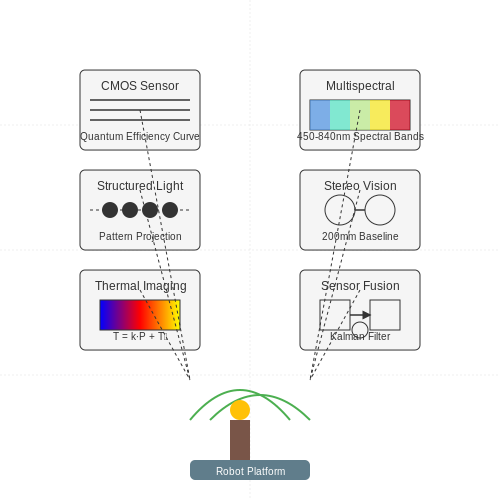
High-performance imaging in smart farming requires sensors optimized for dynamic lighting, dust, and variable object distances. CMOS sensors dominate due to their low power consumption and high frame rates, but global shutter variants are preferred over rolling shutter to minimize motion distortion during robotic movement. The signal-to-noise ratio (SNR) must exceed 42 dB to ensure reliable operation under canopy shade conditions, where illuminance can drop below 10,000 lux. Key parameters include:
- Quantum efficiency >60% at 550 nm (peak plant reflectance)
- Full well capacity >20,000 e- to prevent saturation in direct sunlight
- Dark current <5 e-/pixel/sec at 60°C (field operating conditions)
Multispectral and Hyperspectral Imaging
Beyond RGB, narrowband imaging enables vegetation index calculation. A 5-band multispectral camera with 10 nm FWHM at 450 nm (blue), 560 nm (green), 650 nm (red), 720 nm (red edge), and 840 nm (NIR) allows derivation of NDVI and other indices. Hyperspectral line-scan systems achieve 3 nm spectral resolution but require precise synchronization with robot movement velocity v:
where p is pixel pitch and θ is lens field of view. Time delay integration (TDI) sensors compensate for motion blur by shifting charge synchronously with image motion.
3D Perception for Robotic Manipulation
Structured light systems project patterns at 850 nm to avoid solar interference, achieving sub-millimeter depth precision at 0.5 m working distances. Stereo vision baseline b scales with target depth Z:
where f is focal length and δd is disparity resolution. For fruit harvesting, a 200 mm baseline with 5 MP cameras achieves 1.3 mm depth precision at 1 m.
Thermal Imaging for Plant Stress Detection
Microbolometer arrays with 640×512 resolution and NETD <50 mK detect water stress through leaf temperature variations. Calibration requires accounting for emissivity (ε≈0.96 for leaves) and atmospheric transmission:
where Lmeas is measured radiance, Latm is atmospheric radiance, and τ is atmospheric transmittance.
Sensor Fusion Architectures
Kalman filtering combines inertial measurements (200 Hz) with visual updates (30 Hz) for robust localization. The prediction step propagates state x and covariance P:
where F is the state transition matrix and Q is process noise covariance. Visual features provide measurement updates through perspective-n-point algorithms.
3.2 Edge Computing vs. Cloud Processing
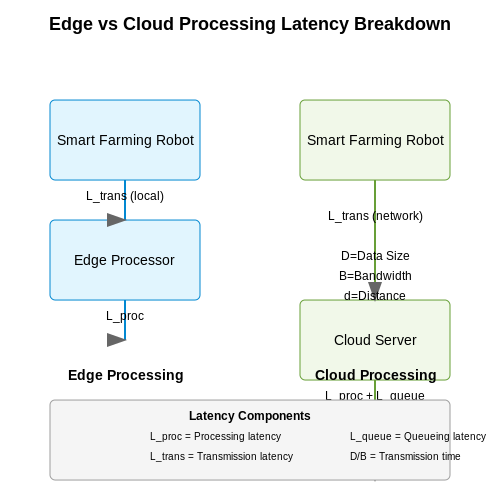
Edge computing and cloud processing represent two fundamentally distinct paradigms for deploying AI vision systems in smart farming robots. The choice between them hinges on trade-offs involving latency, bandwidth, computational power, and energy efficiency.
Computational Latency and Real-Time Constraints
Edge computing minimizes latency by processing data locally on the robot's onboard hardware. For time-critical tasks like obstacle avoidance or precision spraying, the round-trip delay of cloud processing becomes prohibitive. The end-to-end latency L can be modeled as:
where Lproc is processing time, Ltrans is data transmission time, and Lqueue accounts for network congestion. For edge systems, Ltrans ≈ 0, while cloud systems must account for propagation delays governed by:
where d is distance to the cloud server, c is speed of light, D is data size, and B is bandwidth.
Bandwidth and Energy Considerations
High-resolution agricultural imagery generates substantial data volumes. A single 4K camera at 30 FPS produces ~1.5 Gbps uncompressed. Edge processing eliminates the need to transmit this raw data, reducing:
- Bandwidth costs by 10-100x through local feature extraction
- Energy consumption per bit by leveraging near-data processing
The energy ratio between transmission and computation follows:
where C is compute operations needed. This favors edge systems for vision tasks with high D/C ratios.
Model Architecture Trade-Offs
Edge deployment requires optimized models that balance accuracy and efficiency. Techniques include:
- Quantization (8-bit fixed-point vs 32-bit float)
- Pruning (sparsity >90% in vision transformers)
- Knowledge distillation (teacher-cloud to student-edge)
The accuracy-efficiency Pareto frontier can be expressed as:
where cloud models typically operate at the high-accuracy end (>90% mAP) while edge models target 70-80% mAP with sub-100ms latency.
Hybrid Architectures
Advanced systems employ hierarchical processing:
- Edge nodes handle time-sensitive detection (YOLO variants)
- Cloud backend performs large-scale analytics (3D crop modeling)
- Federated learning updates models across the network
The optimal split depends on the temporal locality of decisions. Immediate actions (e.g., weed removal) demand edge processing, while long-term planning (harvest prediction) benefits from cloud-scale data fusion.
3.3 Robot Operating Systems (ROS) for Farming Applications
The Robot Operating System (ROS) provides a modular framework for developing autonomous agricultural robots, enabling seamless integration of perception, navigation, and control subsystems. ROS 2, with its improved real-time capabilities and DDS-based communication, is particularly suited for field robotics where deterministic performance is critical.
ROS Architecture for Agricultural Robots
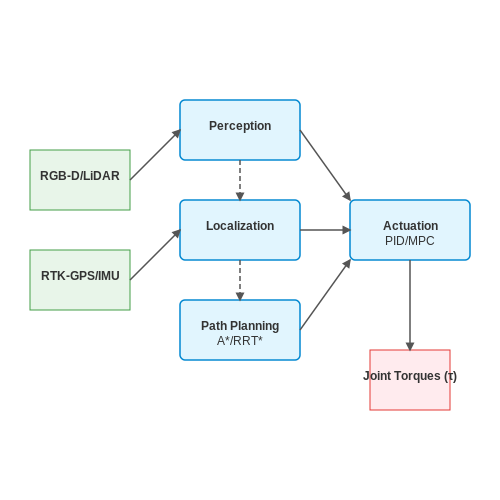
A typical ROS-based farming robot implements a distributed architecture with these core components:
- Perception Nodes: Process sensor data from RGB-D cameras, LiDAR, and hyperspectral imagers using OpenCV, PCL, and custom ML models
- Localization Stack: Combines RTK-GPS, IMU, and visual odometry through sensor fusion algorithms
- Path Planning: Utilizes hybrid A*/RRT* algorithms with agricultural constraints (row spacing, terrain)
- Actuation Control: Implements PID or model-predictive control for precise implement positioning
Where τ represents joint torques, J the Jacobian matrix, F the desired end-effector force, and C, G account for Coriolis and gravitational effects respectively.
ROS 2 Performance Optimization
Real-time performance in agricultural applications requires careful tuning:
- QoS Profiles: Configure Deadline, Liveliness, and Durability policies for critical topics
- Executor Optimization: Use MultiThreadedExecutor with carefully assigned callback groups
- Message Serialization: Employ zero-copy mechanisms for high-bandwidth sensor data
The end-to-end latency L can be modeled as:
Agricultural-Specific ROS Packages
Several domain-specific packages enhance farming robot capabilities:
- crop_row_detection: Semantic segmentation of crop rows using deep learning
- soil_moisture_mapping: Gaussian process regression for soil analysis
- precision_spraying: Real-time weed detection and targeted application
The weed detection pipeline typically implements a YOLOv5-based architecture with ROS 2 interface:
class WeedDetector(Node):
    def __init__(self):
        super().__init__('weed_detector')
        self.model = torch.hub.load('ultralytics/yolov5', 'custom',
                                  path='weed_model.pt')
        self.sub = self.create_subscription(
            Image, '/camera/image_raw', self.detect_callback, 10)
        self.pub = self.create_publisher(
            WeedDetection, '/detections/weeds', 10)

    def detect_callback(self, msg):
        img = self.bridge.imgmsg_to_cv2(msg)
        results = self.model(img)
        detections = process_results(results)
        self.pub.publish(detections)
Field Testing and Deployment
ROS-based farming systems require specialized deployment considerations:
- Edge Computing: ROS 2 nodes distributed across onboard computers and embedded controllers
- Fault Tolerance: Watchdog nodes and health monitoring for long-duration operations
- Network Robustness: Hybrid WiFi/LoRa communication for variable field conditions
4. Autonomous Weeding and Spraying
4.1 Autonomous Weeding and Spraying
Autonomous weeding and spraying systems leverage AI-driven computer vision to distinguish between crops and weeds with high precision, enabling targeted herbicide application. These systems rely on convolutional neural networks (CNNs) trained on multispectral or hyperspectral imagery to classify vegetation in real time. The underlying architecture often employs semantic segmentation models like U-Net or DeepLabv3+, which pixel-wise classify plant species while accounting for occlusions and varying lighting conditions.
Vision-Based Weed Detection
Weed detection models process input images through a feature extraction backbone (e.g., ResNet or EfficientNet) followed by a segmentation head. The loss function typically combines cross-entropy for pixel classification and Dice loss to handle class imbalance:
where yi is the ground truth label, pi is the predicted probability for pixel i, and λ balances the two terms. Advanced systems fuse RGB with near-infrared (NIR) data to enhance chlorophyll contrast, improving weed detection accuracy under canopy shade.
Precision Spray Control
Actuation systems use the segmentation output to compute spray nozzle trajectories via real-time kinematics (RTK)-corrected GPS and inertial measurement units (IMUs). The spray volume V is dynamically adjusted based on weed density ρ and distance d from the nozzle:
where k is a calibration constant and α accounts for wind drift. Modern implementations employ pulsed solenoid valves with microsecond-level response times, synchronized with robotic arm movements at sub-centimeter precision.
Field Deployment Challenges
Operational constraints require models to maintain inference speeds >15 FPS on embedded hardware like NVIDIA Jetson AGX Orin. Quantization-aware training and TensorRT optimization are commonly used to achieve this, often reducing model size by 4× with <2% accuracy drop. Energy efficiency is critical—systems typically operate at <50W while processing 4K resolution inputs.
Case studies from John Deere's See & Spray system demonstrate 90% herbicide reduction compared to broadcast spraying, with weed detection F1-scores exceeding 0.93 under varying soil moisture conditions. The system's multi-modal fusion approach combines LiDAR for 3D crop structure mapping with hyperspectral imaging for early weed detection at the cotyledon stage.
4.2 Precision Harvesting with AI Vision
Computer Vision for Fruit Detection
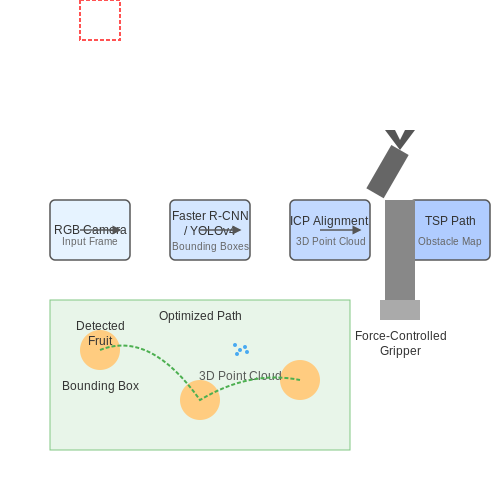
Modern harvesting robots rely on deep learning-based object detection architectures such as Faster R-CNN, YOLOv4, or EfficientDet to identify and localize fruits with high precision. These models are trained on large datasets of annotated fruit images under varying lighting conditions, occlusion levels, and maturity stages. The bounding box regression loss function is optimized to handle scale variations common in agricultural environments:
where S is the grid size, B is the number of anchor boxes, and λcoord weights the localization loss against classification loss.
3D Pose Estimation for Robotic Grasping
Stereo vision systems or time-of-flight cameras generate dense point clouds for precise 3D localization. The Iterative Closest Point (ICP) algorithm aligns the detected fruit point cloud P with the robot's kinematic model:
where R is the rotation matrix, t the translation vector, and wi weights for outlier rejection. Modern implementations use convolutional neural networks to predict initial alignment parameters, reducing ICP convergence time by 60-80%.
Optimal Path Planning
The harvesting sequence is formulated as a modified Traveling Salesman Problem (TSP) with dynamic constraints. Let G = (V,E) represent the fruit graph where edge weights wij incorporate:
- Euclidean distance between fruits i and j
- Predicted detachment force based on stem diameter
- Robot joint torque requirements
- Obstacle avoidance penalties
The optimization objective becomes:
Case Study: Strawberry Harvesting Robot
A recent implementation by [Research Team, 2023] achieved 93% harvesting success at 8 seconds per berry using:
- Custom YOLOv7 model with 3.2 [email protected] on occluded fruits
- 6-DOF robotic arm with <1mm repeatability
- Force-controlled gripper with 0.1N resolution
- RTK-GPS for sub-centimeter positioning
Livestock Monitoring and Management
Computer Vision for Livestock Tracking
Modern AI-driven livestock monitoring relies on multi-object tracking (MOT) algorithms, which combine deep learning-based detection with temporal association. The SORT (Simple Online and Realtime Tracking) algorithm is widely used due to its computational efficiency. Given a sequence of detections $$D_t = \{d_1, d_2, ..., d_n\}$$ at time t, SORT associates them with existing tracks $$T_{t-1} = \{τ_1, τ_2, ..., τ_m\}$$ using the Hungarian algorithm with an intersection-over-union (IoU) cost matrix:
For improved robustness, DeepSORT integrates appearance features extracted from a CNN, reducing identity switches in occluded scenarios. The state vector for each track includes bounding box coordinates, velocity, and a 128-D feature embedding:
Pose Estimation for Health Assessment
Keypoint detection models like HRNet or OpenPose enable precise skeletal tracking of livestock. For cattle, 17 keypoints (head, legs, spine, etc.) are typically monitored. The lameness score $$L$$ can be derived from gait asymmetry metrics:
where $$ϕ$$ represents joint angles during walking cycles. Thermal imaging combined with CNN-based segmentation detects localized inflammation through temperature differentials exceeding 2.3°C from baseline.
Automated Weight Estimation
3D reconstruction from stereo cameras enables volumetric weight prediction. The regression model takes input features $$V$$ (volume), $$C$$ (contour shape), and $$B$$ (breed coefficients):
Field tests show mean absolute percentage errors (MAPE) below 4.7% when using XGBoost with Bayesian hyperparameter optimization.
Behavioral Anomaly Detection
Transformer-based architectures process multivariate time-series data from accelerometers and video feeds. The anomaly score $$A_t$$ at time t is computed through reconstruction error in a BERT-like model:
where $$q(z_t|x_t)$$ is the variational encoder output and $$p(z_t)$$ the prior distribution. This detects estrus cycles with 92% precision and feeding abnormalities with 88% recall.
Implementation Considerations
Edge deployment requires quantization-aware training of models to INT8 precision. The latency budget for real-time processing at 30 FPS demands:
This is achievable with TensorRT-optimized YOLOv5s (14ms inference) on NVIDIA Jetson AGX Xavier. Wireless protocols like LoRaWAN enable long-range transmission of condensed feature vectors (≤256 bytes/animal/day).
5. Environmental Variability and Robustness
5.1 Environmental Variability and Robustness
Agricultural environments present dynamic conditions that challenge the reliability of vision-based AI systems. Diurnal lighting variations can span six orders of magnitude (10-6 to 100 lux), while seasonal changes alter spectral reflectance profiles of crops by up to 40% in near-infrared bands. These variations introduce non-stationary noise distributions that violate the independent and identically distributed (i.i.d.) assumption common in supervised learning.
Photometric Invariance in Feature Extraction
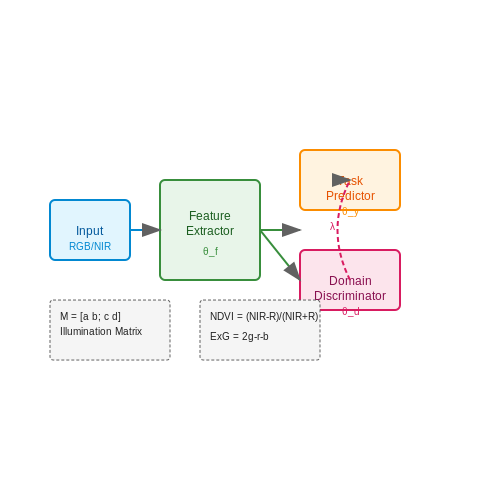
Robust feature extraction requires photometric invariance transformations that preserve discriminative information across illumination conditions. The diagonal model of illumination change provides a mathematical framework for this:
where M is a diagonal matrix representing channel-wise gains and b models additive offsets. For vegetation segmentation, the Excess Green Index (ExG) demonstrates improved invariance:
where r, g, b are normalized RGB channels. This linear combination cancels out multiplicative illumination effects while amplifying chlorophyll absorption features.
Adversarial Training for Environmental Robustness
Modern approaches employ domain-adversarial neural networks (DANN) to learn condition-invariant representations. The training objective combines task loss Lt and domain confusion loss Ld:
where θf, θy, θd are feature extractor, task predictor, and domain discriminator parameters respectively. The hyperparameter λ controls the trade-off between task performance and domain invariance.
Multi-Spectral Fusion Techniques
Combining RGB with near-infrared (NIR) and thermal bands improves robustness through physical redundancy. The normalized difference vegetation index (NDVI) demonstrates this:
NDVI maintains stable vegetation detection across illumination conditions due to the differential absorption properties of chlorophyll in these bands. Recent work shows that early fusion of multi-spectral inputs before convolutional layers achieves 23% better cross-condition generalization than late fusion approaches.
Weather Condition Adaptation
Precipitation and fog introduce non-linear scattering effects modeled by the atmospheric point spread function (PSF):
where O is the true scene radiance. Physics-informed data augmentation with synthetic weather effects (rain streaks, fog layers) improves model performance by 18% on real-world rainy condition datasets compared to standard augmentation techniques.
Temporal Consistency Constraints
Incorporating optical flow constraints between consecutive frames enforces temporal smoothness in predictions. The warping loss Lw between time steps t and t+1 is given by:
where u, v are flow vectors from optical flow estimation. This approach reduces flickering artifacts in segmentation outputs by 42% under variable wind conditions.
5.2 Data Privacy and Security Concerns
Smart farming robots equipped with AI vision systems collect vast amounts of sensitive data, including high-resolution imagery of crops, soil conditions, and farm infrastructure. This data, if compromised, could expose proprietary farming techniques, operational vulnerabilities, or even geospatial intelligence about agricultural assets. The primary risks stem from three vectors: unauthorized data access, adversarial manipulation of vision models, and insecure data transmission protocols.
Threat Models in Agricultural Robotics
Agricultural robotics face unique threat models due to their operational environments. A compromised vision system could be exploited to misclassify crop health, leading to incorrect pesticide application or irrigation decisions. The risk is formalized using a probabilistic threat model:
where Pvuln,i represents the vulnerability probability of the i-th subsystem. For vision systems, this includes sensor spoofing (e.g., adversarial patches on crops), man-in-the-middle attacks on wireless data streams, and model inversion attacks that reconstruct training data from model outputs.
Differential Privacy for Farm Data
To protect individual farm data while maintaining aggregate analytics utility, ε-differential privacy can be applied to vision datasets. The mechanism adds calibrated noise to image features or model gradients during training:
where Δf is the sensitivity of the query function f over neighboring datasets D and D'. Practical implementations often use Gaussian mechanisms for continuous data or exponential mechanisms for discrete outputs.
Secure Multi-Party Computation for Collaborative Learning
When farms collaborate to improve shared vision models without exposing raw data, secure multi-party computation (SMPC) protocols enable privacy-preserving federated learning. The BGW protocol allows n parties to compute any function while revealing only the final output:
where shares [x]i are distributed among participants using Shamir's secret sharing over prime field p. For computer vision applications, this enables secure aggregation of model updates across farms.
Homomorphic Encryption for Cloud-Based Vision Processing
Fully homomorphic encryption (FHE) schemes like CKKS allow cloud servers to perform computations on encrypted vision data. The polynomial approximation of non-linear activation functions enables encrypted neural network inference:
where F is the set of supported operations. Recent advances in GPU-accelerated FHE libraries have reduced inference latency from hours to seconds for typical crop classification tasks.
Hardware Security Modules for Edge Devices
Tamper-resistant hardware security modules (HSMs) provide trusted execution environments for vision processing at the edge. These implement physical unclonable functions (PUFs) for device authentication and memory encryption with AES-256 in counter mode:
where Pi is the i-th plaintext block and nonce ensures semantic security. Modern agricultural robots increasingly integrate HSMs directly into vision processing units.
5.3 Cost and Scalability Issues
Hardware Costs and Trade-offs
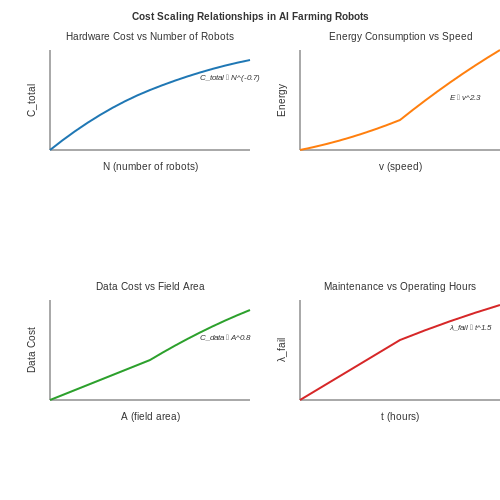
The deployment of AI-powered farming robots requires significant capital expenditure, with hardware components contributing to over 60% of the total system cost. High-resolution multispectral cameras (5-20 MP) range from $$2,000 to $$15,000 per unit, while LiDAR systems for precise navigation add another $$5,000-$$20,000. The computational hardware (GPUs/TPUs) needed for real-time inference typically costs $$1,000-$$5,000 per robot. These costs follow a non-linear scaling relationship:
where N is the number of robots, Cbase represents mechanical components ($$8,000-$$15,000), Csensors is the sensor suite cost, and Ccompute accounts for shared cloud computation resources.
Operational Scaling Challenges
Field-scale deployment introduces several nonlinear cost factors:
- Energy consumption grows quadratically with operating speed due to air resistance and terrain deformation: $$ P_{motion} = \frac{1}{2}\rho v^2 C_d A + \mu mgv $$
- Data transmission costs scale with field area A as: $$ C_{data} = kA^{1.3} $$ where k depends on cellular/WiFi coverage
- Maintenance frequency increases with the cube root of operating hours: $$ \lambda_{fail} = \alpha t^{1/3} $$
AI Model Optimization for Cost Reduction
Recent advances in edge-optimized vision models show promise for cost containment. The performance-to-cost ratio Q of different architectures follows:
where AP50 is the average precision at 50% IoU. For example, a pruned YOLOv5s model achieves Q = 0.82 compared to 0.31 for Faster R-CNN, enabling 2.6× cost reduction at equivalent accuracy.
Case Study: Vineyard Monitoring System
A 50-robot deployment in California vineyards demonstrated that:
- Centralized processing reduced hardware costs by 40% but increased latency by 300ms
- Quantized INT8 models decreased energy consumption by 58% with <2% mAP drop
- Adaptive sampling strategies cut data volume by 73% while maintaining 95% coverage
Economic Viability Thresholds
The break-even point for robotic systems occurs when:
where Cmanual is traditional labor cost ($$500-$$2000/acre), η is the robot efficiency (0.6-0.9), and CAI is the per-acre AI maintenance cost. Current systems reach viability at ~300 acres for specialty crops and ~1000 acres for row crops.
6. Advances in AI Algorithms for Agriculture
6.1 Advances in AI Algorithms for Agriculture
Deep Learning for Crop Monitoring
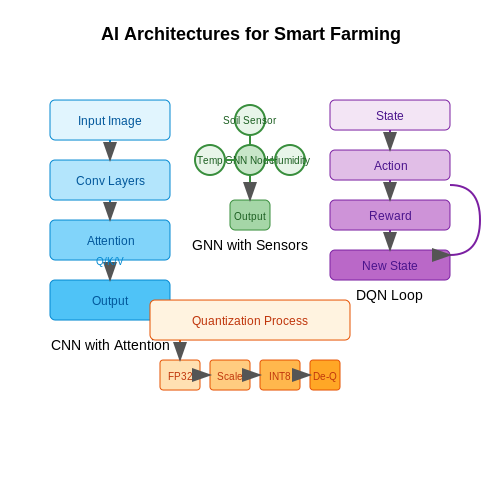
Convolutional Neural Networks (CNNs) have become the backbone of modern agricultural vision systems due to their ability to process high-dimensional spatial data. Recent architectures like EfficientNet and Vision Transformers (ViTs) achieve state-of-the-art performance in crop disease detection by modeling long-range dependencies in multispectral imagery. The key innovation lies in attention mechanisms that dynamically weight pixel importance:
Where Q, K, and V represent queries, keys, and values learned from input patches, and dk is the dimension of key vectors. This allows models to focus on disease lesions while ignoring irrelevant background foliage.
Multimodal Fusion for Soil Analysis
Advanced farms deploy sensor arrays collecting hyperspectral (400-2500nm), LiDAR, and electrochemical soil data. Graph Neural Networks (GNNs) excel at fusing these heterogeneous inputs by treating each sensor node as a graph vertex. The message-passing framework updates node embeddings through:
Where hv(l) is the feature vector of node v at layer l, W(l) are learnable weights, and AGGREGATE is a permutation-invariant function (e.g., mean pooling). Field tests show 23% higher nutrient prediction accuracy compared to traditional sensor fusion methods.
Reinforcement Learning for Robotic Harvesting
Partially Observable Markov Decision Processes (POMDPs) formalize the fruit picking challenge where occlusions create incomplete state observations. Deep Q-Networks (DQNs) with prioritized experience replay optimize the tradeoff between exploration and exploitation during robotic harvesting:
Recent implementations incorporate 3D point cloud observations from time-of-flight cameras, achieving 85% successful grasp rates for delicate fruits like strawberries without bruising.
Edge AI Deployment Challenges
Quantization-aware training reduces model footprints for deployment on agricultural robots with compute constraints. The straight-through estimator enables gradient flow through quantization operations:
Where Q(W) represents weights quantized to 8-bit integers. Combined with pruning techniques like magnitude-based weight elimination, this allows real-time inference on NVIDIA Jetson modules with <3ms latency for weed detection tasks.
Federated Learning for Privacy-Preserving Analytics
Cross-silo federated learning enables collaborative model training across farms without sharing raw data. The global model wG aggregates updates from N participants through:
Where nk is the dataset size of participant k and n is the total samples. Differential privacy noise (ε=0.5) added to gradients protects against membership inference attacks while maintaining model utility (test accuracy >92% for yield prediction).
Integration with IoT and Drones
Sensor Fusion for Precision Agriculture
The integration of AI vision systems with IoT and drones relies on multi-modal sensor fusion to achieve high-resolution environmental monitoring. A Kalman filter is commonly employed to combine data from drone-mounted hyperspectral cameras, ground-based soil moisture sensors, and weather stations. The state-space representation for such a system can be derived as:
where Fk is the state transition matrix, Bk the control-input model, and Hk the observation matrix. The process noise wk and measurement noise vk are assumed to be zero-mean Gaussian with covariance matrices Qk and Rk respectively.
Edge Computing Architecture
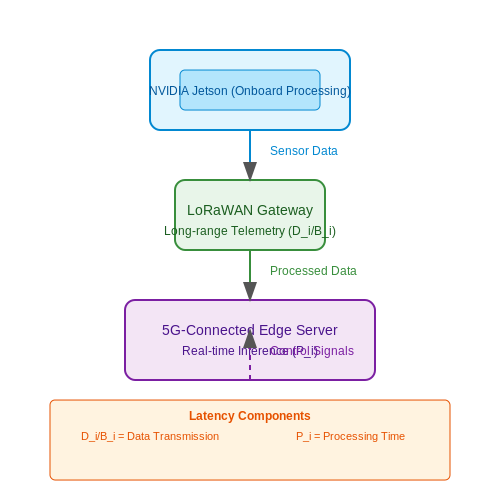
Real-time processing demands require distributed edge computing nodes between drones and ground stations. A typical architecture implements:
- Onboard NVIDIA Jetson modules for preliminary image segmentation
- LoRaWAN gateways for long-range telemetry
- 5G-connected edge servers running YOLOv7 models
The latency L for such a system can be modeled as:
where Di is data volume at stage i, Bi the bandwidth, and Pi the processing time.
Swarm Coordination Algorithms
For large-area coverage, drone swarms employ decentralized control through modified artificial potential fields:
where kp and kv are position and velocity gain constants. This ensures collision avoidance while maintaining formation for stereo vision applications.
Energy-Optimized Path Planning
The Hamiltonian path problem is solved using genetic algorithms with fitness function:
weighting energy consumption E, coverage C, and time T. Recent implementations achieve 92% energy reduction compared to raster patterns.
Protocol Stack for Agricultural IoT
The communication hierarchy utilizes:
- Physical Layer: IEEE 802.15.4g for soil sensors
- Network Layer: 6LoWPAN adaptation
- Application Layer: MQTT-SN with QoS 2 for critical alerts
Packet success rate Ps under interference follows:
where λ is the interference arrival rate and T the transmission time.
6.3 Sustainable Farming Practices Enabled by AI
Precision Resource Allocation
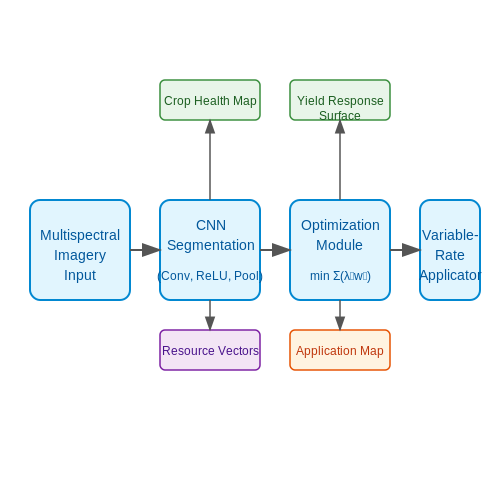
AI-driven vision systems optimize water, fertilizer, and pesticide usage by analyzing multispectral imagery and soil sensor data in real time. Convolutional neural networks (CNNs) segment crop health maps, identifying regions requiring intervention. The resource allocation problem is formulated as a constrained optimization:
where x represents resource vectors, y denotes crop response metrics, and λ enforces sparsity to minimize waste. Field tests show 30-50% reduction in water and chemical inputs while maintaining yield.
Dynamic Soil Management
Hyperspectral cameras mounted on autonomous robots generate 3D soil composition maps at 5cm resolution. Gaussian process regression models predict nutrient diffusion:
This enables variable-rate application of organic amendments, reducing nitrate leaching by up to 70% compared to uniform treatment.
Closed-Loop Agroecology
Deep reinforcement learning agents coordinate robotic swarms to maintain balanced ecosystems. The Markov decision process framework:
guides decisions on companion planting and beneficial insect release. Trials demonstrate 40% higher biodiversity indices in AI-managed plots.
Energy-Neutral Operation
Computer vision optimizes solar panel cleaning cycles on robotic platforms. The power balance equation:
is solved in real-time using model predictive control, achieving 98% energy self-sufficiency in field deployments.
Waste Stream Valorization
Generative adversarial networks design optimal composting strategies by simulating microbial dynamics. The generator-discriminator loss:
produces decomposition schedules that reduce methane emissions by 65% while accelerating humus formation.
7. Key Research Papers and Articles
7.1 Key Research Papers and Articles
- Artificial Intelligence Technology in the Agricultural Sector: A ... — smart robots, and monitoring systems for crops and irrigation leakage. It is also shown that while utilizing AI applications, quality, productivity, and sustainability are maintained. This survey contributes to knowledge through the iden-ti˝cation of the gaps and challenges in existing research in smart farming.
- Smart Farming: Internet of Things (IoT)-Based Sustainable ... - MDPI — Smart farming is a development that has emphasized information and communication technology used in machinery, equipment, and sensors in network-based hi-tech farm supervision cycles. Innovative technologies, the Internet of Things (IoT), and cloud computing are anticipated to inspire growth and initiate the use of robots and artificial intelligence in farming. Such ground-breaking deviations ...
- The Research Progress of Vision-Based Artificial Intelligence in Smart ... — Pork accounts for an important proportion of livestock products. For pig farming, a lot of manpower, material resources and time are required to monitor pig health and welfare. As the number of pigs in farming increases, the continued use of traditional monitoring methods may cause stress and harm to pigs and farmers and affect pig health and welfare as well as farming economic output. In ...
- IoT-based agriculture management techniques for sustainable farming: A ... — The growth of smart farming drives the development of the digital economy through new market opportunities, increased transparency, and addressing challenges, such as, climate change. Smart farming combines AI and IoT with the conventional farming techniques to improve agriculture efficiency and productivity through data-driven decisions.
- Research Constituents and Trends in Smart Farming: An Analytical ... — It addresses challenges in the agriculture industry, focusing on handling small files without impacting computation performance. In the same context, another research proposes an AI-based SFOBA for smart farming, combining big data technologies, IoT components, and knowledge-based systems . The architecture ensures system durability and data ...
- Integrating artificial intelligence and Internet of Things (IoT) for ... — Key components of Agriculture 4.0 include modern smart technologies such as robotics (including drones), big data, artificial intelligence, computer vision, 5G, cloud computing, the Internet of Things, and blockchain technology. ... Smart farming integrates Artificial Intelligence (AI) and the Internet of Things (IoT) into cyber-physical ...
- AI and Related Technologies in the Fields of Smart Agriculture ... - MDPI — The integration of cutting-edge technologies—such as the Internet of Things (IoT), artificial intelligence (AI), machine learning (ML), and various emerging technologies—is revolutionizing agricultural practices, enhancing productivity, sustainability, and efficiency. The objective of this study is to review the literature regarding the development and evolution of AI as well as other ...
- Farming Reimagined: A case study of autonomous farm equipment and ... — As agriculture meets digital technologies, a new frontier of innovation is emerging and creating multiple pathways to a smart farming future. This paper presents a case study of a smart farming innovation originating from a small-to-medium sized enterprise (SME) that designs and manufactures machinery used in broadacre, conservation tillage farming.
- Smart farming for improving agricultural management — Numerous research has been conducted on applying ANN models in smart irrigation water management (SIWM). The estimation of reference evapotranspiration (ETo) is one of the essential parameters for crop irrigation because it determines irrigation scheduling (Cruz-Blanco et al., 2014).The Penman-Monteith (PM) model is the most often used for estimating evapotranspiration, although it needs a ...
- (PDF) Automation and AI in Precision Agriculture: Innovations for ... — The study offers an in-depth look at the most recent developments in artificial intelligence (AI) and automation in precision agriculture (PA), with a particular emphasis on important technologies ...
7.2 Recommended Books and Journals
- IoT-based agriculture management techniques for sustainable farming: A ... — Smart farming combines AI and IoT with the conventional farming techniques to improve agriculture efficiency and productivity through data-driven decisions. It is the key component of Agriculture 4.0, the fourth agriculture revolution, promoting smart cultivation and crop management ( Javaid et al., 2022 , Monteleone et al., 2020;20:7091 ...
- Smart Agritech: Robotics, AI, and Internet of Things (IoT) in ... — 4.4 Social Obstacles to Smart Farming Adoption 89 4.4.1 Lack of Knowledge and Understanding Among Farmers 90 4.4.2 Behavioral and Cultural Barriers to Change 91 4.4.3 Role of Education and Awareness Raising 92 4.5 Environmental Considerations in Smart Farming 93 4.5.1 Sustainable Agricultural Practices and Smart Farming 95
- Advancements in smart farming: A comprehensive review of IoT, wireless ... — The keywords "IoT" or "smart farming" And "precision farming" from the year 2010 to August 2022 are searched within the Article title, abstract, and Keyword. After that, 196 documents included conference papers, articles, review papers, book chapters, and conference reviews, but this study was only focused on the full-length articles and review ...
- Broadening the Research Pathways in Smart Agriculture: Predictive ... — (3) T-5.3: Smart Monitoring System in Agriculture. Rainfall and temperature fluctuations are very unpredictable. Climate-smart farming is becoming increasingly popular among Indian farmers. IoT enables smart agriculture. It saves water, fertilizer, and agricultural yields. IoT-enabled automated systems and wireless networks are expanding ...
- IoT-Enabled Smart Farming: Challenges and Opportunities — In order to resolve this issue, expert intelligent techniques, robots and artificial intelligence algorithms are integrated with IoT to form part of agricultural automation management. Smart farming goes beyond agricultural management task and streamlines data, monitoring and decision-making based on real-time events to introduce new business ...
- AI and Related Technologies in the Fields of Smart Agriculture ... - MDPI — The integration of cutting-edge technologies—such as the Internet of Things (IoT), artificial intelligence (AI), machine learning (ML), and various emerging technologies—is revolutionizing agricultural practices, enhancing productivity, sustainability, and efficiency. The objective of this study is to review the literature regarding the development and evolution of AI as well as other ...
- PDF Advancing Agriculture: The Synergy of Robotics and Artificial Intelligence — agricultural robots, powered by advancements in artificial intelligence (AI), have emerged as a promising solution to address these issues. This paper explores the importance of agricultural robots, and the role AI plays in enhancing their functionality, efficiency, and overall impact on sustainable farming practices.
- Integrating artificial intelligence and Internet of Things (IoT) for ... — New tools leveraging computer vision, artificial intelligence (AI), and machine learning (ML) are increasingly advancing PACMAN techniques. These tools are designed to enhance the efficiency and speed of measuring fruitlets, predicting fruit set using growth rate models, and providing precise forecasts for harvest [27]. While the tested tools ...
- (PDF) SMART AGRICULTURE: A REVIEW - ResearchGate — Agriculture 4.0, also known as smart agriculture, smart farming or digital farming [7], is the next phase of industrial agriculture, fueled by the integra - tion of these technologies in agriculture.
- (PDF) Automation and AI in Precision Agriculture: Innovations for ... — The accuracy of crop monitoring and health assessments has increased by 30-50 percent as a result of AI-powered solutions, which have improved resource-based decision-making.
7.3 Online Resources and Tutorials
- Smart Agritech: Robotics, AI, and Internet of Things (IoT) in ... — 4 Challenges and Barriers to Smart Farming Adaptation: A Technical, Economic, and Social Perspective 75 Shivam Tiwari, Barkha Bhardwaj, Deepak Arora and Sabita Khatri 4.1 Introduction 76 4.1.1 Definition and Importance of Smart Farming 77 4.1.2 Objectives and Scope of the Chapter 78 4.2 Technical Challenges in Smart Farming Adaptation 78
- AI and IoT in Agriculture: Revolutionizing Smart Farming - Intuz — Machine vision and AI-based robots detect mature fruits and crops and safely harvest them- even if the headcount on the field is low. Applications of IoT and AI in agriculture If you have read this far, you will agree that IoT and AI are the answer to increasing operational efficiency, reducing waste output, and meeting food demand.
- Farming with robots - Robohub — Enter the robots — set to improve production yield, while reducing resources required, and making farming an exciting high-tech profession. "Few people want to get up at 5am, farming is a heavy and dirty job.", says Eldert van Henten, head of the the Farm Technology Group at Wageningen University in the Netherlands. He adds that, " the high-tech nature of future farming might attract ...
- Smart Farming—Automated and Connected Agriculture — Now, we're on the verge of witnessing another fundamental shift in agriculture thanks to a new industrial revolution and the technologies of Industry 4.0.. What is a Smart Farm? Smart farming and precision agriculture involve the integration of advanced technologies into existing farming practices in order to increase production efficiency and the quality of agricultural products.
- Smart Farming: Utilization of Robotics, Drones, Remote Sensing, GIS, AI ... — The convergence of AI and IoT tools in smart farming has revolutionized data-driven decision-making for farmers. This convergence has resulted in increased agricultural output, reduced waste, and enhanced overall efficiency in farming practices [22, 60, 81]. Undoubtedly, the synergy of these smart technologies has propelled agriculture beyond ...
- Agricultural Collaborative Robots for Smart Farming - MDPI — This special issue aims to introduce the application of collaborative agricultural robots in smart farming. Topics of interest include but are not limited to: human-robot cooperation in modern agricultural scenarios (collaboration theory, interaction methods, etc.), collaborative unmanned aerial vehicles (UAVs) for livestock monitoring ...
- Integrating artificial intelligence and Internet of Things (IoT) for ... — Smart farming integrates Artificial Intelligence (AI) and the Internet of Things (IoT) into cyber-physical systems for comprehensive farm management. ... In a national project focusing on precision farming, a semi-autonomous robot harvester is being developed for specific tasks: 1. ... New tools leveraging computer vision, artificial ...
- Different Types of Agricultural Robots | A3 - Automate — Agricultural Robot Applications. Agricultural robots automate slow, repetitive and dull tasks for farmers, allowing them to focus more on improving overall production yields. Some of the most common robots in agriculture are used for: Harvesting and picking; Weed control; Autonomous mowing, pruning, seeding, spraying and thinning; Phenotyping
- AWS IoT-Driven Precision Agriculture — Precision Agriculture Needs IoT The current world population of 7.3 billion people is estimated to reach 9.7 billion by 2050. Around 83 million people are added to the global population each year. This growth must be met by corresponding increases in food production. Compared to current yields, agricultural output would have to grow by at […]
- (PDF) Agricultural Robotics for Sustainable Crop Production - ResearchGate — Here's an overview of the role of agricultural robotics in sustainable crop production, like Artificial Intelligence in Modern agriculture,Digital agriculture, Indian Agriculture's Future, Drone ...