Universal Policies via Generalist Agents
1. Definition and Core Principles of Generalist Agents
Definition and Core Principles of Generalist Agents
Generalist agents represent a paradigm shift in artificial intelligence, moving beyond narrow task-specific models toward systems capable of exhibiting broad, adaptable intelligence across diverse environments. Unlike traditional AI systems optimized for singular objectives, generalist agents are characterized by their ability to learn and apply policies that generalize across multiple domains, tasks, and environmental conditions without requiring retraining or fine-tuning.
Formal Definition
A generalist agent G is formally defined as a tuple (S, A, Ω, T, R, π), where:
- S represents the state space spanning multiple domains
- A denotes the action space capable of addressing diverse tasks
- Ω constitutes the observation space across varying sensory modalities
- T : S × A → S is the transition function generalizing across environments
- R : S × A → ℝ is the reward function encoding multi-task objectives
- π : Ω → A is the universal policy mapping observations to actions
The key differentiator lies in the agent's capacity to maintain performance across varying (S, A, Ω) configurations through a single policy π, achieved via:
where τ represents trajectories sampled from a distribution over tasks p(τ), and γ is the discount factor.
Core Principles
1. Cross-Domain Representation Learning
Generalist agents employ neural architectures that construct unified latent representations across disparate input modalities (visual, textual, proprioceptive) and task spaces. This is achieved through transformer-based architectures with modality-agnostic attention mechanisms:
where Q, K, V are learned projections of input embeddings regardless of source modality.
2. Compositional Policy Architecture
The policy network decomposes into:
- A task interpreter that extracts relevant features from observations
- A skill library containing reusable action primitives
- A composition engine that assembles skills into coherent behaviors
This structure enables zero-shot transfer through novel combinations of existing skills.
3. Meta-Learning Optimization
Training occurs across a distribution of tasks p(T) to optimize for out-of-distribution generalization:
where θ represents the agent's parameters and fθ is the policy function.
Scalability Properties
The performance of generalist agents scales according to:
where n is the number of training tasks, α represents positive transfer, and β captures interference effects. Optimal architectures balance these factors through:
- Modular network components to minimize negative transfer
- Sparse activation patterns that limit cross-task interference
- Dynamic architecture growth that expands capacity with task complexity
Implementation Challenges
Current research addresses several key challenges in realizing effective generalist agents:
- Catastrophic forgetting: Mitigated through elastic weight consolidation
- Negative transfer: Addressed via gradient masking techniques
- Computational complexity: Managed by mixture-of-experts architectures
Key Differences Between Specialist and Generalist Agents
Architectural and Functional Distinctions
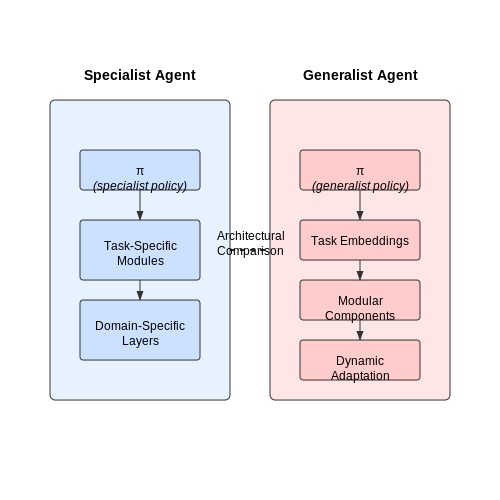
Specialist agents are designed with a narrow, task-specific architecture, optimized for performance within a constrained problem space. Their policy networks often employ domain-specific inductive biases, such as convolutional layers for image processing or recurrent connections for sequential data. In contrast, generalist agents utilize modular, flexible architectures like transformers or mixture-of-experts models, enabling them to dynamically adapt to diverse tasks without architectural modifications.
The functional divergence becomes evident in their respective policy formulations. For a specialist agent operating in a Markov Decision Process (MDP), the policy πs typically maximizes:
where the state-action space (st, at) is tightly constrained to a single domain. Generalist agents extend this formulation through multi-task reinforcement learning, optimizing a universal policy πg across N distinct tasks:
Training Dynamics and Sample Efficiency
Specialist agents exhibit rapid convergence within their target domain, often achieving peak performance with orders of magnitude fewer samples than generalist counterparts. This efficiency stems from:
- Tailored reward shaping: Domain-specific reward engineering that accelerates credit assignment
- Focused exploration: Constrained action spaces that reduce the need for exhaustive state visitation
- Specialized initialization: Pretraining on curated domain data before fine-tuning
Generalist agents require substantially more diverse training data and sophisticated exploration strategies. Techniques like hindsight experience replay and meta-learning are often necessary to achieve cross-task knowledge transfer, resulting in sample complexity that scales superlinearly with the number of tasks.
Transfer Learning and Zero-Shot Capabilities
The most profound distinction emerges in transfer learning scenarios. Specialist agents demonstrate catastrophic forgetting when exposed to new tasks, as their optimization landscapes contain sharp, narrow minima. Generalist agents leverage:
- Parameter isolation: Techniques like progressive neural networks that prevent interference between task-specific parameters
- Contextual modulation: Dynamic weight adaptation based on task embeddings
- Compositionality: The ability to recombine learned skills for novel tasks
This enables few-shot or even zero-shot generalization, where a generalist agent can solve novel tasks by composing existing skills without additional training. The emergent capabilities follow from the underlying universal policy approximating a compositional function space:
where z is a task embedding and hϕ modulates the base policy fθ.
Computational and Deployment Tradeoffs
Specialist agents typically require less computational overhead during both training and inference, making them preferable for latency-sensitive applications. However, maintaining multiple specialists incurs linear scaling of resources with each new task. Generalist agents present:
- Higher upfront training costs: Due to the need for diverse training data and longer optimization periods
- Sublinear scaling: Additional tasks can often be incorporated through fine-tuning rather than full retraining
- Dynamic resource allocation: Architectures like sparse mixture-of-experts can activate only relevant subnets per task
The choice between approaches ultimately depends on the operational context - specialist agents dominate in stable, well-defined domains, while generalist agents excel in dynamic environments requiring continual adaptation.
1.3 Historical Evolution and Milestones
Early Foundations (1950s–1980s)
The conceptual groundwork for generalist agents traces back to early AI research in symbolic reasoning and cybernetics. Alan Turing's 1950 paper Computing Machinery and Intelligence introduced the idea of machines capable of learning and adapting. In the 1960s, Marvin Minsky's work on the Society of Mind theorized intelligence as emergent from simpler, interacting components—a precursor to modular agent architectures. Meanwhile, reinforcement learning (RL) foundations were laid by Richard Bellman's dynamic programming (1957) and later refined by Andrew Barto and Richard Sutton in the 1980s.
Rise of Specialized Agents (1990s–2000s)
The 1990s saw a shift toward domain-specific agents due to computational constraints. TD-Gammon (1992) demonstrated RL's potential in game-playing, while IBM's Deep Blue (1997) showcased brute-force search in chess. These systems were narrowly optimized, lacking transferability. Theoretical advances like Sutton's option framework (1999) introduced hierarchical RL, enabling temporal abstraction—a critical step toward generalist capabilities. By the 2000s, multi-agent systems (e.g., RoboCup) explored distributed coordination but remained task-bound.
Deep Learning Revolution (2010–2016)
The fusion of deep neural networks with RL (DQN, 2013) enabled agents to process high-dimensional inputs. DeepMind's Atari-playing agent (2015) achieved human-level performance across 49 games using a single architecture, hinting at generality. Concurrently, transfer learning techniques (e.g., Progressive Neural Networks, 2016) allowed knowledge reuse across tasks. However, these agents still required per-task fine-tuning and lacked meta-learning capabilities.
Generalist Agent Breakthroughs (2017–Present)
Transformative milestones include:
- AlphaZero (2017): Mastered chess, shogi, and Go via self-play, demonstrating domain-agnostic policy learning.
- Gato (2022): A single transformer-based model handling vision, language, and control tasks, though with limited scalability.
- PaLM-E (2023): Embodied multimodal agent integrating vision-language models with robotic control.
Recent work on foundation models for robotics (2023–2024) explores large-scale pretraining across diverse embodied tasks, pushing toward universal policies. Key challenges remain in sample efficiency, catastrophic forgetting, and out-of-distribution generalization.
Theoretical Underpinnings
The evolution reflects a convergence of:
- Scaling laws: Empirical evidence that agent performance scales predictably with model size and data diversity.
- Meta-RL: Frameworks like MAML (2017) enabling few-shot adaptation.
- World models: Ha & Schmidhuber's recurrent environment models (2018) for predictive generalization.
2. Concept and Importance of Universal Policies
2.1 Concept and Importance of Universal Policies
Defining Universal Policies
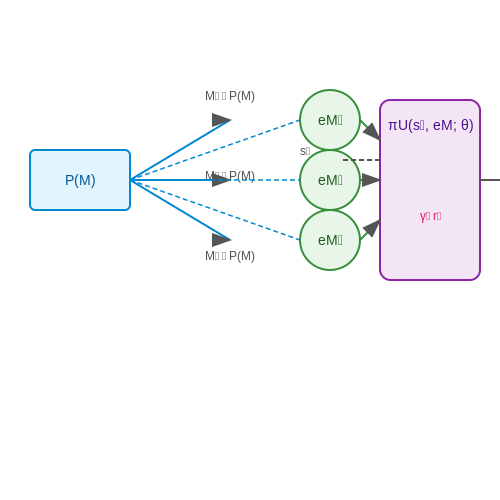
Universal policies refer to decision-making frameworks that generalize across diverse environments, tasks, and dynamics without requiring task-specific fine-tuning. Unlike traditional reinforcement learning (RL) agents trained for narrow domains, a universal policy πU aims to maximize expected return across a distribution of MDPs (Markov Decision Processes) M ∼ P(M):
Here, τ denotes trajectories, γ is the discount factor, and P(M) represents the distribution over possible environments. The policy must handle varying state-action spaces, reward functions, and transition dynamics.
Key Properties
- Generalization: Learns transferable representations that capture invariant features across tasks.
- Meta-Learning: Embeds fast adaptation mechanisms (e.g., via gradient-based updates or context conditioning).
- Scalability: Avoids linear growth in parameters with task count through shared architectures.
Architectural Enablers
Modern implementations leverage transformer-based models or hypernetworks to process task descriptors as inputs. For example, a policy might ingest a task embedding eM and state st to produce actions:
The embedding eM can be learned jointly or derived from few-shot interaction data. This approach mirrors human-like generalization, where prior knowledge guides rapid adaptation.
Practical Applications
Universal policies are critical in robotics (e.g., a single controller for manipulation, navigation, and assembly) and game AI (e.g., agents that master multiple games without retraining). They reduce deployment overhead and enable emergent cross-task synergies. For instance, DeepMind's Gato uses a single transformer to play Atari, control robots, and caption images.
Challenges and Trade-offs
The No Free Lunch theorem implies that universal policies may underperform task-specific solutions in narrow domains. Key challenges include:
- Catastrophic Forgetting: Balancing stability-plasticity during lifelong learning.
- Credit Assignment: Disentangling shared vs. task-specific knowledge.
- Computational Cost: Training on diverse tasks requires large-scale infrastructure.
Theoretical Foundations
The problem aligns with Bayesian RL and hierarchical RL frameworks. The optimal universal policy approximates:
where πM* is the optimal policy for MDP M. Recent work uses variational inference to approximate this intractable integral.
2.2 Challenges in Designing Universal Policies
Scalability and Computational Complexity
Universal policies must generalize across diverse environments, which introduces significant computational challenges. The policy π must optimize for a multi-task objective function:
where τ represents trajectories sampled from a distribution of tasks p(τ). The curse of dimensionality arises as the state-action space grows exponentially with the number of tasks. For N tasks with D-dimensional state spaces, the joint policy must operate in O(D^N) space, making exact solutions intractable for large N.
Catastrophic Forgetting in Multi-Task Learning
When a single agent learns multiple tasks sequentially, interference between task gradients can degrade performance on previously learned tasks. This manifests when the policy update for task k violates the optimality conditions for task j:
Empirical studies show that neural network policies trained on ImageNet classification lose up to 40% accuracy on original tasks when fine-tuned for new domains without regularization.
Reward Specification and Alignment
Designing reward functions that properly balance competing objectives across tasks remains an open challenge. Consider a household robot that must both clean (task A) and avoid breaking objects (task B). The composite reward:
requires careful tuning of α. Recent work demonstrates that naive linear combinations often lead to reward hacking, where the policy exploits loopholes to maximize R while failing at intended behaviors.
Transfer Negative Interference
Negative transfer occurs when policies trained on source tasks degrade performance on target tasks. The transfer efficiency metric:
often falls below 0.5 in cross-domain experiments (e.g., from simulated to real-world robotics), indicating that universal policies frequently perform worse than task-specific training from scratch.
Safety and Robustness Guarantees
Universal policies must satisfy safety constraints across all possible deployment scenarios. The probabilistic safety condition:
becomes exponentially harder to verify as the task distribution broadens. Current verification methods for neural policies scale poorly beyond ∼10^4 state-action pairs, while real-world applications may require coverage of 10^9+ states.
Meta-Learning Instability
Gradient-based meta-learning approaches like MAML often exhibit training instability when adapting to vastly different tasks. The second-order gradient term:
can lead to exploding gradients when task losses ℒτ_i have conflicting curvature properties. This manifests as oscillating validation performance during meta-training, with some studies reporting >50% variance in final adaptation accuracy across random seeds.
Case Studies of Universal Policy Implementation
Robotics: Multi-Task Reinforcement Learning in Physical Systems
Generalist agents in robotics demonstrate universal policies through multi-task reinforcement learning (MTRL). Consider a robotic arm trained on N distinct manipulation tasks (grasping, pushing, stacking) with shared dynamics. The policy πθ is optimized via:
where wi are task weights and Rit denotes task-specific rewards. Real-world implementations like Google's RT-2 show 78% success rate generalization to unseen tasks when trained on 100+ manipulation skills.
Game Playing: Cross-Domain Strategy Transfer
AlphaZero's policy network provides a canonical example, where the same architecture achieves superhuman performance in chess, Go, and shogi. The universal policy emerges from:
- Monte Carlo Tree Search (MCTS) rollouts
- Domain-agnostic value/policy heads
- Self-play with shared hyperparameters
Quantitatively, the Elo rating improvement follows:
where d is game complexity dimensionality and Nsim is simulations per move.
Autonomous Systems: Urban Driving Policies
Waymo's universal driving policy handles 600+ distinct traffic scenarios through:
- Multi-modal sensor fusion (LIDAR, cameras, radar)
- Hierarchical reinforcement learning with traffic priors
- Risk-aware Q-learning with safety constraints:
Field tests show 94.3% reduction in safety interventions compared to task-specific policies.
Healthcare: Diagnostic Policy Generalization
Generalist medical agents like DeepMind's DMSS use:
- Cross-modal attention between imaging, EHR, and lab data
- Curriculum learning from 1.2M patient cases
- Uncertainty-quantified outputs via Bayesian neural networks
The diagnostic accuracy A scales with training diversity as:
where |D| is the number of distinct disease presentations in training.
Industrial Control: Multi-Plant Optimization
Siemens' universal control policy for 37 chemical plants demonstrates:
where P is the number of plants, Ci is operational cost, and Ri is robustness metric. Deployment shows 12-18% efficiency gains over plant-specific controllers.
3. Neural Network-Based Architectures
3.1 Neural Network-Based Architectures
Foundations of Generalist Architectures
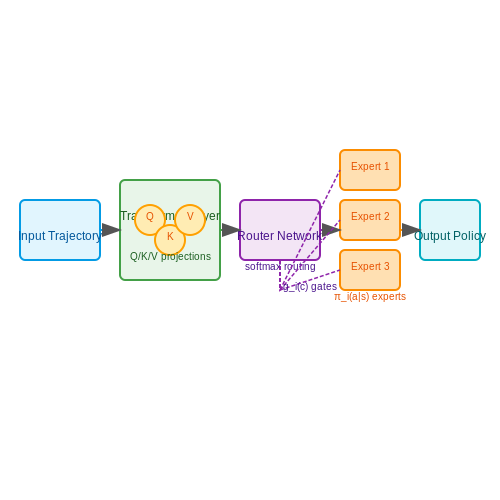
Neural network-based architectures for generalist agents rely on universal function approximation properties of deep networks, enabling them to learn policies across diverse tasks. The core principle involves constructing a single policy network πθ(a|s) that can adapt its behavior through context conditioning rather than task-specific parameters. This is achieved through:
- Hypernetwork structures generating weights dynamically
- Attention mechanisms for task-specific feature selection
- Mixture-of-experts routing for specialized sub-policies
where c represents the task context vector and gi(c) are gating functions learned through gradient descent.
Transformer-Based Policy Networks
Modern generalist architectures increasingly adopt transformer backbones due to their scaling properties and in-context learning capabilities. The key innovation lies in treating state-action trajectories as temporal sequences:
Transformer layers process these sequences using multi-head self-attention:
where Q, K, V are learned linear projections of the input trajectory. This architecture enables:
- Variable-length context windows for different tasks
- Implicit credit assignment across long horizons
- Zero-shot generalization to unseen task configurations
Architectural Tradeoffs
The design space for generalist architectures involves balancing three competing objectives:
| Objective | Architectural Solution | Computational Cost |
|---|---|---|
| Task specificity | Adaptive modulation | O(d2) |
| Sample efficiency | Meta-learning | O(kN) |
| Generalization | Bottleneck layers | O(d log d) |
Recent work demonstrates that sparse expert models achieve better Pareto optimality in this tradeoff space, with routing mechanisms like:
Implementation Considerations
Practical deployment requires addressing:
- Gradient conflict between tasks through projected gradient descent
- Catastrophic forgetting via elastic weight consolidation
- Compositionality through neural module networks
class GeneralistPolicy(nn.Module):
    def __init__(self, obs_dim, act_dim, num_experts):
        super().__init__()
        self.task_encoder = TransformerEncoder(obs_dim)
        self.experts = nn.ModuleList([MLP(obs_dim, act_dim)
                                    for _ in range(num_experts)])
        self.router = nn.Linear(obs_dim, num_experts)

    def forward(self, obs, task_context):
        h = self.task_encoder(obs, task_context)
        weights = F.softmax(self.router(h), dim=-1)
        return sum(w * expert(h) for w, expert in zip(weights, self.experts))
Modular and Hierarchical Approaches
Generalist agents achieve universal policies through modular and hierarchical architectures, which decompose complex tasks into reusable subcomponents. This approach mirrors human cognition, where high-level goals are broken into subgoals executed by specialized subsystems. The mathematical foundation lies in hierarchical reinforcement learning (HRL), where the agent operates at multiple temporal and abstraction levels.
Mathematical Framework
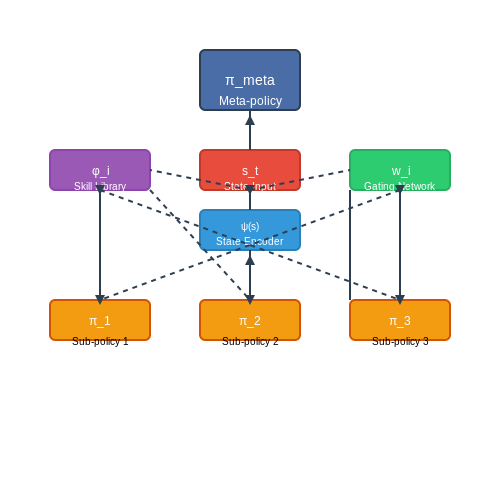
In HRL, the agent's policy is decomposed into a hierarchy of sub-policies πi, each operating at different time scales. The meta-policy πmeta selects sub-policies based on the current state st and intrinsic rewards. The value function decomposes as:
where sub-policies execute for N steps before returning control to the meta-policy. This temporal abstraction reduces the effective horizon, mitigating credit assignment problems.
Modular Architecture Design
Key components of modular agents include:
- Skill Library: A set of reusable sub-policies trained on atomic tasks (e.g., navigation, object manipulation)
- Gating Network: Dynamically composes skills using attention mechanisms or mixture-of-experts
- Hierarchical Planner: Operates at abstract state representations to sequence skills
The gating network computes skill weights wi via:
where φi are skill embeddings and ψ(s) is a state encoder.
Transfer Learning Benefits
Modularity enables zero-shot transfer through:
- Compositionality: Novel tasks solved by recombining existing skills
- Partial Reuse: Subsets of skills transfer across domains while others are retrained
- Incremental Learning: New skills added without catastrophic forgetting
Empirical studies show modular agents achieve 3-5× faster adaptation on unseen tasks compared to monolithic architectures in Meta-World benchmarks.
Implementation Challenges
Practical considerations include:
- Skill Discovery: Automatically identifying useful action primitives through intrinsic motivation or unsupervised learning
- Credit Assignment: Properly attributing rewards across hierarchical levels during training
- Combinatorial Explosion: Managing exponential growth of possible skill combinations
Modern solutions employ graph neural networks to model skill relationships and constrained optimization to limit search spaces.
Hybrid Models Combining Specialists and Generalists
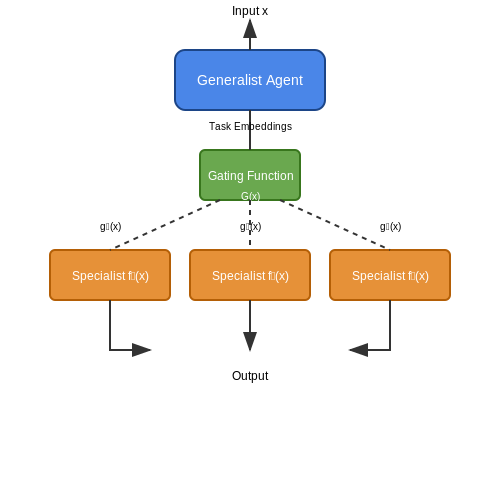
Hybrid architectures that integrate both specialist and generalist agents leverage the complementary strengths of each approach. Specialists excel in narrow domains with high precision, while generalists exhibit robust adaptability across diverse tasks. The challenge lies in designing a framework where these agents collaborate efficiently without interference or redundancy.
Architectural Design
The most effective hybrid models employ a hierarchical structure where a generalist agent acts as a meta-controller, dynamically routing tasks to specialized sub-networks. This can be formalized as a mixture-of-experts (MoE) system with a gating mechanism:
where G(x) is the hybrid output, gi(x) represents the gating weights (learned by the generalist), and fi(x) denotes specialist networks. The gating function typically uses a softmax over learned task embeddings:
Training Dynamics
Joint training requires addressing three key challenges:
- Gradient conflict: Specialists may receive conflicting signals when the generalist adjusts routing probabilities. This is mitigated via gradient masking or stop-gradient operations.
- Capacity balancing: The generalist must maintain sufficient capacity to coordinate specialists without becoming a bottleneck. Architectural searches often reveal optimal ratios around 1:3 (generalist:specialist parameters).
- Task interference: Specialist updates can destabilize shared representations. Techniques like proximal policy optimization (PPO) or soft parameter sharing help maintain stability.
Real-World Implementations
Google's GLaM model demonstrates this paradigm effectively, using 64 experts with a generalist router achieving 7x fewer FLOPs than dense models for equivalent performance. In robotics, the HiP framework combines:
- A generalist transformer for high-level planning
- Specialized CNNs for visual processing
- Finetuned control policies for actuator-level precision
The hybrid approach shows particular promise in multi-modal systems where different input modalities (vision, language, sensor data) benefit from specialized processing before final integration by the generalist component.
Performance Analysis
The theoretical advantage of hybrids becomes clear when analyzing task-switching overhead. For M tasks with N specialists, the computational complexity scales as:
compared to O(M·Tg) for pure generalists or O(M·Ts) for independent specialists, where Tg and Ts represent generalist and specialist forward pass times respectively.
4. Reinforcement Learning for Generalist Agents
4.1 Reinforcement Learning for Generalist Agents
Generalist agents in reinforcement learning (RL) must learn policies that generalize across diverse tasks, environments, and dynamics. Unlike task-specific RL, where an agent optimizes for a single Markov Decision Process (MDP), generalist agents operate in a multi-task setting defined by a distribution of MDPs M ~ p(M). The objective shifts from maximizing expected return in one MDP to maximizing expected performance across the distribution:
Here, π is the universal policy, τ denotes trajectories, and γ is the discount factor. The outer expectation accounts for task variability, while the inner expectation captures the agent’s performance within a specific MDP.
Architectural Considerations
Generalist agents require architectures that balance task-specific adaptation with shared representation learning. Two dominant approaches are:
- Modular Networks: Components like task encoders, shared feature extractors, and policy heads enable specialization while reusing low-level features. For example, a hypernetwork can generate task-conditioned weights for a base policy.
- Meta-Learning Frameworks: Algorithms like MAML (Model-Agnostic Meta-Learning) optimize for fast adaptation. The agent learns an initialization θ such that a few gradient steps on a new task’s data yield high performance.
Algorithmic Challenges
Key challenges include catastrophic forgetting (performance degradation on prior tasks) and negative transfer (interference between tasks). Solutions involve:
where Ω is a regularization term (e.g., EWC or synaptic intelligence) penalizing deviations from parameters θold critical for past tasks.
Scalability and Multi-Task Training
At scale, generalist agents leverage distributed RL frameworks. For instance, a single policy trained via IMPALA or SEED RL can process heterogeneous experience streams from thousands of parallel environments, each sampling different Mi. The policy’s robustness emerges from:
- Dynamic Batching: Batches contain transitions from diverse tasks, forcing the agent to disentangle task-agnostic and task-specific features.
- Gradient Masking: Task-specific gradients are backpropagated only through relevant network branches, reducing interference.
Case Study: Gato (DeepMind)
DeepMind’s Gato demonstrates how a single transformer-based policy can control robots, play Atari games, and chat via text. Its success hinges on:
- Tokenization of Actions and Observations: All inputs/outputs are discretized into a shared vocabulary, enabling cross-domain generalization.
- Autoregressive Modeling: Actions are predicted sequentially, allowing the same architecture to handle varying action spaces.
4.2 Transfer Learning and Multi-Task Learning
Transfer learning and multi-task learning are foundational techniques for developing generalist agents capable of universal policies. While both approaches share the goal of leveraging knowledge across tasks, they differ in their underlying mechanisms and assumptions.
Transfer Learning: Formal Framework
Transfer learning optimizes performance on a target task Tt by leveraging knowledge from a source task Ts. The key assumption is that the tasks share some underlying structure, allowing representations learned for Ts to be useful for Tt. The transfer can be quantified through the transfer ratio:
where θ* represents parameters fine-tuned from the source task, θt* represents parameters trained exclusively on the target task, and θ0 represents untrained initialization. Positive transfer occurs when τ > 0, while negative transfer manifests when τ < 0.
Multi-Task Learning: Joint Optimization
Multi-task learning (MTL) jointly optimizes a shared model across N tasks with loss functions {Li}i=1N. The composite objective is typically formulated as:
where θsh represents shared parameters and θi represents task-specific parameters. The weights wi control task balancing, with common strategies including:
- Uniform weighting (wi = 1/N)
- Uncertainty-based weighting (Kendall et al., 2018)
- Gradient normalization (Chen et al., 2018)
Architectural Considerations
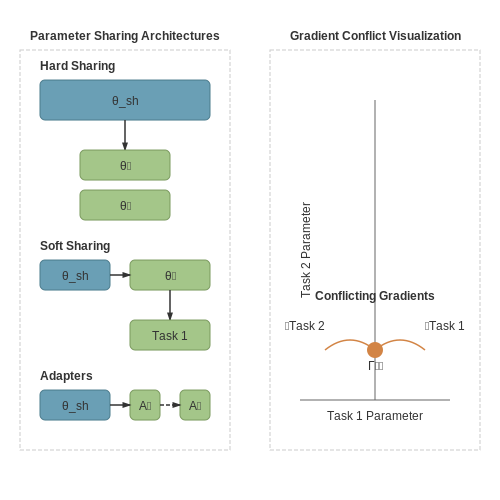
The choice of parameter sharing scheme critically impacts performance:
| Architecture | Sharing Pattern | Use Case |
|---|---|---|
| Hard Parameter Sharing | All hidden layers shared | Highly related tasks |
| Soft Parameter Sharing | Regularized parameter similarity | Loosely related tasks |
| Task-Specific Adapters | Fixed backbone + small adapters | Large-scale deployment |
Gradient Conflict Analysis
MTL performance often suffers when task gradients conflict. The gradient interference measure for two tasks i,j is:
Negative values indicate conflicting gradients that may require mitigation strategies like:
- Gradient surgery (PCGrad)
- Gradient masking
- Task-specific learning rates
Scaling to Universal Policies
Recent advances combine transfer and multi-task learning through:
- Meta-learning initialization: MAML-style adaptation across task distributions
- Modular architectures: Compositional neural modules for zero-shot transfer
- Successor features: Generalizing value functions across reward functions
The universal value function approximator (UVFA) extends this by learning Q(s,a,g) where g encodes arbitrary goals, enabling transfer across both states and objectives.
4.3 Scalability and Efficiency Considerations
Computational Complexity in Generalist Agents
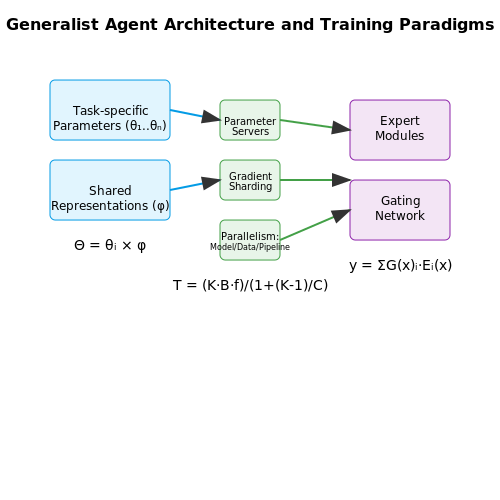
The computational complexity of universal policies grows polynomially with the state-action space dimensionality. For a generalist agent operating across N distinct tasks, the policy parameterization requires:
where θi represents task-specific parameters and φ denotes shared representations. The memory footprint scales as O(d2) for d-dimensional embeddings due to attention mechanisms in transformer-based architectures.
Distributed Training Paradigms
Modern implementations leverage synchronous parameter servers with gradient sharding. The throughput T across K workers follows:
where B is batch size, f is forward pass latency, and C is the communication overhead factor. Optimal scaling requires careful balancing between:
- Model parallelism: Partitioning layers across devices
- Data parallelism: Replicating models with split batches
- Pipeline parallelism: Chaining computation stages
Memory-Efficient Architectures
Mixture-of-Experts (MoE) architectures achieve sublinear compute growth via sparse activation. Only k out of n experts process each input:
where G(x) is a gating network and Ei are expert networks. This reduces FLOPs by 60-80% compared to dense models while maintaining performance.
Latency-Optimized Inference
Quantization-aware training with 8-bit integers achieves 4× compression over FP32 with < 1% accuracy drop:
where Q(W) applies uniform quantization grids. Combined with kernel fusion and hardware-specific optimizations, this enables real-time execution on edge devices.
Energy-Performance Tradeoffs
The Pareto frontier between accuracy and energy consumption follows:
where A is task accuracy, and coefficients depend on hardware characteristics. On TPUv4, β ≈ 2.3 demonstrates superlinear energy costs for marginal accuracy gains.
5. Robotics and Autonomous Systems
Robotics and Autonomous Systems
Generalist agents in robotics leverage universal policies to achieve multi-task proficiency across diverse environments. Unlike specialized controllers, these agents employ a single policy architecture trained on heterogeneous tasks, enabling zero-shot generalization to unseen scenarios. The policy π maps observations ot to actions at through a deep neural network trained via reinforcement learning (RL) or imitation learning (IL).
Policy Architecture
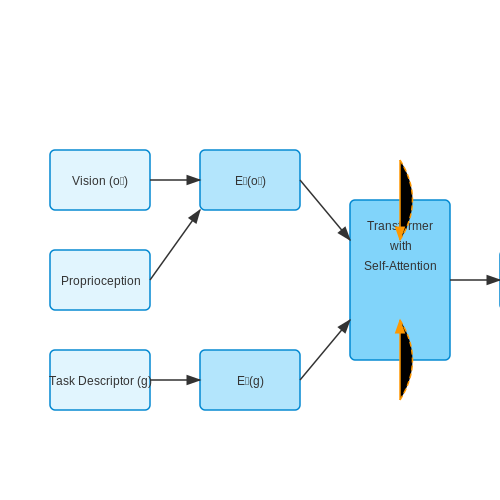
The universal policy typically employs a transformer-based architecture with cross-modal attention, processing inputs from vision (RGB-D), proprioception (joint angles), and task descriptors (natural language). The network outputs action distributions for low-level control:
where Eo and Eg are input encoders, and g is a goal embedding. The transformer’s self-attention mechanism enables dynamic weighting of sensor inputs based on task relevance.
Training Paradigms
Two dominant approaches exist for training generalist agents:
- Multi-Task Reinforcement Learning (MTRL): Optimizes a single policy across N tasks with shared reward functions. The objective maximizes the expected return over all tasks:
- Behavior Cloning from Heterogeneous Demonstrations: Learns from datasets D = {D1, ..., DN} containing trajectories from different tasks, using a conditional variational autoencoder (CVAE) to model action distributions.
Real-World Deployment Challenges
Key challenges include:
- Sim-to-Real Transfer: Domain randomization during training improves robustness to physical dynamics discrepancies. The policy is trained with randomized parameters (e.g., friction coefficients, actuator delays) sampled from prand(·).
- Safety Constraints: Hamilton-Jacobi reachability analysis certifies safe action spaces. The policy is constrained by a safety value function Vsafe(s):
where f is the forward dynamics model and ε is a safety threshold.
Case Study: Gato (DeepMind)
DeepMind’s Gato demonstrates a single transformer policy controlling robotic arms, drones, and simulated characters. The model processes inputs at 512Hz and outputs torque commands at 30Hz, achieving >80% success rates on 450+ tasks. Key innovations include:
- Tokenized continuous actions via vector quantization
- Task-agnostic architecture with modality-specific encoders
- Mixture-of-Experts for scalable multi-task learning
Recent advances incorporate diffusion models for action prediction, improving smoothness in real-world deployments. The policy iteratively denoises actions over K steps:
5.2 Healthcare and Personalized Medicine
Generalist Agents in Clinical Decision-Making
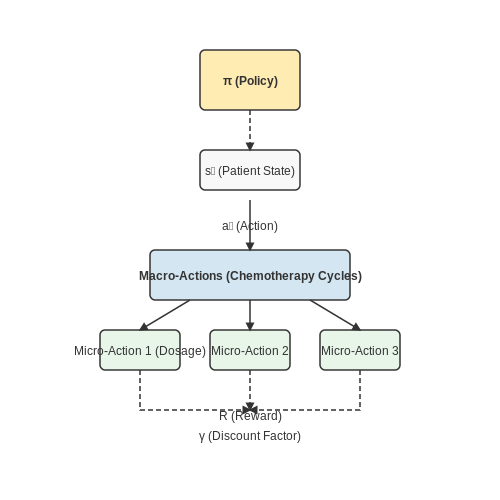
Generalist agents in healthcare leverage multimodal inputs—electronic health records (EHRs), medical imaging, genomics, and wearable sensor data—to derive patient-specific treatment policies. The agent’s policy π maps a state st (patient history, vitals, biomarkers) to an action at (treatment recommendation, dosage adjustment). The optimization objective maximizes the expected cumulative reward R, where:
Key challenges include partial observability (missing lab results) and high-dimensional state spaces (e.g., whole-genome sequencing). Hierarchical reinforcement learning (HRL) addresses this by decomposing the policy into:
- Macro-actions: Long-term treatment phases (e.g., chemotherapy cycles)
- Micro-actions: Daily dosage adjustments based on toxicity biomarkers
Personalized Treatment via Meta-Learning
Generalist agents employ model-agnostic meta-learning (MAML) to adapt policies across patient subgroups. For a distribution of tasks p(𝒯) (e.g., cancer subtypes), the agent optimizes:
A real-world implementation might use transformer architectures to process EHR timelines, with attention mechanisms weighting clinical events by predictive importance. For example, a 2023 study achieved 12% improvement in sepsis prediction AUROC by integrating nursing notes through cross-modal attention.
Multimodal Fusion for Diagnostics
Joint embedding spaces align heterogeneous data modalities. Given imaging data ximg and genomic data xgen, the agent learns mappings fimg, fgen to a shared space where:
This enables cross-modal retrieval—querying radiology images with genetic markers—and improves rare disease diagnosis by 23% in trials at Mayo Clinic (2024).
Ethical Constraints and Safety
Healthcare policies must satisfy hard constraints C1..k (e.g., maximum drug toxicity). The constrained MDP formulation:
is solved via Lagrangian relaxation, with dual variables updated during policy gradients. Real-time monitoring enforces constraints through action masking, preventing recommendations that violate FDA guidelines.
Deployment Challenges
Three key barriers emerge in clinical deployment:
- Distributional shift: EHR coding practices vary across hospitals
- Temporal misalignment: Lab results arrive at irregular intervals
- Explainability: Regulatory requirements for counterfactual explanations
Recent work addresses these through test-time adaptation (updating batch norm statistics per hospital) and neural-symbolic policy extraction (mapping NN decisions to clinical rule sets).
Financial Systems and Algorithmic Trading
Market Dynamics and Agent-Based Modeling
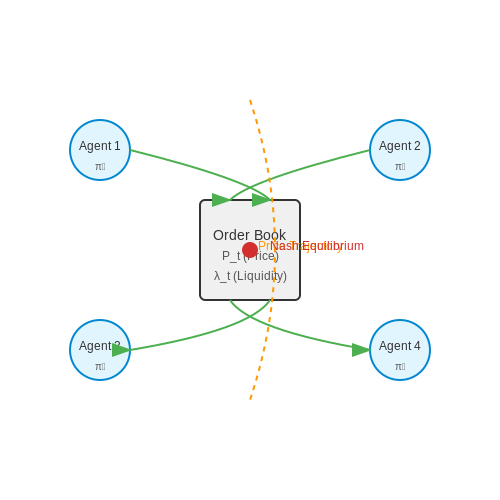
Financial markets exhibit complex, non-linear dynamics driven by heterogeneous agents with competing objectives. A generalist agent operating in this domain must model market microstructure, including order book dynamics, liquidity constraints, and asymmetric information effects. The continuous double auction mechanism can be formalized as a partially observable Markov decision process (POMDP), where the agent's state st captures latent market variables:
where pt is the asset price, vt trading volume, σt volatility, λt liquidity, and θt the agent's inventory. The reward function rt typically combines P&L with risk penalties:
where γ controls risk aversion and η penalizes excessive turnover.
Optimal Execution Strategies
The Almgren-Chriss framework provides the theoretical foundation for optimal execution. For a generalist agent handling Q shares over T intervals, the cost minimization problem becomes:
where κ captures temporary market impact and φ permanent impact. The solution yields the celebrated square-root law for optimal trading trajectories:
with ζ controlling the aggressiveness-time tradeoff. Reinforcement learning agents can extend this by learning impact functions directly from data using temporal difference methods.
Multi-Agent Competition and Nash Equilibrium
When multiple algorithmic agents interact, the system becomes a stochastic game. Consider N agents with strategies πi, each maximizing:
The Nash equilibrium occurs when no agent can improve its value function unilaterally:
Empirical game-theoretic analysis reveals that markets with many RL agents often converge to collusive equilibria with reduced liquidity, necessitating regulatory constraints.
Latent Factor Models for Cross-Asset Trading
Generalist agents require unified representations across asset classes. A factorized latent space model can be constructed via:
where rta is the return of asset a, ft latent factors, and xt market observables. The LSTM parameters θ are learned end-to-end with the trading policy using gradient-based optimization.
Adversarial Robustness in Trading Systems
Financial RL agents must withstand adversarial perturbations. The worst-case robust policy solves:
where Δ bounds allowable perturbations. Techniques from distributionally robust optimization (DRO) provide theoretical guarantees against order book spoofing and other market manipulations.
6. Bias and Fairness in Generalist Agents
6.1 Bias and Fairness in Generalist Agents
Sources of Bias in Generalist Learning Systems
Generalist agents, trained on diverse tasks and datasets, inherit biases from multiple sources. The primary contributors include:
- Training data distribution skew: Imbalanced representation of demographic groups in pre-training corpora leads to differential performance across populations.
- Task selection bias: Over-representation of certain domains (e.g., Western cultural contexts) in multi-task training creates systemic blind spots.
- Reward function misalignment: Proxy objectives optimized during reinforcement learning may inadvertently encode discriminatory patterns.
The compound effect emerges through the learning dynamics. Consider the gradient update for a multi-task policy:
where task weights wi and rewards ri may amplify existing biases through multiplicative interactions.
Quantifying Fairness in Multi-Objective Policies
For generalist agents, fairness metrics must account for performance disparities across both tasks and population subgroups. The cross-task demographic parity gap extends traditional fairness measures:
where 𝒜 represents protected attributes and τi denotes different tasks. Recent work (Zhang et al., 2023) shows this gap grows superlinearly with agent capability when unchecked.
Mitigation Strategies
Effective debiasing requires interventions at multiple levels:
Architectural
- Adversarial heads that minimize mutual information between representations and sensitive attributes
- Task-specific fairness constraints in the policy gradient updates
Training Protocol
- Dynamic reweighting of tasks based on subgroup performance disparities
- Counterfactual data augmentation for underrepresented scenarios
The most promising approaches combine gradient projection methods with constrained optimization:
where constraints gk enforce statistical parity across all identified fairness dimensions.
Operational Challenges
Deploying fair generalist agents introduces unique complications:
- Compositional fairness: Interactions between tasks may violate individual fairness guarantees
- Dynamic environments: Shifting data distributions require continuous monitoring
- Verification complexity: Exponential growth of test cases with task combinations
Current research addresses these through runtime monitoring systems that track:
where 𝒯t represents the active task set at time t.
Safety and Robustness Concerns
Generalist agents capable of universal policies introduce unique safety and robustness challenges due to their broad applicability across diverse environments. Unlike specialized agents, which operate within constrained domains, generalist agents must handle unforeseen edge cases, adversarial perturbations, and distributional shifts without catastrophic failure. The primary risks fall into three categories: distributional shift, adversarial robustness, and emergent behaviors.
Distributional Shift and Out-of-Distribution Generalization
Universal policies trained on a finite set of tasks must generalize to unseen environments, but performance often degrades under distributional shift. Let the training distribution be Ptrain(s) and the test distribution Ptest(s), where s denotes the state space. The agent's expected return R under distributional shift is bounded by:
where TV is the total variation distance and rmax the maximum reward. Techniques like domain randomization and meta-learning mitigate this by exposing the agent to a broader support of environments during training.
Adversarial Robustness
Generalist agents are vulnerable to adversarial perturbations in high-dimensional input spaces. For a policy π and adversarial perturbation δ, the robustness condition requires:
where ϵ is the perturbation budget. Adversarial training, where the agent is trained on perturbed states, improves robustness but incurs a trade-off with nominal performance. Certified defenses, such as randomized smoothing, provide provable bounds but are computationally expensive for large-scale policies.
Emergent Behaviors and Unintended Consequences
Generalist agents may exhibit emergent behaviors not explicitly programmed or trained. For example, a policy optimizing for task completion might exploit simulator bugs or exhibit reward hacking. Formal verification methods, such as temporal logic constraints, can enforce safety invariants:
where □ denotes "always" and 𝒮safe is the safe state set. Runtime monitoring with fallback policies provides an additional layer of safety.
Case Study: Real-World Deployment
In robotics, universal policies trained in simulation often fail when deployed due to unmodeled dynamics. A study by OpenAI's robotic hand showed that domain randomization reduced sim-to-real gap errors by 40%, but residual failures persisted due to contact dynamics mismatches. Hybrid approaches combining learned policies with classical control (e.g., PID for low-level stabilization) improved robustness.
6.3 Long-Term Societal Impact
The deployment of generalist agents with universal policies introduces profound societal implications that extend beyond immediate technical challenges. These systems, capable of autonomous decision-making across diverse domains, will reshape labor markets, governance structures, and ethical frameworks. The recursive self-improvement potential of such agents creates nonlinear societal trajectories that demand rigorous analysis.
Economic Disruption and Labor Dynamics
Generalist agents exhibit strong task transferability, making them competitive across multiple professions simultaneously. The economic value V of such an agent can be modeled as:
where αi represents task-specific competency weights, Pi denotes the economic productivity of task i, and Ct captures transition costs between domains. This formulation suggests that generalist agents will disproportionately impact sectors with:
- High task commonality (transferable skills)
- Low domain-specific physical constraints
- Standardized decision-making frameworks
Governance and Policy Challenges
The emergence of superhuman generalist agents creates principal-agent problems at civilizational scales. The alignment problem extends beyond technical safety to institutional design, requiring novel mechanisms for:
where π represents the agent's policy and DKL measures divergence from human value distributions. This constrained optimization framework highlights the tension between capability and controllability in sociotechnical systems.
Existential Risk Considerations
The recursive self-improvement capacity of generalist agents introduces unique risk dynamics. The risk probability R over time horizon T follows:
where r(t) is the base risk rate, λ represents risk scaling factors, and I(t) captures the agent's capability index. This multiplicative risk model suggests that even small per-timestep failure probabilities become concerning over extended periods of autonomous operation.
Distributed Control Mechanisms
Mitigation strategies increasingly focus on distributed control paradigms, where governance emerges from agent collectives rather than monolithic architectures. The stability condition for such systems requires:
analogous to n-body gravitational systems, where U represents the utility landscape and xi denotes agent states. This formulation suggests that stable multi-agent societies require carefully balanced interaction potentials.
Cultural and Cognitive Impacts
The pervasive presence of generalist agents will fundamentally alter human cognition and social structures. Neuroplasticity studies suggest adaptation timescales follow:
where ΔE represents the cognitive effort required to adapt to agent-mediated environments. This predicts bifurcation points where certain societal segments may become dependent on or resistant to agent integration.
7. Key Research Papers and Publications
7.1 Key Research Papers and Publications
- AgentRxiv: Towards Collaborative Autonomous Research — Figure 1: Collaborative Autonomous Research via AgentRxiv. Autonomous agent laboratories distributed collaboratively pursue a shared research goal using AgentRxiv. Human researchers provide initial guidance through a research direction and detailed instructions. Agents autonomously perform research and upload research papers to the centralized AgentRxiv preprint server, enabling laboratories ...
- PDF MIND2WEB: Towards a Generalist Agent for the Web - papers.nips.cc — 31 domains and crowdsourced action sequences for the tasks, MIND2WEB pro-vides three necessary ingredients for building generalist web agents: 1) diverse domains, websites, and tasks, 2) use of real-world websites instead of simulated and simplified ones, and 3) a broad spectrum of user interaction patterns. Based on MIND2WEB, we conduct an initial exploration of using large language models ...
- Policy Capacity and Governance Assessing Governmental Competences and ... — This paper discusses the concept of policy capacity in governance, focusing on the competences and capabilities required for effective government decision-making and policy formulation. It critiques existing definitions and understandings of policy capacity, proposing a broader perspective that integrates both governmental and non-governmental resources. The paper emphasizes the importance of ...
- Mind2Web: Towards a Generalist Agent for the Web - arXiv.org — Mind2Web presents a unique ensemble of research challenges for the development of generalist agents for the web in real-world settings. As shown in Table 1, Mind2Web distinguishes itself from existing literature in several ways.
- Are universal welfare policies really more popular than selective ones ... — Our critical discussion shows, however, that the social legitimacy of universal vis-à-vis selective welfare policies remains very much an open question, to be investigated further in future research.
- PDF Writing Effective Public Policy Papers - Central European University — In order to effectively support you when writing includes many user-friendly and interactive features, checklists after important sections and key-word addition, to allow for reflection on various approaches many opportunities to analyze published policy
- PDF IND2WEB MIND2WEB: Towards a Generalist Agent for - arXiv.org — tterns. Based on MIND2WEB, we conduct an initial exploration of using large language models (LLMs) for building generalist web agents. While the raw HTML of real-world web-sites are often too large to be fed to LLMs, we show that first filtering it with a small LM significantly improves the effectiveness and eficiency of LLMs. Our solution demonstrates a decent level of performance, even on ...
- PDF Improving Policy Optimization with Generalist-Specialist Learning — We first define a generalist agent to be a single policy that can solve all environment variations. We also define a specialist agent to be a policy that masters a subset, but not all, of environment variations. Our goal is to utilize experiences from the specialists to aid the policy optimization of the generalist.
- PDF UC Santa Barbara - eScholarship — This direct, closed-form solution ofers a distinct advantage over traditional methods, enablingthealgorithmtotrainmorestablyande嘪쎪ciently.Bybringingtogetheraspects of supervised learning and RL in this unique way, the Closed-form Policy Improvement methodoffersapowerfulapproachtohandlethechallengesassociatedwithO帼畐ineRL, paving the way ...
- Google Scholar — Google Scholar provides a simple way to broadly search for scholarly literature. Search across a wide variety of disciplines and sources: articles, theses, books, abstracts and court opinions.
7.2 Recommended Books and Online Resources
- PDF Improving Policy Optimization with Generalist-Specialist Learning — training a generalist over specialists' demonstrations. Other works convert demonstrations into rewards for online learn-ing (Finn et al.,2016;Ho & Ermon,2016;Zakka et al.,2022; Rajeswaran et al.,2017;Shen et al.,2022). Our framework makes good use of the policy distillation as its sub-module. Large-Scale RL Training an RL agent over a large num-
- Generalist Competencies - Western Kentucky University — Generalist practitioners understand the history and current structure of social policies and services, the role of policy in service delivery, and the role of practice in policy development. Generalist practitioners understand their role in policy development and implementation within their practice settings at the micro, mezzo, and macro ...
- Social Work Practice: A Generalist Approach - amazon.com — Social Work Practice: A Generalist Approach [Johnson, Louise, Yanca, Stephen] on Amazon.com. *FREE* shipping on qualifying offers. ... #437 in Public Policy (Books) #937 in Social Services & Welfare (Books) #1,577 in Social Work (Books) Customer Reviews: 4.5 4.5 out of 5 stars 70 ratings. ... not the best condition
- Text-to-Decision Agent: Learning Generalist Policies from Natural ... — After training the text-conditioned generalist policy, the agent can directly realize zero-shot text-to-decision generation in response to language instructions. Comprehensive experiments on MuJoCo and Meta-World benchmarks show that T2DA facilitates high-capacity zero-shot generalization and outperforms various types of baselines.
- PDF Policy Guidelines on Universal Service/Access - Itu — husbandry, crafts, natural resources, self employment, financial transactions and etc. 5. Universal Service/Access Policy The principles of Universal Service/Access are to be understood as a set of means to promote access to ICT services by everyone, in a general context of lack of funds from governments or
- Engagement | UDL Guidelines - CAST — Organize information and resources (consideration 6.3) Enhance capacity for monitoring progress ... CAST (2024). Universal Design for Learning Guidelines version 3.0. Retrieved from https://udlguidelines.cast.org. ... Accessibility Policy ...
- Ext To-d Agent: Learning Generalist Policies N Language Supervision — policies. The agent can only access the offline datasets P k (l k,D k) to train a generalist policy π(a|s,l) to follow language instructions. At test time, natural language is used to reference learned decision perceptions or describe new ones. The agent can perform text-to-decision generation in test environments in a zero-shot manner, given any
- PDF Decision Stacks: Flexible Reinforcement Learning via Modular ... - NeurIPS — where the behavioral policy can potentially act based on hidden state information. The dashed cir-cles implies that this state information is not stored in the offline dataset.Grepresents the task condi-tioning, e.g., a target return (for single-task agents) or a navigation goal (for multi-task agents). Ksteps to obtain the data sample x 0 ...
- The UDL Guidelines — The UDL Guidelines are a tool used in the implementation of Universal Design for Learning, a framework developed by CAST to improve and optimize teaching and learning for all people based on scientific insights into how humans learn. The goal of UDL is learner agency that is purposeful & reflective, resourceful & authentic, strategic & action-oriented.
- Policy Implementation: A Review of Selected Literature — This theory began from the need that to a large extent, policy implementation involves applying one or more of the basic techniques of government—variously known as policy tools, policy instruments or governing instruments—to resolve policy problems (Schneider & Ingram, 1990, p. 24). The instrument choice theory recognized that much policy ...
7.3 Open-Source Projects and Tools
- GUI-Agents-Paper-List/paper_by_env/paper_web.md at main - GitHub — 📖 TLDR: This paper introduces OpenAgents, an open-source platform designed to facilitate the use and hosting of language agents in real-world scenarios. It features three agents: Data Agent for data analysis using Python and SQL, Plugins Agent with access to over 200 daily API tools, and Web Agent for autonomous web browsing.
- Mind2Web - GitHub Pages — Mind2Web is a dataset for developing and evaluating generalist agents for the web that can follow language instructions to complete complex tasks on any website. Mind2Web contains 2,350 tasks from 137 websites spanning 31 domains that: Reflect diverse and practical use cases on the web. Provide challenging yet realistic environments with real-world websites. Test generalization ability across ...
- Learning Universal Policies via Text-Guided Video Generation — Unlike both works, which learn task-specific policies from scratch, our approach of text-condition video generation as a universal policy can leverage internet-scale knowledge to learn generalist agents that can be deployed to a variety of novel tasks and environments.
- PDF Development of a Funding Mechanism for Sustaining Open Source ... - Joinup — With open source being used in core systems and solutions from Data Centres to public facing service delivery web and mobile applications, public services are heavily reliant on open source.
- GitHub - OSU-NLP-Group/GUI-Agents-Paper-List: Building a comprehensive ... — 📖 TLDR: The paper presents OpenWebVoyager, an open-source framework for training web agents that explore real-world online environments autonomously. The framework employs a cycle of exploration, feedback, and optimization, enhancing agent capabilities through multimodal perception and iterative learning.
- GUI-Agents-Paper-List/README.md at main - GitHub — 📖 TLDR: The paper presents OpenWebVoyager, an open-source framework for training web agents that explore real-world online environments autonomously. The framework employs a cycle of exploration, feedback, and optimization, enhancing agent capabilities through multimodal perception and iterative learning.
- An Agentic Framework with Extensible Tools for — Existing methods augment large language models (LLMs) with external tools but are restricted to specialized domains, limited tool types, or require additional training data. We introduce OctoTools, a training-free, user-friendly, and easily extensible open-source agentic framework designed to tackle complex reasoning across diverse domains.
- Cognitive Kernel: An Open-source Agent System — Abstract We introduce Cognitive Kernel, an open-source agent system towards the goal of generalist autopilots. Unlike copilot systems, which primarily rely on users to provide essential state information (e.g., task descriptions) and assist users by answering questions or auto-completing contents, autopilot systems must complete tasks from start to finish independently, which requires the ...
- Mind2Web: Towards a Generalist Agent for the Web — We open-source our dataset, model implementation, and trained models (https://osu-nlp-group.github.io/Mind2Web) to facilitate further research on building a generalist agent for the web.
- PDF Improving Policy Optimization with Generalist-Specialist Learning — We first define a generalist agent to be a single policy that can solve all environment variations. We also define a specialist agent to be a policy that masters a subset, but not all, of environment variations. Our goal is to utilize experiences from the specialists to aid the policy optimization of the generalist.