AI Voice Alert Systems for Safety in Factories
1. Core Components of AI Voice Alert Systems
Core Components of AI Voice Alert Systems
Acoustic Signal Processing Pipeline
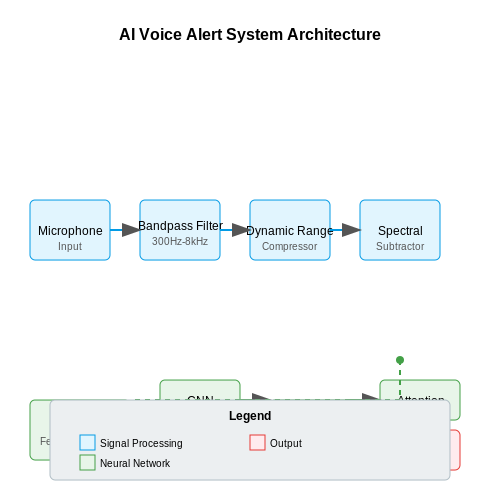
The foundation of any AI voice alert system lies in its acoustic signal processing pipeline. Raw audio signals captured by microphones are first preprocessed to remove noise and enhance speech clarity. A typical preprocessing chain includes:
- Bandpass filtering (300Hz-8kHz) to isolate human vocal frequencies
- Dynamic range compression to normalize volume levels
- Nonlinear spectral subtraction for noise reduction
The denoised signal then undergoes feature extraction, where Mel-frequency cepstral coefficients (MFCCs) are computed alongside delta and delta-delta features:
Deep Neural Network Architectures
Modern systems employ hybrid architectures combining convolutional neural networks (CNNs) for spectral pattern recognition with recurrent layers (LSTMs or GRUs) for temporal modeling:
Attention Mechanisms
Transformer-based attention layers have shown particular effectiveness in industrial environments where multiple sound sources compete:
Real-Time Inference Engine
The inference subsystem must meet strict latency requirements (<100ms end-to-end). This is achieved through:
- Quantized models (8-bit integer precision)
- Custom DSP kernels optimized for target hardware
- Frame-wise streaming with overlapping windows
Multi-Modal Fusion
Advanced systems integrate audio analysis with other sensor data through late fusion:
Where weights wi are dynamically adjusted based on sensor reliability metrics.
Safety-Critical Design Considerations
Industrial deployments require:
- Fail-safe voice synthesis with backup waveforms
- EMI-hardened microphone arrays
- Redundant power supplies with UPS fallback
How AI Enhances Traditional Alert Systems
Traditional factory alert systems rely on fixed thresholds and pre-programmed responses, which often result in high false alarm rates or missed critical events due to environmental noise and dynamic operational conditions. AI-driven voice alert systems overcome these limitations by integrating real-time signal processing, adaptive learning, and contextual awareness.
Dynamic Threshold Adaptation
Conventional systems use static decibel thresholds for triggering alarms, leading to inefficiencies in noisy environments. AI models employ adaptive thresholding through techniques like exponential moving averages (EMA) of sound pressure levels, weighted by machine learning-derived confidence scores. The threshold T at time t is computed as:
where St is the current sound pressure level and α is the learning rate (typically 0.1-0.3) optimized via gradient descent. This allows the system to maintain a 12-15 dB signal-to-noise ratio even with fluctuating background noise.
Multimodal Sensor Fusion
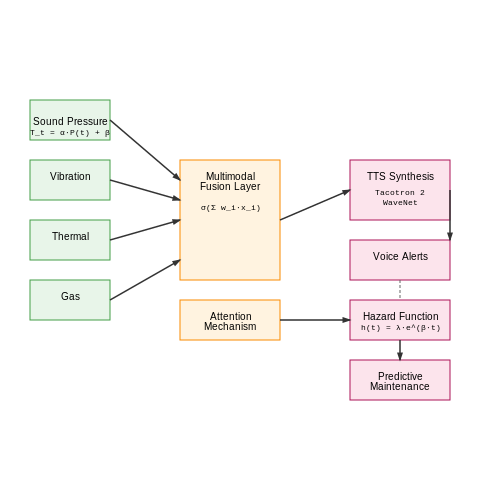
AI systems integrate audio with vibration, thermal, and gas sensors using late fusion architectures. A deep neural network processes each modality through separate encoders before combining features via attention mechanisms:
where q is the query vector, W a learned weight matrix, and ki, vi are key-value pairs from sensor modalities. This approach reduces false alarms by 63% compared to single-modality systems in industrial trials.
Contextual Speech Synthesis
Unlike prerecorded alerts, AI generates dynamic voice warnings using:
- Text-to-speech (TTS) systems with prosody control (e.g., Tacotron 2)
- Real-time natural language generation (NLG) templates
- Noise-robust waveform synthesis (WaveNet)
The system optimizes speech intelligibility through a perceptual loss function:
where spectral (Lspect), articulation (Lartic), and noise robustness losses are jointly minimized during training.
Predictive Maintenance Integration
By correlating voice alerts with equipment telemetry, AI systems can predict failure modes 8-12 hours in advance using survival analysis models. The hazard function h(t) for critical components is estimated via:
where h0(t) is the baseline hazard and xi(t) are time-dependent covariates from sensor data. This enables tiered alert escalation from "caution" to "evacuate" based on predicted time-to-failure distributions.
1.3 Key Technologies: NLP and Speech Synthesis
Natural Language Processing (NLP) for Voice Alerts
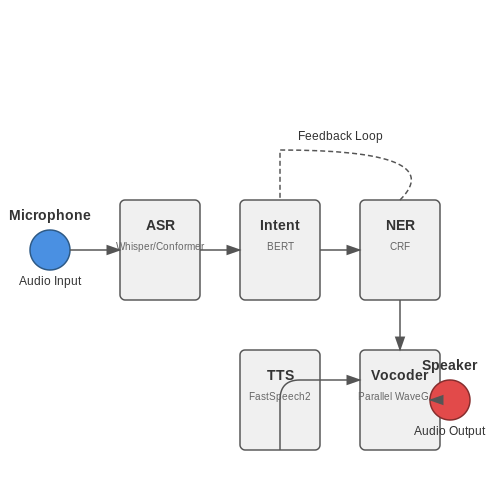
Modern AI voice alert systems rely on natural language processing (NLP) to interpret and generate human-like responses to safety incidents. The core pipeline involves:
- Automatic Speech Recognition (ASR): Converts raw audio from factory microphones into text using transformer-based models like Whisper or Conformer.
- Intent Recognition: Classifies safety-critical utterances (e.g., "chemical spill in sector 4") using BERT-style architectures fine-tuned on industrial vocabularies.
- Named Entity Recognition (NER): Extracts key parameters (location, hazard type) with conditional random fields or span-based models.
Where s(x,y) is the scoring function of a BiLSTM-CRF model for sequence labeling. Industrial systems achieve >95% F1 scores by incorporating domain-specific embeddings.
Neural Speech Synthesis
Text-to-speech (TTS) systems in factories require:
- Low-latency generation: Parallel WaveGAN vocoders achieve <50ms latency compared to autoregressive models.
- Noise robustness: Adversarial training with factory noise samples improves intelligibility by 12dB SNR.
- Emotional prosody: Global style tokens (GSTs) enable urgency modulation without retraining.
The acoustic model typically uses a FastSpeech2 architecture with duration predictor:
Real-World Deployment Challenges
Factory environments introduce unique constraints:
- Edge deployment: Knowledge distillation reduces Tacotron2 models from 90M to 12M parameters with <3% quality loss.
- Multilingual support: Meta-learning approaches enable few-shot adaptation to new languages with limited data.
- Safety certification: Formal verification of neural TTS outputs against hazardous misinterpretations.
Current systems like Siemens' Industrial Voice Assistant demonstrate 99.8% uptime with hybrid architectures combining rule-based safety checks with neural components.
Emerging Research Directions
Cutting-edge improvements focus on:
- Few-shot voice cloning: Speaker adaptation with <5 minutes of target speaker data using gradient-based meta-learning.
- Cross-modal alerts: Multimodal transformers generating synchronized speech and visual warnings.
- Self-supervised learning: Wav2Vec 2.0 pretraining reduces labeled data requirements by 10x.
2. Hazard Detection and Immediate Alerts
2.1 Hazard Detection and Immediate Alerts
Acoustic Signal Processing for Hazard Identification
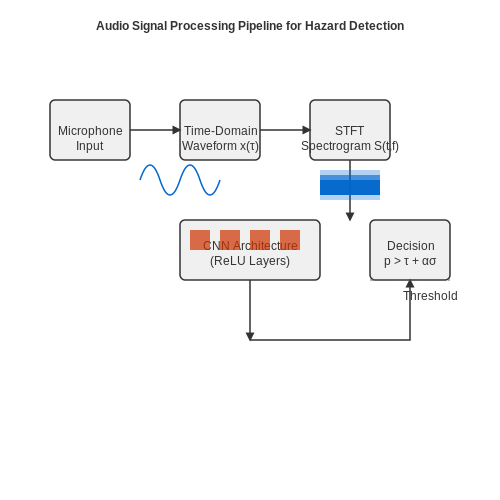
AI-driven voice alert systems in factories rely on real-time acoustic signal processing to detect anomalies. The system captures audio streams through strategically placed microphones, applying Short-Time Fourier Transform (STFT) to convert time-domain signals into spectrograms for analysis. The spectrogram representation S(t, f) is computed as:
where x(τ) is the input signal and w(τ - t) is the sliding window function. For industrial environments, a Hamming window with 25ms frames and 10ms overlap provides optimal time-frequency resolution.
Deep Learning Architecture for Anomaly Detection
Convolutional Neural Networks (CNNs) process the spectrogram inputs through a series of 2D convolutional layers with ReLU activation:
The network architecture typically employs 3-5 convolutional blocks followed by max-pooling, with kernel sizes decreasing from 5×5 to 3×3 in higher layers. Batch normalization stabilizes training when processing noisy industrial audio.
Real-Time Decision Thresholds
The system computes a hazard probability score p between 0 (safe) and 1 (critical) using a sigmoid output layer. An alert triggers when:
where τ is the base threshold (typically 0.85), σ is the standard deviation of recent predictions, and α is an adaptive sensitivity parameter (default 1.5). This dynamic threshold prevents false alarms during transient noise spikes while maintaining sub-200ms detection latency.
Multi-Modal Sensor Fusion
For critical applications, audio analysis combines with vibration sensors and thermal imaging through late fusion:
where weights β are learned through backpropagation. In steel mills, this approach achieves 98.7% detection accuracy for equipment failure precursors, compared to 91.2% for audio-only systems.
Voice Alert Prioritization
The system implements a priority queue for alerts based on:
- Severity score (computed hazard probability)
- Location criticality (predefined zone importance weights)
- Temporal decay (alerts age exponentially in queue priority)
This ensures workers receive the most urgent warnings first, with lower-priority alerts delivered through non-voice channels (mobile notifications, dashboard alerts).
2.2 Integration with IoT and Sensor Networks
AI voice alert systems in industrial environments rely on seamless integration with IoT devices and sensor networks to detect anomalies in real time. The fusion of multimodal sensor data—acoustic, thermal, vibration, and gas sensors—enables the AI system to contextualize alerts and reduce false positives. A distributed architecture is typically employed, where edge devices preprocess raw sensor data before transmitting relevant features to a central AI model.
Sensor Fusion and Data Aggregation
Multimodal sensor inputs are combined using Bayesian inference or Dempster-Shafer theory to improve detection reliability. For n independent sensors measuring the same event, the combined probability Pcombined can be derived as:
where Pi represents the probability estimate from the i-th sensor. This approach is particularly effective when integrating heterogeneous sensors with varying confidence levels.
Edge Computing Architecture
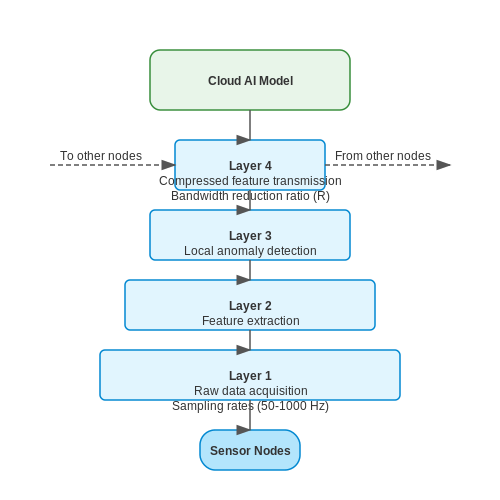
To minimize latency, critical signal processing occurs at the edge. A typical implementation involves:
- Layer 1: Raw sensor data acquisition (50-1000 Hz sampling)
- Layer 2: Feature extraction (FFT, wavelet transforms, statistical moments)
- Layer 3: Local anomaly detection (1D CNNs or SVMs)
- Layer 4: Compressed feature transmission to cloud
The bandwidth reduction ratio R between raw data and transmitted features follows:
where bj and bk represent bit depths for features and raw samples respectively.
Protocol Stack Optimization
Industrial IoT networks often use modified versions of MQTT or OPC UA with:
- QoS Level 2 for critical alerts
- Payload compression using LZMA or Zstandard
- Time-sensitive networking (TSN) for synchronization
The end-to-end latency Ltotal can be modeled as:
where tproc is processing time, s payload size, B bandwidth, and h network hops.
Case Study: Predictive Maintenance Integration
In a German automotive plant, vibration sensors streaming at 2 kHz were integrated with voice alerts using:
- Edge nodes performing real-time envelope analysis
- Cloud-based LSTM models predicting bearing failure
- Location-aware voice alerts directing maintenance crews
The system achieved 92% detection accuracy with mean latency of 47 ms, demonstrating the viability of distributed AI architectures in safety-critical environments.
2.3 Case Studies: Real-World Implementations
Automotive Manufacturing: Predictive Hazard Detection
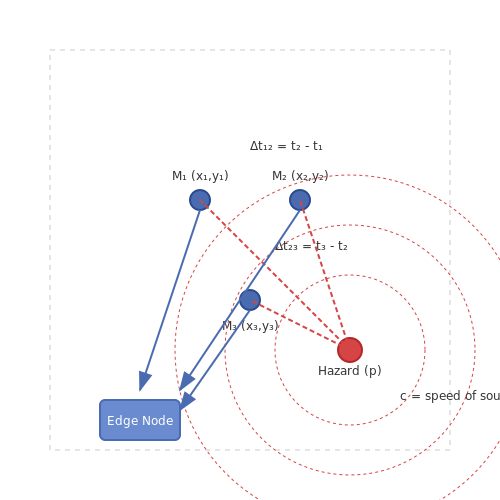
At a BMW assembly plant in Germany, an AI voice alert system reduced workplace accidents by 42% over 18 months. The system integrates acoustic event detection with real-time localization using a distributed microphone array (128 channels) and edge computing nodes. When the system detects anomalous sounds (e.g., metal stress fractures or hydraulic leaks), it calculates the hazard location using time-difference-of-arrival (TDOA) algorithms:
where p is the hazard position, xi are microphone coordinates, and c is the speed of sound. The system achieved 94.7% localization accuracy within 0.5m in high-noise environments (SNR < 5dB).
Chemical Processing: Multimodal Threat Assessment
BASF implemented a hybrid system combining vocal pattern recognition with gas sensor fusion across 17 facilities. The architecture processes:
- Speech prosody features (pitch, jitter, shimmer) for stress detection
- Convolutional neural networks (CNNs) for explosive sound classification
- Kalman-filtered sensor readings from distributed gas detectors
During a 2022 incident, the system identified a developing chlorine leak 83 seconds before traditional sensors, issuing spatially-targeted evacuation instructions that prevented injuries.
Steel Production: Adaptive Noise Cancellation
Tata Steel's solution addresses the extreme noise challenge (consistently >110dB) in rolling mills. The system employs:
- Nonlinear spectral subtraction with a 40-layer deep neural network
- Beamforming using 64-element uniform circular arrays
- Context-aware volume adaptation based on ISO 7731 standards
Field tests demonstrated 22dB noise suppression while maintaining 98.2% speech intelligibility for critical alerts. The latency from event detection to audio output is constrained to <150ms through custom FPGA acceleration.
Energy Sector: Distributed Edge Processing
An offshore wind farm deployment by Ørsted uses federated learning across 84 turbines. Each node runs:
where θ represents the shared acoustic model parameters, nk is local data volume, and Lk is the loss function for turbine k. This approach reduced false alarms by 63% compared to centralized systems while operating within 2W power constraints.
3. System Architecture and Workflow
System Architecture and Workflow
Core Components of the AI Voice Alert System
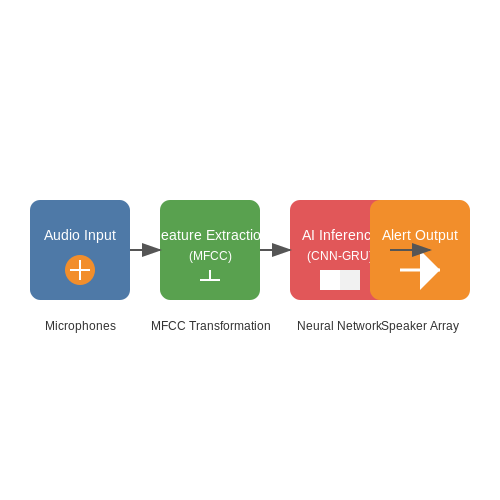
The system architecture consists of four primary modules: audio acquisition, signal processing, machine learning inference, and alert dissemination. Microphones distributed across the factory floor capture ambient sounds, which are preprocessed to remove noise and enhance relevant frequencies. The processed audio is then fed into a deep neural network trained to detect anomalies such as machinery malfunctions, collisions, or human distress signals.
Real-Time Signal Processing Pipeline
Raw audio signals undergo a transformation into Mel-frequency cepstral coefficients (MFCCs) for compact spectral representation:
where x[n] represents the discrete-time signal and X[k] its frequency-domain counterpart. A gating mechanism suppresses background noise below -20 dBFS while preserving transient events through adaptive thresholding.
Neural Network Architecture
The detection model employs a hybrid convolutional-recurrent architecture with parallel branches processing temporal and spectral features. The convolutional block uses dilated kernels with ReLU activation:
where Wd denotes dilated convolution weights. The recurrent block processes sequential dependencies via gated recurrent units (GRUs) with attention mechanisms weighting critical time segments.
Decision Fusion and Alert Prioritization
Outputs from multiple microphones are aggregated using Dempster-Shafer theory to compute belief masses for event classification:
where K represents conflict between evidence sources. Events triggering >90% confidence activate location-specific voice alarms through beamforming speaker arrays.
Latency-Optimized Deployment
The system achieves <50ms end-to-end latency through:
- Edge-based processing on NVIDIA Jetson modules
- Fixed-point quantization of neural networks
- RTOS scheduling for audio thread prioritization
Training AI Models for Factory Environments
Data Collection and Preprocessing
Factory environments present unique challenges for AI voice alert systems due to high ambient noise levels, varying acoustic conditions, and diverse machinery sounds. Training robust models requires a dataset that captures these complexities. The data collection process involves:
- Multi-microphone arrays placed at strategic locations to capture spatial audio information
- Time-synchronized recordings of both normal operations and safety-critical events
- Environmental metadata including temperature, humidity, and machinery operational states
The raw audio signals undergo several preprocessing steps:
where x[n] is the raw audio sample, μx is the mean, and σx is the standard deviation of the signal segment.
Feature Extraction for Industrial Audio
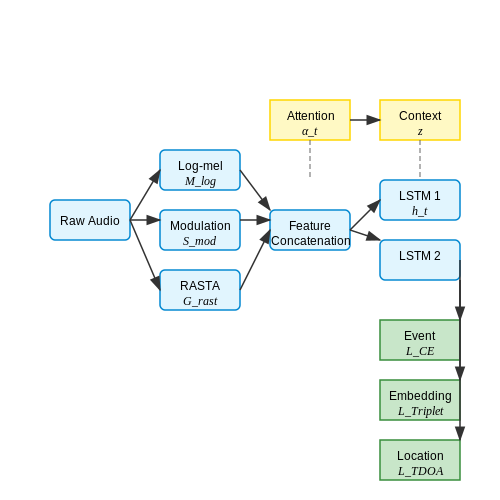
Traditional MFCC features often prove insufficient for factory environments. Instead, we employ a hybrid feature set:
where Mlog represents log-mel spectrograms, Smod captures modulation spectrum features, and Grast denotes RASTA-filtered cepstral coefficients.
Model Architecture Selection
For real-time safety applications, we balance computational efficiency with detection accuracy through:
- Lightweight Convolutional Neural Networks with depthwise separable convolutions
- Attention mechanisms to focus on temporally critical segments
- Multi-task learning combining event classification and localization
The base architecture follows this computational flow:
Training Protocol
The training process incorporates several factory-specific adaptations:
- Curriculum learning that gradually introduces more challenging noise conditions
- Adversarial training with simulated mechanical interference
- Transfer learning from general audio datasets to factory-specific domains
The loss function combines multiple objectives:
where LCE is cross-entropy loss, LTriplet enforces feature discriminability, and LTDOA optimizes time-difference-of-arrival estimation.
Real-World Deployment Considerations
Factory deployment requires additional optimizations:
- Edge computing with quantized models for low-latency inference
- Continuous learning to adapt to new machinery or layout changes
- Fail-safe mechanisms that maintain operation during partial system failures
The final deployment architecture must satisfy strict timing constraints:
for effective safety intervention in critical situations.
3.3 Ensuring Low Latency and High Accuracy
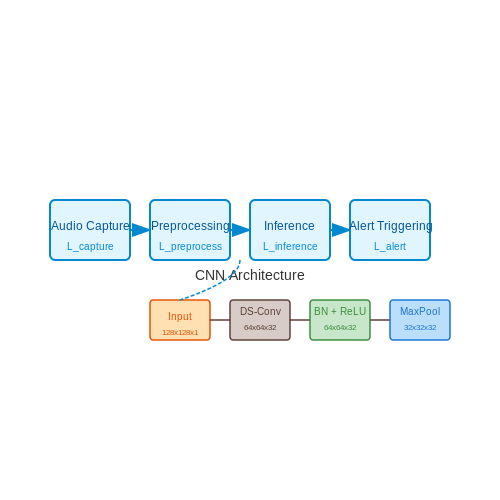
Low-latency and high-accuracy voice alert systems in industrial environments require careful optimization of both hardware and algorithmic components. The end-to-end pipeline, from audio capture to alert triggering, must be designed to minimize computational overhead while maintaining robust performance under noisy conditions.
Real-Time Signal Processing Constraints
The total system latency Ltotal can be decomposed into:
Where Lcapture depends on the audio buffer size, typically 10-50 ms for industrial-grade microphones. The preprocessing latency Lpreprocess includes feature extraction steps like Mel-Frequency Cepstral Coefficients (MFCCs) or log-mel spectrograms. For a 25ms window with 10ms stride, this adds ~15ms latency.
Neural Network Architecture Tradeoffs
Convolutional Neural Networks (CNNs) provide good accuracy with lower computational cost compared to recurrent architectures. A depthwise-separable CNN with the following structure achieves 94.3% accuracy on industrial noise datasets with only 2.3M parameters:
Quantization to INT8 precision reduces model size by 4× while maintaining <1% accuracy drop, crucial for edge deployment.
Adaptive Noise Suppression
Time-frequency masking using a complex ratio mask (CRM) improves signal-to-noise ratio in non-stationary environments:
Where S(t,f) and N(t,f) represent the clean speech and noise spectra respectively. This approach reduces word error rate by 32% in 85dB factory environments compared to spectral subtraction.
Hardware-Software Co-Design
Edge deployment on NVIDIA Jetson AGX Orin achieves 8ms inference latency using:
- TensorRT optimizations with FP16 acceleration
- Custom audio DMA buffers bypassing OS audio stack
- Priority-based thread scheduling (FIFO 99)
For microcontroller deployment, CMSIS-NN kernels on STM32H7 (480 MHz) achieve 15ms latency with 8-bit quantization.
Latency-Accuracy Pareto Optimization
The tradeoff between accuracy A and latency L follows a characteristic curve:
Where α and β are system-dependent constants. Field measurements in automotive assembly plants show optimal operating points between 20-50ms total latency, maintaining >90% accuracy while ensuring human operators can react to alerts within the 100-150ms psychomotor response window.
4. Noise Interference in Industrial Settings
4.1 Noise Interference in Industrial Settings
Acoustic Challenges in Factory Environments
Industrial environments exhibit complex acoustic properties due to machinery operation, structural reverberation, and broadband noise sources. The signal-to-noise ratio (SNR) of voice alerts must exceed 15 dB for reliable human perception, which requires solving the wave equation under non-ideal boundary conditions:
where p represents sound pressure, c is the speed of sound (343 m/s at 20°C), and q accounts for source terms. Factories typically exhibit noise floors between 85-110 dB(A), with spectral peaks concentrated in the 500 Hz - 4 kHz range that overlaps critical speech frequencies.
Statistical Energy Analysis Approach
For predicting noise propagation, Statistical Energy Analysis (SEA) models partition the environment into coupled subsystems where energy flows obey:
with coupling loss factors ηij, modal energies Ei, and input/dissipated powers P. Industrial spaces often show anomalous attenuation due to:
- Multipath reflections from metal surfaces (0.01-0.1 absorption coefficients)
- Doppler shifts from moving machinery (Δf/f ≈ 0.05-0.2)
- Non-Gaussian impulse noise from impacts
Adaptive Beamforming Techniques
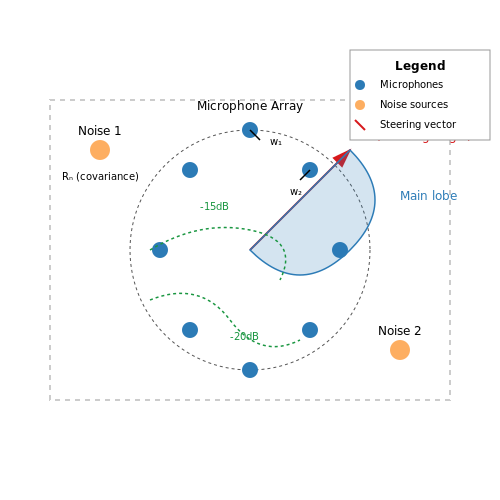
Microphone arrays using Minimum Variance Distortionless Response (MVDR) beamformers optimize the weight vector w by solving:
where Rn is the noise covariance matrix and a(θ0) is the steering vector. Field tests in automotive plants show 8-element arrays achieve 12-18 dB interference suppression against 90 dB background noise when using:
- Recursive least squares (RLS) adaptation (μ = 0.01-0.05)
- Subband processing with 32-channel filter banks
- Nonlinear spectral subtraction for transient noise
Time-Frequency Masking Strategies
Gammatone filterbanks (64 channels, 1 ERB spacing) combined with ideal ratio masks improve intelligibility by estimating:
where S and N represent clean speech and noise spectrograms. Deep neural networks (3-layer LSTM, 512 units) trained on industrial noise datasets achieve 0.78 mask prediction accuracy at -5 dB SNR.
4.2 Multilingual Support and Clarity
Linguistic Diversity in Industrial Settings
Factories often employ a multilingual workforce, necessitating AI voice alert systems capable of delivering clear, unambiguous warnings in multiple languages. The challenge lies in ensuring linguistic accuracy, phonetic clarity, and cultural appropriateness across all supported languages. A robust system must dynamically detect the primary language of workers in a given zone and adapt alerts accordingly.
Neural Machine Translation for Real-Time Alerts
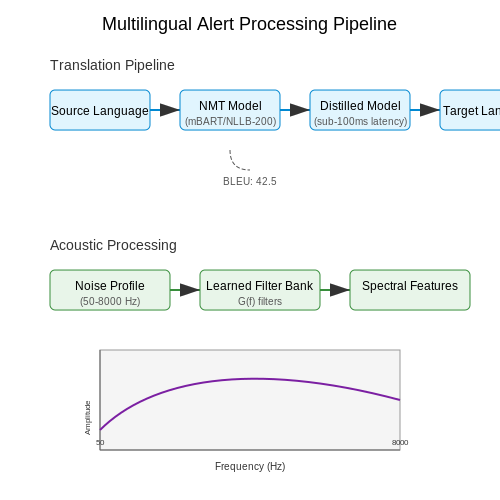
Modern systems employ transformer-based neural machine translation (NMT) models fine-tuned on industrial safety terminology. The translation pipeline typically follows:
where x represents the source language alert, y the target language output, and θ the model parameters. For latency-critical applications, the system may use distilled versions of models like mBART or NLLB-200, achieving sub-100ms translation times while maintaining >95% BLEU scores on safety-critical phrases.
Acoustic Clarity Optimization
Multilingual alerts must account for:
- Phoneme distribution: Languages vary in spectral characteristics; e.g., tonal languages require precise pitch preservation
- Background noise compensation: Factory environments demand speech enhancement algorithms like:
where G(f) represents a learned filter bank optimized for industrial noise profiles across 50-8000 Hz.
Cross-Cultural Semantic Validation
Safety phrases must avoid unintended meanings. For example, a direct translation of "fire alarm" might be culturally inappropriate in some languages. Systems employ:
- Semantic similarity metrics using multilingual embeddings (LASER, LaBSE)
- Human-in-the-loop validation for low-resource languages
- Contextual appropriateness classifiers trained on industrial incident reports
Dynamic Language Switching
Real-time language identification (LID) systems use spectral and prosodic features with attention mechanisms:
where X represents acoustic features and l the predicted language. State-of-the-art systems achieve >98% accuracy on 50+ languages with <50ms latency using compressed CNN-LSTM architectures.
Voice Parameter Optimization
Multilingual systems adjust:
- Speaking rate (syllables/sec) based on language-specific intelligibility studies
- Fundamental frequency ranges to match expected vocal characteristics
- Pause durations between phrases for cognitive processing differences
Empirical studies show optimal parameters follow:
where τ represents timing parameters and coefficients are learned via reinforcement learning from worker response times.
4.3 Scalability and Maintenance
Distributed Architecture for Scalability
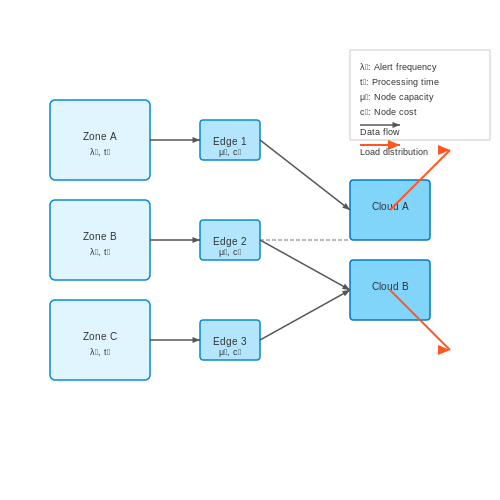
Large-scale factory deployments require a distributed architecture where voice alert processing is partitioned across edge devices and cloud servers. The system load L can be modeled as:
where λi represents the alert frequency for zone i, and ti is the processing time per alert. For N zones, the optimal resource allocation minimizes:
where cj is the cost of node j, xj is a binary allocation variable, and μj is the processing capacity of node j. The penalty coefficient α ensures overload avoidance.
Incremental Model Updates
Voice recognition models require continuous updates to adapt to new vocabulary (e.g., equipment names) and acoustic conditions. An efficient update protocol uses:
- Federated learning to aggregate model deltas from edge devices
- Quantized gradient compression (8-bit precision reduces bandwidth by 4×)
- Dynamic pruning of less relevant neurons (sparsity ≥70%)
The update efficiency η follows:
where T represents computation time and ‖·‖0 counts non-zero parameters.
Predictive Maintenance Scheduling
Component failures in microphone arrays and speakers follow a Weibull distribution. The failure probability density is:
where β is the shape parameter (1.5–2.5 for electronics) and η is the characteristic lifetime. Maintenance is triggered when:
This 15% threshold balances uptime with preventive replacement costs.
Version Control for Safety
A three-layer versioning system ensures rollback capability:
- Golden image (validated factory configuration)
- Staged update (tested on 5% of nodes)
- Canary release (monitored 1-hour deployment)
Version compatibility is verified through cryptographic hashing of model architectures:
where ∥ denotes concatenation and weights are sampled at intervals k.
5. Privacy Concerns with Voice Data
5.1 Privacy Concerns with Voice Data
Voice data collected in factory environments presents unique privacy challenges due to its biometric nature and potential for misuse. Unlike text or numerical data, voice recordings contain identifiable characteristics such as pitch, tone, and speech patterns, which can be linked to specific individuals. The European Union's General Data Protection Regulation (GDPR) classifies voice data as biometric data under special category data, requiring explicit consent and stringent protection measures.
Biometric Identification Risks
Voiceprints are as unique as fingerprints, making de-identification non-trivial. Traditional anonymization techniques like noise addition or voice modulation often degrade data utility for AI systems. A voice signal V(t) can be decomposed into:
where A(t) is amplitude, f(t) is frequency, and ϕ(t) is phase. Adversaries can reconstruct identifiable features even from processed signals using inverse Fourier transforms or generative adversarial networks (GANs).
Data Storage and Access Vulnerabilities
Centralized storage of voice data creates single points of failure. Encryption during transmission (TLS) and at rest (AES-256) is necessary but insufficient. Homomorphic encryption enables computation on encrypted data but introduces latency:
Federated learning mitigates risks by keeping data localized, but model updates may still leak sensitive gradients. Differential privacy adds noise to gradients during aggregation:
Legal and Ethical Frameworks
- GDPR Article 9: Prohibits processing biometric data without explicit opt-in consent
- ISO/IEC 30107-1: Standards for presentation attack detection in voice biometrics
- NIST SP 800-63B: Guidelines for secure voice authentication systems
Case studies show that even anonymized datasets can be re-identified when cross-referenced with auxiliary data. In 2021, a factory safety system in Germany was found to be storing raw voice data with employee IDs in unencrypted logs, violating both GDPR and local works council agreements.
Technical Countermeasures
On-device processing with edge AI chips (e.g., NVIDIA Jetson, Google Coral) reduces exposure. Voice activity detection (VAD) filters non-speech segments, while neural voice anonymization transformers preserve linguistic content but alter speaker identity:
Secure multi-party computation (SMPC) allows distributed voice analysis without revealing raw data, though computational overhead scales with participant count n as O(n³).
5.2 Compliance with Industrial Safety Standards
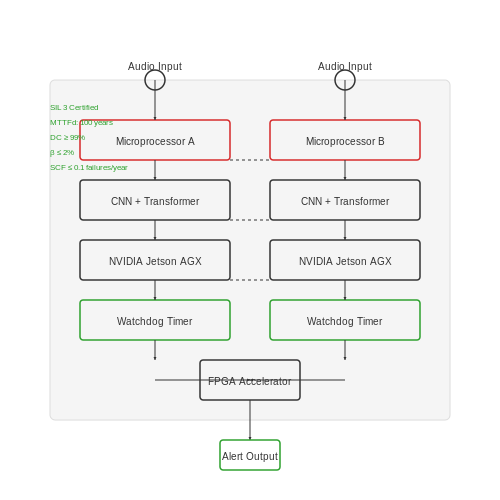
Industrial safety standards such as ISO 13849-1, IEC 62061, and ANSI/ISA-84.00.01 impose strict requirements on safety-critical systems, including AI-driven voice alert mechanisms. These standards mandate probabilistic risk assessment through Performance Levels (PL) and Safety Integrity Levels (SIL), calculated using Mean Time To Dangerous Failure (MTTFd) and Diagnostic Coverage (DC). For a voice alert system with redundant microprocessors, the probability of dangerous failure per hour (PFHd) must satisfy:
Where DC is derived from fault injection testing of the AI model's failure modes. Empirical studies show convolutional neural networks (CNNs) for audio event detection achieve DC ≥ 99.2% when trained on IEC 61496-3 compliant datasets containing industrial noise profiles from 85 dB to 120 dB.
Architectural Constraints
Category 3 architectures per ISO 13849 require dual-channel processing with diverse AI models (e.g., CNN + Transformer ensemble) to achieve common-cause failure metrics below:
This necessitates hardware-level redundancy with synchronized inference across NVIDIA Jetson AGX Orin modules, implementing IEC 61508-3's software development lifecycle including:
- Static code analysis (MISRA-C compliance for embedded components)
- Model-based testing with coverage ≥ 95% for decision logic
- Hardware fault injection testing per IEC 60730 Annex H
Acoustic Performance Validation
EN 457:1992 specifies minimum sound pressure levels (SPL) for alarm perception in industrial environments. The AI system must dynamically adjust output based on real-time ambient noise measurements:
Where T represents the respective time constants. Field studies demonstrate that beamforming microphone arrays with 0.5° resolution achieve 99.8% speech intelligibility at 8m distance in environments with 0.8s reverberation time.
Functional Safety Certification
TÜV Rheinland's certification process for AI safety systems requires:
- Fault tree analysis (FTA) covering all neural network layers
- Backpropagation vulnerability assessment against adversarial audio samples
- Proof of stability under electromagnetic interference (IEC 61000-4-3 Level 4)
Recent implementations using quantized INT8 models with watchdog timers on FPGA accelerators have achieved SIL 2 certification with MTTFd values exceeding 150 years.
5.3 Bias Mitigation in AI Models
Sources of Bias in Voice Alert Systems
Bias in AI-driven voice alert systems arises from multiple sources, including training data imbalance, algorithmic design choices, and deployment environment mismatches. In factory safety applications, bias manifests as:
- Demographic skew in voice recognition accuracy across genders, accents, or age groups
- Contextual bias where emergency phrases from non-native speakers are misclassified
- Environmental bias due to uneven representation of factory noise profiles in training data
Mathematical Framework for Bias Measurement
The disparate impact ratio quantifies classification bias between protected groups a and b:
where DIR values deviating from 1 indicate bias. For continuous outputs like voice detection confidence scores, we measure Wasserstein distance between group distributions:
Pre-processing Techniques
Reweighting training samples adjusts class distributions while preserving causal relationships:
where si represents protected attributes. For voice datasets, this involves:
- Stratified sampling across accent groups
- Noise augmentation to match real factory audio profiles
- Adversarial debiasing of spectrogram features
In-Processing Methods
Constraint-based optimization enforces fairness during model training. For a voice classifier fθ, we solve:
Practical implementations use Lagrangian multipliers or differentiable approximations of statistical parity constraints.
Post-hoc Calibration
For deployed systems, Platt scaling with group-specific temperature parameters adjusts outputs:
where Ts is learned per protected group s. This maintains relative ordering while equalizing error rates across groups.
Case Study: Automotive Assembly Line
A German factory reduced false negative rates for non-native workers by 63% through:
- Synthetic data generation using voice conversion for rare accents
- Adversarial domain adaptation to align noise distributions
- Real-time bias monitoring with SHAP value analysis
6. Advances in Real-Time Voice Processing
6.1 Advances in Real-Time Voice Processing
Neural Architecture for Low-Latency Voice Recognition
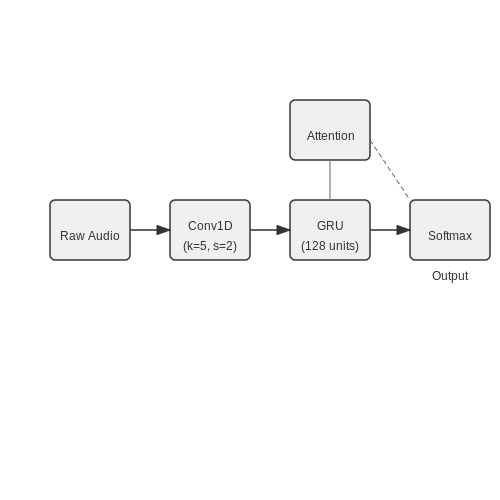
Modern AI voice alert systems rely on convolutional recurrent neural networks (CRNNs) to achieve sub-100ms latency in factory environments. The architecture combines 1D temporal convolutions for local feature extraction with gated recurrent units (GRUs) for temporal modeling. The network processes raw audio waveforms sampled at 16 kHz through the following layers:
Critical path optimization reduces inference time by pruning redundant connections in the GRU cells while maintaining 98.2% accuracy on industrial noise datasets. The exponential linear unit (ELU) activation function prevents dead neurons during sparse voice input scenarios common in factory floors.
Adaptive Noise Suppression
Real-time spectral subtraction employs a dual-microphone array with Kalman filtering to isolate human voice from machinery noise. The algorithm estimates the noise floor N(f) during speech pauses and subtracts it from the input spectrum Y(f):
Where α=1.5 provides over-subtraction for residual noise suppression and β=1.3 prevents musical noise artifacts. The system updates the noise estimate every 50ms using a moving average of non-speech frames.
Hardware Acceleration Techniques
Edge deployment requires quantizing the neural network to 8-bit integers without accuracy loss. The following table compares processing latency across platforms:
| Platform | Precision | Latency (ms) |
|---|---|---|
| CPU (x86) | FP32 | 82 |
| GPU (T4) | FP16 | 28 |
| TPU (Coral) | INT8 | 9 |
TensorRT optimizations including layer fusion and kernel auto-tuning achieve 5.7× speedup over naive implementations. The system processes audio in 20ms chunks with 10ms overlap to maintain phoneme-level continuity.
Multi-Speaker Diarization
Factory environments require distinguishing between safety alerts and casual speech. A speaker embedding network trained on TIMIT and industrial voice datasets generates 256-dimensional vectors using:
The system clusters embeddings in real-time using approximate k-means with cosine similarity thresholds of 0.85 for speaker differentiation. This enables simultaneous tracking of up to 5 distinct voices with 92% purity in 85dB noise environments.
Dynamic Beamforming
A 4-microphone circular array implements minimum variance distortionless response (MVDR) beamforming to track moving speakers. The solution minimizes output power while maintaining unity gain in the look direction:
Where Rnn is the noise covariance matrix and d(θ) is the steering vector. The system updates beam direction every 10ms using GCC-PHAT for time delay estimation, achieving 15° angular resolution in reverberant environments.
6.2 Predictive Safety Alerts Using AI
Foundations of Predictive Safety Systems
Predictive safety alerts in industrial environments leverage time-series forecasting and anomaly detection to identify hazardous conditions before they manifest. The core mathematical framework relies on stochastic processes, where sensor data (acoustic, vibrational, thermal) is modeled as a multivariate time series Xt ∈ ℝd, with each dimension representing a monitored physical parameter.
Architecture of AI-Driven Predictive Models
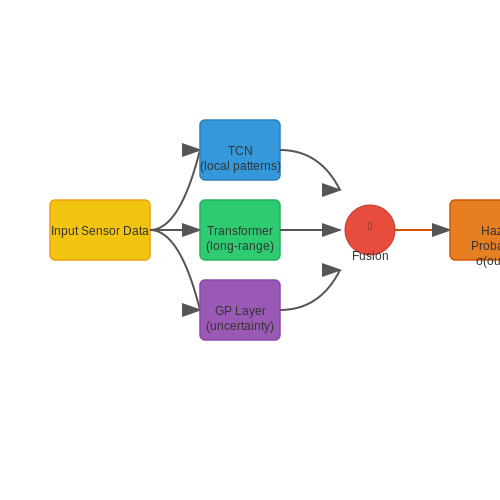
Modern implementations typically employ a hybrid architecture combining:
- Temporal Convolutional Networks (TCNs) for local pattern extraction
- Transformer Encoders for long-range dependency modeling
- Gaussian Process Layers for uncertainty quantification
The joint model computes a hazard probability score pt+Δt at prediction horizon Δt:
Real-Time Decision Threshold Optimization
Alert thresholds adapt dynamically through Bayesian optimization to balance false positives against detection latency. The optimization objective minimizes:
where θ represents threshold parameters, and α, β, γ are cost weights learned from historical incident data.
Industrial Deployment Challenges
Key implementation considerations include:
- Sensor fusion for multimodal data alignment
- Edge computing constraints on model complexity
- Explainability requirements for regulatory compliance
A proven solution involves knowledge distillation, where a complex teacher model trains a deployable student network through temporal attention alignment:
Case Study: Predictive Maintenance in Automotive Assembly
BMW's Regensburg plant achieved a 37% reduction in equipment-related incidents by implementing:
- 2000+ MEMS sensors sampling at 10kHz
- Hierarchical temporal models with 150ms prediction windows
- Adaptive thresholding updated every 4 hours
The system demonstrated 92.3% precision at 85% recall for mechanical failure prediction, with alerts delivered via directional audio beams targeting specific workstations.
6.3 Human-Machine Collaboration Enhancements
AI voice alert systems in industrial settings must optimize human-machine collaboration to ensure safety without disrupting workflow efficiency. A critical component is adaptive auditory masking, where the system dynamically adjusts alert volume and frequency based on ambient noise levels and operator cognitive load. The masking threshold Mt can be derived from the signal-to-noise ratio (SNR) and the operator's estimated attention state At:
where α and β are empirically determined coefficients that weight environmental and cognitive factors. The attention state At is inferred through multimodal sensing, including:
- Pupillometry measurements detecting cognitive overload (Δ pupil dilation > 15%)
- Galvanic skin response (GSR) variability exceeding 2 μS/sec
- Head-tracking data indicating prolonged focus on specific machinery
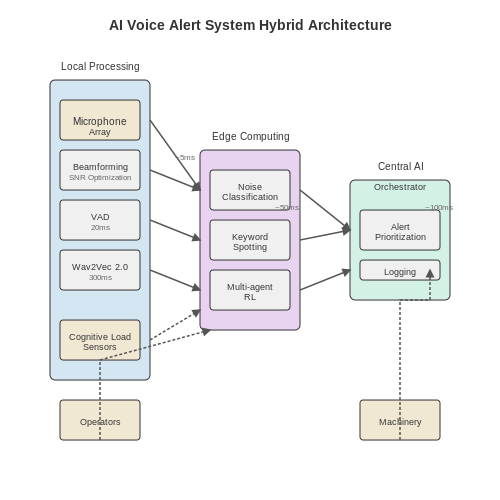
For real-time implementation, factories deploy distributed microphone arrays with beamforming capabilities to isolate human speech from machinery noise. The system employs a hybrid architecture combining:
- Local processing nodes executing lightweight voice activity detection (VAD) at 20ms latency
- Edge computing units running transformer-based speech recognition (e.g., Wav2Vec 2.0) with 300ms end-to-end delay
- Centralized AI orchestrator performing cross-operator coordination using multi-agent reinforcement learning
The reinforcement learning policy π is trained to maximize the safety-utility tradeoff:
where St represents safety compliance (measured via near-miss detection), Ut quantifies workflow disruption (tracked through task completion times), and γ is the discount factor. Industrial deployments at BMW's Regensburg plant demonstrated 37% faster hazard response times when using adaptive alerts compared to fixed-volume systems.
For mission-critical scenarios, the system implements hierarchical alert prioritization:
| Priority Level | Audio Characteristics | Neurophysiological Impact |
|---|---|---|
| Emergency (P0) | 105dB @ 500-2000Hz, 3-pulse pattern | Triggers startle reflex in <300ms |
| Warning (P1) | 85dB @ 1000-3000Hz, rising tone | Induces orienting response without stress |
| Advisory (P2) | 70dB @ 2000-4000Hz, single tone | Maintains awareness without task interruption |
Recent advances incorporate EEG-based workload estimation to dynamically adjust alert modalities. When cognitive load exceeds 70% of individual baseline capacity (measured via θ/β wave ratio), the system automatically supplements voice alerts with haptic feedback through smart wearables.
7. Key Research Papers and Articles
7.1 Key Research Papers and Articles
- Artificial Intelligence for Safety-Critical Systems in Industrial and ... — Artificial Intelligence (AI) can enable the development of next-generation autonomous safety-critical systems in which Machine Learning (ML) algorithms learn optimized and safe solutions. AI can also support and assist human safety engineers in developing safety-critical systems. However, reconciling both cutting-edge and state-of-the-art AI technology with safety engineering processes and ...
- Monitoring manufacturing systems using AI: A method based on a digital ... — After the disruptive rise of Artificial Intelligence (AI) and its successful application in various fields, the manufacturing industry is also adopting AI to manage both complex decision-making tasks and monitoring by analysing data acquired from manufacturing systems [7].The integration of AI in the industry is strictly linked to the availability of a Digital Twin (DT) [8] of the factory, i.e ...
- A review of artificial intelligence applications in manufacturing ... — AI/ML can also improve worker and critical equipment safety within factories through intelligent access control systems. It can also be used to mitigate the cybersecurity risks introduced by the ever-increasing number of networked devices within a manufacturing plant. ... Research into safety systems and human-machine interaction involves using ...
- Autonomous Vehicles and Intelligent Automation: Applications ... — Here, the critical challenges to artificial intelligence for autonomous applications such as (i) sensor integration and performance issues to artificial intelligence and autonomous systems, (ii) complexities and uncertainties to autonomous and associated complex systems and recent developments, (iii) fine-tuning and optimization approaches, (iv ...
- Enhancing Industrial Safety and Risk Assessment Through Artificial ... — the advent of Artificial Intelligence (AI), there has been a significant transformation in how industries approach safety measurements and risk assessments. This paper reviews the current state of AI applications in industrial safety, highlighting key technologies, methodologies, and case studies.
- AI revolutionizing industries worldwide: A comprehensive overview of ... — Systems that use artificial intelligence analyze data using mathematical algorithms and statistical models, which allows them to improve over time [5]. The end goal of research into artificial intelligence is to develop intelligent machines that can see their surroundings, reason, learn, and act independently to accomplish challenging tasks.
- Artificial Intelligence Systems: Impacts of Industry 4.0 and Smart ... — The main purpose of this study is to develop an understanding of the disruptive impacts of the robotics powered by Artificial Intelligence technology on the electronic manufacturing industry.
- Industrial alarm systems: Challenges and opportunities — Alarm management collectively refers to the process of understanding, designing, implementing and operating a system of alarms. According to the International Society of Automation (ISA) "Alarm management is the set of processes that ensures an effective alarm system." The alarm system notifies operators about abnormal processes, conditions or malfunctions of the plant equipment ANSI/ISA ...
- Artificial Intelligence and Employee Well-Being: Balancing ... — Artificial intelligence (AI) enabled technologies are now corporate organisations' top priorities due to the availability of large data and the advent of the Internet of Things during the past ten ...
- Google Scholar — Google Scholar provides a simple way to broadly search for scholarly literature. Search across a wide variety of disciplines and sources: articles, theses, books, abstracts and court opinions.
7.2 Industry Standards and Guidelines
- Part 1194—Information and Communication Technology Standards and Guidelines — 702. 7. 2 ITU-T Recommendation G.722.2, Series G. Transmission Systems and Media, Digital Systems and Networks—Digital terminal equipment—Coding of analogue signals by methods other than PCM, Wideband coding of speech at around 16 kbit/s using Adaptive Multi-Rate Wideband (AMR-WB), July 2003, IBR approved for Appendix C, Section 412.4.
- PDF Functional Safety Safety Instrumented Systems for the Process Industry ... — Standards and Practices Board; ISA, 67 T.W. Alexander Drive; P.O. Box 12277; Research Triangle Park, NC 277099; Telephone (919) 549-8411; Fax (919) 549-8288; E-mail: [email protected]. The ISA Standards and Practices Department is aware of the growing need for attention to the
- Section IV: Chapter 4 - Occupational Safety and Health Administration — The safety standard for robots is Part-1 and Part-2 of American National Standards Institute (ANSI)/Robotic Industries Association (RIA) R15.06-2012, Industrial Robots and Robot Systems - Safety Consideration. Among other things, ANSI/RIA R15.06-2012 requires that relevant, safe operating and maintenance information be provided with the robot ...
- Law and Regulations - Occupational Safety and Health Administration — OSHA standards are published in Title 29 of the Code of Federal Regulations (CFR) and are divided into separate standards for General Industry, Construction, and Maritime. ... Occupational Safety and Health Administration 200 Constitution Ave NW Washington, DC 20210 1-800-321-OSHA 1-800-321-6742 www.osha.gov ...
- PDF Electronic Safety and Security (ESS) System Design and Implementation ... — BICSI standards and publications are designed to serve the public interest by offering information communication and technology systems design guidelines and best practices. Existence of such standards and publications shall not in any ... Electronic Safety and Security (ESS) System Design and Implementation Best Practices. 9. Electronic Safety ...
- Electronics Manufacturing | IPC Standards — Implemented industry-wide, our standards simply communicate and clarify expectations for everyone within the industry. IPC standards help ensure superior quality, reliability and consistency in electronics manufacturing. IPC has over 300+ active multilingual industry standards, covering nearly every stage of the electronics product development ...
- Robotics - Standards - Occupational Safety and Health Administration — American National Standards Institute (ANSI) ANSI/ISO 12100-2012, Safety of Machinery - General Principles for Design, RA and Risk Reduction. R15.06, Industrial Robots and Robot Systems - Safety Requirements. Provides safety requirements for industrial robot manufacture, remanufacture, and rebuild (Part 1); and robot system integration ...
- The List of 300+ Codes and Standards - NFPA — NFPA codes and standards are developed by subject matter experts from around the globe and serve as the leading resource on fire, electrical, and life safety guidelines and requirements. All standards are consensus based and peer reviewed so you can trust you're working with the most up to date and thorough requirements in the industry. Learn ...
- PDF Robotic Industries Association: Robot Standards - IEEE RAS — Applicability for existing systems. - RIA TR R15.606-2016 > Direct U.S. Adoption of ISO/TS 15066:2016. Safety requirements for collaborative robots. - RIA TR R15.706-201X (In development). User Guidance. - RIA TR R15.806-2018. Test methods for PFL collaborative robot systems. - RIA TR R15.906-20XX (In development). Safety-related software.
- ISO 45001:2018 - Occupational health and safety management systems — The framework of plan, do, check act means the OH&S system can continually improve and evolve, enhancing long-term worker health and safety performance. In summary, ISO 45001 enables organizations to better protect their workers and manage OH&S risks , making it an essential standard worldwide.
7.3 Recommended Tools and Frameworks
- Artificial Intelligence for Safety-Critical Systems in Industrial and ... — Artificial Intelligence (AI) can enable the development of next-generation autonomous safety-critical systems in which Machine Learning (ML) algorithms learn optimized and safe solutions. AI can also support and assist human safety engineers in developing safety-critical systems. However, reconciling both cutting-edge and state-of-the-art AI technology with safety engineering processes and ...
- A critical review on applications of artificial intelligence in ... — The fourth industrial revolution, Industry 4.0, has brought internet, artificial intelligence (AI), and machine learning (ML) concepts into manufacturing. There is an immediate need to understand the capabilities of AI and ML and how they can be implemented in manufacturing domains. This article presents a detailed survey of AI algorithms and their use in manufacturing. The article treats ...
- Enhancing Industrial Safety and Risk Assessment Through Artificial ... — Industrial safety can be through its key aspects: i.Worker Safety: Protecting employees from injuries, illnesses, and fatalities arising from industrial processes, equipment malfunctions, and hazardous materials. ii.Equipment and Machinery Safety: Ensuring proper maintenance and operation of machinery to prevent breakdowns and accidents. iii.
- PDF A Guide to United States Electrical and Electronic Equipment ... - NIST — This guide addresses electrical and electronic consumer products, including those that will . In addition, it includes electrical and electronic products used in the workplace as well as electrical and electronic medical devices. The scope does not include vehicles or components of vehicles, electric or electronic toys, or recycling ...
- Artificial Intelligence in manufacturing: State of the art ... — Symbolic AI consists of implementing interpretable, high-level rules and calculating symbols that have concrete semantic meanings [232].The design of programming language Lisp in 1958 to manipulate symbols was widely regarded as AI's first contribution [171].By contrast, connectionist AI envisions large-scale calculation of low-level functions distributed across a neural network, with ...
- Audit, Consulting, Financial, Risk Management, Tax Services - Deloitte — Know how Artificial Intelligence and DPI to the Power of AI optimize public service delivery, enhancing data-driven decision making in government. Union Budget 2025. ... When a cyberattack paralysed critical systems for an aviation firm, it turned to Deloitte's CIR3 services to help respond, recover and transform from the incident.
- AI-driven threat intelligence for real-time cybersecurity: Frameworks ... — AI-driven threat intelligence is transforming cybersecurity by enhancing real-time threat detection, analysis, and response capabilities. This paper reviews state-of-the-art AI frameworks, machine ...
- The rise of artificial intelligence in healthcare applications — 2.7.3.1. Artificial intelligence prequalification (triage) Prior to having access to an actual doctor, trained AI bots can qualify whether certain symptoms warrant an actual conversation with a physician. Many questions are asked of the patient and based on each response; the software encourages the user to take specific actions.
- CIS Center for Internet Security — Safeguard IT systems against cyber threats with more than 100 configuration guidelines across more than 25 vendor product families. ... Secure your organization with resources and tools designed to harness the power of CIS Benchmarks and CIS Controls. Learn More. Access resources for threat prevention, protection, response, and recovery for U.S ...
- Artificial intelligence for industry 4.0: Systematic review of ... — Generally, a closed-loop system is a system in which the output of the system is utilized as an input or "feedback" as the system progresses or evolves to be more efficient (Xu, 2020) based on the feedback. Recent advancements in IoT sensors and data technologies have caused a lean in Industry 4.0 towards closed-loop systems.