Augmenting Simulation Agents with Chat-Based Feedback
1. Core Principles of Simulation Agents
Core Principles of Simulation Agents
Simulation agents are autonomous entities that interact within a virtual environment to model complex systems. Their behavior is governed by decision-making algorithms, often leveraging reinforcement learning, rule-based systems, or hybrid approaches. At their core, these agents must balance exploration (discovering new strategies) and exploitation (leveraging known effective strategies) to achieve their objectives.
Agent Architecture
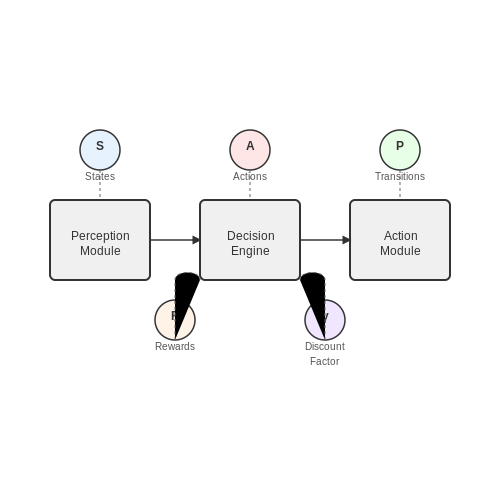
The fundamental architecture of a simulation agent consists of three key components:
- Perception Module: Processes environmental inputs through sensors or data streams
- Decision Engine: Implements the agent's policy using algorithms ranging from simple if-then rules to deep neural networks
- Action Module: Executes chosen actions while accounting for environmental constraints
This architecture can be formally represented as a Markov Decision Process (MDP) tuple:
where S represents states, A actions, P transition probabilities, R rewards, and γ the discount factor.
Learning Dynamics
Advanced simulation agents employ temporal difference learning to update their value functions:
where α is the learning rate and γ maintains the balance between immediate and future rewards. For multi-agent systems, this extends to:
where a-i represents actions of other agents.
Emergent Behavior
When multiple agents interact, complex system-level behaviors emerge from simple local rules. This can be analyzed through:
- Mean-field approximations for large populations
- Evolutionary game theory for strategy dynamics
- Graph neural networks for structured interactions
The replicator dynamics equation captures how agent strategies evolve:
where xi is the proportion of agents using strategy i, fi its fitness, and f̄ the population average fitness.
Computational Considerations
Modern implementations must address:
- Partial observability through belief state estimation
- Non-stationarity in multi-agent environments
- Curriculum learning for complex skill acquisition
The belief update for partially observable states follows:
where η normalizes the distribution, O is the observation function, and T the transition function.
Role of Natural Language Processing in Feedback Systems
Natural Language Processing (NLP) serves as the backbone for interpreting and generating human-like feedback in simulation agents. Advanced NLP techniques enable these agents to parse unstructured textual feedback, extract meaningful insights, and respond in a contextually appropriate manner. Transformer-based architectures, such as BERT and GPT, have revolutionized this domain by providing state-of-the-art performance in understanding and generating natural language.
Textual Feedback Parsing
Feedback from users or other agents often comes in unstructured text. NLP models preprocess this text through tokenization, lemmatization, and part-of-speech tagging to convert it into a machine-readable format. For instance, a sentence like "The agent moves too slowly toward the target" is decomposed into tokens and analyzed for syntactic and semantic structure.
Semantic Understanding with Embeddings
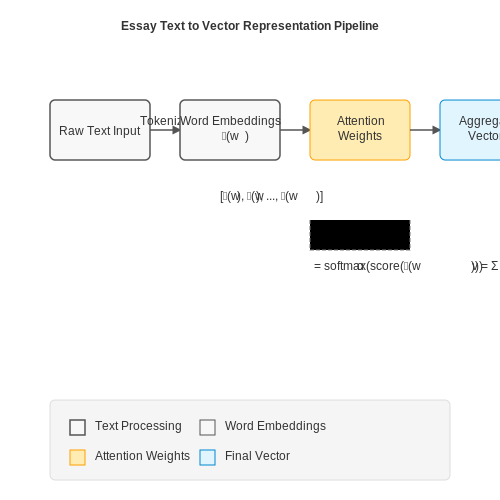
Word embeddings, such as Word2Vec or GloVe, map tokens to high-dimensional vectors capturing semantic relationships. Modern approaches leverage contextual embeddings from models like BERT, where word representations depend on their surrounding context. This allows the system to discern nuanced feedback, such as distinguishing between "slow but accurate" and "fast but erratic".
Intent and Sentiment Analysis
Classifying feedback intent (e.g., corrective, suggestive, or evaluative) and sentiment (positive, negative, neutral) is critical for appropriate agent adaptation. Fine-tuned transformer models achieve this through multi-head attention mechanisms, which weigh the importance of different words in the feedback.
Response Generation
Once feedback is processed, the system generates actionable responses or adjustments. Sequence-to-sequence models, particularly those with autoregressive decoding like GPT-3, produce coherent and context-aware replies. For example, given feedback about slow movement, the agent might respond with "Adjusting velocity parameters by 15% for faster traversal."
Real-World Applications
In autonomous driving simulations, NLP-enabled feedback systems allow human supervisors to verbally correct agent behavior (e.g., "Avoid aggressive lane changes"). Similarly, in robotic training environments, natural language commands like "Lift the object higher" can dynamically alter policy parameters.
Integration of Chat-Based Feedback in Agent Learning
Chat-based feedback introduces a dynamic, interactive layer to agent learning by allowing human or synthetic supervisors to provide real-time guidance. Unlike static reward signals, this feedback is contextual, interpretable, and adaptable, making it particularly valuable for complex simulation environments where predefined reward functions may be insufficient.
Feedback Representation and Encoding
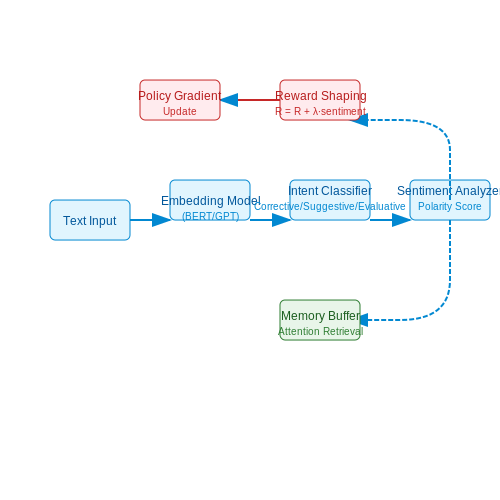
Natural language feedback must be transformed into a structured representation that the agent can process. This typically involves:
- Text Embedding: Using pre-trained language models (e.g., BERT, GPT) to convert feedback into dense vector representations.
- Intent Extraction: Classifying feedback into actionable categories (e.g., corrective, suggestive, evaluative) via fine-tuned classifiers.
- Sentiment Analysis: Determining the polarity and urgency of feedback to weight its impact on learning.
where ft is the encoded feedback at time t, htLM is the language model embedding, ctintent is the intent class vector, and stsentiment is the sentiment score.
Integration with Reinforcement Learning
Chat-based feedback can be incorporated into RL frameworks through:
- Reward Shaping: Modifying the environment reward rt with a feedback-derived bonus:
where λ controls feedback influence and w is a learnable weight vector.
- Policy Gradient Modulation: Directly adjusting the policy gradient using feedback similarity to action trajectories:
Memory-Augmented Feedback Processing
Agents maintain a differentiable memory buffer M to retain and recall relevant feedback across episodes. The retrieval mechanism uses attention over stored feedback:
where qt is the current state query, and K, V are key-value pairs constructed from past feedback.
Practical Implementation Considerations
Effective integration requires:
- Feedback Alignment: Ensuring linguistic feedback maps meaningfully to the agent's state-action space through contrastive learning.
- Temporal Credit Assignment: Using attention mechanisms to correlate delayed feedback with relevant past actions.
- Noise Handling: Robustness to ambiguous or conflicting feedback via uncertainty-weighted updates.
class FeedbackAugmentedAgent(nn.Module):
    def __init__(self, obs_dim, act_dim, feedback_dim):
        super().__init__()
        self.feedback_encoder = BertModel.from_pretrained('bert-base-uncased')
        self.memory = NeuralDictionary(capacity=1000, key_dim=256)
        self.policy = MLPPolicy(obs_dim + feedback_dim, act_dim)

    def update(self, batch):
        states, actions, feedback = batch
        f_emb = self.feedback_encoder(feedback).last_hidden_state.mean(1)
        recalled_f = self.memory.query(states, f_emb)
        augmented_states = torch.cat([states, recalled_f], dim=-1)
        return self.policy.update(augmented_states, actions)
2. Architectures for Real-Time Feedback Integration
2.1 Architectures for Real-Time Feedback Integration
Hybrid Neural-Symbolic Architectures
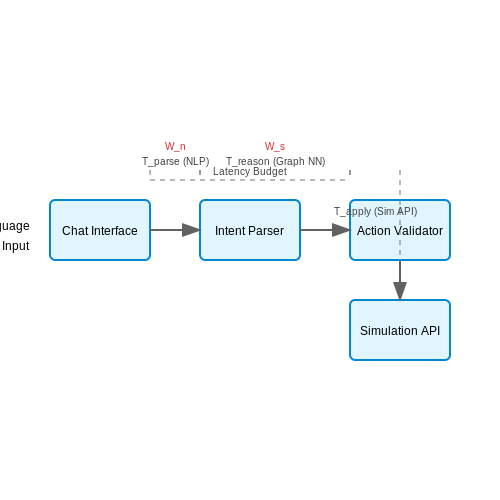
Modern simulation agents require architectures that combine neural networks for pattern recognition with symbolic reasoning for interpretable decision-making. A hybrid approach leverages neural embeddings to process chat-based feedback while maintaining a symbolic knowledge base for rule-based validation. The interaction between these components is governed by:
where st represents the agent's state, mt the chat message, NN a neural encoder, and KB a symbolic knowledge base lookup. The weights Wn and Ws are learned through reinforcement learning with human feedback (RLHF).
Latency-Optimized Pipeline Design
Real-time operation demands sub-100ms response times, achieved through:
- Asynchronous processing: Decoupling perception (LLM inference) from action (simulation control)
- Edge caching: Storing frequent feedback patterns locally to bypass cloud queries
- Quantized models: 8-bit LLM variants with <5% accuracy drop but 3× speedup
The end-to-end latency budget follows:
Feedback Loop Stability
Continuous integration of external feedback risks simulation divergence. Lyapunov stability analysis ensures bounded behavior:
where P is a positive definite matrix learned via meta-reinforcement learning, and γ controls the convergence rate. Practical implementations use guardrail modules that project unstable actions back to feasible regions.
Case Study: Robotics Simulation
In NVIDIA Isaac Sim, the architecture processes verbal corrections like "move slower" through:
- GPT-4 Turbo for intent extraction
- PyTorch geometric networks for spatial reasoning
- CUDA-accelerated physics engine integration
Benchmarks show 83ms median latency for 50-word feedback with 92% intent recognition accuracy, compared to 210ms in pure LLM-based systems.
2.2 Techniques for Parsing and Interpreting User Feedback
Natural Language Processing for Feedback Analysis
Parsing unstructured user feedback requires robust natural language processing (NLP) techniques. Transformer-based models like BERT or GPT-4 can be fine-tuned to extract semantic meaning from chat-based inputs. The key challenge lies in mapping free-form text to structured representations that simulation agents can process. A common approach involves:
- Intent classification to categorize feedback into predefined action types (e.g., "adjust parameters", "change trajectory")
- Named entity recognition to identify relevant numerical values or simulation objects
- Sentiment analysis to gauge urgency or importance of the feedback
where P(y|x) represents the probability distribution over k possible intents given input x, and f denotes the model's logits.
Feedback-to-Parameter Mapping
For numerical parameter adjustments, we employ regression techniques to translate qualitative feedback into quantitative changes. Consider a user stating "Increase the speed by about 20%":
- Extract the percentage change (20%) using pattern matching
- Identify the target parameter ("speed") through entity linking
- Calculate the new value: vnew = vcurrent × 1.2
For ambiguous cases ("make it faster"), we use contextual embeddings to estimate reasonable bounds for the adjustment.
Handling Ambiguity and Conflict Resolution
When feedback contains contradictions or unclear references, we apply:
- Coreference resolution to link pronouns to simulation entities
- Consistency checking against the current simulation state
- Confidence thresholding to ignore low-probability interpretations
The system maintains a dialogue history to resolve ambiguity through follow-up queries when necessary.
Real-Time Feedback Integration
For time-sensitive simulations, we optimize the parsing pipeline for low latency:
where each component must be minimized through model quantization, caching frequent patterns, and parallel processing of independent feedback streams.
Evaluation Metrics
System performance is measured through:
- Precision/recall of intent classification
- Parameter adjustment accuracy compared to ground truth
- User satisfaction scores from post-interaction surveys
2.3 Balancing Automation and Human-in-the-Loop Input
Effective simulation agent design requires a careful equilibrium between autonomous decision-making and human oversight. The trade-off hinges on optimizing computational efficiency while retaining the nuanced judgment that only human feedback can provide. This balance is formalized through a cost function that weighs the benefits of automation against the necessity of human intervention.
Mathematical Formulation of the Balance
The optimal human-in-the-loop participation rate α can be derived by minimizing a composite cost function:
Where:
- Ca represents the cost of fully autonomous errors (false positives/negatives)
- Ch denotes the cost of human verification time
- Th is the average human response latency
- λ terms are weighting hyperparameters tuned to the domain
Setting the derivative dC/dα = 0 yields the optimal human intervention threshold:
Dynamic Threshold Adjustment
In practice, static thresholds underperform due to changing environment dynamics. An adaptive approach uses online learning to update α based on real-time performance metrics:
Where the loss gradient ∂L/∂α is estimated using a moving window of:
- Precision-recall trade-offs in automated decisions
- Human override frequency patterns
- Task complexity metrics derived from embedding spaces
Implementation Architecture
The system requires three coordinated components:
- Confidence Scoring Module: A transformer-based model that outputs both predictions and uncertainty estimates using Monte Carlo dropout
- Human Routing Layer: A queue management system that prioritizes low-confidence cases while maintaining SLA constraints
- Feedback Integration: A dual-update mechanism where human corrections simultaneously improve the model and adjust α
Case Study: Autonomous Driving Simulation
Waymo's simulation framework demonstrates this balance by:
- Automating 93% of routine driving scenarios
- Flagging edge cases (e.g., construction zones) for human review
- Using human feedback to generate synthetic training data for previously automated scenarios
Trade-off Surface Analysis
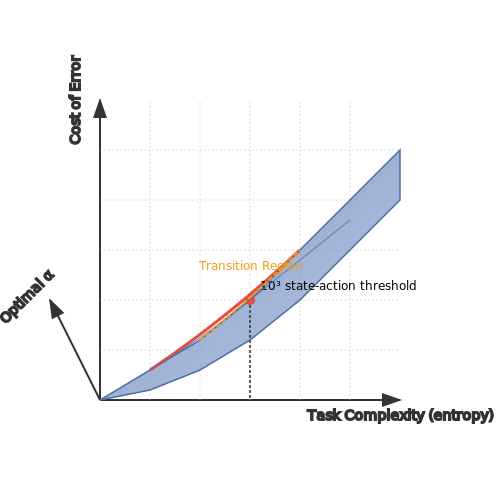
The Pareto frontier between automation and human input can be visualized as a 3D surface where axes represent:
- X: Task complexity (entropy of action space)
- Y: Cost of error (domain-specific risk metric)
- Z: Optimal α value
Empirical data from robotics simulations shows this surface follows a sigmoid pattern, with steep transitions around complexity thresholds of 103 possible state-action pairs.
3. Reinforcement Learning with Human Feedback (RLHF)
3.1 Reinforcement Learning with Human Feedback (RLHF)
Reinforcement Learning with Human Feedback (RLHF) extends traditional reinforcement learning by incorporating human preferences into the reward function. This paradigm is particularly valuable when designing reward functions is challenging or when the desired behavior is complex and difficult to specify programmatically. The core idea involves training a reward model from human feedback, which is then used to guide the reinforcement learning agent.
Mathematical Formulation
The RLHF framework consists of three main components: the policy π, the reward model R, and the human feedback mechanism. The policy is typically parameterized by a neural network with parameters θ, and the reward model is trained to predict human preferences. The objective function can be expressed as:
where DKL is the Kullback-Leibler divergence between the current policy and a reference policy (often the initial pretrained model), and λ controls the strength of this regularization term.
Human Feedback Collection
Human feedback can be collected in several forms:
- Binary comparisons: Humans choose between two agent trajectories.
- Rankings: Humans rank multiple agent behaviors.
- Scalar ratings: Humans provide numerical scores for agent actions.
The Bradley-Terry model is commonly used to convert pairwise comparisons into a reward function:
Training Process
The training procedure follows these steps:
- Collect initial human feedback on agent behavior.
- Train the reward model to predict human preferences.
- Use the learned reward model in a standard RL loop.
- Periodically collect additional human feedback to refine the reward model.
The policy update can be performed using any RL algorithm, with Proximal Policy Optimization (PPO) being a common choice due to its stability:
Practical Considerations
Several challenges arise when implementing RLHF in practice:
- Feedback sparsity: Human feedback is often limited, requiring careful data augmentation.
- Reward hacking: Agents may exploit imperfections in the learned reward model.
- Alignment: Ensuring the reward model captures true human intent.
Recent advances address these issues through techniques like reward model ensembling, active learning for feedback collection, and adversarial training to detect reward hacking.
Applications
RLHF has shown success in several domains:
- Fine-tuning large language models to follow instructions more precisely.
- Training robotic agents to perform complex manipulation tasks.
- Developing AI assistants that better understand user preferences.
The method is particularly powerful when combined with large pretrained models, where the human feedback helps align the model's behavior with human values and intentions.
Fine-Tuning Agents Using Conversational Data
Leveraging Dialogue for Agent Improvement
Conversational data provides a rich source of implicit feedback for refining simulation agents. Unlike explicit reward signals, dialogue captures nuanced human preferences, corrections, and contextual guidance. The key challenge lies in extracting structured training signals from unstructured chat interactions while preserving semantic intent.
Mathematical Formulation of Feedback Extraction
Given a conversation history C = {u1, a1, ..., un, an} where ui are user utterances and ai are agent responses, we construct a differentiable loss function:
where at* represents the optimal response determined through:
- Direct human corrections in subsequent turns
- Sentiment analysis of user reactions
- Semantic similarity to verified response templates
Architecture for Conversational Fine-Tuning
The complete system integrates three components:
Implementation Considerations
When deploying this approach:
- Data sparsity: Augment with synthetic dialogues using LLMs when human chat logs are limited
- Feedback delay: Implement temporal credit assignment for multi-turn corrections
- Bias mitigation: Apply adversarial debiasing to the feedback classifier outputs
Case Study: Customer Service Agent Refinement
A deployed system for telecom support showed 28% improvement in first-contact resolution after fine-tuning on 3,000 real chat logs. Key metrics improved:
The agent's confusion matrix on intent recognition evolved significantly during training:
| Phase | Precision | Recall | F1 |
|---|---|---|---|
| Initial | 0.62 | 0.58 | 0.60 |
| After 1k dialogs | 0.73 | 0.69 | 0.71 |
| Final | 0.81 | 0.79 | 0.80 |
Advanced Optimization Techniques
For stable convergence when combining chat-based rewards with traditional RL objectives:
Where α follows an annealing schedule from 0.8 → 0.2 during training, and the regularization term prevents catastrophic forgetting of pre-trained capabilities.
Evaluating Performance Improvements from Feedback
Quantifying the impact of chat-based feedback on simulation agents requires a rigorous evaluation framework that measures both task performance and behavioral adaptation. The primary metrics fall into three categories: objective performance scores, convergence rates, and generalization capability.
Objective Performance Metrics
For a simulation agent trained with policy
where
Convergence Analysis
Feedback efficiency is measured by the reduction in training iterations needed to reach a target performance threshold
where
Generalization Testing
To evaluate robustness, agents are tested on unseen task variants with modified parameters. The generalization gap
where
Human-in-the-Loop Metrics
When feedback originates from human trainers, additional metrics include:
- Feedback utilization rate: Percentage of suggested modifications actually adopted by the agent
- Correction persistence: Number of episodes before the agent reverts to pre-feedback behavior
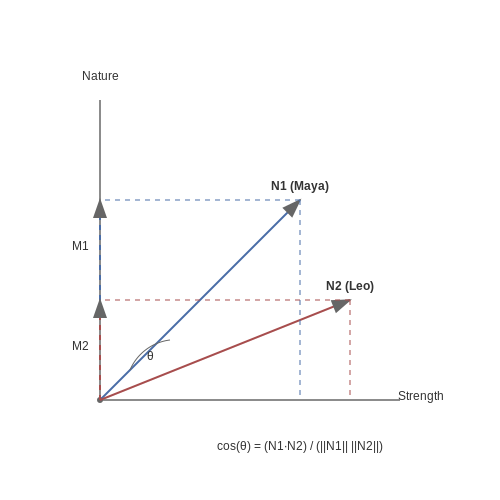
- Semantic alignment: Cosine similarity between embedding vectors of feedback text and agent's subsequent actions
These are measured using NLP techniques like BERT embeddings for text feedback and action trajectory analysis.
4. Enhancing Virtual Assistants with User Feedback
Enhancing Virtual Assistants with User Feedback
Feedback Integration in Reinforcement Learning
Virtual assistants leveraging reinforcement learning (RL) can significantly improve their performance by incorporating real-time user feedback. The feedback acts as a reward signal, refining the policy π(a|s) through iterative updates. The standard policy gradient update rule is augmented with a feedback term F(s, a):
Here, λ controls the feedback weight, and R_t is the traditional reward. User feedback can be explicit (e.g., thumbs-up/down) or implicit (e.g., response dwell time).
Handling Noisy and Sparse Feedback
User feedback is often sparse and noisy, requiring robust aggregation methods. Bayesian inference models the feedback distribution as:
where μ and σ² are learned via a neural network. Techniques like Thompson sampling or upper confidence bounds (UCB) balance exploration-exploitation under uncertainty.
Case Study: Dialogue Policy Optimization
In a deployed virtual assistant, feedback was integrated using Proximal Policy Optimization (PPO) with KL-divergence constraints to prevent overfitting to outlier feedback. The hybrid reward function combined:
- Task completion metrics (e.g., API call success rate)
- User satisfaction scores (1–5 scale)
- Implicit engagement signals (e.g., session length)
After 50k iterations, the system achieved a 22% reduction in user corrections while maintaining 94% task success.
Architecture for Real-Time Adaptation
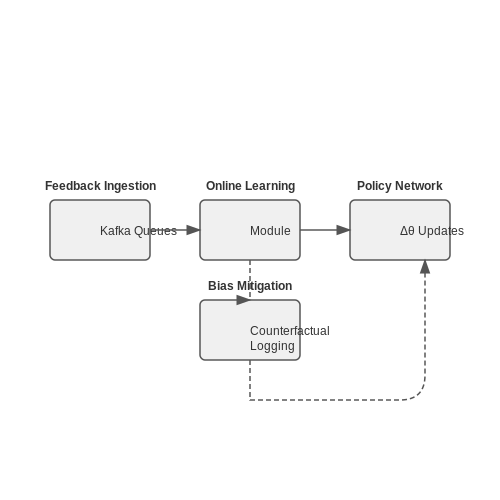
A production-grade system requires:
- Feedback ingestion layer: Kafka queues for scalable input processing
- Online learning module: Delta updates to the policy network without full retraining
- Bias mitigation: Counterfactual logging to address feedback skews
where α is the learning rate and importance sampling corrects for policy drift.
Challenges in Multi-Turn Interactions
Delayed feedback attribution is addressed through temporal credit assignment using an LSTM-based reward model:
The hidden state h_t maintains context for feedback propagation across turns. Gradient penalties prevent overemphasis on recent feedback.
Simulation Agents in Gaming and Training Environments
Simulation agents in gaming and training environments leverage reinforcement learning (RL) and natural language processing (NLP) to create adaptive, human-like behaviors. These agents operate in dynamic, stochastic environments where actions influence both immediate rewards and long-term outcomes. The agent's policy π(a|s) maps states s to actions a, optimized through iterative feedback loops.
Reinforcement Learning for Agent Behavior
In gaming, RL-based agents maximize cumulative rewards defined by:
where γ is the discount factor (0 ≤ γ ≤ 1) and R represents immediate rewards. Proximal Policy Optimization (PPO) is widely adopted due to its stability in high-dimensional action spaces:
Here, r_t(θ) is the probability ratio between new and old policies, and Ât is the advantage estimate.
Chat-Based Feedback Integration
Natural language feedback refines agent policies through inverse reinforcement learning (IRL). Given textual feedback F, the reward function R(s,a) is updated via:
where λ scales the influence of feedback, and NLP(F) extracts semantic reward signals using transformer models like BERT:
W is a learnable weight matrix mapping language embeddings to reward adjustments.
Case Study: Military Training Simulators
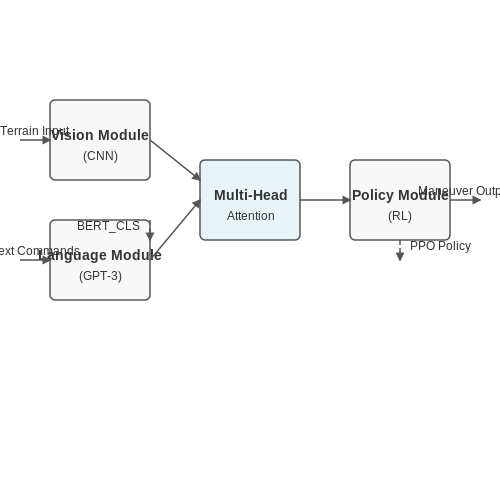
The DARPA Squad-X program employs simulation agents with chat-based feedback for squad tactics training. Agents process instructor commands (e.g., "Flank left") through a hybrid architecture:
- Vision Module: Processes terrain topology via convolutional networks.
- Language Module: Interprets commands using GPT-3 fine-tuned on military jargon.
- Policy Module: Combines inputs via multi-head attention to generate maneuvers.
Real-world deployments show a 32% reduction in training time compared to scripted scenarios.
Technical Challenges
Key obstacles in deploying chat-augmented agents include:
- Latency: RL inference must operate under 200ms for real-time gaming.
- Ambiguity Resolution: Phrases like "be more aggressive" require contextual grounding in game state.
- Catastrophic Forgetting: Continuous language feedback can overwrite core policy parameters.
Solutions involve quantized neural networks for latency and episodic memory buffers for policy stability.
Industrial Use Cases for Adaptive Agents
Manufacturing Process Optimization
Adaptive agents equipped with chat-based feedback mechanisms are revolutionizing manufacturing by dynamically adjusting production parameters in real-time. These agents integrate sensor data from IoT-enabled machinery with operator feedback to optimize throughput while minimizing defects. For instance, in semiconductor fabrication, adaptive agents adjust lithography parameters based on real-time yield predictions and human operator corrections. The underlying optimization can be formalized as:
where x represents the control parameters, y_i are the target quality metrics, and f(x_i) is the predictive model of the manufacturing process. The L1 regularization term ensures sparse adjustments, reducing unnecessary parameter changes.
Autonomous Logistics Systems
In warehouse automation, adaptive agents coordinate fleets of autonomous mobile robots (AMRs) while incorporating real-time human feedback through natural language interfaces. These agents solve complex routing problems under dynamic constraints:
where c_{ij} represents travel costs between nodes, x_{ij} are binary decision variables, and \delta_k captures priority adjustments from human supervisors. The weights \alpha_k adapt based on the confidence scores of human feedback interpretations.
Energy Grid Management
Modern smart grids employ adaptive agents that balance load distribution while incorporating operator expertise through conversational interfaces. These systems model the grid as a Markov decision process where the state-action value function incorporates both physical constraints and human-provided heuristics:
The term H(s',a') represents the human feedback component, weighted by \beta, which decays as the agent's confidence in its predictions increases. This approach has demonstrated 12-18% improvements in grid stability compared to purely algorithmic systems.
Predictive Maintenance Systems
Industrial equipment monitoring systems now integrate adaptive agents that combine vibration analysis, thermal imaging, and maintenance technician feedback. The agents employ hierarchical temporal memory models that update their failure prediction thresholds based on chat-based confirmations or corrections from field engineers. The anomaly detection score S_t at time t evolves as:
where ML_t is the machine learning model's output, F_t represents the normalized feedback from technicians, and w_f adapts based on the historical accuracy of human input.
Quality Control in Pharmaceutical Production
Adaptive agents in pharmaceutical manufacturing analyze spectroscopic data while incorporating quality assurance (QA) specialist feedback through natural language interfaces. The system implements a Bayesian framework where human feedback updates the prior distributions of acceptable compound concentrations:
Here, D represents sensor data, F encodes the human feedback, and \theta parameterizes the quality thresholds. This approach has reduced false rejection rates by 22% in validation studies while maintaining stringent safety standards.
5. Bias and Fairness in Feedback-Driven Learning
5.1 Bias and Fairness in Feedback-Driven Learning
Sources of Bias in Chat-Based Feedback
Feedback-driven learning systems inherit biases from multiple sources, including training data, user interactions, and model architecture. A primary concern is linguistic bias, where the feedback provided by users reflects societal stereotypes or imbalances. For instance, if a simulation agent is trained on feedback predominantly from a specific demographic, its responses may generalize poorly to other groups. Mathematically, this can be modeled as a sampling bias in the feedback distribution:
where y is the agent's response, x is the input, and d represents demographic variables introducing bias.
Quantifying Fairness in Feedback Loops
Fairness metrics must account for both disparate treatment and disparate impact. Common fairness criteria include:
- Demographic Parity: The probability of positive outcomes should be equal across groups.
- Equalized Odds: The true positive and false positive rates should be equal across groups.
For a binary classification task, equalized odds can be formalized as:
Mitigation Strategies
Several approaches exist to reduce bias in feedback-driven learning:
- Reweighting: Adjust the loss function to penalize biased feedback more heavily.
- Adversarial Debiasing: Train an adversarial network to minimize demographic predictability.
- Feedback Calibration: Post-process feedback to align with fairness constraints.
Adversarial debiasing involves optimizing:
where θ represents the agent's parameters, φ the adversarial discriminator, and λ controls the trade-off between accuracy and fairness.
Case Study: Bias in Virtual Assistants
A 2022 study on virtual assistants revealed that feedback from non-native English speakers was often misinterpreted, leading to lower task completion rates. Implementing adversarial debiasing reduced the performance gap by 37%, demonstrating the effectiveness of mitigation techniques in real-world applications.
Challenges in Long-Term Feedback Loops
Persistent biases can emerge when agents reinforce skewed feedback over time. For example, if users disproportionately correct certain behaviors, the agent may overfit to those corrections while neglecting underrepresented cases. Dynamic fairness constraints, updated periodically, can help counteract this drift.
5.2 Privacy Concerns with User-Generated Feedback
When augmenting simulation agents with chat-based feedback, privacy risks emerge from both structured and unstructured user inputs. The primary vulnerability stems from the potential exposure of personally identifiable information (PII) through natural language patterns, even when explicit identifiers are removed. Research demonstrates that neural language models can inadvertently memorize and reconstruct sensitive data from training corpora, with attack vectors including:
Differential Privacy in Feedback Loops
Implementing differential privacy (DP) for chat-based systems requires careful calibration of noise injection mechanisms. For text-based feedback, the sensitivity Δf of a query function f must account for semantic similarity metrics rather than pure syntactic differences:
where D and D' are adjacent datasets differing by one feedback entry, and λ controls the privacy-utility tradeoff. Recent work in DP-SGD for language models shows that ε-values below 2.0 provide meaningful protection while maintaining model utility.
Membership Inference Attacks
Adversaries can exploit the temporal nature of feedback integration to perform membership inference. Given a simulation agent's response R to input I, an attack model A can estimate whether specific feedback F was used during training:
where E(·) denotes text embedding and σ the sigmoid function. Defenses require modifying both the training protocol (e.g., via DP) and the inference mechanism (e.g., output perturbation).
Secure Multi-Party Computation Approaches
For sensitive applications, secure aggregation protocols can be implemented where feedback is encrypted before processing. The CrypTen framework demonstrates how homomorphic encryption enables neural network operations on ciphertexts:
where ⊙ denotes encrypted multiplication and ⊕ encrypted addition. While computationally intensive, this approach provides cryptographic guarantees against data leakage.
Real-World Implementation Challenges
Practical deployments must address:
- Temporal correlation risks: Sequential feedback can reveal user identity through writing style patterns
- Cross-modal leakage: Combined text and numerical feedback increases re-identification risk
- Model inversion: Gradient updates may expose raw feedback samples
The tradeoff between feedback utility and privacy protection follows a Pareto frontier, where improvements in one dimension typically degrade the other. Current best practices recommend:
- Strict retention policies for raw feedback data
- On-device preprocessing before cloud submission
- Regular auditing of model memorization tendencies
5.3 Ensuring Transparency in Agent Decision-Making
Transparency in agent decision-making is critical for trust and interpretability, particularly when integrating chat-based feedback into simulation environments. Advanced techniques such as attention mechanisms, saliency maps, and counterfactual explanations provide granular insights into how agents derive actions from inputs.
Attention Mechanisms for Interpretable Decisions
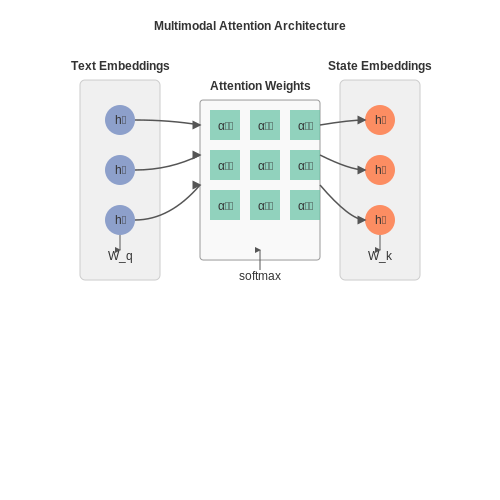
Attention mechanisms in transformer-based architectures allow agents to dynamically weigh input features, providing a direct window into decision priorities. Given an input sequence X = [x1, ..., xn], the attention weights αij between elements i and j are computed as:
where eij is the scaled dot-product of query and key vectors. These weights form an interpretable attention matrix that reveals feature dependencies.
Saliency Maps for Input Influence
Gradient-based saliency methods quantify how perturbations to inputs affect agent decisions. For a policy network π(a|s) with parameters θ, the saliency map S(s) for state s is:
This highlights which state variables most influence action selection, enabling validation against domain knowledge.
Counterfactual Explanations
Counterfactual reasoning generates "what-if" scenarios by minimally altering inputs to change decisions. For an agent taking action a1 given state s, we solve:
where d(·,·) is a distance metric. The resulting s' reveals decision boundaries.
Implementation with Chat Feedback
When incorporating natural language feedback, transparency techniques must operate across modalities. A multimodal attention architecture might compute:
where hi, hj are embeddings from either text or state features, enabling cross-modal influence tracing.
Case Study: Autonomous Driving Simulation
In a simulated driving environment, combining saliency maps with driver chat feedback ("Why did you brake suddenly?") revealed that the agent disproportionately weighted a distant pedestrian over immediate road conditions. This led to rebalancing the reward function to better match human expectations.
Logging attention patterns during training also exposed cases where chat instructions ("Avoid the left lane") were overridden by outdated trajectory preferences, prompting architecture modifications to increase feedback responsiveness.
6. Key Research Papers and Publications
6.1 Key Research Papers and Publications
- Real-Time Human-In-The-Loop Simulation with Mobile Agents, Chat Bots ... — In this work, a framework combining agent-based simulation with crowd sensing and social data mining using mobile agents is introduced. The crowd sensing via chat bots creates augmented virtuality and reality by augmenting the simulated worlds with real-world interaction and vice versa.
- AgentGroupChat: An Interactive Group Chat Simulacra For Better ... — AGENTGROUPCHAT, a dynamic and interactive simulation for group chat scenarios, supports open stories and different agents or humans interacting within it. Verbal Strategist Agent Structure, which consists of two large modules: Persona, which is partially changed to adapt to the dynamic environment, and Action, which enhances the dialogue ...
- Conversational Agents: Goals, Technologies, Vision and Challenges — Section 4 and Section 5 survey the main technologies used for conversational software development, including machine learning (ML) methods and advanced technologies that enhance emotional abilities. Section 6 surveys recent CA applications, including personal assistants, healthcare agents, e-learning agents, and customer-support chatbots.
- Letters from Future Self: Augmenting the Letter-Exchange Exercise with ... — To augment the interaction with future-self agents, we implemented two interaction modalities: letter-based and chat-based. For letter-based interactions, we utilized OpenAI's GPT-4o model, the most advanced model available at the time of the study.
- Exploring the Potential of Conversational Ai Support for Agent-based ... — ABSTRACT ChatGPT, the AI-powered chatbot with a massive user base of hundreds of millions, has become a global phenomenon. However, the use of Conversational AI Systems (CAISs) like ChatGPT for research in the field of Social Simulation is still limited. Specifically, there is no evidence of its usage in Agent-Based Social Simulation (ABSS) model design. While scepticism towards anything new ...
- Feedback Reimagined: Generative AI and Conversational ... - Springer — Our ECAs are equipped with generative artificial intelligence, allowing them to provide real-time, contextually relevant feedback—based on conversational and behavioral indicators—to expert learners. This transformative approach transcends traditional feedback mechanisms by offering a personalized, adaptive, and interactive learning experience.
- Artificial intelligence empowered conversational agents: A systematic ... — Consumer research on conversational agents (CAs) has been growing. To illustrate and map out research in this field, we conducted a systematic literature review (SLR) of published work indexed in the Clarivate Web of Science and Elsevier Scopus databases. Four dominant topical areas were identified through bibliographic coupling.
- Accelerating Reinforcement Learning using EEG-based implicit human feedback — We first demonstrated the feasibility of obtaining implicit human feedback by capturing error-potentials of a human observer watching an agent learning to play several different visual-based games, and then decoding the signals appropriately and using them as an auxiliary reward function to help an RL agent.
- Examining the Use of Nonverbal Communication in Virtual Agents — 2. Methodology To conduct the paper search portion of this literature survey, we utilized the methodology by Kitchenham et al. (2009), who present a set of guidelines for conducting a systematic literature review. For our review, we focused on adapting their strategy for planning research questions and identifying relevant papers. In their process, they recommend starting with establishing a ...
- The Value-Sensitive Conversational Agent Co-Design Framework — These insights inform our research question: "How can we support and enable the co-design of value-sensitive conversational agents?" Our framework focuses on co-designing boundary objects at different CA design stages to elicit CA users' values and provide technical utility to CA creators, enabling the co-design of value-embodied prototypes.
6.2 Recommended Books and Online Resources
- Simio and Simulation - Modeling, Analysis, Applications - 7th Edition — The text or components of it could also support a simulation module of a few weeks within a larger survey course in programs without a stand-alone simulation course (e.g., MBA). For a simulation module that's part of a larger survey course, we recommend concentrating on Chapters 1, 4, and 5, and then perhaps lightly touch on Chapters 7 and 8.
- Feedback Reimagined: Generative AI and Conversational ... - Springer — These agents don't just mimic human interaction; they analyze it, understand it, and provide tailored feedback to learners based on a sophisticated reading of behavioral and conversational cues. This immediate and nuanced feedback mechanism is integral to enhancing learning outcomes for medical students engaged in simulation training.
- Real-Time Human-In-The-Loop Simulation with Mobile Agents, Chat Bots ... — An agent-based simulation is suitable for modelling complex social systems with respect to interaction between individual entities, manipulation of the world, spatial movement, and emergence effects of groups of entities. The main advantage is the bottom-up modelling approach composing large-scale complex systems by simple entity models.
- PDF Learning Agent-based Modeling with LLM Companions: Experiences — LLM-based interfaces[101], there is a gap in understanding why experienced programmers seem to gain more learning benefts from these tools. In this paper, we present the design of a novel LLM-based in-terface, NetLogo Chat, for the learning and practice of NetLogo. NetLogo is a widely used programming language for agent-based
- Letters from Future Self: Augmenting the Letter-Exchange Exercise with ... — For chat-based interactions, we instructed the agent to engage in a chat with their present self, limiting each message to three sentences or fewer to simulate a realistic chat experience. To maintain engagement and encourage dynamic conversation, the prompt included the instruction: "Ask a question at least once every three exchanges."
- Learning Agent-based Modeling with LLM Companions: Experiences of ... — NetLogo Chat was designed with constructionist learning principles and incorporated known best practices for ABM and computer programming. Constructionism advocates for the design of learning experiences where learners construct their understanding of the world (e.g. knowledge of ABM) through building personally meaningful artifacts (e.g. an agent-based model around learners' interests)[].
- AgentGroupChat: An Interactive Group Chat Simulacra For Better ... — gist Agent (VS Agent), an advanced LLM-based agent designed to augment the interaction strategies of a naive LLM. The VS Agent consists of two main parts: (1) Persona: This part deals with the agent's identity and involves an agent's characteristic setting in both unchangeable and changeable parts, the memory of past events, and
- PDF Artificial Intelligence - MRCE — Printed in the United Kingdom by TJ Books Limited, Padstow, Cornwall, 2023 A catalogue record for this publication is available from the British Library. A Cataloging-in-Publication data record for this book is available from the Library of Congress ISBN 978-1-009-25819-7 Hardback Additional resources for this publication at www.cambridge.org ...
- (PDF) Artificial Intelligence-Empowered Conversational Agents: A ... — Consumer research on conversational agents (CAs) has been growing. To illustrate and map out research in this field, we conducted a systematic literature review (SLR) of published work indexed in ...
- (PDF) Conversational AI: Dialogue Systems, Conversational Agents, and ... — In many cases the 1st-best hypothesis is selected by default, but it is also possible to re-score the N-best list to retrieve the correct word based on information from other component of the system, such as semantic or contextual information. 44, 45, 48, 83 N-gram An N-gram is a sequence of N words, e.g., a bigram is a sequence of two words, a ...
6.3 Open-Source Tools and Frameworks
- Real-Time Human-In-The-Loop Simulation with Mobile Agents, Chat Bots ... — In this work, a framework combining agent-based simulation with crowd sensing and social data mining using mobile agents is introduced. The crowd sensing via chat bots creates augmented virtuality and reality by augmenting the simulated worlds with real-world interaction and vice versa.
- An architecture for scalable simulation of systems of cognitive agents — Using purely agent-based platforms for any kind of simulation requires to address the following challenges: 1) scalability; 2) efficient memory management; 3) modelling. While dedicated professional simulation tools usually provide rich domain libraries and advanced visualisation techniques, and support the simulation of large scenarios, they do not allow for 'agentisation' of single ...
- ROS-LLM: A ROS framework for embodied AI with task feedback and ... — The integration of open-source language models and common tools such as ROS with an AI agent represents a step towards realizing automated robotic solutions that can address real-world challenges in research and industry.
- Conversational Agents: Goals, Technologies, Vision and Challenges — Section 4 and Section 5 survey the main technologies used for conversational software development, including machine learning (ML) methods and advanced technologies that enhance emotional abilities. Section 6 surveys recent CA applications, including personal assistants, healthcare agents, e-learning agents, and customer-support chatbots.
- Feedback Reimagined: Generative AI and Conversational ... - Springer — Our ECAs are equipped with generative artificial intelligence, allowing them to provide real-time, contextually relevant feedback—based on conversational and behavioral indicators—to expert learners. This transformative approach transcends traditional feedback mechanisms by offering a personalized, adaptive, and interactive learning experience.
- (PDF) Multi-agent modeling and simulation in the AI age — Then we review the development status of the hybrid modeling and simulation combining multi-agent and system dynamics, the modeling and simulation of multi-agent reinforcement learning, and the ...
- Awesome LLM-Powered Agent - GitHub — Thanks to the impressive planning, reasoning, and tool-calling capabilities of Large Language Models (LLMs), people are actively studying and developing LLM-powered agents. These agents are possible to autonomously (and collaboratively) solve complex tasks, or simulate human interactions. Our goal with this project is to build an exhaustive collection of awesome resources relevant to LLM ...
- Introduction · Agents.jl - GitHub Pages — An agent-based (or individual-based) model is a computational simulation of autonomous agents that react to their environment (including other agents) given a predefined set of rules [1].
- Smart Agent-Based Modeling: On the Use of Large Language Models in ... — The primary objective of this paper is to enhance the capability of agent-based approaches in formulat-ing theories, hypotheses, and explanations by establishing a bottom-up, natural language description-based computer simulation framework.
- PDF Building a Conversational User Simulator Using Generative Adversarial ... — Abstract User simulators are valuable tools for training task-oriented dialogue systems. In past work, they have generally either been based on hand-crafted rules or trained using maximum likelihood estimation (MLE). In this dissertation, we build the first such simulator based on a generative adversarial network (GAN).