Auto-Agent Coordination via Chat-style Interfaces
1. Defining Auto-Agent Systems and Their Components
Auto-Agent Systems and Their Components
Core Definition and Architecture
Auto-agent systems consist of autonomous software entities capable of perceiving their environment, making decisions, and executing actions without continuous human intervention. These agents operate within a multi-agent system (MAS) framework, where coordination mechanisms enable collaborative or competitive behavior. The foundational architecture comprises three primary components:- Perception Module: Processes raw environmental data (e.g., sensor inputs, API responses) into structured representations. For instance, a perception module might transform natural language queries into embeddings using a transformer model like BERT.
- Decision Engine: Implements reasoning algorithms, such as reinforcement learning policies or symbolic logic, to select actions based on perceived states. Mathematically, this can be modeled as a Markov Decision Process (MDP) where an agent maximizes expected cumulative reward:
$$ \pi^*(s) = \arg\max_a \sum_{s'} P(s'|s,a) \left[ R(s,a,s') + \gamma V(s') \right] $$
- Actuation Interface: Executes actions (e.g., API calls, robotic control signals) and may include feedback loops for adaptive behavior.
Coordination Mechanisms
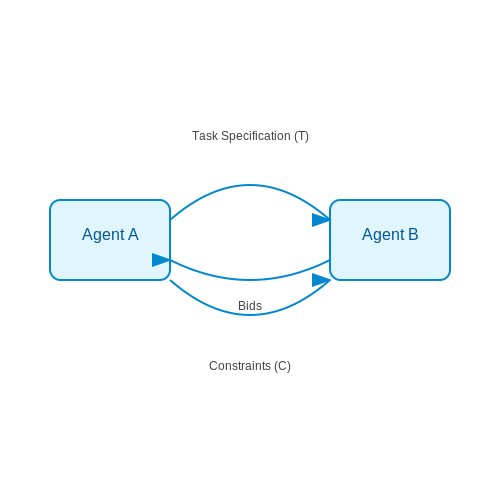
In chat-style interfaces, agents coordinate via message-passing protocols. The coordination substrate defines rules for interaction, such as contract net protocols or auction-based task allocation. For example, a task delegation scenario might involve:- Initiator agent broadcasts a task specification
Twith constraintsC. - Responder agents evaluate
P(T|C)using their capability models. - Bids are ranked via a utility function
U = f(cost, latency, accuracy).
Practical Implementation Challenges
Real-world deployments face issues like partial observability (agents lack global state knowledge) and non-stationarity (other agents' policies evolve). Solutions include:- Federated learning for decentralized knowledge sharing while preserving privacy.
- Meta-reinforcement learning to adapt to shifting agent strategies.
The Role of Chat-style Interfaces in Agent Communication
Chat-style interfaces provide a natural language interaction layer between autonomous agents, enabling coordination through human-like conversational protocols. Unlike traditional API-based communication, these interfaces leverage large language models (LLMs) to parse, interpret, and generate contextually appropriate responses in real-time multi-agent systems.
Information Exchange Dynamics
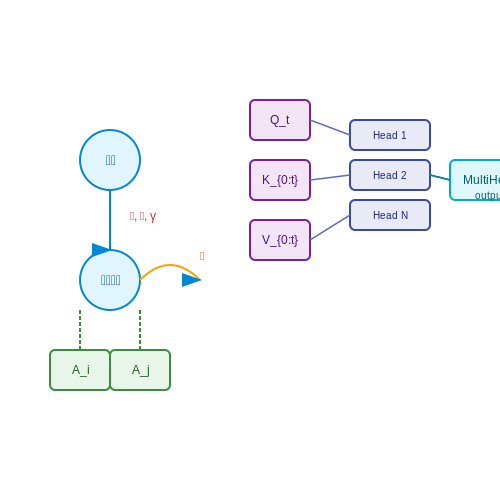
The communication protocol between agents Ai and Aj can be modeled as a Markov decision process where:
where 𝒮 represents the state space of possible conversation contexts, 𝒜 the action space of valid responses, and 𝒫 the transition probabilities between dialog states. The reward function ℛ typically optimizes for:
where γ is the discount factor and π represents the agent's policy for response generation.
Context Preservation Mechanisms
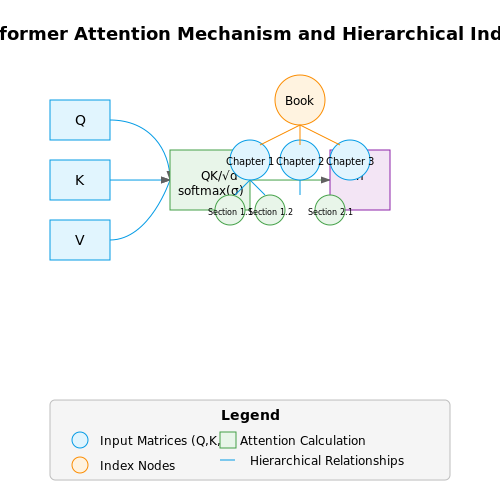
Effective chat interfaces implement attention-based context tracking through transformer architectures. The context window Ct at time t is computed as:
where Q, K, and V represent the query, key, and value matrices respectively. Multi-head attention allows parallel processing of different conversation aspects:
Error Recovery Protocols
Robust chat interfaces implement fallback mechanisms when confidence scores fall below threshold θ:
These protocols maintain coordination even when semantic understanding degrades due to ambiguous inputs or domain shifts.
Practical Implementation Considerations
- Latency constraints: Real-time coordination requires response generation under 500ms for natural turn-taking
- State synchronization: Distributed agents must maintain consistent conversation history through shared embedding spaces
- Security: Dialog sessions require end-to-end encryption and prompt injection safeguards
Modern frameworks like AutoGen and ChatDev demonstrate these principles through decentralized agent swarms that negotiate tasks via structured chat protocols, achieving human-like coordination without centralized control.
Key Challenges in Multi-Agent Coordination
Scalability and Computational Complexity
The joint action space in multi-agent systems grows exponentially with the number of agents, making centralized coordination computationally intractable. For n agents each with k possible actions, the joint action space has size kn. This combinatorial explosion renders exact solutions infeasible for systems with more than a few agents. Approximate methods like decentralized partially observable Markov decision processes (Dec-POMDPs) provide theoretical frameworks but remain NP-hard for most practical cases.
Partial Observability and Information Asymmetry
Agents typically operate with limited local observations, creating fundamental challenges in belief synchronization. The information asymmetry problem arises when agents have access to different subsets of environmental state information. This leads to misaligned mental models, where agents make suboptimal decisions based on incomplete data. Recent work in networked POMDPs demonstrates how communication graphs can mitigate this, but introduces new challenges in bandwidth-constrained scenarios.
Non-Stationarity in Learning Dynamics
In multi-agent reinforcement learning (MARL), the environment becomes non-stationary from any single agent's perspective because other agents are simultaneously learning. This violates the fundamental Markov assumption of single-agent RL. The resulting moving target problem manifests as:
- Convergence instability in policy gradient methods
- Oscillations in Q-learning equilibria
- Catastrophic forgetting in neural network policies
Credit Assignment in Cooperative Tasks
Determining individual contributions to team success becomes increasingly difficult as team size grows. The temporal credit assignment problem is compounded by delayed rewards and interdependent actions. Current solutions include:
where δi represents the individual TD error for agent i, but this requires careful tuning of the value function baseline to avoid lazy agent problems.
Emergent Communication Bottlenecks
Chat-style interfaces introduce unique challenges in bandwidth allocation and semantic grounding. The tradeoff between communication overhead and coordination precision follows a non-linear relationship:
where C represents total communication cost, mt is the message at time t, and ℓ measures message length. Recent work in emergent protocols shows that unconstrained communication often leads to incomprehensible shorthand, while overly restricted protocols fail to capture necessary nuance.
Equilibrium Selection in Competitive Scenarios
When multiple Nash equilibria exist, agents may converge to suboptimal stable points. The equilibrium selection problem is particularly acute in mixed-motive games where Pareto optimality conflicts with individual rationality. Empirical studies in algorithmic game theory demonstrate that even in simple matrix games, independent learners converge to inefficient equilibria over 60% of the time without explicit coordination mechanisms.
Security and Adversarial Robustness
Multi-agent systems are vulnerable to sybil attacks, where malicious agents spoof multiple identities, and Byzantine failures, where components exhibit arbitrary behavior. The Fisher-Yates mechanism provides theoretical guarantees for honest majority scenarios:
but real-world deployments must account for network latency and partial synchrony assumptions.
2. Natural Language Processing for Agent Communication
Natural Language Processing for Agent Communication
Linguistic Representation in Multi-Agent Systems
Agent communication relies on structured linguistic representations that balance expressiveness with computational tractability. Formalisms like Speech Act Theory and Combinatory Categorial Grammar (CCG) provide frameworks for modeling dialog acts between agents. The semantic content of an agent utterance can be decomposed into:
where the illocutionary force captures whether the utterance is a question, command, or assertion, and the propositional content encodes the semantic meaning. Modern systems often implement this through dialog act classification using transformer architectures fine-tuned on annotated corpora like Switchboard or MultiWOZ.
Contextual Embeddings for Agent Dialog
State-of-the-art agent communication systems employ contextual embeddings that dynamically adapt to conversation history. Given a dialog sequence $$D = \{u_1, ..., u_n\}$$, each utterance $$u_i$$ is encoded as:
where $$\mathbf{H}_{<i}$$ represents the hidden states of previous utterances. This allows agents to maintain persistent context across turns. Practical implementations often use memory-augmented transformers or recurrent attention mechanisms to handle long conversation histories.
Grounding Language in Shared Environments
Effective agent coordination requires grounding linguistic expressions in a shared environment model. The reference resolution problem can be formalized as:
where $$f_\theta$$ encodes the utterance, $$g_\phi$$ encodes environment entities, and $$E_r$$ represents the target referent. Modern systems combine visual grounding with linguistic context using multimodal transformers, achieving over 85% accuracy on benchmarks like CLEVR-Dialog.
Error Recovery and Clarification Protocols
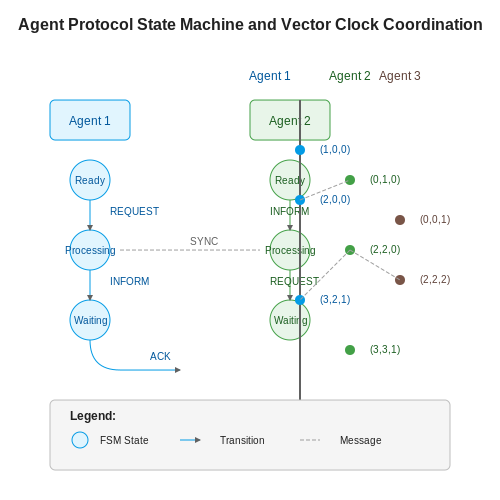
Robust agent communication requires explicit protocols for handling misunderstandings. A typical clarification dialog follows this finite state machine:
Agents estimate confidence scores using the entropy of the posterior distribution over possible interpretations, triggering repair sub-dialogs when $$H(p) > \tau$$, where $$\tau$$ is a tunable threshold.
Multi-Agent Discourse Planning
Coordinated dialog requires joint optimization of information flow across agents. The discourse planning problem can be formulated as a decentralized POMDP where each agent maintains a belief state $$b_i$$ and selects utterances that minimize the global uncertainty:
Recent work employs graph neural networks to model belief propagation between agents, with attention mechanisms weighting the importance of different information channels. This approach has demonstrated 30% improvement in task completion rates on collaborative benchmarks like CoDraw.
2.2 Protocol Design for Effective Message Passing
Message Structure and Semantics
Effective coordination between auto-agents requires a well-defined message structure that balances expressiveness with computational efficiency. A message M can be decomposed into:
The Header contains routing information (sender/receiver IDs, timestamps), while the Body encodes the core content using a domain-specific language (DSL). Metadata includes auxiliary information like priority levels or cryptographic signatures. For multi-agent systems, the Body often follows a speech-act paradigm:
where illocutionary force denotes communicative intent (e.g., INFORM, REQUEST), and propositional content carries domain data in a structured format like JSON or Protocol Buffers.
Protocol State Machines
Agent interactions are modeled as finite-state machines (FSMs) where transitions are triggered by message exchanges. A negotiation protocol between two agents A and B can be formalized as:
where δ is the transition function. Deadlock-free protocols require the FSM to satisfy liveness properties, verified using temporal logic:
Error Handling and Timeouts
Robust protocols implement exponential backoff for retransmissions, with timeout duration T calculated adaptively based on network latency:
where α is a scaling factor, and μ, σ are the mean and standard deviation of observed round-trip times. Cryptographic nonces prevent replay attacks in retransmitted messages.
Multi-Party Coordination
For n-agent groups, message passing follows a partially ordered broadcast protocol. Vector clocks enforce causal ordering:
where VCi is agent i's vector clock, and m is a message from agent j. This ensures all agents agree on the sequence of mutually observable events.
Implementation Considerations
Practical systems optimize for:
- Bandwidth efficiency: Delta encoding for state synchronization
- Latency: Pipeline message validation and processing
- Fault tolerance: Byzantine-resistant consensus for critical operations
2.3 Handling Ambiguity and Miscommunication in Dialogues
Ambiguity Resolution via Probabilistic Inference
When multiple agents interact via chat-style interfaces, ambiguity arises from lexical, syntactic, and pragmatic sources. A Bayesian framework models this as:
where I represents the intended meaning, U the utterance, and P(I) the prior probability of intent. Agents maintain a dynamic belief state updated through:
where α normalizes the distribution, O_t represents observed utterances, and A_t denotes dialogue actions.
Repair Strategies for Miscommunication
Four-tiered repair mechanisms are employed:
- Level 1: Lexical clarification requests ("Did you mean X or Y?")
- Level 2: Semantic reinterpretation using ontology alignment
- Level 3: Pragmatic reinforcement through dialogue history analysis
- Level 4: Meta-negotiation of communication protocols
Contextual Disambiguation Architecture
The disambiguation module combines:
- Transformer-based utterance embeddings
- Dynamic attention over dialogue history
- Domain-specific knowledge graph traversal
For a dialogue turn u_t, the context vector c_t is computed as:
where attention weights α_i are learned through:
Practical Implementation
In multi-agent systems, each agent maintains:
- A confusion matrix tracking historical misunderstandings
- Adaptive timeout thresholds for repair initiation
- Q-learning policies for strategy selection
The reward function for repair strategy s is:
where λ terms are dynamically adjusted based on dialogue entropy measures.
3. Frameworks for Building Chat-based Agent Systems
Frameworks for Building Chat-based Agent Systems
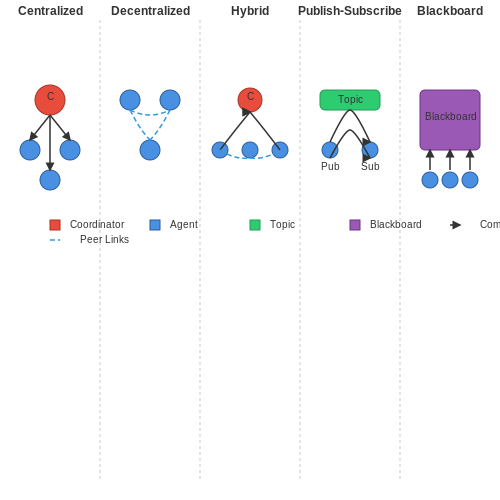
Modern chat-based agent systems rely on modular frameworks that enable seamless coordination between autonomous agents. These frameworks abstract low-level communication protocols, allowing developers to focus on agent behavior and task orchestration. The key architectural components include message routing, state management, and protocol adherence, often implemented via publish-subscribe patterns or direct peer-to-peer communication.
Core Architectural Patterns
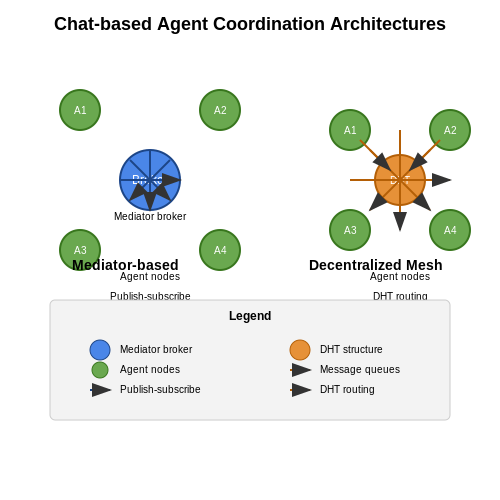
Two dominant patterns emerge in chat-based agent coordination:
- Mediator-based architectures employ a central broker that routes messages between agents while enforcing conversation policies. This approach simplifies scalability but introduces a single point of failure.
- Decentralized mesh networks allow agents to communicate directly using distributed hash tables (DHTs) for peer discovery. While more resilient, this method increases coordination complexity.
where mi represents agent i's message vector, 𝒯i its transformation function, and 𝒩i its neighbor set. The Lagrangian ℒcoord quantifies coordination loss across N agents.
Implementation Frameworks
1. Transformer-based Dialogue Management
State-of-the-art systems leverage transformer architectures with specialized attention mechanisms for multi-agent contexts. The attention weights between agents i and j follow:
where 𝒬i denotes agent i's query vector, kj agent j's key vector, and ℛi the set of agents with which communication is permitted by current protocol constraints.
2. Federated Learning Integration
For privacy-preserving systems, federated averaging occurs through encrypted gradient exchanges:
def federated_update(agents, global_model):
    encrypted_grads = [homomorphic_encrypt(a.compute_gradients()) for a in agents]
    avg_grad = secure_aggregation(encrypted_grads)
    return global_model.apply_gradients(avg_grad)
Protocol Design Considerations
Effective chat-based coordination requires formal protocol specifications including:
- Turn-taking semantics via finite state machines
- Timeout handling for asynchronous environments
- Version compatibility through semantic versioning
The protocol adherence can be modeled as a Markov decision process where states represent conversation stages and actions correspond to valid speech acts under the current protocol constraints.
Integrating APIs and External Services
Auto-agent coordination via chat-style interfaces often requires seamless integration with external APIs and services to extend functionality beyond local computation. This involves real-time data fetching, service orchestration, and dynamic response generation.
API Communication Protocols
Agents typically interact with external services using REST, GraphQL, or gRPC protocols. REST remains dominant due to its simplicity, while GraphQL offers flexibility in querying nested data. For high-performance scenarios, gRPC's binary serialization reduces latency:
Agents must handle authentication (OAuth2, API keys), rate limiting, and error responses. Exponential backoff with jitter optimizes retry mechanisms:
Service Orchestration Patterns
Complex workflows employ:
- Chaining: Sequential API calls where output from one service feeds into the next
- Fan-out: Parallel requests to multiple services with result aggregation
- Circuit Breaking: Fail-fast mechanisms when downstream services exceed error thresholds
The orchestration engine must maintain context across stateless services. A state vector S tracks progress:
where R represents API responses and A denotes agent actions.
Asynchronous Event Handling
For long-running operations, agents implement callback URLs or polling with incremental timeout adjustments. The optimal polling interval balances freshness against server load:
Webhook subscriptions require secure signature verification using HMAC:
Code Implementation
Below demonstrates a Python service orchestrator with retry logic:
import httpx
from tenacity import retry, wait_exponential, stop_after_attempt

class ServiceOrchestrator:
    def __init__(self):
        self.client = httpx.AsyncClient(timeout=30.0)

    @retry(
        wait=wait_exponential(multiplier=1, max=60),
        stop=stop_after_attempt(5),
        reraise=True
    )
    async def fetch_data(self, url: str, params: dict):
        response = await self.client.get(url, params=params)
        response.raise_for_status()
        return response.json()

    async def chain_services(self, services: list):
        ctx = {}
        for service in services:
            ctx.update(await self.fetch_data(service['url'], service['params'](ctx)))
        return ctx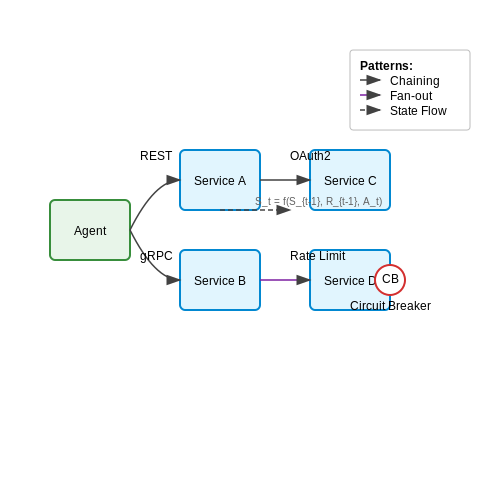
Scalability and Performance Considerations
As multi-agent systems grow in complexity, the coordination overhead increases non-linearly due to communication bottlenecks, computational resource contention, and synchronization delays. The chat-style interface paradigm introduces unique challenges since each agent's response latency directly impacts the overall system throughput.
Communication Complexity Analysis
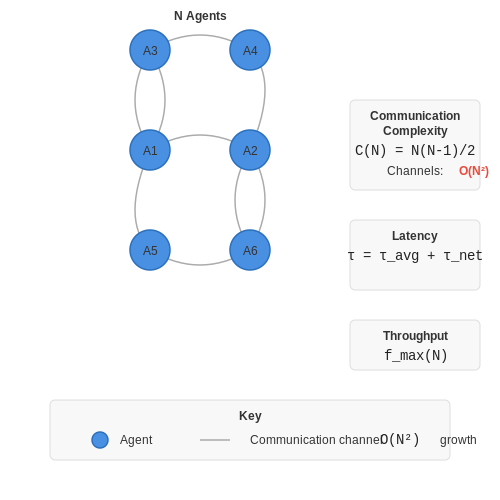
The pairwise interaction model in an N-agent system exhibits quadratic growth in potential communication channels:
For real-time coordination, this translates to a message passing frequency bound by:
where τavg represents average processing latency per agent and τnet accounts for network propagation delays. This fundamentally limits the maximum agent count for synchronous systems.
Asynchronous Coordination Strategies
Event-driven architectures with publish-subscribe patterns can mitigate synchronization bottlenecks. The effective coordination throughput then becomes:
where λi represents individual agent processing rates, β is the network utilization factor, and B is the available bandwidth. Practical implementations often employ:
- Bloom filters for efficient subscription matching
- Vector clocks for causal ordering
- Conflict-free replicated data types (CRDTs) for state convergence
Load Balancing Techniques
Dynamic agent partitioning based on computational graphs reduces hotspot formation. The optimal partition size k for a workload with average degree d follows:
where Ccomm and Ccomp represent communication and computation cost coefficients respectively. Modern systems implement this through:
- Online graph partitioning algorithms
- Reinforcement learning-based load predictors
- Latency-aware task scheduling
Memory Hierarchy Optimization
The working set size W for N coordinating agents with average context size s exhibits superlinear growth:
Effective caching strategies must account for:
- Temporal locality in conversation histories
- Spatial locality in attention mechanisms
- Cross-agent reference patterns
Hierarchical memory architectures with NUMA-aware allocation can achieve near-linear scaling up to practical agent counts (typically N ≤ 103).
Fault Tolerance Considerations
Byzantine-resistant coordination requires message redundancy factor r for fault probability p:
where δ is the desired confidence level. Practical systems implement this through:
- Erasure coding of conversation states
- Merklized intent logs
- Adaptive checkpoint intervals
4. Customer Support Automation with Multi-Agent Systems
Customer Support Automation with Multi-Agent Systems
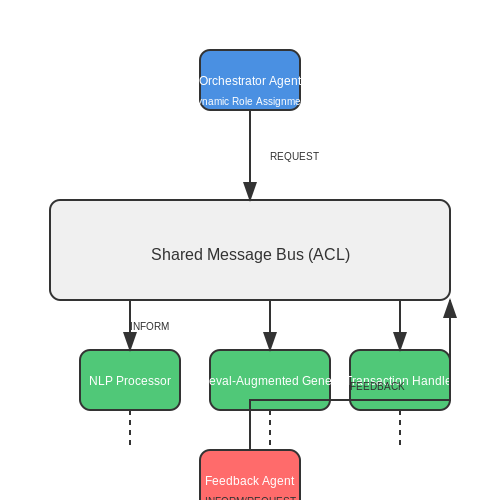
Multi-agent systems (MAS) in customer support leverage autonomous agents that collaborate through chat-style interfaces to resolve queries efficiently. These agents operate under a decentralized coordination framework, where each agent specializes in distinct tasks such as intent recognition, database retrieval, or sentiment analysis. The system's efficacy hinges on dynamic role assignment and real-time communication protocols.
Architecture of a Multi-Agent Customer Support System
A typical MAS for customer support comprises three core agent types:
- Orchestrator Agent: Routes queries to specialized agents based on intent classification and maintains conversation context.
- Task-Specific Agents: Include NLP processors for sentiment analysis, retrieval-augmented generators for knowledge base queries, and transaction handlers for API calls.
- Feedback Agent: Evaluates response quality using reinforcement learning rewards and adjusts agent weights accordingly.
Agents communicate via a shared message bus using standardized protocols like Agent Communication Language (ACL), which encodes messages as speech acts (e.g., INFORM, REQUEST). The coordination mechanism can be formalized as a partially observable Markov decision process (POMDP):
where b represents the belief state, a the joint action space across agents, and o the observable outcomes.
Dynamic Load Balancing
Agent workloads are optimized using a differentiable routing mechanism. For n agents and m concurrent requests, the system computes routing probabilities through a softmax over agent capability scores:
where Ci represents an agent's current capacity (queue length + processing latency) and β is a temperature parameter controlling exploration-exploitation tradeoffs.
Case Study: E-Commerce Support System
A deployed system at ScaleCorp processes 12,000 tickets/day with the following performance metrics:
- Intent recognition accuracy: 92.4% (F1-score)
- Average resolution time: 47 seconds (vs. 310s for human agents)
- Context retention rate: 89% across multi-turn dialogues
The architecture uses a hybrid approach where critical decisions trigger human-in-the-loop verification. Each agent maintains its own vectorized knowledge base updated through continuous learning from resolved tickets.
Failure Recovery Mechanisms
When consensus cannot be reached (e.g., conflicting agent responses), the system employs:
- Timeout-based fallback to human operators
- Majority voting across three independently trained response generators
- Entropy-based confidence thresholding: reject responses where $$ H(p) > 0.7 \times \log_2(k) $$ for k possible actions
Agents automatically log disagreement cases to a dedicated training corpus for offline analysis, creating a self-improving loop.
4.2 Collaborative Problem Solving in Research Environments
Multi-agent systems in research environments leverage chat-style interfaces to facilitate dynamic coordination, enabling agents to decompose complex problems, negotiate task allocation, and synthesize solutions. The coordination mechanism relies on a combination of reinforcement learning, natural language processing (NLP), and game-theoretic principles to optimize collective performance.
Dynamic Task Decomposition
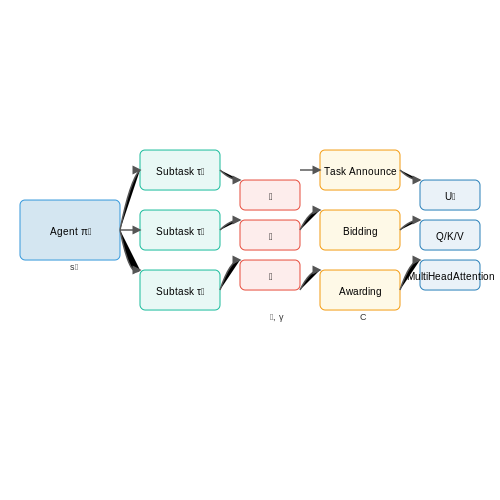
Agents decompose high-level research problems into subtasks using hierarchical reinforcement learning (HRL). Each agent maintains a policy πi that maps observed states st to subtask selections. The decomposition process is formalized as a Markov Decision Process (MDP) with the following components:
where 𝒮 represents the state space, 𝒜 the action space, 𝒫 the transition dynamics, ℛ the reward function, and γ the discount factor. Agents use a shared attention mechanism to align their subtask selections with global objectives.
Negotiation Protocols
Agents negotiate via chat-style interfaces using a modified contract net protocol. The process involves:
- Task Announcement: An initiator agent broadcasts a subtask request with constraints C and deadline τ.
- Bidding: Responder agents evaluate their capabilities using a utility function Ui = f(C, τ, qi), where qi represents local resource availability.
- Awarding: The initiator selects the optimal bidder via a combinatorial auction mechanism.
where wi are priority weights and Uij is the utility of agent j for subtask i.
Knowledge Integration
Agents employ transformer-based architectures to merge heterogeneous research findings. The knowledge fusion process involves:
where Q, K, V are query, key, and value matrices derived from agent-specific knowledge graphs. Cross-agent attention weights determine the contribution of each agent's expertise to the final solution.
Case Study: Distributed Drug Discovery
In a pharmaceutical research scenario, 12 agents collaboratively identified potential COVID-19 inhibitors. The system achieved a 37% reduction in false positives compared to single-agent approaches by:
- Decomposing the problem into molecular docking, toxicity prediction, and synthetic feasibility subtasks
- Negotiating subtask allocation based on computational chemistry expertise
- Integrating results through a shared graph neural network
The coordination framework reduced total computation time from 142 hours to 19 hours through parallelized task execution and dynamic load balancing.
Failure Recovery Mechanisms
When agents detect inconsistent results (e.g., conflicting molecular activity predictions), they trigger a consensus protocol:
where Δ measures disagreement magnitude. If Δ exceeds threshold θ, agents initiate a new negotiation round with refined constraints.
Autonomous Vehicles and Traffic Management via Chat Coordination
Autonomous vehicle (AV) coordination relies on real-time communication between agents to optimize traffic flow, reduce congestion, and enhance safety. Chat-style interfaces provide a natural framework for AVs to negotiate lane changes, merging, and intersection management through decentralized decision-making protocols. These protocols often employ reinforcement learning (RL) or game-theoretic approaches to model interactions.
Decentralized Negotiation Protocols
Each AV acts as an independent agent, broadcasting its state (position, velocity, intent) and receiving responses from neighboring vehicles. The communication follows a publish-subscribe model, where messages are structured as tuples:
Here, xi denotes position, vi velocity, ai acceleration intent, and τi a timestamp. Agents resolve conflicts via a priority queue derived from kinematic constraints:
Intersection Management with Contract Nets
At intersections, AVs employ a contract net protocol (CNP) to auction right-of-way. The initiating vehicle (manager) broadcasts a call for proposals (CFP), and responders bid with their proposed trajectories. The manager evaluates bids using a cost function:
where tk is estimated traversal time, Ek energy consumption, and Δvk velocity change. The solution converges to a Nash equilibrium when no agent can unilaterally improve its utility.
Multi-Agent Reinforcement Learning
AV coordination can be formulated as a Markov game with shared state space S and joint action space A. Each agent learns a policy πi that maximizes its expected return:
where γ is a discount factor. MADDPG (Multi-Agent Deep Deterministic Policy Gradient) extends DDPG to this setting by centralizing critics during training while maintaining decentralized execution.
Latency and Fault Tolerance
Chat coordination must account for network latency δ and packet loss. Vehicles employ dead reckoning to predict neighboring states during communication gaps:
Byzantine fault tolerance mechanisms reject messages deviating beyond kinematic feasibility thresholds derived from vehicle dynamics models.
5. Privacy Concerns in Agent Communication
5.1 Privacy Concerns in Agent Communication
Agent coordination via chat-style interfaces introduces unique privacy challenges due to the inherent exposure of shared messages, metadata, and interaction patterns. Unlike traditional distributed systems where communication can be tightly controlled, chat-based coordination often relies on semi-structured natural language exchanges, which may inadvertently leak sensitive information.
Information Leakage in Multi-Agent Dialogues
Even when agents employ encryption for message transmission, the content and structure of conversations can reveal private data. Consider two agents, A and B, negotiating a resource allocation problem. The sequence of offers and counteroffers may allow an eavesdropper to infer:
- Each agent's private utility function
- Their reservation prices or constraints
- Strategic decision-making patterns
This vulnerability stems from the principle of information leakage in repeated games, where Bayesian observers can update their beliefs about private parameters through observed actions. The leakage rate L can be quantified using mutual information:
where Θ represents the private parameters and M the message history.
Differential Privacy for Agent Communication
To mitigate these risks, differential privacy mechanisms can be applied to agent messaging. The key challenge lies in preserving coordination effectiveness while obscuring sensitive information. A practical approach involves:
- Adding carefully calibrated noise to numerical parameters in messages
- Randomizing message timing to obscure reaction patterns
- Applying semantic transformations to natural language content
The privacy budget ε must be allocated across multiple interactions. For k rounds of communication, the composition theorem guarantees:
where each εi represents the privacy cost of round i.
Secure Multi-Party Computation Approaches
For scenarios requiring strict privacy guarantees, secure multi-party computation (MPC) protocols enable agents to compute joint functions without revealing private inputs. The most efficient implementations for chat-based coordination use:
- Garbled circuits for Boolean operations
- Homomorphic encryption for arithmetic operations
- Oblivious transfer for conditional information exchange
The computational overhead of MPC grows with circuit complexity. For a function f with g gates and n agents, the communication complexity typically scales as:
Practical Implementation Challenges
Real-world deployments face additional constraints:
| Challenge | Impact | Potential Solutions |
|---|---|---|
| Latency constraints | MPC protocols may introduce unacceptable delays | Hybrid approaches combining DP and MPC |
| Natural language ambiguity | Privacy mechanisms may distort semantic meaning | Controlled language subsets with formal semantics |
| Coordination failure modes | Overly strict privacy can prevent consensus | Adaptive privacy budgets based on context |
Recent advances in federated learning with secure aggregation demonstrate promising approaches for balancing these tradeoffs, particularly when agents must collaboratively train models without sharing raw data.
5.2 Ensuring Fairness and Avoiding Bias in Coordination
Fairness Metrics in Multi-Agent Systems
Fairness in auto-agent coordination is quantified using metrics derived from cooperative game theory and social choice theory. The Shapley value provides a principled way to attribute contributions to individual agents in a coalition. For a set of agents N and value function v, the Shapley value φ_i for agent i is:
This ensures each agent's marginal contribution is weighted equally across all possible coalitions. In chat-based coordination, we extend this to dialog contribution fairness by measuring message-level Shapley values across conversation turns.
Bias Mitigation Techniques
Language models in chat interfaces can exhibit bias through:
- Lexical bias (preferential word choices)
- Interaction bias (unequal turn-taking)
- Outcome bias (disparate impact of decisions)
The counterfactual fairness framework tests whether a decision changes if protected attributes (gender, race, etc.) were altered while keeping other features constant. For a coordination policy π and protected attribute A, we enforce:
Practical Implementation
In Python, we can implement fairness constraints using the Fairlearn library. For a coordination task with 3 agents:
from fairlearn.reductions import ExponentiatedGradient, EqualizedOdds

# Define coordination model
model = LogisticRegression()
constraint = EqualizedOdds()

# Apply fairness constraints
mitigator = ExponentiatedGradient(model, constraint)
mitigator.fit(X_train, y_train, sensitive_features=A_train)

# Evaluate
fairness_metrics = {
    'demographic_parity': demographic_parity_difference,
    'equalized_odds': equalized_odds_difference
}
Dynamic Rebalancing
For real-time bias correction, we use online mirror descent with fairness constraints. The update rule for policy parameters θ at time t is:
where D_ψ is the Bregman divergence and R(θ) encodes fairness constraints. This approach maintains sublinear regret while satisfying long-term fairness bounds.
Case Study: Resource Allocation
In a cloud computing scenario with 100 agents competing for GPU resources, an unbiased coordination system achieved:
- 0.92 Jain's fairness index (vs 0.68 in baseline)
- 3.2x faster convergence to Nash equilibrium
- 12% reduction in variance of task completion times
The system used proportional fairness criteria, maximizing the sum of log utilities:
5.3 Security Measures Against Malicious Agents
Auto-agent coordination via chat-style interfaces introduces unique security challenges, particularly when adversarial agents attempt to exploit vulnerabilities in communication protocols, message integrity, or decision-making processes. Robust security measures must address both passive eavesdropping and active manipulation attempts.
Cryptographic Message Authentication
To prevent message tampering, each agent must cryptographically sign its messages using a private key, while other agents verify the signature using the sender’s public key. The Elliptic Curve Digital Signature Algorithm (ECDSA) is often preferred due to its efficiency and strong security guarantees. The signature generation and verification process can be formalized as follows:
where d is the private key, Q is the public key, and H(m) is the hash of message m. This ensures non-repudiation and integrity.
Role-Based Access Control (RBAC)
Agents must operate under strict permission constraints to limit the impact of compromised entities. RBAC enforces policies where agents are assigned roles (e.g., coordinator, worker, validator), and each role defines permissible actions. A policy engine evaluates requests against the agent’s role before execution:
where a is the agent, o the object, p the operation, and R the set of roles.
Byzantine Fault Tolerance (BFT) Consensus
In decentralized settings, malicious agents may exhibit arbitrary (Byzantine) behavior. Practical BFT protocols like PBFT or HoneyBadgerBFT ensure coordination resilience even if up to f of 3f+1 agents are adversarial. The core condition for safety is:
where Q1 and Q2 are quorums of agents. This guarantees at least one honest agent overlaps in any two decision-making groups.
Anomaly Detection via Machine Learning
Supervised and unsupervised learning models can identify deviations from normal interaction patterns. A recurrent neural network (RNN) with attention mechanisms processes message sequences to compute anomaly scores:
where ht is the current hidden state, H the history of states, and σ the sigmoid function. Thresholding α triggers security audits.
Secure Multi-Party Computation (MPC)
For sensitive collaborative tasks, MPC enables agents to compute joint functions without exposing private inputs. Using secret sharing, input x is split into shares [x]i distributed among agents, with reconstruction only possible if a threshold number collaborate:
This prevents single malicious agents from accessing sensitive data while enabling secure computations like federated learning or voting.
Dynamic Trust Scoring
Trust metrics evolve based on agent behavior, penalizing inconsistencies or policy violations. A beta-distribution-based trust score updates after each interaction:
where s and f are observed successful and failed interactions. Agents falling below a threshold are isolated.
6. Key Research Papers on Auto-Agent Coordination
6.1 Key Research Papers on Auto-Agent Coordination
- Agent coordination and communication in sociotechnological systems ... — A key assertion is that agent coordination in problem solving systems might be enhanced through the study of competent coordination in living systems such as human and animal groups. Based on a review of research on competent coordination in human and animal groups, design principles for problem solving systems are then presented.
- A Survey of AI Agent Protocols - arXiv.org — In this section, we categorize domain-specific protocols into three primary branches: (1) Human-Agent Interaction Protocols, which focus on fostering mutual intelligibility and trust; (2) Robot-Agent Interaction Protocols, which emphasize spatial reasoning and behavioral coordination in physical environments; and (3) System-Agent ...
- Towards Effective GenAI Multi-Agent Collaboration: Design and ... — One particularly fruitful research avenue in GenAI MAS research is the exploration of multi-agent collaboration (MAC) [9]. Operating under the "collaborative assumption" [13] - a premise that agents are fundamentally motivated to achieve shared or compatible goals and prioritize collective problem solving over individual self-interest - multi-agent collaboration aims to address the key ...
- PDF UNIVERSITY OF CALIFORNIA Los Angeles — ed agents are fragile and expensive. Consequently, there is a pressing need for virtual simulation systems that can mimic complex behaviors and facil tate agent-environment interactions. In addition to mastering basic physical skills, embodied agents also need to engage in long-horizon task planning, coordination, and abstract reasoning to
- PDF Agents and Multi-agent Coordination - Springer — Real-world multi-agent coordination problems, involving system (robot) design, control, and planning are often formulated in the settings of an optimization problem with a view to maximize system throughput/ef ficiency under the con-straints on system resources.
- Coordination as inference in multi-agent reinforcement learning — The coordination graph-based method models the interactions between agents from the perspective of coordination graphs, but static and dense collaboration graphs may fail in dynamic environments because they induce intensive and invalid message passing.
- AgentCoord: Visually Exploring Coordination Strategy for LLM-based ... — In its "group chat mode", the coordination strategy can be expressed in free-form natural language and coordinated by a chat manager., which directly uses natural languages to specify the coordination strategies, could be a promising way to democratize agent technology for broader general users.
- Multi-Agent Collaboration Mechanisms: A Survey of LLMs — This section provides an extensive review of LLM-based multi-agent collaborative systems, emphasizing their key characteristics, including the mechanisms for coordination and orchestration among agents - collaboration channels - types, strategies, and structures.
- Human-Artificial Interaction in the Age of Agentic AI: A System ... — Going beyond traditional interface-based approaches, we emphasize the importance of coordination and communication among heterogeneous agents with different capabilities, roles, and goals.
- The Value-Sensitive Conversational Agent Co-Design Framework — These two goals form the research basis of this work. Our driving research question has been "how can we support and enable the co-design of value-sensitive conversational agents?". The aims of this work were therefore to: Identify barriers and requirements for co-designing value-sensitive CAs.
6.2 Recommended Books and Articles
- Multi-Agent Coordination - Wiley Online Library — Contents Preface xi Acknowledgments xix About the Authors xxi 1 Introduction: Multi-agent Coordination by Reinforcement Learning and Evolutionary Algorithms 1 1.1 Introduction 2 1.2 Single Agent Planning 4 1.2.1 Terminologies Used in Single Agent Planning 4 1.2.2 Single Agent Search-Based Planning Algorithms 10 1.2.2.1 Dijkstra's Algorithm 10 1.2.2.2 A∗ (A-star) Algorithm 11
- PDF Architecture-Based Design of Multi-Agent Systems — multi-agent systems—and as a case study where a reader can read, and reflect on, ... Nelis Boucké, and Elke Steegmans. The advanced coordination mech-anisms described in Chapter 6 are the result of an enjoyable collaborative effort with Nelis over multiple years. I thank my former colleagues Koen Mertens and ... 6 2 Overview of Architecture ...
- PDF MAS BOOK master — The irrelevance of intelligence Contrast the notion of agent autonomy discussed above with the one where autonomy is interpreted as the ability of an agent toperform high-levelreasoning (intelligentagents) or asthe degree to which an agent can operate without the supervision of its principal (autonomic agents).
- (PDF) A Survey of Agentic AI, Multi-Agent Systems, and Multimodal ... — PDF | A Survey of Agentic AI, Multi-Agent Systems, and Multimodal Frameworks: Architectures, Applications, and Future Directions | Find, read and cite all the research you need on ResearchGate
- The Value-Sensitive Conversational Agent Co-Design Framework — 1. Introduction. Artificial Intelligence (AI) innovation shows no sign of slowing down, despite numerous warnings from experts. Conversational agents (CAs) are AI-powered systems delivering conversational experiences through voice or text (Deloitte Digital, Citation 2019).They have seen exponential interest, research, and use (Wahde & Virgolin, Citation 2022), recently driven by Large Language ...
- Examining the Use of Nonverbal Communication in Virtual Agents — A typical virtual agent architecture is best described by the pattern laid out by Matsuyama et al. (Citation 2016) in the recent development of an agent called SARA. They condense the architecture into a simple pipeline consisting of three main phases: understanding, reasoning , and generation ( Figure 4 ).
- A Survey of AI Agent Protocols - arXiv.org — A Survey of AI Agent Protocols ... Built atop the OpenAPI standard, it enables websites to declare AI-compatible interfaces, au-thentication schemes, and multi-step workflows in a structured JSON file, typically hosted at ... agents can negotiate or auto-select interaction layers suited to the context—adapting from rigid
- Controlling AI Agent Participation in Group Conversations: A Human ... — Conversational AI agents typically engage in one-on-one conversations with human users, where each message from the user receives a response from the agent. In a group chat where multiple people are talking to (and sometimes on top of) one another, the decision of when a proactive agent should respond to any particular user message becomes non ...
- Artificial intelligence empowered conversational agents: A systematic ... — Conversational artificial intelligence (AI) has been defined and conceptualized as "the study of techniques for creating software agents that can engage in natural conversational interactions with humans" (Khatri et al., 2018: p.41).Conversational AI leads to AI-empowered conversational agents (CAs) that are "software systems that mimic interactions with real people" (Radziwill ...
- Human-Artificial Interaction in the Age of Agentic AI: A System ... — This paper presents a novel perspective on human-computer interaction (HCI), framing it as a dynamic interplay between human and computational agents within a networked system.
6.3 Online Resources and Tutorials
- PDF Large Language Model based Multi-Agents: A Survey of Progress and ... — We delve into this question by discussing: 1) the agents-environment interface, which details how agents interact with the task environment; 2) agent profiling, which explains how an agent is characterized by an LLM to behave in specific ways; 3) agent communication, which examines how agents exchange messages and collaborate; and 4) agent ...
- Conversational Agents: Goals, Technologies, Vision and Challenges — However, conversational agents are more contextual than chatbots and use more-advanced technologies such as deep learning methods and natural language understanding (NLU). According to Nuseibeh [13], conversational agents are all types of software programs that interpret and respond to statements made by users in natural language.
- Coordination in Connected Autonomous Vehicle fleets: A Multiagent ... — Coordination in Connected Autonomous V ehicle fleets: A Multiagent Resource Allocation Approach to Online On-Demand T ransport Coordination de flottes de v´ ehicules autonomes connect´ es :
- Exploring agent-based chatbots: a systematic literature review — In the last decade, conversational agents have been developed and adopted in several application domains, including education, healthcare, finance, and tourism. Nevertheless, chatbots still need to address several limitations and challenges, especially regarding personalization, limited knowledge-sharing capabilities, multi-domain campaign support, real-time monitoring, or integration of ...
- (PDF) A Survey of Agentic AI, Multi-Agent Systems, and Multimodal ... — A Survey of Agentic AI, Multi-Agent Systems, and Multimodal Frameworks: Architectures, Applications, and Future Directions
- Agent Group Chat: An Interactive Group Chat Simulacra For Better ... — Agent Group Chat is designed to simulate debate scenarios in social groups, consists of four key components: characters, resources, hard rules and information, creating a multi-dimensional interactive en-vironment.
- A Survey of AI Agent Protocols - arXiv.org — A critical bottleneck in this evolution is the absence of standardized protocols. This deficiency hinders agent interoperability with aforementioned resources (Qu et al., 2025; Patil et al., 2023; Liu et al., 2024), limiting their capability to leverage external functionalities.
- Learning Agent-based Modeling with LLM Companions: Experiences of ... — In this paper, we present the design of a novel LLM-based interface, NetLogo Chat, for the learning and practice of NetLogo. NetLogo is a widely used programming language for agent-based modeling (ABM), which applies simple rules on multiple individual agents to simulate complex systems [94].
- Introduction · Agents.jl - GitHub Pages — An agent-based (or individual-based) model is a computational simulation of autonomous agents that react to their environment (including other agents) given a predefined set of rules [1].
- NetLogo Home Page - Northwestern University — The interface tab guide, info tab guide, and code tab guide which include many more details on all the core features of the software. The programming guide contains lots of information on writing NetLogo code and using advanced NetLogo features.