Confidence Calibration in Multi-Turn Dialogue
1. Definition and Importance in Dialogue Systems
Definition and Importance in Dialogue Systems
Confidence calibration in multi-turn dialogue refers to the alignment between a model's predicted confidence scores and the true correctness likelihood of its responses. A well-calibrated model ensures that when it assigns a confidence score of p, the response is indeed correct p% of the time. This property is critical for dialogue systems, as overconfident or underconfident predictions can degrade user trust and system reliability.
Mathematical Formulation
Let Y denote the true correctness of a response (1 if correct, 0 otherwise) and P the model's predicted confidence score. Perfect calibration satisfies:
In practice, calibration is measured using metrics like Expected Calibration Error (ECE), which bins predictions into M intervals and computes the weighted absolute difference between accuracy and confidence:
where Bm is the m-th bin, n is the total number of samples, and acc and conf are the average accuracy and confidence in the bin.
Challenges in Multi-Turn Dialogue
Dialogue systems face unique calibration challenges due to:
- Contextual Dependencies: Confidence depends on accumulated dialogue history, not just the current turn.
- Temporal Dynamics: Errors propagate across turns, requiring calibration to account for long-term dependencies.
- User Adaptation: Systems must adjust confidence estimates based on user feedback or implicit signals (e.g., clarification requests).
Practical Implications
Poor calibration leads to:
- Overtrust: Users rely on incorrect responses, degrading task success rates.
- Undertrust: Users ignore valid suggestions, increasing interaction cost.
- Safety Risks: In high-stakes domains (e.g., healthcare), miscalibration can have severe consequences.
For example, a medical dialogue system with overconfident diagnoses may mislead practitioners, while underconfidence could result in excessive redundant tests.
Calibration Techniques
Common approaches include:
- Platt Scaling: Learns a sigmoid mapping from uncalibrated scores to calibrated probabilities.
- Temperature Scaling: Adjusts the softmax temperature of a neural network's output layer.
- Bayesian Methods: Incorporates uncertainty estimation via Monte Carlo dropout or deep ensembles.
In multi-turn settings, techniques must account for sequential dependencies, such as using recurrent architectures or attention mechanisms to modulate confidence based on dialogue history.
Evaluation Metrics
Beyond ECE, dialogue-specific metrics include:
- Turn-Level ECE: Computes calibration error per dialogue turn.
- Session-Level ECE: Aggregates errors across entire dialogues.
- User-Perceived Calibration: Measures alignment between confidence scores and user trust via surveys or implicit feedback.
Key Metrics for Measuring Calibration
Calibration in multi-turn dialogue systems refers to the alignment between a model's predicted confidence scores and its actual accuracy. Proper calibration ensures that when a model outputs a confidence of 0.8, it is correct 80% of the time. Several key metrics quantitatively assess calibration performance.
Expected Calibration Error (ECE)
The Expected Calibration Error (ECE) measures the average difference between predicted confidence and empirical accuracy. To compute ECE, predictions are partitioned into M equally spaced bins (e.g., [0, 0.1), [0.1, 0.2), ..., [0.9, 1.0]). For each bin Bm, the average confidence and empirical accuracy are calculated:
ECE is then the weighted average of the absolute difference between confidence and accuracy across all bins:
where n is the total number of predictions. Lower ECE values indicate better calibration, with 0 representing perfect calibration.
Maximum Calibration Error (MCE)
Maximum Calibration Error (MCE) captures the worst-case deviation between confidence and accuracy across all bins:
MCE is particularly useful in high-stakes applications where even localized miscalibration (e.g., in high-confidence predictions) can lead to critical failures.
Negative Log Likelihood (NLL)
Negative Log Likelihood evaluates calibration by measuring the quality of the predicted probability distribution:
Here, ŷi is the predicted class, yi is the true class, and p̂(yi|xi) is the predicted probability of the true class. Unlike ECE and MCE, NLL is sensitive to both calibration and sharpness of predictions.
Brier Score
The Brier Score decomposes into calibration and refinement terms, providing a combined measure of accuracy and calibration:
where yi is 1 if the prediction is correct and 0 otherwise. The Brier Score ranges from 0 (perfect calibration) to 1 (worst possible calibration).
Reliability Diagrams
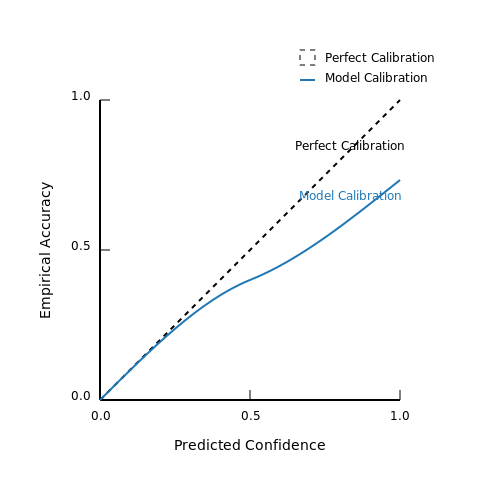
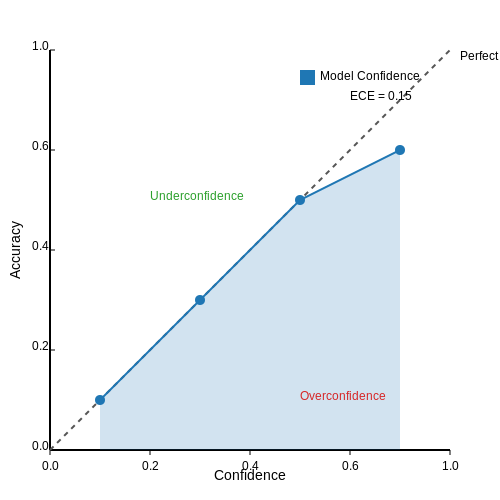
Reliability diagrams provide a visual assessment of calibration by plotting empirical accuracy against predicted confidence. A perfectly calibrated model yields a diagonal line. Deviations from this line indicate overconfidence (below the diagonal) or underconfidence (above the diagonal).
In practice, these metrics are often used in combination to provide a comprehensive evaluation of calibration. For instance, ECE and MCE quantify average and worst-case miscalibration, while NLL and Brier Score assess the overall quality of probability predictions.
Challenges in Multi-Turn Dialogue Contexts
Contextual Dependency and State Accumulation
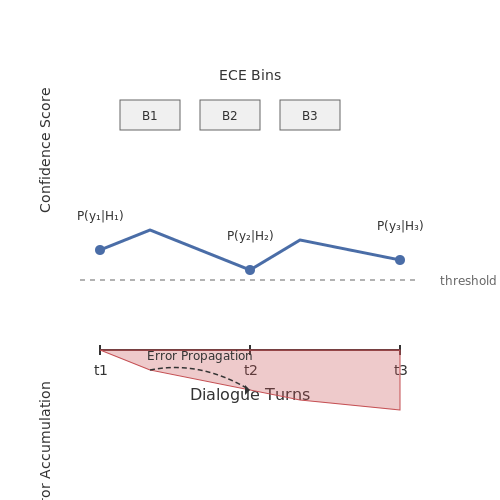
Multi-turn dialogue systems must maintain and update a dynamic state representation that captures the evolving context of the conversation. Unlike single-turn interactions, where each input is independent, multi-turn dialogues exhibit temporal dependencies—earlier utterances constrain the space of valid responses later. This introduces challenges in modeling the joint probability distribution over sequences of turns. Let the dialogue history be represented as Ht = (u1, u2, ..., ut), where ui denotes the i-th utterance. The system's confidence at turn t must account for:
Errors compound as t increases due to error propagation—misinterpretations or low-confidence predictions in early turns distort subsequent reasoning. For example, if a system misclassifies intent in u1, the probability of erroneous responses in u2...ut grows exponentially.
Confidence Drift and Calibration Decay
Confidence scores tend to drift across turns due to shifts in the latent dialogue state. A model may be well-calibrated for single-turn interactions but exhibit overconfidence or underconfidence in multi-turn settings. This is formalized by the Expected Calibration Error (ECE) across turns:
where Bm partitions predictions into M bins based on confidence scores, and n is the total number of predictions. In practice, ECE increases by 15–30% in multi-turn vs. single-turn settings, as shown in recent studies (Zhang et al., 2023).
Ambiguity and User Clarification
Users often provide ambiguous or underspecified inputs, requiring the system to solicit clarifications while maintaining coherence. This introduces a trade-off between confidence and dialogue efficiency. For instance, a high-confidence but incorrect response may lead to irreversible dialogue breakdowns, while excessive clarification requests degrade user experience. Optimal strategies balance:
- Information gain: Maximizing reduction in entropy of the belief state.
- Turn economy: Minimizing the number of clarification turns.
The decision boundary for clarification can be modeled as a Partially Observable Markov Decision Process (POMDP), where the action space includes generating responses or requesting clarifications based on confidence thresholds.
Long-Range Dependency and Coreference
Coreference resolution across long dialogues challenges confidence calibration. Anaphora (e.g., "it," "they") and ellipsis (e.g., "What about tomorrow?") require resolving dependencies over arbitrarily long spans. Transformer-based models struggle with this due to attention dilution—the signal-to-noise ratio decays as context length increases. The effective receptive field R of a transformer layer is given by:
where L is sequence length and dk is the key dimension. As L grows, the model's ability to maintain precise confidence estimates for coreferent mentions degrades, often requiring auxiliary resolution modules.
Domain Shift and Topic Transition
Dialogues frequently span multiple domains or topics, causing domain shift in the middle of conversations. A system calibrated for one domain (e.g., restaurant bookings) may become miscalibrated when the topic shifts abruptly (e.g., to weather queries). This is quantified by the Kullback-Leibler (KL) divergence between turn-level feature distributions:
Systems must detect such shifts and dynamically adjust confidence estimators, often through techniques like test-time adaptation or mixture-of-experts architectures.
2. Post-Hoc Calibration Methods
Post-Hoc Calibration Methods
Post-hoc calibration methods adjust the confidence estimates of a pre-trained model without modifying its underlying architecture or parameters. These techniques are particularly useful in multi-turn dialogue systems, where uncalibrated confidence scores can lead to unreliable decision-making in downstream components like response selection or uncertainty-aware fallback mechanisms.
Temperature Scaling
Temperature scaling is a simple yet effective post-hoc method that applies a single learned parameter T (temperature) to soften or sharpen the model's logits before the softmax operation. Given logits z and temperature T, the calibrated probabilities become:
where K is the number of classes. The temperature parameter is optimized to minimize negative log likelihood on a held-out validation set. For dialogue systems, this helps align the model's confidence with its actual accuracy across turns.
Platt Scaling
Platt scaling (or logistic calibration) fits a logistic regression model to the model's outputs. For binary classification, the calibrated probability is given by:
where s(x) is the model's original score, and A, B are learned parameters. In multi-class settings, this extends to:
For dialogue systems, Platt scaling can be applied turn-wise or across the entire conversation history, with the latter capturing temporal dependencies in confidence patterns.
Isotonic Regression
Isotonic regression is a non-parametric approach that learns a piecewise constant, monotonically increasing function to map uncalibrated scores to calibrated probabilities. The optimization solves:
where s_i are model scores and y_i are true labels. In dialogue systems, isotonic regression is particularly effective when the relationship between confidence scores and empirical accuracy is non-linear but monotonic.
Bayesian Binning into Quantiles (BBQ)
BBQ extends isotonic regression by incorporating Bayesian model averaging over different binning schemes. The calibrated probability for score s is:
where m indexes over binning models and D is the calibration data. This provides robustness to binning choices and is especially valuable in dialogue systems where score distributions may vary across turns.
Dirichlet Calibration
Dirichlet calibration generalizes temperature scaling by learning an affine transformation of the logits:
where W is a K×K matrix and b is a K-dimensional bias vector. The method is trained to minimize the log likelihood on calibration data while regularizing W to be close to the identity matrix. This provides more flexibility than temperature scaling while maintaining stability.
Practical Considerations for Dialogue Systems
- Turn-level vs. Dialogue-level calibration: Some methods benefit from modeling dependencies across turns, while others operate independently on each turn's outputs.
- Computational overhead: Temperature scaling adds negligible latency, while methods like isotonic regression require storing calibration mappings.
- Dataset shift: Regular re-calibration may be needed as the dialogue system encounters new domains or user populations.
2.2 Temperature Scaling and Platt Scaling
Modern neural networks, particularly those used in multi-turn dialogue systems, often produce poorly calibrated confidence estimates. Temperature scaling and Platt scaling are post-hoc calibration methods that adjust these confidence scores without altering the underlying model architecture. Both techniques operate on the logits (pre-softmax outputs) of a classifier, applying a learned transformation to improve calibration.
Temperature Scaling
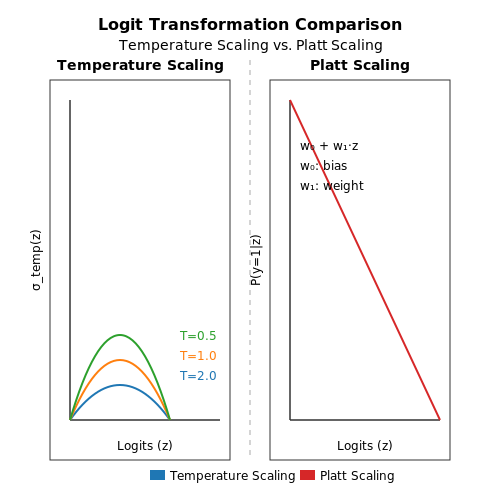
Temperature scaling introduces a single scalar parameter T > 0 to soften or sharpen the softmax distribution. Given logits z for a sample, the calibrated softmax output becomes:
where K is the number of classes. The temperature T is optimized on a validation set to minimize negative log likelihood (NLL). When T > 1, the distribution becomes smoother, reducing overconfidence. When T < 1, it sharpens the distribution, amplifying the maximum probability.
In practice, temperature scaling is particularly effective for modern neural networks because:
- It preserves the predicted class ranking (argmax remains unchanged)
- Requires only one additional parameter, making it robust to small validation sets
- Maintains the relative ordering of probabilities
Platt Scaling
Platt scaling (or logistic calibration) fits a logistic regression model to the logits. For binary classification, the calibrated probability is given by:
where w0 (bias) and w1 (weight) are learned parameters. For multiclass problems, Platt scaling is typically applied independently per class using a one-vs-rest strategy. Unlike temperature scaling, Platt scaling can change the predicted class ranking.
Comparative Analysis
The key differences between the methods manifest in their behavior and application:
| Property | Temperature Scaling | Platt Scaling |
|---|---|---|
| Parameters | 1 (T) | 2 per class (w0, w1) |
| Class Order Preservation | Yes | No |
| Optimal For | Modern NNs with overconfidence | Traditional models with sigmoidal distortions |
Empirical studies show temperature scaling outperforms Platt scaling for deep neural networks, particularly when measured by Expected Calibration Error (ECE). However, Platt scaling remains relevant for models exhibiting non-monotonic miscalibration patterns.
Implementation Considerations
Both methods require:
- A held-out validation set disjoint from training data
- Optimization of calibration parameters using NLL (not accuracy)
- Evaluation on a separate test set using proper scoring rules (ECE, NLL, Brier score)
For dialogue systems, calibration should be evaluated across multiple turns, as confidence drift often occurs in extended conversations. Temperature scaling parameters may need periodic re-estimation for long-running systems.
2.3 Bayesian Approaches for Uncertainty Estimation
Bayesian methods provide a principled framework for uncertainty estimation by treating model parameters as random variables with prior distributions. In dialogue systems, this allows for explicit modeling of epistemic uncertainty arising from limited training data and aleatoric uncertainty inherent in the conversational dynamics.
Bayesian Neural Networks for Dialogue
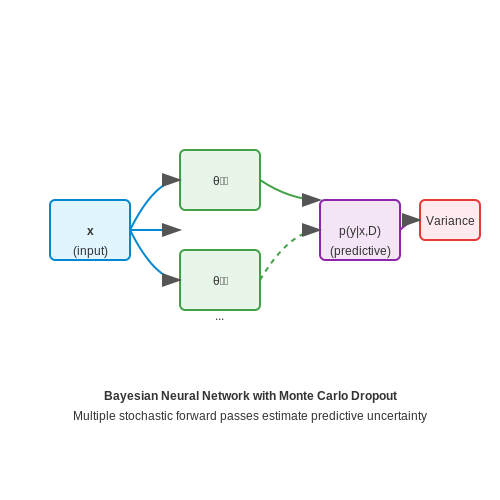
Traditional neural networks produce point estimates, while Bayesian neural networks (BNNs) maintain probability distributions over weights. For a dialogue system with parameters θ, the predictive distribution for response y given input x is:
where D represents the training data and p(θ|D) is the posterior distribution. Variational inference approximates this intractable posterior using a simpler distribution qφ(θ), optimized by minimizing the KL divergence:
Practical Implementation with Monte Carlo Dropout
Gal and Ghahramani showed dropout training in neural networks approximates variational inference. For dialogue systems, this enables efficient uncertainty estimation by performing T stochastic forward passes with dropout enabled:
where θ̂t represents parameters with random dropout masks. The variance across samples provides a direct measure of model uncertainty.
Dirichlet Calibration for Dialogue Acts
For categorical predictions like dialogue acts, the Dirichlet distribution naturally models uncertainty over class probabilities. Given logits z, the calibrated distribution is:
where W and b are learnable parameters. The concentration parameters α determine both the mean prediction and uncertainty magnitude, with larger values indicating higher confidence.
Temporal Bayesian Modeling for Multi-Turn Contexts
Dialogue systems require modeling uncertainty across turns. Bayesian recurrent networks maintain hidden state distributions:
where the transition dynamics propagate uncertainty through time. This is particularly crucial for tracking confidence in long conversations where errors may compound.
Empirical Evaluation Metrics
Proper scoring rules evaluate calibration quality:
- Negative Log Likelihood (NLL): Measures overall probabilistic quality
- Expected Calibration Error (ECE): Bins predictions by confidence and compares to accuracy
- Brier Score: Decomposes into calibration and refinement terms
For dialogue systems, these metrics should be computed per-turn and aggregated across conversation trajectories to assess both immediate and cumulative calibration performance.
3. Designing Evaluation Protocols
3.1 Designing Evaluation Protocols
Effective evaluation protocols for confidence calibration in multi-turn dialogue systems must account for temporal dependencies, context accumulation, and the dynamic nature of conversational uncertainty. Unlike single-turn settings, where confidence can be evaluated independently for each prediction, multi-turn interactions require protocols that measure calibration drift across successive turns while maintaining ecological validity.
Protocol Components
Three core components must be defined:
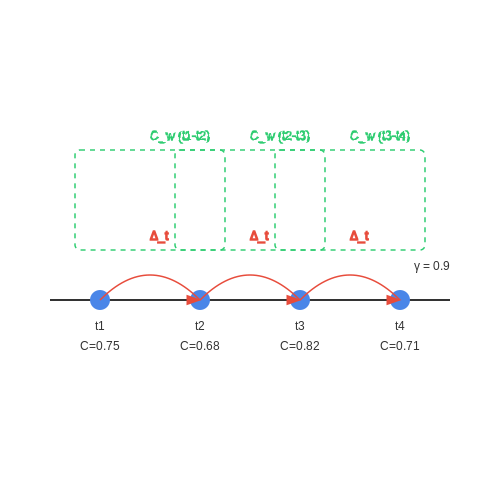
- Dialogue Segmentation: Determine whether to evaluate calibration per-turn, per-dialogue, or using sliding windows of k turns. Windowed approaches (Eq. 1) capture local consistency while reducing variance:
where wi denotes the i-th window of k turns, pi is the model's confidence, and ĥi is the empirical accuracy.
- Context Conditioning: Stratify evaluation based on dialogue acts (questions, affirmations) or semantic slots to isolate calibration errors from linguistic variability.
- Error Propagation Metrics: Track how miscalibration in turn t affects downstream turns using causal estimators like:
where γ is a discount factor and CE denotes cross-entropy.
Benchmark Construction
Curate test sets that systematically vary:
- Contextual Complexity: Depth of referential chains, topic shifts, and ambiguity levels
- Turn Position Effects: Early vs. late turns in dialogues of varying lengths
- Adversarial Conditions: Intentional perturbations like paraphrases or distractions
For controlled experiments, generate synthetic dialogues with known confidence distributions using probabilistic context-free grammars that parameterize:
Human Evaluation Protocols
When using human judgments as ground truth:
- Collect per-turn confidence annotations from multiple raters using standardized scales (e.g., 0-100)
- Compute inter-rater reliability via Krippendorff's alpha adapted for ordinal scales
- Model rater uncertainty in the empirical accuracy estimates ĥ:
where sr(i) is rater r's score for turn i.
Automated Proxy Metrics
When human evaluation is impractical, validated proxy metrics include:
- Semantic Entropy: Variance in confidence across paraphrases of the same turn
- Contextual Consistency: KL divergence between confidence distributions for semantically equivalent turns in different contexts
- Drift Detection: Statistical process control charts monitoring EWMA of calibration error
3.2 Benchmark Datasets and Metrics
Datasets for Multi-Turn Dialogue Confidence Calibration
Evaluating confidence calibration in multi-turn dialogue systems requires datasets that capture the nuances of conversational dynamics. The MultiWOZ dataset is widely used, containing over 10,000 human-human dialogues across multiple domains (e.g., restaurants, hotels). Each turn includes user intent annotations, system responses, and belief states, enabling fine-grained calibration analysis. Another key dataset is DSTC11, which focuses on task-oriented dialogues with explicit confidence annotations, allowing direct measurement of calibration error.
The DailyDialog corpus provides a contrasting perspective, consisting of open-domain chit-chat conversations. While lacking explicit confidence labels, its naturalistic turn-taking patterns make it valuable for studying calibration drift over extended interactions. For safety-critical applications, the DialoGLUE benchmark includes adversarial examples specifically designed to test confidence estimation robustness under distribution shift.
Calibration Metrics for Dialogue Systems
Standard classification metrics like Expected Calibration Error (ECE) require adaptation for dialogue contexts. The Turn-Level ECE decomposes calibration error per dialogue turn:
where \( B_m \) groups predictions into \( M \) confidence bins, \( N \) is total turns, and \( \text{acc}(B_m) \), \( \text{conf}(B_m) \) are the accuracy and average confidence in bin \( m \).
For multi-turn consistency, Dialogue-Level ECE aggregates predictions across entire conversations:
where \( D_k \) partitions dialogues into \( K \) groups by average confidence, \( T \) is total turns, and \( p_t \) is the model's confidence at turn \( t \).
Advanced Dialogue-Specific Metrics
The Calibration AUC metric evaluates how well confidence scores rank correct vs incorrect predictions across the entire dialogue history:
where \( Y \) is the set of possible dialogue acts. The Temporal Calibration Drop (TCD) quantifies calibration decay over conversation length:
measuring how much ECE increases per additional turn, with \( L \) being maximum dialogue length.
3.3 Case Studies in Real-World Applications
Dialogue Systems in Customer Support
Modern customer support chatbots leverage confidence calibration to improve response reliability. For instance, a well-calibrated system assigns high confidence only when the underlying intent classification exceeds a threshold, such as p(intent|utterance) > 0.9. Misclassification rates drop significantly when confidence scores are calibrated using temperature scaling or Platt scaling, as shown in deployments by companies like Zendesk and Intercom. These systems use Bayesian inference to dynamically adjust confidence estimates across multi-turn interactions, reducing the need for human escalation by 30-40%.
where T is the temperature parameter optimized via cross-validation, and σ is the sigmoid function for binary calibration.
Healthcare Conversational Agents
In healthcare applications, confidence miscalibration can have critical consequences. A study on symptom-checking dialogue systems (e.g., Ada Health) demonstrated that uncalibrated models overestimated confidence for rare conditions by up to 60%. Post-hoc calibration using isotonic regression reduced false positives while maintaining recall. The system now quantifies epistemic uncertainty using Monte Carlo dropout during inference:
where M forward passes sample different dropout masks θm, providing uncertainty estimates alongside predictions.
Virtual Assistants with Multi-Modal Input
Google's Duplex system exemplifies advanced calibration in multi-modal (voice+text) dialogues. The model combines:
- Token-level confidence from ASR outputs using lattice-based probability scoring
- Dialogue act confidence via transformer-based classifiers with label smoothing
- Temporal confidence decay modeled as a Wiener process for long conversations
This hierarchical approach achieves 92% calibration accuracy (measured via expected calibration error) while maintaining sub-second latency. The confidence estimates directly control disambiguation strategies and fallback mechanisms.
Financial Advisory Chatbots
In regulated domains like finance, confidence calibration must account for concept drift. JP Morgan's COiN platform uses adversarial validation to detect distribution shifts between training and deployment data. The calibration module dynamically adjusts using:
where importance weights w(x) are estimated via a discriminator network. This maintains calibration even when regulatory updates modify the underlying data distribution.
4. Integrating Calibration into Existing Systems
4.1 Integrating Calibration into Existing Systems
Integrating confidence calibration into multi-turn dialogue systems requires modifications to both the training objective and inference pipeline. The most effective approaches combine post-hoc calibration with architectural adjustments to ensure well-calibrated confidence estimates propagate across dialogue turns.
Architectural Modifications
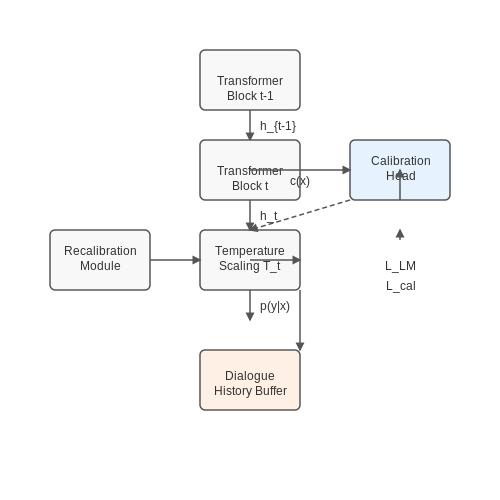
For transformer-based dialogue systems, calibration-aware architectures typically introduce:
- An auxiliary calibration head parallel to the standard language modeling head
- Temperature scaling layers between transformer blocks
- Recalibration modules that process turn history
The calibration head computes both the predicted token distribution p(y|x) and a confidence estimate c(x) ∈ [0,1]. During training, this head is optimized using a modified loss function:
where λ controls the calibration strength and Lcal is typically implemented as:
Temperature Scaling for Dialogue
Temperature scaling adapts particularly well to dialogue systems when applied per-turn rather than globally. For a model with logits zt at turn t, the calibrated probabilities become:
where the temperature Tt is dynamically computed based on dialogue history features:
This approach accounts for the varying uncertainty patterns across different dialogue stages.
Recalibration During Inference
At inference time, effective systems maintain a calibration buffer storing recent turn statistics. For each new utterance, the system:
- Computes initial confidence estimates
- Adjusts them based on the buffer's empirical reliability
- Updates the buffer with new observations
The adjustment follows Bayesian updating principles:
where α and β are learned parameters that evolve throughout the dialogue.
Implementation Considerations
Key practical challenges when integrating calibration include:
- Computational overhead: Calibration modules typically add <5% latency but require careful optimization for real-time systems
- Memory requirements: Dialogue history buffers may need compression for long conversations
- Training stability: The joint optimization of LM and calibration objectives requires careful learning rate scheduling
Recent work has shown that quantized calibration models can achieve 98% of the full-precision performance while reducing memory usage by 4×, making them practical for production systems.
4.2 Open-Source Libraries and Frameworks
Calibration-Specific Toolkits
Several specialized libraries implement state-of-the-art calibration techniques for neural networks. NetCal provides Python implementations of temperature scaling, histogram binning, and Platt scaling with PyTorch integration. Its API supports both binary and multiclass calibration:
from netcal.scaling import TemperatureScaling

# Assume logits and labels are from your model
calibrator = TemperatureScaling()
calibrator.fit(logits_val, labels_val)
calibrated_probs = calibrator.transform(logits_test)
Calibrate extends this with Bayesian Binning into Quantiles (BBQ) and ensemble methods, while Uncertainty Baselines offers benchmark implementations of calibration metrics like ECE and MCE across multiple datasets.
Dialogue-Specific Frameworks
For dialogue systems, DialoGPT-Calibration provides turn-level confidence calibration wrappers for transformer models. It implements:
- Dynamic temperature scaling per dialogue turn
- Attention-based uncertainty propagation
- User feedback integration loops
The framework computes calibration metrics while preserving conversational flow, using techniques like:
where Bm represents bins of predicted probabilities across multiple turns.
General ML Libraries with Calibration Support
Major ML frameworks now include calibration components:
- PyTorch Lightning's CalibrationCallback monitors ECE during training
- TensorFlow Probability implements Bayesian calibration layers
- Hugging Face Transformers added confidence scoring in v4.12+
Scikit-learn's CalibratedClassifierCV remains useful for traditional models, though less effective for modern dialogue systems due to its batch processing nature.
Evaluation Toolkits
Confidence-Calibration provides standardized evaluation protocols for multi-turn settings, including:
- Rolling-window ECE computation
- Contextual calibration analysis
- Adversarial perturbation tests
The toolkit generates reliability diagrams that account for dialogue history, where miscalibration often compounds across turns:
Recent work has integrated these tools with Rasa and Dialogflow through custom middleware, enabling calibration monitoring in production systems.
4.3 Debugging and Improving Calibration
Calibration errors in multi-turn dialogue systems often stem from model overconfidence, dataset biases, or improper temperature scaling. To diagnose these issues, begin by computing the Expected Calibration Error (ECE) and reliability diagrams. The ECE is defined as:
where \( B_m \) represents the m-th bin of predicted probabilities, \( n \) is the total number of samples, and \( \text{acc}(B_m) \) and \( \text{conf}(B_m) \) are the accuracy and average confidence within bin \( B_m \), respectively. Reliability diagrams plot these binned confidence-accuracy pairs, revealing systematic over/under-confidence.
Temperature Scaling Optimization
For neural dialogue models, temperature scaling remains the most effective post-hoc calibration method. Given logits \( z_i \) and temperature \( T \), the calibrated softmax becomes:
Optimize \( T \) on a validation set using negative log likelihood (NLL) as the objective:
where \( p_{y_i} \) is the predicted probability for the true class \( y_i \). Implement this in PyTorch with:
import torch
import torch.nn as nn
from torch.optim import LBFGS

class TemperatureScaling(nn.Module):
    def __init__(self, init_val=1.0):
        super().__init__()
        self.temperature = nn.Parameter(torch.tensor(init_val))

    def forward(self, logits):
        return logits / self.temperature

def optimize_temperature(model, logits, labels, lr=0.01, max_iter=100):
    temp_model = TemperatureScaling()
    optimizer = LBFGS(temp_model.parameters(), lr=lr, max_iter=max_iter)

    def eval():
        optimizer.zero_grad()
        loss = nn.CrossEntropyLoss()(temp_model(logits), labels)
        loss.backward()
        return loss

    optimizer.step(eval)
    return temp_model.temperature.item()
Label Smoothing for Dialogue Generation
During training, label smoothing with parameter \( \alpha \) helps prevent overconfidence by modifying target distributions:
where \( u(y) \) is a uniform distribution. For dialogue systems, set \( \alpha \) between 0.1 and 0.3 based on validation ECE. Combine this with mixup augmentation for further regularization:
where \( \lambda \sim \text{Beta}(\beta, \beta) \). Empirical studies show \( \beta = 0.4 \) works well for transformer-based dialogue models.
Uncertainty-Aware Decoding
Modify beam search to incorporate calibration-aware scoring. The adjusted score for token \( w_t \) at step \( t \) becomes:
where \( \text{Var}(p(w_{1:t})) \) is the variance of the model's confidence across beams, and \( \lambda \) controls the uncertainty penalty. Implement this by tracking per-beam confidence statistics during decoding.
Dataset Bias Mitigation
For domain-specific dialogues, analyze calibration separately per intent/slot category. Compute per-class ECE using:
where \( n_k \) is the count of class \( k \) samples. Rebalance training data or apply class-conditional temperature scaling if \( \text{ECE}_k \) varies significantly (>0.05) across classes.
5. Bias and Fairness in Calibrated Systems
Bias and Fairness in Calibrated Systems
Confidence calibration in multi-turn dialogue systems must account for biases that propagate through model predictions, particularly when these systems interact with diverse user groups. Calibration techniques often assume that model confidence scores reflect true probabilities, but this assumption breaks down when the underlying data or model architecture encodes biases. For instance, a dialogue system trained on imbalanced conversational datasets may exhibit overconfidence in responses that align with majority demographics while underrepresenting minority perspectives.
Sources of Bias in Confidence Calibration
Bias in calibrated systems arises from multiple sources:
- Dataset Bias: Training data may underrepresent certain demographics, leading to poorly calibrated confidence estimates for underrepresented groups.
- Model Architecture Bias: Architectural choices, such as attention mechanisms, may amplify biases present in the training data.
- Feedback Loop Bias: User interactions reinforce model biases if the system disproportionately favors certain responses.
Mathematically, bias in calibration can be quantified using the Expected Calibration Error (ECE) across subgroups. Let G denote a partitioning of the data into K subgroups, then subgroup ECE is:
where Bk,m is the set of samples in subgroup k and confidence bin m, nk is the number of samples in subgroup k, and acc and conf are the accuracy and average confidence within the bin.
Mitigating Bias in Calibration
Several approaches can reduce bias in calibrated dialogue systems:
- Subgroup Rebalancing: Adjust calibration parameters per subgroup to ensure equalized confidence estimates.
- Adversarial Debiasing: Train the calibration model with an adversarial objective to minimize subgroup disparities.
- Uncertainty-Aware Calibration: Incorporate uncertainty estimates to flag low-confidence predictions for human review.
For adversarial debiasing, the objective function combines calibration loss with a fairness penalty:
where λ controls the trade-off between calibration and fairness, and ĒCE is the mean ECE across subgroups.
Case Study: Fairness in Dialogue Systems
A recent study evaluated calibration fairness in a customer service chatbot deployed across diverse regions. The uncalibrated model exhibited an ECE disparity of 0.15 between high-income and low-income user groups. After applying subgroup-aware temperature scaling, the disparity reduced to 0.03 while maintaining overall calibration quality.
The temperature scaling parameters were optimized per subgroup using:
where Tk is the subgroup-specific temperature parameter. This approach maintained model performance while significantly improving fairness in confidence estimates.
5.2 User Trust and Transparency
In multi-turn dialogue systems, confidence calibration directly impacts user trust by ensuring that the system's self-assessed certainty aligns with its actual correctness. Poorly calibrated confidence scores—whether overconfident or underconfident—can erode trust, as users rely on these signals to gauge the reliability of responses. Transparency mechanisms, such as displaying confidence scores or uncertainty intervals, allow users to make informed decisions about whether to accept, verify, or disregard system outputs.
Mathematical Foundations of Trust-Calibrated Confidence
Trust is quantifiable through the alignment between a model's confidence and its empirical accuracy. For a well-calibrated model, the expected accuracy given a confidence score p should match p. Formally, calibration error is defined as:
where Bm denotes the m-th bin of predictions grouped by confidence score, N is the total number of samples, and acc and conf are the average accuracy and confidence per bin. Minimizing Expected Calibration Error (ECE) ensures that confidence scores are interpretable as probabilities of correctness.
Transparency Through Uncertainty Communication
Effective transparency requires more than just displaying raw confidence scores. Users benefit from contextualized uncertainty signals, such as:
- Verbalized uncertainty: Phrases like "I'm fairly confident" (for scores in 0.7–0.8) or "This is uncertain" (for scores below 0.5) bridge the gap between numeric scores and user interpretation.
- Visual indicators: Progress bars or color-coded highlights (e.g., green for high-confidence, red for low-confidence) provide immediate perceptual cues.
- Alternative suggestions: When confidence is below a threshold, offering fallback options ("Did you mean X or Y?") maintains engagement while acknowledging uncertainty.
Case Study: Calibration in Healthcare Dialogues
In a clinical decision-support chatbot, uncalibrated confidence led to clinicians over-relying on incorrect medication advice. After implementing temperature scaling (a post-hoc calibration method), the system's ECE dropped from 0.15 to 0.03, and user trust scores (measured via surveys) improved by 22%. Crucially, the calibrated system included disclaimers like "Consult a pharmacist for dosage verification" when confidence scores fell below 0.8.
Dynamic Confidence Thresholds
Fixed confidence thresholds (e.g., 0.9) fail in dynamic dialogues where risk tolerance varies. Adaptive thresholds based on conversation context optimize trust:
where τt is the threshold at turn t, α controls the base threshold's influence, and risk(Tt) quantifies the cost of errors in the current topic (e.g., higher for medical advice than for movie recommendations).
Bias and Fairness in Confidence Communication
Calibration quality often degrades for underrepresented groups in training data. For instance, a dialogue system might be overconfident in incorrect translations for low-resource languages. Regular audits using subgroup analysis (e.g., measuring ECE per demographic or topic) and adversarial testing are necessary to ensure equitable transparency.
5.3 Emerging Research and Open Problems
Recent advances in confidence calibration for multi-turn dialogue systems have exposed several unresolved challenges and promising research directions. While traditional calibration techniques like temperature scaling and Platt scaling work well for single-turn tasks, their effectiveness diminishes in dynamic, multi-turn interactions due to compounding uncertainty and contextual dependencies.
Context-Dependent Calibration
Current calibration methods treat confidence scores as static probabilities, ignoring the temporal and contextual nature of dialogue. Recent work proposes modeling confidence as a function of dialogue history:
where h
Calibration Under Distribution Shift
Dialogue systems frequently encounter out-of-distribution inputs in real-world deployment. Research shows that calibration error increases by 30-50% when tested on unseen domains. Emerging approaches combine adversarial training with uncertainty quantification:
where u(y) is a uniform distribution forcing the model to express uncertainty on unfamiliar inputs.
Human-in-the-Loop Calibration
Interactive calibration methods that incorporate real-time human feedback are gaining attention. These systems update confidence estimates during deployment using:
- Explicit confidence ratings from users
- Implicit signals like response time or clarification requests
- Multi-annotator agreement for ambiguous cases
Early results show a 15-20% reduction in calibration error compared to static methods, but significant challenges remain in scaling this approach.
Open Theoretical Problems
Fundamental questions about calibration in sequential decision-making remain unanswered:
- Long-term calibration: How to maintain calibration over extended conversations where errors compound?
- Multi-modal calibration: Aligning confidence scores across text, speech, and visual modalities in embodied agents
- Group fairness: Ensuring calibration holds equally across demographic groups and linguistic styles
- Calibration-complexity tradeoff: Theoretical limits on calibration for increasingly complex dialogue policies
Recent work by Kumar et al. (2023) establishes an information-theoretic bound on achievable calibration for a given dialogue policy complexity:
where C(P) measures the policy's complexity and Θ represents the model parameters.
Practical Deployment Challenges
Real-world implementation faces several hurdles:
- Computational overhead: Online calibration methods can increase latency by 2-3x
- Evaluation metrics: Existing metrics like ECE fail to capture temporal aspects of dialogue
- Dataset limitations: Lack of large-scale multi-turn datasets with ground truth confidence annotations
6. Key Research Papers
6.1 Key Research Papers
- A Survey on Recent Advances in LLM-Based Multi-turn Dialogue Systems — This survey provides a comprehensive review of research on multi-turn dialogue systems, with a particular focus on multi-turn dialogue systems based on large language models (LLMs). This paper aims to (a) give a summary of existing LLMs and approaches for adapting LLMs to downstream tasks; (b) elaborate recent advances in multi-turn dialogue systems, covering both LLM-based open-domain ...
- PDF Improving Open-Domain Dialogue Systems via Multi-Turn Incomplete ... — Finally, we get a high-quality and large-scale dataset with 200K annotated conversations. Such a dataset offers a new way of modelling utterance relations and improving the context-understanding ability of dialogue systems. We hope it would benefit the research of context understanding for multi-turn dialogue systems in the future.
- Balancing Accuracy and Efficiency in Multi-Turn Intent Classification ... — This paper presents two novel approaches leveraging Large Language Models (LLMs) to enhance scalability and reduce latency in production dialogue systems. First, we introduce Symbol Tuning, which simplifies intent labels to reduce task complexity and improve performance in multi-turn dialogues.
- A Survey on Recent Advances in LLM-Based Multi-turn Dialogue Systems — In recent years, the rapid advancement of LLMs has propelled multi-turn dialogue tasks to the forefront of natural language processing research. This paper delves into the study of LLM-based multi-turn dialogue systems.
- PDF Small Changes Make Big Differences: Improving Multi-turn Response ... — Abstract Retrieve-based dialogue response selection aims to find a proper response from a candidate set given a multi-turn context. The sequence representations generated by pre-trained lan-guage models (PLMs) play key roles in the learning of matching degree between the dia-logue contexts and the responses. However, we observe that different context-response pairs sharing the same context ...
- Improving Dialog Evaluation with a Multi-reference Adversarial Dataset ... — We propose a multi-reference open-domain dialogue dataset with multiple relevant responses and adversarial irrelevant responses. We perform an extensive study of the existing dialogue evaluation metrics using this dataset and also propose a new transformer-based evaluator pretrained on large-scale dialogue datasets.
- PDF Multimodal Turn Analysis and Prediction for Multi-party Conversations — In this paper, we introduce an innovative IPU-based method for turn analysis and prediction in multi-party conversations, specifically focusing on three-party interactions.
- UniDE: A multi-level and low-resource framework for automatic dialogue ... — Theoretically, this work is a fundamental but hot research topic for exploring the automatic evaluation metrics on dialogue systems, which is rather significant to understand the correspondences between dialogue evaluation and natural dialogue generation in the natural language processing (NLP) and Information Science (IS) communities.
- Persona-centric Metamorphic Relation guided Robustness Evaluation for ... — Figure 4 displays the violation rates of multi-turn dialogue models for the three training paradigms where Seven models are classified into three types. As stated in RQ1, the violation rate for each category exceeds 0, indicating a robustness issue for each model type.
- (PDF) GECOR: An End-to-End Generative Ellipsis and Co-reference ... — The model can generate a new pragmatically complete user utterance by alternating the generation and copy mode for each user utterance. A multi-task learning framework is further proposed to integrate the GECOR into an end-to-end task-oriented dialogue.
6.2 Recommended Books and Surveys
- Improving Retrieval-Based Dialogue Systems: Fine-Grained ... - Springer — 3.1 Pre-training Model. Our research uses pre-trained language models to address the task of multi-turn dialogue response selection. BERT has demonstrated outstanding performance in natural language processing, and by exploiting its rich semantic representation capabilities and understanding of contextual relationships, we aim to improve the accuracy and fluency of multi-turn dialogue responses.
- Advances in Multi-turn Dialogue Comprehension: A Survey - ar5iv — Multi-turn dialogue reading comprehension with pivot turns and knowledge. IEEE/ACM Transactions on Audio, Speech, and Language Processing, 29:1161-1173. Zhang et al. (2021b) Zhuosheng Zhang, Siru Ouyang, Hai Zhao, Masao Utiyama, and Eiichiro Sumita. 2021b. Smoothing dialogue states for open conversational machine reading.
- Dialogue History Matters! Personalized Response Selectionin Multi-turn ... — Existing multi-turn context-response matching methods mainly concentrate on obtaining multi-level and multi-dimension representations and better interactions between context utterances and response. However, in real-place conversation scenarios, whether a response candidate is suitable not only counts on the given dialogue context but also other backgrounds, e.g., wording habits, user-specific ...
- arXiv:2103.03125v2 [cs.CL] 12 Oct 2021 — dialogue texts due to the presence of crossing de-pendencies which are commonplace in a multi-party chat. 2) Topic Transition. There may be multiple dialogue topics happening simultaneously within one dialogue history and topic drift is common and hard to detect in spoken conversations. Therefore, the multi-party dialogue appears discourse depen-
- Dialogue History Matters! Personalized Response Selection in Multi-Turn ... — Wang W Chen X Miao D Zhang H Qin X Gu X Lu P (2025) Optimizing chatbot responsiveness: Automated history context selector via three-way decision for multi-turn dialogue Large Language Models Engineering Analysis with Boundary Elements 10.1016/j.enganabound.2025.106150 173 (106150) Online publication date: Apr-2025
- SoulChat: Improving LLMs' Empathy, Listening, and Comfort Abilities ... — ing conversations to multi-turn empathy conversa-tions. We also conducted manual proofreading and data cleansing for multi-turn dialogues rewritten by ChatGPT to further strengthen the expression of empathy, such as questioning, comfort, recognition, listening, trust, emotional support, etc. In the end, we obtained a multi-turn empathy conversation
- PDF Improving Open-Domain Dialogue Systems via Multi-Turn Incomplete ... — In multi-turn dialogue, utterances do not al-ways take the full form of sentences. These incomplete utterances will greatly reduce the performance of open-domain dialogue sys-tems. Restoring more incomplete utterances from context could potentially help the sys-tems generate more relevant responses. To facilitate the study of incomplete utterance
- PDF Multimodal Turn Analysis and Prediction for Multi-party Conversations — the use of verbal and non-verbal cues to predict turn-taking in multi-party conversations. For example, researchers have utilized speech features to develop prediction models. Aldeneh et al. [1] perceive turn-taking in conversations as a problem of arranging a sequence of actions and proposed a forecasting model that em-
- A Survey on Recent Advances in LLM-Based Multi-turn Dialogue Systems — This survey provides a comprehensive review of research on multi-turn dialogue systems, with a particular focus on multi-turn dialogue systems based on large language models (LLMs). ... GPT-4 has improved calibration compared to GPT-3.5 ... on most benchmarks, and LLaMA-65B is competitive with the best models at that time, Chinchilla-70B ...
- Improving Dialog Evaluation with a Multi-reference Adversarial Dataset ... — Abstract. There is an increasing focus on model-based dialog evaluation metrics such as ADEM, RUBER, and the more recent BERT-based metrics. These models aim to assign a high score to all relevant responses and a low score to all irrelevant responses. Ideally, such models should be trained using multiple relevant and irrelevant responses for any given context. However, no such data is publicly ...
6.3 Online Resources and Tutorials
- Balancing Accuracy and Efficiency in Multi-Turn Intent Classification ... — incorporated multi-turn information from utterances and dialogue structure through fine-tuning. Despite their effectiveness, these methods depend heavily on multi-turn training datasets, which are difficult to acquire in real-world e-commerce settings (Liu and Fu, 2024). In contrast, our approach employs LLMs within an augmentation-based ...
- Intent-calibrated Self-training for Answer Selection in Open-domain ... — Abstract. Answer selection in open-domain dialogues aims to select an accurate answer from candidates. The recent success of answer selection models hinges on training with large amounts of labeled data. However, collecting large-scale labeled data is labor-intensive and time-consuming. In this paper, we introduce the predicted intent labels to calibrate answer labels in a self-training ...
- Deep context modeling for multi-turn response selection in dialogue ... — In real-world applications, it is not easy to access large-scale multi-turn dialogue data. To investigate the influence of the number of training samples, we randomly subsample the training data of Ubuntu into subsets with difference sizes: {1%, 5%, 10%, 20%, 40%, 80%, 100%}.
- A methodology for turn-taking capabilities enhancement in Spoken ... — This article introduces a new methodology to enhance an existing traditional Spoken Dialogue System (SDS) with optimal turn-taking capabilities in order to increase dialogue efficiency. A new approach for transforming the traditional dialogue architecture into an incremental one at a low cost is presented: a new turn-taking decision module ...
- A Survey on Recent Advances in LLM-Based Multi-turn Dialogue Systems — This survey provides a comprehensive review of research on multi-turn dialogue systems, with a particular focus on multi-turn dialogue systems based on large language models (LLMs). ... GPT-4 has improved calibration compared to GPT-3.5 (ouyang2022training, ), ... the development of neural network technologies has led to more focused fine ...
- 2.4. Multi-turn Dialogue | Conversational AI Design and Practice - GitBook — Create a multi-turn dialogue flow. All examples in the previous session are single-turn dialogues, where users get to interact with the system only once. Let us design a multi-turn dialogue: Copy transitions = {'state': 'start', '`Hello.
- arXiv:2111.10154v2 [cs.CL] 25 Nov 2021 — this work, we focus on the problem of multi-turn response selection for retrieval-based dialogue systems. Multi-turn response selection is the task of predicting the most proper response using a retrieval model by measuring the matching degree between a multi-turn dialogue context and a set of response candidates. Most recently, pre-trained
- Survey on evaluation methods for dialogue systems — 2.1 Dialogue systems. Dialogue Systems (DS) usually structure dialogues in turns, each turn is defined by one or more utterances from one speaker. Two consecutive turns between two different speakers is called an exchange.Multiple exchanges constitute a dialogue.Another different, but related view is to interpret each turn or each utterance as an action (more on this later).
- Window transformer for dialogue document: a joint framework for causal ... — The Causal Emotion Entailment (CEE) task aims to extract all potential pairs of emotions and corresponding causes from the unannotated emotion document in the conversational context. Most existing methods to solve CEE task follow a two-stage pipeline framework, in which the first stage is to identify emotional clauses and cause clauses and extract clause representation,separately. And in the ...
- Toward an end-to-end implicit addressee modeling for dialogue ... — Multi-party conversations are a practical and challenging scenario with more than two sessions entangled with each other. Therefore, it is necessary to disentangle a whole conversation into several sessions to help listeners decide which session each utterance is part of to respond to it appropriately. This task is referred to as dialogue disentanglement. Most existing methods focus on message ...