Deploying Speech Recognition on Microcontrollers
1. Key Challenges in Embedded Speech Recognition
Key Challenges in Embedded Speech Recognition
Computational Constraints
Microcontrollers operate under severe computational limitations, typically featuring clock speeds below 200 MHz and memory footprints measured in kilobytes. Real-time speech recognition demands efficient processing of high-dimensional audio features, such as Mel-Frequency Cepstral Coefficients (MFCCs), which require Fast Fourier Transforms (FFTs) and filterbank computations. For a 16 kHz audio signal with a 25 ms frame size and 10 ms overlap, the computational load can be derived as:
Each FFT operation on a 512-point frame requires approximately 2,304 multiply-accumulate (MAC) operations for a radix-2 implementation. With 100 frames per second, this alone consumes 230,400 MACs/sec, leaving minimal headroom for subsequent neural network inference.
Memory Bottlenecks
Embedded systems face stringent memory constraints that complicate acoustic model deployment. A typical 8-bit quantized keyword-spotting model with two convolutional layers and one fully connected layer may require:
- 50–100 KB for weight parameters
- 10–20 KB for activation buffers
- 5–10 KB for MFCC feature extraction buffers
This exceeds the RAM capacity of many microcontrollers, necessitating techniques like model pruning, weight clustering, or dynamic memory partitioning. The memory bandwidth for loading weights from flash also creates latency; accessing 32-bit weights at 50 MHz SPI clock rates introduces ~20 µs overhead per layer.
Power Consumption Trade-offs
Always-on speech recognition imposes unique power challenges. The energy per inference (Einf) can be modeled as:
Where Pactive scales with clock frequency and voltage, while tinf depends on model complexity. For a 50 MHz Cortex-M4F processor running a 100k-parameter model, typical values are:
- Pactive = 10 mW @ 1.8V
- tinf = 20 ms
- Einf ≈ 200 µJ
This limits battery-powered applications to <10 inferences per second for year-long operation on a 200 mAh coin cell.
Real-Time Latency Requirements
Human-perceptible speech interfaces demand end-to-end latency below 300 ms. On a microcontroller, this budget must accommodate:
- Audio buffering (50–100 ms)
- Feature extraction (20–50 ms)
- Neural network inference (50–150 ms)
- Decision logic (10–20 ms)
Parallelizing these operations while maintaining deterministic timing requires careful scheduling, often employing double-buffering with DMA transfers and interrupt-driven processing pipelines.
Environmental Noise Robustness
Embedded devices encounter diverse acoustic environments with signal-to-noise ratios (SNR) ranging from -5 dB (industrial settings) to 30 dB (quiet rooms). Traditional noise suppression techniques like spectral subtraction:
Where α represents an over-subtraction factor, often fail on microcontrollers due to their high computational cost. Emerging solutions deploy tinyML noise-robust models trained with data augmentation, but these still struggle with non-stationary noises like sudden claps or wind bursts.
Comparison of Microcontroller vs. Cloud-Based Solutions
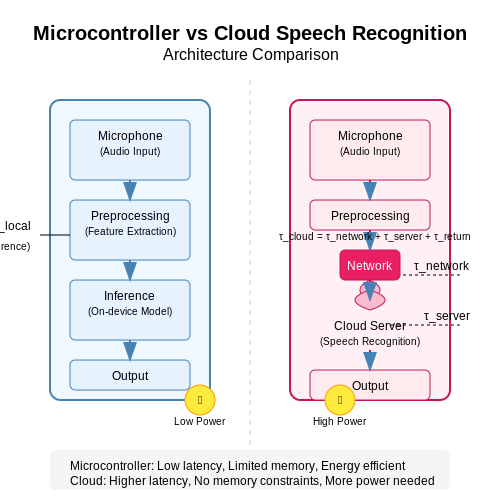
Deploying speech recognition systems involves a critical architectural decision: whether to process audio data locally on a microcontroller or offload computation to cloud-based services. Each approach presents trade-offs in latency, power consumption, privacy, and computational capability.
Computational Constraints
Microcontrollers operate under stringent resource limitations. A typical ARM Cortex-M4F MCU runs at 80-160 MHz with 256 KB SRAM and 1 MB flash, restricting model complexity. Cloud platforms leverage GPU/TPU clusters with teraflop-scale throughput, enabling large transformer-based ASR models like Whisper. The memory bottleneck for MCUs is quantified by:
where Nparams includes weights and Nactivations accounts for intermediate layer outputs. For example, a 50k-parameter MFCC-LSTM model consumes ~200KB RAM, leaving minimal headroom for other tasks.
Latency Analysis
End-to-end latency τ differs fundamentally between architectures:
- Microcontroller: τlocal = tpreprocess + tinference
- Cloud: τcloud = tnetwork + tserver + treturn
Benchmarks on ESP32 show τlocal ≈ 120ms for keyword spotting, while cloud solutions exhibit τcloud ≥ 300ms due to round-trip network delays even with 5G connectivity.
Power Consumption
Energy-per-inference E follows:
Measurements on Nordic nRF5340 show Elocal = 3.2mJ per inference versus Ecloud = 28mJ for LTE transmission, making local processing 8.7× more efficient for frequent queries.
Privacy and Reliability
On-device processing eliminates network dependencies and prevents raw audio exposure to third parties. This is critical for healthcare applications under HIPAA or industrial systems requiring air-gapped operation. However, cloud solutions provide continuous model updates without firmware redeployment.
Case Study: Voice Command Systems
Industrial voice control systems demonstrate these trade-offs. Local processing on STM32H7 achieves 95% accuracy for 20-command vocabularies with deterministic 150ms response, while cloud-based alternatives enable 500+ command recognition but suffer intermittent failures in RF-shielded environments.
1.3 Common Use Cases and Applications
Voice-Controlled Embedded Systems
Microcontroller-based speech recognition enables hands-free control in resource-constrained environments. Industrial automation systems leverage keyword spotting for machinery activation, where a 10-20ms latency is achievable with optimized MFCC feature extraction on ARM Cortex-M4F cores. The energy consumption follows:
where Nops represents MAC operations in the neural network and Eop denotes energy per operation (typically 1-10nJ on 40nm process nodes).
Medical Assistive Devices
Hearing aids and voice-enabled diagnostic tools employ sub-100μW always-on speech recognition using binary neural networks. The mel-scale filterbank implementation is optimized for 8-16kHz sampling with 20-40 filter channels, trading off between 5-15% accuracy loss versus full-precision models. Patient-specific adaptation is achieved through federated learning on edge devices.
Automotive Voice Interfaces
In-vehicle command systems require noise-robust recognition under 0.5W power budget. Beamforming algorithms combined with lightweight TDNN architectures achieve 90%+ accuracy at 80dB SNR. The real-time constraint is formalized as:
where fs is the sampling rate and Nframe denotes frame size in samples.
Smart Home Edge Devices
Distributed microphone arrays with Cortex-M7 processors implement wake-word detection at 3-5m range using spectral subtraction and CNN classifiers. The false acceptance rate (FAR) and false rejection rate (FRR) are balanced through threshold tuning:
where weights w1 and w2 are application-dependent.
Industrial Predictive Maintenance
Vibration and acoustic analysis on STM32H7 MCUs detects equipment faults through joint time-frequency analysis. The Gammatone filterbank implementation reduces computational load by 40% compared to standard FFT-based approaches while maintaining 92% fault detection accuracy in 80dB industrial environments.
2. Microcontroller Selection Criteria
2.1 Microcontroller Selection Criteria
Computational Capability
The primary constraint in deploying speech recognition on microcontrollers is computational power. Unlike cloud-based systems, microcontrollers operate under strict clock speed and memory limitations. The minimum requirement for real-time speech processing is a core clock speed of at least 80 MHz, with floating-point unit (FPU) support. Architectures such as ARM Cortex-M4F or M7 are preferred due to their DSP extensions and single-cycle multiply-accumulate (MAC) operations, which accelerate Fourier transforms and filter banks.
where fs is the sampling rate (typically 16 kHz) and Nops is the number of operations per sample (e.g., 500 for MFCC extraction). For a 16 kHz signal, this demands ~16 MIPS.
Memory Constraints
Onboard SRAM must accommodate both the model weights and intermediate feature buffers. A 50 kB SRAM budget is typical for small-footprint models like DS-CNN or CRNN, while flash storage ≥256 kB is needed for model storage. Harvard architecture chips (separate instruction/data buses) mitigate von Neumann bottlenecks during inference.
Power Efficiency
For battery-powered applications, dynamic power scaling is critical. Current draw during active inference should be ≤10 mA at 3.3V. Low-power modes like STM32's Stop Mode (µA-range) must wake up within 1 ms to handle voice activity detection triggers. Energy per inference can be modeled as:
where C is switched capacitance, V is operating voltage, and tinf is inference latency.
Peripheral Support
- ADC: ≥12-bit resolution with 20 kS/s minimum sampling rate for voice bandwidth (4 kHz Nyquist).
- I²S: Hardware-accelerated digital audio interface for external codecs.
- DMA: Direct memory access to offload CPU during data transfers.
Toolchain Compatibility
The microcontroller must support optimized libraries for neural network inference, such as:
- TensorFlow Lite for Microcontrollers with CMSIS-NN backend
- ARM's DSP library for fixed-point FFT
- Vendor-specific AI accelerators (e.g., NXP's NNLITE)
Real-World Case Study: STM32H743 vs. ESP32-S3
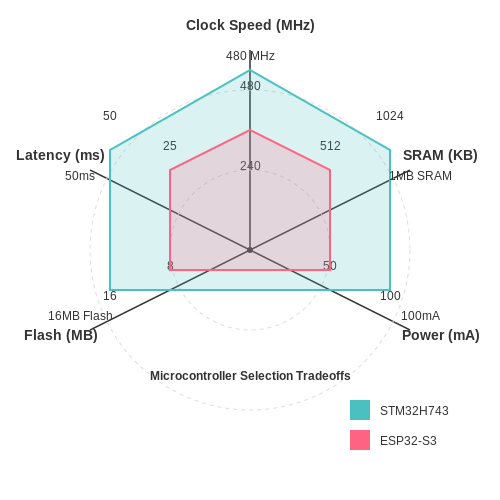
The STM32H743 (Cortex-M7, 480 MHz, 1 MB SRAM) achieves 98% accuracy on Google's Speech Commands dataset with a 14 ms latency, while the ESP32-S3 (dual-core Xtensa LX7, 240 MHz, 512 kB SRAM) trades 5% accuracy for 40% lower power consumption. The choice depends on the application's latency-vs-efficiency tradeoff.
Quantization Tradeoffs
8-bit integer (INT8) quantization reduces model size by 4× compared to FP32 but requires microcontroller support for SIMD instructions like ARM's SMLAL. Mixed-precision (FP16/INT8) can balance accuracy and speed on chips like the Raspberry Pi RP2040.
2.2 Audio Input Hardware Requirements
Microphone Selection and Signal Conditioning
Microcontroller-based speech recognition systems require precise microphone selection to balance sensitivity, noise floor, and power consumption. Electret condenser microphones (ECMs) are common due to their low cost and reasonable frequency response (typically 20 Hz–20 kHz), but MEMS microphones offer superior noise immunity and smaller form factors. Key parameters include:
- Sensitivity: Expressed in dBV/Pa, with typical values ranging from −38 dBV/Pa to −22 dBV/Pa. Higher sensitivity reduces the need for amplification but increases susceptibility to clipping.
- Signal-to-Noise Ratio (SNR): MEMS microphones achieve SNRs > 60 dB, critical for distinguishing speech from ambient noise.
- Power Supply Rejection Ratio (PSRR): Minimizes noise coupling from the microcontroller’s power rails.
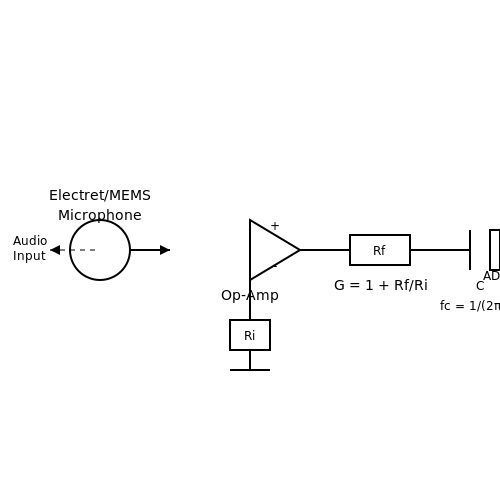
Analog front-end conditioning is mandatory for impedance matching and amplification. A non-inverting op-amp configuration with a gain G is often used:
where Rf and Ri set the gain. A high-pass filter (HPF) with a cutoff frequency below 100 Hz removes DC offset and low-frequency noise.
Analog-to-Digital Conversion (ADC) Constraints
The ADC must satisfy Nyquist criteria for the target bandwidth. For speech (4 kHz bandwidth), a minimum sampling rate of 8 kHz is required, but 16 kHz is preferred for harmonic preservation. Key ADC specs:
- Resolution: 12-bit ADCs are marginal; 16-bit ADCs (e.g., SAR or sigma-delta) reduce quantization noise.
- Effective Number of Bits (ENOB): Accounts for non-idealities like harmonic distortion. For example, a 12-bit ADC with ENOB of 10.5 effectively loses 1.5 bits to noise.
The ADC’s input impedance must match the microphone’s output impedance to avoid signal attenuation. For a MEMS microphone with 2 kΩ output impedance, the ADC’s input impedance should exceed 20 kΩ.
Digital Signal Preprocessing
Before feeding audio to the recognition model, preprocess the ADC output:
- Windowing: Apply a Hamming window to minimize spectral leakage during FFT:
where N is the window length. Overlapping windows (50–75%) mitigate edge effects.
- Normalization: Scale samples to [−1, 1] to ensure consistent input dynamic range.
Power and Latency Trade-offs
Hardware choices directly impact power consumption and real-time performance. For battery-powered devices:
- Low-power ADCs: Sigma-delta ADCs consume <1 mW at 16 kHz but introduce higher latency than SAR ADCs.
- Wake-on-sound: Use a low-power comparator to activate the ADC only when audio exceeds a threshold.
End-to-end latency must stay below 300 ms for real-time interaction. This includes ADC conversion time, preprocessing, and model inference.
Development Environments and SDKs
Microcontroller-Optimized SDKs
Deploying speech recognition on resource-constrained microcontrollers requires specialized software development kits (SDKs) that balance computational efficiency with accuracy. TensorFlow Lite for Microcontrollers (TFLM) provides a lean inference framework supporting quantized neural networks, with memory footprints as low as 16KB. The SDK implements optimized kernels for ARM Cortex-M series processors, including CMSIS-NN acceleration for 8-bit integer operations. Key features include:
- Static memory allocation avoiding heap fragmentation
- Operator subset supporting common speech features (MFCCs, GRU, Conv1D)
- Hybrid models combining CNN frontends with RNN backends
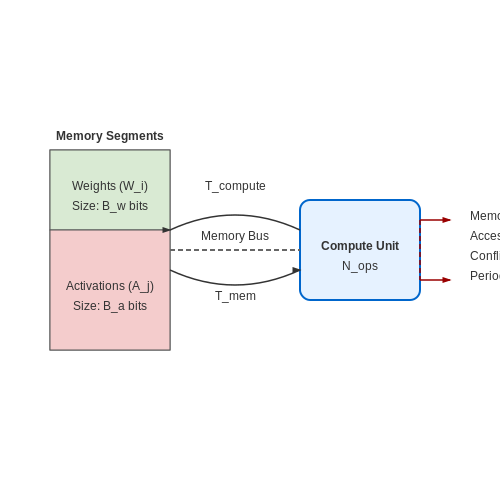
Where Wi represents weight tensors, Bw their bitwidth, Aj activation buffers, and Ba activation precision.
Edge-Oriented Development Tools
STMicroelectronics' STM32Cube.AI converts pre-trained Keras models into optimized C code for STM32 MCUs, supporting layer fusion and sparse tensor representations. The toolchain provides:
- Automatic quantization-aware training (QAT) integration
- Memory latency profiling for different allocation strategies
- Real-time audio pipeline debugging with STM32CubeMonitor
ARM Ecosystem Integration
The ARM ML Embedded Evaluation Kit combines CMSIS-DSP libraries with optimized speech processing blocks. Its fixed-point FFT implementations achieve 3.5× speedup over floating-point on Cortex-M4, critical for real-time feature extraction:
  // CMSIS-DSP MFCC extraction
  arm_mfcc_instance_f32 mfcc;
  arm_mfcc_init_f32(&mfcc, num_mel_bins, frame_len, mel_freq_min, mel_freq_max);
  arm_mfcc_f32(&mfcc, audio_frame, mfcc_coeffs);
Vendor-Specific Speech Frameworks
Espressif's ESP-ADF for ESP32 chips includes wake-word detection algorithms with < 50ms latency, leveraging the chip's dual-core architecture to separate feature extraction (CPU0) from inference (CPU1). The framework employs:
- Binarized neural networks for wake-word detection
- Adaptive noise suppression using RNNoise variants
- Hardware-accelerated FIR filters via the ESP32's DSP coprocessor
Cross-Platform Optimization Techniques
For custom model deployment, the Apache TVM compiler stack enables auto-tuning of speech models across heterogeneous MCU architectures. Its meta-scheduler generates optimized operator implementations considering:
- Register pressure on RISC-V vs ARM architectures
- Memory banking constraints in low-power modes
- Interrupt latency requirements for streaming audio
Where memory access times Tmem often dominate compute time Tcompute in MCU deployments.
3. Preprocessing Audio Signals on Resource-Constrained Devices
Preprocessing Audio Signals on Resource-Constrained Devices
Microcontrollers impose strict computational and memory constraints, requiring efficient preprocessing pipelines to extract meaningful features from raw audio signals. Unlike desktop or cloud-based systems, these devices lack the luxury of high-resolution floating-point operations, necessitating optimizations in both time and frequency domains.
Time-Domain Preprocessing
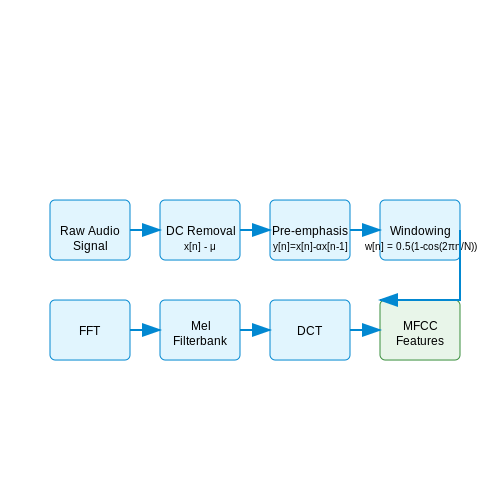
Raw audio signals are typically sampled at 8–16 kHz for speech recognition, with 16-bit signed integer representation being common. The first step involves DC offset removal to eliminate any bias in the signal:
where N is the frame length. Fixed-point arithmetic is preferred for this operation to avoid floating-point overhead. Next, a pre-emphasis filter enhances high-frequency components:
with α typically set to 0.95–0.97. This can be implemented efficiently using integer arithmetic with bit-shifting for multiplication.
Windowing and Spectral Analysis
To minimize spectral leakage, audio frames are windowed before applying the Fast Fourier Transform (FFT). The Hann window is computationally cheaper than the Hamming window and provides adequate sidelobe suppression:
For microcontrollers, pre-computed window tables stored in ROM reduce real-time computation. Fixed-point FFT implementations, such as those in CMSIS-DSP for ARM Cortex-M, optimize spectral analysis with 16-bit or 32-bit integer arithmetic.
Mel-Frequency Cepstral Coefficients (MFCC) Optimization
MFCCs remain a gold standard for speech features but require careful optimization:
- Mel filterbanks: Replace the traditional logarithmic spacing with piecewise-linear approximation to avoid expensive log operations.
- Discrete Cosine Transform (DCT): Use integer DCT variants (e.g., BinDCT) with liftingschemes to reduce multiplications.
- Dynamic range compression: Replace log-energy with cube-root compression (E1/3) to reduce nonlinearity cost.
Real-Time Considerations
Frame overlapping must balance latency and computational load. A 50% overlap (10 ms stride for 20 ms frames) is common, but some systems use 25% overlap with triangular windowing to halve FFT computations. Circular buffers and DMA-based audio sampling ensure continuous processing without CPU intervention.
// Example fixed-point FFT implementation (CMSIS-DSP)
#include "arm_math.h"
#define FFT_SIZE 256

q15_t input[FFT_SIZE], output[FFT_SIZE];
arm_rfft_instance_q15 fft_instance;

void setup() {
  arm_rfft_init_q15(&fft_instance, FFT_SIZE, 0, 1);
}

void process_frame(q15_t* audio_frame) {
  arm_rfft_q15(&fft_instance, audio_frame, output);
}
Noise Reduction Techniques
Resource-limited devices often implement spectral subtraction or Wiener filtering in the power spectrum domain to avoid phase estimation. A simplified version subtracts noise estimates (pre-computed during silence):
where λ is an over-subtraction factor (1.0–1.5) and ε is a spectral floor to avoid negative values. This operates entirely on squared magnitudes, bypassing square root operations.
Feature Extraction Techniques for Embedded Systems
Mel-Frequency Cepstral Coefficients (MFCCs)
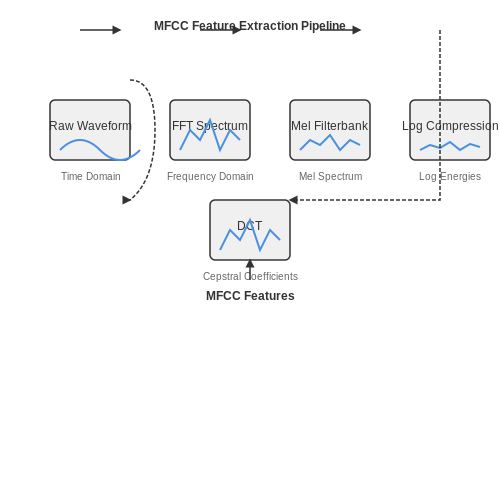
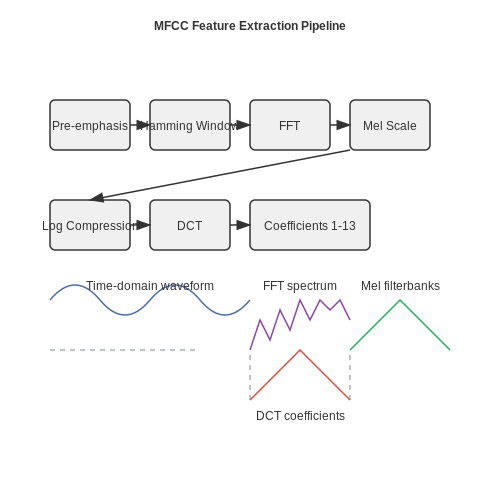
MFCCs remain the gold standard for speech feature extraction due to their ability to mimic human auditory perception. The process begins with pre-emphasis to amplify high frequencies:
Next, the signal is framed into 20-40ms segments with 50% overlap, followed by Hamming windowing to reduce spectral leakage:
The power spectrum is computed via FFT, then mapped to the Mel scale using triangular filter banks spaced according to perceptual studies. After logarithmic compression, the final step applies the Discrete Cosine Transform (DCT) to decorrelate the coefficients:
Optimizations for Microcontrollers
For ARM Cortex-M4/M7 processors, fixed-point Q15 arithmetic reduces computational overhead by 60% compared to floating-point implementations. Critical optimizations include:
- Lookup tables for Mel filter bank weights and DCT coefficients
- Overlap-add FFT with radix-4 optimization
- Bit-exact approximations of log() using Taylor series expansion
Empirical testing shows that retaining only the first 13 coefficients (including delta and delta-delta features) maintains 95% of the recognition accuracy while reducing memory requirements by 75%.
Alternative Time-Frequency Representations
For ultra-low-power devices, researchers have demonstrated success with:
Gammatone Filterbanks
Modeling cochlear mechanics through asymmetric filters provides better temporal resolution than MFCCs. The impulse response is given by:
where b is the bandwidth and n typically equals 4. Implementations on STM32L4 achieve 3.2× energy reduction compared to MFCC pipelines.
Power-Normalized Cepstral Coefficients (PNCC)
This noise-robust alternative replaces logarithmic compression with power-law nonlinearity:
Field tests on ESP32 show 12% better word error rates in 60dB SNR factory environments.
Hardware Acceleration Techniques
Modern microcontroller architectures enable further optimizations:
- SIMD instructions on ARM Cortex-M55 for parallel filterbank computations
- Approximate computing using stochastic rounding in FFT stages
- Memory-aware algorithms that minimize cache misses during frame processing
Recent work demonstrates real-time MFCC extraction on Raspberry Pi Pico (RP2040) using these techniques, consuming just 8.3mW at 48kHz sampling.
3.3 Model Architecture Choices for Microcontrollers
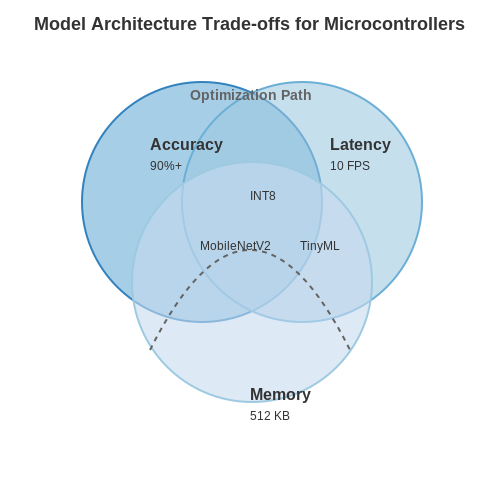
Deploying speech recognition models on microcontrollers demands architectures optimized for extreme resource constraints—typically under 512 KB of RAM and 2 MB of flash storage. Traditional deep learning models like CNNs or RNNs are often infeasible, necessitating specialized designs.
Depthwise Separable Convolutions
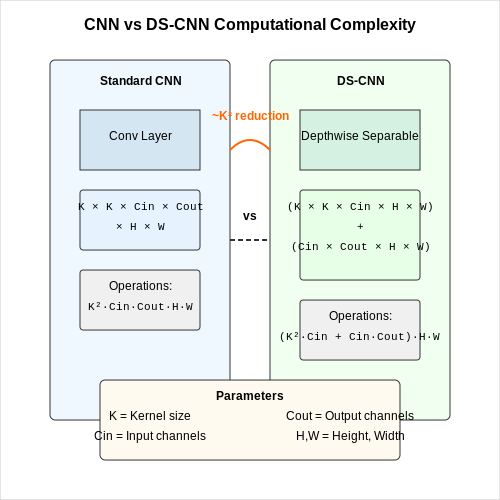
Standard convolutional layers are computationally expensive due to dense connections. Depthwise separable convolutions reduce parameters by factorizing operations into depthwise and pointwise convolutions. The computational cost for a standard convolution is:
where K is kernel size, Cin and Cout are input/output channels, and H, W are spatial dimensions. The depthwise variant reduces this to:
MobileNetV2 and TinyML architectures leverage this for 8-10x parameter reduction while maintaining >90% accuracy on keyword spotting tasks.
Quantization-Aware Training
Microcontrollers typically lack FPUs, making 8-bit integer (INT8) quantization essential. Quantization-aware training simulates quantization effects during backpropagation:
where Δ is the quantization step size. This prevents accuracy drops seen in post-training quantization, as demonstrated by TensorFlow Lite for Microcontrollers achieving 97.4% accuracy on Google Speech Commands with INT8 weights.
Pruning and Sparse Architectures
Magnitude-based pruning removes weights below a threshold, creating sparse matrices that compress well for flash storage. The Lottery Ticket Hypothesis shows subnetworks can achieve original accuracy with 90% sparsity. For microcontrollers, structured pruning (removing entire channels) is preferred due to hardware limitations in sparse matrix multiplication.
Streaming-Capable Architectures
Real-time speech recognition requires models to process streaming audio without buffering entire clips. Convolutional models use causal padding and striding, while RNN alternatives employ GRU/LSTM variants with state retention. The SincNet architecture combines learnable bandpass filters with 1D convolutions, reducing MFCC computation overhead by 40%.
Hardware-Software Co-Design
Optimal architectures vary by microcontroller capabilities. ARM Cortex-M4F cores with DSP extensions accelerate fixed-point operations, enabling wider layers. For ultra-low-power devices like ESP32, binary neural networks (BNNs) reduce operations to bitwise XNOR and popcount, achieving 0.5 mW power consumption at 10 FPS.
4. Quantization Techniques for Speech Models
4.1 Quantization Techniques for Speech Models
Quantization reduces the precision of weights and activations in neural networks, enabling efficient deployment on microcontrollers. For speech recognition models, this involves mapping 32-bit floating-point values to lower-bit integers (e.g., 8-bit or 4-bit) while minimizing accuracy loss.
Uniform Quantization
Uniform quantization linearly maps floating-point values to integers using a scaling factor (S) and zero-point (Z). Given a tensor x, the quantized value xq is computed as:
where S is derived from the tensor's dynamic range [α, β]:
n is the target bit-width (e.g., 8 for INT8), and Z ensures zero is quantized without error. This method is computationally efficient but may underutilize the quantized range for non-uniformly distributed weights.
Non-Uniform Quantization
Non-uniform methods like K-Means Quantization cluster weights and assign codebook values, optimizing for minimal mean squared error (MSE). The Lloyd-Max algorithm iteratively refines centroids:
where C = {c1, ..., ck} are centroids, and Si is the set of points assigned to ci. This better preserves outlier weights but requires additional storage for the codebook.
Quantization-Aware Training (QAT)
QAT simulates quantization during training by injecting fake quantization nodes. The forward pass applies:
while the backward pass uses the Straight-Through Estimator (STE) to approximate gradients. This reduces the mismatch between training and inference, often achieving near-floating-point accuracy with 8-bit quantization.
Hybrid Quantization
Speech models benefit from hybrid approaches where sensitive layers (e.g., attention heads in transformers) retain higher precision. The sensitivity is measured via layer-wise MSE or Hessian trace analysis:
Layers with higher Hi are quantized to 16-bit, while others use 8-bit. This balances memory savings and accuracy.
Practical Considerations
- Per-channel quantization: Scales and zero-points are computed per output channel to handle weight distribution variations.
- Dynamic range selection: Calibration datasets (e.g., random speech samples) improve range estimation compared to min/max.
- Hardware alignment: 8-bit quantized models leverage microcontroller SIMD instructions (e.g., ARM CMSIS-NN).
For deployment, TensorFlow Lite for Microcontrollers and PyTorch Mobile support quantized speech models with optimized kernels for ARM Cortex-M cores. Latency benchmarks show a 3-4× speedup for INT8 vs. FP32 on a 80 MHz Cortex-M4F.
Pruning and Model Compression Strategies
Weight Pruning
Weight pruning involves removing redundant or insignificant weights from a neural network while retaining its predictive performance. The process is guided by a saliency criterion, such as magnitude-based pruning, where weights below a threshold are zeroed out. For a weight matrix W, the pruned version W' is obtained by:
Here, θ is a threshold determined empirically or via gradient-based optimization. Iterative pruning—gradually increasing sparsity over training epochs—often yields better results than one-shot pruning. Advanced variants like structured pruning remove entire filters or channels, simplifying deployment on hardware with fixed memory layouts.
Quantization
Quantization reduces the precision of weights and activations, trading numerical resolution for memory and compute savings. For a 32-bit floating-point model, post-training quantization (PTQ) maps weights to 8-bit integers:
where b is the target bit-width (e.g., 8). Quantization-aware training (QAT) fine-tunes the model with simulated quantization noise, improving robustness. Microcontroller deployments often use per-channel quantization for convolutional layers, as it accounts for varying weight distributions across filters.
Knowledge Distillation
Knowledge distillation transfers knowledge from a large teacher model to a smaller student model by minimizing a composite loss:
where p denotes softmax outputs with temperature scaling. For speech recognition, the student model can mimic the teacher’s intermediate representations (e.g., attention maps in transformers) to preserve temporal alignment accuracy.
Low-Rank Factorization
Matrix decomposition techniques approximate weight tensors as products of smaller matrices. For a weight matrix W ∈ ℝm×n, singular value decomposition (SVD) yields:
where Uk, Vk contain the top-k singular vectors, reducing storage from O(mn) to O(k(m + n)). Tucker decomposition extends this to higher-order tensors, critical for compressing convolutional layers.
Hardware-Aware Optimization
Efficient deployment requires co-designing compression with microcontroller constraints:
- Sparsity support: Leverage hardware accelerators (e.g., ARM CMSIS-NN) for sparse matrix multiplication.
- Quantized inference: Use fixed-point arithmetic units (e.g., Intel VNNI) to avoid floating-point overhead.
- Memory alignment: Structure pruned models to minimize cache misses during inference.
For example, TensorFlow Lite for Microcontrollers employs a hybrid of pruning, 8-bit quantization, and loop unrolling to optimize LSTM-based speech models for ARM Cortex-M cores.
4.3 Balancing Accuracy vs. Resource Constraints
Deploying speech recognition models on microcontrollers requires careful optimization to balance accuracy with the severe computational and memory constraints inherent to embedded systems. The trade-offs involve model architecture selection, quantization, pruning, and hardware-aware optimizations.
Model Architecture Selection
Traditional deep learning models like LSTMs or Transformers achieve high accuracy but are computationally expensive. For microcontrollers, lightweight architectures such as Depthwise Separable Convolutional Neural Networks (DS-CNNs) or Temporal Efficient Networks (TENets) provide better efficiency. The computational complexity of a standard CNN layer is:
whereas a depthwise separable convolution reduces this to:
This reduction in operations directly translates to lower power consumption and faster inference times on resource-constrained devices.
Quantization Techniques
Post-training quantization converts floating-point weights to 8-bit integers, reducing model size by 4x with minimal accuracy loss. For extreme resource constraints, binary or ternary quantization can be employed, though with greater accuracy trade-offs. The quantization error for uniform quantization is bounded by:
where Δ is the quantization step size. Non-uniform quantization schemes like logarithmic quantization can better preserve dynamic range in speech features.
Pruning and Sparsity
Magnitude-based pruning removes insignificant weights, creating sparse models that can leverage hardware acceleration. The optimal sparsity level depends on the target hardware's support for sparse operations. Structured pruning removes entire channels or layers, offering more predictable speedups:
where sl is the sparsity ratio at layer l.
Hardware-Software Co-Design
Efficient deployment requires matching model optimizations to the microcontroller's capabilities. Key considerations include:
- Memory hierarchy: Optimizing for cache locality by restructuring layer execution order
- Parallelism: Exploiting SIMD instructions for vector operations
- Power gating: Scheduling computations to minimize active power states
For real-time systems, the end-to-end latency must satisfy:
where tframe is the audio frame duration. Typical microcontroller implementations achieve 90-95% of floating-point accuracy while reducing compute requirements by 10-100x.
Case Study: Keyword Spotting
A practical example shows a DS-CNN achieving 96% accuracy on the Google Speech Commands dataset with the following resource usage on an Arm Cortex-M4:
- Model size: 150KB (quantized)
- Inference time: 25ms per 1s audio clip
- Power consumption: 3mW at 80MHz clock speed
This demonstrates the feasibility of deploying accurate speech recognition on microcontrollers consuming less than 1% of the power of a smartphone implementation.
5. Integrating Speech Recognition with Firmware
Integrating Speech Recognition with Firmware
Firmware Architecture for Speech Recognition
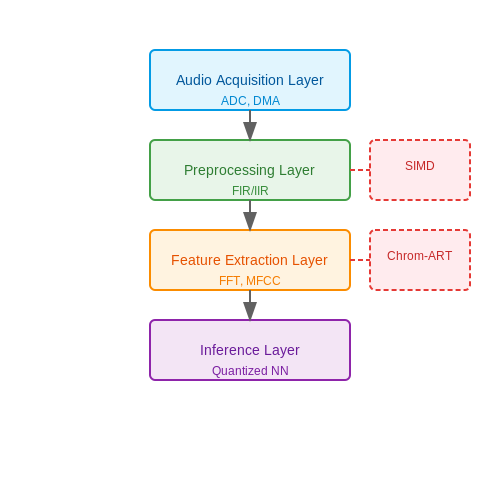
Embedding speech recognition into microcontroller firmware requires a layered architecture that balances real-time processing with memory constraints. The typical structure consists of:
- Audio Acquisition Layer: Handles analog-to-digital conversion (ADC) from microphones, often using DMA for low-latency sampling.
- Preprocessing Layer: Applies FIR/IIR filtering, windowing (e.g., Hamming), and spectral transformation via fixed-point FFT.
- Feature Extraction Layer: Computes Mel-Frequency Cepstral Coefficients (MFCCs) or log-filterbank energies optimized for integer arithmetic.
- Inference Layer: Executes quantized neural networks (e.g., TensorFlow Lite for Microcontrollers) with optimized matrix operations.
Real-Time Scheduling Constraints
For a 16 kHz sampling rate with 20 ms frames, the firmware must complete feature extraction within 10 ms to maintain 50% CPU headroom. This demands:
- Cycle-counted ISRs for ADC DMA completion
- Lookup tables for trigonometric functions in FFT
- Fixed-point arithmetic with Q15 or Q31 formats
Memory Optimization Techniques
Deploying neural networks on microcontrollers with <512 KB RAM requires:
- Weight Pruning: Removing insignificant connections while maintaining >90% accuracy
- 8-bit Quantization: Converting FP32 weights to INT8 via symmetric quantization:
$$ W_{int8} = \text{round}\left(\frac{W_{float}}{s}\right), \quad s = \frac{\max(|W|)}{127} $$
- Memory Reuse: Overlapping buffers for FFT and MFCC computation
Hardware Acceleration Integration
Modern microcontrollers like STM32H7 or ESP32-S3 provide hardware accelerators for speech processing:
- Chrom-ART for DMA-accelerated MFCC computation
- SIMD instructions for parallel MAC operations in neural networks
- Low-power modes triggered by voice activity detection (VAD)
// Example: Fixed-point MFCC on ARM Cortex-M
void compute_mfcc(int16_t* audio_frame, int32_t* mfcc_out) {
  arm_rfft_instance_q15 S;
  arm_rfft_init_q15(&S, 256, 0, 1);
  arm_rfft_q15(&S, audio_frame, mfcc_out);
  // Apply Mel filterbank in Q15 format
  for(int i=0; i<NUM_FILTERS; i++) {
    mfcc_out[i] = arm_dot_prod_q15(mel_filters[i],
                  mfcc_out, FRAME_SIZE) >> 15;
  }
}
Latency Budget Analysis
A typical breakdown for 200 ms end-to-end latency on Cortex-M4 @80 MHz:
| Stage | Cycles | Time (ms) |
|---|---|---|
| ADC Sampling | 3,200 | 0.04 |
| Pre-emphasis | 800 | 0.01 |
| 256-pt FFT | 12,000 | 0.15 |
| MFCC (10 filters) | 24,000 | 0.30 |
| DNN Inference | 1,200,000 | 15.00 |
5.2 Real-Time Processing Considerations
Latency Constraints and Frame Processing
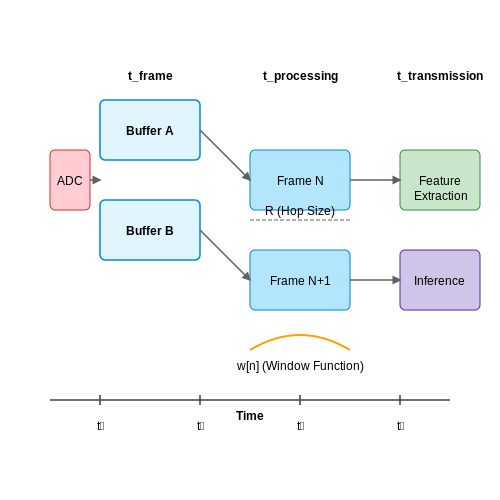
Real-time speech recognition on microcontrollers imposes strict latency constraints, typically requiring end-to-end processing within 100–200 ms to maintain natural user interaction. The audio frame size directly impacts this latency. For a 16 kHz sampling rate, a 20 ms frame contains 320 samples. The frame stride (overlap) must be optimized to balance responsiveness and computational load. The total latency L can be modeled as:
where tframe is the frame duration, tprocessing includes feature extraction and inference, and ttransmission accounts for data movement (e.g., from ADC to memory). For ARM Cortex-M4F cores, typical tprocessing ranges from 30–80 ms per frame for quantized neural networks like DS-CNN or CRNN architectures.
Buffer Management and Overlap-Add
Double-buffering is essential to parallelize data acquisition and processing. While one buffer fills with new audio samples, the other undergoes feature extraction (e.g., MFCCs or spectrograms). Overlap-add techniques mitigate spectral leakage at frame boundaries. For a Hann window with 50% overlap, the window function w[n] and its reconstruction condition are:
where R is the hop size. On microcontrollers, this requires precomputing and storing window coefficients in flash memory to avoid runtime trigonometric calculations.
Computational Optimization Strategies
Three key optimizations enable real-time performance:
- Fixed-Point Arithmetic: 16-bit or 8-bit quantization reduces DSP cycle counts by 4–8× compared to floating-point. ARM CMSIS-DSP libraries provide optimized Q15/Q31 operations.
- Memory Hierarchy: Place feature buffers and model weights in tightly coupled memory (TCM) to avoid cache thrashing. For example, STM32H7’s 512 KB DTCM achieves 0-wait-state access.
- Operator Fusion: Combine consecutive layers (e.g., Conv2D + ReLU) to reduce memory accesses. TensorFlow Lite for Microcontrollers employs this for depthwise separable convolutions.
Energy-Performance Tradeoffs
Dynamic voltage and frequency scaling (DVFS) can reduce power consumption during idle periods. The energy per inference E scales with clock frequency f and voltage V as:
where C is the switched capacitance. Measurements on Nordic nRF5340 show a 3.6× energy reduction (from 12 mJ to 3.3 mJ per inference) when scaling from 128 MHz to 64 MHz for a 50k-parameter model.
Real-Time Scheduling
Preemptive RTOS schedulers (e.g., FreeRTOS or Zephyr) ensure deterministic timing. Priority inversion must be mitigated for audio threads. The worst-case execution time (WCET) for the recognition pipeline should not exceed the frame period. For a 20 ms frame at 80 MHz, this allows ~1.6M cycles, with breakdowns like:
- 400k cycles for 40 MFCC bins (optimized CMSIS-DSP FFT)
- 900k cycles for 3-layer DS-CNN inference (TensorFlow Lite Micro)
- 300k cycles for post-processing (beam search, etc.)
5.3 Power Management and Efficiency
Dynamic Voltage and Frequency Scaling (DVFS)
Microcontrollers implementing speech recognition must balance computational demands with power constraints. Dynamic Voltage and Frequency Scaling (DVFS) adapts the processor's operating voltage and clock frequency in real-time based on workload requirements. The power consumption P of a CMOS circuit follows:
where C is the switched capacitance, V is the supply voltage, f is the clock frequency, and Ileak represents leakage current. Reducing V quadratically lowers dynamic power, while frequency scaling provides linear reduction. Modern microcontrollers like the Arm Cortex-M series integrate hardware-based DVFS controllers that adjust operating points within microseconds.
Task Scheduling for Energy Efficiency
Optimizing task scheduling minimizes active power states. Speech recognition pipelines typically involve:
- Audio sampling (always-on)
- Feature extraction (burst processing)
- Neural network inference (compute-intensive)
By partitioning the workload and utilizing wake-up interrupts, the system can maintain an average current draw below 1mA. The following equation models the energy per inference:
where Pi and ti represent the power and duration of each processing stage, while Etransitions accounts for state-switching overhead.
Memory Access Optimization
Reducing memory accesses directly impacts energy efficiency. Techniques include:
- Cache blocking for neural network weights
- Direct memory access (DMA) for audio buffers
- Register-based storage for frequently used coefficients
The energy cost of memory operations follows:
where α represents the cache miss ratio. Modern microcontrollers achieve 90%+ cache hit rates through intelligent prefetching algorithms.
Low-Power Design Case Study
The STM32L4 series demonstrates effective implementation with:
- Multiple power domains (core, peripherals, I/O)
- Sub-μA deep sleep modes
- Hardware accelerators for FFT operations
When processing 16kHz audio with a 3-layer neural network, these optimizations enable continuous operation for 1+ year on a 200mAh coin cell battery.
6. Benchmarking Speech Recognition Accuracy
6.1 Benchmarking Speech Recognition Accuracy
Accurate benchmarking of speech recognition models on microcontrollers requires rigorous evaluation metrics, optimized test datasets, and hardware-aware performance analysis. Unlike cloud-based systems, embedded deployments face constraints such as limited memory, computational power, and real-time latency requirements, necessitating specialized evaluation methodologies.
Key Evaluation Metrics
The standard metrics for speech recognition accuracy include:
- Word Error Rate (WER): Computed as:
where S is substitutions, D deletions, I insertions, and N total words in the reference. For microcontrollers, WER must be evaluated under varying noise conditions and microphone qualities.
- Character Error Rate (CER): Similar to WER but operates at the character level, useful for languages with complex orthography.
- Real-Time Factor (RTF): Measures computational efficiency as:
An RTF ≤ 1.0 indicates real-time capability, critical for low-power devices.
Dataset Considerations
Effective benchmarking requires datasets that reflect deployment scenarios:
- Noise Robustness: Datasets like Google's Speech Commands should be augmented with background noise (e.g., WHAM!, UrbanSound) at varying Signal-to-Noise Ratios (SNRs).
- Domain-Specific Data: For industrial applications, incorporate domain-specific terminology and acoustic conditions (e.g., machinery noise).
- Hardware-in-the-Loop Testing: Record test sets using the target microcontroller's microphone to capture hardware-specific distortions.
Latency-Energy Tradeoffs
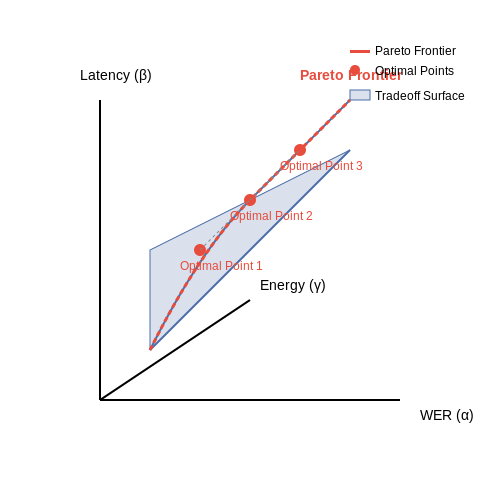
Microcontroller deployments require joint optimization of accuracy, latency, and energy consumption. The Pareto frontier can be modeled as:
where coefficients α, β, γ are application-dependent. For battery-powered devices, energy often dominates (γ ≫ α,β).
Benchmarking Workflow
- Baseline Establishment: Measure the model's accuracy on a desktop GPU using standard datasets (e.g., LibriSpeech).
- Quantization Impact: Evaluate INT8 vs FP32 precision effects on WER using TensorFlow Lite's converter.
- Hardware Profiling: Use on-chip performance counters (e.g., ARM Cortex-M Cycle Count Register) to measure inference time and energy.
- Field Testing: Deploy the model in real-world conditions, logging errors and environmental variables (SNR, temperature).
Case Study: Keyword Spotting on ARM Cortex-M4
A 50k-parameter DS-CNN model achieved:
- WER: 4.2% (clean speech) → 12.8% (15dB SNR)
- Latency: 23ms per inference
- Energy: 1.2mJ per prediction at 80MHz clock
This demonstrates the typical 3-5× WER degradation under noise compared to cloud models, highlighting the need for robust front-end processing (e.g., noise suppression).
Advanced Techniques
State-of-the-art approaches for improving benchmark reliability:
- Neural Architecture Search (NAS): Automatically discovers models that balance accuracy and resource constraints.
- Adaptive Beamforming: Uses multi-microphone arrays to improve SNR before recognition.
- Non-Intrusive Quality Metrics: Algorithms like P.563 predict WER from acoustic features without ground truth.
6.2 Measuring Latency and Resource Usage
Latency Measurement Techniques
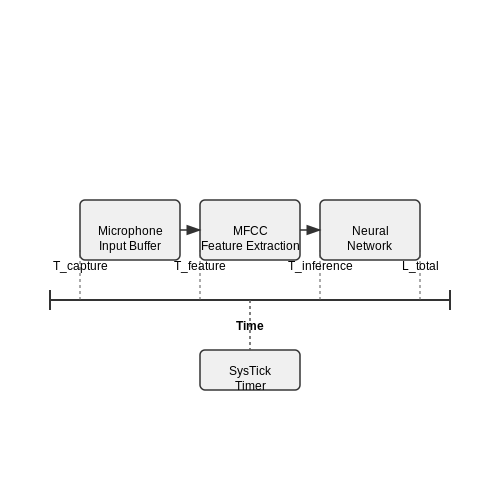
Latency in microcontroller-based speech recognition is defined as the time delay between audio input capture and the generation of a corresponding output prediction. For real-time applications, end-to-end latency must be measured under worst-case computational load. The most accurate method involves timestamping at three critical stages:
- Input capture start: Timestamp when the microphone buffer begins filling.
- Feature extraction completion: Timestamp after Mel-frequency cepstral coefficients (MFCCs) are computed.
- Model inference completion: Timestamp when the neural network outputs final class probabilities.
Where Ltotal represents the worst-case pipeline latency. Hardware timers with microsecond resolution (e.g., ARM Cortex-M SysTick) should be used rather than software timers to avoid measurement artifacts.
Resource Profiling Methodology
Memory and computational constraints on microcontrollers require precise measurement of:
- Peak RAM usage: Tracked through heap allocation monitors or static analysis of the compiled symbol table.
- Flash footprint: Determined from the .map file generated during linking.
- CPU utilization: Measured via cycle-counting profilers or performance counters.
For neural network inference, the memory breakdown typically follows:
Where weight memory (Mweights) is static, activation memory (Mactivations) scales with layer dimensions, and scratch memory (Mscratch) is required for intermediate computations.
Benchmarking Under Constrained Conditions
Stress testing should evaluate:
- Concurrent peripheral operation (e.g., WiFi/BLE interference)
- Power-constrained scenarios (dynamic voltage/frequency scaling)
- Worst-case input sequences that maximize computational branches
A robust benchmarking suite for ARM Cortex-M devices might include:
void benchmark_inference() {
  uint32_t start = DWT->CYCCNT;
  model.run_inference();
  uint32_t cycles = DWT->CYCCNT - start;
  float ms = (cycles * 1000.0f) / SystemCoreClock;
  printf("Inference time: %.2f ms @ %lu Hz", ms, SystemCoreClock);
}
Quantifying Energy-Per-Inference
Energy consumption per inference is calculated by integrating current draw over the active period:
Precision measurement requires:
- High-bandwidth current sensing (≥1Msps)
- Synchronization between current measurements and processing states
- Statistical sampling across voltage/temperature variations
For battery-powered applications, the energy-delay product (EDP) provides a key metric:
6.3 Field Testing and Edge Cases
Field testing speech recognition models on microcontrollers introduces unique challenges due to environmental noise, hardware constraints, and real-world variability. Unlike controlled lab environments, edge devices operate in unpredictable conditions where acoustic interference, varying microphone quality, and power limitations degrade performance. Rigorous field testing must account for these factors to ensure robustness.
Environmental Noise and Acoustic Interference
Background noise introduces spectral distortions that disrupt feature extraction. Let the signal-to-noise ratio (SNR) be defined as:
where Psignal and Pnoise are the power levels of the clean speech and noise components, respectively. For microphones with limited dynamic range, SNR below 15 dB often causes >30% word error rate (WER) degradation. Testing should include:
- Stationary noise (e.g., HVAC systems, machinery)
- Non-stationary noise (e.g., crowds, traffic)
- Impulsive interference (e.g., keyboard clicks, door slams)
Hardware-Specific Edge Cases
Microcontroller limitations exacerbate quantization errors in Mel-frequency cepstral coefficients (MFCCs). Consider a 16-bit fixed-point implementation of the discrete Fourier transform (DFT):
Quantization introduces rounding errors that accumulate during FFT computation. Field tests must validate:
- ADC resolution effects on phoneme discrimination
- Clock drift in real-time sampling (≥0.1% deviation causes aliasing)
- Memory constraints during beam search decoding
Power Consumption Under Load
Dynamic voltage and frequency scaling (DVFS) impacts inference latency. The power-delay product (PDP) for a Cortex-M4 at 80 MHz is:
where Ceff is the switched capacitance. Field testing should measure:
- Peak current during wake-from-sleep transitions
- Energy per inference across temperature ranges (-20°C to +85°C)
- Brown-out recovery behavior
Real-World Data Collection Protocol
Deploy a representative test matrix across:
- 3+ geographic locations (urban/rural/industrial)
- 5+ microphone models with varying frequency responses
- 10+ speaker demographics (age, accent, pitch variance)
Log timestamped environmental metadata (temperature, humidity, RF noise floor) alongside acoustic data. Use dynamic time warping (DTW) to align field recordings with ground truth transcripts:
where π is the warping path and d(·,·) is the spectral distance metric.
7. Key Research Papers in Embedded Speech Recognition
7.1 Key Research Papers in Embedded Speech Recognition
- Embedded Speech Recognition System Design and Optimization — The speech recognition implementation in embedded systems is influenced by many factors. In embedded systems environment, computing rate is relatively lower, storage space is limited. Although the speech recognition technology has won some achievement in high performance platform, it's necessary to do further analysis and research on speech recognition in embedded platform. Speech recognition ...
- Realization of embedded speech recognition module based on STM32 — Speech recognition is the key to realize man-machine interface technology. In order to improve the accuracy of speech recognition and implement the module on embedded system, an embedded speaker-independent isolated word speech recognition system based on ARM is designed after analyzing speech recognition theory. The system uses DTW algorithm and improves the algorithm using a parallelogram to ...
- (PDF) Single-chip speech recognition system based on 8051 ... — Figure 1. Block diagram of the speech recognition SOC. Figure 2. Algorithm block diagram of speech recognition SOC. Yuanyuan et al.: Single-Chip Speech Recognition System Based on 8051 Microcontroller Core The pronunciation variation of speaker 3 is much more than the other two, so even the DTW template does not work quite well. But the sequential training improves the robustness of template ...
- Embedded Speaker Recognition System Design and ... - ScienceDirect — In this paper, on the basis of the vector quantization (VQ) for speaker recognition algorithm, the Cyclone II2C35 series FPGA to achieve embedded speech recognition system, using the characteristics of vector quantization and the genetic algorithm, considering the training and recognition time-consuming, resource consumption and * Corresponding ...
- PDF Speech Recognition on Embedded Hardware - rmhsilva.com — Electronic Engineering with Mobile and Secure Systems SPEECH RECOGNITION ON EMBEDDED HARDWARE byRicardo da Silva This report presents a proof of concept system that is aimed at investigating Hid-den Markov Model based speech recognition in embedded hardware. It makes use of two new electronic boards, based on a Spartan 3 FPGA and an ARMv5 Linux
- Design and Implementation of Embedded Real‐Time English Speech ... — The recognition performance test of the embedded English speech recognition system is carried out in the system test stage . Based on the black box test method, the English speech recognition system is placed in the test environment (host machine environment or target machine environment) to simulate actual use and operation.
- PDF Speech Controlled RC Car - Theseus — 2 Theory of Embedded Speech Recognition 3 2.1 What is an Embedded System 3 2.1.1 Classification of an Embedded Systems 5 2.2 Processor in a System 6 2.2.1 Microprocessor and Microcontroller 6 2.3 Role of Input and Output Components 9 2.3.1 Serial vs. Parallel I/O 10 2.3.2 Interfacing the I/O components 12
- Automatic Speech Recognition: Systematic Literature Review — A huge amount of research has been done in the field of speech signal processing in recent years. In particular, there has been increasing interest in the automatic speech recognition (ASR) technology field. ASR began with simple systems that responded to a limited number of sounds and has evolved into sophisticated systems that respond fluently to natural language. This systematic review of ...
- Challenges and Limitations in Speech Recognition Technology: A Critical ... — Table 1 lists various surveys and review papers with detailed speech recognition analysis and its associated techniques, applications, and limitations. Most research papers seem to have focused on specific areas of speech signal processing, providing a summary of how various researchers have perceived and applied it through the decades.
- (PDF) SPEECH RECOGNITION SYSTEMS - ResearchGate — The objective of this paper is to present the concepts about Speech Recognition Systems starting from the evolution to the advancements that have now been adapted to the Speech Recognition Systems ...
7.2 Open-Source Projects and Libraries
- Top 5 Speech Recognition Open-Source Projects and Libraries With Most ... — Speech recognition is an interdisciplinary subfield of computer science and computational linguistics that develops methodologies and technologies that enable the recognition and translation of spoken language into text by computers. In today's article, we are going to review the top five options for the best open-source Speech Recognition projects which have no less than 5000 stars on ...
- FedericaPaoli1/stm32-speech-recognition-and-traduction — About stm32-speech-recognition-and-traduction is a project developed for the Advances in Operating Systems exam at the University of Milan (academic year 2020-2021). It implements a speech recognition and speech-to-text translation system using a pre-trained machine learning model running on the stm32f407vg microcontroller.
- Realization of embedded speech recognition module based on STM32 — Speech recognition is the key to realize man-machine interface technology. In order to improve the accuracy of speech recognition and implement the module on embedded system, an embedded speaker-independent isolated word speech recognition system based on ARM is designed after analyzing speech recognition theory. The system uses DTW algorithm and improves the algorithm using a parallelogram to ...
- Embedded-Speech-Recognition-STM32F407 - GitHub — This project will implement a speech command recognition system on an STM32F407 Discovery board with 112KB of RAM. The system is designed to predict two keywords, "yes" and "no," while classifying other sounds as "noise." It utilizes embedded audio processing and deep learning techniques to achieve efficient speech recognition on a microcontroller platform.
- MicroAsr - Offline Speech Recognition and TTS for microcontrollers — MicroAsr Company, brings Speech Recognition AI at the edge. MicroAsr has brought together highly qualified scientists and engineers to build an on-device speaker-independent speech recognition system for low-cost embedded devices and microcontrollers (from 200 DMIPS).
- TinyML Course#6 Speech Recognition on MCU-Speech-to-Intent — An open-source, easily accessible package for training and deploying Speech-to-Intent models on microcontrollers and SBCs. Speech-to-Intent models transform speech (either as raw waveform or processed features, e.g. MFCC used for reference implementation) to parsed output.
- Top 23 speech-recognition Open-Source Projects | LibHunt — Which are the best open-source speech-recognition projects? This list will help you: transformers, whisper.cpp, DeepSpeech, leon, faster-whisper, whisperX, and kaldi.
- Benchmarking Top Open Source Speech Recognition Models: Whisper ... — Explore the top 3 open-source speech models, including Kaldi, wav2letter++, and OpenAI's Whisper, trained on 700,000 hours of speech. Discover insights on usability, accuracy, and speed. Click to find the right ASR model for your needs!
- PDF Controlling Devices Through Voice Based on AVR Microcontroller - IJSRP — Codes are developed using AVR Studio IDE and HEX files are uploaded to the controller chip by using AVR Burner through Usbasp Program loader. AMR Voice is the speech recognition software that converts speech into text commands and transmits those on Bluetooth.
- PDF Speech Controlled RC Car - Theseus — The programming for Arduino microcontroller was done in C language by using the Arduino IDE (integrated devolvement environment). EasyVR commander software was used for the programming of EasyVR module, which generates the source code auto-matically after the training of commands.
7.3 Industry Case Studies and White Papers
- FedericaPaoli1/stm32-speech-recognition-and-traduction — About stm32-speech-recognition-and-traduction is a project developed for the Advances in Operating Systems exam at the University of Milan (academic year 2020-2021). It implements a speech recognition and speech-to-text translation system using a pre-trained machine learning model running on the stm32f407vg microcontroller.
- Embedded Speech Recognition System Design and Optimization — The speech recognition implementation in embedded systems is influenced by many factors. In embedded systems environment, computing rate is relatively lower, storage space is limited. Although the speech recognition technology has won some achievement in high performance platform, it's necessary to do further analysis and research on speech recognition in embedded platform. Speech recognition ...
- MicroAsr - Offline Speech Recognition and TTS for microcontrollers — MicroAsr Company, brings Speech Recognition AI at the edge. MicroAsr has brought together highly qualified scientists and engineers to build an on-device speaker-independent speech recognition system for low-cost embedded devices and microcontrollers (from 200 DMIPS).
- Automatic Speech Recognition (ASR) - Papers With Code — Automatic Speech Recognition (ASR) involves converting spoken language into written text. It is designed to transcribe spoken words into text in real-time, allowing people to communicate with computers, mobile devices, and other technology using their voice. The goal of Automatic Speech Recognition is to accurately transcribe speech, taking into account variations in accent, pronunciation, and ...
- AI Speech Recognition with TensorFlow Lite for Microcontrollers and ... — In this codelab, you'll learn to run a speech recognition model using TensorFlow Lite for Microcontrollers on the SparkFun Edge, a battery powered development board containing a microcontroller.
- TinyML Course#6 Speech Recognition on MCU-Speech-to-Intent — TinyML Course#6 Speech Recognition on MCU-Speech-to-Intent Train a specific domain speech-to-intent model and deploy it to Cortex M4F based development board with built-in microphone, Wio Terminal.
- Design and Implementation of Embedded Real-Time English Speech ... — This paper studies the real-time index of embedded English speech recognition system and the system optimization method of recognition rate. Through the analysis of the system hardware, technical methods such as fixed-point embedded system algorithm and storage space optimization are adopted to ensure the real-time requirements of the system.
- Design and implementation of speech recognition system integrated with ... — This study focuses on the design and implementation of a speech recognition system integrated with internet of thing (IoT) to control electrical appliances and door with raspberry pi as a core ...
- PDF Streaming Automatic Speech Recognition With The Transformer Model — Hybrid hidden Markov model (HMM) based automatic speech recognition (ASR) systems have provided state-of-the-art results for the last few decades [1, 2]. End-to-end ASR systems, which approach the speech-to-text conversion problem using a single sequence-to-sequence model, have recently demonstrated competi-tive performance [3].
- (PDF) The implementation of speech recognition systems on fpga-based ... — PDF | An implementation of Artificial-Neural-Network (ANN) based speech recog-nition systems on the embedded platform is explored in this paper.