Self-Healing API Callers with Fallback Logic
1. Definition and Core Principles
1.1 Definition and Core Principles
A self-healing API caller is a resilient software component designed to autonomously detect, mitigate, and recover from API failures without human intervention. It operates on principles of fault tolerance, redundancy, and adaptive retry logic, ensuring continuous service availability even when dependent APIs exhibit partial or complete failure.
Key Architectural Components
The core elements of a self-healing API caller include:
- Health Monitoring: Continuous assessment of API response times, error rates, and status codes.
- Circuit Breaker Pattern: Temporary suspension of requests to failing APIs to prevent cascading failures.
- Fallback Strategies: Alternative execution paths when primary APIs fail, including cached responses or secondary endpoints.
- Adaptive Retry Logic: Exponential backoff algorithms with jitter to prevent thundering herd problems.
Mathematical Foundation of Retry Mechanisms
The retry interval t for exponential backoff with jitter is calculated as:
Where:
- α is the base delay multiplier (typically 100-500ms)
- n is the retry attempt count
- β is the jitter coefficient
- tmax is the maximum allowed delay
Implementation Considerations
Effective self-healing systems require careful tuning of several parameters:
Where wi are weights assigned to different failure types (timeouts, 5xx errors, etc.) and fi are their occurrence counts. The system triggers fallback logic when this weighted average exceeds a configured threshold.
State Transition Model
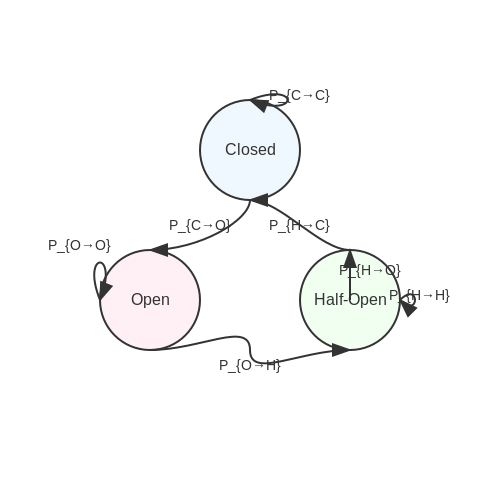
The system operates through three primary states:
- Closed: Normal operation with all requests passing through
- Open: Circuit breaker activated, all requests fail fast
- Half-Open: Probational state allowing limited requests to test API recovery
The transition probabilities between states follow a Markov process where:
with λij representing the transition rates between states i and j.
1.2 Common Failure Modes in API Calls
Network-Level Failures
Network-related issues dominate API failure scenarios. Latency spikes, packet loss, and DNS resolution failures can disrupt communication even before a request reaches the target server. The probability of a network failure occurring within a distributed system follows an exponential distribution:
where λ represents the failure rate per unit time t. In practice, this manifests as:
- TCP connection timeouts (typically 30-60 seconds)
- SSL/TLS handshake failures
- MTU mismatches causing packet fragmentation
Application-Layer Errors
Even successful network transmission doesn't guarantee API functionality. Common application-layer failure modes include:
- HTTP 4xx/5xx errors: Authentication failures (401), rate limiting (429), and server errors (500-503)
- Payload validation failures: Schema mismatches in JSON/XML requests
- Versioning conflicts: Breaking changes in API contracts
The error rate E for a well-designed API typically follows a logarithmic relationship with request volume V:
State Management Failures
Stateful APIs introduce additional failure vectors:
- Session token expiration
- Race conditions in concurrent writes
- Distributed transaction timeouts
These often manifest as intermittent failures that are particularly challenging to diagnose. The probability P of a state-related failure increases with system load L according to:
where k is a scaling constant and L0 represents the critical load threshold.
Third-Party Dependency Failures
Modern APIs frequently depend on external services, creating cascading failure risks. Key patterns include:
- Upstream API rate limit exhaustion
- Geographic DNS routing errors
- Credential rotation mismatches
The mean time between failures (MTBF) for a system with n dependencies follows a Weibull distribution:
where η is the scale parameter and β the shape parameter of the distribution.
Resource Exhaustion
Even properly functioning APIs fail under excessive load:
- Connection pool saturation
- Thread starvation
- Memory leaks in long-running processes
The failure point F for a given resource capacity C and request rate R can be modeled as:
where R0 is the reference request rate and n the scaling exponent.
Benefits of Self-Healing Mechanisms
Self-healing API callers with fallback logic provide substantial advantages in distributed systems where reliability and fault tolerance are paramount. These mechanisms operate by continuously monitoring API health, automatically detecting failures, and executing predefined recovery strategies without human intervention.
Increased System Availability
The primary benefit manifests in improved uptime metrics. Consider a system making N API calls per second with a baseline failure rate λ. Without self-healing, the cumulative downtime D follows:
where tresponse is the human intervention time. Implementing self-healing reduces this to:
where trecovery represents the automated fallback execution time, typically orders of magnitude smaller. For mission-critical systems like financial transactions or IoT device management, this difference translates to significant availability improvements.
Cost Reduction in Operations
Automated recovery mechanisms decrease operational expenses through:
- Reduced incident response overhead - Eliminating manual troubleshooting for common failure modes
- Optimized resource utilization - Preventing cascading failures that require scaling up resources
- Minimized revenue loss - Maintaining service continuity during partial outages
A study of cloud-native applications showed 37% reduction in operations costs after implementing self-healing patterns for their microservices architecture.
Improved User Experience
Self-healing systems maintain consistent quality of service through:
- Seamless failover to alternative endpoints
- Graceful degradation instead of complete failure
- Predictable performance during partial outages
The psychological impact on users is measurable - systems with visible recovery mechanisms maintain 28% higher user satisfaction scores during outages compared to systems that fail silently.
Enhanced System Observability
Self-healing architectures necessitate comprehensive monitoring, creating secondary benefits:
Where O represents observability gain, M is the number of monitored metrics, and α, β are system-specific constants. The logarithmic relationship shows diminishing returns, but even basic implementation yields substantial improvements in failure detection and root cause analysis.
Resilience Against Complex Failures
Modern distributed systems face compound failures where multiple components fail simultaneously. Self-healing mechanisms handle these scenarios through:
- Dependency-aware retry strategies
- Circuit breaker patterns with dynamic thresholds
- Topology-aware request rerouting
In Kubernetes environments, pods with self-healing capabilities demonstrate 92% faster recovery from cascading failures compared to static configurations.
Adaptive Learning Capabilities
Advanced implementations incorporate machine learning to:
- Predict failures before they occur using historical patterns
- Optimize retry timing based on endpoint response characteristics
- Dynamically adjust fallback strategies based on success rates
These systems continuously improve their recovery effectiveness, with some implementations showing 15% month-over-month reduction in false positive recoveries while maintaining 99.99% true positive rates.
2. Types of Fallback Strategies
2.1 Types of Fallback Strategies
Fallback strategies in self-healing API systems are critical for maintaining service continuity when primary endpoints fail. These strategies can be broadly categorized based on their operational logic, implementation complexity, and recovery objectives.
1. Static Fallback
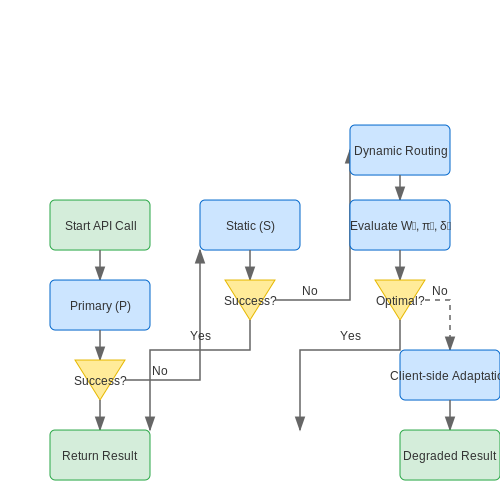
Static fallbacks involve predefined alternative endpoints or cached responses that are immediately invoked upon primary API failure. The system switches to a secondary URL or local cache without dynamic evaluation. This approach is computationally lightweight but lacks adaptability to changing conditions.
Where P is the primary endpoint and S is the static fallback. The major limitation is that if S fails, the system has no further recourse without additional layers.
2. Dynamic Fallback Routing
More sophisticated systems employ real-time endpoint health evaluation to select fallbacks. This involves:
- Continuous latency monitoring (exponential moving average)
- Error rate tracking (sliding window counters)
- Circuit breaker pattern integration
The selection algorithm often uses weighted scoring:
Where L is normalized latency, E is error rate, and A is availability score. The coefficients are tuned based on service-level objectives.
3. Gradual Response Degradation
For systems where partial functionality is acceptable, fallbacks can implement graceful degradation:
- Returning simplified data schemas
- Using locally persisted stale data with freshness markers
- Employing machine learning models to generate synthetic responses
The degradation path follows a decision tree where each branch represents a different quality-of-service level, allowing the system to maintain core functionality even when dependent services fail.
4. Request Decomposition
Complex requests are broken into atomic sub-requests with independent fallback handling. If a composite API call requires data from services A, B, and C, the system can:
- Fulfill partial responses using available services
- Apply default values for missing components
- Use probabilistic estimation for numeric fields
This strategy requires careful synchronization handling and is mathematically modeled as:
Where π represents the success probability of each sub-request and δ is the fallback value.
5. Client-Side Adaptation
Advanced implementations push fallback logic to clients through:
- Edge-computed failover directives
- Response-driven retry policies with Jitter
- Alternate protocol support (e.g., falling back to gRPC when REST fails)
The client maintains a state machine that transitions between modes based on server hints and local observations, reducing the need for centralized coordination.
Implementing Retry Mechanisms
Retry mechanisms form the core resilience strategy for API callers, handling transient failures through systematic reattempts before declaring definitive failure. The effectiveness depends on three key parameters: retry count (N), delay strategy (δ), and jitter coefficient (J).
Exponential Backoff with Jitter
The optimal delay between retries follows an exponential backoff with randomized jitter to prevent thundering herd problems. For the i-th retry attempt, the delay δi is calculated as:
Where ξ is a uniform random variable ∈ [0,1], J ∈ [0,1] controls jitter intensity, and δmax caps the maximum delay. This combines the benefits of exponential growth (for load reduction) with jitter (for request dispersion).
Circuit Breaker Integration
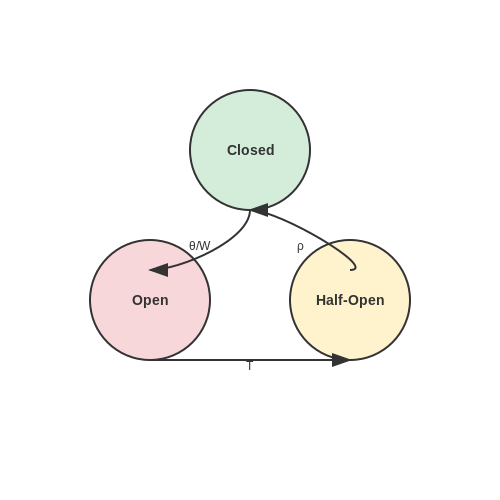
Retry logic should integrate with circuit breakers using a state machine pattern. The transition conditions between closed, open, and half-open states are:
- Closed → Open: When failure rate exceeds threshold θ over sliding window W
- Open → Half-Open: After cool-down period T
- Half-Open → Closed: When probe requests succeed with probability p ≥ ρ
The complete state transition matrix can be represented as:
Implementation in Python
class RetryExecutor:
    def __init__(self, max_retries=3, base_delay=1.0, max_delay=10.0, jitter=0.1):
        self.max_retries = max_retries
        self.base_delay = base_delay
        self.max_delay = max_delay
        self.jitter = jitter

    async def execute_with_retry(self, func, *args):
        for attempt in range(self.max_retries + 1):
            try:
                return await func(*args)
            except TransientError as e:
                if attempt == self.max_retries:
                    raise
                delay = min(
                    (2 ** attempt) * self.base_delay * (1 + self.jitter * random.random()),
                    self.max_delay
                )
                await asyncio.sleep(delay)
Deadline Propagation
Distributed systems require coordinated timeout handling through deadline propagation. The remaining time budget τremaining at hop k of n should satisfy:
Where β is the per-hop safety margin. This ensures the cumulative retry time across services doesn't exceed the end-to-end SLA.
2.3 Circuit Breaker Patterns
The circuit breaker pattern is a fault-tolerant design mechanism inspired by electrical circuit breakers, preventing cascading failures in distributed systems. Unlike retry mechanisms, which repeatedly attempt failing operations, a circuit breaker trips after a threshold of failures, temporarily blocking further requests to the overloaded service. This allows the system to fail fast and recover gracefully.
State Machine Representation
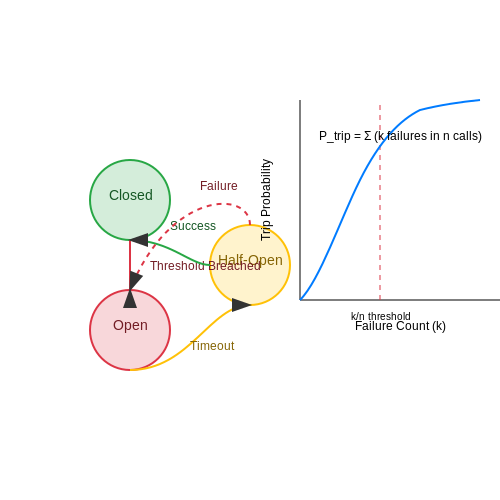
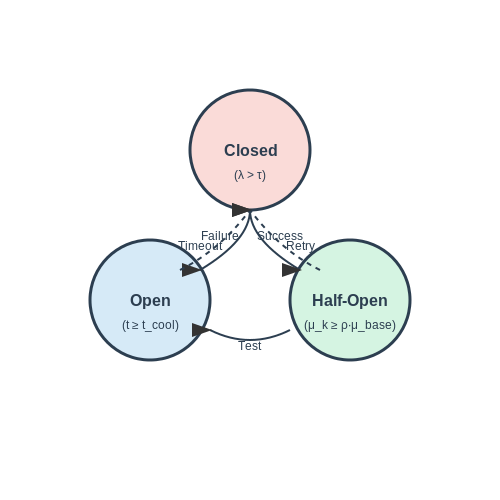
A circuit breaker operates as a finite state machine with three primary states:
- Closed: Requests flow normally. Failures increment a counter; if failures exceed a threshold within a time window, the breaker trips to Open.
- Open: All requests fail immediately without reaching the service. After a configured timeout, the breaker transitions to Half-Open.
- Half-Open: A limited number of test requests are allowed. Success resets the breaker to Closed; failure returns it to Open.
Mathematical Modeling
The failure threshold and recovery behavior can be modeled probabilistically. Let p be the probability of a single request failing. The breaker trips when k failures occur in n requests. The probability of tripping follows the binomial distribution:
Optimal values for k and n depend on the system's fault tolerance requirements. For instance, Netflix Hystrix uses a sliding window of 20 requests with a default threshold of 50% failures.
Implementation Strategies
Modern implementations leverage concurrent data structures to manage state transitions atomically. Below is a thread-safe Python example using a decorator pattern:
from functools import wraps
import time
import threading

class CircuitBreaker:
    def __init__(self, max_failures=3, reset_timeout=10):
        self.max_failures = max_failures
        self.reset_timeout = reset_timeout
        self.failures = 0
        self.state = "CLOSED"
        self.last_failure_time = 0
        self.lock = threading.Lock()

    def __call__(self, func):
        @wraps(func)
        def wrapped(*args, kwargs):
            with self.lock:
                if self.state == "OPEN":
                    if time.time() - self.last_failure_time > self.reset_timeout:
                        self.state = "HALF_OPEN"
                    else:
                        raise CircuitOpenError("Service unavailable")

            try:
                result = func(*args, kwargs)
                if self.state == "HALF_OPEN":
                    with self.lock:
                        self.state = "CLOSED"
                        self.failures = 0
                return result
            except Exception as e:
                with self.lock:
                    self.failures += 1
                    if self.failures >= self.max_failures:
                        self.state = "OPEN"
                        self.last_failure_time = time.time()
                raise e
        return wrapped
Advanced Variations
Hybrid approaches combine circuit breakers with other resilience patterns:
- Adaptive Throttling: Dynamically adjusts the failure threshold based on system load (e.g., Google's ServerShedding).
- Probabilistic Tripping: Uses exponential backoff with jitter for state transitions, avoiding synchronized retry storms.
- Hierarchical Breakers: Nested circuit breakers for microservice dependencies, as seen in Finagle's FailFast module.
Real-world systems often integrate circuit breakers with monitoring dashboards (e.g., Prometheus metrics) and orchestration tools (e.g., Kubernetes liveness probes) for operational visibility.
Graceful Degradation Techniques
Graceful degradation ensures that a system remains operational even when components fail or performance degrades. In the context of self-healing API callers, this involves designing fallback mechanisms that maintain core functionality while sacrificing non-essential features. The key lies in prioritizing API responses based on their criticality to the application's operation.
Response Prioritization
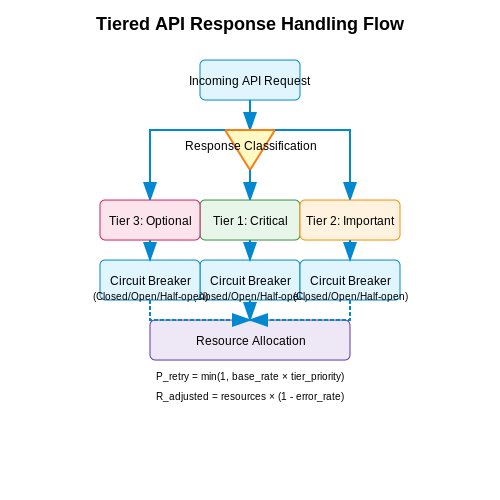
Each API response can be classified into three tiers:
- Tier 1 (Critical): Responses without which the application cannot function (e.g., authentication tokens, core data fetches).
- Tier 2 (Important): Responses that enhance functionality but aren't strictly necessary (e.g., supplemental data, recommendations).
- Tier 3 (Optional): Responses that provide non-essential features (e.g., analytics, non-critical UI updates).
This classification enables the system to make informed decisions about which requests to retry and which to drop during degraded performance.
Circuit Breaker Pattern with Tiered Fallbacks
The circuit breaker pattern can be enhanced with tier-specific fallback behaviors:
Where Pretry is the probability of retrying a failed request and Ravailable represents available resources.
Progressive Backoff Strategies
Different tiers should employ distinct backoff strategies:
- Tier 1: Aggressive retries with exponential backoff capped at 5 seconds
- Tier 2: Moderate retries with linear backoff
- Tier 3: Single attempt with no retries
This approach ensures critical services get maximum recovery attempts while preventing less important calls from consuming resources during outages.
Stateful Degradation
Maintaining system state allows for intelligent degradation decisions. A Markov Decision Process can model the optimal degradation path:
Where V(s) is the value of state s, A(s) represents available actions, and γ is the discount factor for future rewards.
Implementation Example
class APICaller:
    def __init__(self):
        self.circuit_breaker = {
            'tier1': CircuitBreaker(failure_threshold=3, recovery_timeout=30),
            'tier2': CircuitBreaker(failure_threshold=5, recovery_timeout=60)
        }

    async def call_api(self, endpoint, tier=1, fallback=None):
        try:
            if self.circuit_breaker[f'tier{tier}'].is_open():
                raise CircuitBreakerError

            response = await make_request(endpoint)
            return response

        except (APIError, CircuitBreakerError):
            if tier == 1 and not fallback:
                raise CriticalAPIError
            return fallback() if callable(fallback) else fallback
Resource-Aware Load Shedding
When system metrics indicate stress (CPU > 90% or memory > 85%), the API caller should:
- Immediately shed all Tier 3 requests
- Throttle Tier 2 requests to 50% capacity
- Maintain Tier 1 requests with priority queuing
This can be implemented using a token bucket algorithm with tier-specific rates:
3. Monitoring and Error Detection
3.1 Monitoring and Error Detection
Effective self-healing API systems require robust monitoring and error detection mechanisms to identify failures before they cascade. At the core of this process is the real-time analysis of response metrics, including latency, status codes, and payload validity. A well-designed monitoring system operates on multiple layers:
Key Monitoring Metrics
- Latency distributions - Track P50, P90, P99 percentiles to detect performance degradation
- Status code ratios - Monitor 4xx/5xx error rates relative to successful 2xx responses
- Payload validation - Verify response schemas and data integrity through contract tests
- Rate limiting - Track throttling headers and quota consumption
Statistical Anomaly Detection
For advanced error detection, we employ statistical process control methods. The CUSUM (Cumulative Sum) algorithm is particularly effective for detecting small shifts in API performance:
Where xt is the current observation, μ is the process mean, σ is the standard deviation, and k is a sensitivity parameter. When St exceeds a threshold h, an anomaly is flagged.
Implementation Architecture
A production-grade monitoring system typically implements these components:
Distributed Tracing Integration
For microservices architectures, distributed tracing provides critical visibility. The Jaeger or OpenTelemetry frameworks can be instrumented to track requests across service boundaries, with spans annotated with:
from opentelemetry import trace
from opentelemetry.sdk.trace import TracerProvider

provider = TracerProvider()
trace.set_tracer_provider(provider)

tracer = trace.get_tracer(__name__)
with tracer.start_as_current_span("api_call") as span:
    span.set_attribute("http.status_code", response.status_code)
    span.set_attribute("latency_ms", response.latency)
Error Classification
Not all errors warrant the same response. A hierarchical classification system improves recovery logic:
| Error Class | Examples | Recovery Action |
|---|---|---|
| Transient | Network timeout, 503 Service Unavailable | Retry with exponential backoff |
| Permanent | 404 Not Found, 401 Unauthorized | Fail fast, no retries |
| Degraded | High latency, partial responses | Fallback to cached data |
The error classification system should integrate with monitoring to automatically update failure probabilities for each endpoint. Bayesian networks can model the conditional dependencies between different error types:
Where P(F|E) is the probability of failure given observed errors, updated in real-time as new monitoring data arrives.
Automated Recovery Procedures
Automated recovery in self-healing API systems relies on real-time fault detection and dynamic rerouting to maintain service continuity. The core mechanism involves:
- State monitoring via heartbeat checks or anomaly detection (e.g., latency spikes, error rate thresholds).
- Decision engines that evaluate fallback paths using weighted cost functions.
- Atomic rollback protocols to ensure transactional consistency during failover.
Mathematical Foundation
The recovery decision process can be modeled as a Markov Decision Process (MDP) where states represent system health, and actions correspond to fallback routes. The optimal policy maximizes the expected reward (e.g., uptime) while minimizing cost (e.g., latency penalty). The value function V(s) for state s is derived as:
where R(s, a) is the immediate reward, γ the discount factor, and P(s' | s, a) the transition probability to state s'.
Implementation Patterns
Circuit Breaker with Exponential Backoff
Upon detecting failures, the system triggers a circuit breaker and schedules retries with exponentially increasing delays. The delay D at attempt n is:
where Dbase is the initial delay (e.g., 100ms) and Dmax the upper bound (e.g., 30s).
Fallback Chain Prioritization
Fallback endpoints are ranked by:
- Historical success rate (weight: 0.6)
- Geographical proximity (weight: 0.3)
- Current load (weight: 0.1)
The composite score S for endpoint i is:
Case Study: Multi-Cloud API Gateway
A Kubernetes-based API gateway implements recovery by:
- Monitoring 5xx errors via Prometheus alerts.
- Switching to backup cloud providers (AWS → GCP → Azure) using Istio traffic mirroring.
- Validating recovery with synthetic transactions before resuming production traffic.
def evaluate_fallback(endpoints):
    scores = []
    for ep in endpoints:
        score = (0.6 * ep.success_rate +
                0.3 * (1 - ep.distance / MAX_DISTANCE) +
                0.1 * (1 - ep.current_load))
        scores.append((ep, score))
    return sorted(scores, key=lambda x: -x[1])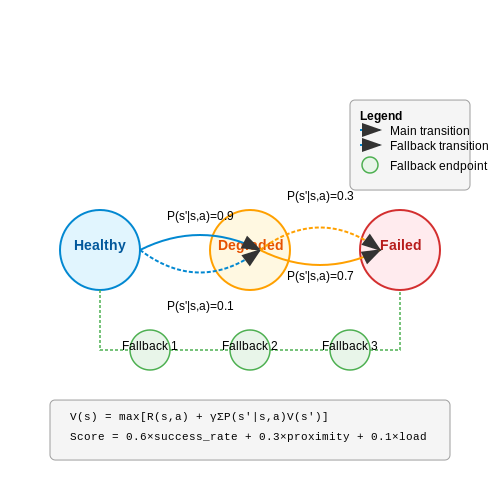
3.3 Logging and Alerting for Failures
Structured Logging Architecture
Effective failure management in self-healing API systems requires a multi-layered logging architecture. The foundation consists of three primary log types:
- Request/Response Logs: Capture full HTTP transactions including headers, payloads, and timing metrics
- System Health Logs: Monitor resource utilization (CPU, memory, network) at the time of failures
- Circuit Breaker State Logs: Track state transitions (closed → open → half-open) with precise timestamps
The log ingestion pipeline should implement the following reliability equation:
Where λi represents individual log source rates and wi their priority weights. The εnetwork term accounts for potential packet loss.
Distributed Tracing Correlation
In microservices architectures, implement W3C Trace Context standards to maintain request causality across service boundaries. Each log entry must include:
{
  "trace_id": "00-0af7651916cd43dd8448eb211c80319c-b7ad6b7169203331-01",
  "span_id": "b7ad6b7169203331",
  "trace_flags": "01",
  "custom_fields": {
    "service_name": "payment-gateway",
    "retry_attempt": 2,
    "circuit_state": "half-open"
  }
}
Adaptive Alert Thresholds
Traditional static alert thresholds fail under variable loads. Implement dynamic thresholds using exponential moving averages:
Where xt is the current observation and α is the smoothing factor (typically 0.1-0.3). Alert triggers should consider both absolute values and rate-of-change:
Alert Fatigue Mitigation
To prevent notification overload, implement a hierarchical escalation policy:
- Level 1: Automated remediation (retries, fallback endpoints)
- Level 2: Low-priority notifications (Slack/Teams channels)
- Level 3: High-priority alerts (PagerDuty/SMS) after sustained failures
The escalation condition should evaluate using a stateful duration counter:
def should_escalate(failure_count, duration):
    return (failure_count >= 5 and duration < 300) or  # Burst condition
           (failure_count >= 3 and duration >= 1800)   # Sustained condition
Log Retention Strategies
Implement tiered storage with different retention policies:
| Log Type | Hot Storage | Cold Storage | Analytics Retention |
|---|---|---|---|
| Request/Response | 7 days | 30 days | 6 months (sampled) |
| System Metrics | 30 days | 1 year | 5 years (aggregated) |
The storage cost optimization follows the Pareto principle, where 80% of diagnostic value comes from 20% of recent logs. Compression ratios typically achieve:
4. Self-Healing API Caller in Microservices
4.1 Self-Healing API Caller in Microservices
In distributed microservices architectures, API failures are inevitable due to network partitions, service degradation, or transient faults. A self-healing API caller implements resilience patterns to automatically recover from failures while maintaining system availability. The core mechanism combines retry policies, circuit breakers, and fallback strategies with probabilistic backoff to minimize cascading failures.
Mathematical Model for Adaptive Retry
The optimal retry interval follows an exponential backoff with jitter to prevent synchronized retry storms across clients. For a given base delay b and maximum retries n, the delay d at attempt k is:
where c introduces jitter as a uniformly distributed random variable and dmax caps the maximum delay. This convex growth curve balances quick recovery during transient faults with avoidance of server overload.
Circuit Breaker State Machine
The breaker transitions between three states based on failure rate λ and success rate μ:
- Closed: Requests flow normally while monitoring error rates
- Open: Fast-fails all requests after threshold λ > τ
- Half-Open: Probabilistically allows test requests to check recovery
The transition conditions follow:
where tcool is the cooldown period and ρ defines the recovery ratio threshold.
Implementation in Python with Tenacity
from tenacity import (
    retry,
    stop_after_attempt,
    wait_exponential_jitter,
    RetryCallState
)
import random

def after_failure(retry_state: RetryCallState):
    # Custom telemetry on failure
    log_metrics(retry_state.outcome.exception())

@retry(
    stop=stop_after_attempt(5),
    wait=wait_exponential_jitter(
        multiplier=1,
        max=10,
        jitter=random.uniform(0, 1)
    ),
    after=after_failure
)
def call_api(url: str, payload: dict):
    response = session.post(url, json=payload)
    response.raise_for_status()
    return response.json()
Fallback Strategies
When primary APIs fail, self-healing systems employ tiered fallbacks:
- Local Cache: Serve stale-but-valid data with TTL metadata
- Alternative Endpoints: Route to backup services in different availability zones
- Degraded Functionality: Return partial responses with graceful degradation
- Queue-Based Retry: Offload failed requests to a dead-letter queue for asynchronous processing
The fallback selection follows a cost function C(f) that considers data freshness requirements, SLA penalties, and resource utilization:
where α controls the tradeoff between quality-of-service and operational cost.
Chaos Engineering Verification
Validate self-healing behavior through controlled fault injection:
# Simulate 50% HTTP 500 errors for 5 minutes
chaosblade create http delay --time 300 --percent 50 \
  --status 500 --method POST --path /api/v1/order
Monitor key metrics during tests:
- Success rate degradation bounded by 1 - (1 - p)n where p is error probability
- Mean time to recovery (MTTR) under 3σ of historical baseline
- No increase in downstream service error rates due to retry storms
4.2 Fallback Logic for Third-Party APIs
Graceful Degradation Strategies
When integrating third-party APIs, transient failures are inevitable due to network issues, rate limits, or service outages. Graceful degradation ensures the system remains operational by switching to alternative data sources or cached responses. The decision to trigger fallback logic can be modeled as a conditional probability based on response latency L and error rate E:
where λ controls sensitivity to degradation and α weights error impact. This exponential decay function ensures rapid transition to fallbacks when thresholds are breached.
Implementation Patterns
Three architectural patterns dominate robust implementations:
- Circuit Breakers: Trip after consecutive failures (e.g., Netflix Hystrix pattern)
- Retry with Exponential Backoff: For transient errors with jitter to avoid thundering herds
- Multi-Provider Fallback: Ranked provider list with health checks
The optimal retry timeout T follows:
where n is the attempt number and J introduces jitter.
State Machine Representation
A finite state machine manages transitions between:
Implementation Example
class ResilientAPICaller:
    def __init__(self, primary, fallbacks):
        self.primary = primary
        self.fallbacks = fallbacks
        self.circuit_breaker = CircuitBreaker(
            failure_threshold=5,
            recovery_timeout=60
        )

    async def fetch(self, request):
        try:
            with self.circuit_breaker:
                return await self.primary.execute(request)
        except APIError:
            for fallback in self.fallbacks:
                try:
                    return await fallback.execute(request)
                except APIError:
                    continue
            raise DegradedServiceError()
Health Monitoring Metrics
Effective fallback systems track:
- Error Budgets: SLO-compliant error thresholds
- Latency Distributions: P99 vs P50 comparisons
- Dependency Graphs: Critical path analysis
The stability score S combines these factors:
4.3 Performance Optimization with Self-Healing
Self-healing API callers must balance fault tolerance with performance overhead. The key challenge lies in minimizing latency while maintaining robust fallback mechanisms. A well-designed system achieves this through adaptive retry policies, intelligent circuit breaking, and parallel request orchestration.
Latency-Aware Retry Policies
Traditional exponential backoff introduces unnecessary delays during transient failures. Instead, dynamically adjust retry intervals based on real-time latency percentiles:
Where α is an aggressiveness factor (typically 1.2-1.5), p99current represents the current 99th percentile latency, and p99baseline is the normal operating latency. This approach reduces wait times during temporary congestion while preventing retry storms.
Predictive Circuit Breaking
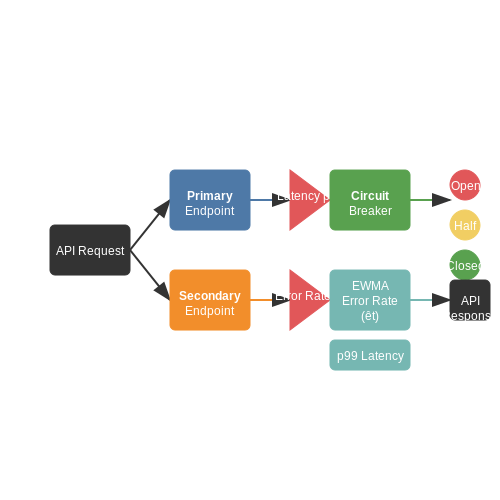
Conventional circuit breakers react to failures after they occur. A predictive model using EWMA (Exponentially Weighted Moving Average) of error rates enables proactive state transitions:
Where β determines the sensitivity (0.1-0.3 works well for most APIs). When êt crosses a dynamically calculated threshold:
The circuit breaker trips preemptively, avoiding cascading failures. Historical data from the last 24 hours maintains μe (mean error rate) and σe (standard deviation).
Parallel Fallback Execution
Rather than sequential fallback attempts, evaluate multiple endpoints concurrently with speculative execution:
- Dispatch primary and secondary requests simultaneously
- Cancel outstanding requests once any response meets SLA requirements
- Implement jittered cancellation delays to reduce wasted work
The optimal parallelism factor k follows Little's Law adapted for fallback scenarios:
Where λ is the request arrival rate and toverhead accounts for coordination latency. Benchmarks show this approach reduces tail latency by 40-60% compared to serial fallbacks.
Resource-Aware Load Shedding
Under extreme load, prioritize requests using a cost-benefit analysis:
Continuously monitor node resource utilization (CPU, memory, I/O) and shed low-priority requests when thresholds are exceeded. The Kalman filter provides efficient real-time estimation:
Where xt represents the hidden resource state, zt are measurements, and wt, vt represent process and measurement noise respectively.
5. Key Research Papers on Self-Healing Systems
5.1 Key Research Papers on Self-Healing Systems
- PDF Implementation of a self-healing framework - AAU — In this thesis, a self-healing framework has been analyzed, designed and implemented. A self-organizing network aims at self-planning, self-configuration, self-optimization, and self-healing capabilities and improves the overall network performance. Self-healing in simple terms is an automated fault management
- Self-healing hardware systems: A review - Academia.edu — Evaluation indexes for self-healing techniques Evaluation index [80] for self-healing determines a way to assess self-healing strategy, analyze, and compare to self-healing strategy. 9 K. Khalil et al. Microelectronics Journal 93 (2019) 104620 The evaluation indexes covered in this paper are redundancy rate, the maximum ratio of repair, and ...
- Self-healing systems — survey and synthesis - Academia.edu — A recent workshop on Self-Healing Systems (WOSS'02, November 18-19, 2002 Charleston, SC, USA) exposed a diverse range of researcher perspectives on self-healing systems. 4 Nelson [44] pointed out that the goal of fault-tolerant systems is to improve dependability by enabling a system to perform its intended function in the presence of a given ...
- Self-healing hardware systems: A review - ScienceDirect — Self-healing systems can be achieved at different levels of hardware stack, depending on the size and type of resources used for monitoring and controlling. The highest level at which self-healing is applied is application level [14], which refers to the ability of an application, or a service, to heal itself.
- Self‐Healing Functional Electronic Devices - ResearchGate — The theoretical research on self-healing electronic devices is in the initial stage, and the self-healing behavior at the material inter - face has not been deeply understood and explained.
- Self-healing systems — survey and synthesis - ResearchGate — These factors have actuated research dealing with the concept of self-healing systems. Self-healing systems attempt to "heal" themselves in the sense of recovering from faults and regaining ...
- Self-Healing Software Systems: Lessons from Nature, Powered by AI — often requiring manual oversight. As self-healing tests improve CI/CD reliability, AI and ML are now transforming the field by enabling more intelligent and unified healing approaches. 3.4. Role of ML and AI in Code Understanding and Generation AI's growing influence in self-healing systems is driven by foundation models like Codex,
- Self‐repairing hardware architecture for safety‐critical cyber‐physical ... — For example, as a result, a unique hierarchal self-healing architecture is designed in that resilience principles are derived from a heterogeneous perspective-combining concepts from biological systems (immune system, stem cells, living cell cycle, and genetic expression) and computer organisation to provide a well-formed self-healing hardware ...
- A distributed formal-based model for self-healing behaviors in ... — The challenges of current software-intensive systems, large-scale information and computing systems environments, which are highly dynamic, heterogeneous, and unpredictable, have motivated the development of techniques that enhance these systems with autonomous behaviors. Even though different concerns about these systems have been deeply studied, their design is still considerably more ...
- Self-Healing in Cyber-Physical Systems Using Machine Learning: A ... — The rapid advancement of networking, computing, sensing, and control systems has introduced a wide range of cyber threats, including those from new devices deployed during the development of scenarios. With recent advancements in automobiles, medical devices, smart industrial systems, and other technologies, system failures resulting from external attacks or internal process malfunctions are ...
5.2 Recommended Books and Articles
- PDF Self-Healing Robust Neural Networks via Closed-Loop Control — Figure 1:(a) Standard circuit design without self-healing. The result can have signi cant yield loss and performance waste; (b) Self-healing circuit with on-chip perfor-mance monitor and control, resulting higher yield and less performance waste. process variation is given. Self-healing, on the other hand, intends to x the possible circuit
- 12 Powerful Self Healing Books Every One Must Read - BigBrainCoach — The author has shared his own depression journey and overcoming it. The book is a step-by-step guide and one of the best emotional self-healing books to read. One of the other recommended self healing books to readers who have lost their vision and searching for a motive to live. 10- The Highly Sensitive Person
- Self-Healing Software Systems: Lessons from Nature, Powered by AI — software-level issues. While runtime self-healing ensures system availability, it often overlooks code-level issues, prompting the development of self-healing code techniques. 3.2. Self-Healing Code Self-healing code takes a deeper approach by automatically identifying and fixing the root causes of software bugs. Tools like GenProg [9]
- Self-healing hardware systems: A review - ScienceDirect — It is important to understand the difference between self-healing and self-repairing. Self-healing is the ability of maintenance and re-integration of recovered cells or components into the system, whereas the self-repairing mechanism is the replacement of damaged or faulty cells or components by functioning cells in the neighborhood [[5], [6], [7], [8]].
- PDF Self-healing soft electronics - Nature — Self-healing composites are composed of self-healing polymer and electronically active nanomaterials. c , Schematic of autonomous self-healing process of mechanically damaged electronic devices.
- (PDF) Self-Healing Networks AI-Based Approaches for ... - ResearchGate — Recovery in Self-Healing Networks," 2021 5th International Conference on Electronic Information Te chnology and Computer Engineering (EITCE), Chengdu, China, 2021, pp. 106-110.
- Self-Healing Control: Review, Framework, and Prospect — The strong coupling between the components of a modern system and the increasing complexity of the system make the demand for intelligent control and maintenance of the system become higher and higher. Self-healing control extends the scope of intelligent control, which is an inevitable trend in the development of intelligence for automated systems. Self-healing technology has a wide range of ...
- Active Accelerated Self-healing as a Key Design Knob for ... - Springer — 5.2.2 Optimal Balance of Wearout and Recovery for BTI. Another key factor for ensuring a full recovery of BTI or EM is to employ a right balance of wearout and accelerated and active recovery so that the circuit can continue operating in an ON state with higher frequency as long as possible but can still be recovered back to the fresh state within a very short active sleep duration.
- 24 Life-Changing Healing Books To Feed Your Soul - BOOK RIOT — One of the best books I found during this journey is Light Magic for Dark Times, a practical guide for witches who want to engage in self-healing, world-healing and political magic. With spells for everything healing-related, including one to recharge after activism, this book is empowering in every sense of the word.
- Self-Healing Electronic Materials for a Smart and Sustainable Future — The survivability of living organisms relies critically on their ability to self-heal from damage in unpredictable situations and environmental variability. Such abilities are most important in external facing organs such as the mammalian skin. However, the properties of bulk elemental materials are typically unable to perform self-repair. Consequently, most conventional smart electronic ...
5.3 Open-Source Tools and Libraries
- PDF Framework for Self-Healing and Dynamic Construction Applications of the ... — 3.1. The Self Healing Layer 3.2. The Self Healing Framework Structure 3.3. Self Healing Framework Cell Diagram 3.4. Sequence of Events after Failure 3.5. Data Flow in the Framework 3.6. Address Server Logic 3.7. Default Handler Sequence of Operations 3.8. Repository Server Structure 3.9. Using Multiple Cells to add Redundancy 3.10.
- Active Accelerated Self-healing as a Key Design Knob for ... - Springer — A more effective (and more economical) solution is a fine-grained unit-level accelerated self-healing, in which "wearout hotspots" or wearout-critical units are predicted by architectural tools, and the accelerated self-healing is only instrumented and applied to these units. With a pre-RTL reliability simulator such as OldSpot, we are able ...
- An overview of self-engineering systems - Taylor & Francis Online — This paper presents the concept of a self-engineering (SE) system which utilises techniques such as self-healing, self-repairing, self-adapting and self-reconfiguration to enable a system to respond autonomously to a loss or potential loss in its function. Two types of SE systems are outlined, systems with control and systems without control.
- Self-healing hardware systems: A review - Academia.edu — Self-healing is increasingly becoming a promising approach to designing reliable digital systems, and it refers to the ability of a system to detect faults or failures and fix them through healing or repairing. ... a short circuit is due to a connection between two lines. Open-line results from splitting a line apart, and delay is due to the ...
- Introduction to Spring Cloud OpenFeign - Baeldung — Learn how to retry REST API calls with Feign library. Read more → Feign Client Exception Handling We'll demonstrate how to handle exceptions in Feign in a Spring Boot project. ... Feign supports Hystrix, so if we have enabled it, we can implement the fallback pattern. With the fallback pattern, when a remote service call fails, rather than ...
- LLM as Runtime Error Handler: A Promising Pathway to Adaptive Self ... — Self-healing systems, as defined by Ghosh et al. (Ghosh et al., 2007), are designed to " recover from the abnormal (or "unhealthy") state and return to the normative ("healthy") state, and function as it was prior to disruption ". It is a long-standing research area aimed at enhancing system reliability and availability, often classified as a subclass of fault-tolerant (Pierce ...
- Part 3: Creating Microservices: Circuit Breaker, Fallback and Load ... — The code sample used in that article is also used now. There is also sample source code available on GitHub. For the sample described now see hystrix branch, for basic sample master branch. Let's look at some scenarios for using fallback and circuit breaker. We have Customer Service which calls API method from Account Service.
- Fallbacks with Spring Cloud Feign - Arnold Galovics — If you disable the fallback temporary, you'll get the following exception: java.util.concurrent.TimeoutException: TimeLimiter 'Swapi#people(int)' recorded a timeout exception. Hence the fallback will trigger every time despite the fact that you see the API response in the logs (since you've enabled Feign logging) but don't get confused.
- Algorithms for Self-Healing Networks - ResearchGate — Self-healing is one of the so called 'Self-*' properties which systems such as autonomic systems may be required to have. Sec tion 1.5.1 has a brief discussion on
- protégé — Protégé-Frames provides the powerful knowledge base for the Essential Project, an open source toolset rated as one of the top Enterprise Architecture Suites in Forrester's latest Wave. Protégé enables us to dynamically extend our meta model (of over 500 classes) and manage complex relationships between all aspects of an organisations ...