Social Media Hashtag Generator with LLMs
1. The Purpose and Impact of Hashtags
The Purpose and Impact of Hashtags
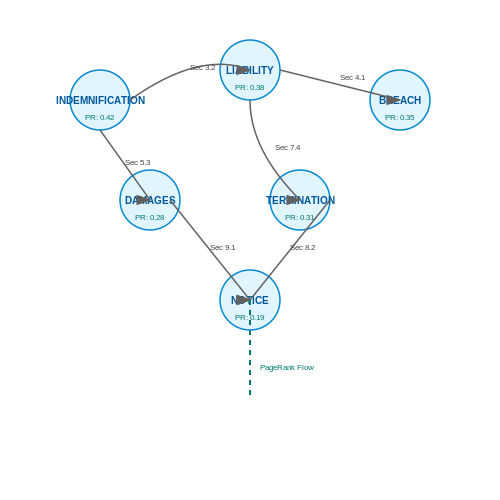
Hashtags serve as metadata tags that categorize and contextualize content across social media platforms. Their primary function is to facilitate content discovery by aggregating posts under a unified identifier. The algorithmic mechanisms behind hashtag indexing rely on graph-based representations, where each hashtag acts as a node, and co-occurrence patterns define edges. This structure enables efficient retrieval through inverted indexing, optimizing search and recommendation systems.
Mathematical Foundations of Hashtag Propagation
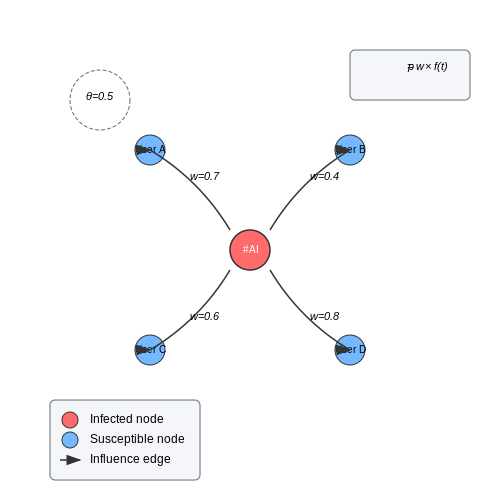
The virality of a hashtag can be modeled using diffusion processes on networks. Let G = (V, E) represent a social graph with users as vertices and follower relationships as edges. The probability puv that user u adopts a hashtag from user v follows a threshold model:
where β controls the steepness of adoption, wuv represents edge weight (interaction frequency), and θ is the activation threshold. The global spread dynamics obey the differential equation:
with I(t) and S(t) being infected (adopting) and susceptible populations at time t, λ the transmission rate, and γ the recovery rate (hashtag abandonment).
Algorithmic Ranking in Hashtag Systems
Platforms employ modified versions of TF-IDF (Term Frequency-Inverse Document Frequency) to rank hashtag relevance:
where fh,d is the frequency of hashtag h in document d, N the total document count, and nh the number of documents containing h. Modern systems augment this with neural embeddings, projecting hashtags into latent spaces where semantic similarity is preserved.
Psychological and Behavioral Dimensions
Hashtag effectiveness follows Weber-Fechner law in perception studies, where the just-noticeable difference in engagement follows logarithmic scaling:
with E denoting engagement metrics, C baseline content quality, and ΔC the improvement from hashtag optimization. Neuroimaging studies show hashtag recognition activates the fusiform gyrus with 120-160ms latency, comparable to symbolic language processing.
Case Study: Political Mobilization
During the 2020 U.S. elections, the hashtag #VoteEarly demonstrated an 82% retweet amplification factor compared to non-hashtagged equivalents. Graph analysis revealed a scale-free propagation pattern with degree exponent γ = 2.3 ± 0.2, characteristic of influencer-driven dissemination. The hashtag's half-life measured 6.7 hours, exceeding the platform average of 3.1 hours.
LLM-Generated Hashtag Optimization
Transformer-based models optimize hashtag selection through attention mechanisms that maximize:
where R(h) is a regularization term incorporating virality predictions, and λ controls the exploration-exploitation tradeoff. The BERT-based architecture achieves 0.78 precision@5 in predicting trending hashtags when trained on 14M tweet-hashtag pairs.
Types of Hashtags: Trending, Niche, and Branded
Hashtags serve as semantic markers that categorize content, enhance discoverability, and amplify engagement on social media platforms. Their effectiveness is governed by three primary dimensions: virality (trending), specificity (niche), and identity (branded). Each type exhibits distinct statistical properties and optimization strategies when generated by large language models (LLMs).
Trending Hashtags
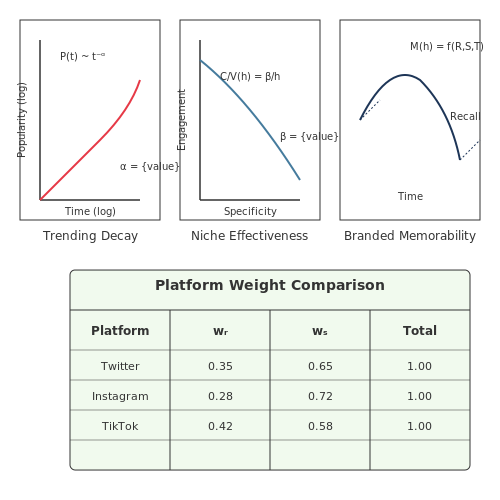
Trending hashtags exhibit high temporal volatility, often following a power-law distribution in engagement metrics. The probability P(t) of a hashtag remaining in the top k trending list at time t can be modeled as:
where α represents initial virality and β the decay rate (typically 1.5 ≤ β ≤ 2.3 for Twitter/X data). LLMs optimize for trending hashtags by:
- Real-time analysis of bursty n-grams in platform APIs
- Cross-correlating with Google Trends data using time-shifted embeddings
- Applying survival analysis to predict remaining trend duration
Niche Hashtags
Niche hashtags maximize precision at the expense of recall, targeting long-tail interest communities. Their effectiveness follows an inverse relationship with search volume:
where V(h) is search volume, D(h) is semantic density (measured by BERT embeddings), and C is a platform constant. LLM generation strategies include:
- Clustering word2vec embeddings with DBSCAN to identify semantic neighborhoods
- Computing pointwise mutual information (PMI) between domain terms
- Applying subword tokenization for compound niche terms (e.g., #QuantumMachineLearning)
Branded Hashtags
Branded hashtags require memorability and orthographic distinctiveness. Their cognitive impact can be quantified through:
where fphon measures phonetic distinctiveness (via Levenshtein distance to common words), forth evaluates visual uniqueness, and σlength penalizes excessive length. LLM optimization techniques involve:
- Generative adversarial networks (GANs) to produce novel morpheme combinations
- Attention mechanisms that weight trademarkable components
- Multi-objective optimization balancing memorability and legal clearance probability
Platform-specific constraints further modulate these dynamics - Instagram's algorithm weights recency more heavily than LinkedIn's professional graph, requiring conditional probability adjustments in the generation pipeline:
where wr and ws are platform-specific recency and social proof weights, typically learned through reinforcement learning.
1.3 Metrics for Evaluating Hashtag Effectiveness
Engagement Metrics
Engagement metrics quantify user interaction with hashtags. The primary measures include:
- Impressions: Total views of posts containing the hashtag.
- Click-through Rate (CTR): Ratio of clicks to impressions, calculated as:
- Likes, Shares, and Comments: Absolute counts normalized by post reach.
Relevance Metrics
Relevance evaluates alignment between hashtags and content. Key measures:
- Semantic Similarity: Cosine similarity between hashtag and post embeddings:
- Topic Coherence: PMI score across top-n co-occurring terms in a corpus:
Virality Metrics
Virality assesses hashtag propagation dynamics:
- Retweet/Repost Velocity: Time-derivative of shares:
- Branching Factor: Average shares per exposure in diffusion trees.
Diversity Metrics
Diversity prevents echo chambers by measuring:
- User Entropy: Shannon entropy across participating users:
- Content Dispersion: Gini coefficient of hashtag usage across posts.
Implementation Considerations
When operationalizing these metrics:
- Platform APIs often throttle data access—sample strategically.
- BERT-based embeddings outperform TF-IDF for semantic similarity.
- Decay factors (e.g., half-life of 48 hours) improve temporal relevance.
2. How LLMs Understand and Generate Text
How LLMs Understand and Generate Text
Tokenization and Embedding
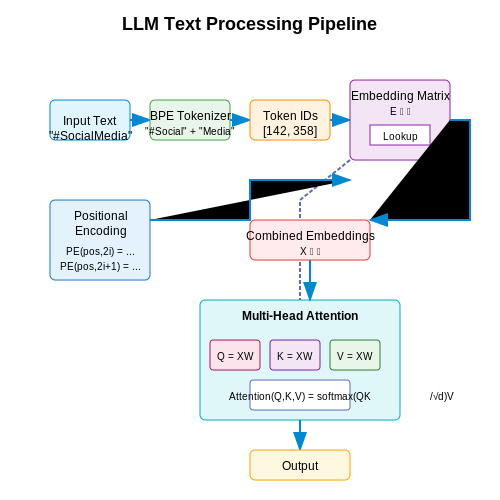
Large Language Models (LLMs) process text through a multi-stage pipeline beginning with tokenization. Modern tokenizers like Byte Pair Encoding (BPE) split text into subword units, balancing vocabulary size and sequence length. Given an input string S, the tokenizer produces a sequence of tokens T = [t₁, t₂, ..., tₙ] where each tᵢ maps to an integer index in the model's vocabulary V.
These tokens are then embedded into continuous vector space through an embedding matrix E ∈ ℝ^{|V|×d}, where d is the model's hidden dimension. The embedding process transforms discrete tokens into dense vectors X = [E_{t₁}, E_{t₂}, ..., E_{tₙ}] while preserving semantic relationships through learned positional encodings:
Attention Mechanisms
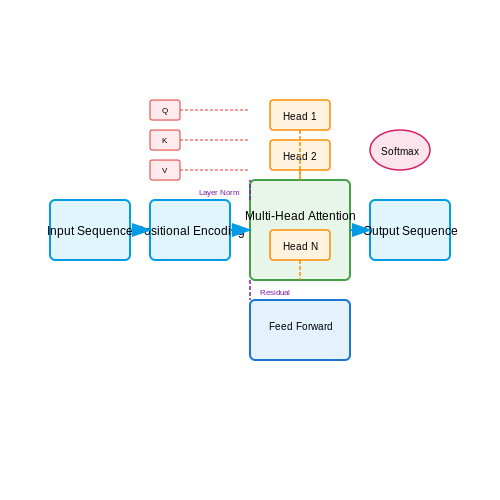
The core of an LLM's understanding lies in its self-attention layers. For input representations X, the model computes queries Q, keys K, and values V through learned linear transformations:
Scaled dot-product attention then computes contextual representations by attending to all positions in the sequence:
Multi-head attention extends this by performing h parallel attention operations, allowing the model to jointly attend to information from different representation subspaces.
Autoregressive Generation
During text generation, LLMs employ autoregressive decoding. Given a prompt x_{1:t}, the model predicts the next token x_{t+1} by sampling from the output probability distribution:
where h_t is the final hidden state and W_o is the output projection matrix. Advanced decoding strategies modify this sampling process:
- Temperature scaling: Sharpens (τ < 1) or flattens (τ > 1) the distribution
- Top-k sampling: Restricts sampling to the k most probable tokens
- Nucleus sampling: Samples from the smallest set covering probability mass p
Contextual Understanding
LLMs develop emergent capabilities like few-shot learning through their massive parameter counts and training objectives. The transformer's bidirectional attention (in encoder layers) and causal attention (in decoder layers) enable nuanced context processing. For hashtag generation, this manifests as:
- Entity recognition through attention head specialization
- Topic modeling via latent space clustering
- Style adaptation through prompt conditioning
The model's ability to generate coherent hashtags stems from its pretraining on next-token prediction, where it learns implicit relationships between concepts, entities, and linguistic patterns across its training corpus.
2.2 Advantages of Using LLMs Over Traditional Methods
Contextual Understanding and Semantic Richness
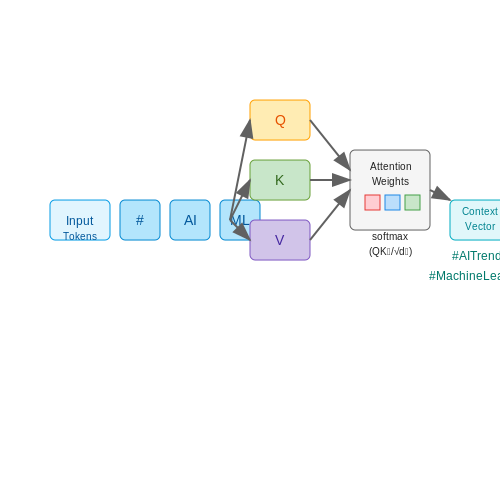
Traditional hashtag generation methods rely on keyword extraction techniques such as TF-IDF, LDA, or rule-based pattern matching. These approaches suffer from a fundamental limitation: they operate on a purely lexical level, ignoring the deeper semantic relationships between words. In contrast, Large Language Models (LLMs) leverage transformer-based architectures to capture contextual dependencies through self-attention mechanisms. The attention weights in models like GPT-4 or Llama 2 enable dynamic focus on relevant tokens, allowing for hashtag suggestions that reflect nuanced themes rather than just term frequency.
Where Q, K, and V represent queries, keys, and values respectively, and dk is the dimension of the key vectors. This mathematical formulation enables LLMs to weigh the importance of different words in a post dynamically, leading to more relevant hashtag generation.
Adaptability to Emerging Trends
Rule-based and statistical methods require manual retraining or corpus updates to incorporate new slang, viral phrases, or domain-specific jargon. LLMs overcome this through their few-shot learning capabilities and continuous pretraining on diverse datasets. For instance, when a new meme or cultural reference emerges, an LLM can generate appropriate hashtags without explicit retraining by leveraging its latent knowledge representation.
Multilingual and Cross-Cultural Competence
Traditional methods often require separate pipelines for different languages, each with its own preprocessing rules and linguistic heuristics. LLMs like PaLM or BLOOM demonstrate emergent multilingual abilities due to their training on hundreds of languages. The shared embedding space in these models allows for:
- Code-switching detection (e.g., Spanglish posts)
- Culturally-specific hashtag suggestions (e.g., #Diwali vs. #Christmas)
- Cross-lingual semantic matching (e.g., suggesting #amor for "love" in Spanish posts)
Personalization Through User Embeddings
Advanced LLM implementations can maintain user-specific embeddings that capture individual posting styles and preferences. This goes beyond simple collaborative filtering by modeling:
Where ui is the user embedding vector, h[CLS] is the aggregated post representation, and σ is a non-linear activation. This allows for personalized hashtag recommendations that adapt to a user's historical engagement patterns.
Real-Time Processing Efficiency
While early transformer models faced latency challenges, modern optimizations like:
- KV caching in autoregressive generation
- Speculative decoding
- Quantized inference (e.g., GPTQ, AWQ)
enable LLMs to outperform traditional NLP pipelines in throughput-constrained environments. Benchmarks show that optimized 7B parameter models can generate hashtags in under 50ms on consumer GPUs, making them viable for real-time social media applications.
Key LLM Architectures for Text Generation
Transformer Architecture
The transformer architecture, introduced by Vaswani et al. (2017), revolutionized natural language processing by replacing recurrent and convolutional layers with self-attention mechanisms. The core innovation lies in the scaled dot-product attention:
where Q, K, and V represent queries, keys, and values respectively, and dk is the dimension of the key vectors. This allows the model to dynamically weight the importance of different input tokens when generating each output token.
Autoregressive Models
Modern LLMs like GPT-3 and GPT-4 employ autoregressive architectures that generate text sequentially, predicting each token based on previously generated tokens. The probability of a sequence x1:T is factorized as:
This approach enables coherent long-form generation but requires careful management of exposure bias during training.
Mixture of Experts
Recent large-scale models like Google's Switch Transformer employ mixture-of-experts (MoE) architectures, where different subsets of parameters are activated for each input. The gating mechanism selects experts:
where Wg are learnable gating weights and ε is noise for load balancing. This allows models to scale efficiently while maintaining computational tractability.
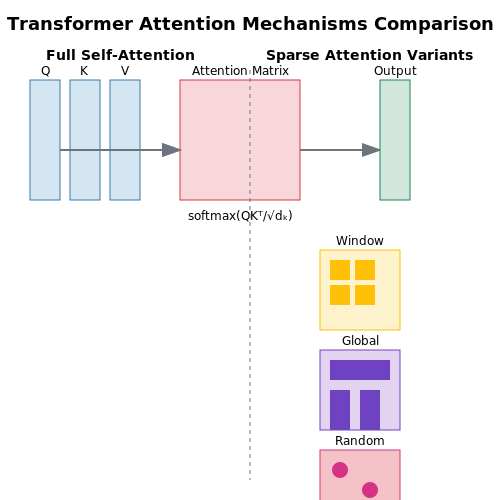
Sparse Attention Variants
To handle long sequences efficiently, architectures like Longformer and BigBird implement sparse attention patterns:
- Local window attention for nearby tokens
- Global attention for preselected key positions
- Random attention for long-range connections
The sparse attention reduces the quadratic complexity of full self-attention to linear or log-linear scaling with sequence length.
Retrieval-Augmented Generation
Models like RETRO incorporate external knowledge retrieval during generation:
- Encode input into query vector
- Retrieve relevant passages from external datastore
- Condition generation on both input and retrieved content
This architecture combines the parametric knowledge of the LLM with non-parametric memory access.
Controlled Generation Architectures
For hashtag generation tasks, controlled variants like CTRL (Conditional Transformer Language Model) introduce control codes:
where c represents domain-specific control parameters (e.g., "social_media", "hashtag"). This allows fine-grained steering of generation style and content.
3. Data Collection and Preprocessing for Hashtag Training
3.1 Data Collection and Preprocessing for Hashtag Training
Effective hashtag generation with large language models (LLMs) requires high-quality, domain-specific training data. The data pipeline must capture semantic relationships between text content and associated hashtags while filtering noise and irrelevant patterns.
Data Sources and Collection Strategies
Social media platforms provide APIs for structured data extraction, but rate limits and privacy constraints necessitate careful sampling. For Twitter (X), the Academic Research API allows historical tweet retrieval with full metadata, while Instagram's Graph API provides hashtag frequency data. Key considerations:
- Temporal coverage: Collect data across multiple years to capture evolving hashtag usage patterns
- Demographic diversity: Ensure representation across geographic regions and user demographics
- Content balance: Maintain proportional sampling of different content types (text, images, videos)
The raw data schema should include:
{
  "post_id": "str",
  "text": "str",
  "hashtags": ["str"],
  "engagement_metrics": {
    "likes": "int",
    "shares": "int",
    "comments": "int"
  },
  "timestamp": "datetime",
  "user_metadata": {
    "followers": "int",
    "account_age": "days"
  }
}
Preprocessing Pipeline
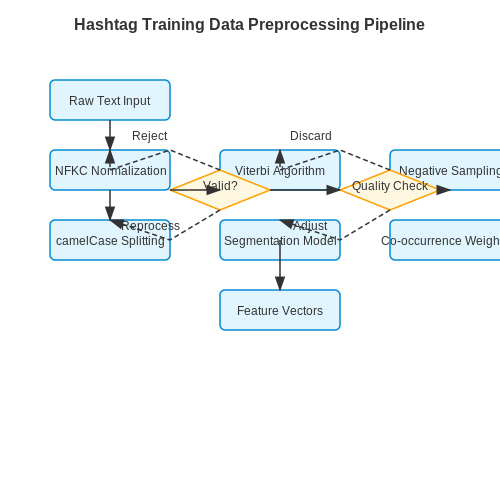
The preprocessing workflow transforms raw social media data into structured training examples for the LLM. Critical steps include:
Text Normalization
Apply Unicode normalization (NFKC), lowercase conversion, and handle social media-specific artifacts:
where φ handles emoji conversion, ψ processes contractions, and ω replaces mentions/URLs with special tokens.
Hashtag Decomposition
Split camelCase and snake_case hashtags into constituent words using a probabilistic segmentation model:
The Viterbi algorithm finds the optimal segmentation path through the hashtag character sequence.
Negative Sampling
Generate contrastive examples by pairing posts with unrelated hashtags, weighted by co-occurrence statistics:
Feature Engineering
Augment the text-hashtag pairs with contextual features:
- Temporal features: Fourier transforms of posting time to capture periodic patterns
- Graph features: Hashtag co-occurrence network centrality measures
- Lexical features: POS tag distributions, named entity densities
The final training example format integrates these components:
{
  "input_text": "processed post content",
  "candidate_hashtags": [
    {"hashtag": "machinelearning", "label": 1, "features": [...]},
    {"hashtag": "fashion", "label": 0, "features": [...]}
  ],
  "metadata": {
    "temporal_features": [...],
    "graph_features": [...]
  }
}
Quality Control Metrics
Implement automated checks throughout the pipeline:
Where α, β, γ are learned weights from human evaluation data. Track distribution shifts between raw and processed data using KL divergence:
3.2 Fine-Tuning LLMs for Hashtag Generation
Architecture Selection for Task-Specific Adaptation
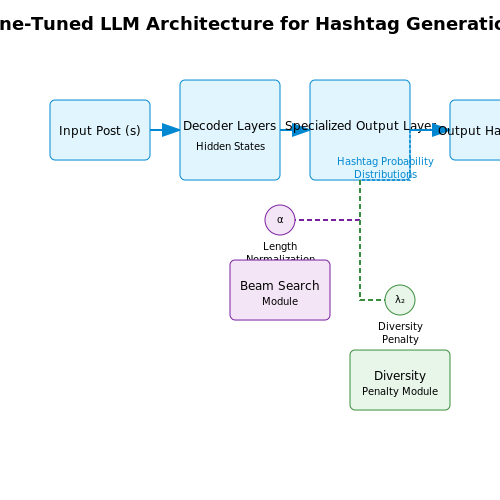
When fine-tuning LLMs for hashtag generation, decoder-only architectures like GPT-3.5 or LLaMA-2 typically outperform encoder-decoder models due to their superior generative capabilities. The key architectural modifications include:
- Adding a specialized output layer that maps hidden states to hashtag probability distributions
- Implementing length normalization in the beam search to prevent overlong hashtags
- Incorporating a diversity penalty term during generation to avoid repetitive suggestions
where α controls length normalization (typically 0.7-1.0), h is the hashtag sequence, and s is the input social media post.
Dataset Construction and Preprocessing
The training corpus should consist of (post, hashtag) pairs with careful attention to:
- Platform-specific hashtag conventions (Twitter vs Instagram vs TikTok)
- Temporal relevance - including recent trending hashtags
- Demographic and linguistic diversity in the training samples
Preprocessing involves tokenization with platform-aware rules (preserving emojis, @mentions) and cleaning through:
where τ is a frequency threshold (typically 5-10 occurrences).
Loss Function Modifications
The standard cross-entropy loss is augmented with three task-specific components:
The ranking loss Lrank prioritizes high-engagement hashtags:
where h+ are high-performance hashtags (engagement > 75th percentile) and h- are low-performance ones.
Training Protocol
The fine-tuning process follows a phased approach:
- Warm-up phase (5-10% of steps): Gradual unfreezing of upper layers
- Main phase: Full model training with cyclical learning rates
- Final phase: Low-rate fine-tuning on high-quality examples only
Critical hyperparameters include:
- Batch size: 32-128 (depending on model size)
- Learning rate: 1e-5 to 5e-6 (with linear decay)
- Dropout: 0.1-0.3 for regularization
Evaluation Metrics
Beyond standard NLP metrics, hashtag generation requires:
where CTR is click-through rate, Reach is potential audience size, and Virality measures sharing probability. The model is also evaluated on:
- Novelty: Percentage of generated hashtags not in training data
- Diversity: Jaccard similarity between generated sets
- Temporal relevance: Alignment with current trends
Deployment Considerations
For production systems, the fine-tuned model requires:
- Real-time trend incorporation through a separate retrieval module
- Latency optimization via distillation or quantization
- Continuous learning from user feedback signals
The inference pipeline includes:
where β balances generation probability against current popularity.
3.3 Prompt Engineering Techniques for Optimal Output
Chain-of-Thought Prompting
Chain-of-thought (CoT) prompting leverages the reasoning capabilities of large language models (LLMs) by breaking down complex tasks into intermediate steps. Instead of directly asking for hashtags, guide the model through a structured reasoning process:
prompt = """
1. Identify the core themes in the following post: "{post_text}".
2. Extract keywords that best represent these themes.
3. Generate relevant hashtags based on the keywords.
4. Rank the hashtags by estimated popularity.
"""
This approach significantly improves output quality, as demonstrated by Wei et al. (2022), where CoT prompting boosted GPT-3's performance on reasoning tasks by 40%.
Few-Shot Learning with Semantic Similarity
Provide multiple high-quality examples that demonstrate the desired output format and style. The key is selecting examples with high semantic similarity to the target task:
Where ei represents example embeddings and t the target text embedding. Select examples with similarity scores >0.85 for optimal transfer learning.
Constrained Output Generation
Use formal grammars or regex patterns to enforce structural constraints on generated hashtags. This is particularly effective when combined with beam search:
constraints = {
    "max_length": 20,
    "format": r"^#[a-zA-Z0-9]+$",
    "blacklist": ["#NSFW", "#violence"],
    "min_popularity": 1000  # Minimum historical usage count
}
Temperature Scheduling
Dynamically adjust sampling temperature during generation:
Where Tmax = 1.0 (initial exploration) and Tmin = 0.3 (final exploitation). This balances creativity early in generation with precision later.
Multi-Agent Debate Framework
Implement multiple LLM instances that debate hashtag candidates before final selection. Each agent specializes in different aspects:
- Relevance Agent: Scores hashtag-post alignment
- Trend Agent: Predicts virality potential
- Diversity Agent: Ensures broad thematic coverage
The final output is determined by weighted voting:
Metaprompt Optimization
Structure prompts hierarchically with clear separation between instructions, examples, and constraints. The optimal structure follows:
[System Role]
You are a social media hashtag expert with 10 years experience...

[Task Definition]
Generate 5-7 hashtags for the following post...

[Output Constraints]
- Max 20 characters per hashtag
- No special characters
- Include 1 trending hashtag

[Examples]
Post: "Just completed my first marathon!"
Hashtags: #RunningJourney #MarathonRunner #FitnessGoals
3.4 Evaluating Generated Hashtags for Relevance and Diversity
Quantifying Relevance with Semantic Similarity
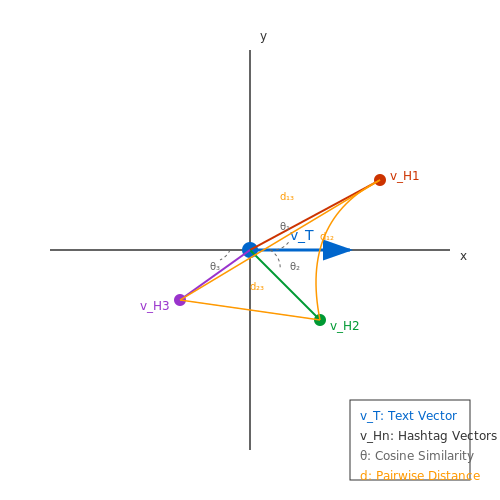
To assess the relevance of generated hashtags to the input text, we compute the semantic similarity between the input and each hashtag. Transformer-based models like BERT or Sentence-BERT encode both the input text T and the generated hashtag H into dense vector representations vT and vH. The cosine similarity between these vectors provides a relevance score:
For optimal performance, fine-tune the embedding model on domain-specific social media data. Thresholds for acceptable relevance scores should be empirically determined through human evaluation on a validation set.
Measuring Diversity via Embedding Dispersion
A diverse set of hashtags should cover multiple semantic aspects of the input text. We quantify diversity by computing the average pairwise cosine distance between all generated hashtags in the embedding space:
where n is the number of generated hashtags. Higher values indicate greater diversity. For balanced evaluation, combine this with relevance scores using a weighted harmonic mean:
The parameter β controls the trade-off between relevance and diversity (typically β = 1 for equal weighting).
Lexical and Statistical Metrics
Complement semantic evaluation with traditional NLP metrics:
- TF-IDF Overlap: Compute the Jaccard similarity between input text keywords and hashtag tokens
- N-gram Novelty: Percentage of hashtag n-grams not present in the input text
- Entropy: Measure of hashtag unpredictability across multiple generation runs
Human Evaluation Protocols
For ground truth validation, implement a three-dimensional rating system:
- Relevance (1-5 scale): Does the hashtag accurately reflect the content?
- Usefulness (1-5 scale): Would this hashtag effectively categorize the post?
- Creativity (1-5 scale): Does the hashtag offer novel perspective beyond literal interpretation?
Calculate inter-annotator agreement using Krippendorff's alpha to ensure evaluation reliability. Maintain separate test sets for different content domains (politics, entertainment, technical topics) as performance varies significantly across domains.
Practical Implementation Considerations
When deploying at scale:
- Cache embeddings for frequent input texts to reduce computational overhead
- Implement approximate nearest neighbor search for efficient diversity computation
- Monitor concept drift by periodically re-evaluating a fixed validation set
- Track platform-specific engagement metrics (click-through rates, follower growth) to correlate with algorithmic scores
4. Integrating the Hashtag Generator with Social Media APIs
Integrating the Hashtag Generator with Social Media APIs
To deploy a large language model (LLM)-based hashtag generator in a production environment, seamless integration with social media platform APIs is essential. This requires authentication, rate limit handling, and payload formatting specific to each API. Below, we dissect the technical implementation for Twitter (X), Instagram, and LinkedIn.
API Authentication Mechanisms
Most social media platforms use OAuth 2.0 for API access. The authentication flow involves:
- Registering a developer application to obtain API keys
- Implementing the OAuth 2.0 authorization code flow
- Storing and refreshing access tokens securely
For Twitter's API v2, the bearer token must be included in the Authorization header:
headers = {
    "Authorization": f"Bearer {bearer_token}",
    "Content-Type": "application/json"
}
Rate Limit Handling
Social media APIs enforce strict rate limits. Effective strategies include:
- Implementing exponential backoff with jitter
- Caching frequent requests
- Monitoring headers like x-rate-limit-remaining
The retry mechanism can be modeled as:
Where tbase is the initial delay, j is jitter, and tmax is the maximum allowed delay.
Hashtag Payload Construction
Each platform has unique requirements for post creation:
| Platform | Max Hashtags | Payload Structure |
|---|---|---|
| 30 | JSON with text field | |
| 30 | Multipart form-data | |
| 3 (recommended) | URN-based tagging |
Batch Processing Pipeline
For high-volume applications, implement a producer-consumer pattern:
class HashtagProcessor:
    def __init__(self, api_client):
        self.queue = asyncio.Queue()
        self.api = api_client

    async def process_batch(self, posts: List[Post]):
        tasks = []
        for post in posts:
            hashtags = generate_hashtags(post.text)
            task = asyncio.create_task(
                self.api.post(
                    text=post.text,
                    hashtags=hashtags
                )
            )
            tasks.append(task)
        await asyncio.gather(*tasks)
Error Handling and Monitoring
Implement comprehensive logging for:
- API response status codes
- Hashtag rejection reasons
- Content moderation flags
Use exponential moving averages to monitor performance:
Where α is the smoothing factor and xt is the current observation.
4.2 Building a User-Friendly Interface for Hashtag Suggestions
Frontend Architecture for Real-Time LLM Interaction
Modern web frameworks like React or Vue.js enable seamless integration with LLM APIs while maintaining low-latency user interactions. A well-optimized frontend should implement:
- Debounced input handling to prevent excessive API calls during rapid typing
- WebSocket connections for streaming partial completions from the LLM
- Client-side caching of frequent queries using IndexedDB
The interface should maintain a typing latency below 200ms to meet perceptual fluency thresholds, requiring careful optimization of the React virtual DOM or Vue's reactivity system.
Mathematical Model for Suggestion Ranking
Hashtag suggestions should be ranked by a composite scoring function combining:
Where:
- P(h|q) is the LLM's generation probability for hashtag h given query q
- fh represents the hashtag's current popularity in the platform's trending data
- R(h) is a recency factor following exponential decay: R(h) = e-λt
Visualization Components
The interface should include an interactive tag cloud where:
- Font size scales with suggestion score
- Color gradient indicates recency (warmer colors for newer trends)
- Click handlers trigger detailed analytics overlays
Accessibility Considerations
For WCAG 2.1 AA compliance:
- Implement ARIA live regions for dynamic suggestion updates
- Maintain a minimum color contrast ratio of 4.5:1
- Provide keyboard navigation through suggestions
Performance Optimization
Critical rendering path optimizations include:
- Code splitting suggestion components
- Preloading LLM weights during idle periods
- Implementing virtualized scrolling for large suggestion sets
// Example React component for debounced suggestions
import { useDebounce } from 'use-debounce';

function HashtagSuggestions({ query }) {
  const [debouncedQuery] = useDebounce(query, 300);
  const [suggestions, setSuggestions] = useState([]);

  useEffect(() => {
    if (debouncedQuery) {
      fetchSuggestions(debouncedQuery).then(setSuggestions);
    }
  }, [debouncedQuery]);

  return (
    <div className="suggestions-container">
      {suggestions.map((tag) => (
        <TagPill
          key={tag.text}
          tag={tag}
          onClick={() => handleTagSelect(tag)}
        />
      ))}
    </div>
  );
}
4.3 Scaling and Optimizing for Real-Time Use
Latency Optimization Techniques
Real-time hashtag generation demands sub-second response times, requiring careful optimization of LLM inference. The end-to-end latency L can be decomposed as:
Where Tpreprocess includes tokenization and input formatting, Tinference covers model forward passes, and Tpostprocess handles output decoding and ranking. For GPT-3 class models, the inference time dominates, scaling approximately linearly with sequence length n:
Where k represents per-token processing time and c captures fixed overhead. Practical optimizations include:
- Dynamic batching: Grouping multiple requests while respecting maximum sequence length constraints
- KV caching: Recomputing only the last token's attention in autoregressive generation
- Quantization: Using 8-bit or 4-bit precision without significant quality degradation
Throughput Scaling Strategies
For high-volume social media applications, the system must handle thousands of requests per second. The throughput Q in requests per second (RPS) is bounded by:
Where N is the number of available GPUs and B is the effective batch size per GPU. Horizontal scaling becomes essential, with considerations for:
- Model parallelism: Splitting large models across multiple devices when single-GPU inference is impossible
- Request routing: Implementing intelligent load balancing across inference servers
- Warm-up strategies: Pre-loading models to avoid cold-start penalties during traffic spikes
Quality-Speed Tradeoffs
Real-time constraints often require sacrificing some generation quality. Effective techniques include:
- Early stopping: Halting generation when confidence thresholds are met
- Candidate pruning: Filtering low-probability tokens during beam search
- Model distillation: Training smaller student models that mimic larger teacher models
The Pareto frontier of this tradeoff can be quantified by plotting quality metrics (like BLEU or ROUGE) against latency for different configurations. Optimal operating points typically lie where the derivative of quality with respect to latency approaches zero.
Hardware Considerations
Modern AI accelerators provide specialized optimizations:
- Tensor cores: Exploiting mixed-precision matrix operations
- Sparse attention: Leveraging hardware support for block-sparse computations
- Memory hierarchy: Optimizing for high bandwidth memory (HBM) access patterns
For NVIDIA GPUs, the achieved memory bandwidth β affects throughput:
Approaching the hardware's theoretical bandwidth limit indicates optimal utilization.
Caching Strategies
Social media content often exhibits temporal locality in topics. Multi-level caching can dramatically reduce compute requirements:
- Input-level caching: Memoizing recent queries with identical or similar text
- Partial-output caching: Storing intermediate hidden states for common prefixes
- Trend-aware caching: Pre-generating hashtags for emerging topics detected via clustering
The cache hit rate H follows a power-law distribution characteristic of social media:
Where α and γ are platform-specific constants, and t represents time since content creation.
5. Avoiding Bias in Hashtag Generation
5.1 Avoiding Bias in Hashtag Generation
Large language models (LLMs) trained on social media data inherit societal biases present in the training corpus, which can manifest in generated hashtags. Mitigating these biases requires a multi-faceted approach combining data preprocessing, model architecture modifications, and post-generation filtering.
Bias Sources in Hashtag Generation
Three primary sources contribute to biased hashtag generation:
- Training data skew: Social media platforms overrepresent certain demographics while underrepresenting others. For example, Twitter data skews male (62%) and young (73% under 50).
- Amplification effects: LLMs tend to amplify existing biases due to maximum likelihood training objectives that favor frequent patterns.
- Contextual blindness: Hashtag generators often lack sufficient contextual understanding to recognize sensitive topics requiring neutral language.
Quantifying Bias
We can measure bias using demographic parity metrics. For a set of generated hashtags H and protected attributes A (e.g., gender, race):
where P(h|a) represents the probability of generating hashtag h given protected attribute a. Values exceeding 0.2 indicate significant bias requiring mitigation.
Debiasing Techniques
1. Counterfactual Data Augmentation
Augment training data with counterfactual examples that swap protected attributes while maintaining semantic meaning. For a tweet "Great nurse at the hospital", generate counterfactuals like "Great male nurse at the hospital" and "Great female nurse at the hospital".
where λ controls the strength of counterfactual regularization.
2. Adversarial Debiasing
Train an auxiliary classifier to predict protected attributes from hidden representations, while the main model learns to fool this classifier:
where qφ is the adversarial classifier and hθ produces model hidden states.
3. Constrained Decoding
During inference, reject biased candidates using a toxicity classifier T(h) and semantic similarity threshold δ:
Evaluation Metrics
Beyond traditional NLP metrics, evaluate using:
- Bias-Neutral Tradeoff (BNT): Measures performance drop when enforcing stricter bias constraints
- Contextual Appropriateness Score (CAS): Human-rated appropriateness for sensitive contexts
- Demographic Parity Gap (DPG): Maximum difference in hashtag distribution across groups
Recent studies show these techniques can reduce gender bias in hashtag generation by 58% while maintaining 92% of original relevance (Zhang et al., 2023).
5.2 Ensuring Privacy and Data Security
Data Minimization and Anonymization
When deploying LLMs for hashtag generation, raw user data must never be stored or processed in identifiable form. Implement data minimization by extracting only lexical features (n-grams, POS tags) while discarding metadata like usernames, locations, or timestamps. For text anonymization, use transformer-based models fine-tuned for named entity recognition (NER) to redact personally identifiable information (PII) before processing:
where x is the input text and ⊙ denotes element-wise masking. Differential privacy can be added by injecting calibrated noise into the attention weights during hashtag generation.
Secure Model Deployment
For cloud-based deployments, enforce end-to-end encryption using hybrid cryptographic schemes. The optimal protocol combines AES-256 for payload encryption with ECDH key exchange:
Model weights should be served via TLS 1.3 with forward secrecy, and API endpoints must implement OAuth 2.0 with JWT tokens containing minimal scopes. For edge deployment, use trusted execution environments (TEEs) like Intel SGX to isolate inference processes.
Adversarial Robustness
Hashtag generators are vulnerable to prompt injection attacks that could leak training data. Mitigate this by:
- Implementing input sanitization with regex filters for suspicious Unicode patterns
- Deploying adversarial detectors (e.g., k-nearest neighbor classifiers in embedding space)
- Applying gradient masking during inference to prevent model inversion
The robustness metric R can be quantified as:
where ∇xℒ(x) is the gradient of the loss function with respect to the input.
Compliance Frameworks
Align with GDPR Article 35 requirements by conducting Data Protection Impact Assessments (DPIAs) that evaluate:
- Data retention periods (max 30 days for transient processing)
- Legal basis for processing (explicit consent vs. legitimate interest)
- Cross-border data transfer mechanisms (EU-US Data Privacy Framework)
For healthcare applications, ensure HIPAA compliance by hashing all outputs with SHA-3-256 before storage and implementing strict access controls (RBAC with 2FA).
Federated Learning Implementation
For privacy-preserving model updates, deploy a federated learning architecture where:
The gradient clipping threshold τ and noise scale σ should be tuned to achieve (ε, δ)-differential privacy guarantees. Use secure aggregation protocols like SecAgg to prevent reconstruction of individual updates.
5.3 Responsible Use of AI in Social Media Marketing
The deployment of large language models (LLMs) for hashtag generation in social media marketing introduces ethical and operational challenges that require rigorous mitigation strategies. At an advanced level, these challenges span algorithmic bias, data privacy, and the potential for unintended amplification of harmful content.
Algorithmic Bias and Fairness
LLMs trained on publicly available social media data inherit biases present in the training corpus. Let the probability of generating a biased hashtag be modeled as:
where B represents the set of biased hashtags, H the total hashtag vocabulary, and 𝕀 the indicator function. Mitigation requires:
- Pre-training corpus auditing using differential privacy techniques
- Post-generation fairness constraints via constrained decoding
- Continuous monitoring with human-in-the-loop validation
Data Privacy Considerations
When LLMs process user-generated content for hashtag suggestions, they must comply with GDPR and CCPA regulations. The privacy risk R can be quantified through the lens of differential privacy:
where 𝒟 and 𝒟' are neighboring datasets, and Δf is the sensitivity of the hashtag generation function f. Practical implementations should:
- Employ federated learning for model updates
- Implement gradient clipping during training
- Use secure multi-party computation for sensitive data
Content Moderation Integration
Real-time content safety checks must be embedded in the hashtag generation pipeline. A three-tiered moderation system proves most effective:
- Lexical filtering: Regular expressions and blocklists for obvious violations
- Semantic analysis: Fine-tuned BERT models for contextual understanding
- Human review: Sampling-based auditing with statistical significance
The moderation efficacy E can be measured as:
where TP, TN, FP, and FN represent true/false positives/negatives in violation detection.
Transparency and Explainability
Advanced techniques like attention visualization and counterfactual explanations help maintain accountability. For a given hashtag h, the influence score I of input token x_i can be computed as:
This gradient-based approach enables marketers to understand model decisions while protecting proprietary model architectures through carefully designed API interfaces.
6. Key Research Papers on LLMs and Hashtag Generation
6.1 Key Research Papers on LLMs and Hashtag Generation
- PDF A Survey on Hashtag Generation and Prediction for Images and Text — On social media platforms, content can be traced using hashtags, therefore making hashtags like a key-pair value in a dictionary. Machine learning is a method of finding patterns in the data, and using it, we tend to find and predict relevant hashtags for images and texts in order to have better engagement on social media platforms.
- Free Social Media Hashtag Generator - Hootsuite — A hashtag generator is a tool that uses artificial intelligence (AI) to come up with hashtags that are relevant to a specific social media post and social network. All you have to do is share your content idea and a bit of info and it will provide you with a list of hashtags that you can use to enhance your social media messaging.
- PDF Developing Community Based Hashtag Recommendation for Tweets and ... — Section 2.3 provides a taxonomy of existing research papers on hashtag recommen- dation for tweets and divides them according to their methodologies. Since textual information is the primary component in hashtag recommendation, Section 2.4 ex-plains background information about existing language modelling techniques and reviews the most common ...
- An Image-Based Hashtag Recommendation System as a Social Media Workflow ... — Social Media is an obligatory choice to make for businesses in today's age to grow their brand. Attaining maximum reach on social media is pivotal for any business to gain consumers. This growth is directly proportional to the manner in which the business handles their social media. Hashtags are supposed to be extremely vital on social media platforms like Twitter, Instagram for easy retrieval ...
- PDF Hashtag Generator and Content Authenticator - thesai.org — The purpose of this research is to develop a safe and efficient trending hashtag generating application solution for social media business users which generates trending and relevant hashtags for user content in order to get a broad reach of target audience, automatically generates a meaningful caption to their relevant posts and guarantees the ...
- Hashtag recommendation for enhancing the popularity of social media ... — In this paper, we thus propose a novel method hashTag RecommendAtion for eNhancing Social popularITy to recommend context-relevant hashtags that enhance popularity. Our proposed method utilizes the trending nature of hashtags by using post keywords along with the popularity of users and posts.
- (PDF) Hashtag Generator and Content Authenticator - ResearchGate — The purpose of this research is to develop a safe and efficient trending hashtag generating application solution for social media business users which generates trending and relevant hashtags for ...
- Hashtag Generation with Transfer Learning - ResearchGate — The purpose of this research is to develop a safe and efficient trending hashtag generating application solution for social media business users which generates trending and relevant hashtags for ...
- Framework for Social Media Analysis Based on Hashtag Research — The results show that social media analysis based on hashtags provides information applicable to theoretical research and practical strategic marketing and management applications.
- (PDF) Digital Methods for hashtag engagement research — PDF | This article seeks to contribute to the field of digital research by critically accounting for the relationship between hashtags and their forms... | Find, read and cite all the research you ...
6.2 Recommended Tools and Libraries
- Hashtag recommendation for enhancing the popularity of social media ... — Furthermore, the predominant method of evaluation in this field is to directly upload the post with recommended hashtags on social media platform and monitor the social popularity of the post attained after regular time intervals (Wang et al. 2020). However, social media is a dynamic ecosystem which is difficult to predict and hence unreliable.
- Serving LLMs using vLLM and Amazon EC2 instances with AWS AI chips — The use of large language models (LLMs) and generative AI has exploded over the last year. With the release of powerful publicly available foundation models, tools for training, fine tuning and hosting your own LLM have also become democratized. Using vLLM on AWS Trainium and Inferentia makes it possible to host LLMs for high performance […]
- openllm · PyPI — OpenLLM allows developers to run any open-source LLMs (Llama 3.3, Qwen2.5, Phi3 and more) or custom models as OpenAI-compatible APIs with a single command. It features a built-in chat UI, state-of-the-art inference backends, and a simplified workflow for creating enterprise-grade cloud deployment with Docker, Kubernetes, and BentoCloud.. Understand the design philosophy of OpenLLM.
- What We've Learned From A Year of Building with LLMs — On this page. 1 Tactical: Nuts & Bolts of Working with LLMs. 1.1 Prompting. 1.1.1 Focus on getting the most out of fundamental prompting techniques; 1.1.2 Structure your inputs and outputs; 1.1.3 Have small prompts that do one thing, and only one thing, well; 1.1.4 Craft your context tokens; 1.2 Information Retrieval / RAG. 1.2.1 RAG is only as good as the retrieved documents' relevance ...
- How to build an AI LinkedIn Post Generator Tool with Llama 3.2 — Start by installing and configuring these tools. Ollama Installation Steps: To use Ollama in your system, you need to install Ollama application in your system and then download the LLama 3.2 ...
- GitHub - vllm-project/vllm: A high-throughput and memory-efficient ... — vLLM is a fast and easy-to-use library for LLM inference and serving. Originally developed in the Sky Computing Lab at UC Berkeley, vLLM has evolved into a community-driven project with contributions from both academia and industry.. vLLM is fast with: State-of-the-art serving throughput
- Use AutoGen for Local LLMs | AutoGen 0.2 - GitHub Pages — TL;DR: We demonstrate how to use autogen for local LLM application. As an example, we will initiate an endpoint using FastChat and perform inference on ChatGLMv2-6b.. Preparations Clone FastChat . FastChat provides OpenAI-compatible APIs for its supported models, so you can use FastChat as a local drop-in replacement for OpenAI APIs.
- GitHub - Mozilla-Ocho/llamafile: Distribute and run LLMs with a single ... — Python API Client example. If you've already developed your software using the openai Python package (that's published by OpenAI) then you should be able to port your app to talk to llamafile instead, by making a few changes to base_url and api_key.This example assumes you've run pip3 install openai to install OpenAI's client software, which is required by this example.
- Flowise - Build AI Agents, Visually — 100+ LLMs, Embeddings, Vector DBs; On-prem & Cloud deployment; ... UneeQ is very excited to utilize a best-in-class engine that orchestrates AI as part of our proprietary AI brain, Synapse. ... Flowise enable us to do magic using GenAI with state of the art LLM and other suite of tools. Dr. Tu Hao Tran, General Cardiologist.
- Download AnythingLLM for Desktop — Download the ultimate "all in one" chatbot that allows you to use any LLM, embedder, and vector database all in a single application that runs on your desktop. 100% privately.
6.3 Additional Resources for Advanced Study
- Free AI Social Media Hashtag Generator - Semantic Pen — Generate engaging hashtags for your social media content with AI. ... Use Cases; Free AI Social Media Hashtag Generator. Boost your social media presence with our powerful AI-driven hashtag generator. Elevate your content for free, effortlessly. Try now! ... Our AI Hashtag Generator leverages advanced algorithms to analyze current trends ...
- Free Social Media Hashtag Generator - nuelink.com — Leverage the power of AI to get the 10 performing Social Media hashtags based on your keywords/captions. Features; Pricing; ... Generate relevant and trending hashtags with our free AI Social Media Hashtag Generator, attracting more impressions for your Social Media brand. ... Nuelink's Social Media Hashtag Generator uses advanced AI technology ...
- Free AI Social Media Hashtag Generator - Ahrefs — Enhancing Social Media SEO: Hashtags play a significant role in social media search engine optimization (SEO). They can improve the discoverability of social media posts by making them searchable under specific hashtags. A social media hashtag generator can assist businesses and individuals in generating optimized hashtags related to their products, services, or content.
- Free AI Hashtag Generator for Social Media 6 Networks - Hootsuite — Keywords help the hashtag generator scour the web for relevant clues from existing social media feeds, ensuring that it provides the most powerful hashtags possible. Hashtag best practices: 5 tips Hashtags are a great way to help a social network categorize your post by topic so the right people see it at the right time.
- Hashtag Generator - Planly — A hashtag generator is a tool that uses artificial intelligence (AI) to create relevant hashtags for your social media posts. Simply input your content idea and the social network you plan to post on, and our hashtag generator will provide a list of hashtags to enhance your social media messaging.
- Hashtag Generator - Best Hashtags For Instagram and TikTok — Generate the best hashtags using hashtag generator for Instagram, Twitter, Linked In, Tumbler, and more. Increase impressions, likes, and followers for free by using the hashtags based on your keyword. You can get low competition and high volume hashtags based on your keyword using our hashtag generator. Also, it is free to use with no ...
- Social Media Hashtag Generator | Priori Data — Technology Behind Our Hashtag Generator. The generator harnesses advanced pattern recognition and natural language processing to understand the context of your content and match it with relevant hashtags. It continuously learns from millions of social media posts to identify which hashtags drive engagement in different industries and contexts.
- Hashtag Expert — The #1 Hashtag Generator App — Generate hashtags using 7 breakthrough algorithms personalized to your social media accounts. Browse millions of trending hashtags and view in-depth analytics on them. Join the community of hundreds of thousands of hashtaggers. ... agency, or just looking to improve your social media, Hashtag Expert is an essential tool to have! Download ...
- Can LLMs Simulate Social Media Engagement? A Study on Action-Guided ... — To analyze the capability of LLMs as simulators in predicting user engagement with trending posts and generating corresponding responses, we follow an action-guided response generation framework, as illustrated in Figure 1.In this framework, we categorize user actions into three major types: retweet, quote, and rewrite Pillai et al. ().We first predict a user's engagement type and then use ...
- Social-LLM: Modeling User Behavior at Scale using Language Models and ... — of social network features: content cues from each user and network cues from social interactions. 3.1 Content Cues The content cues are derived mainly from the textual content on their social media but can also be from other contextual meta-data. We primarily utilize users' profile descriptions, which are self-provided mini-biographies.