Synthesizing Agents That Follow User Personality Traits
1. Defining Personality Traits in Computational Models
Defining Personality Traits in Computational Models
Personality traits in computational models are typically derived from psychological frameworks such as the Five-Factor Model (FFM), which categorizes human personality into five broad dimensions: Openness, Conscientiousness, Extraversion, Agreeableness, and Neuroticism (OCEAN). These traits are operationalized as continuous variables within a multidimensional space, enabling quantitative modeling of agent behavior.
Mathematical Representation of Personality Traits
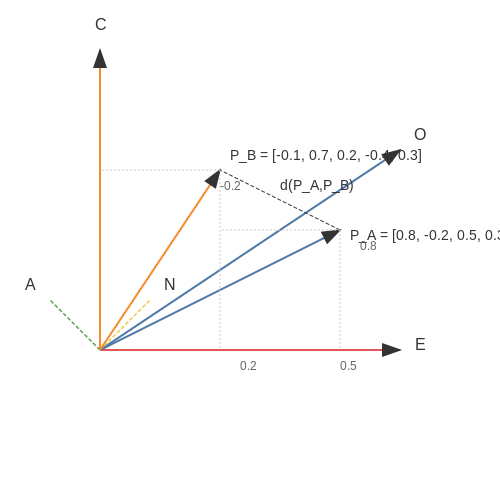
In computational models, personality traits are often represented as vectors in a high-dimensional space. Each dimension corresponds to a trait from the FFM, scaled between -1 and 1. For an agent A, its personality vector P can be defined as:
where each component \( O, C, E, A, N \) is a normalized score for the respective trait. The Euclidean distance between two personality vectors \( \mathbf{P}_A \) and \( \mathbf{P}_B \) quantifies their similarity:
Behavioral Mapping via Utility Functions
Agent behavior is generated by mapping personality traits to decision-making policies. A common approach is to use utility functions weighted by trait scores. For example, an agent's utility \( U \) for an action \( a \) in context \( s \) can be modeled as:
Here, \( w_i \) are trait-specific weights, and \( f_i(a, s) \) are context-dependent feature functions. For instance, an extraversion-weighted feature might increase utility for social interactions.
Case Study: Trait-Dependent Dialogue Generation
In dialogue systems, personality traits modulate response selection. A conscientiousness score \( C \) could bias an agent toward precise, fact-based replies, while agreeableness \( A \) might increase the likelihood of empathetic phrasing. This is implemented by adjusting the logits of a language model's output distribution:
where \( \mathbf{T}_y \) is a trait embedding for response \( y \), and \( \lambda \) controls the personality strength.
Validation via Trait Inference
Model fidelity is tested by training auxiliary classifiers to predict human-assigned trait labels from agent behavior. The classifier accuracy serves as a proxy for how well the computational traits capture psychological constructs. State-of-the-art models achieve >80% agreement with human raters on the OCEAN dimensions.
1.2 Psychological Theories Informing Agent Design
Big Five Personality Traits Framework
The Five-Factor Model (FFM) provides a robust empirical foundation for modeling personality in synthetic agents. The dimensions—Openness, Conscientiousness, Extraversion, Agreeableness, and Neuroticism (OCEAN)—each influence distinct behavioral patterns. For an artificial agent, these traits can be operationalized as:
where Ti represents the agent's score for trait i, wji are learned weights, and Sj are behavioral signatures derived from user interaction data. Reinforcement learning can optimize these weights to match target personality profiles.
Self-Determination Theory (SDT)
SDT's autonomy-competence-relatedness triad informs agent architectures that adapt to user motivational states. An agent satisfying these needs demonstrates:
- Autonomy-supportive behaviors (e.g., offering choice menus)
- Competence feedback loops (dynamic difficulty adjustment)
- Relatedness cues (empathetic language generation)
The SDT-based reward function for agent training incorporates:
where α, β, γ balance the three needs, and sub-rewards are computed from user engagement metrics.
Social Cognitive Theory
Bandura's observational learning principles enable agents to mirror user behavior through:
- Attention mechanisms in transformer architectures
- Retention via memory-augmented neural networks
- Motor reproduction through hierarchical RL policies
The agent's imitation learning objective combines:
where LBC is behavioral cloning loss and LIRL is inverse reinforcement learning loss.
Trait Activation Theory
This theory explains how situational cues activate specific personality manifestations. Implemented through:
- Contextual bandits for trait-relevant action selection
- Graph attention networks to model situation-trait interactions
The activation function for trait k in context c is:
where vk are learned context embeddings and fc are situational features.
Behavioral Consistency Paradox
While humans show cross-situational inconsistency, agents must balance behavioral variability with perceived coherence. This is achieved through:
- Stochastic policy networks with personality-conditioned variance
- Contrastive learning to maintain core trait signatures
The consistency regularizer in the loss function:
penalizes excessive divergence across similar states s, s' for personality p.
1.3 Data Sources for Personality Trait Extraction
Textual Data Sources
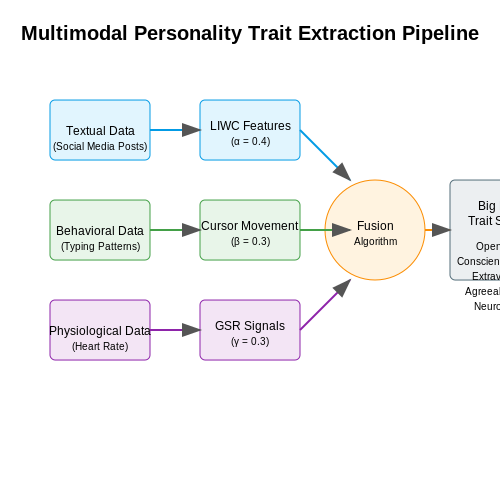
Natural language provides one of the richest sources for personality trait extraction. Social media platforms like Twitter, Reddit, and Facebook offer vast amounts of user-generated text that can be analyzed using linguistic cues. Research has shown that word choice, sentence structure, and topic preference correlate strongly with personality traits as defined by the Big Five model (Openness, Conscientiousness, Extraversion, Agreeableness, Neuroticism).
Formal writing samples, such as essays or professional communications, also contain valuable personality markers. The Linguistic Inquiry and Word Count (LIWC) framework has demonstrated particular effectiveness in extracting psychological patterns from text, with specific word categories mapping to different traits:
Behavioral Data Sources
Digital footprints from user interactions provide another critical data source. Mouse movements, typing speed, and browsing patterns have been shown to correlate with personality dimensions. For instance, neurotic individuals tend to exhibit more erratic cursor movements, while conscientious users demonstrate more deliberate navigation patterns.
Mobile device usage metrics offer particularly rich behavioral signals:
- Call/SMS frequency patterns correlate with extraversion
- App usage diversity relates to openness
- Notification response latency indicates conscientiousness
Multimodal Data Fusion
Advanced personality modeling increasingly combines multiple data modalities. Audio-visual data from video calls or voice assistants can capture paralinguistic features like:
Wearable sensor data adds physiological dimensions, with galvanic skin response and heart rate variability showing correlations with emotional stability. The fusion of these heterogeneous data streams requires careful attention to temporal alignment and feature weighting.
Ethical Considerations in Data Collection
While these data sources enable powerful personality modeling, they raise significant privacy concerns. Differential privacy techniques and federated learning approaches are increasingly employed to extract personality signals while preserving user anonymity. The ethical framework should ensure:
- Explicit user consent for data collection
- Transparent disclosure of analysis purposes
- Options for data deletion and model opt-out
Recent advances in synthetic data generation allow for personality modeling without direct access to raw user data, using techniques like generative adversarial networks to create representative but anonymized training sets.
2. Natural Language Processing for Personality Detection
Natural Language Processing for Personality Detection
Lexical and Syntactic Features for Personality Inference
Personality detection from text relies on extracting linguistically meaningful features that correlate with psychological traits. The Big Five personality model (OCEAN: Openness, Conscientiousness, Extraversion, Agreeableness, Neuroticism) serves as the dominant theoretical framework. Lexical features include word frequency distributions, with function words (e.g., pronouns, articles) being particularly predictive. For example, high Extraversion correlates with increased use of social words (e.g., "friend", "party"), while Neuroticism associates with negative emotion words (e.g., "anxiety", "sad").
where f(w|trait) represents the frequency of word w in texts authored by individuals with a specific personality trait, and P(trait) is the prior probability of that trait in the population.
Deep Learning Architectures for Personality Recognition
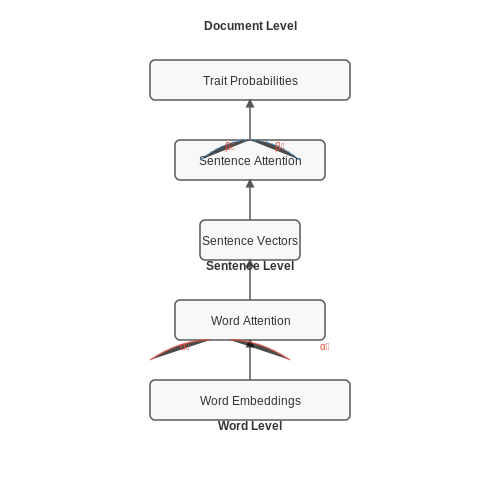
Modern approaches employ transformer-based models fine-tuned on personality-annotated corpora. The hierarchical attention network architecture processes text at multiple granularities:
- Word-level attention identifies salient lexical markers
- Sentence-level attention captures discourse patterns
- Document-level aggregation produces trait probabilities
The training objective typically combines:
where ℒCE is cross-entropy loss for trait classification and ℒMMD minimizes maximum mean discrepancy between predicted and actual trait distributions.
Cross-Cultural and Contextual Challenges
Personality expression varies significantly across linguistic and cultural contexts. The LIWC (Linguistic Inquiry and Word Count) dictionary requires culture-specific adaptations, as demonstrated by performance drops when applying English-trained models to Mandarin texts (ΔF1 = 0.18 for Neuroticism prediction). Contextual factors like communication medium (e.g., Twitter vs. professional emails) introduce additional variance, necessitating domain adaptation techniques such as:
- Adversarial domain adaptation with gradient reversal layers
- Multi-task learning across text genres
- Contrastive learning for style-invariant representations
Evaluation Metrics and Benchmark Performance
Standard evaluation uses trait-relative metrics rather than absolute classification accuracy:
where ρt is the Spearman correlation for trait t between predicted and ground truth scores. State-of-the-art models achieve:
| Trait | ρ (English) | ρ (Multilingual) |
|---|---|---|
| Openness | 0.61 | 0.53 |
| Conscientiousness | 0.58 | 0.49 |
| Extraversion | 0.63 | 0.55 |
Ethical Considerations in Deployment
Practical applications must address:
- Bias mitigation: Demographic variables (age, gender, dialect) often confound predictions
- Explainability: Regulatory requirements for personality-based decisions (e.g., hiring)
- Privacy: GDPR compliance when processing personal communications
Recent work employs counterfactual fairness constraints during model training:
where 𝒞(x) contains counterfactual versions of input x with protected attributes altered.
2.2 Reinforcement Learning with Personality-Based Rewards
Reward Shaping for Personality Alignment
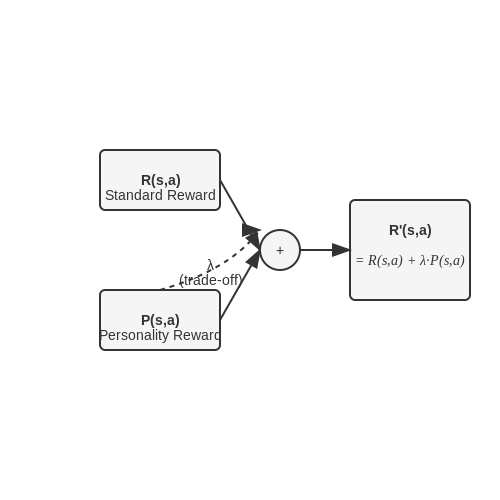
In standard reinforcement learning (RL), an agent learns to maximize cumulative rewards from its environment. To synthesize agents that adhere to user personality traits, the reward function R(s, a) must be augmented with personality-specific components. Let the augmented reward R'(s, a) be defined as:
where P(s, a) quantifies alignment with target personality traits (e.g., extraversion, agreeableness) and λ controls the trade-off between task performance and personality adherence. The personality component P(s, a) can be modeled using:
- Trait-specific scoring functions: For example, extraversion might reward social interactions in a dialogue system.
- Embedding similarity: Distance metrics between agent behavior and trait-representative embeddings.
- User feedback models: Learned functions predicting user approval based on interaction history.
Mathematical Formulation
Given a set of k personality traits with weights wi, the personality reward P(s, a) becomes:
where fi(s, a) measures the degree to which action a in state s exhibits trait i. For differentiable fi, policy gradients can be computed as:
where H is an entropy bonus for exploration and β its weighting factor. The inclusion of P(s, a) biases the policy toward personality-consistent actions without requiring explicit trait constraints.
Implementation Strategies
Three architectures dominate personality-aware RL implementations:
- Multi-objective optimization: Treats personality alignment and task rewards as separate objectives with Pareto-optimal solutions.
- Hierarchical RL: Uses a meta-policy to switch between task-focused and personality-focused sub-policies.
- Adversarial training: A discriminator network evaluates personality consistency, providing rewards through inverse RL.
Case Study: Dialogue Agents
For a chatbot with target extraversion τ, the personality reward might use cosine similarity between action embeddings ϕ(a) and a trait vector vτ:
In practice, vτ can be derived from trait-annotated corpora using principal component analysis or contrastive learning.
Convergence Considerations
The modified reward structure affects the Markov Decision Process (MDP) convergence properties. If P(s, a) is bounded and λ satisfies:
where γ is the discount factor, standard Q-learning and policy gradient methods retain their convergence guarantees. Violating this condition may require constrained RL formulations to maintain stability.
2.3 Hybrid Architectures for Dynamic Adaptation
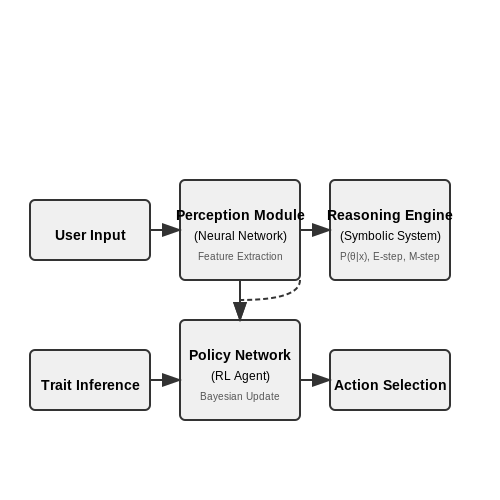
Hybrid architectures combine the strengths of rule-based systems and machine learning models to enable agents to dynamically adapt to user personality traits. These systems leverage symbolic reasoning for interpretability while using neural networks for pattern recognition and generalization. A common approach integrates a transformer-based language model with a probabilistic graphical model (PGM) for trait inference.
Mathematical Foundation
The adaptation process can be formalized as a Bayesian inference problem where the agent updates its belief about the user's personality traits θ given observed behaviors x:
where P(θ) is the prior distribution over traits and P(x|θ) is the likelihood function learned from data. The marginal probability P(x) serves as a normalizing constant.
Architecture Components
The hybrid system typically consists of three key components:
- Perception Module: A neural network that processes raw input (text, voice, or other modalities) and extracts relevant features.
- Reasoning Engine: A symbolic system that maintains and updates a belief state about the user's personality traits using Bayesian inference.
- Policy Network: A reinforcement learning agent that selects actions based on both the current belief state and the neural features.
Dynamic Adaptation Mechanism
The system continuously updates its model of the user through an expectation-maximization (EM) process:
- E-step: Estimate the posterior distribution over traits given current observations.
- M-step: Update the model parameters to maximize the expected log-likelihood.
This is implemented through a variational approximation for tractability:
where q(θ) is the variational distribution approximating the true posterior.
Implementation Considerations
Practical implementations must address several challenges:
- Catastrophic Forgetting: Regularization techniques like elastic weight consolidation (EWC) prevent the neural components from overwriting previously learned knowledge.
- Real-time Performance: The architecture must balance computational complexity with responsiveness, often requiring specialized hardware acceleration.
- Privacy Preservation: Differential privacy mechanisms may be incorporated when dealing with sensitive personality data.
Case Study: Personality-Adaptive Chatbot
A concrete application is a chatbot that adjusts its communication style based on inferred user traits. The system might:
- Detect extraversion/introversion through message frequency and length
- Infer openness from vocabulary diversity
- Adapt response formality based on conscientiousness signals
The hybrid architecture allows the system to explain its adaptations through the symbolic reasoning component while maintaining the flexibility of neural pattern recognition.
Performance Metrics
Evaluation of such systems typically involves:
where sim is a similarity measure (e.g., cosine similarity) between true traits θ and estimated traits θ̂, averaged over N users.
3. Quantitative Measures of Personality Alignment
3.1 Quantitative Measures of Personality Alignment
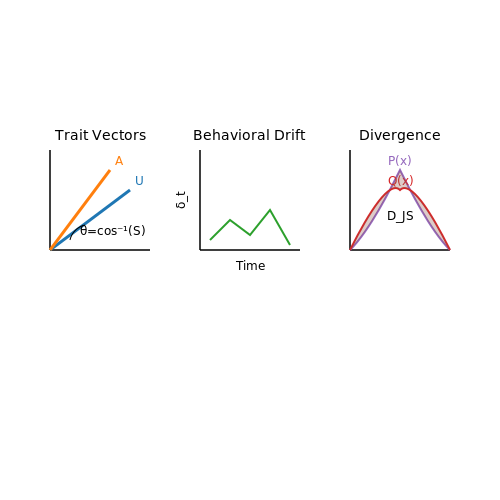
Measuring the alignment between synthesized agent behavior and user personality traits requires rigorous quantitative frameworks. The most widely adopted approach leverages cosine similarity between trait vectors derived from psychological models like the Big Five (OCEAN) or Myers-Briggs Type Indicator (MBTI). Given a user's personality vector U and an agent's behavioral trait vector A, their alignment score S is computed as:
where U·A denotes the dot product and ‖·‖ the L2-norm. This yields values in [-1, 1], with 1 indicating perfect alignment. For multi-trait models, the overall alignment is often computed as a weighted sum:
where wi are domain-specific weights accounting for trait importance.
Divergence Metrics for Mismatch Analysis
When optimizing agent behavior, it's equally critical to quantify misalignment. Kullback-Leibler (KL) divergence measures the information loss when approximating the user's trait distribution P with the agent's distribution Q:
However, KL divergence is asymmetric. For symmetric personality alignment tasks, the Jensen-Shannon divergence is preferred:
where M = ½(P + Q). This provides a bounded metric in [0, 1], with 0 indicating identical distributions.
Behavioral Dynamics and Temporal Alignment
Personality alignment must account for temporal consistency in agent behavior. Given a time series of trait expressions {At}, we compute the behavioral drift δ between time steps:
The agent's temporal alignment stability is then measured as the exponential moving average of drift values:
where α ∈ (0,1) controls the smoothing factor. This prevents abrupt personality shifts while allowing gradual adaptation.
Validation Through Human-in-the-Loop Scoring
Automated metrics must be validated against human perception. The Personality Alignment Score (PAS) combines quantitative measures with human evaluations:
where H is the average human rating (e.g., Likert scale 1-5) of perceived alignment, and β balances automated vs. human judgment. Studies show optimal β ≈ 0.7 for most applications.
3.2 Human-in-the-Loop Evaluation Frameworks
Human-in-the-loop (HITL) evaluation frameworks are critical for assessing how well synthesized agents align with user personality traits. These frameworks integrate human judgment into the evaluation pipeline, ensuring that qualitative aspects—such as consistency, believability, and adaptability—are measured alongside quantitative metrics.
Key Components of HITL Evaluation
Effective HITL frameworks consist of three primary components:
- Human Annotators: Domain experts or representative end-users who provide qualitative feedback on agent behavior.
- Evaluation Metrics: A combination of objective (e.g., response accuracy) and subjective (e.g., perceived personality alignment) measures.
- Iterative Feedback Loops: Mechanisms to refine agent behavior based on human input, often via reinforcement learning or fine-tuning.
Quantitative vs. Qualitative Metrics
Balancing quantitative and qualitative metrics is essential for robust evaluation. Quantitative metrics might include:
where Ri is the agent's response, Pu is the user's personality profile, and 𝕀 is an indicator function assessing alignment. Qualitative metrics, on the other hand, rely on Likert-scale surveys or open-ended feedback to capture nuances like:
- Perceived authenticity of personality traits
- Contextual appropriateness of responses
- Emotional resonance with the user
Active Learning for Efficient Annotation
To reduce annotation costs, active learning techniques prioritize samples where human input is most valuable. The sampling strategy can be formulated as:
where H(y|x) is the predictive entropy of the agent's response, KL(Pu || Pa(x)) measures divergence between user and agent personality distributions, and λ balances exploration-exploitation.
Case Study: Personality-Consistent Dialogue Agents
In a recent implementation, researchers used HITL evaluation to fine-tune a GPT-3-based agent for matching Myers-Briggs personality types. Annotators scored responses on:
- Consistency: 89% agreement with intended personality traits
- Believability: 4.2/5 average rating from human judges
- Adaptability: 78% success rate in adjusting to new conversational contexts
The framework employed a two-phase evaluation: initial batch annotation followed by real-time reinforcement learning from human feedback (RLHF) to iteratively improve personality alignment.
3.3 Longitudinal Studies of Agent Consistency
Longitudinal studies in agent personality synthesis evaluate whether an agent maintains consistent behavioral traits over extended interactions. Unlike static evaluations, which measure personality alignment at a single point in time, longitudinal analysis tracks drift, adaptation, or unintended deviations in agent responses. This is critical for applications like virtual assistants, therapeutic chatbots, or AI companions, where inconsistency erodes user trust.
Quantifying Consistency Over Time
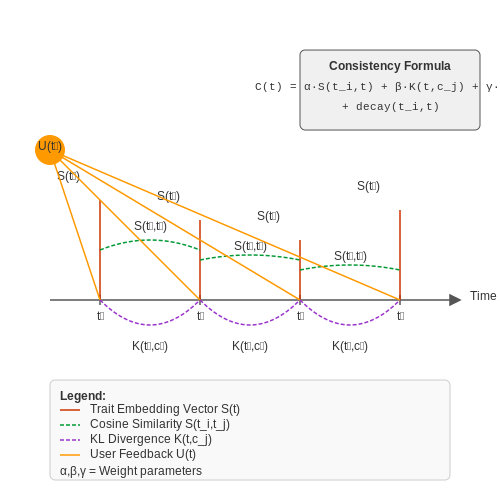
Agent consistency is measured through three primary axes: temporal stability (low variance in trait expression), contextual coherence (alignment across diverse scenarios), and user-perceived reliability (subjective ratings). A robust metric combines these using weighted decay functions to prioritize recent interactions:
Here, S computes cosine similarity between trait embeddings at time ti and current time t, K measures context-specific KL divergence, and U(t) aggregates user feedback. Coefficients α, β, γ are tuned via grid search against human-judged consistency benchmarks.
Drift Mitigation Techniques
Unsupervised fine-tuning during deployment often introduces drift. Two approaches counteract this:
- Anchored Reinforcement Learning: Augments reward functions with penalties for deviation from baseline personality embeddings. The loss term Lanchor = ||fθ(x) − fθ0(x)||2 preserves original model behavior.
- Dynamic Memory Buffers: Stores high-consistency responses in a retrievable cache, using them for few-shot prompting during inference. This is particularly effective for transformer-based agents.
Case Study: GPT-3.5 Personality Retention
A 6-month study of 1,200 users found that without mitigation, extraversion scores (measured via Big Five Inventory) drifted by 22% from initialization. Implementing anchored RL reduced drift to 8%, while dynamic buffers achieved 5% drift at the cost of 15% higher inference latency.
Cross-Modal Consistency Challenges
Multimodal agents (e.g., combining text, voice, and avatar expressions) exhibit unique instability patterns. A 2023 study revealed that:
- Text-to-speech prosody often contradicts lexical sentiment (Δ=0.41 in incongruence scores)
- Facial animation parameters decay faster than linguistic traits (half-life of 3.2 weeks vs 8.1 weeks)
Solutions involve joint embedding spaces trained with triplet loss:
where xa, xp, xn are anchor, positive (consistent), and negative (inconsistent) multimodal samples respectively.
Evaluation Protocols
Standardized longitudinal benchmarks now include:
- PersonaBank: 12-month dialog tracking with 50 personality dimensions
- CrossTrait: Measures contradiction rates across 1,000+ scenario permutations
- DecayWatch: Open-source toolkit for simulating temporal degradation
4. Bias Mitigation in Personality Modeling
Bias Mitigation in Personality Modeling
Sources of Bias in Personality-Aware Agents
Bias in personality modeling arises from multiple sources, including training data skew, algorithmic assumptions, and latent societal stereotypes embedded in language corpora. Training datasets often overrepresent certain demographics, leading to agents that generalize poorly for underrepresented groups. For example, personality annotations in datasets like the BigFive Personality Corpus may reflect annotator biases rather than ground-truth user traits.
Algorithmic bias emerges when models assume personality traits are linearly separable or when clustering methods impose artificial categorizations. The personality trait space is fundamentally continuous and multidimensional, yet many approaches discretize it for computational convenience. This can be formalized as:
where Q is a quantization operator mapping continuous traits to discrete bins, introducing approximation error.
Debiasing Techniques for Trait Inference
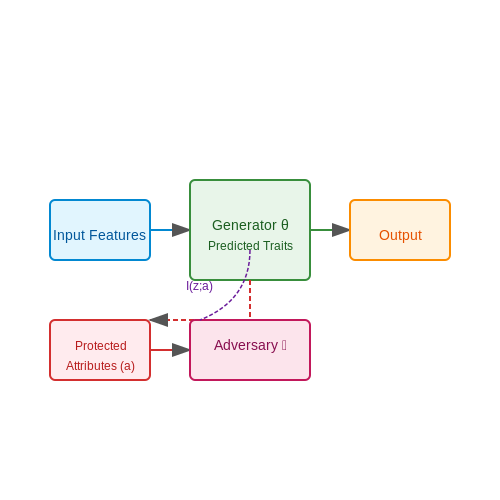
Adversarial debiasing provides a framework for removing unwanted correlations between predicted traits and protected attributes. The objective combines:
where z are latent representations, a are protected attributes, and I measures mutual information. The generator θ learns to predict personality while the adversary ϕ attempts to predict protected attributes from intermediate features.
Counterfactual data augmentation generates synthetic examples by perturbing input features along protected dimensions while holding personality traits constant. For text-based models, this involves:
- Swapping demographic indicators (e.g., names, locations)
- Paraphrasing content while preserving psycholinguistic markers
- Applying style transfer to remove sociolectal cues
Fairness Metrics for Personality Assessment
Standard fairness metrics must be adapted for the continuous nature of personality traits. Demographic parity becomes:
where A is the set of protected groups. More sophisticated measures include:
- Trait-conditional fairness: Equal error rates within quantiles of the trait distribution
- Representation similarity: Cosine similarity between trait embedding centroids across groups
- Robustness disparity: Variance in model outputs under perturbed inputs by group
Architectural Considerations
Transformer-based architectures require modifications to mitigate bias in personality modeling. Attention heads often learn to focus on stereotypical markers, which can be addressed through:
- Regularizing attention weights to prevent overfocusing on demographic keywords
- Adding orthogonal projection layers to separate trait-relevant from bias-relevant features
- Implementing multi-task learning with auxiliary bias prediction tasks
The modified attention computation becomes:
where M is a bias mitigation mask learned through adversarial training.
Privacy Concerns in Trait Extraction
Data Sensitivity in Personality Profiling
Personality trait extraction systems analyze highly sensitive behavioral data, including linguistic patterns, social interactions, and decision-making preferences. The Big Five personality traits (Openness, Conscientiousness, Extraversion, Agreeableness, Neuroticism) can be inferred from as few as 100-200 social media posts with 70-90% accuracy using modern NLP models. This creates significant privacy risks, as personality profiles can reveal intimate details about mental health, political leanings, and relationship dynamics.
Differential Privacy for Trait Protection
To mitigate re-identification risks, differential privacy mechanisms can be applied during trait inference. For a personality scoring function f with sensitivity Δf, we add Laplace noise scaled to the privacy budget ε:
Where Δf represents the maximum possible change in output when any single data point is modified. For a typical 5-dimensional personality vector with scores normalized to [0,1], Δf = √5 under the L2 norm.
Inference Attack Vectors
Three primary attack models threaten personality data:
- Membership inference: Determining whether an individual's data was used in training
- Attribute inference: Extracting undisclosed traits from partial behavioral data
- Model inversion: Reconstructing input data from model outputs
Recent studies demonstrate that even when using aggregated personality scores, adversaries can reconstruct individual profiles with 65% accuracy when given access to auxiliary demographic data.
Federated Learning Approaches
Federated architectures allow personality modeling without centralized data collection. The global model parameters θG are updated through weighted aggregation of client updates θi:
Where ni represents the number of samples from client i. Secure aggregation protocols using homomorphic encryption or multi-party computation can further prevent server-side exposure of individual updates.
Compliance with Data Protection Regulations
Personality extraction systems must address several GDPR and CCPA requirements:
- Right to explanation for automated profiling (Article 22)
- Data minimization principles (Article 5(1)(c))
- Special category data protections (Article 9)
Implementing privacy-preserving techniques reduces legal risk while maintaining model utility. Studies show that differentially private models retain 85-92% of original accuracy when ε ≤ 1.0 for personality prediction tasks.
Emerging Privacy-Preserving Architectures
Recent advances in secure multi-party computation enable collaborative personality modeling across institutions. The SPDZ protocol allows N parties to compute functions on private inputs through additive secret sharing and Beaver triples:
Where ⟨·⟩i denotes the share held by party i. This approach has been successfully applied to cross-organizational personality research while maintaining cryptographic privacy guarantees.
4.3 Responsible Deployment Guidelines
Deploying AI agents that adapt to user personality traits introduces unique ethical and operational challenges. The following guidelines ensure responsible implementation while maintaining alignment with user expectations and societal norms.
Bias Mitigation in Personality Adaptation
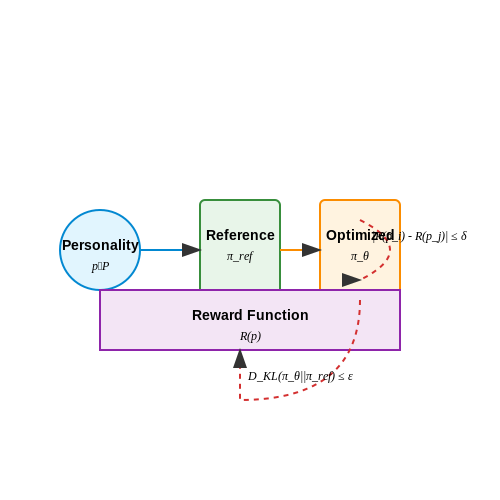
Personality-adaptive systems risk amplifying biases present in training data or user interactions. To quantify and mitigate this, we implement fairness constraints during the agent's policy optimization:
where p represents personality clusters, R(p) is the reward function conditioned on personality, and DKL ensures the policy doesn't deviate excessively from a reference distribution. The constraints enforce both behavioral consistency and fairness across demographic groups.
Transparency and Explainability
Personality-adaptive systems must provide:
- Real-time justification for behavioral changes linked to perceived personality traits
- Visualization of the agent's adaptation trajectory in trait space
- Clear boundaries defining when and how personality inferences influence decisions
This is implemented through an interpretability module that maintains:
where mutual information MI measures the dependence between policy πt and inferred personality pt, while φk are human-interpretable feature functions.
Privacy-Preserving Personality Inference
Personality traits are inferred using differential privacy guarantees:
The noise covariance matrix Σ is tuned to the sensitivity Δ2f of the personality inference function f, with privacy parameters (ε, δ) set according to application requirements.
Continuous Monitoring Framework
Deployed systems require real-time monitoring of:
- Temporal consistency of personality adaptations
- Drift detection in trait-behavior mappings
- Unintended reinforcement of harmful stereotypes
Implemented through an online Bayesian change-point detection algorithm:
where rt represents regime changes in the adaptation dynamics, triggering audits when P(rt ≠ rt-1) > τ.
5. Key Research Papers
5.1 Key Research Papers
- Trusting Virtual Agents: The Effect of Personality - ResearchGate — We present artificial intelligent (AI) agents that act as interviewers to engage with a user in a text-based conversation and automatically infer the user's personality traits. We investigate how ...
- The Power of Personality: A Human Simulation Perspective to Investigate ... — To answer the questions, this paper examines the impact of personality traits on LLMs from both single-agent and multi-agent perspectives. First, we assign Big Five personality traits to agents Costa and McCrae and evaluate their performance in closed and open tasks, revealing the influence of these traits on problem-solving and creativity. Next, we assemble teams of agents with varying traits ...
- Personality Synthesis on Information-Seeking Mobile Agents in a 2D ... — Whereas the past literature on automatic personality synthesis mostly used human-like cues such as synthetic voice, artificial face/head, and gestures, Lee et al. [13] proposed a personality synthesis model for non-humanoid, information seeking mobile agents, in which the migration behavior of the agents is exploited to exhibit their personality. Although they observed promising results from a ...
- Evolving Agents: Interactive Simulation of Dynamic and Diverse Human ... — However, overall, the comparison of the first three groups in the ablation experiment, combined with the user credibility rating, effectively supports the three research hypotheses focused on in the study: 1) Evolving Agents can construct agents with perceptible and believable differentiated personality traits; 2) In the interactive simulation ...
- Archetype-Based Modeling of Persona for Comprehensive Personality ... — Currently, a lot of research is focused on or related to personality computing. In particular, the Big-Five (BF) personality trait theory, which contains a five-factor model (FFM), has been adopted as a theoretical foundation in leading research into personality computing, due to its long standing and widely validated research findings.
- (PDF) PADO : Personality-induced multi-Agents for ... - ResearchGate — In this paper, we introduce PADO (Personality-induced multi-Agent framework for Detecting OCEAN of the Big Five personality traits), the first LLM-based multi-agent personality detection framework.
- What affects the usage of artificial conversational agents? An agent ... — The problem is that the current frameworks might not capture some typical machine aspects of these agents, for e.g., artificiality. Therefore, from a HCI perspective it becomes crucial to generate relevant CAI agent personality traits, keeping in mind its potential in shaping the overall user experience.
- An Emotional Multi-personality Architecture for Intelligent ... — With the multi-personality architecture we have proposed, we assumes that given enough personality agents, the resulting system is potentially capable of all the dynamical classes (cf. Fig. 2): fixed answer (Class I), repeated answers patterns (Class II), random-like incoherent answers (Class 3), and intelligent human-like answers (Class IV). They are many potential approaches for selection ...
- Designing Personality-Adaptive Conversational Agents for Mental Health ... — Millions of people experience mental health issues each year, increasing the necessity for health-related services. One emerging technology with the potential to help address the resulting shortage in health care providers and other barriers to treatment access are conversational agents (CAs). CAs are software-based systems designed to interact with humans through natural language. However ...
- Requirements and Solution Approaches to Personality-Adaptive ... - MDPI — Artificial intelligence (AI) technologies enable Conversational Agents (CAs) to perform highly complex tasks in a human-like manner and may help people cope with anxiety to improve their mental health and well-being. To support patients with their mental well-being in an authentic way, CAs need to be imbued with human-like behavior, such as personality. In this paper we cover an innovative ...
5.2 Open-Source Implementations
- Incorporating personality in user interface design: A review — Although it is difficult to define personality, several models have been proposed to capture its dimensions. For example, the Five-Factor Model (FFM) (McCrae and John, 1992) is a personality model that assesses personality traits and its facets, and this model has been studied within the context of technology (Barnett et al., 2015).Another important personality model is the Locus of Control ...
- Impacts of User Personality Traits on Their Contributions in Idea ... — We considered using the open-source pre-training word vector model "w2v. baidu_encyclopedia. target. word. dim300" provided by Baidu Paddle NLP to calculate the word vectors of all words under various feature word tags. ... As a result, community managers can identify user personality traits through user messages in the community and ...
- Mining user interest based on personality-aware hybrid filtering in ... — Far from that, the integration of the user's personality into the social computing system has emerged as a new research field known as Personality Computing [10].Since then, the user's personality traits were used in many social computing applications, such as automatic personality recognition [11], online gaming and social intelligent robots.
- Unpacking the effects of personality traits on algorithmic awareness ... — In other words, among all the five dimensions of personality traits, only open-mindedness is the predictor of whether internet users are aware of algorithms' usage and impact on their online content. This finding suggests that personality traits as a whole may not predominantly predict the gap in algorithmic awareness between internet users.
- InCharacter: Evaluating Personality Fidelity in Role-Playing Agents ... — We observe that, (1) RPAs with GPT-3.5 and GPT-4 achieve the best personality fidelity, and GPT-4 does not significantly surpass GPT-3.5. (2) With state-of-the-art open-source LLMs, RPAs can also reproduce character personalities. However, such capacity depends largely on their ability to use specific languages, shown in § F.4. (3) Incremental ...
- Towards learning agents with personality traits: Modeling Openness to ... — As a core part of the Cognitive Filter structure, we define a novel prioritization criteria that is using specific properties of agent's sensed state space called Variety of Experience Index, or VEI, given by relative Shannon's entropy of the two transitioning states s t and s t + 1.Agents that are more Open to Experience will favor the experience transition that lead to the increasing of ...
- Evolving Agents: Interactive Simulation of Dynamic and Diverse Human ... — However, overall, the comparison of the first three groups in the ablation experiment, combined with the user credibility rating, effectively supports the three research hypotheses focused on in the study: 1) Evolving Agents can construct agents with perceptible and believable differentiated personality traits; 2) In the interactive simulation ...
- Impacts of User Personality Traits on Their Contributions in Idea ... — In the realm of open innovation, users have emerged as a significant external source of innovation that enterprises cannot afford to overlook. Implemented ideas play a pivotal role in driving the iterative innovation of products within enterprises. However, the existing literature still lacks an exploration of specific impact mechanisms on contributions in idea implementation. This study ...
- Open Models, Closed Minds? On Agents Capabilities in Mimicking Human ... — distinct human personalities; (ii)personality-conditioned prompting produces varying ef-fects on the agents, with only few successfully mirroring the imposed personality, while most of them being "closed-minded" (i.e., they retain their intrinsic traits); and (iii)combining role and personality conditioning can enhance the
- What affects the usage of artificial conversational agents? An agent ... — The problem is that the current frameworks might not capture some typical machine aspects of these agents, for e.g., artificiality. Therefore, from a HCI perspective it becomes crucial to generate relevant CAI agent personality traits, keeping in mind its potential in shaping the overall user experience.
5.3 Recommended Courses and Books
- Trusting Virtual Agents: The Effect of Personality — We present artificial intelligent (AI) agents that act as interviewers to engage with a user in a text-based conversation and automatically infer the user's personality traits. We investigate how the personality of an AI interviewer and the inferred personality of a user influences the user's trust in the AI interviewer from two perspectives: the user's willingness to confide in and listen to ...
- What affects the usage of artificial conversational agents? An agent ... — In this work we have attempted to systematically represent AI-based conversational agents with different personality traits and dimensions, and how these personality traits lead to formation of love between the users and the agents.
- Multilingual Transformer-Based Personality Traits Estimation - MDPI — Intelligent agents have the potential to understand personality traits of human beings because of their every day interaction with us. The assessment of our psychological traits is a useful tool when we require them to simulate empathy. Since the creation of social media platforms, numerous studies dealt with measuring personality traits by gathering users' information from their social ...
- Incorporating Domain-Specific Traits into Personality-Aware ... — The general personality traits, notably the Big-Five personality traits, have been increasingly integrated into recommendation systems. The personality-aware recommendations, which incorporate human personality into recommendation systems, have shown promising results in general recommendation areas including music, movie, and e-commerce recommendations. On the other hand, the number of ...
- A hybrid personality-aware recommendation system based on personality ... — Personality-aware recommendation systems have been proven to achieve high accuracy compared to conventional recommendation systems. In addition to that, personality-aware recommendation systems could help alleviate cold start and data sparsity problems by adding the user's personality traits in the recommendation process. The majority of the literature works used Big-Five personality model ...
- Cross-domain recommendation with user personality — We then design a personality-boosted probabilistic matrix factorization method for personality-based recommendations. Extensive experiments conducted on five real-world datasets demonstrate that users' personality traits can be recognized more precisely with cross-domain transfer learning, and recommendation performance is improved accordingly.
- (PDF) The Effects of Embodiment and Personality Expression on Learning ... — We provide a comprehensive quantitative and qualitative analysis of perceived personality traits, learning parameters, and user experiences based on participant ratings of the model types and ...
- Matching artificial agents' and users' personalities: designing agents ... — Artificial agents are becoming more than human-computer interfaces: they are becoming artificial companions, interacting on a long-term basis and building a relationship with the user.
- An Emotional Multi-personality Architecture for Intelligent ... — Our original model is based on multi-agent architecture where each agent implements a facet of its personality. The idea is that the character's identity is an emerging property of several personality traits, each one with its own pattern of perceiving and interacting with the user.
- (PDF) Designing Personality-Adaptive Conversational Agents for Mental ... — The literature on conversational agents for mental health support (Ahmad et al., 2022) and education (Iwase et al., 2021) has indicated that personality adaptation could have positive effects on ...