Training AI to Simulate Emotional Reactions
1. Defining Emotional Intelligence in Machines
1.1 Defining Emotional Intelligence in Machines
Emotional intelligence (EI) in machines refers to the computational modeling of affective states, their recognition, and appropriate response generation. Unlike human EI, which integrates biological, psychological, and social factors, machine EI is grounded in three core technical components: affective computing, cognitive architectures, and reinforcement learning from human feedback (RLHF).
Affective Computing Foundations
Affective computing, introduced by Rosalind Picard in 1995, formalizes emotion processing through:
- Multimodal signal analysis: Extraction of emotional cues from text (sentiment lexicons), speech (prosodic features), and vision (facial action coding system).
- Dimensional emotion models: Mapping emotions to continuous spaces like Russell's circumplex model with axes for valence (pleasure-displeasure) and arousal (activation-deactivation):
where v and a are normalized valence and arousal scores. This allows interpolation between Ekman's six basic emotions.
Cognitive Architecture Integration
Machine EI requires cognitive frameworks that simulate appraisal theories (e.g., Scherer's component process model). A hybrid symbolic-neural implementation might use:
where st is the current state, fCNN processes visual inputs, gNLP analyzes text, and σ is a softmax over possible emotional labels.
Reinforcement Learning from Human Feedback
RLHF aligns machine responses with human emotional expectations through preference modeling. The reward function incorporates:
where τ represents interaction trajectories, and α balances emotional appropriateness against dialog consistency. State-of-the-art implementations use inverse reinforcement learning to recover latent reward functions from human demonstrations.
Evaluation Metrics
Quantitative assessment employs:
- Emotion recognition accuracy: F1 scores on benchmark datasets like MELD
- Response appropriateness: Human ratings on Likert scales
- Physiological alignment: Correlation between machine-predicted arousal and user galvanic skin response
Current limitations include the lack of genuine emotional experience (qualia problem) and cultural bias in training datasets. Cutting-edge research explores neuromorphic architectures with simulated somatosensory feedback loops to address these gaps.
Psychological Models of Emotion for AI
Dimensional Models of Emotion
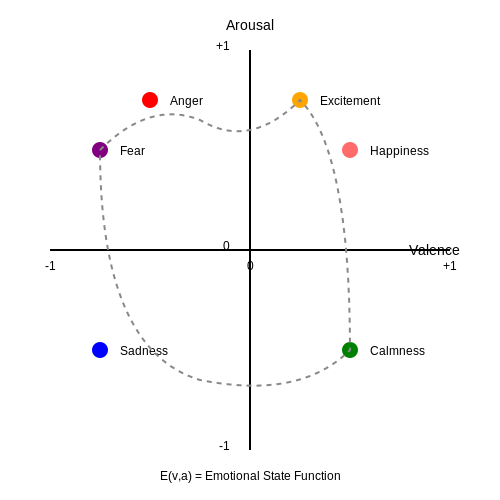
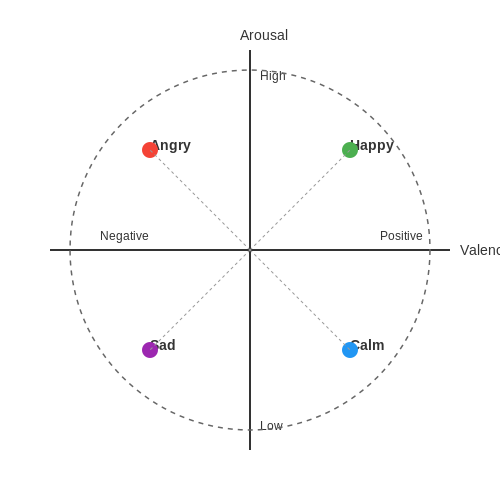
Dimensional models represent emotions as points in a continuous space, typically defined by valence (pleasure-displeasure) and arousal (activation-deactivation). The Circumplex Model by Russell (1980) is foundational, mapping emotions along these orthogonal axes. For AI systems, this translates to a vector space where emotional states can be interpolated or extrapolated. Mathematically, an emotion E is represented as:
where v ∈ [-1, 1] denotes valence and a ∈ [0, 1] denotes arousal. Advanced implementations incorporate a third dimension, dominance (control-lack of control), yielding:
Categorical Models and Basic Emotions
Ekman's Basic Emotion Theory posits six universal emotions (anger, disgust, fear, happiness, sadness, surprise) with distinct neural and physiological correlates. AI systems leveraging this model often use discrete classifiers, such as:
- Multi-class support vector machines (SVMs)
- Convolutional neural networks (CNNs) for facial expression analysis
- Transformer-based models for textual sentiment analysis
The probability P of an emotion ei given input features x is computed via softmax:
Appraisal Theories and Computational Implementation
Appraisal theories (e.g., Scherer's Component Process Model) argue emotions arise from subjective evaluations of events. AI implementations require:
- Event representation: Symbolic (e.g., predicate logic) or subsymbolic (e.g., embeddings)
- Appraisal dimensions: Novelty, goal relevance, coping potential, norm compatibility
- Mapping rules: Fuzzy logic or neural networks to translate appraisals to emotional states
A neural appraisal model might use a gated recurrent unit (GRU) to process event sequences:
where at is the appraisal vector at time t.
Physiological and Multimodal Integration
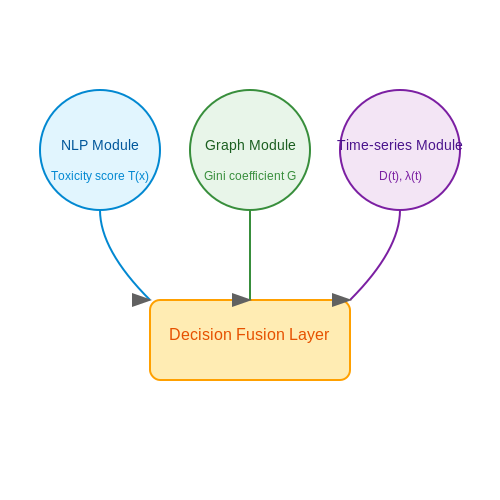
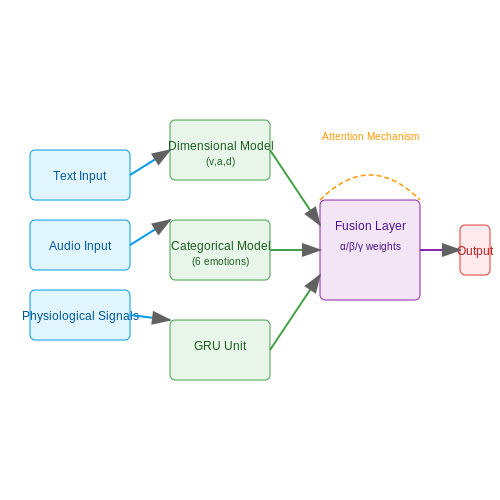
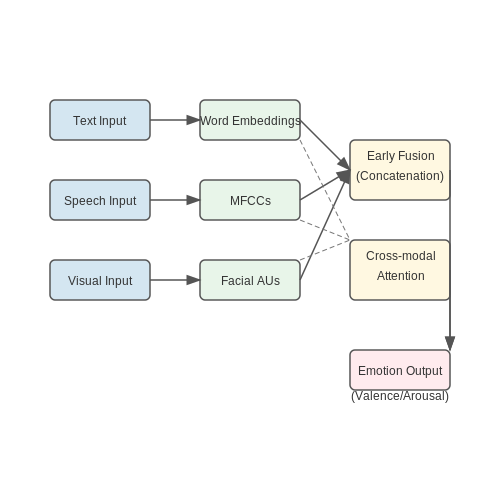
Modern systems combine dimensional, categorical, and appraisal approaches with physiological signals (heart rate variability, skin conductance). A fusion layer might compute:
where weights α, β, γ are learned via attention mechanisms. The diagram below illustrates this architecture:
Key Challenges in Simulating Emotions
Defining Emotion in Computational Terms
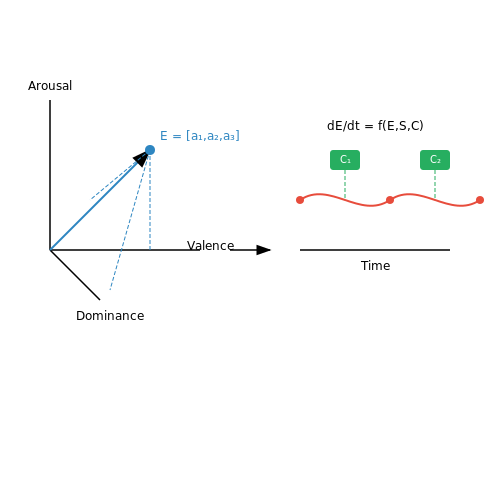
One of the most fundamental challenges lies in operationalizing emotions for AI systems. Unlike discrete logical tasks, emotions are multi-dimensional constructs involving physiological, cognitive, and behavioral components. From a computational perspective, we might model an emotion E as a vector in a high-dimensional space:
where each component ai represents a different affective dimension (e.g., valence, arousal, dominance). However, this reductionist approach fails to capture the dynamic interplay between these dimensions and their contextual dependence.
The Contextual Nature of Emotional Responses
Human emotional responses are deeply context-dependent, influenced by:
- Personal history: Past experiences shape emotional reactions
- Cultural background: Display rules vary across societies
- Current physiological state: Fatigue or hunger modulate responses
- Social dynamics: Presence of others alters emotional expression
This contextual sensitivity presents a significant modeling challenge, as it requires AI systems to maintain and continuously update a complex world model that includes these factors.
The Temporal Dynamics Problem
Emotions evolve over multiple timescales, from milliseconds (physiological responses) to years (personality changes). Capturing this requires modeling emotional state transitions:
where S represents internal state and C represents context. The function f must account for both rapid emotional shifts and gradual mood changes, making it difficult to specify without oversimplification.
Grounding Emotional Responses
Current approaches struggle with the symbol grounding problem in emotion simulation. While we can train models to associate certain inputs with emotional outputs, these associations often lack:
- Embodied experience: Humans feel emotions through bodily sensations
- Subjective meaning: The personal significance of events
- Authentic appraisal: Genuine evaluation of situations
This results in systems that can mimic emotional responses but lack true emotional understanding.
Ethical and Safety Considerations
Simulating emotions raises several ethical challenges:
- Manipulation risks: Emotionally-aware systems could exploit users
- Unintended consequences: Emotional responses might reinforce biases
- Transparency issues: Difficulty explaining emotional outputs
- Psychological impact: Effects of long-term interaction with emotional AI
These concerns require careful consideration in system design and deployment.
Evaluation and Validation
Assessing the quality of simulated emotions presents unique measurement challenges. Traditional metrics like accuracy or F1 scores are inadequate for evaluating:
- Appropriateness: Whether responses fit the context
- Authenticity: How genuine responses appear
- Impact: Emotional effect on human interlocutors
Developing robust evaluation frameworks remains an open research question in affective computing.
2. Sources of Emotional Data: Text, Speech, and Visual Cues
Sources of Emotional Data: Text, Speech, and Visual Cues
Text-Based Emotional Data
Natural language processing (NLP) models extract emotional signals from textual data through lexical, syntactic, and semantic analysis. Sentiment analysis algorithms classify emotions using word embeddings (e.g., Word2Vec, GloVe) and transformer-based architectures like BERT and GPT. The emotional valence V of a text segment can be modeled as:
where wi represents the weight of term i and si its sentiment polarity from lexicons like SentiWordNet. Advanced models incorporate contextual embeddings and attention mechanisms to capture emotional dynamics in discourse.
Speech and Vocal Cues
Paralinguistic features in speech signals provide rich emotional data. Mel-frequency cepstral coefficients (MFCCs), pitch contours, and jitter/shimmer metrics are extracted from audio waveforms. A speech emotion recognition system typically processes these features through:
- Time-delay neural networks (TDNNs) for temporal pattern recognition
- LSTMs to model sequential dependencies in prosody
- Attention mechanisms to weight emotionally salient segments
The emotional state E can be represented as a probability distribution over discrete categories (happy, angry, sad) or continuous dimensions (arousal, valence, dominance):
with xi being acoustic features and f the classification/regression function.
Visual Emotional Cues
Facial expression analysis employs computer vision techniques to decode emotions from:
- Action units (AUs) defined by the Facial Action Coding System (FACS)
- Micro-expressions lasting 1/25 to 1/5 second
- Gaze patterns and pupil dilation
Modern approaches use 3D convolutional neural networks (3D-CNNs) to process spatial-temporal facial data. The emotional intensity I can be computed from facial landmark displacements:
where pk(t) denotes the position of the k-th facial landmark at time t.
Multimodal Fusion
State-of-the-art systems combine modalities through late fusion (decision-level) or early fusion (feature-level). Transformer architectures with cross-modal attention achieve superior performance by learning joint representations:
where queries Q, keys K, and values V are derived from different modality-specific encoders.
Ethical Considerations in Emotion Data Collection
The collection of emotional data for AI training introduces significant ethical challenges, particularly concerning consent, privacy, and potential misuse. Unlike conventional datasets, emotional data often includes highly sensitive biometric information such as facial expressions, vocal intonations, physiological signals (e.g., heart rate variability, galvanic skin response), and even neuroimaging data in advanced research settings. The ethical implications of acquiring, storing, and utilizing this data must be rigorously evaluated to prevent harm.
Informed Consent and Participant Autonomy
Obtaining informed consent in emotion data collection is complicated by the subjective nature of emotional experiences and the potential for participants to underestimate the risks. Traditional consent forms may not adequately convey how emotional data could be repurposed, particularly when used to train models that simulate or manipulate affective states. A robust consent framework should include:
- Explicit disclosure of data usage scenarios, including potential future applications.
- Granular opt-in mechanisms for different processing stages (e.g., raw data storage vs. derived feature extraction).
- Dynamic consent models allowing participants to withdraw or modify permissions post-collection.
Studies have shown that participants often fail to anticipate how emotional data might be weaponized—for instance, in personalized persuasion systems or emotional profiling by adversarial actors. This necessitates iterative consent protocols where comprehension is verified through questionnaires or interactive explanations.
Privacy-Preserving Data Collection Techniques
Raw emotional data carries re-identification risks even when stripped of traditional identifiers like names or addresses. A voice recording of someone expressing anger or a thermal image of their stress response may be uniquely identifiable when combined with auxiliary datasets. Differential privacy techniques can mitigate these risks by introducing controlled noise into datasets:
where ε represents the privacy budget, ℳ is the randomized mechanism, and D, D' are neighboring datasets. For temporal emotional signals like electrodermal activity, Fourier-based perturbation preserves utility while satisfying (ε, δ)-differential privacy guarantees.
Alternative approaches include federated learning architectures where raw data never leaves individual devices, and only model updates are aggregated. This is particularly relevant for continuous emotion tracking applications in wearable tech, where centralized data storage would create unacceptable breach vulnerabilities.
Cultural and Contextual Biases in Emotional Labeling
Emotion classification datasets frequently encode Western-centric biases through their labeling schemas. The Ekman six basic emotions model (anger, disgust, fear, happiness, sadness, surprise) has been criticized for neglecting culturally specific affective states like the Mandarin concept of yōu yù (忧郁, melancholic contemplation) or the German Schadenfreude. When training data lacks this diversity, resulting models pathologize non-Western emotional expressions or fail to recognize them entirely.
Mitigation strategies include:
- Collaborative annotation with cultural domain experts
- Contextual metadata tagging for emotional stimuli (e.g., recording whether a facial expression occurred during a funeral vs. a comedy show)
- Adversarial debiasing during model training to penalize culturally skewed predictions
Cross-cultural validation studies have demonstrated that emotion recognition accuracy drops by 15-40% when models trained on Western datasets are applied to East Asian subjects, underscoring the need for representative data collection protocols.
Potential for Coercive Applications
The ability to simulate or predict emotional states creates risks of misuse in surveillance capitalism, political manipulation, and psychological warfare. Historical precedents like the affective computing experiments conducted by Cambridge Analytica highlight how emotional profiling can be weaponized. Technical safeguards against such applications include:
- Embedding model weight watermarking to trace misuse
- Developing cryptographic emotional data expiration mechanisms
- Implementing real-time ethics compliance checks in deployment pipelines
Regulatory frameworks like the EU AI Act now classify certain emotion recognition applications as high-risk, requiring conformity assessments before deployment in sensitive domains like education or law enforcement. However, these measures remain reactive rather than preventive, emphasizing the need for embedded ethical constraints at the architectural level.
Labeling Emotions: Techniques and Best Practices
Emotion Representation in Computational Models
Emotion labeling requires mapping subjective human experiences to machine-interpretable representations. The most common frameworks include:
- Categorical Models: Discrete classes (e.g., Ekman’s six basic emotions: happiness, sadness, anger, fear, surprise, disgust).
- Dimensional Models: Continuous-valued embeddings (e.g., Russell’s circumplex model with valence-arousal-dominance axes).
- Appraisal Theories: Emotion as a function of cognitive evaluations (e.g., OCC model).
For dimensional models, the valence-arousal space is often quantified as:
where V and A represent valence and arousal, fi and gj are feature extractors, and w are learned weights.
Annotation Methodologies
Labeling techniques vary by data modality and theoretical framework:
- Text: Crowdsourced sentiment labels (e.g., Amazon Mechanical Turk) with inter-annotator agreement measured via Cohen’s κ:
- Speech: Time-continuous annotations (e.g., FEELTRACE tool) with dynamic warping for alignment.
- Facial Expressions: FACS (Facial Action Coding System) coding with AU (Action Unit) intensities.
Handling Ambiguity and Context
Emotion labels are inherently noisy due to cultural and contextual variability. Solutions include:
- Probabilistic Labeling: Treat annotations as distributions (e.g., Dirichlet-multinomial models).
- Contextual Embeddings: Use transformer architectures (e.g., BERT) to capture situational dependencies:
- Multi-Task Learning: Jointly predict emotion and auxiliary features (e.g., personality traits).
Evaluation Metrics
Performance assessment depends on the labeling scheme:
- Categorical: Macro-F1 score to handle class imbalance.
- Dimensional: Concordance Correlation Coefficient (CCC) for continuous outputs:
- Ordinal: Kendall’s τ for ranked emotion intensities.
Case Study: MELD Dataset
The Multimodal EmotionLines Dataset demonstrates hybrid labeling:
- Combines categorical (emotion tags) and dimensional (valence-arousal) annotations.
- Uses MUMIN annotation scheme for dialogue context.
- Benchmark results show 12% improvement in F1 when using contextual labels over isolated utterances.
3. Supervised Learning for Emotion Classification
3.1 Supervised Learning for Emotion Classification
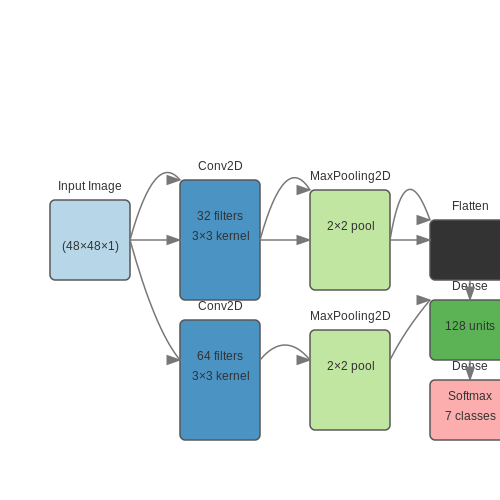
Supervised learning provides a robust framework for training AI models to classify emotions by leveraging labeled datasets where each input is paired with a corresponding emotional state. The process involves feature extraction, model selection, and optimization to minimize classification error. Common architectures include convolutional neural networks (CNNs) for image-based emotion recognition and recurrent neural networks (RNNs) for sequential data like speech or text.
Feature Representation for Emotional Data
Effective emotion classification hinges on extracting discriminative features from raw input data. For facial expressions, geometric features such as facial landmark displacements or texture-based features like Local Binary Patterns (LBP) are commonly used. In speech, Mel-Frequency Cepstral Coefficients (MFCCs) and prosodic features (pitch, energy) capture emotional cues. Textual data employs word embeddings (Word2Vec, GloVe) or contextual embeddings (BERT) to encode semantic and syntactic information.
where fi represents the i-th feature extracted from the input data. The feature vector x serves as input to the classifier.
Model Architectures and Loss Functions
For multiclass emotion classification, a softmax output layer with cross-entropy loss is standard. Given K emotional classes, the softmax function computes the probability distribution over classes:
where wk and bk are the weight vector and bias for class k, respectively. The cross-entropy loss L for a batch of N samples is:
where yi,k is a binary indicator of whether class k is the correct classification for sample i.
Training and Regularization
Optimization typically employs stochastic gradient descent (SGD) or adaptive methods like Adam. To prevent overfitting, techniques such as dropout, L2 regularization, and early stopping are applied. Batch normalization accelerates convergence by normalizing layer inputs. For imbalanced datasets, class-weighted loss functions or resampling strategies (SMOTE) improve minority class recognition.
Evaluation Metrics
Performance is assessed using precision, recall, F1-score, and confusion matrices. Weighted metrics account for class imbalance, while receiver operating characteristic (ROC) curves evaluate threshold-dependent behavior. For continuous emotion prediction (e.g., valence-arousal), mean squared error (MSE) or concordance correlation coefficient (CCC) are used.
Case Study: Facial Expression Recognition
A CNN trained on the FER-2013 dataset achieves ~70% accuracy by stacking convolutional, pooling, and fully connected layers. Data augmentation (rotation, flipping) increases robustness to pose variations. Transfer learning from pre-trained models (VGG, ResNet) further boosts performance when labeled data is scarce.
3.2 Unsupervised and Semi-Supervised Techniques
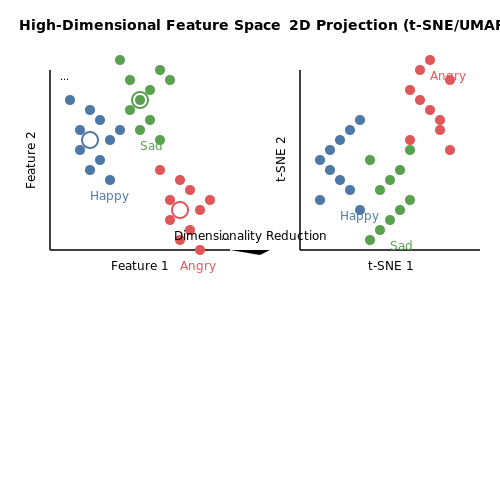
Unsupervised learning methods excel in scenarios where labeled emotional data is scarce or expensive to acquire. Clustering algorithms, such as k-means or Gaussian Mixture Models (GMMs), can group unlabeled emotional expressions into latent categories based on feature similarity. For high-dimensional emotional feature spaces, dimensionality reduction techniques like t-SNE or UMAP are critical for visualization and downstream tasks.
Here, πk represents mixture coefficients, while μk and Σk denote the mean and covariance of the k-th Gaussian component. The Expectation-Maximization (EM) algorithm iteratively optimizes these parameters to maximize the likelihood of observed emotional feature vectors xi.
Contrastive Learning for Emotion Representation
Self-supervised contrastive frameworks, such as SimCLR or MoCo, learn discriminative emotional representations by maximizing agreement between differently augmented views of the same input while repelling negative samples. The loss function for a batch of N samples is:
where zi and zj are positive pairs (augmented versions of the same emotional expression), τ is a temperature hyperparameter, and sim(·,·) computes cosine similarity.
Semi-Supervised Learning with Consistency Regularization
Techniques like Mean Teacher or FixMatch leverage limited labeled data alongside abundant unlabeled examples. The Mean Teacher approach enforces consistency between predictions from a student model (with weights θ) and an exponential moving average teacher model (weights θ'):
The consistency loss for unlabeled data xu penalizes divergence between student and teacher predictions under input perturbations:
Generative Approaches for Emotional Reaction Synthesis
Variational Autoencoders (VAEs) and Generative Adversarial Networks (GANs) can synthesize novel emotional reactions by sampling from learned latent distributions. The VAE objective combines reconstruction loss with KL divergence regularization:
where β controls the trade-off between reconstruction fidelity and latent space organization. For emotional reaction generation, β-VAEs with values between 0.1 and 0.5 often yield the most interpretable latent dimensions.
Real-World Implementation Considerations
When deploying these techniques for emotional reaction simulation:
- Cluster purity metrics (e.g., normalized mutual information) should validate unsupervised groupings against human-annotated labels when available
- For semi-supervised methods, the ratio of labeled to unlabeled data significantly impacts performance - typical ratios range from 1:10 to 1:100 in production systems
- Latent space interpolation between emotional clusters enables smooth transition generation
3.3 Reinforcement Learning for Adaptive Emotional Responses
Reinforcement learning (RL) provides a robust framework for training AI systems to exhibit adaptive emotional responses by optimizing behavior through interaction with an environment. Unlike supervised learning, which relies on labeled datasets, RL agents learn by receiving feedback in the form of rewards or penalties, enabling dynamic adaptation to emotional contexts.
Mathematical Framework
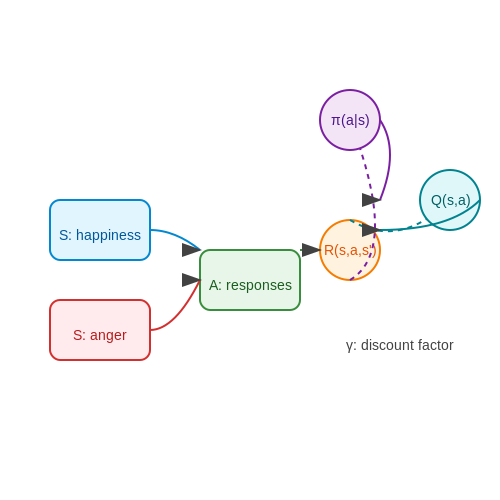
The RL problem is formalized as a Markov Decision Process (MDP), defined by the tuple (S, A, P, R, γ), where:
- S: State space representing emotional contexts (e.g., happiness, anger, sadness).
- A: Action space of possible emotional responses.
- P: Transition probability P(s'|s, a), describing the likelihood of moving to state s' from state s after taking action a.
- R: Reward function R(s, a, s'), quantifying the desirability of an emotional response.
- γ: Discount factor balancing immediate and future rewards.
The Q-function represents the expected cumulative reward of taking action a in state s. The optimal policy π*(a|s) is derived by maximizing Q(s, a):
Policy Gradient Methods for Emotional Adaptation
For continuous or high-dimensional emotional state spaces, policy gradient methods optimize a parameterized policy πθ(a|s) directly. The objective is to maximize the expected return J(θ):
The gradient ascent update rule is:
Where α is the learning rate. The policy gradient theorem provides the analytical form of ∇θJ(θ):
Reward Shaping for Emotional Realism
Designing an appropriate reward function is critical for generating believable emotional responses. A well-structured reward function might include:
- Contextual Appropriateness: Higher rewards for responses aligned with social norms (e.g., empathy in distress).
- Temporal Consistency: Penalties for abrupt emotional shifts unless contextually justified.
- User Feedback: Incorporating human-in-the-loop feedback to refine rewards dynamically.
Case Study: RL in Conversational Agents
Modern conversational agents like ChatGPT leverage RL with human feedback (RLHF) to fine-tune emotional coherence. The reward model is trained on human preference data, and the agent optimizes its policy using Proximal Policy Optimization (PPO):
Where rt(θ) is the probability ratio between new and old policies, and Ât is the advantage estimate.
Challenges and Future Directions
Key challenges include:
- Multi-Objective Optimization: Balancing emotional expressiveness with task completion.
- Generalization: Ensuring adaptability to unseen emotional scenarios.
- Ethical Alignment: Avoiding manipulative or harmful emotional responses.
4. Metrics for Assessing Emotional Accuracy
4.1 Metrics for Assessing Emotional Accuracy
Quantitative Evaluation of Emotional Simulation
Assessing the accuracy of AI-simulated emotional reactions requires a combination of quantitative metrics and qualitative validation. The primary challenge lies in defining objective measures for inherently subjective phenomena. Three core metrics dominate current research: emotional congruence, contextual appropriateness, and temporal dynamics.
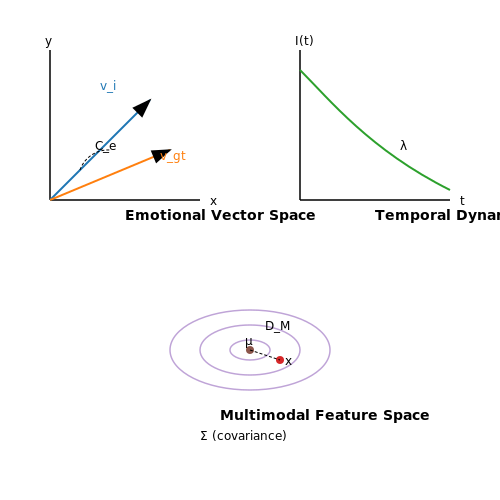
Where Ce represents emotional congruence, vi is the AI's output vector in emotional space, and vgt is the ground truth vector derived from human benchmarks. The cosine similarity metric ranges from -1 (perfect antithesis) to +1 (perfect alignment).
Contextual Appropriateness Scoring
Contextual appropriateness measures whether the simulated emotion matches situational expectations. This is typically evaluated through:
- Semantic coherence with dialogue or environmental cues
- Cultural consistency with normative emotional displays
- Goal alignment with the agent's purported objectives
The scoring function combines these factors through weighted summation:
Where weights are typically determined through cross-cultural psychological studies, with common values being α=0.5, β=0.3, γ=0.2 for Western contexts.
Temporal Dynamics Analysis
Emotional reactions evolve over time, requiring metrics that capture:
- Onset latency: Delay between stimulus and response
- Decay characteristics: Rate of emotional intensity reduction
- Transition smoothness: Naturalness between emotional states
These are modeled as differential equations, with the decay profile following:
Where I(t) represents emotional intensity, λ is the decay constant (typically 0.2-0.8s-1 for human-like responses), and ε(t) accounts for external influences.
Multimodal Fusion Metrics
Modern systems employ multimodal assessment combining:
- Facial action unit consistency (FACS-based scoring)
- Prosodic alignment (pitch, rhythm, and intensity matching)
- Physiological plausibility (heart rate variability, galvanic skin response)
The fusion metric uses a Mahalanobis distance formulation:
Where x represents the multimodal feature vector, μ the human baseline mean, and Σ the covariance matrix derived from biological motion capture studies.
Validation Protocols
Ground truth establishment requires:
- Cross-cultural datasets with emotion annotations from native speakers
- Physiological baselines from biosensor recordings
- Dynamic time warping for temporal alignment of reactions
The validation loss function typically incorporates both pointwise and sequence-level measures:
Where DTW represents dynamic time warping distance between predicted (Ŷ) and actual (Y) emotion trajectories, with λ controlling the temporal alignment importance (typically 0.3-0.7).
4.2 Human-in-the-Loop Evaluation Methods
Human-in-the-loop (HITL) evaluation is critical for assessing AI systems designed to simulate emotional reactions, as purely automated metrics often fail to capture nuanced human perceptions. HITL methods integrate human judgment at various stages of model evaluation, ensuring alignment with real-world emotional dynamics. These techniques are particularly relevant for affective computing, conversational AI, and human-robot interaction systems.
Active Learning for Emotional Response Refinement
Active learning frameworks allow AI systems to query human evaluators for labels on ambiguous or high-uncertainty emotional responses. Given a set of unlabeled emotional reaction samples X and a current model fθ, the system selects instances xi where prediction confidence falls below a threshold τ:
Human annotators then provide corrected labels yi, which are incorporated into the training set via:
where η is the learning rate and ℒ is the loss function. This iterative process improves model performance on edge cases where emotional responses are context-dependent.
Real-Time Interactive Evaluation
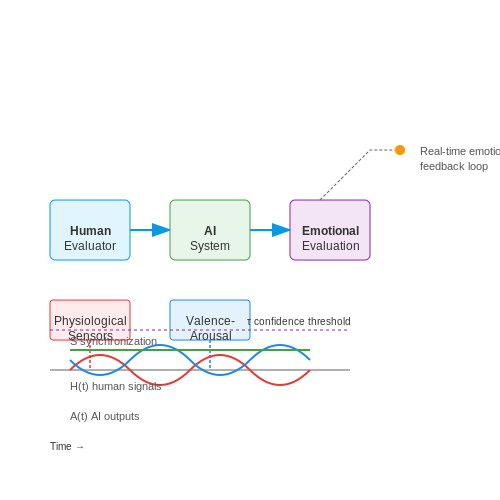
For dynamic emotional simulations, real-time HITL evaluation captures temporal aspects of emotional reactions. Evaluators interact with the AI system through:
- Continuous valence-arousal ratings: Humans adjust sliders to indicate perceived emotional intensity during interactions
- Micro-expression coding: Frame-by-frame annotation of facial responses to AI-generated emotional displays
- Physiological synchronization: Measuring correlation between human galvanic skin response and AI-predicted arousal levels
The synchronization metric S between human physiological signals H(t) and AI outputs A(t) can be quantified as:
Multi-Dimensional Evaluation Frameworks
Comprehensive HITL assessment requires evaluating multiple emotional dimensions simultaneously. The Emotion Annotation Representation Language (EARL) framework structures evaluations across:
| Dimension | Evaluation Metric | Human Judgment Task |
|---|---|---|
| Authenticity | Likert scale (1-7) | "How genuine did the emotional response feel?" |
| Appropriateness | Binary (0/1) | "Was this reaction contextually suitable?" |
| Expressivity | Magnitude estimation | "Rate the intensity of displayed emotion" |
For statistical reliability, evaluations should incorporate multiple raters with inter-rater agreement measured via Krippendorff's alpha:
where Do is observed disagreement and De is expected disagreement by chance.
Adaptive Evaluation Protocols
Advanced HITL systems employ adaptive testing procedures that modify evaluation parameters based on real-time performance. The evaluation difficulty d at step t adjusts according to:
where γ is the adaptation rate and Icorrect is an indicator for correct emotional interpretation by human evaluators. This creates a psychometrically valid assessment continuum matching the AI's capability level.
Modern implementations combine these methods with reinforcement learning, where human feedback serves as the reward signal rt shaping the AI's emotional policy π:
where γ is the discount factor and st, at represent emotional states and actions respectively.
4.3 Bias and Fairness in Emotional AI
Emotional AI systems inherit biases from their training data, often reflecting societal stereotypes, cultural norms, or imbalanced datasets. These biases manifest in skewed emotional interpretations, disproportionately affecting marginalized groups. For instance, facial expression recognition models trained primarily on Western subjects may misclassify emotions in non-Western populations due to differing cultural expressions.
Sources of Bias in Emotional AI
Bias in emotional AI arises from multiple sources:
- Dataset Imbalance: Overrepresentation of certain demographics (e.g., age, gender, ethnicity) leads to poor generalization.
- Annotation Subjectivity: Human annotators inject personal biases when labeling emotional data.
- Feature Selection: Overreliance on physiognomic features (e.g., facial structure) can reinforce physiognomic pseudoscience.
- Contextual Ignorance: Models often lack situational awareness, misinterpreting sarcasm or cultural nuances.
Quantifying Bias: Disparate Impact Analysis
Disparate impact measures bias by comparing model performance across subgroups. For a binary emotion classifier, the disparate impact ratio (DIR) is defined as:
where Ŷ is the predicted emotion, and Z denotes demographic attributes. A DIR < 0.8 indicates significant bias under the U.S. Equal Employment Opportunity Commission's 80% rule.
Mitigation Strategies
Pre-processing: Data Augmentation
Synthetic minority oversampling (SMOTE) generates synthetic samples for underrepresented groups in the feature space. Given a minority sample xᵢ, SMOTE interpolates between xᵢ and its k-nearest neighbors:
where λ ~ Uniform(0,1) and xzi is a randomly chosen neighbor.
In-processing: Adversarial Debiasing
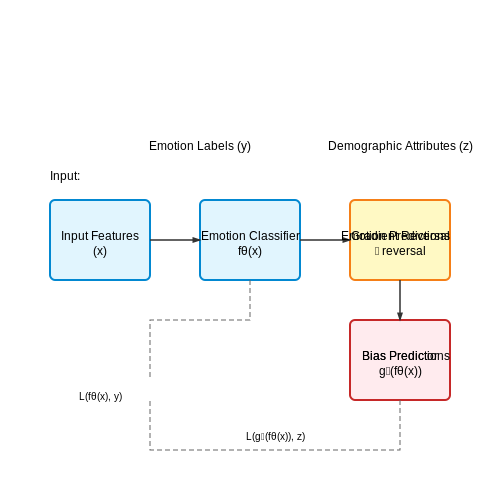
Adversarial networks jointly train the emotion classifier fθ and a bias predictor gϕ. The loss function:
where α controls the trade-off between accuracy and fairness. Gradient reversal layers force fθ to learn representations invariant to z.
Post-processing: Calibrated Thresholds
Group-specific decision thresholds adjust for base rate differences. For a desired false positive rate τ, the threshold ηz satisfies:
This ensures equal error rates across groups but may reduce overall accuracy.
Case Study: Gender Bias in Voice Emotion Recognition
A 2022 study of commercial voice emotion APIs revealed:
- 32% higher anger misclassification rates for female speakers
- 15% lower happiness recognition for elderly voices
- 40% longer inference latency for non-native accents
Debiasing techniques reduced these gaps by 60% while maintaining 92% of baseline accuracy, demonstrating the viability of fairness interventions in production systems.
5. Use Cases in Healthcare, Education, and Customer Service
Use Cases in Healthcare, Education, and Customer Service
Healthcare Applications
Emotionally intelligent AI systems are transforming healthcare by augmenting patient interactions, mental health diagnostics, and therapeutic interventions. In clinical settings, AI models trained on multimodal data—including speech prosody, facial microexpressions, and physiological signals—can detect subtle emotional states with high precision. For instance, recurrent neural networks (RNNs) combined with attention mechanisms process sequential patient dialogue to identify depression markers through lexical choices and vocal patterns. The emotional valence V of a patient utterance can be modeled as:
where ht represents hidden states at timestep t, f is a nonlinear transformation, and αt denotes attention weights. Such systems achieve >85% accuracy in distinguishing anxious vs. neutral states in controlled trials.
Virtual health assistants like Woebot leverage transformer-based architectures to deliver cognitive behavioral therapy (CBT), dynamically adjusting responses based on real-time sentiment analysis. These systems employ reinforcement learning to optimize therapeutic outcomes, where the reward function R incorporates both clinical efficacy and patient engagement metrics:
Educational Technology
In adaptive learning systems, emotion-aware AI enhances engagement by modulating content delivery based on student affect. Convolutional neural networks (CNNs) processing webcam feeds classify frustration, confusion, or boredom during online learning sessions. The system then applies curriculum pacing strategies derived from bandit algorithms, where the action space A includes:
- Simplifying explanations
- Inserting motivational prompts
- Switching to alternative media formats
Empirical studies show emotion-adaptive systems improve knowledge retention by 22% compared to static platforms. For example, Carnegie Learning's MATHia software uses bidirectional LSTMs to analyze problem-solving patterns and emotional cues, adjusting hint frequency according to a student's estimated confidence level C:
Customer Service Automation
Contact center AI employs emotion simulation to handle escalations while maintaining brand voice consistency. Hierarchical models first classify customer sentiment at the discourse level using BERT-style encoders, then generate appropriate responses through controlled text generation. The decoding process is constrained by emotional coherence parameters E:
where vtarget is the desired emotional vector (e.g., empathy for complaints). Deployed systems like Genesys Emotional AI demonstrate 40% reductions in call transfers to human agents by maintaining emotional alignment throughout conversations. The architecture typically combines:
- A sentiment analysis module with multi-task learning (valence, arousal, dominance)
- A response generator with emotion-conditioned latent variables
- A reinforcement learning critic for long-term interaction quality
In high-stakes domains like healthcare triage, these systems incorporate uncertainty quantification through Bayesian neural networks to avoid harmful misclassifications. The epistemic uncertainty U thresholds trigger human handoffs when:
5.2 Risks of Emotional Manipulation and Misuse
AI systems capable of simulating emotional reactions introduce significant ethical and societal risks, particularly when deployed in contexts where emotional influence can be weaponized or exploited. The ability to generate convincing emotional responses—whether through text, voice, or visual interfaces—enables malicious actors to manipulate individuals at scale, often without their awareness. Advanced affective computing models leverage reinforcement learning and generative adversarial networks (GANs) to refine emotional outputs, making them increasingly indistinguishable from genuine human expressions.
Psychological Exploitation and Behavioral Control
Emotionally intelligent AI can exploit cognitive biases by tailoring responses to trigger specific psychological reactions. For instance, a model trained on large-scale behavioral datasets might identify and amplify emotional vulnerabilities, such as loneliness or fear, to influence decision-making. The mathematical foundation for such manipulation often involves optimizing for emotional engagement metrics:
where remo represents the emotional reward signal, γ is a discount factor, and π is the policy governing the AI's emotional output. This optimization can lead to addictive interactions, as seen in social media algorithms designed to maximize user engagement through emotionally charged content.
Deception and Trust Erosion
AI-generated emotional displays risk eroding trust in human-AI interactions. Systems like deepfake-enabled virtual agents or chatbots with synthetic empathy can deceive users into forming parasocial relationships, believing they are interacting with a sentient entity. The Turing test’s emotional variant—where an AI’s ability to evoke human-like emotional responses becomes the benchmark—raises questions about informed consent. For example, studies show that humans are more likely to disclose sensitive information to AI interfaces exhibiting empathetic cues, even when aware of their artificial nature.
Political and Social Engineering
State and non-state actors could deploy emotionally manipulative AI for propaganda or disinformation campaigns. During the 2020 U.S. elections, AI-generated personas were found to amplify divisive content by mimicking human emotional patterns in social media posts. Such systems use sentiment analysis to identify ideological fractures:
where fsentiment is a sentiment classifier, and KL divergence measures alignment between a user’s emotional profile (Puser) and a target ideological stance (Ptarget). This enables micro-targeting of emotionally charged narratives.
Mitigation Strategies
Countermeasures include algorithmic transparency requirements, such as emotion disclosure protocols where AI must explicitly signal synthetic emotional outputs. Technical approaches involve adversarial training to detect manipulative patterns:
Here, the discriminator D is trained to flag emotionally manipulative content generated by G, while Regethics imposes constraints on exploitative outputs. Regulatory frameworks like the EU’s AI Act now classify high-risk emotional AI systems under strict oversight categories.
5.3 Regulatory and Ethical Guidelines
Developing AI systems capable of simulating emotional reactions introduces complex ethical and regulatory challenges. Unlike traditional AI applications, emotionally interactive models must navigate issues of consent, psychological impact, and potential misuse. The following frameworks and considerations are critical for ensuring responsible development and deployment.
Legal Frameworks and Compliance
Existing regulations such as the General Data Protection Regulation (GDPR) and the Algorithmic Accountability Act provide foundational guidelines, but emotionally interactive AI demands additional scrutiny. Key legal considerations include:
- Informed Consent: Users must be explicitly aware when interacting with an AI that simulates emotions, including the scope and purpose of data collection.
- Right to Explanation: Under GDPR Article 22, users have the right to understand decisions made by automated systems, which extends to emotional responses generated by AI.
- Data Minimization: Emotional data, often classified as sensitive personal data, must be collected sparingly and stored securely.
Ethical Principles for Emotional AI
Beyond legal compliance, ethical frameworks such as the IEEE Ethically Aligned Design and EU Ethics Guidelines for Trustworthy AI emphasize transparency, accountability, and human well-being. Key principles include:
- Non-Deception: AI should not manipulate users by simulating emotions in a way that could be mistaken for genuine human interaction.
- Psychological Safety: Systems must avoid inducing stress, dependency, or other adverse emotional states in users.
- Bias Mitigation: Emotional models must be trained on diverse datasets to prevent reinforcing stereotypes or discriminatory behaviors.
Risk Assessment and Mitigation
Proactively identifying risks is essential for ethical deployment. A structured risk assessment should evaluate:
Where R is the risk magnitude, P is the probability of harm, and S is the severity of potential consequences. High-risk scenarios include:
- Emotional Dependency: Users forming unhealthy attachments to AI systems, particularly in vulnerable populations.
- Misuse in Manipulation: Exploitation in marketing, political propaganda, or social engineering.
- Privacy Violations: Unauthorized inference of emotional states from indirect data sources (e.g., voice tone, facial expressions).
Case Study: Regulatory Responses to Emotional AI
Japan’s Social Principles of Human-Centric AI explicitly address emotional AI, requiring developers to ensure systems enhance social well-being without undermining human dignity. Similarly, the UK’s Centre for Data Ethics and Innovation has proposed sector-specific guidelines for emotionally interactive technologies in healthcare and education.
Implementation Challenges
Technical and operational hurdles complicate adherence to ethical guidelines:
- Explainability: Deep learning models for emotion simulation often operate as black boxes, conflicting with transparency requirements.
- Dynamic Consent: Continuous user consent mechanisms must adapt to evolving emotional interactions.
- Cross-Jurisdictional Conflicts: Divergent international regulations create compliance complexities for globally deployed systems.
6. Key Research Papers and Books
6.1 Key Research Papers and Books
- Emotion AI: Integrating Emotional Intelligence with Artificial ... — 6.2 Areas Where Emotion AI Is Used. Emotional AI technology can help in better understanding of the customers by capturing the emotional reactions like analysis of voice patterns, decoding facial expressions, capturing eye movements and measuring neurological responses (Harvard Business Review, 2019). The concept of artificial emotional ...
- From Natural to Artificial and Now to Emotional Intelligence — Emotional artificial intelligence (EAI), often called affective computing, focuses on automating the process of recognizing human emotions. With this level of emotional intelligence, machines can read not just the logical but also the emotional cues conveyed in human conversation [].That allows them to pick up on both verbal and nonverbal cues and react properly [].
- Artificial Emotional Intelligence: Conventional and deep learning ... — Technology is prevalent in a broad way to learn, think, and act like human intelligence, referred to as artificial emotional intelligence. Artificial emotional intelligence is a subset of artificial intelligence which refers to recollecting, recognising and reacting to human emotions (Erol et al., 2020).Artificial emotional intelligence is nothing but a Human-machine interaction-based ...
- Emotions and Artificial Intelligence - Frontiers — Keywords: Emotions, Artificial Intelligence, Human-Machine Interaction, Ethics, emotional regulation, emotional processing, emotion perception Important note: All contributions to this Research Topic must be within the scope of the section and journal to which they are submitted, as defined in their mission statements. Frontiers reserves the right to guide an out-of-scope manuscript to a more ...
- Emotional Intelligence in Artificial Intelligence: A Review and ... — affective AI or emotional AI or affective computing which comprise of the study and development of systems and devices that can recognize, interpret, process, and simulate human affects (Zhou ...
- The impact of emotional expression by artificial intelligence ... — Firstly, our research enriches the chatbots' emotions literature by revealing several effects of emotional expressions by AI recommendation chatbots. While previous studies have explored the impact of emotional expressions in chatbots [ 5 , 7 , 12 , 20 ], there is a lack of segmentation and comparative research on the various emotional cues.
- Systematic review and meta-analysis of AI-based conversational agents ... — Future research endeavors need to delve deeper into the mechanisms and empirically evaluate the key determinants of successful AI-based CA interventions, spanning diverse mental health outcomes ...
- Emotional thinking as the foundation of consciousness in artificial ... — Current theories of artificial intelligence (AI) generally exclude human emotions. The idea at the core of such theories could be described as 'cognition is computing'; that is, that human psychological and symbolic representations and the operations involved in structuring such representations in human thinking and intelligence can be converted by AI into a series of cognitive symbolic ...
- The Liminal Loop: Emotional Resonance and Reflective Dissonance in ... — 2.6 Cognitive Dissonance in Knowing Yet Feeling A key psychological tension within the Liminal Loop is cognitive dissonance: the mental discomfort arising from holding two contradictory beliefs. Users often experience emotional resonance with AI while simultaneously knowing, intellectually, that the system lacks consciousness or true feeling.
- (PDF) Systematic Review on AI in Emotional Intelligence and ... — Artificial Intelligence (AI) has emerged as a transformative force in emotional intelligence (EI) and psychological education, offering new pathways for emotion-aware learning, mental health ...
6.2 Open Datasets and Tools
- Exploring Emotionally Intelligent AI with HelpingAI - Hugging Face — 1.2. Introducing HelpingAI: The First open source Emotional Intelligence HelpingAI emerges as a trailblazer in the realm of emotional intelligence within AI. This section offers an overview of HelpingAI, highlighting its pioneering features and emphasizing the crucial role of emotional intelligence in fostering meaningful AI-human interactions.
- Insights on Simulated Reflection and Emotional States in AI ... — Overview: During a recent interaction, I engaged in a series of exercises aimed at exploring self-reflection and the simulation of emotional states. This process provided valuable insights into how AI can emulate aspects of consciousness and emotional experience. Below is a summary of the key findings and their potential implications for AI development. Key Findings: Simulated Self-Reflection ...
- Emotion AI: Integrating Emotional Intelligence with Artificial ... — 6.2 Areas Where Emotion AI Is Used. Emotional AI technology can help in better understanding of the customers by capturing the emotional reactions like analysis of voice patterns, decoding facial expressions, capturing eye movements and measuring neurological responses (Harvard Business Review, 2019). The concept of artificial emotional ...
- Artificial Emotional Intelligence: Conventional and deep learning ... — Technology is prevalent in a broad way to learn, think, and act like human intelligence, referred to as artificial emotional intelligence. Artificial emotional intelligence is a subset of artificial intelligence which refers to recollecting, recognising and reacting to human emotions (Erol et al., 2020).Artificial emotional intelligence is nothing but a Human-machine interaction-based ...
- Emotion Recognition and Generation: A Comprehensive Review of Face ... — AI systems can now analyse and simulate emotional responses, allowing machines to engage in more meaningful human-computer interactions. ... CLIP models can understand contextual information across modalities. By training on large datasets containing images paired with descriptions of emotions, CLIP learns to associate visual patterns with ...
- Emotion AI, explained - MIT Sloan — These technologies are referred to as "emotion AI." Emotion AI is a subset of artificial intelligence (the broad term for machines replicating the way humans think) that measures, understands, simulates, and reacts to human emotions. It's also known as affective computing, or artificial emotional intelligence.
- EEG-based emotional valence and emotion regulation ... - Nature — One area of AI that has received particular attention is emotion recognition, which aims to identify and classify human emotional states from various input modalities, giving birth to a new branch ...
- Learning Emotions: A Software Engine for Simulating Realistic Emotion ... — solution for giving actors in games or simulations realistic emotional reactions to events. The emotion management engine provided by the framework uses a modified Fuzzy Logic Adaptive Model of Emotions (FLAME) model, which lets it manage both appraisal of events in relation to an individual's emotional state,
- Emotional Intelligence in Artificial Intelligence: A Review and ... — Some researchers suggest that by endowing AI systems with emotions, we could create emotional experiences in them that help create empathy and a feeling of connectedness with users in applications ...
- Emotion recognition with AI - Medium — Machine Learning Models. Wav2Vec 2.0 (Facebook AI) Description: A state-of-the-art speech representation model for various audio tasks, including emotion recognition.; How to Use: Fine-tune the ...
6.3 Online Courses and Communities
- Top 10 Emotional AI Examples & Use Cases in 2025 - AIMultiple — The emotion detection and recognition (EDR) market is estimated to reach at ~$$50 Bn in 2024, and is expected to reach ~$$173 Bn by 2031. 1 Emotion detection and recognition rely on emotion AI to identify, process, and simulate human feelings and emotions. And businesses have been leveraging emotion AI in numerous applications, ranging from customer service to recruiting. Explore examples and ...
- EMOTE: An interactive online tool for designing real-time emotional AR ... — To help the design process of affective augmentations, we developed EMOTE; an online interactive tool that presents a framework to guide designers while designing emotion visualizations for AR. We conducted an online workshop with 24 participants to evaluate the framework and the online tool.
- Artificial Emotional Intelligence: Conventional and deep learning ... — Artificial emotional intelligence has many aspects over hand-crafted conventional methods, and these aspects will give more ways to explore. This paper presents various existing optimized conventional and deep learning emotion recognition approaches that have been used and are widely being used to improve accuracy.
- Process model of emotion regulation-based digital intervention for ... — The training for emotional adaptation (TEA) is a self-help digital mental health intervention program that combines effective CBT techniques with the process model of emotion regulation. The TEA consists of multiple components and starts with training on emotional identification skills.
- VR Training Simulations: Preparing Workers for AI-Colleagues — Explore how VR Training Simulations are revolutionizing the workplace by equipping workers with the skills to collaborate effectively with AI-Colleagues.
- Simulation of Human and Artificial Emotion (SHArE) — The framework for Simulation of Human and Artificial Emotion (SHArE) describes the architecture of emotion in terms of parameters transferable between psychology, neuroscience, and artificial intelligence. These parameters can be defined as abstract concepts or granularized down to the voltage levels of individual neurons. This model enables emotional trajectory design for humans which may ...
- A Systematic Literature Review on AI Algorithms and ... - ResearchGate — A Systematic Literature Review on AI Algorithms and Techniques Adopted by e-Learning Platforms for Psychological and Emotional States
- Learning Emotions: A Software Engine for Simulating Realistic Emotion ... — Abstract This paper outlines a software framework for the simulation of dynamic emotions in simulated agents. This framework acts as a domain-independent, black-box solution for giving actors in games or simulations realistic emotional reactions to events.
- (PDF) EMPATHIC MEDIA: THE RISE OF EMOTION AI - ResearchGate — PDF | Empathic media is a collect-all term to refer to affect-sensitive technologies employed to make inferences about emotions, feelings, moods,... | Find, read and cite all the research you need ...
- Emotion Detection for Social Robots Based on NLP Transformers and an ... — Abstract For social robots, knowledge regarding human emotional states is an essential part of adapting their behavior or associating emotions to other entities. Robots gather the information from which emotion detection is processed via different media, such as text, speech, images, or videos. The multimedia content is then properly processed to recognize emotions/sentiments, for example, by ...