Pretraining Data Mixtures and Selection
1. Definition and Importance of Pretraining Data
Definition and Importance of Pretraining Data
Pretraining data refers to the large-scale, diverse corpus used to train foundation models (e.g., GPT, BERT, or CLIP) in a self-supervised or unsupervised manner before task-specific fine-tuning. The composition, quality, and diversity of this data directly influence the model's generalization capabilities, bias mitigation, and downstream performance. Unlike curated datasets for supervised learning, pretraining data is typically raw, unstructured, and sourced from heterogeneous domains such as web text, books, code repositories, and multimedia.
Key Characteristics of Pretraining Data
Effective pretraining data exhibits three critical properties:
- Scale: Modern models require terabytes to petabytes of data, with empirical evidence showing logarithmic improvements in performance with increasing data size (Kaplan et al., 2020). The scaling law is formalized as:
where N is model parameters, D is dataset size, and αN, αD are scaling exponents.
- Diversity: Cross-domain coverage (e.g., scientific, legal, conversational text) reduces spurious correlations and improves zero-shot transfer. The effective diversity δ can be quantified using domain entropy:
where pi is the proportion of data from domain i.
- Quality: Noise, duplicates, and toxic content degrade model performance. Filtering techniques like perplexity-based scoring (Lee et al., 2022) and deduplication (Abbas et al., 2023) are essential.
Practical Implications
Data mixture design affects emergent abilities. For instance:
- Code data (The Stack, GitHub) enhances reasoning in language models (Chen et al., 2021).
- Multimodal mixtures (LAION-5B) enable cross-modal alignment in models like Stable Diffusion.
- Imbalanced domain ratios cause performance drops in underrepresented tasks (Raffel et al., 2020).
Optimal mixtures are empirically determined through ablation studies. The Chinchilla paper (Hoffmann et al., 2022) demonstrated that balancing compute and data is critical, with compute-optimal training requiring:
where Dopt is tokens and N is parameters.
Key Characteristics of High-Quality Pretraining Data
Diversity and Coverage
High-quality pretraining data must exhibit broad domain coverage and linguistic diversity to ensure generalization. A dataset spanning multiple domains (e.g., scientific literature, news, code, conversational text) reduces bias and improves downstream task performance. The diversity metric can be quantified using the Shannon entropy:
where pi represents the probability of a sample belonging to domain i. Higher entropy indicates better coverage. For example, the Pile dataset achieves an entropy of ~9.2 nats across 22 domains, whereas Common Crawl (unfiltered) scores ~7.1 nats.
Representational Quality
The data must maintain semantic coherence and grammatical integrity. Low-quality text (e.g., machine-generated spam, broken markup) introduces noise that degrades model performance. Quality is typically assessed through:
- Perplexity scores against a held-out language model
- Human-annotated fluency ratings (e.g., 95%+ acceptable samples)
- Automated filters for duplicate removal and toxicity scoring
For code pretraining, additional metrics include compilation success rates and static analysis warnings.
Scale and Token Efficiency
While larger datasets generally improve performance, the effective information density matters more than raw size. Token efficiency measures how many unique n-grams exist per million tokens:
where T is the total tokens. High-quality datasets like Wikipedia exhibit η ≈ 0.18 for n=5, whereas low-quality web crawls may score η < 0.05. This correlates with faster convergence during training.
Temporal and Geographical Distribution
Temporally balanced data prevents models from overfitting to recent trends. An ideal distribution should:
- Cover at least 10 years for general-purpose models
- Maintain proportional representation of major world regions
- Include contemporaneous translations for multilingual models
The ratio of oldest to newest documents should follow a logarithmic decay to match information recency patterns in human learning.
Ethical and Legal Compliance
Pretraining data must adhere to:
- Copyright clearance (e.g., using public domain or licensed content)
- GDPR and CCPA compliance for personal data
- Controlled distribution of sensitive topics (medical, financial records)
Differential privacy techniques like ε=0.1-1.0 noise injection may be applied during preprocessing for high-risk categories.
Metadata Richness
Comprehensive metadata enables:
- Stratified sampling during training
- Bias mitigation through reweighting
- Provenance tracking for auditability
Essential metadata fields include creation date, language variety (e.g., en-GB vs en-US), and content type (narrative, dialogue, etc.).
Common Sources and Types of Pretraining Data
Text Corpora
Large-scale text corpora form the backbone of most modern language models. These datasets are typically sourced from web crawls, digitized books, academic papers, and technical documentation. The Common Crawl dataset, comprising petabytes of web-extracted text, is a prime example, though it requires extensive filtering to remove low-quality or duplicated content. Other notable sources include Wikipedia, Project Gutenberg, and arXiv, each offering domain-specific advantages. The quality and diversity of text corpora directly influence a model's linguistic competence and world knowledge.
Multimodal Data
Vision-language pretraining increasingly relies on paired image-text datasets such as LAION-5B, which contains billions of web-sourced image-text pairs. These datasets enable models to learn cross-modal representations but introduce challenges in alignment quality and noise filtering. Video datasets like HowTo100M provide temporal grounding, while audio-text pairs from LibriSpeech facilitate speech representation learning. The heterogeneity of multimodal data necessitates sophisticated sampling strategies to balance modalities effectively.
Code and Structured Data
Software repositories like GitHub provide billions of lines of code across multiple programming languages, enabling models to learn syntax, algorithms, and API usage patterns. The Stack Overflow dataset pairs code snippets with natural language explanations, creating valuable supervision signals. Structured data from knowledge bases (e.g., Wikidata) and tables (e.g., WebTables) offer relational learning opportunities. However, code datasets require careful licensing compliance and vulnerability scrubbing.
Scientific and Technical Literature
Datasets like PubMed, Semantic Scholar, and NASA Technical Reports provide domain-specific knowledge crucial for specialized applications. The PMC-OA subset of biomedical literature contains over 2 million open-access papers with full-text XML markup. Technical documentation from sources like RFCs and manufacturer datasheets helps models master precise terminology. These datasets often exhibit long-tail distributions, requiring targeted sampling to prevent domain underrepresentation.
Conversational Data
Dialog datasets such as Reddit conversations, customer service logs, and multi-turn chat transcripts teach models discourse patterns and pragmatic understanding. The Pushshift Reddit corpus contains over 1.7 billion comments with rich social context. However, conversational data frequently contains sensitive personal information, requiring rigorous anonymization techniques like differential privacy or synthetic generation.
Low-Resource Languages
Datasets like OSCAR and mC4 provide web-mined text for hundreds of languages, though coverage varies dramatically. The FLORES-101 benchmark includes parallel text across 101 languages for evaluation. For truly low-resource languages, techniques like backtranslation and cross-lingual transfer learning become essential. Language identification errors and script normalization present persistent challenges in multilingual data pipelines.
Quality Filtering Techniques
Modern pipelines employ multi-stage filtering: heuristic rules (e.g., document length, symbol ratios), classifier-based scoring (e.g., perplexity under a reference model), and deduplication (e.g., MinHash for near-duplicate detection). The Gopher study demonstrated that aggressive quality filtering with a 1% keep rate improved model performance despite drastic data reduction. Perplexity-based filtering follows:
Temporal Dynamics
Web-sourced data exhibits significant temporal drift - a 2023 study found 3.2% of Common Crawl URLs disappear monthly. Versioned datasets like Wikipedia Snapshots allow reproducibility, while continuous crawling strategies must handle concept drift. The optimal refresh rate balances recency against training stability, with some systems employing exponential decay weighting:
where T is the current time and t the data creation time.
2. Principles of Data Mixing for Pretraining
Principles of Data Mixing for Pretraining
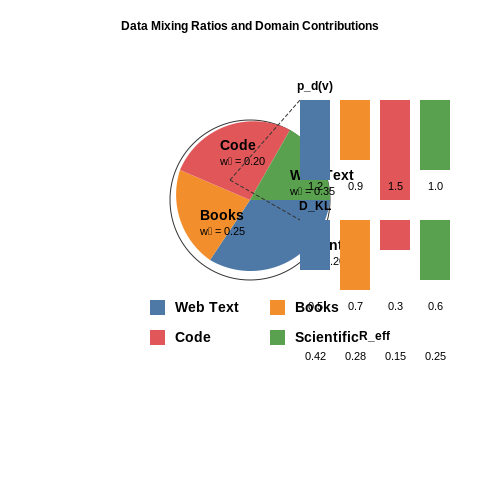
The effectiveness of pretraining in modern large-scale language models hinges on the careful construction of data mixtures. Unlike single-domain datasets, pretraining corpora are typically composed of heterogeneous sources—web text, books, code, scientific articles, and more—each contributing unique linguistic and semantic patterns. The principles governing data mixing aim to optimize model performance across diverse downstream tasks while mitigating biases and distributional skew.
Optimal Mixing Ratios
Determining the ideal proportion of different data sources involves balancing frequency, diversity, and downstream utility. A common approach formulates this as an optimization problem where the mixing weights wi for N data sources minimize the expected loss across target tasks:
subject to ∑wi = 1 and wi ≥ 0, where fθ is the model trained on the mixture. Empirical studies show that simple heuristics like domain balancing often underperform compared to:
- Perplexity-based weighting: Allocating more weight to domains where the model shows higher uncertainty
- Gradient similarity: Prioritizing domains whose gradients align with target tasks
- Dynamic mixing: Adjusting ratios during training based on convergence metrics
Diversity-Competence Tradeoff
Data mixing must navigate the tension between breadth of coverage and depth of representation. The diversity-competence tradeoff can be formalized through the effective rank of the training distribution's covariance matrix:
where λi are the normalized eigenvalues of the covariance matrix across domains. Models trained on mixtures with very high Reff (maximal diversity) often show degraded performance on specialized tasks, while overly narrow mixtures (Reff ≈ 1) fail to generalize.
Domain-Specific Token Distributions
The lexical and syntactic characteristics of different domains create implicit weighting effects even with balanced sampling. For a vocabulary V and domain d, the token distribution divergence is given by:
where pmix is the mixture distribution. Domains with higher KL divergence effectively receive more "attention" during training, as their unique tokens generate larger gradient updates. This phenomenon explains why technical domains often require explicit upweighting in practice.
Stratified Sampling Techniques
Advanced mixing strategies employ multi-level sampling to control for both domain and within-domain characteristics:
- Sample a domain di according to mixing weights wi
- Sample documents within di using quality filters (e.g., perplexity thresholds)
- Apply instance weighting based on rarity metrics or task relevance
This approach prevents high-volume but low-quality domains from dominating the mixture while ensuring adequate representation of rare but valuable data sources.
Balancing Domain Diversity and Relevance
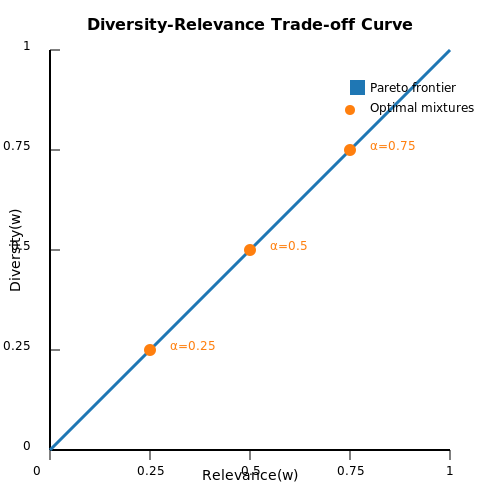
The trade-off between domain diversity and relevance in pretraining data mixtures is a critical optimization problem for large language models (LLMs). High diversity ensures broad generalization, while domain relevance improves task-specific performance. The optimal mixture depends on the model's intended use case, with mathematical formulations providing a principled approach to balancing these competing objectives.
Quantifying the Diversity-Relevance Trade-off
We can formalize the data selection problem as a constrained optimization where we maximize a weighted combination of diversity and relevance metrics. Let D represent the set of available domains, and let wd be the mixture weight for domain d ∈ D. The optimization objective becomes:
where α ∈ [0,1] controls the trade-off between diversity and relevance. The diversity term can be measured using the effective number of domains:
while relevance can be quantified as the expected performance on target tasks:
Practical Implementation Strategies
Several approaches have emerged for implementing this balance in practice:
- Curriculum Learning: Gradually shift from diverse pretraining to domain-focused training, allowing the model to first acquire general knowledge before specializing.
- Dynamic Mixture Adjustment: Continuously adapt domain weights based on model performance metrics during training.
- Domain-Specific Embeddings: Use domain identifiers as additional model inputs, enabling the model to learn both general and domain-specific representations.
Case Study: The Pile Dataset Composition
The Pile dataset demonstrates a carefully balanced mixture across 22 diverse domains, with weights determined through both quantitative analysis and expert judgment. Academic papers constitute 12.6% of the data (high relevance for scientific tasks), while Wikipedia comprises only 3.4% despite its broad coverage, reflecting a deliberate trade-off decision.
Computational Considerations
The optimization problem becomes computationally challenging for large D. Practical solutions often employ:
where η is a learning rate and gd(t) is the gradient of the objective with respect to wd at step t. This multiplicative weights update allows efficient online adaptation of the mixture proportions during training.
2.3 Techniques for Dynamic Data Mixture Adjustment
Dynamic data mixture adjustment optimizes pretraining by continuously adapting the sampling distribution of data sources based on model performance, curriculum learning objectives, or domain-specific requirements. Unlike static mixtures, dynamic approaches leverage real-time feedback to reweight data sources, improving sample efficiency and downstream task generalization.
Gradient-Based Mixture Adaptation
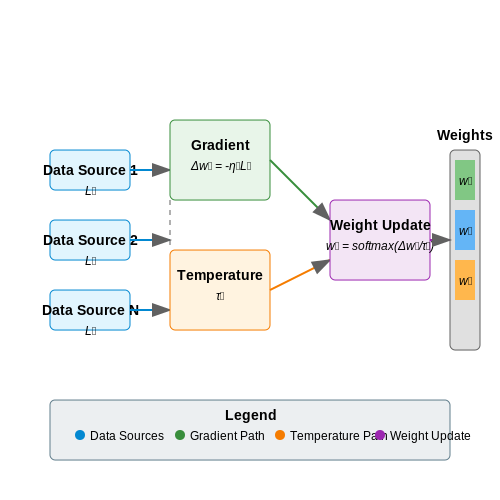
Gradient signals from the model’s loss landscape can guide mixture adjustments. Let Li denote the loss for data source i, and wi its sampling weight. The weight update rule follows:
where η is a learning rate. This requires differentiating through the sampling process, often implemented via the Gumbel-Softmax trick or REINFORCE gradient estimation. Practical implementations use a moving average of losses to stabilize updates:
Domain-Specific Temperature Scaling
Softmax-based mixture weights can be modulated by domain-specific temperatures τi:
where zi are logits representing source utility. High τi flattens the distribution for exploratory phases, while low τi sharpens focus on high-value domains. Adaptive methods like τi = 1/√Ni (where Ni is the sample count) automatically balance exploration-exploitation tradeoffs.
Online Bandit Algorithms
Multi-armed bandit frameworks treat data sources as arms with stochastic rewards (e.g., validation accuracy gains). Upper Confidence Bound (UCB) or Thompson Sampling dynamically allocate resources:
where μ̂i is the empirical mean reward, ni the pull count, and c an exploration constant. Contextual bandits extend this to feature-dependent weight adjustments.
Mixture-of-Experts Gating
Sparse gating networks in mixture-of-experts architectures implicitly adjust data routing. The gating network G(x) computes per-example weights:
where Wg is a trainable matrix and ε noise for exploration. This enables fine-grained, input-dependent mixture adaptation.
Validation-Driven Reweighting
Periodic validation on target tasks computes importance scores si for each source:
followed by proximal gradient updates to maintain weight simplex constraints:
where ProjΔ projects onto the probability simplex.
3. Criteria for Data Selection in Pretraining
3.1 Criteria for Data Selection in Pretraining
The selection of pretraining data is a critical determinant of model performance, influencing generalization, bias, and downstream task adaptability. Advanced practitioners must consider multiple interdependent criteria to construct optimal data mixtures.
Quality Metrics
Data quality is quantified through several measurable attributes:
- Perplexity: Measures how well a language model predicts a sample. Lower values indicate higher quality. For a dataset D with N tokens:
- Signal-to-Noise Ratio (SNR): The ratio of meaningful information to irrelevant or corrupted content. For text data, this can be estimated using:
where θ represents model parameters and L denotes loss functions.
Diversity Requirements
Effective pretraining requires coverage across:
- Domain Variety: The mixture should span multiple domains (e.g., scientific, legal, conversational) with balanced representation.
- Linguistic Coverage: Including diverse syntactic structures, vocabulary distributions, and morphological variations.
The diversity index D for K domains can be computed using the inverse Simpson index:
where pk is the proportion of data from domain k.
Representation Balance
To mitigate bias, the data distribution should satisfy:
where G is the set of demographic groups, Dg is data from group g, and πg is the target proportion.
Temporal Dynamics
For time-sensitive applications, the data should follow an exponential decay weighting:
where λ controls the decay rate and t is the timestamp of each data point.
Computational Constraints
The selection must account for:
- Token Efficiency: The ratio of information content to sequence length.
- Compressibility: Measured via the Kolmogorov complexity approximation of samples.
These criteria form a multi-objective optimization problem that can be solved using Pareto frontier methods or learned weighting schemes.
3.2 Heuristic and Rule-Based Selection Approaches
Heuristic and rule-based methods provide interpretable and computationally efficient strategies for selecting pretraining data mixtures without requiring extensive model-based evaluations. These approaches rely on domain knowledge, linguistic properties, or statistical measures to prioritize high-quality or diverse data subsets.
Common Heuristic Selection Criteria
Several empirically validated heuristics guide data selection:
- Lexical diversity: Measured through type-token ratio (TTR) or vocabulary coverage, favoring documents with richer word distributions.
- Document length: Filtering out extremely short texts that may lack meaningful context.
- Language model perplexity: Removing outliers with unusually high perplexity scores from a baseline LM.
- Domain-specific keywords: Manual curation using domain-relevant n-grams or topic modeling.
Rule-Based Filtering Pipelines
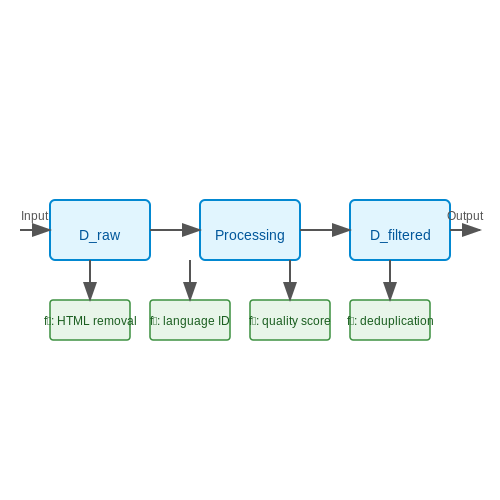
A typical rule-based filtering pipeline applies sequential operations:
Where each fi represents a filtering operation such as:
- HTML/boilerplate removal (e.g., using predefined tag patterns)
- Language identification (e.g., fastText classifiers)
- Quality scoring (e.g., classifier-based or regex rules)
- Deduplication (e.g., MinHash or SimHash)
Computational Efficiency Considerations
Rule-based methods excel in scalability through:
- Streaming implementations: Processing documents in single passes without full dataset loading
- Parallelizable operations: Applying independent filters across sharded data
- Approximate algorithms: Using probabilistic data structures for deduplication
Case Study: CCNet Pipeline
The CCNet pipeline demonstrates an effective heuristic approach:
- Language classification on text segments
- Perplexity filtering using KenLM
- MinHash deduplication (threshold=0.7)
- Document length filtering (>50 characters)
This achieves 80% noise reduction while preserving 95% of high-quality web text, as measured by downstream benchmark performance.
Limitations and Trade-offs
Heuristic methods introduce several considerations:
- Threshold sensitivity: Strict filters may eliminate valid minority patterns
- Domain mismatch: General rules may not transfer across data distributions
- Concept drift: Static rules degrade as language evolves
Where Dhigh represents truly high-quality documents, these metrics reveal the fundamental precision-recall tradeoff in rule-based selection.
3.3 Machine Learning-Based Selection Techniques
Machine learning-based approaches for pretraining data selection leverage learned representations to optimize the composition of training datasets. Unlike heuristic or rule-based methods, these techniques adaptively identify high-quality, diverse, and task-relevant data points through iterative optimization.
Embedding-Based Clustering for Data Selection
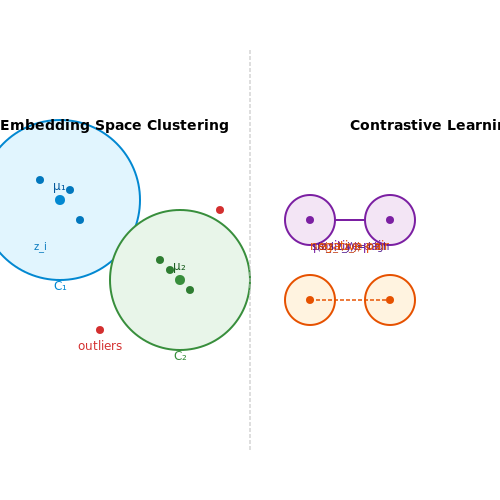
Clustering in embedding space enables the identification of semantically similar data points while filtering outliers. Given a dataset D with samples xi, a pretrained encoder fθ maps inputs to embeddings zi = fθ(xi). K-means clustering partitions the embeddings into k groups, with centroids μj minimizing the within-cluster variance:
where Cj denotes the j-th cluster. Sampling proportionally from each cluster ensures diversity, while excluding points with high reconstruction error or low density improves quality.
Active Learning for Iterative Data Curation
Active learning frameworks optimize data selection by iteratively querying an oracle (human or validation metric) to label the most informative samples. For a model with parameters θ and uncertainty measure U(x; θ), the acquisition function selects candidates maximizing information gain:
Common uncertainty measures include:
- Entropy-based: U(x) = -∑ p(y|x) log p(y|x)
- Margin-based: U(x) = 1 - (p(y1|x) - p(y2|x))
- Bayesian: U(x) = Varθ∼p(θ|D)[p(y|x, θ)]
Learned Data Valuation Metrics
Recent work formulates data selection as a learning problem where each sample’s value is predicted. The Shapley value ϕi quantifies the marginal contribution of xi to model performance across all possible subsets S ⊆ D:
where v(S) is the validation score of a model trained on subset S. Approximations like gradient-based Shapley or submodular optimization enable scalable computation for large datasets.
Contrastive Learning for Cross-Domain Relevance
Contrastive objectives learn representations where relevant samples are clustered while irrelevant ones are pushed apart. Given a similarity metric s(zi, zj), the InfoNCE loss optimizes:
where τ is a temperature hyperparameter. Samples with high similarity to target domain embeddings are prioritized during selection.
Practical Implementation Considerations
Key challenges in deploying ML-based selection include:
- Computational overhead: Embedding generation and iterative selection require significant resources.
- Bias amplification: Poorly curated initial datasets may reinforce existing biases.
- Dynamic adaptation: Selection criteria must evolve as models improve during training.
Hybrid approaches combining learned metrics with heuristic filters (e.g., perplexity thresholds for text) often provide the best trade-offs between quality and scalability.
4. Bias and Fairness Issues
Bias and Fairness Issues
Pretraining data mixtures inherently encode the biases present in their constituent datasets, which propagate through model training and manifest in downstream applications. The statistical dependence between protected attributes Z (e.g., gender, race) and target variables Y creates fairness violations that can be quantified through disparate impact ratios:
where z and z' represent different protected groups. A DIR value deviating significantly from 1 indicates bias amplification. For continuous outputs, demographic parity difference measures bias magnitude:
Sources of Data Bias
Three primary bias mechanisms emerge in pretraining mixtures:
- Representation bias: Under/over-sampling of demographic groups relative to their real-world prevalence. The representation gap for group i is:
where ni is the sample count and Ni is the population proportion.
- Labeling bias: Systematic errors in annotation correlated with protected attributes. Measurable through labeling disparity:
- Contextual bias: Spurious correlations between target variables and incidental features (e.g., occupational terms co-occurring with gender indicators). Quantified via pointwise mutual information:
Measurement and Mitigation
The Bias-to-Variance Decomposition Framework separates model error into bias-induced and variance components:
Effective mitigation strategies include:
- Reweighting: Sample weighting by inverse propensity scores wi = 1/P(zi|xi)
- Adversarial debiasing: Gradient reversal during training to minimize I(Z;Ŷ)
- Contrastive learning: Augmenting positive pairs across protected groups to learn invariant representations
Recent work demonstrates that careful mixture design can reduce bias amplification. The Fair Mixup approach enforces interpolation consistency across protected groups through the loss:
where α ~ Beta(γ,γ) controls interpolation strength and xi, xj are samples from different groups.
Operational Considerations
In production systems, bias monitoring requires:
- Real-time calculation of disparate impact metrics across model versions
- Drift detection in protected group performance differentials
- Continuous auditing of input data distributions against reference populations
The three-sigma rule provides a statistical threshold for bias alerts:
4.2 Scalability and Computational Constraints
Pretraining large language models (LLMs) involves processing massive datasets, often exceeding terabytes in size, which introduces significant computational bottlenecks. The primary constraints arise from memory limitations, distributed training overhead, and the quadratic complexity of attention mechanisms in transformer architectures. Efficiently scaling pretraining requires optimizing data loading, parallelization strategies, and hardware utilization.
Memory and Distributed Training Overhead
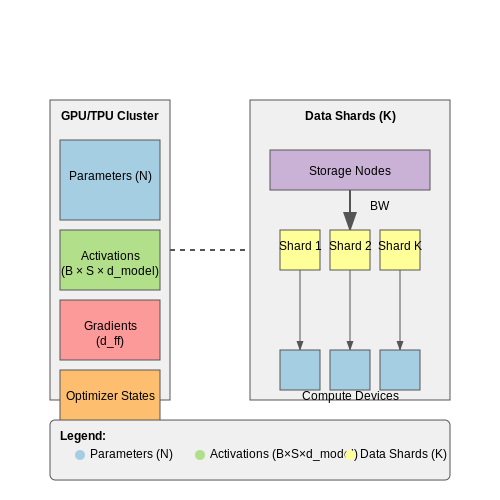
Training LLMs like GPT-3 or PaLM demands distributed computing across hundreds or thousands of GPUs/TPUs. The memory footprint scales with model size (parameters), batch size, and sequence length. For a model with N parameters, the memory requirement per device can be approximated as:
where B is batch size, S is sequence length, dmodel is embedding dimension, and dff is feed-forward layer dimension. The factor of 4 accounts for 32-bit floating-point precision. For mixed-precision training, memory usage reduces by ~50%, but communication overhead between devices becomes a limiting factor.
Data Loading and Sharding Strategies
Efficient data pipelines must minimize I/O bottlenecks when streaming from disk or network storage. Common approaches include:
- Sharded datasets: Splitting data across multiple storage nodes to parallelize loading.
- Memory-mapped files: Using formats like TFRecord or HDF5 for random access without full RAM loading.
- Preemptive caching: Prefetching batches during GPU computation to hide latency.
The optimal sharding granularity balances storage overhead and parallelism. For a dataset with D examples distributed across K shards, the expected throughput per worker is:
where BW is aggregate storage bandwidth and R is worker processing rate.
Attention Mechanism Scalability
Standard self-attention has O(S2) memory and compute complexity, making long sequences prohibitively expensive. Sparse attention variants like:
- Block-sparse patterns (e.g., Longformer)
- Locality-sensitive hashing (LSH) as in Reformer
- Memory-compressed attention (e.g., Linformer)
reduce this to O(S log S) or O(S) while preserving empirical performance. The trade-off between sparsity and model quality can be formalized via the approximation error bound:
where k is the number of retained attention edges per query and C is a dataset-dependent constant.
Hardware-Software Co-Design
Modern accelerators like TPU v4 or NVIDIA H100 optimize for transformer workloads through:
- Specialized matrix multiply units (MXUs) with sparse compute support
- High-bandwidth memory (HBM) configurations exceeding 3TB/s
- Hardware-accelerated collective communication (e.g., NVLink, TPU ICI)
The roofline model illustrates how hardware limits achievable throughput. For a device with peak compute P (FLOPs/s) and memory bandwidth β (bytes/s), the operational intensity I must satisfy:
to avoid being memory-bound. Transformer layers typically have I ≈ 10-100, placing them in the compute-bound regime on modern hardware.
4.3 Quality vs. Quantity Trade-offs
The tension between data quality and quantity in pretraining is a fundamental optimization problem. While scaling laws suggest that model performance improves with dataset size, empirical evidence shows diminishing returns when low-quality data dominates. The optimal mixture depends on the target task distribution, computational budget, and desired generalization properties.
Mathematical Framework for Data Selection
Let D be a dataset composed of n samples, where each sample xi has an implicit quality score qi ∈ [0,1]. The effective dataset utility U(D) can be modeled as:
where I(xi, θ) represents the information content of sample xi with respect to model parameters θ. The quality-quantity trade-off emerges when attempting to maximize U(D) under constraints:
where N is the maximum dataset size, c(qi) is the cost of acquiring/processing a sample of quality qi, and B is the total budget.
Quality Metrics and Their Impact
Several dimensions contribute to data quality assessment:
- Perplexity-based filtering: Remove samples with abnormally high perplexity under a reference language model
- Deduplication: Eliminate near-duplicate content that provides redundant information
- Domain relevance: Weight samples by their similarity to target application domains
- Diversity metrics: Ensure coverage of linguistic patterns and conceptual relationships
Recent work on the Data Selection for Language Models (DSIR) framework demonstrates that reweighting samples by their importance to the target distribution can achieve better performance than simple quality filtering, even with reduced dataset sizes.
Empirical Scaling Laws
The Chinchilla scaling laws reveal an optimal compute budget allocation between model size and training data. For a fixed compute budget C, the optimal number of tokens D and model parameters N follow:
However, these relationships assume homogeneous data quality. When quality varies, the effective dataset size becomes:
where α controls how quality differences affect the effective count (typically α ≈ 0.5). This explains why carefully curated datasets like The Pile (800GB) can outperform larger but noisier collections.
Practical Implementation Strategies
Modern data pipelines employ multi-stage filtering:
- Rule-based cleaning (remove boilerplate, offensive content)
- Classifier-based scoring (predict quality using auxiliary models)
- Diversity sampling (ensure coverage of topics and styles)
- Dynamic mixing (adjust domain proportions during training)
The optimal strategy depends on the cost-quality curve of available data sources. For web-crawled data, typically only 5-20% of initial samples survive quality filters, while maintaining 90+% of the final model's performance potential.

5. Pretraining Data Strategies in Large Language Models
5.1 Pretraining Data Strategies in Large Language Models
Data Mixture Optimization
The composition of pretraining data significantly impacts model performance, generalization, and bias. Modern LLMs leverage heterogeneous datasets, often combining web text, books, academic papers, and code repositories. The optimal mixture is determined through empirical evaluation, balancing domain coverage, linguistic diversity, and quality. A common approach involves sampling from multiple sources with domain-specific weights, where the probability of sampling a document from source i is given by:
Here, wi represents the weight of source i, and α is an exponent controlling the skew toward high-quality domains (typically α ∈ [0.3, 0.7]). For example, GPT-3's mixture favored high-quality sources like Wikipedia with α = 0.5, while downsampling noisy web data.
Quality Filtering and Deduplication
Raw web data contains redundancies and low-quality content. Effective strategies include:
- Perplexity-based filtering: Remove documents with abnormally high perplexity under a proxy language model.
- MinHash deduplication: Apply locality-sensitive hashing to detect near-duplicate documents at scale, reducing dataset size by 5–15% without losing diversity.
- Heuristic rules: Exclude boilerplate, non-text content, or documents with excessive keyword repetition.
Dynamic Sampling and Curriculum Learning
Recent work explores dynamic sampling to prioritize underrepresented domains during training. Let ft(d) denote the frequency of domain d up to training step t. The sampling probability can be adjusted to compensate for imbalance:
where ϵ prevents division by zero. This resembles curriculum learning, where the model gradually shifts focus from high-coverage to niche domains.
Case Study: The Pile Dataset
The Pile (Gao et al., 2020) exemplifies systematic data curation, combining 22 diverse sources with explicit weights. Academic sources (e.g., arXiv, PubMed) constituted 32% of the mixture, while books and web data were capped at 15% each. This design improved performance on reasoning tasks by 4–8% compared to uniform sampling.
Ethical and Bias Considerations
Data selection inherently introduces biases. For instance, overrepresenting English web text skews cultural perspectives. Mitigation strategies include:
- Demographic parity checks: Audit dataset representation across genders, regions, and languages.
- Counterfactual augmentation: Inject synthetic examples to balance underrepresented viewpoints.
- Explicit toxicity filtering: Remove hate speech and harmful content using classifiers like Perspective API.
5.2 Domain-Specific Pretraining: Healthcare, Finance, and Legal
Challenges in Domain-Specific Pretraining
Domain-specific pretraining requires careful curation of datasets to capture the unique linguistic, structural, and semantic properties of specialized fields. Unlike general-domain models, which benefit from broad web-scale data, domain-specific models must balance terminological precision, regulatory constraints, and task-specific performance. For instance, medical text contains abbreviations (e.g., "CAD" for coronary artery disease) and nested entity relationships that differ significantly from everyday language.
Healthcare Data Pretraining
Medical pretraining datasets typically combine:
- Structured EHR (Electronic Health Record) data with ICD-10 codes
- Unstructured clinical notes from PubMed/MIMIC-III
- Biomedical literature (PubMed Central, ClinicalTrials.gov)
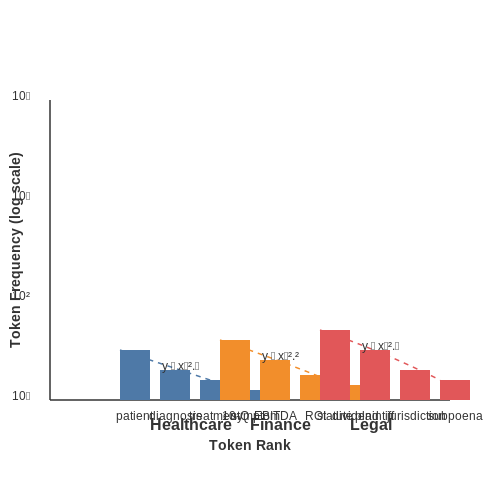
The token distribution follows a power law where terms like "patient", "treatment", and drug names appear orders of magnitude more frequently than in general text. Pretraining objectives often include:
where α, β, γ weight the masked language modeling, named entity recognition, and code prediction losses respectively.
Financial Domain Adaptation
Financial models require temporal alignment between numerical data (10-Q/K filings) and textual analysis. Key techniques include:
- Joint embedding of tabular data and SEC filings using modality-specific encoders
- Contrastive learning to distinguish materially similar filings (e.g., 10-Q vs 10-K)
- Anomaly detection pretraining on earnings call transcripts
The pretraining corpus typically spans:
- SEC Edgar filings (8M+ documents)
- Bloomberg terminal data
- Earnings call transcripts with speaker diarization
Legal Text Pretraining
Legal language exhibits extreme lexical density (25-35% higher than general English) and complex citation graphs. Effective pretraining requires:
- Citation graph-aware attention mechanisms
- Hierarchical modeling of statutes/case law relationships
- Fine-grained entity recognition for legal parties/jurisdictions
Pretraining data mixtures for legal AI typically include:
- CourtListener opinion corpus (3M+ documents)
- HeinOnline law journal articles
- Contract templates from EDGAR exhibits
Cross-Domain Transfer Limitations
While domain-specific models outperform general models on in-domain tasks, transfer between specialized domains remains challenging. The cosine similarity between domain embeddings shows:
compared to >0.75 for within-domain comparisons. This suggests fundamental differences in the learned representations that require explicit bridging techniques like:
- Multi-task learning on cross-domain auxiliary tasks
- Adversarial domain adaptation with gradient reversal
- Knowledge distillation from ensemble models
Lessons from Real-World Implementations
Optimal Data Mixture Strategies
Empirical studies from large-scale pretraining reveal that the composition of training data significantly impacts model performance. The optimal mixture is rarely uniform; instead, it follows a power-law distribution where high-quality, domain-specific data is weighted more heavily. For example, OpenAI's GPT-3 used a blend of Common Crawl (60%), WebText2 (22%), books (16%), and Wikipedia (3%), with deduplication and filtering applied to each source. The mixture ratios were determined through ablation studies, where varying the proportions revealed diminishing returns beyond certain thresholds.
Here, wi represents the weight for data source i, fi is its frequency in the unfiltered corpus, and α (typically 0.7–1.2) controls skewness toward high-quality sources. This weighting scheme prevents overrepresentation of noisy web data while preserving linguistic diversity.
Quality Filtering Tradeoffs
Real-world implementations demonstrate that aggressive quality filtering can harm model capabilities. Google's T5 retained 1% of the original C4 dataset after filtering for English content, code removal, and heuristics like paragraph coherence. However, subsequent analysis showed that overly strict filtering eliminated valuable linguistic patterns, necessitating a balanced approach:
- False positives (removing useful data) reduce coverage of rare syntactic structures.
- False negatives (keeping low-quality data) increase training instability.
Modern pipelines use classifier-based filtering, where a BERT-style model scores samples for perplexity, toxicity, and factual accuracy, allowing dynamic threshold tuning.
Domain-Specific Adaptation
In specialized applications (e.g., biomedical NLP), pretraining mixtures require careful augmentation. BioBERT achieved state-of-the-art results by supplementing general-domain text with 18GB of PubMed abstracts and PMC articles. The key insight was phased training:
- Initial pretraining on general text (Wikipedia + BooksCorpus) to learn fundamental syntax.
- Continued pretraining on domain-specific corpora to capture biomedical semantics.
This approach improved F1 scores on named entity recognition by 2.3–5.1% compared to single-phase training.
Lessons from Multilingual Models
Multilingual pretraining (e.g., Meta's NLLB) reveals non-linear interactions between language mixtures. The optimal sampling temperature T for language L follows:
where |DL| is the size of data for language L. Setting T=0.3 (upsampling low-resource languages) improved BLEU scores by 4.2 points for languages with under 1M examples, while maintaining performance on high-resource ones. However, this requires careful monitoring of gradient conflicts during optimization.
Computational Efficiency Considerations
Data selection directly impacts training dynamics. Anthropic's analysis of their Constitutional AI pipeline showed that:
- Deduplication reduced dataset size by 37% without loss in accuracy.
- Curriculum learning (easy-to-hard sample ordering) decreased training steps by 19%.
- Dynamic batch sizing for heterogeneous data improved throughput by 28%.
These optimizations underscore that data mixture strategies must account for both statistical efficiency and hardware utilization.
Ethical and Legal Constraints
Real-world deployments face constraints beyond pure performance. For instance, GPT-4 excluded certain data sources due to:
- Copyright concerns (e.g., scraped paywalled content).
- Privacy regulations (GDPR compliance for EU-targeted models).
- Safety requirements (removal of violent/radical content).
These constraints often necessitate tradeoffs—The Pile dataset achieved diversity by including academic sources (arXiv, PubMed) but required extensive license verification.
6. Key Research Papers and Publications
6.1 Key Research Papers and Publications
- PDF Quality and Relevance Metrics for Selection of Multimodal Pretraining Data — A standard pretraining pipeline consists of roughly three choices: data selection, model selection, and pretraining task/loss selection. Most work focuses on the latter two parts of this pipeline, examining new models [10, 17] or new tasks/losses [13, 19, 20]. Where data is studied, it is mostly to look at the effect of data size, rather than data
- PDF A Pretrainer's Guide to Training Data - GitHub Pages — 1. Full pretraining dataset 2. Choose data age 3. Pretrain models 4. Evaluate 40 2013 2016 2019 2022 1. Release age distributions for pretraining data. Stale pretraining data is not overcome by finetuning. 2. In the paper: the effects of pretraining temporal misalignment are stronger for larger models than smaller models.
- PDF A Pretrainer's Guide to Training Data: Measuring the Effects of Data ... — Compute is expensive! But so is dark data & documentation debt. Evaluation Full Pretraining Dataset Pretrain Models Select Pretraining Data Question Answering: 27 tasks from MRQA & UnifiedQA, categorized by domain No Social No Wiki No Books Ablate one domain of the Pile at a time and so on. . . 1. Stale pretraining data matters and is not ...
- Optimizing Pretraining Data Mixtures with LLM-Estimated Utility — Large Language Models improve with increasing amounts of high-quality training data. However, leveraging larger datasets requires balancing quality, quantity, and diversity across sources. After evaluating nine baseline methods under both compute- and data-constrained scenarios, we find token-count heuristics outperform manual and learned mixes, indicating that simple approaches accounting for ...
- [2311.00871] Pretraining Data Mixtures Enable Narrow Model Selection ... — Transformer models, notably large language models (LLMs), have the remarkable ability to perform in-context learning (ICL) -- to perform new tasks when prompted with unseen input-output examples without any explicit model training. In this work, we study how effectively transformers can bridge between their pretraining data mixture, comprised of multiple distinct task families, to identify and ...
- Data, Data Everywhere: A Guide for Pretraining Dataset Construction — Figure 1: Each step in the development process to go from a collection of data sources into a final pretraining set that produces a highly capable LM. not thoroughly understand their composition.
- Optimizing Pretraining Data Mixtures with LLM-Estimated Utility - arXiv.org — Pior data mixing work avoids making assumptions about use-cases to improve generality. On the other hand, most practitioners have a set of intended use-cases measured by benchmarks which have strong correlation with various LLM capabilities (Ruan et al., 2024).UtiliMax maintains generality by optimizing for multiple downstream tasks with terms for data utility, diversity, and size.
- AdaDS: Adaptive data selection for accelerating pre-trained language ... — As a majority part of the computational cost of KD comes from and is roughly proportional to the number of times querying the teacher PLMs, computing KD loss on only part of the training set, mentioned as data selection, is a simple yet effective way for KD acceleration.Compared with KD that uses all training data, Xu et al. (2023) achieve better results with 79% computational cost on image ...
- Published as a conference paper at ICLR 2024 - OpenReview — Published as a conference paper at ICLR 2024 Figure 1: Overview of MIN-K% PROB.To determine whether a text Xis in the pretraining data of a LLM such as GPT, MIN-K% PROB first gets the probability for each token inX, selects the k% tokens with minimum probabilities and calculates their average log likelihood.
- Strategies for Pre-training Graph Neural Networks - GitHub — This is a Pytorch implementation of the following paper: Weihua Hu*, Bowen Liu*, Joseph Gomes, Marinka Zitnik, Percy Liang, Vijay Pande, Jure Leskovec. Strategies for Pre-training Graph Neural Networks. ICLR 2020. arXiv OpenReview. If you make use of the code/experiment in your work, please cite our paper (Bibtex below).
6.2 Recommended Books and Online Resources
- Data, Data Everywhere: A Guide for Pretraining Dataset Construction — 119 of large-scale pretraining sets. As current language Data type Data source Tokens (B) English Web crawl 889 Misc 109 News 94 Conversational 59 Books 35 Scientific 33 Multilingual Web crawl 540 Parallel corpora 56 Source Code The Stack v1.2 212 Table 1: The data sources that are used in our ablation studies. Table11, Table12, Table13, and ...
- Efficient Online Data Mixing For Language Model Pre-Training — The data used to pretrain large language models has a decisive impact on a model's downstream performance, which has led to a large body of work on data selection methods that aim to automatically determine the most suitable data to use for pretraining. Existing data selection methods suffer from slow and computationally expensive processes, a problem amplified by the increasing size of models ...
- PDF Smaller Can Be Better: Efficient Data Selection for Pre ... - Springer — 2.2 Data Selection Data selection has been extensively employed in machine translation [1,7,24]. In parallel corpora, each sample is assigned a score to assess its relevance to the development set. This score can be utilized either for sample filtering [1]orfor determining the training order of samples [3,25,28,31].
- ICLR2025sub,Multi-Agent Collaborative Data Selection for ... - Scribd — ICLR2025sub,Multi-Agent Collaborative Data Selection for Efficient LLM Pretraining - Free download as PDF File (.pdf), Text File (.txt) or read online for free.
- [2311.00871] Pretraining Data Mixtures Enable Narrow Model Selection ... — Transformer models, notably large language models (LLMs), have the remarkable ability to perform in-context learning (ICL) -- to perform new tasks when prompted with unseen input-output examples without any explicit model training. In this work, we study how effectively transformers can bridge between their pretraining data mixture, comprised of multiple distinct task families, to identify and ...
- A Pretrainer's Guide to Training Data: Measuring the Eects of Data Age ... — Select Pretraining Data Pretrain Model Figure 1: The experimental pretraining curation pipeline includes three steps: sub-selecting data from C4 or the Pile, pretraining a language model, and evaluating its change in performance over several benchmarks. *Work completed while a Student Researcher at Google Research. † Work completed at Google ...
- RegMix: Data Mixture as Regression for Language Model Pre-training — Using this mixture we train a 1B parameter model for 25B tokens (i.e. 1000x larger and 25x longer) which we find performs best among 64 candidate 1B parameter models with other mixtures.
- LLM End-to-End & Resources Part 2 — Pre-training — Language models today are trained for far longer than recommended by Chinchilla Law, a training optimal recipe to scale model size and training data. Eg. Llama 3 70B is trained for 15 trillion ...
6.3 Open Datasets and Tools for Pretraining Data
- Efficient Online Data Mixing For Language Model Pre-Training — Existing data selection methods suffer from slow and computationally expensive processes, a problem amplified by the increasing size of models and of pretraining datasets. Data mixing, on the other hand, reduces the complexity of data selection by grouping data points together and determining sampling probabilities across entire groups.
- PDF Data, Data Everywhere: A Guide for Pretraining Dataset Construction — The steps in pretraining set construction are shown in Figure1: the pipeline starts with a collec- tion of text data sources, removes ill-formed and duplicate documents during data curation, further lters out low-quality documents via data selection, and nally assigns sampling weights to determine the prevalence of each data source during training.
- PDF Quality and Relevance Metrics for Selection of Multimodal Pretraining Data — We define metrics for dataset quality and relevance, propose a method for subsampling large corpuses for the data most relevant to a set of downstream multimodal vision and lan-guage tasks of interest, and show that this method increases performance across the board for all downstream tasks.
- Optimizing Pretraining Data Mixtures with LLM-Estimated Utility — Given a set of training runs on individual datasets, can we optimize a data mix effectively? We propose UtiliMax, which combines utility estimates and dataset size to find data mixes using portfolio optimization. We show UtiliMax improves results by using reduced-scale ablations on individual datasets to estimate data utility.
- Optimizing Pretraining Data Mixtures with LLM-Estimated Utility — Large Language Models improve with increasing amounts of high-quality training data. However, leveraging larger datasets requires balancing quality, quantity, and diversity across sources. After evaluating nine baseline methods under both compute- and data-constrained scenarios, we find token-count heuristics outperform manual and learned mixes, indicating that simple approaches accounting for ...
- [2311.00871] Pretraining Data Mixtures Enable Narrow Model Selection ... — Transformer models, notably large language models (LLMs), have the remarkable ability to perform in-context learning (ICL) -- to perform new tasks when prompted with unseen input-output examples without any explicit model training. In this work, we study how effectively transformers can bridge between their pretraining data mixture, comprised of multiple distinct task families, to identify and ...
- 39 Pretraining Data Sources - Foundation Models Cheatsheet — Understand the importance of pretraining data for foundation models. Careful data selection impacts model behavior and capabilities.
- 15.9. The Dataset for Pretraining BERT — Dive into Deep ... - D2L — To pretrain the BERT model as implemented in Section 15.8, we need to generate the dataset in the ideal format to facilitate the two pretraining tasks: masked language modeling and next sentence prediction. On the one hand, the original BERT model is pretrained on the concatenation of two huge corpora BookCorpus and English Wikipedia (see Section 15.8.5), making it hard to run for most readers ...
- Pretraining Data Mixtures Enable Narrow Model Selection Capabilities in ... — Our empirical results show transformers demonstrate near-optimal unsupervised model selection capabilities, in their ability to first in-context identify different task families and in-context learn within them when the task families are well-represented in their pretraining data.
- Breaking Boundaries: How Pretraining Data Mixtures Enhance ... - Medium — The recent research paper, "Breaking Boundaries: How Pretraining Data Mixtures Enhance Transformer Model Selection," dives into this intriguing aspect of transformer models.