Embedding Space Surgery for Concept Manipulation
1. What Are Embedding Spaces?
What Are Embedding Spaces?
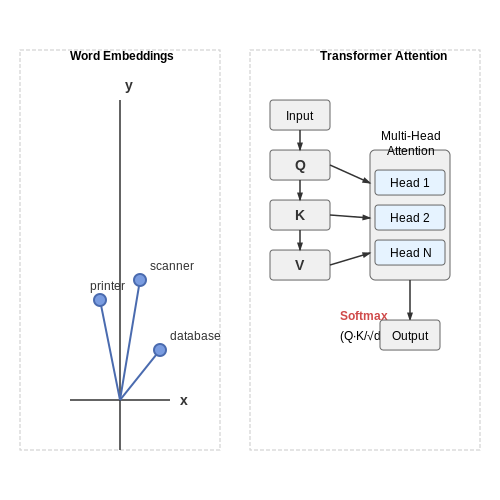
Embedding spaces are high-dimensional vector spaces where discrete objects—such as words, images, or concepts—are mapped to continuous vectors. These representations capture semantic relationships, enabling algebraic operations like addition and subtraction to reflect meaningful transformations. For instance, in natural language processing (NLP), word embeddings like Word2Vec or GloVe position synonyms and related terms closer in the space, while dissimilar words are farther apart.
Mathematical Foundations
An embedding is a function f: X → ℝd that maps an input x ∈ X (e.g., a word or image) to a d-dimensional real-valued vector. The space’s structure is learned through optimization objectives, such as maximizing the likelihood of co-occurring words or minimizing classification error. The cosine similarity between vectors often quantifies semantic relatedness:
where 𝐮 and 𝐯 are embedding vectors. This metric is invariant to magnitude, focusing solely on directional alignment.
Properties of Effective Embeddings
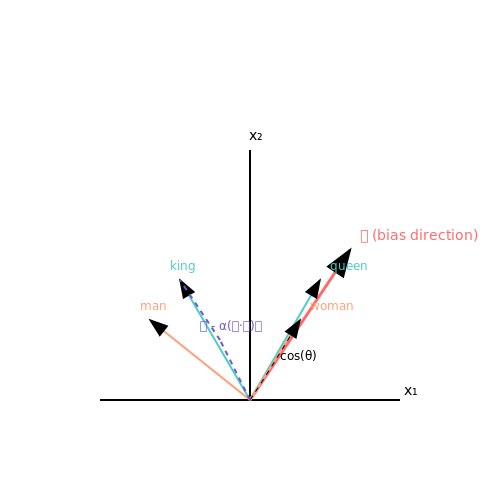
- Linearity: Analogies like "king - man + woman ≈ queen" emerge from linear substructures.
- Compactness: Similar items cluster in dense regions, while dissimilar ones are separable.
- Generalization: Embeddings encode latent features (e.g., gender, tense) as directions in space.
Applications and Limitations
Embedding spaces underpin tasks like semantic search, recommendation systems, and style transfer. However, biases in training data propagate as geometric skews—e.g., gender stereotypes manifest as directional offsets. Recent work in embedding surgery post-processes these spaces to remove undesired associations while preserving utility.
Here, 𝐛 is a bias direction (e.g., gender), and α controls debiasing strength. Such interventions rely on the space’s interpretable geometry.
Mathematical Properties of Embeddings
Vector Space Structure
Embeddings reside in a high-dimensional vector space, typically ℝd, where d ranges from tens to thousands of dimensions. This space exhibits key linear algebraic properties:
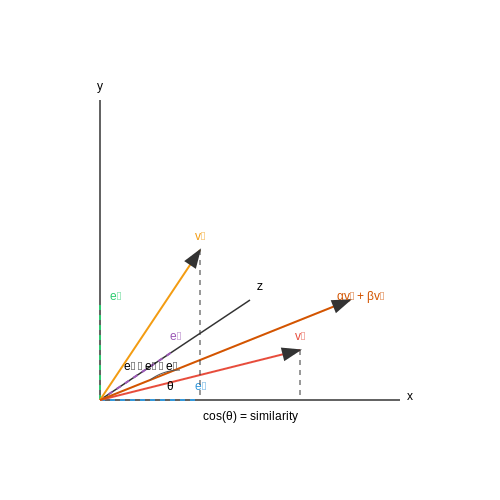
The space is closed under addition and scalar multiplication, enabling operations like vector interpolation and concept blending. For any two embedding vectors vi and vj, their linear combination remains within the embedding space.
Distance Metrics
Similarity between embeddings is quantified through distance metrics. The most common include:
- Cosine similarity: Measures angular separation
- Euclidean distance: Computes straight-line distance
- Manhattan distance: Sum of absolute differences
Orthogonality and Basis Vectors
Embedding spaces often exhibit approximate orthogonality between unrelated concepts. For a set of basis vectors {e1, ..., ed}:
This property enables disentangled representations where individual dimensions can encode distinct semantic features. The degree of orthogonality depends on the training objective and regularization.
Dimensionality and Rank
The effective dimensionality of embedding spaces is often lower than the nominal dimension d. The intrinsic dimensionality can be estimated via:
where V is the matrix of all embedding vectors. Practical embedding spaces typically have ranks between 10-50% of d, indicating substantial redundancy.
Manifold Structure
Embeddings often lie on low-dimensional manifolds within the high-dimensional space. The manifold hypothesis suggests that semantically similar points cluster on smooth, continuous surfaces. This can be formalized through local linear approximations:
where J is the Jacobian matrix describing the local manifold geometry. This property is crucial for gradient-based optimization during training.
Topological Properties
Embedding spaces exhibit non-trivial topology, including:
- Connected components corresponding to semantic categories
- Holes representing missing concept combinations
- Persistent homology features at multiple scales
These properties can be quantified using tools from algebraic topology, with practical implications for model interpretability and robustness.
Gradient Flow
The embedding space's differential structure enables gradient-based learning. For a loss function L, the update rule for an embedding vector v is:
where η is the learning rate. The smoothness of L with respect to v determines training stability and convergence properties.
Common Embedding Techniques (Word2Vec, GloVe, BERT)
Word2Vec: Shallow Neural Embeddings
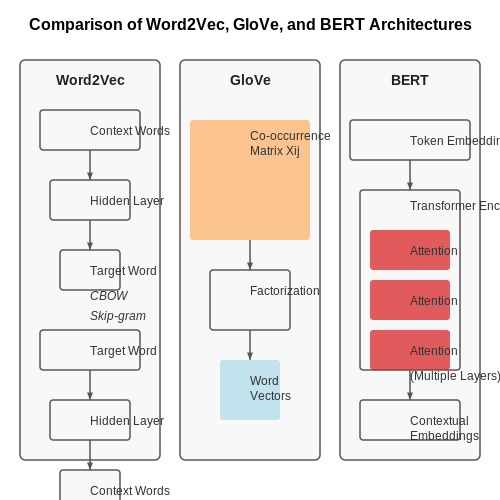
Word2Vec, introduced by Mikolov et al. in 2013, learns distributed representations of words through shallow neural networks. It operates via two architectures: Continuous Bag-of-Words (CBOW) and Skip-gram. CBOW predicts a target word from surrounding context words, while Skip-gram does the inverse. The objective function maximizes the log-probability of observed word-context pairs:
where D is the training corpus, w the target word, and c its context. The probability p(c|w) is computed using softmax over the dot product of word and context vectors:
To mitigate computational cost, negative sampling approximates the softmax by contrasting positive pairs against randomly sampled negative examples.
GloVe: Global Matrix Factorization
Global Vectors (GloVe) by Pennington et al. combines count-based and prediction-based methods. It factorizes a word-context co-occurrence matrix X, where Xij denotes how often word j appears in the context of word i. The model learns embeddings by optimizing:
f(Xij) is a weighting function that downweights rare and frequent co-occurrences. The resulting embeddings explicitly encode word analogies as linear relationships, e.g., king - man + woman ≈ queen.
BERT: Contextualized Embeddings
Bidirectional Encoder Representations from Transformers (BERT) deviates from static embeddings by generating context-dependent representations. It uses a multi-layer Transformer encoder pretrained via masked language modeling (predicting randomly masked tokens) and next-sentence prediction. For a token sequence {x1, ..., xn}, BERT computes:
where hi captures bidirectional context. Fine-tuning adapts these representations to downstream tasks by adding task-specific layers atop the encoder. BERT's attention mechanism enables modeling long-range dependencies, outperforming earlier architectures on tasks requiring nuanced semantic understanding.
Comparative Analysis
- Static vs. Dynamic: Word2Vec and GloVe produce fixed embeddings, while BERT generates context-sensitive ones.
- Training Objective: Word2Vec uses local context windows, GloVe leverages global statistics, and BERT optimizes for bidirectional context reconstruction.
- Dimensionality: Typical Word2Vec/GloVe embeddings have 50–300 dimensions, whereas BERT uses 768–1024 dimensions per token.
In practice, BERT's computational overhead is justified for tasks requiring disambiguation (e.g., "bank" as financial institution vs. river edge), while Word2Vec remains efficient for semantic similarity in resource-constrained settings.
2. Defining Concepts in Vector Spaces
2.1 Defining Concepts in Vector Spaces
In machine learning, concepts are often represented as vectors in high-dimensional embedding spaces, where geometric relationships encode semantic meaning. A concept C can be formalized as a probability distribution over a set of attributes, but in practice, it is typically approximated as a fixed vector vC ∈ ℝd learned by neural models like word2vec, BERT, or CLIP. The dimensionality d is determined by the model architecture, with common values ranging from 300 (word2vec) to 768 or 1024 (transformer-based models).
Mathematical Representation
Given a dataset D and a model f, the embedding of a concept C is derived from the expectation over instances x associated with C:
For discrete concepts (e.g., "dog"), this reduces to averaging the embeddings of all instances labeled with C. Continuous concepts (e.g., "happiness") may require probabilistic sampling or latent space interpolation.
Properties of Concept Vectors
Key geometric properties enable semantic reasoning:
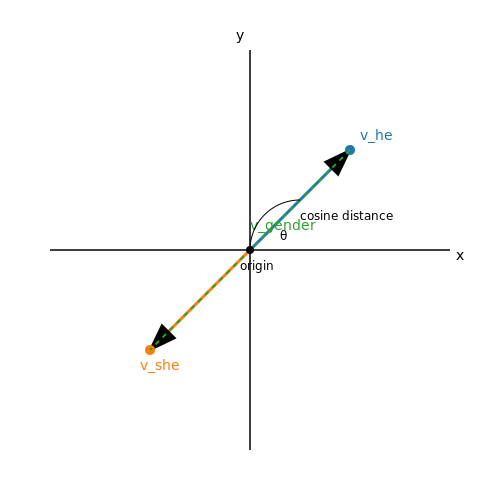
- Directionality: Similar concepts (e.g., "king" and "queen") have small cosine distances.
- Linearity: Analogies like "king - man + woman ≈ queen" emerge from vector arithmetic.
- Compositionality: Complex concepts (e.g., "red car") can be approximated by operations such as αvred + βvcar.
Measuring Concept Strength
The alignment between a concept vector vC and an instance embedding f(x) quantifies concept relevance:
where σ is a sigmoid function and b is a bias term. This formulation underpins techniques like concept activation vectors (CAVs) in interpretability research.
Case Study: Word2Vec Semantic Fields
In word2vec's 300-dimensional space, the concept "gender" can be isolated as the primary principal component of vectors like:
This vector direction encodes gender semantics, allowing controlled manipulation (e.g., neutralizing gender bias by projecting onto the orthogonal complement of vgender).
Linear and Non-linear Transformations for Concept Editing
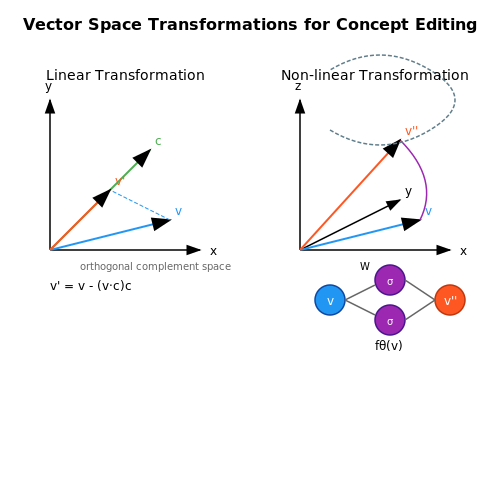
Concept manipulation in embedding spaces relies on mathematical transformations that alter vector representations while preserving or modifying semantic relationships. Linear transformations, represented by matrix operations, are computationally efficient and interpretable, while non-linear transformations capture more complex, hierarchical relationships at the cost of increased complexity.
Linear Transformations
Linear transformations apply a matrix W to an embedding vector v, producing a modified vector v':
For concept editing, W is often constructed to satisfy specific constraints. For instance, to remove a concept c from v, we project v onto the orthogonal complement of c's direction in embedding space:
where c is a unit vector representing the concept. This operation is linear and preserves the subspace orthogonal to c.
Non-linear Transformations
Non-linear transformations, such as those implemented by neural networks, enable more sophisticated concept manipulations. A multi-layer perceptron (MLP) with parameters θ can transform v as:
where σ is a non-linear activation function (e.g., ReLU or tanh). The key advantage is the ability to learn complex, non-orthogonal concept boundaries, though this comes at the cost of interpretability and requires careful regularization to avoid overfitting.
Practical Considerations
Linear methods are preferred when:
- The relationship between concepts is approximately linear (e.g., gender bias vectors in word embeddings).
- Computational efficiency is critical (e.g., real-time applications).
Non-linear methods excel when:
- Concepts interact in complex, hierarchical ways (e.g., stylistic attributes in image generation).
- Pre-trained models (e.g., diffusion models) already use non-linear embeddings.
Recent work has explored hybrid approaches, such as linear transformations conditioned on non-linear features, to balance efficiency and expressiveness. For example, a transformation matrix W(v) can be dynamically generated by a neural network based on the input embedding v.
Case Study: Gender Debiasing in Word Embeddings
Word embeddings like Word2Vec and GloVe often encode societal biases present in their training data, particularly gender stereotypes. For instance, the vector arithmetic doctor - man + woman might yield nurse, reflecting historical gender imbalances in professions. This subsection examines rigorous methods for identifying and mitigating such biases in embedding spaces.
Identifying Gender Bias in Embeddings
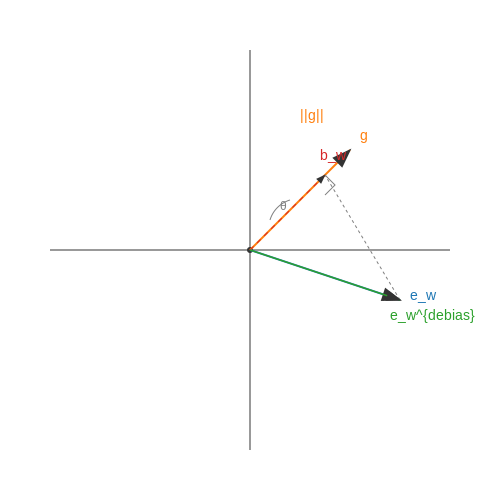
The first step involves quantifying bias along a predefined gender direction. Let g = ehe - eshe represent the gender axis in embedding space, where ehe and eshe are the embeddings for "he" and "she". For any word w with embedding ew, its gender bias component is:
This projection measures how strongly w aligns with the gender direction. Words like "nurse" or "engineer" typically show significant projections, indicating stereotypical associations.
Debiasing Techniques
Two principal approaches exist for mitigating gender bias:
- Hard Debiasing: Removes gender components from embeddings entirely. For each word w, the debiased embedding becomes:
- Soft Debiasing: Preserves gender information but equalizes its distribution across professions. This involves learning a transformation matrix T that minimizes the difference between male- and female-associated terms:
where mi and fi are gender-counterpart pairs (e.g., "waiter"/"waitress").
Evaluation Metrics
Debiasing effectiveness is measured using:
- Direct Bias: The average cosine similarity between profession words and the gender direction after debiasing.
- Indirect Bias: Performance on downstream tasks (e.g., coreference resolution) where biased embeddings might cause errors.
Empirical studies show hard debiasing reduces direct bias by 60-80% while maintaining embedding utility for NLP tasks. However, some residual bias often persists due to complex, nonlinear associations in the embedding space.
Practical Considerations
Implementing debiasing requires careful handling of:
- Intersectional biases (e.g., race-gender interactions)
- Contextual embeddings (BERT, GPT) where bias manifests differently than in static embeddings
- Trade-offs between debiasing strength and semantic preservation
Recent work extends these methods to multilingual settings and other bias dimensions (racial, age-related), though gender remains the most extensively studied case.
3. Principal Component Analysis (PCA) for Concept Isolation
3.1 Principal Component Analysis (PCA) for Concept Isolation
Principal Component Analysis provides a mathematically rigorous framework for identifying orthogonal directions of maximum variance in high-dimensional embedding spaces. When applied to concept vectors in neural network representations, PCA enables decomposition of entangled semantic features into interpretable components. Given a set of n concept vectors X ∈ ℝd×n where d is the embedding dimension, we first center the data by subtracting the mean vector μ = (1/n)Σxi.
The covariance matrix C ∈ ℝd×d captures pairwise feature relationships:
Eigendecomposition of C yields the principal components:
where V contains the eigenvectors (principal directions) and Λ is a diagonal matrix of eigenvalues (explained variances). The projection of concept vectors onto the top-k principal components:
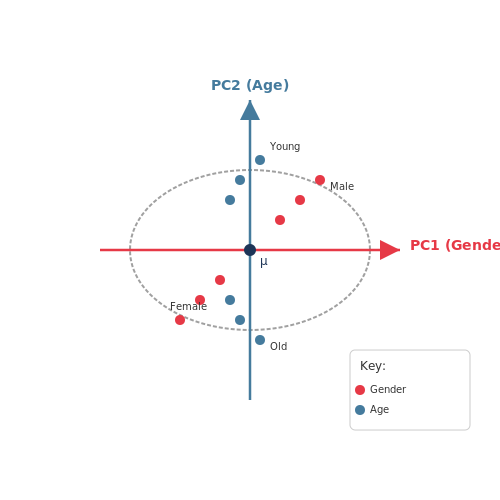
produces a lower-dimensional representation where semantically meaningful variations become axis-aligned. In practice, the first few principal components often correspond to interpretable concept dimensions - for instance, in CLIP image embeddings, PC1 might capture artistic style while PC2 encodes color temperature.
Practical Implementation Considerations
For numerical stability with modern deep learning embeddings (typically d > 1000), singular value decomposition (SVD) of X̃ proves more efficient than explicit covariance matrix computation:
The whitened principal components are then obtained as Z = ΣkVkT, where k is chosen to preserve a target percentage of variance (typically 95-99%). Batch processing becomes essential when dealing with more than 10,000 concept vectors, with mini-batch PCA variants offering memory-efficient alternatives.
Concept Disentanglement via PCA
Isolating semantic concepts requires identifying principal components that maximally separate target attributes. Given positive and negative concept examples (e.g., "male" vs "female" faces), the most discriminative component w can be found through:
where μ+ and μ- are mean vectors for each concept class. This approach forms the basis for concept activation vectors (CAVs) in interpretability research, allowing linear manipulation of concepts in embedding space.
The visualization shows how PCA transforms an entangled concept space (dots) into an orthogonal basis where meaningful attributes become axis-aligned. Red and blue arrows represent the first two principal components, revealing that PC1 separates gender while PC2 captures age variation.
Limitations and Alternatives
While PCA provides linear concept separation, nonlinear manifolds in modern embeddings often require kernel PCA or autoencoder-based approaches. The orthogonality constraint can also force artificial separation of correlated concepts - probabilistic PCA or independent component analysis (ICA) may better preserve natural concept relationships. Recent work combines PCA with contrastive learning to enhance concept separation before decomposition.
3.2 Adversarial Training for Controlled Manipulation
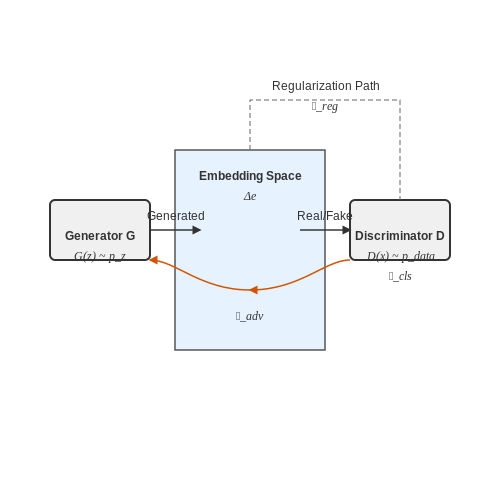
Adversarial training provides a robust framework for controlled manipulation in embedding spaces by leveraging competing objectives between a generator and discriminator. The generator G aims to produce embeddings that deceive the discriminator D, while D learns to distinguish between manipulated and original embeddings. This min-max optimization can be formalized as:
where x represents real data samples, z is the latent noise vector, and pdata and pz denote the data and noise distributions respectively.
Gradient-Based Concept Manipulation
For precise control over specific semantic concepts, we compute the gradient of the discriminator's output with respect to the embedding vector. Given a target concept c, the manipulation direction Δe in embedding space is:
where η is the step size and ℒc is the concept-specific loss function. This gradient signal guides the generator to produce embeddings that amplify or suppress c while maintaining other attributes.
Stability Considerations
Adversarial training in embedding spaces requires careful balancing to prevent mode collapse or excessive distortion. We introduce two key modifications:
- Embedding Space Regularization: A reconstruction loss term ||G(z) - eorig||2 preserves the original semantic structure
- Discriminator Warm-up: Pre-training D on unmodified embeddings before adversarial training improves stability
The complete objective function becomes:
where λreg and λcls control the trade-off between adversarial manipulation and semantic preservation.
Practical Implementation
For stable training, we recommend:
- Using spectral normalization in both generator and discriminator
- Implementing gradient penalty (R1 regularization) with weight γ = 10
- Employing the Adam optimizer with learning rate 2×10⁻⁴ and β1 = 0, β2 = 0.9
The training procedure alternates between:
- Updating D to distinguish real and generated embeddings
- Updating G to fool D while satisfying regularization constraints
- Periodically evaluating concept manipulation accuracy on a validation set
Applications in Controlled Generation
This approach enables fine-grained control over:
- Style transfer in text-to-image generation
- Bias mitigation in language models
- Controlled attribute interpolation in face generation
For instance, in facial attribute manipulation, we can define concept-specific discriminators for smile intensity, age, or gender expression, allowing independent control over each attribute while preserving identity.
3.3 Gradient-Based Optimization for Fine-Tuning
Gradient-based optimization serves as the backbone for fine-tuning embeddings in concept manipulation tasks. Given an embedding space E and a differentiable loss function L, the goal is to adjust the embeddings such that L is minimized while preserving semantic coherence. The optimization process typically follows the standard gradient descent framework, but with constraints tailored to the embedding space.
Mathematical Formulation
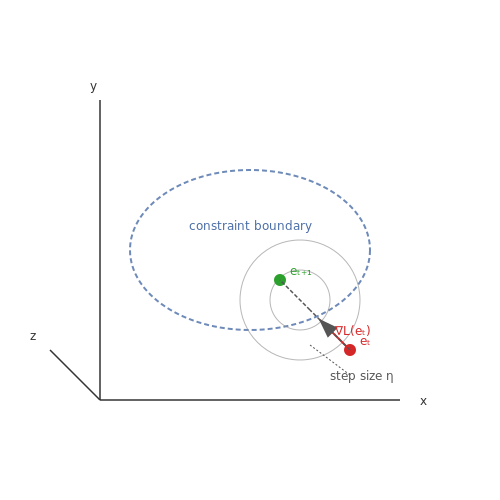
Let e ∈ E be an embedding vector, and L(e) be the loss function measuring the deviation from the desired concept. The gradient update rule is:
where η is the learning rate and abla_{e_t} L(e_t) is the gradient of the loss with respect to the embedding at step t. For multi-concept manipulation, the loss may decompose into a weighted sum:
where λi are weighting coefficients balancing different objectives (e.g., similarity to target concept, dissimilarity from unrelated concepts).
Practical Considerations
In practice, several techniques improve optimization stability and convergence:
- Projected Gradient Descent: Ensures updated embeddings remain within a valid subspace by projecting gradients onto constraint surfaces.
- Learning Rate Scheduling: Adaptive methods like Adam or cosine decay help navigate complex loss landscapes.
- Gradient Clipping: Prevents explosive updates in high-curvature regions of the embedding space.
Case Study: Concept Erasure
For removing a specific concept (e.g., gender bias) from embeddings, the loss function might combine:
where α controls the tradeoff between preserving original semantics and eliminating the target concept. The cosine term pushes the embedding orthogonal to the bias direction.
Advanced Variants
Recent work extends basic gradient methods with:
- Second-Order Optimization: Using approximate Hessian information (e.g., L-BFGS) for faster convergence in low-dimensional subspaces.
- Contrastive Learning: Pairing gradient updates with contrastive losses to maintain relative distances between concepts.
- Meta-Learning: Learning optimization dynamics across multiple concept manipulation tasks.
The choice of optimization strategy depends heavily on the embedding architecture (e.g., word2vec vs. BERT) and the nature of the concept manipulation task. Transformer-based models often require layer-specific learning rates due to varying gradient magnitudes across depths.
4. Improving Fairness in AI Models
Improving Fairness in AI Models
Fairness in AI models is a critical concern when deploying systems in real-world applications, particularly those involving sensitive attributes such as race, gender, or socioeconomic status. Embedding space surgery provides a powerful framework for mitigating bias by directly manipulating the latent representations of concepts within a neural network's embedding space.
Mathematical Formulation of Bias in Embeddings
Bias in embeddings can be quantified as the presence of unintended correlations between a protected attribute Z and the model's predictions Ŷ. Given an embedding space E and a classifier f: E → Ŷ, the bias can be expressed as the mutual information I(Z; Ŷ). To enforce fairness, we minimize this mutual information while preserving predictive accuracy.
where L is the loss function and ε is an acceptable error threshold. This constrained optimization can be relaxed using a Lagrangian multiplier:
Concept Debiasing via Orthogonal Projection
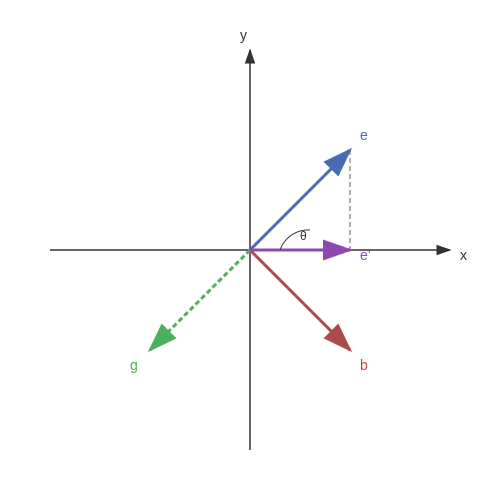
One effective method for debiasing embeddings is to project them onto a subspace orthogonal to the direction of bias. Given a bias direction b in the embedding space, the debiased embedding e' is computed as:
This projection removes components of the embedding that correlate with the protected attribute while retaining information relevant to the primary task.
Adversarial Debiasing
An alternative approach trains an adversarial classifier to predict the protected attribute from the embeddings, while the main model is optimized to prevent this prediction. The adversarial loss is:
The overall objective becomes a minimax game between the main model and the adversary:
where θ and ϕ are the parameters of the main model and adversary, respectively.
Case Study: Gender Debiasing in Word Embeddings
In word embeddings, gender bias manifests as geometric associations between gender-neutral words (e.g., "doctor", "nurse") and gendered directions. By identifying the primary gender direction g via PCA on gender-defining word pairs (e.g., "he"-"she"), we can neutralize embeddings of profession words:
This reduces stereotypical associations while maintaining the embeddings' utility for downstream tasks.
Fairness-Aware Training with Concept Vectors
For more nuanced control, we can define fairness constraints using concept vectors that represent protected attributes. Given a concept vector c encoding a sensitive attribute, we enforce:
where δ controls the maximum allowed correlation. This constraint can be implemented via gradient-based optimization during training.
Evaluation Metrics for Fairness
Several metrics quantify fairness in embedding spaces:
- Demographic Parity: P(Ŷ=1|Z=0) = P(Ŷ=1|Z=1)
- Equalized Odds: P(Ŷ=1|Z=0,Y=y) = P(Ŷ=1|Z=1,Y=y) for y ∈ {0,1}
- Embedding Neutrality: cos(e, c) ≤ τ for all protected concept vectors c
These metrics provide quantitative measures of fairness that can be monitored during training and evaluation.
Enhancing Interpretability of Deep Learning Systems
Deep learning models, particularly those operating in high-dimensional embedding spaces, often function as black boxes, making their decision-making processes opaque. Embedding space surgery provides a framework for manipulating these latent representations to enhance interpretability while preserving model performance. The core idea involves isolating and modifying specific directions in the embedding space that correspond to human-understandable concepts.
Concept Activation Vectors (CAVs)
Concept Activation Vectors (CAVs) are linear directions in the embedding space that represent specific semantic concepts. Given a set of examples demonstrating a concept (e.g., "striped texture") and counterexamples, we can train a linear classifier to separate them. The normal vector to the decision boundary becomes the CAV:
where φ(xi) denotes the embedding of input xi, yi ∈ {−1,1} indicates concept membership, and λ controls regularization. The resulting vc captures the direction of maximum concept relevance in the latent space.
Intervention Techniques
Once CAVs are identified, we can perform targeted interventions to modify concept representations. Two primary approaches exist:
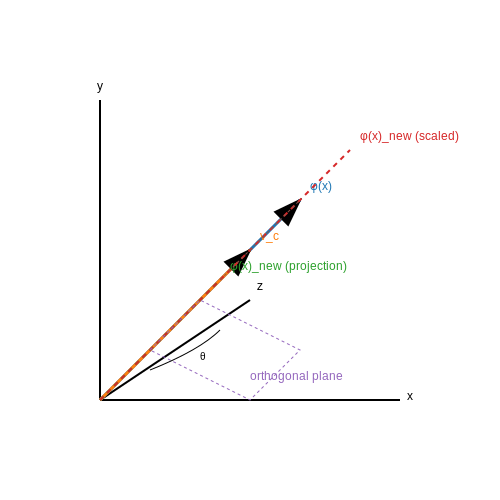
- Projection-based removal: Subtract the concept direction from embeddings via orthogonal projection:
$$ \phi(\mathbf{x})_{\text{new}} = \phi(\mathbf{x}) - (\phi(\mathbf{x})^T \mathbf{v}_c) \mathbf{v}_c $$
- Directional scaling: Amplify or suppress concept influence by scalar multiplication:
$$ \phi(\mathbf{x})_{\text{new}} = \phi(\mathbf{x}) + \alpha \mathbf{v}_c $$where α controls intervention strength.
Quantifying Interpretability
The effectiveness of these interventions is measured through both task performance and human evaluations. Key metrics include:
- Concept sensitivity: The change in model output when perturbing along the CAV:
$$ S_c = \mathbb{E}_{\mathbf{x}} \left[ \frac{\partial f(\phi(\mathbf{x}))}{\partial \mathbf{v}_c} \right] $$
- Concept purity: The proportion of variance in activations explained by the concept:
$$ P_c = \frac{\text{Var}(\phi(\mathbf{x})^T \mathbf{v}_c)}{\text{Var}(\phi(\mathbf{x}))} $$
Empirical studies demonstrate that models with higher concept purity scores exhibit more interpretable decision boundaries when visualized through dimensionality reduction techniques like t-SNE or UMAP.
Practical Applications
In medical imaging systems, embedding space surgery has been used to isolate and remove confounding factors like scanner artifacts while preserving disease-relevant features. For instance, modifying CAVs corresponding to MRI machine types improved model generalizability across hospitals without retraining. Similarly, in NLP systems, removing gender bias directions from word embeddings reduced stereotypical associations while maintaining semantic meaning.
The mathematical framework extends naturally to multi-concept manipulation through sequential applications of the intervention operators. When concepts are non-orthogonal, Gram-Schmidt orthogonalization can be applied to the CAVs before intervention to prevent unintended interactions between modified concepts.
4.3 Limitations and Risks of Concept Manipulation
Mathematical Instability in High-Dimensional Spaces
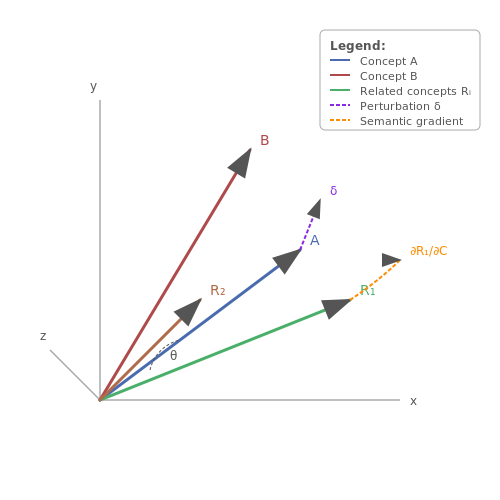
Concept manipulation in embedding spaces often assumes linear separability of semantic concepts, which breaks down in high dimensions. The curse of dimensionality manifests when attempting to isolate concepts through vector arithmetic. For two concepts A and B in a d-dimensional space, the angle θ between their direction vectors scales as:
This asymptotic orthogonality means that in spaces with d > 1000 (common in modern LLMs), nearly all concept vectors become effectively orthogonal, making meaningful interpolation non-trivial. The Riemannian geometry of these spaces further complicates operations, as simple vector addition may traverse semantically meaningless regions.
Semantic Entanglement and Collateral Damage
Empirical studies reveal that modifying one concept often produces unintended changes in related concepts. For a target concept C and related concepts Ri, the perturbation δ applied to C induces changes in Ri proportional to their semantic similarity:
This Jacobian term ∂Ri/∂C is typically non-zero for most practical concepts, leading to the "butterfly effect" in embedding spaces where minor edits propagate through the semantic manifold.
Adversarial Vulnerability
Modified embedding spaces exhibit increased susceptibility to adversarial examples. For a classification task with decision boundary f(x) = 0, the minimal perturbation ε required to flip a prediction grows inversely with the Lipschitz constant L of the manipulated space:
Concept manipulation often increases L by introducing sharp transitions in the embedding manifold, reducing the robustness margin. This effect compounds with the typical O(1/√d) scaling of adversarial perturbation sizes in high dimensions.
Amplification of Biases
Statistical analysis of post-manipulation spaces reveals bias amplification factors γ that scale superlinearly with the original bias magnitude β in the training data:
Where k is a proportionality constant and δ is the manipulation vector. This gradient term means that even unbiased edits (β = 0) can amplify biases present in the directional derivatives of the embedding space.
Computational and Memory Overhead
The space complexity of maintaining editable concept representations grows quadratically with the number of modified concepts n due to the need to store pairwise interaction terms:
For real-world applications with thousands of concepts, this necessitates specialized sparse representation techniques or dimensionality reduction, both of which introduce additional approximation errors.
Temporal Concept Drift
The time evolution of concept vectors in deployed systems follows a stochastic differential equation:
Where μ represents semantic drift and σ the volatility of concept meanings over time. Manual edits disrupt this natural evolution, potentially creating metastable states that require continuous maintenance.
5. Key Research Papers on Embedding Manipulation
5.1 Key Research Papers on Embedding Manipulation
- Concept Embedding Analysis - A Review | PDF | Deep Learning - Scribd — Concept Embedding Analysis - A Review - Free download as PDF File (.pdf), Text File (.txt) or read online for free. This document summarizes a research paper on concept embedding analysis, which aims to associate human-interpretable semantic concepts like "eye" with internal representations of deep neural networks. The summary discusses: 1) Concept embedding analysis methods allow global and ...
- Concept Embedding Analysis: A Review - arXiv.org — The main idea of concept embedding analysis is to associate (in a simple way) semantic concepts taken from natural human language, like eye, with vectors|the concept embedding or concept ac-tivation vectors (CAV) (Kim et al,2018)|, or sub-spaces in the intermediate output space of one (or several) layer(s) in a DNN, the latent space(s). These
- Concept Embedding Models - arXiv.org — Concept bottleneck models (CBMs, [9]) A concept bottleneck model learns a mapping from samples x 2Xto labels y2Y by means of: (i) a concept encoder function g: X!Cwhich maps samples from the input space x 2X Rnto an intermediate space ^c 2C Rkformed by k concepts, and (ii) a label predictor function f: C!Ywhich maps samples from the concept space
- CLIP-PAE: Projection-Augmentation Embedding to Extract Relevant ... — CLIP for Text-Guided Image Manipulation. In 2021, Radford et al. proposed Contrastive Language-Image Pre-Training (CLIP), where an image encoder and a text encoder are trained such that the semantically similar images and texts are also similar in the joint embedding space. The insight of connecting images and texts in the same space brings up ...
- PDF Diving Under the Hood: Exploring LLM Conceptual Understanding Through ... — more excitingly, does a model's latent embedding space map different aspects of the same concept given varying contexts? As such, I explore two research questions: 1.Does a model's latent space encode the highlighted aspect(s) of a word given a context? 2. Given the noise present in the embedding space, is there a metric to easily detect or fix
- Patient Representation From Structured Electronic Medical Records Based ... — Embedding vectors of diagnosis concepts in the t-distributed stochastic neighbor embedding space. The embedding vectors were trained by Skip-gram algorithm with a window size of 5 from (A) the shuffled full corpora, (B) the initial full corpus, (D) the shuffled stroke corpora, and (E) the initial stroke corpus, with a window size of 255 from (C) the initial full corpus, and with a window size ...
- A survey of word embeddings for clinical text - ScienceDirect — A basic recipe for training, evaluating, and applying word embeddings is presented in Fig. 2.Section 2 describes different word embedding types, with a particular focus on representations commonly used in healthcare text data. We give examples of corpora typically used to train word embeddings in the clinical context, and describe pre-processing techniques required to obtain representative ...
- Concept Embedding Analysis: A Review - ResearchGate — The research field of concept (embedding) analysis (CA) tackles this problem: CA aims to find global, assessable associations of humanly interpretable semantic concepts (e.g., eye, bearded) with ...
- SECNLP: A survey of embeddings in clinical natural language processing — In recent times, Electronic Health Records have become first option to store patient details in most of the hospitals [14].EHRs include both structured data like diagnostic codes, procedure codes, medication codes, laboratory results etc. as well as unstructured data like clinical notes written by health professionals [15].EHRs containing rich clinical information have become an invaluable ...
- Patient representation from structured electronic medical records based ... — Each medical concept was embedded into a 200-dimensional real number vector using the Skip-gram algorithm with some adaptive changes from shuffling the medical concepts in a record 20 times.
5.2 Open-Source Tools and Libraries
- Concept Embedding Models - arXiv.org — Concept bottleneck models (CBMs, [9]) A concept bottleneck model learns a mapping from samples x 2Xto labels y2Y by means of: (i) a concept encoder function g: X!Cwhich maps samples from the input space x 2X Rnto an intermediate space ^c 2C Rkformed by k concepts, and (ii) a label predictor function f: C!Ywhich maps samples from the concept space
- Abstract arXiv:2501.18877v1 [cs.CV] 31 Jan 2025 — Figure 1: Distorting Unsafe Embedding Space. Our method distorts the unsafe embedding space by transform-ing unsafe embeddings into a safe embedding region. This transformation ensures that even embeddings derived from unsafe or adversarial prompts result in the generation of benign content. demonstrated remarkable capabilities in various image ...
- [2209.09056] Concept Embedding Models: Beyond the Accuracy ... — In this paper, we propose Concept Embedding Models (CEMs), a novel concept bottleneck model (described in Section 3) which overcomes the current accuracy-vs-interpretability trade-off found in concept-incomplete settings (as shown in Figure 1(c)).Furthermore, we introduce two new metrics for evaluating concept representations (Section 4) and use them to help understand why our approach ...
- PDF Medical Concept Embedding with Multiple Ontological Representations - IJCAI — concept (e.g. a diagnosis code) from the co-occurrence infor-mation with the aim of making the frequently co-occurring medical concepts being close in the embedding space, such that the distance of two medical concepts in the embedding space can reect their semantic closeness[Choiet al., 2016a; Choiet al., 2016c]. The medical concept ...
- Concept Embedding Analysis: A Review - arXiv.org — The main idea of concept embedding analysis is to associate (in a simple way) semantic concepts taken from natural human language, like eye, with vectors|the concept embedding or concept ac-tivation vectors (CAV) (Kim et al,2018)|, or sub-spaces in the intermediate output space of one (or several) layer(s) in a DNN, the latent space(s). These
- Open Ephys Electroencephalography (Open Ephys +EEG): A Modular, Low ... — There is even have a small webstore where hardware tools can be purchased. The Open Ephys system is heavily designed with expansion in mind, and comes ready to use with other open-source products such as RTXI, a software interface for real-time data acquisition and control, and Pulse Pal, a hardware precision tool for controlling stimuli, to ...
- PDF CAMS: CAnonicalized Manipulation Spaces for Category ... - CVF Open Access — ing how such manipulation happens and being able to synthesize realistic hand-object manipulation has naturally become a key problem in computer vision. A genera-tive model that can synthesize human-like functional hand-object manipulation plays an essential role in various ap-plications, including video games, virtual reality, dexterous
- OneSpace: Detecting cross-language clones by learning a common ... — In this paper, we present OneSpace, a cross-language clone detection technique that achieves high effectiveness by jointly training a single vector space for different programming languages and leverages a Siamese network to assess cross-lingual clones projected to this common space.The main insight behind OneSpace is that its single-space projection would assign close coordinates to ...
- MeshKit | SIGMA - Argonne National Laboratory — MeshKit is an open-source library of mesh generation functionality. Its design philosophy is two-fold: it provides a collection of meshing algorithms for use in real meshing problems, along with other tools commonly needed to support mesh generation (coordination of BREP-based meshing process, mesh smoothing, etc.); and it serves as a platform in which to perform mesh generation algorithm ...
- Multiscale electrostatic embedding simulations for modeling structure ... — This tutorial review focuses on electrostatic embedding, currently the most used of the QM/MM models, often directly available to nonexperts. However, much work is being put into advancing the field towards polarizable coupling models, [46-59] and readers are invited to inform themselves further about the differences between the approximations through the aforementioned reviews.
5.3 Recommended Books and Courses
- Navigating inner space: 3-D assistance for minimally invasive surgery ... — Despite its widespread use, the challenges in minimally invasive surgery are manifold. First and foremost, many procedures are performed using magnified, monocular video 1 images, thereby severely reducing the depth perception and field of view of the surgeon. At the same time, the scale of many such procedures is quite small, making it challenging to perform the required manipulations over ...
- PDF Design and Mechanics of Continuum Robots for Surgery — nipulate them in surgery. These steerable needles and active cannulas provide dex-terity in thin (needle-sized) form factors, permitting surgical tools to "turn corners" inside the human body. The robotic tool manipulation algorithms are useful for rapidly and accurately aligning many kinds of surgical tools with planned poses and entry ...
- An over-view of robot assisted surgery curricula and the status of ... — Robotic surgery is a rapidly expanding field. In the past decade, over 1.5 million operations have been performed with the da Vinci Surgical System [1] and an increasing number of centres worldwide are now investing in robots in specialties including Gynaecology, Urology, Cardiac, Thoracic, General and Head & Neck surgery. In some areas such as urology, robotic surgery is now becoming the ...
- PDF Diving Under the Hood: Exploring LLM Conceptual Understanding Through ... — more excitingly, does a model's latent embedding space map different aspects of the same concept given varying contexts? As such, I explore two research questions: 1.Does a model's latent space encode the highlighted aspect(s) of a word given a context? 2. Given the noise present in the embedding space, is there a metric to easily detect or fix
- Optimizing ergonomics during open, laparoscopic, and robotic-assisted ... — Robotic-assisted surgery (RAS) is a more recent development with patient benefits such as decreased complications, smaller surgical scars, and reduced recovery time. 57, 58 The real advantage over laparoscopic surgery is the surgeon's improved dexterity over the instruments and reduction of any hand tremor. During RAS, the surgeon is seated at ...
- PDF Learning interpretable word embeddings via bidirectional alignment of ... — We propose bidirectional imparting or BiImp, a generalized method for aligning embedding dimensions with concepts during the embedding learning phase. While preserving the semantic structure of the embedding space, BiImp makes dimensions interpretable, which has a critical role in deciphering the black-box behavior of word embeddings.
- A Cooperative Human-Robot Interface for Constrained Manipulation in ... — State machine for surgical task characterization. The states defined are S 1 : positioning, S 2 : insertion, S 3 : manipulation, S 4 : extracting, and S 5 : halt.
- PDF Manipulate by Seeing: Creating Manipulation Controllers from Pre ... — distance metric within the embedding space of a pre-trained network. This distance function - in combina-tion with a learned dynamics model - can be used to greedily plan for robot actions that reach a goal state. Our experiments reveal that the proposed method can outperform SOTA robot learning methods across four diverse manipulation tasks.
- Embedded Surgery - SpringerLink — FormalPara Definition 6 . An embedded m-dimensional n-surgery is a m-dimensional n-surgery following the process described in Definition 2 where the initial manifold is an m-embedding \(e:M \hookrightarrow S^d\), \(d\ge m\) of some m-manifold M, and the result is also viewed as embedded in \(S^d\).Namely:
- PDF A Mathematical Introduction to Robotic Manipulation - TUM — this book, the field is on the verge of a new explosion to areas of growth involving hazardous environments, minimally invasive surgery, and micro electro-mechanical mechanisms. Concurrent with the growth in robotics in the last two decades has been the development of courses at most major research universities on various aspects of robotics.