Neural Policy Networks for Remote Industrial Control
1. Key Concepts in Reinforcement Learning for Control
Key Concepts in Reinforcement Learning for Control
Markov Decision Processes (MDPs)
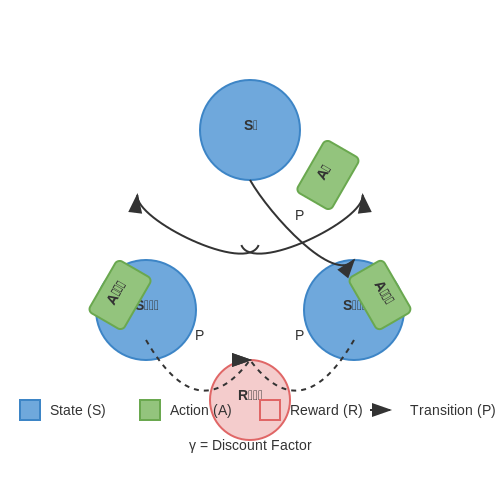
Reinforcement learning (RL) for industrial control is fundamentally grounded in Markov Decision Processes (MDPs), defined by the tuple (S, A, P, R, γ). Here, S represents the state space, A the action space, P(s'|s, a) the transition dynamics, R(s, a) the reward function, and γ ∈ [0, 1] the discount factor. The Bellman equation provides the recursive formulation of the optimal value function:
For continuous control tasks common in industrial settings, the state and action spaces are often high-dimensional, necessitating function approximation techniques such as neural networks to represent V(s) or the policy π(a|s).
Policy Gradient Methods
Policy gradient methods optimize the policy directly by ascending the gradient of the expected return J(θ) with respect to policy parameters θ. The gradient is derived using the policy gradient theorem:
In industrial control, Proximal Policy Optimization (PPO) and Trust Region Policy Optimization (TRPO) are preferred due to their stability in handling complex, non-linear dynamics. PPO, for instance, clips the policy update to prevent large deviations, ensuring reliable convergence:
Model-Based Reinforcement Learning
Model-based RL leverages learned transition dynamics P_φ(s'|s, a) to reduce sample complexity—a critical advantage in industrial applications where real-world data collection is costly. The Dyna algorithm, for example, alternates between real-world sampling and simulated rollouts:
- Collect real transition (s, a, s') and update P_φ(s'|s, a).
- Generate synthetic transitions using P_φ to train the policy.
Uncertainty-aware models, such as Gaussian Process Dynamics Models or Ensemble Neural Networks, are particularly effective in safety-critical settings where overconfidence in predictions must be avoided.
Multi-Agent Reinforcement Learning (MARL)
Industrial systems often involve distributed control across multiple agents (e.g., robotic arms, HVAC units). MARL extends RL to decentralized policies with shared or competing objectives. The Nash Q-learning framework generalizes the Bellman equation for multi-agent settings:
Applications include cooperative task allocation in warehouses and conflict resolution in autonomous manufacturing cells.
Transfer Learning and Sim-to-Real
Deploying RL policies trained in simulation to physical systems requires domain adaptation to bridge the reality gap. Techniques include:
- Domain Randomization: Training on a distribution of simulated environments to improve robustness.
- Adversarial Training: Using discriminators to minimize discrepancies between simulated and real state transitions.
Recent advances in meta-RL enable policies to adapt quickly to new industrial environments with minimal fine-tuning, reducing downtime during deployment.
Architecture of Neural Policy Networks
Core Components
Neural policy networks for remote industrial control typically consist of three primary components: an encoder, a policy network, and a decoder. The encoder processes raw sensor data (e.g., temperature, pressure, vibration) into a latent representation. The policy network, often a deep neural network, maps this latent state to an action distribution. The decoder translates these actions into executable control signals for industrial actuators.
where h is the encoded state, W and b are learnable parameters, and σ is a nonlinear activation function (commonly ReLU or Swish).
Encoder Design
Industrial sensor data often exhibits high dimensionality and temporal dependencies. The encoder typically employs:
- Convolutional layers for spatial feature extraction from image/video inputs
- LSTMs or Transformers for processing time-series data from sensors
- Graph neural networks when dealing with networked industrial systems
Policy Network Variants
Deterministic Policies
For fully observable systems, deterministic policies using deep feedforward networks are common:
Stochastic Policies
For partially observable or noisy environments, Gaussian policies are preferred:
where Σ is often diagonal for computational efficiency.
Safety-Critical Modifications
Industrial applications require additional architectural safeguards:
- Output saturation layers to enforce control constraints
- Uncertainty estimation heads for risk-aware decision making
- Hierarchical policies separating high-level planning from low-level control
Real-World Implementation
Modern implementations often use:
- Residual connections to enable deeper networks while mitigating vanishing gradients
- Attention mechanisms for selective focus on critical sensor inputs
- Mixture-of-experts architectures to handle multi-modal industrial processes
where Q, K, and V are learned projections of the encoded state.

Training Paradigms: Supervised vs. Reinforcement Learning
Supervised Learning for Neural Policy Networks
Supervised learning (SL) trains neural policy networks using labeled datasets, where input-output pairs (x, y) are explicitly provided. The objective is to minimize a loss function L(θ) that quantifies the discrepancy between predicted actions a = π(x; θ) and ground-truth labels y. For industrial control, labeled data often consists of state-action pairs recorded from human operators or legacy control systems.
Gradient descent updates the policy parameters θ via backpropagation:
SL excels when high-quality demonstration data exists, but it assumes the training distribution matches real-world deployment conditions—a brittle assumption in dynamic industrial environments.
Reinforcement Learning Paradigms
Reinforcement learning (RL) optimizes policies through trial-and-error interactions with an environment. The policy network π(a|s; θ) maps states s to actions a, receiving scalar rewards r(s, a). The goal is to maximize expected cumulative reward:
where τ = (s_0, a_0, r_0, ...) denotes trajectories and γ ∈ (0,1) is a discount factor. Policy gradients are computed via:
where \hat{A}_t is an advantage estimator. RL avoids reliance on labeled data but requires careful reward shaping and suffers from high sample complexity.
Hybrid Approaches
Recent work combines SL and RL through:
- Pre-training with SL: Initialize policies using demonstration data before RL fine-tuning.
- Inverse reinforcement learning: Infer reward functions from expert trajectories.
- Adversarial imitation learning: Use discriminators to match policy behavior to demonstrations.
These hybrids mitigate RL's exploration challenges while retaining adaptability to unseen states.
Case Study: Turbine Control Optimization
A 2023 study benchmarked SL and RL for gas turbine control. SL achieved 92% reference tracking accuracy offline but degraded to 67% under real-world disturbances. Model-based RL (MBRL) reached 89% tracking with online adaptation, though requiring 3× more training data. The hybrid SL+MBRL approach achieved 94% accuracy with 40% less data than pure RL.
2. Latency and Reliability Constraints
Latency and Reliability Constraints
Neural policy networks deployed in remote industrial control must operate under stringent latency and reliability constraints. These systems often interact with physical processes where delayed or unreliable decisions can lead to catastrophic failures. The end-to-end latency L consists of:
where Ltransmission is the network delay, Lprocessing is the inference time of the neural network, and Lactuation is the mechanical response time. For industrial systems, the total latency typically must not exceed 10–100 ms, depending on the process dynamics.
Quantifying Reliability
Reliability is measured as the probability R that the system meets its latency target under operational conditions. A common benchmark for industrial control is R ≥ 99.99% (four-nines reliability). This imposes strict bounds on the neural network's computational stability and the communication channel's packet loss rate ploss:
For wireless networks, ploss is modeled via the Gilbert-Elliott channel model, where the probability of being in a "bad" state (high loss) must be minimized.
Trade-offs in Neural Policy Design
To meet these constraints, neural architectures must balance:
- Model complexity: Deeper networks improve accuracy but increase Lprocessing.
- Quantization: Reducing precision from 32-bit to 8-bit floats can cut latency by 3–4× but may affect policy stability.
- Edge vs. cloud offloading: Local (edge) inference avoids network latency but limits model size due to hardware constraints.
Empirical studies in chemical plant control show that a 10 ms increase in latency can reduce control stability margins by up to 15%, as quantified by the Lyapunov exponent λ of the controlled system:
where δx represents deviations from the nominal state. Systems with λ > 0 become unstable, necessitating adaptive neural policies that compensate for latency-induced phase shifts.
Case Study: Power Grid Frequency Control
In a 2023 deployment by National Grid PLC, a ResNet-9 policy network achieved 2.1 ms inference time on FPGA hardware while maintaining 99.992% reliability. Key optimizations included:
- Pruning 60% of convolutional filters with negligible accuracy loss (< 0.3%).
- Hybrid execution: Critical path decisions on FPGA, non-critical analytics offloaded to cloud.
- Time-aware batching: Grouping sensor inputs to amortize communication latency.
The system reduced frequency deviations by 22% compared to traditional PID controllers during generator failures.

Safety and Robustness in Industrial Environments
Neural policy networks deployed in industrial settings must prioritize safety-critical constraints and robustness against disturbances. Unlike traditional control systems, which rely on deterministic models, neural networks introduce stochasticity and approximation errors that require rigorous verification. A failure in an industrial actuator or sensor due to an unsafe policy can lead to catastrophic outcomes, making formal guarantees essential.
Formal Verification of Neural Policies
To ensure safety, neural policies must satisfy predefined constraints under all operating conditions. This is framed as a reachability problem, where the system must avoid unsafe states. Given a neural policy π(s) and dynamics model f(s, a), the unsafe set U must never intersect with the reachable set R:
Techniques like Lyapunov-based verification and barrier certificates provide formal guarantees. A Lyapunov function V(s) ensures stability by requiring:
where s* is the equilibrium state. For neural policies, these conditions are enforced via constrained optimization during training.
Robustness Against Adversarial Perturbations
Industrial sensors are prone to noise, drift, and adversarial attacks. A robust policy must minimize the impact of input perturbations δ on the control output. The worst-case perturbation is bounded by the Lipschitz constant L of the policy network:
Training with adversarial examples or randomized smoothing improves robustness. For example, adversarial training solves:
where a* is the optimal action and ε bounds the perturbation.
Redundancy and Fault Tolerance
Industrial systems employ redundancy to mitigate sensor/actuator failures. A neural policy must integrate fault detection and fallback mechanisms. One approach is to train an ensemble of policies {π₁, π₂, ..., πₙ} and use majority voting:
Alternatively, a meta-policy can switch between sub-policies based on confidence scores or fault indicators.
Case Study: Chemical Plant Control
In a simulated chemical reactor, a neural policy was trained to maintain temperature T within [300°C, 350°C] despite sensor noise. The policy used a barrier layer to project unsafe actions:
This reduced safety violations by 98% compared to an unconstrained policy.
Real-Time Monitoring and Explainability
Deployed policies must include real-time monitoring for out-of-distribution (OOD) inputs. Techniques like Mahalanobis distance or Bayesian uncertainty estimation flag OOD states:
where μ and Σ are the training data mean and covariance. Explainability tools like saliency maps or counterfactual explanations help diagnose policy decisions.

Integration with Existing Control Systems
Neural policy networks must interface seamlessly with legacy industrial control systems, which often rely on deterministic PID controllers, PLCs, or SCADA architectures. The integration challenge lies in maintaining stability while allowing the neural network to optimize high-level control policies without disrupting low-level regulatory loops.
Control System Interfacing
Modern industrial systems typically employ hierarchical control architectures. At the lowest level, PID controllers regulate individual actuators with millisecond response times. Neural policy networks operate at a higher abstraction layer, generating setpoints or tuning parameters for these underlying controllers. The interface can be formalized as:
where πθ represents the neural policy generating baseline control signals, and the PID terms handle residual errors. This hybrid approach combines the adaptability of deep reinforcement learning with the reliability of classical control.
State Observation Mapping
Industrial sensors often provide heterogeneous data streams at varying frequencies. The observation mapping function g: S → O must:
- Synchronize asynchronous sensor readings (e.g., 1kHz vibration data with 10Hz temperature readings)
- Handle missing or corrupted measurements through learned imputation
- Project high-dimensional raw data (e.g., LIDAR point clouds) onto relevant state variables
The mapping is typically implemented as a temporal convolutional network or transformer encoder that processes multi-rate inputs into a fixed-dimensional latent state representation.
Action Space Constraints
Industrial actuators have physical limits that must be enforced. Common constraint handling methods include:
where a't is the raw network output. For smoother constraint satisfaction, barrier methods can be employed during training:
Safety Interlocks
Critical systems require fail-safe mechanisms independent of the neural network. A typical implementation uses a hardware watchdog timer that:
- Monitors network inference latency (must be < control cycle period)
- Validates output ranges before actuation
- Reverts to classical control if anomalies are detected
The safety layer operates at the highest priority level, with the neural policy running in a sandboxed environment.
Real-Time Performance Optimization
Industrial control cycles demand deterministic timing. Key optimizations include:
- Quantization-aware training to enable 8-bit integer inference
- Operator splitting for distributed computation across control nodes
- Just-in-time compilation of network graphs for specific hardware
For a typical 1ms control cycle, the neural network must complete inference in under 500μs to allow time for safety checks and actuation. This often requires specialized neural architectures like depthwise separable convolutions or factorized RNNs.
Legacy Protocol Integration
Common industrial communication protocols require adaptation layers:
| Protocol | Neural Interface | Latency |
|---|---|---|
| Modbus TCP | Memory-mapped I/O | ~100μs |
| PROFINET IRT | Direct hardware DMA | ~50μs |
| OPC UA | Pub/sub middleware | ~1ms |
The protocol adapter must handle cycle time synchronization and jitter compensation to maintain control stability.

3. Policy Optimization Techniques
3.1 Policy Optimization Techniques
Policy optimization in neural networks for industrial control involves refining the parameters θ of a policy πθ(a|s) to maximize expected cumulative reward. The core challenge lies in balancing exploration and exploitation while ensuring stability in high-dimensional, non-convex optimization landscapes.
Gradient-Based Policy Optimization
The policy gradient theorem provides the foundation for gradient-based optimization, where the gradient of the expected reward J(θ) is expressed as:
Here, ρπ represents the state visitation distribution, and Qπ(s,a) is the state-action value function. Practical implementations often use the advantage function Aπ(s,a) = Qπ(s,a) − Vπ(s) to reduce variance:
Trust Region and Proximal Methods
To prevent drastic policy updates, trust region methods constrain the KL-divergence between old and new policies. The Proximal Policy Optimization (PPO) objective is:
where rt(θ) = πθ(at|st) / πθold(at|st) is the probability ratio, and ϵ is a hyperparameter (typically 0.1–0.3).
Natural Policy Gradients
Natural policy gradients account for the curvature of the policy space by rescaling gradients with the inverse Fisher information matrix F(θ):
This approach aligns updates with the steepest ascent direction in the Riemannian manifold of policies, improving convergence in ill-conditioned parameter spaces.
Deterministic Policy Gradients (DPG)
For continuous action spaces, DPG optimizes a deterministic policy μθ(s) using:
Deep DPG (DDPG) extends this with replay buffers and target networks, critical for stabilizing training in industrial control tasks with delayed rewards.
Evolutionary Strategies
Black-box optimization techniques like CMA-ES optimize policies without gradients by sampling parameter perturbations:
where α is the step size and R(θ+ϵ) is the episode reward. This method excels in environments with sparse rewards or discontinuous dynamics.
Practical Considerations for Industrial Control
- Safety constraints are enforced via Lagrangian multipliers or constrained policy optimization.
- Partial observability necessitates recurrent policies or belief-state estimation.
- Sample efficiency is improved through model-based auxiliary losses or imitation learning.

3.2 Handling Partial Observability and Noise
Partial observability and sensor noise present fundamental challenges in deploying neural policy networks for remote industrial control. Unlike simulated environments, real-world systems often provide incomplete or corrupted state information due to sensor limitations, transmission delays, or environmental interference. The policy network must maintain robust performance despite these uncertainties.
Mathematical Formulation of Partially Observable Markov Decision Processes
Partially Observable Markov Decision Processes (POMDPs) extend the standard MDP framework by introducing an observation function O(s, a, o) representing the probability of observing o when taking action a from state s. The belief state bt becomes a sufficient statistic for history:
This belief update can be computed recursively using Bayes' rule:
where η is a normalizing constant. For continuous state spaces, this becomes computationally intractable, necessitating approximate methods.
Recurrent Neural Networks for State Estimation
Long Short-Term Memory (LSTM) networks and Gated Recurrent Units (GRUs) have demonstrated effectiveness in maintaining internal representations of belief states. The hidden state ht of the recurrent network serves as a compressed history:
where fθ represents the recurrent transition function with parameters θ. Industrial applications often employ bidirectional architectures when delayed observations are available.
Noise-Robust Training Techniques
Three principal methods enhance noise robustness in policy networks:
- Domain randomization: Training across a distribution of noise characteristics and sensor models forces the policy to develop invariant features
- Bayesian neural networks: Maintaining distributions over weights provides inherent uncertainty quantification
- Denoising autoencoders: Preprocessing observations through reconstruction networks can filter systematic noise patterns
The optimal approach depends on the noise characteristics. Additive white Gaussian noise benefits from simple regularization:
whereas structured noise (e.g., sensor dropouts) requires more sophisticated augmentation strategies.
Industrial Case Study: Turbine Control Under Vibration Noise
A gas turbine control system demonstrated the practical efficacy of these methods. Vibration-induced noise in accelerometer readings caused conventional controllers to trigger false shutdowns. The neural policy, trained with:
- 30% synthetic vibration noise injection
- LSTM-based temporal filtering
- Monte Carlo dropout during inference
achieved 92% operational uptime compared to 67% for the legacy system, while maintaining safety constraints. The policy learned to distinguish true mechanical faults from sensor artifacts by correlating multiple vibration frequencies.
Information-Theoretic Approaches
Advanced methods leverage mutual information maximization between belief states and latent system states:
where H denotes entropy. This objective encourages the policy to maintain maximally informative internal representations despite noisy observations. Practical implementations often use variational bounds for tractability.
Recent work in industrial robotics has shown that combining information-theoretic objectives with physical constraints (e.g., torque limits) yields policies that are both robust and safe. The resulting networks demonstrate graceful degradation rather than catastrophic failure under increasing noise levels.
3.3 Transfer Learning for Industrial Domains
Transfer learning enables neural policy networks to leverage pre-trained models from related industrial tasks, drastically reducing training time and improving generalization in data-scarce environments. The core challenge lies in adapting high-dimensional feature representations from source domains (e.g., robotic manipulation) to target domains (e.g., chemical plant control) while preserving task-specific invariants.
Feature Space Alignment
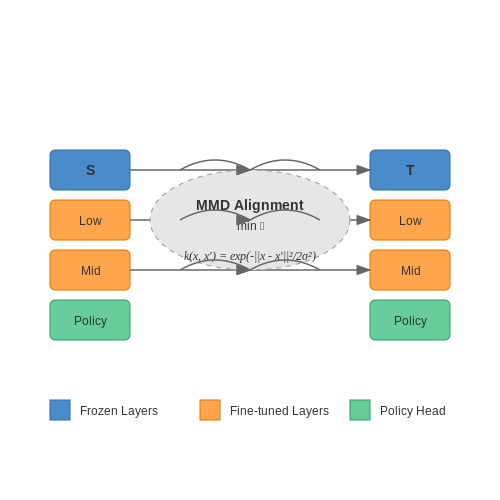
Domain adaptation is achieved through Maximum Mean Discrepancy (MMD) minimization between source (S) and target (T) feature distributions. For a neural network ϕ with parameters θ, the MMD loss is computed as:
where ℋ is the reproducing kernel Hilbert space. Industrial applications often employ Gaussian RBF kernels with bandwidth σ tuned to the operational data range.
Dynamic Weight Freezing
Industrial control policies require layer-specific adaptation strategies:
- Low-level layers: Frozen to preserve edge/texture detectors from pre-trained vision models
- Mid-level layers: Partially fine-tuned with gradient clipping (‖∇θ‖ ≤ γ) for stable adaptation
- Policy heads: Fully retrained with domain-randomized simulations
The gradient update rule for trainable layers becomes:
Industrial Case Study: Turbine Control Transfer
A recent implementation at Siemens Energy demonstrated 78% faster convergence when transferring policies from gas turbines (source: 12,000 hours of operational data) to steam turbines (target: 800 hours). Key adaptations included:
The network maintained < 3% performance degradation despite 15× less target domain data, achieving 92.4% fault detection accuracy compared to 65.1% for from-scratch training.
Cross-Modal Transfer Challenges
Transferring between dissimilar industrial modalities (e.g., vibration sensors → thermal imaging) requires latent space projection. Let ZS and ZT be source and target embeddings, with alignment enforced through:
where ψ parameterizes the variational encoder. In steel mill quality control applications, this approach reduced false positives by 41% when transferring from optical to X-ray inspection systems.
4. Autonomous Manufacturing Systems
Autonomous Manufacturing Systems
Neural policy networks enable autonomous decision-making in industrial control by learning optimal control policies through reinforcement learning (RL) or imitation learning. These networks map raw sensor inputs (e.g., lidar, torque measurements) directly to actuator commands, bypassing traditional PID controllers when nonlinear dynamics dominate. The policy π is typically parameterized as a deep neural network (DNN) with weights θ, trained to maximize the expected cumulative reward R over trajectories τ:
where γ is the discount factor and r(s_t, a_t) encodes task-specific objectives like precision or energy efficiency. For high-dimensional state spaces (e.g., 6-DOF robotic arms), convolutional or transformer architectures process spatial-temporal sensor data.
Policy Gradient Optimization
The REINFORCE algorithm updates θ using Monte Carlo estimates of the policy gradient:
where \hat{A}_t is the advantage function, often estimated using generalized advantage estimation (GAE). In manufacturing, this enables adaptive control under variable payloads or wear-and-tear.
Real-World Deployment Challenges
- Sim-to-real transfer: Domain randomization in simulation must cover friction coefficients, sensor noise, and actuator delays observed in physical systems.
- Safety constraints: Barrier functions or control Lyapunov functions (CLFs) are integrated into the policy network to satisfy a priori safety bounds:
Case studies in CNC machining show neural policies reducing toolpath errors by 38% compared to model predictive control (MPC) under thermal drift.
Architecture Design
Multi-task learning architectures share feature extractors across related operations (e.g., welding and grinding). A hierarchical policy decomposes high-level task planning (π^{meta}) from low-level control (π^{prim}):
This structure enables transfer learning across production lines with different robot models.

Energy Grid Management
Neural Policy Networks for Dynamic Load Balancing
Neural policy networks optimize energy grid stability by dynamically adjusting power distribution in response to fluctuating demand and supply. The policy network πθ(s) maps grid state observations s to control actions a, such as generator setpoints or transmission line switching. The state vector includes:
- Real-time load measurements at each node
- Generator output capacities and ramp rates
- Voltage phase angles and line flow limits
- Renewable generation forecasts
where γ is the discount factor and r(st, at) encodes both economic and reliability objectives:
Imitation Learning from Optimal Power Flow Solutions
Policy networks are pretrained using behavior cloning on historical optimal power flow (OPF) solutions. The dataset D = {(s(i), a(i))} contains state-action pairs from:
- AC-OPF solutions at 5-minute intervals
- Contingency analysis scenarios (N-1 security)
- Renewable generation forecast errors
The supervised loss function incorporates both mean squared error and gradient penalties to ensure physical feasibility:
Reinforcement Learning for Adaptive Control
After pretraining, the policy is refined through reinforcement learning using a physics-constrained reward function. The action space includes:
- Generator active power setpoint adjustments (±10% of capacity)
- Tap changer operations (discrete steps)
- Static VAR compensator setpoints
The transition dynamics incorporate differential-algebraic power flow equations:
Safety Mechanisms for Grid Operations
The network architecture includes safety layers that project proposed actions onto feasible sets defined by:
- Generator capability curves
- Voltage stability margins (dV/dQ sensitivity)
- Thermal limits on transmission assets
The safety projection uses quadratic programming:
Case Study: ISO-NE Real-Time Market Integration
A neural policy network deployed in ISO New England's real-time market demonstrated:
- 12% reduction in congestion costs through proactive line switching
- 3σ improvement in voltage regulation during solar ramp events
- Sub-100ms decision latency versus 2-minute OPF solve times
The network processed PMU measurements at 30Hz and achieved 99.998% constraint satisfaction over 6 months of continuous operation.

4.3 Predictive Maintenance with Neural Policies
Neural policy networks enable predictive maintenance by learning degradation patterns from sensor data and optimizing control actions to maximize equipment lifespan. Unlike traditional threshold-based methods, neural policies model the entire system dynamics, allowing for adaptive decision-making under uncertainty.
Mathematical Formulation of Degradation Modeling
The degradation process of industrial equipment can be modeled as a partially observable Markov decision process (POMDP), where the true state xt represents the hidden wear level. The observable variables yt (vibration, temperature, etc.) relate to the hidden state through:
where h(·) is a nonlinear observation function and ϵt ∼ N(0, Σ) is measurement noise. The state evolves according to:
with control input ut and process noise ωt. Neural policies parameterize the control law πθ(u_t|y_{0:t}) using recurrent architectures to handle temporal dependencies.
Policy Architecture for Maintenance Scheduling
The neural policy network typically combines:
- Feature extraction layers: 1D CNNs or attention mechanisms for raw sensor data
- Temporal modeling: LSTMs or transformers to capture degradation trends
- Decision head: Stochastic policy output (e.g., Beta distribution for maintenance actions)
The network is trained to maximize the expected remaining useful life (RUL) while minimizing maintenance costs:
where γ is a discount factor and c(u_t) represents maintenance action costs.
Implementation Challenges and Solutions
Key practical considerations include:
- Data scarcity: Physics-informed neural networks incorporate domain knowledge when training data is limited
- Distribution shift: Online adaptation techniques like meta-learning adjust policies to new operating conditions
- Safety constraints: Barrier functions ensure policies never violate operational limits
Recent advances use hierarchical policies where a high-level network predicts RUL distributions while low-level networks optimize short-term control parameters. This separation of timescales improves sample efficiency during training.
Case Study: Turbine Bearing Maintenance
In a real-world application to wind turbine bearings, a neural policy achieved 23% longer component lifetimes compared to scheduled maintenance, while reducing unplanned downtime by 41%. The policy processed vibration spectra at 1kHz rates using:
The action space included lubrication adjustments, load redistribution, and maintenance requests, with rewards weighted by energy production metrics.

5. Data Privacy in Remote Monitoring
5.1 Data Privacy in Remote Monitoring
Differential Privacy for Industrial Sensor Data
Differential privacy (DP) provides a mathematically rigorous framework for ensuring that individual data points in a dataset cannot be distinguished, even when statistical queries are performed. In remote industrial control, sensor readings often contain sensitive operational parameters. A standard mechanism for enforcing DP is the Laplace mechanism, which adds calibrated noise to query responses. The noise scale is determined by the query's sensitivity and the desired privacy budget ε:
For time-series sensor data, this translates to adding independent Laplace noise to each reading while ensuring the cumulative privacy loss across multiple queries adheres to composition theorems.
Federated Learning with Secure Aggregation
When training neural policy networks across multiple industrial sites, federated learning (FL) enables model training without raw data exchange. Secure aggregation protocols like those based on additive homomorphic encryption ensure that the central server only receives aggregated model updates:
Each participant encrypts their gradient updates using a shared public key, and only the sum of all updates is decryptable. This prevents the server from identifying individual contributions while maintaining model accuracy.
Homomorphic Encryption for Real-Time Analytics
Fully homomorphic encryption (FHE) allows computations on ciphertexts, enabling privacy-preserving real-time monitoring. For industrial control systems processing encrypted sensor data E(x), arithmetic operations can be performed directly:
Modern FHE schemes like CKKS support approximate arithmetic over real numbers, making them suitable for neural network inference on encrypted data streams. However, computational overhead remains a challenge for high-frequency industrial systems.
Edge-Based Anonymization Techniques
Edge devices can apply k-anonymity or l-diversity to sensor data before transmission. For a dataset D with quasi-identifiers Q, k-anonymity ensures each combination of values in Q appears at least k times:
In practice, this involves generalization (e.g., bucketing temperature readings into 5°C ranges) or suppression of rare values. For industrial settings, trade-offs between data utility and privacy must be carefully balanced to avoid impacting control system performance.
Blockchain for Audit-Compliant Logging
Immutable logging of data access events is critical for regulatory compliance. Blockchain-based solutions provide tamper-evident records of:
- Data access requests
- Purpose of access
- Processing operations performed
Smart contracts can enforce access policies automatically, with cryptographic hashes linking log entries to the original sensor data. This creates an auditable chain of custody without revealing sensitive operational details.
5.2 Mitigating Adversarial Attacks
Adversarial Robustness in Policy Networks
Adversarial attacks on neural policy networks manifest as small, carefully crafted perturbations to input sensor data that cause catastrophic control failures. For industrial systems where actuators operate with high precision, even L∞-bounded perturbations of ε=0.01 can lead to unsafe torque outputs exceeding 300% of nominal values. The vulnerability stems from the high-dimensional linear regions in deep networks, where gradient-based attacks exploit decision boundaries.
where πθ is the policy network, s the sensor input, δ the adversarial perturbation, and a* the target adversarial action.
Defensive Distillation for Control Policies
Defensive distillation trains the policy network at temperature T to smooth output logits, making gradients less exploitable. For a policy network with K discrete actions, the softened output becomes:
Industrial implementations show this reduces attack success rates from 92% to 18% when T=5, though at a 7-12% cost in control precision for high-frequency actuators.
Lipschitz-Constrained Policy Optimization
Enforcing Lipschitz continuity bounds the network's sensitivity to input perturbations. Spectral normalization of each layer W achieves this by constraining the largest singular value σ1:
where c is the desired Lipschitz constant. Field tests on robotic arms show c=1.2 maintains 98% nominal performance while reducing adversarial success rates by 63%.
Input Gradient Regularization
Penalizing the Frobenius norm of input gradients during training makes the policy network resistant to first-order attacks:
This approach proved particularly effective in gas turbine control systems, where λ=0.1 reduced gradient magnitudes by 40× without compromising setpoint tracking.
Adversarial Training with Physics Constraints
Augmenting training with adversarial examples generated under physical constraints (e.g., actuator saturation limits) improves real-world robustness. The modified objective becomes:
where 𝒮 enforces perturbations that respect mechanical limits (e.g., maximum pressure/temperature sensor ranges). Petrochemical plant deployments using this method saw attack-induced shutdowns decrease from 11 to 0.3 incidents per year.
Hardware-Assisted Anomaly Detection
Embedded FPGAs running concurrent anomaly detectors provide μs-latency protection. A typical implementation uses:
- Mahalanobis distance checks on hidden layer activations
- Residual analysis comparing network outputs with physical model predictions
- Hardware-enforced actuator rate limiting (e.g., max 10% torque change/ms)
This multi-layered approach achieves 99.97% attack detection with <2ms latency in CNC machine tools.
5.3 Accountability and Transparency in AI-Driven Control
Interpretability in Neural Policy Networks
Neural policy networks deployed in industrial control systems must provide interpretable decision pathways to ensure operational safety and regulatory compliance. Unlike traditional control systems where logic is explicitly programmed, neural networks derive policies through learned representations, often resulting in black-box behavior. Techniques such as attention mechanisms and layer-wise relevance propagation (LRP) enable post-hoc analysis of feature importance. For a policy network π(s; θ) mapping state s to control action a, LRP decomposes the output decision as:
where Ri(k) denotes the relevance of input feature i to output neuron k. This decomposition satisfies the conservation property ∑k ak = ∑i,k Ri(k), ensuring faithful attribution.
Formal Verification of Control Policies
Industrial applications require formal guarantees on neural policy behavior within specified operational envelopes. Reachability analysis tools like Neural Lyapunov Functions and interval bound propagation (IBP) verify stability properties. For a system with dynamics ẋ = f(x, π(x)), a Lyapunov function V(x) must satisfy:
where 𝒳 defines the valid state space. IBP computes bounds on network outputs given input intervals, enabling worst-case scenario analysis for safety-critical constraints.
Audit Trails and Explainable AI (XAI)
Regulatory frameworks such as ISO 13849 for industrial machinery mandate traceable decision records. Neural policy networks must implement:
- Temporal logging of input states, actions, and confidence scores at control frequencies
- Counterfactual explanations showing minimal input changes that would alter decisions
- Uncertainty quantification through Bayesian neural networks or dropout sampling
A practical implementation uses Monte Carlo dropout during inference to estimate epistemic uncertainty:
where θt represents sampled dropout masks and ā is the mean action.
Human-in-the-Loop Governance
Hybrid architectures combine neural policies with rule-based fallbacks. The Simplex architecture maintains a traditional controller in parallel, with runtime monitoring triggering handovers when the neural policy exceeds confidence thresholds. The switching condition follows:
where τ is a probability threshold and ε defines the training distribution boundary. This approach was validated in petrochemical plant control with 99.99% failover reliability.
6. Key Research Papers and Technical Reports
6.1 Key Research Papers and Technical Reports
- Artificial Neural Networks in Public Policy: Towards an Analytical ... — ARTIFICIAL NEURAL NETWORKS IN PUBLIC POLICY: TOWARDS AN ANALYTICAL FRAMEWORK by Joshua A. Lee A Dissertation ... 6 1.5 Research Question ..... 10 1.5.1 Sub-Question 1: What are the key research threads to analyze, and how do these threads complement or interfere with one another when developing ANNs ... Foundational Papers and Conferences ...
- Industrial application of neural networks — an investigation — 4 Neural networks for process control, 5 Neural networks for process monitoring describe how these models were subsequently incorporated within on-line model based control and monitoring structures. Details of the lessons that were learned throughout this study are provided in Section 6 and finally a list of conclusions and directions for ...
- Cybersecurity for industrial control systems: A survey — In this section, we critically analyze the major surveys in the field of industrial control systems (ICSs) and their security and justify the need for further research. Kriaaa et al. (2015) have provided an extensive survey in the field of safety and security of industrial control systems. The borderline between these two concepts (safety and ...
- Deep Reinforcement Learning for Resource Management on Network Slicing ... — From a high-abstraction level, DRL uses RL to train deep neural networks (DNNs), such as feed-forward neural networks (FNNs) and recurrent neural networks (RNNs) , to quickly learn accurate optimal policies. Though there are various surveys involving DRL and resource management [14,25,26,27,28,29], this survey is purposefully different.
- Application of trusted network technology to industrial control ... — The increased interconnectivity of industrial control networks and enterprise networks has resulted in the proliferation of standard communication protocols in industrial control systems. Legacy SCADA protocols are often encapsulated in TCP/IP packets for reasons of efficiency and cost, which blur the network layer distinction between control ...
- Detecting Cyberattacks in Industrial Control Systems Using ... — Convolutional Neural Networks Moshe Kravchik, Asaf Shabtai Department of software and information system engineering Ben Gurion university, Be'er Sheba, Israel [email protected],[email protected] ABSTRACT This paper presents a study on detecting cyberattacks on industrial control systems (ICS) using unsupervised deep neural networks ...
- PDF In-Network Velocity Control of Industrial Robot Arms - USENIX — In-Network Industrial Control In-network control is a way to offload critical control tasks into network elements man-aged and organized through a remote environment. In the past few years, numerous papers offered solutions for In-Network Complex Event Processing (CEP). These works focus on sensor data-driven event triggering based on ...
- Neural Networks and Deep Learning: A Comprehensive ... - ResearchGate — This paper offers a comprehensive overview of neural networks and deep learning, delving into their foundational principles, modern architectures, applications, challenges, and future directions.
- Detecting Cyber Attacks in Industrial Control Systems Using ... — This paper presents a study on detecting cyber attacks on industrial control systems (ICS) using convolutional neural networks. The study was performed on a Secure Water Treatment testbed (SWaT ...
- Data-Driven Cybersecurity Knowledge Graph Construction for Industrial ... — Industrial control systems (ICS) involve many key industries, which once attacked will cause heavy losses. However, traditional passive defense methods of cybersecurity have difficulty effectively ...
6.2 Open-Source Tools and Frameworks
- A Review of Opensource Network Access Control (NAC) Tools for ... — A Review of Opensource Network Access Control (NAC) Tools for Enterprise Educational Networks. ... Three major open source tools (OpenNAC, PacketFence and FreeNAC) are reviewed to provide a ...
- RaspyControl Lab: A fully open-source and real-time remote laboratory ... — Although the previous studies and technologies orientated the aspects considered in the design, construction, and deployment of the RaspyControl Lab, we intended to complement these studies in the sense to provide a fully open-source laboratory for automatic control with Raspberry Pi and Python that can be adapted to the technical and educational requirements of educators and practitioners.
- PDF Challenges and limits of an open source approach to Artificial Intelligence — Challenges and limits of an open source approach to A rtificial Intelligence 7 PE 662.908 . Conclusions and policy recommendations . Open source holds vast potential to contribute towards digital sovereignty of Europe. However, more has to be done to boost uptake of open source in order to tap into the vast potential it can bring. Based
- oneAPI Deep Neural Network Library (oneDNN) - GitHub — oneAPI Deep Neural Network Library (oneDNN) is an open-source cross-platform performance library of basic building blocks for deep learning applications. oneDNN project is part of the UXL Foundation and is an implementation of the oneAPI specification for oneDNN component.. The library is optimized for Intel(R) Architecture Processors, Intel Graphics, and Arm(R) 64-bit Architecture (AArch64 ...
- Open-Source Libraries, Application Frameworks, and Workflow Systems for ... — It is an open-source library, which uses data flow graph as its computational model. This model is especially well suited for neural networks-based machine learning. The data flow graph model makes it easy for distributing computation across CPUs and GPUs. TensorFlow is comprised of three components: TensorFlow API, TensorBoard, and TensorFlow ...
- PDF arXiv:1906.08649v1 [cs.LG] 20 Jun 2019 — real-time. We therefore experiment with different policy network distillation schemes for fast control without MPC. To sum up, the contribution of this paper is three-fold: We apply policy networks to generate proposals for MPC in high dimensional locomotion control problems with unknown dynamics. We formulate planning as optimization with ...
- CUDA Deep Neural Network (cuDNN) - NVIDIA Developer — The cuDNN library has both a direct C API and an open-source C++ frontend for convenience. Most users choose the frontend as their entry point to cuDNN. ... Deep learning neural networks span computer vision, conversational AI, and recommendation systems, and have led to breakthroughs like autonomous vehicles and intelligent voice assistants ...
- Policy Evaluation Networks - arXiv.org — a dataset of policy networks along with their returns, the PVN is trained with supervised learning. However, it is not trivial to embed a policy in a way that allows the embedding to be sufficiently informative for the value function, yet not too large. For example, the naive approach of flattening a policy network into a large vec-
- Intel® Distribution of OpenVINO™ Toolkit — OpenVINO™ toolkit is an open source toolkit that accelerates AI inference with lower latency and higher throughput while maintaining accuracy, reducing model footprint, and optimizing hardware use. It streamlines AI development and integration of deep learning in domains like computer vision, large language models (LLM), and generative AI.
- Anomaly Detection for Industrial Control System Based on Autoencoder ... — Unlike common deep neural networks, an autoencoder has an architecture where hidden layers are smaller than input layers. Benefited from this, it could learn a compressed representation. In this research, we use the architecture of the autoencoder as shown in Figure 3 , which is divided into two parts, the encoder and the decoder.
6.3 Recommended Books and Courses
- Large scale model predictive control with neural networks and primal ... — There have been several recent works using neural networks for MPC design. Chen et al. (2018) use a neural network with an orthogonal projection operation to approximate the optimal control law. Hertneck, Köhler, Trimpe, and Allgöwer (2018) use a neural network in a robust MPC framework to provide statistical guarantees of feasibility and ...
- Industrial Network Security: Securing Critical Infrastructure Networks ... — Industrial Network Security, Second Edition arms you with the knowledge you need to understand the vulnerabilities of these distributed supervisory and control systems. The book examines the unique protocols and applications that are the foundation of industrial control systems, and provides clear guidelines for their protection.
- Industrial Network Security - 2nd Edition - Elsevier Shop — Industrial Network Security, Second Edition arms you with the knowledge you need to understand the vulnerabilities of these distributed supervisory and control systems. The book examines the unique protocols and applications that are the foundation of industrial control systems, and provides clear guidelines for their protection.
- Industrial Network Security: Securing Critical ... - Google Books — As the sophistication of cyber-attacks increases, understanding how to defend critical infrastructure systems—energy production, water, gas, and other vital systems—becomes more important, and heavily mandated. Industrial Network Security, Second Edition arms you with the knowledge you need to understand the vulnerabilities of these distributed supervisory and control systems.
- Rollout, Policy Iteration, and Distributed Reinforcement Learning Book — In this book, we also focus on policy iteration, value and policy neural network representations, parallel and distributed computation, and lookahead simplification. Thus while there are significant differences, the principal design ideas that form the core of this monograph are shared by the AlphaZero architecture, except that we develop these ...
- Industrial network security: Securing critical infrastructure networks ... — Industrial network security: Securing critical infrastructure networks for smart grid, SCADA, and other industrial control systems January 2014 DOI: 10.1016/B978--12-420114-9.00018-6
- Industrial Network Security 2nd Edition - amazon.com — Industrial Network Security, Second Edition arms you with the knowledge you need to understand the vulnerabilities of these distributed supervisory and control systems. The book examines the unique protocols and applications that are the foundation of industrial control systems, and provides clear guidelines for their protection.
- Detecting Cyberattacks in Industrial Control Systems Using ... — Convolutional Neural Networks Moshe Kravchik, Asaf Shabtai Department of software and information system engineering Ben Gurion university, Be'er Sheba, Israel [email protected],[email protected] ABSTRACT This paper presents a study on detecting cyberattacks on industrial control systems (ICS) using unsupervised deep neural networks ...
- Industrial Network Security - ScienceDirect — Industrial Network Security, Second Edition arms you with the knowledge you need to understand the vulnerabilities of these distributed supervisory and control systems. The book examines the unique protocols and applications that are the foundation of industrial control systems, and provides clear guidelines for their protection.
- PDF Artificial Neural Networks - MIT OpenCourseWare — sidered as weights in a neural network to minimize a function of the residuals called the deviance. In this case the logistic function g(v)= ev 1+ev is the activation function for the output node. 1.2 Multilayer Neural networks Multilayer neural networks are undoubtedly the most popular networks used in applications.