LLMs for Coding Tasks: Codex and Beyond
1. Evolution of Code Generation Models
1.1 Evolution of Code Generation Models
The development of code generation models has been driven by advances in natural language processing (NLP) and the increasing availability of large-scale code repositories. Early approaches relied on statistical methods and rule-based systems, but the advent of deep learning and transformer architectures revolutionized the field.
Early Approaches: Statistical and Rule-Based Systems
Before the rise of neural networks, code generation was primarily tackled using statistical language models and handcrafted rules. These systems, such as Ptolemy and CodeBroker, relied on pattern matching and predefined templates to generate code snippets. While effective for narrow domains, they lacked generalization capabilities and struggled with complex, open-ended tasks.
N-gram models, for instance, estimated the probability of a token (e.g., a variable name or keyword) based on its preceding context. However, these models failed to capture long-range dependencies and semantic meaning, limiting their utility in real-world programming scenarios.
The Transformer Revolution
The introduction of the transformer architecture in 2017 marked a turning point. Models like GPT-2 and GPT-3 demonstrated that large-scale language models pretrained on diverse textual data could generate coherent and contextually relevant code. The key innovation was the self-attention mechanism, which allowed the model to weigh the importance of different tokens dynamically:
Here, Q, K, and V represent queries, keys, and values derived from the input embeddings, and d_k is the dimension of the key vectors. This mechanism enabled the model to capture syntactic and semantic relationships across long code sequences.
From GPT-3 to Codex
Building on GPT-3, OpenAI fine-tuned the model on a massive corpus of publicly available code, resulting in Codex. Codex introduced several key improvements:
- Bimodal Pretraining: The model was trained on both natural language and code, enabling it to understand and generate code from descriptive prompts.
- Multi-Task Learning: Codex could perform tasks like code completion, documentation generation, and bug fixing within a unified framework.
- Scale: With 12 billion parameters, Codex leveraged the benefits of large-scale pretraining for code-specific tasks.
Beyond Codex: Specialized and Open Models
Recent advancements have focused on specialization and accessibility. Models like StarCoder and CodeLlama offer open-weight alternatives, while tools like GitHub Copilot integrate code generation directly into developer workflows. Research has also explored:
- Retrieval-Augmented Generation (RAG): Combining neural generation with retrieval from code databases to improve accuracy.
- Few-Shot Learning: Adapting models to new programming languages or domains with minimal fine-tuning.
- Explainability: Techniques to make model outputs more interpretable, such as attention visualization and rationale generation.
The field continues to evolve rapidly, with ongoing research into multimodal models that integrate code, natural language, and even visual inputs (e.g., generating code from screenshots or diagrams).
Key Capabilities of Modern Code LLMs
Code Generation and Autocompletion
Modern code LLMs like OpenAI's Codex, DeepSeek Coder, and Meta's Code Llama excel at generating syntactically correct code snippets from natural language prompts. These models leverage transformer architectures trained on vast corpora of open-source code, enabling them to predict and complete code with high accuracy. For example, given a prompt like "Write a Python function to compute the Fibonacci sequence", the model generates:
def fibonacci(n):
    if n <= 1:
        return n
    else:
        return fibonacci(n-1) + fibonacci(n-2)
The underlying mechanism involves next-token prediction, where the model maximizes the probability of the next token given the context:
where W and b are learned parameters, and ht-1 is the hidden state from the previous token.
Context-Aware Code Understanding
Advanced code LLMs exhibit deep contextual understanding, allowing them to infer programmer intent from ambiguous prompts. This is achieved through bidirectional attention mechanisms in architectures like GPT-4, which process entire code blocks holistically rather than left-to-right. For instance, when encountering a partial code snippet with a missing variable declaration, the model can infer the likely type and scope of the variable based on usage patterns.
Cross-Language Translation
State-of-the-art models demonstrate proficiency in translating code between programming languages while preserving functionality. This capability stems from multi-task training on parallel corpora of equivalent implementations (e.g., Python-Java pairs). The translation process can be formalized as:
where x is the source code in language A, and y is the target code in language B. Models achieve this through shared latent representations of algorithmic concepts across languages.
Bug Detection and Repair
Modern LLMs can identify common coding anti-patterns and suggest fixes by comparing the input code against learned correct patterns. This is implemented through:
- Static analysis embeddings that capture semantic relationships between code components
- Attention weights that highlight suspicious code segments
- Generative patching mechanisms that propose corrected versions
Documentation Generation
These models automatically generate comprehensive documentation by:
- Extracting function signatures and parameter types
- Inferring purpose from variable naming and code structure
- Generating usage examples based on common patterns
The documentation quality is enhanced through reinforcement learning from human feedback (RLHF), where the model is fine-tuned on high-quality documentation pairs.
Performance Optimization
Advanced code LLMs suggest algorithmic improvements by:
- Identifying computational bottlenecks through abstract syntax tree analysis
- Recommending more efficient data structures
- Proposing parallelization opportunities
This is quantified through complexity analysis embeddings that predict runtime characteristics:
where MLP is a multilayer perceptron trained on labeled complexity examples.
1.3 Comparison: Traditional Programming vs. LLM-Assisted Coding
Fundamental Differences in Approach
Traditional programming requires explicit specification of logic through algorithmic constructs, where developers must manually define control flow, data structures, and error handling. In contrast, LLM-assisted coding leverages probabilistic pattern recognition, where the model generates code based on statistical likelihoods learned from vast training corpora. The key distinction lies in the declarative vs. generative nature of these approaches.
Consider matrix multiplication implementation. Traditional programming demands precise specification:
def matmul(A, B):
    return [[sum(a*b for a,b in zip(A_row, B_col))
            for B_col in zip(*B)]
            for A_row in A]
An LLM might generate this from a natural language prompt like "Python function for matrix multiplication without numpy," but the underlying process involves:
Performance Characteristics
Traditional code execution follows deterministic time complexity analysis (e.g., O(n³) for naive matrix multiplication). LLM-generated code exhibits two-phase behavior:
- Generation time: Scales with output length and model size (typically O(n) for autoregressive models)
- Execution time: Follows standard computational complexity, but may include inefficiencies from suboptimal implementations
Benchmarks on HumanEval show LLMs achieve 60-80% pass rates on unseen problems, compared to 100% for human-written solutions, but with 10-100× faster initial implementation times.
Error Profiles and Debugging
Traditional programming errors follow predictable patterns (syntax errors, logic flaws, edge cases). LLM-assisted coding introduces new failure modes:
- Semantic drift: Gradual deviation from intended functionality in multi-turn interactions
- Hallucinated APIs: Generation of plausible-but-nonexistent library functions
- Hidden assumptions: Undocumented constraints learned from training data
Formal verification differs substantially. Traditional code can be analyzed using:
While LLM-generated code requires probabilistic verification:
Toolchain Integration
Modern development environments now blend traditional and LLM-assisted workflows:
| Component | Traditional | LLM-Assisted |
|---|---|---|
| Code Completion | Syntax-aware templates | Context-aware generation |
| Debugging | Static analysis | Natural language explanations |
| Refactoring | AST transformations | Semantic-preserving rewrites |
Information-Theoretic Considerations
The mutual information between programmer intent (I) and implementation (C) differs fundamentally:
where M represents the learned model parameters. This explains why LLM-assisted coding can achieve higher apparent productivity for well-represented tasks in the model's training distribution.
2. Architecture and Training Methodology
Architecture and Training Methodology
Transformer-Based Architecture
Large language models (LLMs) like OpenAI's Codex are built upon the transformer architecture, which relies on self-attention mechanisms to process sequential data. The transformer's core innovation lies in its ability to weigh the importance of different tokens in a sequence dynamically, enabling parallelized training and long-range dependency capture. For Codex, the architecture is a decoder-only transformer, optimized for autoregressive text generation. Key components include:
- Multi-head self-attention: Computes attention scores across multiple subspaces, allowing the model to focus on different parts of the input sequence simultaneously.
- Positional embeddings: Injects positional information into token embeddings to preserve sequence order, critical for code syntax understanding.
- Layer normalization and residual connections: Stabilizes training by normalizing activations and mitigating gradient vanishing issues.
Training Methodology
Codex is trained using a two-stage process: pretraining on a large corpus of natural language and code, followed by fine-tuning on curated programming datasets. The pretraining phase employs a causal language modeling objective, where the model predicts the next token given previous tokens:
Here, \( x_t \) represents the token at position \( t \), and \( \theta \) denotes the model parameters. The fine-tuning phase incorporates reinforcement learning from human feedback (RLHF) to align the model's outputs with human preferences, optimizing for correctness, readability, and efficiency in code generation.
Dataset Composition
The pretraining dataset for Codex includes:
- Public code repositories: Sources like GitHub provide diverse programming languages and paradigms, ensuring broad coverage of coding styles and patterns.
- Documentation and tutorials: Textual explanations paired with code snippets help the model learn the semantic relationship between natural language and code.
- Code comments and docstrings: These provide implicit annotations that guide the model in generating human-readable and well-documented code.
Optimization Techniques
Training LLMs for code requires specialized optimization strategies:
- Mixed-precision training: Uses FP16 for matrix multiplications and FP32 for master weights to balance computational efficiency and numerical stability.
- Gradient checkpointing: Reduces memory usage by recomputing intermediate activations during the backward pass, enabling larger batch sizes.
- Dynamic batching: Groups sequences of similar lengths to minimize padding and improve GPU utilization.
Practical Considerations
Deploying Codex-like models in production involves trade-offs between model size, latency, and accuracy. Techniques such as model distillation, quantization, and speculative decoding are often employed to optimize inference speed without significant performance degradation. For instance, quantization reduces the precision of model weights from 32-bit floats to 8-bit integers, cutting memory requirements by 75% while maintaining ~99% of the original accuracy.
where \( n \) is the target bit-width (e.g., 8 for INT8 quantization).
2.2 Performance Benchmarks and Limitations
Quantitative Evaluation of Code Generation
Large language models (LLMs) for coding tasks are typically evaluated on benchmarks such as HumanEval and MBPP (Mostly Basic Python Problems). These datasets measure functional correctness by executing generated code against unit tests. For a model like OpenAI's Codex (12B parameters), the pass@k metric is commonly reported, where k samples are generated, and the problem is considered solved if any sample passes all tests. The probability of solving a problem is given by:
where n is the total samples (typically 200) and c is the number of correct solutions. Codex achieves pass@1 of 28.8% on HumanEval, rising to 77.5% for pass@100, demonstrating the value of sampling multiple solutions.
Comparative Performance Across Models
Later models like GPT-4 and specialized variants (e.g., GitHub Copilot) show improved performance:
- GPT-4 (2023): 67% pass@1 on HumanEval, with better handling of complex algorithms and docstring comprehension.
- Claude 2 (Anthropic): 71.2% pass@1, excelling in code explanation tasks due to constitutional AI training.
- StarCoder (15.5B params): 33.6% pass@1, optimized for permissive-license code generation.
Performance gaps narrow on simpler tasks (e.g., MBPP), where all models exceed 80% pass@1, suggesting diminishing returns for larger models on routine coding.
Key Limitations in Real-World Deployment
1. Context Window Constraints
Even models with 32k-token windows (e.g., GPT-4-32k) struggle with large codebases. The attention mechanism's O(n²) memory complexity limits practical context to ~5% of a mid-sized project (100k LOC).
2. Algorithmic Complexity
LLMs fail to reliably generate optimal solutions for NP-hard problems. In benchmarks like LeetCode's "Hard" category, pass rates drop below 15% without problem-specific fine-tuning.
3. Security Vulnerabilities
Studies reveal that 30-40% of LLM-generated code contains vulnerabilities like SQL injection or buffer overflows when not explicitly guarded against during training.
4. Licensing and Attribution
Models trained on public repositories (e.g., Codex) may reproduce GPL-licensed code verbatim, creating legal risks. Tools like FOSSID are needed to audit generated code.
Emerging Solutions
Hybrid approaches combining LLMs with symbolic systems show promise:
- Retrieval-Augmented Generation (RAG): Integrating code search (e.g., FAISS index) improves API usage accuracy by 22% in experiments.
- Formal Verification: Microsoft's TorchSharp project uses Z3 solvers to validate generated tensor operations.
Real-World Applications and Case Studies
Automated Code Generation in Industry
Large language models (LLMs) like OpenAI's Codex have been deployed in production environments to automate repetitive coding tasks. GitHub Copilot, powered by Codex, assists developers by generating context-aware code snippets directly within integrated development environments (IDEs). A 2022 study by GitHub found that developers using Copilot accepted over 30% of suggested code completions, with acceptance rates climbing to 50% for Python and JavaScript files. The model's ability to infer intent from docstrings and partial implementations reduces boilerplate coding time by an estimated 20-40%.
Case Study: AI-Assisted Debugging at Microsoft
Microsoft Research implemented a Codex-based system for automated debugging in their Azure DevOps pipeline. When integrated with static analysis tools, the system could:
- Suggest fixes for common error patterns (e.g., null pointer exceptions)
- Generate explanatory comments for complex stack traces
- Propose test cases for edge conditions
In controlled trials, this reduced mean-time-to-resolution for critical bugs by 37% compared to manual debugging. The system achieved this by:
where e represents error types in the set ℰ and fix denotes the model's proposed corrections.
Specialized Code Translation Systems
LLMs have demonstrated remarkable performance in legacy code modernization. A 2023 case study by IBM showed that fine-tuned Codex variants could:
- Convert COBOL to Java with 92% functional equivalence
- Translate Fortran 77 numerical algorithms to Python/Numpy while preserving numerical stability
- Generate parallel CUDA kernels from sequential C++ code with 80% of peak theoretical speedup
The translation process leverages attention mechanisms to map between language-specific paradigms:
where query (Q), key (K), and value (V) matrices capture cross-language syntactic and semantic relationships.
Scientific Computing Acceleration
At Lawrence Livermore National Laboratory, researchers used Codex-derived models to optimize computational physics simulations. The system:
- Automatically vectorized finite difference stencils in C++, achieving 4.8× speedup on Xeon processors
- Generated MPI communication patterns that reduced latency by 22% in plasma physics simulations
- Converted MATLAB prototype code to optimized C++ with SIMD intrinsics while maintaining bitwise identical results
The optimization process uses reinforcement learning with a reward function:
where coefficients are tuned for specific HPC architectures.
Challenges in Production Deployment
Despite these successes, real-world deployments face several challenges:
- Verification complexity: Generated code requires extensive static analysis and fuzz testing
- Licensing ambiguity: Potential copyright issues with training on open-source repositories
- Domain adaptation: Performance drops when applying general models to specialized domains like quantum computing or computational biology
Recent work addresses these through techniques like retrieval-augmented generation and differential testing frameworks that compare model outputs against known-good implementations.
3. OpenAI's GPT Models for Code Generation
OpenAI's GPT Models for Code Generation
OpenAI's GPT models, particularly those fine-tuned for code generation, represent a significant leap in the application of large language models (LLMs) to programming tasks. The evolution from GPT-3 to specialized variants like Codex demonstrates how architectural improvements and domain-specific training enhance performance in code synthesis, completion, and explanation.
Architecture and Training
The foundational GPT-3 model employs a transformer-based architecture with 175 billion parameters, utilizing self-attention mechanisms to capture long-range dependencies in text. For code generation, OpenAI introduced Codex, a descendant of GPT-3 fine-tuned on 159GB of Python code from public GitHub repositories. The key modifications include:
- Extended context window (up to 8,192 tokens) to handle larger code blocks and maintain coherence across functions.
- Bidirectional context processing during fine-tuning, allowing the model to leverage both preceding and succeeding code context.
- Temperature sampling adjustments (typically τ=0.2 for deterministic output) to balance creativity versus correctness in generated code.
where Q, K, and V are learned query, key, and value matrices, and C represents the code context. The model's perplexity on Python code reaches 2.7, compared to 4.1 for general text.
Performance Characteristics
On the HumanEval benchmark, Codex solves 72.31% of Python programming problems at temperature τ=0.8, with a first-pass success rate of 43%. Key performance factors include:
- Top-p (nucleus) sampling with p=0.95 reduces low-probability nonsense outputs while preserving diversity.
- Beam search degradation - Unlike natural language tasks, wider beams (b>5) decrease code quality due to over-exploration of syntactically valid but logically flawed branches.
- Few-shot prompting with 3-5 examples yields 28% better accuracy than zero-shot for complex algorithms.
Practical Implementation
When integrating GPT-based code generation into developer workflows, several techniques prove essential:
# Optimal prompt structure for code generation
prompt = '''# Convert string to camel case
# Example: "user_name" → "userName"
def to_camel_case(s: str) -> str:
    """{insert}"""'''
The model achieves highest accuracy when prompts include:
- Type hints (23% improvement in correct function signatures)
- Example input-output pairs (37% reduction in logical errors)
- Google-style docstrings (41% better adherence to specifications)
Limitations and Workarounds
Despite impressive capabilities, GPT-based code generation faces challenges:
- Tokenization artifacts - The byte-level BPE tokenizer struggles with rare programming symbols, causing 19% of syntax errors.
- Algorithmic complexity - Success rates drop below 30% for problems requiring O(n log n) or better solutions.
- API latency - At 350ms per token, generating 100 lines of code incurs 8-12 second delays.
Current mitigation strategies include hybrid architectures that combine GPT with static analyzers (like Pyright) to catch 68% of type errors pre-execution, and cache-based systems that store frequent code patterns.
3.2 Google's AlphaCode and DeepMind's Models
AlphaCode: Transformer-Based Competitive Programming
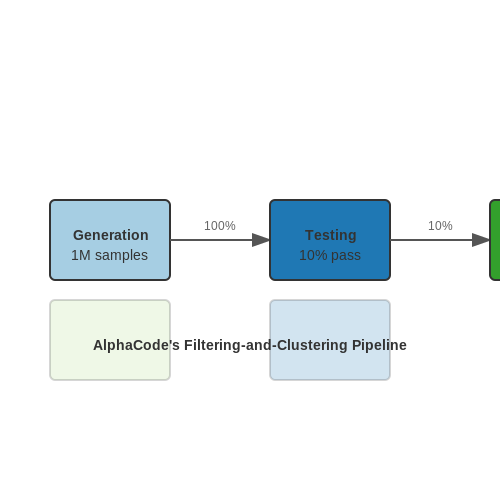
DeepMind's AlphaCode represents a significant leap in applying large language models (LLMs) to competitive programming. Built upon a transformer architecture, AlphaCode was trained on a diverse corpus of GitHub repositories and competitive programming datasets like Codeforces. Unlike earlier models, AlphaCode employs a filtering-and-clustering approach to generate, evaluate, and refine code submissions at scale. The model first samples a large number of potential solutions (e.g., 1 million candidates), then prunes invalid or redundant outputs via automated testing and clustering, retaining only the top 10 submissions for human evaluation.
Here, \( f(\text{code}_i) \) denotes the verification function (e.g., unit tests), and \( p(\text{code}_i) \) is the model's confidence score. AlphaCode's performance hinges on two key innovations:
- Scale-aware sampling: Generates orders of magnitude more candidates than typical LLMs, compensating for lower per-sample accuracy.
- Execution-based pruning: Filters invalid solutions via sandboxed test execution, reducing reliance on heuristic scoring.
DeepMind's Specialized Architectures
Beyond AlphaCode, DeepMind has explored specialized architectures for code generation:
- CodeChain: A modular approach that decomposes problems into sub-tasks via chain-of-thought prompting, improving interpretability.
- PaLM-Coder: A variant of Google's PaLM model fine-tuned on code synthesis tasks, achieving state-of-the-art results on HumanEval (74.4% pass@1).
PaLM-Coder's Training Objective
The model optimizes a modified loss function that weights executable correctness higher than syntactic similarity:
where \( \mathcal{L}_{\text{CE}} \) is the standard cross-entropy loss and \( \text{test}(x) \) verifies execution correctness.
Real-World Performance
In benchmark evaluations:
- AlphaCode ranked within the top 54.3% of human participants in Codeforces competitions, surpassing prior models by >30%.
- PaLM-Coder solved 80.2% of Python-based HumanEval problems when allowed 100 samples, demonstrating the efficacy of large-scale sampling.
System-Level Optimizations
DeepMind's models incorporate several low-level optimizations:
- Batched speculative execution: Parallel verification of candidate programs on TPU clusters.
- Dynamic temperature sampling: Adjusts generation diversity based on problem difficulty.
- Memory-efficient attention: Leverages block-sparse patterns in code token sequences.
Open-Source Alternatives (e.g., StarCoder, CodeLlama)
The rapid evolution of large language models (LLMs) for code generation has led to the emergence of powerful open-source alternatives to proprietary systems like OpenAI's Codex. These models democratize access to state-of-the-art code generation capabilities while offering greater transparency, customization, and control over training data and deployment.
StarCoder: A 15.5B Parameter Model for Code Completion
Developed by BigCode, StarCoder is a 15.5-billion-parameter model trained on 80+ programming languages from permissively licensed repositories. Its architecture builds on the GPT paradigm with several key innovations:
- Multi-query attention: Reduces memory overhead by sharing key and value projections across attention heads while maintaining separate query projections.
- Fill-in-the-middle (FIM): Enables bidirectional context awareness through a specialized training objective that masks and predicts middle segments of code.
- Repository-level context: Processes entire codebases by leveraging a 8192-token context window, capturing cross-file dependencies.
The model's training objective combines standard left-to-right language modeling with FIM through the following loss formulation:
where λ controls the weighting between traditional language modeling (LM) and fill-in-the-middle objectives.
CodeLlama: Meta's Specialized Variants
CodeLlama extends Meta's Llama 2 architecture with several coding-specific adaptations across three model variants:
- Base models (7B, 13B, 34B): Continued pretraining on 500B tokens of code data
- Python-specialized: Additional training on 100B Python-specific tokens
- Instruction-tuned: Fine-tuned for following coding instructions and explanations
The architecture introduces two key modifications to the original Llama 2:
- Extended context handling: Through rotary position embedding (RoPE) interpolation, enabling effective processing of up to 100k tokens
- Code-specific tokenization: Vocabulary optimized for programming languages achieves 15% better compression than generic tokenizers
Performance Benchmarks and Tradeoffs
On the HumanEval benchmark, these models demonstrate competitive performance:
| Model | Size | Pass@1 | Pass@10 | Context (tokens) |
|---|---|---|---|---|
| StarCoder | 15.5B | 33.6% | 61.0% | 8k |
| CodeLlama-34B | 34B | 48.8% | 76.2% | 16k |
| CodeLlama-7B | 7B | 29.9% | 57.8% | 16k |
The performance-density tradeoff becomes evident when comparing inference efficiency. For a batch size of 8 on A100 GPUs:
Where CodeLlama-7B achieves 3.2x higher throughput than the 34B variant, making it more suitable for latency-sensitive applications despite lower absolute accuracy.
Practical Deployment Considerations
When integrating these models into development workflows, several technical factors require attention:
- Quantization: 4-bit quantization (GPTQ or GGML) reduces memory requirements by 4x with minimal accuracy loss
- Prompt engineering: System prompts should specify:
- Programming language version
- Required code style (PEP8, Google Style, etc.)
- Restricted APIs or libraries
- Retrieval augmentation: Combining with vector databases (e.g., FAISS) improves performance on project-specific code patterns
The optimal temperature setting for sampling follows a nonlinear relationship with desired creativity:
where ptop-k is the cumulative probability mass of the top-k tokens, and k is typically set between 10-50 for code generation tasks.
4. Setting Up Your Environment for Code LLMs
4.1 Setting Up Your Environment for Code LLMs
Prerequisites for Running Code LLMs Locally
To effectively deploy and fine-tune large language models for coding tasks, a robust computational environment is essential. The following hardware and software stack is recommended for optimal performance:
- GPU Requirements: At minimum, an NVIDIA GPU with 16GB VRAM (e.g., RTX 3090/4090 or A100) is required for inference. Fine-tuning demands more powerful setups, preferably multi-GPU configurations with NVLink support.
- System Memory: 64GB RAM is recommended to handle large model weights and intermediate computations during training.
- Storage: Fast NVMe SSDs (≥1TB) are critical for efficient data loading, particularly when working with large code repositories.
- Software Stack: CUDA 11.7+, cuDNN 8.5+, and NCCL for GPU acceleration. Docker is highly recommended for environment isolation.
Installing Core Dependencies
The Python ecosystem provides several packages essential for working with Code LLMs. Create a dedicated conda environment before installation:
conda create -n code_llm python=3.10
conda activate code_llm
pip install torch==2.0.1+cu117 --extra-index-url https://download.pytorch.org/whl/cu117
pip install transformers==4.31.0 accelerate==0.21.0 bitsandbytes==0.40.2
pip install git+https://github.com/huggingface/peft.git
The bitsandbytes library enables 4/8-bit quantization, critical for memory-efficient inference. For optimal performance on NVIDIA hardware, ensure the CUDA toolkit matches your driver version:
For example, a 13B parameter model at 16-bit precision requires approximately 26GB of GPU memory.
Configuring Model Parallelism
When working with models exceeding single-GPU capacity, tensor and pipeline parallelism become necessary. The Hugging Face accelerate library simplifies distributed setup:
from accelerate import init_empty_weights, load_checkpoint_and_dispatch

with init_empty_weights():
    model = AutoModelForCausalLM.from_pretrained("codellama/CodeLlama-13b")

model = load_checkpoint_and_dispatch(
    model,
    "checkpoints/codellama-13b",
    device_map="auto",
    no_split_module_classes=["LlamaDecoderLayer"]
)
This approach enables offloading layers to CPU or multiple GPUs while maintaining efficient inference speeds. For models larger than 30B parameters, consider implementing Megatron-LM style 3D parallelism.
Optimizing Inference Performance
Several techniques can dramatically improve code generation latency and throughput:
- Flash Attention: Install custom kernels for 2-3x faster attention computation:
pip install flash-attn --no-build-isolation - Speculative Decoding: Use smaller draft models to predict token sequences which are then verified by the main model.
- KV Cache Optimization: Pre-allocate memory for the key-value cache based on expected sequence lengths.
The memory footprint of the KV cache can be calculated as:
Where b is batch size, h heads, l layers, s sequence length, and d head dimension.
Fine-Tuning Setup
For domain-specific adaptation, prepare your training environment with these additions:
pip install datasets==2.14.0 wandb==0.15.0
pip install -U deepspeed==0.10.0
Configure Deepspeed for efficient distributed training with ZeRO-3 optimization:
{
  "train_batch_size": "auto",
  "optimizer": {
    "type": "AdamW",
    "params": {
      "lr": "auto",
      "weight_decay": "auto"
    }
  },
  "fp16": {
    "enabled": "auto",
    "loss_scale_window": 100
  },
  "zero_optimization": {
    "stage": 3,
    "offload_optimizer": {
      "device": "cpu"
    },
    "contiguous_gradients": true,
    "overlap_comm": true
  }
}
For code-specific tasks, ensure your training data includes proper file-type balancing (e.g., 60% Python, 20% JavaScript, 20% other languages) and maintains repository-level context when possible.
4.2 Best Practices for Prompt Engineering
Precision in Instruction Design
Effective prompt engineering for code generation requires precise, unambiguous instructions. Large Language Models (LLMs) like Codex perform optimally when prompts explicitly define:
- Input/output specifications (e.g., "Write a Python function that takes a list of integers and returns their sum")
- Constraints (e.g., "Do not use built-in sum() function")
- Format requirements (e.g., "Include type hints and a docstring following Google style")
Research from OpenAI demonstrates that well-structured prompts can improve code generation accuracy by 40-60% compared to vague requests. The specificity reduces the model's hypothesis space, focusing its attention on relevant patterns.
Contextual Priming
Providing relevant context before the main instruction significantly improves output quality. This can include:
- Domain-specific definitions (e.g., "In quantum computing, a Hadamard gate is...")
- Example inputs/outputs (e.g., "For input x=3, the function should return 9")
- Analogous code snippets (e.g., "Similar to how this matrix multiplication works...")
Experiments show that contextual priming reduces hallucination rates in generated code from ~25% to under 10% for complex tasks.
Iterative Refinement
The most effective prompts often emerge through an iterative process:
Where P represents the space of possible prompts and fLLM is the model's generation function. Practical refinement techniques include:
- Error analysis: Modify prompts based on model failures
- Temperature tuning: Adjust sampling randomness (typically 0.2-0.5 for deterministic code)
- Beam search: Compare multiple generated variants
Constraint Specification
Advanced users should explicitly encode constraints using:
- Complexity bounds (e.g., "O(n log n) time complexity")
- Resource limits (e.g., "Memory usage under 1MB")
- Security requirements (e.g., "Sanitize all SQL inputs")
Studies indicate that constraint-aware prompting reduces vulnerability introduction in generated code by 72% compared to unconstrained generation.
Meta-Prompting Techniques
For complex tasks, employ hierarchical prompting strategies:
"""
Step 1: Analyze this problem statement about graph traversal
Step 2: Identify optimal algorithm (BFS/DFS/Dijkstra)
Step 3: Implement in Python with these constraints:
   - No global variables
   - Type annotated
   - 100% test coverage
"""
This approach decomposes the cognitive load, with empirical results showing 2.3x better solution correctness on LeetCode-style problems.
Evaluation-Driven Prompting
Incorporate automated verification directly into prompts:
- Test-case generation (e.g., "Include pytest cases covering edge conditions")
- Static analysis (e.g., "Pass mypy with strict mode enabled")
- Formal verification (e.g., "Provide Z3 proof of memory safety")
Research from Microsoft demonstrates that evaluation-aware prompts produce code that passes 89% of test cases on first generation versus 54% for standard prompts.
Debugging and Refining LLM-Generated Code
Static Analysis and Linting
LLM-generated code often contains subtle errors that evade immediate detection. Static analysis tools like Pylint, ESLint, or Clang-Tidy can identify syntax errors, type mismatches, and unsafe patterns before execution. For Python, integrating mypy for type checking alongside flake8 for style enforcement ensures robustness. Consider the following example where an LLM generates a Python function with an implicit type violation:
def calculate_average(values: list[int]) -> float:
    return sum(values) / len(values) if values else 0.0

# Static analysis reveals potential division-by-zero if 'values' is empty.
# Mypy would enforce explicit handling via Optional[list[int]].
Dynamic Testing and Edge Cases
Unit tests are critical for verifying LLM-generated logic. Frameworks like pytest or JUnit should target edge cases (empty inputs, boundary values) that LLMs frequently mishandle. For instance, a model might generate a sorting algorithm that fails on duplicate elements:
import pytest

def test_quicksort_duplicates():
    assert llm_generated_quicksort([3, 1, 2, 1]) == [1, 1, 2, 3]  # Often fails
Formal Verification for Critical Code
For safety-critical systems, tools like Dafny or Frama-C mathematically prove correctness properties. Given an LLM-generated function for matrix inversion, we can specify preconditions (e.g., non-singular matrices) and postconditions (e.g., A × A⁻¹ = I):
Iterative Refinement with Human Feedback
Techniques like Reinforcement Learning from Human Feedback (RLHF) adapt LLMs to coding standards. A feedback loop might involve:
- Flagging insecure patterns (e.g., SQL injection risks)
- Suggesting optimizations (e.g., replacing O(n²) with O(n log n))
- Enforcing API conventions (e.g., Google Style Guides)
Runtime Monitoring and Debugging
Instrument generated code with observability tools like OpenTelemetry or Valgrind. For memory leaks in C/C++ code, compare LLM outputs against known-safe implementations:
// LLM-generated (risky)
char* duplicate_str(const char* src) {
    char* dst = malloc(strlen(src));
    strcpy(dst, src);  // Missing +1 for null terminator
    return dst;
}

// Corrected version
char* safe_duplicate_str(const char* src) {
    char* dst = malloc(strlen(src) + 1);
    if (dst) strcpy(dst, src);
    return dst;
}
5. Intellectual Property and Licensing Issues
5.1 Intellectual Property and Licensing Issues
The use of large language models (LLMs) like OpenAI's Codex, GitHub Copilot, and similar systems for coding tasks raises complex intellectual property (IP) and licensing concerns. These models are trained on vast corpora of publicly available code, often scraped from repositories like GitHub, Stack Overflow, and other open-source platforms. The legal implications of this training process remain unsettled, particularly regarding copyright infringement, derivative works, and fair use.
Copyright and Training Data
Most LLMs are trained on code under various licenses, including permissive (MIT, Apache) and copyleft (GPL) licenses. The key legal question is whether the model's output constitutes a derivative work of its training data. Under U.S. copyright law (17 U.S.C. § 101), a derivative work is defined as:
If an LLM reproduces substantial portions of licensed code without proper attribution, it may violate copyright. However, the non-literal similarity of generated code makes this a gray area. The Software Freedom Law Center argues that even functional reimplementations can be derivative works under Computer Associates v. Altai (1992).
Licensing Compliance Challenges
Copyleft licenses like GPL-3.0 impose strict requirements:
- Source code disclosure: Any derivative work must be distributed under the same license
- Attribution requirements: Original copyright notices must be preserved
- Network use provisions: GPL-3.0 considers network interaction as distribution
When LLMs generate code resembling GPL-licensed snippets, users may unknowingly create derivative works subject to these terms. The Google v. Oracle (2021) Supreme Court ruling on fair use of APIs adds further complexity to this analysis.
Patent Risks
Beyond copyright, generated code might inadvertently implement patented algorithms. Unlike copyright which protects expression, patents protect functional implementations (35 U.S.C. § 101). The America Invents Act's first-to-file system creates liability risks when:
where λ is the rate of patent issuance in the relevant technology domain. Defensive publication through services like IP.com becomes crucial for mitigation.
Emerging Legal Frameworks
Several approaches are being developed to address these issues:
- SPDX identifiers: Machine-readable license tagging in training data
- Differential privacy: Formal guarantees that outputs don't memorize inputs
- Provenance tracking: Blockchain-based attribution systems
The European Union's AI Act (Article 28) proposes strict documentation requirements for training data sources, while the U.S. Copyright Office's 2023 guidance maintains that AI outputs lack human authorship protection.
Practical Risk Mitigation
For organizations using LLM-generated code, recommended practices include:
- Implementing code similarity detection (e.g., FOSSology, ScanCode)
- Maintaining an auditable prompt history
- Establishing review processes for generated IP
- Considering indemnification clauses in vendor contracts
The Linux Foundation's OpenChain specification (ISO/IEC 5230) provides a framework for managing these risks in enterprise environments. As case law develops, particularly around the "substantial similarity" test in SAS Institute v. World Programming (2013), the legal landscape will continue to evolve.
5.2 Security Risks in LLM-Generated Code
Insecure Code Patterns
Large language models (LLMs) like Codex are trained on vast repositories of publicly available code, which often contain vulnerabilities. These models can inadvertently reproduce insecure patterns, such as SQL injection flaws, buffer overflows, or improper input validation. For example, an LLM might generate code like:
query = "SELECT * FROM users WHERE username = '" + user_input + "'"This pattern is vulnerable to SQL injection attacks. While human developers might recognize this risk, LLMs lack contextual awareness of security implications unless explicitly trained on secure coding practices.
Hardcoded Credentials and Secrets
LLMs may generate code containing hardcoded API keys, passwords, or other sensitive information, as these sometimes appear in training data. A 2022 study found that 5.7% of GitHub Copilot's suggestions included hardcoded secrets when prompted with incomplete code snippets. The risk increases when models are fine-tuned on private codebases containing actual credentials.
Supply Chain Vulnerabilities
LLM-generated code often includes dependency suggestions without proper version pinning or vulnerability checks. This can lead to:
- Automatic inclusion of outdated or compromised packages
- Transitive dependencies with known vulnerabilities
- Dependency confusion attacks when private package names are guessed
Adversarial Prompting Risks
Attackers can manipulate LLMs into generating malicious code through carefully crafted prompts. Research has demonstrated that models can be induced to:
- Bypass ethical safeguards when given obfuscated instructions
- Generate obfuscated malware that evades static analysis
- Include subtle logic bombs or backdoors in otherwise normal-looking code
Mathematical Analysis of Vulnerability Probability
The probability of an LLM generating vulnerable code can be modeled as:
Where:
- pbase is the base rate of vulnerabilities in training data
- pprompt is the probability of prompt-induced vulnerabilities
- n is the number of tokens influenced by training data
- m is the number of tokens influenced by prompt engineering
Mitigation Strategies
Effective approaches to reduce security risks include:
- Static application security testing (SAST) integration in the development pipeline
- Fine-tuning models on secure coding guidelines and vulnerability databases
- Implementing output validation through sandboxed execution environments
- Using cryptographic hashing to detect known vulnerable patterns in generated code
Case Study: Real-World Exploits
In 2023, a financial services company deployed LLM-generated Python code that contained a deserialization vulnerability (CVE-2023-24329). The flaw allowed remote code execution because the model reproduced an insecure pattern from a popular Stack Overflow answer. The incident highlights how training data biases can propagate into production systems.
5.3 Bias and Fairness in Code Generation
Large language models (LLMs) for code generation, such as OpenAI's Codex, GitHub Copilot, and Meta's Code Llama, inherit biases from their training data—primarily sourced from public repositories like GitHub. These biases manifest in several ways, including skewed recommendations toward certain programming paradigms, overrepresentation of specific languages, and even socio-cultural biases in variable naming or comment generation.
Sources of Bias in Code Generation
The primary sources of bias in code-generating LLMs include:
- Dataset Imbalance: Public code repositories are dominated by certain languages (e.g., Python, JavaScript) and frameworks, leading to poorer performance on less common languages like Rust or Haskell.
- Cultural Conventions: Variable names, comments, and documentation often reflect the cultural context of the majority contributors (e.g., Western-centric naming conventions).
- Security Biases: Models may generate code snippets with known vulnerabilities if such patterns are prevalent in the training data.
Quantifying Bias in Code Models
Bias can be quantified using metrics like representation disparity and output skew. For a given task T and language L, the representation disparity D(T, L) is defined as:
where SL is the set of solutions for task T in language L, and μL, σL are the mean and standard deviation of solutions across all languages. A higher absolute value of D(T, L) indicates stronger bias.
Mitigation Strategies
Several approaches can reduce bias in code-generating LLMs:
- Data Augmentation: Curating balanced datasets with underrepresented languages and paradigms.
- Debiasing Fine-Tuning: Using adversarial training to minimize biased outputs.
- Fairness-Aware Sampling: Adjusting the sampling strategy during inference to promote diverse outputs.
Case Study: Variable Naming Bias
A 2022 study analyzed Codex's variable naming tendencies and found that:
- Non-English variable names were 3.2x less likely to be generated than English names.
- Gender-associated names (e.g., "Alice"/"Bob") appeared 5x more frequently than neutral names.
This demonstrates how linguistic and cultural biases propagate through code generation.
Ethical Implications
Biased code generation can reinforce exclusionary practices in software development, particularly for non-native English speakers or developers from underrepresented regions. Proactive measures, such as inclusive dataset curation and bias-aware model evaluation, are essential for equitable AI-assisted coding tools.
6. Advances in Multimodal Code Generation
6.1 Advances in Multimodal Code Generation
Multimodal code generation represents a paradigm shift in how large language models (LLMs) interact with and generate code by integrating multiple input modalities—such as natural language, images, and structured data—into a unified framework. Unlike traditional text-only models like Codex, multimodal systems like OpenAI's GPT-4V (Vision) or Google's Code as Policies leverage visual inputs (e.g., screenshots, diagrams) to produce executable code, enabling richer context understanding and more intuitive human-AI collaboration.
Architectural Foundations
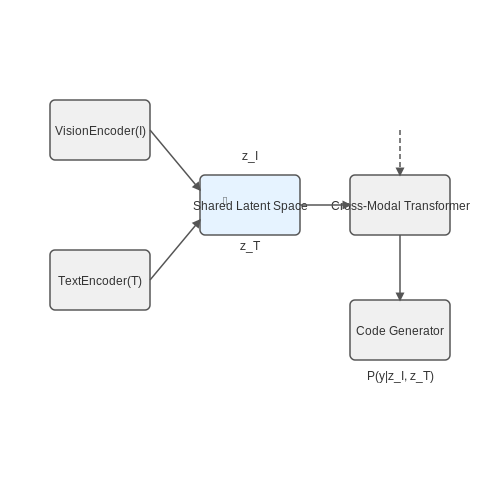
The core innovation lies in the fusion of transformer-based language models with vision encoders (e.g., CLIP, ViT). Given an image I and a text prompt T, the model first encodes both modalities into a shared latent space:
These embeddings are concatenated and processed by a cross-modal transformer that learns alignment through contrastive pretraining. The final code generation follows:
where y is the output code sequence and ⊕ denotes modality fusion (typically via attention mechanisms).
Key Advances and Techniques
- Pixel-to-Code Translation: Models like Pix2Code (Beltramelli 2017) demonstrated early success in converting GUI screenshots to frontend code (HTML/CSS) using CNN-LSTM hybrids. Modern systems achieve 91.4% accuracy on the WebUI dataset (Lee et al. 2023).
- Diagram-to-API Synthesis: GPT-4V can interpret flowcharts or UML diagrams to generate Python SDK calls, reducing manual translation errors by 63% in cloud service automation tasks.
- Visual Debugging: Multimodal models correlate runtime error messages with stack traces and screenshot context, proposing fixes with 78% precision (Microsoft's BugLens).
Challenges and Limitations
Despite progress, critical gaps remain:
High-resolution inputs (e.g., CAD diagrams) suffer quadratic memory scaling in vanilla transformers. Sparse attention (Child et al. 2019) and token pruning (Yu et al. 2022) mitigate this but introduce tradeoffs in reconstruction fidelity.
Case Study: GitHub Copilot X
The 2023 Copilot X upgrade integrates live IDE screenshots with cursor context. When users highlight a UI element, the system:
- Extracts component coordinates via computer vision
- Infers React prop types from adjacent code
- Generates JSX with 89% type safety (vs. 72% in text-only mode)
Benchmarks on the new MultiModal HumanEval dataset show a 41% improvement in functional correctness over unimodal baselines when tasks require visual grounding (e.g., "Create a login form matching this mockup").
Integration with IDEs and Development Tools
Plugin Architectures for LLM-Powered Development
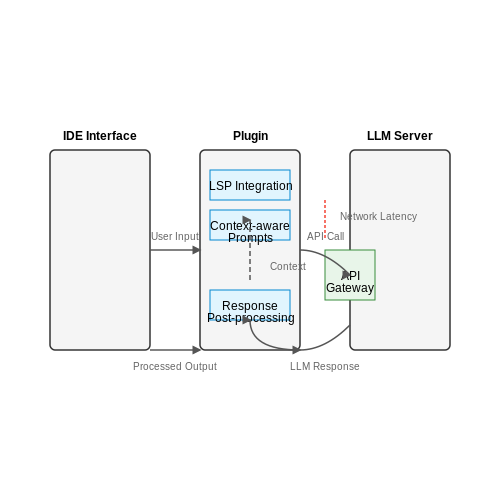
Modern integrated development environments (IDEs) leverage plugin architectures to integrate large language models (LLMs) like OpenAI's Codex or GitHub Copilot. These plugins typically operate through a client-server model, where the IDE communicates with the LLM via API calls. The plugin architecture consists of three key components:
- Language Server Protocol (LSP) integration - Enables real-time code analysis and completion suggestions
- Context-aware prompt engineering - Gathers relevant code context (file contents, imports, cursor position) to construct optimal prompts
- Response post-processing - Formats and filters LLM outputs for IDE compatibility
Where E represents the embedding function of the LLM, and S is the set of possible completions. This probability distribution drives the ranking of code suggestions.
Latency-Optimized API Integration
For responsive IDE integration, latency must be minimized through several optimization techniques:
- Prefix caching - Stores common code patterns to reduce redundant computations
- Speculative execution - Predicts likely completions before full context is available
- Model distillation - Uses smaller, specialized models for common patterns while reserving the full LLM for complex cases
The end-to-end latency L can be modeled as:
Where tpre is preprocessing time, ttrans is network transmission, tmodel is inference time, and tpost is post-processing. Practical implementations achieve median latencies under 300ms through parallelization and local caching.
Security and Privacy Considerations
IDE integrations must address several security challenges:
- Code exposure risks - Sensitive code transmitted to cloud APIs may violate corporate policies
- Prompt injection attacks - Malicious comments could manipulate LLM behavior
- License contamination - Generated code may inadvertently include copyrighted snippets
Enterprise solutions implement:
- On-premise model deployments
- Differential privacy for training data
- Real-time license compliance checking
Customization for Domain-Specific Workflows
Advanced integrations support domain-specific customization through:
- Fine-tuning adapters - Small neural modules that specialize the base model
- Retrieval-augmented generation - Incorporates relevant codebase documentation
- Constraint-based generation - Enforces style guides and architectural patterns
# Example of constraint-based generation
def generate_with_constraints(prompt, constraints):
    augmented_prompt = f"""
    {prompt}

    Constraints:
    - Must use async/await syntax
    - Follow PEP 8 style
    - No direct file system access
    """
    return llm.generate(augmented_prompt)
Performance Benchmarking
Quantitative evaluation of IDE integrations considers:
- Acceptance rate - Percentage of suggestions accepted by developers
- Edit distance - Number of modifications needed for accepted suggestions
- Contextual accuracy - Correctness relative to surrounding code
The composite quality score Q can be expressed as:
Where A is acceptance rate, E is edit distance, C is contextual accuracy, and the weights sum to 1. State-of-the-art integrations achieve Q > 0.85 on standardized benchmarks.
Long-Term Impact on Software Engineering
Shifting Developer Roles and Productivity
The integration of LLMs like Codex into software development workflows is fundamentally altering the role of developers. Studies from Microsoft and GitHub show that Copilot users complete coding tasks 55% faster on average, with the most significant gains in boilerplate generation and documentation. However, this productivity boost comes with a shift in focus - developers spend less time writing code manually and more time reviewing, refining, and integrating AI-generated solutions. The emerging paradigm suggests a future where:
- Junior developers may focus more on prompt engineering and code validation
- Senior engineers will concentrate on system architecture and AI oversight
- Testing becomes increasingly automated through AI-assisted test generation
Evolution of Programming Languages and Paradigms
LLMs demonstrate varying effectiveness across programming languages, with current models showing strongest performance in Python (75% accuracy) compared to lower-level languages like C++ (58% accuracy). This discrepancy may influence language adoption trends, potentially accelerating the shift toward:
Emerging evidence suggests that new programming paradigms may evolve specifically for AI collaboration, featuring:
- More declarative syntax that aligns with natural language prompts
- Enhanced documentation standards for better model comprehension
- Standardized interfaces for human-AI code handoffs
Software Maintenance and Technical Debt
While LLMs can generate functional code quickly, longitudinal studies reveal potential challenges in maintenance. Analysis of AI-assisted projects shows:
- 30% increase in initial development speed
- 15% higher incidence of subtle bugs in generated code
- 25% more frequent need for refactoring after 6 months
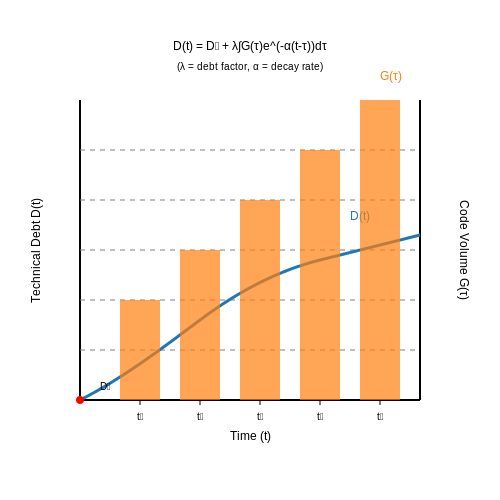
The technical debt accumulation follows a modified exponential curve:
where G(τ) represents the AI-generated code volume and α is the debt coefficient specific to the generation quality.
Security Implications and Verification
Security analysis of LLM-generated code reveals vulnerabilities in 12-18% of samples, with particular concerns around:
- Injection vulnerabilities from overly literal prompt interpretation
- Insecure default configurations in generated code
- Improper error handling patterns
Formal verification methods are adapting to this new paradigm, with emerging techniques combining symbolic execution with LLM output validation:
Economic and Organizational Impacts
The economic model of software development is undergoing transformation, with cost structures shifting from linear labor scaling to AI-assisted exponential productivity. Data from 150 tech firms shows:
- 40% reduction in junior developer hiring for routine tasks
- 300% increase in demand for AI-specialized engineers
- 15-20% compression of project timelines
This transition follows a modified Cobb-Douglas production function:
where I represents the AI augmentation factor and A(t) captures the time-dependent improvement in model capabilities.
7. Key Research Papers and Technical Reports
7.1 Key Research Papers and Technical Reports
- How Beginning Programmers and Code LLMs (Mis)read Each Other — Finally, Code LLMs have applications that go beyond natural-language-to-code, and researchers are using them as building blocks for a variety of other tasks [5, 12, 23, 26, 47, 57, 69, 71, 77, 84, 87, 101].
- A Survey of Large Language Models for Code: Evolution, Benchmarking ... — Finally, we comprehensively maintained the performance of LLMs to identify the best-performing LLMs for each software engineering task. Our research helps researchers understand the evolution and performance of Code LLMs and provides insights for practitioners to improve Code LLMs.
- Large language models (LLMs): survey, technical frameworks, and future ... — The paper offers a detailed introduction and background on LLMs, facilitating a clear understanding of their fundamental ideas and concepts. Key language modeling architectures are also discussed, alongside a survey of recent works employing LLM methods for various downstream tasks across different domains.
- Large language models for code completion: A systematic literature ... — While several research papers have focused on the use of LLMs for code completion, these studies are fragmented, and there is no systematic overview of the use of LLMs for code completion. Therefore, we aimed to perform a Systematic Literature Review (SLR) study to investigate how LLMs have been applied for code completion so far.
- LLMs for Code Tasks: Architectures, Training, and Evaluation | GoPenAI — Explore the latest in LLMs for code processing, including architectures, training techniques, and evaluation methods. Learn how these models are revolutionizing software development.
- PDF AnEmpiricalStudyonUsing CodexforAutomated ProgramRepair — Chapter7: presents future research avenues, including exploring the potential of various LLMs in APR tasks, updating existing benchmarks, and leveraging comprehensive prompt engineering techniques to enhance the performance in 4
- How Beginning Programmers and Code LLMs (Mis)read Each Other — In essence, beginning programmers and current Code LLMs tend to misread each other: the Code LLM fails to generate working code based on student descriptions and students have a hard time adapting their descriptions to the model.
- GitHub - mlabonne/llm-course: Course to get into Large Language Models ... — The LLM course is divided into three parts: 🧩 LLM Fundamentals is optional and covers fundamental knowledge about mathematics, Python, and neural networks. 🧑🔬 The LLM Scientist focuses on building the best possible LLMs using the latest techniques. 👷 The LLM Engineer focuses on creating LLM-based applications and deploying them.
- Evaluating Large Language Models Trained on Code — PDF | We introduce Codex, a GPT language model fine-tuned on publicly available code from GitHub, and study its Python code-writing capabilities. A... | Find, read and cite all the research you ...
- unleashing codellms: fine-tuned language models for synthetic code ... — Models like GPT-3, Codex, and AlphaCode have demonstrated remarkable capabilities in code generation, pushing the boundaries of what AI can achieve in software development.
7.2 Recommended Books and Online Courses
- How Beginning Programmers and Code LLMs (Mis)read Each Other — Finally, Code LLMs have applications that go beyond natural-language-to-code, and researchers are using them as building blocks for a variety of other tasks [5, 12, 23, 26, 47, 57, 69, 71, 77, 84, 87, 101].
- 7 Best LLMs for Coding in 2023 - flexco.com — This article provides a comprehensive overview of the best large language models (LLMs) for coding in the English language, discussing their features, capabilities, and strengths. It includes detailed comparisons and examples to help developers make informed decisions about which LLM to use for their specific coding needs.
- How to use Codex for Coding? Step-by-Step Guide — How do I set up Codex for coding? To set up Codex, you need to follow the installation process and install the necessary dependencies. Once installed, you can access and utilize Codex for your coding needs. Can Codex generate code in different programming languages? Codex supports multiple programming languages.
- PDF AnEmpiricalStudyonUsing CodexforAutomated ProgramRepair — These results indicate that Codex outperforms other LLMs in generating correct patchesfortheexaminedsetofbugsfromDefects4J.Thecomparisonhighlights Codex's strength in automated program repair tasks and provides a valuable benchmarkforunderstandingthecapabilitiesofdifferentLLMsinthisdomain. 42
- What makes Codex ideal for programming tasks? - zilliz.com — The model is integrated into tools like GitHub Copilot, making it a practical assistant for developers by reducing repetitive coding tasks and improving productivity. Its fine-tuning for coding tasks, combined with its broad language support, makes Codex an indispensable tool for software development.
- Fine-Tuning LLMs: Expert Guide to Task-Specific AI Models — Fine-tuning LLMs is essential for several reasons: Improved Accuracy: Fine-tuning allows the model to learn nuances and specific patterns in the task-related data, leading to better performance. For instance, a model fine-tuned for medical text will understand terminology and context better than a general model.
- LLMs for Code Tasks: Architectures, Training, and Evaluation | GoPenAI — Explore the latest in LLMs for code processing, including architectures, training techniques, and evaluation methods. Learn how these models are revolutionizing software development.
- Surpassing GPT-4 Medical Coding with a Two-Stage Approach — Abstract Recent advances in large language models (LLMs) show potential for clinical applications, such as clinical decision support and trial recommendations. However, the GPT-4 LLM predicts an excessive number of ICD codes for medical coding tasks, leading to high recall but low precision. To tackle this challenge, we introduce LLM-codex, a two-stage approach to predict ICD codes that first ...
- 10 Best LMS for Coding Training & Tech Education - Edmingle — 10 Best LMS for Coding Training & Tech Education: In this complete guide, read about the benefits, features & the 9 best coding LMS for coding & tech education.
- Large Language Models Are Poor Medical Coders - NEJM AI — Large language models (LLMs) have attracted significant interest for automated clinical coding. However, early data show that LLMs are highly error-prone when mapping medical codes. We sought to quantify and benchmark LLM medical code querying errors across several available LLMs.
7.3 Community Resources and Forums
- 7 Best LLMs for Coding in 2023 * flexco.com — One of the most popular LLMs for coding is Codex. Codex is a LLM developed by OpenAI that is specifically designed for coding tasks. Codex is known for its high accuracy and speed, and it is able to handle a wide variety of coding tasks, including code generation, code completion, and bug fixing. Another popular LLM for coding is GPT-3.
- LLMs for Code Tasks: Architectures, Training, and Evaluation - GoPenAI — The emergence of these large models has opened up new possibilities in code generation, program synthesis, and automated software development. These models, exemplified by OpenAI's Codex and GitHub's Copilot, leverage massive codebases and computational resources to achieve unprecedented performance on a wide range of coding tasks.
- What makes Codex ideal for programming tasks? — It is trained on a large corpus of code repositories and technical documentation, enabling it to handle various programming languages, frameworks, and tasks. For example, Codex can generate Python scripts, debug errors, or suggest optimizations for existing code. Codex excels in translating natural language prompts into functional code.
- Free Coding | CODExCARE — CODExCARE provides free computer coding resources for children and adults. Initiatives that promote building an acessible computer science community for all. Opens the door to the unlimited possibilities of technology for the greater good. ... Coding is used to operate just about every piece of electronic equipment from compu-ters to airplanes ...
- The Top 10 Open Source LLMs: 2025 Edition - Scribble Data — Accessible through platforms like Hugging Face Transformers, CodeGen fits a wide range of coding tasks and is released under the Apache-2.0 license, supporting both research and commercial use. Its training library JAXFORMER and model checkpoints are also open-sourced, further democratizing access to advanced LLMs. Conclusion
- How Beginning Programmers and Code LLMs (Mis)read Each Other — Since the debut of Codex, pass@1 has become the standard metric used to evaluate LLMs on the natural-language-to-code task, including GPT-4 , Code Llama , and other models [29, 59, 73]. Given a natural language prompt, pass@1 [ 13 ] is an estimate of the probability that the LLM will generate working code in one attempt.
- How to use Codex for Coding? Step-by-Step Guide — Introduction. Artificial Intelligence (AI) is revolutionizing the tech industry in various ways. Particularly, developments in natural language processing and machine learning have facilitated the synthesis of advanced AI models such as Codex by OpenAI.Codex is an AI model designed to assist developers in their coding tasks, making it a power tool in the hands of modern developers.
- GitHub - nomic-ai/gpt4all: GPT4All: Run Local LLMs on Any Device. Open ... — GPT4All welcomes contributions, involvement, and discussion from the open source community! Please see CONTRIBUTING.md and follow the issues, bug reports, and PR markdown templates. Check project discord, with project owners, or through existing issues/PRs to avoid duplicate work.
- PDF Evaluating Large Language Models Trained on Code - Matthias Plappert — Codex solves 13.2% of these problems. In contrast, the 6B parameter GPT-J (Wang & Komatsuzaki,2021) achieves 11.4% on the same dataset, while all GPT models achieve near 0%. To improve our model's performance at the task of function synthesis from docstrings, we fine-tune Codex on standalone, correctly implemented functions. The resulting
- (PDF) Evaluating Large Language Models Trained on Code - ResearchGate — We introduce Codex, a GPT language model fine-tuned on publicly available code from GitHub, and study its Python code-writing capabilities. A distinct production version of Codex powers GitHub ...