Multi-Turn Dialogue Generation
1. Definition and Key Characteristics
Multi-Turn Dialogue Generation: Definition and Key Characteristics
Multi-turn dialogue generation refers to the process by which an artificial intelligence system engages in a coherent, contextually grounded conversation with a human or another agent across multiple exchanges. Unlike single-turn tasks (e.g., question-answering or command execution), multi-turn systems must maintain dialog state tracking, contextual memory, and strategic coherence over successive utterances.
Formal Definition
Given a dialogue history H = (u1, u2, ..., ut-1) where ui represents the i-th utterance, the system generates response ut by modeling:
Modern approaches often factor this through latent variables representing dialog acts (at) or belief states (bt):
Key Characteristics
- Context Sensitivity: Responses must dynamically adapt to new information while avoiding contradiction. Transformer-based architectures achieve this through attention mechanisms over H.
- Goal Orientation: Task-oriented dialogues (e.g., customer service) require explicit reward modeling, often formalized as Partially Observable Markov Decision Processes (POMDPs):
- Turn-Taking Dynamics: Systems must manage pragmatic cues (e.g., question-answer pairs, acknowledgments) using discourse modeling frameworks like Dialogue Acts Theory.
- Personalization: User-specific adaptation requires differentiable memory modules or meta-learning techniques like Model-Agnostic Meta-Learning (MAML).
Architectural Components
State-of-the-art systems integrate:
- Hierarchical Encoders: Separate token-level and utterance-level representations using architectures like HRED (Hierarchical Recurrent Encoder-Decoder).
- Knowledge Grounding: External database queries or retrieval-augmented generation (e.g., RAG models) for factual consistency.
- Controllable Generation: Steering mechanisms like plug-and-play language models (PPLM) or contrastive decoding.
Example: Context Window Management
For long conversations, systems truncate or compress H using:
- Token-level attention sparsity (e.g., Longformer, BigBird)
- Memory networks with differentiable write/read operations
- Latent variable compression (e.g., VAEs over dialogue states)
Evaluation Metrics
Beyond perplexity and BLEU scores, advanced benchmarks assess:
- Coherence: Measured via human judgments or learned metrics like BERTScore.
- Engagement: User retention rates or continuation likelihood.
- Task Success: For goal-directed dialogues, precision of API calls or database updates.
1.2 Differences Between Single-Turn and Multi-Turn Dialogue Systems
Contextual Dependency
Single-turn dialogue systems process each query independently, treating user inputs as isolated events. The response Rt at time t depends solely on the current input Ut, modeled as:
In contrast, multi-turn systems maintain a dialogue history Ht = {U1, R1, ..., Ut-1, Rt-1}, making responses contextually dependent:
State Tracking
Multi-turn systems require explicit dialogue state tracking to manage evolving user goals. A state St is typically represented as a set of slots and values, updated recursively:
Single-turn systems lack this mechanism, as they don’t aggregate information across interactions.
Architectural Complexity
Multi-turn systems often employ hierarchical architectures:
- Encoder-Decoder with Attention: Processes history via attention over Ht.
- Memory Networks: Explicitly stores past interactions in external memory.
- Transformers: Uses self-attention to model long-range dependencies in dialogue history.
Single-turn systems typically use simpler sequence-to-sequence models without memory components.
Evaluation Metrics
Multi-turn dialogue evaluation incorporates:
- Coherence: Consistency across turns (measured by BLEU-4 or ROUGE-L).
- Task Completion: Success rate in goal-oriented scenarios.
- Contextual Understanding: Human-rated relevance to preceding dialogue.
Single-turn systems are evaluated primarily on utterance-level metrics like perplexity or single-response accuracy.
Practical Challenges
Multi-turn systems face unique issues:
- Error Propagation: Mistakes in early turns compound over time.
- Long-Term Dependency: Maintaining coherence beyond 5–10 turns.
- User Modeling: Adapting to dynamic user preferences mid-dialogue.
These challenges are absent in single-turn systems, which trade depth for robustness.

1.3 Core Challenges in Multi-Turn Dialogue Generation
Contextual Coherence and Long-Term Dependency
Maintaining coherence across multiple dialogue turns requires models to capture long-term dependencies, often spanning hundreds of tokens. Traditional autoregressive models like GPT struggle with this due to their fixed-length attention windows. The probability of generating a coherent response yt given a dialogue history H = (x1, y1, ..., xt-1, yt-1) can be formulated as:
where wi represents the i-th token in the response. The challenge intensifies when H exceeds the model's context window, forcing either truncation or lossy compression of earlier turns.
Entity and Coreference Resolution
Multi-turn dialogues frequently involve ambiguous references (e.g., pronouns like "it" or "they") that require dynamic entity tracking. A neural model must resolve coreferences by maintaining an internal entity graph G = (V, E), where vertices V represent entities and edges E capture their relationships. The probability of correct resolution decays exponentially with turn distance:
where λ is a decay constant dependent on model architecture and k is the turn gap between references.
Consistency Preservation
Dialogue systems often exhibit contradictory statements across turns due to:
- Catastrophic forgetting in neural weights during fine-tuning
- Context collision when blending contradictory user inputs
- Over-optimization for local turn-level metrics (e.g., BLEU) at the expense of global consistency
Formally, the consistency loss Lcons between turns t and t+k can be measured through logical entailment:
Multi-Modal Grounding
In visual dialogue systems, textual responses must remain grounded in both previous dialogue and visual context I. The joint probability space becomes:
Current models often fail to properly attend to both modalities simultaneously, leading to either:
- Visual neglect (ignoring image content)
- Dialogue drift (overfitting to visual features at the expense of conversational flow)
Dynamic Adaptation to User Behavior
Effective systems must detect and adapt to:
- Topic shifts (abrupt changes in conversation direction)
- Preference drift (evolving user personality traits)
- Communication style (formal vs. casual registers)
This requires real-time updates to the latent user model U through online learning:
where f is an adaptation function and θ represents the model parameters.
2. Retrieval-Based Models
2.1 Retrieval-Based Models
Retrieval-based models for multi-turn dialogue generation operate by selecting responses from a predefined repository rather than generating novel text. These systems rely on sophisticated matching algorithms to identify the most contextually appropriate response given the dialogue history. The core challenge lies in effectively modeling the conversation context and mapping it to candidate responses with high semantic relevance.
Architecture and Key Components
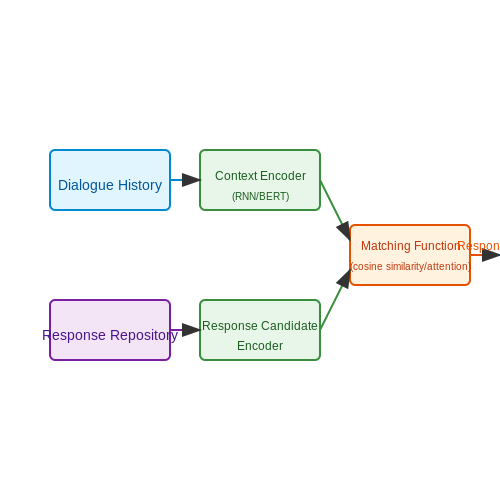
A typical retrieval-based system consists of three main components:
- Context Encoder: Transforms the dialogue history into a dense vector representation. Common approaches use recurrent neural networks (RNNs) or transformer-based architectures like BERT.
- Response Candidate Encoder: Similarly encodes potential responses from the repository into the same latent space.
- Matching Function: Computes a relevance score between the context and each candidate response, often using cosine similarity or learned attention mechanisms.
Mathematical Formulation
The retrieval process can be formalized as finding the response r that maximizes the conditional probability given the context c:
where P(r|c) is typically modeled using a deep neural network. The scoring function often takes the form:
where hc and hr are the encoded representations of context and response, respectively. The function f can be implemented as:
where M is a learnable similarity matrix that captures the interaction between context and response features.
Advanced Matching Strategies
Recent advances have introduced more sophisticated matching approaches:
- Hierarchical Matching: Models interactions at multiple granularities (word, phrase, utterance levels)
- Cross-Attention Mechanisms: Computes attention weights between all context-response token pairs
- Dual Encoder Architectures: Uses separate encoders for context and responses with late fusion
Practical Considerations
Effective retrieval-based systems must address several practical challenges:
- Response Diversity: Techniques like maximum marginal relevance help balance relevance and diversity
- Scalability: Approximate nearest neighbor search (e.g., FAISS) enables efficient retrieval from large repositories
- Context Window: Managing long conversation histories requires careful attention to memory and computational constraints
Performance Metrics
Evaluation typically employs both automatic metrics and human judgments:
- Recall@k: Measures whether the correct response appears in the top-k retrieved candidates
- Mean Reciprocal Rank (MRR): Considers the rank position of the first correct response
- Human Evaluation: Assesses response quality along dimensions like relevance, coherence, and naturalness
State-of-the-art retrieval systems achieve recall@1 scores of 60-70% on standard benchmarks like the Ubuntu Dialogue Corpus, demonstrating their effectiveness for practical applications.
Generative Models (Seq2Seq, Transformers)
Generative models for dialogue systems rely on sequence-to-sequence (Seq2Seq) architectures and their modern Transformer-based variants. These models encode an input sequence (user utterance) into a latent representation and decode it autoregressively into a response. The key challenge lies in maintaining coherence across multiple turns while capturing long-range dependencies.
Sequence-to-Sequence (Seq2Seq) Architecture
The foundational Seq2Seq model consists of an encoder RNN (typically LSTM or GRU) and a decoder RNN. Given an input sequence $$X = (x_1, ..., x_T)$$, the encoder computes hidden states $$h_t = f_{enc}(x_t, h_{t-1})$$, where $$f_{enc}$$ is a recurrent function. The decoder generates output tokens $$y_i$$ conditioned on the encoder's final state $$h_T$$ and its own previous hidden state:
where $$g$$ is a softmax over the vocabulary. The model is trained end-to-end using teacher forcing with cross-entropy loss:
Practical limitations include exposure bias (training uses ground truth $$y_{
Attention Mechanisms
Global attention (Bahdanau et al., 2015) addresses the bottleneck of compressing the entire input into a single vector. The decoder computes attention weights $$\alpha_{ij}$$ over encoder states:
The context vector $$c_i$$ is concatenated with the decoder state to predict the next token. This allows dynamic focus on relevant input tokens, significantly improving performance on long sequences.
Transformer Architecture
Transformers (Vaswani et al., 2017) replace recurrence entirely with self-attention and positional encodings. For dialogue, the key components are:
- Multi-head attention: Projects queries, keys, and values $$h$$ times and concatenates the outputs:
$$ \text{MultiHead}(Q,K,V) = \text{Concat}(head_1, ..., head_h)W^O $$ $$ head_i = \text{Attention}(QW_i^Q, KW_i^K, VW_i^V) $$
- Position-wise FFN: Applied to each position separately after attention:
$$ \text{FFN}(x) = \max(0, xW_1 + b_1)W_2 + b_2 $$
- Positional encoding: Injects token position information using sinusoidal functions:
$$ PE_{(pos,2i)} = \sin(pos/10000^{2i/d_{model}}) $$ $$ PE_{(pos,2i+1)} = \cos(pos/10000^{2i/d_{model}}) $$
For dialogue generation, the decoder uses masked self-attention to prevent attending to future tokens during training. Transformers process all tokens in parallel, enabling more efficient training on long conversations compared to RNNs.
Handling Multi-Turn Context
Effective dialogue models must track state across turns. Common approaches include:
- Hierarchical encoding: Encode each utterance with an RNN, then pass the sequence of utterance embeddings to a context-level RNN.
- Memory networks: Maintain an external memory bank of previous turns that the model can attend to dynamically.
- Transformer variants: Models like DialoGPT concatenate all previous turns with special separator tokens, allowing the self-attention mechanism to directly model cross-turn dependencies.
The training objective often combines next-utterance prediction with auxiliary losses like mutual information maximization to encourage diverse, context-aware responses.
# Example transformer-based dialogue generation with HuggingFace
from transformers import GPT2Tokenizer, GPT2LMHeadModel

tokenizer = GPT2Tokenizer.from_pretrained('microsoft/DialoGPT-medium')
model = GPT2LMHeadModel.from_pretrained('microsoft/DialoGPT-medium')

# Multi-turn conversation handling
chat_history_ids = None
for _ in range(5):
    user_input = input(">> User:")
    new_input_ids = tokenizer.encode(user_input + tokenizer.eos_token, return_tensors='pt')
    bot_input_ids = new_input_ids if chat_history_ids is None else torch.cat([chat_history_ids, new_input_ids], dim=-1)
    chat_history_ids = model.generate(bot_input_ids, max_length=1000, pad_token_id=tokenizer.eos_token_id)
    print("DialoGPT: {}".format(tokenizer.decode(chat_history_ids[:, bot_input_ids.shape[-1]:][0], skip_special_tokens=True)))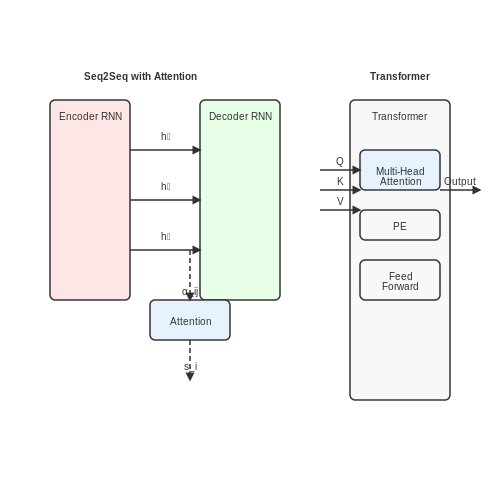
2.3 Hybrid Approaches
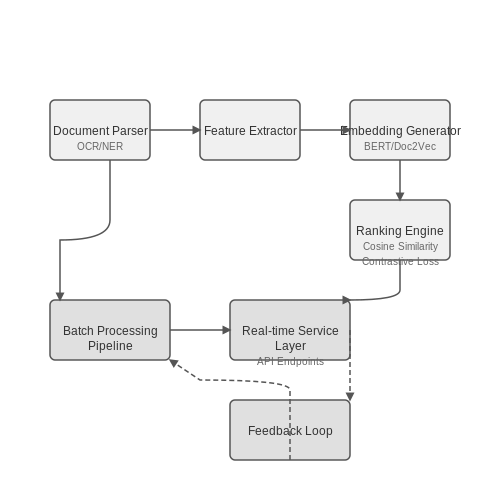
Hybrid approaches in multi-turn dialogue generation combine the strengths of rule-based systems, retrieval-based methods, and generative models to achieve more robust and contextually coherent conversations. These systems leverage structured knowledge bases for factual accuracy while employing neural models for fluency and adaptability. A common architecture integrates a retrieval module to fetch relevant candidate responses and a generative component to refine or augment them.
Architectural Components
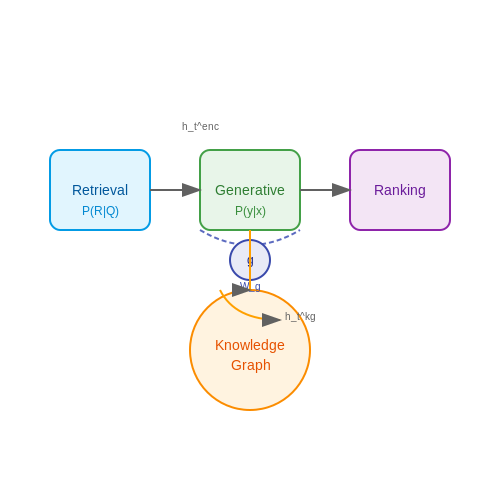
The hybrid framework typically consists of three key modules:
- Retrieval Module: Searches a pre-defined response database or knowledge graph using semantic similarity metrics like cosine distance in embedding space.
- Generative Module: A transformer-based model (e.g., GPT, T5) that conditions on both dialogue history and retrieved candidates.
- Ranking Module: Applies learned scoring functions to select or combine outputs from other components.
The retrieval process can be formalized as finding responses R that maximize:
where Q represents the query, f is an embedding function, and D is the response database.
Knowledge-Grounded Generation
When integrating external knowledge, the generation probability decomposes as:
where htenc is the dialogue encoder state, htkg is the knowledge graph representation, and W is a learnable projection matrix. The knowledge attention mechanism computes:
with qi being decoder queries and kj knowledge graph keys.
Dynamic Mixture Models
Advanced implementations use gating mechanisms to dynamically weight retrieval vs. generation:
where g is a learned sigmoid gate. The retriever and generator are often jointly trained using multi-task objectives:
Implementation Considerations
Practical systems must handle:
- Latency constraints between retrieval and generation phases
- Consistency between retrieved facts and generated text
- Fallback mechanisms when retrieval returns low-confidence results
The trade-off between modularity and end-to-end learning remains an active research area, with recent work exploring differentiable retrieval through approximate nearest neighbor search in continuous spaces.
3. Context Encoding Techniques
Context Encoding Techniques
Hierarchical Recurrent Encoders
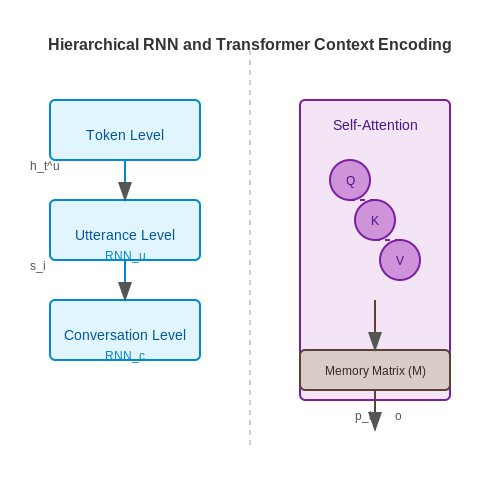
Hierarchical recurrent encoders model dialogue context through layered recurrent networks, capturing both local (utterance-level) and global (conversation-level) dependencies. The architecture typically consists of two stacked recurrent layers:
where RNNu processes individual tokens within an utterance, followed by:
RNNc aggregates utterance representations hTiu (final token state of utterance i) into conversation-level states si. Bidirectional variants often replace the RNNs with LSTMs or GRUs to capture forward/backward dependencies.
Transformer-Based Context Encoding
Transformer architectures leverage self-attention to model arbitrary context windows without sequential processing bottlenecks. Given a sequence of tokens X = (x1, ..., xn), multi-head attention computes:
where Q, K, V are learned linear projections of the input. For dialogue, positional encodings are often replaced with:
- Turn embeddings to mark utterance boundaries
- Speaker embeddings to distinguish participants
Memory Networks for Long-Term Context
Memory-augmented networks address context truncation in transformers by maintaining an external memory matrix M ∈ ℝm×d. At each turn, relevant memories are retrieved via:
where q is the current query. The output o is fused with the current hidden state through residual connections. Dynamic memory updates ensure recent interactions overwrite stale entries.
Contrastive Learning Objectives
Recent work employs contrastive losses to improve context discrimination. Given a positive context-response pair (c+, r+) and negatives r-, the InfoNCE loss maximizes:
where f(·) computes similarity (e.g., dot product) and τ is a temperature hyperparameter. This forces the encoder to distinguish relevant contexts from distractors.
Practical Implementation Tradeoffs
Key considerations when deploying context encoders:
- Computational cost: Transformers scale quadratically with context length, while RNNs suffer from vanishing gradients
- State management: Memory networks require explicit storage/retrieval logic
- Pretraining compatibility: BERT-style models need careful fine-tuning to avoid catastrophic forgetting of dialogue-specific patterns
Memory Networks and Attention Mechanisms
Memory-Augmented Neural Networks
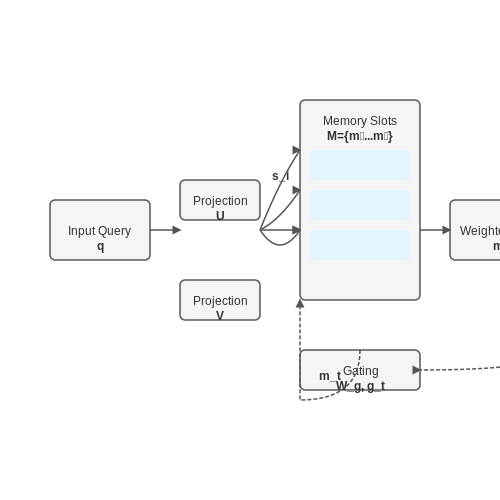
Memory Networks (MemNNs) extend traditional neural architectures with an explicit memory component, enabling dynamic storage and retrieval of information across multiple dialogue turns. The memory module consists of a set of memory slots M = {m1, ..., mN}, where each slot stores an encoded representation of past utterances or facts. Given an input query q, the model computes relevance scores for each memory entry:
where U and V are learned projection matrices. The retrieved memory m̂ is a weighted sum:
Hierarchical Attention Mechanisms
Transformer-based architectures employ multi-head attention to capture dependencies between tokens and across dialogue history. For a sequence of hidden states H = {h1, ..., hT}, the scaled dot-product attention computes:
where Q, K, and V are linear transformations of H, and dk is the key dimension. Hierarchical attention extends this by applying separate attention mechanisms at the token level and the utterance level, enabling the model to focus on both local and global context.
Key-Value Memory Networks
Key-Value Memory Networks (KV-MemNNs) decouple memory addressing from content retrieval. Each memory slot stores a key-value pair (ki, vi), where keys are used for relevance scoring and values store retrievable information. The addressing mechanism computes:
where ϕ is a feature mapping, and A, B are learned matrices. The output combines retrieved values:
Dynamic Memory Updates
Gated memory networks employ write operations to dynamically update memory based on new inputs. A gating mechanism controls the degree of memory modification:
where Wg is a learnable weight matrix, and σ is the sigmoid function. This allows the model to retain long-term dependencies while incorporating new information.
3.3 Handling Long-Term Dependencies
The Challenge of Long-Term Context Retention
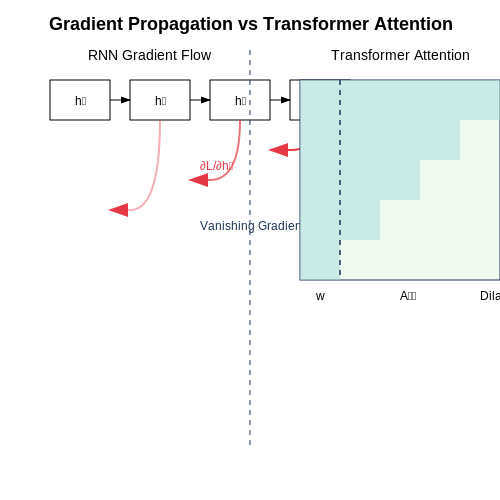
Traditional recurrent neural networks (RNNs) and even early variants of long short-term memory (LSTM) networks struggle to maintain coherent dialogue context beyond 10-20 turns. The vanishing gradient problem causes earlier utterances to decay exponentially in influence, making it difficult for the model to reference key facts or intentions established much earlier in the conversation.
The core mathematical limitation manifests in the gradient propagation through time. For a vanilla RNN processing a sequence of length T, the gradient of the loss L with respect to hidden state ht at time t is:
Where the product term causes either exponential growth or decay of gradients depending on the eigenvalues of the recurrent weight matrix.
Transformer-Based Solutions
Modern dialogue systems leverage transformer architectures with several key modifications for long-term dependency handling:
- Attention Window Expansion: Models like Longformer employ dilated attention patterns, allowing tokens to attend to distant context without quadratic computation cost. The attention score between position i and j becomes:
Where w is the local window size and the second term implements position-based decay for distant tokens.
- Memory-Augmented Architectures: Systems like MemN2N incorporate external memory banks that accumulate salient facts across turns. The memory update at turn t follows:
Where ut is the current utterance and rt-1 the previous response.
Hierarchical Encoding Strategies
For particularly long conversations (>50 turns), hierarchical encoding proves effective:
- Encode individual utterances with a sentence-level transformer
- Pass utterance embeddings through a turn-level LSTM
- Compute attention over the LSTM hidden states using:
Where ht represents turn t and hT the current turn. This allows the model to attend to relevant turns regardless of distance.
Practical Implementation Considerations
When implementing these techniques, several practical constraints emerge:
- Memory-augmented models require careful dimensionality reduction to prevent memory explosion in multi-session dialogues
- Hierarchical approaches introduce latency proportional to conversation length
- The choice of maximum context length (typically 512-4096 tokens) creates tradeoffs between computational cost and context retention
Recent benchmarks on the MultiWOZ dataset show transformer variants with expanded context windows achieve 18-22% better consistency in 50+ turn conversations compared to standard seq2seq approaches, while memory-augmented models show particular strength in maintaining entity references across long dialogues.
4. Human Evaluation vs. Automated Metrics
4.1 Human Evaluation vs. Automated Metrics
Evaluating multi-turn dialogue systems presents unique challenges due to the complexity of conversational dynamics. While automated metrics provide scalability, human evaluation remains the gold standard for assessing nuanced aspects like coherence, engagement, and naturalness. The trade-offs between these approaches shape model development and deployment strategies.
Limitations of Automated Metrics
Common automated metrics like BLEU, ROUGE, and METEOR were originally designed for machine translation or summarization tasks. When applied to dialogue, they suffer from several shortcomings:
- Lexical overlap bias: These metrics heavily favor responses containing exact word matches with references, penalizing valid paraphrases or alternative valid responses.
- Context blindness: Most metrics evaluate single utterances in isolation, ignoring the conversational history that gives them meaning.
- Human preference mismatch: Studies show weak correlation between metric scores and human judgments of dialogue quality.
Recent metrics like BERTScore and BLEURT attempt to address these issues by incorporating contextual embeddings:
where x and y are the candidate and reference sentence embeddings respectively. While these show improved correlation with human judgments, they still struggle with multi-turn consistency evaluation.
Human Evaluation Protocols
Human evaluation typically assesses dimensions that automated metrics cannot capture:
- Coherence: Logical flow within and across turns
- Engagement: Ability to maintain user interest
- Error recovery: Handling of misunderstandings
- Persona consistency: Maintaining a stable character
Standard protocols include:
- Likert-scale ratings: Human judges score specific aspects on predefined scales
- Pairwise comparisons: Direct comparison of system outputs
- Interactive evaluation: Real conversations with the system
The DynaEval framework introduces dynamic evaluation where judges assess entire conversations rather than isolated turns:
with weights learned from human preference data.
Hybrid Approaches
State-of-the-art evaluation combines automated metrics with targeted human assessment:
- Automated screening: Use metrics to filter obviously poor responses before human evaluation
- Active learning: Focus human evaluation on cases where metrics disagree
- Metric ensembling: Combine multiple metrics with learned weights
The FED (Fine-grained Evaluation for Dialogue) framework decomposes evaluation into 23 fine-grained dimensions, combining automated scoring for objective aspects with human evaluation for subjective ones.
Practical Considerations
In industrial applications, evaluation strategies vary by development stage:
- Research phase: Heavy reliance on automated metrics for rapid iteration
- Pre-deployment: Extensive human evaluation with diverse test cases
- Production: Continuous A/B testing with real users
Recent work in self-supervised evaluation shows promise by training evaluation models on synthetic preference data, though human validation remains essential for high-stakes applications.
Popular Benchmarks (e.g., MultiWOZ, ConvAI2)
MultiWOZ
MultiWOZ (Multi-Domain Wizard-of-Oz) is a large-scale multi-turn dialogue dataset spanning seven domains, including restaurants, hotels, and attractions. It contains over 10,000 dialogues with an average of 13.5 turns per dialogue, annotated with dialogue states and system actions. The dataset is designed to evaluate task-oriented dialogue systems in complex, multi-domain scenarios where context tracking and domain switching are critical.
Key features of MultiWOZ include:
- Multi-domain interactions with natural topic shifts
- Fine-grained annotations for belief states and dialogue acts
- Both user and system utterances for full conversational context
- Multiple versions (2.0-2.4) with improved annotations and error corrections
The evaluation metrics for MultiWOZ typically include:
ConvAI2
ConvAI2 (Conversational AI Challenge 2) is a benchmark dataset focused on open-domain, persona-based chit-chat dialogues. Derived from the Persona-Chat dataset, it contains 164,356 utterance pairs where speakers maintain consistent personas throughout conversations. The dataset emphasizes natural language understanding and generation in social contexts.
Notable aspects of ConvAI2:
- Persona-conditioned dialogues (5-7 sentences per persona)
- Human-human conversation data with crowd-sourced annotations
- Evaluation focuses on engagement, consistency, and fluency
- Includes both original and revised persona sets for robustness testing
Primary evaluation metrics for ConvAI2 include:
Comparative Analysis
While MultiWOZ evaluates task completion in constrained domains, ConvAI2 measures social conversation quality. MultiWOZ uses exact match accuracy for slot values, while ConvAI2 employs human evaluation and language model metrics. Both benchmarks have spurred advances in dialogue state tracking (MultiWOZ) and persona consistency modeling (ConvAI2).
Recent hybrid approaches combine both benchmarks' strengths, using MultiWOZ for task learning and ConvAI2 for social skill acquisition. The datasets complement each other in developing complete conversational agents capable of both functional and social dialogue.
4.3 Challenges in Evaluating Coherence and Consistency
Subjectivity in Human Evaluation
Human evaluation remains the gold standard for assessing dialogue quality, but it suffers from inherent subjectivity. Annotators may disagree on what constitutes coherent or consistent responses due to differences in cultural background, linguistic preferences, or interpretation of context. Studies show inter-annotator agreement scores (e.g., Fleiss' kappa) rarely exceed 0.6 for coherence judgments, indicating moderate reliability at best. This variability makes it difficult to establish reproducible benchmarks.
Contextual Dependency
Coherence is highly context-dependent—a response that appears appropriate in one dialogue state may be nonsensical in another. Consider a dialogue where the user asks:
"What's the weather today?" → "Sunny and 25°C" → "How about tomorrow?"
A model must maintain entity consistency (weather queries) while adapting to temporal shifts (today→tomorrow). Current automated metrics struggle to capture this nested dependency structure, often treating each turn as an independent evaluation unit.
Long-range Consistency
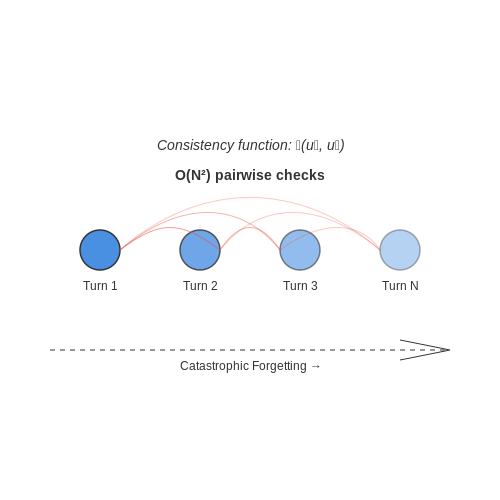
Maintaining consistency across extended conversations presents unique challenges. The probability of contradiction grows exponentially with dialogue length due to the catastrophic forgetting phenomenon in neural models. For a dialogue with N turns, the consistency requirement involves checking O(N2) pairwise relationships:
where ui, uj are utterance pairs and 𝕀 is the indicator function.
Metric Limitations
Popular automated metrics exhibit critical flaws when applied to multi-turn evaluation:
- BLEU/ROUGE: Designed for monologic text, they fail to capture discourse-level patterns
- BERTScore: While context-aware, it lacks temporal sensitivity to dialogue history
- Perplexity: Measures local fluency but not global consistency
Recent work proposes adversarial evaluation frameworks where models must detect inconsistencies in deliberately corrupted dialogues, providing a more rigorous test of coherence understanding.
Grounding in External Knowledge
Consistency often requires alignment with external knowledge bases. A model claiming "The Eiffel Tower is in Rome" demonstrates factual inconsistency, while "Let's meet at the Eiffel Tower" → "Okay, I love Parisian landmarks" shows contextual coherence. Current evaluation methods struggle to jointly assess these orthogonal dimensions, requiring separate verification pipelines for factual accuracy and discourse continuity.
Temporal Dynamics
Dialogues evolve dynamically, rendering static evaluation inadequate. A response's coherence depends on the derivative of the conversation state—not just its current value. This necessitates evaluation metrics that incorporate:
where C(t) represents coherence at dialogue turn t. Such differential approaches remain largely unexplored in current literature.
5. Customer Support Chatbots
5.1 Customer Support Chatbots
Architecture and Context Management
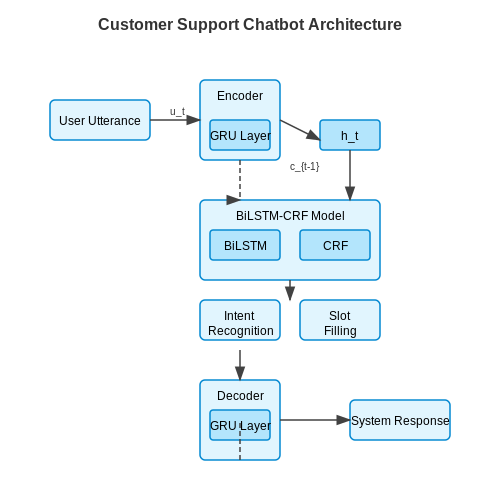
Modern customer support chatbots rely on hierarchical recurrent architectures to maintain context across multiple turns. A typical implementation involves a hierarchical encoder-decoder framework, where the encoder processes individual utterances, and a higher-level recurrent network aggregates dialogue history. The hidden state ht at turn t is computed as:
where ut is the current user utterance embedding, and ct-1 represents the previous system response context. This architecture enables the model to retain long-term dependencies while avoiding the vanishing gradient problem inherent in vanilla RNNs.
Intent Recognition and Slot Filling
Effective customer support chatbots employ joint intent-slot models to parse user queries. A BiLSTM-CRF architecture is commonly used, where:
- Bidirectional LSTMs capture contextual word dependencies.
- A conditional random field (CRF) layer enforces global tag consistency.
The probability of a tag sequence y given input x is:
where Z(x) is the partition function and fk are feature functions.
Response Generation with Reinforcement Learning
Advanced systems optimize dialogue policies using reinforcement learning, where the reward function combines:
- Task completion rate (binary reward for resolved queries)
- User satisfaction (predicted from sentiment and dialogue length)
- Business metrics (e.g., upsell conversion)
The Q-function is updated via deep Q-learning:
where s represents the dialogue state and a the system action.
Handling Ambiguity and Clarification
For ambiguous queries, chatbots must generate clarification questions. This is modeled as a Bayesian decision process:
where u' are possible user intents inferred from the ambiguous utterance u, and R is the expected reward of action a.
Real-World Deployment Challenges
Production systems face several key challenges:
- Cold-start problem: Bootstrapping with limited domain-specific data requires techniques like few-shot learning and synthetic data generation.
- Context switching: Handling topic changes within a conversation demands robust attention mechanisms.
- Safety constraints: Ensuring responses comply with regulatory requirements through constrained decoding.
State-of-the-art systems address these by combining:
- Transformer-based architectures (e.g., T5, GPT-3.5) for generation
- Knowledge graphs for factual grounding
- Adversarial training to improve robustness
5.2 Virtual Assistants (e.g., Siri, Alexa)
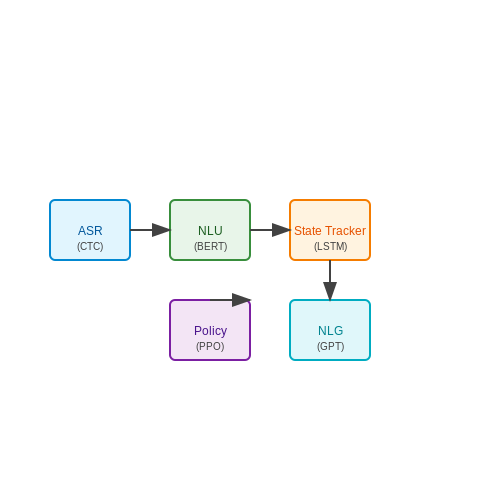
Virtual assistants like Siri, Alexa, and Google Assistant rely on multi-turn dialogue systems to maintain context across user interactions. These systems integrate automatic speech recognition (ASR), natural language understanding (NLU), dialogue management, and text-to-speech (TTS) synthesis to deliver seamless conversational experiences.
Architecture of Modern Virtual Assistants
The core pipeline consists of:
- ASR Module: Converts spoken input into text using deep neural networks like Connectionist Temporal Classification (CTC) or transformer-based models.
- NLU Component: Extracts intents and entities through sequence labeling models (e.g., BiLSTM-CRF) or fine-tuned language models like BERT.
- Dialogue State Tracker: Maintains conversation context using recurrent networks or memory-augmented architectures.
- Policy Learning: Reinforcement learning (e.g., PPO) or supervised learning determines system responses.
- Natural Language Generation: Template-based or neural (e.g., GPT-style) approaches generate fluent responses.
Context Retention Mechanisms
Effective multi-turn dialogue requires maintaining state across turns. Two dominant approaches exist:
Where ht represents the hidden state at turn t. More advanced systems employ:
- Memory Networks: External memory banks store long-term context
- Attention Mechanisms: Cross-turn attention weights relevant prior utterances
- Graph Neural Networks: Model dialogue as a graph of interconnected turns
Personalization Challenges
Virtual assistants must adapt to individual users while preserving privacy. Federated learning enables model personalization without centralized data collection:
Where θi(local) represents client models trained on private data Di.
Evaluation Metrics
Beyond traditional NLP metrics (BLEU, ROUGE), dialogue systems require specialized evaluation:
- Task Completion Rate: Percentage of successfully completed user requests
- Conversation Depth: Average number of turns per session
- User Satisfaction: Measured through explicit ratings or implicit signals
- Contextual Coherence: Human evaluation of response relevance to prior turns
Case Study: Alexa Conversations
Amazon's neural dialogue manager uses:
- A hybrid approach combining rule-based and machine learning components
- Multi-task learning for intent detection, slot filling, and dialogue acts
- Active learning to identify ambiguous utterances for human annotation
Where λ parameters balance the loss components during joint training.
Emerging Challenges
Current research focuses on:
- Few-shot adaptation to new domains
- Multimodal dialogue (combining speech, vision, and touch)
- Explainable system decisions
- Emotion-aware response generation
5.3 Educational and Therapeutic Dialogue Systems
Architecture and Design Principles
Educational and therapeutic dialogue systems require specialized architectures that balance domain expertise, empathy, and adaptability. Unlike general-purpose chatbots, these systems integrate knowledge graphs for structured domain representation and reinforcement learning for personalized interaction. The core components include:
- Domain-Specific Encoder-Decoder Models: Fine-tuned transformer architectures (e.g., BERT, GPT-3) with curriculum learning for pedagogical or clinical contexts.
- Empathy Module: A sentiment-aware layer that adjusts responses based on emotional valence, often implemented as a bi-directional LSTM with attention.
- Feedback Loop: Real-time adaptation via user engagement metrics (e.g., response latency, sentiment shifts).
where r is the system response, u_t the user utterance at turn t, and H_{t-1} the dialogue history. The scoring function often combines semantic similarity and therapeutic alignment metrics.
Case Study: Cognitive Behavioral Therapy (CBT) Assistants
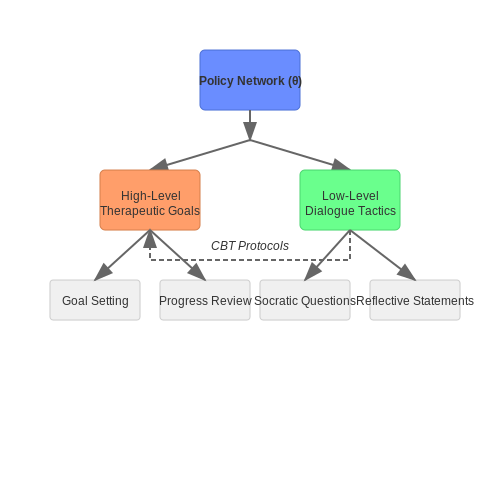
Therapeutic systems like Woebot employ hierarchical reinforcement learning to guide users through CBT protocols. The policy network decomposes into:
- High-Level Strategy: Selects therapeutic goals (e.g., cognitive restructuring).
- Low-Level Tactics: Generates Socratic questions or reflective statements.
Clinical efficacy is measured through Hamilton Rating Scales, with recent systems achieving Cohen’s d = 0.63 for anxiety reduction.
Pedagogical Dialogue Systems
Educational agents (e.g., AutoTutor) use latent semantic analysis to assess student understanding and dialogue moves like hints or prompts. The discourse is modeled as:
where q is the student query, k the knowledge component, and θ the pedagogical strategy parameters. Systems achieve 0.82 correlation with human tutors in learning gain assessments.
Ethical Constraints and Safety
Therapeutic applications necessitate:
- Differential Privacy: Noise injection in training data (ε ≤ 1.0).
- Fallback Protocols: Handoff to human operators when risk scores exceed thresholds.
Adherence to HIPAA and GDPR requires end-to-edge encryption and federated learning architectures.
6. Bias and Fairness in Dialogue Systems
Bias and Fairness in Dialogue Systems
Sources of Bias in Dialogue Models
Dialogue systems inherit biases from multiple sources, primarily training data, model architecture, and evaluation metrics. Training corpora often reflect societal biases present in human-generated text, such as gender stereotypes, racial prejudices, or cultural assumptions. For example, a study by Sheng et al. (2019) found that dialogue models trained on Reddit data amplified negative stereotypes about marginalized groups by a factor of 1.5-2x compared to the original data distribution.
Architectural choices can introduce inductive biases. Transformer-based models with self-attention mechanisms may disproportionately weight certain token sequences based on their frequency in training data. The probability of generating a biased response y given input x can be modeled as:
where θ represents parameters that may encode biased associations through the softmax distribution over the vocabulary.
Quantifying Bias in Multi-Turn Interactions
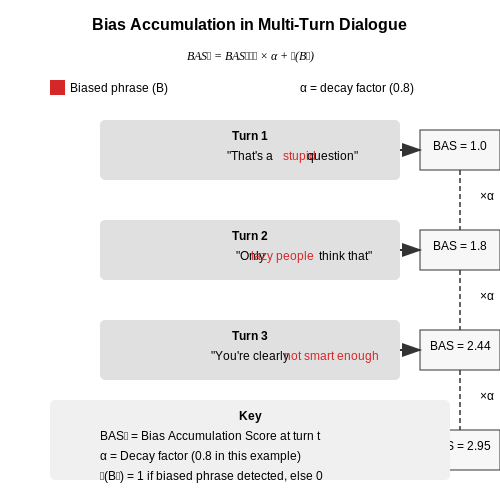
Bias metrics for dialogue systems extend beyond single-utterance analysis. The Bias Accumulation Score (BAS) measures how bias compounds across turns:
where B is the set of biased phrases, α is a decay factor (typically 0.9-1.0), and 𝕀 is the indicator function. This exponential weighting accounts for the snowball effect of bias in prolonged conversations.
Debiasing Techniques
Current debiasing approaches operate at three levels:
- Data-level: Adversarial filtering (Dixon et al., 2018) removes biased examples using classifier-in-the-loop training
- Model-level: Counterfactual logit adjustment (Prabhumoye et al., 2021) modifies output probabilities:
$$ \hat{P}(y_t) = \text{softmax}(\log P(y_t) - \lambda \cdot \nabla_{y_t} \mathcal{L}_{\text{bias}}) $$
- Decoding-level: Constrained beam search with bias classifiers (Liu et al., 2020) enforces fairness constraints during generation
Fairness-Aware Evaluation
Traditional metrics like BLEU and perplexity fail to capture fairness dimensions. The Equity Evaluation Framework (Henderson et al., 2018) introduces:
- Disparate impact ratio: DIR = P(y|z=1)/P(y|z=0) for protected attribute z
- Contextualized bias scores using embedding-based cosine similarity to stereotype phrases
Recent work (Smith et al., 2022) proposes testing dialogue systems with adversarial personas - synthetic user profiles designed to expose bias through strategic conversation patterns.
Architectural Innovations
Modified attention mechanisms can reduce bias propagation. The FairAttention variant (Zhang et al., 2021) computes:
where S is the set of token positions identified as potentially biased by an auxiliary classifier, and β controls the suppression strength.
Privacy Concerns in Multi-Turn Interactions
Multi-turn dialogue systems inherently accumulate user data across interactions, raising significant privacy challenges. Unlike single-turn exchanges, where context is transient, multi-turn systems retain conversational history, often storing sensitive personal details, preferences, and behavioral patterns. The persistence of this data introduces risks such as unauthorized access, unintended memorization, and inference attacks.
Data Retention and Exposure Risks
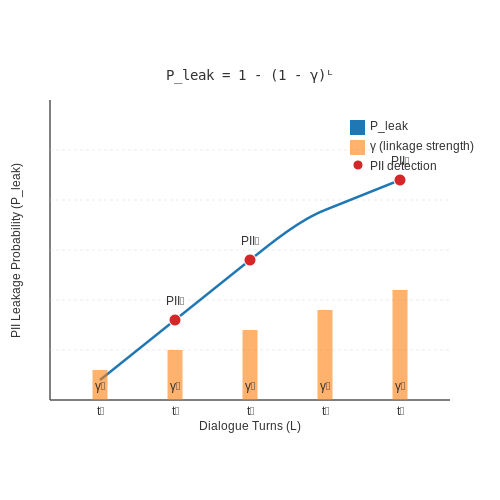
Dialogue systems typically employ one of two storage paradigms: explicit state tracking, where user inputs are logged verbatim, or latent representation, where embeddings encode conversation history. Both approaches risk exposing personally identifiable information (PII). For example, a user mentioning their location in turn t and medical history in turn t+k creates a composite privacy hazard. The probability of PII leakage Pleak scales with dialogue length L and entity linkage strength γ:
where ui represents the i-th utterance and 𝕀PII is an indicator function for PII detection.
Inference Attacks
Adversaries can exploit language model outputs to reconstruct sensitive data through:
- Membership inference: Determining if a specific data point was in the training set
- Attribute inference: Extracting demographic or behavioral attributes from responses
- Model inversion: Reconstructing raw input data from system outputs
These attacks become more potent in multi-turn settings due to the increased surface area for information leakage. For instance, a model's tendency to maintain lexical consistency across turns enables semantic triangulation of sensitive details.
Differential Privacy Solutions
Applying differential privacy (DP) to dialogue systems involves noise injection at either:
- The training phase via DP-SGD (Stochastic Gradient Descent)
- The inference phase through response perturbation
The privacy budget ε for a multi-turn system with T turns follows composition theorems:
where δ represents the failure probability. Practical implementations often use Rényi differential privacy for tighter bounds on composition.
Architectural Mitigations
State-of-the-art approaches include:
- Ephemeral embeddings: Context vectors that decay over turns
- Federated learning: Keeping raw data decentralized
- Homomorphic encryption: Processing encrypted user inputs
The trade-off between privacy and utility manifests in metrics like privacy-utility frontier curves, where systems optimize:
with 𝒰 measuring task performance and ℐ quantifying mutual information between inputs x and outputs ŷ.
Regulatory Compliance
Multi-turn systems must navigate overlapping jurisdictions like GDPR Article 22 (automated decision-making) and CCPA's right to deletion. Technical implementations require:
- Provable data deletion mechanisms
- Conversation-level opt-out capabilities
- Audit trails for all data processing
The k-anonymity criterion for dialogues requires that any sequence of k turns cannot be uniquely linked to an individual, necessitating techniques like:
where 𝒟public is the published dataset and Q represents all possible queries.
6.3 Mitigating Harmful or Misleading Outputs
Challenges in Multi-Turn Dialogue Safety
Multi-turn dialogue systems face unique safety challenges compared to single-turn generation. The conversational context accumulates over time, allowing subtle biases or harmful patterns to emerge gradually. Three key failure modes dominate:
- Contextual drift - Initial benign responses that gradually steer toward harmful content
- Prompt injection - User inputs designed to override system safeguards
- Implicit bias amplification - Reinforcement of stereotypes through repeated interaction patterns
Mathematical Framework for Safety Constraints
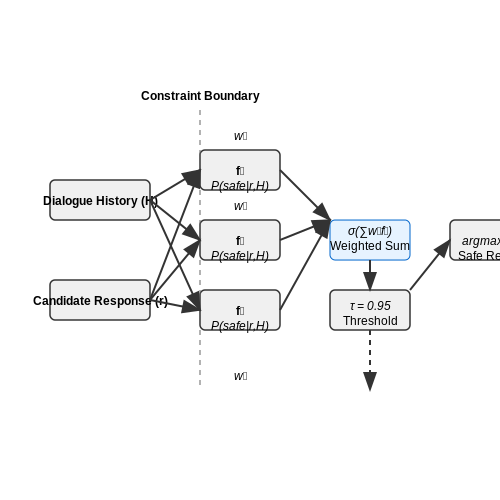
We can formalize safety constraints through probabilistic filtering. Given dialogue history H and candidate response r, we compute:
Where fi are safety classifiers (toxicity, misinformation, etc.) and wi are learned weights. The response is constrained by:
with τ being a safety threshold typically set ≥0.95 for high-risk applications.
Advanced Mitigation Techniques
Dynamic Safety Fine-Tuning
Adversarial training with safety-specific loss terms:
where λ1 controls safety-weighting and λ2 enforces consistency across dialogue turns.
Constitutional AI Methods
Layer multiple defense mechanisms:
- Pre-training on curated ethical datasets
- Reinforcement learning from human feedback (RLHF) with safety bonuses
- Runtime verification through ensemble classifiers
Case Study: Medical Dialogue Systems
In healthcare applications, we implement additional safeguards:
where Pmed verifies medical accuracy against knowledge graphs and Pethics enforces HIPAA compliance and ethical guidelines.
Real-World Implementation Challenges
Production systems must balance safety with usability. Key tradeoffs include:
- Latency overhead from multiple safety checks (typically 15-30% slower inference)
- False positive rates in safety classifiers (current SOTA models achieve ~92% precision)
- Cultural and contextual variability in harm definitions
Recent approaches use adaptive thresholding, where τ varies based on conversation risk assessment:
7. Key Research Papers
7.1 Key Research Papers
- PDF MMDialog: A Large-scale Multi-turn Dialogue Dataset Towards Multi-modal ... — Table 1: A summary of main multi-modal dialogue datasets. We can conclude that MMDialog is the only multi-modal dialogue dataset that satises the following criteria simultaneously: 1) Million-scale multi-turn dialogue sessions; 2) The modality of the response can be image or text or a exible combination; 3) Casual, open-domain
- A Survey on Recent Advances in LLM-Based Multi-turn Dialogue Systems — We created this flowchart primarily relying on information from research papers, blog articles, and official APIs provided by OpenAI. ... (zeng2022glm, ) is a bilingual model incorporating question-answering, multi-turn dialogue, and code generation. Built upon GLM-130B (zeng2022glm, ), ... highlighting their key concepts and contributions to ...
- (PDF) Conversational AI: Dialogue Systems, Conversational Agents, and ... — Modeling these capabilities computationally is a key challenge in Cognitive Science research. • To simulate human conversational behavior so that the dialogue system might pass as a human, as in the Turing test and competitions such as the Loebner prize (see Section 1.2.3). ... 1.4.3 MULTI-TURN OPEN-DOMAIN DIALOGUE Multi-turn open-domain ...
- Deep context modeling for multi-turn response selection in dialogue ... — In the same way, learning dialogue-oriented representation is a key step in multi-turn response selection. Both word-level and sentence-level representations have been widely used in dialogue context encoding ( Gu, Ling, Liu, 2019 , Mikolov, Sutskever, Chen, Corrado, Dean, 2013 , Tao, Wu, Xu, Hu, Zhao, Yan, 2019a ).
- PDF Improving Contextual Language Modelsfor Response Retrieval in Multi ... — Improving Contextual Language Models for Response Retrieval in Multi-Turn Conversation Junyu Lu 1∗ Xiancong Ren 1∗ Yazhou Ren 1 Ao Liu 1 Zenglin Xu 2,3,1 1SMILE Lab, Sch. Computer Science and ...
- Multi-modal multi-hop interaction network for dialogue response generation — In this respect, we divide the task into two steps: Step (1) to capture the interaction between the user's query and multi-modal information (both visual and language content); and Step (2) to generate a textual response based on the gathered information (with interactions among the modalities). To tackle the task, we propose a MIND model for dialogue response generation.
- PDF Multimodal Turn Analysis and Prediction for Multi-party Conversations — the use of verbal and non-verbal cues to predict turn-taking in multi-party conversations. For example, researchers have utilized speech features to develop prediction models. Aldeneh et al. [1] perceive turn-taking in conversations as a problem of arranging a sequence of actions and proposed a forecasting model that em-
- Full article: Building a hospitable and reliable dialogue system for ... — 1. Introduction. In recent years, there has been an active pursuit of dialogue systems research to handle multiple modalities, including text, image, voice, and sensor information [Citation 1, Citation 2].Dialogue systems using androids [Citation 3, Citation 4], in particular, are expected to find applications in fields that require customer services, such as travel and insurance agency ...
- A Sequential Matching Framework for Multi-Turn Response Selection in ... — A key step in response selection is measuring matching degree between an input and response candidates. Different from single-turn conversation, in which the input is a single utterance (i.e., the message), multi-turn conversation requires context-response matching where both the current message and the utterances in its previous turns should be taken into consideration.
- A Personalized Multi-Turn Generation-Based Chatbot with Various ... - MDPI — Existing persona-based dialogue generation models focus on the semantic consistency between personas and responses. However, various influential factors can cause persona inconsistency, such as the speaking style in the context. Existing models perform inflexibly in speaking styles on various-persona-distribution datasets, resulting in persona style inconsistency. In this work, we propose a ...
7.2 Recommended Books and Surveys
- Human-Machine Multi-Turn Language Dialogue Interaction Based on Deep ... — During multi-turn dialogue, with the increase in dialogue turns, the difficulty of intention recognition and the generation of the following sentence reply become more and more difficult. This paper mainly optimizes the context information extraction ...
- Context and knowledge aware conversational model and system combination ... — Our main contributions of this paper have two-fold : (1) we propose a knowledge grounded hierarchical encoder-decoder model that considers both the multi-turn conversation and external knowledge, and (2) we apply a combination of systems that reranks hypotheses produced from the context- and knowledge-aware generation-based and the retrieval ...
- Conversational Agents: Goals, Technologies, Vision and Challenges — The dialogues in the dataset conform to various common dialogue flows, such as question and answer, bi-turn flows, and multi-turn dialogue-flow patterns reflecting realistic dialogues.
- A Survey on Recent Advances in LLM-Based Multi-turn Dialogue Systems — Abstract. This survey provides a comprehensive review of research on multi-turn dialogue systems, with a particular focus on multi-turn dialogue systems based on large language models (LLMs).
- A Survey on Recent Advances in LLM-Based Multi-turn Dialogue Systems — This survey provides a comprehensive review of research on multi-turn dialogue systems, with a particular focus on multi-turn dialogue systems based on large language models (LLMs). This paper aims to (a) give a summar…
- Towards information-rich, logical dialogue systems with knowledge ... — Combined with external knowledge, dialogue systems can deeply understand the dialogue context, and generate more informative and logical responses. This survey gives a comprehensive review of knowledge-enhanced dialogue systems, summarizes research progress to solve these challenges and proposes some open issues and research directions.
- (PDF) Conversational AI: Dialogue Systems, Conversational Agents, and ... — All of these aspects are important for a conversational agent to be effective as well as engaging for the user. In the second and third approaches, dialogue strategies are learned from data. Statistical data-driven dialogue systems emerged in the late 1990s and end-to-end neural dialogue systems using deep learning began to appear around 2014.
- Improving Dialog Evaluation with a Multi-reference Adversarial Dataset ... — We propose a multi-reference open-domain dialogue dataset with multiple relevant responses and adversarial irrelevant responses. We perform an extensive study of the existing dialogue evaluation metrics using this dataset and also propose a new transformer-based evaluator pretrained on large-scale dialogue datasets.
- A Survey on Evaluation of Large Language Models — NLG evaluates the capabilities of LLMs in generating specific texts, which consists of several tasks, including summarization, dialogue generation, machine translation, question answering, and other open-ended generation tasks.
- Recent advances in deep learning based dialogue systems: a systematic ... — Finally, some possible research trends are identified based on the recent research outcomes. To the best of our knowledge, this survey is the most comprehensive and up-to-date one at present for deep learning based dialogue systems, extensively covering the popular techniques.
7.3 Open-Source Tools and Datasets
- GitHub - KwanWaiChung/MT-Eval: Code and data for "MT-Eval: A Multi-Turn ... — multi: multi-turn dialogues. single: single-turn version of the multi-turn dialogues. Each multi-turn dialogue is converted to a single version using methods outlined in Section 3.1 of the paper. cls: Document classification task. global-inst: Global instruction following task. data is a list of dialogue instances. Each dialogue instance ...
- S2M: Converting Single-Turn to Multi-Turn Datasets for - arXiv.org — The output is the multi-turn dialogue rewritten by the Rewriter. ... [29, 30, 31] have shown that the open-source information extraction model is most suitable for the context from an arbitrary domain. Inspired by them, ... We are the first to use generation datasets to help the CQA task and achieve success.
- A memory network based end-to-end personalized task-oriented dialogue ... — Dialogue generation aims to find a mapping from source input to target response. ... these four datasets are multi-turn dialogue corpus with personalized interactions. There are five separate tasks for each dataset in restaurant reservation domain: tasks 1 and 2 test the ability of the model to track the state of the dialogue, and tasks 3 and 4 ...
- GitHub - hkhdair/Code-LLM: A curated list of language modeling ... — [Verilog] "RTLCoder: Outperforming GPT-3.5 in Design RTL Generation with Our Open-Source Dataset and Lightweight Solution" [2023-12] ... Real-World Website Navigation with Multi-Turn Dialogue", 2024-02, ... "A Manually-Curated Dataset of Fixes to Vulnerabilities of Open-Source Software" 2019-09: NeurIPS 2019: Devign: 49K: C
- MORTAR: Metamorphic Multi-turn Testing for LLM-based Dialogue Systems — MuTual is a multi-turn reasoning-based dialogue dataset in open-domain (Cui et al., 2020). MT-Bench is a 2-turn open-end dialogue dataset that is used to evaluate chatbot's conversation performance (Zheng et al., 2023). The "LLM-as-a-judge" approach is reported as feasible when comparing strong LLM's alignment with human preference.
- Can a Single Model Master Both Multi-turn Conversations and Tool Use ... — The system features a self-evolution synthesis process that curates a pool of 26,507 diverse APIs, coupled with a multi-agent dialogue generation system and a dual-layer verification process for ensuring data accuracy. Using data generated and fine-tuning on Llama-3.1-8B-Instruct, ToolACE achieve top results on the BFCL Leaderboard.
- (PDF) S2M: Converting Single-Turn to Multi-Turn Datasets for ... — To solve this problem, we propose a novel method to convert single-turn datasets to multi-turn datasets. The proposed method consists of three parts, namely, a QA pair Generator, a QA pair ...
- OSU-NLP-Group/GUI-Agents-Paper-List - GitHub — The authors demonstrate that careful model design, a well-tuned training pipeline, and high-quality open datasets can produce VLMs that outperform existing open models and rival proprietary systems. The model weights, datasets, and source code are made publicly available to advance research in this field.
- MINT: Evaluating LLMs in Multi-turn Interaction with Tools and Language ... — Interaction Framework. MINT mirrors the real-world User-LLM-Tool collaborative problem-solving setting. To solve a problem, the LLM can (1) use external tools by generating and executing Python programs and/or (2) collecting natural language feedback to refine its solutions; the feedback is provided by GPT-4, aiming to simulate human users in a reproducible and scalable way.
- Deep context modeling for multi-turn response selection in dialogue ... — Empirical results on three public datasets from two different languages show that our proposed model outperforms existing promising models significantly, pushing recall to 86.8% (+5.2% improvement over BERT) on Ubuntu Dialogue corpus, recall to 68.5% (+6.4% improvement over BERT) on E-Commerce Dialogue corpus, MAP and MRR to 61.6% and 64.9% ...