Procedural Content Generation with GANs
1. Definition and Scope of PCG
Definition and Scope of PCG
Procedural Content Generation (PCG) refers to the algorithmic creation of game content—such as levels, textures, narratives, or soundtracks—without direct human authorship. Unlike handcrafted design, PCG leverages mathematical models, noise functions, and rule-based systems to produce diverse, scalable, and often infinite variations of content. The scope of PCG spans deterministic methods (e.g., Perlin noise for terrain) and stochastic approaches (e.g., Markov chains for text generation), but the integration of Generative Adversarial Networks (GANs) has redefined its capabilities by enabling data-driven, high-dimensional content synthesis.
Mathematical Foundations
Traditional PCG relies on parametric algorithms where output variability is controlled by seed values or heuristic rules. For instance, fractal-based terrain generation uses recursive subdivision:
Here, A_i controls amplitude decay across octaves, and noise is a gradient function (e.g., Simplex noise). In contrast, GANs learn content distributions from data through adversarial training. The generator G and discriminator D optimize the minimax objective:
where z is latent noise, and p_data is the real data distribution. This formulation allows GANs to capture complex patterns in textures, 3D models, or game levels that are infeasible to model explicitly.
Scope in Modern Applications
PCG with GANs extends beyond traditional domains:
- Level Design: GANs like PCGML (Procedural Content Generation via Machine Learning) learn from existing game levels (e.g., Super Mario Bros.) to generate coherent, playable stages with preserved mechanics.
- Texture Synthesis: StyleGAN variants generate high-resolution, tileable textures conditioned on material properties (e.g., roughness, reflectivity).
- Narrative Generation: Transformer-GAN hybrids produce branching dialogues or quests by adversarial fine-tuning on narrative corpora.
The key advantage lies in scalability—GANs can synthesize content at resolutions and complexities impractical for rule-based systems, though challenges persist in controllability and training stability.
Comparative Analysis
Traditional PCG excels in predictable, constrained environments (e.g., dungeon layouts with connectivity guarantees), while GANs thrive in open-ended domains requiring realism (e.g., open-world vegetation). Hybrid approaches, such as using GANs to refine rule-based outputs, are increasingly common. For example, a GAN might stylize a procedurally generated 3D mesh to match an artistic target:
where ℒ_procedural enforces geometric constraints from the underlying algorithm.
Traditional PCG Techniques and Limitations
Deterministic Algorithms in PCG
Traditional procedural content generation (PCG) relies heavily on deterministic algorithms such as Perlin noise, cellular automata, and L-systems. These methods generate content by following predefined mathematical rules, ensuring reproducibility given the same initial seed. For example, Perlin noise constructs smooth, continuous gradients through interpolation of pseudorandom values, making it ideal for terrain generation. The underlying function can be expressed as:
While deterministic algorithms excel in predictability, their outputs often lack diversity beyond parametric variations. Adjusting parameters like frequency or amplitude in Perlin noise merely scales existing patterns rather than creating fundamentally new structures.
Search-Based and Grammar-Driven Methods
Search-based PCG techniques, such as genetic algorithms or simulated annealing, optimize content against fitness functions. For instance, a dungeon generator might evolve layouts to maximize enemy encounter density while minimizing player backtracking. Grammar-driven methods, like shape grammars or stochastic context-free grammars, recursively apply production rules to construct complex outputs from simple primitives. These approaches enable finer control over output properties but suffer from computational inefficiency. The search space grows combinatorially with content complexity, often requiring heuristic pruning to remain tractable.
Limitations of Traditional Approaches
Three fundamental constraints plague classical PCG methods:
- Content Diversity vs. Control Tradeoff: Increasing randomness erodes designer control, while rigid constraints yield repetitive outputs. Hand-authored rules struggle to capture the nuance of organic structures like vegetation or urban sprawl.
- Computational Intractability: Search-based methods become prohibitively expensive for high-dimensional content spaces. Generating a 3D city with interdependent road networks, zoning laws, and architectural styles often requires domain-specific simplifications.
- Artifact Propagation: Deterministic algorithms exhibit recognizable patterns—grid-like artifacts in cellular automata or directional bias in Perlin noise. These signatures break immersion in applications like open-world games.
The Expressiveness Gap
Traditional techniques fail to capture the implicit design principles underlying human-created content. A Markov chain might generate plausible-sounding fantasy names by learning letter transitions, but cannot invent naming conventions reflecting fictional cultures. This expressiveness gap becomes critical when generating semantically rich content like quest narratives or musical compositions, where surface-level validity differs from meaningful coherence.
Case Study: Roguelike Dungeons
Binary space partitioning (BSP) trees exemplify these limitations in roguelike dungeon generation. While BSP efficiently produces rectangular rooms connected by corridors, the resulting layouts feel mechanically constructed compared to organically evolved caverns. Hybrid approaches combining BSP with agent-based erosion partially mitigate this, but require manual tuning of interaction parameters—a process that doesn't scale across content types.
Role of Machine Learning in PCG
Traditional vs. ML-Based PCG
Traditional procedural content generation (PCG) relies on handcrafted algorithms, such as Perlin noise, L-systems, or cellular automata, to create content algorithmically. While effective, these methods often require extensive manual tuning to produce diverse and coherent outputs. Machine learning, particularly deep learning, shifts this paradigm by learning content generation rules directly from data. Instead of explicitly programming rules for terrain, textures, or levels, ML models infer these patterns from existing examples, enabling more adaptive and scalable generation.
GANs as Content Generators
Generative Adversarial Networks (GANs) have emerged as a dominant framework for PCG due to their ability to model high-dimensional data distributions. A GAN consists of two neural networks: a generator G and a discriminator D, engaged in a minimax game. The generator learns to produce synthetic content (e.g., game levels, textures) by minimizing:
where x is real data, z is a latent vector, and pdata, pz are the data and latent distributions. This adversarial training forces G to produce outputs indistinguishable from real data, as judged by D.
Key Advantages of ML in PCG
- Data-Driven Design: ML models capture implicit design rules from datasets, reducing reliance on manual rule specification.
- Diversity and Novelty: Latent space sampling enables infinite variations, while techniques like conditional GANs allow controlled generation (e.g., "generate a medieval dungeon level").
- Adaptability: Models can be fine-tuned for specific constraints, such as difficulty balancing in game levels or stylistic consistency in textures.
Challenges and Solutions
Despite their potential, ML-based PCG methods face challenges. Mode collapse in GANs can limit output diversity, mitigated by architectures like Wasserstein GANs or adding diversity terms to the loss function. Training instability is addressed via techniques such as spectral normalization or progressive growing. Additionally, evaluating generated content often requires hybrid metrics combining statistical similarity (e.g., Fréchet Inception Distance) with human perceptual studies.
Case Study: Level Generation in Mario
A notable application is the use of GANs to generate Super Mario Bros.-style levels. By training on a corpus of existing levels represented as tile matrices, the generator learns spatial patterns (e.g., pipe placements, enemy distributions). The discriminator evaluates feasibility, ensuring generated levels are playable. This approach demonstrates how ML can automate creative design while preserving functional constraints.
Emerging Directions
Recent work explores transformer-based models for PCG, leveraging their ability to handle sequential data (e.g., level layouts as token sequences). Diffusion models also show promise for high-fidelity asset generation. Hybrid approaches, combining ML with symbolic reasoning, are being investigated to enforce hard constraints (e.g., ensuring paths between rooms in dungeons).
2. GAN Architecture: Generator and Discriminator
GAN Architecture: Generator and Discriminator
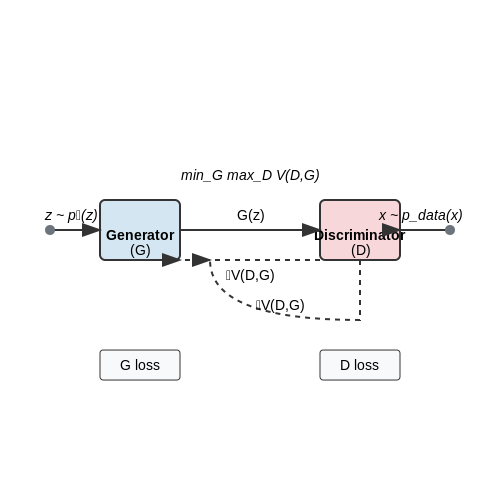
The core of a Generative Adversarial Network (GAN) consists of two neural networks—the generator (G) and the discriminator (D)—engaged in a minimax game. The generator synthesizes data samples from random noise, while the discriminator evaluates their authenticity relative to real data. This adversarial dynamic drives both networks toward improved performance.
Generator Network
The generator G maps a latent noise vector z, sampled from a prior distribution pz(z), to the data space. Typically, z is drawn from a Gaussian or uniform distribution. The generator's objective is to produce samples G(z) that are indistinguishable from real data x ~ pdata(x). Architecturally, G is often implemented as a deep neural network with transposed convolutional layers for upsampling, enabling high-dimensional output generation.
Training involves backpropagating gradients from the discriminator's feedback, encouraging G to minimize the probability of D correctly classifying its outputs as fake:
Discriminator Network
The discriminator D acts as a binary classifier, assigning a probability that an input sample originates from the real data distribution rather than the generator. It outputs a scalar D(x) ∈ [0,1], where values closer to 1 indicate higher confidence in authenticity. D is typically a convolutional neural network (CNN) for image data, though architectures vary by application.
D is trained to maximize the probability of correctly classifying real and generated samples:
Adversarial Training Dynamics
The combined objective forms a zero-sum game, formalized as a minimax optimization:
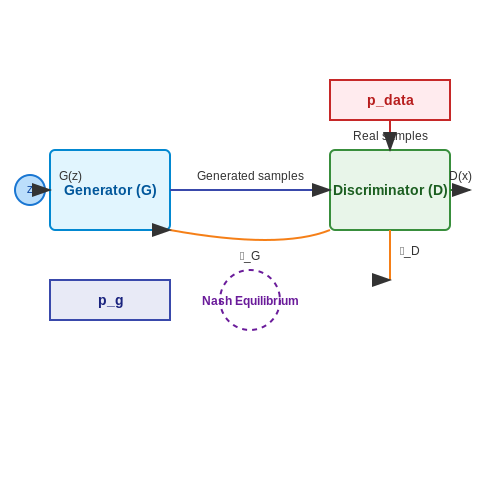
In practice, training alternates between updating D to improve discrimination and updating G to better fool D. This equilibrium is theoretically reached when pG = pdata, though challenges like mode collapse and vanishing gradients often arise.
Architectural Variants
Several refinements address GAN training instability:
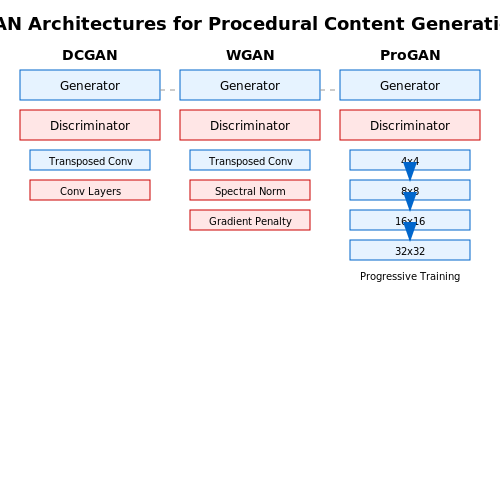
- DCGAN: Uses strided convolutions, batch normalization, and ReLU/LeakyReLU activations for stable image generation.
- Wasserstein GAN (WGAN): Replaces Jensen-Shannon divergence with Earth Mover's distance via weight clipping or gradient penalty.
- Conditional GAN (cGAN): Extends the framework by conditioning both G and D on auxiliary information (e.g., class labels).
For procedural content generation, the generator's ability to learn hierarchical feature representations is critical. For example, in game level design, G might encode spatial dependencies through dilated convolutions, while D enforces global coherence via multi-scale discrimination.
2.2 Training Dynamics and Challenges
GAN Training as a Min-Max Optimization Problem
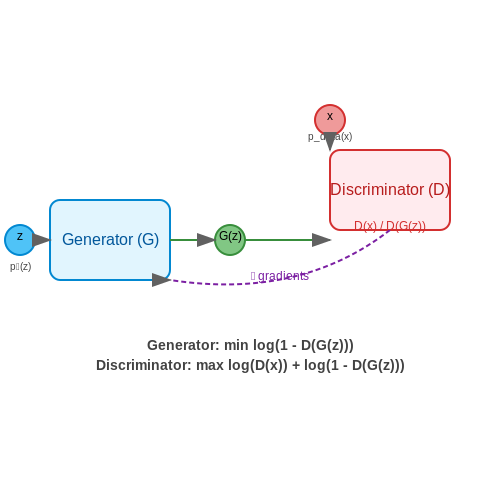
The training dynamics of GANs are framed as a two-player minimax game between the generator G and discriminator D, where the objective function is given by:
Here, D(x) represents the discriminator's probability estimate that sample x is real, while G(z) generates samples from noise z. The Nash equilibrium occurs when the generator produces samples indistinguishable from real data (pg = pdata), and the discriminator outputs D(x) = 0.5 everywhere.
Mode Collapse and Oscillations
In practice, GANs frequently suffer from mode collapse, where the generator produces limited varieties of outputs, ignoring entire modes of the data distribution. This occurs when the generator exploits weaknesses in the discriminator by converging to a small set of highly convincing samples. The phenomenon can be formalized as:
where k is the number of collapsed modes, and πi are mixing coefficients. Concurrently, training oscillations may arise when the generator and discriminator fail to reach equilibrium, causing cyclic improvements and regressions in sample quality.
Gradient Vanishing and Exploding
The discriminator's gradients directly influence the generator's updates. If D becomes too confident (D(G(z)) → 0), the generator's gradient ∇θg log(1 - D(G(z))) vanishes, halting learning. Conversely, unstable gradients may explode when the discriminator provides noisy or overly strong feedback. This is particularly problematic in deep architectures where gradients are multiplied across many layers.
Evaluation Challenges
Quantifying GAN performance remains non-trivial. Common metrics like Inception Score (IS) and Fréchet Inception Distance (FID) have limitations:
- IS favors high diversity but may not correlate with perceptual quality.
- FID compares feature statistics but assumes Gaussian distributions, which may not hold for complex data.
Alternative approaches include precision-recall curves for generative models and human evaluation, though these are resource-intensive.
Stabilization Techniques
Several methods mitigate these challenges:
- Wasserstein GAN (WGAN) replaces Jensen-Shannon divergence with Earth Mover's Distance, using weight clipping or gradient penalty to enforce Lipschitz continuity.
- Two-Time-Scale Update Rule (TTUR) assigns different learning rates to G and D to prevent one network from overpowering the other.
- Spectral Normalization constrains the discriminator's Lipschitz constant by normalizing weight matrices using their spectral norm.
These techniques are critical for procedural content generation, where stable training ensures diverse and high-quality outputs.
2.3 Variants of GANs Relevant to PCG
Conditional GANs (cGANs)
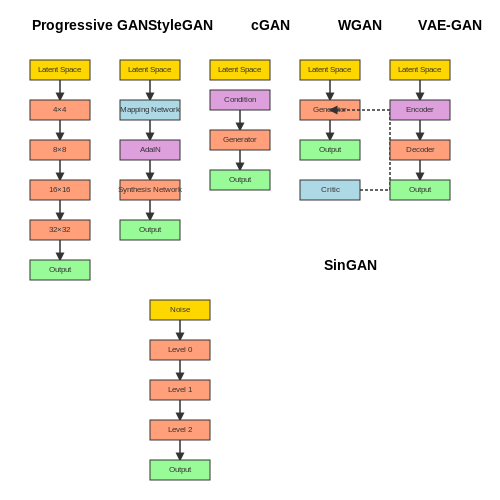
Conditional GANs extend the standard GAN framework by incorporating auxiliary information, such as class labels or structured metadata, into both the generator G and discriminator D. The objective function modifies the original minimax game:
Here, y represents the conditioning variable, enabling controlled generation of content (e.g., terrain types in game levels or architectural styles in 3D models). cGANs are particularly effective in PCG for tasks like texture synthesis with user-defined constraints.
Wasserstein GANs (WGANs)
WGANs address training instability in vanilla GANs by replacing the Jensen-Shannon divergence with the Wasserstein-1 distance. The critic (replacing the discriminator) is trained to approximate:
The Lipschitz constraint (‖f‖L ≤ 1) is enforced via weight clipping or gradient penalty. WGANs demonstrate superior convergence in generating large-scale procedural content like open-world maps, where mode collapse would otherwise fragment biome distributions.
Progressive Growing GANs (PGGANs)
PGGANs incrementally increase the resolution of generated outputs through a pyramidal training approach. The generator and discriminator architectures grow symmetrically:
- Start with low-resolution layers (e.g., 4×4 pixels)
- Add blocks doubling the resolution (8×8 → 16×16 → ... → 1024×1024)
- Use smooth fading between resolution stages
This method achieves state-of-the-art results in high-resolution texture generation and 3D model synthesis, critical for AAA game asset pipelines.
Variational Autoencoder GANs (VAE-GANs)
VAE-GANs combine the latent space regularization of VAEs with GAN discriminators. The hybrid objective function:
enables both reconstruction and generation of content with interpretable latent dimensions. This is valuable for PCG applications requiring editable latent spaces, such as parametric level design tools.
SinGAN
SinGAN learns a pyramid of generators at multiple scales from a single training example. The model captures:
- Global structure at coarse scales
- Local details at finer scales
Each generator Gn in the hierarchy is conditioned on the output of Gn+1 and noise zn:
where ↑r denotes upsampling. This approach excels in texture extrapolation and non-parametric style transfer for terrain generation.
StyleGAN and StyleGAN2
StyleGAN's architecture introduces:
- Mapping network transforming latent z to intermediate w
- Adaptive instance normalization (AdaIN) for style transfer
- Stochastic variation via noise inputs
The generator becomes:
where f(x) denotes feature maps, σ is a learned scaling factor, and ⊙ is element-wise multiplication. StyleGAN2 further refines this with weight demodulation and path length regularization. These variants enable precise control over generated content attributes, making them ideal for character design and material synthesis.
3. Applications of GANs in Game Design
Applications of GANs in Game Design
Texture and Asset Generation
Generative Adversarial Networks (GANs) excel in synthesizing high-resolution textures and game assets, reducing manual labor in asset creation. StyleGAN and its variants, such as StyleGAN2, generate photorealistic textures by learning hierarchical features from a dataset. The discriminator evaluates the realism of generated textures, while the generator refines its output through adversarial training. This approach is particularly effective for creating terrain textures, character skins, and environmental details with minimal human intervention.
Here, G generates textures from noise vector z, and D distinguishes between real (x) and synthetic samples. The minimax objective ensures convergence toward high-fidelity outputs.
Procedural Level Design
GANs enable dynamic level generation by learning spatial patterns from existing game maps. A conditional GAN (cGAN) can produce levels constrained by designer-specified parameters, such as difficulty or theme. For example, a cGAN trained on Super Mario Bros. levels generates playable stages with coherent platform layouts. The generator G maps latent vectors and conditions y to level structures:
The discriminator D evaluates both adherence to y and playability, ensuring functional outputs. This method scales to open-world games, where terrain and quest layouts must remain coherent.
Character and NPC Creation
GANs automate the design of non-player characters (NPCs) with unique appearances and animations. DCGANs (Deep Convolutional GANs) generate 3D character models by learning from meshes and rigs. The generator outputs UV maps and skeletal rigs, while the discriminator assesses anatomical correctness. Recent work integrates GANs with reinforcement learning to animate NPCs, where motion realism is adversarially evaluated.
Dialogue and Narrative Generation
Text-based GANs, such as SeqGAN, generate branching dialogue trees and quest narratives. The generator produces token sequences, and the discriminator evaluates coherence and alignment with game lore. While traditional LSTMs suffer from mode collapse, GANs trained with policy gradients yield diverse, context-aware narratives. For instance, AI Dungeon leverages this approach for dynamic storytelling.
Audio and Soundtrack Synthesis
WaveGAN and SpecGAN synthesize game soundtracks and ambient audio by operating on raw waveforms or spectrograms. The generator produces audio samples conditioned on in-game events (e.g., combat intensity), while the discriminator ensures perceptual quality. This reduces reliance on pre-recorded tracks, enabling adaptive soundscapes.
Wasserstein GANs (WGANs) stabilize training for audio synthesis, avoiding artifacts common in vanilla GANs.
Case Study: No Man’s Sky
Procedural generation in No Man’s Sky combines GANs with Perlin noise for planetary ecosystems. A GAN generates flora/fauna variants, while the discriminator enforces biome consistency. The game’s universe scales infinitely by sampling latent spaces dynamically, showcasing GANs’ potential in large-scale procedural generation.
3.2 Generating Textures, Levels, and Characters
Texture Synthesis with GANs
Generative Adversarial Networks (GANs) excel at synthesizing high-resolution textures by learning the underlying statistical distributions from real-world examples. The discriminator D evaluates local patches of the generated texture, ensuring high-frequency details are preserved. For a texture dataset T, the generator G minimizes the adversarial loss:
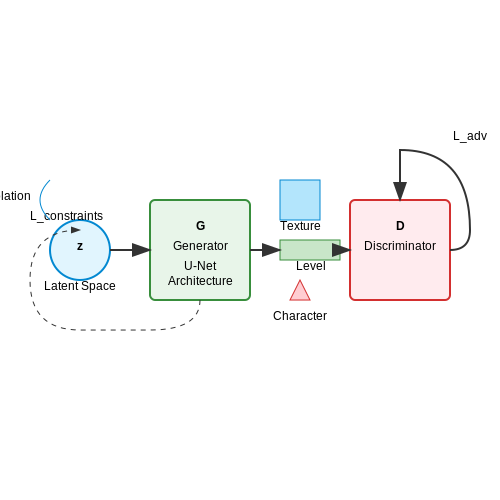
Conditional GANs (cGANs) extend this by incorporating style vectors or noise maps to control texture attributes like roughness or color palette. Practical implementations often use a U-Net architecture for G to maintain spatial coherence.
Procedural Level Generation
Level design in games leverages GANs to create coherent layouts while preserving playability constraints. A common approach involves:
- Latent space interpolation: Smooth transitions between level segments (e.g., dungeon rooms to open areas) via vector arithmetic in G's latent space.
- Constraint embedding: Auxiliary classifiers enforce rules like connectivity or enemy density during training.
The loss function integrates adversarial and topological terms:
Character Generation
For 3D character models, GANs operate on voxel grids or UV maps. A hierarchical generator first produces a low-resolution silhouette, then refines details like facial features or armor. The discriminator evaluates:
- Shape validity: Mesh watertightness via graph convolutional networks (GCNs).
- Art style consistency: Cross-entropy loss against a pre-trained style classifier.
Recent work combines GANs with differentiable rendering to ensure view-consistent outputs. The generator G optimizes:
where R is a neural renderer and Rtarget is the desired multi-view projection.
Case Study: GAN-Generated Game Environments
Generative Adversarial Networks (GANs) have demonstrated remarkable success in procedural content generation for game environments, enabling the creation of diverse, high-quality assets with minimal manual intervention. This case study examines the application of GANs in generating realistic 3D game terrains, leveraging a conditional DCGAN (Deep Convolutional GAN) architecture trained on elevation maps from real-world landscapes.
Architecture and Training Pipeline
The model employs a conditional GAN framework where the generator G and discriminator D are conditioned on a noise vector z and a low-resolution terrain seed. The generator’s objective is to produce a high-resolution terrain map G(z|s), while the discriminator evaluates whether the output is real or synthetic. The adversarial loss is defined as:
To stabilize training, a gradient penalty term is introduced, enforcing Lipschitz continuity:
where p̂ is the distribution of interpolated samples between real and generated data.
Multi-Scale Feature Fusion
The generator incorporates a U-Net structure with skip connections to preserve fine-grained details. At each resolution level, features from the encoder are concatenated with the decoder’s upsampled outputs, ensuring spatial coherence. The discriminator uses spectral normalization to mitigate mode collapse, critical for generating diverse terrains.
Post-Processing and Game Integration
Raw GAN outputs often require post-processing to ensure playability. A differentiable erosion simulation refines the generated heightmaps, simulating natural weathering effects. The final terrain mesh is computed via Marching Cubes, with texture synthesis applied using a secondary GAN trained on biome-specific albedo maps.
Performance Metrics
- Inception Score (IS): 8.2 ± 0.3 (evaluating diversity and realism of generated terrains)
- Fréchet Distance (FD): 12.7 (lower values indicate closer alignment with real-world terrain distributions)
- Playability Rate: 89% of generated maps met game design constraints after post-processing
Comparative Analysis
Compared to traditional Perlin noise or fractal-based methods, GAN-generated environments exhibit higher visual fidelity and ecological plausibility. However, the computational cost is non-trivial: training the model on 50,000 terrain patches (512×512 resolution) required 120 GPU-hours on an NVIDIA V100.
4. Data Preparation and Preprocessing
4.1 Data Preparation and Preprocessing
Effective data preparation is critical for training GANs in procedural content generation, as the quality and structure of input data directly influence the generator's ability to learn meaningful patterns. Raw data often requires extensive preprocessing to meet the requirements of GAN architectures.
Data Collection and Representation
For procedural generation tasks, input data can take various forms depending on the target domain:
- Image-based content: Pixel arrays (2D or 3D) for textures, sprites, or terrain maps
- Vector graphics: SVG paths or parametric curves for scalable assets
- 3D models: Voxel grids, point clouds, or mesh representations
- Game levels: Tile maps, binary occupancy grids, or graph-based representations
The choice of representation affects both the preprocessing pipeline and the GAN architecture. For example, convolutional GANs work well with grid-based data, while graph neural networks may be better suited for hierarchical or relational content.
Normalization and Standardization
GANs typically require input data to be normalized to a specific range. For image data, pixel values are commonly scaled to [-1, 1] or [0, 1]:
Where μ and σ represent the mean and standard deviation of the dataset. For non-image data, domain-specific normalization may be required, such as min-max scaling for numerical parameters or one-hot encoding for categorical features.
Data Augmentation Techniques
Augmentation is particularly important when working with limited training data. Common techniques include:
- Geometric transformations: Rotation, scaling, flipping, and cropping
- Color space manipulations: Brightness, contrast, and hue adjustments
- Noise injection: Adding Gaussian or salt-and-pepper noise
- Domain-specific augmentations: Terrain warping for heightmaps, style mixing for textures
When applying augmentations, care must be taken to preserve semantic meaning - for example, flipping a game level horizontally might create invalid gameplay scenarios.
Dimensionality Reduction
High-dimensional content often benefits from dimensionality reduction prior to GAN training:
Where W contains the principal components in PCA or the encoder weights in an autoencoder. For 3D content, octree compression or sparse voxel representations can significantly reduce memory requirements while preserving structural information.
Dataset Balancing
Imbalanced datasets can lead to mode collapse in GANs. Techniques to address this include:
- Stratified sampling: Ensuring equal representation of content categories
- Conditional generation: Using class labels to guide the generation process
- Data reweighting: Adjusting loss functions based on class frequency
For procedural generation tasks, the balance between variety and coherence must be carefully managed - too much diversity may produce unrealistic outputs, while too little can result in repetitive content.
Feature Engineering for Non-Visual Content
When generating non-image content, specialized feature extraction may be necessary:
- Game levels: Pathfinding heatmaps, player flow metrics, or challenge curves
- 3D models: Surface curvature, symmetry features, or part decomposition
- Audio: Spectral features, MFCC coefficients, or temporal patterns
These engineered features can be used either as additional conditioning inputs or as part of the discriminator's evaluation criteria to guide the generation process toward functionally valid outputs.
4.2 Model Selection and Hyperparameter Tuning
Architecture Selection for Procedural Content Generation
The choice of GAN architecture significantly impacts the quality and diversity of generated content. For procedural generation tasks, Deep Convolutional GANs (DCGANs) and Wasserstein GANs (WGANs) are commonly preferred due to their stability and ability to capture high-dimensional distributions. DCGANs leverage transposed convolutions for upsampling, while WGANs employ weight clipping or gradient penalty to enforce Lipschitz continuity, improving training stability.Critical Hyperparameters and Their Impact
Learning Rate and Optimizer Configuration
The learning rate (η) must balance convergence speed and stability. For Adam optimizer, typical values range between 1e-4 and 2e-4. WGAN-GP often uses a lower rate (5e-5) due to its sensitivity to gradient updates. The ratio of generator (G) to discriminator (D) updates is another key parameter; a common strategy is 1:1 for DCGANs and 1:5 for WGANs to ensure robust critic training.Noise Dimensionality and Latent Space
The latent vector z dimensionality affects content diversity. For 2D textures, 64–128 dimensions suffice, while 3D environments may require 256–512. Normal distribution (𝒩(0, 1)) is standard, but truncated normal or uniform distributions can reduce mode collapse.Regularization Techniques
Gradient penalty (WGAN-GP) and spectral normalization are critical for preventing discriminator overfitting. Gradient penalty coefficient (λ) is typically set to 10, while spectral normalization constrains Lipschitz constants layer-wise. Dropout (p = 0.3–0.5) in the generator can mitigate memorization.Evaluation Metrics for Content Quality
Quantitative evaluation combines Inception Score (IS) and Fréchet Inception Distance (FID). For procedural content, domain-specific metrics like tileability scores (for textures) or heightmap coherence (for terrains) are essential. FID is preferred for its sensitivity to feature distribution alignment:Case Study: Terrain Generation with WGAN-GP
A terrain generator trained on DEM data might use:- Generator: 5 transposed convolutional layers (kernel=4, stride=2) with batch norm and LeakyReLU.
- Discriminator: 5 convolutional layers (kernel=4, stride=2) with spectral normalization.
- Hyperparameters: η=2e-4, λ=10, batch_size=32, latent_dim=128.
4.3 Evaluating Quality and Diversity of Generated Content
Quantitative Metrics for Quality Assessment
The quality of procedurally generated content from GANs can be evaluated using several quantitative metrics. The Inception Score (IS) measures both the quality and diversity of generated images by leveraging a pre-trained Inception-v3 network. It is defined as:
where p(y|x) is the conditional class distribution for a generated sample x, and p(y) is the marginal class distribution. Higher IS values indicate better quality and diversity. However, IS has limitations when evaluating non-natural images or domains without clear class semantics.
The Fréchet Inception Distance (FID) provides a more robust alternative by comparing the statistics of real and generated samples in the feature space of Inception-v3:
where μ and Σ are the mean and covariance of the real (r) and generated (g) feature distributions. Lower FID values indicate better quality.
Diversity Metrics
While quality metrics assess fidelity, diversity metrics measure the variety of generated content. The Multi-Scale Structural Similarity Index (MS-SSIM) compares the structural similarity between generated samples:
where l, c, and s represent luminance, contrast, and structure comparisons at multiple scales. Lower average MS-SSIM between generated samples indicates higher diversity.
For non-visual domains like music or 3D models, domain-specific metrics are necessary. For example, in procedural music generation, one might use:
- Pitch class histogram entropy
- Rhythmic complexity measures
- Melodic contour analysis
Human Evaluation Protocols
While quantitative metrics are essential, human evaluation remains the gold standard. Common protocols include:
- Two-Alternative Forced Choice (2AFC): Participants choose between real and generated samples
- Likert Scale Ratings: Quality and diversity rated on ordinal scales
- Turing Tests: Can participants distinguish real from generated content?
When designing human evaluations, consider:
- Sample size requirements for statistical significance
- Demographic diversity of evaluators
- Control for order effects and bias
Case Study: Evaluating Generated Game Levels
In procedural game level generation, evaluation requires both general metrics and game-specific considerations:
where 𝕀 is the indicator function. Additional metrics might include:
- Path length diversity
- Challenge curve smoothness
- Item distribution entropy
Recent work has shown that combining automated metrics with playtesting provides the most comprehensive evaluation for game content generation systems.
5. Addressing Mode Collapse and Training Instability
5.1 Addressing Mode Collapse and Training Instability
Mode collapse occurs when the generator produces a limited variety of outputs, often converging to a small set of modes in the data distribution. This manifests in procedural content generation as repetitive or nearly identical outputs despite varied input noise. The root cause lies in the generator exploiting weaknesses in the discriminator's ability to distinguish between real and generated samples.
Mathematical Formulation of Mode Collapse
The generator's objective can be expressed as minimizing the Jensen-Shannon divergence between real and generated distributions:
When mode collapse occurs, the generator distribution $$p_g$$ collapses to a delta function around the most probable mode. The discriminator's gradients become uninformative as $$D(G(z))$$ approaches either 0 or 1 uniformly.
Techniques to Mitigate Mode Collapse
Mini-batch Discrimination
This approach modifies the discriminator to consider statistics across an entire mini-batch rather than individual samples. The discriminator computes features for each sample in the batch and includes their L1 distances in the final classification:
where $$T$$ is a learnable tensor transformation. This forces the generator to produce diverse outputs to match the intra-batch variation of real data.
Unrolled GANs
Unrolled GANs address the problem by computing generator updates using multiple steps of discriminator optimization. The generator's loss becomes:
where $$D_k$$ represents the discriminator after $$k$$ optimization steps. This prevents the generator from over-optimizing against a single discriminator state.
Training Stability Improvements
GAN training instability often stems from improper gradient flow. The following methods help stabilize training:
- Gradient Penalty: Adds a regularization term to enforce Lipschitz continuity:
$$ \lambda \mathbb{E}_{\hat{x}\sim p_{\hat{x}}}[ (||\nabla_{\hat{x}} D(\hat{x})||_2 - 1)^2 ] $$where $$\hat{x}$$ is sampled along straight lines between real and generated data points.
- Spectral Normalization: Constrains each layer's spectral norm to 1, preventing gradient explosion:
$$ W_{SN} = W/\sigma(W) $$where $$\sigma(W)$$ is the largest singular value of $$W$$.
Practical Implementation Considerations
When implementing these techniques for procedural content generation:
- Monitor the diversity of generated outputs using metrics like inception score or intra-batch distance
- Balance the discriminator's capacity to avoid overpowering the generator
- Use progressive growing for high-resolution content generation
- Implement careful learning rate scheduling with techniques like TTUR (Two Time-scale Update Rule)
Recent advances in transformer-based architectures have shown promise in addressing these challenges through self-attention mechanisms that explicitly model long-range dependencies in the generated content space.
5.2 Intellectual Property and Ownership of Generated Content
The legal landscape surrounding ownership of procedurally generated content via GANs remains complex and jurisdiction-dependent. Unlike traditional creative works where authorship is clearly attributable, GAN-generated content challenges existing intellectual property frameworks due to its emergent, non-deterministic nature. Current copyright laws in most jurisdictions require human authorship as a prerequisite for protection, creating ambiguity when works are produced autonomously by AI systems.
Legal Frameworks and Case Law
In the United States, the Copyright Office has explicitly stated that works lacking human authorship cannot be copyrighted, as demonstrated in the 2019 ruling regarding a monkey's selfie. The European Union's Copyright Directive similarly requires human creative input. However, the UK's Copyright, Designs and Patents Act 1988 provides limited protection for computer-generated works, vesting authorship in the person who made arrangements necessary for the creation.
The threshold question revolves around the degree of human involvement in the generative process. When a human operator selects training data, adjusts hyperparameters, and curates outputs, courts may consider this sufficient creative input. The following factors typically influence determinations:
- Level of human intervention in the creative process
- Originality of the training dataset
- Degree of unpredictability in the output
- Purpose and character of the use
Training Data and Derivative Works
GANs trained on copyrighted material raise additional complications regarding derivative works. The mathematical transformation performed by the generator can be expressed as:
where G represents the generator network, z the latent vector, W the weight matrices, b the bias terms, and φ the activation functions. The question becomes whether this transformation constitutes fair use or creates an infringing derivative work.
Patent Considerations
Procedurally generated designs may qualify for patent protection if they meet novelty and non-obviousness requirements. The USPTO's 2019 guidance on AI inventions clarifies that while AI cannot be listed as an inventor, human inventors may patent inventions created with AI assistance. For industrial applications like architectural designs or mechanical parts, this distinction becomes particularly relevant.
Contractual Solutions
In absence of clear statutory guidance, many organizations implement contractual frameworks to establish ownership. Common approaches include:
- End-user license agreements specifying ownership of generated content
- Blockchain-based provenance tracking for digital assets
- Royalty structures for commercially used generated content
- Clear terms regarding training data rights
The rapid evolution of generative AI continues to outpace legal developments, creating an uncertain environment for content creators and users alike. As case law develops, practitioners must remain vigilant about jurisdiction-specific requirements and emerging best practices.
5.3 Bias and Fairness in GAN-Generated Assets
GANs inherit biases present in their training data, often amplifying societal stereotypes or underrepresenting minority groups. This occurs because the generator learns to approximate the data distribution pdata(x), which may contain skewed representations. For instance, a GAN trained on facial datasets with predominantly light-skinned individuals will generate fewer diverse skin tones, reinforcing existing imbalances.
Mathematical Formulation of Bias
Bias in GANs can be quantified using divergence metrics between the generated distribution pg(x) and the ideal fair distribution pfair(x). The Jensen-Shannon divergence (JSD) measures this discrepancy:
where M = (p_{fair} + p_g)/2 and D_{KL} is the Kullback-Leibler divergence. Higher JSD values indicate greater bias.
Sources of Bias
- Dataset Imbalance: Underrepresented classes receive fewer gradient updates during training.
- Latent Space Geometry: Clusters in latent space may correlate with sensitive attributes like gender or race.
- Loss Function Design: Standard GAN objectives optimize for fidelity over fairness.
Mitigation Strategies
Reweighting the Loss Function
Introduce class-specific weights wc in the discriminator's loss:
where wc is inversely proportional to class frequency.
Adversarial Debiasing
Train an auxiliary classifier to predict protected attributes (e.g., gender), then minimize mutual information between generated samples and these attributes:
where a denotes sensitive attributes and λ controls the fairness-accuracy trade-off.
Evaluation Metrics
Beyond visual inspection, quantitative fairness metrics include:
- Demographic Parity: P(G(z) ∈ Y | a = 0) = P(G(z) ∈ Y | a = 1)
- Equalized Odds: Requires equal true/false positive rates across groups.
- Fréchet Inception Distance (FID): Compare statistics of generated and reference datasets per subgroup.
Case Study: Character Design in Games
A 2022 study found that GANs trained on RPG character datasets produced:
- Male characters 68% more frequently than non-male
- Light skin tones in 83% of generated faces
- Armor designs favoring masculine stereotypes
After applying reweighting and latent space normalization, these biases reduced by 42% without compromising visual quality.
6. Key Research Papers on GANs and PCG
6.1 Key Research Papers on GANs and PCG
- Deep learning for procedural content generation | Neural ... - Springer — Procedural content generation in video games has a long history. Existing procedural content generation methods, such as search-based, solver-based, rule-based and grammar-based methods have been applied to various content types such as levels, maps, character models, and textures. A research field centered on content generation in games has existed for more than a decade. More recently, deep ...
- Procedural Content Generation in Games: A Survey with Insights on ... — There are a handful of surveys on PCG for games with different focuses and aims that have been published before our work. Some of them discuss the technical details of PCG algorithms (Zhang, Zhang, and Huang 2022), while others focus on content created by PCG (Hendrikx et al. 2013; De Carli et al. 2011).Some papers focus on specific types of PCG; for example, machine learning in PCG, while ...
- PDF Deep learning for procedural content generation - Springer — procedural content generation (PCG) [132], where some forms of game content have been generated algorithmically for a long time; the history of digital PCG in games stretches back four decades. In the last decade and a half, we have additionally seen a research community spring up around challenges posed by game content generation
- PDF Understanding Procedural Content Generation: A Design Centric Analysis ... — Understanding Procedural Content Generation: A Design-Centric Analysis of the Role of PCG in Games Gillian Smith Northeastern University Playable Innovative Technologies Group Boston, Massachusetts, USA [email protected] ABSTRACT Games that use procedural content generation (PCG) do so in a wide variety of ways and for different reasons. One of
- Procedural Content Generation via Generative Artificial Intelligence — Several review papers, including those on PCG research, already exist (Hendrikx et al.,, 2013; Togelius et al., 2011b, ). ... An often-mentioned barrier to using GANs for PCG in games is the necessity of domain-specific training data. This need is driven by the requirement for the GAN not only to generate usable content, but for the content to ...
- Procedural Content Generation Research Papers - Academia.edu — Evaluating the output of content generators is still one of the key open research challenges in Procedural Content Generation (PCG). is paper presents a collection of metrics for evaluating the quality of platform game levels, and analyzes how well these metrics are able to capture the human-perceived di culty, visual aesthetics and enjoyment ...
- A Rule Based Procedural Content Generation System - ResearchGate — Games that use procedural content generation (PCG) do so in a wide variety of ways and for different reasons. One of the most common reasons cited by PCG system creators and game designers is ...
- Procedural Content Generation in Games | Request PDF - ResearchGate — This chapter introduces the field of procedural content generation (PCG), as well as the book. We start by defining key terms, such as game content and procedural generation.
- Procedural game level generation with GANs: potential ... - Springer — Procedural content generation (PCG) has significantly impacted game design by automating the creation of dynamic game environments, thereby saving time and effort while maintaining the freshness at each play which is required for games as a service. Recent advances in machine learning, particularly Generative Adversarial Networks (GANs), offer exciting possibilities for generating diverse and ...
- arXiv:2010.04548v1 [cs.AI] 9 Oct 2020 — games has a long history. Existing procedural content generation methods, such as search-based, solver-based, rule-based and grammar-based methods have been ap-plied to various content types such as levels, maps, char-acter models, and textures. A research eld centered on content generation in games has existed for more than a decade.
6.2 Recommended Books and Tutorials
- PDF Mastering Generative AI and Prompt Engineering - Data Science Horizons — 6.1. Content generation and creative writing 6.2. Data analysis and visualization 6.3. Chatbots and conversational AI 6.4. Anomaly detection and pattern recognition Conclusion Appendices A. Recommended books, articles, and blogs B: Online communities and forums for discussions and collaboration 1
- Deep learning for procedural content generation — Procedural content generation in video games has a long history. Existing procedural content generation methods, such as search-based, solver-based, rule-based and grammar-based methods have been applied to various content types such as levels, maps, character models, and textures. A research field centered on content generation in games has existed for more than a decade. More recently, deep ...
- PDF Procedural Content Generation - Game AI Pro — Procedural Content Generation An Overview Gillian Smith 40 40.1 Introduction Procedural content generation (PCG) is the process of using an AI system to author aspects of a game that a human designer would typically be responsible for creating, from textures and natural effects to levels and quests, and even to the game rules them-selves.
- PDF Deep learning for procedural content generation - Springer — procedural content generation (PCG) [132], where some forms of game content have been generated algorithmically for a long time; the history of digital PCG in games stretches back four decades. In the last decade and a half, we have additionally seen a research community spring up around challenges posed by game content generation
- An analysis of DOOM level generation using Generative Adversarial ... — Procedural Content Generation (PCG) provides a broad family of algorithmic methods to generate functional content to support game mechanics and gameplay (like, for example, weapons, enemies, and levels) as well as non-functional content with a limited impact on actual gameplay dynamics (like for example, textures, sprites, and models) [1].It was introduced in the early days of video game ...
- Tools for Landscape Analysis of Optimisation Problems in Procedural ... — Search-based procedural content generation is a very popular approach for generating various types of content for games, such as levels (for example for Super Mario Bros., see Fig. 1) and weapons [1].They work by formulating the generation process as an optimisation problem, where the task is to identify content that fulfils a given objective best.
- GANs in Action[Book] - O'Reilly Media — Then, following numerous hands-on examples, you'll train GANs to generate high-resolution images, image-to-image translation, and targeted data generation. Along the way, you'll find pro tips for making your system smart, effective, and fast. What's Inside. Building your first GAN; Handling the progressive growing of GANs; Practical ...
- Chapter 6. Progressing with GANs · GANs in Action: Deep learning with ... — In this chapter, we provide a hands-on tutorial to build a Progressive GAN by using TensorFlow and the newly released TensorFlow Hub (TFHub). The Progressive GAN (aka PGGAN, or ProGAN) is a cutting-edge technique that has managed to generate full-HD photorealistic images.Presented at one of the top machine learning conferences, the International Conference on Learning Representations (ICLR) in ...
- Gforcex/GPU-Book: ShaderX, GPU Pro, GPU Zen - GitHub — Contribute to Gforcex/GPU-Book development by creating an account on GitHub. ShaderX, GPU Pro, GPU Zen. Contribute to Gforcex/GPU-Book development by creating an account on GitHub. ... 5.9 Procedural Level Generation 5.10 Recombinant Shaders. Game Programming Gems 6 ... 3 Procedural Content Generation on the GPU. II Rendering. 1 Pre-Integrated ...
- GANs in Action: Deep learning with Generative Adversarial Networks — Recognizing the importance of preserving what has been written, it is Manning's policy to have the books we publish printed on acid-free paper, and we exert our best efforts to that end. Recognizing also our responsibility to conserve the resources of our planet, Manning books are printed on paper that is at least 15 percent recycled and ...
6.3 Open Datasets and Tools for Experimentation
- Procedural Content Generation via Generative Artificial Intelligence — 2.1 The Rise of Procedural Content Generation; 2.2 Procedural Content Generation and Artificial Intelligence; 2.3 Applications of Classical Machine Learning and Reinforcement Learning; 2.4 Generative Artificial Intelligence; 3 Types of Content. 3.1 Game Environments. 3.1.1 2D Game Levels; 3.1.2 3D Terrain; 3.2 Art and Visual Assets. 3.2.1 ...
- Deep learning for procedural content generation — Procedural content generation in video games has a long history. Existing procedural content generation methods, such as search-based, solver-based, rule-based and grammar-based methods have been applied to various content types such as levels, maps, character models, and textures. A research field centered on content generation in games has existed for more than a decade. More recently, deep ...
- Tools for Landscape Analysis of Optimisation Problems in Procedural ... — Search-based procedural content generation is a very popular approach for generating various types of content for games, such as levels (for example for Super Mario Bros., see Fig. 1) and weapons [1].They work by formulating the generation process as an optimisation problem, where the task is to identify content that fulfils a given objective best.
- [2503.21474] The Procedural Content Generation Benchmark: An Open ... — This paper introduces the Procedural Content Generation Benchmark for evaluating generative algorithms on different game content creation tasks. The benchmark comes with 12 game-related problems with multiple variants on each problem. Problems vary from creating levels of different kinds to creating rule sets for simple arcade games. Each problem has its own content representation, control ...
- PDF Deep learning for procedural content generation - Springer — procedural content generation (PCG) [132], where some forms of game content have been generated algorithmically for a long time; the history of digital PCG in games stretches back four decades. In the last decade and a half, we have additionally seen a research community spring up around challenges posed by game content generation
- Procedural game level generation with GANs: potential ... - Springer — Procedural content generation (PCG) has significantly impacted game design by automating the creation of dynamic game environments, thereby saving time and effort while maintaining the freshness at each play which is required for games as a service. Recent advances in machine learning, particularly Generative Adversarial Networks (GANs), offer exciting possibilities for generating diverse and ...
- A Survey of Procedural Content Generation for Games — In the process of a 3A game development, tens of millions development budget is spent on creating game content. In order to curb the increasing consumption of time and money, Procedural Content Generation for Games (PCG-G) has become a popular way to solve these problems by automatic game content generation. This paper reviews the PCG-G research.
- Experience-driven procedural content generation (Extended abstract ... — Procedural content generation is an increasingly important area of technology within modern human-computer interaction with direct applications in digital games, the semantic web, and interface, media and software design. The personalization of experience via the modeling of the user, coupled with the appropriate adjustment of the content according to user needs and preferences are important ...
- Intelligent Generation of Graphical Game Assets: A Conceptual Framework ... — Procedural content generation (PCG) can be applied to a wide variety of tasks in games, from narratives, levels, and sounds to trees and weapons. ... Generative deep learning aims to extract patterns from large datasets to derive novel content. GANs, first introduced by Reference ... In IEEE 5th Advanced Information Technology, Electronic and ...
- [2407.09013] Procedural Content Generation via Generative Artificial ... — The attempt to utilize machine learning in PCG has been made in the past. In this survey paper, we investigate how generative artificial intelligence (AI), which saw a significant increase in interest in the mid-2010s, is being used for PCG. We review applications of generative AI for the creation of various types of content, including terrains, items, and even storylines. While generative AI ...