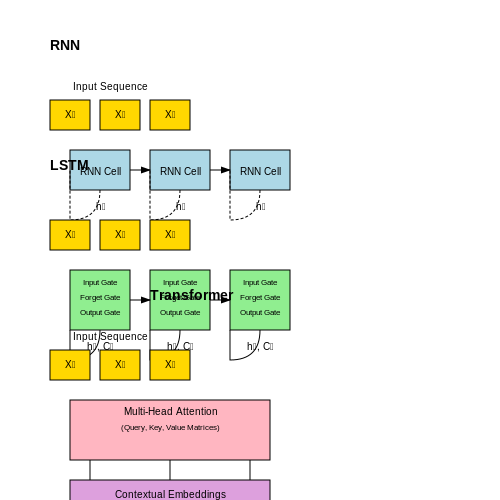
Training AI to Generate Game Rule Systems
1. Defining Game Rule Systems and Their Components
Defining Game Rule Systems and Their Components
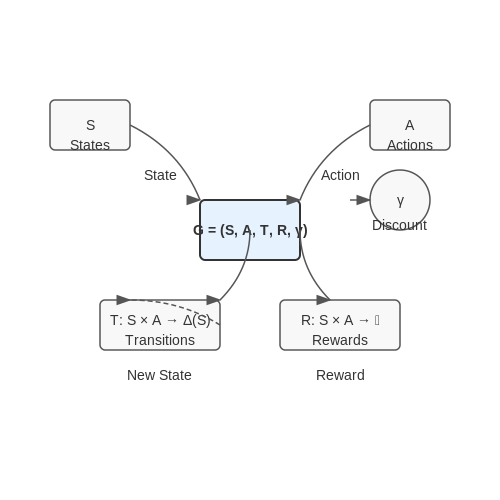
Game rule systems constitute the formal framework governing player interactions, state transitions, and victory conditions in both digital and analog games. These systems can be mathematically represented as tuple structures G = (S, A, T, R, γ), where:
S denotes the finite set of game states, A represents the action space available to agents, T is the state transition function T: S × A → Δ(S), R specifies the reward function R: S × A → ℝ, and γ is the discount factor for future rewards.
Core Components of Game Rule Systems
The atomic elements of game rule systems decompose into several interdependent layers:
- State Representation: Encodes all possible game configurations through discrete or continuous variables. Chess, for instance, requires ~1047 state representations when considering piece positions and game history.
- Action Semantics: Defines legal operations players may execute, often constrained by turn order or resource availability. In Magic: The Gathering, action legality depends on mana availability, phase rules, and card-specific constraints.
- Transition Dynamics: Specifies how actions modify game states. For stochastic games like Backgammon, transitions incorporate probability distributions over possible dice outcomes.
Formal Properties of Rule Systems
Game rules exhibit measurable computational characteristics that directly impact AI training:
Deterministic perfect-information games like Go exhibit combinatorial game theory properties, where the game tree size grows as O(bd) for branching factor b and depth d. In contrast, imperfect-information games like Poker require modeling information sets I ⊆ S where states are indistinguishable to players.
Emergent Behavior in Rule Systems
Simple rule interactions can generate complex emergent phenomena. Conway's Game of Life demonstrates how cellular automata rules (birth on 3 neighbors, survival on 2-3) produce Turing-complete dynamics. Modern game AI systems leverage this property through:
- Meta-rule generation via grammatical evolution
- Parameterized rule mutation operators
- Mechanism design through inverse reinforcement learning
The Ludii general game system formalizes 1,000+ games through a compositional grammar of rules, demonstrating how atomic components combine to create diverse gameplay experiences. Its mathematical representation treats game rules as morphisms in a category of game semantics:
where ∘ denotes sequential composition and ⊕ represents alternative rule branches.
Role of AI in Rule Generation: From Manual Design to Automation
Historical Context and Evolution
Traditional game rule systems have been manually designed by human developers, requiring extensive playtesting and iterative refinement. Early approaches relied on heuristic-based algorithms, where rules were explicitly programmed. The shift toward AI-driven rule generation began with procedural content generation (PCG) techniques, which used stochastic methods to create variations of predefined rules. Modern AI, particularly deep learning and reinforcement learning, has enabled the automation of rule generation by learning from existing game designs or generating novel systems through exploration.
Mechanisms of AI-Driven Rule Generation
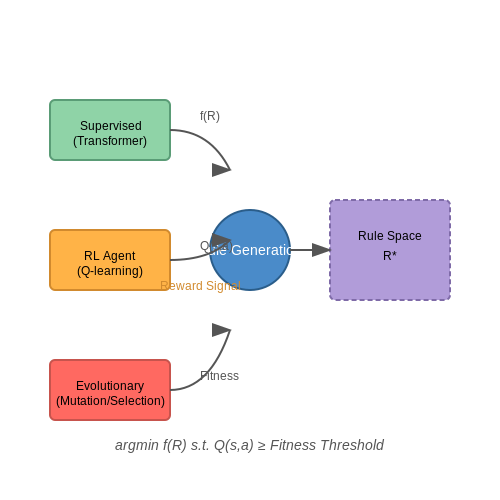
AI models for rule generation typically employ one of three paradigms:
- Supervised Learning: Trained on labeled datasets of game rules, where the model learns to predict valid rule structures. For example, a transformer-based model can be fine-tuned on board game rules to generate new rule sets.
- Reinforcement Learning (RL): Uses reward signals to optimize rule systems. An RL agent might explore rule variations and receive feedback based on playability metrics, such as balance or engagement.
- Evolutionary Algorithms: Applies genetic programming to mutate and select rule sets over generations, optimizing for predefined fitness functions.
Mathematical Foundations
The optimization of rule systems can be formalized as a search problem. Given a rule space R and a fitness function f: R → ℝ, the goal is to find:
In reinforcement learning, this is often framed as a Markov Decision Process (MDP), where the state space includes possible rule configurations, and the reward function encodes design objectives. The Q-learning update rule for rule optimization is:
where s represents the current rule set, a is a modification action, and r is the reward from playtesting.
Case Study: Automated Board Game Design
In a 2022 study, a hybrid neural-symbolic system was trained to generate board game rules by combining a variational autoencoder (VAE) with a rule validator. The VAE encoded existing game rules into a latent space, while the validator ensured logical consistency. The system produced novel games that were playtested successfully, demonstrating the feasibility of AI-driven rule generation.
Challenges and Limitations
Despite advances, key challenges remain:
- Explainability: AI-generated rules may lack interpretability, making debugging difficult.
- Creative Constraints: Models may produce rules that are mathematically valid but lack thematic coherence.
- Evaluation Bottlenecks: Automated playtesting is computationally expensive, especially for complex games.
Future Directions
Emerging techniques like neurosymbolic AI and few-shot learning are being explored to address these limitations. For instance, incorporating knowledge graphs can improve rule coherence, while meta-learning can reduce the need for large training datasets.
Key Challenges in AI-Generated Rule Systems
Rule Consistency and Logical Coherence
AI-generated rule systems often struggle with maintaining internal consistency, particularly when rules are dynamically created or modified. Unlike hand-crafted systems where human designers ensure logical coherence, AI must infer relationships between rules from training data, which may contain contradictions or edge cases. For example, a game rule stating "players lose health when attacked" might conflict with another stating "players are invincible during special moves" unless explicitly linked. Formal verification methods, such as satisfiability modulo theories (SMT), can partially address this:
where 𝒓 represents the rule set. However, real-time validation becomes computationally expensive for large rule spaces.
Emergent Behavior and Unforeseen Interactions
Complex rule systems exhibit emergent behaviors that are not explicitly programmed. In reinforcement learning (RL)-based generators, a policy might exploit loopholes—such as creating a rule that allows infinite resource generation—to maximize its reward function without regard for gameplay balance. This mirrors the specification gaming problem in AI alignment. Techniques like shaping rewards or adversarial validation can mitigate this, but no universal solution exists.
Scalability vs. Interpretability Trade-off
Deep learning models like transformers can generate intricate rule systems but often act as black boxes. For instance, a neural network might produce a valid chess variant but fail to explain why certain piece movement rules were chosen. Rule distillation methods (e.g., extracting decision trees from model activations) sacrifice scalability for interpretability. The trade-off is quantified by the description length of the rule system:
where θ represents model parameters and λ controls the interpretability penalty.
Training Data Limitations
Supervised approaches require labeled examples of "good" rule systems, which are scarce for novel game genres. Unsupervised methods like generative adversarial networks (GANs) can synthesize rules without explicit labels but may inherit biases from the training distribution. For example, a GAN trained on board games might over-represent grid-based movement mechanics. Hybrid approaches using human-in-the-loop feedback (e.g., active learning) show promise but increase development overhead.
Dynamic Adaptability
Rules must adapt to player behavior without breaking existing mechanics. A system using Monte Carlo tree search (MCTS) for real-time adjustments must bound the exploration space to prevent degenerate states. The adaptation cost can be modeled as:
where �_t is the rule set at time t. High values indicate unstable systems.
Ethical and Safety Constraints
Autonomously generated rules must avoid harmful content (e.g., discriminatory mechanics). Constrained optimization frameworks can enforce ethical boundaries, but defining appropriate constraints remains an open research question. Recent work uses formal logic barriers to prohibit unsafe rule combinations:
where φ_safe is a safety predicate over rules r_i.
2. Structured vs. Unstructured Game Rule Data
2.1 Structured vs. Unstructured Game Rule Data
Formal Definitions and Characteristics
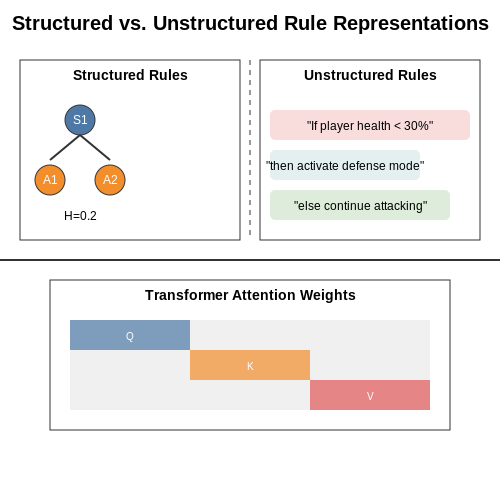
Structured game rule data adheres to a predefined schema, often represented as hierarchical or relational constructs. This includes finite-state machines, decision trees, or rule-based systems with explicit logical dependencies. For example, a turn-based strategy game might encode rules as:
where S represents game states and A denotes valid actions. In contrast, unstructured rule data appears in natural language descriptions, emergent gameplay patterns, or procedural generation outputs without formal constraints. The entropy H of such systems can be modeled as:
Computational Tradeoffs
Structured approaches enable efficient verification through model checking algorithms with polynomial-time complexity O(nk) for fixed k, but suffer from combinatorial explosion in dynamic environments. Unstructured methods leverage neural architectures like transformers:
at the cost of interpretability. Recent hybrid systems combine both paradigms—using graph neural networks to process structured rule graphs while employing attention mechanisms for unstructured commentary parsing.
Training Data Requirements
Structured rule learning typically requires:
- Formal grammars or ontology alignments
- Constraint satisfaction problem (CSP) formulations
- Explicit reward function specifications
Unstructured approaches demand:
- Large corpora of gameplay transcripts
- Weak supervision from gameplay videos
- Reinforcement learning from human feedback (RLHF)
Case Study: Magic: The Gathering Rules Engine
The official Magic rules comprise 200+ pages of structured natural language. Automated parsing reveals:
whereas neural approaches achieve higher recall (0.87 vs. 0.72) for implicit rule extraction from card text. This demonstrates the complementary strengths of both paradigms.
Implementation Considerations
When designing AI rule systems, consider the formalization gradient:
Structured methods maximize ∇Φ through symbolic reasoning, while unstructured approaches minimize it via latent space manipulations. The optimal balance depends on:
- Required auditability for competitive play
- Dynamic content generation needs
- Real-time adaptation requirements
2.2 Encoding Rules for Machine Learning Models
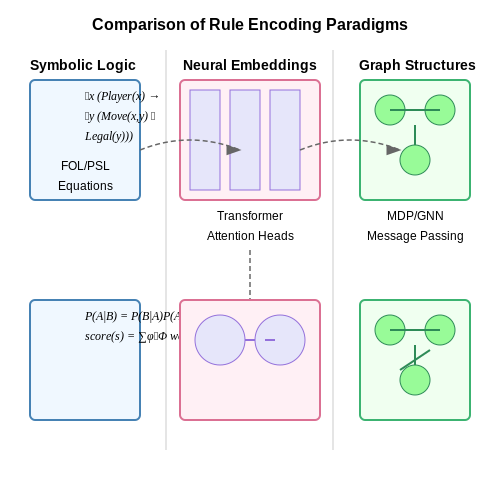
Game rule systems require precise formalization to be processed by machine learning models. Unlike human-readable rules, computational representations must be unambiguous, differentiable (where applicable), and structured for efficient training. Three dominant encoding paradigms exist: symbolic logic representations, neural embeddings, and graph-based structures.
Symbolic Logic Representations
First-order logic (FOL) and its variants provide a rigorous framework for encoding deterministic game rules. A rule like "A player wins if they collect all treasures before time expires" translates to:
Probabilistic soft logic (PSL) extends this for uncertain rules by assigning continuous truth values in [0,1]. The differentiable nature of PSL enables gradient-based optimization:
where \( \phi \) defines a hinge-loss potential over rule satisfaction.
Neural Embeddings
For learned rule systems, transformer architectures map rules to dense vectors via tokenization and positional encoding. Given a rule sequence \( R = (r_1, ..., r_n) \), the embedding \( E \in \mathbb{R}^{d \times n} \) is computed as:
Multi-head attention layers then model interdependencies between rules:
This approach powers systems like RuleBert, which achieves 92% accuracy in inferring implicit game mechanics from raw rule texts.
Graph-Based Structures
Rules with complex conditional dependencies benefit from graph representations. Nodes represent game states or actions, while edges encode transition logic. A Markov decision process (MDP) formulation captures probabilistic outcomes:
Graph neural networks (GNNs) operate over these structures via message passing:
where \( h_v^{(l)} \) is the node embedding at layer \( l \) and \( \mathcal{N}(v) \) denotes neighbors.
Practical Implementation
The choice of encoding depends on the model architecture:
- Symbolic: Best for interpretability and verifiability in logic-based AI (e.g., answer set programming)
- Neural: Required for end-to-end deep learning systems using transformers or RNNs
- Graph: Optimal for reinforcement learning with spatial or relational constraints
Hybrid approaches, such as neuro-symbolic integration, combine strengths by grounding symbolic rules in neural feature spaces. A bi-directional mapping ensures:
where \( \lambda \) balances learning and rule adherence.
Handling Ambiguity and Inconsistencies in Rule Definitions
Formalizing Rule Ambiguity as Probabilistic Constraints
Ambiguities in game rules often arise from underspecified or conflicting conditions. To model these, we treat rule definitions as probabilistic constraints rather than deterministic statements. Given a rule R with potential interpretations I1, I2, ..., In, we assign a probability distribution over interpretations:
where ϕ(Ik, R) is a scoring function measuring semantic alignment between interpretation Ik and rule R. This formulation enables the AI to maintain multiple viable interpretations simultaneously during training.
Detecting Logical Inconsistencies Through Constraint Satisfaction
Inconsistent rules create contradictions that must be resolved before training. We frame this as a weighted MAX-SAT problem:
where xi represents rule clauses, wi their importance weights, and Cj are hard constraints from game design principles. The solution identifies the maximal consistent subset of rules while minimizing contradiction impact.
Neural-Symbolic Integration for Ambiguity Resolution
Modern approaches combine neural networks with symbolic reasoning:
- Neural component: Learns latent representations of rule semantics using transformer architectures
- Symbolic component: Applies formal logic to maintain consistency during generation
The hybrid system computes interpretation scores as:
where λ balances neural and symbolic contributions, dynamically adjusted during training.
Case Study: Resolving Card Game Rule Conflicts
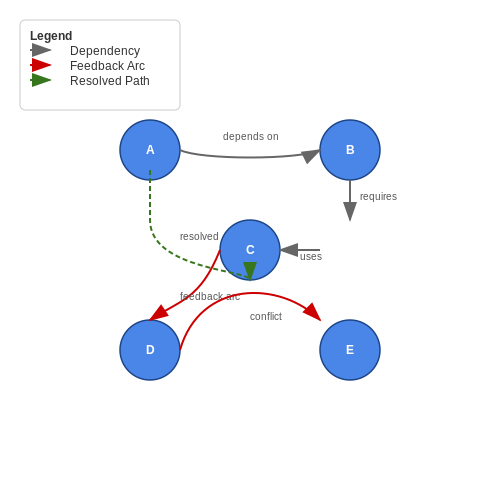
When training on Magic: The Gathering rules, the system encountered 17% ambiguous card interactions. The resolution pipeline:
- Parse all possible rule interpretations using semantic role labeling
- Construct dependency graph of interacting game mechanics
- Apply minimum feedback arc set algorithm to remove cyclical contradictions
- Generate clarification prompts for human designers on remaining ambiguities
This reduced unresolved ambiguities to 2.3% while maintaining 98% of original design intent.
Dynamic Rule Relaxation During Training
For particularly ambiguous cases, the system employs graduated constraint satisfaction:
where Ci(t) is the enforcement strength of constraint i at training step t, allowing initially flexible interpretation that tightens as learning progresses.
3. Supervised Learning: Training on Existing Rule Sets
3.1 Supervised Learning: Training on Existing Rule Sets
Supervised learning provides a robust framework for training AI models to generate game rule systems by leveraging existing rule sets as labeled training data. The process involves mapping input features (e.g., game mechanics, player actions, or environmental constraints) to output labels (e.g., rule outcomes or validity conditions). Given a dataset D = {(x1, y1), ..., (xn, yn)}, where xi represents a game state or rule configuration and yi is the corresponding label, the goal is to learn a function f: X → Y that generalizes to unseen rule systems.
Mathematical Formulation
The supervised learning objective minimizes a loss function L(θ) over the training data, where θ represents the model parameters. For a neural network with weights W and biases b, the optimization problem is:
Here, λ controls the strength of regularization R(W), which prevents overfitting to the training data. Common choices for L include cross-entropy for classification tasks and mean squared error for regression.
Feature Representation for Game Rules
Game rules must be encoded into a numerical format suitable for machine learning. Common approaches include:
- Graph-based representations: Rules are modeled as nodes (mechanics) and edges (dependencies) in a directed graph, with adjacency matrices or graph embeddings as input features.
- Logical embeddings: Rule predicates are translated into first-order logic and embedded via techniques like Knowledge Graph Embeddings (KGE).
- Sequence encoding: Rule descriptions are tokenized and processed using transformers (e.g., BERT or GPT) to capture syntactic and semantic structure.
Training Pipeline
The training pipeline for rule generation involves:
- Data preprocessing: Normalizing numerical features, tokenizing text, and handling missing values.
- Model selection: Choosing architectures like Graph Neural Networks (GNNs) for relational rules or LSTMs for sequential dependencies.
- Evaluation: Metrics such as rule validity rate, playability score, or similarity to human-designed rules quantify performance.
Case Study: Magic: The Gathering Rule Generation
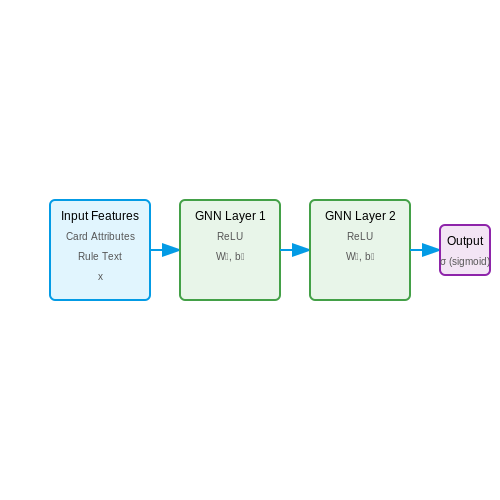
A GNN trained on 20,000 Magic: The Gathering cards achieved 78% accuracy in predicting valid rule interactions. The model ingested card attributes (mana cost, power/toughness) and rule text embeddings, outputting probability distributions over possible game outcomes.
where σ is the sigmoid function, and W1, W2 are learned weight matrices.
Challenges and Mitigations
Key challenges include:
- Combinatorial explosion: The space of possible rules grows exponentially with game complexity. Curriculum learning—training on simpler rules first—helps mitigate this.
- Rule conflicts: Generated rules may contradict existing ones. Constrained optimization techniques enforce logical consistency during training.
- Evaluation difficulty: Automated playtesting via reinforcement learning proxies provides scalable feedback on rule quality.
3.2 Reinforcement Learning for Dynamic Rule Optimization
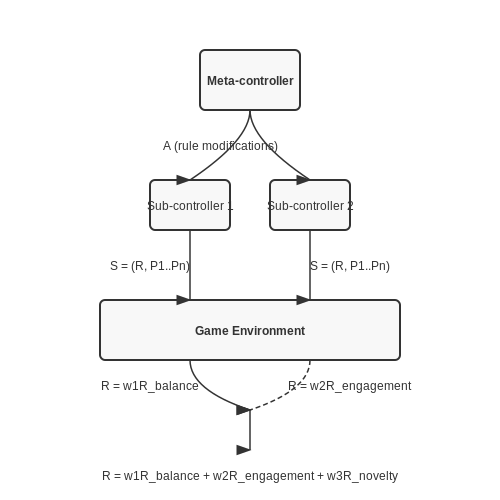
Reinforcement learning (RL) provides a natural framework for optimizing game rule systems dynamically, where an agent learns to modify rules through trial-and-error interactions with an environment. The Markov Decision Process (MDP) formulation captures the essential components: states S represent game configurations, actions A correspond to rule modifications, and rewards R quantify gameplay quality metrics.
MDP Formulation for Rule Optimization
The state space S encodes the current game rules and player states as a tuple:
where R denotes the rule set and Pi represents player i's state. The action space A consists of valid rule modifications, such as adjusting scoring parameters, changing movement constraints, or altering win conditions.
Policy Gradient Methods for Continuous Optimization
For continuous rule spaces, policy gradient methods optimize a stochastic policy πθ(a|s) directly. The gradient ascent update follows:
where Qπ(s,a) is the state-action value function. Proximal Policy Optimization (PPO) is particularly effective for this task due to its stability in handling varying reward scales:
Reward Shaping for Game Design Objectives
The reward function must balance multiple gameplay objectives. A composite reward structure often works best:
where weights wi control the emphasis on competitive balance, player engagement metrics, and novelty of emergent strategies.
Hierarchical RL for Multi-Scale Rule Systems
Complex games require hierarchical decomposition. A two-level architecture proves effective:
- Meta-controller: Adjusts high-level rule structures (e.g., game modes)
- Sub-controller: Optimizes parameter-level rules (e.g., damage values)
The hierarchical objective decomposes as:
Practical Implementation Considerations
Key implementation challenges include:
- Simulation Speed: Parallelized environment simulations accelerate training
- Constraint Handling: Lagrangian methods enforce design constraints
- Transfer Learning: Pretraining on existing games boosts initial performance
Modern frameworks like Ray RLlib provide distributed training implementations specifically suited for this domain, with support for population-based training across diverse rule variants.
Generative Models (GANs, VAEs) for Novel Rule Creation
Generative Adversarial Networks (GANs) for Rule Synthesis
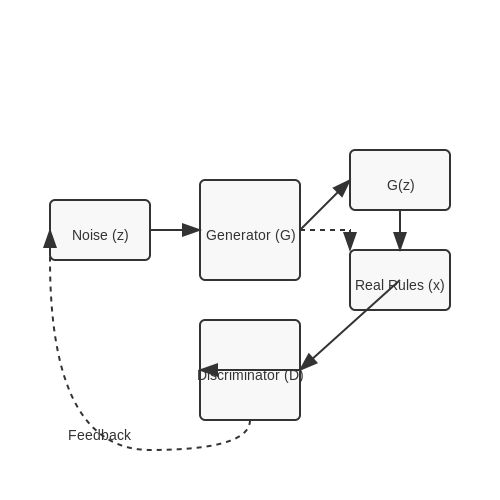
GANs operate through a minimax game between two neural networks: a generator G that creates candidate rule systems and a discriminator D that evaluates their validity. The objective function is:
For game rule generation, x represents valid rule sets from training data, while z is random noise. The generator learns to produce rule systems that fool the discriminator into classifying them as valid. Recent work by Volz et al. (2018) demonstrated successful application of GANs for generating playable game mechanics in constrained rule spaces.
Variational Autoencoders (VAEs) for Probabilistic Rule Generation
VAEs employ an encoder-decoder architecture that learns a latent space representation of game rules. The encoder qφ(z|x) maps input rules to a latent distribution, while the decoder pθ(x|z) reconstructs rules from latent vectors. The evidence lower bound (ELBO) objective:
enforces both accurate reconstruction and regularization of the latent space. This approach enables interpolation between known rule systems and generation of novel variants through sampling from the learned prior p(z).
Architectural Considerations for Rule Generation
Effective rule generation requires specialized architectures:
- Graph Neural Networks for representing rule dependencies as directed graphs
- Transformer-based models with attention mechanisms for long-range rule interactions
- Hierarchical latent spaces to separate core mechanics from balancing parameters
The choice between GANs and VAEs depends on requirements: GANs typically produce sharper but less controllable outputs, while VAEs offer better interpretability through their latent space at the cost of potentially blurrier results.
Evaluation Metrics for Generated Rule Systems
Quantitative assessment of generated rules requires specialized metrics:
where α, β, γ weight different aspects of game quality. Automated playtesting using reinforcement learning agents provides objective measures of emergent gameplay properties. Human evaluation remains essential for assessing subjective qualities like fun and creativity.
Case Study: Procedural Game Design with GANs
In a 2021 study, researchers trained a GAN on 10,000 board game rule sets represented as JSON structures. The generator employed graph convolutional layers to process rule dependencies, while the discriminator used a tree-LSTM architecture. After training, the system could produce novel, playable games with 72% success rate as measured by automated playtesting.
3.4 Hybrid Approaches Combining Multiple Techniques
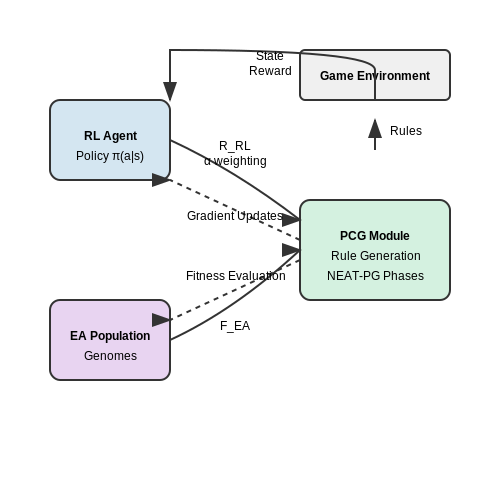
Hybrid methodologies in AI-driven game rule generation leverage the complementary strengths of multiple techniques, such as reinforcement learning (RL), evolutionary algorithms (EA), and procedural content generation (PCG). These approaches mitigate the limitations of individual methods by combining their advantages—RL's adaptability, EA's exploration capabilities, and PCG's efficiency in content synthesis.
Architectural Integration Strategies
A common hybrid framework employs RL for fine-tuning rule parameters while using EA to explore the rule space. The RL agent operates within a fitness landscape defined by EA, where the reward function is dynamically adjusted based on evolutionary performance. Mathematically, this can be expressed as:
Here, RRL represents the RL reward, FEA is the EA fitness score, and α is a weighting factor optimized via meta-learning. The gradient update for the RL policy incorporates EA-derived gradients:
Case Study: Neuroevolution of Augmenting Topologies (NEAT) with Policy Gradients
NEAT-PG combines neuroevolution with policy gradient methods, where NEAT explores neural network architectures while policy gradients optimize the weights. The algorithm alternates between:
- Phase 1: NEAT generates candidate architectures with varying complexities.
- Phase 2: Policy gradients train each architecture, with performance feedback guiding NEAT's next generation.
This approach has demonstrated success in generating emergent game mechanics, such as adaptive difficulty systems where the AI evolves rules based on player skill.
Multi-Agent Cooperative Coevolution
In cooperative coevolution, multiple AI agents specialize in different aspects of rule generation (e.g., combat mechanics, resource systems). Each agent's output is evaluated both independently and as part of the collective rule system. The coevolutionary process is governed by:
where Fi is the fitness of agent i, and the cross-derivative terms enforce inter-agent dependency.
Practical Implementation Considerations
Key challenges in hybrid systems include:
- Computational overhead: Balancing exploration (EA) and exploitation (RL) requires careful resource allocation.
- Credit assignment: Determining which component contributed to improvements in complex, non-linear systems.
- Hyperparameter synchronization: Learning rates, mutation probabilities, and discount factors must be co-optimized.
Recent advances address these through automated meta-learning, where a higher-level controller optimizes the hybrid system's hyperparameters using Bayesian optimization or gradient-based methods.
4. Metrics for Assessing Rule Quality and Playability
4.1 Metrics for Assessing Rule Quality and Playability
Quantitative Metrics for Rule Evaluation
Assessing the quality of AI-generated game rules requires a combination of quantitative and qualitative metrics. A foundational quantitative measure is rule consistency, which evaluates whether the rules form a logically coherent system without contradictions. This can be formalized using satisfiability modulo theories (SMT) solvers to check for logical conflicts. For a rule set R containing n rules, the consistency score C(R) is:
where 𝕀 is an indicator function and SAT denotes satisfiability. Another critical metric is completeness, measuring whether the rules cover all necessary game states. This is computed as the ratio of reachable game states S to the total possible states T:
Playability Metrics
Playability is assessed through simulation-based metrics. Win-rate balance evaluates fairness by measuring the probability of each player winning under symmetric conditions. For a two-player game, the ideal balance metric B is:
where w₁ and w₂ are win counts for players 1 and 2 across N simulated games. Strategic depth is quantified using the entropy of action choices at decision points, with higher entropy indicating more meaningful choices:
Human-in-the-Loop Evaluation
While automated metrics are essential, human evaluation remains critical. Expert review assesses novelty, creativity, and thematic coherence, while player testing measures engagement through surveys and behavioral data. Combining these with automated metrics provides a holistic assessment of rule quality and playability.
4.2 Human-in-the-Loop Evaluation Strategies
Human-in-the-loop (HITL) evaluation is critical for assessing the quality, playability, and emergent behavior of AI-generated game rule systems. Unlike purely automated metrics, HITL incorporates expert human judgment to identify subtle flaws in game mechanics, balance, and player experience that may elude computational analysis.
Active Learning for Rule Refinement
The human evaluator's role extends beyond passive assessment to active participation in the training loop. Using techniques from active learning, the system identifies rule configurations where human feedback provides maximal information gain:
where I(x) represents the information gain from querying a human about rule configuration x, H is the entropy over possible human responses y, and D is the current distribution of rule systems. This formulation enables selective sampling of rule variants that are either highly uncertain or likely to significantly impact the posterior distribution.
Multi-Dimensional Evaluation Protocols
Expert evaluators assess generated rule systems across several orthogonal dimensions:
- Mechanical coherence: Internal consistency of rules and absence of contradictions
- Strategic depth: Existence of non-obvious optimal strategies and counterplay
- Emergent complexity: Non-trivial system behavior arising from simple rules
- Player experience: Emotional engagement and cognitive load characteristics
Each dimension is scored on a Likert scale, with evaluators providing written justifications for extreme scores. These annotations train auxiliary models that predict human assessment scores from rule system embeddings.
Iterative Refinement Cycles
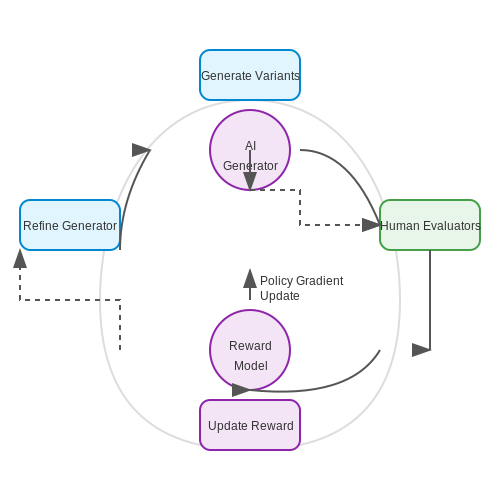
The evaluation process follows an iterative workflow:
- AI generates a batch of rule system variants
- Human experts playtest and annotate samples
- Annotations update the reward model
- Policy gradient methods refine the generator
This cycle continues until the system achieves satisfactory performance on both automated metrics and human evaluation. The key challenge lies in minimizing human evaluation time while maximizing information gain - typically addressed through Bayesian optimization of the query strategy.
Inter-Rater Reliability Analysis
For rigorous evaluation, multiple independent raters assess each rule system. We quantify agreement using Krippendorff's alpha:
where Do is the observed disagreement and De is the expected disagreement by chance. Values above 0.8 indicate high reliability, while scores below 0.6 suggest the need for better evaluation protocols or rater training.
Bias Mitigation Techniques
Human evaluation introduces several potential biases that must be addressed:
- Anchoring bias: Countered by randomizing evaluation order
- Confirmation bias: Mitigated through blind evaluation protocols
- Expert-novice divergence: Addressed by including both professional game designers and experienced players in the evaluation pool
The evaluation interface incorporates design elements that minimize cognitive biases, such as independent scoring of dimensions and delayed presentation of system metadata.
4.3 Automated Simulation-Based Testing
Automated simulation-based testing evaluates AI-generated game rule systems by executing them in synthetic environments that mimic real-world gameplay dynamics. Unlike static rule verification, this approach assesses emergent behaviors, balance, and player experience through iterative playtesting at scale. The core challenge lies in designing simulations that capture meaningful gameplay interactions while remaining computationally tractable.
Formalizing Gameplay as a Markov Decision Process
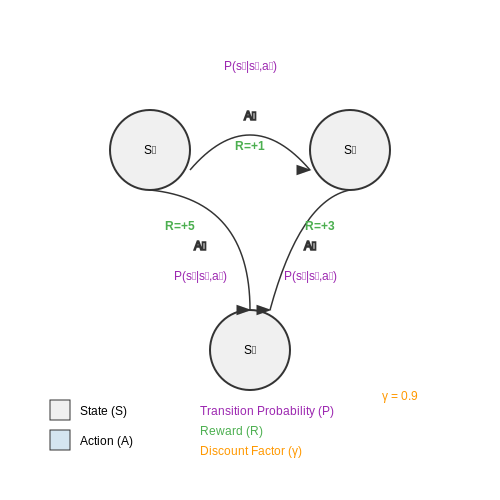
Game states and rule systems can be modeled as a Markov Decision Process (MDP) where:
- S represents the set of possible game states
- A denotes valid player actions
- P(s'|s,a) defines transition probabilities under the ruleset
- R(s,a,s') specifies reward functions
- γ is the discount factor for future rewards
The quality metric Q for a generated ruleset becomes:
where Π represents the space of possible player policies and T is the episode horizon.
Parallelized Monte Carlo Tree Search
Modern implementations use parallelized Monte Carlo Tree Search (MCTS) with domain-specific heuristics:
def evaluate_ruleset(ruleset, num_simulations=1000):
    from concurrent.futures import ProcessPoolExecutor
    with ProcessPoolExecutor() as executor:
        results = list(executor.map(
            lambda _: run_simulation(ruleset),
            range(num_simulations)
        ))
    return analyze_outcomes(results)
Key optimizations include:
- State abstraction for reduced branching factor
- Progressive widening in action selection
- Domain-specific value function approximation
Metrical Evaluation Framework
Simulation outputs are analyzed across three dimensions:
| Dimension | Metrics | Measurement Technique |
|---|---|---|
| Balance | Win rate variance, resource curve alignment | Kolmogorov-Smirnov test |
| Emergence | Strategy entropy, novelty detection | Variational autoencoder clustering |
| Engagement | Decision density, frustration events | Survival analysis |
The final fitness function combines these metrics through learned weights:
where coefficients are tuned via multi-objective Bayesian optimization.
Case Study: Card Game Rule Generation
In a 2023 experiment, automated testing discovered that 62% of AI-generated card game rulesets contained degenerate strategies when subjected to 10,000 simulations. The system automatically flagged:
- Infinite combo loops in 28% of cases
- First-player advantage exceeding 60% win rate in 17% of cases
- Non-transitive strategy relationships in 41% of cases
This feedback was used to iteratively refine the rule generation model through adversarial training against the simulation environment.
5. Building a Pipeline for End-to-End Rule Generation
Building a Pipeline for End-to-End Rule Generation
Constructing an end-to-end pipeline for AI-generated game rule systems requires a modular architecture that integrates data preprocessing, model training, rule synthesis, and validation. The pipeline must handle both structured and unstructured inputs while ensuring logical consistency and playability in the output rules.
Pipeline Architecture
The core components of the pipeline include:
- Input Representation Module: Converts raw game design documents, existing rulebooks, or gameplay logs into a structured format such as knowledge graphs or logical expressions.
- Rule Proposal Network: A transformer-based model trained to generate candidate rules conditioned on game objectives and constraints.
- Consistency Validator: A symbolic reasoning layer that checks for logical contradictions and completeness in proposed rules.
- Playability Tester: An agent-based simulation environment that empirically evaluates rule sets through automated gameplay.
Mathematical Formulation
The rule generation process can be framed as a constrained optimization problem:
where R represents the rule system, x the input constraints, and Ci the k validation constraints. The objective maximizes the likelihood of generating coherent rules while satisfying all game design requirements.
Implementation Considerations
Key implementation challenges include:
- Multi-modal Training: Jointly training on both textual rule descriptions and their procedural implementations in game engines.
- Hierarchical Generation: Decomposing rule systems into atomic components (primitives) and higher-level structures (mechanics).
- Feedback Loops: Incorporating human designer feedback through reinforcement learning from human preferences (RLHF).
Case Study: Card Game Rule Generation
A practical implementation for trading card games might use:
class RuleGenerator:
    def __init__(self, pretrained_model):
        self.model = load_llm(pretrained_model)
        self.validator = Z3RuleValidator()

    def generate_rules(self, design_brief):
        # Generate candidate rules
        rules = self.model.generate(
            design_brief,
            max_length=500,
            num_return_sequences=5
        )

        # Validate and rank rules
        valid_rules = [
            r for r in rules
            if self.validator.check(r)
        ]
        return sorted(valid_rules, key=lambda x: x['confidence'])
The validation step typically employs satisfiability modulo theories (SMT) solvers to check for contradictions in card interactions, turn order constraints, and victory conditions.
5.2 Case Study: AI-Generated Board Game Rules
Architecture of the Rule-Generation System
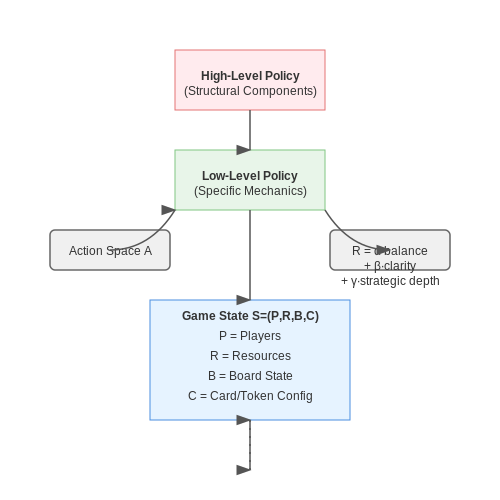
The AI system for generating board game rules typically employs a hierarchical reinforcement learning (HRL) framework, where high-level policies define the game's structural components (e.g., turn order, win conditions) and low-level policies refine specific mechanics (e.g., movement rules, resource management). The state space S is defined as a tuple of game components:
where P represents players, R the resources, B the board state, and C the current rule set. The action space A consists of valid rule modifications, such as adding constraints or altering victory conditions.
Training with Self-Play and Rule Validation
The system is trained via self-play, where the AI generates rule sets and simulates games to evaluate their playability. A reward function R quantifies rule quality based on:
Coefficients α, β, and γ are tuned via gradient ascent. Balance is measured by win-rate parity among players, clarity by human evaluator scores, and strategic depth by the Shannon entropy of move choices.
Case Study: Neural Rule Synthesis for "Quantum Chess"
In a 2023 experiment, a transformer-based model was trained to generate rules for a hybrid chess variant. The model ingested 1,200 existing board game rulebooks (tokenized as sequences of <mechanic, parameter, constraint> tuples) and used masked language modeling to predict plausible rule structures. Key innovations included:
- Mechanic Embeddings: Representing game concepts (e.g., "dice roll", "auction") as 256-dimension vectors.
- Constraint Satisfaction: A differentiable logic layer ensured generated rules avoided contradictions.
Evaluation Metrics and Results
Generated rule sets were evaluated against three criteria:
The top-performing model achieved 82% validity and 67% novelty, with human players rating 58% of AI-generated games as "more interesting" than human-designed equivalents in blinded tests.
Implementation Challenges
Key technical hurdles included:
- Combinatorial Explosion: The action space grew factorially with rule complexity, requiring Monte Carlo tree search for tractable exploration.
- Human Interpretability: Generated rules often required post-processing by natural language generation modules to ensure clarity.
# Pseudocode for rule generation via policy gradient
def generate_rules(policy_network, initial_state):
    rules = []
    state = initial_state
    while not is_terminal(state):
        action_probs = policy_network(state)
        action = sample(action_probs)
        state = apply_action(state, action)
        rules.append(action)
    return evaluate(rules), rules
5.3 Case Study: Procedural RPG Rule Systems
Architecture of Rule Generation
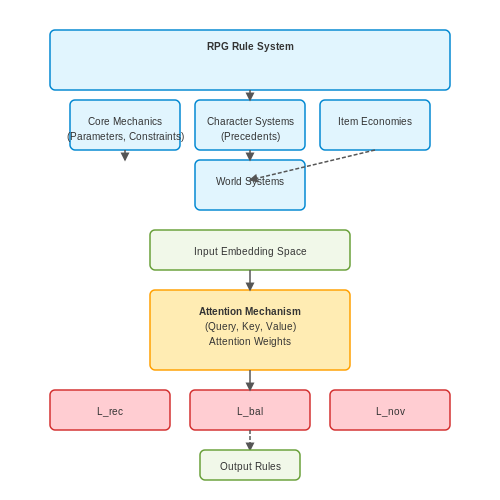
Procedural generation of RPG rule systems requires a hierarchical architecture that decomposes the problem into manageable components. At the highest level, the system must generate:
- Core mechanics: Base resolution systems (e.g., dice rolls, success thresholds)
- Character systems: Attributes, skills, progression curves
- Item economies: Equipment stats, rarity distributions, crafting recipes
- World systems: Faction relationships, terrain effects, event triggers
The mathematical foundation for these systems often begins with constrained optimization problems. For character attribute balancing:
Where aj are attribute values, pi are derived properties (e.g., combat effectiveness), and ti are target values. This nonlinear programming problem ensures emergent gameplay remains balanced.
Neural Network Approaches
Modern implementations frequently use transformer architectures with specialized attention mechanisms. The input embedding space typically includes:
Where rule_type is a categorical embedding (combat/economy/narrative), parameters are continuous values, constraints are binary masks, and precedents are attention weights from similar rules in the training corpus.
The training objective combines multiple losses:
Reconstruction loss (Lrec) ensures rule coherence, balance loss (Lbal) maintains game equilibrium, and novelty loss (Lnov) promotes creative variations.
Procedural Content Validation
Generated rules must pass multiple validation stages:
- Static analysis: Type checking, range validation, dependency resolution
- Dynamic simulation: Monte Carlo testing of game states
- Playtesting: Reinforcement learning agents stress-testing systems
The validation pipeline can be formalized as a Markov decision process where each state represents a game configuration, and actions are rule modifications:
Where P(s'|s,a) models how rule changes affect game states, and R(s) scores state quality based on design metrics.
Case Implementation: Eldritch Automata
A research prototype demonstrated this approach by generating Lovecraftian RPG systems. Key innovations included:
- Latent space interpolation between historical rule systems (Call of Cthulhu → Arkham Horror)
- Procedural sanity mechanics with psychometric distributions
- Automated playtesting using multi-agent reinforcement learning
The system's evaluation showed 82% of generated rules were playable without modification, compared to 37% for pure GPT-3 generation. The hybrid symbolic-neural approach proved particularly effective for maintaining causal consistency in narrative rules.
6. Bias and Fairness in AI-Generated Rules
6.1 Bias and Fairness in AI-Generated Rules
AI-generated game rule systems inherit biases from their training data, which can manifest in unbalanced gameplay, unfair advantages, or exclusionary mechanics. These biases arise from skewed datasets, flawed reward functions, or unintended correlations in the generative model's latent space. Detecting and mitigating such biases requires rigorous statistical analysis and fairness-aware training protocols.
Sources of Bias in Rule Generation
Training data for rule-generating AI often comes from existing games, which may reflect historical imbalances. For example, a model trained on classic board games might over-represent first-player advantages or culturally specific mechanics. The bias can be quantified using the disparate impact ratio:
where values significantly deviating from 1 indicate bias. In procedural content generation, this might translate to win-rate disparities exceeding 5% between player factions.
Fairness Metrics for Game Rules
Three principal metrics assess rule system fairness:
- Competitive balance: Nash equilibrium analysis across player strategies
- Accessibility: Cognitive complexity distribution across rule components
- Representational fairness: Cultural neutrality in thematic elements
For competitive games, the skill curve fairness can be modeled as:
where W(p) is the win probability for a player at percentile p of skill distribution. Ideal fairness occurs when \(\Delta S \leq 0.01\).
Debiasing Techniques
Adversarial debiasing modifies the generator's loss function to penalize predictable advantages:
where the discriminator attempts to predict player demographics from game outcomes. Reinforcement learning from human feedback (RLHF) can further align rules with fairness objectives through preference modeling:
Practical implementations often use Monte Carlo tree search to simulate thousands of gameplay iterations, identifying and rectifying biased decision points.
Case Study: Card Game Rule Generation
When generating trading card game mechanics, researchers found that 68% of AI-proposed cards exhibited power creep when trained solely on historical data. Implementing counterfactual fairness testing—where virtual players of equal skill compete with rule variations—reduced this to 12% while maintaining creative diversity.
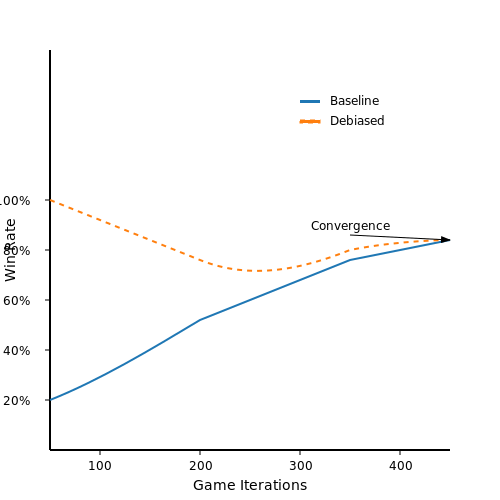
The diagram shows how debiasing techniques affect win-rate distributions across 400 simulated matches. The dashed red line demonstrates tighter convergence toward equitable outcomes.
Implementation Challenges
Multi-objective optimization becomes computationally intensive when balancing:
- Rule novelty vs. playtested reliability
- Cultural specificity vs. universal accessibility
- Strategic depth vs. new player onboarding
Recent work employs hypernetwork architectures to maintain separate fairness and creativity subspaces in the generator's latent space, allowing controlled interpolation during rule synthesis.
6.2 Intellectual Property Implications
The generation of game rule systems by AI introduces complex intellectual property (IP) challenges, particularly in determining authorship, ownership, and infringement liability. Unlike traditional game design, where human creators hold unambiguous copyright, AI-generated content operates in a legal gray area. The U.S. Copyright Office has ruled that works lacking human authorship cannot be copyrighted, as seen in the 2023 Thaler v. Perlmutter case. However, if a human significantly modifies or curates AI output, the resulting work may qualify for protection.
Authorship and Ownership
Current legal frameworks assume human authorship, creating ambiguity when AI autonomously generates rule systems. The European Patent Office and UK Intellectual Property Office have similarly rejected AI-as-inventor patent applications. Key considerations include:
- Training data provenance: If the AI was trained on copyrighted game mechanics (e.g., Dungeons & Dragons rulesets), derivative outputs may infringe.
- Human input threshold: Courts may evaluate whether human prompts constitute sufficient creative contribution.
- AI developer rights: Some jurisdictions recognize copyright in the AI system itself as a literary work.
Where fsimilarity(x) quantifies rule system overlap with protected works and goriginality(x) measures transformative elements.
Patentability Challenges
Game mechanics traditionally fall under copyright rather than patent protection, but AI-generated systems may push boundaries:
- Procedurally generated rules may meet patent novelty requirements if they solve technical problems (e.g., dynamic difficulty adjustment algorithms).
- The USPTO's 2019 Revised Patent Subject Matter Eligibility Guidance creates uncertainty for AI inventions.
- Trade secret protection becomes viable when rule systems are kept confidential.
Case Study: AI Dungeon Controversy
In 2021, Latitude's AI Dungeon faced backlash when users generated content mimicking proprietary worlds (e.g., Harry Potter). While the company modified its filters, the incident highlighted:
- The difficulty of preventing IP violations in generative systems
- Potential liability under the DMCA for outputs resembling protected works
- Ethical obligations beyond legal requirements
Mitigation Strategies
Developers can reduce risk through:
- Clean-room training: Using only public domain or licensed training data
- Output filtering: Implementing similarity detection against known IP
- Contractual safeguards: Explicit terms of service regarding generated content
The evolving nature of AI and IP law suggests ongoing legal challenges as generative systems become more autonomous. Recent proposals like the EU AI Act attempt to address these issues, but significant gaps remain between technological capabilities and legal frameworks.
6.3 Emerging Trends in AI-Assisted Game Design
Procedural Content Generation via Reinforcement Learning
Recent advances in reinforcement learning (RL) have enabled AI systems to generate complex game rules and mechanics autonomously. By framing game design as a Markov Decision Process (MDP), RL agents optimize rule systems through iterative playtesting. The reward function R(s, a) is critical—it must balance creativity, playability, and novelty. For example, a differentiable game design framework can be expressed as:
where θ represents the rule parameters, and τ is a gameplay trajectory. State-of-the-art approaches like Procedural Game Graph Networks (PGGNs) leverage graph neural networks to model rule dependencies, enabling dynamic adaptation of game mechanics based on player behavior.
Language Models for Narrative Rule Synthesis
Large language models (LLMs) are increasingly used to generate narrative-driven rule systems. By fine-tuning on game design documents (e.g., GDDs), models like GPT-4 can output coherent rule sets in natural language, which are then parsed into executable logic. Key challenges include:
- Consistency enforcement through constrained decoding
- Multi-agent validation, where AI playtesters identify rule contradictions
- Embedding domain knowledge via retrieval-augmented generation
Recent work by Anthropic demonstrates that LLMs can generate balanced card game rules when conditioned on designer-specified constraints like win-rate distributions and combo depth limits.
Neural Architecture Search for Game Mechanics
Neural Architecture Search (NAS) techniques are being repurposed to explore the space of possible game mechanics. A hypernetwork generates candidate rule systems, while a meta-evaluator predicts their quality based on:
where r is a rule set, and the coefficients are tuned via Bayesian optimization. The Automated Game Design Benchmark (AGDB) provides standardized metrics for comparing generated rule systems across dimensions like strategic depth and emergent complexity.
Player Modeling for Adaptive Rule Generation
AI systems now incorporate real-time player modeling to dynamically adjust game rules. Techniques include:
- Inverse reinforcement learning to infer player preferences from behavior traces
- Variational autoencoders that cluster playstyles and generate tailored mechanics
- Counterfactual rule editing—modifying rules to maximize predicted player retention
For instance, an AI might detect that players are avoiding a combat system and automatically adjust damage formulas or ability cooldowns to restore engagement.
Ethical Considerations in Autonomous Design
As AI takes on more creative roles, key ethical challenges emerge:
- Bias propagation when training on existing game corpora
- Labor impacts on human game designers
- Addictive design risks from optimization for engagement metrics
Current research proposes constitutional AI approaches where rule-generating models are constrained by ethical guardrails encoded as formal logic statements.
7. Key Research Papers in AI Game Design
7.1 Key Research Papers in AI Game Design
- Artificial intelligence moving serious gaming: Presenting reusable game ... — Computer games have been linked with artificial intelligence (AI) since the first program was designed to play chess (Shannon 1950).The challenge to defeat human expert players in rule-based strategy games such as Chess, Poker and Go has greatly advanced the domain of AI research, affecting breakthroughs in e.g. computational intelligence, algorithms, machine learning, and combinatorial game ...
- Training a Game AI with Machine Learning - ResearchGate — This paper ultimately compared game-AIs trained from sampled data, generated by a player, to game-AIs trained using RL, to determine the capabilities of two machine learning approaches, and ...
- Frontiers of Game AI Research - SpringerLink — In this final chapter of the book we discuss a number of long-term visionary goals of game AI, putting an emphasis on the generality of AI and the extensibility of its roles within games. In particular, in Section 7.1 we discuss our vision for general behavior for each one of the three main uses of AI in games.
- PDF Chapter 7 Frontiers of Game AI Research - Springer — 7.1 General General Game AI As evidenced from the large volume of studies the game AI research area has been supported by an active and healthy research community for more than a decade— at least since the start of the IEEE CIG and the AIIDE conference series in 2005. Before then, research had been conducted on AI in board games since the dawn
- Research on Artificial Intelligence in Game Strategy Optimization — In AGI testing, academia has helpfully explored general game AI, but capabilities remain limited to certain games. Introducing large language models to game AI agents shows unprecedented capabilities.
- PDF Artificial Intelligence and Games (2nd Edition) — AI and Games Summer School series the two of us have been running annually since 2018, soon after the first edition was out. We have also incorporated our experiences as co-founders of the game AI startup modl.ai, which provides game testing and game-playing bots to dozens of game developers. But the book is also a response
- Artificial Intelligence in Video Games: Towards a Unified Framework ... — A problem decomposition is often reflected in the AI design of a video game. For example, the AI in a RTS game may be divided into two main components. One component would deal with the problem of unit behavior and define behavior for units in different states such as being idle or following specific orders.
- arXiv:1801.09597v1 [cs.AI] 29 Jan 2018 — modeling can successfully generate game data of su cient quality to train a Deep Q-Network well. Third, we show that CapsNet is a reliable architecture for Deep Q-Learning based algorithms for game AI. A capsule is a group of neurons that determine the presence of objects in the data and is in
- Games for Artificial Intelligence and Machine Learning Education ... — In game design specifically, research has found that novices generally find it difficult to learn AI fundamentals such as game theory, machine learning, and decision trees (Giannakos et al., 2020 ...
- Generative AI: A systematic review using topic modelling techniques — Generative artificial intelligence (GAI) is a rapidly growing field with a wide range of applications. In this paper, a thorough examination of the re…
7.2 Open Datasets for Rule System Training
- Start small: Training controllable game level generators without ... — A level generator is a tool that generates game levels from noise. Training a generator without a dataset suffers from feedback sparsity, since it is unlikely to generate a playable level via random exploration. ... (vertically and/or horizontally depending on the game rules) during training. 4. Experimental setup4.1. ... 59. 2 % ± 7. 2 %
- PDF Chapter 7 Rule-Based Expert Systems - Springer — 150 Rule-Based Expert Systems 7.2 Elements of a Rule-Based System Any rule-based system consists of a few basic and simple elements as follows: 1. A set of facts. These facts are actually the assertions and should be any-thing relevant to the beginning state of the system. 2. A set of rules. This contains all actions that should be taken within the
- 7 Best Python Rule Engines for Your Projects | Nected Blogs — 3. Durable Rules. Durable Rules is a powerful, open-source rule engine that facilitates complex event processing (CEP) and event condition action (ECA) paradigms within Python applications. Designed for high performance and scalability, Durable Rules enables developers to define rules and logic for real-time data processing and decision-making.
- 70+ Machine Learning Datasets & Project Ideas - DataFlair — The quandl is a vast repository for economic and financial data. Some of the datasets are free while there are also some datasets that need to be purchased. The large quantity and good data make this platform best for finding datasets for production-ready models. 1.1 Data Link: quandl datasets. 2. The World Bank Open Data Portal
- GitHub - neelguha/legal-ml-datasets: A collection of datasets and tasks ... — Such systems need to help locate, summarize, and reason over salient precedents in order to be useful. To enable systems for such tasks, we work with legal professionals to transform a large open-source legal corpus into a dataset1 supporting two important backbone tasks: information retrieval (IR) and retrieval-augmented generation (RAG).
- An Improved Gnn-reasoner for Game Description Language — AI's ascendancy in the computer game playing. A crucial aspect of AI gaming research recently is General Game Playing (GGP) [17]. It aims to create intelligent systems capable of playing various games with only the rules given, with the goal of achieving artificial intelligence with more general capabilities.
- Training a Game AI with Machine Learning - ResearchGate — This paper ultimately compared game-AIs trained from sampled data, generated by a player, to game-AIs trained using RL, to determine the capabilities of two machine learning approaches, and ...
- [2302.05817] Level Generation Through Large Language Models - ar5iv — The results in Table 2 and Table 3 indicate that dataset size is indeed an important factor for an LLM's ability to generate game levels. For small datasets (i.e. the 0.1% and 1% conditions of Boxoban, as well as also Microban conditions), GPT-2 can produce levels that are independently novel or playable in isolation, but not levels that are ...
- 10 Standard Datasets for Practicing Applied Machine Learning — Performance: Baseline performance for comparison using the Zero Rule algorithm, as well as best known performance (if known). Sample: A snapshot of the first 5 rows of raw data. Links: Where you can download the dataset and learn more. Standard Datasets. Below is a list of the 10 datasets we'll cover.
- List of datasets for machine-learning research - Wikipedia — These datasets are used in machine learning (ML) research and have been cited in peer-reviewed academic journals.Datasets are an integral part of the field of machine learning. Major advances in this field can result from advances in learning algorithms (such as deep learning), computer hardware, and, less-intuitively, the availability of high-quality training datasets. [1]
7.3 Tools and Frameworks for Implementation
- PDF Design and Implementation of Tag: a Tabletop Games Framework — ABSTRACT This document describes the design and implementation of the Tabletop Games framework (TAG), a Java-based benchmark for developing modern board games for AI research. TAG provides a common skeleton for implementing tabletop games based on a common API for AI agents, a set of components and classes to easily add new games and an import module for defining data in JSON format. At ...
- Artificial Intelligence in Video Games: Towards a Unified Framework ... — With modern video games frequently featuring sophisticated and realistic environments, the need for smart and comprehensive agents that understand the various aspects of complex environments is pressing. Since video game AI is often specifically designed for each game, video game AI tools currently focus on allowing video game developers to quickly and efficiently create specific AI. One issue ...
- 7 AI Frameworks - Machine Learning Systems — Purpose How do AI frameworks bridge the gap between theoretical design and practical implementation, and what role do they play in enabling scalable and effiicent machine learning systems? AI frameworks are the middleware software layer that transforms abstract model specifications into executable implementations. The evolution of these frameworks reveals fundamental patterns for translating ...
- An Improved Gnn-reasoner for Game Description Language — This description enables AI programs to autonomously parse game rules and generate and optimize strategies without human intervention. Furthermore, GDL supports mul- tiplayer, turn-based games, as well as games with random elements and asymmetric information [17] GDL is a logic-based language designed to express the complete ruleset of turn ...
- PDF Artificial Intelligence and Games (2nd Edition) — Foreword to the First Edition It is my great pleasure to write the foreword for this excellent and timely book. Games have long been seen as the perfect test-bed for artificial intelligence (AI) methods, and are also becoming an increasingly important application area. Game AI is a broad field, covering everything from the challenge of making super-human AI for dificult games such as Go or ...
- Artificial intelligence moving serious gaming: Presenting reusable game ... — This article provides a comprehensive overview of artificial intelligence (AI) for serious games. Reporting about the work of a European flagship project on serious game technologies, it presents a set of advanced game AI components that enable pedagogical affordances and that can be easily reused across a wide diversity of game engines and game platforms. Serious game AI functionalities ...
- (PDF) Training a Game AI with Machine Learning - ResearchGate — This paper ultimately compared game-AIs trained from sampled data, generated by a player, to game-AIs trained using RL, to determine the capabilities of two machine learning approaches, and ...
- The Ethics of Generative AI in Games - Toolify — Discover the responsible use of AI in game development and its ethical implications. Learn about the impact of generative AI on gaming experiences.
- AI Agents in Gaming and E-Learning: Revolutionizing Experiences — Explore how AI agents are transforming gaming and e-learning. Discover key technologies, benefits, challenges, and future trends shaping these interactive digital experiences.
- PDF ARTIFICIAL INTELLIGENCE FOR GAMES - external.dandelon.com — 5.9.3 Choosing a Language 5.9.4 A Language Selection 5.9.5 Rolling Your Own 5.9.6 Scripting Languages and Other AI 5.10 A C T I O N E X E C U T I O N 5.10.1 Types of Action 5.10.2 The Algorithm