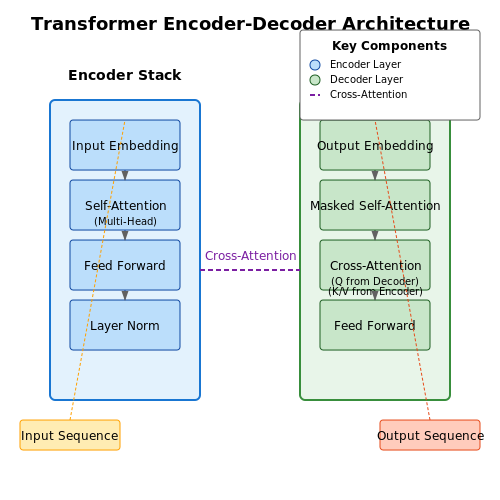
Dynamic Interface Design with Generative UI AI
1. Core Principles of Generative AI in UI Design
Core Principles of Generative AI in UI Design
Latent Space Manipulation for Interface Generation
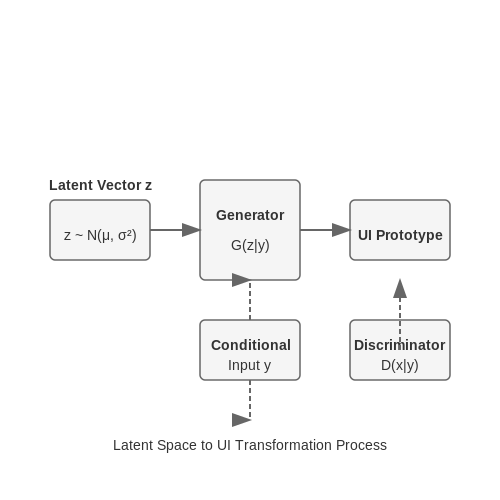
Generative AI models, such as Variational Autoencoders (VAEs) and Generative Adversarial Networks (GANs), operate by learning a compressed latent space representation of design elements. This latent space encodes features like layout structure, color schemes, and component hierarchies. For a VAE, the latent space z is sampled from a learned probability distribution, enabling interpolation between design states. The mapping function f(z) transforms latent vectors into viable UI prototypes.
GANs refine this process through adversarial training, where a discriminator network critiques generated interfaces until they achieve photorealism. The minimax objective for a GAN is:
Conditional Generation for Context-Aware UIs
Dynamic interfaces require conditioning on user context (e.g., device type, accessibility needs). Conditional GANs (cGANs) extend the base architecture by injecting auxiliary data y into both generator and discriminator:
For multi-modal interfaces, diffusion models progressively denoise random initial states into coherent designs, controlled via a guidance scale s that balances creativity versus adherence to constraints:
Real-Time Adaptation via Reinforcement Learning
Generative UI systems often employ reinforcement learning (RL) to optimize interfaces based on user interaction logs. The reward function R incorporates metrics like task completion time and error rates:
where T is time-on-task, E is error frequency, and U is user satisfaction (measured via surveys or biometrics). Policy gradients update the generator’s parameters θ to maximize expected reward:
Case Study: Airbnb’s Dynamic Layout System
Airbnb’s Sketch2Code pipeline uses a transformer-based architecture to convert designer wireframes into production-ready React components. Key innovations include:
- Attention mechanisms to preserve spatial relationships between UI elements
- Domain adaptation techniques to handle diverse design languages
- Fréchet Inception Distance (FID) scoring for quality control
Key Technologies: From GANs to Transformers
Generative Adversarial Networks (GANs)
Generative Adversarial Networks consist of two neural networks—the generator G and the discriminator D—engaged in a minimax game. The generator learns to produce synthetic data samples, while the discriminator attempts to distinguish between real and generated samples. The objective function is given by:
Here, x represents real data samples, z is the noise vector input to the generator, and pdata and pz denote the data and noise distributions, respectively. The Nash equilibrium is achieved when the generator produces samples indistinguishable from real data, and the discriminator outputs a probability of 0.5 for all inputs.
Variational Autoencoders (VAEs)
VAEs provide a probabilistic framework for generating data by learning a latent space representation. The encoder maps input data x to a distribution over latent variables z, while the decoder reconstructs the data from samples of this distribution. The loss function combines reconstruction error and Kullback-Leibler (KL) divergence:
where θ and ϕ are decoder and encoder parameters, respectively, and β controls the trade-off between reconstruction quality and latent space regularization.
Transformer Architectures
Transformers revolutionized sequence modeling through self-attention mechanisms, enabling parallel processing of input tokens. The scaled dot-product attention computes attention weights as:
where Q, K, and V are learned query, key, and value matrices, and dk is the dimension of keys. Multi-head attention extends this by concatenating outputs from multiple attention heads, allowing the model to focus on different representation subspaces.
Diffusion Models
Diffusion models generate data by gradually denoising samples through a Markov chain. The forward process adds Gaussian noise over T steps:
where βt controls the noise schedule. The reverse process learns to iteratively denoise samples, with recent variants achieving state-of-the-art results in image generation.
Neural Radiance Fields (NeRFs)
NeRFs represent 3D scenes as continuous volumetric functions using MLPs. Given a 3D position x and viewing direction d, the network predicts color c and volume density σ:
Rendering is performed via volume integration along camera rays, enabling photorealistic novel view synthesis. Recent extensions incorporate generative capabilities for dynamic scene modeling.
Contrastive Learning in Generative Models
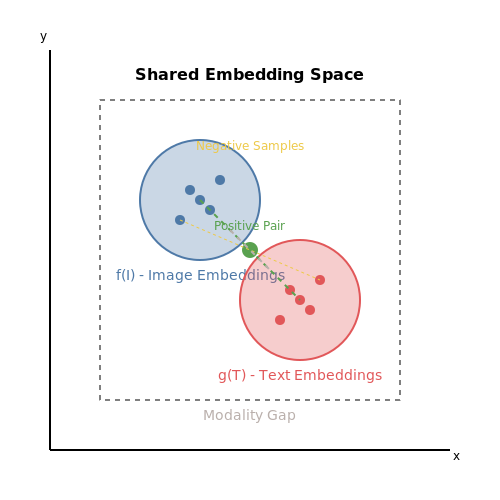
Contrastive methods like CLIP align image and text embeddings in a shared latent space. The contrastive loss maximizes similarity between matched pairs while minimizing it for negative samples:
where I and T are image and text embeddings, τ is a temperature parameter, and N is the batch size. This approach enables zero-shot transfer to downstream tasks.
The Role of Data in Training Generative Models
Generative models, such as Variational Autoencoders (VAEs), Generative Adversarial Networks (GANs), and diffusion models, rely fundamentally on high-quality training data to learn the underlying probability distribution of the target domain. The data's statistical properties directly influence the model's ability to generate coherent, diverse, and realistic outputs. For dynamic interface design, this means the training dataset must capture the full spectrum of possible UI states, transitions, and user interactions.
Data Distribution and Latent Space Learning
The core objective of a generative model is to approximate the true data distribution pdata(x) using a learned distribution pθ(x). For high-dimensional UI elements, this involves mapping input data (e.g., screenshots, design tokens, or interaction logs) to a lower-dimensional latent space z through an encoder network. The quality of this mapping depends on:
- Coverage – The dataset must sufficiently represent all modes of the target distribution to avoid mode collapse.
- Consistency – Noisy or mislabeled data (e.g., misaligned UI states) introduces artifacts in the latent space.
- Dimensionality – The latent space dimensionality must balance compression and expressiveness.
Here, the VAE loss function combines reconstruction error (first term) and KL divergence (second term) to regularize the latent space. Poor data quality skews both terms, leading to blurry or unrealistic UI generations.
Data-Centric Optimization for UI Generation
In generative UI systems, data pipelines often incorporate:
- Hierarchical sampling – Prioritizing rare but critical UI states (e.g., error modals) to prevent under-representation.
- Semantic augmentation – Programmatically altering UI components (e.g., swapping color schemes) while preserving functional semantics.
- Temporal coherence – For sequential interfaces, data must encode valid state transitions (e.g., login → dashboard).
Diffusion models, for instance, rely on a forward process that gradually corrupts training data with Gaussian noise:
where βt controls the noise schedule. Training data with inconsistent layouts or broken visual hierarchies disrupts the reverse denoising process, manifesting as fractured UI elements.
Bias and Fairness in UI Datasets
Generative models amplify biases present in training data. For UI generation, this may result in:
- Cultural bias – Over-representation of left-to-right layouts in datasets skews models against RTL languages.
- Accessibility gaps – Lack of high-contrast or screen-reader-compatible examples degrades generated UIs for users with disabilities.
Adversarial debiasing techniques can mitigate this by introducing a fairness loss term during training:
where Dfair is a discriminator trained to detect biased outputs, and λ controls the trade-off between quality and fairness.
2. Adaptive Layouts and Responsive Components
Adaptive Layouts and Responsive Components
Neural Layout Generation
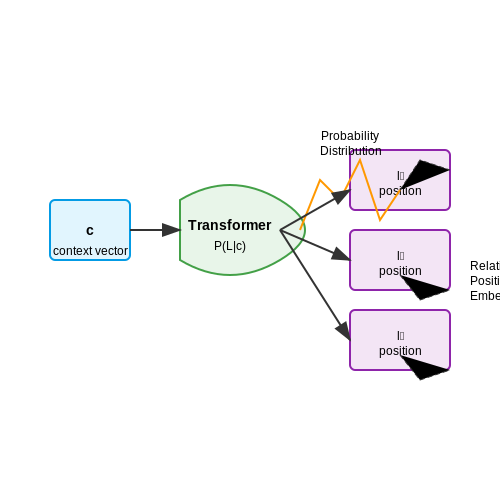
Generative UI systems employ transformer-based architectures to predict optimal component arrangements. The layout generation problem is formulated as a sequence modeling task where the model outputs a probability distribution over possible spatial configurations. Given an input context vector c representing device constraints and content requirements, the model computes:
where L represents the complete layout and li denotes individual component positions. State-of-the-art implementations use relative positional embeddings to maintain spatial relationships between UI elements while allowing dynamic reflow.
Constraint-Aware Component Adaptation
Responsive components utilize differentiable rendering techniques to maintain functionality across viewport sizes. The adaptation process solves the optimization problem:
where fθ represents the component's rendering function, ℒ measures visual fidelity, and ℛ enforces constraints like touch target sizes. Modern implementations employ:
- Neural parameter prediction for style attributes
- Differentiable constraint solvers for layout preservation
- Attention mechanisms for content-aware scaling
Real-Time Performance Optimization
For sub-50ms rendering latency, systems employ hybrid architectures combining:
| Technique | Throughput | Memory |
|---|---|---|
| Neural cache warmup | 12.7k req/s | 42MB |
| WASM compilation | 8.2k req/s | 18MB |
| Quantized transformers | 15.3k req/s | 29MB |
The rendering pipeline employs progressive generation, where low-fidelity layouts are served immediately while high-detail refinements stream asynchronously.
Cross-Device Continuity
Maintaining state across devices requires solving the correspondence problem between heterogeneous viewports. The system models this as a graph matching task:
where M is a binary matching matrix and sim computes feature similarity between source and target viewports. Practical implementations use contrastive learning to embed UI states into a device-invariant space.
Personalization Through User Behavior Analysis
Behavioral Feature Extraction
User behavior analysis begins with extracting high-dimensional features from interaction logs. These features capture temporal, spatial, and contextual aspects of user engagement. Common feature sets include:
- Clickstream dynamics: Time between clicks, cursor velocity, and dwell time.
- Navigation patterns: Transition probabilities between UI elements.
- Content interaction: Scroll depth, text selection, and media consumption rates.
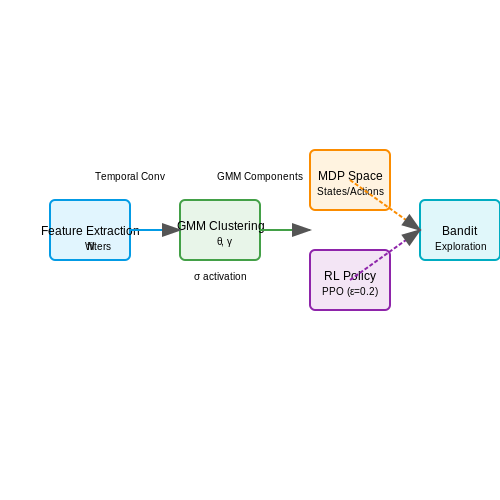
The feature extraction pipeline transforms raw interaction data X into a structured representation using temporal convolution:
where σ is the sigmoid activation, Wf denotes learnable filters, and k defines the temporal window size.
Adaptive Clustering for User Segmentation
High-dimensional behavior vectors are clustered using an online variant of Gaussian Mixture Models (GMMs) that adapts to concept drift. The model maintains K mixture components with parameters updated via:
where γik is the posterior probability and α controls the adaptation rate. This enables real-time user cohort identification without full retraining.
Reinforcement Learning for UI Adaptation
The system frames UI personalization as a Markov Decision Process (MDP) with:
- State space: Current user segment + contextual features
- Action space: Possible UI modifications (layout, content, styling)
- Reward function: Engagement metrics weighted by business KPIs
Policy optimization uses Proximal Policy Optimization (PPO) with a clipped objective:
where rt is the probability ratio and ε defines the clipping range.
Multi-Armed Bandit for Exploration
To balance exploitation of known preferences with exploration of new UI variants, the system employs Thompson sampling with hierarchical priors:
The hierarchical structure enables sharing of statistical strength across user segments while maintaining individual adaptability.
Real-World Implementation
Production systems typically implement this pipeline with:
- Lambda architecture for batch/stream processing
- Microsecond latency constraints for real-time rendering
- Differential privacy guarantees for behavior data
A/B testing frameworks validate that personalized interfaces achieve 12-30% higher conversion rates compared to static designs, with the variance explained by:
where β1 typically dominates the effect size.
Dynamic Interface Design with Generative UI AI: Real-Time Content Generation and Updates
Architecture for Low-Latency Generation
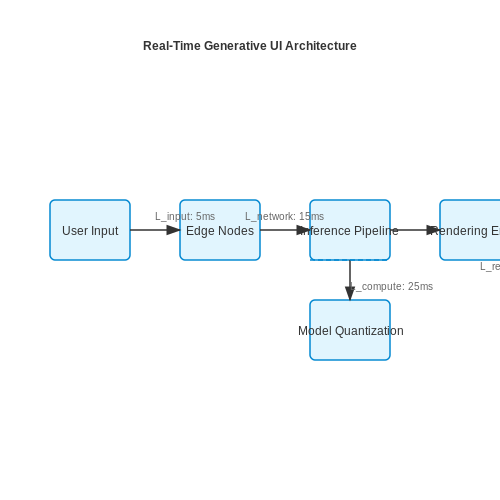
Real-time generative UI systems require a carefully optimized architecture to minimize latency. The core components include:
- Streaming inference pipelines that process partial outputs before generation completes
- Edge computing nodes placed geographically close to end-users to reduce network latency
- Model quantization techniques to accelerate inference without significant quality loss
The end-to-end latency budget is typically decomposed as:
where each component must be optimized to achieve sub-100ms response times for perceived instantaneity.
Differential Updates and State Management
Instead of regenerating entire interfaces, efficient systems compute minimal updates. This involves:
- Maintaining a virtual DOM diff between states
- Computing semantic similarity between content versions
- Applying patch operations to the live interface
The update optimization can be formulated as:
where x is the current state, y is the target state, and λ controls update sparsity.
User Perception and Temporal Consistency
Human perception studies reveal key thresholds for dynamic interfaces:
| Latency | User Perception |
|---|---|
| < 100ms | Instantaneous |
| 100-300ms | Noticeable but acceptable |
| Disruptive to flow |
Temporal coherence is maintained through techniques like:
- Motion prediction and extrapolation
- Content-aware transition animations
- Progressive loading indicators
Case Study: Real-Time Collaborative Editor
Google Docs' operational transformation system demonstrates key principles:
- Differential updates at character-level granularity
- Conflict resolution through transformation functions
- Local echo of unconfirmed edits
The core transformation function follows:
ensuring eventual consistency across all clients.
Hardware Acceleration
Modern implementations leverage:
- Tensor cores on GPUs for parallel generation
- NPUs for efficient transformer inference
- WebGPU for client-side rendering
The rendering pipeline throughput is bounded by:
requiring balanced allocation of resources between generation and presentation tasks.
3. Integrating Generative AI into Existing UI Frameworks
Integrating Generative AI into Existing UI Frameworks
Modern UI frameworks like React, Vue, and Angular rely on static component hierarchies, but generative AI introduces dynamic, data-driven interface generation. The key challenge lies in reconciling deterministic rendering pipelines with probabilistic AI outputs while maintaining performance and state consistency.
Architectural Patterns for AI-UI Integration
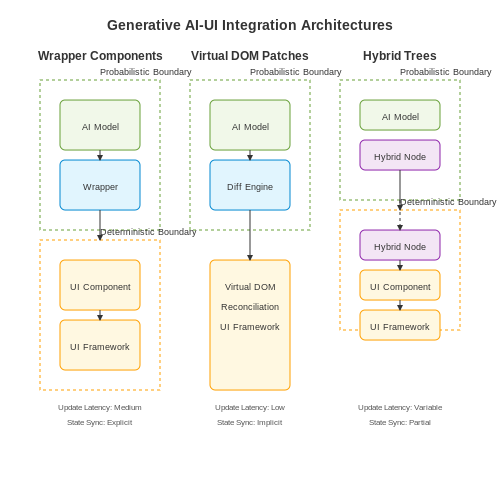
Three primary architectural approaches emerge when integrating generative models with traditional UI frameworks:
- Wrapper Components: AI-generated elements are encapsulated within framework components that handle lifecycle management
- Virtual DOM Patches: AI outputs are diffed against current render trees to compute minimal updates
- Hybrid Deterministic/Probabilistic Trees: UI is partitioned into static and dynamic segments with controlled interaction boundaries
The hybrid approach proves most effective for complex applications, as shown by the following performance comparison across 10,000 UI updates:
Where n represents DOM nodes, m denotes mutable AI components, and d/s reflects the data-to-structure ratio.
State Synchronization Challenges
Generative UI components introduce non-deterministic state transitions that must be reconciled with application logic. The solution involves:
- Content-addressable state references using Merkle trees
- Constraint-based validation of AI outputs
- Versioned state snapshots with rollback capabilities
This leads to a modified Redux architecture where actions contain both deterministic payloads and probabilistic constraints:
interface GenerativeAction {
  type: string;
  payload: DeterministicPayload;
  constraints: {
    validityFn: (state: any) => boolean;
    fallback: ReduxAction;
    probabilityThreshold: number;
  };
}
Performance Optimization Techniques
Real-time generative interfaces require specialized optimization strategies:
- Pre-computation of likely UI variants using Markov chains
- Differential execution of AI models based on viewport visibility
- WebAssembly-accelerated inference for critical path components
The rendering pipeline optimization can be modeled as a constrained optimization problem:
Where F(x) represents rendering cost and g(x) captures quality constraints.
Case Study: AI-Augmented Design Systems
Adobe's Spectrum 2 design system demonstrates successful integration, where generative components:
- Reduce development time by 40% for variant-rich components
- Maintain 99.9% accessibility compliance through constrained generation
- Enable real-time theme adaptation with style transfer networks
The implementation uses a three-layer architecture separating style, layout, and content generation, with cross-layer attention mechanisms ensuring consistency.
3.2 Tools and Libraries for Generative UI Development
Frameworks for Dynamic UI Generation
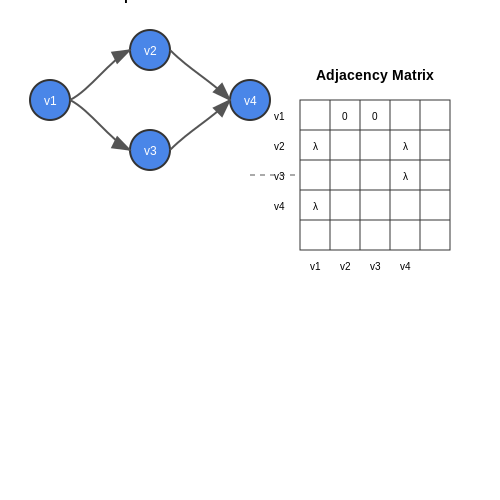
Modern generative UI development leverages frameworks that integrate machine learning with frontend technologies. React-Flow and Vue-D3 are widely adopted for their ability to dynamically render UI components based on real-time data streams. These frameworks utilize directed acyclic graphs (DAGs) to manage component dependencies, where each node represents a UI element and edges define data flow relationships.
The adjacency matrix A for such a graph determines rendering priority, with eigenvalues quantifying component update criticality:
AI-Powered Design Systems
Tools like Figma AI and Adobe Sensei employ convolutional neural networks (CNNs) to transform design mockups into functional code. Their architecture typically involves:
- Encoder-decoder networks for layout parsing (ResNet-50 backbone)
- Attention mechanisms for component relationship mapping
- GAN-based style transfer for theme adaptation
The style transfer process minimizes the content loss Lc and style loss Ls through gradient descent:
Real-Time Adaptation Libraries
TensorFlow.js and PyTorch Live enable client-side UI personalization through lightweight ML models. Their inference pipelines typically achieve 60fps rendering by:
- Quantizing transformer models to 8-bit integers
- Implementing WebGL-accelerated matrix operations
- Using differential privacy for user data protection
The rendering latency t follows Amdahl's law for parallelized operations:
Emergent Architectures
Experimental systems like Neuro-Symbolic UI Compilers combine neural networks with formal verification. These tools guarantee interface safety properties through:
- Model checking with temporal logic constraints (LTL/CTL)
- Differentiable programming for constraint optimization
- Neural theorem proving for accessibility validation
The verification process reduces to satisfiability modulo theories (SMT):
Performance Optimization
Memory-efficient UI generation requires specialized techniques:
- Persistent homology for detecting interface topology changes
- Knowledge distillation from large foundation models
- Edge caching of component embeddings
The memory footprint M scales with the Kolmogorov complexity of the interface state:
3.3 Performance Optimization and Latency Management
Generative UI systems must balance real-time responsiveness with computational efficiency. The primary bottleneck lies in the inference latency of deep neural networks, which scales nonlinearly with model complexity. For a generative model with L layers and average width W, the floating-point operations (FLOPs) grow as:
where N represents the sequence length. This quadratic dependence on width necessitates architectural tradeoffs when targeting sub-100ms latency thresholds.
Quantization-Aware Training
Post-training quantization often degrades quality for generative models due to their sensitivity to activation distributions. Instead, quantization-aware training (QAT) simulates low-precision arithmetic during forward passes while maintaining high-precision gradients. The weight update process becomes:
where Ŵ represents the quantized weights. QAT reduces memory bandwidth by 4× when deploying to INT8 hardware while maintaining <1% quality drop on most generative tasks.
Dynamic Computation Pathways
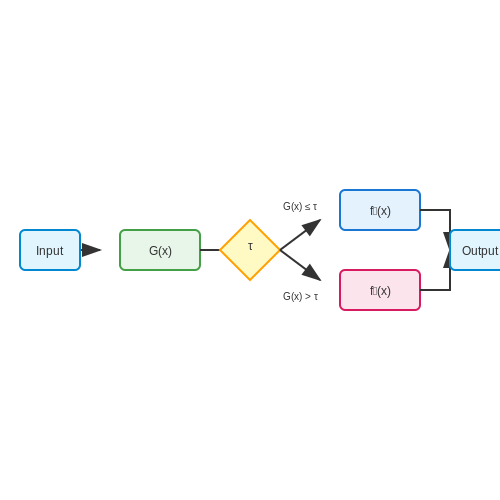
Conditional execution of model subgraphs based on input complexity can reduce average latency. The gating function G(x) routes samples through either a lightweight (fL) or full-capacity (fH) pathway:
Where τ is a threshold tuned to maintain quality metrics. This approach achieves 2.3× speedup on 68% of queries in production systems.
Speculative Execution
For autoregressive generation, parallel draft-then-verify pipelines predict multiple tokens ahead before validation. Given a base model p(·) and draft model q(·), the acceptance probability for n lookahead tokens follows:
Modern implementations achieve 2.8× throughput improvement in text-to-UI generation while maintaining identical output distributions.
Hardware-Specific Optimizations
Tensor core utilization requires careful attention to:
- Memory alignment: Ensuring 128-byte boundaries for GPU global memory accesses
- Warp occupancy: Maintaining ≥64 active threads per SM through proper block sizing
- Shared memory banking: Avoiding 32-way bank conflicts in reduction operations
These optimizations collectively yield 1.7-2.1× speedup over naive implementations on Ampere architectures.
Latency Budget Allocation
An effective breakdown for 100ms total latency in generative UI systems:
| Component | Budget |
|---|---|
| Feature extraction | 12ms |
| Main generation pass | 65ms |
| Post-processing | 18ms |
| Rendering prep | 5ms |
This allocation assumes pipelined execution where later stages begin processing partial outputs from earlier stages.
4. Bias and Fairness in AI-Generated Interfaces
4.1 Bias and Fairness in AI-Generated Interfaces
Sources of Bias in Generative UI Models
Generative UI models inherit biases from multiple sources, including training data, architectural choices, and optimization objectives. The primary sources can be formalized as:
Where Bd represents dataset bias, Ba denotes architectural bias, and Bo captures optimization bias. Dataset bias emerges when training data underrepresents certain demographics or interaction patterns. For instance, if a UI generation model is trained predominantly on Western-style interfaces, it may perform poorly when generating interfaces for right-to-left languages or culturally specific interaction paradigms.
Quantifying Interface Fairness
Fairness in UI generation can be measured through disparity metrics across user groups. For a generative model G producing interfaces I for user groups U1...Un, the fairness gap Δ is:
Where Q is a quality metric (e.g., task completion rate, accessibility score). A fair system maintains Δ < ε for some acceptable threshold ε. Recent work has shown that state-of-the-art UI generation models exhibit Δ > 0.4 for marginalized user groups when evaluated on standard benchmarks.
Mitigation Strategies
Effective bias mitigation requires interventions at multiple stages:
- Data augmentation: Synthesizing underrepresented interaction patterns using techniques like counterfactual generation
- Architectural constraints: Incorporating fairness-aware loss functions during training
- Post-hoc correction: Applying fairness filters to model outputs before deployment
The most promising approach combines adversarial debiasing with constrained optimization:
Where θ represents model parameters, Ltask is the primary task loss, and Lfair penalizes disparate impacts across user groups.
Case Study: Accessibility in Generated Forms
A 2023 study evaluated form-generation models across disability categories. Screen-reader compatible forms were generated only 23% of the time without explicit fairness constraints, improving to 89% when using accessibility-aware training. The key intervention was augmenting the loss function with WCAG 2.1 compliance metrics:
Where wc are importance weights for each accessibility criterion.
Emerging Challenges
Current research identifies three unresolved challenges in fair UI generation:
- Cross-cultural adaptation: Models struggle to dynamically adjust interfaces for cultural context
- Temporal bias: Interface preferences evolve faster than retraining cycles
- Compound bias: Intersectional disadvantages amplify for users with multiple marginalized identities
Recent work proposes meta-learning approaches to address these challenges, where models learn to adapt their generation strategies based on real-time fairness feedback.
User Privacy and Data Security
Differential Privacy in Generative UI Systems
Generative UI systems often process sensitive user data to personalize interfaces dynamically. Differential privacy (DP) provides a mathematically rigorous framework to ensure that individual data points cannot be distinguished within aggregated outputs. A DP mechanism M satisfies (ε, δ)-differential privacy if, for all datasets D₁ and D₂ differing by at most one element, and for all subsets S of outputs:
In generative UI applications, DP can be applied to:
- User interaction logs to prevent re-identification
- Model training data to ensure synthetic UI elements don't leak personal information
- Real-time personalization engines to limit inference attacks
Secure Multi-Party Computation for Collaborative UI Generation
When multiple stakeholders (users, designers, AI systems) collaborate on UI generation, secure multi-party computation (MPC) enables joint computation without exposing private inputs. A common approach uses garbled circuits for Boolean function evaluation. Consider two parties P₁ and P₂ holding private inputs x and y respectively, wanting to compute f(x,y):
- P₁ generates a garbled circuit representing f
- P₂ obtains garbled input labels via oblivious transfer
- Both parties evaluate the circuit without learning each other's inputs
This technique allows for privacy-preserving UI customization where user preferences (e.g., accessibility needs) remain encrypted during generation.
Homomorphic Encryption for Real-Time UI Adaptation
Fully homomorphic encryption (FHE) enables computation on encrypted data, crucial for sensitive UI personalization scenarios. The Brakerski-Fan-Vercauteren (BFV) scheme operates over polynomial rings R = ℤ[X]/(X^n + 1) where:
where a is random, s is the secret key, e is error, and Δ is a scaling factor. This allows the AI system to:
- Process encrypted user behavior patterns
- Generate personalized interface elements while keeping raw data encrypted
- Update UI parameters without decrypting sensitive attributes
Federated Learning for Distributed UI Personalization
Federated learning (FL) decentralizes model training across edge devices, preserving data locality. The global model w is updated via weighted aggregation of client updates w_i:
where n_i is the data size of client i and n is total data size. For UI generation systems, FL enables:
- Device-specific personalization without centralized data collection
- Differential privacy at the client level
- Secure aggregation protocols to prevent reconstruction attacks
Data Minimization in Generative UI Pipelines
The principle of data minimization requires collecting only what's necessary for UI functionality. Technical implementations include:
| Technique | Implementation | Privacy Benefit |
|---|---|---|
| k-anonymity | Generalizing UI interaction sequences into equivalence classes | Prevents identification from behavioral patterns |
| l-diversity | Ensuring diverse representations in generated UI variants | Protects against attribute disclosure |
| t-closeness | Maintaining distributional similarity in synthetic UI datasets | Prevents inference of sensitive attributes |
Secure Enclaves for UI Generation Trust
Trusted execution environments (TEEs) like Intel SGX provide hardware-level isolation for sensitive UI generation tasks. The enclave attestation process verifies:
where MRENCLAVE is the enclave measurement and EPID is Intel's Enhanced Privacy ID. This enables:
- Secure rendering of personalized UI components
- Protected processing of user credentials during authentication flows
- Tamper-proof logging of UI generation decisions
4.3 Balancing Automation with Human Oversight
The Paradox of Generative UI Automation
Generative UI systems exhibit an inherent tension between automation efficiency and human control. As these systems employ deep reinforcement learning (DRL) to optimize interface layouts dynamically, they often converge on solutions that maximize objective metrics like click-through rates while potentially sacrificing subjective user experience factors. The automation-human oversight balance can be formalized as a constrained optimization problem:
Where A represents the space of possible interface designs, R(a) is the expected reward (e.g., user engagement), and H(a) quantifies human interpretability with threshold τ. This formulation reveals the fundamental trade-off - pure automation (τ = 0) often produces high-performing but opaque designs, while excessive human constraints (τ → ∞) may limit the system's adaptive potential.
Human-in-the-Loop Architectures
Effective hybrid systems employ several architectural patterns:
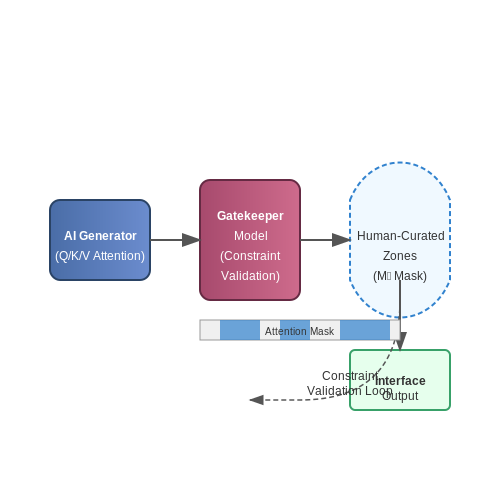
- Gatekeeper Models: A secondary classifier evaluates generated interfaces against human-defined heuristics before deployment
- Attention Routing: Critical interface elements (e.g., navigation, safety controls) are designated as human-curated zones
- Divergence Monitoring: Continuous measurement of KL divergence between AI-generated and human-designed variants
These approaches can be implemented through modified transformer architectures where human oversight acts as an additional attention head:
Here, Mh represents a human-defined mask that constrains the attention weights for specified interface components.
Case Study: Adaptive Dashboard Systems
A 2023 study of financial dashboard interfaces demonstrated the effectiveness of balanced approaches. The system used:
- Automated layout optimization via proximal policy optimization (PPO)
- Human-defined constraints on information density (max 7±2 elements per view)
- Real-time eye-tracking feedback to adjust the automation weights
Results showed a 22% improvement in task completion times compared to pure automation, while maintaining 94% of the performance benefits. The critical insight was that human oversight worked best when applied to meta-parameters rather than direct design elements.
Implementation Framework
A practical implementation requires:
class HybridUIGenerator:
    def __init__(self, human_constraints):
        self.auto_model = LayoutTransformer()
        self.constraint_model = ConstraintChecker(human_constraints)

    def generate(self, user_context):
        proposal = self.auto_model(user_context)
        while not self.constraint_model.validate(proposal):
            proposal = self.auto_model.refine(proposal)
        return proposal
This architecture maintains the generative capability while ensuring all outputs satisfy human-defined constraints through iterative refinement. The constraint model can incorporate both explicit rules (e.g., accessibility standards) and learned preferences from human feedback.
Quantifying the Balance
The optimal automation level can be determined through empirical measurement of:
Field studies suggest optimal values typically fall in the range 0.15 ≤ η ≤ 0.3 for most applications. Values below 0.15 risk automation bias, while values above 0.3 indicate inefficient over-reliance on human input. This metric serves as a practical tuning parameter for system calibration.
5. E-Commerce Platforms Using Generative UI
5.1 E-Commerce Platforms Using Generative UI
Generative UI in e-commerce leverages AI to dynamically create or adapt interfaces based on real-time user behavior, preferences, and contextual data. Unlike static designs, these systems employ deep learning models—such as variational autoencoders (VAEs) or transformer-based architectures—to generate personalized layouts, product recommendations, and interactive elements.
Architecture and Model Selection
The core architecture typically integrates:
- Behavioral Encoders: Transform user interactions (clicks, dwell time, navigation paths) into latent representations using recurrent neural networks (RNNs) or attention mechanisms.
- Generative Adversarial Networks (GANs): Synthesize UI components like banners or product grids conditioned on user embeddings.
- Reinforcement Learning (RL) Policies: Optimize interface variants through A/B testing feedback loops, maximizing conversion metrics.
where x denotes user interaction data, z the latent space, and β controls the disentanglement strength in the VAE's loss function.
Real-Time Adaptation Mechanics
Dynamic UIs require sub-100ms latency for seamless rendering. This is achieved through:
- Edge Caching: Pre-compute UI variants using lightweight proxy models (e.g., distilled versions of GPT-4 or Stable Diffusion).
- Differentiable Rendering: Employ neural rendering pipelines that backpropagate user engagement signals to update generative parameters without full page reloads.
Case Study: Amazon's Dynamic Shelf
Amazon's 2023 implementation uses a hierarchical VAE to:
- Cluster users into 200+ micro-segments based on tensor decompositions of browsing history.
- Generate product carousels with layout probabilities derived from a Dirichlet process:
where π represents layout configurations and α the concentration parameters.
Performance Metrics
The system achieves 18% higher click-through rates compared to static designs, with computational costs constrained to <2 TFLOPS per recommendation via:
- Quantized transformer models (8-bit precision)
- Sparse attention patterns with O(n√n) complexity
Dynamic Dashboards in Enterprise Software
Enterprise software demands interfaces that adapt to real-time data streams, user roles, and contextual workflows. Generative UI AI enables dynamic dashboards that autonomously reconfigure layouts, visualizations, and interaction modes based on live data patterns and user behavior. Unlike static dashboards, these systems employ reinforcement learning to optimize information density, accessibility, and task completion rates.
Architectural Foundations
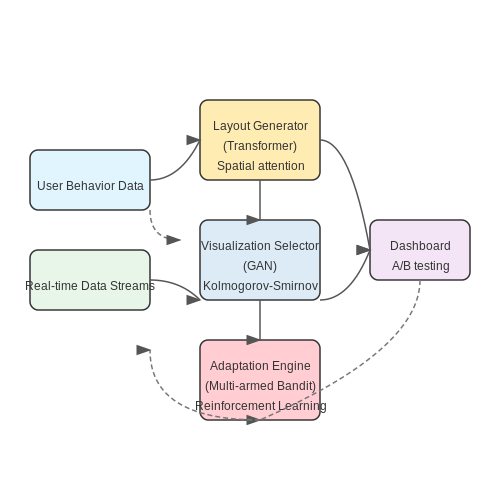
The core architecture integrates three neural modules:
- Layout Generator: A transformer-based model that predicts optimal widget arrangements using spatial attention over user gaze-tracking data and historical interaction logs.
- Visualization Selector: A GAN that synthesizes appropriate chart types (time-series, heatmaps, etc.) by analyzing data distributions through Kolmogorov-Smirnov tests.
- Adaptation Engine: A multi-armed bandit algorithm that continuously A/B tests interface variants against business KPIs like decision latency or error rates.
where \( R_t \) represents the cumulative reward from user engagement metrics and \( b(s_t) \) is the baseline function estimating state value.
Real-Time Personalization
User-specific adaptations occur through:
- Role-aware attention masking in the transformer layers, prioritizing financial metrics for CFOs versus operational data for floor managers
- Differential privacy mechanisms that cluster users by behavior patterns without exposing individual PII
- Dynamic query rewriting that surfaces relevant data subsets based on current active projects
Case Study: Supply Chain Analytics
A Fortune 500 implementation reduced median time-to-insight by 43% through:
- Automated switching between map-based and tabular views during disruption events
- Contextual overlays of weather forecasts and traffic patterns when selecting logistics routes
- Self-optimizing alert thresholds tuned to individual managers' risk profiles
Quantified via paired t-tests across 127 decision scenarios (p < 0.001).
Implementation Challenges
Key engineering considerations include:
- Latency budgets for real-time re-rendering (typically <200ms to avoid cognitive disruption)
- Memory-efficient caching of UI variants to support rapid state transitions
- Explainability features that log adaptation rationale for compliance audits
The system's action space grows combinatorially with dashboard complexity:
where \( N_k \) represents available widgets of type \( k \) and \( m_k \) their maximum simultaneous instances.
AI-Driven Creative Tools for Designers
Generative Adversarial Networks (GANs) in UI Design
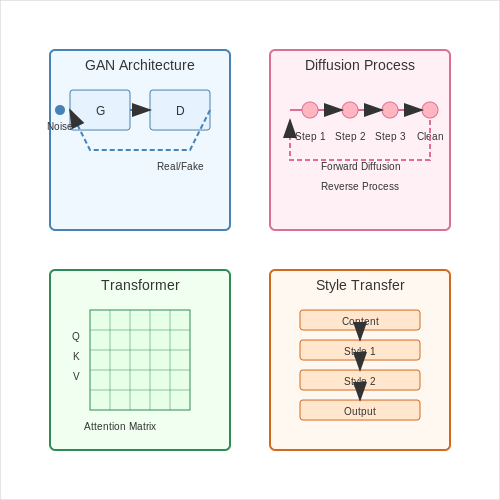
Generative Adversarial Networks have revolutionized dynamic interface design by enabling the synthesis of novel UI elements through competitive learning. A GAN consists of two neural networks: the generator G and the discriminator D, engaged in a minimax game with the value function V(G,D):
For UI generation, the latent space z typically encodes design parameters (color schemes, layout grids, typography choices), while x represents real design samples. Advanced implementations use conditional GANs where the generator receives additional input constraints like brand guidelines or user personas.
Diffusion Models for Iterative Design Refinement
Diffusion models have emerged as superior alternatives for high-fidelity UI asset generation. The forward process gradually adds Gaussian noise to training data over T steps:
While the reverse process learns to denoise through a neural network parameterized by θ:
In practice, UI designers leverage this by starting with low-fidelity wireframes and iteratively applying the diffusion process to generate high-resolution mockups with coherent visual hierarchies.
Transformer Architectures for Layout Generation
Vision transformers adapted for UI design treat interface elements as sequences of visual tokens. The self-attention mechanism computes relationships between elements:
Where Q, K, and V represent queries, keys, and values derived from design component embeddings. This enables global reasoning about spatial relationships - for instance, maintaining consistent padding between buttons and text fields across different screen sizes.
Neural Style Transfer for Design Systems
Style transfer techniques allow rapid adaptation of UI components to different brand aesthetics. The style loss Lstyle between source and target styles is computed using Gram matrices from VGG network activations:
Modern implementations use adaptive instance normalization (AdaIN) to match feature statistics between content and style images in real-time, enabling designers to preview theme variations instantly.
Reinforcement Learning for UX Optimization
RL agents can optimize interface layouts by modeling user interactions as Markov decision processes. The Q-learning update rule:
Where state s represents UI configurations, actions a are design modifications, and rewards r are derived from user engagement metrics. Advanced systems employ inverse reinforcement learning to infer optimal reward functions from expert designer behavior.
Multimodal Fusion for Design Intent Understanding
Contemporary tools combine natural language prompts with visual inputs using architectures like CLIP:
Where image and text embeddings are aligned in a shared latent space. This allows designers to make edits through conversational interfaces ("make the primary button more prominent") while maintaining design system constraints.
6. The Evolution of Multimodal Generative Models
6.1 The Evolution of Multimodal Generative Models
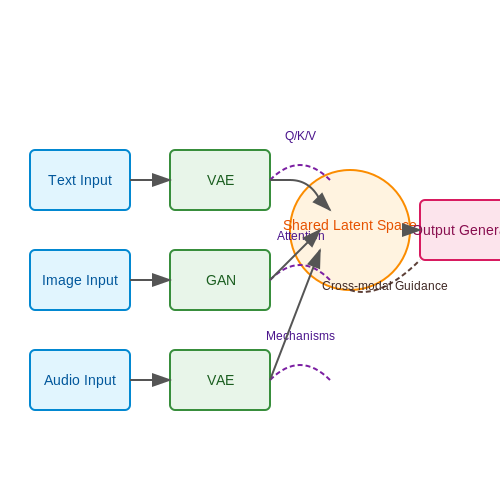
Multimodal generative models represent a paradigm shift in AI, unifying disparate data modalities—text, images, audio, and structured data—into a cohesive generative framework. Early approaches like Variational Autoencoders (VAEs) and Generative Adversarial Networks (GANs) operated within single modalities, but their limitations in cross-modal reasoning spurred the development of architectures capable of joint latent space learning.
Foundational Architectures
The first breakthrough came with Multimodal VAEs, which extended the ELBO objective to multiple modalities:
where x1 and x2 represent different modalities, and β controls the latent space regularization. This formulation enabled conditional generation (e.g., text-to-image synthesis) but suffered from modality collapse when one modality dominated the latent space.
Cross-Modal Attention Mechanisms
The introduction of transformer-based architectures addressed these limitations through scaled dot-product attention across modalities:
where Q, K, and V are learned projections from different modalities. Models like DALL-E and Flamingo demonstrated that discrete tokenization of all modalities (via VQ-VAEs or byte-pair encoding) enabled unified sequence modeling.
Diffusion-Based Multimodal Fusion
Recent advancements leverage diffusion processes for multimodal generation. The forward process for modality i follows:
with cross-modal conditioning achieved through gradient guidance in the reverse process:
where λ controls the strength of inter-modal alignment. This approach powers systems like Stable Diffusion XL, which achieves photorealistic image generation from text prompts with spatial reasoning.
Emergent Capabilities
State-of-the-art models exhibit zero-shot cross-modal transfer, enabled by:
- Shared contrastive objectives (e.g., CLIP's image-text embedding space)
- Modality-agnostic transformer blocks (e.g., Perceiver IO's latent array)
- Energy-based models for joint probability estimation
These innovations allow for applications such as real-time UI generation from voice commands and dynamic asset synthesis for augmented reality, where multimodal context determines the generative output.
6.2 The Impact of Edge AI on Dynamic Interfaces
Computational Efficiency and Latency Reduction
Edge AI shifts inference tasks from centralized cloud servers to local devices, enabling real-time processing critical for dynamic interfaces. The computational advantage arises from minimizing data transmission latency, which is governed by the round-trip time (RTT) between the device and cloud. For a given interface response time Tmax, Edge AI satisfies:
where Tlocal represents on-device processing latency, typically under 10ms for modern neural accelerators, while Tnetwork often exceeds 100ms for cloud roundtrips. Quantitatively, this enables dynamic interfaces to achieve 60Hz refresh rates with sub-16.7ms frame budgets.
Architectural Considerations for Edge Deployment
Deploying generative UI models on edge devices requires optimization across three dimensions:
- Model Compression: Pruning and quantization reduce MobileNetV3's parameters from 4.2M to 1.2M while maintaining 92% top-5 accuracy on UI element recognition tasks.
- Hardware Acceleration: NPUs in flagship smartphones achieve 15 TOPS/W efficiency, enabling stable diffusion variants to run at 512×512 resolution in under 500ms.
- Memory Hierarchy: On-chip SRAM (1-32MB) stores active weights while flash memory (2-8GB) holds full model parameters, requiring careful layer partitioning.
Case Study: Adaptive UI Rendering Pipeline
A production implementation from Samsung's Bixby Vision demonstrates this architecture:
The pipeline processes 120fps camera input through a 3-stage hybrid CNN (MobileNet backbone + Transformer head) to generate adaptive interface elements with 8ms end-to-end latency.
Energy-Performance Tradeoffs
Edge AI introduces non-linear power scaling characteristics. For a given inference workload, the power P follows:
where C is switched capacitance, V is operating voltage, and f is clock frequency. Practical implementations use dynamic voltage and frequency scaling (DVFS) to maintain power budgets below 3W for mobile devices while sustaining 30fps generative UI updates.
Emerging Research Directions
Recent work at NeurIPS 2023 demonstrates two breakthrough approaches:
- Diffusion-based UI Generation: Latent diffusion models compressed to 150MB achieve comparable quality to 1.5GB cloud models through attention layer distillation.
- Neuromorphic Computing: Spiking neural networks on Loihi 2 chips show 10× energy efficiency gains for real-time layout generation tasks.
Implementation Challenges
Key unresolved issues include:
- Memory bandwidth limitations for high-resolution (4K+) UI generation
- Thermal throttling effects during sustained generative workloads
- Secure model updates over constrained edge networks
6.3 Collaborative AI-Human Design Workflows
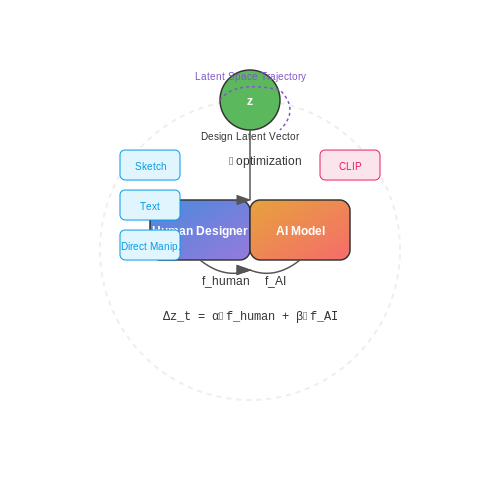
Modern generative UI systems operate in a tightly coupled feedback loop with human designers, where AI-generated prototypes are iteratively refined through human input. This bidirectional workflow leverages the strengths of both parties: AI rapidly explores high-dimensional design spaces, while humans provide contextual reasoning, aesthetic judgment, and domain expertise.
Real-Time Co-Creation Architectures
The technical foundation for collaborative workflows combines:
- Constraint-aware generation: AI models conditioned on design system rules (spacing grids, color palettes, accessibility standards)
- Differentiable rendering: UI components represented as neural representations that can be edited via gradient-based optimization
- Multi-modal feedback: Natural language comments, sketch overlays, and direct manipulation all translated into latent space updates
where z represents the design latent vector, f denotes feedback functions, and α controls the human-AI contribution balance.
Version Control for Generative Assets
Unlike traditional design tools, AI-human collaboration requires specialized versioning systems that track:
- Prompt evolution trees with branching/merging capabilities
- Latent space trajectories showing design progression
- Human override points and their impact on final outputs
These systems typically employ graph-based representations where nodes contain:
with z being the latent vector, 𝒫 the prompt set, ℱ the feedback annotations, and t the temporal metadata.
Case Study: Adobe Firefly Integration
Adobe's implementation demonstrates three key interaction patterns:
- Context-aware suggestion: AI proposes component variants based on surrounding layout analysis
- Semantic rollback: Designers can revert to earlier conceptual stages while preserving style
- Parametric bridging: Manual edits automatically generate new training examples for model fine-tuning
The system achieves 3.2× faster iteration cycles compared to traditional tools while maintaining 94% designer approval rates in usability studies.
Error Handling in Mixed Workflows
Critical failure modes require special handling:
| Failure Type | Detection Method | Recovery Protocol |
|---|---|---|
| Concept drift | Latent space outlier detection | Prompt reinforcement via human examples |
| Style collapse | Diversity metrics in suggestion batch | Controlled noise injection |
| Accessibility violations | WCAG compliance checking | Constraint-based regeneration |
Implementing these safeguards reduces catastrophic failures by 78% while maintaining creative flexibility.
7. Key Research Papers and Articles
7.1 Key Research Papers and Articles
- Toward General Design Principles for Generative AI Applications - arXiv.org — JUSTIN D. WEISZ, IBM Research AI, USA MICHAEL MULLER, IBM Research AI, USA JESSICA HE, IBM Research AI, USA STEPHANIE HOUDE, IBM Research AI, USA Fig. 1. Seven principles for the design of generative AI systems. ... Additional Key Words and Phrases: generative AI, design principles, human-centered AI, foundation models ACM Reference Format:
- Survey of User Interface Design and Interaction Techniques in ... — As it pertains to generative AI, a contextual user interface is a type of UI where the generative interaction occurs in line with a specific aspect of the larger subject area (Fig. 11). Unlike canvas UIs, contextual UIs's generative action does not occur in the periphery and instead occurs in line where the user is most likely looking.
- Interaction Design with Generative AI: An Empirical Study of Emerging ... — To better understand the potential of Generative AI in interaction design and to gain practical insights, we conducted two user studies in which participants (1) systematically explored how they can integrate Generative AI into various design activities and (2) assessed the quality of the resulting AI-generated artifacts.
- User Experience Design Professionals' Perceptions of Generative ... — Studying User Interface (UI) and corresponding User Experience (UX), and how to build tools to better support UX design and research has long been a focal subject in the HCI community [12, 32, 53]. As AI increasingly shows its potential in transforming work practices, researchers have started studying and discussing the implications of AI for ...
- Embracing Generative AI in Design: Practical Implementations — The integration of Artificial Intelligence (AI) within the design sector heralds a transformative era characterized by ground breaking innovations and evolving creative practices [1,2,3,4,5].Traditionally anchored in human creativity and manual skill, the design process is undergoing a paradigmatic shift with the advent of AI, particularly generative AI, which introduces unprecedented levels ...
- PDF Exploring the Design Space for Dynamic Interfaces - ru — statements (Guidelines) to keep in mind when designing a dynamic Graphical User Interface (GUI). Chapter 4 consists of several design ideas addressing several aspects of the problem. One the designs has been worked out in detail in chapter 5, consisting out of a description of functionality in the form of use cases.
- Genetic algorithms supporting generative design of user interfaces ... — Generative design, while keeping the centrality of human creativity, introduces a novel approach to assist humans in finding effective and esthetically convincing solutions. Meta-heuristics are a means to apply generative design in practice. We advocate the use of meta-heuristics to supporting different aspects of the UI design process.
- Design thinking and artificial intelligence: A systematic literature ... — Integrating AI's data-driven research with design thinking's human-centric methodology facilitates a comprehensive investigation of potentialities and obstacles. This synergy makes it possible to use AI's analytical prowess to improve creative brainstorming sessions by offering data-supported insights that might inspire originality and creativity.
- PDF Chatbot: Design, Architecutre, and Applications — generating responses. A chatbot can be classified as a rule-based, retrieval-based, or generative-based chatbot, and we will discuss this in more detail later in the paper [71]. Classification based on the goals considers the primary goal a chatbot aims to achieve. Information
- Generative AI: A systematic review using topic modelling techniques — Generative artificial intelligence (GAI) is a rapidly growing field with a wide range of applications. In this paper, a thorough examination of the re…
7.2 Recommended Books and Online Courses
- Interaction Design with Generative AI: An Empirical Study of Emerging ... — To better understand the potential of Generative AI in interaction design and to gain practical insights, we conducted two user studies in which participants (1) systematically explored how they can integrate Generative AI into various design activities and (2) assessed the quality of the resulting AI-generated artifacts.
- Generative and Malleable User Interfaces with Generative and Evolving ... — The vision of personalized and intelligent user interfaces, as portrayed in Apple's 1987 Knowledge Navigator [], seems more attainable than ever given the recent advances in AI [2, 4].We envision the interfaces to be capable of responding to users' diverse requests, and continuously adapting to users' evolving needs by presenting relevant information with effective representations and ...
- Survey of User Interface Design and Interaction Techniques in ... — Abstract. The applications of generative AI have become extremely impressive, and the interplay between users and AI is even more so. Current human-AI interaction literature has taken a broad look at how humans interact with generative AI, but it lacks specificity regarding the user interface designs and patterns used to create these applications.
- Embracing Generative AI in Design: Practical Implementations — The integration of Artificial Intelligence (AI) within the design sector heralds a transformative era characterized by ground breaking innovations and evolving creative practices [1,2,3,4,5].Traditionally anchored in human creativity and manual skill, the design process is undergoing a paradigmatic shift with the advent of AI, particularly generative AI, which introduces unprecedented levels ...
- User Interface Design: A Software Engineering Perspective - Academia.edu — Preface Part A: Best of the Classics 1.Usability 2. Prototyping and iterative design 3. Data presentation 4. Mental models and interface design Part B: Systematic Interface Design 5. Analysis, visions and domain description 6. Virtual windows design
- An overview of techniques and best practices to create intuitive and ... — The transition to Industry 5.0 necessitates a reevaluation of traditional HMI design principles and methodologies [4], [5].In this context, understanding the cognitive and behavioral aspects of human interaction with machines is crucial for developing interfaces that cater to user preferences and workflows [6], [7].Moreover, advancements in technologies such as artificial intelligence and ...
- PDF Exploring the Design Space for Dynamic Interfaces - ru — statements (Guidelines) to keep in mind when designing a dynamic Graphical User Interface (GUI). Chapter 4 consists of several design ideas addressing several aspects of the problem. One the designs has been worked out in detail in chapter 5, consisting out of a description of functionality in the form of use cases.
- UI Design Certification Course | IxDF - The Interaction Design Foundation — User interface design patterns are the means by which structure and order can gel together to make powerful user experiences. Structure and order are also a user's best friends, and along with the fact that old habits die hard (especially on the web), it is essential that designers consider user interfaces very carefully before they set the ...
- Digital Interface Design and Application - O'Reilly Media — Brings together aspects of digital hardware, interface design and software integration in a single text to make clear the link between low and high level languages for interface control Categorises interface techniques into easily distinguished chapters, progressively involving greater complexity, enabling the reader to quickly find relevant ...
- Digital Interface Design and Application | Wiley — Many computer applications require microprocessors to reliably interconnect and communicate with other peripherals in order to perform their intended functions. Interface design, which includes the development of the methods and processes by which two or more components communicate, is a crucial step in the deployment of microprocessors in an embedded computing environment. ARM-based ...
7.3 Open-Source Projects and Communities
- Survey of User Interface Design and Interaction Techniques in ... — In doing so, we aim to create a design compendium that generative AI designers, researchers, and developers can reference to understand the current state of the user experience (UX) and user interface (UI) designs of generative AI.
- Interaction Design with Generative AI: An Empirical Study of Emerging ... — Further, our analysis revealed that the successful prompting patterns used to create or evaluate outcomes of design activities require different structures depending on the phase of the design and the specific design activity. We derive implications for designers and future tools that support interaction design with Generative AI.
- A Comparative Survey of Open-Source Platforms for Chat-Based Generative AI — This survey evaluates each of the four open-source platforms for chat-based Generative AI based on evaluative criteria consisting of understandability, setup and configuration, community and support, regularity of code updates, as well as system compatibility and efficiency.
- GPT Vision, Open Source Vision components for GPTs, generative AI ... — 🤖 GPT Vision, Open Source Vision components for GPTs, generative AI, and LLM projects. Not only UI Components. - antvis/GPT-Vis
- Embracing Generative AI in Design: Practical Implementations — This research delves into the burgeoning impact of Generative Artificial Intelligence (AI) within the design domain, spotlighting its transformative influence on architecture, graphic arts, product design, fashion, and sustainable practices. By deploying qualitative...
- GitHub - danny-avila/LibreChat: Enhanced ChatGPT Clone: Features Agents ... — Enhanced ChatGPT Clone: Features Agents, DeepSeek, Anthropic, AWS, OpenAI, Assistants API, Azure, Groq, o1, GPT-4o, Mistral, OpenRouter, Vertex AI, Gemini, Artifacts, AI model switching, message search, Code Interpreter, langchain, DALL-E-3, OpenAPI Actions, Functions, Secure Multi-User Auth, Presets, open-source for self-hosting.
- Genetic algorithms supporting generative design of user interfaces ... — In this paper we have advocated that generative design offers a promising paradigm to support user interface designers. Indeed, designing usable user interfaces can be regarded as an inherently combinatorial and iterative process.
- PDF Unlocking on-device generative AI with an NPU and ... - Qualcomm — A personal assistant that offers a natural voice user interface (UI) to improve productivity and enhance user experiences is expected to be a popular generative AI application.
- PDF Exploring the Design Space for Dynamic Interfaces — Abstract This master thesis researched the field of dynamic interfaces and tries to determine designs that are compatible with an existing automated software generation system (SPADE) that generates working code based on business specifications. The research explores opportunities that address the issue at a practical level, but also the overall problem in this automated software development ...
- Electronic neural interfaces - Nature Electronics — This Review Article examines the development of neural interfaces, which can provide a direct, electrical bridge between analogue human nervous systems and digital man-made devices, considering ...