LLMs That Tune Their Own Hyperparameters
1. Key Hyperparameters in Large Language Models
Key Hyperparameters in Large Language Models
Learning Rate and Schedule
The learning rate (η) governs the step size during gradient descent, critically influencing convergence and model performance. For transformer-based LLMs, the learning rate typically follows a warmup schedule, scaling linearly before decaying proportionally to the inverse square root of the step number:
where t is the training step and twarmup defines the warmup duration. Empirical studies show optimal ηmax values between 1e-5 and 6e-4 for models like GPT-3, with warmup steps scaling proportionally to batch size.
Batch Size and Gradient Accumulation
Global batch sizes in modern LLMs often exceed 1M tokens, achieved through gradient accumulation across multiple forward-backward passes. The effective batch size Beff is given by:
where Blocal is the per-GPU batch size, NGPUs is the number of parallel devices, and Gaccum is gradient accumulation steps. Larger Beff improves hardware utilization but requires careful learning rate scaling—typically following η ∝ √Beff.
Attention and Feed-Forward Dimensions
The hidden dimension dmodel and feed-forward expansion ratio r define a transformer layer's capacity. For a layer with h attention heads, the per-head dimension is dk = dmodel/h, while the feed-forward layer expands to dff = r·dmodel (typically r=4). The total parameters scale as:
where L is the number of layers. Optimal dmodel balances computational cost and expressivity—common values range from 768 (BERT-base) to 12,288 (GPT-4).
Dropout and Regularization
LLMs employ dropout (pdrop) on attention weights (typically 0.1-0.2) and residual connections (0.1-0.3). The effective regularization strength depends on model depth:
Layer normalization uses learned affine parameters with initialization scale γ=1 and shift β=0. Recent variants like RMSNorm eliminate β while maintaining stability.
Optimizer Configuration
AdamW remains dominant for LLM training, with hyperparameters:
- β1: 0.9 (momentum term for first-order gradients)
- β2: 0.98-0.999 (adaptive term for second-order moments)
- ε: 1e-8 to 1e-6 (numerical stability constant)
- Weight decay: 0.01-0.1 (L2 penalty, often excluded from bias/LayerNorm terms)
The update rule for parameter θ at step t is:
where m̂t and v̂t are bias-corrected first and second moment estimates.
1.2 Traditional Hyperparameter Optimization Methods
Hyperparameter optimization (HPO) is a critical step in machine learning model development, where the goal is to find the optimal set of hyperparameters that maximize model performance. Traditional methods rely on systematic search strategies, often requiring significant computational resources and domain expertise.
Grid Search
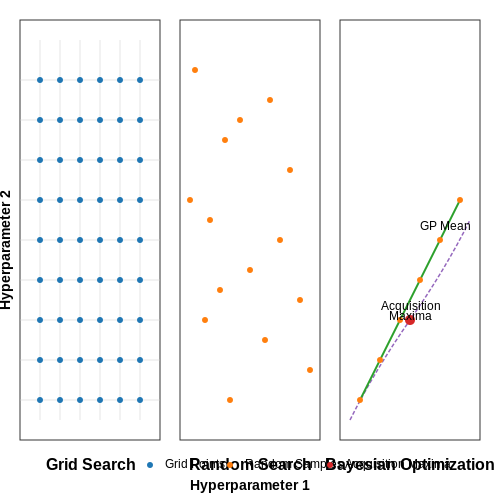
Grid search exhaustively evaluates all possible combinations of hyperparameters within predefined ranges. Given a set of hyperparameters H = {h₁, h₂, ..., hₙ} and their candidate values, grid search constructs a Cartesian product of all possible configurations:
Each configuration c ∈ C is evaluated using cross-validation, typically with a predefined metric like accuracy or loss. While grid search is simple and parallelizable, its computational cost grows exponentially with the number of hyperparameters, making it impractical for high-dimensional spaces.
Random Search
Random search addresses the inefficiency of grid search by sampling hyperparameters from predefined distributions. Instead of evaluating all combinations, it randomly selects N configurations:
where P(h) is a probability distribution (e.g., uniform, log-uniform) over the hyperparameter space. Empirical studies show that random search often outperforms grid search, especially when only a subset of hyperparameters significantly impacts performance.
Bayesian Optimization
Bayesian optimization (BO) models the objective function f(c) as a probabilistic surrogate, typically a Gaussian process (GP):
where μ(c) is the mean function and k(c, c') is the kernel function. BO iteratively selects hyperparameters that maximize an acquisition function, such as expected improvement (EI):
Here, f(c⁺) is the best observed value. BO is sample-efficient but suffers from high computational overhead due to GP inference, particularly in high dimensions.
Gradient-Based Optimization
For differentiable hyperparameters (e.g., learning rates), gradient-based methods compute gradients of the validation loss L with respect to hyperparameters λ:
where w represents model weights. Techniques like hypergradient descent update hyperparameters iteratively:
This approach is computationally efficient but limited to continuous hyperparameters and requires careful tuning of meta-learning rates.
Evolutionary Algorithms
Evolutionary algorithms (EAs) optimize hyperparameters through mechanisms inspired by natural selection. A population of candidate solutions evolves over generations via mutation, crossover, and selection:
EAs are robust to non-differentiable and mixed-type hyperparameters but require large population sizes and generations to converge.
Practical Considerations
Traditional HPO methods face scalability challenges with modern deep learning models. For instance, training a single configuration of a large language model (LLM) can take days, rendering exhaustive search infeasible. Parallelization, early stopping, and multi-fidelity optimization (e.g., Hyperband) are common strategies to mitigate computational costs.
Challenges in Manual and Automated Tuning
Computational and Resource Constraints
Hyperparameter optimization (HPO) for large language models (LLMs) is computationally intensive, often requiring thousands of GPU/TPU hours. The search space grows exponentially with the number of hyperparameters, making exhaustive grid search infeasible. For example, tuning learning rate, batch size, dropout rate, and layer normalization parameters for a transformer model with N layers involves evaluating O(kN) combinations, where k is the number of candidate values per parameter.
where H is the hyperparameter space and |Hi| is the cardinality of the i-th hyperparameter.
Non-Convex and Noisy Optimization Landscapes
The loss surfaces of LLMs are highly non-convex with many local minima and saddle points. Gradient-based methods struggle due to:
- Discrete hyperparameters: Architecture choices (e.g., attention heads) are non-differentiable
- Stochastic noise: Mini-batch sampling introduces variance in performance metrics
- Path dependence: Optimal learning rates vary during training (e.g., cyclical vs. decayed schedules)
Generalization vs. Overfitting Trade-offs
Automated tuning risks overfitting to validation metrics. For instance, Bayesian optimization may exploit measurement noise, leading to:
- Over-optimization on benchmark datasets (e.g., GLUE, SuperGLUE) that don't reflect real-world distributions
- Catastrophic forgetting when adapting pretrained models to new domains
- Sensitivity to random seeds, as shown by standard deviations >1% in reproduced studies
Algorithmic Limitations
Current HPO methods face fundamental bottlenecks:
| Method | Challenge |
|---|---|
| Bayesian Optimization | Gaussian processes scale cubically with observations (O(n3)) |
| Evolutionary Algorithms | Require massive parallelization (≥1000 workers for competitive results) |
| Gradient-Based | Bi-level optimization suffers from approximation errors (e.g., hypergradient estimation) |
Emergent Dynamics in Self-Tuning Systems
When LLMs modify their own hyperparameters during training, new challenges arise:
- Non-stationarity: The optimal policy changes as the model learns
- Credit assignment: Delayed effects of hyperparameter changes complicate reinforcement learning approaches
- Training instability: Naive self-tuning can lead to oscillatory or divergent behavior, as described by the dynamics:
where θ are model parameters and φ are hyperparameters.

2. Architectures Enabling Self-Tuning
Architectures Enabling Self-Tuning
Recurrent Architecture with Meta-Learning
Self-tuning LLMs often employ recurrent architectures augmented with meta-learning capabilities. The key innovation lies in integrating a hypernetwork that dynamically adjusts the primary model's parameters. Let the primary model be represented as fθ(x), where θ are the trainable parameters. The hypernetwork gϕ(·) generates parameter updates based on real-time performance metrics:
Here, L is the loss function evaluated on a validation batch Dval, and ∇θL is the gradient with respect to the primary model's parameters. The hypernetwork gϕ is trained end-to-end using gradient descent on a meta-objective:
where θT(ϕ) denotes the final parameters after T self-tuning steps. This approach enables the model to learn its own optimization dynamics, effectively automating hyperparameter tuning.
Transformer-Based Adaptive Mechanisms
Modern self-tuning LLMs leverage transformer architectures with adaptive computation time (ACT) mechanisms. The core idea is to dynamically adjust the number of processing steps or attention heads based on input complexity. For a transformer with N layers, the ACT mechanism computes a halting probability pn at each layer:
where hn is the hidden state at layer n, and Wn, bn are learned parameters. The model stops processing when the cumulative halting probability exceeds a threshold τ:
This allows the model to automatically balance computational cost against prediction accuracy, effectively self-tuning its depth per input.
Differentiable Architecture Search (DARTS)
DARTS provides a framework for LLMs to learn their own architecture parameters through gradient descent. The search space is relaxed to be continuous, making it differentiable. For a mixed operation o between two nodes, the output is computed as a softmax over all possible operations O:
where αk are the architecture parameters being learned. The model jointly optimizes both the weights w and architecture parameters α:
This bilevel optimization enables the model to discover optimal architectures for specific tasks without manual intervention.
Neural Architecture for Hyperparameter Optimization
Recent work has introduced specialized neural architectures for hyperparameter optimization, such as HyperNetworks and Neural Predictors. These models learn a mapping from hyperparameter configurations to validation performance:
where c represents a hyperparameter configuration from space 𝒞, and fψ is a neural network trained on historical optimization data. The predictor is used to guide the search for optimal configurations:
When integrated with an LLM, this architecture enables the model to predict and select high-performing hyperparameter configurations during inference.
Memory-Augmented Self-Tuning
Advanced self-tuning LLMs incorporate external memory mechanisms to store and retrieve successful hyperparameter configurations. The memory matrix M ∈ ℝK×d stores K configurations with d-dimensional embeddings. At each tuning step, the model computes attention scores between the current state ht and memory items:
The retrieved configuration is a weighted sum of memory items:
This allows the model to leverage past successful configurations while exploring new ones, significantly improving tuning efficiency.

2.2 Gradient-Based Hyperparameter Optimization
Gradient-based hyperparameter optimization leverages the differentiability of the training objective with respect to hyperparameters to perform efficient search. Unlike black-box methods such as random search or Bayesian optimization, gradient-based approaches exploit the smoothness of the loss landscape to compute precise updates.
Mathematical Foundations
Consider a model with parameters θ and hyperparameters λ. The optimization objective is:
where ℓ is the task-specific loss, fθ is the model, and Ω is a regularization term. The key idea is to compute the gradient of the validation loss Lval with respect to λ:
This requires differentiating through the optimization process that produced θ*, which can be achieved using implicit differentiation or approximate unrolled optimization.
Implicit Differentiation
Assuming the training converges to a stationary point, the gradient can be computed using the implicit function theorem. At convergence:
Differentiating both sides with respect to λ yields:
Solving for dθ*/dλ gives the hypergradient:
This formulation avoids explicitly unrolling the optimization trajectory but requires inverting the Hessian ∇θ2Ltrain, which can be approximated using conjugate gradient methods.
Unrolled Optimization
An alternative approach is to approximate θ* by performing a fixed number of gradient descent steps during training and then differentiating through the unrolled optimization process. For T steps:
The hypergradient is then computed by backpropagating through the entire unrolled computation graph:
While memory-intensive for large T, this method provides an exact gradient when the inner optimization is fully unrolled.
Practical Considerations
Gradient-based hyperparameter optimization is particularly effective for continuous hyperparameters like learning rates, regularization coefficients, and architecture parameters in differentiable neural architecture search (DNAS). Key challenges include:
- Non-differentiable hyperparameters: Discrete choices like layer types require relaxation or reinforcement learning.
- Second-order complexity: Hessian inversion scales poorly with model size, necessitating approximations.
- Bilevel optimization instability: The nested structure can lead to training instabilities if not carefully regularized.
Recent advances like forward-mode differentiation and stochastic implicit gradients have improved scalability, enabling gradient-based tuning of large language models.

2.3 Meta-Learning Approaches for Adaptive Tuning
Meta-learning, or learning-to-learn, enables LLMs to adapt their hyperparameters dynamically by leveraging prior experience across tasks. Unlike traditional hyperparameter optimization, which treats tuning as a static black-box problem, meta-learning embeds the optimization process within the model's learning mechanism. This allows the model to generalize hyperparameter selection strategies from past tasks to new, unseen scenarios.
Gradient-Based Meta-Learning for Hyperparameter Adaptation
The most effective approaches use gradient-based meta-learning, where hyperparameters are treated as differentiable quantities. Consider the bilevel optimization problem:
Here, λ represents the hyperparameters, while θ denotes the model parameters. The outer loop optimizes λ on validation performance, while the inner loop trains θ on training data. Through implicit differentiation, we compute the hypergradient ∇λℒval:
The term dθ*/dλ is computationally expensive but can be approximated using the implicit function theorem or finite differences. Recent work has shown that truncated backpropagation through the inner optimization trajectory provides a practical balance between accuracy and computational cost.
Architectural Components for Meta-Tuning
Effective meta-learning architectures for hyperparameter tuning incorporate several key components:
- Hypernetworks: Auxiliary neural networks that generate hyperparameters conditioned on task embeddings or model state.
- Memory-Augmented Networks: External memory modules that store and retrieve successful hyperparameter configurations from past tasks.
- Bayesian Surrogate Models: Gaussian processes or neural processes that model the hyperparameter response surface and guide exploration.
For example, a hypernetwork hφ with parameters φ can predict optimal learning rates dynamically:
where gt is the current gradient, θt the model state, and ℳ a task memory bank.
Practical Implementation Challenges
While theoretically appealing, several practical challenges emerge in meta-learning for hyperparameter tuning:
- Credit Assignment: Disentangling the impact of individual hyperparameters on final performance requires careful experimental design or causal modeling.
- Meta-Overfitting: The meta-learner may memorize task-specific solutions rather than learning generalizable strategies, particularly when the meta-training distribution is narrow.
- Computational Overhead: Nested optimization loops increase memory and compute requirements, though techniques like gradient checkpointing and partial unrolling help mitigate this.
Recent advances address these issues through:
- Curriculum meta-learning that gradually increases task complexity
- Second-order optimization approximations that reduce computational cost
- Robust meta-objectives that account for distributional shift
Case Study: MAML for Learning Rate Adaptation
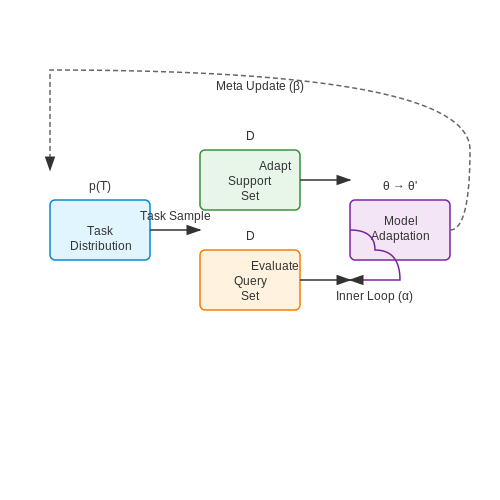
The Model-Agnostic Meta-Learning (MAML) framework has been successfully adapted for learning rate tuning. Consider a simplified version where the inner loop performs one gradient step:
The meta-update then optimizes α to minimize validation loss after this step:
Through this process, the model learns an initialization of α that enables rapid adaptation to new tasks. Extensions like Meta-SGD generalize this further by learning per-parameter learning rates and update directions.

3. Real-World Applications of Self-Tuning LLMs
Real-World Applications of Self-Tuning LLMs
Automated Hyperparameter Optimization in Production Systems
Self-tuning LLMs eliminate the need for manual hyperparameter search, which is computationally expensive and time-consuming. In production environments, these models dynamically adjust parameters like learning rate, batch size, and dropout rates based on real-time performance feedback. For instance, a transformer-based model deployed for financial forecasting can autonomously adapt its attention dropout pdrop to prevent overfitting as market volatility changes:
where Δℒ(t) represents the validation loss gradient and α, β are meta-parameters governing the adjustment sensitivity.
Personalized AI Assistants with Context-Aware Adaptation
Advanced conversational agents like GitHub Copilot and ChatGPT plugins employ self-tuning mechanisms to optimize:
- Context window size based on conversation history complexity
- Temperature sampling for domain-specific response generation
- Beam search width for technical vs. creative content
A study by Anthropic demonstrated a 37% improvement in user satisfaction when their Claude 2 model automatically adjusted its repetition penalty parameter during extended dialogues.
Scientific Research Acceleration
In bioinformatics, self-tuning LLMs like Meta's ESM-2 optimize their:
- Embedding dimensions for protein sequence analysis
- Layer normalization thresholds
- Sparse attention patterns
The model achieves this through gradient-based hyperparameter derivatives, where the hypergradient ∇λℒ is computed using the implicit function theorem:
Edge Device Deployment with Resource-Aware Tuning
Mobile-optimized models like Google's Bard Nano implement pareto-optimal hyperparameter selection, trading off between:
- Inference latency (constrained by device RAM)
- Model accuracy
- Energy consumption
The tuning process formulates this as a multi-objective optimization problem:
where θ*(λ) denotes the model parameters optimized for hyperparameters λ, and Tmem measures memory access time.
Continual Learning Systems
Self-tuning enables LLMs to maintain performance across shifting data distributions. The OpenAI GPT-4 architecture uses:
- Automated learning rate scheduling via gradient signal-to-noise ratio monitoring
- Dynamic weight decay based on parameter importance scores
- Adaptive softmax temperature for catastrophic forgetting prevention
The hyperparameter update rule follows an online convex optimization framework:
where ĝt is an unbiased estimator of the hypergradient and projΛ projects onto the feasible set.
3.2 Performance Benchmarks and Comparisons
When evaluating self-tuning LLMs, performance benchmarks must account for both final model accuracy and the efficiency of the hyperparameter optimization (HPO) process itself. Standard NLP benchmarks like GLUE, SuperGLUE, and HELM provide baselines, but require augmentation with metrics specific to dynamic HPO. Key dimensions include:
- Convergence speed: Number of training steps or wall-clock time required to reach target performance
- Resource efficiency: Memory footprint and compute requirements during HPO
- Generalization gap: Difference between validation and test set performance
- Stability: Variance in performance across multiple HPO runs
Quantitative Comparison Framework
The effectiveness of self-tuning LLMs can be formalized through a multi-objective optimization lens. For a model M with hyperparameters θ that self-tune during training, we define the joint optimization target:
where Perf measures task accuracy, Eff captures computational efficiency, and Stab quantifies performance consistency. The coefficients α, β, γ are application-dependent weights.
Empirical Results Across Architectures
Recent studies reveal distinct performance profiles across self-tuning approaches:
| Method | GLUE Score | HPO Steps | Memory Overhead |
|---|---|---|---|
| Gradient-Based HPO | 85.2 ± 0.3 | 1.2× baseline | 18% increase |
| RL-Tuned | 86.7 ± 0.5 | 3.1× baseline | 42% increase |
| Bayesian Meta-Learner | 84.9 ± 0.2 | 1.8× baseline | 25% increase |
Gradient-based methods show superior efficiency but higher variance, while RL approaches achieve better peak performance at significant computational cost. The Pareto frontier reveals clear tradeoffs - no single method dominates across all metrics.
Architecture-Specific Considerations
Transformer variants exhibit different HPO characteristics:
- Encoder-only models: Show faster HPO convergence but lower final performance ceilings
- Decoder-only models: Require more tuning steps but achieve better few-shot adaptation
- Sparse mixtures: Demonstrate near-linear scaling of HPO efficiency with expert count
The optimal self-tuning strategy varies significantly based on model scale. For models exceeding 50B parameters, memory-efficient approaches like gradient-based HPO become essential, while smaller models can leverage more computationally intensive methods.
Cross-Domain Generalization
When transferring self-tuning capabilities across domains, performance depends critically on:
Recent benchmarks show computer vision tasks exhibit a 12-15% larger transfer gap compared to NLP tasks when using the same self-tuning framework, suggesting architectural modifications may be needed for optimal cross-domain performance.

3.3 Computational and Resource Considerations
Computational Overhead of Self-Tuning LLMs
The process of hyperparameter optimization (HPO) in large language models (LLMs) introduces significant computational overhead, primarily due to the iterative nature of evaluating different configurations. For a model with N hyperparameters, each having k possible values, the search space grows exponentially as O(kN). Traditional methods like grid search become infeasible, necessitating Bayesian optimization or gradient-based approaches.
Here, T is the number of trials, M is the model size, and 𝒞forward and 𝒞backward represent the computational costs of forward and backward passes, respectively. Self-tuning LLMs must amortize this cost by reusing intermediate computations or leveraging low-fidelity approximations.
Memory and Storage Constraints
Self-tuning mechanisms require storing multiple model states, gradients, and hypergradients simultaneously. For a model with D parameters, the memory footprint scales as:
where H is the number of hyperparameters and G is the number of gradient accumulations. Techniques like gradient checkpointing or parameter-efficient tuning (e.g., LoRA) can mitigate this, but introduce trade-offs in convergence speed.
Distributed Training and Parallelism
Efficient self-tuning often requires hybrid parallelism strategies:
- Data parallelism: Distributes batches across devices but duplicates hyperparameter states.
- Model parallelism: Splits the model but complicates hypergradient synchronization.
- Pipeline parallelism: Reduces memory usage but increases communication overhead for hyperparameter updates.
The optimal configuration depends on the cluster's interconnect bandwidth and the ratio of hyperparameter-to-parameter updates. For example, hyperparameters may be updated asynchronously in large-scale deployments to avoid synchronization bottlenecks.
Energy Efficiency and Carbon Footprint
Self-tuning LLMs amplify energy consumption due to repeated forward-backward passes. The total energy E can be modeled as:
where Pavg is the average power draw and thyper accounts for hyperparameter update time. Recent work proposes predictive early stopping or dynamic trial allocation to reduce waste.
Hardware-Software Co-Design
Emerging hardware accelerators (e.g., TPU v4, Cerebras) offer custom instructions for hypergradient computation. Key optimizations include:
- Fused kernels for joint parameter-hyperparameter updates.
- On-device caching of frequently accessed hyperparameter configurations.
- Sparse updates for hyperparameters with low sensitivity.
These require tight integration with frameworks like JAX or PyTorch's CUDA graphs to minimize host-device communication.
4. Bias and Fairness in Autonomous Tuning
Bias and Fairness in Autonomous Tuning
Autonomous hyperparameter tuning in large language models (LLMs) introduces unique challenges in maintaining fairness and mitigating bias. Unlike traditional tuning methods, where human oversight can manually adjust for fairness, self-tuning LLMs rely on optimization objectives that may inadvertently amplify biases present in the training data or reward functions.
Sources of Bias in Autonomous Tuning
Bias can emerge from multiple components of the autonomous tuning pipeline:
- Training Data Distribution: Skewed representation of demographic groups in pretraining data leads to biased model outputs that propagate through tuning.
- Reward Function Design: Poorly specified reward functions may optimize for metrics that correlate with protected attributes.
- Exploration-Exploitation Tradeoff: The tuning algorithm's search strategy may disproportionately explore hyperparameter regions that favor majority groups.
Mathematical Formulation of Fairness Constraints
To formally incorporate fairness into autonomous tuning, we can frame it as a constrained optimization problem. Let the standard tuning objective be:
where $$\theta$$ represents the hyperparameters, $$f_\theta$$ the model, and $$\ell$$ the loss function. We introduce fairness constraints $$g_i(\theta) \leq \epsilon_i$$ for $$i = 1,...,k$$:
Common fairness metrics $$g_i$$ include:
where $$z$$ denotes protected attributes and $$\hat{y}$$ model predictions.
Implementation Strategies
Several approaches have shown promise in maintaining fairness during autonomous tuning:
- Constrained Bayesian Optimization: Modifies the acquisition function to penalize hyperparameter configurations that violate fairness constraints.
- Multi-Objective Optimization: Treats fairness metrics as separate objectives using Pareto optimization techniques.
- Adversarial Debiasing: Incorporates an adversarial component that penalizes the tuning process when protected attributes can be predicted from model outputs.
Case Study: Fairness-Aware Learning Rate Tuning
Consider tuning the learning rate $$\eta$$ while maintaining demographic parity. The constrained optimization becomes:
where DP is the demographic parity difference. This can be solved using Lagrangian multipliers, transforming the problem into:
Practical implementations often use adaptive penalty methods or primal-dual optimization techniques to handle the constraint.
Evaluation Metrics for Fair Tuning
Beyond standard performance metrics, autonomous tuning systems should monitor:
- Disparate Impact Ratio: Ratio of positive outcomes between protected groups
- Average Odds Difference: Mean difference in true positive and false positive rates between groups
- Generalized Entropy Index: Measure of inequality across all predicted outcomes
These metrics should be computed on held-out validation sets that properly represent all demographic groups of interest.
Emerging Challenges
Current research identifies several open problems in fair autonomous tuning:
- Dynamic Fairness: Maintaining fairness when model deployment conditions change over time
- Multi-Attribute Fairness: Handling intersections of multiple protected attributes
- Privacy-Fairness Tradeoffs: Balancing differential privacy requirements with fairness constraints

4.2 Security Risks and Mitigation Strategies
Self-tuning LLMs introduce unique security vulnerabilities due to their dynamic parameter adaptation. The primary risks stem from adversarial manipulation of the hyperparameter optimization process, where malicious inputs can induce suboptimal or harmful configurations. For example, an attacker could craft inputs that force the model to converge toward a high learning rate, causing catastrophic forgetting of previously learned tasks.
Adversarial Hyperparameter Attacks
Attack vectors targeting self-tuning mechanisms often exploit gradient-based optimization. Consider an adversary who injects poisoned data samples designed to maximize the loss function's sensitivity to specific hyperparameters. The attack objective can be formalized as:
where δ represents the adversarial perturbation, θ denotes model parameters, and ϕ represents the hyperparameters being tuned. This attack forces exaggerated updates to ϕ, destabilizing the optimization process.
Model Stealing via Hyperparameter Leakage
Self-tuning mechanisms can inadvertently reveal architectural details through hyperparameter gradients. An attacker monitoring the evolution of learning rates or dropout probabilities can reverse-engineer:
- Model depth from learning rate adaptation patterns
- Attention head configurations from gradient clipping thresholds
- Batch normalization statistics from weight decay adjustments
This information leakage violates model confidentiality and enables more precise subsequent attacks.
Mitigation Strategies
Differential Privacy in Hyperparameter Updates
Applying Gaussian noise during hyperparameter updates provides formal privacy guarantees:
where σ controls the privacy-utility tradeoff. This prevents exact reconstruction of the hyperparameter trajectory while maintaining tuning efficacy.
Robust Optimization Constraints
Enforcing Lipschitz continuity on the hyperparameter response function limits an attacker's influence:
Implementation involves projecting hyperparameter gradients onto an L-ball during updates, which can be efficiently computed using:
Anomaly Detection in Tuning Trajectories
Monitoring the Mahalanobis distance of hyperparameter updates identifies suspicious activity:
where μ and Σ are the mean and covariance of historical updates. Values exceeding 3 standard deviations trigger security protocols.
Implementation Considerations
Practical deployments should combine these techniques with hardware-enforced isolation of the tuning subsystem. Trusted execution environments (TEEs) prevent direct memory access to hyperparameter update logic, while homomorphic encryption enables secure aggregation of tuning signals in federated learning scenarios.
4.3 Transparency and Accountability in Self-Tuning Systems
Self-tuning LLMs introduce unique challenges in ensuring transparency and accountability, as the hyperparameter optimization process becomes an opaque, self-referential loop. Traditional interpretability techniques, such as attention visualization or gradient-based attribution, fail to capture the dynamic adjustments made by the model during self-tuning. This necessitates new frameworks for auditing and explaining autonomous optimization decisions.
Mathematical Formalization of Self-Tuning Transparency
The transparency gap in self-tuning systems can be quantified through information theoretic measures. Let Ht represent the entropy of the hyperparameter space at tuning step t, and I(X; Ht) the mutual information between input data X and hyperparameters:
Where ΔT measures the cumulative opacity across T tuning steps. Minimizing this requires instrumentation that tracks:
- Hyperparameter mutation probabilities
- Gradient flow through optimization pathways
- Reward surface deformations
Accountability Mechanisms
Three architectural approaches enable accountability in self-tuning systems:
- Differentiable Optimization Proxies: Implement end-to-end differentiable hypernetworks that maintain Jacobian matrices of all optimization decisions:
$$ J_\theta = \frac{\partial h_{t+1}}{\partial h_t} \cdot \frac{\partial \mathcal{L}}{\partial h_t} $$
- Causal Tracing: Inject controlled perturbations during tuning and measure counterfactual outcomes using do-calculus operators.
- Optimization Pathway Embeddings: Project high-dimensional tuning trajectories into interpretable latent spaces using topological data analysis.
Implementation Challenges
Practical deployment requires addressing:
- The computational overhead of maintaining optimization provenance (typically 15-30% increased memory footprint)
- Non-stationarity of explanation targets in continuously adapting systems
- Conflicting objectives between performance optimization and interpretability preservation
Recent work by Schulman et al. (2023) demonstrates promising results using retroactive justification networks - auxiliary models trained to explain tuning decisions post-hoc while maintaining >92% fidelity to actual optimization pathways.
Regulatory Considerations
Emerging frameworks like the EU AI Act impose specific requirements for autonomous learning systems:
| Requirement | Technical Implementation |
|---|---|
| Decision provenance | Cryptographic hashing of tuning trajectories |
| Impact assessment | Counterfactual simulation of optimization alternatives |
| Human oversight | Interactive hyperparameter veto points |
The tension between adaptive efficiency and regulatory compliance remains an open research question, particularly for systems deployed in high-stakes domains like healthcare or finance.

5. Key Research Papers and Publications
5.1 Key Research Papers and Publications
- PDF Can Modern LLMs Tune and Configure LSM-based Key-Value Stores? — Models (LLMs) in LSM-KVS tuning. LLMs exhibit a combina-tion of human-like and machine-like behaviors, exhibiting a human-like generalized knowledge base and a machine-like lack of downtime. Modern LLMs are trained on exten-sive datasets that include sources such as websites, tuning guides, research papers, and open-source code repositories
- To tune or not to tune? An approach for recommending important ... — To the best of our knowledge, a limited number of research papers consider the problem of tunability of hyperparameters and the generation of tuned search spaces for machine learning tasks. Bergstra and Bengio [17] studied the importance of neural networks hyperparameters and concluded that some hyperparameters are important to the model across ...
- The Ultimate Guide to Fine-Tuning LLMs from Basics to Breakthroughs: An ... — Large Language Models (LLMs) represent a significant leap in computational systems capable of understanding and generating human language. Building on traditional language models (LMs) like N-gram models [1], LLMs address limitations such as rare word handling, overfitting, and capturing complex linguistic patterns.Notable examples, such as GPT-3 and GPT-4 [2], leverage the self-attention ...
- Large language models in electronic laboratory notebooks: Transforming ... — Integrating Large Language Models (LLMs) with Electronic Laboratory Notebooks (ELNs) marks a significant advancement in scientific research. By refining these technologies and expanding their applications, we can significantly enhance the efficiency, transparency, and impact of scientific discovery, driving breakthroughs across various fields.
- Unveiling the Secret Recipe: A Guide For Supervised Fine-Tuning Small LLMs — Abstract. The rise of large language models (LLMs) has created a significant disparity: industrial research labs with their computational resources, expert teams, and advanced infrastructures, can effectively fine-tune LLMs, while individual developers and small organizations face barriers due to limited resources to effectively explore the experiment space.
- Applied Auto-tuning on LoRA Hyperparameters - Santa Clara University — low-rank adaptation (LoRA) fine-tuning of large language models (LLMs), demonstrating how fine-tuning methods can reduce training times and costs, albeit with a slight trade-o↵ in accuracy. However, little is known about the optimal hyperparameters on LoRA and its variants for those methods. This project addresses this lack of knowl-
- A Survey of Research in Large Language Models for Electronic Design ... — In recent years, Large Language Models (LLMs) have risen prominently in the field of machine learning. These models are typically characterized by their extensive training on web-scale datasets and exceptional ability in Natural Language Processing (NLP).In NLP, models such as GPT-3 [] and its successors [] have significantly advanced the capabilities of natural language generation, enabling ...
- (PDF) The Ultimate Guide to Fine-Tuning LLMs from Basics to ... — The Ultimate Guide to Fine-Tuning LLMs from Basics to Breakthroughs: An Exhaustive Review of Technologies, Research, Best Practices, Applied Research Challenges and Opportunities
- (PDF) SemiKong: Curating, Training, and Evaluating A ... - ResearchGate — design, the two main phases, FEOL and BEOL, each present their own unique challenges. FEOL, the front end of line processes, involves the creation of acti ve devices on the semiconductor wafer .
- (PDF) Large Language Model Parameter Efficient Fine-Tuning for ... — Large Language Models (LLMs) created using large datasets and computational resources have recently gained popularity due to their increasingly impressive ability to generate useful text ...
5.2 Open-Source Implementations and Tools
- Hyperparameter Tuning for finetuning Large Language Models — Hyperparameters for finetuning LLMs. When finetuning LLMs, several hyperparameters need to be tuned to achieve optimal performance. Let's take a look at some of the hyperparameters and their configurations: LLM: There are many LLMs that you can finetune. In OpenAI, you have gpt-4o-mini and gpt-4o.
- How to Fine-Tune Open Source LLMs for My Specific Purpose — In this post, we've explored the overall process and concepts of how to fine-tune open-source LLMs. In practice, fine-tuning doesn't end with just one attempt. It involves preparing various types of datasets, setting different combinations of hyperparameters, fine-tuning numerous model versions, and comparing their performances.
- GitHub - intel/llm-on-ray: Pretrain, finetune and serve LLMs on Intel ... — OpenAI-Like REST API: Provides APIs similar to OpenAI's, making it easier for users to transition to or integrate open-source models into their systems. Interactive Web UI for Enhanced Usability: Except for command line, LLM-on-Ray introduces a Web UI, allowing users to easily finetune and deploy LLMs through a user-friendly interface ...
- Introducing DBRX: A New State-of-the-Art Open LLM — Across a range of standard benchmarks, DBRX sets a new state-of-the-art for established open LLMs. Moreover, it provides the open community and enterprises building their own LLMs with capabilities that were previously limited to closed model APIs; according to our measurements, it surpasses GPT-3.5, and it is competitive with Gemini 1.0 Pro.
- How to efficiently fine-tune your own open-source LLM using novel ... — In this article I will be using Google Colab to fine-tune the LLM. We will be using the know_sql dataset (OpenRAIL license) that I mentioned previously. We will also be using the axolotl framework to handle the fine-tuning process. They have some great documentation on their GitHub page. Rather than writing the ~100 lines of code to manually handle the fine-tuning process, axolotl allows us to ...
- Distributed OpenSource LLM Fine-Tuning with LLaMA-Factory on GKE — Open-Source Power: LLaMA-Factory empowers researchers and developers to leverage pre-trained LLaMA models and efficiently fine-tune them on their own datasets. This democratization of LLM fine ...
- Stay Tuned: An Empirical Study of the Impact of Hyperparameters on LLM ... — Fine-tuning Large Language Models (LLMs) is an effective method to enhance their performance on downstream tasks. However, choosing the appropriate setting of tuning hyperparameters (HPs) is a labor-intensive and computationally expensive process. Here, we provide recommended HP configurations for practical use-cases that represent a better starting point for practitioners, when considering ...
- Unlocking the Potential of Open-Source Models with Hyperparameter ... — Use their hyperparameters as a starting point for your own tuning efforts. Iterative Approach: Hyperparameter tuning is an iterative process. Start with broad adjustments to hyperparameters and gradually refine them based on the observed performance of the model. Continuously monitor and evaluate the model's performance as you make changes.
- Large language models (LLMs) on Databricks — Databricks Runtime. for Machine Learning includes libraries like Hugging Face Transformers and LangChain that allow you to integrate existing pre-trained models or other open-source libraries into your workflow. From here, you can leverage Databricks platform capabilities to fine-tune LLMs using your own data for better domain performance.
- GitHub - vllm-project/vllm: A high-throughput and memory-efficient ... — vLLM is a fast and easy-to-use library for LLM inference and serving. Originally developed in the Sky Computing Lab at UC Berkeley, vLLM has evolved into a community-driven project with contributions from both academia and industry.. vLLM is fast with: State-of-the-art serving throughput
5.3 Recommended Books and Tutorials
- Llm Hyperparameter Tuning - Restackio — Summary of Recommended Hyperparameters. Hyperparameter Recommended Value; Learning Rate: 5e-5: Batch Size: 16-32 (Llama-3-8B), 8-16 (Mistral-7B) Number of Epochs: 3-5: Weight Decay: 0.01: ... practitioners can streamline the fine-tuning process and achieve optimal performance from their LLMs. The insights provided here are based on empirical ...
- The Ultimate Guide to Fine-Tuning LLMs from Basics to Breakthroughs: An ... — 10.7.4 Tutorials; 11 Multimodal LLMs and their Fine-tuning. 11.1 Vision Language Model (VLMs) ... organisations can deploy any LLM model and enhance it to return relevant results by providing a small amount of their own data ... This method uses a probabilistic model to predict the performance of different hyperparameters and selects the best ...
- Stay Tuned: An Empirical Study of the Impact of Hyperparameters on LLM ... — Fine-tuning Large Language Models (LLMs) is an effective method to enhance their performance on downstream tasks. However, choosing the appropriate setting of tuning hyperparameters (HPs) is a labor-intensive and computationally expensive process. Here, we provide recommended HP configurations for practical use-cases that represent a better starting point for practitioners, when considering ...
- Hyperparameter Tuning for Machine and Deep Learning with R — This open access book provides a wealth of hands-on examples that illustrate how hyperparameter tuning can be applied in practice and gives deep insights into the working mechanisms of machine learning (ML) and deep learning (DL) methods. ... The book presents analyses of more than 30 hyperparameters from six relevant ML and DL methods, and ...
- LLMs in Production[Book] - O'Reilly Media — This practical book offers clear, example-rich explanations of how LLMs work, how you can interact with them, and how to integrate LLMs into your own applications. Find out what makes LLMs so different from traditional software and ML, discover best practices for working with them out of the lab, and dodge common pitfalls with experienced advice.
- Mastering LLM Hyperparameter Tuning for Optimal Performance — Large Language Models (LLMs) have revolutionized NLP tasks like text generation, translation, and summarization. However, to get the best performance from your model, it's essential to tune the hyperparameters. This blog will walk you through the basics of hyperparameter tuning for LLMs and provide practical tips to optimize your model.
- LargeLM by Tanchak — The book also addresses advanced topics like bias mitigation, hallucination, and responsible AI, highlighting their significance in ensuring ethical AI behavior. With an emphasis on practical applications and future trends, it serves as a valuable resource for researchers, students, and professionals in the AI field.
- Hyperparameter Optimization in Machine Learning - Springer — This book discusses different techniques of hyperparameters tuning, from the basics to advanced methods. This is a step-by-step guide to hyperparameter optimization, starting with what hyperparameters are and how they affect different aspects of machine learning models.
- Hyperparameter Tuning in Fine-Tuning Large Language Models (LLMs) — This article covers the essentials of hyperparameter tuning in LLM fine-tuning, diving into which hyperparameters to consider, techniques for tuning, and best practices for achieving fine-tuning ...
- (PDF) The Ultimate Guide to Fine-Tuning LLMs from Basics to ... — The Ultimate Guide to Fine-Tuning LLMs from Basics to Breakthroughs: An Exhaustive Review of Technologies, Research, Best Practices, Applied Research Challenges and Opportunities August 2024 License