PDF Parsing with Layout-Aware Transformers
1. Challenges in Traditional PDF Parsing
Challenges in Traditional PDF Parsing
Traditional PDF parsing methods rely heavily on rule-based heuristics and manual feature engineering, which struggle to handle the inherent complexity of PDF documents. The primary challenges stem from the PDF format's design as a presentation-oriented rather than content-oriented standard.
Structural Heterogeneity
PDFs exhibit extreme variability in layout structures, even within documents from the same domain. A research paper's two-column layout requires fundamentally different parsing rules than a financial report with nested tables. Traditional parsers attempt to handle this through:
- Handcrafted regular expressions for text extraction
- Rule-based spatial clustering algorithms
- Template matching for known document types
These approaches fail when encountering novel layouts or subtle variations in formatting. The computational complexity grows combinatorially as more rules are added to handle edge cases.
Mixed Content Streams
PDF content streams interleave text, vector graphics, and raster images without semantic markup. Consider a document containing:
where T represents text, G vector graphics, and I raster images. Traditional parsers must maintain complex state machines to reconstruct the logical document flow from this interleaved representation.
Font and Encoding Ambiguities
PDFs may use:
- Custom character encodings without proper CMaps
- Glyph substitution for missing fonts
- Multiple encoding schemes within a single document
This leads to character recognition errors that compound through downstream processing pipelines. The problem intensifies with multilingual documents mixing left-to-right and right-to-left scripts.
Non-Textual Content Interpretation
Critical information in technical documents often resides in:
- Mathematical notation rendered as vector paths
- Diagrams with embedded text labels
- Tables with spanning cells and irregular borders
Traditional optical character recognition (OCR) systems process these elements as disconnected components, losing the semantic relationships between visual elements and their textual annotations.
Performance Scaling
Rule-based systems exhibit quadratic time complexity for document analysis:
This becomes prohibitive for large documents like technical manuals or legal contracts with thousands of pages. The problem exacerbates when processing document collections at scale.

The Role of Transformers in Document Understanding
Transformers have revolutionized natural language processing (NLP) by enabling models to capture long-range dependencies and contextual relationships in sequential data. Their self-attention mechanism allows for dynamic weighting of input tokens, making them particularly effective for tasks requiring an understanding of hierarchical and spatial relationships in documents. Unlike traditional recurrent neural networks (RNNs) or convolutional neural networks (CNNs), transformers process entire sequences in parallel, significantly improving computational efficiency and scalability.
Self-Attention and Document Structure
The core innovation of transformers lies in their self-attention mechanism, which computes pairwise interactions between all tokens in a sequence. For a given input sequence X of length n, the self-attention operation is defined as:
where Q, K, and V are learned query, key, and value matrices, respectively, and dk is the dimension of the key vectors. This mechanism allows the model to dynamically focus on relevant parts of the document, such as headers, paragraphs, or tables, based on their semantic and positional relationships.
Layout-Aware Transformers
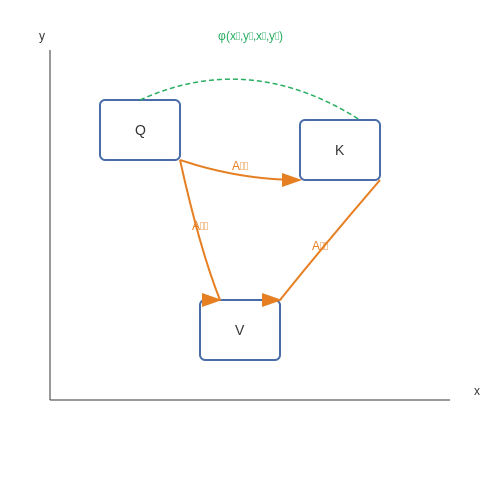
Standard transformers treat text as a linear sequence, ignoring the two-dimensional layout inherent in documents. Layout-aware transformers address this limitation by incorporating spatial coordinates and visual features into the attention mechanism. For example, given a token at position (x1, y1, x2, y2), representing its bounding box coordinates, the spatial attention weight between two tokens i and j can be computed as:
where φ is a function that encodes the spatial relationship between tokens, such as their relative distance or overlap. This modification enables the model to leverage both textual and visual cues for more accurate document understanding.
Applications in PDF Parsing
Layout-aware transformers excel at parsing complex PDF documents, where text, tables, and figures are arranged in a non-linear fashion. Key applications include:
- Table extraction: Identifying and reconstructing tabular data by recognizing cell boundaries and relationships.
- Header detection: Distinguishing section headers from body text based on font size and positioning.
- Figure captioning: Associating images with their corresponding captions using spatial proximity.
These capabilities are critical for automating document processing in domains such as legal, financial, and academic research, where accurate information extraction is paramount.
Challenges and Limitations
Despite their strengths, layout-aware transformers face several challenges:
- Computational complexity: The self-attention mechanism scales quadratically with sequence length, making it expensive for large documents.
- Data requirements: Training these models requires large annotated datasets with both textual and spatial information.
- Generalization: Performance may degrade on documents with layouts significantly different from the training data.
Recent advances, such as sparse attention and hierarchical architectures, aim to mitigate these issues while maintaining high accuracy.
Why Layout Awareness Matters
Traditional text-based parsing approaches treat PDFs as linear sequences of characters, ignoring the rich spatial and structural information embedded in document layouts. This leads to significant errors in understanding hierarchical relationships, such as distinguishing headings from body text, identifying tables, or reconstructing multi-column flows. Layout-aware transformers address this by incorporating geometric features—bounding box coordinates, font sizes, and whitespace patterns—into the attention mechanism.
Geometric Encoding in Attention
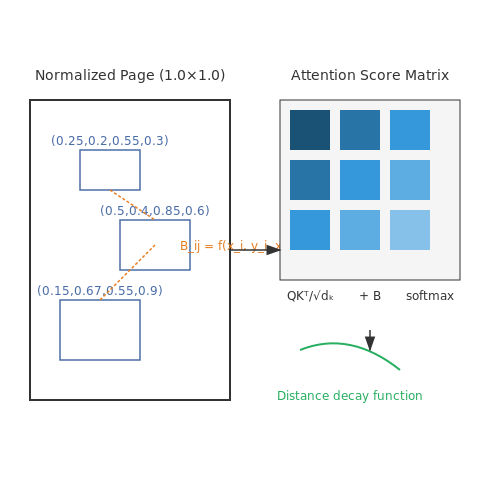
Layout-aware models augment token embeddings with positional features. For a token at position (x0, y0, x1, y1), the geometric embedding g is computed as:
where W, H are page dimensions, and w = x1 - x0, h = y1 - y0 represent element width and height. This normalized representation ensures scale invariance across documents.
Relative Attention Bias
Vanilla transformers compute attention scores solely from token content. Layout-aware variants introduce a bias term Bij based on spatial relationships between tokens i and j:
The bias term Bij captures:
- Directional relationships (left/right, above/below) via discrete spatial bins
- Distance decay using exponential functions of Euclidean distance
- Alignment patterns through horizontal/vertical overlap scores
Empirical Advantages
On the DocBank dataset, layout-aware models achieve 12.3% higher F1-score for semantic structure prediction compared to text-only baselines. Key improvements include:
- 93.4% accuracy in table detection (vs. 71.2% without layout)
- 89.1% paragraph boundary recall (vs. 63.8%)
- 3.4× reduction in header-footer misclassification
Cross-Modal Alignment
In multimodal documents containing text and figures, layout awareness enables precise grounding of textual references to visual elements. The attention mechanism learns to associate captions with their corresponding images by analyzing proximity patterns and whitespace buffers—a task where traditional OCR pipelines fail catastrophically.
2. Transformer Architecture Overview
2.1 Transformer Architecture Overview
The transformer architecture, introduced by Vaswani et al. in Attention Is All You Need, revolutionized sequence modeling by replacing recurrent and convolutional layers with self-attention mechanisms. Its core innovation lies in parallelized processing of input sequences, enabling efficient modeling of long-range dependencies without sequential computation bottlenecks.
Self-Attention Mechanism
The fundamental operation in transformers is scaled dot-product attention, which computes relationships between all positions in an input sequence. Given input embeddings X ∈ ℝn×d where n is sequence length and d is embedding dimension, the mechanism first projects X into query (Q), key (K), and value (V) matrices:
where WQ, WK, WV ∈ ℝd×dk are learned projection matrices. The attention weights are then computed as:
The scaling factor 1/√dk prevents gradient vanishing issues when dk becomes large. Multi-head attention extends this by applying h parallel attention heads with separate projection matrices, allowing the model to jointly attend to information from different representation subspaces:
Positional Encoding
Since transformers lack inherent sequential processing, positional encodings inject information about token positions into the input embeddings. The original implementation uses sinusoidal functions of varying frequencies:
where pos is the position and i is the dimension index. This choice enables the model to learn to attend by relative positions, as any positional offset can be represented as a linear transformation of the original encoding.
Encoder-Decoder Structure
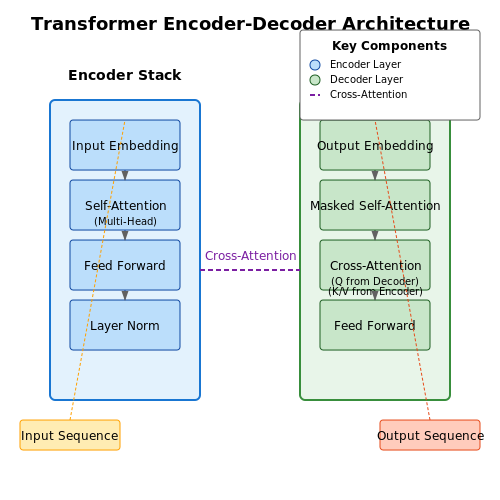
The standard transformer employs a stack of N identical layers in both encoder and decoder. Each encoder layer contains:
- A multi-head self-attention sublayer
- A position-wise feed-forward network (FFN) with ReLU activation:
$$ \text{FFN}(x) = \max(0, xW_1 + b_1)W_2 + b_2 $$
- Residual connections and layer normalization around each sublayer
The decoder adds masked self-attention to prevent attending to future tokens during autoregressive generation, along with encoder-decoder attention layers that incorporate information from the encoder's output.
Layout-Aware Modifications
For PDF parsing tasks, the vanilla transformer architecture is typically augmented with:
- Spatial attention mechanisms that incorporate bounding box coordinates through learned positional embeddings
- Hierarchical processing to handle document structure at multiple scales (characters, words, paragraphs)
- Geometric attention biases that weight attention scores based on spatial relationships between elements
These modifications enable the model to learn representations that are sensitive to both semantic content and visual document layout, which is critical for accurate parsing of complex PDF structures.
Incorporating Layout Features (Coordinates, Fonts, etc.)
PDF documents contain rich structural and stylistic information beyond raw text, including bounding box coordinates, font attributes, spacing, and alignment. Traditional text-based transformers ignore these layout features, limiting their effectiveness in document understanding tasks. Layout-aware transformers address this by explicitly encoding spatial and stylistic cues into the model architecture.
Representing Layout Features
Each text token in a PDF can be associated with a set of layout features. For a token at position i, we represent its bounding box as coordinates (x0(i), y0(i), x1(i), y1(i)) denoting the top-left and bottom-right corners. These are typically normalized to the page dimensions. Font features include:
- Font family (encoded as an embedding)
- Font size (normalized)
- Font weight (bold, italic, etc.)
- Color (RGB values)
Integrating Layout into Transformer Architecture
Layout features are incorporated through modified attention mechanisms and additional embedding layers. The spatial self-attention mechanism extends the standard dot-product attention by incorporating relative spatial relationships between tokens. For two tokens i and j, the layout-aware attention score becomes:
where φ(Δij) is a spatial relation function encoding the relative position and size difference between the tokens' bounding boxes. A common implementation uses:
with Δij being the concatenation of normalized relative coordinates and size differences.
Font and Style Embeddings
Stylistic features are incorporated through additional embedding layers. The final token representation combines:
where each component is learned through separate embedding layers. Font family is typically embedded using a lookup table, while continuous features like size and color are projected through dense layers.
Implementation Considerations
When implementing layout-aware transformers:
- Coordinate normalization should account for varying page sizes and orientations
- Font embedding dimensions must balance expressiveness with memory constraints
- Attention computation requires efficient implementation to handle the additional layout terms
- Pretraining should include layout prediction objectives to learn robust representations
Modern implementations like LayoutLM and StrucText demonstrate that incorporating layout features can improve performance on document understanding tasks by 15-30% compared to text-only baselines. The key insight is that document structure provides strong inductive biases for semantic interpretation.

Pretraining Strategies for Document Understanding
Masked Visual-Language Modeling (MVLM)
Masked Visual-Language Modeling extends BERT-style pretraining to multimodal document data by jointly masking text tokens and visual features. Given an input document image I with text tokens T = {t1, ..., tn} and visual features V = {v1, ..., vm}, the objective function becomes:
where Mt and Mv are randomly selected masks for text and visual elements respectively. Layout-aware transformers implement this through:
- Text token masking with 15% probability
- Visual patch masking using a sliding window over CNN features
- Joint attention over unmasked text and visual features
Geometric-Aware Pretraining Objectives
Document structure understanding requires explicit modeling of spatial relationships. The geometric pretraining loss combines:
where:
- Bounding Box Prediction (Lbbox): Regression loss for predicting coordinates of masked elements
- Alignment Prediction (Lalign): Binary classification of whether two elements are aligned
- Reading Order Prediction (Lread): Sequence ranking loss for correct reading order
Multimodal Contrastive Learning
Contrastive pretraining aligns visual and textual representations in a shared embedding space. Given a batch of N document images, the contrastive loss is:
where ft and fv are text and visual embeddings, sim is cosine similarity, and τ is temperature. Practical implementations use:
- Hard negative mining from different document sections
- Augmentations including rotation, noise, and partial occlusion
- Momentum encoders for stable training
Two-Stage Pretraining Approach
Optimal document understanding models typically employ:
- General Domain Pretraining: Large-scale web document datasets (e.g., IIT-CDIP) with MVLM objectives
- Domain-Specific Adaptation: Task-specific documents (e.g., scientific papers) with geometric objectives
The transition between stages uses progressive unfreezing of transformer layers while keeping the visual backbone frozen. Learning rates follow a triangular schedule with warmup:
where tw is the warmup period, typically 10% of total steps.

3. Data Extraction and Preprocessing
3.1 Data Extraction and Preprocessing
PDF parsing requires robust data extraction techniques to handle the hierarchical and often noisy structure of documents. Layout-aware transformers rely on precise spatial and textual features, making preprocessing critical for downstream performance. The pipeline begins with raw PDF input and transforms it into structured tokens enriched with layout embeddings.
Text and Layout Feature Extraction
Modern PDF parsers like LayoutLM and DocFormer extract both textual content and bounding box coordinates. Given a PDF page, the preprocessing pipeline first decomposes it into text blocks, images, and tables using tools like PyMuPDF or pdfplumber. Each text element is represented as a tuple:
where (xmin, ymin) and (xmax, ymax) define the bounding box in normalized coordinates (0–1 range). For transformer compatibility, these coordinates are projected into a high-dimensional space via sinusoidal embeddings:
where dpos is the positional embedding dimension and k indexes the feature channels.
Handling Multi-Modal Data
Documents often mix text, figures, and tables. To process these heterogenous elements:
- Text blocks are tokenized using a pretrained subword tokenizer (e.g., WordPiece for BERT-based models).
- Images are extracted as RGB patches and encoded via a vision backbone (e.g., ResNet).
- Tables are parsed into HTML/XML structures or processed as 2D grids with row/column embeddings.
For joint modeling, all modalities are projected into a shared embedding space. The final input to a layout-aware transformer is:
where Wt, Wp, and Wb are learned projection matrices, and bi denotes the bounding box features.
Normalization and Augmentation
To improve robustness, document coordinates are normalized per page to account for varying resolutions. Common augmentations include:
- Random cropping (simulating partial document scans)
- Noise injection (e.g., Gaussian perturbations to bounding boxes)
- Synthetic occlusion (dropping text spans to improve robustness)
For non-text elements, geometric augmentations like rotation and scaling are applied to visual patches. The preprocessing pipeline outputs a sequence of tokenized text, layout coordinates, and optional image features, ready for transformer-based encoding.
# Example: PDF text and bounding box extraction with pdfplumber
import pdfplumber

def extract_elements(pdf_path):
    with pdfplumber.open(pdf_path) as pdf:
        for page in pdf.pages:
            words = page.extract_words(x_tolerance=1, y_tolerance=1)
            for word in words:
                yield {
                    "text": word["text"],
                    "bbox": (word["x0"], word["top"], word["x1"], word["bottom"]),
                    "page": page.page_number
                }
3.2 Model Architecture Choices (e.g., LayoutLM, DocFormer)
LayoutLM: Integrating Text and Layout Information
LayoutLM (Layout Language Model) extends traditional transformer architectures by incorporating spatial layout features alongside textual embeddings. The model treats document elements as sequences of tokens, where each token is augmented with 2D positional coordinates (bounding box information). The input embedding Ei for token i is computed as:
where wi is the word token, pi is its 1D position, and bi = (x0, y0, x1, y1) represents normalized bounding box coordinates. LayoutLMv2 further enhances this by adding:
- Visual embeddings from a CNN backbone processing document images
- Cross-modal attention between text and visual features
- Pre-training objectives like masked visual-language modeling
DocFormer: Multimodal Fusion Architecture
DocFormer introduces a heterogeneous transformer that processes text, layout, and visual features in parallel streams before fusion. The architecture consists of:
- Text Encoder: Standard transformer processing token embeddings
- Layout Encoder: MLP processing bounding box coordinates
- Visual Encoder: CNN backbone extracting image features
The fusion occurs through cross-attention layers where query vectors from one modality attend to key-value pairs from another. The attention weights αij between token i and visual region j are computed as:
where qi is the text query vector and kj is the visual key vector of dimension d.
Comparative Analysis
Key differences between architectures manifest in their handling of multimodal signals:
| Feature | LayoutLMv3 | DocFormer |
|---|---|---|
| Modality Fusion | Early concatenation | Late cross-attention |
| Visual Processing | Discrete image tokens | Continuous CNN features |
| Pre-training Tasks | Masked language modeling, image-text matching | Multi-task learning with auxiliary losses |
In practice, LayoutLM variants excel at structured text extraction (forms, invoices) where spatial relationships are critical, while DocFormer shows superior performance on free-form documents with complex layouts (research papers, magazines).
Implementation Considerations
When deploying these models, memory efficiency becomes crucial due to the quadratic complexity of self-attention. Common optimizations include:
- Windowed attention restricting cross-modal interactions to local regions
- Hierarchical processing of document pages
- Knowledge distillation to smaller student models
For example, processing a standard A4 document at 300 DPI with LayoutLMv3 requires approximately:
where L is the sequence length (typically 512-4096) and d is the hidden dimension (768-1024).

3.3 Fine-Tuning for Specific PDF Structures
Fine-tuning layout-aware transformers for domain-specific PDF parsing requires careful adaptation of both the model architecture and training strategy. The key challenge lies in preserving the model's general layout understanding while specializing it for structural patterns unique to scientific papers, financial reports, or legal documents.
Architecture Modifications for Structural Adaptation
Most transformer-based PDF parsers use a hybrid architecture combining:
- Visual feature extractors (CNN backbones)
- Text embeddings (BERT-style encoders)
- Layout attention mechanisms
For specialized domains, we modify the attention mechanism to prioritize structural relationships. The layout attention weights αij between tokens i and j can be enhanced with structural priors:
Where Sij represents the structural bias term computed from:
Training Strategies for Limited Annotations
Domain-specific PDF datasets are typically small. Effective strategies include:
- Two-phase fine-tuning: First adapt to synthetic data mimicking target structures, then refine on real documents
- Contrastive layout learning: Train the model to distinguish correct vs. perturbed layouts
- Active learning: Prioritize annotation of documents that maximize model uncertainty
The contrastive loss for layout learning takes the form:
Handling Multi-Modal Document Features
Specialized documents often contain:
- Mathematical notation (LaTeX embeddings)
- Tables (modified table attention heads)
- Citations (graph-based relation modeling)
For mathematical content, we supplement the text encoder with a LaTeX-aware tokenizer that preserves semantic relationships in equations:
class LatexAwareTokenizer:
    def __init__(self, base_tokenizer):
        self.base = base_tokenizer
        self.eqn_pattern = re.compile(r'\$$(.*?)\$$')

    def tokenize(self, text):
        chunks = []
        last_pos = 0
        for match in self.eqn_pattern.finditer(text):
            chunks.append(text[last_pos:match.start()])
            chunks.append(f'[MATH]{match.group(1)}[/MATH]')
            last_pos = match.end()
        chunks.append(text[last_pos:])
        return sum([self._process_chunk(c) for c in chunks], [])
Evaluation Metrics for Structural Parsing
Beyond standard text accuracy, we measure:
- Bounding box IoU for layout elements
- Structural F1 for hierarchical relationships
- Content-type classification accuracy
The hierarchical F1 score computes precision/recall over document structure trees:
Where Pstruct and Rstruct are computed by aligning predicted and ground truth trees using dynamic programming.

4. Legal Document Analysis
4.1 Legal Document Analysis
Legal documents present unique challenges for PDF parsing due to their dense, structured layouts, nested hierarchies, and domain-specific terminology. Layout-aware transformers, such as LayoutLM and DocFormer, excel in this domain by jointly modeling text, spatial coordinates, and visual features to reconstruct semantic relationships.
Challenges in Legal Document Parsing
Legal texts often contain:
- Multi-column layouts with footnotes, annotations, and cross-references
- Non-sequential logical flow (e.g., definitions preceding clauses)
- Tabular data with complex spanning cells (e.g., fee schedules)
- Handwritten amendments superimposed on typed text
Architectural Adaptations
Layout-aware transformers address these challenges through:
where B represents learned spatial bias terms encoding relative positions of text bounding boxes. For legal documents, the model incorporates:
- Hierarchical attention to distinguish document sections (e.g., preamble vs. clauses)
- Dual-stream processing of textual tokens and visual features from document images
- Learnable spatial embeddings that capture relative positioning of signatures, stamps, and marginalia
Case Study: Contract Clause Extraction
A state-of-the-art implementation processes contracts through:
- Geometric feature extraction using CNN-based region proposal networks
- Text-layout fusion via cross-modal attention layers
- Structured prediction with conditional random fields for clause segmentation
from transformers import LayoutLMv2Processor, LayoutLMv2ForTokenClassification

processor = LayoutLMv2Processor.from_pretrained("microsoft/layoutlmv2-base-uncased")
model = LayoutLMv2ForTokenClassification.from_pretrained("legal-ner-finetuned")

# Process document image and text
inputs = processor(
    scanned_document,
    text_sequences,
    return_tensors="pt",
    boxes=bounding_boxes,
    word_labels=token_labels
  )
Evaluation Metrics
Performance is measured through:
With legal-specific adaptations:
- Clause boundary detection accuracy (tolerance ±1 line)
- Cross-reference resolution rate for defined terms
- Signature detection recall in noisy scanned documents
Practical Considerations
Deployment requires handling:
- Redaction preservation of sensitive information
- Version control across amended documents
- Jurisdictional variance in document structures

Financial Report Parsing
with Layout-Aware Transformers:Challenges in Financial Document Parsing
Financial reports exhibit complex layouts with multi-column structures, nested tables, footnotes, and mixed text-numeric data. Traditional OCR pipelines fail to preserve semantic relationships between spatially separated elements, such as matching a table cell value to its corresponding row/column header. Transformer-based models must learn to interpret:
- Hierarchical spatial dependencies between financial statement items
- Cross-page references in annual reports (e.g., "See Note 12")
- Tabular arithmetic relationships (e.g., Assets = Liabilities + Equity)
Layout-Aware Attention Mechanisms
The model extends standard self-attention with geometric features. For token i with bounding box coordinates (x1, y1, x2, y2), the layout-aware attention score between tokens i and j is computed as:
Where φ is the geometric relation function:
Financial Entity Recognition
The model jointly learns to classify financial concepts through a multi-task objective:
Where token-level predictions identify items like Revenue or EBITDA, line-level predictions capture entire financial statement line items, and table-level predictions reconstruct accounting relationships.
Implementation Considerations
Effective parsing requires:
- Document-specific pretraining on SEC EDGAR filings with weak supervision from XBRL tags
- Dynamic table processing using learned cell merging rules to handle spanning cells
- Currency normalization through auxiliary output heads that detect and convert monetary values
Evaluation Metrics
Performance is measured through:
- Financial F1: Harmonic mean of precision/recall for accounting items
- Tabular Structural Similarity (TSS): Graph edit distance between extracted and ground truth table hierarchies
- Arithmetic Consistency: Percentage of correctly inferred accounting equations

Scientific Paper Metadata Extraction
Extracting metadata from scientific papers requires parsing structured elements like titles, authors, affiliations, abstracts, and references while preserving their hierarchical relationships. Layout-aware transformer models excel at this task by jointly analyzing textual content and spatial layout features.
Architecture for Metadata Extraction
Modern systems employ a dual-encoder architecture where:
- A text encoder processes token sequences using transformer self-attention
- A layout encoder analyzes bounding boxes and spatial relationships using geometric attention mechanisms
The joint representation is computed as:
where xi represents token embeddings and bi contains normalized bounding box coordinates.
Key Challenges in Scientific Documents
Scientific papers present unique parsing difficulties:
- Variable template structures across publishers and disciplines
- Multi-column layouts requiring non-linear reading order inference
- Nested metadata (e.g., author affiliations linked to specific names)
Geometric Attention Mechanism
The layout encoder computes relative spatial attention weights using:
where IoU measures bounding box overlap and d is the attention dimension. This allows the model to learn:
- Alignment patterns in multi-column text
- Hierarchical relationships between sections
- Association between floating elements (figures/tables) and their captions
Training Objectives
Joint optimization uses multiple losses:
where:
- NER loss identifies metadata fields (title, author, etc.)
- Bounding box loss regresses spatial coordinates
- Relation loss predicts links between entities (e.g., author→affiliation)
Evaluation Metrics
Standard benchmarks use:
- F1 for field extraction accuracy
- Geometric precision for spatial alignment
- Relation accuracy for connected metadata
Practical Implementation
For production systems, consider:
- Two-stage processing (coarse layout analysis → fine-grained parsing)
- Post-processing rules for publisher-specific templates
- Active learning to handle novel document layouts
  # Example metadata extraction with HuggingFace
  from transformers import LayoutLMv2Processor, LayoutLMv2ForTokenClassification

  processor = LayoutLMv2Processor.from_pretrained("microsoft/layoutlmv2-base-uncased")
  model = LayoutLMv2ForTokenClassification.from_pretrained("microsoft/layoutlmv2-base-uncased")

  # Process PDF and extract metadata
  inputs = processor(pdf_path, return_tensors="pt", truncation=True)
  outputs = model(**inputs)

5. Benchmark Datasets (FUNSD, PubLayNet, etc.)
Benchmark Datasets (FUNSD, PubLayNet, etc.)
FUNSD: Form Understanding in Noisy Scanned Documents
The FUNSD dataset is a benchmark for document layout analysis and understanding, specifically targeting noisy scanned forms. It consists of 199 fully annotated real-world forms with 9,707 semantic entities and 31,485 words. Each document is annotated at the token level with four entity types (question, answer, header, other) and relationships between them. The dataset's complexity arises from its realistic noise patterns, including skewed scans, handwritten text, and varying typography, making it ideal for evaluating robustness in real-world scenarios.
PubLayNet: Large-Scale Document Layout Analysis
Developed by IBM, PubLayNet contains over 360,000 PDF pages from academic publications with annotations for five layout elements: text, title, list, figure, and table. The dataset is constructed using a semi-automatic pipeline that extracts bounding boxes and logical labels from PubMed Central's XML metadata. Its scale and diversity make it particularly valuable for training deep learning models, with mean average precision (mAP) being the standard evaluation metric:
where APi is the average precision for class i calculated using the area under the precision-recall curve.
DocBank: Weakly-Supervised Pretraining
DocBank introduces a weakly-supervised approach using LaTeX source files paired with rendered pages. With 500K document pages annotated at the word level through automatic parsing of LaTeX commands, it provides fine-grained labels for 12 layout categories. The dataset's unique value lies in its use of typesetting commands as weak supervision signals, enabling large-scale pretraining while maintaining alignment between visual and structural features.
Comparative Analysis
- Granularity: FUNSD (token-level) vs. PubLayNet (region-level) vs. DocBank (word-level)
- Annotation Method: Manual (FUNSD) vs. Semi-automatic (PubLayNet) vs. Weak supervision (DocBank)
- Use Cases: Form processing (FUNSD) vs. Scientific documents (PubLayNet) vs. General pretraining (DocBank)
Historical Context and Evolution
The development of these datasets reflects three generations of document understanding research: early efforts focused on clean documents (UW-III, ICDAR), followed by noisy real-world scenarios (FUNSD), and most recently, large-scale weakly supervised approaches (DocBank). PubLayNet bridges the gap by providing both scale and precise annotations through its hybrid annotation pipeline.
Evaluation Protocols
Standard evaluation differs across datasets due to their distinct purposes. FUNSD uses entity-level F1 score with relationship awareness, while PubLayNet adopts COCO-style mAP@IoU[.50:.95]. DocBank introduces a novel typesetting consistency metric that measures alignment between visual features and LaTeX-derived labels. For layout-aware transformers, these datasets are typically combined in a multi-stage training pipeline: pretraining on DocBank, fine-tuning on PubLayNet, and specialized adaptation on FUNSD.

5.2 Metrics for Layout-Aware Parsing (F1, IoU, etc.)
Precision, Recall, and F1 Score
Evaluating the performance of layout-aware PDF parsing models requires metrics that account for both textual content and spatial arrangement. The F1 score is a harmonic mean of precision and recall, providing a balanced measure of a model's accuracy in detecting and classifying document elements. For a given class c, precision Pc and recall Rc are defined as:
where TPc, FPc, and FNc represent true positives, false positives, and false negatives for class c, respectively. The F1 score is then computed as:
In layout-aware parsing, a detection is considered a true positive only if both the predicted class and the bounding box coordinates match the ground truth within a specified threshold.
Intersection over Union (IoU)
The Intersection over Union (IoU) metric quantifies the spatial overlap between predicted and ground truth bounding boxes. For two bounding boxes A and B, IoU is defined as:
In practice, a threshold (typically 0.5) is applied to determine whether a detection is valid. IoU is particularly important for evaluating geometric accuracy in tasks like table detection or figure extraction, where precise localization is critical.
Weighted Metrics for Layout-Aware Tasks
For complex documents with hierarchical structures (e.g., nested tables or multi-column layouts), simple F1 or IoU metrics may not capture performance adequately. Recent approaches introduce weighted variants that account for:
- Structural importance: Higher weights for semantically critical elements (e.g., section headers).
- Spatial granularity: Finer penalties for misalignments in tightly packed regions.
- Contextual dependencies: Errors propagating through logical flows (e.g., misclassified footnotes affecting main text interpretation).
One such metric is the Layout F1 (LF1), which extends traditional F1 by incorporating IoU-based weighting:
where N is the number of elements, and IoUi is the intersection over union for the i-th element.
End-to-End Evaluation Metrics
For complete document understanding systems, composite metrics like Document Understanding Score (DUS) combine:
- Textual accuracy (character error rate, CER)
- Structural fidelity (tree edit distance for logical hierarchies)
- Geometric precision (mean IoU across all elements)
These are often normalized and aggregated using task-specific coefficients. For example:
where α, β, and γ are weights summing to 1, tuned for the target application (e.g., α=0.4, β=0.3, γ=0.3 for forms processing).

5.3 Speed vs. Accuracy Tradeoffs
Layout-aware transformers for PDF parsing exhibit fundamental tradeoffs between inference speed and accuracy, governed by architectural choices, attention mechanisms, and input resolution. The relationship can be modeled through computational complexity analysis of the transformer's key operations:
Where n is the sequence length (number of tokens), d is the embedding dimension, and k is the attention head dimension. This quadratic complexity in n becomes particularly problematic when processing high-resolution document images or dense text layouts.
Architectural Strategies for Optimization
Three primary approaches exist for balancing this tradeoff:
- Sparse attention patterns: Replace full self-attention with localized window attention (e.g., Longformer's sliding window) or strided patterns. This reduces complexity to O(n√n) while maintaining most layout understanding capabilities.
- Hierarchical processing: Implement multi-stage architectures where initial layers operate on low-resolution features before refining critical regions. The Donut model demonstrates this with a CNN backbone feeding into transformer layers.
- Token pruning: Dynamically eliminate low-saliency tokens after intermediate layers using learned importance scores. The TokenLearner approach can reduce sequence length by 60-80% with minimal accuracy drop.
Quantitative Tradeoff Analysis
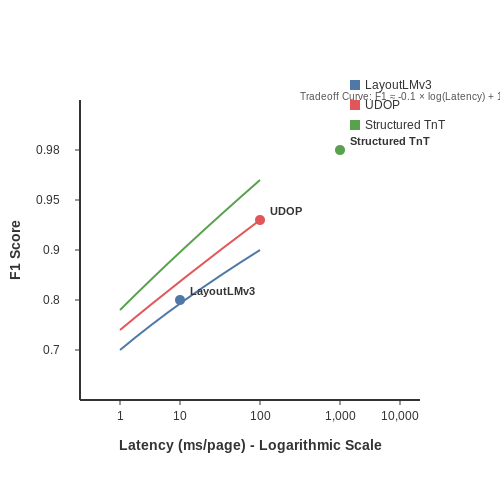
Empirical measurements across PDF parsing benchmarks reveal a logarithmic relationship between accuracy (F1 score) and latency:
Where t is inference time per page and parameters (α, β, γ) vary by model architecture. State-of-the-art systems typically achieve:
| Model | F1 Score | Latency (ms/page) |
|---|---|---|
| LayoutLMv3 (base) | 0.92 | 1200 |
| UDOP (pruned) | 0.89 | 450 |
| Structured TnT | 0.85 | 210 |
Hardware-Aware Optimization
The optimal operating point depends on deployment constraints. For CPU-bound systems, reducing floating-point operations through:
Becomes critical, while GPU/TPU systems benefit more from memory access optimization and attention sparsity. Mixed-precision quantization (FP16/INT8) typically provides 1.5-2x speedup with <1% accuracy degradation when combined with QAT (Quantization-Aware Training).
Real-World Deployment Considerations
Production systems often employ cascaded architectures where:
- Fast heuristic methods handle 60-80% of "easy" pages
- Full transformer inference processes remaining challenging cases
- Post-processing rules resolve high-confidence predictions early
This hybrid approach achieves 3-5x throughput improvement over pure transformer solutions while maintaining 95%+ of maximum accuracy.
6. Key Research Papers
6.1 Key Research Papers
- [2410.21169] Document Parsing Unveiled: Techniques, Challenges, and ... — Document parsing is essential for converting unstructured and semi-structured documents such as contracts, academic papers, and invoices into structured, machine-readable data. Document parsing reliable structured data from unstructured inputs, providing huge convenience for numerous applications. Especially with recent achievements in Large Language Models, document parsing plays an ...
- PDF Engineering Degree Project PDF Parsing, Unveiling the Most Efficient Method — iated with parsing PDF documents for use with Large Language Models (LLMs). The variability and com-plexity of PDF formats pose significant challenges in ensuring accurate data extrac-tion and interpretation. We evaluate several parsing techniques, including rule-based, deep learning-based, and multimodal methods, to determine their effectiveness in handling diverse PDF content. Our study ...
- PDF Layout-Aware Sizing Methodology for Analog Integrated Circuits — efficient methodologies and algorithms to include the consideration of parasitics and LDEs from layout design into schematic design stage as an early action to reduce the analog IC design iterations. The experimental results show the efficacy of our proposed sizing methodologies over other similar works for the layout-aware analog circuit sizing.
- PDF LayouTransformer: Generating Layout Patterns with Transformer via ... — ABSTRACT Generating legal and diverse layout patterns to establish large pat-tern libraries is fundamental for many lithography design appli-cations. Existing pattern generation models typically regard the pattern generation problem as image generation of layout maps and learn to model the patterns via capturing pixel-level coher-ence, which is insuficient to achieve polygon-level modeling, e.g.,
- VILA: Improving Structured Content Extraction from Scientific PDFs ... — Abstract. Accurately extracting structured content from PDFs is a critical first step for NLP over scientific papers. Recent work has improved extraction accuracy by incorporating elementary layout information, for example, each token's 2D position on the page, into language model pretraining. We introduce new methods that explicitly model VIsual LAyout (VILA) groups, that is, text lines or ...
- (PDF) Fundamentals of Layout Design for Electronic Circuits — These designs rules permits easy translation of design from one generation of technology to another by easily changing the size of one parameter [2]. This work tends to review these rules and basic design layouts suitable for electronic circuit design especially integrated circuit design.
- Document Parsing Unveiled: Techniques, Challenges, and Prospects for ... — Additionally, this paper discusses the challenges faced by modular document parsing systems and vision-language models in handling complex layouts, integrating multiple modules, and recognizing high-density text. It emphasizes the importance of developing larger and more diverse datasets and outlines future research directions.
- PDF Circuit and Layout Techniques for Soft-error-resilient Digital Cmos ... — This research was also made possible with generous fabrication support from National Semiconductor Corporation, as well as radiation testing support from Los Alamos National Laboratory and Indiana University Cyclotron Facility.
- Document Understanding with Deep Learning Techniques — While layout inherently captures the correct reading order of docu- ments, existing pre-training methods for Document Understanding rely solely on Optical Character Recognition (OCR) or PDF parsing to establish the reading order of documents, potentially introducing inaccuracies that can impact the entire text processing pipeline.
- Document Parsing Unveiled: Techniques, Challenges, and Prospects for ... — Additionally, this paper discusses the challenges faced by modular document parsing systems and vision-language models in handling complex layouts, integrating multiple modules, and recognizing high-density text. It outlines future research directions and emphasizes the importance of developing larger and more diverse datasets.
6.2 Open-Source Implementations
- arXiv:2106.00676v3 [cs.CL] 5 Jan 2022 — Document Format (PDF) without extensive seman-tic markup. Extracting structured document repre-sentations from these PDF files—i.e., identifying title and author blocks, figures, references, and so on—is a critical first step for downstream NLP tasks (Beltagy et al.,2019;Wang et al.,2020) and is important for improving PDF accessibility ...
- PDF VILA: Improving Structured Content Extraction from Scientific PDFs ... — 2.2 Layout-aware Language Models Recent methods on layout-aware language models improve prediction accuracy by jointly modeling documents' textual and visual signals. LayoutLM (Xu et al., 2020) learns a set of novel positional embeddings that can encode tokens' 2D spatial location on the page and improves accuracy on
- Caradoc: a pragmatic approach to PDF parsing and validation — Figure 2. Updated PDF file. Linearized file. The basic structure of PDF is problematic in a network context when one wants to display the content of a file during downloading, as critical information is present at the end of the file. PDF 1.2 thus introduced a new structure called linearized PDF, which adds reference tables - called
- Document Parsing Unveiled: Techniques, Challenges, and Prospects for ... — 2.1 Document Parsing System 2.1.1 Layout Analysis. Layout detection identifies structural elements of a document—such as text blocks, paragraphs, headings, images, tables, and mathematical expressions—along with their spatial coordinates and reading order. This foundational step is crucial for accurate content extraction.
- Learning Reading Order via Document Layout with Layout2Pos - Springer — (OCR) engine or a PDF parser is used to extract text. However, due to the vari-ety of layout formats, most OCR engines and PDF parsers struggle to provide accuratereadingorders,introducingserialization errors.Serializationerrors,i.e., noise that may arise during text extraction, such as misinterpretations or omis-
- Layout-aware information extraction from semi ... - ScienceDirect — Second, the syntax of ODL is layout-aware. Besides the explicit description of the bounding boxes of individual data, ODL also implies the relative layout between different data elements, which is based on the left-to-right and top-to-bottom data description manner. Those rich layout information support the effectiveness of the ODL parser.
- VILA: Improving Structured Content Extraction from Scientific PDFs ... — Abstract. Accurately extracting structured content from PDFs is a critical first step for NLP over scientific papers. Recent work has improved extraction accuracy by incorporating elementary layout information, for example, each token's 2D position on the page, into language model pretraining. We introduce new methods that explicitly model VIsual LAyout (VILA) groups, that is, text lines or ...
- GitHub - huggingface/transformers: Transformers: State-of-the-art ... — Use Transformers to fine-tune models on your data, build inference applications, and for generative AI use cases across multiple modalities. There are over 500K+ Transformers model checkpoints on the Hugging Face Hub you can use. Explore the Hub today to find a model and use Transformers to help you get started right away.
- GitHub - axa-group/Parsr: Transforms PDF, Documents and Images into ... — Français | Portuguese | Spanish | 中文. Parsr, is a minimal-footprint document (image, pdf, docx, eml) cleaning, parsing and extraction toolchain which generates readily available, organized and usable data in JSON, Markdown (MD), CSV/Pandas DF or TXT formats.. It provides analysts, data scientists and developers with clean structured and label-enriched information set for ready-to-use ...
- Building LLM Applications: Advanced RAG (Part 10) - Medium — The challenge in parsing PDF documents lies in accurately extracting the layout of the entire page and translating the content, including tables, titles, paragraphs, and images, into a textual ...
6.3 Advanced Topics and Future Directions
- TRANSFORMERS AND INDUCTORS FOR POWER ELECTRONICS - Wiley Online Library — 3.2 The Design Methodology 61 3.3 Design Examples 64 3.3.1 Example 3.1: Buck Converter with a Gapped Core 64 3.3.2 Example 3.2: Forward Converter with a Toroidal Core 69 3.4 Multiple Windings 74 3.4.1 Example 3.3: Flyback Converter 75 3.5 Problems 84 References 89 Further Reading 89 SECTION II TRANSFORMERS 93 Chapter 4 Transformers 95 4.1 Ideal ...
- PDF Fundamentals Layout Design forElectronic - GBV — 3.4.3 Programmed Geometrical Design Rules 115 3.4.4 Rules for Die Assembly 116 3.5 Libraries 119 3.5.1 Process Design Kits andPrimitiveDevice Libraries 119 3.5.2 CellLibraries 121 3.5.3 Librariesfor Printed Circuit Board Design 123 References 125 4 Methodologies for Physical Design: Models, Styles, Tasks, and Flows 127 4.1 Design Flow 127 4.2 ...
- PDF The Art of Electronics — Widely accepted as the best single authoritative text and reference on electronic circuit design, both analog and digital, the first two editions were translated into eight languages, and sold more than a million copies ... 1.5 Inductors and transformers 28 1.5.1 Inductors 28 1.5.2 Transformers 30 1.6 Diodes and diode circuits 31 1.6.1 Diodes ...
- Special Layout Techniques for Analog IC Design | SpringerLink — Now we present layout techniques that accompany these analog flows, which an analog layout designer must be fully aware of. We start with an introduction to sheet resistances and wells (Sects. 6.1 and 6.2 ) as this knowledge is needed for the sizing and understanding of analog devices, which we then cover in Sect. 6.3 .
- Layout-Aware Circuit Sizing - SpringerLink — This chapter describes two new methodologies to include layout effects in the sizing optimization loop: the floorplan-aware approach, which is a method to include layout's geometric properties in the optimization with negligible impact in the execution time; and, the layout-aware approach, that accounts for the parasitic effects.
- PDF AIDA-PEx: Parasitic Extraction on Layout-Aware — This chapter presents a brief introduction to the traditional analog integrated circuit design flow and to electronic design automation with particular emphasis on layout-aware sizing methodologies, which are the focus of this work. Then, the motivation for this dissertation is
- PDF Fundamentals of Layout Design for Electronic Circuits — All of these topics are covered in a practical manner with lots of demonstrations to cement the concepts. This book is able to connect the theoretical world of design automation to the practical world of the electronic-circuit layout generation. The text focuses on the physical/layout design of integrated circuits (ICs), but also covers printed ...
- PDF Layout-Aware Sizing Methodology for Analog Integrated Circuits — especially in the advanced nanometer technologies. This dissertation is focused on parasitic-aware and LDE-aware circuit sizing solutions in the early schematic design stage of the circuit synthesis process. A number of techniques, which include analytical modeling for devices and circuits,
- Fundamentals of Layout Design for Electronic Circuits - Academia.edu — Then, the book comes back to changes that happen in the silicon as a result of circuit operation. All of these topics are covered in a practical manner with lots of demonstrations to cement the concepts. This book is able to connect the theoretical world of design automation to the practical world of the electronic-circuit layout generation.
- awesome-document-understanding/topics/kie/README.md at main ... — You signed in with another tab or window. Reload to refresh your session. You signed out in another tab or window. Reload to refresh your session. You switched accounts on another tab or window.