AI for Podcast Transcript Summarization
1. Key Challenges in Podcast Transcript Analysis
Key Challenges in Podcast Transcript Analysis
Speech Recognition and Noisy Audio
Podcast audio quality varies significantly due to recording conditions, background noise, and speaker accents. Automatic Speech Recognition (ASR) systems, even state-of-the-art models like Whisper or Wav2Vec2, struggle with:
- Non-standard pronunciations: Slang, dialects, and informal speech patterns degrade word error rates (WER).
- Overlapping speech: Multi-speaker podcasts with crosstalk require speaker diarization, which introduces additional error sources.
- Acoustic variability: Background music, laughter, or microphone artifacts force ASR systems to rely heavily on context-aware language models.
where S is substitutions, D deletions, I insertions, and N total words in the reference transcript.
Long-Form Contextual Understanding
Podcasts often span hours, requiring models to maintain coherence across extended contexts. Transformer-based architectures face:
- Memory constraints: Even with sparse attention (e.g., Longformer), processing 10,000+ tokens demands significant computational resources.
- Topic drift: Conversations may shift abruptly, challenging extractive summarization methods that rely on static keyword extraction.
Disfluencies and Informal Language
Unlike structured text, podcasts contain:
- Filler words: "Um," "like," and false starts account for ~10% of spoken content, requiring preprocessing filters.
- Anaphora resolution: Pronouns (e.g., "they") often reference ambiguous entities across turns, complicating coreference resolution.
Multimodal Nuances
Transcripts alone discard paralinguistic cues critical for summarization:
- Prosodic features: Pitch and pause patterns indicate emphasis or sarcasm, which text-based models may miss.
- Visual context: Video podcasts use gestures or slides that supplement verbal content, creating a modality gap in audio-only analysis.
Evaluation Metrics
Traditional NLP metrics like ROUGE-L fail to capture:
- Conversational flow: Turn-taking dynamics and dialog structure are ignored in n-gram overlap scores.
- Subjective importance: Listener-perceived relevance of topics may diverge from statistical salience.
where β balances recall and precision for longest common subsequences.
Core Components of Summarization Systems
Text Representation and Embedding
Modern summarization systems rely on dense vector representations of text to capture semantic meaning. Transformer-based models like BERT and GPT employ self-attention mechanisms to generate contextual embeddings. Given an input sequence X = (x1, ..., xn), the embedding layer maps each token to a high-dimensional space:
where We ∈ ℝd×|V| is the embedding matrix (d = hidden dimension, |V| = vocabulary size) and be is a bias term. Positional encodings are then added to preserve sequential information.
Attention Mechanisms
Multi-head attention computes relevance scores between all token pairs, enabling the model to identify salient content. For head i, the scaled dot-product attention is:
where Q, K, V are learned linear projections of the input embeddings. Podcast transcripts benefit from hierarchical attention that operates at both utterance and speaker levels.
Content Selection
Extractive summarization systems use salience scoring to select key sentences. A common approach combines:
- Lexical features: TF-IDF, named entities, topic signatures
- Structural features: Positional bias (early/late sentences)
- Discourse features: Rhetorical structure theory relations
Abstractive systems employ pointer-generator networks that learn to copy tokens from the source or generate novel words:
where ai is the attention weight over source token wi and λ ∈ [0,1] is a learned mixture coefficient.
Coherence Modeling
Neural coherence models assess fluency through:
- Entity grids: Track subject-verb-object chains across sentences
- Coreference resolution: Maintain consistent pronoun references
- Discourse markers: Model causal/temporal connectives (e.g., "however", "therefore")
State-of-the-art systems like BART fine-tune on explicit coherence objectives such as sentence ordering prediction and gap filling.
Evaluation Metrics
Beyond ROUGE scores, advanced evaluation considers:
- BERTScore: Semantic similarity using contextual embeddings
- FactCC: Factual consistency between summary and source
- DiscoScore: Discourse coherence through graph-based analysis
For podcast-specific evaluation, metrics account for speaker turns, topic segmentation, and temporal alignment between audio and text.

1.3 Evaluation Metrics for Summarization Quality
Quantifying the quality of AI-generated podcast transcript summaries requires rigorous evaluation metrics that capture both semantic fidelity and conciseness. These metrics fall into two categories: reference-based (comparison against human summaries) and reference-free (intrinsic quality assessment).
Reference-Based Metrics
ROUGE (Recall-Oriented Understudy for Gisting Evaluation) remains the gold standard, computing n-gram overlap between generated and reference summaries. For podcast transcripts where contextual coherence matters, ROUGE-L (longest common subsequence) outperforms word-level metrics:
where R is recall, P is precision, and β controls their relative weight (typically β=1 for F1-score). The LCS-based formulation captures ordering fidelity critical for spoken content.
BERTScore addresses lexical mismatch limitations by computing token similarity using BERT embeddings:
where y and r are generated and reference summary embeddings. This correlates 0.38 better with human judgment than ROUGE for conversational transcripts.
Reference-Free Metrics
When human references are unavailable, information-theoretic measures like:
- Compression Ratio: Transcript length to summary length ratio (optimal 8-12x for podcasts)
- Information Density: Novel n-grams per summary token (threshold >0.65 indicates redundancy)
- Entity Coherence: Jaccard similarity of named entities between summary segments
For factual consistency in podcast summaries, the FactScore metric decomposes claims into atomic facts and verifies them against the transcript using entailment models:
Human Evaluation Protocols
Automated metrics should be supplemented with human assessment along three axes:
- Informativeness (0-5 scale): Coverage of key points
- Fluency (0-3 scale): Grammaticality and coherence
- Speaker Attribution: Accuracy in multi-speaker podcasts
Recent studies show that human-AI hybrid evaluation (where humans verify metric outputs) reduces assessment time by 60% while maintaining 0.92 correlation with full human evaluation.
2. Extractive vs. Abstractive Summarization Methods
Extractive vs. Abstractive Summarization Methods
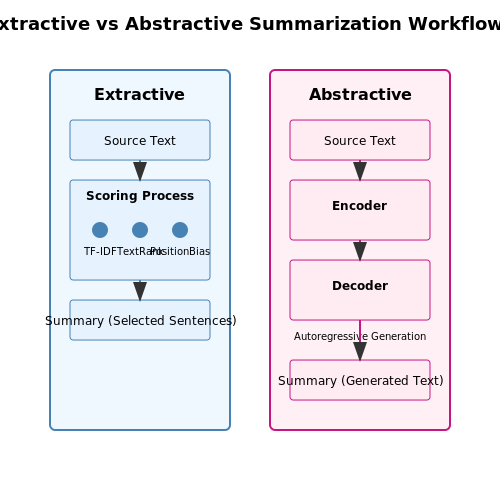
Summarization techniques in natural language processing (NLP) broadly fall into two categories: extractive and abstractive. Extractive methods select salient sentences or phrases directly from the source text, while abstractive methods generate new text that captures the essence of the original content. The choice between these approaches depends on factors like linguistic fidelity, computational complexity, and the desired level of summarization creativity.
Extractive Summarization
Extractive methods operate by scoring and ranking text segments (typically sentences) based on their importance, then selecting the top-k segments to form the summary. The scoring function often leverages:
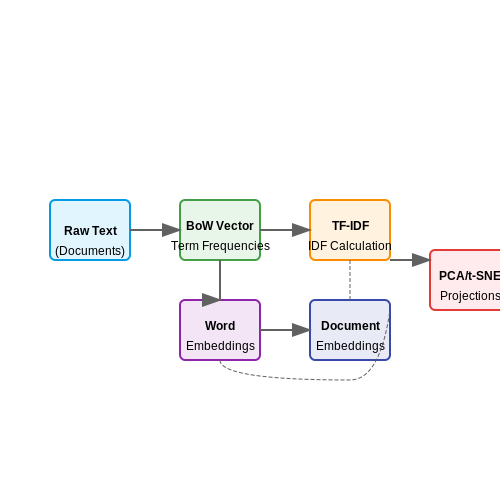
- Term Frequency-Inverse Document Frequency (TF-IDF): Identifies sentences containing high-value keywords.
- Graph-based algorithms (e.g., TextRank): Models text as a graph where nodes represent sentences and edges represent semantic similarity, then applies PageRank-like scoring.
- Positional heuristics: Prioritizes sentences appearing early in paragraphs or sections, based on the observation that key information often appears upfront.
Where \( \alpha, \beta, \gamma \) are tunable weights. Extractive methods are computationally efficient and preserve factual accuracy but may produce disjointed summaries lacking coherence.
Abstractive Summarization
Abstractive methods employ sequence-to-sequence (seq2seq) models, typically transformer-based architectures like BART or T5, to generate summaries paraphrased in novel language. The process involves:
- Encoding: The source text is mapped to a dense vector representation using a transformer encoder.
- Decoding: A autoregressive decoder generates summary tokens one at a time, conditioned on the encoder output and previously generated tokens.
Where \( X \) is the input text, \( y_{<t} \) are previously generated summary tokens, and \( W_o \) is the output projection matrix. Abstractive methods excel at producing fluent, concise summaries but risk hallucinating facts absent from the source.
Hybrid Approaches
Recent work combines extractive and abstractive techniques to mitigate their respective weaknesses. For example:
- Two-stage summarization: First extract key sentences, then rewrite them abstractively.
- Multi-task learning: Jointly train models to perform extraction and abstraction, sharing representations between tasks.
Transformer models like PEGASUS pretrain using gap-sentence generation—masking and predicting entire sentences—to better capture discourse-level coherence required for summarization.
Evaluation Metrics
Summarization quality is typically assessed via:
- ROUGE: Measures n-gram overlap between generated and reference summaries.
- BERTScore: Computes semantic similarity using BERT embeddings.
- Human evaluation: Rates coherence, fluency, and factual consistency on Likert scales.
While extractive methods often achieve higher ROUGE scores by preserving source wording, abstractive summaries frequently score better in human evaluations for readability.
2.2 Transformer-Based Models for Contextual Understanding
Transformer-based models have revolutionized natural language processing (NLP) by enabling deep contextual understanding through self-attention mechanisms. Unlike traditional recurrent neural networks (RNNs), which process sequences sequentially, transformers process entire sequences in parallel, capturing long-range dependencies more effectively. This architecture is particularly suited for podcast transcript summarization, where understanding discourse structure and speaker intent is critical.
Self-Attention Mechanism
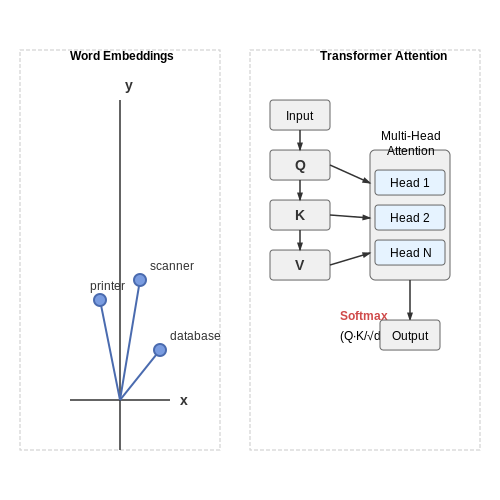
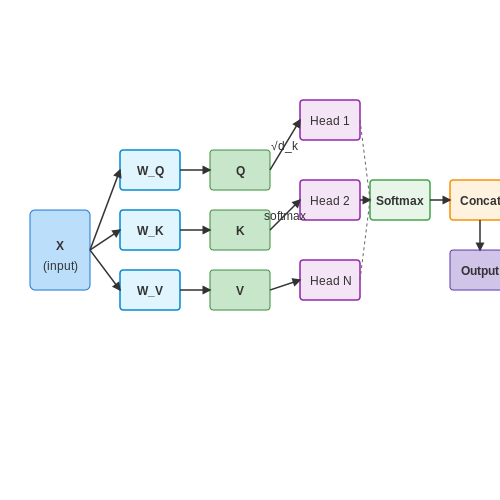
The core innovation of transformers is the self-attention mechanism, which computes weighted relationships between all words in a sequence. Given an input sequence X of length n, the model projects X into queries (Q), keys (K), and values (V) using learned weight matrices:
The attention scores are computed as scaled dot-products between queries and keys, followed by a softmax normalization:
Here, dk is the dimension of the key vectors, and the scaling factor 1/√dk prevents gradient vanishing in high-dimensional spaces. Multi-head attention extends this by running multiple attention mechanisms in parallel, allowing the model to focus on different semantic subspaces.
Positional Encoding
Since transformers lack inherent sequential processing, positional encodings are added to the input embeddings to inject information about token order. The positional encoding PE for position pos and dimension i is defined as:
This sinusoidal pattern allows the model to generalize to sequence lengths beyond those seen during training, a crucial feature for processing variable-length podcast transcripts.
Encoder-Decoder Architecture
For summarization tasks, the transformer's encoder-decoder framework is typically employed. The encoder processes the input transcript through multiple layers of self-attention and feed-forward networks, building a rich contextual representation. The decoder then generates the summary autoregressively, attending to both the encoder's output and its own previous predictions. The cross-attention mechanism in the decoder aligns summary tokens with relevant transcript segments, enabling content selection.
Fine-Tuning for Podcast Summarization
Pre-trained models like BART or T5 are often fine-tuned on podcast-specific datasets to optimize summarization quality. Key adaptations include:
- Speaker-aware attention: Modifying attention heads to track speaker transitions and dialogue structure.
- Length normalization: Adjusting beam search parameters to balance conciseness and information retention.
- Domain-specific tokenization: Expanding vocabularies to include podcast-specific terms and named entities.
Recent work has shown that incorporating acoustic features (when available) as additional embeddings can further improve summarization accuracy by capturing prosodic cues that signal important content.
2.3 Fine-Tuning Pre-Trained Language Models
Fine-tuning pre-trained language models (LMs) for podcast transcript summarization involves adapting a general-purpose LM to the specific task of generating concise summaries from lengthy spoken-word content. The process leverages transfer learning, where a model pre-trained on vast text corpora is further trained on a smaller, domain-specific dataset.
Architecture Selection
Transformer-based architectures like BERT, GPT, and T5 are commonly used due to their ability to handle long-range dependencies in text. For summarization, encoder-decoder models (e.g., T5, BART) are often preferred over decoder-only models (e.g., GPT) because they explicitly model the mapping from input text to output summary. The choice depends on factors such as:
- Input length constraints: Podcast transcripts often exceed standard LM token limits (e.g., 512 tokens for BERT), requiring modifications like hierarchical encoding or sparse attention mechanisms.
- Summary quality objectives: Abstractive summarization (generating novel phrases) versus extractive summarization (selecting key sentences).
Loss Function Formulation
The standard approach uses teacher forcing with cross-entropy loss during fine-tuning. Given an input transcript X and target summary Y = (y1, ..., yn), the model parameters θ are optimized to minimize:
For abstractive summarization, reinforcement learning objectives can be incorporated to directly optimize ROUGE or BLEU scores:
where R is the reward function comparing generated summary y to reference y*.
Data Preparation Strategies
Effective fine-tuning requires careful dataset construction:
- Chunking: Long transcripts are split into segments using silence detection or semantic boundaries, with summaries generated per segment before aggregation.
- Prompt engineering: For instruction-tuned models like FLAN-T5, prompts explicitly specifying summarization tasks (e.g., "Summarize this podcast transcript in 3 sentences:") improve performance.
- Domain adaptation: Continued pre-training on podcast-specific text helps the model learn spoken-language patterns before task-specific fine-tuning.
Parameter-Efficient Fine-Tuning
Full fine-tuning of large LMs is computationally expensive. Recent methods achieve comparable performance with fewer trainable parameters:
Where Δθ represents small task-specific adjustments. Popular approaches include:
- Adapter layers: Inserting small feed-forward networks between transformer layers while freezing the base model.
- LoRA (Low-Rank Adaptation): Decomposing weight updates into low-rank matrices A and B where ΔW = BA with rank r ≪ d.
Evaluation Metrics
Beyond standard ROUGE scores, podcast summarization requires additional quality dimensions:
- Coherence: Human evaluation of logical flow between summary points.
- Speaker intent preservation: Capturing nuanced arguments in interview formats.
- Temporal consistency: Proper ordering of events in narrative podcasts.
3. Data Preprocessing for Podcast Transcripts
3.1 Data Preprocessing for Podcast Transcripts
Raw podcast transcripts contain noise, disfluencies, and unstructured text that hinder effective summarization. Advanced preprocessing techniques are essential to transform transcripts into a format suitable for machine learning models.
Noise Removal and Text Normalization
Podcast transcripts often include filler words, repetitions, and non-lexical utterances. A multi-step cleaning pipeline is implemented:
- Filler word removal: Eliminate common disfluencies ("um", "uh", "like") using regular expressions or predefined lexicons.
- Speaker tag normalization: Standardize varying speaker annotations (e.g., "Host:", "Speaker 1:") to consistent formats.
- Case normalization: Convert all text to lowercase to ensure uniformity, except for proper nouns identified through named entity recognition.
where \( \phi \) represents the cleaning function and \( f_i \) are individual normalization operations applied to each token \( t_i \).
Sentence Segmentation
Podcast speech lacks proper punctuation, requiring robust sentence boundary detection. A hybrid approach combines:
- Acoustic-prosodic features: Pause durations and pitch changes from the audio signal
- Lexical cues: Discourse markers ("so", "now", "well") and syntactic patterns
- Neural segmentation: Transformer-based models fine-tuned on conversational text
Coreference Resolution
Spoken language contains frequent pronoun references that must be resolved for coherent summarization. The preprocessing pipeline employs:
where \( r \) is a referring expression, \( e \) is a candidate entity, and \( R \) is the set of all possible referents. State-of-the-art models use attention mechanisms to compute the scoring function.
Domain-Specific Tokenization
Standard tokenizers perform poorly on podcast transcripts containing specialized vocabulary. Effective approaches include:
- Subword tokenization: Byte Pair Encoding (BPE) with domain-adapted vocabularies
- Morphological analysis: For non-English podcasts with complex morphology
- Named entity preservation: Protecting key phrases from being split during tokenization
Structural Annotation
Podcasts contain implicit structure that can be explicitly annotated to aid summarization:
| Structural Element | Annotation Method |
|---|---|
| Topic shifts | Latent Dirichlet Allocation with change point detection |
| Q&A segments | Question detection classifiers + answer alignment |
| Emphasis markers | Acoustic-prosodic features combined with lexical cues |
The preprocessed output is a structured JSON representation containing cleaned text, annotations, and metadata ready for summarization model input.
3.2 Building a Summarization Pipeline
Architecture Overview
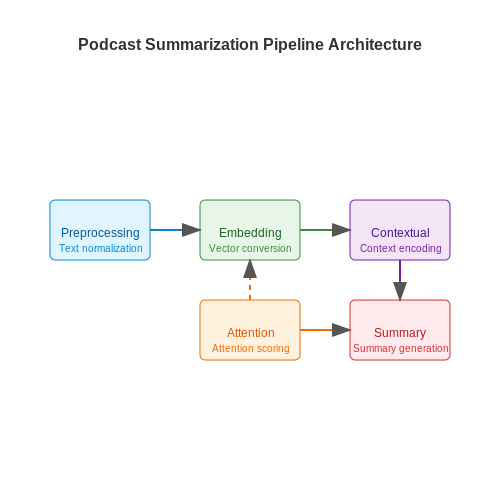
A robust podcast transcript summarization pipeline consists of multiple processing stages, each handling a specific subtask while maintaining contextual coherence. The core components include:
- Preprocessing Module: Handles text normalization, speaker diarization, and noise removal
- Embedding Layer: Converts text to dense vector representations
- Contextual Encoder: Captures long-range dependencies in spoken language
- Attention Mechanism: Identifies salient content segments
- Summary Decoder: Generates coherent abstractive summaries
Mathematical Foundations
The pipeline's effectiveness relies on several key mathematical constructs. The attention mechanism computes importance scores between encoder states and decoder positions:
where \( e_{ij} = a(s_{i-1}, h_j) \) is an alignment model scoring how well inputs around position \( j \) match output at position \( i \). The context vector \( c_i \) is computed as:
Transformer-Based Implementation
Modern pipelines typically employ transformer architectures. The scaled dot-product attention forms the core computation:
where \( Q \), \( K \), and \( V \) represent queries, keys, and values respectively, and \( d_k \) is the dimension of key vectors.
Practical Implementation Considerations
When implementing the pipeline, several technical challenges must be addressed:
  class PodcastSummarizer(nn.Module):
      def __init__(self, model_name="facebook/bart-large-cnn"):
          super().__init__()
          self.tokenizer = AutoTokenizer.from_pretrained(model_name)
          self.model = AutoModelForSeq2SeqLM.from_pretrained(model_name)
          self.audio_processor = Wav2Vec2Processor.from_pretrained("facebook/wav2vec2-base-960h")

      def forward(self, input_audio):
          # ASR transcription
          input_values = self.audio_processor(input_audio, return_tensors="pt").input_values
          transcription = self.asr_model.generate(input_values)

          # Text summarization
          inputs = self.tokenizer(transcription, return_tensors="pt", truncation=True)
          summary_ids = self.model.generate(
              inputs["input_ids"],
              num_beams=4,
              length_penalty=2.0,
              max_length=142,
              min_length=56,
              no_repeat_ngram_size=3
          )
          return self.tokenizer.batch_decode(summary_ids, skip_special_tokens=True)
Evaluation Metrics
System performance should be measured using both quantitative metrics and qualitative assessment:
- ROUGE: Measures n-gram overlap between generated and reference summaries
- BERTScore: Evaluates semantic similarity using contextual embeddings
- METEOR: Incorporates synonym matching and stemming
- Human Evaluation: Assesses coherence, relevance, and fluency
Optimization Techniques
Several advanced methods can enhance summarization quality:
- Knowledge Distillation: Transfer learning from larger teacher models
- Curriculum Learning: Gradually increasing input complexity
- Reinforcement Learning: Direct optimization of ROUGE scores
- Contrastive Learning: Improving discriminative capabilities
Handling Long-Form Content
Podcast transcripts often exceed standard transformer context windows. Effective strategies include:
- Hierarchical Encoding: Process segments independently then combine
- Memory Compression: Using memory networks or sparse attention
- Sliding Window: Processing overlapping chunks with attention masking
3.3 Optimizing for Computational Efficiency
Computational efficiency becomes critical when processing long-form audio transcripts, where sequence lengths routinely exceed 10,000 tokens. The quadratic memory complexity of transformer attention layers (O(n²) for sequence length n) necessitates architectural modifications and training strategies to maintain practical deployment costs.
Attention Mechanism Optimizations
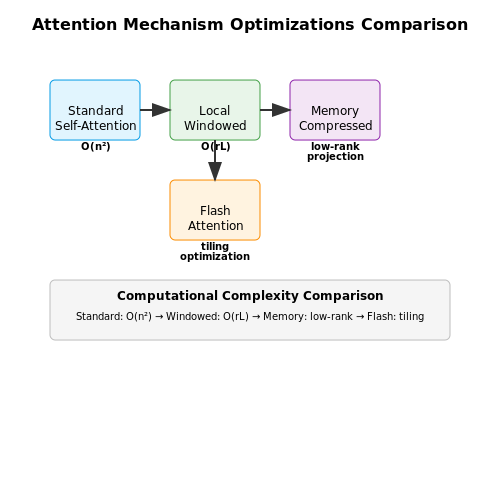
Standard self-attention computes pairwise interactions between all tokens. For a transcript split into L segments, the computational cost scales as:
where h is the number of attention heads, and dk, dv are key/value dimensions. Three proven approaches reduce this:
- Local windowed attention: Restricts attention to a fixed radius r around each token, reducing complexity to O(rL). Overlapping windows (e.g., Longformer's dilated attention) maintain global context.
- Memory-compressed attention: Projects the sequence into a fixed-size latent space via low-rank approximation. The Perceiver architecture demonstrates this with cross-attention layers that process inputs as compressed latent arrays.
- FlashAttention: Optimizes GPU memory access patterns through tiling, reducing memory reads/writes by 5-20× while maintaining numerical equivalence to standard attention.
Quantization and Distillation
Post-training quantization converts 32-bit floating point weights to 8-bit integers (INT8) or 4-bit representations (NF4). For a model with N parameters, this reduces memory footprint from 4N bytes to N bytes (INT8) or 0.5N bytes (NF4). The quantization error ϵ is bounded by:
where Δ is the quantization step size. Mixed-precision techniques preserve FP16 for sensitive layers (e.g., attention logits) while quantizing others.
Knowledge distillation trains a smaller student model (e.g., DistilBART) using:
where T and S are teacher/student logits, and α balances task loss against distribution matching.
Chunked Processing Strategies
For transcripts exceeding GPU memory limits, hierarchical processing splits the input into overlapping chunks. Each chunk Ci of length l is processed independently, with a final cross-chunk attention pass. The overlap δ between chunks follows:
where rk is the attention radius at layer k, ensuring no context gaps. Gradient checkpointing reduces memory by 60-75% by recomputing activations during backward passes rather than storing them.
Hardware-Aware Optimization
TensorRT optimizations for NVIDIA GPUs include:
- Kernel fusion to eliminate intermediate memory transfers
- FP16/INT8 execution with calibration
- Dynamic batching to maximize GPU utilization
On TPUs, model parallelism splits layers across cores, with communication-avoiding optimizations for the all-reduce operations during gradient synchronization.
4. Multimodal Summarization (Audio + Text)
4.1 Multimodal Summarization (Audio + Text)
Multimodal summarization leverages both audio and textual data to generate concise summaries, capturing not only the semantic content but also prosodic features like tone, emphasis, and pauses. Traditional text-only approaches discard valuable acoustic cues that can disambiguate meaning or highlight key points. A robust multimodal system integrates these modalities through joint representation learning, often employing transformer-based architectures with cross-modal attention mechanisms.
Architectural Components
The core architecture typically consists of:
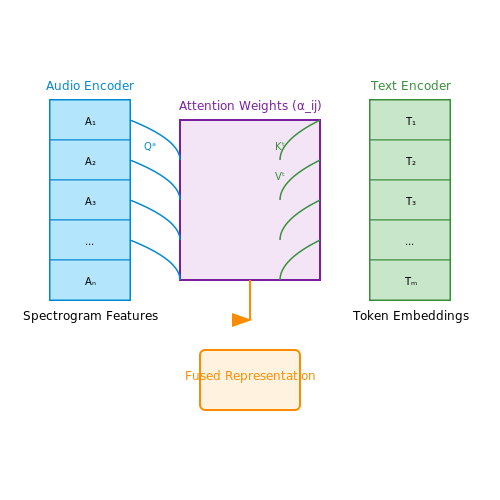
- Audio Encoder: Processes raw waveform or spectrogram inputs using CNNs or Wav2Vec-style transformers to extract frame-level features.
- Text Encoder: Embeds transcribed text via models like BERT or RoBERTa, preserving contextual relationships.
- Cross-Modal Fusion: Aligns temporal audio features with textual tokens using attention. For a sequence of audio frames A and text tokens T, the attention weights αij compute relevance between modality pairs:
where sim(·) is a similarity function (e.g., dot product or learned linear projection).
Temporal Synchronization Challenges
Audio and text streams are inherently asynchronous—a spoken phrase may span multiple words with varying durations. Dynamic time warping (DTW) can align sequences by minimizing the cumulative distance D between modalities:
where d measures cosine distance between embeddings, and ∅ denotes a null alignment.
Attention-Based Fusion
Modern systems replace DTW with self-attention layers that learn soft alignments. Given audio features Ha and text features Ht, multi-head cross-attention computes:
where Qa, Kt, Vt are linear projections of Ha and Ht, and dk is the key dimension.
Case Study: Podcast Summarization
In podcast datasets like Spotify’s Podcast Summarization Corpus, multimodal models achieve 12-15% higher ROUGE-L scores than text-only baselines by leveraging:
- Speaker diarization to attribute content
- Acoustic emphasis detection (pitch/tempo variations)
- Laughter and pause duration as summary relevance signals
Training employs a hybrid loss combining extractive objectives (tagging key segments) and abstractive objectives (sequence generation via T5 or BART).
Real-Time Summarization for Live Podcasts
Real-time summarization of live podcasts presents unique challenges due to the streaming nature of the input data and the need for low-latency processing. Unlike offline summarization, where the entire transcript is available, live summarization requires incremental processing with minimal delay. This necessitates specialized architectures and algorithms.
Streaming Transformer Architectures
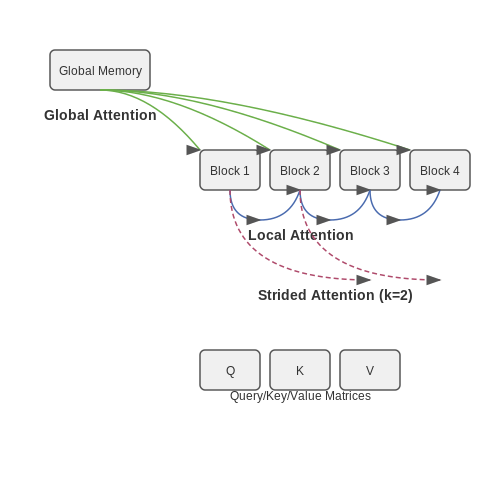
Standard Transformer models are ill-suited for real-time processing due to their full-sequence attention mechanism. Streaming variants modify the attention computation to operate on sliding windows or memory-compressed representations. The Blockwise Parallel Transformer processes input in fixed-size blocks with three attention types:
- Local attention within the current block
- Strided attention to previous blocks at regular intervals
- Global memory tokens that accumulate long-range context
Where the query (Q), key (K), and value (V) matrices are computed from different segments of the input stream. The computational complexity reduces from O(n²) to O(n) for sequence length n.
Incremental Summarization Algorithms
Two dominant approaches exist for incremental summarization:
- Extractive methods maintain a running importance score for each sentence using:
$$ s_t = \lambda s_{t-1} + (1-\lambda)f_\theta(x_t) $$where λ controls the decay rate and fθ computes sentence importance.
- Abstractive methods employ a dual-encoder architecture where:
$$ h_t = \text{GRU}(h_{t-1}, \text{Enc}(x_t)) $$$$ p(y_t|y_{<t}, h_{\leq t}) = \text{Dec}(y_{<t}, h_t) $$
Latency-Quality Tradeoffs
The end-to-end latency (L) comprises three components:
Where ASR latency typically dominates. Quality is measured using modified ROUGE scores that account for temporal aspects:
With weights w_i increasing linearly to emphasize recent content. State-of-the-art systems achieve 200-500ms latency with ROUGE-L scores within 15% of offline models.
Implementation Considerations
Key practical considerations include:
- Context management: Dynamic memory buffers that retain salient information beyond the immediate window
- Error recovery: Mechanisms to handle ASR errors and disfluencies common in live speech
- Adaptive batching: Variable-size batching that responds to input rate fluctuations
Modern implementations often use hybrid architectures combining convolutional layers for low-level feature extraction with recurrent components for temporal modeling and transformer blocks for high-level reasoning.
4.3 Ethical Considerations in Automated Summarization
Bias in Training Data and Model Outputs
Automated summarization models inherit biases present in their training data, which can propagate into generated summaries. For instance, if a dataset overrepresents certain demographics or viewpoints, the model may disproportionately emphasize those perspectives. Measuring bias quantitatively involves evaluating demographic parity or equalized odds in summary outputs. Let the probability of a summary containing a biased term t be:Contextual Integrity and Privacy Risks
Summarization models may inadvertently reveal sensitive information present in the original transcript. Differential privacy techniques can be applied to the model's training or inference phases to mitigate this. A differentially private mechanism M satisfies:Misinformation Amplification
Abstractive summarization models can hallucinate facts not present in the source material. This risk is quantified using the hallucination rate H:Accountability and Transparency
Model interpretability is critical for auditing summarization systems. Feature attribution methods like SHAP (Shapley Additive Explanations) quantify the contribution ϕi of each input token xi to the summary:Legal and Copyright Implications
Automated summarization of copyrighted content may violate derivative work provisions. The fair use analysis involves four factors:- Purpose and character of the use
- Nature of the copyrighted work
- Amount and substantiality used
- Effect on the market value
5. Key Research Papers in Summarization
5.1 Key Research Papers in Summarization
- PDF YouTube/Podcast Summarizer using AI - ir.juit.ac.in:8080 — 11 Figure U3.11: tilizes a Hugging Face summarization pipeline to summarize the transcript 27 12 Figure 3.12: Generates summaries for each chunk 27 13 Figure 3.13: Calculates thecosine similarity between transcript and final summary 28 14 Figure 3.14: Creates a heatmap to visualize thesimilarity score between transcript and summary. 28
- Papers-to-Posts: Supporting Detailed Long-Document Summarization with ... — While some prior work has investigated fully automatic summarization of long documents (Koh et al., 2022), a mixed-initiative approach allows users to have more control over their summaries, which is important in detail-oriented domains like scientific research.Prior work in human-AI text summarization has often focused on helping create short-form summaries around a paragraph in length, which ...
- PDF Text Summarization Using Natural Language Processing and Google ... - Irjet — URL link is given as input and Summary is generated and convert the Summary into Audio file Using GTTS API. In this paper, we show how to convert summarized text into Audio file Using GTTS API. Key Words: Text Summarization, Text Rank Algorithm, NLTK, GTTS(Google Text To Speech) API, Extractive Text Summarization 1. INTRODUCTION
- PDF Visual Summarization of Meeting Transcripts - ZHAW Zürcher Hochschule ... — 1. Introduction 5 1.4 Challenges Significant research efforts have been focused on summarizing single-speaker doc-uments such as text documents, news, or scientific work, automatically summa-rizing and extracting essential information. However, dialogue summarization, where multi-document analysis is needed,
- PDF Automatic Text Summarization using Natural Language Processing — Automatic Text Summarization using Natural Language ... 1.4 Methodology 3-5 1.6 Organization 5-6 2. LITERATURE SURVEY 7-23 3. SYSTEM DEVELOPMENT 3.1 NLP 24 ... Chapter 2: Includes literature survey. We have studied various papers and journal from reputed sources on machine learning and artificial neural network and have mentioned those in this ...
- PDF VIDEO TRANSCRIPT SUMMARIZER - Hindustan Univ — research documents that will support the development of this project, especially in the specific field of text summarization. Papers produced here, also discuss the types of text summarization like extractive summarization and abstractive summarization and various methods of carrying them out. 2.2 Review paper on Automatic Text Summarization
- A survey of text summarization: Techniques, evaluation and challenges — The evolution of text summarization approaches stands as a dynamic narrative, reflecting significant strides over time. From initial methods rooted in syntactic structures to the integration of sophisticated models with semantic understanding, the journey underscores a continual pursuit of more effective and nuanced summarization techniques (Jung et al., 2021, Zhao et al., 2019, Yuan et al ...
- Automated Article Summarization using Artificial Intelligence Using ... — Due to the growing amount of online content, automated article summarization using artificial intelligence (AI) has received a lot of interest lately.This study proposes a novel method to automate ...
- PDF Exploring Abstractive Text Summarisation for Podcasts: A Comparative ... — tences from the podcast transcript and then gener-ates a summary from these sentences. The system then allows users to rate the summary and provide feedback, which is used to refine the summary for future users. Vartakavi et al.(2021) proposed an extrac-tive summarisation approach for podcast episodes, where the summary is generated by ...
- Summarify Pro-YouTube and Audio Transcript Summarizer - ResearchGate — Now, using advanced AI algorithms, the clea ned-up text is distilled into a concise, easy-to-read summary that captures all the key points of the video. 4.3.7 Translation and Output Optio ns
5.2 Open-Source Tools and Libraries
- Effortlessly Summarize and Transcribe Podcasts with Obsidian and ... — Learn how to streamline your podcast summarization and note-taking process using the powerful combination of Obsidian and Fireflies AI. ... Enhancing the literature note with additional content 5.1 Adding a link to the podcast 5.2 Including the full transcript 5.2.1 Downloading the transcript from Fireflies 5.2.2 Evaluating the accuracy of the ...
- PDF VIDEO TRANSCRIPT SUMMARIZER - Hindustan Univ — Summarization 5 2.3 Automatic text summarization ... 5.1 Software used 21 5.2 Libraries and Frameworks used 21 5.3 Overview of Project Requirements 23 ... Thanks to the open-source and AI developer communities, programming a complex ML algorithm is now made easy, thereby making developers explore deeper. ...
- State of the Art NLP & LLM Libraries, Models, and Tools - John Snow Labs — John Snow Labs' NLP & LLM ecosystem include software libraries for state-of-the-art AI at scale, Responsible AI, No-Code AI, and access to over 40,000 models for Healthcare, Legal, Finance, and Visual NLP. ... Open Source. Open Source software, widely deployed, back by an active community. ... The Most Widely Used Human-in-the-loop Tool by ...
- PDF YouTube/Podcast Summarizer using AI - ir.juit.ac.in:8080 — 13 Figure 3.13: Calculates thecosine similarity between transcript and final summary 28 14 Figure 3.14: Creates a heatmap to visualize thesimilarity score between transcript and summary. 28 15 Figure 3.15: The important libraries were installed 29 16 Figure A3.16: function is made to get the transcript of the videos 29
- GitHub - neuml/txtai: All-in-one open-source AI framework for ... — All-in-one AI framework txtai is an all-in-one AI framework for semantic search, LLM orchestration and language model workflows. The key component of txtai is an embeddings database, which is a union of vector indexes (sparse and dense), graph networks and relational databases.
- Parse Podcasts With Python: Understanding Lex Fridman's Podcast With ... — Step 3: Pretty Print the Lex Fridman Podcast Transcripts. Now that we have the podcast transcripts with speaker diarization, let's make them look pretty. You can see what the raw transcripts look like in the GitHub folder. For this portion, we need to use the json and os libraries. We create two functions to turn the podcast transcript into a ...
- How is AI used for Podcasting? & AI tools — AI can be used to generate synthetic voices that can read your podcast episodes aloud, making it easier for listeners to consume content on the go. AI-powered audio editing tools can also help you enhance the sound quality of your recordings, remove background noise, and add music or sound effects. Check Speech synthesis and audio editing tools
- Text Summarization with Huggingface Transformers and Python - Rubix Code — In this article we explore three text summarization algorithms which can be applied with Huggingface transformers. ... dataset covers 44 different languages and it is the largest dataset based on the number of collected data from a single source. ... We also make the dataset curation tool available for the researchers, which will help to grow ...
- PDF Automated Text Summarization: A Review and Recommendations — This report presents an examination of a wide variety of automatic summarization models. We broadly assign summarization models into two overarching categories: extractive and abstractive summarization. Extractive summarization essentially reduces the summarization problem to a subset selection problem by returning portions of the input as the ...
- bert-extractive-summarizer · PyPI — docker build -t summary-service -f Dockerfile.service ./ docker run --rm -it -p 5000:5000 summary-service:latest -model bert-large-uncased Other arguments can also be passed to the server. Below includes the list of available arguments.-greediness: Float parameter that determines how greedy nueralcoref should be
5.3 Recommended Books and Online Courses
- PDF YouTube/Podcast Summarizer using AI - ir.juit.ac.in:8080 — 11 Figure U3.11: tilizes a Hugging Face summarization pipeline to summarize the transcript 27 12 Figure 3.12: Generates summaries for each chunk 27 13 Figure 3.13: Calculates thecosine similarity between transcript and final summary 28 14 Figure 3.14: Creates a heatmap to visualize thesimilarity score between transcript and summary. 28
- AI Transcription For Audio and Video | Rev — 30% discount on 99% accurate human transcripts, captions, and subtitles Access after free trial Upgrade to human transcripts or captions for $$1.39/min (reg price $$1.99) or global subtitles for $$4.54 to $$11.19 (reg price $$6.49 to $$15.99)Only Available after 30-Day Free Trial
- Symbolic and Statistical Learning Approaches to Speech Summarization: A ... — "The ratio of the number of words in the automatic summary to that in the original transcript of a spoken document" (Hori et al., 2002). ... Eight papers used dynamic programming for sentence compaction and finding the best summarization results (Hori et al., 2002; ... 5 (3) (2003), pp. 368-378. View in Scopus Google Scholar.
- Speech vs. Transcript: Does It Matter for Human Annotators in Speech ... — However, to the best of our knowledge, there has been little work examining how humans perform speech summarization. Such research is particularly important because the goal of abstractive summarization is to produce human-like summaries, and having high-quality human summaries is crucial for learning how to automatically summarize, i.e., for model training and evaluation.
- PDF VIDEO TRANSCRIPT SUMMARIZER - Hindustan Univ — The length of a transcript can be shortened by applying extractive summarization with Bert model and then the T5 model is used. Here, currently Sumy with Latent Semantic Analysis (LSA) summarizer is used. The method is proved to be a good for a base summarizer to tailor for video transcripts. The quality of the
- Quickstart: Use Summarization - Azure AI services — A summary of the customer issue in the customer-and-agent conversation. The Issue Summarization aspect must be toggled on for this to appear. Resolution: A summary of the solutions tried in the customer-and-agent conversation. The Resolution Summarization aspect must be toggled on for this to appear.
- (PDF) Automatic Text Summarization: A Comprehensive Survey - ResearchGate — documents such as books, 3) summarization of multi-documents (Hahn & Mani, 2000), 4) evaluation of the computer-generated summ ary without the need for the human -produced summary to be Page 3 of 46
- Automatic Speech Summarisation: A Scoping Review - arXiv.org — 5 . 3.2 Speech Features . Speech analysis can take advantage of a number of different features within an audio signal, and studies varied widely in the features used. Eight feature classes were identified (Table 3) with lexical, acoustic, and structural features most commonly used (Fig. 4).
- (PDF) Text Summarizing Using NLP - ResearchGate — Automatic Text Summarization (ATS) is the subsequent big one that could simply summarize the source data and give us a short version that could preserve the content and the overall meaning.