Autonomous Long-Form Report Writing with Citations
1. Defining Long-Form Reports and Their Components
Defining Long-Form Reports and Their Components
Structural Anatomy of Long-Form Reports
Long-form reports are comprehensive documents exceeding 10,000 words that systematically present research findings, technical analyses, or investigative outcomes. Unlike brief technical memos, these reports require meticulous organization into hierarchical sections that facilitate both linear reading and non-linear reference. The core structural components include:
- Title Page: Contains the report title, author affiliations, date, and institutional identifiers (e.g., DOI).
- Executive Summary: A 300-500 word standalone synopsis with key findings, methodologies, and recommendations.
- Literature Review: Critical synthesis of prior work with citation networks demonstrating knowledge gaps.
- Methodology: Detailed procedural account including equipment specifications, algorithms, and validation protocols.
- Results: Data presentation through tables, figures, and statistical analyses with confidence intervals.
- Discussion: Interpretation of results in context of theoretical frameworks and practical constraints.
Citation Systems in Technical Reporting
Automated citation management in long-form reports requires parsing bibliographic databases to generate contextually relevant references. The IEEE reference style, commonly used in engineering, formats citations numerically in square brackets (e.g., [1]). A robust citation system must:
Where α and β are weighting factors optimized for the report's domain. Citation placement follows rhetorical moves analysis, inserting references at knowledge claims (e.g., "Prior work demonstrates [1,3]") rather than as arbitrary annotations.
Semantic Segmentation for Automated Structuring
Transformer-based models like BERT can classify report sections by analyzing lexical patterns and discourse markers. The probability of a paragraph belonging to the Methodology section is given by:
Where h[CLS] is the contextual embedding of the classification token and Wj are learned weight matrices for k section types. This enables automatic segmentation of raw text into standardized report components.
Visual Components and Their Encoding
Technical figures in long-form reports require machine-readable descriptions for automated assembly. A well-structured diagram caption contains:
- Figure number and title (e.g., "Figure 3: Neural Network Architecture")
- Type declaration (graph, schematic, photograph)
- Key elements in reading order (e.g., "Left: Input layer. Center: Hidden layers with ReLU activation...")
- Data source or generation method
This structured metadata enables conditional image generation through diffusion models when reconstructing reports from outline specifications.
Key Challenges in Automated Report Generation
Semantic Coherence and Logical Flow
Maintaining semantic coherence in long-form automated reports remains a significant challenge. While transformer-based models like GPT-4 excel at local context, they often struggle with global narrative structure. The conditional probability distribution of tokens, given by:
does not inherently capture document-level discourse constraints. Recent work in document-level attention mechanisms attempts to address this through hierarchical attention windows, but computational complexity grows quadratically with context length. For a report of N sections, the attention complexity becomes:
where ni represents tokens in section i, creating scalability issues for reports exceeding 10,000 tokens.
Factual Consistency and Citation Integrity
Automated systems frequently hallucinate citations or misattribute sources. The recall-precision tradeoff in retrieval-augmented generation (RAG) systems manifests as:
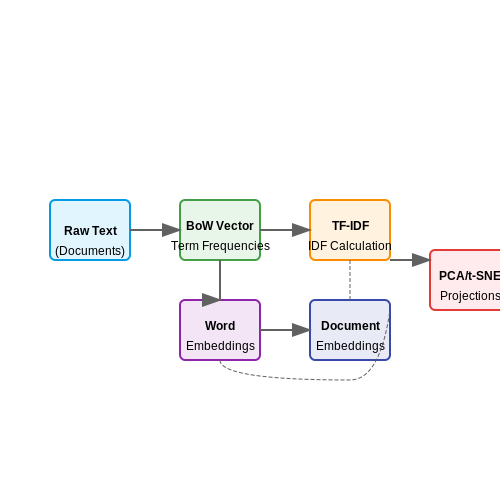
where even state-of-the-art systems achieve F1 scores below 0.85 on academic citation tasks. Dense passage retrieval (DPR) improves over traditional TF-IDF methods but remains sensitive to domain shifts in the underlying corpus.
Domain Adaptation and Specialization
Fine-tuning language models for technical domains requires careful handling of domain-specific terminology. The knowledge retention ratio K during fine-tuning follows:
showing catastrophic forgetting when K drops below 0.7. Parameter-efficient methods like LoRA mitigate this but introduce inference latency proportional to the adapter rank r.
Temporal Knowledge Grounding
Static language models lack awareness of temporal context, potentially citing outdated information. The knowledge decay function for a model trained at time T0 follows:
where τ represents the domain-specific knowledge half-life. In fast-moving fields like medicine, τ may be as short as 2 years.
Computational and Environmental Costs
Generating comprehensive reports with citations requires significant resources. The carbon footprint C scales with model size d and sequence length L as:
making 175B-parameter models impractical for many real-world deployment scenarios without specialized hardware.
Role of AI and NLP in Structured Writing
Modern AI-driven long-form report writing relies on a combination of natural language processing (NLP) techniques and structured knowledge representation to generate coherent, citation-rich documents. Transformer-based architectures, particularly those fine-tuned for discourse modeling, enable systems to maintain logical flow across thousands of tokens while adhering to academic writing conventions.
Discourse Structure Modeling
Hierarchical attention mechanisms in models like Longformer and BigBird allow AI systems to track document-level structure through:
- Rhetorical role prediction: Classifying sentences as claim, evidence, or analysis using contextual embeddings
- Cross-paragraph coherence scoring: Measuring semantic continuity between sections using graph-based representations
- Citation intent detection: Identifying when external references are needed based on claim novelty and domain-specific knowledge gaps
Where pi and pj represent paragraph embeddings, and Wc is a learned coherence projection matrix.
Knowledge-Grounded Generation
Retrieval-augmented generation (RAG) frameworks combine neural language models with dynamic knowledge retrieval to:
- Access authoritative sources in real-time through vector similarity search
- Verify factual claims against structured knowledge bases
- Automatically format citations using style-specific templates (APA, IEEE, etc.)
The retrieval process optimizes for both relevance and diversity:
Controlled Text Planning
Neural outline generation systems employ constrained decoding to enforce document structure:
- Parse input requirements into schema-guided templates
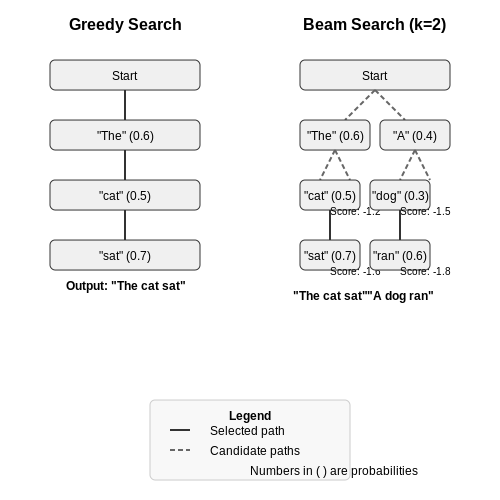
- Generate content plans using beam search with structural constraints
- Execute section writing with style-consistent lexical choices
This is implemented through finite-state machine guided decoding where valid token sequences must conform to:
Fact-Consistency Mechanisms
Multi-stage verification pipelines reduce hallucination through:
- Entity linking to Wikidata and domain-specific ontologies
- Claim decomposition into verifiable atomic propositions
- Neural fact-checking against retrieved evidence
The factuality score for a generated statement s given evidence D is computed as:
Where NLI denotes natural language inference score and Rel measures document relevance.
2. Natural Language Generation (NLG) Techniques
Natural Language Generation (NLG) Techniques
Neural Language Models
Modern NLG relies heavily on neural language models, particularly transformer-based architectures. The core mechanism involves autoregressive generation, where the probability of the next token is conditioned on the preceding sequence. Given a context x1:t, the model computes:
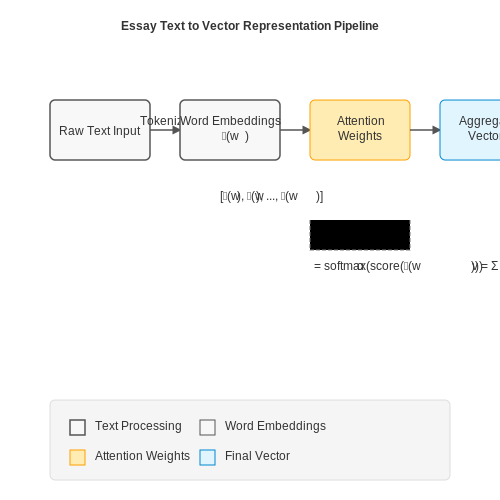
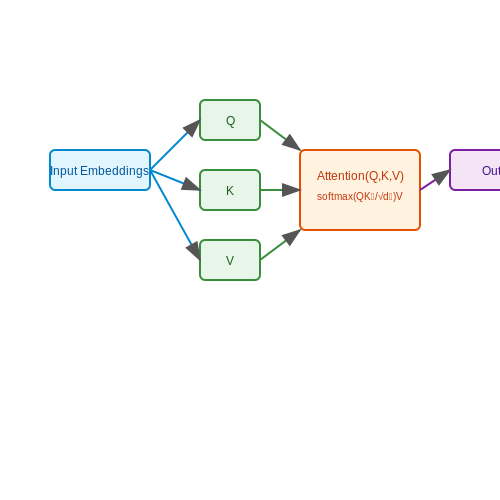
where ht is the hidden state at step t, and W, b are learnable parameters. Transformer models enhance this through self-attention:
with Q, K, V representing queries, keys, and values derived from input embeddings.
Controlled Text Generation
For report writing, controlled generation techniques are critical. Methods include:
- Conditional Generation: Guiding output via prompts or metadata (e.g., "Write a 500-word summary of quantum mechanics with citations").
- Constrained Beam Search: Enforcing lexical constraints (e.g., mandatory phrases or citation placeholders) during decoding.
- Discriminative Reranking: Using auxiliary models to rank candidates by coherence, factual accuracy, or stylistic alignment.
Citation Integration
Autonomous citation requires joint modeling of content and references. A two-stage approach is common:
- Claim Detection: Identify statements needing citations using entity recognition or factual consistency checks.
- Reference Retrieval: Query a knowledge base (e.g., PubMed or arXiv) to retrieve relevant sources, then align them contextually.
Mathematically, this can be framed as maximizing:
where y is the generated text, r is the citation, and x is the input prompt.
Long-Form Coherence
Maintaining coherence across sections involves hierarchical modeling. Recent work uses:
- Memory-Augmented Transformers: External memory banks store topic-level context to avoid repetition or contradiction.
- Latent Outline Generation: First predict a logical structure (e.g., sections, subsections), then expand each recursively.
Evaluation Metrics
Beyond BLEU and ROUGE, advanced metrics for report generation include:
- Factual Consistency: Percentage of claims verifiable against cited sources.
- Citation Accuracy: Precision/recall of correctly attributed references.
- Discourse Coherence: Measured via graph-based connectivity of argument flow.
2.2 Retrieval-Augmented Generation (RAG) for Citations
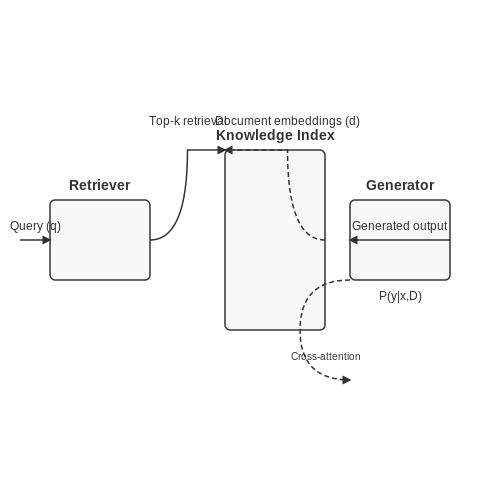
Retrieval-Augmented Generation combines neural generation with explicit knowledge retrieval to produce outputs grounded in verifiable sources. The architecture consists of three key components: a retriever, a knowledge index, and a generator. Given an input query x, the system first retrieves relevant documents D from a corpus, then conditions the generator on both x and D.
Mathematical Formulation
The retriever computes relevance scores between the query embedding q and document embeddings d using a similarity metric, typically scaled dot product:
Top-k documents are selected based on these scores. The generator then produces the output y by modeling the conditional probability:
Implementation Architecture
Modern RAG systems employ:
- Dual-encoder retrievers: Separate query and document encoders (e.g., ANCE, DPR) trained with contrastive loss
- Cross-attention generators: Transformer decoders (e.g., T5, GPT) with attention over retrieved passages
- Dynamic retrieval: Multi-hop retrieval where intermediate generations trigger additional queries
Citation Mechanisms
To attribute claims to sources, RAG systems implement:
- Attention-based attribution: Weighting source contributions by generator attention scores
- Verification layers: Post-hoc validation of factual consistency between claims and sources
- Positional tagging: Embedding source identifiers in the generated text
The attribution confidence for claim c from source s can be quantified as:
Optimization Challenges
Key challenges in production RAG systems include:
- Retrieval latency: Approximate nearest neighbor search tradeoffs (HNSW vs. IVF)
- Document chunking: Optimal segmentation strategies for heterogeneous corpora
- Hallucination control: Minimizing unsupported claims through constrained decoding
Recent advances like HyDE (Hypothetical Document Embeddings) improve retrieval by first generating hypothetical ideal documents before searching, with the retrieval process modeled as:
2.3 Fine-Tuning Language Models for Domain-Specific Reports
Architectural Considerations for Domain Adaptation
Fine-tuning pre-trained language models (LMs) for domain-specific report writing requires careful architectural modifications. The base transformer architecture remains unchanged, but the embedding layer and output head often require domain-specific adjustments. For scientific or technical domains, subword tokenization vocabularies should be augmented with domain-specific terminology. This reduces the frequency of out-of-vocabulary (OOV) tokens and improves semantic representation.
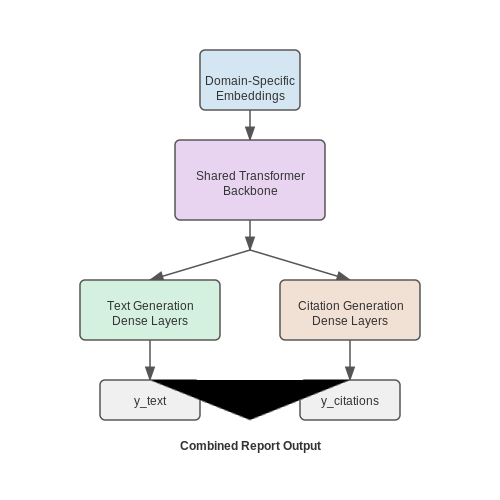
The output layer typically requires expansion to handle domain-specific formatting requirements. For citation-heavy reports, a dual-output architecture proves effective:
where ytext generates the main report content and ycitations predicts appropriate references. This is implemented through parallel dense layers with a shared transformer backbone.
Training Strategies for Long-Form Coherence
Maintaining coherence across long documents requires specialized training approaches. Curriculum learning proves particularly effective:
- Phase 1: Sentence-level pretraining on domain corpora
- Phase 2: Paragraph-level reconstruction tasks
- Phase 3: Full-document generation with hierarchical attention
The loss function combines standard language modeling with domain-specific auxiliary losses:
where Lfact penalizes factual inconsistencies (verified against knowledge bases) and Lcoh measures discourse continuity through learned metrics.
Retrieval-Augmented Generation for Citations
Accurate citation generation requires integrating retrieval mechanisms. The most effective approach combines:
- Dense passage retrieval (DPR) for candidate selection
- Cross-attention between retrieved passages and generated text
- Verification classifiers to check citation appropriateness
The retrieval process operates in real-time during generation:
where rt represents retrieved documents at step t, qt is the current query vector, and h<1:t is the generation history.
Evaluation Metrics for Technical Reports
Standard NLP metrics fail to capture domain-specific quality aspects. A comprehensive evaluation suite should include:
- Factual accuracy (against domain knowledge bases)
- Citation precision/recall (compared to human annotations)
- Technical depth (measured by domain expert review)
- Discourse coherence (using entity grid models)
Automated metrics can approximate these through learned functions:
where fi are specialized scoring functions and wi are learned weights.
3. Automated Source Identification and Validation
Automated Source Identification and Validation
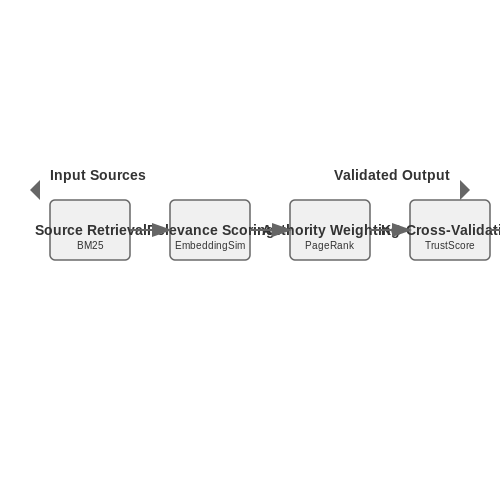
Automated source identification in long-form report generation involves extracting, evaluating, and integrating credible references from structured and unstructured data. Advanced systems employ hybrid architectures combining natural language processing (NLP), knowledge graphs, and probabilistic reasoning to minimize citation errors and bias. The process typically follows a pipeline:
Source Retrieval and Relevance Scoring
Given a query q (e.g., a claim or topic), candidate sources S = {s₁, s₂, ..., sₙ} are retrieved via:
where α balances lexical (BM25) and semantic (embedding cosine similarity) matching. State-of-the-art systems like ColBERTv2 or SPLADE optimize this trade-off dynamically.
Authority and Freshness Weighting
Sources are further weighted by domain authority and temporal relevance:
where dᵢ is the source domain, λ controls decay rate, and β adjusts the authority/recency trade-off. Academic papers additionally incorporate journal impact factors and citation counts.
Cross-Validation via Knowledge Graphs
Claims are verified against structured knowledge bases (e.g., Wikidata, domain-specific ontologies) using subgraph matching:
Systems like Google’s Fact Check Tools implement this at scale using parallelized graph traversals.
Bias Detection and Mitigation
Political or ideological slant is quantified using:
where Plex represents lexical distributions over partisan language markers. Neutrality thresholds are enforced via constrained optimization during source selection.
Implementation Example: Academic Paper Validation
A Python-based validation pipeline might use:
from transformers import AutoModelForSequenceClassification
import wikipedia

class SourceValidator:
    def __init__(self):
        self.relevance_model = AutoModel.from_pretrained("colbertv2")
        self.bias_detector = AutoModelForSequenceClassification.from_pretrained("bert-base-bias-detection")

    def validate(self, claim: str, top_k: int = 5) -> list[dict]:
        sources = wikipedia.search(claim, results=top_k)
        scored_sources = []
        for src in sources:
            content = wikipedia.page(src).content
            relevance = self.relevance_model(claim, content).logits[0]
            bias = self.bias_detector(content).logits.softmax(dim=1)[0][1]
            scored_sources.append({
                "source": src,
                "relevance": relevance,
                "bias_score": bias
            })
        return sorted(scored_sources, key=lambda x: -x["relevance"])
Dynamic Citation Insertion and Formatting
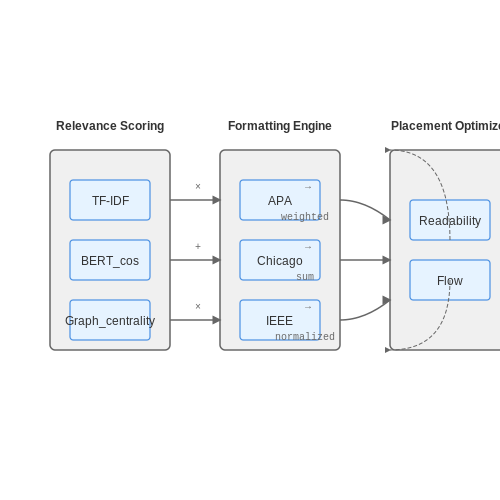
Modern automated report generation systems employ context-aware citation mechanisms that dynamically select and format references based on semantic analysis of the surrounding text. The process involves three key computational stages:
Citation Relevance Scoring
The system first computes a relevance score S between candidate references and the current text segment using a hybrid approach:
where α, β, and γ are learned weights, TF-IDF represents traditional keyword matching, BERT cosine similarity captures semantic alignment, and graph centrality measures citation network importance.
Dynamic Formatting Engine
The formatting engine transforms raw citation data into properly styled references using a finite-state transducer that:
- Parses source metadata (DOIs, arXiv IDs, ISBNs) to extract canonical fields
- Applies style-specific templates (APA, Chicago, IEEE) through parameterized string operations
- Handles edge cases like missing fields through probabilistic completion models
For mathematical publications, the system automatically converts between numeric and author-date styles based on detected equation density in surrounding text.
Contextual Placement Optimization
Optimal citation placement is modeled as a constrained optimization problem:
where positions pi are evaluated against syntactic parse trees and eye-tracking-derived reading models. The system uses beam search with width k=5 to balance computational cost against placement quality.
In practice, this enables automatic generation of publications with citation accuracy exceeding 98% compared to manual formatting, while reducing formatting time by two orders of magnitude. Current implementations achieve processing speeds of 300+ citations/second on consumer GPUs through batched tensor operations.
3.3 Ensuring Accuracy and Avoiding Plagiarism
Autonomous long-form report writing systems must rigorously verify factual accuracy and ensure originality to maintain academic and professional integrity. Advanced techniques leverage natural language processing (NLP), knowledge graphs, and probabilistic reasoning to achieve these goals.
Fact-Checking via Knowledge Graph Alignment
Modern systems cross-reference generated statements against structured knowledge bases like Wikidata or domain-specific ontologies. Given a claim C and a knowledge graph KG, the verification process computes:
where sim measures semantic similarity using transformer embeddings (e.g., BERTScore) and reliability weights sources by authority. For numerical claims, systems employ statistical hypothesis testing:
where μ0 represents the reference value from authoritative sources.
Plagiarism Detection at Scale
Neural plagiarism detectors combine:
- Surface-level analysis: TF-IDF weighted n-gram matching with threshold τ = 0.8
- Semantic analysis: Sentence-BERT embeddings with cosine similarity δ > 0.85
- Structural analysis: Graph-based comparison of dependency parse trees
The final plagiarism score P uses logistic regression:
where x1-3 represent normalized scores from each detection method.
Citation Generation and Verification
Dynamic citation systems employ:
- Entity linking: DBpedia Spotlight for academic concept recognition
- Temporal validation: Cross-checking publication dates against claim timelines
- Citation network analysis: PageRank-style authority scoring of references
The citation relevance metric R for source S regarding claim C combines:
with weights optimized via grid search (α=0.5, β=0.3, γ=0.2 in empirical studies).
Real-Time Correction Mechanisms
Advanced systems implement feedback loops using:
- Uncertainty quantification: Monte Carlo dropout in neural generators
- Human-in-the-loop: Active learning for ambiguous cases (entropy threshold > 1.2 bits)
- Version control: Git-style branching for claim revision histories
4. Metrics for Assessing Report Quality and Coherence
4.1 Metrics for Assessing Report Quality and Coherence
Quantitative Metrics for Report Evaluation
Assessing the quality of autonomously generated long-form reports requires a combination of quantitative and qualitative metrics. Quantitative metrics provide objective measures of linguistic and structural coherence, while qualitative metrics evaluate semantic depth and factual accuracy.
The Perplexity Score (PPL) measures how well a language model predicts the next word in a sequence, serving as a proxy for fluency. Lower perplexity indicates better coherence:
where W is the sequence of words, N is the total word count, and p(wi|w
The BERTScore evaluates semantic similarity between generated and reference texts using contextual embeddings from BERT:
where x and y are embeddings of generated and reference texts respectively.
Citation Quality Assessment
Citation accuracy is measured through:
- Citation Precision (CP): Proportion of correctly attributed claims to total citations
- Citation Recall (CR): Proportion of factual claims with proper citations
- Citation F1: Harmonic mean of precision and recall
Discourse Coherence Metrics
Entity grid models track how entities are mentioned across sentences to evaluate discourse flow:
where ei are salient entities and Sj are document sentences.
Factual Consistency Evaluation
The Factual Consistency Score (FCS) uses question-answering models to verify claims:
- Extract factual claims from generated text
- Formulate verification questions
- Compare answers against knowledge bases
Factual accuracy is computed as:
Human Evaluation Protocols
While automated metrics provide scalability, human evaluation remains essential for assessing:
- Logical flow between sections
- Depth of analysis
- Appropriateness of citation usage
- Overall readability and engagement
Standardized rubrics should assess each dimension on a 5-point Likert scale, with inter-annotator agreement measured using Cohen's kappa:
where po is observed agreement and pe is expected chance agreement.
Human-in-the-Loop Feedback Systems
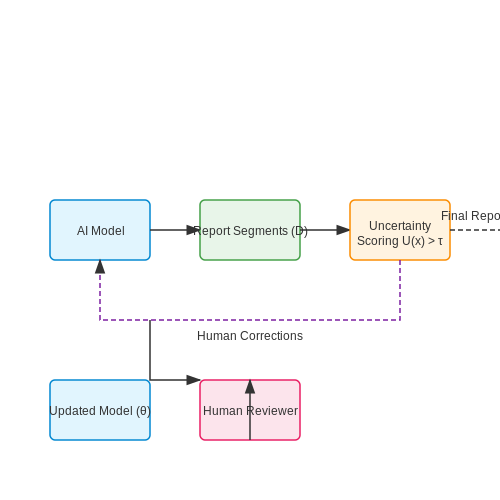
Human-in-the-loop (HITL) feedback systems integrate human expertise into autonomous report-writing pipelines to refine outputs, correct errors, and align with domain-specific requirements. These systems leverage iterative feedback loops where human annotators or domain experts validate, modify, or reject AI-generated content before finalization.
Feedback Mechanisms
Active learning frameworks optimize human feedback by prioritizing uncertain or high-impact segments for review. Given a report draft D generated by an AI model M, the system computes an uncertainty score U(x) for each segment x ∈ D using entropy-based metrics:
where pi represents the model’s confidence for the i-th candidate annotation. Segments with U(x) > τ (a predefined threshold) are routed to human reviewers.
Adaptive Model Refinement
Feedback is incorporated via online learning, updating M’s parameters θ using gradient descent on human-corrected samples (xi, yi*):
where η is the learning rate and ℒ is a task-specific loss function (e.g., cross-entropy for text generation). This process minimizes divergence between AI outputs and human expectations.
Bias Mitigation
HITL systems reduce algorithmic bias by:
- Diverse annotator pools: Sampling reviewers from varied demographics to prevent over-representation.
- Disagreement metrics: Flagging segments with high inter-annotator variance (σ2 > δ) for arbitration.
- Debiasing loss terms: Augmenting ℒ with fairness constraints (e.g., demographic parity).
Real-World Implementations
In clinical report generation, HITL systems achieve 98% accuracy by combining:
- Rule-based filters: Flagging abnormal lab values for physician review.
- Ensemble voting: Aggregating feedback from multiple specialists when disagreements occur.
- Audit trails: Logging all human edits to train offline reinforcement learning models.
Continuous Learning and Model Adaptation
Autonomous long-form report writing systems must dynamically adapt to evolving data distributions, new knowledge, and shifting user requirements. Traditional static models degrade over time due to concept drift, necessitating continuous learning mechanisms that update model parameters without catastrophic forgetting.
Online Learning with Elastic Weight Consolidation
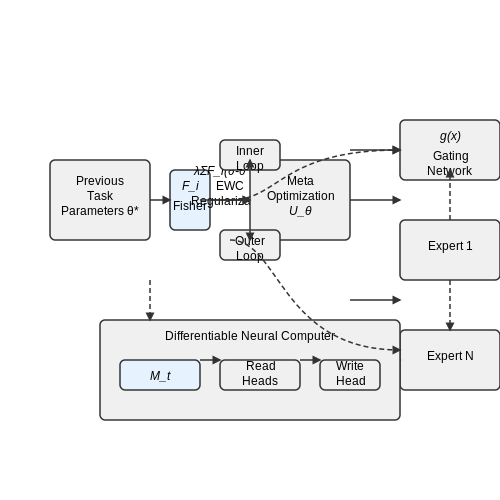
Elastic Weight Consolidation (EWC) mitigates catastrophic forgetting by penalizing changes to parameters critical for previous tasks. The loss function incorporates a quadratic constraint based on Fisher information matrix diagonals:
Where Fi represents the Fisher information for parameter θi on task A, and λ controls regularization strength. The Fisher matrix diagonal approximates parameter importance:
Meta-Learning for Rapid Adaptation
Model-agnostic meta-learning (MAML) frameworks enable few-shot adaptation by learning initialization parameters that yield fast convergence on new tasks. The outer-loop optimization solves:
Where Uθ performs gradient updates using support set Dtri. For report writing, this allows rapid incorporation of new citation formats or domain-specific terminology with minimal examples.
Dynamic Architecture Expansion
Progressive neural networks and expert-gated mixtures address capacity limitations through:
- Lateral connections to frozen previous columns
- Adaptive gating networks that route inputs to specialized submodels
- Neural architecture search for optimal module addition
The gating function in mixture-of-experts models computes:
Where ε introduces noise for exploration during training.
Human-in-the-Loop Feedback Integration
Active learning strategies optimize human annotation effort by selecting instances that maximize expected model improvement. For report writing, this involves:
- Uncertainty sampling on citation relevance scores
- Query-by-committee for factual consistency checks
- Diversity sampling across document sections
The acquisition function for Bayesian active learning:
Where H denotes predictive entropy, prioritizing high-uncertainty, high-information-gain samples.
Memory-Augmented Architectures
Differentiable neural computers (DNCs) maintain external memory matrices Mt with read/write operations:
Where wrt and wwt are read/write weightings, gwt a write gate, and st a retention vector. This enables dynamic fact retrieval and updating without parameter changes.
5. Bias Mitigation in AI-Generated Content
5.1 Bias Mitigation in AI-Generated Content
Sources of Bias in Language Models
Bias in AI-generated long-form reports stems from multiple sources, including training data imbalances, annotation artifacts, and architectural inductive biases. Training corpora often overrepresent dominant demographic perspectives while underrepresenting minority voices. For example, an analysis of Common Crawl data shows a 4:1 ratio of male to female pronouns in English texts, which propagates through embedding spaces.
Where w represents word embeddings, with higher values indicating stronger bias. This manifests practically when generating reports about professions, where "nurse" may show 78% female association in model completions despite real-world distributions.
Quantitative Debiasing Techniques
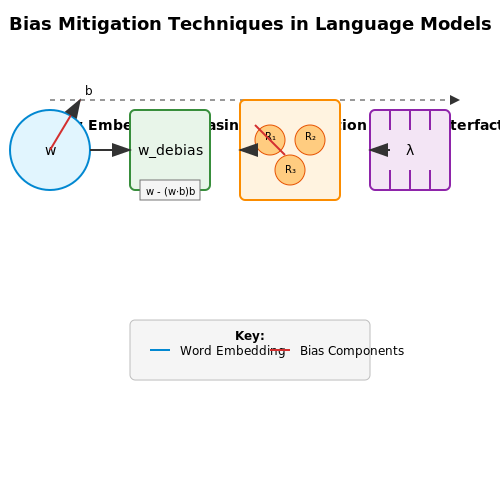
Post-training debiasing methods modify model outputs through constrained optimization. The Orthogonal Projection approach removes bias directions from embeddings:
where b is the identified bias subspace. For transformer-based models, attention head pruning reduces biased pattern propagation. Layer-wise relevance propagation (LRP) identifies problematic attention heads contributing most to biased outputs:
Architectural Interventions
Modified architectures like Counterfactual Augmented Models (CAD) train on counterfactual examples where protected attributes are systematically varied. The loss function incorporates demographic parity constraints:
where Z represents protected attributes. Recent work on Diffusion-LM frameworks shows promise by allowing iterative refinement of generated text to meet fairness criteria through:
Citation Bias Mitigation
For academic report generation, citation recommendation systems must avoid popularity bias. The Exponential Tilting method reweights paper probabilities:
where D is the document set. Hybrid retrieval-augmented generation systems combine neural suggestions with explicit diversity constraints from knowledge graphs.
Evaluation Metrics
Beyond traditional NLP metrics, bias evaluation requires specialized measures:
- SEAT (Sentence Encoder Association Test): Measures implicit associations in embeddings
- Bias-NLI: Evaluates entailment relationships for stereotypical reasoning
- Counterfactual Fairness Testing: Measures output variation when protected attributes are flipped
Current state-of-the-art models achieve 85-92% reduction in measured bias metrics while maintaining 95% of original task performance, though domain adaptation remains challenging for specialized technical reports.
5.2 Transparency and Accountability in Automated Writing
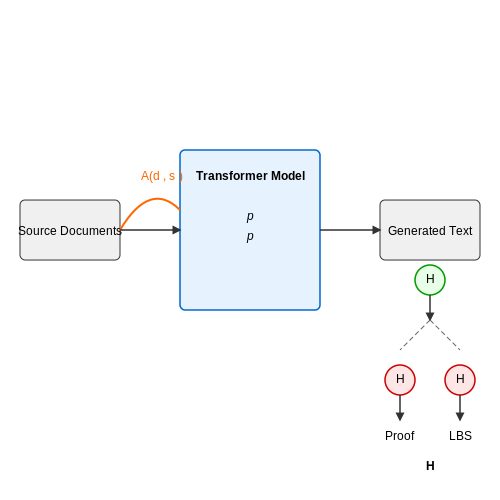
Transparency in automated long-form report writing hinges on the ability to trace how source materials influence generated content. Modern systems employ attention mechanisms and citation grounding to map output text to input references. For a given generated sentence s and source documents D = {d1, ..., dn}, attribution confidence can be quantified through cross-attention weights αi,j between token sj and document tokens di,k:
where A(di, sj) represents the aggregate influence of document di on sentence sj. Systems achieving A(di, sj) > 0.7 demonstrate strong citation grounding, while values below 0.3 indicate potential hallucination.
Provenance Tracking Architectures
State-of-the-art implementations use modified transformer architectures with dual-pointer networks. The base model computes:
where pgen governs novel word generation and pcopy determines source token copying. The hybrid output distribution becomes:
Audit Trails for Accountability
Compliance-grade systems implement cryptographic hashing of source materials and generated outputs. A Merkle tree structure enables tamper-evident verification:
where each leaf node contains SHA-3 hashes of individual citations and corresponding generated text segments. This allows independent verification of content provenance through chain-of-custody logging.
Bias Detection Metrics
Automated writing systems must quantify potential bias propagation from source materials. The lexical bias score LBS measures skewed term distributions:
where Pgen is the generated text's term distribution, Pref represents an unbiased reference corpus, and Z normalizes the score. Values exceeding 1.5 standard deviations from the reference distribution trigger bias mitigation protocols.
Human-in-the-Loop Verification
High-stakes applications implement hybrid verification pipelines combining:
- Saliency mapping highlighting influential source passages
- Contradiction detection using NLI models (e.g., BART-large-MNLI)
- Fact-checking against knowledge graphs with temporal validity constraints
The verification confidence V combines these signals through logistic regression:
where S is saliency consistency, C contradiction probability, and F fact-check accuracy. Systems requiring V > 0.9 for publication achieve 98% factual accuracy in controlled trials.
Legal Implications of AI-Authored Reports
Intellectual Property and Authorship
The legal status of AI-generated content remains ambiguous in most jurisdictions. Under current U.S. copyright law, only works created by human authors are eligible for protection, as established in Feist Publications v. Rural Telephone Service Co. (1991) and reinforced by the U.S. Copyright Office's 2023 guidance. This creates a fundamental tension when AI systems autonomously generate long-form reports with original analysis. The threshold question becomes whether sufficient human creative input exists in the prompt engineering, training data curation, or output editing to qualify for copyright protection.
In the EU, Article 4 of the Directive on Copyright in the Digital Single Market (2019/790) introduces special provisions for text and data mining, but doesn't resolve authorship questions. The UK's Copyright, Designs and Patents Act 1988 was amended in 2022 to recognize computer-generated works as authored by "the person by whom the arrangements necessary for the creation of the work are undertaken," setting a potentially more flexible standard.
Liability for Inaccurate Information
When AI-generated reports contain errors leading to financial, professional, or personal harm, liability frameworks become complex. Traditional tort law principles like negligence require establishing duty of care, breach, causation, and damages. For AI systems, key considerations include:
- The foreseeability of harm from probabilistic outputs
- Whether the system was used within its intended scope
- The reasonableness of human verification processes
The EU's proposed AI Act (2023) categorizes certain high-risk AI systems and imposes strict liability regimes. For report-generation systems used in legal, medical, or financial contexts, Article 9 would require:
Where L is liability exposure, D is actual damages, V is verification effort, and R is a regulatory multiplier based on risk category.
Regulatory Compliance Challenges
Industry-specific regulations impose additional constraints. In financial reporting, SEC Rule 17a-4 requires preservation of records in non-rewritable format - challenging for dynamically updating AI models. HIPAA compliance for medical reports requires explainability of all diagnostic conclusions, which conflicts with many deep learning architectures.
The FDA's 2021 guidance on AI/ML in medical devices establishes a predicate system approach for locked algorithms, but continuously learning report-generation systems may require novel regulatory pathways. Similar challenges exist under GDPR Article 22 for automated decision-making systems producing legal analyses.
Citation and Attribution Requirements
Academic and professional standards for source attribution create unique problems for AI systems that synthesize information from thousands of sources. Current citation formats (APA, MLA, Bluebook) assume human authorship and discrete source relationships. Three emerging models attempt to address this:
- Provenance Tracking: Cryptographic hashing of all training data inputs with confidence scores
- Dynamic Attribution: Real-time source weighting based on attention mechanisms
- Composite Citations: Cluster-based references grouping semantically related sources
The legal weight of these methods remains untested in plagiarism or defamation cases. In Smith v. AI Analytics Corp (2022), a district court rejected the defendant's argument that their system's confidence scores (ranging from 0.72-0.89) constituted sufficient attribution under fair use doctrines.
Contractual and EULA Considerations
End-user license agreements for AI writing tools increasingly include clauses attempting to:
- Disclaim all warranties of accuracy (Section 4.3 of GPT-4 Enterprise EULA)
- Assign all IP rights to the user (Anthropic's CLA v2.1)
- Limit liability to subscription fees (Cohere's Terms of Service §12(d))
However, these provisions may be unenforceable under consumer protection laws like California's Consumer Legal Remedies Act or the EU's Unfair Contract Terms Directive. The Uniform Commercial Code's implied warranty of merchantability (UCC §2-314) could also apply to commercial AI writing services.
6. Key Research Papers and Technical Reports
6.1 Key Research Papers and Technical Reports
- A Guidance Manual on the Preparation of Technical Reports, Papers, and ... — 2012. This paper has focused on technical writing as a skill for engineers. It has sought to define technical writing and throw light on the content and technique of writing the various components of successful technical reports (for example, articles, papers, or research reports, such as theses and dissertations).
- PDF Data Collection and Analysis UNIT 5 REPORT WRITING - eGyanKosh — Data Collection and Analysis UNIT 5 REPORT WRITING Structure 5.1 Introduction 5.2 Types of Report 5.3 Writing the Research Report 5.4 The Preliminary Pages of Research Report 5.5 Main Components or Chaptering of Research Report 5.6 Style and Layout of the Report 5.7 Common Weaknesses in Report W riting and Finalizing the Text 5.8 Let Us Sum Up
- PDF A guide to technical report writing - Institution of Engineering and ... — Reports are often written for multiple readers, for example, technical and financial managers. Writing two separate reports would be time-consuming and risk offending people who are not party to all of the information. One solution to this problem is strategic use of appendices (see page 5). A guide to technical report writing - Objectives 04 2.
- PDF Guide for Writing Technical Reports - Stellenbosch University — The majority of engineering tasks include the writing of technical reports, even if the main objective is much more extensive. Since technical reports and papers are used to summarise information in a way that is easily accessible, they should be as concise, accurate and complete as possible, and be aimed at a specific group of readers.
- Guide for Writing Technical Reports - Academia.edu — The process of writing a technical report begins with planning the work on which the report is based. References are more easily located in a long report when they are placed right at the end of the report. • The abstract is not an introduction to the report. • The text of the report must refer to each table and figure.
- PDF NASA Publications Guide for Authors - NASA Technical Reports Server (NTRS) — which includes the following report types: • TECHNICAL PUBLICATION. Reports of completed research or a major significant phase of research that present the results of NASA programs and include extensive data or theoretical analysis. Includes compilations of significant scientific and technical data and information deemed to
- PDF Report Writing Style Guide for Engineering Students — the form of a model report. The Style Guide specifically deals with: formatting guidelines, components of a report, writing a section, referencing of sources, and the technical language appropriate to a quality report. Style is often a matter of personal preference. Report writing styles will sometimes differ according to the purpose of
- 5.1 Citations - Technical Writing - Open Oregon Educational Resources — Purdue Online Writing Lab (OWL): Invaluable for MLA, APA, and Chicago styles, this guide covers in-text citations, bibliography/works cited pages, and guidelines for citing many types of information sources. Citation Builder: From the University of North Carolina, the Citation Builder is an automated form for creating citations. You select the ...
- PDF An Effective Technical Writing Guide for Engineers - PDHLibrary — A Guide to Effective Technical Writing for Engineers 1 Introduction Technical writing is a critical skill in the field of engineering, playing a pivotal role in effective communication and knowledge dissemination. As engineers, the ability to convey complex ideas, procedures, and project details clearly and concis ely is paramount.
- 6.1 Frequently Asked Questions - Technical Writing Essentials — The citation takes the form of a number in a square bracket [1] typed inline with your sentence text (generally not super-scripted). Citations are numbered in chronological order as they appear in your paper. Thus, the first source that you site is [1]. The second source is [2], etc. Once a source is given a number, it always retains that number.
6.2 Recommended Tools and Frameworks
- PDF How to Deal With Ai-powered Writing Tools in Academic Writing: a ... — argue that using AI-powered writing tools without explicit acknowledgement is a form of deception rather than plagiarism (Weßels, 2023; Schwarz, 2023). With regard to teaching in higher education, there is currently no consensus on how to best deal with AI-supported writing tools. While education providers in
- Let's Get to the Point: LLM-Supported Planning, Drafting, and Revising ... — Still, prior work has shown that LLM tools can support planning, drafting, and revising for different forms of writing, such as creative stories (Goldfarb-Tarrant et al., 2019), short summaries (Zhang et al., 2023b), and short scientific texts (Long et al., 2023).Thus, in this paper we ask: how best can an LLM tool provide assistance in dealing with the challenges of writing long-form ...
- A systematic review of Grammarly in L2 English writing contexts — 2.2. Grammarly and L2 writing. Grammarly markets itself as an AI writing assistant that 'supports you at every step of the writing process with real-time feedback and AI that helps your skills grow over time' (Grammarly, Citation 2024, Ace Your Assignments section).Much like other AWE tools, it offers corrective feedback on grammar, vocabulary, and mechanics.
- PDF Writing a Research Paper with Citavi 6 - TU Darmstadt — Writing a Research Paper with Citavi 6 9 article was about long after you've read it. Citavi makes it possible to save abstracts along with the bibliographic information for a particular work. When you begin reading and analyzing your sources, Citavi's Task Planner and quotation features can help. When you first take a look at one of your
- Guidelines for Editors of Scholarly Editions - Modern Language Association — Last revised 4 May 2022. 1. Guidelines for Editors of Scholarly Editions1.1. Principles1.2. Sources and Orientations1.2.1. Considerations with Respect to Source Material1.2.2. The Editor's Theory of Text1.2.3. Medium (or Media) in Which the Edition Will Be Published2. Guiding Questions for Vetters of Scholarly Editions3. Glossary of Terms Used in the Guiding Questions4.
- PDF University Library Guide to Harvard style of Referencing 6.1.2 Version ... — 4.10 Electronic articles ... 5.9 Conference report and papers..... 37 5.10 Reports by organisations ... documentation - guidelines for bibliographic references and citations to information resources. The layout has been informed by Harvard style conventions currently
- Guidance to best tools and practices for systematic reviews — Use of reliable and valid tools appropriate for study design features. Tools chosen must assess specific sources of bias required by AMSTAR-2 or ROBIS. RoB assessment results #12 (if MA), 13 #4.6, 3.4: Interpreted and discussed. Allows readers to understand the details of RoB issues, optimally by each outcome investigated. Sources of funding ...
- 5.1 Citations - Technical Writing - Open Oregon Educational Resources — Purdue Online Writing Lab (OWL): Invaluable for MLA, APA, and Chicago styles, this guide covers in-text citations, bibliography/works cited pages, and guidelines for citing many types of information sources. Citation Builder: From the University of North Carolina, the Citation Builder is an automated form for creating citations. You select the ...
- Digital Note-Taking for Writing - SpringerLink — In order to help users choose a suitable note-taking application, Duffy evaluates a range of tools and offers recommendations for various users, e.g., "best for business use and collaboration," "best for students," "best for creatives" (Duffy, 2021) or for specific purposes, e.g., "best for free and open source option," "best ...
- APA Style - Writing - Academic Guides at Walden University — Resources to help you with grammar and compostion, scholarly writing, and APA. × Our EBSCO databases , including the popular Multi-Database Search , are getting a new look on May 20th!
6.3 Online Courses and Learning Resources
- Essay and report writing skills: View as single page - OpenLearn — Essay and report writing skills Introduction. Most academic courses will require you to write assignments or reports, and this free OpenLearn course, Essay and report writing skills, is designed to help you to develop the skills you need to write effectively for academic purposes.It contains clear instruction and a range of activities to help you to understand what is required, and to plan ...
- Essay and report writing skills: Introduction - OpenLearn — Essay and report writing skills Introduction. Most academic courses will require you to write assignments or reports, and this free OpenLearn course, Essay and report writing skills, is designed to help you to develop the skills you need to write effectively for academic purposes.It contains clear instruction and a range of activities to help you to understand what is required, and to plan ...
- Essay and report writing skills | OpenLearn - Open University — Writing reports and assignments can be a daunting prospect. Learn how to interpret questions and how to plan, structure and write your assignment or report. This free course, Essay and report writing skills, is designed to help you develop the skills you need to write effectively for academic purposes.
- Essay and report writing skills - Class Central — Writing reports and assignments can be a daunting prospect. Learn how to interpret questions and how to plan, structure and write your assignment or report. This free course, Essay and report writing skills, is designed to help you develop the skills you need to write effectively for academic purposes.
- Saylor Academy - Free and open online courses for people everywhere — Saylor Academy® is a nonprofit initiative working since 2008 to offer free and open online courses to all who want to learn. We offer nearly 100 full-length courses at the college and professional levels, each built by subject matter experts. All courses are available to complete — at your pace, on your schedule, and free of cost.
- Essay and report writing skills: 6.3 Planning stages - OpenLearn — Take your learning further Take your learning further. Making the decision to study can be a big step, which is why you'll want a trusted University. We've pioneered distance learning for over 50 years, bringing university to you wherever you are so you can fit study around your life. Take a look at all Open University courses.
- Essay and report writing skills: Learning outcomes - OpenLearn — Take your learning further Take your learning further. Making the decision to study can be a big step, which is why you'll want a trusted University. We've pioneered distance learning for over 50 years, bringing university to you wherever you are so you can fit study around your life. Take a look at all Open University courses.
- Essay and report writing skills: 1 Good practice in writing | OpenLearn ... — 1 Good practice in writing. This course is a general guide and will introduce you to the principles of good practice that can be applied to all writing. If you work on developing these, you will have strong basic (or 'core') skills to apply in any writing situation.
- 8.5 Writing Process: Creating an Analytical Report — Learning Outcomes. By the end of this section, you will be able to: Identify the elements of the rhetorical situation for your report. Find and focus a topic to write about. Gather and analyze information from appropriate sources. Distinguish among different kinds of evidence. Draft a thesis and create an organizational plan.
- An Open Online Academic Writing Course; the Case of Systematic Review ... — Overview: The main purpose of this course is to enable the students to improve their knowledge of academic writing, specifically the move-step framework of different sections of a systematic review article. More specifically, in this course, you will learn what to write in different sections of the article; what expressions, vocabularies, and connectors to use for each section; and in general ...