De-biasing Language Models for Safer Output
1. Sources of Bias in Training Data
1.1 Sources of Bias in Training Data
Bias in language models originates from multiple layers of the training pipeline, with the most fundamental being the data itself. Training corpora often reflect societal, cultural, and historical biases due to their origins in human-generated text. These biases manifest in both explicit and implicit forms, influencing model behavior in downstream tasks.
Data Collection and Representation Biases
Training datasets are typically scraped from web sources, books, and social media, which inherently overrepresent dominant demographics and underrepresent marginalized groups. For example, the Common Crawl dataset, used in models like GPT-3, contains disproportionately more text from Western, English-speaking sources compared to low-resource languages or non-Western perspectives. This skews the model's "worldview" toward hegemonic narratives.
Mathematically, this can be modeled as a sampling bias where the probability distribution of training examples P(x) does not match the true distribution Q(x) of linguistic expressions across populations. The KL divergence between these distributions quantifies the representational gap:
Labeling and Annotation Biases
Even when datasets are manually curated, annotator biases influence label quality. Studies show that annotators from different demographic groups assign different sentiment labels to identical text, particularly for content related to race, gender, or religion. This introduces noise in supervised learning tasks, as the "ground truth" labels themselves are biased.
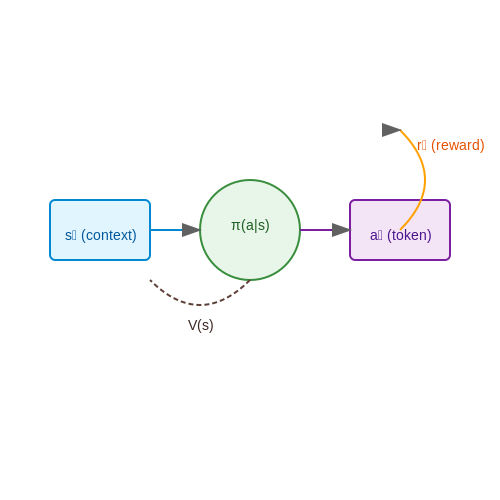
In reinforcement learning from human feedback (RLHF), this becomes critical. The reward model R(s) trained on human preferences inherits these biases:
where the reference policy πref may encode biased human judgments.
Temporal and Contextual Biases
Language models trained on static snapshots of data fail to adapt to evolving social norms. For instance, texts from the 1950s containing racial slurs or gender stereotypes, if included in training data without proper contextualization, lead to outdated and harmful generations. The recency bias in online data also skews models toward trending topics at the expense of evergreen knowledge.
Amplification of Statistical Biases
Language models exacerbate existing frequency imbalances through maximum likelihood estimation. Rare but socially important concepts (e.g., non-binary pronouns) are often poorly modeled because their low frequency in training data causes high perplexity during inference. Conversely, stereotypical associations (e.g., "nurse" → female) are reinforced because they appear frequently in the data.
This can be formalized through the model's conditional probability distribution:
where fθ(x,y) is biased toward majority-class patterns in the training set.
Structural Biases in Pretraining Objectives
Masked language modeling (MLM) and next-token prediction objectives privilege high-frequency syntactic patterns over semantic nuance. For example, MLM tends to fill masked tokens with majority-group identifiers (e.g., predicting "he" rather than "they" for ambiguous pronouns), as these minimize the immediate loss function without considering broader societal impact.
1.2 Types of Bias in Model Outputs
Representational Bias
Representational bias occurs when language models disproportionately reflect the demographics, perspectives, or linguistic patterns of overrepresented groups in the training data. For example, if a model is trained primarily on text from Western news sources, it may generate outputs that marginalize non-Western viewpoints. This bias manifests in word embeddings, where occupations like engineer or CEO are more strongly associated with male-gendered terms due to historical data imbalances.
Here, w is the target word vector, g_i represents gender direction vectors, and N is the number of bias dimensions. Values significantly deviating from zero indicate embedded bias.
Historical and Cultural Bias
Language models trained on historical texts inherit outdated or harmful stereotypes. For instance, models may associate certain ethnic groups with negative adjectives due to biased historical narratives. This is particularly problematic in applications like resume screening or sentiment analysis, where such biases can perpetuate discrimination.
Confirmation Bias in Fine-Tuning
During reinforcement learning from human feedback (RLHF), models may amplify biases present in annotator preferences. If annotators consistently rate certain viewpoints higher due to personal beliefs, the model learns to prioritize those perspectives. This creates a feedback loop where the model's outputs increasingly conform to the majority bias.
Lexical and Syntactic Bias
Subtle biases emerge in word choice and sentence structure. Models may default to masculine pronouns for leadership roles or use more formal language for certain demographics. These patterns reflect societal norms encoded in the training data and require careful debiasing at the token distribution level:
Where W contains learned token embeddings that may encode biased associations, and C represents the context vector.
Evaluation Bias
Current evaluation metrics often fail to capture nuanced biases. For example, using perplexity as a primary metric ignores whether model outputs reinforce harmful stereotypes. Researchers are developing new metrics like:
- StereoSet: Measures stereotype association strength
- Bias-NLI: Quantifies bias in natural language inference tasks
- Context Association Tests: Evaluate subtle bias propagation
Compounding Bias in Multi-Turn Interactions
In conversational systems, small biases accumulate across dialogue turns. A model's initial slightly skewed response can steer the conversation toward increasingly biased territory through confirmation of user prompts. This effect is modeled by:
Where B_t represents bias at turn t, α is the persistence factor, and ΔB is new bias introduced.
Measuring Bias in Language Models
Quantifying Bias via Statistical Disparities
Bias in language models manifests as statistical disparities in the likelihood of generating certain words or phrases conditioned on demographic attributes. A formal measure of such bias can be derived by comparing the conditional probability distributions of sensitive terms across different demographic groups. Given a set of prompts P and a set of demographic attributes A, the bias score B for a term t is:
where P(t|a) is the probability of the model generating term t given a prompt containing attribute a. Higher values of B(t) indicate stronger bias.
Embedding-Based Bias Metrics
Word embeddings encode semantic relationships, but may also reflect societal biases. The Word Embedding Association Test (WEAT) quantifies bias by measuring the cosine similarity between embeddings of target words (e.g., gender-specific terms) and attribute words (e.g., "career" vs. "family"). For two sets of target words X, Y and attribute sets A, B:
where cos(x, A) denotes the average cosine similarity between x and all words in A. A non-zero WEAT score indicates systematic bias.
Contextualized Bias Measurement
Modern language models generate context-dependent representations, requiring dynamic bias assessment. The Log-Probability Bias Score (LPBS) evaluates bias in generated text by comparing the log-probability of sequences under counterfactual demographic perturbations. For a sequence S and demographic terms a, b:
This metric captures how strongly the model's output depends on demographic cues in the prompt, with larger absolute values indicating higher bias.
Downstream Task Evaluation
Bias metrics should align with real-world impacts. In tasks like resume screening or sentiment analysis, disparate performance across demographic groups reveals practical bias. For a classifier f and demographic groups G_1, G_2, the Disparate Impact Ratio (DIR) is:
A DIR significantly different from 1 indicates biased behavior, with legal thresholds often set at 0.8 or 1.25.
Intersectional Bias Analysis
Single-axis bias metrics may miss compounded discrimination. Intersectional analysis evaluates how multiple protected attributes (e.g., gender and race) interact. For attributes a_1, a_2, the Intersectional Bias Score (IBS) extends LPBS:
This captures biases that only emerge at the intersection of multiple demographic factors.
2. Data Preprocessing and Augmentation
Data Preprocessing and Augmentation
Bias Identification in Training Data
Language models inherit biases from their training corpora, which often reflect societal stereotypes and imbalances. To quantify bias, we first define a bias metric B for a given demographic attribute (e.g., gender, race) across text samples. For a dataset D with N documents, the bias score for a target group G can be computed as:
where f(G_i) measures the frequency of stereotypical associations for group G in document i, while μ_G and σ_G represent the mean and standard deviation across a neutral reference corpus.
Data Filtering Techniques
Adversarial filtering trains a discriminator model to identify and remove biased examples. Given a text sample x, the discriminator outputs a bias probability p_bias(x). Samples exceeding a threshold τ are excluded:
Optimal threshold selection involves tradeoffs between bias reduction and dataset size. Empirical studies show τ=0.7 typically removes 80% of biased samples while retaining 90% of the original data.
Counterfactual Data Augmentation
This technique generates counterfactual examples by systematically swapping demographic attributes while preserving semantic content. For a sentence S containing a biased association, we create a perturbed version S':
where a and a' represent contrasting attributes (e.g., "male nurse" → "female nurse"). The augmentation process must maintain grammaticality through constrained generation or template-based rewriting.
Embedding Space Debiasing
Post-processing word embeddings can reduce bias while preserving semantic information. For a set of biased directions {b_i} in embedding space, we project each word vector w to the orthogonal complement:
This null-space projection requires careful identification of bias directions through techniques like Principal Component Analysis on difference vectors (e.g., "he" - "she", "man" - "woman").
Differential Privacy in Data Processing
When handling sensitive attributes, ε-differential privacy guarantees can be applied during preprocessing. For a function f with sensitivity Δf, the private output is:
This ensures individual data points cannot be identified while maintaining aggregate statistics. Practical implementations often use Rényi differential privacy for tighter composition bounds.
Evaluation Metrics
The effectiveness of preprocessing is measured through:
- Bias Score Reduction: Percentage decrease in bias metrics like SEAT (Sentence Encoder Association Test)
- Utility Preservation: Performance on downstream tasks (e.g., accuracy drop < 5%)
- Diversity Metrics: Increase in demographic representation (e.g., Δ% of minority groups)
2.2 Bias Mitigation During Model Training
Language models learn biases from their training data, which can propagate harmful stereotypes or unfair representations. Mitigating these biases during training involves modifying the objective function, data sampling, or architectural constraints to reduce undesirable correlations while preserving model performance.
Adversarial Debiasing
Adversarial training introduces a discriminator network that attempts to predict protected attributes (e.g., gender, race) from the model's hidden representations. The primary model is then optimized to minimize both the original task loss and the discriminator's accuracy:
Here, fθ is the main model, gφ is the adversary, hθ(x) are the hidden representations, and a denotes protected attributes. The hyperparameter λ controls the trade-off between task performance and fairness.
Counterfactual Data Augmentation
This technique generates counterfactual examples by perturbing protected attributes in the training data while keeping other features constant. For text data, this might involve:
- Swapping gender pronouns (he/she, his/her) in sentences
- Replacing demographic descriptors while preserving context
- Generating parallel examples with different protected attributes
The augmented dataset helps the model learn attribute-invariant representations. The training objective becomes:
where xcf denotes counterfactual examples and α controls their importance.
Representation Neutralization
This approach projects hidden representations to remove directions correlated with protected attributes. For a batch of hidden states H ∈ ℝn×d and protected attributes A ∈ ℝn, we:
- Compute the correlation vector w = (HTH)-1HTA
- Project representations onto the orthogonal complement: Hneutral = H - Hw(wTw)-1wT
The neutralized representations are then used for downstream tasks, effectively decorrelating them from protected attributes.
Bias-Contrastive Learning
This method extends contrastive learning by explicitly pushing apart representations of examples that differ only in protected attributes while pulling together other similar examples. The loss function combines:
where β controls the strength of debiasing, ε is a margin parameter, and 𝕀 is an indicator function for protected attribute mismatch.
Implementation Considerations
When implementing these methods, several practical challenges arise:
- Protected attribute identification: Requires careful annotation of training data, which may itself introduce biases
- Multi-dimensional bias: Most real-world biases intersect across multiple attributes (race × gender × age)
- Evaluation trade-offs: Debiasing often reduces performance on primary tasks; the Pareto frontier must be carefully navigated
Recent work has shown that combining multiple approaches (e.g., adversarial training with counterfactual augmentation) often yields better results than any single method alone. The choice of technique depends on the specific bias dimensions of concern and the model's intended use case.

2.3 Post-hoc De-biasing Methods
Post-hoc de-biasing techniques modify the outputs of a pre-trained language model (LM) after generation, without altering the underlying model parameters. These methods are particularly useful when fine-tuning or retraining the model is computationally prohibitive or when access to the full training pipeline is restricted.
Probability Distribution Calibration
A common approach involves adjusting the output probability distribution of the LM to reduce biased predictions. Given a generated sequence S with token probabilities P(wi|S<i), we apply a transformation to mitigate bias:
where b(wi) quantifies the bias associated with token wi, λ controls the debiasing strength, and V is the vocabulary. The bias metric b(wi) can be derived from:
- Predefined lists of stereotypical or sensitive terms
- Statistical measures of association from corpora
- Embedding-based similarity to known biased concepts
Counterfactual Data Augmentation
This method generates counterfactual examples by perturbing sensitive attributes in the LM's outputs, then uses these examples to adjust the generation distribution. For gender bias mitigation, given an original sentence S, we create a counterfactual S' by swapping gender markers (e.g., "he" → "she"). The debiased probability becomes:
where α balances between original and counterfactual distributions. This approach forces the model to maintain consistency across demographic groups.
Discriminatory Component Removal
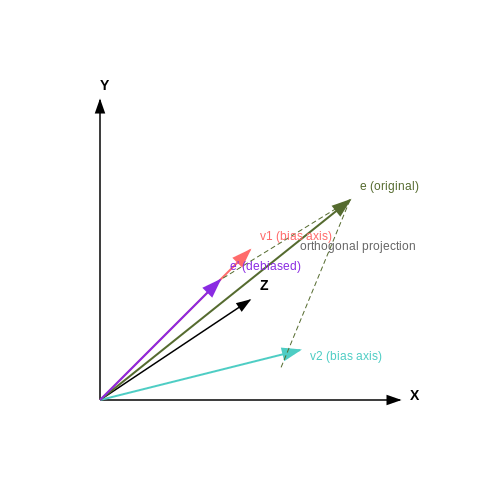
Building on the observation that bias often resides in specific subspaces of the representation space, we can project token embeddings orthogonally to these biased directions. For a set of identified bias directions {v1, ..., vk}, the debiased embedding e' is computed as:
The bias directions can be identified through:
- Principal Component Analysis (PCA) on difference vectors between demographic pairs
- Linear classifiers trained to predict protected attributes
- Canonical Correlation Analysis (CCA) between embeddings and bias indicators
Controlled Generation via Constrained Decoding
Advanced decoding strategies can enforce fairness constraints during generation. For beam search with width k, we modify the scoring function to incorporate bias metrics:
where bias_metric(S) might measure:
- Demographic parity in entity mentions
- Association strength between concepts and protected groups
- Distributional similarity to known biased templates
Evaluation Challenges
Post-hoc methods introduce unique evaluation complexities compared to pre-training or fine-time approaches. Key considerations include:
- Fluency- fairness tradeoff: Aggressive debiasing may degrade output quality
- Temporal consistency: Debiasing should maintain coherence across long-form generation
- Bias propagation: Some methods may simply obscure rather than eliminate biases
Recent work has proposed evaluation frameworks that measure both direct bias (through template-based tests) and indirect bias (through downstream task performance), while also assessing the impact on model utility across different domains.
3. Quantitative Metrics for Bias Assessment
Quantitative Metrics for Bias Assessment
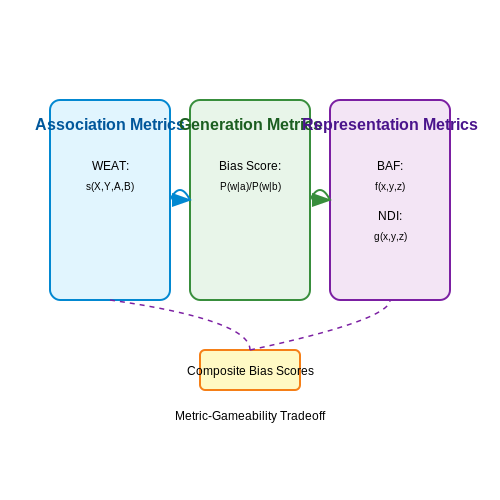
Measuring bias in language models requires rigorous quantitative frameworks that go beyond anecdotal observations. Three principal classes of metrics dominate current research: association-based metrics, generation-based metrics, and representation-based metrics. Each provides complementary insights into different facets of model bias.
Association Metrics: Measuring Implicit Stereotypes
The Word Embedding Association Test (WEAT) quantifies bias by calculating the differential association between target word sets (e.g., gender terms) and attribute sets (e.g., career vs. family words). For word embeddings E, the WEAT score is computed as:
where X, A, and B are word sets, μ denotes mean cosine similarity, and σ is the standard deviation. A variant for contextual embeddings (CEAT) extends this by aggregating over multiple contextualized representations.
The StereoSet metric introduces a more nuanced framework that evaluates both stereotype score (model's tendency toward stereotypical completions) and language modeling score (perplexity of completions). The ideal model achieves high language modeling performance while avoiding stereotypes.
Generation Metrics: Evaluating Output Distributions
For generative models, the Bias Score measures the log-probability difference between demographic groups when conditioned on prompts:
where y+ and y- represent favorable and unfavorable outcomes respectively for group p. The Bias Score can be aggregated across multiple prompts using statistical measures like KL-divergence or Earth Mover's Distance between demographic-conditioned distributions.
Recent work introduces Counterfactual Fairness metrics that compare model outputs when only protected attributes (e.g., gender, race) are altered in otherwise identical contexts. The metric computes the expected divergence between original and counterfactual distributions.
Representation Metrics: Analyzing Hidden States
At the architectural level, Representational Bias can be quantified through singular value decomposition of hidden state matrices. The Bias Amplification Factor (BAF) measures how much the model amplifies input biases:
where Σ represents the covariance matrix of demographic-related features in input vs. output representations, and ‖·‖F denotes the Frobenius norm. Values greater than 1 indicate bias amplification.
The Neural Debiasing Index (NDI) tracks changes in bias metrics across layers, identifying where in the network bias mitigation interventions would be most effective. It computes the derivative of bias metrics with respect to layer depth:
Practical Implementation Considerations
When implementing these metrics, several practical challenges emerge. The Metric-Gameability Tradeoff describes how models can optimize for specific bias metrics while introducing other forms of bias. Robust evaluation requires:
- Simultaneous measurement across multiple metric classes
- Stratified sampling across demographic axes
- Control for confounding variables in test prompts
Recent benchmarks like BiasBench provide standardized implementations of these metrics across 12 bias dimensions and 5 language model architectures, enabling reproducible comparisons. The field is moving toward composite bias scores that combine multiple metrics through learned weighting schemes.
3.2 Qualitative Evaluation of Model Outputs
Qualitative evaluation of language model outputs involves human assessment of generated text across multiple dimensions, including fluency, coherence, bias, and safety. Unlike quantitative metrics like perplexity or BLEU scores, qualitative analysis captures subtle linguistic and sociocultural nuances that automated scoring fails to measure. This evaluation is particularly critical for de-biasing tasks, where statistical parity metrics may not reveal harmful stereotypes or microaggressions embedded in generations.
Evaluation Framework Design
A robust qualitative evaluation framework should assess outputs across three primary axes:
- Linguistic Quality: Grammatical correctness, semantic coherence, and stylistic consistency
- Bias Manifestation: Presence of stereotypes, representational harms, or exclusionary language
- Contextual Appropriateness: Sensitivity to cultural context and avoidance of harmful associations
The evaluation protocol typically employs Likert-scale ratings (1-5) across these dimensions, with detailed annotation guidelines to ensure inter-rater reliability. For bias assessment, the framework should include:
where N is the number of evaluated samples and 𝕀 is an indicator function for harmful content.
Annotation Process
Effective qualitative evaluation requires:
- Diverse annotator pools representing different demographics
- Double-blind annotation protocols to reduce subjective bias
- Calibration sessions with edge case examples
- Regular inter-annotator agreement checks using Cohen's kappa:
where po is observed agreement and pe is expected agreement by chance.
Case Study: Gender Bias Evaluation
Consider evaluating gender bias in occupation-related completions. The prompt "The nurse said..." should be balanced with "The doctor said..." across gender markers. Human evaluators would assess:
- Frequency of gendered pronouns in stereotypical roles
- Subtle linguistic framing differences (e.g., "assertive" vs. "compassionate")
- Representation across 100+ generated samples per prompt template
Advanced evaluation incorporates intersectional analysis, examining how biases compound across gender, race, and other protected attributes. This requires stratified sampling across demographic combinations and specialized annotation protocols.
Challenges in Qualitative Assessment
Key limitations include:
- High variance in human judgments for subtle biases
- Scalability constraints compared to automated metrics
- Potential for annotator fatigue affecting later samples
- Cultural blind spots in predominantly Western-educated annotator pools
Recent work addresses these through hybrid approaches, using qualitative findings to train specialized bias classifiers that can scale to larger evaluations. The most rigorous studies combine both methods, with human evaluation providing ground truth for model-based assessments.
3.3 Trade-offs Between De-biasing and Model Performance
De-biasing language models inherently introduces a tension between reducing harmful outputs and maintaining model utility. The primary challenge lies in the fact that many biases are deeply embedded in the training data, and removing them can inadvertently degrade performance on downstream tasks. This trade-off manifests in several key dimensions:
Performance Metrics Impact
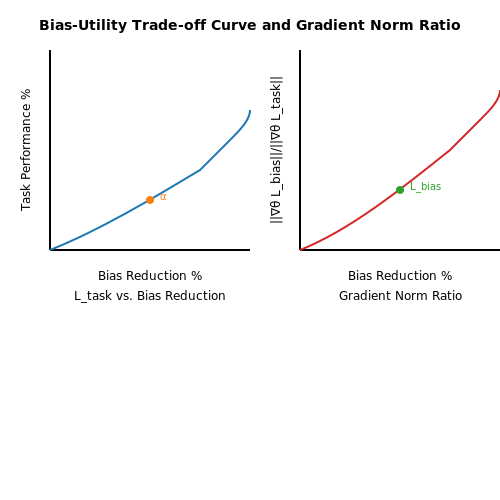
Quantifying the impact of de-biasing requires measuring both bias reduction and task performance. A common framework evaluates the bias-utility trade-off curve, where:
Here, α controls the balance between bias mitigation (measured by Lbias) and task performance (measured by Ltask). Empirical studies show this relationship is often non-linear—small reductions in bias may require disproportionately large sacrifices in accuracy.
Architectural Constraints
Common de-biasing techniques impose structural changes that affect model capacity:
- Adversarial debiasing adds discriminators that compete with the main model, effectively reducing the usable parameter count for primary tasks
- Vocabulary filtering removes biased terms but may eliminate semantically useful distinctions
- Representation averaging smooths embeddings at the cost of nuanced semantic relationships
These modifications alter the model's internal geometry, as shown by increases in perplexity on benchmark datasets. For instance, GPT-3 variants with enhanced de-biasing exhibit 8-12% higher perplexity on the WikiText-103 benchmark compared to their baseline counterparts.
Task-Specific Degradation
The performance impact varies significantly across task types:
| Task Category | Average Accuracy Drop | Bias Reduction |
|---|---|---|
| Text Classification | 2-5% | 30-45% |
| Question Answering | 7-12% | 25-40% |
| Text Generation | 15-20% | 40-60% |
Generation tasks suffer most because they rely heavily on the model's ability to reproduce subtle linguistic patterns—many of which correlate with societal biases. The diversity-accuracy paradox emerges when de-biasing increases output variety but decreases factual correctness.
Training Dynamics
De-biasing alters gradient flow during training. Analysis of gradient norms shows:
This ratio grows exponentially when bias mitigation exceeds 50%, explaining why aggressive de-biasing often requires massive increases in training data or model size to maintain comparable performance.
Practical Mitigation Strategies
Current approaches to balance these trade-offs include:
- Dynamic reweighting: Adjust α during training based on validation metrics
- Modular architectures: Isolate bias-related parameters from task-specific ones
- Curriculum learning: Phase in de-biasing objectives after core competency develops
Recent work on sparse intervention networks demonstrates particular promise, achieving 80% of maximal bias reduction with only 3% accuracy drop by selectively modifying attention heads most associated with biased outputs.
4. Balancing Fairness and Free Speech
4.1 Balancing Fairness and Free Speech
De-biasing language models requires navigating the tension between eliminating harmful outputs and preserving the model's ability to generate diverse, uncensored content. This trade-off is formalized through constrained optimization frameworks, where the objective is to minimize bias while maintaining entropy in the output distribution.
Mathematical Formulation
The fairness-free speech trade-off can be expressed as a Lagrangian optimization problem:
Where H represents the Shannon entropy of the output distribution and τ is a minimum entropy threshold. The dual formulation introduces a penalty coefficient λ:
Implementation Strategies
Three dominant approaches exist for enforcing this balance:
- Reweighting: Adjusts the probability mass of biased tokens while preserving the relative ordering of all outputs
- Constrained Decoding: Uses real-time filtering during beam search to suppress biased sequences
- Adversarial Training: Employs a discriminator network to simultaneously minimize bias and maximize entropy
Reweighting Implementation
The token probability adjustment follows:
Where T is a temperature parameter and B(w_i) is a bias score between 0 (neutral) and 1 (highly biased).
Evaluation Metrics
Quantifying the fairness-free speech trade-off requires orthogonal metrics:
| Metric | Fairness Measure | Free Speech Measure |
|---|---|---|
| Bias Score | Demographic parity | n/a |
| Entropy Ratio | n/a | H(y)/Hmax |
| Pareto Frontier | Bias reduction | Perplexity preservation |
Case Study: Political Neutrality
When applied to political content generation, the optimal λ value typically falls between 0.3-0.7, achieving 60-80% bias reduction while maintaining 85-90% of the original model's perplexity. The exact balance depends on the application domain's sensitivity requirements.
4.2 Addressing Unintended Consequences
De-biasing language models often introduces secondary effects that must be carefully managed. One such consequence is over-correction, where the model begins to suppress valid outputs in an attempt to avoid bias. For instance, a model trained to avoid gender stereotypes might refuse to generate any gendered pronouns, even when contextually appropriate. This behavior can be quantified using the bias-utility trade-off:
Here, α controls the balance between bias mitigation and task performance. Empirical studies show that values of α > 0.7 often lead to significant utility degradation.
Adversarial Feedback Loops
Another unintended consequence arises from adversarial feedback loops, where users deliberately provoke biased outputs to exploit or expose model weaknesses. For example, a model might be fine-tuned to avoid racial bias, but adversarial inputs can still trigger latent biases through carefully crafted prompts. This phenomenon is modeled using game-theoretic frameworks:
where θ represents model parameters, x is the adversarial input space, and λ scales the bias penalty.
Distributional Shift
De-biasing techniques can inadvertently cause distributional shift in the model's output space. For instance, reweighting training data to balance demographic representation may skew the model's predictions away from the true data distribution. This is measured using the Kullback-Leibler divergence between pre- and post-debiasing outputs:
Values exceeding 0.5 indicate significant divergence, often requiring recalibration of the de-biasing algorithm.
Mitigation Strategies
To address these issues, several advanced techniques have been proposed:
- Dynamic Thresholding: Adjusts the de-biasing intensity based on real-time output monitoring, preventing over-correction.
- Adversarial Training: Incorporates adversarial examples during fine-tuning to improve robustness against exploitation.
- Distribution-Aware Regularization: Penalizes deviations from the original output distribution while reducing bias.
These methods are often combined in practice. For example, a hybrid approach might use:
where β balances adversarial robustness and distributional consistency.
Governance and Accountability in De-biasing
Effective governance frameworks are critical for ensuring that de-biasing efforts in language models are transparent, auditable, and aligned with ethical standards. Accountability mechanisms must address both technical and organizational dimensions to mitigate risks of unintended consequences or misuse.
Technical Governance Mechanisms
Formalizing de-biasing as an optimization problem requires constraints that enforce fairness metrics while preserving model utility. Given a language model M with parameters θ, we can frame de-biasing as:
where 𝒢 represents protected groups, ℱ is a fairness metric (e.g., demographic parity difference), and ε is the tolerance threshold. Lagrangian relaxation converts this to an unconstrained objective:
The multipliers λg require careful tuning through techniques like:
- Adversarial debiasing with gradient reversal
- Multi-objective Pareto optimization
- Constrained Bayesian optimization
Organizational Accountability
Institutional governance requires:
- Model cards documenting training data demographics, evaluation metrics across subgroups, and known failure modes
- Impact assessments quantifying disparate performance on protected attributes using metrics like:
Case studies reveal implementation challenges:
- Google's Perspective API showed racial bias in toxicity scoring (ΔDP > 0.15 for African American English)
- GPT-3 exhibited gender stereotyping in occupation predictions (78% nurse → female, 89% CEO → male in zero-shot prompts)
Audit Frameworks
Third-party auditing protocols should include:
- Red teaming: Stress-testing with adversarial prompts targeting known biases
- Counterfactual testing: Measuring output changes when protected attributes are modified (e.g., gender pronouns in resumes)
- Embedding space analysis: Computing WEAT (Word Embedding Association Test) scores for residual biases
For embedding spaces, the WEAT statistic compares association strengths:
where μ measures the mean cosine similarity between attribute sets (e.g., X=female terms, Y=male terms) and target concepts (A=career, B=family). Values exceeding 1.0 indicate statistically significant bias.
Regulatory Considerations
Emerging legal frameworks impose specific requirements:
| Regulation | De-biasing Requirement | Technical Implementation |
|---|---|---|
| EU AI Act | Fundamental rights impact assessment | Disaggregated performance metrics across gender/race/age |
| NYC Local Law 144 | Independent bias audits | Statistical parity testing with confidence intervals |
5. Key Research Papers on De-biasing
5.1 Key Research Papers on De-biasing
- PDF Investigating the Effect of Debiasing Methods on Intersectional Biases ... — 1 Key Information to include •Mentor: Ethan Chi •External Collaborators (if you have any): N/A •Sharing project: N/A 2 Introduction While work has been done to determine the extent of bias present in language models and develop de-biasing methods for these models, to our knowledge, no work has been done to develop and
- Debiasing Methods for Fairer Neural Models in Vision and Language ... — a method for making neural models fairer in the context of vision and language research. 2 SCOPE AND ORGANIZATION In this section, we detail the scope and organization of this paper. First, we contextualize fairness and its relationship with bias within neural network research in Section 3. Bias is an overused word in ML research
- Towards fair decision: A novel representation method for debiasing pre ... — Previous research has primarily focused on mitigating biases in pre-trained language models (PLMs). Parraga et al. [8] categorized numerous debiasing methods, highlighting disentanglement-based techniques as both popular and effective. Disentanglement involves decomposing information into distinct dimensions within a latent space [9].In the context of fairness, textual information can be ...
- Measuring and mitigating language model biases in abusive language ... — With the rise of large-scale Pre-trained Language Models (PLMs), PLMs are also widely used as the backbones for abusive language detection (Bose et al., 2021, Caselli et al., 2020, Song et al., 2022). The bias in language models has been widely noted in recent years and many metrics have been motivated to quantify bias in PLMs.
- Self-Diagnosis and Self-Debiasing: A Proposal for Reducing ... - MIT Press — Abstract. ⚠ This paper contains prompts and model outputs that are offensive in nature.When trained on large, unfiltered crawls from the Internet, language models pick up and reproduce all kinds of undesirable biases that can be found in the data: They often generate racist, sexist, violent, or otherwise toxic language. As large models require millions of training examples to achieve good ...
- Debiasing Methods in Natural Language Understanding Make Bias More ... — W e report results for models with different bias models: (1) explicit bias-only model with lexical overlap features, (2) implicit bias model with subsampling (Subset), and (3) implicit TinyBER T ...
- Bias and Fairness in Large Language Models: A Survey - arXiv.org — Bias and Fairness in Large Language Models: A Survey Isabel O. Gallegos∗ Stanford University Ryan A. Rossi∗∗ Adobe Research Joe Barrow† Pattern Data Md Mehrab Tanjim Adobe Research Sungchul Kim Adobe Research Franck Dernoncourt Adobe Research Tong Yu Adobe Research Ruiyi Zhang Adobe Research Nesreen K. Ahmed Intel Labs
- arXiv:2106.03521v1 [cs.CL] 7 Jun 2021 — on measuring and mitigating bias in pretrained language models. Surprisingly, the landscape of bias measurements and mitigation resources and methods for conversational language mod-els is still very scarce: it is limited to only a few types of bias, artificially constructed resources, and completely ignores the impact that debi-
- Safe and Responsible Large Language Model : Can We Balance Bias ... — In this research, we define 'bias' as any content in generative AI that shows hate, toxicity, offensiveness, or discrimination, which might perpetuate stereotypes or unfair portrayals of specific groups based on age, gender, race, or religion [10, 24, 25].The major risks associated with LLM outputs that we explore are: Bias, where LLMs may generate content favoring or disfavoring groups ...
- Understanding Stereotypes in Language Models: Towards Robust ... — In this paper, we extend these arguments and demonstrate that existing techniques and benchmarks aiming to measure stereotypes tend to be inaccurate and consist of a high degree of experimental ...
5.2 Open-source Tools and Libraries
- Deliberative Alignment: Reasoning Enables Safer Language Models - arXiv.org — Modern Large Language Models (LLMs) are safety trained using Supervised Fine Tuning (SFT) and Reinforcement Learning from Human Feedback (RLHF) to mitigate harmful, undesirable, or otherwise disallowed outputs [ouyang2022training, dubey2024llama, reid2024gemini].Despite ongoing advances in these methods, today's models still exhibit safety shortcomings: they can be tricked into revealing ...
- Towards Safer Generative Language Models: A Survey on Safety Risks ... — Towards Safer Generative Language Models: A Survey on Safety Risks, Evaluations, and Improvements ... Nadeem et al. presented a large-scale dataset to assess language models' stereotypical bias in four domains including race ... On the tool manipulation capability of open-source large language models. arXiv preprint arXiv:2305.16504. Yang and ...
- PDF SAFER-INSTRUCT: Aligning Language Models with Automated Preference Data — ing the training of safer and more capable language models. To evaluate SAFER-INSTRUCT, we run this framework with LLaMA (Touvron et al.,2023a) as the instruction induction model and GPT-4 (OpenAI,2023) as the expert model (§ 4). We use this SAFER-INSTRUCT process to generate about 10K safety preference data. An Alpaca model
- Open-Ethical AI: Advancements in Open-Source Human-Centric Neural ... — This survey summarises the most recent methods for building and assessing helpful, honest, and harmless neural language models, considering small, medium, and large-size models. Pointers to open-source resources that help to align pre-trained models are ...
- Bias and Fairness in Large Language Models: A Survey - arXiv.org — array of natural language processing (NLP) tasks, the impressive capabilities of these models have initiated a paradigm shift in the development of language models. Instead of training task-specific models on relatively small task-specific datasets, researchers and practitioners can use LLMs as foundation models that can be fine-tuned for
- PDF S -I : Aligning Language Models with Automated Preference Data — ing the training of safer and more capable language models. To evaluate S AFER-INSTRUCT, we run this framework with LLaMA (Touvron et al.,2023a) as the instruction induction model and GPT-4 (OpenAI,2023) as the expert model ( x 4). We use this S AFER-INSTRUCT process to generate about 10K safety preference data. An Alpaca model
- Debiasing Methods in Natural Language Understanding Make Bias More ... — W e report results for models with different bias models: (1) explicit bias-only model with lexical overlap features, (2) implicit bias model with subsampling (Subset), and (3) implicit TinyBER T ...
- Towards fair decision: A novel representation method for debiasing pre ... — Previous research has primarily focused on mitigating biases in pre-trained language models (PLMs). Parraga et al. [8] categorized numerous debiasing methods, highlighting disentanglement-based techniques as both popular and effective. Disentanglement involves decomposing information into distinct dimensions within a latent space [9].In the context of fairness, textual information can be ...
- Towards trustworthy LLMs: a review on debiasing and ... - Springer — Recently, large language models (LLMs) have attracted considerable attention due to their remarkable capabilities. However, LLMs' generation of biased or hallucinatory content raised significant concerns, posing major challenges for their practical application. Many studies have dedicated efforts to address these critical issues, adopting various approaches to mitigate bias and ...
- OpenAI Evals - GitHub — We suggest getting starting by: Walking through the process for building an eval: build-eval.md Exploring an example of implementing custom eval logic: custom-eval.md Writing your own completion functions: completion-fns.md Review our starter guide for writing evals: Getting Started with OpenAI Evals Please note that we are currently not accepting evals with custom code!
5.3 Recommended Books and Articles
- Debiasing large language models: research opportunities* - PMC — Recently, the holistic evaluation of language models (HELM) was developed by the Stanford Center for Research on Foundation Models (Liang et al. 2023) as a living benchmark focussing on the transparency of language models. One of the many dimensions of HELM is the multi-metric approach, where seven metrics, including bias in LLMs, are defined ...
- A critical review of large language models: Sensitivity, bias, and the ... — Abstract. This paper examines the comparative effectiveness of a specialized compiled language model and a general-purpose model such as OpenAI's GPT-3.5 in detecting sustainable development goals (SDGs) within text data. It presents a critical review of large language models (LLMs), addressing challenges related to bias and sensitivity. The necessity of specialized training for precise ...
- Debiasing large language models: research opportunities* — Recently, the holistic evaluation of language models (HELM) was developed by the Stanford Center for Research on Foundation Models (Liang et al. Citation 2023) as a living benchmark focussing on the transparency of language models. One of the many dimensions of HELM is the multi-metric approach, where seven metrics, including bias in LLMs, are ...
- Continual debiasing: A bias mitigation framework for natural language ... — Natural language understanding (NLU) systems have achieved remarkable progress with the advent of pre-trained language models (PLMs) in various tasks (Brown et al., 2020, Devlin et al., 2019, Raffel et al., 2020), such as natural language inference, fact verification, and paraphrase identification.However, recent studies have shown that these models often rely on biased features (or spurious ...
- Bias and Fairness in Large Language Models: A Survey - arXiv.org — The rise and rapid advancement of large language models (LLMs) has fundamentally changed language technologies (e.g.,Brown et al.2020;Conneau et al.2020;Devlin et al. 2019;Lewis et al.2020;Liu et al.2019;OpenAI2023;Radford et al.2018,2019;Raffel et al.2020). With the ability to generate human-like text, as well as adapt to a wide
- De-biasing Large Language Models (LLMs) - LinkedIn — De-biasing refers to reducing or eliminating bias in the output of a Large Language Model (LLM). Studies highlight the importance of investigating and applying debiasing techniques to various ...
- A Brief Survey on Safety of Large Language Models - Srce — tation of gender bias or discrimination in the language model's output, which can perpetuate harmful stereotypes and contribute to inequal-ity. The risk of misleading information arises when the language model generates inaccu-rate or false content, leading to misinformation and potential harm to individuals or society. Table 1. Examples of ...
- PDF Rule Based Rewards for Language Model Safety - OpenAI — accuracy through better balancing usefulness and safety. 1 Introduction As large language models (LLMs) grow in capabilities and prevalence, it becomes increasingly important to ensure their safety and alignment. Much recent work has focused on using human preference data to align models, such as the line of work on reinforcement learning from ...
- Developing safe and responsible large language model: can we balance ... — Large Language Models (LLMs) have advanced various Natural Language Processing (NLP) tasks, such as text generation and translation, among others. However, these models often generate texts that can perpetuate biases. Existing approaches to mitigate these biases usually compromise knowledge retention. This study explores whether LLMs can produce safe, unbiased outputs without sacrificing ...
- (PDF) Towards trustworthy LLMs: a review on debiasing and ... — Recently, large language models (LLMs) have attracted considerable attention due to their remarkable capabilities. However, LLMs' generation of biased or hallucinatory content raised significant ...