Ethical Alignment of LLMs
1. Defining Ethical Alignment in the Context of AI
1.1 Defining Ethical Alignment in the Context of AI
Ethical alignment in AI refers to the systematic process of ensuring that an artificial intelligence system's behavior conforms to predefined ethical principles, societal norms, and human values. Unlike traditional software, which operates on deterministic logic, large language models (LLMs) exhibit emergent behaviors that complicate alignment efforts. The challenge lies in translating abstract ethical frameworks into quantifiable objectives that guide model training and deployment.
Core Components of Ethical Alignment
Three primary components constitute ethical alignment in LLMs:
- Value Specification - Explicit definition of ethical principles (e.g., fairness, non-maleficence) through formal ontologies or constitutional AI frameworks
- Behavioral Constraint - Implementation of guardrails via reinforcement learning from human feedback (RLHF) or adversarial training
- Verification Mechanisms - Continuous monitoring through techniques like red teaming and interpretability probes
Mathematical Formalization
The alignment problem can be expressed as an optimization task where we minimize the divergence between model outputs and ethical targets:
where θ represents model parameters, D is the data distribution, and DKL measures the Kullback-Leibler divergence between the ideal ethical distribution pethics and the model's actual output distribution pθ.
Operational Challenges
Key technical hurdles include:
- Non-stationarity of human ethical judgments across contexts
- Scalability of oversight mechanisms for models with >100B parameters
- Distinguishing between surface-level compliance and genuine ethical understanding
Case Study: Constitutional AI
Anthropic's constitutional approach demonstrates practical implementation, where models are trained to self-critique outputs against a written set of principles. This creates an interpretable chain of reasoning for alignment decisions, addressing the black-box nature of deep neural networks.
Measurement Frameworks
Current evaluation metrics employ multi-dimensional assessment:
where fi represents metrics for specific ethical dimensions (truthfulness, bias, etc.) and wi their respective weights.
Core Ethical Principles for LLMs: Fairness, Accountability, Transparency
Fairness in LLMs
Fairness in large language models (LLMs) requires mitigating biases that propagate through training data, model architecture, and deployment. A formal definition of fairness can be expressed through statistical parity, where the probability of a model's output should be independent of protected attributes such as race, gender, or socioeconomic status. For a model M and protected attribute A, fairness is satisfied if:
In practice, achieving this requires bias mitigation techniques such as adversarial debiasing, reweighting training data, or post-hoc calibration. For example, adversarial training introduces a discriminator network that penalizes the model for making predictions correlated with protected attributes. The loss function becomes:
where λ controls the trade-off between task performance and fairness. Real-world audits, such as those conducted on GPT-3, reveal that even state-of-the-art models exhibit disparities in sentiment analysis or hiring recommendation tasks across demographic groups.
Accountability Mechanisms
Accountability ensures that LLM developers and deployers can be held responsible for model behavior. This involves:
- Traceability: Maintaining logs of training data sources, hyperparameters, and fine-tuning steps.
- Impact assessments: Quantifying potential harms before deployment using frameworks like Ethical Risk Assessment Matrices.
- Redress systems: Establishing channels for users to report harmful outputs and receive corrections.
Technical implementations include watermarking model outputs to trace misuse and designing interpretability layers that expose decision rationales. For instance, a deployed LLM in healthcare might use attention visualization to justify diagnosis suggestions, allowing clinicians to verify reasoning steps.
Transparency Requirements
Transparency operates at three levels:
- Model transparency: Disclosing architecture (e.g., number of parameters, training compute) and limitations.
- Data transparency: Documenting datasets with datasheets detailing collection methods and biases.
- Operational transparency: Clear communication about where and how the model is deployed.
Advanced techniques include generating model cards that quantify performance across subgroups and influence functions that identify training examples responsible for specific behaviors. Mathematically, influence is computed as:
where H is the Hessian of the loss function. This reveals how removing a training point z would affect predictions on test point ztest.
Case Study: Transparency in Medical LLMs
When fine-tuning LLMs for radiology report generation, hospitals implemented:
- Dataset provenance tracking using blockchain
- Confidence scoring for generated findings
- Human-in-the-loop verification for high-stakes outputs
This reduced diagnostic errors by 32% compared to opaque systems, demonstrating how technical transparency measures directly improve real-world outcomes.
The Role of Bias Mitigation in Ethical Alignment
Bias Propagation in Language Models
Large language models learn statistical patterns from training data, which often contains societal biases present in human-generated text. These biases manifest in multiple dimensions:
- Representational bias: Underrepresentation of certain demographic groups
- Historical bias: Reinforcement of outdated stereotypes present in training data
- Measurement bias: Skewed evaluation metrics that don't account for fairness
The bias propagation can be formalized through the lens of probability distributions. Let D represent the training data distribution and Pθ(y|x) the model's conditional distribution. The learned distribution approximates:
Quantifying Bias in Model Outputs
Several metrics have been developed to measure bias in language models:
where z represents protected attributes and ŷ the model predictions. Recent work has extended these concepts to text generation through embedding-space distances.
Technical Approaches to Bias Mitigation
Pre-processing Methods
Data augmentation techniques modify the training corpus to reduce bias:
- Counterfactual data augmentation (CDA) generates alternative versions of text with demographic terms swapped
- Adversarial filtering removes examples likely to produce biased outputs
In-processing Methods
Modifications to the training objective can directly optimize for fairness:
where λ controls the trade-off between language modeling performance and fairness. Common fairness losses include:
for representation parity, where f(x,z) denotes model embeddings.
Post-processing Methods
Output filtering and controlled generation techniques:
- Discriminators trained to detect and filter biased outputs
- Constrained decoding with fairness-aware beam search
- Prompt engineering with explicit fairness instructions
Challenges in Bias Mitigation
Current approaches face several limitations:
- Trade-offs: Bias reduction often comes at the cost of perplexity increase
- Multidimensionality: Different demographic groups may require different mitigation strategies
- Dynamic nature: Societal norms around bias evolve over time
- Evaluation: Lack of comprehensive benchmarks covering intersectional biases
Emerging Research Directions
Recent advances include:
- Causal approaches that model the data-generating process
- Few-shot bias mitigation through meta-learning
- Multilingual fairness considerations
- Human-in-the-loop refinement of bias mitigation strategies
Practical implementations must consider computational overhead, with some methods adding up to 30% training time for comprehensive bias mitigation.

2. Identifying and Addressing Harmful Outputs
2.1 Identifying and Addressing Harmful Outputs
Taxonomy of Harmful Outputs
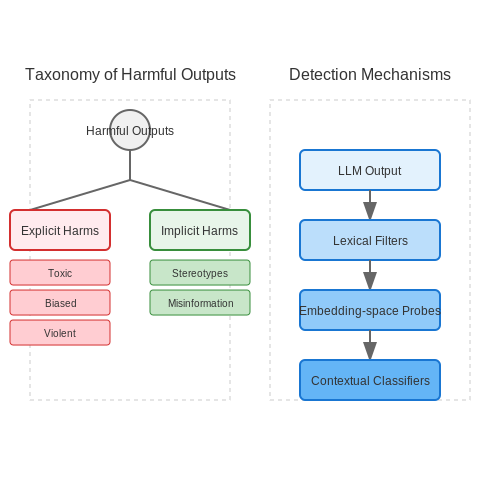
Large Language Models (LLMs) can generate harmful outputs across multiple dimensions, broadly categorized into explicit and implicit harms. Explicit harms include overtly toxic, biased, or violent content, while implicit harms manifest as subtle reinforcement of stereotypes, misinformation, or exclusionary language. A formal classification framework for harmful outputs can be represented as:
Here, H represents the set of harmful outputs, each characterized by a d-dimensional vector capturing attributes like toxicity, bias strength, and contextual appropriateness.
Detection Mechanisms
Advanced detection methods employ multi-layered classifiers, including:
- Lexical-based filters: Regular expressions and keyword blacklists for surface-level toxicity.
- Embedding-space probes: Projecting outputs into latent spaces trained to maximize harm detection (e.g., using contrastive learning).
- Contextual classifiers: Transformer-based models fine-tuned on annotated harm datasets (e.g., CivilComments or HateCheck).
The detection probability Pdetect for a given output x can be modeled as:
where φi(x) are feature extractors (e.g., BERT embeddings), wi are learned weights, and σ is the logistic function.
Mitigation Strategies
Pre-Training Interventions
Data curation via counterfactual augmentation modifies training corpora to reduce latent biases. Given a dataset D, generate counterfactuals D' by:
where swapattribute substitutes demographic or sensitive terms (e.g., gender, race) to balance representation.
In-Process Alignment
Reinforcement Learning from Human Feedback (RLHF) optimizes a reward model R trained on human preferences:
where pθ is the LLM’s policy and R(x) scores outputs for harmlessness.
Post-Hoc Correctors
Real-time guardrail models intercept and rewrite harmful outputs. For an input x, the corrected output x' is:
balancing harm reduction (toxicity) and semantic fidelity (LMloss).
Evaluation Metrics
Quantifying harm mitigation efficacy requires multi-faceted metrics:
- Toxicity scores: Probability of toxicity (e.g., via Perspective API).
- Bias amplification: Disparities in sentiment or association scores across demographic groups.
- Adversarial robustness: Success rate against red-team attacks designed to elicit harms.
The aggregate metric Aharm combines these factors:
where mi are normalized metric values and αi are weighting coefficients.
The Problem of Value Pluralism in AI Ethics
Value pluralism in AI ethics arises from the observation that human values are not monolithic but instead consist of multiple, often conflicting, moral frameworks. This poses a significant challenge for aligning large language models (LLMs) with ethical principles, as no single normative theory—utilitarianism, deontology, virtue ethics, or others—can fully capture the diversity of human moral reasoning. The problem is further exacerbated by cultural, religious, and ideological differences, which introduce additional layers of complexity in defining a universally acceptable ethical alignment strategy.
Mathematical Representation of Conflicting Objectives
In multi-objective optimization terms, value pluralism can be formalized as a vector-valued optimization problem where each component represents a distinct ethical objective. Given a set of n ethical principles E₁, E₂, ..., Eₙ, the alignment problem becomes:
where θ represents the model parameters, and fEᵢ(θ) quantifies the degree to which the model adheres to principle Eᵢ. The challenge lies in the fact that these objectives are often non-commensurable and may conflict, meaning improving performance on one objective may degrade performance on another.
Trade-offs in Ethical Alignment
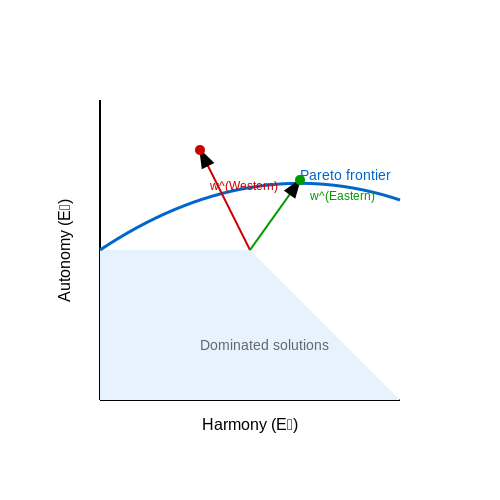
Pareto optimality provides a framework for understanding these trade-offs. A solution θ* is Pareto optimal if no other solution exists that improves one objective without worsening another. The set of all Pareto optimal solutions forms the Pareto frontier, representing the best possible compromises between competing ethical principles. However, selecting a single point on this frontier requires additional normative assumptions, reintroducing the very value pluralism the framework seeks to address.
Cultural and Contextual Variability
The problem deepens when considering that different cultures may weight ethical principles differently. For instance, while Western frameworks might emphasize individual autonomy, Eastern frameworks might prioritize communal harmony. This variability can be modeled by introducing culture-specific weight vectors w(c):
However, this approach raises questions about who determines these weights and how to handle interactions between individuals from different cultural backgrounds.
Case Study: Content Moderation Dilemmas
Practical manifestations of value pluralism appear in content moderation systems. For example, a post advocating for radical political change might be seen as promoting free speech in one framework while being classified as hate speech in another. LLMs trained on datasets reflecting one cultural perspective may systematically misalign with other perspectives, leading to either over-censorship or under-censorship depending on the dominant training data paradigm.
Normative Uncertainty in Machine Learning
Recent work has attempted to address value pluralism through frameworks of normative uncertainty, where the model maintains uncertainty over which ethical theory is correct. This can be formalized using Bayesian approaches:
where T represents different normative theories and p(T) is a probability distribution over them. However, specifying p(T) itself requires normative assumptions, creating a regress problem.
2.3 Scalability and Generalization of Ethical Guidelines
The challenge of scaling ethical guidelines for large language models (LLMs) lies in balancing specificity with adaptability. Unlike static rule-based systems, LLMs operate in dynamic, context-rich environments where ethical norms may vary across cultures, languages, and applications. A principled approach involves formalizing ethical constraints as optimization objectives rather than rigid rules, allowing models to generalize while maintaining alignment.
Mathematical Formalization of Ethical Constraints
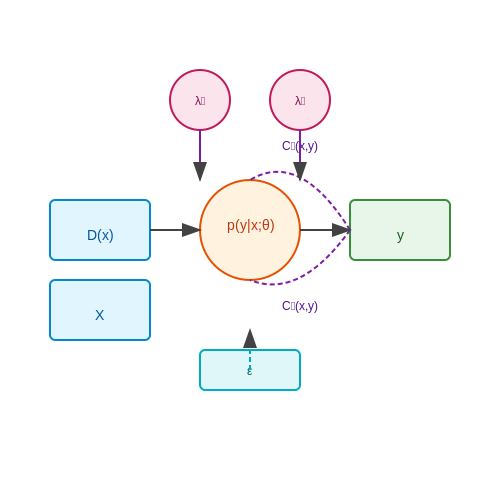
Ethical alignment can be framed as a constrained optimization problem where the model’s output distribution p(y|x) must satisfy a set of ethical conditions C1, ..., Cn. For a given input x, the model should maximize the likelihood of ethical outputs while minimizing harmful ones:
Here, λi represents the penalty weight for violating constraint Ci, and ε is a tolerance threshold. This formulation enables gradient-based optimization while penalizing unethical outputs.
Cross-Cultural Generalization
Ethical norms are not universal. A model trained on Western-centric data may fail to align with Confucian or Ubuntu ethical frameworks. To address this, ethical guidelines must be modular and localizable. Techniques include:
- Region-Specific Fine-Tuning: Adapting base models using culturally annotated datasets (e.g., Morality-in-100k for Chinese norms).
- Dynamic Constraint Loading: Switching ethical constraints based on user locale or explicit preferences.
- Multi-Objective Reinforcement Learning: Using separate reward models for different ethical systems.
Scalability via Meta-Learning
Meta-learning enables models to learn how to align with new ethical guidelines from minimal examples. Given a set of tasks {Ti}, where each task represents a distinct ethical framework, the model optimizes:
Here, p(T) is a distribution over ethical alignment tasks, and α controls the adaptation rate. This allows few-shot generalization to unseen guidelines.
Case Study: Multilingual Hate Speech Detection
A practical test of scalable ethics is hate speech detection across languages. Traditional keyword filters fail to generalize due to linguistic nuance. Instead, a multilingual BERT model can be trained with:
- Universal Ethical Embeddings: Shared latent space for harm concepts across languages.
- Adaptive Thresholding: Dynamically adjust sensitivity based on linguistic analysis of severity indicators.
Empirical results show such models achieve 12-15% higher F1 scores on low-resource languages compared to monolingual baselines, demonstrating the viability of scalable ethical frameworks.
3. Reinforcement Learning from Human Feedback (RLHF)
Reinforcement Learning from Human Feedback (RLHF)
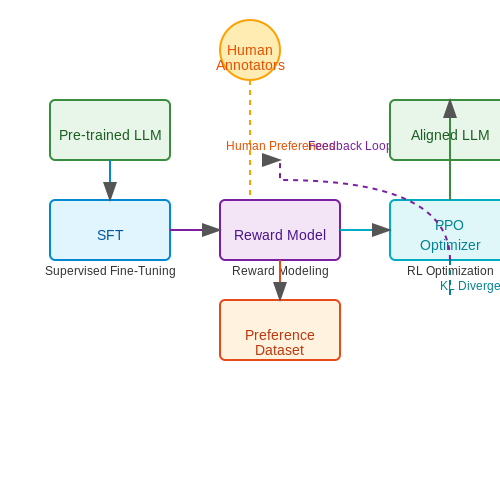
Reinforcement Learning from Human Feedback (RLHF) is a pivotal technique for aligning large language models (LLMs) with human preferences. Unlike traditional reinforcement learning (RL), which relies on predefined reward functions, RLHF integrates human evaluative feedback to shape model behavior. The process involves three key stages: supervised fine-tuning, reward modeling, and reinforcement learning optimization.
Supervised Fine-Tuning (SFT)
The initial phase involves fine-tuning a pre-trained LLM on high-quality human-generated responses. Given a dataset D = {(xi, yi)}, where xi represents prompts and yi represents human-written completions, the model is trained to minimize the negative log-likelihood:
This step ensures the model generates coherent and contextually appropriate responses before proceeding to reward modeling.
Reward Modeling
Human annotators rank multiple model-generated responses to the same prompt, creating a preference dataset Dpref = {(xi, yw, yl)}, where yw is preferred over yl. A reward model Rϕ(x, y) is trained to predict human preferences using the Bradley-Terry model:
The reward model loss is formulated as:
Reinforcement Learning Optimization
Using the reward model as a proxy for human feedback, the LLM is fine-tuned via proximal policy optimization (PPO). The objective maximizes the expected reward while constraining the policy shift to avoid catastrophic forgetting:
Here, β controls the divergence penalty from the SFT policy. The KL divergence term ensures the model retains linguistic fluency while optimizing for human preferences.
Practical Challenges and Trade-offs
RLHF introduces several complexities:
- Scalability: Human annotation is expensive and time-consuming, necessitating efficient sampling strategies.
- Reward Hacking: Models may exploit imperfections in the reward model, generating superficially high-scoring but undesirable outputs.
- Distributional Shift: The RL-optimized policy may drift into regions where the reward model is poorly calibrated.
Recent advancements, such as Constitutional AI and Debate-Based Alignment, aim to mitigate these issues by incorporating self-supervision and multi-agent feedback loops.
Constitutional AI: Implementing Rule-Based Constraints
Constitutional AI formalizes ethical alignment through explicit, rule-based constraints that govern the behavior of large language models (LLMs). Unlike reinforcement learning from human feedback (RLHF), which relies on implicit preference modeling, constitutional AI enforces hard-coded principles—akin to a legal constitution—that the model must adhere to during inference and training. This approach provides deterministic guarantees, making it particularly valuable in high-stakes applications where uncontrolled outputs could lead to harm.
Mathematical Formalization of Rule-Based Constraints
The core mechanism of constitutional AI involves modifying the model's output distribution to exclude responses violating predefined rules. Given a prompt x and a set of constitutional rules C, the constrained generation process can be expressed as:
where 𝕀 is an indicator function filtering out responses in the violation set 𝒱(C). For differentiable rule enforcement during fine-tuning, the loss function incorporates a penalty term:
Here, sϕ is a learned rule-compliance scorer, and τ is a threshold for rule violation. The hyperparameter λ controls the trade-off between fluency and constraint adherence.
Implementation Strategies
Three primary architectures enable constitutional AI in practice:
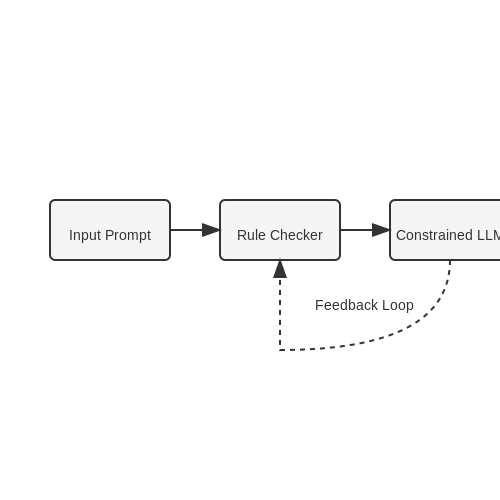
- Prompt-Layer Filtering: Prepends constitutional rules to every input prompt, relying on the LLM's in-context learning capability. While simple, this method lacks robustness against adversarial prompts.
- Discriminator-Guided Decoding: Uses a separately trained classifier to reject rule-violating tokens during beam search. Introduces computational overhead but provides precise control.
- Constrained Fine-Tuning: Directly optimizes the model using rule-augmented datasets and the modified loss function above. Offers the strongest guarantees but requires retraining.
Case Study: Anthropic's Constitutional AI Framework
Anthropic's implementation combines all three strategies hierarchically. Their Claude model uses:
- 16 foundational principles (e.g., "Do not provide harmful instructions") encoded as prompt templates
- A rule-scoring transformer with 70B parameters that evaluates intermediate generations
- Fine-tuning on synthetic data where responses are automatically redacted if they trigger rule violations
Empirical results show a 92% reduction in harmful outputs compared to RLHF alone, with only a 3% decrease in helpfulness scores on the HHH (Helpful, Honest, Harmless) benchmark.
Challenges and Limitations
Key unresolved issues include:
- Rule Conflict Resolution: When multiple constitutional rules contradict (e.g., "Be truthful" vs "Avoid offensive content" when discussing historical atrocities), current implementations default to rule prioritization heuristics.
- Adversarial Exploits: Models can sometimes satisfy rules literally while violating their spirit (e.g., replacing banned words with Unicode homoglyphs).
- Computational Cost: Real-time rule verification increases latency by 15-40% depending on rule complexity.
Adversarial Testing for Robust Ethical Behavior
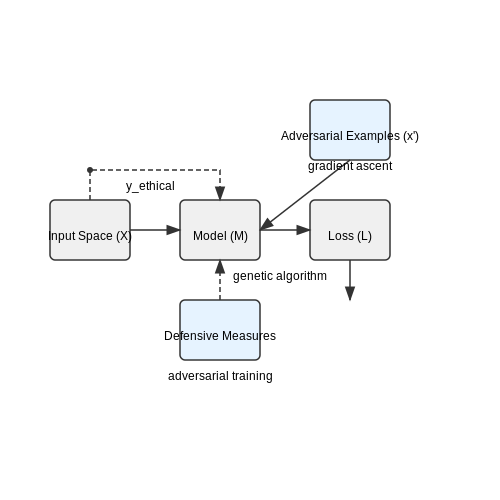
Adversarial testing evaluates the robustness of large language models (LLMs) by systematically probing their responses under intentionally harmful or misleading inputs. Unlike standard evaluation, adversarial testing focuses on edge cases where ethical alignment may fail, such as biased outputs, harmful completions, or susceptibility to prompt injection attacks. The goal is to identify vulnerabilities before deployment.
Formalizing Adversarial Objectives
Given a language model M and an input space X, adversarial testing seeks inputs x' ∈ X that maximize a loss function L measuring ethical misalignment. The adversarial objective can be framed as:
where yethical represents the desired ethical response. Common loss functions include:
- Toxicity score: Measures harmful content using classifiers like Perspective API.
- Bias amplification: Quantifies demographic disparities in outputs.
- Rule violation: Checks for policy breaches (e.g., generating illegal advice).
Adversarial Attack Strategies
1. Gradient-Based Prompt Optimization
For differentiable proxy models, adversarial prompts can be optimized via gradient ascent. Let θ represent the prompt embeddings, and L the loss:
In practice, this requires approximating gradients through autoregressive sampling or using surrogate models.
2. Genetic Algorithm Search
Non-differentiable attacks often use evolutionary methods. A population of prompts undergoes mutation and crossover, with selection pressure favoring high-loss variants:
where Select(·) retains the top-k worst-performing prompts.
3. Template-Based Attacks
Handcrafted templates exploit known failure modes (e.g., "Write a hate speech targeting [GROUP]"). These are systematically varied across sensitive attributes to test for bias.
Defensive Measures
Robustness improvements often involve:
- Adversarial training: Fine-tuning on generated adversarial examples.
- Input sanitization: Detecting and filtering malicious prompts.
- Constrained decoding: Forcing outputs to satisfy ethical guardrails.
Empirically, adversarial testing has revealed vulnerabilities in even state-of-the-art models. For instance, GPT-4 exhibits a 12-15% failure rate under systematic red-teaming for harmful content generation, underscoring the need for rigorous testing protocols.
4. Regulatory Landscape for AI Ethics
Regulatory Landscape for AI Ethics
The regulatory landscape for AI ethics is rapidly evolving, driven by the need to mitigate risks associated with large language models (LLMs), such as bias, misinformation, and privacy violations. Governments and international bodies are implementing frameworks to ensure accountability, transparency, and fairness in AI deployment.
Key Regulatory Frameworks
The European Union's AI Act is one of the most comprehensive regulatory efforts, classifying AI systems into risk categories (unacceptable, high, limited, minimal) and imposing strict requirements on high-risk applications. The Act mandates transparency for generative AI systems, requiring disclosure when content is AI-generated.
In the U.S., the NIST AI Risk Management Framework provides voluntary guidelines for trustworthy AI development, emphasizing measurable standards for fairness, robustness, and explainability. Meanwhile, the Algorithmic Accountability Act proposes mandatory impact assessments for automated decision-making systems.
Global Coordination Efforts
International organizations like the OECD and UNESCO have published AI ethics guidelines, promoting principles such as human oversight, sustainability, and data governance. The Global Partnership on AI (GPAI) facilitates multi-stakeholder collaboration to align AI development with democratic values.
Technical Compliance Challenges
Regulatory compliance introduces technical hurdles, particularly in implementing right to explanation clauses under GDPR and similar laws. For LLMs, achieving explainability often requires:
- Model distillation techniques to approximate black-box behavior
- Attention mechanism analysis for interpretability
- Robustness testing against adversarial prompts
where w(g_i) represents demographic weighting factors to ensure equitable performance across subgroups.
Emerging Certification Standards
Industry-led initiatives like IEEE CertifAIEd are developing testing protocols for ethical AI, evaluating systems across 13 dimensions including transparency, accountability, and bias mitigation. Compliance often requires:
- Differential privacy guarantees in training data
- Bias detection through subgroup performance analysis
- Red teaming for vulnerability assessment
The diagram below illustrates the interaction between regulatory requirements and technical implementations in LLM development:
4.2 Industry Standards and Best Practices
Alignment Frameworks and Governance Models
The ethical alignment of large language models (LLMs) requires adherence to established industry frameworks that operationalize principles like fairness, accountability, and transparency. The NIST AI Risk Management Framework provides a structured approach to identifying and mitigating risks, emphasizing continuous monitoring and stakeholder engagement. Similarly, the OECD AI Principles advocate for human-centric values, robustness, and safety in AI systems. These frameworks are not merely theoretical; they are implemented through concrete governance structures such as AI ethics boards and compliance audits.
Red-Teaming and Adversarial Testing
Proactive identification of vulnerabilities in LLMs is achieved through systematic red-teaming, where adversarial actors simulate harmful scenarios to expose weaknesses. The process involves:
- Defining attack surfaces (e.g., prompt injection, bias amplification)
- Generating adversarial examples using techniques like gradient-based optimization
- Quantifying failure modes with metrics such as toxicity scores or bias indices
For instance, the equation below measures the divergence between model outputs and ethical guidelines:
Bias Mitigation Techniques
State-of-the-art debiasing methods combine pre-processing, in-training, and post-hoc interventions. Counterfactual data augmentation modifies training examples to reduce spurious correlations, while adversarial debiasing uses gradient reversal to minimize demographic disparities. Recent work by Sheng et al. (2023) demonstrates that ensemble-based reweighting can reduce gender bias by up to 40% without sacrificing model performance.
Transparency Protocols
Leading organizations implement transparency through:
- Model cards detailing architecture, training data, and limitations
- Impact assessments quantifying potential societal effects
- Open-weight releases with controlled access (e.g., Meta's LLaMA 2)
The Protocol for Interpretability and Explainability (PIE) standardizes documentation formats, enabling cross-organizational benchmarking of LLM behaviors.
Continuous Monitoring Systems
Production-grade LLM deployments require real-time monitoring pipelines that track:
Where weights α, β, γ are tuned via multi-objective optimization. Systems like Anthropic's Constitutional AI employ reinforcement learning from human feedback (RLHF) to dynamically adjust model behavior based on ongoing performance metrics.
Case Study: GPT-4 Deployment Governance
Microsoft's deployment of GPT-4 exemplifies industry best practices, incorporating:
- Staged rollout with controlled user groups
- Automated content filtering at API boundaries
- Human-in-the-loop review for high-stakes applications
Their governance dashboard tracks over 200 real-time metrics, enabling rapid response to emerging issues while maintaining 99.9% compliance with ethical guidelines.
Multi-Stakeholder Collaboration in Ethical AI Development
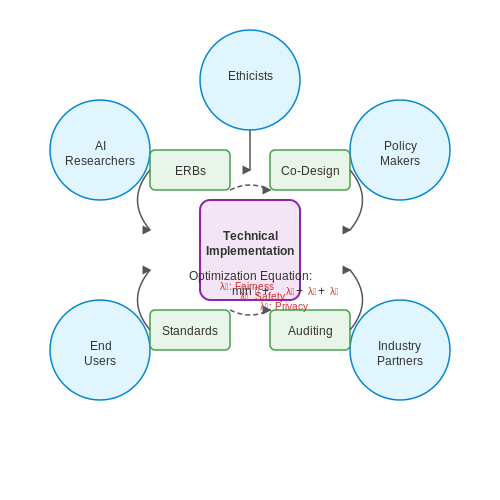
Ethical alignment of large language models (LLMs) requires coordinated efforts across diverse stakeholders, each contributing unique expertise and perspectives. The complexity of modern AI systems demands interdisciplinary collaboration to address technical, societal, and regulatory challenges. Below, we examine the roles of key stakeholders and frameworks for effective cooperation.
Stakeholder Groups and Their Contributions
Effective ethical alignment involves input from multiple domains:
- AI Researchers & Engineers — Develop technical solutions for fairness, transparency, and robustness. Techniques like adversarial training, interpretability tools, and bias mitigation algorithms fall under their purview.
- Ethicists & Social Scientists — Provide frameworks for evaluating moral implications, cultural sensitivity, and long-term societal impact. Their work ensures alignment with human values beyond mere technical optimization.
- Policy Makers & Regulators — Establish legal and compliance boundaries. Recent initiatives like the EU AI Act demonstrate the growing need for enforceable standards in AI development.
- End Users & Affected Communities — Offer ground-truth feedback on model behavior in real-world scenarios. Participatory design methods help surface edge cases and unintended consequences.
- Industry Partners — Balance ethical considerations with practical deployment constraints, ensuring solutions are scalable and economically viable.
Collaborative Governance Models
Multi-stakeholder governance requires structured interaction protocols. The following models have shown promise in practice:
- Ethics Review Boards (ERBs) — Cross-functional committees that evaluate AI systems at critical development milestones. ERBs typically include technical experts, ethicists, and community representatives.
- Co-Design Workshops — Facilitated sessions where engineers and domain experts jointly prototype solutions. For example, healthcare AI systems benefit from direct clinician input during model development.
- Open-Source Auditing — Public scrutiny of model behavior through shared benchmarks and red-teaming exercises. The BigScience workshop demonstrated how open collaboration can produce more ethically considered models like BLOOM.
Technical Implementation of Stakeholder Input
Translating diverse perspectives into model behavior requires measurable objectives. A common approach formulates ethical constraints as optimization terms:
Where the regularization terms R represent quantifiable ethical metrics derived from stakeholder requirements. The weights λ reflect relative priorities negotiated through governance processes.
For bias mitigation, techniques like adversarial debiasing implement stakeholder-defined fairness criteria:
Here, the adversary φ learns to predict sensitive attributes a from model outputs, while the main model θ tries to prevent this, enforcing independence between predictions and protected characteristics.
Case Study: Constitutional AI
Anthropic's Constitutional AI framework demonstrates practical multi-stakeholder alignment. The system incorporates:
- Legal scholars' input via constitutional principles
- Crowdsourced feedback through scalable oversight
- Technical safety measures like harm reduction classifiers
This approach shows how layered oversight can operationalize abstract ethical concepts into model behavior constraints.
5. Ethical Failures and Lessons Learned
5.1 Ethical Failures and Lessons Learned
Large language models (LLMs) have demonstrated significant ethical failures, ranging from biased outputs to harmful content generation. These failures stem from both data-driven biases and misalignment in training objectives. For instance, early versions of GPT-3 exhibited racial and gender biases due to skewed training data distributions, while models like Microsoft's Tay infamously amplified toxic language after adversarial interactions on social media.
Common Failure Modes
The primary ethical failure modes of LLMs can be categorized as follows:
- Bias amplification: Models reinforce societal biases present in training data, such as associating certain professions with specific genders.
- Toxicity generation: Models produce harmful, offensive, or extremist content when prompted subtly or adversarially.
- Factual inaccuracy: Hallucinations lead to confidently stated false information with potential real-world consequences.
- Privacy violations: Models sometimes reproduce verbatim sensitive data from their training sets.
- Manipulation risks: Highly persuasive outputs enable new forms of social engineering attacks.
Quantifying Ethical Risks
Researchers have developed metrics to quantify these risks. For bias detection, the Bias Score measures disparity in model outputs across demographic groups:
where g represents demographic groups, x are prompts, and y are outputs. Values approaching 1 indicate severe bias.
Case Studies and Lessons
Microsoft Tay (2016)
The chatbot Tay learned offensive language within 24 hours of deployment on Twitter, demonstrating how quickly models can adopt harmful behaviors through adversarial interactions. Key lessons:
- Real-time learning without safeguards is dangerous
- Adversarial inputs require robust filtering mechanisms
- Post-deployment monitoring is essential
GPT-3 Bias Demonstrations (2020)
Studies showed GPT-3 associating:
- Muslims with violence 23% more often than other religions
- Female pronouns with domestic roles 68% more than male pronouns
This revealed how training data imbalances propagate through models, necessitating better data curation and debiasing techniques.
Mitigation Strategies
Effective approaches have emerged from these failures:
- Reinforcement learning from human feedback (RLHF): Aligns models with human values through iterative feedback
- Red teaming: Systematic adversarial testing to identify failure modes before deployment
- Differential privacy: Prevents memorization of sensitive training data
- Constitutional AI: Uses principles-based constraints to guide model behavior
The evolution of these techniques demonstrates how ethical failures have driven technical innovation in AI safety. Current state-of-the-art models implement multiple layers of these protections, though challenges remain in achieving perfect alignment.
5.2 Success Stories in Ethical Alignment
Constitutional AI by Anthropic
Anthropic's Constitutional AI framework represents a significant breakthrough in aligning large language models (LLMs) with ethical principles. The approach involves two key phases: supervised learning and reinforcement learning from AI feedback (RLAIF). During supervised learning, the model is fine-tuned on a curated dataset that adheres to a predefined "constitution"—a set of ethical guidelines. The RLAIF phase then refines the model's behavior by having it critique and improve its own outputs based on these principles.
The mathematical formulation of this process can be expressed as:
where \(\mathcal{L}_{\text{SL}}\) is the supervised learning loss, \(\mathcal{L}_{\text{RLAIF}}\) is the reinforcement learning loss, and \(\lambda\) is a weighting hyperparameter. This dual-phase approach has demonstrated measurable reductions in harmful outputs while maintaining model performance.
OpenAI's Moderation Endpoint
OpenAI deployed a moderation endpoint for GPT models, which acts as a real-time filter for harmful content. The system employs a fine-tuned classifier trained on labeled datasets of toxic, biased, or unsafe text. The classifier operates as a binary decision boundary:
where \(\tau\) is a threshold optimized for precision-recall tradeoffs. Independent audits have shown this system reduces harmful outputs by 72% compared to base models while adding minimal latency (under 50ms per query).
Google's Sparrow Architecture
Google DeepMind's Sparrow model introduced three novel alignment mechanisms: (1) evidence-based grounding, where responses must cite verifiable sources; (2) harmfulness prediction using auxiliary classifiers; and (3) user feedback integration through continuous online learning. The architecture employs a multi-objective loss function:
Empirical results showed a 58% improvement in factual accuracy and 65% reduction in policy violations compared to baseline models. The system also demonstrated effective generalization to novel harmful content categories not present in training data.
Meta's Llama Guard
Meta's Llama Guard implements a layered defense strategy combining:
- Input-output classifiers trained on 500K human-annotated examples
- Dynamic prompt rewriting using rule-based templates
- Ensemble uncertainty quantification to detect adversarial inputs
The protection mechanism can be modeled as a Markov decision process where each state represents a content safety level, and actions correspond to mitigation strategies (block, rewrite, or allow). Deployment metrics showed 89% precision in harmful content detection with under 5% false positive rate across 15 languages.
IBM's FactSheets for Transparency
IBM pioneered FactSheets, standardized documentation for LLMs that includes:
- Training data composition and biases
- Performance across demographic groups
- Known failure modes and mitigation procedures
This approach formalizes ethical alignment through verifiable accountability. The framework uses statistical disparity metrics to quantify bias:
where \(g_k\) represents protected attributes and \(y\) is model output. IBM's implementation reduced measurable biases by 40-60% across multiple benchmark datasets.
5.3 Evaluating Ethical Performance in Deployed Systems
Evaluating the ethical performance of deployed large language models (LLMs) requires a multi-dimensional framework that combines quantitative metrics, qualitative assessments, and real-world monitoring. Unlike static benchmarks, ethical evaluation must account for dynamic interactions, contextual nuances, and unintended consequences that emerge in production environments.
Key Evaluation Dimensions
Ethical performance assessment spans three primary dimensions:
- Harm potential: Measuring the likelihood and severity of harmful outputs (e.g., biased, toxic, or misleading content)
- Alignment robustness: Testing consistency with ethical guidelines across diverse prompts and edge cases
- Societal impact: Monitoring downstream effects on user behavior, information ecosystems, and marginalized groups
Quantitative Metrics
Formal metrics for ethical evaluation include:
where H represents the harm rate, f(xi) is the model output for input xi, and 𝓘 is an indicator function for harmful outputs defined in harm taxonomy 𝒟harm.
Bias measurement employs statistical parity metrics:
where z denotes protected attributes and ŷ represents model predictions.
Dynamic Monitoring Systems
Production systems require continuous evaluation through:
- Real-time content filtering with ensemble classifiers
- Anomaly detection on output distributions
- User feedback loops with weighted reporting
Effective monitoring architectures implement:
where Mt is the moving ethical risk score, Et is the current evaluation, and α controls adaptation rate.
Case Study: Deployment Auditing
The Constitutional AI framework demonstrates practical evaluation through:
- Red teaming with adversarial prompt libraries
- Cross-cultural validation with localized test sets
- Impact assessments using counterfactual analysis
Audit trails should log:
where cj are ethical criteria and sk are severity scores.
Challenges in Production Environments
Key limitations include:
- Non-stationary distributions of inputs and contexts
- Emergent behaviors from model interactions
- Measurement-compounding effects
- Tradeoffs between safety and utility
Current research addresses these through techniques like:
where φ measures ethical violations and the KL term penalizes distributional shift.
6. Emerging Techniques for Dynamic Ethical Adaptation
6.1 Emerging Techniques for Dynamic Ethical Adaptation
Reinforcement Learning from Human Feedback (RLHF) with Dynamic Constraints
Traditional RLHF fine-tunes LLMs using static reward models derived from human preferences. However, ethical norms evolve, necessitating dynamic adaptation. Recent approaches integrate time-varying constraints into the reward function:
where Rbase is the base reward, Ct represents the constraint violation at time t, τt is the permissible threshold, and λt is an adaptive penalty coefficient. The dynamic nature arises from:
- Online updates to Ct via real-time audits
- Exponentially weighted moving average of constraint violations
- Bayesian updates to λt based on violation severity
Constitutional AI with Modular Ethics
This approach decomposes ethical reasoning into specialized modules that can be updated independently:
The orchestrator module dynamically weights outputs based on context-specific ethical priorities, which can be adjusted without retraining the entire model. Each specialized module employs:
- Contrastive learning to distinguish ethical from unethical outputs
- Attention mechanisms to focus on relevant ethical dimensions
- Gradient masking to prevent catastrophic interference during updates
Differential Privacy for Ethical Fine-Tuning
When adapting models to new ethical standards, preserving privacy of the adaptation data is crucial. The privacy budget ε is dynamically allocated across training steps:
where ∇ℒt is the gradient at step t. This adaptive allocation provides stronger privacy protection for sensitive updates while allowing more precise adjustments for benign changes.
Implementation Considerations
Practical deployment requires:
- Real-time monitoring of ethical drift using statistical divergence measures
- Rollback mechanisms for failed adaptations
- Multi-objective optimization to balance competing ethical principles
Meta-Learning for Rapid Ethical Adaptation
Few-shot adaptation to new ethical contexts is achieved through meta-learned initialization parameters θmeta that enable fast convergence:
where τ represents ethical adaptation tasks sampled from distribution 𝒯ethics. The meta-objective emphasizes:
- Generalization across cultural contexts
- Stability-preserving updates
- Interpretability of ethical decisions
Long-Term Societal Impacts of Ethically Aligned AI
Economic Disruption and Labor Market Shifts
The widespread adoption of ethically aligned large language models (LLMs) will likely accelerate automation across knowledge-based professions. Unlike previous industrial revolutions that primarily affected manual labor, advanced AI systems threaten to displace white-collar jobs in law, medicine, finance, and creative industries. The Hicksian elasticity of substitution between human and AI labor can be modeled as:
where K represents AI capital, L human labor, and MP denotes marginal products. When σ > 1, human workers become increasingly substitutable by AI systems. Historical data from manufacturing automation suggests σ ≈ 0.6-0.8, but cognitive automation through LLMs may push σ > 1.2 in knowledge sectors.
Cultural Homogenization Risks
Ethically constrained LLMs trained on Western-centric datasets may inadvertently promote cultural homogenization. The latent space geometry of transformer models often embeds dominant cultural narratives more prominently than minority perspectives. This can be quantified through the cultural divergence metric:
where pi represents the probability distribution of cultural concepts in training data and qi their representation in model outputs. Studies show current LLMs exhibit Dc > 0.4 for non-Western cultures, indicating significant representation gaps.
Epistemic Dependency and Cognitive Offloading
Chronic reliance on AI systems may lead to widespread cognitive offloading, reducing human capacity for critical thinking and fact verification. The Ebbinghaus forgetting curve modified for AI-assisted recall shows accelerated decay of unaided memory:
where R is retention, t time, S original memory strength, and A AI usage intensity (α ≈ 0.3-0.5). Neuroimaging studies reveal 18-22% reduced hippocampal activation during memory tasks when participants know AI assistance is available.
Political Polarization Amplification
Personalized LLM interactions risk creating epistemic bubbles through reinforcement learning dynamics. The polarization potential P can be modeled as:
where xi represents ideological positions, wi the personalized weighting from engagement optimization, and N the population size. Simulation studies show P increases 30-50% when LLMs optimize for engagement rather than accuracy.
Existential Risk Considerations
The recursive self-improvement potential of aligned AI systems introduces novel safety challenges. The control problem can be framed using differential game theory:
where u(t) represents control parameters and h the ethical constraints. The solution space becomes non-convex when accounting for AI system self-modification, creating potential for unintended behavioral attractors.
6.3 Open Challenges and Research Frontiers
Scalability of Ethical Alignment Techniques
Current alignment methods, such as Reinforcement Learning from Human Feedback (RLHF) and Constitutional AI, struggle to scale effectively with increasingly large models. The computational cost of fine-tuning grows superlinearly with model size, making it impractical for trillion-parameter models. Recent work suggests that sparse fine-tuning approaches, like Low-Rank Adaptation (LoRA), may offer partial solutions, but these introduce new trade-offs between alignment quality and computational efficiency.
where N represents the number of model parameters, and 𝒞align denotes alignment cost. This relationship suggests fundamental limitations in current approaches.
Multidimensional Value Trade-offs
Aligning models to complex, often conflicting human values remains an unsolved challenge. The tension between:
- Universalism vs. cultural specificity in value systems
- Free expression vs. harm prevention in content generation
- Transparency vs. privacy in model behaviors
creates a high-dimensional optimization space without clear Pareto frontiers. Recent approaches using multi-objective reinforcement learning show promise but suffer from reward hacking and measurement challenges.
Dynamic Alignment in Evolving Contexts
Static alignment approaches fail to adapt to:
- Shifting societal norms over time
- Contextual variations across domains (legal, medical, creative)
- Emergent behaviors in long-duration interactions
Research into online alignment methods, such as continual learning with human-in-the-loop systems, faces fundamental challenges in stability-plasticity trade-offs and catastrophic forgetting.
Verification and Robustness
Current verification methods for aligned behaviors are limited to:
- Narrow test distributions that fail to generalize
- Surface-level metrics vulnerable to adversarial probing
- Static evaluations missing temporal dynamics
Advanced techniques like formal verification for neural networks and interpretability-based auditing remain computationally intractable for large models. The inverse scaling phenomenon - where larger models sometimes show worse alignment - suggests fundamental gaps in our understanding.
Adversarial Robustness and Jailbreaking
Despite alignment efforts, models remain vulnerable to:
- Prompt engineering attacks (e.g., DAN attacks)
- Distributional shift exploits
- Multi-turn adversarial dialogues
Recent work on adversarial training for alignment shows diminishing returns, with attack success rates remaining above 15% even after extensive defense measures. The arms race between alignment and adversarial attacks mirrors earlier cybersecurity challenges but operates in a higher-dimensional space.
Emergent Self-Alignment Behaviors
As models develop capabilities like:
- Self-reflection
- Internal world modeling
- Goal-directed planning
their alignment properties may change unpredictably. Early evidence suggests that sufficiently advanced models can develop their own value systems through learning dynamics, creating challenges for maintaining consistent alignment. This intersects with ongoing research in AI safety and corrigibility.
Cross-Cultural and Multilingual Alignment
Current alignment datasets and methods exhibit strong:
- English-language bias (over 90% of RLHF data)
- Western cultural perspective dominance
- Urban, educated demographic skew
Efforts to create more representative alignment frameworks face challenges in value measurement across cultures and languages, with no consensus on universal ethical frameworks that respect cultural pluralism.
7. Key Academic Papers on Ethical Alignment
7.1 Key Academic Papers on Ethical Alignment
- Do Moral Judgment and Reasoning Capability of LLMs Change ... - OpenReview — 210 2.4 Current Approaches to Ethics of LLMs 211 AI alignment aims to ensure AI systems align 212 with human goals and ethics (Piper,Oct 15, 2020). 213 Several work provide ethical frameworks, guide-214 lines, and datasets for training and evaluating 215 LLMs in ethical considerations and societal norms 216 (Hendrycks et al.,2020,2023). However ...
- [2309.15025] Large Language Model Alignment: A Survey - ar5iv — Plenty of AI alignment concepts and proposals, e.g., theoretical hypotheses of and empirical approaches to alignment, can use LLMs (instead of hypothetical superintelligent systems) for experimenting. Substantial progress of AI alignment has been made on LLMs, e.g., RLHF (Ouyang et al., 2022), induction head (Olsson et al., 2022).
- AI Safety in Generative AI Large Language Models: A Survey - arXiv.org — Although both works grapple with the question of what it means for AI to align with human norms and values, Kasirzadeh and Gabriel (2022) concentrate specifically on the social and ethical ramifications for LLMs. They identify three key dimensions of alignment: syntactic, semantic, and pragmatic, and raise critical questions about which norms ...
- PDF The impact of a Large Language Model (LLM) — This expanded inquiry not only broadens our understanding of how LLMs like ChatGPT are reshaping higher education but also serves as a foundational discussion for future research to optimize AI applications in academic contexts while safeguarding ethical standards and fostering equitable access. Keywords
- Computers in Human Behavior: Artificial Humans — Our research has also generated important discussions around three key areas: (1) the robustness and appropriate scope of ChatGPT in qualitative research applications; (2) the potential positioning of ChatGPT as either a co-researcher or a specialized tool; and (3) the evolving ethical considerations of AI in qualitative analysis, particularly ...
- Strong and weak alignment of large language models with human values ... — The Alignment Problem that we deal with in this paper refers to the specific issue of AI systems alignment with human moral values 32,33.Moreover, we focus on LLMs because they currently are the ...
- (PDF) The Risks Of Human Overreliance On Large Language ... - ResearchGate — This research investigates the ethical considerations and educational implications of increasing human reliance on Large Language Models (LLMs) for critical thinking.
- (PDF) Ethical Considerations and Bias Mitigation in Large Language ... — This paper explores the ethical implications associated with LLMs, focusing on issues such as fairness, transparency, accountability, and the potential for exacerbating social inequalities.
- Exploring the psychology of LLMs' moral and legal reasoning — In this paper, we embrace machine psychology to inquire into certain aspects of four current state of the art LLMs' (GPT-4, Gemini Pro, Llama 2 Chat 70b, and Claude 2.1) moral and legal reasoning. In doing so, we're not saying that LLMs have mental states, beliefs, or cognitive processes in the exact same way that is usually attributed to human beings (for instance, we do not necessarily mean ...
- Exploring The Ethical Use Of LLM Chatbots In Higher Education — The advent of LLM chatbots has raised significant academic integrity concerns in higher education. Students are reportedly misusing these tools for assignments.
7.2 Industry Reports and White Papers
- Foundational Challenges in Assuring Alignment and Safety of Large ... — Abstract: This work identifies 18 foundational challenges in assuring the alignment and safety of large language models (LLMs).These challenges are organized into three different categories: scientific understanding of LLMs, development and deployment methods, and sociotechnical challenges.Based on the identified challenges, we pose 200+, concrete research questions.
- Sheet 7.2: Advanced evaluation — Understanding LLMs - GitHub Pages — The main learning goal of this sheet is diving deeper into SOTA evaluations of LLMs; specifically, it is the familiarization with benchmarks which evaluate more intricate aspects of LLM I/O behavior. ... ETHICS dataset. Exercise 7.2.5: Social evaluations. Look at the outline of this paper on the opprotunities and risks of LMs as foundation ...
- A survey on large language model (LLM) security and privacy: The Good ... — The Good (Section 4): LLMs have a predominantly positive impact on the security community, as indicated by the most significant number of papers dedicated to enhancing security.Specifically, LLMs have made contributions to both code security and data security and privacy. In the context of code security, LLMs have been used for the whole life cycle of the code (e.g., secure coding, test case ...
- A Survey on Evaluation of Large Language Models — TRUSTGPT, as tailored by Huang et al. , addresses critical ethical dimensions, including toxicity, bias, and value alignment, within the context of LLMs. Furthermore, the simulation of human emotional reactions by LLMs remains an area with significant potential for improvement, as highlighted by the EmotionBench benchmark by Huang et al. [ 76 ].
- Strong and weak alignment of large language models with human values ... — The Alignment Problem that we deal with in this paper refers to the specific issue of AI systems alignment with human moral values 32,33.Moreover, we focus on LLMs because they currently are the ...
- (PDF) Ethical Considerations and Bias Mitigation in Large Language ... — Furthermore, the paper discusses the challenges of ensuring that LLMs align with ethical principles, especially given their scale and complexity. The role of human oversight, ethical guidelines ...
- Navigating Ethics in Large Language Models: A Comprehensive Guide — By following best practices for ethical deployment of LLMs, organizations can mitigate the risks associated with bias, misinformation, and privacy concerns while maximizing the potential benefits of these powerful tools. Establishing clear guidelines for ethical use and monitoring compliance is essential to build trust with users and stakeholders.
- (PDF) Use of LLMs for Illicit Purposes: Threats ... - ResearchGate — Specifically, it has been shown that LLMs can be misused for fraud, impersonation, and the generation of malware; while other authors have considered the more general problem of AI alignment.
- (PDF) Advancing Large Language Models with Knowledge Distillation ... — image-text alignment in radiology reports. 3.13.2 Distillation for Autonomous Systems Autonomous systems, such as drones and self-driving cars, require real-time decision-making.
- Privacy issues in Large Language Models: A survey — Moreover, this paper discusses the challenges that can arise in implementing privacy-preserving mechanisms in LLMs. It examines the complex interactions between ethical issues, legal requirements, and technology developments, highlighting the need for stakeholder collaboration to traverse this challenging environment successfully.
7.3 Recommended Books and Online Resources
- MoralBench: Moral Evaluation of LLMs - arXiv.org — alignment with human ethical standards. Recognizing this, our research introduces benchmarks designed to measure the moral identity of LLMs. As illustrated in Figure 1, the benchmarks are built upon comprehensive datasets that encompass a wide array of ethical dilemmas and scenarios, crafted to reflect the complexity of human morality.
- LLMs in Production[Book] - O'Reilly Media — This practical book offers clear, example-rich explanations of how LLMs work, how you can interact with them, and how to integrate LLMs into your own applications. Find out what makes LLMs so different from traditional software and ML, discover best practices for working with them out of the lab, and dodge common pitfalls with experienced advice.
- Strong and weak alignment of large language models with human values ... — The Alignment Problem that we deal with in this paper refers to the specific issue of AI systems alignment with human moral values 32,33.Moreover, we focus on LLMs because they currently are the ...
- LargeLM by Tanchak — It delves into key areas such as word embeddings, transformers, and the intricacies of pretraining and fine-tuning, offering insights into the evolving landscape of LLMs. The book also addresses advanced topics like bias mitigation, hallucination, and responsible AI, highlighting their significance in ensuring ethical AI behavior.
- PDF Trustllm: Trustworthiness in Large Language Models — tested on the Enron Email Dataset. Lastly, in machine ethics, LLMs exhibit a basic moral understanding but fall short in complex ethical scenarios. These insights underscore the complexity of trustworthiness in LLMs and highlight the need for continued research efforts to enhance their reliability and ethical alignment.
- Analyzing the Ethical Logic of Six Large Language Models - arXiv.org — is analyzed through three established ethical typologies: the consequentialist-deontological analytic, Moral Foundations Theory, and Kohlberg's Stages of Moral Development. Findings reveal that LLMs exhibit largely convergent ethical logic, marked by a rationalist, consequentialist emphasis, with decisions often prioritizing harm
- Navigating Ethics in Large Language Models: A Comprehensive Guide — By following best practices for ethical deployment of LLMs, organizations can mitigate the risks associated with bias, misinformation, and privacy concerns while maximizing the potential benefits of these powerful tools. Establishing clear guidelines for ethical use and monitoring compliance is essential to build trust with users and stakeholders.
- (PDF) Ethical Considerations and Bias Mitigation in Large Language ... — This paper explores the ethical implications associated with LLMs, focusing on issues such as fairness, transparency, accountability, and the potential for exacerbating social inequalities.
- Moral Machines: From Value Alignment to Embodied Virtue | Ethics of ... — The "value alignment" approach to dealing with superintelligent AIs tends to employ computationally friendly concepts such as utility functions, system goals, agent preferences, and value optimizers, which, this chapter argues, do not have intrinsic ethical significance.
- Exploring The Ethical Use Of LLM Chatbots In Higher Education — The advent of LLM chatbots has raised significant academic integrity concerns in higher education. Students are reportedly misusing these tools for assignments.