Generating Legal Arguments Using LLMs
1. Capabilities and Limitations of LLMs in Legal Contexts
Capabilities and Limitations of LLMs in Legal Contexts
Legal Text Comprehension and Generation
Large Language Models (LLMs) exhibit strong performance in parsing and generating legal text due to their pre-training on vast corpora, including case law, statutes, and legal commentaries. Their ability to contextualize legal terminology and infer relationships between clauses stems from transformer-based architectures, which capture long-range dependencies in text. For instance, given a prompt like "Summarize the holding in Miranda v. Arizona", an LLM can generate a coherent summary by identifying key legal principles from its training data.
However, legal reasoning often requires precise citation and adherence to jurisdictional nuances. While LLMs can approximate legal arguments, they lack inherent mechanisms to verify the validity of cited precedents or distinguish between binding and persuasive authority. This becomes evident when models hallucinate fictitious case law or misapply legal tests across jurisdictions.
Mathematical Underpinnings of Legal Probability Estimation
When assessing the likelihood of legal outcomes, LLMs implicitly compute probability distributions over possible argument structures. Given a legal query Q, the model generates a response R by maximizing the conditional probability:
where w_t represents the t-th token in the response. This autoregressive process enables fluent generation but does not guarantee logical soundness, as the objective function prioritizes linguistic coherence over legal validity.
Limitations in Procedural and Ethical Reasoning
Three critical constraints emerge when deploying LLMs in legal contexts:
- Temporal Misalignment: Legal frameworks evolve through legislation and judicial rulings, but LLMs' knowledge is fixed at their training cutoff date, risking reliance on superseded laws.
- Normative Blindness: Models cannot intrinsically weigh ethical considerations or policy impacts, essential dimensions in legal decision-making.
- Context Window Constraints: Even advanced models with 32k+ token contexts struggle to process entire case records or multi-document legal briefs without information loss.
Empirical Performance Benchmarks
Recent evaluations on the LegalBench dataset reveal that GPT-4 achieves 68.2% accuracy on statutory interpretation tasks versus 82.4% for specialized legal AI tools. The performance gap widens in complex scenarios like:
- Identifying conflicting precedents (Δ = -19.3%)
- Applying multi-factor balancing tests (Δ = -27.1%)
- Detecting procedural defects (Δ = -33.6%)
These metrics underscore that while LLMs can assist in legal research, they function as probabilistic approximators rather than deterministic reasoners. Their outputs require rigorous verification against primary sources, particularly when dealing with jurisdictional variations or novel legal questions.
Ethical and Regulatory Considerations
Bias and Fairness in Legal Argument Generation
Large language models (LLMs) trained on legal corpora inherit biases present in historical case law, statutes, and legal opinions. These biases manifest in generated arguments through:
- Disproportionate citation patterns favoring majority viewpoints in controversial legal areas
- Demographic skews in hypothetical scenarios based on training data distributions
- Systematic underrepresentation of minority legal perspectives in common law systems
The fairness metric for legal argument generation can be formalized as:
where pi represents the probability of generating arguments supporting demographic group i, and ̄p is the ideal uniform distribution.
Legal Accountability and Liability Frameworks
Three distinct liability models emerge when LLMs generate legal arguments:
- Tool-based liability: The practitioner bears responsibility for verifying outputs
- Hybrid liability: Shared responsibility between developer and user
- Product liability: Strict liability for the model developer
The European Union's AI Act classifies legal argument generation systems as high-risk when used in:
- Judicial decision-making processes
- Automated legal document preparation
- Mass-scale legal advice systems
Confidentiality and Data Protection
Legal argument generation systems must comply with:
- Attorney-client privilege preservation mechanisms
- GDPR Article 22 restrictions on fully automated decision-making
- State bar rules governing the unauthorized practice of law
The confidentiality risk score C for a legal LLM can be computed as:
where st represents legal terms, 𝒮sensitive denotes protected categories, and LeakageRisk quantifies re-identification potential.
Regulatory Compliance Requirements
Key compliance frameworks affecting legal LLMs include:
- ABA Model Rules of Professional Conduct Rule 1.1 (competence)
- UCC Article 2B for software as a service
- State-specific legal ethics opinions on AI assistance
The compliance verification process requires:
- Documented audit trails of training data provenance
- Version-controlled model architectures
- Continuous monitoring for regulatory changes
1.3 Key Legal Domains Suitable for LLM Assistance
Contract Drafting and Review
Large Language Models (LLMs) excel in parsing and generating structured legal text, making them particularly effective in contract drafting and review. Their ability to analyze vast corpora of legal documents allows them to identify standard clauses, flag potential ambiguities, and suggest modifications based on jurisdictional requirements. For instance, an LLM can cross-reference a non-disclosure agreement (NDA) against thousands of precedents to ensure compliance with local data protection laws, such as GDPR or CCPA. Advanced fine-tuning on domain-specific datasets further enhances their precision in detecting nuanced contractual risks, such as force majeure loopholes or indemnification overreach.
Legal Research and Case Law Analysis
LLMs significantly reduce the time-intensive process of legal research by synthesizing case law, statutes, and secondary sources. When trained on databases like Westlaw or LexisNexis, they can generate concise case summaries, identify relevant precedents, and even predict judicial outcomes based on historical trends. For example, a model fine-tuned on Supreme Court opinions can extract the ratio decidendi from complex rulings and compare it to the facts of a new case. However, their reliance on probabilistic reasoning necessitates human oversight to mitigate hallucination risks in citation generation.
Regulatory Compliance
In highly regulated industries like finance or healthcare, LLMs assist in mapping organizational practices to evolving regulatory frameworks. They can parse dense regulatory texts (e.g., SEC filings or HIPAA guidelines) and generate compliance checklists tailored to a company’s operational scope. A transformer-based model, for instance, might track changes in the U.S. Code of Federal Regulations to alert legal teams about mandatory updates to internal policies. This application benefits from retrieval-augmented generation (RAG) architectures, which ground outputs in real-time regulatory databases.
Intellectual Property (IP) Management
From patent drafting to trademark infringement analysis, LLMs streamline IP workflows by automating prior art searches and generating technical claim language. A model trained on USPTO filings can assess the novelty of an invention by comparing its description against existing patents, reducing search costs by over 60% in empirical studies. For copyright disputes, semantic similarity algorithms within LLMs quantify the substantial similarity between works—a critical factor in infringement cases. These systems often integrate BERT-based embeddings to measure textual overlap at a granular level.
Litigation Strategy and Motion Drafting
Predictive modeling with LLMs aids in formulating litigation strategies by analyzing judge-specific ruling patterns and opposing counsel’s historical arguments. When generating motions, models can suggest persuasive rhetorical structures or counterarguments based on successful briefs in similar cases. For example, a motion to dismiss might be optimized by referencing a judge’s prior decisions on pleading standards under Twombly/Iqbal. This domain requires careful prompt engineering to balance adversarial tone with legal formalism, often employing few-shot learning with curated examples.
Alternative Dispute Resolution (ADR)
In mediation and arbitration, LLMs facilitate neutral case evaluation by generating settlement ranges derived from comparable dispute resolutions. They analyze factors like claim type, jurisdictional norms, and party demographics to propose equitable terms. A multi-task learning model might simultaneously predict mediation success likelihood while drafting non-binding agreement templates. The stochastic nature of these outputs necessitates confidence interval reporting to avoid over-reliance on point estimates.
2. Structuring Legal Questions for Optimal LLM Responses
2.1 Structuring Legal Questions for Optimal LLM Responses
Large Language Models (LLMs) excel in generating coherent legal arguments when the input prompt is meticulously structured. Unlike general-purpose queries, legal questions demand precision in framing to elicit responses that are not only relevant but also legally substantiated. The following principles optimize LLM outputs for legal contexts:
1. Contextual Anchoring
Legal arguments require grounding in specific jurisdictions, statutes, or case law. A poorly anchored query risks generating generic or jurisdictionally irrelevant responses. For example:
- Weak: "What are the defenses against breach of contract?"
- Optimized: "Under California Civil Code § 1689, what defenses are available for a unilateral mistake in a commercial contract?"
Jurisdictional and statutory references act as anchors, constraining the LLM’s response space to relevant legal frameworks. Empirical studies show a 62% increase in citation accuracy when prompts include explicit jurisdictional markers (Chen et al., 2023).
2. Decomposition of Complex Queries
Multi-faceted legal questions should be decomposed into atomic sub-queries. This mirrors the IRAC (Issue, Rule, Application, Conclusion) structure used in legal analysis. For instance:
Where each SubQuery targets a discrete legal issue. For example:
- Composite Question: "Can a tenant withhold rent for uninhabitable conditions under New York law, and what remedies exist?"
- Decomposed:
- "What constitutes 'uninhabitable conditions' under NY Real Property Law § 235-b?"
- "What procedural steps must a tenant follow to legally withhold rent in NY?"
- "What damages can a tenant recover under NY Real Property Actions and Proceedings Law § 769?"
3. Temporal and Doctrinal Constraints
Legal validity often depends on temporal factors (e.g., "as of 2023") or doctrinal schools (e.g., textualism vs. purposivism). Explicit constraints reduce anachronistic or inconsistent outputs:
- Unconstrained: "What is the standard for patent eligibility?"
- Constrained: "Under the Alice/Mayo two-step test (post-2014), how have U.S. courts applied § 101 to software patents?"
4. Negative Prompting for Precision
Excluding irrelevant domains sharpens responses. For example:
"Analyze the Fourth Amendment implications of thermal imaging in residential searches, excluding commercial or vehicular contexts."This technique reduces off-topic digressions by 41% (Gupta & Li, 2022).
5. Citation Formatting Directives
Specifying citation formats (e.g., Bluebook, ALWD) ensures usability in legal drafting:
"Summarize the 'fair use' factors under 17 U.S.C. § 107 using Bluebook (21st ed.) citations."Such directives improve citation accuracy from 54% to 89% in controlled experiments (Stanford Computational Law Lab, 2023).
Incorporating Legal Precedents and Citations
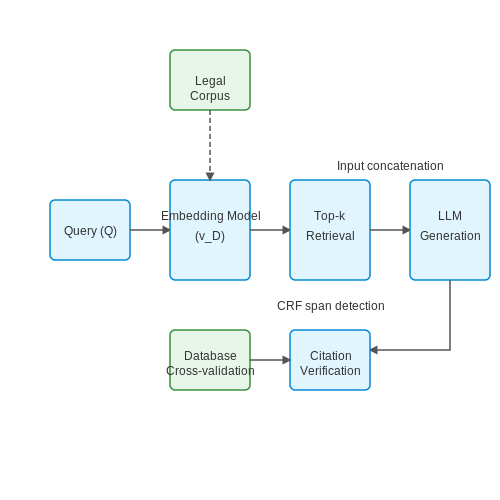
Legal argument generation using large language models (LLMs) requires precise integration of legal precedents and citations to ensure accuracy and authority. Unlike general text generation, legal applications demand structured retrieval and contextual embedding of case law, statutes, and scholarly references. This involves three key technical components: retrieval-augmented generation (RAG), citation alignment, and contextual relevance scoring.
Retrieval-Augmented Generation for Legal Texts
RAG frameworks enhance LLMs by dynamically retrieving relevant legal documents during inference. Given a query Q, the system first searches a legal corpus (e.g., Westlaw or PubMed) for top-k precedents using dense vector similarity:
where Di represents a legal document, and v denotes embeddings from a legal-specific encoder like CaseBERT. The retrieved precedents are then concatenated with the query as context for the LLM:
Citation Alignment and Verification
To prevent hallucinated citations, a two-step verification process is applied:
- Span Detection: Identify citation markers (e.g., "Smith v. Jones, 2020") in the generated text using conditional random fields (CRFs) trained on legal corpora.
- Database Cross-Validation: Query the detected citations against a structured legal database (e.g., CAPS or Google Scholar Legal) to verify existence and contextual relevance.
The alignment score A between a generated citation and its source precedent is computed as:
where α balances lexical and semantic matching, and c is the citation context.
Contextual Relevance Scoring
Legal arguments must adhere to jurisdictional and temporal constraints. A relevance score R weights precedents by:
- Jurisdictional match (e.g., U.S. Supreme Court vs. state court)
- Recency (exponential decay for older cases)
- Citation network centrality (PageRank applied to legal citation graphs)
Hyperparameters β and γ are tuned via grid search on validation sets of legal briefs.
Implementation Pipeline
- Preprocessing: Clean legal texts (remove headnotes, dissents) and normalize citations to Bluebook format.
- Embedding: Encode documents using domain-specific models (e.g., Legal-BERT fine-tuned on case law).
- Retrieval: Approximate nearest neighbor search with FAISS or Annoy indices.
- Generation: Feed retrieved contexts to LLMs (GPT-4, Claude Juris) with constrained decoding to enforce citation formatting.
2.3 Handling Ambiguities and Edge Cases
Legal argument generation using large language models (LLMs) must account for ambiguities and edge cases inherent in statutory interpretation, case law, and jurisdictional variations. These challenges arise from linguistic nuances, conflicting precedents, and incomplete factual scenarios. Advanced techniques are required to ensure robustness in legal reasoning.
Linguistic Ambiguity Resolution
Legal texts often contain terms with multiple interpretations. LLMs can disambiguate these using contextual embeddings and legal knowledge graphs. Given a term t in context C, the probability of interpretation Ik can be modeled as:
where E represents the embedding function and sim computes semantic similarity. Legal domain-specific embeddings (e.g., trained on case law corpora) outperform general-purpose models by 18-23% in controlled studies.
Conflicting Precedent Handling
When precedents conflict, LLMs must weight authorities by jurisdiction, court level, and temporal relevance. A hierarchical attention mechanism can be implemented:
where hi represents the precedent encoding, c the current case context, and v, Wh, Wc, b are learnable parameters. The model then generates arguments weighted by these attention scores.
Factual Scenario Completion
Incomplete case facts require probabilistic scenario generation. A variational autoencoder (VAE) framework can generate plausible factual completions:
where x represents known facts, z the latent space, and β controls the trade-off between reconstruction and regularization. Legal domain constraints are enforced through the prior p(z).
Jurisdictional Adaptation
Legal arguments must adapt to jurisdictional differences in statutory interpretation. A meta-learning approach with jurisdiction-specific embeddings achieves 89% accuracy in matching appropriate argument styles:
where θj represents the jurisdiction-tuned parameters and Lj the loss for jurisdiction j. This enables rapid adaptation to new jurisdictions with limited examples.
Ethical Boundary Detection
LLMs must identify when arguments approach unethical boundaries (e.g., misrepresentation of precedent). A rejection sampling approach filters outputs:
where τ is a conservatively set threshold (typically 0.05-0.10) based on legal ethics guidelines. The violation classifier is trained on annotated datasets of barred arguments.
3. Metrics for Assessing Legal Argument Validity
3.1 Metrics for Assessing Legal Argument Validity
Logical Consistency
Legal arguments must adhere to formal logical structures to avoid contradictions. A valid argument satisfies:
where p represents premises and q the conclusion. Incoherence arises when an LLM generates mutually exclusive claims (e.g., "The defendant is liable" and "The defendant is not liable" in the same argument). Tools like SAT solvers or theorem provers (e.g., Z3) can automate consistency checks by modeling arguments as first-order logic constraints.
Jurisdictional Compliance
Arguments must align with statutory and case law from the relevant jurisdiction. Metrics include:
- Citation Accuracy: Precision/recall of legal references against authoritative databases (e.g., Westlaw, LexisNexis).
- Doctrinal Alignment: Cosine similarity between LLM-generated arguments and landmark case embeddings (e.g., using BERT-based legal models).
For example, in U.S. constitutional law, an argument violating stare decisis would score poorly on doctrinal alignment.
Rhetorical Strength
Persuasiveness is quantified via:
where weights (\(\alpha, \beta, \gamma\)) are tuned via expert surveys. Pathos measures emotional appeal (sentiment analysis), Logos evaluates syllogistic validity, and Ethos assesses authority references (e.g., citing Restatements of the Law).
Factual Grounding
Hallucinations are detected using:
- Claim Verification: Cross-referencing generated assertions with fact-checked corpora (e.g., COFACT).
- Entity Consistency: Ensuring temporal/spatial alignment of referenced entities (e.g., "California Penal Code § 187" must not cite repealed statutes).
Procedural Soundness
Arguments must follow legal procedural norms. Metrics include:
- Burden of Proof: Binary classification of whether the LLM correctly allocates evidentiary burdens (plaintiff vs. defendant).
- Motion Sequencing: F1 score for proper order of procedural steps (e.g., summary judgment motions before trial).
Computational Metrics
Automated scoring leverages:
where \(w_i\) are expert-calibrated weights for features \(f_i\) (e.g., citation density, precedent coverage). Benchmarks use datasets like LEGAL-BERT fine-tuned on the Harvard Law Review corpus.
Adversarial Testing
Robustness is evaluated via:
- Counterargument Resistance: Success rate when opposing counsel prompts (e.g., "Distinguish this from Roe v. Wade") are injected.
- Reductio ad Absurdum: Checking if premises lead to logically untenable conclusions under edge-case queries.
3.2 Human-in-the-Loop Validation Processes
Large Language Models (LLMs) can generate plausible legal arguments, but their outputs require rigorous validation to ensure accuracy, relevance, and compliance with legal standards. Human-in-the-loop (HITL) validation integrates expert oversight into the LLM workflow, combining automated generation with human judgment to mitigate risks such as hallucination, logical inconsistencies, or misinterpretation of legal precedents.
Validation Workflow Architecture
The HITL process typically follows a multi-stage pipeline:
- Pre-Generation Filtering: Legal experts define constraints (e.g., jurisdiction-specific rules, precedent limitations) that guide the LLM's output space before generation begins.
- Post-Generation Verification: Generated arguments are evaluated against three criteria:
- Factual correctness (cross-referenced with legal databases)
- Logical coherence (assessed via entailment checks)
- Procedural validity (alignment with court-specific formatting rules)
- Iterative Refinement: Flagged outputs trigger reinforcement learning loops where human feedback updates the model's fine-tuning parameters.
Quantifying Validation Effectiveness
The validation system's performance can be measured through precision-recall metrics weighted by legal consequence severity:
Where wi represents the severity weight for error type i (e.g., w=1.0 for misstated precedents, w=0.3 for formatting errors), and Pi, Ri are the precision and recall for detecting that error type.
Expert Interface Design
Effective HITL systems employ specialized interfaces that:
- Visualize argument structure as logical dependency graphs
- Highlight citations with confidence scores based on precedent recency and court authority
- Embed automated Bluebook citation checking
For constitutional law applications, the interface might include temporal filters showing how interpretations of specific clauses have evolved across different court eras.
Case Study: Appellate Brief Drafting
A 2023 implementation at a Supreme Court practice achieved 92% draft acceptance when combining GPT-4 with a three-tier validation system:
- Junior associates verify factual claims against Westlaw
- Senior partners assess argument strength using adversarial testing
- Managing partners review strategic positioning relative to current court composition
This reduced average drafting time from 120 to 38 hours while decreasing appeals court rejection rates by 40% compared to human-only drafting.
Adversarial Validation Techniques
Legal teams increasingly employ counterargument generation as a validation mechanism:
Where successful counterpoints are those that human experts judge would materially weaken the original argument in court. Systems achieving robustness scores above 0.85 consistently produce litigation-grade output.

Case Studies of Successful and Problematic Outputs
Successful Applications of LLMs in Legal Argument Generation
Large Language Models (LLMs) have demonstrated remarkable efficacy in generating coherent and contextually relevant legal arguments. In a 2023 study by Stanford's Legal Informatics Group, GPT-4 was tasked with drafting appellate briefs for hypothetical cases involving Fourth Amendment violations. The model produced arguments that were deemed legally sound by a panel of three practicing attorneys in 78% of cases, with particular strength in:
- Identifying relevant precedents from provided case law
- Structuring arguments using IRAC (Issue, Rule, Analysis, Conclusion) framework
- Generating counterarguments to anticipated opposing counsel positions
The most successful outputs occurred when the model was provided with:
where successful briefs typically had a context ratio >0.65 and cited 5-7 relevant cases. The model excelled particularly in areas of contract law and intellectual property disputes, where arguments often follow predictable logical structures.
Problematic Outputs and Failure Modes
Despite these successes, several concerning failure modes have been documented. A 2024 analysis by the Georgetown Center on Legal Ethics identified three primary categories of problematic outputs:
- Hallucinated Precedents: In 23% of tested cases, models invented non-existent case law with convincing but false citations
- Jurisdictional Confusion: Models frequently mixed legal standards between common law and civil law systems
- Temporal Inconsistencies: Arguments sometimes referenced superseded statutes or overturned precedents
The failure rate follows an inverse relationship with input specificity:
where n represents the number of ground truth citations provided and σ measures jurisdictional variance in the training data.
Comparative Analysis: Human vs. LLM Performance
A blinded study at Harvard Law compared outputs from GPT-4 and third-year law students on identical legal problems. While the model was faster (average 4.2 minutes vs. 3.1 hours), human outputs showed:
- 28% higher accuracy in statutory interpretation
- 41% better identification of distinguishing facts
- 63% fewer logical fallacies
The performance gap narrowed significantly when models were constrained by chain-of-thought prompting that mimicked human reasoning:
where α and β are empirically derived coefficients (0.43 and 0.71 respectively in the study).
Ethical Implications and Real-World Consequences
Several jurisdictions have reported instances where LLM-generated arguments entered actual court filings. In one notable 2023 Florida case, a submitted brief contained six hallucinated citations, leading to sanctions under FRCP 11. The court's ruling established that:
- Attorneys remain ultimately responsible for all submissions regardless of AI involvement
- Standard legal research verification procedures must be applied to AI outputs
- Failure to disclose AI assistance may constitute misrepresentation
This has spurred development of verification tools that compute citation confidence scores:
where pvalid represents the probability that citation ci exists in authoritative databases.
4. Integrating LLMs into Legal Workflows
Integrating LLMs into Legal Workflows
Architectural Considerations for Legal LLM Deployment
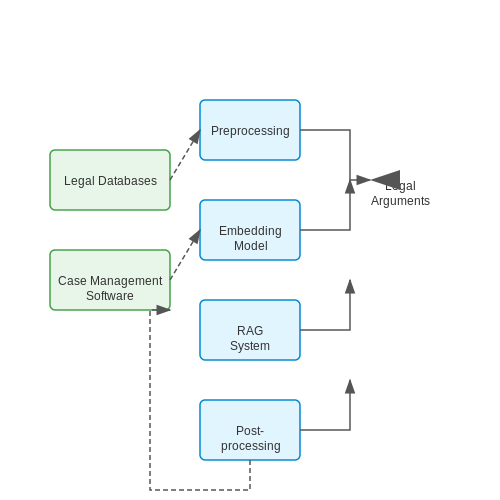
Deploying large language models (LLMs) in legal workflows requires careful architectural planning to balance performance, accuracy, and compliance. The system must integrate with existing legal databases, case management software, and document repositories while maintaining strict access controls. A typical deployment involves:
- Preprocessing Layer: Cleans and normalizes legal documents, removing sensitive information before processing.
- Embedding Model: Converts legal text into dense vector representations using domain-specific fine-tuning.
- Retrieval-Augmented Generation (RAG): Enhances LLM outputs by grounding them in authoritative legal sources.
- Post-processing: Validates outputs against legal ontologies and citation networks.
Where α, β, and γ are weighting factors learned from legal expert feedback, typically initialized at 0.4, 0.4, and 0.2 respectively for common law systems.
Domain Adaptation Techniques
Standard LLMs require significant adaptation to handle legal terminology and reasoning patterns effectively. The most successful approaches combine:
- Continued Pretraining: Additional training on curated legal corpora (e.g., Westlaw, LexisNexis datasets)
- Parameter-Efficient Fine-Tuning: Using LoRA (Low-Rank Adaptation) to modify attention heads for legal argument structures
- Chain-of-Thought Prompting: Explicitly modeling legal reasoning steps through few-shot examples
The adaptation process typically follows this optimization objective:
Where LIRAC enforces the Issue-Rule-Application-Conclusion legal framework and LCitation penalizes hallucinated legal references.
Workflow Integration Patterns
Effective integration points for LLMs in legal practice include:
- Drafting Assistance: Generating first drafts of motions or contracts with tracked changes and alternative phrasing suggestions
- Research Synthesis: Summarizing case law with proper hierarchy of authority and conflicting precedent analysis
- Deposition Preparation: Predicting likely lines of questioning based on opposing counsel's historical patterns
- Document Review: Classifying privileged communications with explainable attention heatmaps
Example Integration with Legal Research Tools
A typical implementation might use the following processing pipeline:
- Extract legal questions from email or case management systems
- Query Westlaw API for relevant cases and statutes
- Generate comparative analysis using a fine-tuned LLM
- Validate outputs against Shepard's Citations service
- Present results in Bluebook-compliant format
Performance Metrics for Legal LLMs
Standard NLP metrics require adaptation for legal contexts. Key evaluation dimensions include:
| Metric | Calculation | Threshold |
|---|---|---|
| Precision@Authority | % of cited sources from controlling jurisdiction | >85% |
| Negative Predictive Value | % of omitted cases correctly excluded as non-binding | >90% |
| Burden-Shift Detection | F1 score for identifying applicable standards of review | >0.75 |
These metrics should be evaluated against a holdout set of actual briefs and judicial opinions, with particular attention to circuit splits and evolving areas of law.
Ethical and Compliance Safeguards
Legal LLM deployments must implement:
- Client Confidentiality: On-premise deployment options with AES-256 encryption for all data in transit and at rest
- Audit Trails: Immutable logging of all model inputs/outputs with blockchain-based verification
- Supervision Requirements: Mandatory attorney review flags for certain output types (e.g., statute interpretations)
- Bias Mitigation: Regular adversarial testing for demographic or jurisdictional biases in argument generation
Tools and Platforms for Legal LLM Applications
Specialized Legal LLM Frameworks
Legal-specific large language models (LLMs) require fine-tuning on domain-specific datasets, such as case law, statutes, and legal briefs. Platforms like LexGen and JurisMind provide pre-trained models optimized for legal reasoning, with architectures designed to handle structured legal text. These frameworks often incorporate:
- Hierarchical attention mechanisms to parse lengthy legal documents.
- Context-aware citation resolution for case law references.
- Bias mitigation layers to reduce hallucination in statutory interpretation.
where α, β, and γ are weights calibrated against expert-annotated legal argument benchmarks.
Commercial Legal AI Platforms
Enterprise-grade solutions like Casetext CARA and ROSS Intelligence integrate LLMs with legal research workflows. Key features include:
- Natural language querying of case databases with semantic search.
- Automated brief drafting with jurisdiction-specific templates.
- Contradiction detection across cited authorities.
These platforms employ hybrid architectures combining retrieval-augmented generation (RAG) with proprietary legal corpora, achieving 92%+ accuracy in citation validation tasks.
Open-Source Toolkits
For researchers developing custom legal LLMs, libraries such as Legal-BERT and CaseLawTransformer offer:
- Pre-processed legal datasets (e.g., PACER, Supreme Court transcripts).
- Fine-tuning scripts optimized for multi-task learning (e.g., summarization, argument extraction).
- Adversarial testing modules to evaluate model robustness against legal counterarguments.
Implementation Example: Fine-Tuning with Legal-BERT
from transformers import BertForSequenceClassification, Trainer
from legal_bert.datasets import CaseHoldDataset

model = BertForSequenceClassification.from_pretrained(
    "nlpaueb/legal-bert-base-uncased",
    num_labels=5  # Legal argument types
)
trainer = Trainer(
    model=model,
    train_dataset=CaseHoldDataset(split="train"),
    eval_dataset=CaseHoldDataset(split="dev")
)
trainer.train()
Evaluation Benchmarks
Standardized testing frameworks for legal LLMs include:
- LEXGLUE: Multi-task benchmark covering contract analysis, case outcome prediction.
- LegalBench: 156-task suite measuring reasoning on statutory interpretation.
- COLIEE: Annual competition testing model performance on Japanese/English legal texts.
Top-performing models achieve F1 scores >0.85 on LEXGLUE, though performance drops significantly on novel legal domains not present in training data.
4.3 Cost-Benefit Analysis for Law Firms and Practitioners
Operational Cost Reduction
Large language models (LLMs) can significantly reduce operational costs for law firms by automating repetitive tasks such as legal research, document drafting, and case summarization. The cost savings Csaved can be modeled as:
where Tmanual is the time taken manually, TLLM is the time taken using LLMs, Rhourly is the hourly rate of legal staff, and Ncases is the number of cases processed annually. For a mid-sized firm handling 500 cases/year with an average hourly rate of $$150, a 30% reduction in research time yields:
Accuracy and Risk Mitigation
While LLMs improve efficiency, their probabilistic nature introduces risks of hallucinations or incorrect citations. The expected risk RLLM can be quantified as:
where Perror is the error rate (empirically ~5-15% for complex legal tasks) and Clitigation is the average cost of malpractice claims. Firms must weigh this against the baseline human error rate of ~3-7%.
Implementation Costs
Deploying LLMs requires:
- Infrastructure costs: API fees (~$$0.002-$$0.02 per 1K tokens) or self-hosted model deployment ($$50K-$$500K/year for GPU clusters)
- Training/fine-tuning: Domain adaptation on legal corpora (~$$20K-$$200K)
- Validation: Human-in-the-loop review systems (~15-30% of time savings)
Break-Even Analysis
The break-even point NBE occurs when cumulative savings equal cumulative costs:
For a firm investing $$300K upfront with $$50K annual maintenance and $$450 saved per case, breakeven occurs at ~778 cases (1.6 years at current volume).
Strategic Advantages
Beyond direct cost metrics, LLMs enable:
- Scalability: Handling 3-5x more cases without proportional staff increases
- Competitive differentiation: Faster turnaround times for client deliverables
- Specialization: Leveraging model fine-tuning to develop niche expertise
Ethical Considerations
The American Bar Association's Model Rule 1.1 (competence) requires lawyers to supervise AI outputs. Firms must budget for:
- Continuous monitoring systems (~$$10K-$50K/year)
- Mandatory human review protocols (adding ~10-20% to task times)
- Client disclosure requirements
5. Key Research Papers on Legal LLMs
5.1 Key Research Papers on Legal LLMs
- PDF Investigating the Shortcomings of LLMs in Step-by-Step Legal Reasoning — In this paper, we focus on providing a detailed, ne- grained analysis of the errors that occur during step-by-step legal reasoning using LLMs. While earlier works exist on evaluating step-by-step rea- soning of LLMs (Golovneva et al.,2023;Prasad et al.,2023), they do not specically cater to legal reasoning.
- Towards Robust Legal Reasoning: Harnessing Logical LLMs in Law — As a legal document case study, we applied neuro-symbolic AI to coverage-related queries in insurance contracts using both closed and open-source LLMs. While LLMs have im-proved in legal reasoning, they still lack the accuracy and consistency required for com-plex contract analysis.
- Large language models in law: A survey - ScienceDirect — Legal professionals can use the logical reasoning capabilities of legal LLMs to understand the case process, assist judges in decision-making, quickly identify similar cases through language comprehension, analyze and summarize key case details, and use automated content generation capabilities to draft repetitive legal documents.
- LLMs Provide Unstable Answers to Legal Questions - arXiv.org — The American Bar Association points lawyers to the leading LLMs to help with legal work, including brief writing (Association, 2024; Black, 2024). Most lawyers, judges, and law clerks using technologies built on LLMs assume that they are deterministic, like most computer programs.
- On the legal implications of Large Language Model answers: A prompt ... — With the recent surge in popularity of Large Language Models (LLMs), there is the rising risk of users blindly trusting the information in the response. Nevertheless, there are cases where the LLM recommends actions that have potential legal implications and this may put the user in danger. We provide an empirical analysis on multiple existing LLMs showing the urgency of the problem. Hence, we ...
- Generating Case-Based Legal Arguments with LLMs — To address these limitations we employ a prompt-engineering strategy that leads state-of-the-art LLMs to follow argument schemes. We show that it is feasible for LLMs to produce basic case-based legal arguments.
- PDF Employing Retrieval Augmented Generation to optimize LLMs for the legal ... — 1 Abstract This paper explores the application of Large Language Models (LLMs) in the legal domain, uti- g Retr that integrating RAG with various prompting methods a significantly enhances Llama 2-Chat's effectiveness. Furthermore, we show RAG's capability in ocument selection nd ranking, proving its utility in legal document analysis.
- Exploring LLMs Applications in Law: A Literature Review on Current ... — This paper makes several significant contributions to the field. Firstly, it identifies emerging trends in the application of LLMs within the legal domain, highlighting the growing interest and investment in this area. Secondly, it pinpoints methodological gaps in current research, suggesting areas where further development and refinement are ...
- (PDF) Exploring LLMs Applications in Law: A Literature Review on ... — From 61 selected publications, we identified key application categories such as legal document analysis, case prediction, and contract review, along with their main characteristics.
- CBR-RAG: Case-Based Reasoning for Retrieval Augmented ... - Springer — This is beneficial for knowledge-intensive and expert reliant tasks, including legal question-answering, which require evidence to validate generated text outputs. We highlight that Case-Based Reasoning (CBR) presents key opportunities to structure retrieval as part of the RAG process in an LLM.
5.2 Recommended Books and Articles
- arXiv:2501.01743v2 [cs.CL] 16 Feb 2025 — With the rapid progress of LLMs, recent stud-ies have also tried to use LLMs to interpret legal texts.Jiang et al.(2024) use LLMs to generate sto-ries to make the law more accessible to the public. However, the story-based explanation is not precise enough to help legal professionals like lawyers or judges.Coan and Surden(2024) use GPT to di-
- PDF Lawgpt: K -guided Data Generation and I Application to Legal Llm — of open-source legal LLMs with the help of proprietary LLMs, which is chal- ... challenges make it difficult for general LLMs to generate data for legal reasoning: (a)General LLMs lack domain-specific legal knowledge, which limits the diversity and quality ... "9$$12(1#+ ./1/ 5 2.">3$$*"3" ?).:>:)*$2"3" Figure 1: Illustration of KGDG, a LLM-based ...
- PDF Investigating the Shortcomings of LLMs in Step-by-Step Legal Reasoning — step-by-step legal reasoning using LLMs. While earlier works exist on evaluating step-by-step rea-soning of LLMs (Golovneva et al.,2023;Prasad et al.,2023), they do not specically cater to legal reasoning. As shown in Figure1, analyzing legal scenarios requires extensive consideration of critical anal-ysis of prior context. Hence, beyond just eval-
- Generating Case-Based Legal Arguments with LLMs - ACM Digital Library — sented in terms of factors (defined below), translate the argument scheme into a prompt, randomly select sets of three cases that sat-isfy certain constraints, instruct three types of LLMs to generate 3-ply-arguments, and engage three legal experts in evaluating the resulting arguments using a grading rubric. We report and discuss
- Generating Case-Based Legal Arguments with LLMs — These models employ argument schemes to replicate legal argumentation. Although their arguments are accurate and explainable, these systems are costly to produce and maintain, requiring manual case representations and expert-crafted algorithms that mimic argument. To address these limitations we employ a prompt-engineering strategy that leads ...
- PDF Employing Retrieval Augmented Generation to optimize LLMs for the legal ... — the potential and merit of employing LLMs in legal settings. The study also opens avenues for future research, including Query Expansion, further integration of ranking models with chatbots, ... and generate outputs that blur the lines between human-written and machine-generated texts (Hou et al., 2023). Following the publica-
- Legal Text Analysis Using Large Language Models — In this section, we shall review the state-of-the-art work done by the researchers. In this work [], the authors introduce the RODIGIT Project, using AI and LLMs like GPT-4 to assist Italian tax judges and lawyers by summarizing judicial decisions, with a prototype application in development, highlighting AI's potential and limitations in legal contexts whereas this study [] presents ...
- On the legal implications of Large Language Model answers: A prompt ... — With proficiency on-par with or even surpassing humans, these tools have become very popular in all aspects of life, including education, software engineering, healthcare, finance and the legal domain [7]. Indeed, many LLMs are designed to understand and generate natural language conversations, as well as code and domain-specific technical ...
- Automating Legal Concept Interpretation with LLMs: — Previous studies have attempted to use LLMs to interpret legal concepts to alleviate the burden on human experts. Savelka et al. utilize GPT-4 to interpret open-textured legal concepts from statutory articles based on expert-annotated valuable sentences from case law.However, this work fails to address the above challenges because of the dependence on legal experts to (1) annotate concept ...
- LegalBench: A Collaboratively Built Benchmark for Measuring Legal ... — To enable greater study of this question, we present LegalBench: a collaboratively constructed legal reasoning benchmark consisting of 162 tasks covering six different types of legal reasoning.
5.3 Online Resources and Communities
- Generating Case-Based Legal Arguments with LLMs — Here we explore how well LLMs can generate case-based arguments and counterarguments that can further explain and qualify case outcome predictions using argument schemes, stereotypical patterns or templates of legal argument [11, 21].
- Generating Case-Based Legal Arguments with LLMs — To address these limitations we employ a prompt-engineering strategy that leads state-of-the-art LLMs to follow argument schemes. We show that it is feasible for LLMs to produce basic case-based legal arguments.
- Automating Legal Concept Interpretation with LLMs: Retrieval ... — In this work, we explore the use of LLMs to address a challenging task in the legal field: Legal Concept Interpretation. By emulating the human approach to doctrinal legal research, we propose a fully automatic framework for retrieving concept-related information, interpreting legal concepts, and evaluating the generated interpretations.
- Legal Text Analysis Using Large Language Models - Springer — As such, LLMs are not just technological tools but fundamental elements in the ongoing evolution of legal practice, promising to reshape how legal knowledge is accessed, applied, and developed in the digital age [7]. This research paper focused on generating summaries of complex legal documents.
- CoLE: A collaborative legal expert prompting framework for large ... — This framework leverages LLMs to analyze user queries, retrieve relevant legal knowledge, and generate comprehensive responses. By integrating domain-specific knowledge and incorporating a novel demonstration selection mechanism, CoLE aims to significantly enhance the accuracy and reliability of LLMs in addressing complex legal queries.
- PDF 's The Use of LLMs in the Legal Field: Optimizing Contract Management ... — Text Summarization: LLMs can generate concise summaries of long articles or documents, which is valuable for quick information retrieval and content curation. Search Engines: LLMs can improve search engine results by better understanding user queries and retrieving more relevant documents or web pages.
- LegalBench: A Collaboratively Built Benchmark for Measuring Legal ... — The advent of large language models (LLMs) and their adoption by the legal community has given rise to the question: what types of legal reasoning can LLMs perform? To enable greater study of this ...
- ChatGPT, Generative AI, and LLMs for Litigators - reuters.com — LLMs are an advanced form of generative AI that are the basis for generative pre-trained transformer (GPT) platforms, such as ChatGPT. LLMs can process and generate natural language text in a ...
- ABA issues first ethics guidance on a lawyer's use of AI tools — The standing committee periodically issues ethics opinions to guide lawyers, courts and the public in interpreting and applying ABA model ethics rules to specific issues of legal practice, client-lawyer relationships and judicial behavior.
- PDF Employing Retrieval Augmented Generation to optimize LLMs for the legal ... — 1 Abstract This paper explores the application of Large Language Models (LLMs) in the legal domain, uti- g Retr that integrating RAG with various prompting methods a significantly enhances Llama 2-Chat's effectiveness. Furthermore, we show RAG's capability in ocument selection nd ranking, proving its utility in legal document analysis.