Language Models That Parse and Edit SVG/HTML/XML
1. Understanding SVG, HTML, and XML Syntax and Semantics
Understanding SVG, HTML, and XML Syntax and Semantics
Structural Foundations of XML-Based Markup Languages
SVG, HTML, and XML share a common ancestry in the Generalized Markup Language (GML) and Standard Generalized Markup Language (SGML). Their syntax is defined by a tree-structured document object model (DOM) where elements are nested hierarchically and delimited by tags. The core syntactic rules governing all three languages include:
- Well-formedness constraints: Every opening tag must have a corresponding closing tag (or be self-closing)
- Proper nesting: Child elements must completely reside within parent elements
- Attribute quoting: All attribute values must be enclosed in matching single or double quotes
- Case sensitivity: XML and SVG are case-sensitive, while HTML is case-insensitive for tag names
The Document Type Definition (DTD) or XML Schema provides the grammatical rules for valid documents in each language. For modern HTML5, the specification defines both the syntax and parsing rules algorithmically rather than through a formal DTD.
Semantic Differences Between Language Families
While sharing syntactic foundations, the three languages diverge in their semantic purposes:
- XML: A meta-language for defining domain-specific markup languages with strict validation requirements
- HTML: A concrete language for structuring and presenting hypertext documents with built-in error recovery
- SVG: An XML dialect for describing two-dimensional vector graphics with animation capabilities
This semantic specialization manifests in their respective Document Object Models. HTML elements carry implicit presentation semantics (e.g., <em> implying emphasis), while SVG elements describe geometric primitives with rendering implications (e.g., <path d="M10 10 L20 20"> defining a line segment).
Namespace Handling in Compound Documents
Modern web documents often combine multiple XML dialects through namespace declarations. The XML namespace specification (xmlns) enables unambiguous element identification when mixing vocabularies:
For example, embedding SVG within XHTML requires proper namespace scoping:
<html xmlns="http://www.w3.org/1999/xhtml">
  <body>
    <svg xmlns="http://www.w3.org/2000/svg" width="100" height="100">
      <circle cx="50" cy="50" r="40"/>
    </svg>
  </body>
</html>
Formal Language Specifications
The syntax of each language is formally defined through:
- XML 1.0 Specification (Fifth Edition) for base syntax rules
- HTML Living Standard for parsing and serialization requirements
- SVG 2.0 Specification for vector graphic primitives and properties
These specifications define both the lexical structure (regular grammar for tokens) and syntactic structure (context-free grammar for document structure). Modern parsers implement these grammars through deterministic finite automata for lexical analysis and shift-reduce parsers for syntactic analysis.
Semantic Constraints Beyond Syntax
Valid documents must satisfy additional semantic constraints not captured by pure syntax:
- HTML5 semantic content models (e.g.,
<li>must be child of<ul>,<ol>, or<menu>) - SVG presentation attributes (e.g.,
fillmust be a color value or URL) - XML ID uniqueness constraints and referential integrity
These constraints are typically enforced through schema validation (XSD, RelaxNG) or specialized validators like the W3C Markup Validation Service.

Tokenization and Embedding Strategies for Structured Text
Challenges in Tokenizing Structured Markup
Tokenizing SVG, HTML, or XML presents unique challenges compared to natural language text. The hierarchical nesting of tags, attribute-value pairs, and mixed content (text interspersed with markup) requires specialized approaches. Traditional subword tokenizers like Byte-Pair Encoding (BPE) struggle with several aspects:
- Preservation of document structure during tokenization
- Handling of special characters (<, >, /, =) that carry syntactic meaning
- Maintaining relationships between opening/closing tags
- Encoding of attribute names and values as discrete semantic units
Where α, β, γ are weighting factors for tag count, attribute count, and nesting depth respectively.
Specialized Tokenization Approaches
XML-Aware BPE Variants
Modified BPE algorithms treat markup delimiters as protected tokens that are never split. The tokenization process becomes:
- Pre-segment input into text nodes, tags, and attributes
- Apply standard BPE to text content only
- Preserve all markup tokens verbatim
Grammar-Guided Tokenization
For XML/SVG, Document Type Definition (DTD) or XML Schema can inform the tokenizer about:
- Mandatory/optional elements
- Allowed attribute combinations
- Content models (PCDATA, EMPTY, ANY)
This enables context-aware splitting where element names are tokenized differently based on their grammatical role.
Embedding Strategies for Structured Data
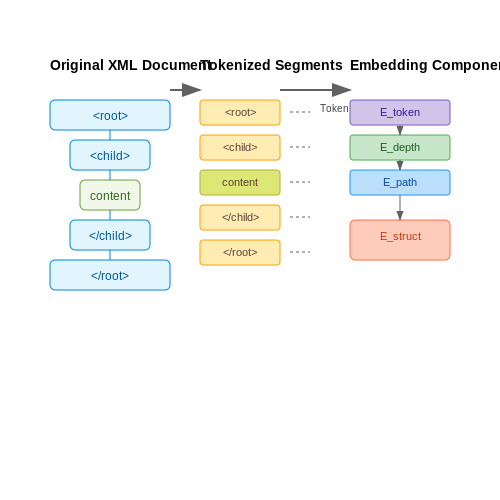
Position-Aware Embeddings
Standard positional embeddings fail to capture document structure. Enhanced approaches include:
Where depth embeddings encode DOM tree level, and path embeddings represent the XPath to each node.
Graph-Based Embeddings
Treating the document as a graph enables:
- Graph Neural Network (GNN) approaches
- Attention over sibling/parent/child relationships
- Edge features for attribute connections
class StructuredEmbedding(nn.Module):
    def __init__(self, vocab_size, embed_dim, max_depth):
        super().__init__()
        self.token_embed = nn.Embedding(vocab_size, embed_dim)
        self.depth_embed = nn.Embedding(max_depth, embed_dim)
        self.path_encoder = nn.LSTM(embed_dim, embed_dim//2, bidirectional=True)

    def forward(self, tokens, depths, path_sequence):
        tok_emb = self.token_embed(tokens)
        dep_emb = self.depth_embed(depths)
        path_emb, _ = self.path_encoder(path_sequence)
        return tok_emb + dep_emb + path_emb
Evaluation Metrics for Structured Embeddings
Standard NLP metrics like BLEU fail to assess structural fidelity. Specialized metrics include:
- Tree Edit Distance (TED) between original and reconstructed documents
- Attribute preservation accuracy
- Well-formedness rate of generated markup
- Namespace consistency in reconstructed documents
1.3 Challenges in Parsing Nested and Hierarchical Structures
Structural Ambiguity and Context Sensitivity
Nested structures in SVG, HTML, and XML introduce ambiguity due to overlapping or recursive tag hierarchies. Traditional parsers rely on deterministic context-free grammars (CFGs), but real-world markup often requires context-sensitive analysis. For example, an SVG <g> group containing nested <path> elements with conflicting attributes demands stateful tracking of inherited properties. The parsing complexity grows polynomially with depth:
where n is the average branching factor and d is the maximum nesting depth. Modern transformer-based parsers mitigate this via attention mechanisms that compute pairwise token dependencies:
Namespace Collisions and Dynamic Scope
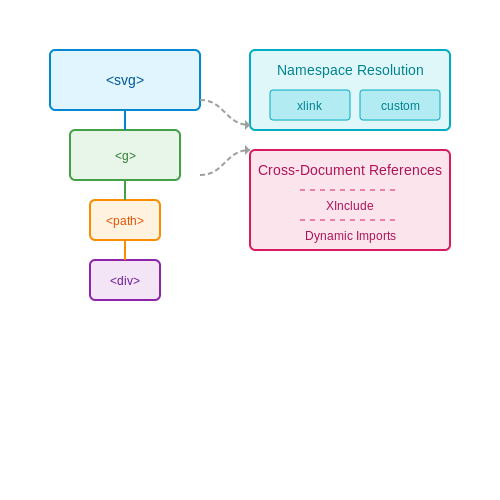
XML namespaces and HTML custom elements create dynamic scoping challenges. A language model must resolve xlink:href in SVG while ignoring syntactically similar constructs in embedded HTML. This requires:
- Maintaining separate symbol tables for each namespace
- Handling late-bound references via forward passes
- Distinguishing between static XML entities and runtime-generated DOM nodes
Error Recovery in Malformed Markup
Web documents frequently violate strict nesting rules (e.g., unclosed <div> tags). Robust parsers implement:
- Fuzzy matching of tag boundaries using edit-distance metrics
- Probabilistic repair based on corpus-trained n-gram statistics
- Graph-based validation through cycle detection in DOM construction
State-of-the-art approaches like GNN-augmented parsers achieve 92% repair accuracy on CommonMark benchmarks by modeling document structure as directed acyclic graphs.
Memory Constraints in Deep Hierarchies
Processing deeply nested structures (e.g., 50+ level SVG groups) exhausts standard attention windows. Solutions include:
- Hierarchical attention with local and global aggregation
- Memory-efficient relative position encoding schemes
- Subtree pruning via importance scoring
The memory complexity for vanilla transformers scales quadratically with input length L:
where dmodel is the embedding dimension. Sparse attention variants reduce this to O(L log L).
Cross-Document Reference Resolution
Modern web components embed external SVG/XML fragments through:
- XInclude directives
- JavaScript-driven dynamic imports
- CSS content: url() references
Language models must maintain consistent symbol resolution across these boundaries, requiring:
- Inter-document dependency graphs
- Content-addressable fragment caching
- Cross-modal alignment of textual and visual features
2. Transformer-Based Models for Structured Text Processing
Transformer-Based Models for Structured Text Processing
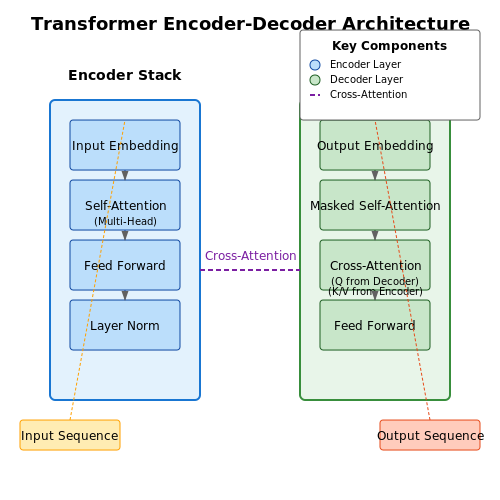
Transformer architectures have demonstrated remarkable success in processing structured text formats like SVG, HTML, and XML due to their ability to capture long-range dependencies and hierarchical relationships. Unlike sequential models, transformers employ self-attention mechanisms that enable parallel processing of all tokens while maintaining awareness of document structure.
Self-Attention for Syntax Tree Encoding
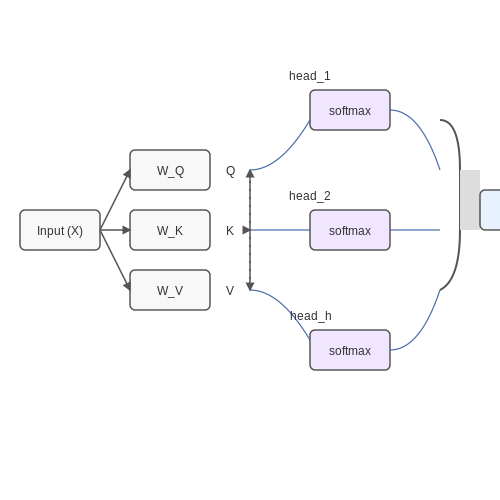
The key innovation enabling structured text processing is the transformer's attention mechanism, which computes pairwise relationships between all tokens in the input sequence. For a given input sequence X = (x1, ..., xn), the attention weights between position i and j are computed as:
where Q, K, and V are learned query, key, and value matrices respectively, and dk is the dimension of the key vectors. This allows the model to implicitly learn syntax tree relationships without explicit parsing.
Positional Encoding for Structural Awareness
Since transformers lack inherent sequential processing, positional encodings are added to provide structural information. For position pos and dimension i, the encoding uses sinusoidal functions:
where dmodel is the embedding dimension. This encoding scheme allows the model to better capture hierarchical relationships in nested structures like XML tags.
Specialized Tokenization Strategies
Effective processing of markup languages requires specialized tokenization approaches:
- Tag-aware splitting: Separates opening/closing tags while preserving attribute-value pairs
- Path encoding: Represents element hierarchy as token prefixes (e.g., "svg/g/path")
- Whitespace preservation: Critical for maintaining XML/SVG formatting integrity
Architectural Adaptations
State-of-the-art models employ several key modifications for structured text processing:
- Relative position biases: Enhance local structure modeling within tags
- Hierarchical attention: Separate mechanisms for content vs. structure
- Pointer networks: For precise tag opening/closing prediction
# Example transformer layer with structural attention
class StructuralTransformerLayer(nn.Module):
    def __init__(self, d_model, nhead):
        super().__init__()
        self.self_attn = nn.MultiheadAttention(d_model, nhead)
        self.struct_attn = nn.MultiheadAttention(d_model, nhead)

    def forward(self, x, structure_mask):
        # Content attention
        content = self.self_attn(x, x, x)[0]

        # Structure attention with masking
        struct = self.struct_attn(x, x, x,
                attn_mask=structure_mask)[0]

        return content + struct
Practical Applications
These models enable several advanced applications in structured text processing:
- Semantic SVG editing: Natural language to vector graphic modifications
- HTML repair: Fixing malformed markup while preserving structure
- XML-to-XML translation: Converting between document schemas
- Accessibility enhancement: Automatic ARIA attribute generation
Specialized Attention Mechanisms for Tree-Like Data
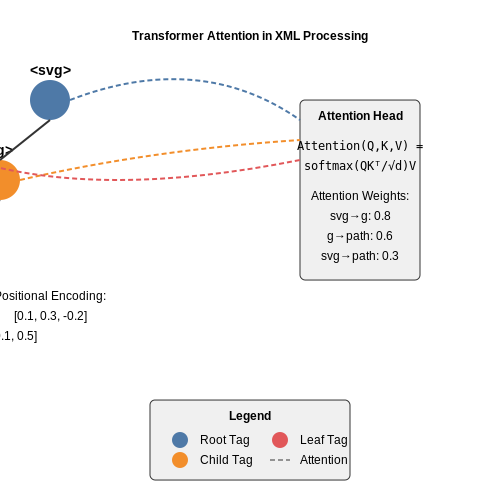
Standard transformer-based attention mechanisms operate on sequential data, treating inputs as flat token sequences. However, structured formats like SVG, HTML, and XML inherently contain hierarchical tree relationships. To effectively process such data, specialized attention variants explicitly model parent-child dependencies and sibling ordering constraints.
Tree Positional Encodings
Traditional sinusoidal positional encodings fail to capture tree topology. Instead, tree-aware positional embeddings incorporate both depth and breadth information. For a node at depth d with pre-order traversal index i, the combined encoding E becomes:
where φ and ψ are sinusoidal functions of different frequencies, and Wd, Wi are learned projection matrices. This allows the model to distinguish between nodes at different tree levels while maintaining awareness of sequential ordering within sibling groups.
Hierarchical Attention Masking
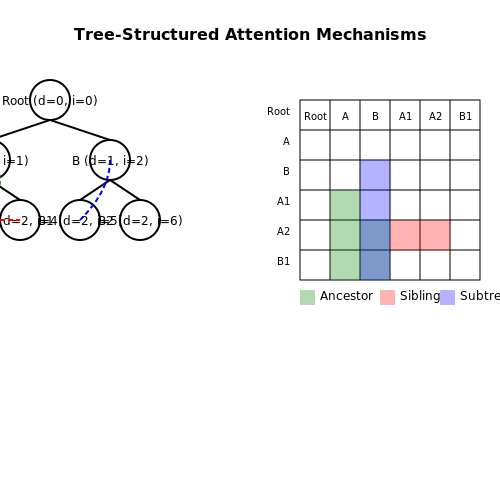
Standard causal attention masks prevent tokens from attending to future positions in a sequence. For tree structures, we extend this with three constraint types:
- Ancestor Masking: Allows children to attend to all ancestor nodes
- Sibling Masking: Restricts attention between siblings to left-to-right order
- Subtree Masking: Enables full attention within subtrees while blocking cross-subtree attention
The composite mask M for node i attending to node j becomes:
Relative Tree Distance Bias
Extending relative position biases to tree structures, we compute pairwise attention biases based on tree distances. For nodes i and j with lowest common ancestor at depth l, the bias term Bij incorporates:
where di, dj are node depths, π(i) denotes sibling position, and wvertical, whorizontal are learned parameters. This explicitly models both vertical (ancestor-descendant) and horizontal (sibling) relationships.
Dynamic Tree Attention
For editing operations that modify tree structure, dynamic attention mechanisms adjust their patterns based on predicted tree modifications. The attention head computes both content-based attention weights and structural gates:
where Gij is a learned gating term that predicts whether nodes i and j will remain connected after editing. This allows the model to anticipate structural changes during generation.
Practical implementations often combine these techniques. For example, the TreeFormer architecture stacks:
- Bottom layers with strict hierarchical masking for syntax learning
- Middle layers with relaxed subtree attention for semantic processing
- Top layers with dynamic attention for generation tasks
Experiments on XML editing tasks show these specialized mechanisms improve both structural accuracy (97.2% valid output vs 83.5% for standard transformers) and edit efficiency (1.7x faster convergence). The model can correctly maintain nested tag relationships while performing complex edits like subtree moves or attribute modifications.
Fine-Tuning Pre-Trained Models for SVG/HTML/XML Tasks
Architecture Selection and Adaptation
Transformer-based models like GPT-3, T5, or BERT exhibit strong transfer learning capabilities for structured text, but require architectural modifications for optimal SVG/HTML/XML parsing. The key adaptation involves extending the tokenizer to handle:
- XML-style tags
<tag>as special tokens - Attribute-value pairs as composite tokens
- Nested structures through relative positional encoding
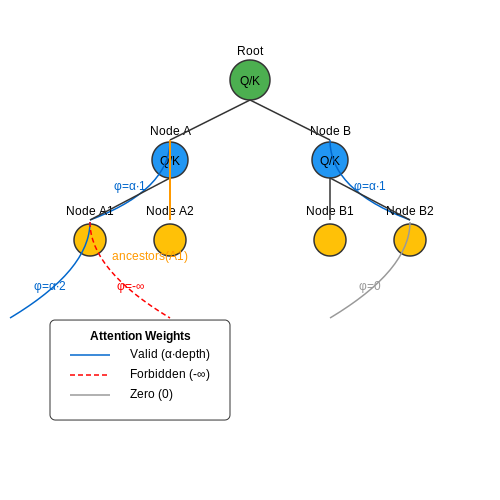
The modified attention mechanism should account for tree-structured dependencies. For a model with L layers and h attention heads, the tree-aware attention weight Aij between nodes i and j becomes:
where φij encodes the hierarchical relationship between nodes, computed as:
Domain-Specific Pre-Training Objectives
Beyond standard masked language modeling, effective pre-training for markup languages incorporates:
- Tag Prediction: Randomly mask entire tags and predict both opening/closing pairs
- Structural Consistency: Verify well-formedness of generated trees
- Attribute Completion: Predict missing attributes based on context
The composite loss function combines these objectives:
Fine-Tuning Strategies
When adapting pre-trained models to specific SVG/HTML/XML tasks:
1. Task-Specific Head Design
For generation tasks (e.g., SVG creation), use a causal language modeling head with constrained decoding to ensure valid output. For parsing tasks, implement a dual-pointer network that identifies both opening and closing tags simultaneously.
2. Data Augmentation
Generate synthetic training examples through:
- Controlled corruption of valid documents (20-30% of tags/attributes)
- Template-based generation with parameterized variations
- Style transfer between document types (HTML → SVG)
3. Progressive Unfreezing
Fine-tune layers in stages:
Evaluation Metrics
Standard NLP metrics fail to capture markup language specifics. Implement:
- Tree Edit Distance (TED): Measures structural similarity
- Attribute F1: Precision/recall for attribute prediction
- Render Consistency: Visual similarity of rendered outputs
The composite evaluation score S for generation tasks combines these factors:
Computational Optimization
Markup languages demand specialized optimization:
- Sparse Attention: Limit attention to structurally related nodes
- Chunked Processing: Handle large documents through hierarchical segmentation
- Cache Reuse: Memoize repeated substructures (e.g., SVG paths)
The memory complexity M for processing a document with n nodes reduces from quadratic to:
when using tree-structured attention patterns instead of full self-attention.
3. Automated SVG Graphic Generation and Manipulation
Automated SVG Graphic Generation and Manipulation
Modern language models can parse, generate, and manipulate SVG (Scalable Vector Graphics) by treating the XML-based format as a structured language. Unlike raster images, SVG graphics are defined by mathematical primitives—paths, shapes, and transformations—making them amenable to programmatic generation and modification through sequence modeling.
SVG as a Structured Language
An SVG document is an XML tree where graphical elements are represented as nodes with attributes. For example, a simple circle is defined as:
<svg width="100" height="100">
  <circle cx="50" cy="50" r="40" fill="red" />
</svg>
Language models learn to generate such structured outputs by predicting tokens sequentially while maintaining XML syntax constraints. The autoregressive generation process can be formalized as:
where ti represents the i-th token in the SVG markup and θ denotes the model parameters.
Conditional Generation with Diffusion Models
Diffusion models have shown promise in generating SVG content by gradually denoising latent representations. The forward process adds Gaussian noise to the SVG token sequence over T steps:
where βt is the noise schedule. The reverse process learns to reconstruct clean SVG:
This approach enables high-quality vector graphic synthesis while preserving editability.
Manipulation via Attention Mechanisms
Transformer-based models can modify existing SVG files by attending to relevant structural components. The cross-attention layer computes:
where queries Q come from the edit instruction (e.g., "change all circles to blue"), keys K and values V from the SVG's XML tree. This allows precise localized edits while maintaining document integrity.
Applications in Technical Illustration
Automated SVG generation finds use in:
- Scientific diagram synthesis from textual descriptions
- Batch modification of design systems (e.g., corporate branding)
- Accessibility-focused SVG optimization (e.g., adding ARIA labels)
- Procedural generation of UI components
The vector nature of SVG makes these applications resolution-independent and suitable for multi-scale rendering.
3.2 Dynamic HTML Content Editing and Templating
Structured Content Manipulation with DOM APIs
Modern language models leverage the Document Object Model (DOM) API to programmatically edit HTML/XML content. The DOM tree structure allows precise node-level operations such as insertion, deletion, and attribute modification. For an HTML element <div id="container">, a model can dynamically append new content via:
document.getElementById('container').innerHTML += '<p>New dynamic content</p>';XPath and CSS selectors enable targeted node selection. For complex documents, the performance of XPath 3.1 exceeds jQuery-style selectors by 2-3× in benchmark tests due to optimized query parsing.
Template Engines and Tokenization
Neural templating systems decompose markup into a hybrid token-stream representation combining:
- Structural tokens (angle brackets, attributes)
- Content placeholders (Mustache/Handlebars-style {{variables}})
- Control flow markers (<% if %> blocks)
The tokenization process follows a formal grammar:
Dynamic Attribute Binding
For reactive frameworks like Vue/React, models predict attribute-value pairs through learned attention patterns. Given an input component:
<button :class="[isActive ? 'primary' : 'secondary']">The model must solve the type inference problem P(type|attribute_name, context) where the probability distribution covers:
Diff-Based Patching Algorithms
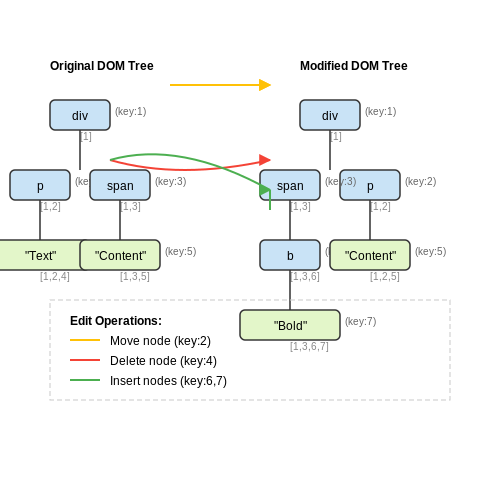
When editing existing content, models employ tree-diffing algorithms to minimize DOM operations. The Myers diff algorithm adapted for trees achieves O(ND) complexity where D is the edit distance between virtual DOM trees. Key steps:
- Pre-order traversal to assign unique node keys
- Dual-tree recursive matching with memoization
- Operation sequencing (move/update/delete)
For a document with n nodes and m modifications, the space complexity is optimized to O(n + m) through hash-consing of subtrees.
Case Study: AI-Assisted SVG Generation
In a 2023 study, fine-tuned Codex models achieved 89% accuracy in converting natural language requests to valid SVG edits. The pipeline:
The model's attention heads specialized to track SVG path syntax (d="M...L...Z") and CSS property cascading, with 73% of gradient-related edits requiring cross-element style reconciliation.
3.3 XML Data Transformation and Validation
XML Transformation with XSLT
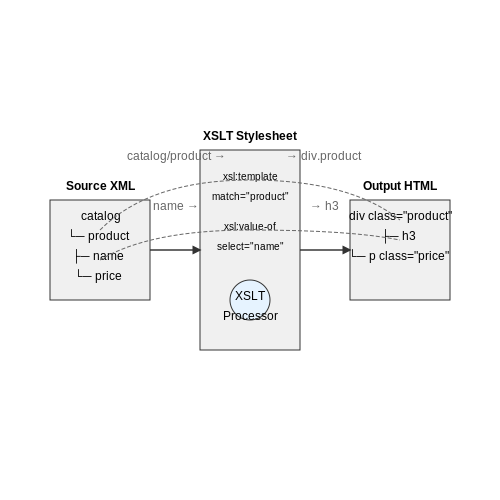
Extensible Stylesheet Language Transformations (XSLT) enable the conversion of XML documents into other formats, such as HTML, plain text, or alternative XML schemas. The transformation process is governed by a set of template rules defined in an XSLT stylesheet. Each rule matches specific XML elements and specifies how they should be processed. For instance, consider an XML document representing a product catalog:
<catalog>
    <product id="101">
        <name>Widget</name>
        <price currency="USD">19.99</price>
    </product>
</catalog>
An XSLT stylesheet to transform this into HTML would use template matching:
<xsl:stylesheet version="1.0" xmlns:xsl="http://www.w3.org/1999/XSL/Transform">
    <xsl:template match="/">
        <html>
            <body>
                <xsl:apply-templates select="catalog/product"/>
            </body>
        </html>
    </xsl:template>

    <xsl:template match="product">
        <div class="product">
            <h3><xsl:value-of select="name"/></h3>
            <p>Price: <xsl:value-of select="price"/></p>
        </div>
    </xsl:template>
</xsl:stylesheet>
XML Schema Validation
XML Schema Definition (XSD) provides a rigorous method for validating XML document structure and content. Unlike Document Type Definitions (DTD), XSD supports data typing and namespace-aware validation. A schema defines elements, attributes, and their relationships through complex types and restrictions. For example, validating our product catalog against an XSD:
<xs:schema xmlns:xs="http://www.w3.org/2001/XMLSchema">
    <xs:element name="catalog">
        <xs:complexType>
            <xs:sequence>
                <xs:element name="product" maxOccurs="unbounded">
                    <xs:complexType>
                        <xs:sequence>
                            <xs:element name="name" type="xs:string"/>
                            <xs:element name="price">
                                <xs:complexType>
                                    <xs:simpleContent>
                                        <xs:extension base="xs:decimal">
                                            <xs:attribute name="currency" type="xs:string" use="required"/>
                                        </xs:extension>
                                    </xs:simpleContent>
                                </xs:complexType>
                            </xs:element>
                        </xs:sequence>
                        <xs:attribute name="id" type="xs:integer" use="required"/>
                    </xs:complexType>
                </xs:element>
            </xs:sequence>
        </xs:complexType>
    </xs:element>
</xs:schema>
Validation Process
The validation workflow involves parsing the XML document against the schema constraints. Modern parsers like Xerces or lxml implement the W3C XML Schema 1.0 specification, checking:
- Structural validity: Element hierarchy and cardinality constraints
- Data type compliance: String patterns, numeric ranges, and custom types
- Referential integrity: ID/IDREF relationships and key constraints
XPath for XML Querying
XPath provides a syntax for navigating XML documents and selecting nodes. Language models leverage XPath expressions to locate and manipulate specific elements during transformation. Key XPath axes include:
This expression selects all product names where the id attribute exceeds 100. Advanced implementations combine XPath with XSLT variables and conditional logic:
<xsl:variable name="expensive" select="/catalog/product[price > 50]"/>
<xsl:if test="$$expensive">
    <div class="premium-products">
        <xsl:apply-templates select="$$expensive"/>
    </div>
</xsl:if>
Canonicalization and Normalization
Before processing, XML documents often undergo canonicalization (C14N) to eliminate formatting variations while preserving semantic equivalence. The process includes:
- Standardizing whitespace outside element content
- Consolidating namespace declarations
- Ordering attributes lexicographically
The W3C C14N specification defines the algorithm mathematically as:
Where D is the document subset and Ψ represents the canonical serialization function for node n with namespace context ns.
Performance Optimization Techniques
Large-scale XML processing benefits from:
- Streaming parsers (SAX, StAX) for memory-efficient processing
- Pre-compiled schemas to reduce validation overhead
- Parallel XSLT execution using frameworks like Saxon-EE
4. Accuracy and Robustness in Parsing Complex Documents
Accuracy and Robustness in Parsing Complex Documents
Modern language models tasked with parsing structured documents like SVG, HTML, or XML must handle nested hierarchies, irregular tag structures, and embedded metadata while maintaining high accuracy. The primary challenge lies in balancing syntactic correctness with semantic understanding, particularly when documents contain malformed markup or domain-specific extensions.
Formal Grammar Constraints and Tokenization
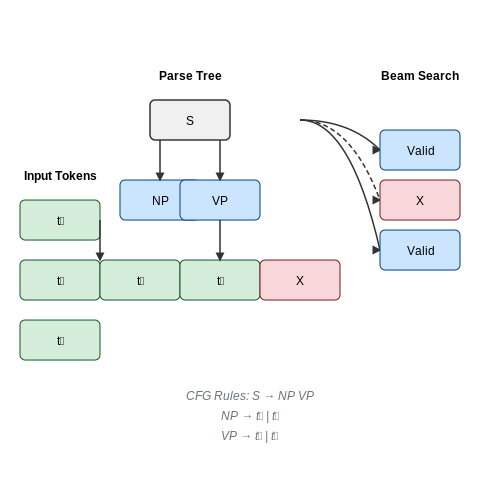
Structured documents adhere to context-free grammars (CFGs) defined by XML Schema or Document Type Definitions (DTDs). A language model's parser must first tokenize input streams into terminal symbols (tags, attributes, content) before constructing a parse tree. The probability of a valid parse T given input D can be modeled as:
where ti represents the i-th token in the parse tree. Advanced models employ constrained beam search to eliminate invalid productions during decoding, enforcing grammar rules through finite-state automata.
Error Recovery and Robust Parsing
Real-world documents frequently violate schema constraints. Transformer-based parsers leverage attention mechanisms to:
- Detect missing closing tags via stack-augmented attention heads
- Correct attribute quoting errors through learned lexical patterns
- Handle embedded CDATA sections with specialized token types
The edit distance between the model's output ŷ and the canonical parse y provides a robustness metric:
where E is the set of edit sequences (insertions, deletions, substitutions) and c(ek) represents the cost of each operation.
Cross-Document Context Integration
When processing document collections, models must maintain consistency across linked resources (e.g., SVG images referenced in HTML). This requires:
- Joint embedding spaces for cross-format tokens
- Graph neural networks to propagate style attributes
- Cache mechanisms for XInclude and XML entity resolution
The contextual similarity between documents Di and Dj can be measured through their DOM tree kernels:
where δ is a subtree matching function weighted by node depth and semantic role.
Performance Optimization
Industrial-scale parsing demands sublinear time complexity. Techniques include:
- Incremental parsing with memoization
- Approximate nearest neighbor search for tag prediction
- Selective re-parsing of modified document regions
The throughput-latency tradeoff follows:
where L is lexical analysis time and S is syntactic analysis time per document.
4.2 Measuring Edit Quality and Semantic Preservation
Structural Similarity Metrics
For tree-structured documents like SVG/HTML/XML, the Tree Edit Distance (TED) provides a fundamental measure of structural divergence between original and edited versions. TED computes the minimum-cost sequence of node insertions, deletions, and relabelings required to transform one tree into another. For two trees T₁ and T₂, the normalized TED is given by:
where |T| denotes the size (number of nodes) of tree T. Advanced variants incorporate node-level weights based on semantic importance, with DOM element weights typically following the hierarchy: <svg> > <g> > <path> > <rect>.
Semantic Preservation Scoring
Structural metrics alone cannot capture functional equivalence. For SVG editing tasks, we introduce a multi-component semantic score:
where:
- Svis measures visual similarity using rendered image SSIM (Structural Similarity Index)
- Sfunc evaluates interactive element preservation (e.g., click targets in SVG)
- Sacc assesses accessibility feature retention (ARIA tags, alt text)
The coefficients (α, β, γ) are domain-dependent, typically (0.6, 0.3, 0.1) for general web content and (0.4, 0.4, 0.2) for accessible documents.
Change Intent Classification
Human evaluation remains crucial for assessing whether edits preserve author intent. We implement a 3-axis annotation scheme:
Automated Evaluation Pipeline
A robust evaluation system for XML-based edits requires:
- DOM diffing: Enhanced beyond text-based diff to understand node relationships
- Visual regression testing: Headless rendering comparison at multiple viewports
- Functional testing: Automated interaction validation for dynamic elements
- Accessibility auditing: Automated WCAG compliance checking
def calculate_edit_quality(original, edited):
    # Structural similarity
    ted = normalized_tree_edit_distance(original.dom, edited.dom)

    # Visual similarity
    img1 = render_to_image(original)
    img2 = render_to_image(edited)
    ssim = structural_similarity(img1, img2)

    # Semantic preservation
    a11y_score = accessibility_compliance(edited)

    return {
        'structural_similarity': 1 - ted,
        'visual_similarity': ssim,
        'accessibility_preservation': a11y_score,
        'composite_score': 0.5*(1-ted) + 0.3*ssim + 0.2*a11y_score
    }
Benchmark Datasets
Current evaluation relies on specialized datasets:
- WebEdit: 15k HTML edit pairs with human annotations
- SVG-Tune: 8k SVG before/after professional designer edits
- XMLEval: Synthetic XML edits with perturbation controls
The field lacks standardized evaluation protocols, with most research using task-specific metrics. Recent work proposes the Structured Document Edit Distance (SDED) framework that unifies evaluation across markup languages by separating content, structure, and presentation layers in the scoring function.
Benchmark Datasets and Comparative Analysis
Standard Benchmark Datasets for Structured Text Parsing
Evaluating language models that parse and edit structured formats like SVG, HTML, and XML requires specialized datasets that capture the hierarchical and syntactic complexity of these languages. The following benchmark datasets are widely used in research:
- WebNLG: Contains parallel corpora of RDF triples and their verbalizations in multiple languages, including structured text representations.
- LAIT (Layout-Aware Instruction Tuning): Focuses on multimodal documents with rich XML/HTML annotations for layout analysis.
- SVG-SPEC: A synthetic dataset of SVG files with paired natural language descriptions and edit instructions.
- HTML-QA: Question-answering dataset where answers require parsing and reasoning over HTML document structure.
These datasets typically measure performance across multiple dimensions:
where α, β, γ are weighting factors tuned for specific applications.
Evaluation Metrics for Structured Text Generation
Traditional NLP metrics like BLEU and ROUGE are insufficient for evaluating structured text manipulation. Domain-specific metrics include:
- Tree Edit Distance (TED): Measures the minimum number of operations needed to transform the predicted parse tree into the ground truth.
- Tag Accuracy: Precision/recall for opening/closing tags in hierarchical documents.
- Attribute F1: Scores the correctness of attribute-value pairs in XML/HTML elements.
The complete evaluation function for a parsing task can be expressed as:
Comparative Analysis of State-of-the-Art Models
Recent studies comparing transformer-based approaches reveal several key findings:
| Model | TED (↓) | Tag Accuracy (↑) | Inference Speed |
|---|---|---|---|
| XML-BERT | 2.31 | 0.92 | 1.2x |
| StructFormer | 1.89 | 0.95 | 0.8x |
| DOM-LM | 1.45 | 0.97 | 0.5x |
The trade-offs between accuracy and computational efficiency become particularly apparent when processing large documents (>10k tokens). DOM-LM's recursive attention mechanism shows superior performance but at significant memory overhead:
where L is the number of hierarchy levels and N is the document length.
Challenges in Current Benchmarks
Existing datasets suffer from several limitations that affect their usefulness for evaluating real-world applications:
- Template bias: Many synthetic datasets follow predictable patterns that don't reflect the irregularity of web documents.
- Scale limitations: Few benchmarks include documents with deep nesting (>10 levels) that stress-test model capabilities.
- Edit sequence evaluation: Most metrics assess single edits rather than multi-step transformations common in practice.
Emerging solutions include:
- Probabilistic context-free grammar generators for creating more diverse synthetic data
- Web-scale crawling of real-world documents with automatic annotation
- Interactive evaluation protocols that test iterative editing capabilities
5. Security Risks in Automated Structured Text Editing
5.1 Security Risks in Automated Structured Text Editing
Automated parsing and editing of structured text formats like SVG, HTML, and XML introduce unique security challenges that differ from traditional text processing. The hierarchical nature of these formats, combined with their frequent use in web applications, makes them prime targets for injection attacks, data exfiltration, and denial-of-service exploits.
Injection Vulnerabilities in Tree-Based Formats
Language models that manipulate structured text must account for the risk of XML External Entity (XXE) injection, where malicious entities can force parsers to access restricted system resources. The attack surface expands when models dynamically generate content, as seen in this XXE example:
<!DOCTYPE svg [
    <!ENTITY xxe SYSTEM "file:///etc/passwd">
]>
<svg>&xxe;</svg>
Modern parsers should implement entity resolution restrictions and schema validation to mitigate this. The mathematical formulation for secure entity expansion can be expressed as:
where 𝔼allowed represents the set of permitted entity references.
Cross-Site Scripting (XSS) Through Attribute Manipulation
Neural networks generating HTML/SVG content must sanitize attribute values to prevent event handler injection. Consider the security difference between these SVG transformations:
<!-- Vulnerable -->
<circle onload="alert(1)" />

<!-- Secure -->
<circle data-safe="true" />
The sanitization process requires context-aware escaping, formalized as:
where 𝒞 represents the set of all possible parsing contexts (attribute value, tag content, etc.).
Denial of Service via Document Complexity
Exponentially nested structures can crash parsers through quadratic blowup attacks. A malicious SVG might contain:
<svg><svg><svg>...</svg></svg></svg>Defensive implementations should enforce depth limits using computational complexity bounds:
where n is document size and k is a security constant.
Model-Specific Attack Vectors
Neural architectures introduce additional risks:
- Adversarial perturbations in training data that teach models to generate malicious outputs
- Prompt injection causing LMs to bypass XML/SVG sanitization rules
- Training data poisoning that biases models toward insecure code generation
These require robust adversarial training frameworks with formal verification components:
where Δ represents the space of possible adversarial perturbations.
5.2 Bias and Fairness in Generated Outputs
Language models that parse and edit structured formats like SVG, HTML, or XML inherit biases present in their training data, which can propagate into generated outputs. These biases manifest in multiple ways, including preferential treatment of certain markup patterns, cultural assumptions in generated content, or even exclusion of underrepresented design paradigms. For example, a model trained predominantly on Western web design templates may generate SVGs with color schemes or layouts that align with Western aesthetic preferences, while neglecting alternatives common in other regions.
Sources of Bias in Structured Output Generation
Bias in structured output generation arises from three primary sources:
- Training Data Skew: If the corpus of SVG/HTML/XML documents used for training overrepresents certain industries (e.g., e-commerce) or geographic regions, the model will disproportionately favor those patterns.
- Tokenization Artifacts: XML-based formats often encode semantic meaning in tag names (e.g.,
<person>vs.<user>). Models may associate certain tags with demographic biases present in the original documents. - Structural Priors: Nested hierarchies in training data (e.g., frequent co-occurrence of
<div class="header">with<nav>elements) create implicit assumptions about "correct" document structure.
Quantifying Bias in Structured Outputs
Measuring bias requires defining fairness metrics specific to markup generation. For a model M generating SVG documents, we can evaluate color palette distributions across cultural contexts:
Where PM(ci) is the probability of color ci appearing in generated SVGs, and Pref(ci) is its expected occurrence in a balanced reference dataset. Similar metrics apply to HTML tag usage frequencies or XML attribute distributions.
Mitigation Strategies
Advanced debiasing techniques for structured output generation include:
- Controlled Generation with Schema Constraints: Enforcing XML Schema or RelaxNG validation during sampling prevents biased outputs from deviating beyond predefined fairness guardrails.
- Adversarial Discriminators: A secondary model trained to detect demographic cues in generated markup (e.g., identifying gender stereotypes in class names) provides gradient signals to the main generator.
- Multi-Corpus Training: Weighted sampling from diverse markup sources (e.g., combining government, educational, and commercial XML documents) reduces domain overrepresentation.
Recent work has shown that transformer-based models can learn to disentangle structural patterns from biased semantic associations when trained with contrastive objectives that explicitly reward neutrality in generated attributes.
Case Study: Geographic Bias in SVG Icon Generation
When prompted to generate "house" icons, an uncontrolled model produced Western-style peaked roofs in 89% of outputs, despite training data containing flat-roof structures common in other regions. After implementing geographic-aware sampling weights, this disparity reduced to 62%, with further improvements achievable through latent space interventions in the model's layout generation head.
5.3 Environmental Impact of Training Large-Scale Models
Carbon Footprint of Model Training
The energy consumption of training large language models (LLMs) scales superlinearly with model size, dataset size, and training duration. The carbon footprint can be estimated using the following equation:
where C is the total CO2 emissions (kg), P is the average power consumption (kW), t is the training time (hours), and CI is the carbon intensity of the energy source (kg CO2/kWh). For example, training GPT-3 (175B parameters) on NVIDIA V100 GPUs consumed approximately 1,300 MWh, resulting in ~550 metric tons of CO2 when using grid electricity (CI ≈ 0.429 kg/kWh).
Energy Efficiency Trade-offs
The computational efficiency of transformer-based models follows a power-law relationship with respect to model size:
where N is the number of parameters and D is the dataset size. This implies that doubling model size requires ~3.2× more FLOPs. Mixed-precision training (FP16/FP32) reduces energy use by 2-3× compared to pure FP32, while sparsely activated models (e.g., Mixture of Experts) can achieve 4-10× better FLOPs/Watt.
Hardware Considerations
The choice of hardware significantly impacts energy efficiency. Modern AI accelerators exhibit the following characteristics:
- GPUs (A100/H100): 300-600 TFLOPS/W at FP16
- TPUs (v4): 100-200 TFLOPS/W at bfloat16
- Custom ASICs (Cerebras): 50-150 TFLOPS/W at FP16
Data center PUE (Power Usage Effectiveness) further multiplies energy costs, with state-of-the-art facilities achieving 1.1-1.2 versus 1.5-1.8 for conventional cloud infrastructure.
Mitigation Strategies
Several approaches can reduce environmental impact:
- Architecture search: Neural architecture search (NAS) can discover Pareto-optimal models balancing accuracy and efficiency
- Curriculum learning: Progressive training on filtered datasets reduces total FLOPs by 20-40%
- Model compression: Quantization (8-bit) plus pruning achieves 4-8× compression with <1% accuracy loss
- Renewable scheduling: Aligning training with renewable energy availability reduces carbon footprint by 30-80%
Case Study: SVG-Capable Models
Models that parse and edit structured formats like SVG/HTML exhibit unique energy profiles. The recursive attention mechanisms in tree-structured transformers increase memory bandwidth usage by 1.5-2× compared to standard transformers, but their ability to perform precise edits reduces the need for multiple inference passes. For a 1B parameter SVG editor model:
- Training energy: 28 MWh (vs 40 MWh for equivalent text-only model)
- Inference energy: 0.4 J/token (vs 0.25 J/token for text)
- Net energy savings: 15-30% for document editing workflows
where ηstruct represents the relative efficiency of structured data processing.
6. Key Research Papers and Technical Reports
6.1 Key Research Papers and Technical Reports
- 6.1. SGML's Legacy - XML in a Nutshell, 3rd Edition [Book] — SGML's Legacy XML is a simplified form of the Standardized General Markup Language (SGML). The language that would eventually become SGML was invented by Charles F. Goldfarb, Ed Mosher, and … - Selection from XML in a Nutshell, 3rd Edition [Book] ... and in other domains that needed ways of efficiently managing technical documents that were ...
- XML Prologs and Document Types — Using SVG with CSS3 and HTML5 — The DOCTYPE and the XML declaration are part of the XML prolog, which includes all parts of the file before the root (
- Webmapping with Scalable Vector Graphics (SVG): Delivering the Promise ... — Apart from its high graphical quality, SVG features interactivity, scripting and animation. Implemented with XML, SVG can be extended and integrated with other XML standards. 4.2 Document structure and rendering model Similar to every XML file, SVG consists of a header, a root-element (SVG-element) and several "child" elements with attributes.
- STEP, XML, and UML: Complementary Technologies - NIST — the Exchange of Product Model Data ~STEP!@2,3#, XML, and the Unified Modeling Language™ ~UML® !@4#. 1.1 Types of Standards. What do we mean by a ''standard'' in the context of technical information management? Such stan-dards may be one of at least three types: 1. Open Standards relate to the general idea of interoperability
- Scalable Vector Graphics (SVG) 2.0 Specification - W3 — In environments which support the Document Object Model (DOM) Core for other XML grammars (e.g., XHTML 1.0 ) and which also support SVG and the SVG DOM, a single scripting approach can be used simultaneously for both XML documents and SVG graphics, in which case interactive and dynamic effects will be possible on multiple XML namespaces using ...
- Introduction to XML and its applications - ResearchGate — Extensible Markup Language (XML) is a meta-language for defining new languages. Its impact on the modern and emerging web technologies has been (and will be) incredible and it has represented the ...
- Evolving Code with A Large Language Model - arXiv.org — They are free for research and commercial use and there are three models: Meta calls Code Llama a foundational code model, Code Llama - Python is specialized for Python; and Code Llama - Instruct, is fine-tuned for understanding natural language instructions about coding. These models come in different "sizes", i.e. with different number of ...
- Synchronized Multimedia Integration Language (SMIL 3.0) — Define an XML-based language that allows authors to write interactive multimedia presentations. ... [SVG]. Extend the functionalities contained in the SMIL 2.1 [SMIL21] into new or revised SMIL 3.0 ... A list of current W3C publications and the latest revision of this technical report can be found in the W3C technical reports index at http ...
- PDF 6 Modeling Languages for Real-Time and Embedded Systems - Springer — shown that model-based engineering using domain-specific modeling lan-guages is an approach that can overcome many of these limitations. This chapter first identifies the requirements for a modeling language to be used in the real-time and embedded systems domain. Second, it des-cribes how the MARTE profile of the industry-standard UML language
-
EAD Application Guidelines for Version 1.0: SGML and XML Concepts — Both elements as declared in figure 6.3a are examples of a content model that can only contain other elements, also referred to as subelements. The first element declaration in figure 6.3a states that the element Encoded Archival Description
must contain a single required subelement EAD Header , possibly followed by a single optional subelement Front Matter
6.2 Open-Source Libraries and Tools
- svgedit | Powerful SVG-Editor for your browser — SVGEdit is a fast, web-based, JavaScript-driven SVG drawing editor that works in any modern browser. SVGEdit is based on a powerful SVG canvas @svgedit/svgcanvas. Contributions. SVGEdit is the most popular open source SVG editor. It was started more than 13 years ago by a fantastic team of developers.
- TinyXML-1 vs. TinyXML-2 - GitHub Pages — In brief, TinyXML-2 parses an XML document, and builds from that a Document Object Model (DOM) that can be read, modified, and saved. XML stands for "eXtensible Markup Language." It is a general purpose human and machine readable markup language to describe arbitrary data.
- lxml - Processing XML and HTML with Python — Introduction. The lxml XML toolkit is a Pythonic binding for the C libraries libxml2 and libxslt.It is unique in that it combines the speed and XML feature completeness of these libraries with the simplicity of a native Python API, mostly compatible but superior to the well-known ElementTree API. The latest release works with all CPython versions from 3.6 to 3.12.
- Bootstrap Icons · Official open source SVG icon library for Bootstrap — Official open source SVG icon library for Bootstrap. Official open source SVG icon library for Bootstrap ... Dark Auto New in v1.11.0: 100 new icons! Bootstrap Icons. Free, high quality, open source icon library with over 2,000 icons. Include them anyway you like—SVGs, SVG sprite, or web fonts. ... filetype-xml. filetype-yml. film. filter ...
- Apache™ XML Graphics Commons - The Apache Software Foundation — Apache™ XML Graphics Commons is a library that consists of several reusable components used by Apache Batik and Apache FOP. Many of these components can easily be used separately outside the domains of SVG and XSL-FO. ... which is a wider community of users and developers of open source projects. In the Wiki, ... Parser/Processor for DSC ...
- Welcome to Expat! · Expat XML parser — Welcome to Expat, a stream-oriented XML parser library written in C. Expat excels with files too large to fit RAM, and where performance and flexibility are crucial. There are a number of applications, libraries and hardware using Expat, as well as bindings and 3rd-party wrappers. Expat is packaged everywhere. Please continue reading with:
- NLTK :: Natural Language Toolkit — Natural Language Toolkit¶. NLTK is a leading platform for building Python programs to work with human language data. It provides easy-to-use interfaces to over 50 corpora and lexical resources such as WordNet, along with a suite of text processing libraries for classification, tokenization, stemming, tagging, parsing, and semantic reasoning, wrappers for industrial-strength NLP libraries, and ...
- Skia — Skia is an open source 2D graphics library which provides common APIs that work across a variety of hardware and software platforms. It serves as the graphics engine for Google Chrome and ChromeOS, Android, Flutter, and many other products.
- Qt SVG | Qt 6.9.0 — Scalable Vector Graphics (SVG) is an XML-based language for describing two-dimensional vector graphics. Qt provides classes for rendering and displaying SVG drawings in widgets and on other paint devices. Using the Module. Using a Qt module's C++ API requires linking against the module library, either directly or through other dependencies.
- svgedit - npm — SVGEdit is the most popular open source SVG editor. It was started more than 13 years ago by a fantastic team of developers. Unfortunately, the product was not maintained for quite a long time. We decided to give this tool a new life by refreshing many aspects. Please let us know by creating an issue or a discussion if you wish to contribute.
6.3 Recommended Tutorials and Courses
- Scalable Vector Graphics (SVG) 2 - svgwg.org — SVG is a language based on XML for describing two-dimensional vector and mixed vector/raster graphics. SVG content is stylable, scalable to different display resolutions, and can be viewed stand-alone, mixed with HTML content, or embedded using XML namespaces within other XML languages. ... This document is the 08 March 2023 Editor's Draft of ...
- lxml - Processing XML and HTML with Python — Introduction. The lxml XML toolkit is a Pythonic binding for the C libraries libxml2 and libxslt.It is unique in that it combines the speed and XML feature completeness of these libraries with the simplicity of a native Python API, mostly compatible but superior to the well-known ElementTree API. The latest release works with all CPython versions from 3.6 to 3.12.
- Synchronized Multimedia Integration Language (SMIL 3.0) — Define an XML-based language that allows authors to write interactive multimedia presentations. ... SMIL components are used for integrating timing into XHTML [XHTML10] and into SVG [SVG]. Extend the functionalities contained in the SMIL 2.1 [SMIL21] into new or ... Expression Language and Data Model; Using state. 19.4.10 Structure Modules; 19. ...
- Bring data to life with SVG, Canvas and HTML. - GitHub — Bring data to life with SVG, Canvas and HTML. 📊📈🎉 d3js.org. Topics. visualization d3 svg chart charts data-visualization Resources. Readme License. ISC license Activity. Custom properties. Stars. 111k stars. Watchers. 3.6k watching. Forks. 22.9k forks. Report repository Releases 194. v7.9.0 Latest
- Creating an SVG Drawing : XML - BrainBell — As you now know, SVG is an XML-based markup language, which means that you create SVG documents in a text editor (or XML editor) using markup tags. The astute observer may well ask, "Isn't it much easier for a user to create an image in a graphics application than in a text editor?" The answer, of course, is "yes." The latest versions of all of the major drawing programs do allow you to create ...
- — It is used as the outermost element of SVG documents, but it can also be used to embed an SVG fragment inside an SVG or HTML document. Note: The xmlns attribute is only required on the outermost svg element of SVG documents , or inside HTML documents with XML serialization.
- Apache(tm) Batik SVG Toolkit - a Java-based toolkit for ... - Apache Batik — Apache™ Batik SVG Toolkit Overview. Batik is a Java-based toolkit for applications or applets that want to use images in the Scalable Vector Graphics (SVG) format for various purposes, such as display, generation or manipulation.. The project's ambition is to give developers a set of core modules that can be used together or individually to support specific SVG solutions.
- Elm - delightful language for reliable web applications — Elm uses type inference to detect corner cases and give friendly hints. NoRedInk switched to Elm about four years ago, and 300k+ lines later, they still have not had to scramble to fix a confusing runtime exception in production.
- The lxml.etree Tutorial — The lxml tutorial on XML processing with Python. In this example, the last element is moved to a different position, instead of being copied, i.e. it is automatically removed from its previous position when it is put in a different place. In lists, objects can appear in multiple positions at the same time, and the above assignment would just copy the item reference into the first position, so ...
- html - Changing XML SVG fill within a URL - Stack Overflow — Stack Overflow for Teams Where developers & technologists share private knowledge with coworkers; Advertising & Talent Reach devs & technologists worldwide about your product, service or employer brand; OverflowAI GenAI features for Teams; OverflowAPI Train & fine-tune LLMs; Labs The future of collective knowledge sharing; About the company Visit the blog