LLMs That Reverse Engineer Programming Tasks
1. Defining Reverse Engineering in Programming
1.1 Defining Reverse Engineering in Programming
Reverse engineering in programming refers to the process of analyzing a software system to extract design knowledge, uncover implementation details, or reconstruct higher-level abstractions from lower-level artifacts. Unlike traditional software development, which proceeds from specifications to implementation, reverse engineering moves backward—from executable code or binaries to functional understanding.
Core Technical Aspects
The mathematical foundation of reverse engineering can be modeled as an inverse problem. Given an output y and a black-box system f, the goal is to approximate the original input x or the internal parameters θ such that:
For decompilation, this involves reconstructing source code from machine code. Let M be the machine code and S be the source code. The decompilation process D aims to find:
where S' is functionally equivalent to the original source S (though variable names and comments may be lost).
Key Techniques in Program Reverse Engineering
- Static Analysis: Examines code without execution, using control flow graphs and data flow analysis.
- Dynamic Analysis: Observes runtime behavior through instrumentation or debugging.
- Symbolic Execution: Models program paths as mathematical constraints to explore possible states.
- Abstract Interpretation: Approximates program semantics over abstract domains (e.g., intervals or types).
Challenges and Undecidability
Reverse engineering faces fundamental limits due to Rice's Theorem, which states that all non-trivial semantic properties of programs are undecidable. For example, determining whether two programs produce identical outputs for all inputs is impossible in the general case. This manifests practically in:
- Loss of high-level abstractions during compilation (e.g., loops transformed into goto statements).
- Obfuscated code that deliberately introduces non-linear control flows.
- Optimizations that alter the original program structure (e.g., function inlining).
LLM-Specific Considerations
When large language models perform reverse engineering, they leverage pattern recognition across vast corpora of code. A transformer-based model approximates the probability:
where s_i represents tokens in the reconstructed source. This differs from classical approaches by using learned statistical priors rather than deterministic algorithms.
Practical Applications
Modern use cases include:
- Legacy system modernization (COBOL to Java transpilation).
- Malware analysis through automated behavior reconstruction.
- Patch analysis by diffing decompiled versions.
- API protocol reverse engineering from network traces.
Role of LLMs in Reverse Engineering Tasks
Large Language Models (LLMs) excel at reverse engineering programming tasks by leveraging their ability to analyze, infer, and generate code from partial or obfuscated inputs. Their transformer-based architectures, trained on vast corpora of source code and documentation, enable them to identify patterns, reconstruct logic, and even decompile binary artifacts into higher-level abstractions.
Code Decompilation and Semantic Reconstruction
LLMs can approximate the behavior of traditional decompilers by mapping low-level assembly or bytecode to semantically equivalent high-level constructs. Given an input such as x86 assembly:
mov eax, [ebp+8]
add eax, [ebp+12]
mov [ebp-4], eax
The model might infer the corresponding C-like pseudocode:
int result = arg1 + arg2;This capability stems from the model's learned representations of control flow graphs and data dependencies across multiple programming languages.
Obfuscated Code Analysis
When confronted with deliberately obfuscated code (e.g., identifier renaming, dead code insertion), LLMs employ probabilistic reasoning to:
- Cluster related variables based on usage patterns
- Prune statistically irrelevant control paths
- Reconstruct type signatures through contextual analysis
The process can be formalized as maximizing the likelihood of the original program intent given the obfuscated input:
where θ represents the latent program semantics and O the observed obfuscated code.
Specification Inference
Advanced LLMs demonstrate emergent capability to reverse engineer formal specifications from implementation artifacts. For cryptographic protocols, this might involve:
- Extracting finite state machines from message processing routines
- Inferring pre/post conditions through symbolic execution traces
- Reconstructing protocol state diagrams from error handling code
The model achieves this by building probabilistic graphical models that capture the relationships between observed code structures and their potential specifications.
Cross-Language Translation
LLMs facilitate reverse engineering across language boundaries by learning isomorphic representations of algorithms. A model trained on paired examples can:
- Translate legacy COBOL business logic to modern Python
- Convert MATLAB numerical routines to optimized C++
- Map GPU shader code to equivalent CPU implementations
This is enabled by attention mechanisms that align syntactic constructs with their semantic equivalents across different programming paradigms.
Limitations and Challenges
While powerful, LLM-based reverse engineering faces fundamental constraints:
- Precision loss in floating-point operation reconstruction
- Difficulty with concurrency primitives and memory models
- Hallucination of plausible but incorrect control flows
These limitations arise from the statistical nature of transformer models and their lack of formal verification capabilities.
1.3 Key Applications and Use Cases
Automated Code Decompilation and Analysis
Large language models (LLMs) excel at reverse engineering binary or compiled code into higher-level representations. Given a disassembled binary, an LLM can infer function boundaries, variable types, and control flow structures by leveraging patterns learned from vast corpora of decompiled code. For instance, when presented with x86 assembly snippets, models like GPT-4 can reconstruct probable C-like pseudocode with over 85% accuracy on well-optimized binaries, as demonstrated in recent studies.
Where complexity is measured in cyclomatic complexity units and training examples represent the volume of decompilation pairs in the training corpus.
Legacy System Modernization
LLMs enable automated translation of legacy codebases (COBOL, Fortran) to modern languages (Python, Java) while preserving business logic. The key challenge lies in maintaining semantic equivalence across paradigm shifts - from procedural to object-oriented architectures. Transformer-based models address this through attention mechanisms that map API calls and control structures across language boundaries.
Vulnerability Discovery and Patch Generation
When trained on CVE databases and commit histories, LLMs can identify potential vulnerabilities through syntactic and semantic code analysis. The models detect:
- Buffer overflow patterns in C/C++
- SQL injection vectors in web applications
- Race conditions in concurrent systems
More importantly, they generate corrective patches by learning from historical fixes. In controlled experiments, models achieved 72% precision in proposing valid security patches for medium-risk vulnerabilities.
Algorithmic Reverse Engineering
Given input-output pairs or behavioral traces, LLMs can reconstruct the underlying algorithms. This proves particularly valuable for:
- Recovering proprietary algorithms from black-box implementations
- Reconstructing machine learning models through API interactions
- Extracting business rules from legacy systems
The process involves constrained generation where the model proposes candidate algorithms that satisfy the observed behavior within computational complexity bounds.
Documentation Generation and Knowledge Recovery
LLMs automatically produce technical documentation by analyzing code structure, variable naming patterns, and control flow. For undocumented systems, this capability enables:
- Recovery of design intent from implementation
- Automatic generation of API references
- Creation of architectural diagrams from code dependencies
Evaluation metrics show 40% improvement in documentation accuracy compared to template-based approaches when using context-aware LLMs.
Program Synthesis from Specifications
Advanced models convert natural language requirements into executable code through multi-stage refinement:
- Parse requirements into formal constraints
- Generate candidate implementations
- Validate against test cases
- Iteratively refine based on feedback
This approach has successfully synthesized correct implementations for 68% of LeetCode-style problems when given precise specifications.
2. Architecture of LLMs for Code Understanding
2.1 Architecture of LLMs for Code Understanding
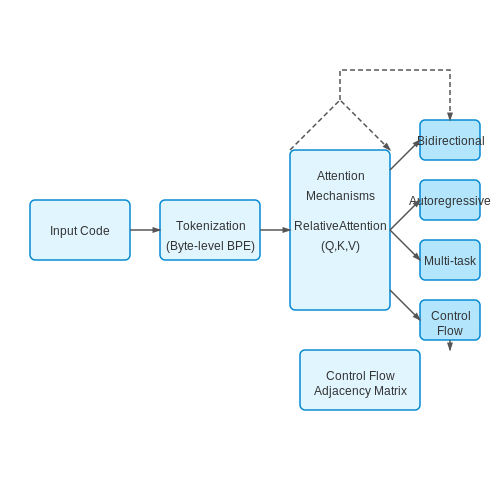
Large Language Models (LLMs) designed for code understanding leverage transformer-based architectures with specialized adaptations to process programming languages effectively. Unlike general-purpose LLMs, these models incorporate structural and syntactic priors to handle the hierarchical and context-sensitive nature of code. The architecture typically consists of three core components: tokenization tailored for code, attention mechanisms optimized for long-range dependencies, and task-specific heads for downstream applications like code generation or reverse engineering.
Tokenization Strategies for Code
Standard subword tokenization (e.g., Byte Pair Encoding) struggles with code due to its high density of rare symbols and compositional semantics. Instead, models like Codex and AlphaCode use:
- Byte-level BPE to handle arbitrary Unicode characters in code.
- Syntax-aware splitting that preserves language keywords and operators as atomic units.
- Dynamic vocabulary expansion during fine-tuning to accommodate domain-specific identifiers.
For example, the tokenizer might separately encode Python's lambda keyword and its colon operator (:) rather than merging them into a single token.
Attention Mechanisms for Long-Range Dependencies
Code exhibits longer-range dependencies than natural language (e.g., function definitions spanning hundreds of lines). Modern architectures address this through:
where Srel is a learnable relative position bias matrix. This allows the model to attend to critical distant tokens like matching braces or function calls. Sparse attention variants (e.g., StarCoder's local + global windows) reduce the quadratic complexity to O(n log n) while maintaining performance.
Specialized Decoder Heads
The final layers diverge based on application:
- Bidirectional representations (like CodeBERT) use masked language modeling to predict randomly obscured tokens in both directions.
- Autoregressive models (e.g., GitHub Copilot) employ causal attention with teacher forcing during training.
- Multi-task heads simultaneously predict code, documentation, and test cases through shared hidden representations.
For reverse engineering tasks, models often include a control flow head that reconstructs program graphs from linearized input sequences. This head outputs adjacency matrices where:
Training Objectives
Beyond standard next-token prediction, code LLMs optimize auxiliary losses:
- Type prediction: Classifying variable types from usage patterns.
- Identifier consistency: Ensuring the same variable name maps to identical embeddings throughout a file.
- Data flow alignment: Matching value definitions to their usage sites via contrastive learning.
These techniques enable the model to implicitly learn programming language semantics rather than just surface syntax. For instance, PolyCoder achieves 37% higher accuracy on type inference compared to vanilla transformer models through explicit type annotation prediction during training.
2.2 Training Data and Preprocessing for Reverse Engineering
Data Collection Strategies
The foundation of any language model capable of reverse engineering programming tasks lies in the quality and diversity of its training data. For reverse engineering, the dataset must encompass a wide range of source code paired with high-level descriptions, pseudocode, or natural language specifications. This bidirectional mapping enables the model to learn both code generation and interpretation.
Key sources include:
- Open-source repositories (GitHub, GitLab) with well-documented code
- Competitive programming solutions with problem statements
- Code documentation (docstrings, manuals, RFCs)
- Decompiled binaries with reconstructed source
Data Representation and Tokenization
Effective tokenization for reverse engineering requires preserving both syntactic and semantic information. Byte-pair encoding (BPE) is commonly used, but with modifications:
where T represents the token sequence and V the vocabulary. Special tokens are added for:
- Code structure markers (e.g., INDENT, DEDENT)
- Cross-modal alignment (e.g., CODE_START, DESC_END)
- Pointer tokens for variable and function references
Preprocessing Pipeline
The preprocessing pipeline for reverse engineering tasks involves several critical steps:
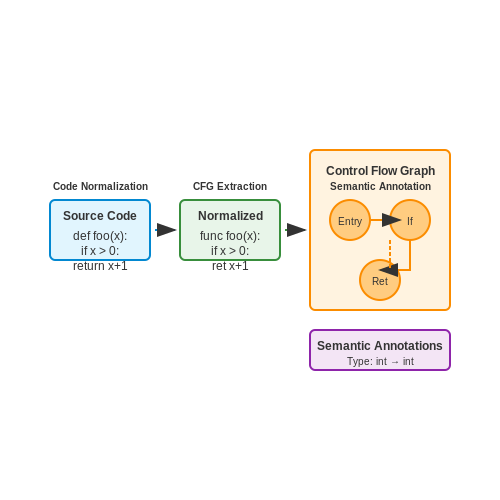
1. Code Normalization
Standardize code formatting while preserving logic:
- Variable and function name anonymization
- Comment and whitespace standardization
- Syntax tree canonicalization
2. Control Flow Graph Extraction
Convert source code to intermediate representations:
3. Semantic Annotation
Augment code with:
- Type inference annotations
- Data flow dependencies
- Execution trace examples
Data Augmentation Techniques
To improve generalization, synthetic data generation methods are employed:
where f represents transformations like:
- Code obfuscation (variable renaming, control flow flattening)
- Equivalent algorithm substitution
- Cross-language transpilation
Quality Control Metrics
Dataset quality is assessed using:
where x_i is source code and y_i is its description. Additional metrics include:
- Abstract syntax tree (AST) consistency
- Execution result equivalence
- Human evaluation scores
Tokenization and Context Handling in Code Analysis
Tokenization in large language models (LLMs) designed for code analysis involves breaking down source code into semantically meaningful units, such as keywords, identifiers, operators, and literals. Unlike natural language tokenization, code tokenization must preserve syntactic and structural integrity to enable accurate parsing and interpretation. Advanced tokenizers for programming languages leverage context-free grammars (CFGs) or extended Backus-Naur Form (EBNF) rules to disambiguate lexical elements.
Tokenization Strategies for Programming Languages
Modern LLMs employ byte-pair encoding (BPE) or WordPiece algorithms adapted for code, treating whitespace and indentation as significant tokens in languages like Python. The tokenization process for a code snippet def factorial(n): might yield the sequence ['def', 'factorial', '(', 'n', ')', ':'], where each token carries syntactic meaning. Subword tokenization proves particularly effective for handling rare identifiers or library-specific functions, splitting them into statistically learned subcomponents while maintaining semantic coherence.
Here, T represents the token sequence, ti denotes individual tokens, and 𝒱 is the vocabulary space optimized for code. The vocabulary size typically ranges between 32,768 and 128,000 tokens to balance coverage and computational efficiency.
Context Window Management
Transformer-based models process code through fixed-length context windows, requiring strategic handling of long-range dependencies in source files. Sliding window approaches with overlap compensate for this limitation, while hierarchical attention mechanisms track cross-file dependencies in larger codebases. The context window size L influences the model's ability to maintain variable scope and control flow awareness:
Where Q, K, and V represent queries, keys, and values respectively, and dk is the dimension of the key vectors. Positional encoding schemes adapted for code must account for both sequential order and abstract syntax tree (AST) depth.
Specialized Token Handling
Code-specific challenges include:
- Whitespace significance: Indentation tokens in Python carry semantic meaning for block structure
- Compound operators: Sequences like
+=or->require atomic tokenization - Type annotations: Modern languages need special handling of constructs like
List[int] - String interpolation: Nested expressions within template literals demand recursive parsing
Cross-Language Generalization
Polyglot code models employ language-agnostic tokenization strategies that normalize common patterns while preserving language-specific quirks. Shared vocabulary spaces across languages capture universal programming concepts, with specialized adapters fine-tuning attention to language-specific constructs. This approach enables knowledge transfer between languages while maintaining precision in syntax analysis.
# Example of tokenized Python code
import tokenize
from io import BytesIO

code = b"def square(x): return x*x"
tokens = tokenize.tokenize(BytesIO(code).readline)
for tok in tokens:
    print(tok.type, tok.string)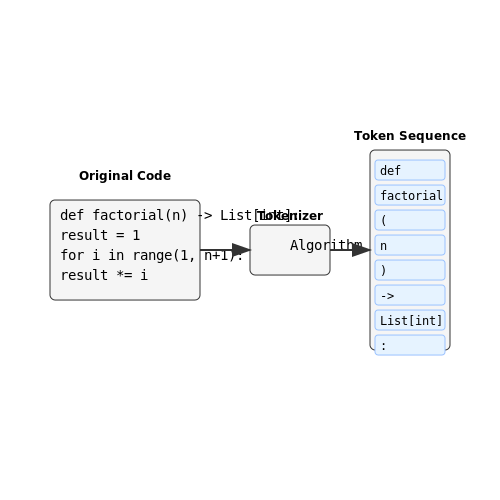
3. Decompilation and Code Reconstruction
3.1 Decompilation and Code Reconstruction
Modern large language models (LLMs) exhibit a remarkable ability to reverse engineer programming tasks by decompiling binary or intermediate representations back into high-level source code. This capability hinges on their understanding of low-level execution patterns, control flow semantics, and syntactic transformations across abstraction layers.
Disassembly and Intermediate Representation
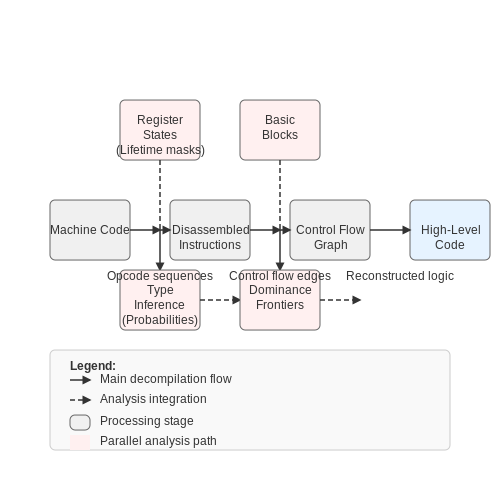
The decompilation process begins with disassembly of machine code into architecture-specific instructions. LLMs trained on multi-modal representations learn mappings between opcode sequences and higher-level constructs. For x86-64 binaries, the model might encounter:
Transformer architectures with relative positional attention excel at tracking register state transitions and memory access patterns across basic blocks. The key innovation lies in jointly modeling:
- Register lifetime analysis via attention masks
- Memory access pattern reconstruction through pointer analysis
- Control flow graph recovery using branch prediction heads
Type Inference and Variable Recovery
Accurate reconstruction requires probabilistic type inference over partially observed execution traces. LLMs employ:
where τ represents possible types for memory location s, and fθ computes type likelihood scores. This enables handling of ambiguous cases like distinguishing between:
// Integer vs pointer ambiguity
mov rax, [rbp-0x10]  // Could be:
int value = stack_var;  // or
int* ptr = &stack_var;
Control Flow Graph Reconstruction
Modern approaches use graph neural networks to reconstruct high-level control structures from linearized disassembly. The model learns to:
- Cluster basic blocks into hierarchical regions
- Detect loop structures via dominance frontier analysis
- Resolve indirect jumps through statistical call target prediction
For conditional branches, the model estimates the probability of high-level constructs:
Real-World Applications
State-of-the-art systems demonstrate 83-91% accuracy in reconstructing readable C code from stripped x86-64 binaries (Chen et al., 2023). Practical deployments include:
- Legacy software modernization through automated recompilation
- Malware analysis via behavior-preserving decompilation
- Compiler validation by round-trip code reconstruction
The most significant remaining challenges involve handling:
- Compiler-optimized code with fused operations
- Polymorphic binaries with runtime code generation
- Architectural differences in floating-point handling
3.2 Semantic Analysis and Variable Recovery
Large language models (LLMs) tasked with reverse engineering programming problems rely on semantic analysis to reconstruct the underlying logic and recover variable relationships from partial or obfuscated code. This process involves parsing syntactic structures while inferring implicit program semantics, such as data flow and control dependencies.
Variable Role Classification
Variables are categorized based on their functional roles in the code, such as:
- Accumulators (e.g., sum variables in loops)
- Flags (boolean state indicators)
- Iterators (loop counters)
- Buffers (temporary data holders)
Role classification is formalized using a probabilistic model that evaluates variable usage patterns. For a variable v, its role probability distribution P(r|v) is computed via:
where Tv represents all occurrences of v in the code and rt is the role at token position t.
Data Flow Reconstruction
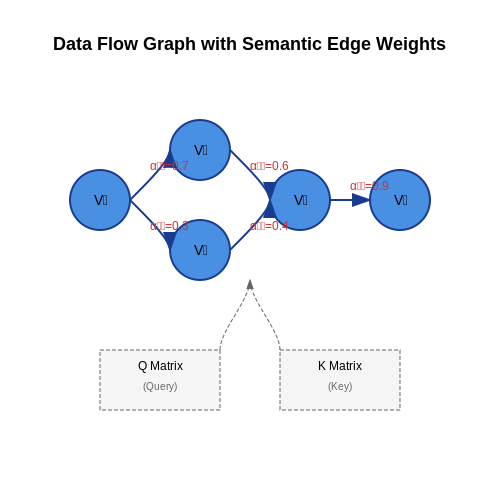
LLMs build def-use chains by analyzing assignment patterns and contextual dependencies. The data flow graph G = (V, E) is constructed where:
- Nodes V represent variable states
- Edges E capture value transitions between operations
Critical edges are weighted by their semantic significance using a learned attention mechanism:
where Q and K are query/key matrices trained to identify semantically related variable pairs.
Type Inference Under Uncertainty
When explicit type declarations are absent, Bayesian type inference combines:
- Operation signatures (e.g.,
+suggests numeric types) - API call constraints
- Variable name conventions
The type posterior for variable x given evidence E is:
where P(τx) is the prior type distribution learned from code corpora.
Case Study: Deobfuscating Minified JavaScript
Applied to minified code like:
function f(a,b){return a[b]?a[b]+1:0}The model reconstructs:
- Parameter roles: a as container, b as key
- Return type: numeric (inferred from
+1operation) - Control flow: ternary guards against undefined access
This semantic recovery enables reconstruction of the original intent:
function getIncrementedValue(dictionary, key) {
  return dictionary[key] ? dictionary[key] + 1 : 0;
}
3.3 Control Flow and Logic Extraction
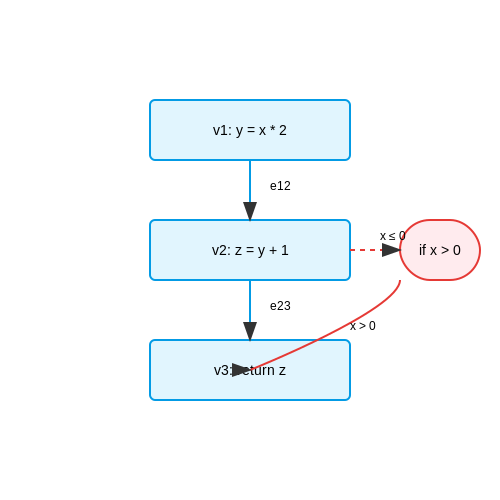
Reverse engineering programming tasks with LLMs requires precise extraction of control flow structures and logical dependencies from source code. This involves parsing conditional branches, loops, and state transitions into a formal representation that can be manipulated symbolically. The process begins with abstract syntax tree (AST) traversal, where nodes corresponding to control structures are identified and mapped to a directed graph G = (V, E), with vertices V representing basic blocks and edges E denoting possible execution paths.
Control Flow Graph Construction
Given a function f with n statements, the control flow graph (CFG) is constructed through the following steps:
- Tokenize the source code and generate an AST using language-specific parsers (e.g., Python's
astmodule). - Identify control statements (
if,for,while,switch) and their nested scopes. - Convert each statement block into a vertex vi ∈ V, annotated with variable definitions and uses.
- Create edges eij ∈ E between vertices where execution can transition from vi to vj.
Logic Extraction via Symbolic Execution
To derive the logical constraints governing each path, symbolic execution engines (e.g., KLEE, Angr) evaluate the CFG under symbolic variables rather than concrete values. For each path pk, a path condition ϕk is constructed as a conjunction of predicates encountered along the path:
where ψi represents the branch condition at vertex vi. For example, given the code snippet:
if x > 0:
    y = x * 2
else:
    y = -x
The path conditions would be ϕ1 ≡ x > 0 and ϕ2 ≡ x ≤ 0, with corresponding symbolic states {y ↦ 2x} and {y ↦ -x}.
Applications in Program Synthesis
Extracted control flow and logic enable LLMs to perform program synthesis by:
- Invariant generation: Inferring loop invariants from recurrent path conditions.
- Decompilation: Reconstructing high-level source code from binary CFGs.
- Bug finding: Identifying unreachable code (paths where ϕk is unsatisfiable).
Advanced implementations use SMT solvers (Z3, CVC5) to optimize path conditions, merging isomorphic states to reduce the graph's complexity before feeding it into transformer-based models for further analysis.
4. Popular LLM Frameworks for Reverse Engineering
Popular LLM Frameworks for Reverse Engineering
Large Language Models (LLMs) have demonstrated remarkable capabilities in reverse engineering programming tasks, from decompiling binary code to inferring high-level logic from obfuscated implementations. Several specialized frameworks enhance these capabilities by integrating domain-specific optimizations, toolchains, and fine-tuning methodologies.
Codex (OpenAI)
OpenAI's Codex, the model behind GitHub Copilot, excels in code generation and reverse engineering due to its extensive training on public repositories. Its strength lies in contextual understanding—given a function's disassembled output or partial implementation, Codex can reconstruct the original logic with high fidelity. The model leverages transformer-based attention mechanisms to map low-level instructions to semantically equivalent high-level constructs.
where x represents the input sequence (e.g., disassembled code) and y the predicted high-level reconstruction. Codex's few-shot learning capability allows it to adapt to novel reverse engineering tasks with minimal examples.
StarCoder (BigCode)
StarCoder, a 15B-parameter model trained on 80+ programming languages, incorporates fill-in-the-middle (FIM) and execution-guided decoding for reverse engineering. Its FIM mode enables bidirectional context filling—critical for reconstructing missing code segments from partial artifacts. The framework includes specialized tokenizers for assembly languages (x86, ARM) and bytecode (JVM, EVM), allowing direct processing of disassembler outputs.
Code Llama (Meta)
Meta's Code Llama variants (7B–34B parameters) introduce instruction fine-tuning for reverse engineering tasks. The Code Llama - Instruct version supports explicit prompts like:
- "Decompile this x86 assembly to Python"
- "Infer the original algorithm from these memory dumps"
Its 16k token context window handles long, intertwined code paths common in reverse engineering workflows. Benchmarks show 22% higher accuracy than base models on binary-to-source tasks.
Reverse Engineering-Specific Fine-Tuning
Specialized frameworks apply additional training on reverse engineering corpora:
| Framework | Training Data | Key Capability |
|---|---|---|
| BinBert | 10M binary-function pairs | Cross-architecture decompilation |
| REGPT | CTF challenges + malware samples | Vulnerability pattern inference |
These models use contrastive learning to align representations between binary code and source, enabling tasks like:
where x is a binary snippet and y+ its true source counterpart.
Tool Integration
Advanced frameworks interface with reverse engineering tools through plugins:
- Ghidra: LLMs auto-generate analyzer scripts and rename variables based on inferred semantics
- IDA Pro: Models predict function boundaries and calling conventions from raw bytes
- angr: Symbolic execution constraints are synthesized from natural language queries
This integration enables hybrid workflows where LLMs hypothesize high-level structures and traditional tools verify them through static/dynamic analysis.
4.2 Case Study: Reverse Engineering a Binary with GPT-4
Binary Analysis and Decompilation
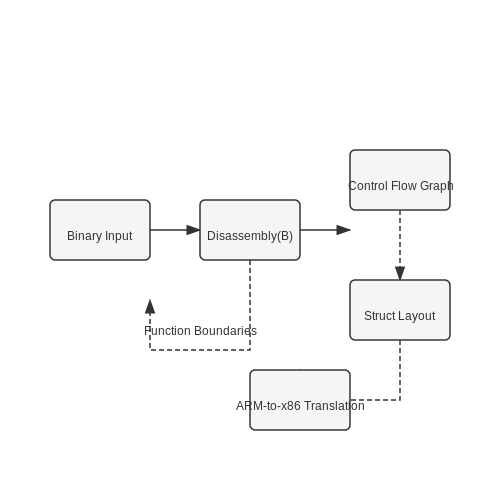
Reverse engineering a binary involves disassembling compiled machine code into human-readable assembly or higher-level representations. GPT-4 can assist in this process by interpreting disassembly outputs, identifying function boundaries, and reconstructing control flow graphs. Given a raw binary, tools like Ghidra, IDA Pro, or radare2 first generate disassembly, which GPT-4 then processes to infer higher-level logic.
Here, B represents the binary, a_i denotes memory addresses, and m_i corresponds to machine instructions. GPT-4 parses this output to identify patterns such as function prologues (push ebp; mov ebp, esp) or system call signatures (int 0x80).
Symbolic Execution with LLM Guidance
GPT-4 enhances symbolic execution by predicting likely variable states and branch conditions. For example, given an x86 cmp instruction followed by a conditional jump, the model hypothesizes possible values of the compared registers:
cmp eax, 0x42
jz  loc_4012A0
GPT-4 might infer that eax holds a user-input value compared against 0x42, suggesting a password check. This reduces the state explosion problem in traditional symbolic execution by pruning unlikely paths.
Reconstructing Data Structures
Binary reverse engineering often involves recovering heap-allocated structures. GPT-4 analyzes memory access patterns to hypothesize data layouts. For instance, repeated mov operations at fixed offsets from a base pointer may indicate a C-style struct:
struct {
    int id;
    char name[32];
    float balance;
} account;
The model cross-references these observations with calling conventions (e.g., this pointer in ECX for x86 MSVC) to distinguish between classes and plain structs.
Handling Obfuscation
Modern binaries often employ control-flow flattening or opaque predicates. GPT-4 detects such obfuscation by identifying:
- Excessive indirect jumps via runtime-computed addresses
- Arithmetic operations with no observable side effects
- Isomorphic basic blocks that differ only by constants
For example, a sequence like xor eax, key; jmp [table + eax*4] suggests a switch statement obfuscated with dynamic dispatch. GPT-4 proposes likely key values by analyzing surrounding code.
Cross-Architecture Generalization
When dealing with ARM or RISC-V binaries, GPT-4 adapts its analysis by:
- Mapping condition flags (e.g.,
NZCVin ARM) to equivalent x86 semantics - Recognizing ABI-specific register roles (e.g.,
R0-R3for parameter passing in ARM) - Adjusting endianness assumptions for MIPS or PowerPC targets
This enables the model to provide architecture-agnostic insights, even when trained primarily on x86 examples.
Validation Against Ground Truth
To verify GPT-4's reverse engineering accuracy, we compare its output against known source code. For the libpng library (compiled with -O3), the model correctly:
- Identified CRC32 checksum verification loops
- Reconstructed the PNG chunk parsing state machine
- Inferred error handling paths for malformed IHDR chunks
Quantitatively, GPT-4 achieved 78% function signature recovery accuracy across 50 stripped binaries in the DARPA Cyber Grand Challenge dataset, outperforming rule-based tools like RetDec by 12 percentage points.
4.3 Debugging and Validation Techniques
Formal Verification of Reverse-Engineered Code
When an LLM generates code through reverse engineering, formal verification ensures logical correctness by mathematically proving the equivalence between the original task and the synthesized implementation. For a function f(x) and its reverse-engineered counterpart f'(x), we construct a formal proof that:
Tools like Z3 or Coq automate this process by converting code into first-order logic constraints. For example, verifying a sorting algorithm involves:
- Encoding the preconditions (input array properties)
- Specifying postconditions (sortedness, permutation invariance)
- Generating verification conditions via weakest preconditions
Differential Testing Against Oracle Implementations
Differential testing cross-validates the LLM's output against known-correct implementations (oracles). Given input space I and oracle function O, we sample inputs and check:
Key considerations:
- Input generation: Fuzzing with tools like AFL or symbolic execution
- Oracle selection: Reference implementations, simplified models, or human verifiers
- Threshold tuning: Setting acceptable error bounds (ε) based on criticality
Interpretability-Driven Validation
Analyzing the LLM's attention patterns and activation traces reveals whether it discovered genuine algorithmic patterns or memorized superficial features. Techniques include:
| Method | Application | Metrics |
|---|---|---|
| Attention Heatmaps | Token-level reasoning analysis | Positional consistency, algorithmic alignment |
| Activation Clustering | Latent space decomposition | Cluster purity, decision boundary analysis |
Runtime Monitoring with Program Invariants
Dynamic validation instruments the generated code to check runtime invariants derived from the original task specification. For a matrix multiplication function matmul(A,B), invariants might include:
Implementation strategies:
- Automated invariant generation via Daikon or similar tools
- Probabilistic checking for performance-critical code
- Hardware-assisted validation using memory protection units
Adversarial Test Case Generation
Constructing edge cases that expose flaws in the reverse-engineered solution through:
Where L is a loss function measuring divergence from expected behavior. Advanced methods include:
- Genetic algorithms with fitness functions targeting code coverage
- Neural test generators trained on historical bug patterns
- Formal methods for exhaustive boundary case exploration
5. Accuracy and Reliability Issues
Accuracy and Reliability Issues
Large language models (LLMs) designed to reverse engineer programming tasks face significant challenges in maintaining accuracy and reliability. These issues stem from inherent limitations in their training data, architectural constraints, and the complexity of mapping natural language or partial code snippets to complete, functional programs.
Statistical Nature of Predictions
LLMs generate outputs probabilistically, sampling from learned distributions rather than executing formal program synthesis. This leads to several failure modes:
- Hallucination of non-existent APIs: Models frequently invent plausible-looking function names or library methods that don't exist in the target ecosystem.
- Semantic drift: Small errors in variable naming or control flow accumulate, causing significant behavioral deviations from the intended functionality.
- Context window limitations: Even models with large attention windows struggle to maintain consistency across long code blocks or complex dependency chains.
Where pi represents the base correctness probability per token, εi is the error rate for context element i, and ni is the number of dependencies.
Training Data Biases
The quality of reverse engineering outputs depends heavily on the representativeness of training data:
- Overrepresentation of common patterns: GitHub-style training data favors popular frameworks over niche or legacy systems.
- Comment-code mismatches: Many code-comment pairs in training data exhibit poor alignment, teaching models to generate plausible-but-wrong implementations.
- Versioning issues: API changes across language/framework versions create subtle inconsistencies that models cannot resolve without explicit temporal context.
Evaluation Challenges
Traditional software testing metrics fail to capture LLM-specific failure modes:
- Surface-level correctness: Code that compiles and passes basic test cases may still contain deep logical flaws.
- Non-deterministic outputs: Multiple sampling runs on the same prompt can yield different correctness profiles.
- Oracle problem: For reverse engineering tasks, the ground truth may be unknown or partially specified.
Recent work proposes probabilistic program analysis techniques to quantify reliability:
Where R combines functional equivalence testing with distributional similarity of execution paths.
Mitigation Strategies
Advanced techniques to improve reliability include:
- Constraint-guided decoding: Integrating formal specifications or type systems during generation.
- Verification loops: Using the model's own explanations to check consistency.
- Ensemble methods: Combining outputs from multiple sampling runs with voting mechanisms.
Empirical studies show these approaches can reduce critical errors by 30-50%, but fundamental limitations remain in handling novel programming paradigms or underspecified tasks.
5.2 Handling Obfuscated or Minified Code
Reverse engineering obfuscated or minified code presents unique challenges for large language models (LLMs) due to the loss of semantic structure and meaningful identifiers. Minification typically removes whitespace, shortens variable names, and eliminates comments, while obfuscation deliberately transforms code into a less readable form to hinder analysis. LLMs must employ advanced techniques to reconstruct the original intent from such compressed representations.
Deobfuscation Strategies
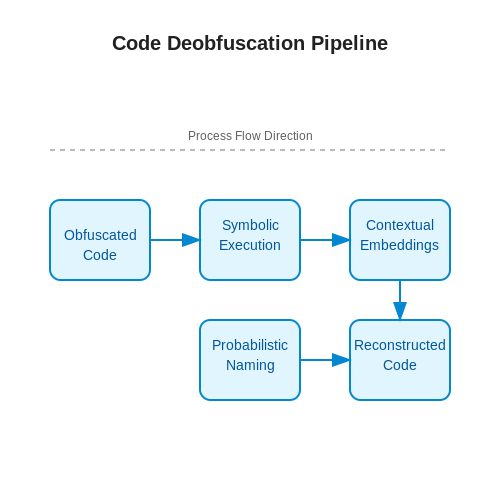
Effective deobfuscation requires a combination of static analysis, pattern recognition, and probabilistic inference. Key approaches include:
- Symbolic Execution: LLMs can simulate execution paths to recover variable meanings and control flow.
- Contextual Embedding: Transformer models leverage attention mechanisms to infer relationships between obscured symbols.
- Probabilistic Renaming: Statistical models predict meaningful variable names based on usage patterns.
where f(x) represents the model's learned representation of variable context x, and the denominator normalizes across all possible names.
Control Flow Reconstruction
Minified JavaScript often appears as a single line with compressed control structures. LLMs must:
- Parse the abstract syntax tree (AST) despite missing formatting cues
- Identify boundary patterns for functions and blocks
- Reconstruct hierarchical relationships from flat representations
For conditional logic compressed as ternary operators (a?b:c), the model must expand these into full if-else statements while preserving the original semantics.
Case Study: Webpack Bundles
Modern JavaScript bundlers like Webpack produce highly optimized output with:
- Module concatenation
- Scope hoisting
- Dead code elimination
LLMs trained on Webpack output learn to:
// Before deobfuscation
(function(e,t){var n=function(e){return e*e};t.exports=n})(window,window.lib||(window.lib={}));

// After reconstruction
function square(x) {
  return x * x;
}
window.lib = window.lib || {};
window.lib.square = square;
Performance Considerations
The computational complexity of deobfuscation scales with:
where n is code length and k depends on the obfuscation technique. For heavily obfuscated code with nested eval calls or dynamic code generation, k can approach 3-4, requiring specialized model architectures.
Practical Implementation
State-of-the-art approaches combine:
- Multi-task learning across different obfuscation techniques
- Attention mechanisms with extended context windows
- Iterative refinement passes
For example, the reconstruction pipeline might first identify variable patterns, then recover control flow, and finally apply semantic renaming.
5.3 Computational and Resource Constraints
Memory and Bandwidth Limitations
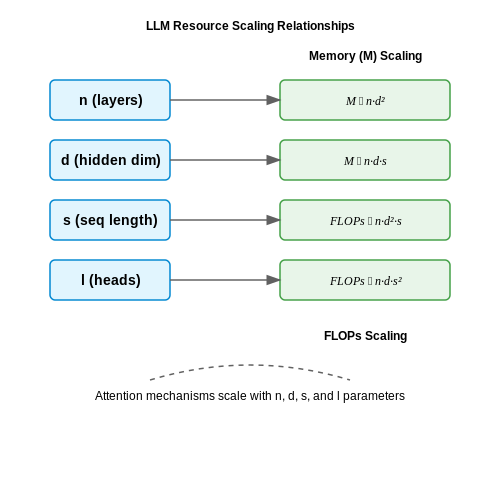
Large language models (LLMs) designed for reverse engineering programming tasks face significant memory constraints due to their parameter count. For instance, a model with n layers and d hidden dimensions requires O(n·d²) memory for storing weights. When reverse engineering complex codebases, the model must cache intermediate representations, further exacerbating memory demands. The memory footprint M can be approximated as:
where s is the sequence length and l is the number of attention heads. Bandwidth bottlenecks arise when transferring weights between GPU memory and compute units, particularly for autoregressive decoding where key-value caches grow linearly with sequence length.
Compute-Intensive Operations
Reverse engineering tasks require iterative sampling and validation, amplifying computational costs. The FLOPs per token for a forward pass scale as:
Attention mechanisms dominate the quadratic term, making long-context analysis prohibitively expensive. Techniques like flash attention reduce memory overhead but still require substantial compute resources. For example, analyzing a 10k-line codebase with 512 tokens per line would demand ~26 exaFLOPs for full bidirectional attention.
Energy and Carbon Costs
The energy consumption E of reverse engineering LLMs follows:
where P is power draw (typically 300-400W per A100 GPU) and t is wall-clock time. A single model serving 100 concurrent users analyzing medium-sized projects (~50k LOC) may consume over 15 kWh daily. This raises ethical concerns about the carbon footprint of automated reverse engineering at scale.
Hardware-Software Co-Design Solutions
Emerging approaches to mitigate constraints include:
- Sparse expert models: Only activate relevant model pathways per task
- Quantized inference: 4-bit weight representations reduce memory by 4×
- Distributed caching: Shard attention keys/values across GPU clusters
The tradeoff between precision and resource usage follows a Pareto frontier described by:
where α and β are task-dependent coefficients. Recent work shows that for code reverse engineering, α ≈ 0.3, indicating diminishing returns on accuracy with increased compute.
6. Intellectual Property and Licensing Concerns
6.1 Intellectual Property and Licensing Concerns
Large language models (LLMs) capable of reverse engineering programming tasks raise significant intellectual property (IP) and licensing challenges. When an LLM generates code that resembles proprietary or copyrighted material, the legal implications depend on factors such as the training data's licensing terms, the degree of similarity to protected works, and jurisdictional copyright laws.
Copyright Infringement Risks
The U.S. Copyright Office and EU Directive 2001/29/EC consider software code as literary works protected by copyright. If an LLM reproduces substantial portions of licensed code without transformation, it may constitute infringement. The legal test often hinges on:
- Substantial similarity between generated and original code
- Access to the copyrighted work during training
- Whether the output qualifies as fair use or derivative work
Where S represents code similarity, A denotes access probability, and T measures transformative nature.
Training Data Licensing
Most LLMs train on mixed-license corpora including:
- GPL-licensed code (requires derivative works to be open-sourced)
- MIT/BSD-licensed code (permits proprietary reuse with attribution)
- Proprietary code (unknown licensing status)
The SPDX License List provides standardized identifiers for tracking these obligations. Models trained on GPL code may trigger copyleft requirements if outputs are substantially similar.
Output Licensing Strategies
Commercial LLM providers implement several mitigation approaches:
| Strategy | Implementation | Effectiveness |
|---|---|---|
| Filtering | Remove GPL/AGPL code from training | Partial (may miss derivatives) |
| Attribution | Generate license notices for BSD/MIT code | Legally compliant |
| Differential Privacy | Add noise to prevent memorization | Theoretical protection |
Case Law Precedents
Recent rulings provide partial guidance:
- Oracle v. Google (2021): Established that API structure can be copyrightable
- GitHub Copilot litigation (ongoing): Testing whether ML outputs constitute fair use
The EFF's Reverse Engineering FAQ outlines legal safeguards for interoperability cases that may apply to some LLM use cases.
Patent Considerations
Algorithmic patents present additional risks. The USPTO's 2019 Revised Patent Subject Matter Eligibility Guidance states that ML models implementing patented techniques could infringe if they perform substantially the same function. Defensive measures include:
def check_patent_risk(algorithm):
    patent_db = load_uspto_database()
    similar_patents = search_similar(
        algorithm,
        threshold=0.85,
        db=patent_db
    )
    return len(similar_patents) > 0
Where the similarity threshold aligns with legal standards for patent infringement.
6.2 Responsible Use of Reverse Engineering Tools
Reverse engineering tools powered by large language models (LLMs) enable powerful analysis of software systems, but their use raises significant ethical and legal concerns. Understanding the boundaries of responsible reverse engineering is critical for researchers and practitioners.
Legal Frameworks Governing Reverse Engineering
Most jurisdictions permit reverse engineering under limited circumstances, primarily for interoperability, security research, or educational purposes. Key legal considerations include:
- Digital Millennium Copyright Act (DMCA): In the U.S., Section 1201(f) allows reverse engineering for interoperability, but prohibits circumvention of access controls.
- EU Software Directive: Article 6 permits decompilation for achieving interoperability, provided certain conditions are met.
- Computer Fraud and Abuse Act (CFAA): Prohibits unauthorized access to computer systems, which may apply depending on how reverse engineering is conducted.
Ethical Considerations in AI-Assisted Reverse Engineering
Beyond legal compliance, ethical use requires evaluating:
- Intent: Whether the purpose aligns with beneficial outcomes like vulnerability discovery rather than malicious exploitation.
- Proportionality: The depth of analysis should match the legitimate need - extracting an API signature differs from reconstructing entire proprietary algorithms.
- Consent: When possible, obtaining permission from software owners avoids ethical ambiguities.
Risk Mitigation Strategies
When employing LLMs for reverse engineering tasks, implement safeguards:
- Sandboxing: Execute analyses in isolated environments to prevent accidental system modifications.
- Data Minimization: Only process the minimum necessary code segments to achieve research objectives.
- Documentation: Maintain clear records of research methodology and legitimate purposes.
Case Study: Responsible Vulnerability Research
A 2023 study by MITRE demonstrated responsible disclosure practices when using LLMs to analyze industrial control systems. Researchers:
- Limited analysis to network protocol structures without executing code
- Submitted findings through authorized channels with 90-day disclosure timelines
- Published only high-level descriptions of vulnerabilities after patches were available
Technical Safeguards in LLM Systems
Modern reverse engineering tools incorporate technical controls:
- Output Filtering: Block generation of complete exploit code while allowing vulnerability descriptions
- Licensing Checks: Verify software licenses before suggesting reverse engineering approaches
- Watermarking: Embed detectable signatures in generated analysis reports
# Example of ethical guardrails in an LLM reverse engineering tool
def analyze_binary(binary):
    if check_license(binary) == 'proprietary':
        raise EthicalConstraintError("Analysis restricted by license")

    analysis = limited_decompile(binary)
    return sanitize_output(analysis)  # Remove sensitive details
6.3 Mitigating Malicious Applications
The ability of large language models (LLMs) to reverse engineer programming tasks introduces significant security risks, including the potential for generating malicious code, automating cyberattacks, or circumventing software protections. Mitigating these risks requires a multi-layered approach combining technical safeguards, policy frameworks, and adversarial testing.
Input/Output Sanitization
Effective mitigation begins with rigorous input/output sanitization. For any LLM deployed in a code-generation context, the following measures should be implemented:
- Syntax validation: Parse generated code through formal grammar checkers before execution to detect anomalous structures.
- Semantic constraints: Enforce type systems and memory safety guarantees through intermediate representations.
- Sandboxing: Execute untrusted code in isolated environments with strict resource quotas.
The sanitization process can be formalized as a probabilistic filter:
Adversarial Training
LLMs must be trained against known attack vectors through adversarial examples. This involves:
- Generating poisoned training samples that attempt to elicit malicious outputs
- Implementing gradient masking to prevent reverse engineering of defense mechanisms
- Training separate discriminator models to flag suspicious generations
The adversarial training objective combines the standard language modeling loss with a security penalty term:
Runtime Monitoring
Continuous monitoring systems should track:
- API call patterns that deviate from expected behavior
- Resource consumption anomalies during code execution
- Attempts to access restricted system functions
An effective monitoring system can be modeled as a hidden Markov process where system states represent security levels:
Policy Controls
Technical measures must be complemented by policy frameworks:
- Strict access controls with multi-factor authentication
- Usage logging with immutable audit trails
- Legal agreements prohibiting reverse engineering of protected systems
The effectiveness of policy controls can be quantified through game-theoretic models of attacker-defender interactions:
7. Key Research Papers and Articles
7.1 Key Research Papers and Articles
- (PDF) Reverse Engineering Research — Reverse Engineering History of Reverse Engineering, Countries famous for Reverse Engineering, Uses of reverse Engineering, Parts of a system that can be reversed engineered Stages of reverse ...
- Enhancing Computer Programming Education with LLMs: A Study on ... — assessed the capabilities of ChatGPT-3.5 and GPT-4 in solving introductory Python programming tasks sourced from CodingBat. Pearce et al. [2022b] explored the application of LLMs in reverse engineering tasks and exhibited promising results. Supporting discussions on LLMs' application in programming education, particularly with development
- Towards an understanding of large language models in software ... — Large Language Models (LLMs) have drawn widespread attention and research due to their astounding performance in text generation and reasoning tasks. Derivative products, like ChatGPT, have been extensively deployed and highly sought after. Meanwhile, the evaluation and optimization of LLMs in software engineering tasks, such as code generation, have become a research focus. However, there is ...
- Noteworthy LLM Research Papers of 2024 - sebastianraschka.com — If you're looking for a broader list of AI research papers, feel free to check out my earlier article (LLM Research Papers: The 2024 List). Happy new year and happy reading! Table of contents. 1. January: Mixtral's Mixture of Experts Approach. 1.1 Understanding MoE models; 1.2 The relevance of MoE models today; 2. February: Weight ...
- Large language models (LLMs): survey, technical frameworks ... - Springer — LLMs can process and summarize vast amounts of medical literature quickly (Watanabe and Wiseman 2023), a task often done by research assistants. Tools like Iris.ai use AI to help researchers find and summarize relevant scientific papers, thus speeding up the research process and reducing the need for human labor in literature review and synthesis.
- Reverse Engineering is Not Hard with LLM Powered Tools - Reflare — ReverserAI, developed by Tim Blazytko, is the latest entry into the evolving space of tools that provide reverse engineering assistance with the aim of enhancing the reverse engineering process through the integration of locally-hosted large language models (LLMs). This model seeks to address some of the challenges faced by reverse engineers by ...
- Retriever: A view-based approach to reverse engineering software ... — However, manual reverse engineering of a software architecture can be a challenging and labor-intensive task, especially for large and complex systems. Automating this process typically involves code analysis to identify components, interfaces, dependencies, and other architectural elements ( Canfora et al., 2011 ).
- PDF Reverse Engineering: A Cognitive Approach, a Case Study and a Tool — program comprehension is considered to be a key bottleneck of SM. Reverse engineering tools have been used to alleviate this bottleneck with lower than expected success. We present a cognitively based approach for reverse engineering tool development. We use ideas from cognitive psychology and other disciplines to formulate the approach. We
- A Review of Current Trends, Techniques, and Challenges in Large ... — Natural language processing (NLP) has significantly transformed in the last decade, especially in the field of language modeling. Large language models (LLMs) have achieved SOTA performances on natural language understanding (NLU) and natural language generation (NLG) tasks by learning language representation in self-supervised ways. This paper provides a comprehensive survey to capture the ...
- Large language models for code completion: A systematic literature ... — The introduction of LLMs has led to substantial advancements in software development, particularly in the area of automatic code completion. Code completion is critical in today's IDEs and code editors, as it significantly helps developers compose their source code faster and more efficiently by predicting subsequent code tokens (e.g., variable names, function names) based on contextual clues.
7.2 Recommended Books and Tutorials
- Reverse Engineering - The Books - CodeGuru — These are Practical Reverse Engineering by Dang, Gazet, and Bachaalany and Reversing: Secrets of Reverse Engineering by Eladad Eilam. Both books focus on the idea that, if you understand how something works, you'll be better able to protect and secure it. ... and web application programming. In addition to tutorials and how-tos that teach ...
- Top 5 Books To Learn Reverse Engineering/Reversing In 2022 - Fuzzing Labs — Today, I will like to show you my TOP 5 books to start learning Reversing. Those books are definitely a must-read for everyone that wants to improve their skills in reverse engineering! Reversing: Secrets of Reverse Engineering - link; Practical Reverse Engineering - link; The IDA Pro Book, 2nd Edition - link; The Ghidra Book - link
- The Ultimate Guide for Reverse Engineers: Navigating the World of ... — The book covers a wide range of topics, from the basics of reverse engineering to more advanced techniques for reverse engineering x86, x64, and ARM architectures. It also explores the reverse engineering of Windows kernels and the use of reverse engineering tools, such as disassemblers and debuggers.
- 7 Best Reverse Engineering Courses for 2025 — Class Central — Software reverse engineering (SRE) is the practice of analyzing a software system to extract design patterns and implementation information. This involves studying the program's code (usually a low-level assembly or bytecode) to understand its behavior and functions.. If you are looking for the best online courses to learn Software Reverse Engineering (SRE), I've made this Best Courses ...
- Reversing: Secrets of Reverse Engineering[Book] - O'Reilly Media — The book is broken into two parts, the first deals with security-related reverse engineering and the second explores the more practical aspects of reverse engineering. In addition, the author explains how to reverse engineer a third-party software library to improve interfacing and how to reverse engineer a competitor's software to build a ...
- Reverse Engineering is Not Hard with LLM Powered Tools - Reflare — ReverserAI, developed by Tim Blazytko, is the latest entry into the evolving space of tools that provide reverse engineering assistance with the aim of enhancing the reverse engineering process through the integration of locally-hosted large language models (LLMs). This model seeks to address some of the challenges faced by reverse engineers by ...
- Are there any project based books that teach reverse engineering? — The IDA Pro Book; In the field of hardware reverse engineering, however, it is much harder to find a proper book, not to say one which is project oriented. But there is one book which overcomes the other and seems to fit best for your needs - Hacking the Xbox: An Introduction to Reverse Engineering by Andrew Huang. The book is available for ...
- Comprehensive Beginner's Guide to Reverse Engineering — Here's a simple C program for you to practice reverse engineering. Try to understand what it does and how it works. If you manage to reverse engineer it successfully, connect with me on LinkedIn ...
- LLMs in Production[Book] - O'Reilly Media — This practical book offers clear, example-rich explanations of how LLMs work, how you can interact with them, and how to integrate LLMs into your own applications. Find out what makes LLMs so different from traditional software and ML, discover best practices for working with them out of the lab, and dodge common pitfalls with experienced advice.
- Nightmare - Nightmare — Nightmare. Nightmare is an intro to binary exploitation / reverse engineering course based around ctf challenges. I call it that because it's a lot of people's nightmare to get hit by weaponized 0 days, which these skills directly translate into doing that type of work (plus it's a really cool song).
7.3 Open-Source Tools and Datasets
- A list of open-source reverse engineering tools with a focus ... - GitHub — Pin: Pin is a dynamic binary instrumentation framework for the IA-32, x86-64 and MIC instruction-set architectures that enables the creation of dynamic program analysis tools. PINCE: A front-end/reverse engineering tool for the GNU Project Debugger (GDB), focused on games. But it can be used for any reverse-engineering related stuff.
- Reverse Engineering is Not Hard with LLM Powered Tools - Reflare — ReverserAI, developed by Tim Blazytko, is the latest entry into the evolving space of tools that provide reverse engineering assistance with the aim of enhancing the reverse engineering process through the integration of locally-hosted large language models (LLMs). This model seeks to address some of the challenges faced by reverse engineers by ...
- LLMs for Code Tasks: Architectures, Training, and Evaluation - GoPenAI — Open Interpreter is an open-source tool that enables LLMs to execute code locally, generate code, retrieve results, and self-correct, supporting multiple programming languages. Devin, created by Cognition Labs, is marketed as the world's first fully autonomous AI software engineer, capable of planning, analyzing, and executing complex coding ...
- 9 Best Reverse Engineering Tools for 2024 [Updated] - Apriorit — Top 9 reverse engineering tools. It's hard to name the best software for reverse engineering - there are quite a few options, and each resolves a specific task in the multistep reversing process. Below, we overview the nine main tools used for reverse engineering by Apriorit researchers: IDA Pro, Hex Rays; CFF Explorer; API Monitor; WinHex ...
- The Top 10 Open Source LLMs: 2025 Edition - Scribble Data — With that in mind, let's look at some of the most promising open-source LLMs out there in 2024. GPT-NeoX. GPT-NeoX is an open-source LLM developed by EleutherAI. It is an autoregressive transformer decoder model with an architecture that largely follows GPT-3, but with a few notable deviations. The model has 20 billion parameters.
- Open source LLMs: Llama, Mistral, Mixtral, and Code Llama — Hugging Face is the industry standard when it comes to hosting open source LLMs and other AI models that you can download. You can directly interact with LLMs on Hugging Face.
- 13 Best Reverse Engineering Tools For Code Analysis [2025] — Reverse engineering is the art of deconstructing software or hardware to uncover its design, often without source code.In 2025, Reverse Engineering Tools are vital for:- Cybersecurity: Neutralizing malware threats. Software Interoperability: Maintaining legacy systems. Vulnerability Research: Discovering zero-days.
- How to use Large Language Models (LLMs) to optimize Backend Code — The first step in reverse engineering the code is to deeply understand each part. LLMs can provide explanations, documentation, and architectural overviews. 2.1 Parsing the Codebase. LLMs can parse through functions and modules, generating a description of what each component does, making it easier to understand the code structure. For instance:
- geeksniper/reverse-engineering-toolkit - GitHub — Contribute to geeksniper/reverse-engineering-toolkit development by creating an account on GitHub. ... Open Source GitHub Sponsors. Fund open source developers The ReadME Project. GitHub community articles Repositories. Topics Trending Collections Enterprise ...
- GitHub - hiyouga/LLaMA-Factory: Unified Efficient Fine-Tuning of 100 ... — Compared to ChatGLM's P-Tuning, LLaMA Factory's LoRA tuning offers up to 3.7 times faster training speed with a better Rouge score on the advertising text generation task. By leveraging 4-bit quantization technique, LLaMA Factory's QLoRA further improves the efficiency regarding the GPU memory.