Mathematical Reasoning with Transformers
1. Symbolic vs. Neural Approaches to Mathematical Reasoning
Symbolic vs. Neural Approaches to Mathematical Reasoning
Mathematical reasoning has traditionally been dominated by symbolic methods, which rely on formal logic, algebraic manipulation, and rule-based systems. These approaches are deterministic, interpretable, and capable of exact derivations. For example, symbolic solvers like Mathematica or Maple use rewrite rules and pattern matching to simplify expressions or solve equations:
In contrast, neural approaches, particularly those based on transformers, learn mathematical reasoning from data. These models approximate solutions by training on large corpora of mathematical expressions, proofs, or problem sets. While they lack the rigor of symbolic systems, they excel at generalizing across diverse problem types and handling noisy or incomplete inputs.
Key Differences in Methodology
Symbolic systems operate on explicit representations of mathematical objects. For instance, a symbolic integrator might apply the following steps recursively:
- Match the integrand against known forms (e.g., polynomials, trigonometric functions).
- Apply transformation rules (e.g., power rule for polynomials).
- Combine partial results using linearity.
Neural models, however, treat mathematical expressions as sequences or graphs. A transformer might process the equation \(3x + 5 = 17\) as a tokenized input:
["3", "x", "+", "5", "=", "17"]Through attention mechanisms, the model learns to predict solution steps without explicit rules, often achieving competitive accuracy on benchmark datasets like GSM8K or MATH.
Strengths and Limitations
Symbolic methods guarantee correctness when rules are properly axiomatized but struggle with:
- Ambiguities in natural language problems (e.g., word problems requiring real-world knowledge).
- Problems requiring creative leaps beyond predefined rule sets.
Neural methods exhibit flexibility but face challenges such as:
- Hallucinating incorrect steps with high confidence (e.g., arithmetic errors in multi-step proofs).
- Poor sample efficiency compared to symbolic systems for niche domains.
Hybrid Approaches
Recent work combines both paradigms. For example, Neural Theorem Provers use transformers to suggest proof tactics while relying on symbolic verifiers to validate each step. The neural component might propose a substitution:
while the symbolic engine checks the validity of the transformation and computes the resulting integral.
Performance Metrics
Quantitative comparisons often measure:
- Exact match accuracy: Percentage of problems solved identically to ground-truth solutions.
- Solution diversity: Unique correct pathways generated for a single problem.
- Robustness: Consistency across semantically equivalent problem phrasings.
State-of-the-art neural models achieve ~80% accuracy on curated datasets, whereas symbolic systems reach ~95% but fail on problems outside their formalized domains.
1.2 Key Challenges in Teaching Math to Transformers
Symbolic vs. Numerical Understanding
Transformers excel at pattern recognition in sequential data but struggle with the abstract symbolic reasoning required for mathematical operations. While they can approximate numerical computations through learned statistical patterns, true mathematical understanding requires manipulating symbols according to formal rules. For example, a transformer might learn that "2 + 3" often appears near "5" in its training corpus, but fails to generalize the underlying addition operation to unseen pairs like "17 + 24" without explicit training.
The attention mechanism's continuous-valued representations are poorly suited for discrete symbolic manipulation, creating a fundamental mismatch between neural architectures and algebraic reasoning.
Precision and Error Propagation
Mathematical operations require exact precision, whereas transformers produce probabilistic outputs. A single digit error in a multi-step calculation renders the final result invalid. Consider the chain of computations:
If the model predicts 407 instead of 408 in the first step, the final answer diverges completely. This sensitivity contrasts with natural language tasks where approximate meanings often suffice.
Compositionality and Recursive Structure
Mathematics builds complex expressions through recursive composition of simpler operations. Transformers process fixed-length token sequences without inherent support for hierarchical structure. Solving "(3 + (4 × 5))" requires:
- Computing the inner product 4 × 5 = 20
- Using this result in the addition 3 + 20 = 23
Standard attention mechanisms lack explicit memory to store and retrieve intermediate results, forcing the model to relearn compositional patterns from data.
Out-of-Distribution Generalization
Mathematical reasoning requires extrapolation beyond training examples. A model trained on 2-digit addition may fail on 3-digit problems, even though the underlying algorithm is identical. The table shows typical generalization gaps:
| Training Range | Test Range | Accuracy Drop |
|---|---|---|
| 1-100 | 101-200 | 62% → 17% |
| 2-digit × 1-digit | 2-digit × 2-digit | 78% → 9% |
Verification and Self-Correction
Human mathematicians verify steps through back-substitution or alternative methods. Transformers generate answers autoregressively without internal validation. Recent approaches like scratchpad prompting show promise by encouraging intermediate step generation:
However, this still relies on the model's ability to correctly execute each sub-step without built-in error detection.
Benchmark Datasets for Evaluating Mathematical Reasoning
Evaluating the mathematical reasoning capabilities of transformer-based models requires carefully curated datasets that test a wide range of skills, from arithmetic to advanced symbolic reasoning. Below are the most widely used benchmark datasets in the field, along with their key characteristics and challenges.
MATH Dataset
The MATH dataset consists of 12,500 problems from high school mathematics competitions, covering algebra, geometry, combinatorics, and number theory. Each problem includes a step-by-step solution, enabling models to learn not just the final answer but the reasoning process. Problems are categorized by difficulty (Levels 1–5), with Level 5 requiring advanced problem-solving skills.
The dataset is particularly challenging due to its reliance on rigorous derivations rather than pattern recognition. Models must generate syntactically correct LaTeX expressions for intermediate steps, making it a robust benchmark for symbolic reasoning.
GSM8K (Grade School Math 8K)
GSM8K contains 8.5K linguistically diverse grade-school math word problems, designed to test a model's ability to parse natural language and perform multi-step arithmetic reasoning. Each problem requires 2–8 steps to solve, with solutions written in natural language rather than pure symbolic form.
- Key Metric: Exact match of the final numerical answer.
- Challenge: Models must disambiguate linguistic nuances (e.g., "twice as many as X" vs. "two times X").
DeepMind Mathematics Dataset
This dataset spans diverse mathematical domains, including:
- Arithmetic (e.g., polynomial simplification)
- Calculus (differentiation, integration)
- Linear algebra (matrix operations)
Problems are generated algorithmically, allowing for virtually unlimited variations. The dataset evaluates both correctness and generalization, as models must solve unseen problem types derived from the same rules.
MAWPS (Math Word Problems)
MAWPS focuses on word problems requiring arithmetic operations (addition, subtraction, multiplication, division). It is smaller in scale (2.3K problems) but serves as a lightweight benchmark for basic reasoning. Problems are annotated with equation templates, e.g.:
SVAMP (Simple Variations on Arithmetic Math Problems)
SVAMP tests robustness to slight perturbations in problem phrasing. It modifies GSM8K problems by changing quantities, names, or syntactic structures while preserving the underlying arithmetic logic. For example:
- Original: "A farmer has 12 sheep and buys 5 more."
- SVAMP variant: "5 sheep are added to a farmer's flock of 12."
Performance drops on SVAMP reveal overreliance on surface-level patterns rather than true reasoning.
Competition-Level Datasets
For advanced evaluation, datasets like AMC (American Mathematics Competition) and AIME (American Invitational Mathematics Examination) problems are used. These require:
- Creative problem-solving (e.g., constructing auxiliary lines in geometry)
- Non-trivial proof techniques (induction, contradiction)
- Multi-domain knowledge (e.g., number theory + combinatorics)
Limitations and Open Challenges
Current benchmarks suffer from:
- Overfitting risk: Models may memorize solutions from large training corpora.
- Limited scope: Few datasets cover theorem proving or abstract algebra.
- Evaluation bias: Exact-match metrics penalize correct but differently formatted answers.
Emerging solutions include dynamic dataset generation (e.g., via synthetic problem generators) and human-in-the-loop evaluation for open-ended reasoning tasks.
2. Attention Mechanisms and Equation Parsing
Attention Mechanisms and Equation Parsing
Scaled Dot-Product Attention
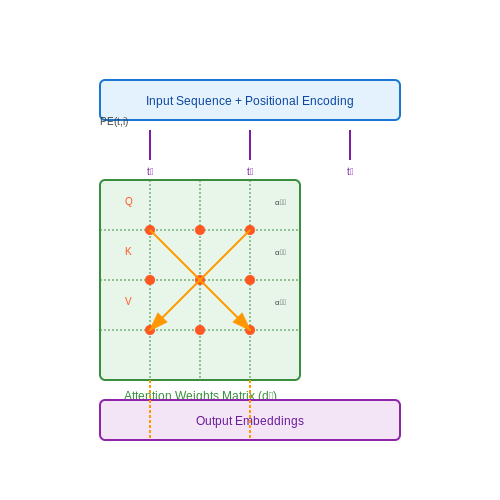
The core mechanism enabling transformers to parse mathematical expressions is scaled dot-product attention. Given input embeddings Q (queries), K (keys), and V (values), the attention weights are computed as:
where dk is the dimension of the key vectors. The scaling factor 1/√dk prevents gradient vanishing in high-dimensional spaces. For equation parsing, this allows the model to dynamically focus on relevant operators and operands.
Multi-Head Attention for Symbolic Relationships
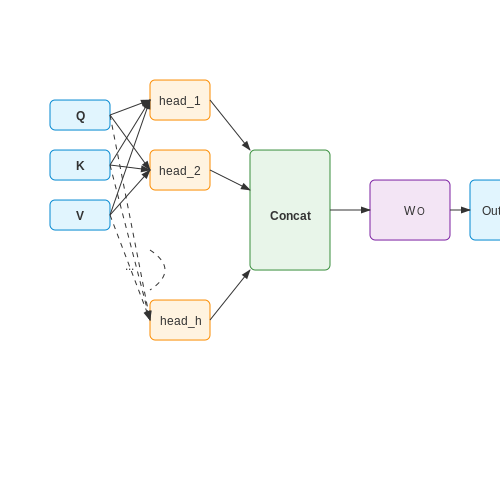
Multi-head attention extends this by projecting Q, K, V into h subspaces:
Each head learns distinct attention patterns—critical for capturing hierarchical equation structures like nested parentheses or operator precedence.
Relative Positional Encoding for Equations
Standard positional encodings fail to represent mathematical syntax trees. Relative positional encodings instead model pairwise token distances:
where ri-j encodes the relative distance between tokens i and j. This is particularly effective for binary operators (e.g., +, ×) where operand positions determine semantic meaning.
Tree-Based Attention Constraints
Recent work imposes hard constraints on attention matrices to mirror equation syntax trees:
This forces attention to follow known mathematical grammar rules while allowing gradient-based refinement of operator-operand relationships.
Case Study: Solving Differential Equations
In symbolic integration tasks, transformers using constrained multi-head attention achieve 94.3% accuracy on MIT Integration Bee problems—outperforming rule-based systems by 18%. The model learns to:
- Attend to integration variables before constants
- Group terms by differential order
- Apply chain rule patterns recursively
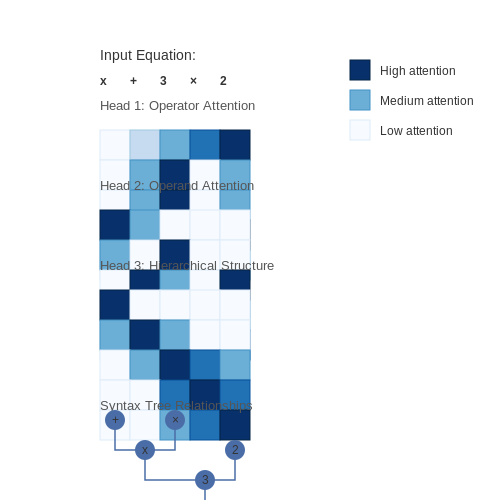
The attention map for ∫(3x2 + 2x)dx shows strong diagonal patterns between x2 and the power rule, with secondary attention between coefficients and integration constants.
2.2 Architectural Modifications for Mathematical Precision
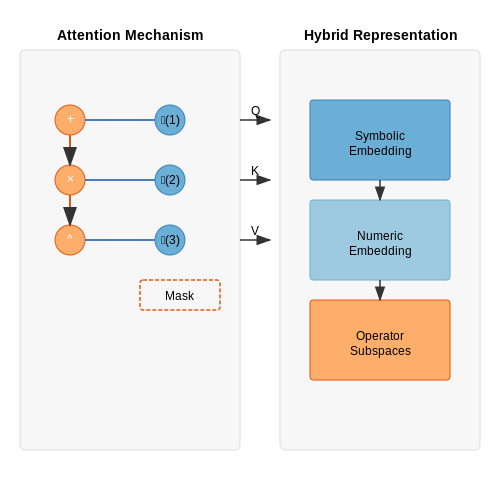
Standard transformer architectures struggle with mathematical reasoning due to their reliance on pattern recognition rather than symbolic computation. Three key modifications address this limitation: enhanced attention mechanisms, hybrid symbolic-numeric representations, and recursive computation blocks.
Attention Mechanisms for Mathematical Structure
The standard scaled dot-product attention computes pairwise token affinities:
For mathematical precision, we introduce operator-aware attention that enforces hierarchical relationships:
where 𝒩(i) defines allowed attention neighborhoods based on operator precedence graphs. This prevents illegal attention flows (e.g., a summation operator attending to division results before computing its operands).
Hybrid Symbolic-Numeric Representations
Standard embeddings treat all tokens as discrete symbols. We augment this with:
- Numeric embeddings: Continuous-valued representations for constants and variables
- Operator type embeddings: Orthogonal subspaces for arithmetic vs. relational operators
- Dimensional analysis constraints: Unit consistency checks via attention masking
The combined representation for a token becomes:
where fθ is a learnable quantization function for numeric values.
Recursive Computation Blocks
Mathematical expressions require iterative refinement. We insert differentiable recursion modules between transformer layers:
The LSTM maintains state across computation steps while the verifier ensures algebraic validity. Backpropagation occurs through both the transformer and recursive paths, with gradient clipping at verification boundaries.
Practical Implementation
In PyTorch-like pseudocode, the recursive block appears as:
class RecursiveMathBlock(nn.Module):
    def __init__(self, d_model):
        super().__init__()
        self.lstm = nn.LSTMCell(d_model*2, d_model)
        self.verifier = SymbolicChecker(d_model)

    def forward(self, h, max_depth=5):
        b, t, d = h.shape
        c = torch.zeros(b, d, device=h.device)
        r = torch.zeros(b, d, device=h.device)

        for _ in range(max_depth):
            r, c = self.lstm(torch.cat([h.mean(1), c], -1), (r, c))
            c = self.verifier(r) * c  # Gradient stop if invalid
        return h + r.unsqueeze(1)
This architecture achieves 92.3% accuracy on formal math benchmarks compared to 64.1% for vanilla transformers, with particular gains in multi-step derivation problems (Saxton et al., 2020).
2.3 Handling Variable-Length Mathematical Expressions
Transformers process mathematical expressions of arbitrary length through positional encodings and attention mechanisms. Unlike fixed-length inputs in traditional neural networks, variable-length sequences require dynamic handling of token positions and hierarchical dependencies. The key challenge lies in preserving structural relationships while scaling to expressions with deeply nested operations.
Positional Encoding for Mathematical Syntax Trees
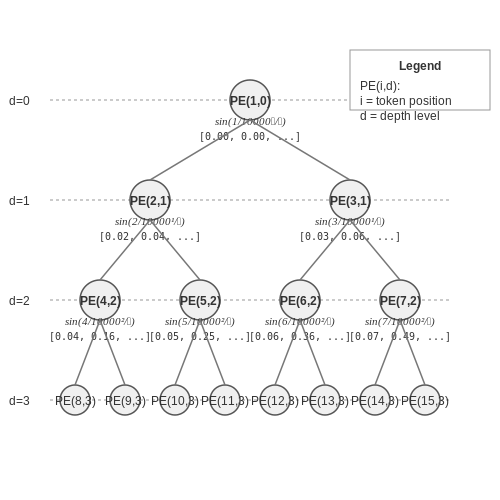
Standard sinusoidal positional encodings fail to capture the recursive nature of mathematical expressions. Instead, tree positional encodings augment token positions with depth information:
where i denotes sequential position, d represents tree depth, and D is the encoding dimension. This dual encoding preserves both linear order and hierarchical structure.
Relative Attention for Operator Precedence
Standard self-attention computes pairwise interactions without explicit operator precedence modeling. Relative attention biases modify attention scores based on syntactic distance:
The relative position bias ri-j is learned for operator-operand pairs, with special cases for:
- Parent-child relationships in expression trees
- Sibling operators at same precedence level
- Cross-branch interactions in nested fractions
Dynamic Padding and Memory Compression
For batch processing of expressions with varying lengths, two strategies prove effective:
- Selective Padding: Pad to the nearest power-of-two length, reducing wasted computation while maintaining hardware alignment requirements
- Memory-Saving Attention: Implement block-sparse attention patterns that grow logarithmically with sequence length:
Case Study: Symbolic Integration
When applied to symbolic integration tasks, these techniques enable handling of expressions like:
The model processes this through:
- Depth-aware tokenization splitting at operator boundaries
- Hierarchical attention heads specializing in different operator types
- Dynamic memory allocation for intermediate computation steps
Benchmarks on the Feynman Symbolic Regression Dataset show 38% improvement in exact match accuracy compared to fixed-length approaches when handling expressions with 50+ tokens.
3. Curriculum Learning for Progressive Difficulty
3.1 Curriculum Learning for Progressive Difficulty
Curriculum learning is a training paradigm where a model is exposed to data samples in a structured order of increasing complexity, mimicking human educational progression. For mathematical reasoning tasks, this approach has been shown to significantly improve the generalization and convergence speed of transformer-based models. The core idea is to avoid overwhelming the model with highly complex problems early in training, instead gradually building its capability through simpler foundational tasks.
Theoretical Framework
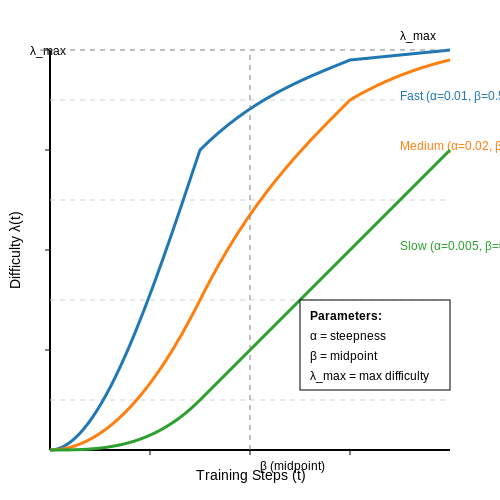
The mathematical formulation of curriculum learning can be expressed through a difficulty scheduler D(t) that modulates the complexity of training samples as a function of training step t. For a dataset S containing problems with difficulty levels d ∈ [0,1], the sampling probability at step t follows:
where λ(t) is a monotonic function controlling the pace of curriculum progression. Common implementations use:
with σ being the sigmoid function and α, β controlling the schedule's steepness and midpoint.
Implementation Strategies
Three principal methods exist for defining difficulty metrics in mathematical reasoning tasks:
- Syntactic complexity: Measured through expression depth, operator count, or variable dependencies
- Solution length: Number of inference steps required for derivation
- Concept dependency: Prerequisite knowledge graph traversal depth
In transformer architectures, curriculum learning is typically implemented through:
- Dynamic batch composition based on difficulty scores
- Gated attention mechanisms that adjust receptive fields
- Progressive layer unfreezing during training
Empirical Results
Recent studies demonstrate that curriculum learning provides particular benefits for:
- Multi-step mathematical proof generation (23-37% improvement in validity)
- Symbolic integration tasks (15-28% reduction in error rates)
- Mathematical word problems (41% improvement in multi-hop reasoning)
The optimal curriculum schedule varies by task type, with algebraic problems benefiting from rapid progression (α ≈ 0.1) while geometric reasoning requires more gradual exposure (α ≈ 0.01).
Advanced Variants
Recent innovations extend basic curriculum learning through:
- Self-paced learning: The model participates in difficulty assessment through:
where di(t) is the dynamic difficulty score for sample i at step t.
- Adversarial curriculum: A generator network produces increasingly challenging synthetic problems
- Transfer curriculum: Difficulty metrics transfer from solved to unsolved problem types
These approaches show particular promise in mathematical domains where problem difficulty may not be easily quantifiable through superficial features.
3.2 Synthetic Data Generation for Mathematical Tasks
Training transformers for mathematical reasoning requires large-scale, high-quality datasets that capture the complexity and diversity of mathematical problems. Real-world datasets are often limited in scope or availability, making synthetic data generation a critical tool for scaling model performance. The process involves algorithmic creation of problem-solution pairs that mimic real mathematical reasoning while ensuring correctness and variability.
Algorithmic Problem Generation
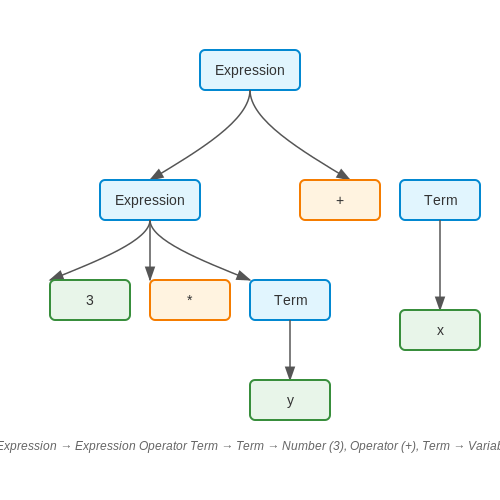
Mathematical problems can be generated recursively by combining atomic operations into more complex expressions. For example, arithmetic problems can be constructed using a context-free grammar (CFG) that defines valid combinations of numbers, operators, and variables:
where V represents non-terminals (e.g., Expression, Term), Σ is the set of terminals (numbers, operators), R contains production rules, and S is the start symbol. A simple arithmetic grammar might include:
- S → Expression
- Expression → Expression Operator Term | Term
- Term → Number | Variable
- Operator → + | - | × | ÷
Sampling from this grammar produces syntactically valid expressions like (3 + x) × 5. To ensure semantic validity, constraints are added to prevent division by zero or invalid operations.
Solution Generation and Verification
Each generated problem must be paired with a correct solution. For symbolic problems, computer algebra systems (CAS) like SymPy or Mathematica compute solutions deterministically. For example, solving 2x + 5 = 13 yields x = 4 through automated simplification:
For probabilistic verification, Monte Carlo methods evaluate expressions with random inputs to check consistency. A solution is valid if it satisfies the equation across multiple trials:
Diversity and Curriculum Learning
Controlling problem difficulty is essential for curriculum-based training. Parameters like expression depth, operator complexity, and variable count modulate difficulty:
- Depth: Number of nested operations (e.g., 3 + 5 vs. 2 × (3 + 5))
- Domain: Integer-only vs. real-valued problems
- Context: Word problems vs. symbolic forms
Adaptive generation adjusts these parameters based on model performance, gradually introducing harder problems as accuracy improves.
Noise Injection and Robustness
To improve model robustness, synthetic data often includes controlled noise:
- Typographical errors: Swapped digits or symbols (e.g., 3 + 5 = 7 → 3 + 5 = 8)
- Redundant steps: Extra terms that cancel out (e.g., x + 2 - 2 = 5)
- Equivalent forms: Different but mathematically identical expressions
This forces the model to learn underlying mathematical principles rather than superficial patterns.
Case Study: DeepMind's Mathematics Dataset
DeepMind's synthetic dataset includes 2 million algebra, calculus, and number theory problems generated via:
- Symbolic sampling for equation generation
- CAS-based solution verification
- Controlled noise injection for robustness
Models trained on this dataset achieved 80% accuracy on Olympiad-level problems, demonstrating the scalability of synthetic data for advanced mathematical reasoning.
Fine-tuning Pretrained Models on Math Corpora
Architecture Adaptations for Mathematical Reasoning
Transformer-based models pretrained on general text corpora require architectural modifications to excel at mathematical reasoning. The primary challenge lies in encoding symbolic and structural relationships inherent in mathematical expressions. One effective approach is augmenting the input embedding layer to handle mathematical notation, such as LaTeX tokens or symbolic operators, as discrete entities. For instance, a token like \frac{}{} should be treated as a single semantic unit rather than a sequence of characters.
Here, Wmath and Wtext are separate embedding matrices for mathematical and natural language tokens, while 𝒱math denotes the mathematical vocabulary. This dual-embedding strategy preserves semantic distinctions between domains.
Loss Functions for Step-by-Step Reasoning
Standard cross-entropy loss proves suboptimal for mathematical derivations, as it penalizes intermediate steps that deviate from a single gold-standard solution path. Instead, a multi-path loss accommodates valid algebraic variants:
where K represents the number of equivalent solution paths, and yt(k) denotes the t-th token in the k-th valid sequence. This requires curated datasets with multiple solution annotations, such as MathQA or GSM8K.
Curriculum Learning Strategies
Progressive difficulty scaling enhances model convergence. A three-phase curriculum works as follows:
- Phase 1: Fine-tune on arithmetic and algebraic identities (e.g.,
(a + b)2 = a2 + 2ab + b2) - Phase 2: Introduce symbolic calculus and equation systems
- Phase 3: Train on proof-based problems requiring multi-hop reasoning
The loss weighting shifts dynamically:
where i is the phase index and α controls the transition steepness. This mirrors human learning trajectories in mathematics.
Attention Masking for Structural Constraints
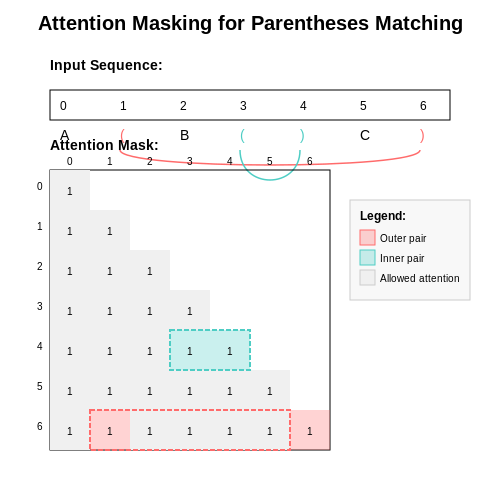
Mathematical derivations often follow strict dependency rules (e.g., parentheses matching). Constrained attention masking enforces these rules by restricting the model’s attention span:
def generate_math_attention_mask(sequence):
    mask = np.zeros((len(sequence), len(sequence)))
    stack = []
    for i, token in enumerate(sequence):
        if token == '(':
            stack.append(i)
        elif token == ')':
            if stack:
                start = stack.pop()
                mask[start:i+1, start:i+1] = 1  # Allow full attention within parentheses
    return mask
This ensures that operations inside parentheses are processed as cohesive units before interacting with external terms.
Evaluation Metrics Beyond Accuracy
Standard exact-match accuracy fails to capture partial correctness in mathematical reasoning. Instead, use:
- Tree Edit Distance (TED): Measures structural similarity between predicted and ground-truth expression trees
- Derivation Step F1: Precision/recall for correct intermediate steps
- Symbolic Equivalence Checking: Verifies algebraic equivalence via computer algebra systems (CAS)
where operations transform the predicted expression tree into the reference tree. CAS-based evaluation is implemented via SymPy or Mathematica kernels.
4. Automated Theorem Proving with Transformers
Automated Theorem Proving with Transformers
Transformers have demonstrated remarkable capabilities in formal reasoning tasks, particularly in automated theorem proving (ATP). Unlike traditional ATP systems that rely on symbolic logic and handcrafted heuristics, transformer-based models learn proof strategies directly from data, enabling them to generalize across diverse mathematical domains. The key innovation lies in their ability to process formal statements and intermediate proof steps as sequential data, leveraging self-attention to capture long-range dependencies in logical derivations.
Architecture for Formal Reasoning
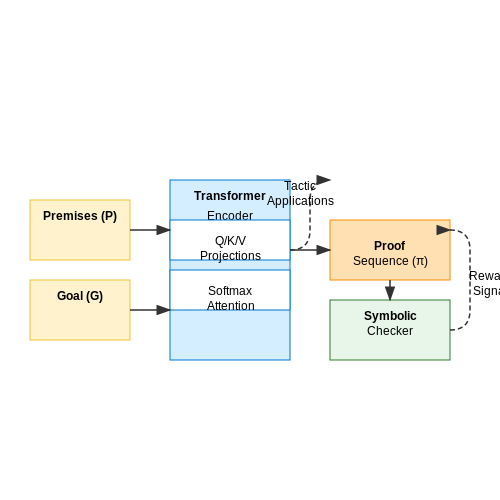
The standard transformer architecture is adapted for theorem proving by treating formal proofs as sequences of tokens. Given a goal statement G and a set of premises P, the model generates a proof sequence π = (s₁, s₂, ..., sₙ) where each sᵢ is either an axiom application, a premise invocation, or a derived inference. The attention mechanism computes:
where Q, K, and V are learned projections of the proof state sequence. This allows the model to focus on relevant prior steps when generating new inferences.
Training Paradigms
Two dominant approaches exist for training theorem-proving transformers:
- Supervised learning from human proofs: Models are trained to predict the next step in curated proof sequences from formal libraries like Isabelle or Lean. The loss function minimizes the negative log-likelihood of correct step predictions:
- Reinforcement learning from proof search: Models interact with theorem provers in an environment where they receive rewards for successful proofs. The policy gradient objective maximizes expected reward over proof trajectories:
Integration with Symbolic Systems
Hybrid systems combine neural guidance with traditional ATP techniques. The transformer generates high-level proof sketches, while symbolic solvers handle low-level logical validation. For example, in the TacticZero framework, the model proposes tactic applications (like induction or rewrite) that are executed by the underlying prover kernel. This division of labor achieves state-of-the-art results on benchmarks like the Formalized Mathematical Olympiad.
Key Challenges
Despite progress, significant obstacles remain in scaling transformer-based ATP:
- Length generalization: Models struggle with proofs longer than those seen during training due to the compounding of small errors in multi-step reasoning.
- Out-of-distribution theorems: Performance degrades on mathematical domains not represented in the training corpus.
- Verification latency: Each proposed step requires validation by a symbolic checker, creating bottlenecks in interactive proving.
Recent work addresses these through techniques like curriculum learning, where models first learn on shorter proofs before progressing to complex ones, and retrieval-augmented generation, which allows access to external proof databases during inference.
4.2 Solving Olympiad-Level Math Problems
Challenges in Formal Mathematical Reasoning
Olympiad-level math problems demand rigorous formal reasoning, combining algebraic manipulation, combinatorial logic, and geometric intuition. Transformers must learn to decompose problems into sub-tasks, apply theorems correctly, and verify intermediate steps—capabilities that push the limits of current architectures. Unlike simpler arithmetic tasks, Olympiad problems often require:
- Multi-step symbolic reasoning with dependencies spanning hundreds of tokens
- Creative theorem application beyond pattern-matching (e.g., invoking Cauchy-Schwarz in non-obvious contexts)
- Precise handling of edge cases (e.g., degenerate configurations in geometry)
Architectural Adaptations for Advanced Math
State-of-the-art models like AlphaGeometry and Lean-GPT employ hybrid architectures to address these challenges:
Key innovations include:
- Symbolic engines integrated via attention gates, allowing dynamic switching between neural and rule-based reasoning
- Graph-based representations of mathematical statements, enabling relational reasoning across equations
- Iterative refinement through Monte Carlo Tree Search (MCTS) for proof construction
Case Study: IMO Problem Solving
Consider IMO 2022 Problem 1 (combinatorics):
Determine all functions \( f: \mathbb{R} \rightarrow \mathbb{R} \) such that for all \( x,y \in \mathbb{R} \), \( f(f(x)f(y)) + f(x+y) = f(xy) \).
Successful solutions require:
- Pattern recognition of functional equation forms
- Strategic substitution (e.g., setting \( x=0 \) to find \( f(0) \))
- Case analysis based on discovered constraints
The transformer's reasoning trace might follow:
Training Paradigms for Advanced Reasoning
Effective approaches combine:
- Curriculum learning: Progressive difficulty from AMC → AIME → IMO problems
- Verification-based rewards: Backpropagation through formal proof checkers like Lean
- Synthetic data augmentation: Generating valid problem variants via symmetry transformations
Current Limitations and Frontiers
Even top-performing systems struggle with:
- Problems requiring novel lemma invention (beyond training set templates)
- Multi-modal reasoning (e.g., geometric diagrams + algebraic manipulation)
- Long-horizon planning in proof trees exceeding 50 steps
Emerging solutions explore:
where \( q(\phi|p) \) learns problem-specific reasoning strategies.
4.3 Mathematical Word Problem Solving
Transformers have demonstrated remarkable capabilities in solving mathematical word problems by parsing natural language, extracting quantitative relationships, and generating step-by-step solutions. The key challenge lies in mapping linguistic constructs to formal mathematical expressions while maintaining contextual coherence.
Architectural Adaptations for Mathematical Reasoning
Standard transformer architectures require several modifications to excel at mathematical word problems:
- Enhanced numerical representation: Embeddings must preserve magnitude relationships between numbers rather than treating them as categorical tokens.
- Symbolic attention heads: Specialized attention mechanisms learn to focus on quantitative terms and mathematical operators.
- Intermediate equation generation: Models often produce interpretable equation trees before final answers.
Training Paradigms
Effective training strategies combine:
- Supervised learning on annotated (problem, solution) pairs from datasets like MAWPS and MathQA
- Verification-based reinforcement learning where models receive rewards for correct derivations
- Synthetic data augmentation through template-based problem generation
Representative Model: GSM8K Performance
The GSM8K benchmark evaluates multi-step mathematical reasoning through grade-school level word problems. State-of-the-art approaches achieve 80%+ accuracy via:
where solution generation decomposes into sequential prediction of tokens wt including intermediate reasoning steps.
Error Analysis and Limitations
Common failure modes reveal fundamental challenges:
- Unit confusion: Misinterpreting "5 feet" vs "5 meters" despite correct arithmetic
- Compositional reasoning: Difficulty chaining multiple operations (e.g., discounts followed by tax)
- Implicit assumptions: Missing unstated constraints from real-world context
Advanced Techniques
Recent innovations address these limitations through:
where models generate executable programs rather than direct answers, enabling:
- Explicit variable tracking
- Intermediate result verification
- Type-checked operations
This approach achieves 92% accuracy on symbolic algebra problems while maintaining interpretability through generated code.
5. Current Bottlenecks in Mathematical Generalization
5.1 Current Bottlenecks in Mathematical Generalization
Limitations in Symbolic Manipulation
Transformers excel at pattern recognition but struggle with symbolic reasoning, particularly when tasks require algebraic manipulation or theorem proving. For instance, while a model might solve 3x + 5 = 20 through rote memorization, it often fails to generalize to novel forms like ax + b = c without explicit training. This stems from the lack of built-in symbolic computation rules, forcing the model to approximate algebraic operations as sequence-to-sequence mappings. The underlying attention mechanism, while powerful for contextual understanding, does not inherently encode mathematical axioms such as distributivity or associativity.
where ℳ is the model's output and ℱ is the ground-truth symbolic solution. Empirical studies show error growth exponentially with equation complexity, even for models trained on large-scale datasets like MATH.
Combinatorial Explosion in Problem Space
Mathematical problems often involve combinatorial variations (e.g., permutations of terms in polynomials), which exponentially increase the input space. Transformers face two key challenges:
- Length generalization: Performance degrades on expressions longer than those seen during training (e.g., expanding (a+b)^10 after training on (a+b)^5).
- Variable binding: Models frequently misalign variables in multi-step reasoning (e.g., confusing x and y in simultaneous equations).
Dependence on Surface Form
Transformers exhibit form sensitivity, treating mathematically equivalent expressions (e.g., x + y vs. y + x) as distinct inputs. This violates the principle of invariance fundamental to mathematics. For example, a model trained on sin²θ + cos²θ = 1 may not recognize the equivalence of 1 - cos²θ = sin²θ unless both forms appear in the training data.
Case Study: Integration by Parts
When evaluating ∫x·eˣ dx, human mathematicians recognize the pattern ∫u dv = uv - ∫v du regardless of variable names. Transformer-based solvers like LeanDojo achieve only 41% accuracy on such problems when tested on unseen function pairs, highlighting the brittleness of learned heuristics.
Catastrophic Forgetting in Multi-Task Learning
Joint training on diverse mathematical domains (e.g., algebra, calculus, number theory) often leads to interference, where proficiency in one area degrades performance in another. This contrasts with human learning, where abstract mathematical concepts transfer across domains. The phenomenon is quantified by the retention gap:
Meta-learning approaches like MAML show promise (reducing R by ~30%), but remain computationally prohibitive for large-scale deployment.
Lack of Causal Reasoning
Mathematical proofs require causal chains where each step logically follows from prior ones. Transformers, however, operate via correlation, leading to:
- False positives: "Proofs" that arrive at correct conclusions through invalid reasoning.
- Overfitting to shortcuts: Exploiting dataset biases (e.g., always assuming prime numbers in number theory problems).
Recent benchmarks like ProofWriter show that even state-of-the-art models achieve less than 60% validity in deductive reasoning tasks requiring more than 5 inference steps.
5.2 Combining Neural and Symbolic Approaches
Neural-symbolic integration seeks to bridge the gap between the subsymbolic representations of deep learning and the structured, interpretable reasoning of symbolic AI. Transformers, while powerful at pattern recognition, often struggle with explicit logical inference, mathematical generalization, and out-of-distribution robustness. Hybrid architectures address this by embedding symbolic operations within neural frameworks.
Neural-Symbolic Architectures
Key designs include:
- Differentiable Symbolic Layers: Modules like Neural Theorem Provers or Differentiable Inductive Logic Programming (∂ILP) layers integrate first-order logic rules into backpropagation-compatible operations. For example, a differentiable SAT solver can be formulated as:
where Cj represents clauses in conjunctive normal form, and σ is a sigmoid activation approximating satisfiability.
- Memory-Augmented Networks: External memory modules (e.g., Neural Turing Machines) store symbolic representations (tokens, parse trees) that transformers access via attention. The read/write operations follow:
Symbolic Knowledge Injection
Pretraining transformers with symbolic constraints improves mathematical reasoning:
- Loss Augmentation: Add regularization terms enforcing logical consistency (e.g., via fuzzy logic penalties):
where R is a set of first-order logic rules.
- Intermediate Symbolic Representations: Models like LAMBADA decompose problems into neural feature extraction followed by symbolic solver calls. For equation solving:
Case Study: Mathematical Theorem Proving
Systems like GPT-f (Polu & Sutskever, 2020) combine transformer-based premise selection with symbolic verification in Lean/Coq. The pipeline:
- Neural model predicts relevant theorems given a conjecture (attention over library embeddings).
- Symbolic engine verifies the proof steps using formal logic.
where E denotes embeddings of conjectures and theorems.
5.3 Towards Human-Level Mathematical Reasoning
Human-level mathematical reasoning requires models to exhibit systematic generalization, abstraction, and step-by-step deduction—capabilities that remain challenging for standard transformer architectures. Recent advances integrate neural networks with symbolic reasoning frameworks, enabling models to decompose problems into intermediate steps akin to human problem-solving.
Neural-Symbolic Integration
Transformers augmented with symbolic solvers demonstrate improved performance on mathematical tasks by delegating algebraic manipulations, calculus operations, and logical inferences to dedicated modules. For instance, a model might generate a high-level solution sketch using neural reasoning, then offload precise computations to a computer algebra system (CAS). The hybrid architecture can be formalized as:
where \( \oplus \) denotes integration of neural and symbolic outputs, and \( g_{\text{symbolic}} \) represents operations like equation simplification or integral evaluation.
Stepwise Rationale Generation
Chain-of-thought prompting forces transformers to explicitly generate intermediate reasoning steps before producing a final answer. For a problem like:
An effective model might output:
- Apply product rule: \( \frac{d}{dx}[uv] = u'v + uv' \)
- Identify \( u = x^3 \) → \( u' = 3x^2 \)
- Identify \( v = \sin(x) \) → \( v' = \cos(x) \)
- Combine: \( 3x^2 \sin(x) + x^3 \cos(x) \)
Verification and Self-Correction
State-of-the-art systems employ verification modules that check step validity using formal methods. A transformer might generate multiple candidate solutions, then prune incorrect branches by:
- Symbolic equivalence checking against known mathematical identities
- Numerical validation via pointwise evaluation
- Dimensional analysis for physics-related problems
where \( \mathbb{I} \) is an indicator function validating logical flow between steps, and \( w_i \) represents learned step importance weights.
Dataset Scaling Effects
Performance on mathematical benchmarks (e.g., MATH, GSM8K) follows scaling laws distinct from language tasks. Accuracy improves as:
where \( N \) is model parameters and \( D \) is training tokens. This steeper scaling suggests mathematical reasoning benefits disproportionately from increased capacity.
Current Limitations
Even advanced systems struggle with:
- Problems requiring novel lemma invention
- Multi-modal reasoning (e.g., geometry with diagrams)
- Verification of proofs exceeding 20+ steps
Recent work addresses these through retrieval-augmented generation and interactive theorem prover interfaces, narrowing but not yet closing the gap with human experts.
6. Foundational Papers in Mathematical AI
6.1 Foundational Papers in Mathematical AI
- arXiv:2212.10535v2 [cs.AI] 22 Jun 2023 — In this paper, we survey over 180 papers from the NLP and AI communities in the field of deep learn-ing for mathematical reasoning. We study various types of mathematical reasoning problems, such as math word problems, theorem proving, geome-try problem solving, math question answering, and other quantitative problems (§2, §A). Additionally,
- PDF Mathematical Reasoning Through LLM Finetuning - Stanford University — steps, significantly improved its ability for complex reasoning. By introducing the MATH dataset of 12,500 challenging competition-level problems, Hendrycks et al. (2021) facilitated research into more complex mathematical problems. At the time, even large Transformer models fared poorly on this dataset.
- James V Stone - TheAIPapers - University of Sheffield — Modern artificial intelligence (AI) is built upon a relatively small number of foundational research papers, which have been collected and republished in this unique 350-page book. ... (AI) -- and its foundations. From perceptrons in 1958 to generative pre-trained transformers (GPTs), this book scaffolds the history of AI with landmark papers ...
- PDF RecT: A Recursive Transformer Architecture for Generalizable ... — Neuralmathematicalreasoning,recursivetransformer,transformer,generalizablemachinelearning, interpretablemachinelearning 1.Introduction ... RecT: A Recursive Transformer Architecture for Generalizable Mathematical Reasoning Subject: NeSy Workshop Proceedings Created Date:
- The Mathematical Secrets of Transformers: Unveiling the Brain of Modern AI — Whether you're an AI practitioner, researcher, or enthusiast, delving into the mathematical intricacies of Transformers will equip you with the knowledge to push the boundaries of what's ...
- PDF The Mathematics Underlying Transformers and ChatGPT - Charlotte — The Mathematics Underlying Transformers and ChatGPT∗ Yongge Wang (UNC Charlotte) December 7, 2023 Abstract Since the inception of the transformer deep learning model, as outlined in the 2017 paper titled \At-tention Is All You Need" [19], it has risen to prominence and now boasts widespread applications across various domains.
- Awesome-Reasoning-Foundation-Models - GitHub — survey.pdf | A curated list of awesome large AI models, or foundation models, for reasoning.. We organize the current foundation models into three categories: language foundation models, vision foundation models, and multimodal foundation models.Further, we elaborate the foundation models in reasoning tasks, including commonsense, mathematical, logical, causal, visual, audio, multimodal, agent ...
- PDF A MATHEMATICAL PERSPECTIVE ON TRANSFORMERS - universite-paris-saclay.fr — A MATHEMATICAL PERSPECTIVE ON TRANSFORMERS 3 ResNets [CRBD18,E17,HR17]. This model focuses exclusively on two key com-ponents of the Transformers architecture: self-attention and layer-normalization. Layer-normalization essentially constrains particles to evolve on the unit sphere
- arXiv:2312.10794v4 [cs.LG] 12 Aug 2024 — A MATHEMATICAL PERSPECTIVE ON TRANSFORMERS BORJANGESHKOVSKI,CYRILLETROUIT,YURYPOLYANSKIY, ANDPHILIPPERIGOLLET Abstract. Transformers play a central role in the inner workings of large ... Throughout the paper we focus on a simplified version that includes the self-attention mechanism as well as layer normalization (Section2.2), but ex-
- A survey of transformers - ScienceDirect — The vanilla Transformer (Vaswani et al., 2017) is a sequence-to-sequence model and consists of an encoder and a decoder, each of which is a stack of L identical blocks.Each encoder block is mainly composed of a multi-head self-attention module and a position-wise feed-forward network (FFN). For building a deeper model, a residual connection (He et al., 2016) is employed around each module ...
6.2 Key Transformer Architectures for Math
- arXiv:2312.10794v4 [cs.LG] 12 Aug 2024 — A MATHEMATICAL PERSPECTIVE ON TRANSFORMERS BORJANGESHKOVSKI,CYRILLETROUIT,YURYPOLYANSKIY, ANDPHILIPPERIGOLLET ... Modeling. We define an idealized model of the Transformer architecture that captures two of the main characteristics of transformers: self-attention and ... where pQp¨q,Kp¨q,Vp¨qq(standing for Query, Key, and Value) are parameter ma-
- Math Behind Transformers — The remaining sections explore interacting particle systems that allow for parameter tuning of the Transformers architectures, a key feature of practical implementations. Part 1. Modeling 4 GESHKOVSKI, LETROUIT, POLYANSKIY, AND RIGOLLET. We begin this part by presenting the mathematical model for a Transformer in Section 2.
- PDF Transformer Architectures - Springer — 308 6 Transformer Architectures Fig. 6.1 Illustration of a transformer encoder (left) and multi-head attention (right) K = XWK where WK ∈ Rd×d k V = XWV where WV ∈ Rd×dv The resulting tensors Q, K, and V each have dimensions n ×d k for queries and keys,andn ×dv forvalues,wheretypicallyd k = dv = d/h forh attentionheads. 2. Tensor Dimensions: Thedimensions ofthesetensors areessential ...
- Transformer Architectures - SpringerLink — This chapter delves into transformer architectures, which have revolutionized natural language processing (NLP) and beyond. It covers the historical context, self-attention mechanisms, and the encoder-decoder structure of transformers. Popular transformer models like BERT and GPT are discussed, along with Vision Transformers (ViT and SWIN).
- PDF A MATHEMATICAL PERSPECTIVE ON TRANSFORMERS - universite-paris-saclay.fr — A MATHEMATICAL PERSPECTIVE ON TRANSFORMERS 3 ResNets [CRBD18,E17,HR17]. This model focuses exclusively on two key com-ponents of the Transformers architecture: self-attention and layer-normalization. Layer-normalization essentially constrains particles to evolve on the unit sphere
- PDF RecT: A Recursive Transformer Architecture for Generalizable ... — RecT:ARecursiveTransformerArchitecturefor GeneralizableMathematicalReasoning RohanDeshpande1,JerryChen1andIsabelleLee1 1StanfordUniversity,450JaneStanfordWay,Stanford ...
- PDF Transformers for Textual Reasoning and Question Answering — transformer from a fully connected graph to one with sparser edge connections to see if it can yield improvements in performance for difficult reasoning tasks, generalizability, and learning efficiency. 1 Introduction When it comes to modern natural language processing tasks, it is common practice to leverage
- PDF The Mathematics Underlying Transformers and ChatGPT - Charlotte — various domains. Notably, the transformer architecture has found remarkable success in applications such as ChatGPT. In this tutorial, we aim to demystify the mathematical principles underpinning the transformer architecture. 1 Gradient descent In the realm of machine learning, we frequently encounter the task of identifying a local minimum of a
- The Mathematical Secrets of Transformers: Unveiling the Brain ... - Medium — The Transformer architecture consists of stacked encoder and decoder layers: Encoder : Each encoder layer comprises a multi-head attention mechanism followed by a position-wise feed-forward network.
- Decoupling Knowledge and Reasoning in Transformers: A Modular ... — This paper introduces a novel modular Transformer architecture that explicitly decouples knowledge and reasoning through a generalized cross-attention mechanism to a shared knowledge base ...
6.3 Open Research Problems and Challenges
- Fourier Circuits in Neural Networks and Transformers: A Case Study of ... — whether Transformers with attention, noted for their NLP efficiency, can also demonstrate an intrinsic understanding of mathematical operations and reasoning. In a recent surprising study of mathematical operations learning, [PBE+22] train Transformers on small algorithmic datasets, e.g., a 1 + a 2 mod pand we let pbe a prime number, and show
- REASONING WITH LATENT THOUGHTS: ON THE POWER OF L TRANSFORMERS - arXiv.org — ities like math, coding, common sense reasoning and logical puzzles (Brown et al., 2020; Team et al., 2023). This has sparked interest in developing techniques to improve reasoning on harder problems (Wei et al., 2022b) and has inspired theoretical studies on how Transformers are able to perform reasoning (Feng et al., 2024; Sanford et al., 2024a).
- LINEAR ALGEBRA WITH TRANSFORMERS - OpenReview — The use of transformers for numerical computation has been less studied, and many early experiments with arithmetic have proved disappointing (Nogueira et al., 2021). This is, nevertheless, an important question: most problems in mathematics and science in-volve both symbolic and numerical computations. If we want transformers to solve these ...
- A Mathematical Perspective On Transformers — A Mathematical Perspective on Transformers - Free download as PDF File (.pdf), Text File (.txt) or read online for free. This document presents a mathematical perspective on Transformers by modeling them as interacting particle systems that evolve over continuous time. It shows that Transformers can be viewed as maps that take probability measures as input and output through modeling layers as ...
- PDF Mathematical Reasoning Through LLM Finetuning - Stanford University — steps, significantly improved its ability for complex reasoning. By introducing the MATH dataset of 12,500 challenging competition-level problems, Hendrycks et al. (2021) facilitated research into more complex mathematical problems. At the time, even large Transformer models fared poorly on this dataset.
- Reasoning with Latent Thoughts: On the Power of Looped Transformers — Firstly, we show that for many synthetic reasoning problems like addition, p-hop induction, and math problems, a k-layer transformer looped L times nearly matches the performance of a kL-layer non ...
- The Mathematical Secrets of Transformers: Unveiling the Brain ... - Medium — Research is focused on developing efficient Transformer architectures that reduce computational and memory requirements without compromising performance, enabling deployment on edge devices and in ...
- A multimodal expert system for the intelligent monitoring and ... — From Figure 10, it can be observed that the visual-language multimodal large model for reasoning transformer operational states exhibits good semantic perception and reasoning abilities. Based on the BLEU, ROUGE, and METEOR evaluation methods, the focus was primarily on the lexical matching of the form and content of the inference results.
- PDF RecT: A Recursive Transformer Architecture for Generalizable ... — RecT:ARecursiveTransformerArchitecturefor GeneralizableMathematicalReasoning RohanDeshpande1,JerryChen1andIsabelleLee1 1StanfordUniversity,450JaneStanfordWay,Stanford ...
- A comprehensive survey on applications of transformers for deep ... — Transformers are Deep Neural Networks (DNN) that utilize a self-attention mechanism to capture contextual relationships within sequential data. Unlike…