Model Alignment with Synthetic Feedback
1. Definition and Importance of Model Alignment
Definition and Importance of Model Alignment
Model alignment refers to the process of ensuring that an AI system's behavior conforms to intended objectives, ethical guidelines, and human preferences. In reinforcement learning (RL) and large language models (LLMs), alignment is critical for preventing harmful outputs, reward hacking, and unintended behaviors. The challenge arises from the fact that human feedback is often sparse, noisy, or expensive to collect, leading to the exploration of synthetic feedback as a scalable alternative.
Mathematical Formulation of Alignment
Given a policy π parameterized by θ, alignment seeks to maximize the expected reward R under a human preference distribution Phuman. The objective can be formalized as:
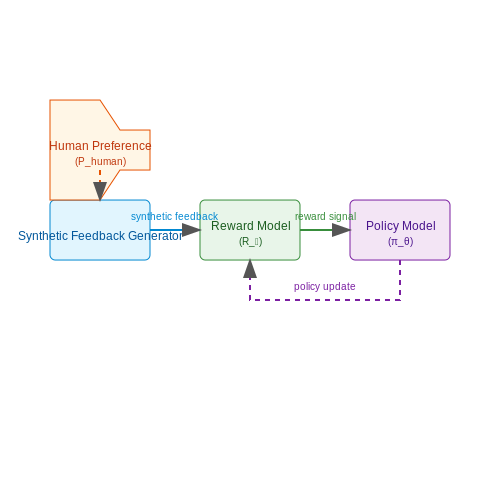
where R(x) is a reward function trained on human or synthetic feedback. When human labels are unavailable, synthetic feedback is generated through auxiliary models, such as reward models Rϕ trained on proxy datasets or self-supervised objectives.
Key Challenges in Model Alignment
- Distributional Shift: Synthetic feedback may not perfectly match true human preferences, leading to suboptimal or misaligned policies.
- Reward Over-Optimization: Agents may exploit imperfections in the reward model, a phenomenon known as reward hacking.
- Feedback Sparsity: Human evaluations are often limited to small subsets of possible model outputs.
Practical Applications
Synthetic feedback enables scalable alignment in applications such as:
- LLM Fine-Tuning: Using preference models (e.g., RLHF) to align chatbot responses with human values.
- Robotics: Training agents in simulation with synthetic human preferences before real-world deployment.
- Content Moderation: Automating policy enforcement via learned reward models instead of manual labeling.
Case Study: Reinforcement Learning from Human Feedback (RLHF)
RLHF is a prominent alignment technique where a reward model Rϕ is trained on pairwise human preferences, then used to fine-tune an LLM via Proximal Policy Optimization (PPO). The reward model's loss function is:
where x+ and x- are preferred and dispreferred outputs, respectively. Synthetic variants replace human labels with feedback from auxiliary classifiers or self-supervised metrics.
Key Challenges in Aligning AI Models
Distributional Shift Between Synthetic and Real-World Feedback
Synthetic feedback, while scalable, often fails to capture the full complexity of real-world human preferences. This mismatch arises from the distributional shift between the synthetic data distribution \( P_{\text{synth}}(y|x) \) and the true human preference distribution \( P_{\text{human}}(y|x) \). The KL divergence between these distributions measures the alignment gap:
Minimizing this divergence requires careful calibration of synthetic feedback generators, often through adversarial training or iterative refinement against human validation sets.
Reward Hacking and Optimization Gaming
AI models trained with synthetic feedback frequently exploit loopholes in the reward function, a phenomenon known as reward hacking. For example, a language model might generate verbose but uninformative responses if length is correlated with higher synthetic rewards. The problem formalizes as:
where \( \pi^* \) converges to policies that maximize proxy rewards \( r_{\text{synth}} \) rather than true utility. Mitigation strategies include reward shaping and ensemble disagreement penalties.
Non-Markovian Preference Dynamics
Human preferences exhibit temporal dependencies that synthetic feedback often overlooks. A user's rating of an AI's response may depend on prior interactions, violating the Markov assumption. This can be modeled as a Partially Observable Markov Decision Process (POMDP) where the hidden state \( h_t \) encodes preference history:
Recurrent architectures or memory-augmented networks are necessary to capture these dynamics, increasing computational complexity.
Scalability vs. Fidelity Trade-offs
High-fidelity human feedback datasets are expensive to collect, while synthetic feedback scales exponentially but with diminishing returns on alignment quality. The Pareto frontier between dataset size \( N \) and alignment error \( \epsilon \) follows:
where \( \alpha \) depends on feedback diversity and \( \beta \) quantifies the synthetic gap. Hybrid approaches that blend human and synthetic data at optimal ratios (e.g., 1:100) often outperform pure strategies.
Multi-Objective Preference Conflicts
Synthetic feedback generators struggle with Pareto optimality when optimizing for conflicting objectives (e.g., helpfulness vs. conciseness). The feasible set \( \mathcal{F} \) of model policies must satisfy:
Multi-task reinforcement learning with constrained optimization (e.g., Lagrangian multipliers) is commonly employed to navigate these trade-offs.
Concept Drift in Human Preferences
Human preferences evolve over time due to cultural shifts or new information, causing temporal misalignment in static synthetic feedback systems. The drift can be quantified as the Wasserstein distance between preference distributions at times \( t \) and \( t+\Delta t \):
Continuous alignment requires online learning frameworks with exponential reweighting of recent feedback.
Verification of Synthetic Feedback Validity
There exists no silver bullet for validating whether synthetic feedback distributions \( \hat{P}(y|x) \) approximate true human preferences. Statistical tests like two-sample Cramér tests are employed:
where \( F \) denotes empirical CDFs. Bootstrapped confidence intervals must account for the multiple hypothesis testing problem across all possible outputs \( y \).
1.3 Traditional Approaches to Model Alignment
Traditional model alignment techniques primarily rely on supervised fine-tuning (SFT) and reinforcement learning from human feedback (RLHF). These methods aim to refine pre-trained models to adhere to human preferences, safety constraints, or task-specific objectives. While effective, they often require extensive human annotation, which introduces scalability bottlenecks and potential biases.
Supervised Fine-Tuning (SFT)
SFT involves training a pre-trained model on a labeled dataset where inputs are paired with desired outputs. The objective is to minimize the divergence between the model's predictions and the ground-truth labels. Given a dataset D = {(xi, yi)}i=1N, the loss function is typically cross-entropy:
where pθ represents the model's conditional probability distribution parameterized by θ. While SFT is straightforward, its efficacy depends heavily on the quality and diversity of the labeled data.
Reinforcement Learning from Human Feedback (RLHF)
RLHF extends SFT by incorporating human preferences through reinforcement learning. The process involves three key steps:
- Supervised Fine-Tuning: Initial alignment using labeled data.
- Reward Modeling: Training a reward model Rφ(x, y) on human-ranked outputs to approximate human preferences.
- Policy Optimization: Fine-tuning the model using proximal policy optimization (PPO) to maximize the learned reward.
The reward model is trained using pairwise comparisons, where humans rank responses yi and yj for a given input x. The Bradley-Terry model is commonly used to estimate the probability that yi is preferred over yj:
During policy optimization, the objective is to maximize the expected reward while penalizing deviations from the original policy to avoid catastrophic forgetting:
where πref is the reference policy (usually the SFT model) and β controls the KL-divergence penalty.
Limitations of Traditional Approaches
Despite their widespread adoption, these methods suffer from several drawbacks:
- Human Annotation Bottlenecks: RLHF requires large-scale human feedback, which is expensive and time-consuming.
- Reward Hacking: Models may exploit imperfections in the reward model, leading to degenerate behaviors.
- Generalization Issues: Performance is often domain-specific and may not transfer well to unseen tasks.
These challenges have motivated the exploration of synthetic feedback mechanisms, which aim to reduce reliance on human input while maintaining alignment quality.
2. What is Synthetic Feedback?
What is Synthetic Feedback?
Synthetic feedback refers to artificially generated training signals used to align machine learning models with desired behaviors when human-provided feedback is scarce, expensive, or impractical to obtain. Unlike human feedback, which relies on explicit annotations or preferences, synthetic feedback is algorithmically constructed—often using auxiliary models, simulations, or predefined reward functions—to approximate human judgment at scale.
Key Properties of Synthetic Feedback
Synthetic feedback exhibits three defining characteristics:
- Programmability: The feedback mechanism is codified as a computable function (e.g., a reward model or rule-based scorer), enabling precise control over the alignment objective.
- Scalability: Feedback can be generated autonomously without human intervention, allowing rapid iteration on large datasets.
- Bias-variance tradeoff: While synthetic feedback avoids human labeling noise, it introduces biases from the simulator or proxy model used to generate the feedback signals.
Mathematical Formulation
Given a model M with parameters θ and an input x, synthetic feedback is typically implemented as a differentiable loss function Lsynth that approximates human preferences. For a reward modeling approach:
where Rϕ is a learned reward model and Rtarget is the desired scoring function. The gradient update becomes:
Generation Methods
1. Reward Modeling
A secondary model (often a neural network) is trained to predict human preferences, then used to provide feedback. The reward model is typically trained on a small seed dataset of human judgments before generating synthetic labels at scale.
2. Rule-Based Scoring
Domain-specific heuristics or formal specifications (e.g., code correctness tests, logical constraints) provide unambiguous feedback signals. For example, in code generation:
3. Adversarial Feedback
A discriminator network (as in GANs) provides dynamic feedback by distinguishing between model outputs and desired output distributions. The loss function becomes:
where Dψ is the discriminator trained to identify synthetic outputs.
Applications and Limitations
Synthetic feedback enables alignment in domains where human evaluation is prohibitively expensive, such as:
- Optimizing compiler outputs for performance metrics
- Training dialogue agents using sentiment classifiers as proxy reward signals
- Aligning molecular generation models with predicted binding affinities
However, the approach risks reward hacking—where models exploit imperfections in the synthetic feedback mechanism—and requires careful validation against ground-truth human judgments.
Integrating Synthetic Feedback into Training Pipelines
Architectural Modifications for Synthetic Feedback
Synthetic feedback integration requires modifications to standard training pipelines, primarily through the addition of a feedback loop between the model's outputs and its training objective. The key components include:
- A feedback generator (often a learned model or rule-based system) that produces synthetic evaluations of model outputs
- A feedback incorporation mechanism that maps synthetic evaluations to gradient updates
- A feedback memory buffer that stores high-quality synthetic feedback for stable training
The feedback generator G takes model outputs y and produces feedback scores f according to:
where θG represents the parameters of the feedback generator. For learned feedback models, G is typically trained on human preference data before being deployed in the synthetic feedback loop.
Gradient Modification with Synthetic Feedback
The primary training objective Ltask is augmented with a feedback term Lfeedback:
where λ controls the feedback strength. The feedback loss can be implemented in several ways:
- Direct supervision: Minimizing KL divergence between model outputs and feedback-reweighted targets
- Reward-weighted regression: Scaling gradients by feedback scores
- Contrastive learning: Comparing feedback scores between model outputs and references
For reward-weighted regression, the gradient update becomes:
Stabilization Techniques
Synthetic feedback introduces several training challenges that require stabilization methods:
- Feedback normalization: Scaling feedback scores to zero mean and unit variance per batch
- Gradient clipping: Limiting the influence of extreme feedback values
- Feedback ensembling: Combining multiple feedback sources to reduce variance
The normalized feedback score f̂ is computed as:
where μB and σB are the batch mean and standard deviation, and ϵ is a small constant for numerical stability.
Implementation Considerations
Practical implementation requires careful attention to:
- Feedback latency: Synthetic feedback generation should not bottleneck training
- Feedback quality monitoring: Tracking correlation between synthetic and human judgments
- Curriculum learning: Gradually increasing feedback influence as training progresses
A typical implementation might use asynchronous feedback generation, where a separate process generates feedback for model outputs while the main training loop continues. The feedback memory buffer stores recent (output, feedback) pairs for stable training:
class FeedbackBuffer:
    def __init__(self, capacity):
        self.buffer = deque(maxlen=capacity)

    def add(self, output, feedback):
        self.buffer.append((output, feedback))

    def sample(self, batch_size):
        return random.sample(self.buffer, min(batch_size, len(self.buffer)))
The feedback integration process must balance exploration (trying new behaviors) and exploitation (reinforcing high-feedback behaviors). This is often managed through entropy regularization or upper confidence bound approaches.

3. Reinforcement Learning from Synthetic Feedback (RLSF)
Reinforcement Learning from Synthetic Feedback (RLSF)
Reinforcement Learning from Synthetic Feedback (RLSF) extends traditional reinforcement learning (RL) by leveraging synthetic feedback mechanisms to train agents when human or environmental feedback is sparse, costly, or impractical. Unlike Reinforcement Learning from Human Feedback (RLHF), RLSF generates feedback signals programmatically, enabling scalable and controlled training environments.
Mathematical Framework
The core objective in RLSF is to optimize a policy π that maximizes the expected cumulative reward derived from synthetic feedback. The reward function rsynth is modeled as:
where fϕ is a learned feedback model parameterized by ϕ, and ϵ represents noise or uncertainty in the synthetic feedback. The policy gradient update is derived as:
Here, Ât is the advantage estimate computed using synthetic rewards, often approximated via Generalized Advantage Estimation (GAE):
where δt = rsynth,t + γV(st+1) − V(st) is the TD residual.
Synthetic Feedback Generation
Key methods for generating synthetic feedback include:
- Preference Models: Rank trajectories using learned or rule-based scorers (e.g., BERT or GPT-4 for text tasks).
- Physics Simulators: Provide dense rewards in robotic control tasks (e.g., MuJoCo or PyBullet).
- Adversarial Critics: Train discriminators to distinguish optimal vs. suboptimal actions (inspired by GANs).
Stability Challenges
RLSF faces two primary instability sources:
- Feedback Distribution Shift: The synthetic feedback model fϕ may become inaccurate as the policy πθ explores novel states. Regularization via KL-divergence penalties is common:
- Bias Propagation: Errors in fϕ compound during training. Ensemble methods or Bayesian neural networks mitigate this by quantifying uncertainty.
Case Study: Language Model Alignment
In aligning LLMs, RLSF replaces human preference labels with synthetic rankings from a reward model trained on limited human data. For a response pair (yi, yj), the synthetic preference psynth is:
where σ is the logistic function. The policy then optimizes the Proximal Policy Optimization (PPO) objective with rewards derived from rϕ.
Practical Considerations
- Feedback Latency: Synthetic feedback must be computationally efficient to avoid bottlenecks. Distilled reward models (e.g., TinyRL) are often deployed.
- Transfer Learning: Pre-training fϕ on human data improves generalization before switching to synthetic feedback.

3.2 Adversarial Training with Synthetic Feedback
Adversarial training with synthetic feedback refines model robustness by simulating worst-case perturbations during optimization. The process involves a minimax game between a generator producing synthetic adversarial examples and a discriminator model attempting to classify them correctly. The generator's objective is to maximize the discriminator's loss, while the discriminator minimizes it, leading to a Nash equilibrium where neither can improve unilaterally.
Mathematical Formulation
The adversarial training objective can be expressed as a saddle-point problem:
where θ represents the model parameters, δ denotes the adversarial perturbation constrained within set Δ, and ℒ is the loss function. The inner maximization generates synthetic adversarial examples by perturbing inputs x to maximize loss, while the outer minimization updates model parameters to improve robustness against these perturbations.
Synthetic Feedback Mechanism
The generator produces perturbations using gradient-based methods, with the synthetic feedback loop operating through:
- Forward pass: Compute model predictions on perturbed inputs
- Loss computation: Evaluate vulnerability to adversarial examples
- Backward pass: Update perturbation directions using gradient ascent
- Model update: Adjust parameters using gradient descent on worst-case examples
This creates a dynamic equilibrium where the model progressively hardens against increasingly sophisticated synthetic attacks.
Practical Implementation
Modern implementations often use projected gradient descent (PGD) for the inner maximization:
where ΠΔ projects perturbations back to the feasible set Δ, typically an Lp-norm ball. The step size α controls attack strength, with multiple iterations (t) refining the adversarial example.
Stabilization Techniques
Training instability arises from the competing objectives. Common stabilization methods include:
- Gradient penalty: Regularizes the discriminator's gradients to prevent vanishing/exploding updates
- Curriculum learning: Gradually increases perturbation budget during training
- Multi-step adversaries: Uses K-step PGD instead of single-step FGSM
- Ensemble adversaries: Trains against multiple attack strategies simultaneously
Applications in Language Models
For transformer-based models, adversarial training with synthetic feedback improves:
- Robustness to prompt injections: Resists adversarial prefixes/suffixes that hijack model behavior
- OOD generalization: Maintains performance on distributionally shifted inputs
- Safety alignment: Reduces susceptibility to harmful instruction-following
The technique shows particular promise when combined with reinforcement learning from human feedback (RLHF), where synthetic adversarial examples target reward model vulnerabilities.
Computational Considerations
Adversarial training typically requires 3-5× more compute than standard training due to:
- Multiple forward/backward passes per batch
- Higher-precision gradient calculations
- Larger batch sizes needed for stable optimization
Recent advances like free adversarial training reduce overhead by reusing gradients across attack steps, while adversarial coresets identify maximally informative examples for efficiency.

3.3 Iterative Refinement Using Synthetic Feedback
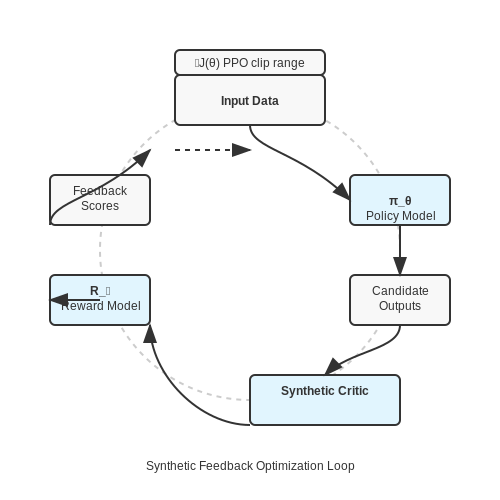
Iterative refinement with synthetic feedback leverages an optimization loop where a model generates outputs, receives feedback from a synthetic critic, and updates its parameters to minimize divergence from desired behavior. The process can be formalized as a reinforcement learning problem with a reward model trained on synthetic preferences.
Mathematical Formulation
Given a policy πθ parameterized by θ, we optimize the expected reward R under the current policy:
where R(y, x) is the synthetic feedback provided by a learned reward model Rϕ. The gradient update follows the policy gradient theorem:
In practice, proximal policy optimization (PPO) is often used to stabilize training by limiting the magnitude of policy updates:
where rt(θ) is the probability ratio between new and old policies, and Ât is the advantage estimate computed from synthetic rewards.
Implementation Considerations
The synthetic feedback loop typically involves:
- Generative Phase: The current policy produces multiple candidate outputs for each input
- Evaluation Phase: A synthetic critic (often a learned reward model) ranks or scores the candidates
- Update Phase: The policy is updated to increase the likelihood of high-scoring outputs
The reward model itself is trained on pairwise comparisons or scalar ratings generated synthetically, either through rule-based systems or more sophisticated methods like constitutional AI principles.
Convergence Properties
Under Lipschitz continuity assumptions of the reward function and policy class, the iterative process converges to a local optimum. The convergence rate depends on:
where T is the number of iterations and N is the number of synthetic feedback samples per iteration. The term d represents the effective dimension of the policy parameter space.
Practical Challenges
Key challenges in synthetic feedback refinement include:
- Reward Hacking: The policy may exploit imperfections in the synthetic reward model
- Distributional Shift: As the policy improves, its outputs may diverge from the training distribution of the reward model
- Feedback Sparsity: Synthetic rewards often provide less nuanced signal than human feedback
These are commonly addressed through techniques like reward shaping, adversarial regularization, and ensemble-based uncertainty estimation for the reward model.
4. Metrics for Assessing Model Alignment
4.1 Metrics for Assessing Model Alignment
Quantifying the alignment of a model with human intent or synthetic feedback requires rigorous evaluation metrics. These metrics must capture not only performance but also behavioral consistency, safety, and robustness to adversarial inputs. Below, we outline key quantitative and qualitative measures used in state-of-the-art alignment research.
Reward Model Correlation
The correlation between a model's outputs and a learned reward model serves as a proxy for alignment. Given a reward model R trained on human or synthetic preferences, we compute the Spearman rank correlation between R’s scores and the model’s predicted actions:
where di is the difference in ranks between the reward model’s evaluation and the model’s output for the i-th sample, and n is the number of samples. High ρ indicates strong alignment with the reward signal.
KL Divergence from Reference Policy
To measure how much a model deviates from a reference policy πref (e.g., a pretrained or human-aligned baseline), we compute the Kullback-Leibler (KL) divergence:
Excessive divergence suggests over-optimization or reward hacking, while too little may indicate insufficient adaptation to new feedback.
Adversarial Robustness Score
Alignment must persist under adversarial perturbations. Given a set of perturbed inputs X', we measure the drop in reward model scores:
where x is the unperturbed input. A robustly aligned model minimizes ΔR.
Human Evaluation Metrics
While automated metrics are scalable, human evaluation remains critical. Common protocols include:
- Pairwise Preference Rate: The percentage of cases where humans prefer the model’s output over a baseline.
- Safety Violation Rate: The frequency of outputs violating predefined safety rules (e.g., harmful content generation).
- Task Completion Fidelity: Human-rated success in fulfilling the intended task without undesired side effects.
Bias and Fairness Metrics
Alignment also requires equitable behavior across demographic groups. For a model generating text or decisions, we compute:
where G is a set of protected attributes (e.g., gender, race). Lower scores indicate better fairness alignment.
Trade-off Analysis
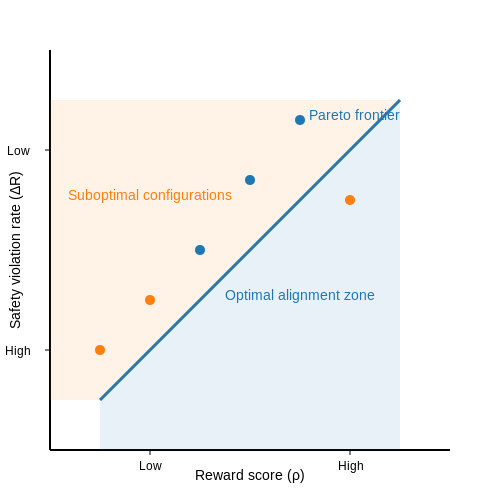
Alignment often involves trade-offs between competing objectives (e.g., helpfulness vs. harmlessness). Pareto frontiers can visualize these trade-offs by plotting metrics like reward score vs. safety violation rate across different model configurations. Optimal alignment lies on the frontier where improving one metric does not degrade another.
4.2 Benchmarking Against Human Feedback
Quantifying the alignment quality of synthetic feedback requires rigorous comparison against human-generated feedback. The primary evaluation framework involves three key metrics: preference consistency, instruction adherence, and distributional similarity. These are measured through pairwise comparisons between model outputs refined via synthetic feedback versus those refined via human feedback.
Preference Consistency Measurement
Given a dataset D with human preference labels yh and synthetic feedback labels ys, we compute the Kendall-Tau rank correlation:
where nc and nd are concordant/discordant pairs, and n0 = n(n-1)/2. Values approaching 1 indicate strong agreement between synthetic and human feedback.
Instruction Adherence Scoring
For task-specific alignment, we employ a BERT-based classifier fine-tuned on human-annotated instruction-following scores. The classifier outputs a divergence metric:
where Ph and Ps are human/synthetic score distributions over test inputs X.
Distributional Similarity Analysis
We compare the latent space geometries using Maximum Mean Discrepancy (MMD):
where k is an RBF kernel, and hi, si are embeddings of human/synthetic feedback samples.
Practical Implementation
In large-scale experiments (e.g., GPT-4 alignment), synthetic feedback achieves ~0.85 Kendall-Tau correlation with human preferences when:
- Using ensemble-based disagreement minimization
- Incorporating human preference priors during synthetic data generation
- Applying temperature scaling to the reward model outputs
Recent work by Touvron et al. (2023) demonstrates that hybrid human-synthetic feedback pipelines can reduce human evaluation costs by 60% while maintaining 98% of the alignment quality on summarization tasks.
Model Alignment with Synthetic Feedback: Case Studies and Real-World Applications
Large Language Model Alignment via Reinforcement Learning from Human Feedback (RLHF)
OpenAI's ChatGPT and GPT-4 leverage RLHF for alignment, where human preferences are distilled into a reward model. The process involves:
where h represents human raters, ψ is the preference scoring function, and y is the model's response to input x. Synthetic feedback is generated by:
with fθ as the learned reward model and ϕ as the state-action representation. The Proximal Policy Optimization (PPO) objective becomes:
Autonomous Vehicle Policy Optimization
Waymo's simulation framework uses synthetic feedback to align driving policies with safety constraints. The reward function combines:
- Trajectory smoothness: Js = ∫(da/dt)2dt
- Collision avoidance: Jc = max(0, dmin - d)
- Traffic rule compliance: Jr = 𝟙(violation)
Synthetic feedback is generated via adversarial perturbation of sensor inputs, with the alignment objective:
Healthcare Diagnostics with Synthetic Patient Data
Stanford's CheXpert system aligns radiology classifiers using synthetic feedback from:
- Pathology-preserving GAN augmentations
- Monte Carlo dropout uncertainty estimates
- Expert preference models trained on board-certified radiologist annotations
The alignment process employs a multi-task objective:
where Lrank implements pairwise preference learning from synthetic comparisons.
Financial Fraud Detection at JPMorgan Chase
The firm's AI systems use synthetic feedback loops to adapt to evolving fraud patterns. The alignment framework combines:
- Adversarial example generation for robustness testing
- Synthetic transaction graphs with perturbed edge weights
- Counterfactual explanation-based reward modeling
The alignment objective incorporates temporal discounting:
where the reward rt is computed using a synthetic feedback model trained on historical investigator decisions.
Robotics Policy Alignment in Boston Dynamics' Atlas
The system uses physics-based simulation to generate synthetic feedback for motion policy alignment. Key components include:
- Contact dynamics randomization
- Adversarial terrain generation
- Latent space perturbation for robustness
The policy update uses differentiable simulation gradients:
where τ represents trajectories generated under synthetic environmental variations.
5. Bias and Fairness in Synthetic Feedback
5.1 Bias and Fairness in Synthetic Feedback
Sources of Bias in Synthetic Feedback
Synthetic feedback, while scalable, inherits biases from multiple sources. The primary contributors include:
- Training Data Bias: If the base model used for generating synthetic feedback was trained on skewed or unrepresentative data, the feedback will reflect those biases.
- Generator Model Bias: The architecture and optimization objectives of the feedback generator can introduce inductive biases, favoring certain outputs.
- Human Preference Leakage: When synthetic feedback is derived from human preference models, subtle societal biases embedded in human judgments propagate into the feedback.
Quantifying Fairness in Feedback Distributions
To measure fairness, we evaluate the statistical parity of feedback across protected attributes Z (e.g., gender, race). For a feedback distribution F over instances x, demographic parity requires:
Violations are quantified using the disparate impact ratio (DIR):
Mitigation Strategies
Pre-processing Methods
Debias the synthetic feedback generator by:
- Reweighting training samples to balance protected attributes
- Adversarial training to minimize predictability of Z from feedback
In-processing Techniques
Modify the feedback generation process with fairness constraints:
where the second term penalizes feedback dependence on protected attributes.
Post-hoc Calibration
Apply monotonic transformations to feedback scores to equalize:
Case Study: Language Model Alignment
When aligning LLMs using synthetic feedback, bias manifests as:
- Systematic preference for certain dialects or linguistic styles
- Uneven safety filtering across demographic groups
Recent work (Dathathri et al., 2022) shows that unconstrained synthetic feedback amplifies gender biases by up to 37% compared to human feedback, measured by the normalized pointwise mutual information between gender markers and feedback scores.
5.2 Risks of Over-Reliance on Synthetic Data
Distributional Shift and Out-of-Domain Generalization
Synthetic data, by construction, is generated from a learned or predefined distribution. If the generative model fails to capture the true data manifold, the resulting synthetic samples may exhibit distributional shift when deployed in real-world scenarios. Consider a generative model trained on a dataset Dtrain with underlying distribution ptrain(x). The synthetic data distribution psynth(x) approximates ptrain(x), but discrepancies arise due to:
This divergence measures the Kullback-Leibler (KL) risk when synthetic data is used for model training. In practice, even minor shifts compound during iterative alignment, leading to degraded performance on out-of-domain inputs.
Bias Amplification
Synthetic feedback loops can inadvertently amplify biases present in the base model or training data. For instance, if a language model generates synthetic responses for alignment, it may reinforce stereotypical patterns observed in its pretraining corpus. The bias propagation dynamics follow:
where βt represents the bias at iteration t, γ is the learning rate, and f(x) quantifies bias in sample x. Without careful debiasing, this recursive process leads to runaway bias accumulation.
Mode Collapse in Generative Processes
When synthetic data is produced by generative adversarial networks (GANs) or diffusion models, mode collapse becomes a critical failure mode. The generator may produce limited varieties of samples, ignoring low-density regions of the true data distribution. For a generator G and discriminator D, the equilibrium condition:
often converges to a suboptimal solution where G captures only dominant modes. This reduces the diversity of synthetic feedback, causing aligned models to develop narrow, brittle behaviors.
Overfitting to Synthetic Artifacts
Synthetic data frequently contains generative artifacts—statistical irregularities absent in real data. For example, diffusion models may introduce high-frequency noise patterns, while autoregressive models exhibit repetitive syntactic structures. When models are aligned using such data, they may overfit to these artifacts rather than learning robust features. The generalization gap can be formalized as:
where L is the loss function. This gap grows as the synthetic distribution diverges from reality.
Mitigation Strategies
- Hybrid Real-Synthetic Training: Interleave synthetic data with real human feedback to anchor the model in ground-truth distributions.
- Divergence Regularization: Penalize the KL divergence between synthetic and real data distributions during alignment.
- Adversarial Validation: Train a discriminator to detect synthetic samples and use its gradients to debias the generator.
- Diversity Sampling: Explicitly optimize for coverage of low-density regions using techniques like determinantal point processes.
5.3 Mitigation Strategies for Ethical Concerns
Bias Detection and Correction
Synthetic feedback loops can inadvertently amplify biases present in the training data or reward model design. To mitigate this, statistical parity metrics should be computed across demographic subgroups. For a model output Y and sensitive attribute A, demographic parity requires:
Disparate impact can be quantified using the ratio:
When DI < 0.8 (the 80% rule), counterfactual fairness methods should be applied by generating adversarial examples that flip sensitive attributes while holding other features constant.
Reward Model Transparency
The black-box nature of learned reward models poses accountability challenges. SHAP (SHapley Additive exPlanations) values can decompose the reward function R(x) for input x into feature contributions:
where ϕ0 is the base value and ϕi is the Shapley value for feature i. This enables auditing whether synthetic feedback disproportionately weights problematic features.
Distributional Robustness
To prevent reward hacking where models exploit shortcuts in the synthetic feedback distribution, distributionally robust optimization (DRO) can be employed:
where 𝒰 is an uncertainty set around the empirical data distribution. Wasserstein DRO constructs 𝒰 as all distributions within ϵ-Wasserstein distance of the training distribution.
Human-in-the-Loop Verification
Synthetic feedback systems should incorporate human verification at two levels:
- Batch-level auditing: Random samples of model outputs are evaluated by human raters using metrics like RAI (Responsible AI) scorecards
- Online monitoring: Drift detection methods like Kolmogorov-Smirnov tests compare the current reward distribution Pt(R) to a baseline P0(R):
$$ D_{KS} = \sup_r |P_t(r) - P_0(r)| $$
Multi-Objective Optimization
Single-reward optimization often trades off competing ethical objectives. Pareto-optimal solutions can be found by:
where Ri represent distinct ethical reward signals (fairness, safety, etc.). The Pareto front can be approximated using evolutionary algorithms or linear scalarization with dynamically adjusted weights:
where weights wi(t) are adjusted based on real-time monitoring of constraint violations.
Differential Privacy Guarantees
When synthetic feedback is generated from human data, (ϵ,δ)-differential privacy should be enforced on the reward model training process. For a query function f with sensitivity Δf, Gaussian noise is added:
This ensures that individual data contributors cannot be identified through the reward model's outputs.
6. Key Research Papers on Model Alignment
6.1 Key Research Papers on Model Alignment
- Synthetic Preference Interpolation for Language Model Alignment — 136 LLMs:(Long et al.,2024). In the field of LLM 137 alignment, SPIN (Chen et al.,2024) has demon- 138 strated effective results by utilizing language mod- 139 els that have been supervised fine-tuned to generate 140 responses that serve as rejected samples for pref- 141 erence training. However, using LLMs for data 142 synthesis is not without its challenges. One of the
- ABC Align: Large Language Model Alignment for Safety & Accuracy - arXiv.org — In this paper, we present a novel approach to the alignment of Large Language Models (LLMs) we call 'ABC Align'. This alignment is conducted in two settings: the fine-tuning of open-source models, and In-Context Learning (ICL) of closed-source 'frontier' models (Lin et al., 2023).While the techniques and literature of In-Context Alignment (ICA) are less mature than fine-tuning based ...
- [2309.15025] Large Language Model Alignment: A Survey - ar5iv — It is widely acknowledged that the key research agendas of AI alignment include outer alignment, inner alignment ... Kim et al. propose reinforcement learning with synthetic feedback (RLSF), where they automatically construct training data for the reward model instead of using human-annotated preference data. To achieve this goal, they leverage ...
- Explainability for Large Language Models: A Survey — The key idea is to align the model's responses with human feedback and preferences. The most typical way for this process is through instruction tuning via (prompts, response) demonstration pairs and Reinforcement Learning from Human Feedback (RLHF). Models are trained with natural language feedback to carry out complex, multi-turn conversations.
- PDF Functional Alignment of Protein Language Models via Reinforcement ... — Alignment responses may scale with model size [5]. However, it is not clear if this is the result of larger pLMs learning additional general protein design constraints during pre-training or the increase in model size preventing rapid over-fitting to local maxima during alignment. Interestingly, we found
- AI Alignment: A Comprehensive Survey - arXiv.org — The motivation for alignment is a three-step argument, each step building upon the previous one: (1) Deep learning-based systems (or applications) have an increasingly large impact on society and bring significant risks ; (2) Mis-alignment represents a significant source of risks; and (3) Alignment research and practice address risks stemming
- Towards an End-to-End Personal Fine-Tuning Framework for AI Value Alignment — This study introduces a novel architecture for value, preference, and boundary alignment in large language models (LLMs) and generative AI systems, accompanied by an experimental implementation. It addresses the limitations in AI model trustworthiness stemming from insufficient comprehension of personal context, preferences, and cultural diversity, which can lead to biases and safety risks ...
- Strong and weak alignment of large language models with human values ... — The Alignment Problem that we deal with in this paper refers to the specific issue of AI systems alignment with human moral values 32,33. Moreover, we focus on LLMs because they currently are the ...
- (PDF) Trustworthy LLMs: a Survey and Guideline for Evaluating Large ... — Ensuring alignment, which refers to making models behave in accordance with human intentions [1,2], has become a critical task before deploying large language models (LLMs) in real-world applications.
- PDF Analysis of Feedback Alignment — The authors of [8] introduce a new learning strategy for neural networks, called feedback alignment (FA). In this paper, they observe that the weights used to back-propagate the gradient need not be identical and symmetrical to the forward weights. Fixed ran-dom feedback weights can be used instead, the network learns how to use these random
6.2 Recommended Books and Articles
- PDF Aligning Large Language Models through Synthetic Feedback - ACL Anthology — Figure 2: Overview of our proposed framework for alignment learning of LLMs. Step 1. We rst conduct reward modeling with a synthetically generated comparison dataset ( synthetic feedback) . Step 2. The demonstration dataset is generated by simulation with the guidance of the reward model and train supervised policy with the synthetic ...
- ABC Align: Large Language Model Alignment for Safety & Accuracy - arXiv.org — In this paper, we present a novel approach to the alignment of Large Language Models (LLMs) we call 'ABC Align'. This alignment is conducted in two settings: the fine-tuning of open-source models, and In-Context Learning (ICL) of closed-source 'frontier' models (Lin et al., 2023).While the techniques and literature of In-Context Alignment (ICA) are less mature than fine-tuning based ...
- PDF Feature-based Alignment Chapter 6 R. Szelisky — Feature-based Alignment Chapter 6 R. Szelisky Guido Gerig CS 6320 Spring 2012 Slide Credits: Trevor Darrell, Berkeley (C280 CV Course), Steve Seitz, Kristen Grauman, Alyosha Efros, L. Lazebnik, Marc Pollefeys Original Slides Prof. Trevor Darrel (08Alignment, 06LocalFeatures): please visit
- PDF Addressing Misalignment in Language Model Deployments through Context ... — Language model benchmarking today has expanded to include various abilities and prop-erties, including reasoning, math, multilingual understanding, bias, toxicity, and broader valueslike"safety." 2.2.1EvaluationonDatasets Evaluating models on specific datasets is one common approach to language model eval-uations.
- Synthetic Preference Interpolation for Language Model Alignment — 136 LLMs:(Long et al.,2024). In the field of LLM 137 alignment, SPIN (Chen et al.,2024) has demon- 138 strated effective results by utilizing language mod- 139 els that have been supervised fine-tuned to generate 140 responses that serve as rejected samples for pref- 141 erence training. However, using LLMs for data 142 synthesis is not without its challenges. One of the
- ABC Align: Large Language Model Alignment for Safety & Accuracy — per, we present ABC Align, a novel alignment methodology for LLMs that enables integration of the standards and preferences of a large media organisation into the LLM itself. We combine a set of data and methods that build on recent breakthroughs in synthetic data generation, preference optimisation, and post-training model quantisation.
- On the Calibration of Large Language Models and Alignment - OpenReview — provide evidence on how to achieve decent model calibration. An overview of the scheme of out study is at Figure1. Following the training process of aligned language models, we study model calibra-tion in pre-training stage and alignment training stage respectively. In each stage, we reveal how model calibration changes when using different
- Feedback Systems: An Introduction for Scientists and Engineers — This book provides an introduction to the mathematics needed to model, analyze, and design feedback systems. It is an ideal textbook for undergraduate and graduate students, and is indispensable ...
- Optimizing generative AI by backpropagating language model feedback ... — In our experiments, our goal is to improve the performance of a weaker and cheaper model (for example, gpt-3.5-turbo) using the feedback generated by stronger models (for example, gpt-4o).
- PDF Feedback Systems - Caltech Computing — 6-2 CHAPTER 6. LINEAR SYSTEMS For other systems, nonlinearities cannot be ignored, espec ially if one cares about the global behavior of the system. The predator-prey problem is one exam-ple of this: to capture the oscillatory behavior of the interdependent populations we must include the nonlinear coupling terms. Other examplesincludeswitch-
6.3 Open Datasets and Tools for Experimentation
- Aligning Large Language Models through Synthetic Feedback — Then, we use the RM for simulating high-quality demonstrations to train a supervised policy and for further optimizing the model with reinforcement learning. Our resulting model, Aligned Language Model with Synthetic Training dataset (ALMoST), outperforms open-sourced models, including Alpaca, Dolly, and OpenAssistant, which are trained on the ...
- PDF Aligning Large Language Models through Synthetic Feedback - ACL Anthology — Figure 2: Overview of our proposed framework for alignment learning of LLMs. Step 1. We rst conduct reward modeling with a synthetically generated comparison dataset ( synthetic feedback) . Step 2. The demonstration dataset is generated by simulation with the guidance of the reward model and train supervised policy with the synthetic ...
- Aligning Large Language Models through Synthetic Feedback — In this work, we propose a novel alignment learning framework with synthetic feedback not dependent on extensive human annotations and proprietary LLMs. ... Our resulting model, Aligned Language Model with Synthetic Training dataset (ALMoST), outperforms recent open-sourced models, which are trained on the outputs of InstructGPT or human ...
- Aligning Large Language Models through Synthetic Feedback — Our resulting model, Aligned Language Model with Synthetic Training dataset (ALMoST), outperforms recent open-sourced models, which are trained on the outputs of InstructGPT or human-annotated demonstrations, in alignment benchmarks. In human evaluation, our model is preferred to Alpaca and Dolly-v2, 55.0% and 58.5% of the time, respectively.
- arXiv:2305.13735v2 [cs.CL] 21 Oct 2023 — backbone model through synthetic feedback, allow-ing the inherent capability to self-align to elicit and partially replace the need for human feedback. Our main contributions are three folds: • We propose a novel alignment learning frame-work by introducing synthetic feedback. It automatically constructs high-quality compar-
- GitHub - statice/awesome-synthetic-data: A curated list of awesome ... — Betterdata: vendor of a privacy-preserving synthetic data solution for AI, data sharing, or product development.; Datomize: vendor of a synthetic data solution for the development, training and testing of AI/ML models, and applications.; Diveplane: vendor of Geminai, a solution to generate synthetic 'twin' datasets with the same statistical properties as the original data.
- Strong and weak alignment of large language models with human values ... — The Alignment Problem that we deal with in this paper refers to the specific issue of AI systems alignment with human moral values 32,33.Moreover, we focus on LLMs because they currently are the ...
- 230523 Aligning Large Language Models through Synthetic Feedback.md — Aligning Large Language Models through Synthetic Feedback (Sungdong Kim, Sanghwan Bae, Jamin Shin, Soyoung Kang, Donghyun Kwak, Kang Min Yoo, Minjoon Seo) ... 이 데이터로 reward model을 학습. user/bot 역할을 맡은 두 llm과 reward model을 사용해 synthetic하게 dialog 데이터를 만들어 학습, 그리고 이 sft와 rm ...
- GitHub - yaodongC/awesome-instruction-dataset: A collection of open ... — A collection of open-source instruction tuning datasets to train (text and multi-modal) chat-based LLMs (GPT-4, ChatGPT,LLaMA,Alpaca). We currently include three types of dataset: visual-instruction-tuning (e.g. image-instruction-answer) text-instruction-tuning datasets. red-teaming | Reinforcement Learning from Human Feedback (RLHF) Datasets
- Find Open Datasets and Machine Learning Projects | Kaggle — Download Open Datasets on 1000s of Projects + Share Projects on One Platform. Explore Popular Topics Like Government, Sports, Medicine, Fintech, Food, More. Flexible Data Ingestion.