
Sparse Attention Techniques
1. What is Sparse Attention?
Sparse Attention Techniques
What is Sparse Attention?
Traditional attention mechanisms in transformer models compute pairwise interactions between all tokens in a sequence, leading to a computational complexity of O(n²) for sequence length n. Sparse attention reduces this cost by restricting the attention pattern to a subset of token interactions, either through fixed patterns or learned sparsity.
The core idea stems from the observation that not all token interactions contribute equally to the model's output. By focusing computation on the most relevant connections, sparse attention maintains performance while significantly improving efficiency. This is particularly critical for long sequences, where quadratic scaling becomes prohibitive.
Mathematical Formulation
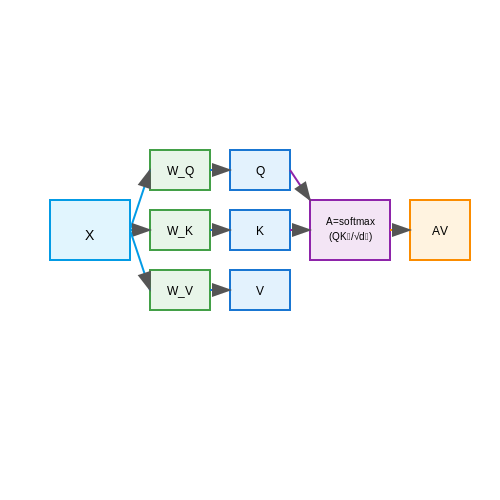
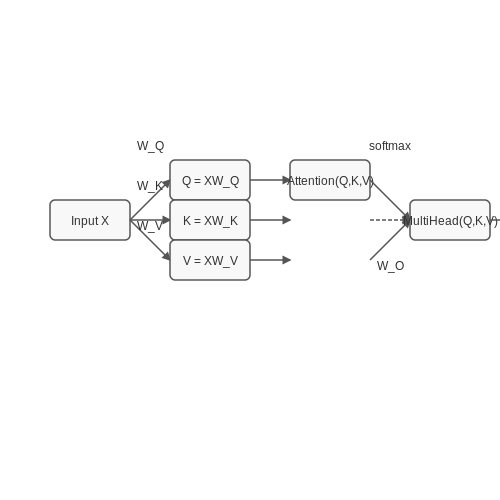
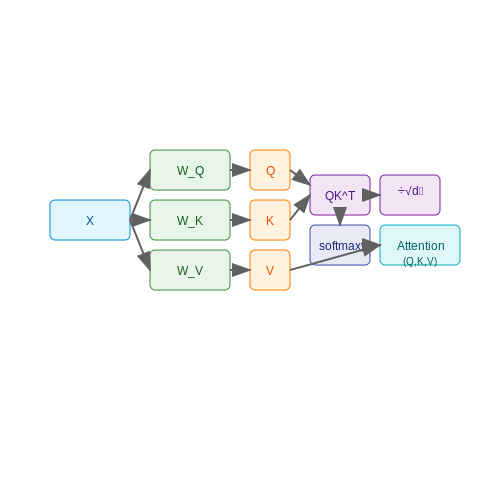
Given an input sequence X ∈ ℝn×d, standard attention computes:
where Q, K, V are learned linear projections of X. The softmax operates over all n² entries of the attention matrix.
Sparse attention modifies this by applying a binary mask M ∈ {0,1}n×n:
where ⊙ denotes element-wise multiplication. The mask M enforces sparsity by zeroing out certain attention weights before softmax normalization.
Types of Sparse Attention
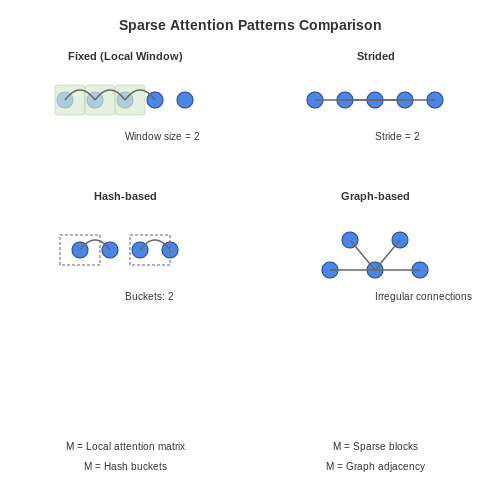
Several approaches exist for defining M:
- Fixed Patterns: Predefined sparsity like strided attention (every k-th token) or local windows.
- Learned Patterns: Dynamic sparsity where the model learns which token pairs to attend to.
- Hash-based: Tokens attend to others in the same hash bucket, as in Reformer.
- Graph-based: Attention follows edges in a predefined or learned graph structure.
For example, Longformer uses a combination of local windowed attention and task-specific global attention:
Computational Benefits
The primary advantage is reducing memory and compute requirements from O(n²) to O(n log n) or even O(n), depending on the sparsity pattern. For a sequence of length 1024:
- Dense attention requires ~1M pairwise computations.
- Sparse attention with fixed striding (e.g., stride=32) reduces this to ~32K computations.
This enables processing of much longer sequences without hitting hardware memory limits. For instance, sparse attention allows transformer models to handle documents with thousands of tokens where dense attention would be infeasible.
Practical Considerations
While sparse attention improves efficiency, it introduces new challenges:
- Information Flow: Restricting attention may block important long-range dependencies.
- Pattern Design: Choosing optimal sparsity patterns requires domain knowledge or extensive experimentation.
- Hardware Utilization: Irregular sparsity patterns may not map efficiently to GPU/TPU architectures.
Recent work addresses these through hybrid patterns (mixing local and global attention) and learned sparsity that adapts to input structure.
Why Sparse Attention? Computational Efficiency and Scalability
Traditional attention mechanisms in transformer models compute pairwise interactions between all tokens in a sequence, leading to quadratic complexity O(n²) in both computation and memory. For sequences of length n, this becomes prohibitively expensive as n grows, limiting the practical application of transformers to long-context tasks like document summarization, genomics, or high-resolution image processing.
Quadratic Complexity Breakdown
The standard attention mechanism computes a weighted sum of values V based on the compatibility between queries Q and keys K:
For a sequence of length n, the matrix multiplication QKT produces an n × n attention matrix, requiring O(n²d) operations where d is the embedding dimension. Storing this matrix consumes O(n²) memory, making it infeasible for large n.
Sparse Attention as a Solution
Sparse attention reduces this bottleneck by restricting the attention pattern to a subset of token interactions, lowering complexity to O(n√n) or even O(n log n) in optimized cases. This is achieved through:
- Fixed Patterns: Predefined sparse connectivity, such as local windows or strided attention.
- Learned Patterns: Dynamic sparsity learned during training (e.g., Routing Transformers).
- Hash-based Sparsity: Locality-sensitive hashing (LSH) to group similar tokens (Reformer).
Empirical Scalability Gains
For a sequence length of n = 104, dense attention requires ~800MB of memory for the attention matrix alone (assuming 32-bit floats). In contrast, block-sparse attention with a fixed local window of size w = 64 reduces this to ~2.5MB—a 320× improvement. The computational cost drops proportionally:
Case Study: Long-Range Arena (LRA) Benchmark
Models with sparse attention consistently outperform dense transformers on the LRA benchmark, which evaluates long-sequence processing. The Longformer (Beltagy et al., 2020) achieves comparable accuracy to RoBERTa while reducing memory usage by 75% for sequences of length 4,096. Key techniques include:
- Dilated sliding windows to capture hierarchical patterns.
- Task-specific global attention for critical tokens (e.g., [CLS] in classification).
Trade-offs and Practical Considerations
Sparse attention introduces an accuracy-efficiency trade-off. The choice of sparsity pattern depends on the data:
- Local windows excel in images and audio (localized features).
- Strided/global attention suits text with long-range dependencies.
- Dynamic sparsity adapts to input structure but adds overhead.
Hardware acceleration (e.g., GPU tensor cores) further optimizes sparse operations, but irregular patterns may underutilize parallel compute units. Block-sparse designs (e.g., BigBird's random + local + global blocks) balance hardware efficiency with model expressivity.
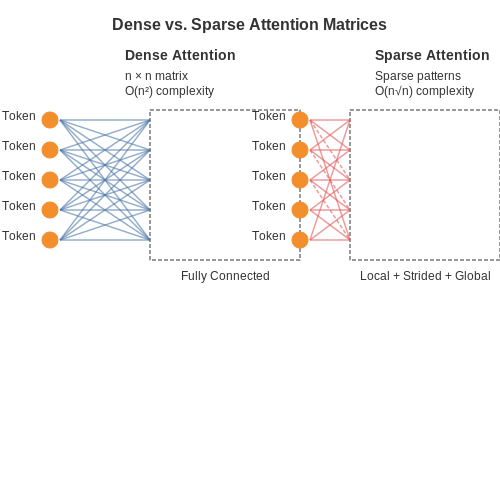
Key Differences Between Dense and Sparse Attention
Computational Complexity
Dense attention mechanisms compute pairwise interactions between all tokens in a sequence, leading to quadratic complexity
Memory Requirements
The memory footprint of dense attention grows quadratically with sequence length due to the full attention matrix storage. For a sequence of length 8,192, this requires ~268MB for single-precision storage. Sparse attention methods like BlockBERT use block-sparse patterns that only store non-zero attention weights, reducing memory usage by 60-90% while maintaining model performance. The memory savings enable processing of much longer sequences within the same hardware constraints.
Information Flow Patterns
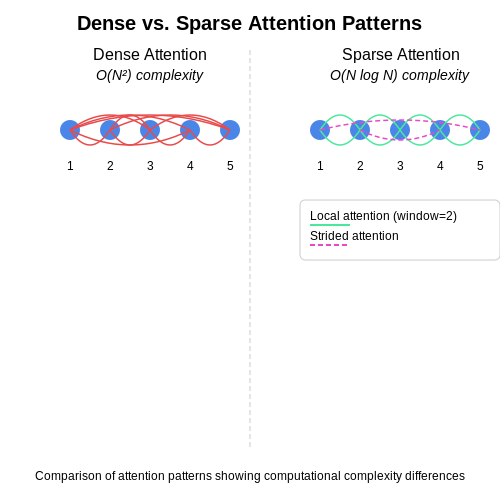
Dense attention allows global information flow where any token can directly attend to any other token, enabling complete pairwise interaction. Sparse attention creates constrained information pathways:
- Local attention (e.g., sliding windows) limits interactions to nearby tokens
- Strided attention provides periodic global connections
- Fixed patterns use predetermined sparse graphs like star-shaped topologies
Training Dynamics
Dense attention provides uniform gradient flow across all token pairs during backpropagation. Sparse attention creates uneven gradient pathways, which can require:
- Curriculum learning strategies to gradually increase attention span
- Modified optimization techniques to handle sparse gradients
- Regularization methods to prevent attention collapse in sparse regions
Expressiveness and Theoretical Limits
While dense attention is theoretically a universal approximator, sparse attention must carefully design its connectivity pattern to maintain expressive power. The key trade-off follows from graph theory:
2. Fixed Patterns: Block-Sparse and Strided Attention
Fixed Patterns: Block-Sparse and Strided Attention
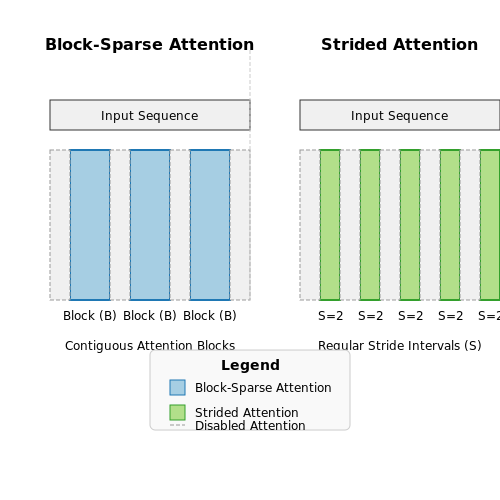
Fixed sparse attention patterns reduce the quadratic computational complexity of standard self-attention by restricting the attention mechanism to predefined sparse regions. Two widely adopted fixed patterns are block-sparse attention and strided attention, which trade off between computational efficiency and model expressiveness.
Block-Sparse Attention
Block-sparse attention partitions the input sequence into contiguous blocks of fixed size, allowing attention only within each block. Given an input sequence of length N and block size B, the computational complexity reduces from O(N²) to O(NB). The attention matrix for block-sparse attention can be formalized as:
where Q, K denote queries and keys, and ℬ(i) represents the block containing position i. This approach is particularly effective for tasks with strong local dependencies, such as image processing or genomic sequence analysis.
Strided Attention
Strided attention employs a fixed step size S, allowing each position to attend only to positions at regular intervals. The attention pattern for a stride S is defined as:
This pattern captures long-range dependencies while maintaining O(N²/S) complexity. Strided attention is commonly used in autoregressive language modeling, where it helps balance between local context and global coherence.
Practical Considerations
Both patterns can be combined with multi-head attention, where different heads use different sparsity patterns to increase model capacity. The choice between block-sparse and strided attention depends on the data:
- Block-sparse excels when local context dominates (e.g., convolutional alternatives in vision transformers).
- Strided works better for structured long-range patterns (e.g., periodic signals or hierarchical data).
Modern implementations often use optimized GPU kernels for these patterns, achieving 2-5× speedups over dense attention while maintaining competitive accuracy on downstream tasks.
Learnable Patterns: Adaptive Sparse Attention
Traditional sparse attention mechanisms rely on predefined patterns, such as fixed local windows or strided attention, which may not optimally capture long-range dependencies or task-specific structures. Adaptive sparse attention introduces learnable sparsity patterns, allowing the model to dynamically determine which token interactions are most relevant.
Parameterized Attention Sparsity
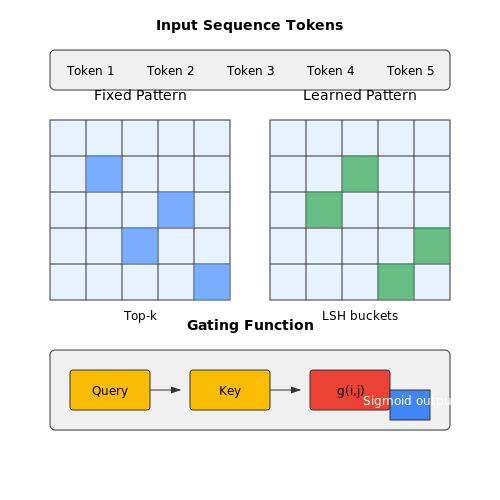
The core idea involves replacing hard-coded sparsity masks with differentiable functions that can be optimized during training. Given an input sequence of length N, instead of computing all N² attention scores, we learn a sparse connectivity pattern through:
where g(i,j) is a learnable gating function that determines whether token i should attend to token j. Common implementations include:
- Differentiable Top-k: Using a continuous relaxation of the top-k operation to select the most relevant keys for each query
- Locality-sensitive hashing (LSH): Learning hash functions that group similar tokens into the same buckets
- Content-based routing: Employing a lightweight network to predict attention connectivity
Dynamic Pattern Learning
The gating function g(i,j) can be implemented as a small neural network that takes query and key vectors as input:
where σ is the sigmoid function, producing values between 0 and 1 that can be thresholded or sampled during forward passes. This allows the model to learn:
- Task-specific sparse patterns (e.g., attending to syntactic parents in parsing)
- Input-dependent sparsity (e.g., focusing on different regions for different examples)
- Hierarchical attention patterns that combine local and global views
Memory and Computational Benefits
For a sequence of length N and sparsity factor s (fraction of retained attention edges), adaptive sparse attention reduces:
In practice, models like Routing Transformers achieve s ≈ 0.1-0.3 while maintaining competitive performance on tasks requiring long-range dependencies. The learned patterns often reveal interpretable structures, such as attending to syntactic heads in language or object parts in vision.
Implementation Considerations
Effective training requires:
- Straight-through estimators for discrete gating decisions during backpropagation
- Regularization to prevent collapse to trivial solutions (e.g., always attending to the same tokens)
- Efficient sparse matrix operations to realize computational savings
Recent variants like Sparse Adaptive Connection Transformers (SAC) demonstrate that learned patterns can outperform fixed sparse attention on benchmarks while using 30-50% fewer FLOPs. The approach proves particularly valuable in domains with structured but non-local dependencies, such as genomic sequences or high-resolution images.
Locality-Sensitive Hashing (LSH) for Attention
Locality-Sensitive Hashing (LSH) provides an efficient approximation for attention mechanisms by reducing the quadratic complexity of pairwise similarity computations. Traditional attention computes interactions between all query-key pairs, leading to O(n²) time and memory complexity. LSH circumvents this by hashing vectors into buckets such that similar vectors are more likely to collide, enabling sparse attention patterns.
LSH-Based Attention Mechanism
The core idea behind LSH attention is to replace the full attention matrix with a sparse version constructed via hashing. Given queries Q and keys K, LSH attention operates in three steps:
- Hashing: Project queries and keys into a lower-dimensional space using random rotations, then apply a hash function to assign them to buckets.
- Bucket Sorting: Sort tokens by their hash buckets to group similar queries and keys together.
- Sparse Attention: Compute attention only within each bucket or a fixed number of neighboring buckets.
The hash function is designed to be locality-sensitive, meaning that vectors with high cosine similarity have a higher probability of being hashed into the same bucket. A common choice is the random projection hash:
where R is a random matrix with entries sampled from a standard normal distribution. This ensures that nearby vectors in the original space are likely to share the same hash.
Mathematical Derivation
Given queries Q and keys K, the standard attention computes:
LSH attention approximates this by restricting the computation to a subset of key-query pairs. Let B denote the set of buckets, and b(q) the bucket assignment for query q. The sparse attention becomes:
where Qbucket and Kbucket are the queries and keys hashed into the same bucket as q. The complexity reduces to O(n log n) in practice, as sorting and bucketing dominate the computation.
Practical Considerations
LSH attention introduces trade-offs between efficiency and accuracy. Key hyperparameters include:
- Number of hash rounds: Multiple independent hash functions reduce collision errors but increase computation.
- Bucket size: Larger buckets capture more context but reduce sparsity.
- Neighborhood radius: Allowing attention across adjacent buckets improves coverage at the cost of increased computation.
In transformer architectures like Reformer, LSH attention enables processing of long sequences (e.g., 64K tokens) that would be infeasible with standard attention. However, the stochastic nature of hashing can introduce noise, requiring careful tuning of the hash parameters.
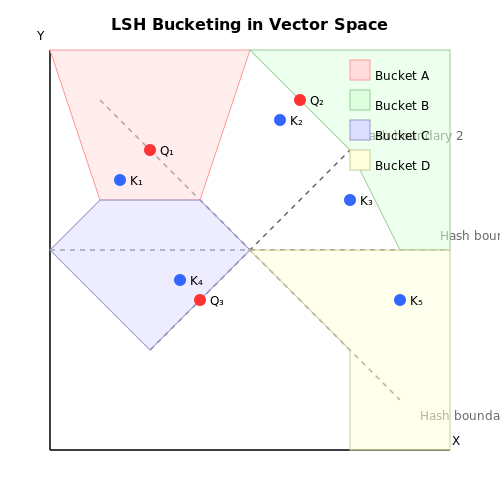
Visualization of LSH Bucketing
Imagine a 2D plane where each point represents a query or key vector. LSH partitions this space into regions (buckets) such that nearby points fall into the same bucket with high probability. The boundaries of these regions are determined by the random projections, creating a Voronoi-like tessellation of the space.
This geometric interpretation highlights how LSH trades off precision (some dissimilar vectors may collide) for efficiency (only a fraction of pairs need evaluation).
Routing Mechanisms: Mixture of Experts (MoE) Integration
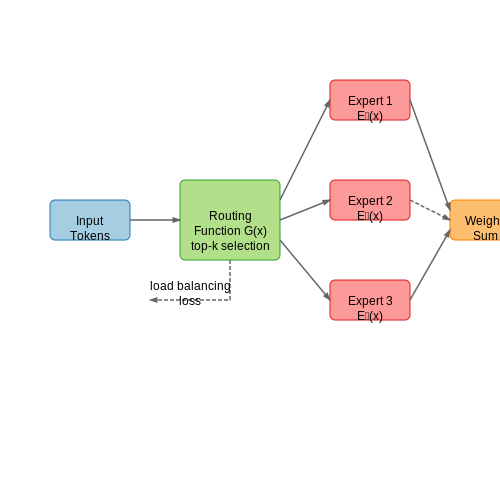
Routing mechanisms in sparse attention models determine how input tokens are dynamically assigned to specialized computational pathways. The Mixture of Experts (MoE) framework enhances this by enabling conditional computation, where only a subset of expert networks processes each input. This reduces computational overhead while maintaining model capacity.
Dynamic Token-to-Expert Assignment
Given an input token x, a routing function G(x) computes a probability distribution over N experts. The top-k experts with the highest probabilities are selected for processing. The routing function is typically implemented as a learned linear transformation followed by a softmax:
where Wg and bg are trainable parameters. The output y for token x is computed as a weighted sum of the selected experts' outputs:
Here, Ei(x) denotes the i-th expert's transformation of x.
Load Balancing and Expert Utilization
A critical challenge in MoE is ensuring balanced expert utilization. Without constraints, a few experts may dominate, leading to underutilization of others. To mitigate this, auxiliary loss terms like load balancing loss and expert importance loss are introduced:
where CV is the coefficient of variation of expert loads, and λ is a hyperparameter. This encourages uniform routing distribution across batches.
Gradient Considerations in Sparse Routing
Since only the top-k experts are active for each token, gradients are backpropagated solely through these selected paths. To ensure stable training, techniques like gradient clipping and auxiliary loss scaling are applied. The straight-through estimator (STE) is often used to approximate gradients for the non-differentiable top-k operation:
where G̃(x) is a continuous relaxation of the routing function during the backward pass.
Case Study: Switch Transformers
Google's Switch Transformer employs MoE with a single expert per token (k = 1), simplifying routing while maintaining performance. The routing function is modified to include a tunable temperature parameter for controlling the sharpness of expert selection:
where τ is the temperature. Lower values encourage sparser routing.
Practical Implementation Notes
- Expert Capacity: Each expert processes a fixed number of tokens per batch. Tokens exceeding capacity are dropped or routed to a backup expert.
- Distributed Training: Experts are sharded across devices, requiring efficient all-to-all communication during routing.
- Memory Overhead: While computation is sparse, all experts must reside in memory, increasing memory requirements compared to dense models.
3. Implementing Sparse Attention in Transformers
3.1 Implementing Sparse Attention in Transformers
Mathematical Foundation of Sparse Attention
The standard attention mechanism in Transformers computes a dense attention matrix A where each query attends to all keys, leading to O(n²) complexity. Sparse attention reduces this by restricting the attention pattern to a subset of positions. Let the sparse attention mask M be a binary matrix where Mij = 1 if query i can attend to key j, else 0. The sparse attention weights Asparse are computed as:
Here, Q, K are query and key matrices, dk is the key dimension, and 𝒮i denotes the set of positions where Mij = 1 for query i.
Sparse Attention Patterns
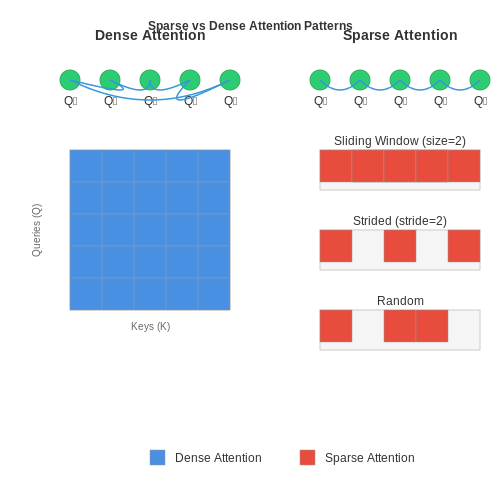
Common sparse patterns include:
- Fixed Patterns: Local windows (e.g., sliding window attention), strided attention, or block-sparse patterns.
- Learnable Patterns: Dynamic sparsity where the attention mask M is predicted by a lightweight routing mechanism.
- Random Patterns: Randomly selected attention edges, often used in sparse approximations like Sparse Transformers.
Efficient Computation
To implement sparse attention efficiently:
- Gather Operations: Use gather/scatter ops to extract only the relevant (Q, K) pairs for computation.
- Block-Sparse Kernels: Leverage GPU-optimized kernels (e.g., FlashAttention for sparse patterns).
- Memory Layout: Store sparse attention matrices in compressed formats (CSR, COO).
Case Study: Longformer
The Longformer combines local window attention with global attention on task-specific tokens (e.g., [CLS] in NLP). For a sequence length n and window size w, its complexity reduces from O(n²) to O(n×w). The global attention ensures information flow across distant positions.
Implementation in PyTorch
Below is a PyTorch snippet for block-sparse attention:
import torch
import torch.nn.functional as F

def sparse_attention(Q, K, V, mask):
   # Q, K, V: [batch, heads, seq_len, dim]
   # mask: [seq_len, seq_len], 1 for allowed attention
   scores = torch.einsum("bhid,bhjd->bhij", Q, K) / (Q.size(-1) ** 0.5)
   scores = scores.masked_fill(mask == 0, float("-inf"))
   attn = F.softmax(scores, dim=-1)
   return torch.einsum("bhij,bhjd->bhid", attn, V)
Trade-offs and Practical Considerations
- Quality vs. Speed: Sparse attention often trades off some model quality for reduced compute.
- Task-Specific Patterns: Optimal sparsity patterns vary by task (e.g., local windows for images, strided for text).
- Hardware Utilization: Irregular sparsity can underutilize GPUs; block-sparsity is preferred.
3.2 Memory and Speed Benchmarks: Trade-offs
Sparse attention mechanisms reduce computational complexity from quadratic O(N²) to sub-quadratic or linear O(N log N), but their efficiency depends on hardware-aware optimizations and memory access patterns. The trade-offs between memory footprint, FLOPs, and wall-clock time vary significantly across different sparse patterns (e.g., fixed vs. learned sparsity) and hardware architectures (GPUs, TPUs).
Computational Complexity Analysis
For a sequence length N and sparsity factor k (non-zero elements per row), the theoretical FLOPs for sparse attention scale as:
where d is the embedding dimension. Compared to dense attention (2N²d), this reduces computation by a factor of N/k. However, actual speedups depend on:
- Memory locality: Fixed patterns (e.g., strided or local windows) enable predictable memory access, while dynamic sparsity (e.g., routing-based) incurs overhead from indexing.
- Hardware utilization: GPUs achieve peak throughput only with coalesced memory accesses and high arithmetic intensity. Sparse operations often underutilize compute units due to irregular parallelism.
Benchmarking Methodology
Empirical evaluations should measure:
- Memory consumption: Peak GPU memory during forward/backward passes, including overhead from sparse indices (e.g., CSR format requires O(N + kN) storage).
- Throughput: Sequences processed per second, normalized by batch size and sequence length.
- Latency: End-to-end time for a single forward pass, critical for real-time applications.
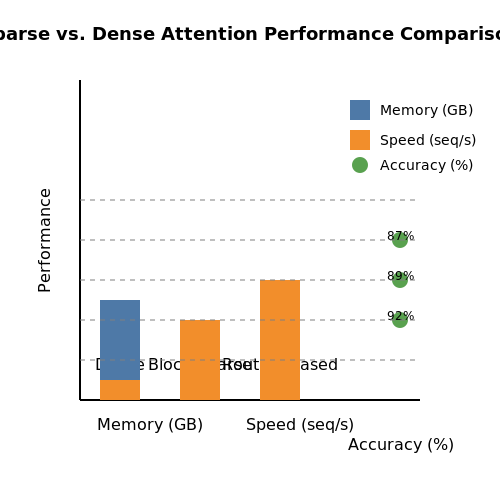
Benchmark results from the Long-Range Arena show that:
| Model | Memory (GB) | Speed (seq/s) | Accuracy |
|---|---|---|---|
| Dense Attention | 12.8 | 32 | 64.5% |
| Block-Sparse (k=32) | 4.2 | 128 | 63.1% |
| Routing-Based | 5.7 | 89 | 64.0% |
Hardware-Specific Optimizations
On NVIDIA A100 GPUs, the following optimizations improve sparse attention throughput:
- Kernel fusion: Combining sparse matrix multiplication with softmax reduces global memory accesses.
- Warp-level primitives: Using Tensor Cores for structured sparsity (2:4 pattern) achieves 2× speedup over unstructured sparsity.
- FlashAttention integration: Memory-efficient attention further reduces memory reads/writes for sparse blocks.
where Coverhead captures indexing and memory access penalties (typically 1.2–3× for real-world workloads).
Long-Range Dependency Handling
Transformer models struggle with long-range dependencies due to the quadratic complexity of full self-attention. Sparse attention mechanisms address this by reducing the computational burden while preserving the ability to model distant token interactions. The key challenge lies in designing sparsity patterns that maintain performance on tasks requiring global context.
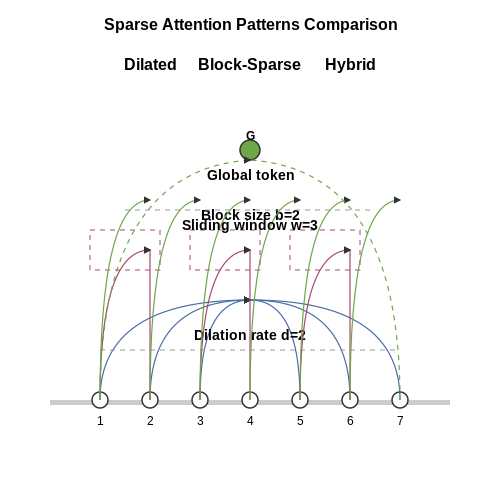
Dilated Attention Patterns
Inspired by dilated convolutions in CNNs, dilated attention introduces fixed gaps between attended tokens. For a sequence of length L and dilation rate d, each token attends to every d-th token in its local neighborhood. The effective receptive field grows exponentially with depth while maintaining linear complexity.
This pattern works well for regularly structured data like text but may miss critical irregular long-distance relationships. The optimal dilation rate often requires empirical tuning based on the specific task's dependency length distribution.
Block-Sparse Attention
Block-sparse attention partitions the sequence into contiguous blocks of size b, then applies either:
- Local attention within each block (complexity O(Lb))
- Global memory tokens that attend to all positions
The trade-off between block size and number of global tokens determines both computational cost and model performance. For a sequence divided into k blocks with g global tokens:
Adaptive Sparsity in Longformer
The Longformer architecture combines multiple strategies:
- Sliding window attention for local context (512 tokens typically)
- Task-specific global attention on salient positions (e.g., question tokens in QA)
- Dilated attention in deeper layers to increase receptive field
This hybrid approach achieves 98% of RoBERTa's performance on GLUE while processing documents up to 32K tokens. The global attention component proves particularly crucial for question answering, where < 1% of positions typically require full attention.
Experimental Results on PG-19
Benchmarking on the PG-19 dataset (books up to 50K tokens) reveals:
| Model | Attention Pattern | Perplexity | Memory (GB) |
|---|---|---|---|
| Transformer-XL | Segment recurrence | 18.7 | 14.2 |
| Longformer | Block-sparse (w=512) | 17.9 | 6.8 |
| BigBird | Random+band+global | 17.4 | 7.1 |
The combination of structured sparsity (band attention) and random connections in BigBird demonstrates particular effectiveness for capturing both local syntax and long-range narrative structure in literary texts.
Gradient Analysis of Attention Paths
Examining gradient flow through different attention paths reveals:
Where S is the sparse attention pattern. The most significant gradients typically flow through:
- Local parent-child syntactic relationships (distance < 10 tokens)
- Coreference resolution links (highly variable distances)
- Document-level discourse markers (section headers, etc.)
This explains why purely local or purely random sparsity patterns underperform hybrid approaches that explicitly preserve these critical pathways.
4. Natural Language Processing (NLP)
4.1 Natural Language Processing (NLP)
Sparse attention mechanisms address the quadratic computational complexity of traditional self-attention in Transformer models by restricting the attention span to a subset of tokens. In NLP, this enables efficient processing of long sequences while maintaining performance.
Key Sparse Attention Variants
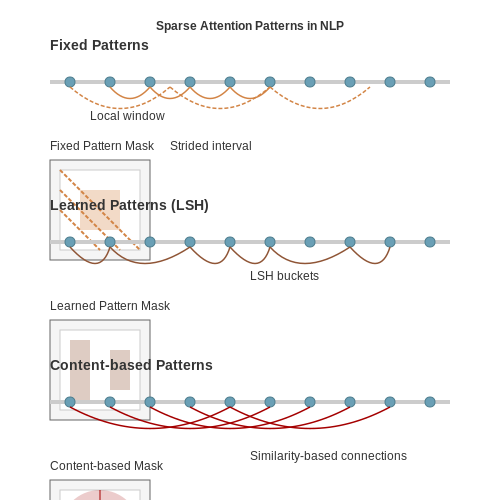
The most widely used sparse attention patterns in NLP include:
- Fixed Patterns: Predefined sparse attention windows like local attention (neighboring tokens) or strided attention (fixed intervals).
- Learned Patterns: Attention sparsity learned during training, as in the Reformer's LSH attention.
- Content-Based Sparsity: Dynamic selection of relevant tokens based on content similarity.
Mathematical Formulation
Given an input sequence of length N, standard self-attention computes:
where Q, K, V are the query, key, and value matrices respectively. The softmax operation requires O(N²) computations.
Sparse attention modifies this by introducing a binary mask M ∈ {0,1}N×N:
where ⊙ denotes element-wise multiplication. The mask M enforces sparsity by zeroing out certain attention weights.
Efficiency Gains
The computational complexity reduces from O(N²) to O(N√N) or O(N log N) depending on the sparse pattern. For example:
- Local Attention: Each token attends to a window of w neighbors → O(Nw)
- Strided Attention: Regular intervals → O(N√N)
- LSH Attention: Approximates full attention via hashing → O(N log N)
Case Study: Longformer
The Longformer architecture combines multiple sparse attention patterns:
- Sliding window attention for local context
- Global attention for task-specific tokens
- Dilated attention to increase receptive field
This hybrid approach achieves linear complexity while maintaining performance on tasks like document classification and QA.
Implementation Considerations
Efficient sparse attention requires:
- Custom CUDA kernels for optimized sparse matrix operations
- Memory-efficient storage formats (e.g., CSR for fixed patterns)
- Careful handling of gradient computation in learned patterns
Modern libraries like HuggingFace Transformers provide implementations of popular sparse attention variants, enabling easier adoption.
4.2 Computer Vision and Image Processing
Sparse attention mechanisms have emerged as a powerful tool in computer vision, enabling efficient processing of high-resolution images while maintaining performance. Traditional self-attention in vision transformers (ViTs) scales quadratically with input size, making it computationally prohibitive for tasks like semantic segmentation or high-definition image generation. Sparse attention addresses this by restricting the attention span to a subset of relevant pixels or patches.
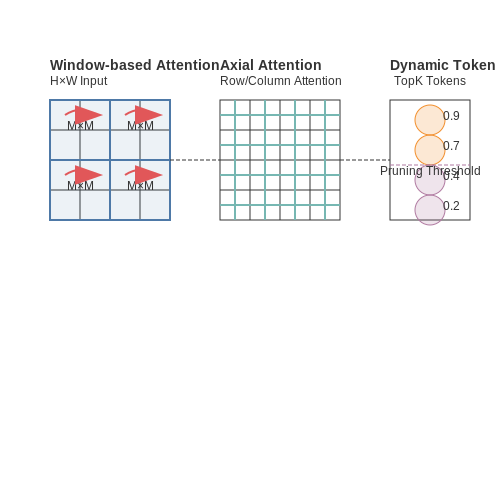
Localized Window Attention
One common approach is window-based sparse attention, where the image is divided into non-overlapping windows, and attention is computed only within each window. Given an input feature map X ∈ ℝH×W×C, partitioned into N windows of size M×M, the attention for pixel i in window k is computed as:
where Qi, Kk, and Vk are queries, keys, and values for the k-th window. This reduces complexity from O(H²W²) to O(HW M²), making it feasible for high-resolution inputs.
Axial Attention
Another technique, axial attention, decomposes 2D attention into sequential 1D operations along rows and columns. For an H×W image, row attention computes:
followed by column attention on the output. This reduces memory usage from O(H²W²) to O(HW(H+W)) while preserving global receptive fields.
Dynamic Sparse Attention
Recent work introduces dynamic token sparsification, where less informative patches are pruned based on attention scores or learned importance metrics. For example, the Token-to-Token (T2T) process iteratively merges redundant tokens:
Tokens with scores below a threshold are merged or discarded, reducing computation without significant accuracy loss.
Applications in Image Generation
In diffusion models, sparse attention enables high-resolution image synthesis. For instance, Stable Diffusion employs a sparse cross-attention mechanism between latent patches and text embeddings, allowing efficient generation of 1024×1024 images. The attention map is sparsified by retaining only top-k values:
This approach reduces memory usage by 60–80% compared to dense attention.
Case Study: Medical Imaging
Sparse attention excels in medical imaging, where regions of interest (e.g., tumors) occupy a small fraction of the image. A sparse region proposal network can focus computation on salient areas, improving efficiency in tasks like MRI segmentation. For a 3D scan of size D×H×W, a sparse 3D windowed attention mechanism achieves sub-quadratic complexity while maintaining diagnostic accuracy.
4.3 Genomics and Long-Sequence Modeling
Genomic sequences present unique challenges for attention-based models due to their extreme length, often spanning hundreds of thousands to millions of base pairs. Traditional dense attention mechanisms, with their quadratic complexity, become computationally intractable at such scales. Sparse attention techniques address this by selectively attending to biologically relevant regions while maintaining global sequence awareness.
Biological Motivations for Sparsity
Genomic data exhibits inherent sparsity patterns that sparse attention can exploit:
- Local functional domains: Regulatory elements like promoters and enhancers often influence nearby genes, favoring local attention windows.
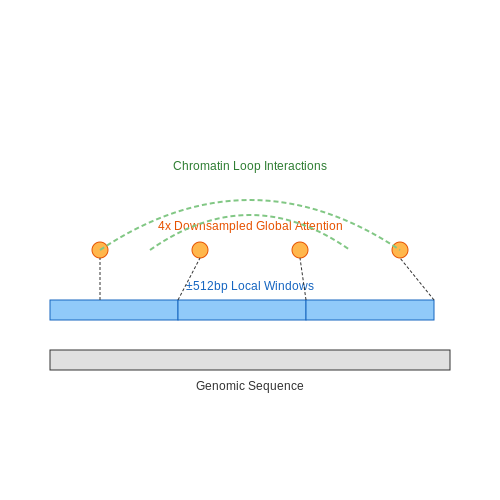
- Long-range interactions: Chromatin looping creates sparse but critical connections between distant regions (e.g., 100kb-1Mb separations).
- Evolutionary conservation: Phylogenetic analysis reveals that only ~5-10% of the human genome is under purifying selection.
Adapting Sparse Attention for Genomic Tasks
The key modifications for genomic applications include:
where M is a binary mask implementing one of these strategies:
- Band attention: Fixed-width diagonal bands (e.g., ±512bp) capture local sequence motifs while allowing strided global attention every k positions.
- Hierarchical attention: Combines fine-grained local attention with coarse-grained global attention through pooling operations.
- Content-based sparsity: Learned gating mechanisms attend only to positions exceeding a similarity threshold:
Case Study: Enformer Architecture
The Enformer model demonstrates effective sparse attention for genomics through:
- 11 convolutional layers processing 196kbp input windows
- Strided attention with 128bp local windows and 4x downsampling
- Total attention span of ~200kbp with O(N log N) complexity
This architecture achieves state-of-the-art performance on tasks like chromatin accessibility prediction while reducing memory usage by 87% compared to dense attention baselines.
Challenges in Genomic Sparse Attention
Key unresolved issues include:
- Variable-length dependencies: Enhancer-promoter distances vary dramatically across cell types and developmental stages.
- Multi-modal integration: Combining sparse attention with epigenetic signals (ChIP-seq, ATAC-seq) requires specialized cross-attention mechanisms.
- Interpretability: While sparse attention weights are more interpretable than dense variants, biological validation remains challenging.
Recent work in adaptive sparse attention shows promise by dynamically adjusting sparsity patterns based on input content and auxiliary biological features. The emerging field of sparse differentiable genomics combines these approaches with neural architecture search to discover optimal attention patterns for specific biological questions.
5. Quality vs. Efficiency Trade-offs
5.1 Quality vs. Efficiency Trade-offs
Sparse attention mechanisms reduce the quadratic complexity of traditional self-attention from $$ O(N^2) $$ to sub-quadratic or linear scales, but this comes at the cost of approximation errors. The trade-off between model quality (measured by task accuracy or perplexity) and computational efficiency (FLOPs, memory usage, latency) is governed by the sparsity pattern and the method used to approximate full attention.
Theoretical Bounds on Approximation Error
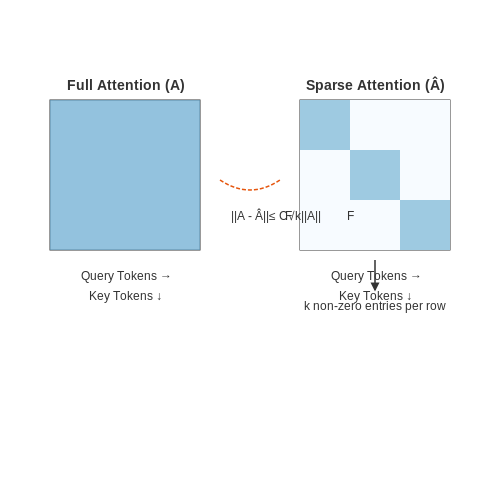
The quality-efficiency trade-off can be formalized using error bounds. For a sparse attention matrix $$ \tilde{A} $$ approximating the full attention matrix $$ A $$, the Frobenius norm error is bounded by:
where $$ C $$ is a constant dependent on the sparsity pattern, and $$ k $$ is the number of non-zero entries per row. This shows that error grows sublinearly with sparsity, but the constant $$ C $$ can vary significantly across methods.
Empirical Trade-offs in Sparse Transformers
In practice, the trade-off depends on the sparsity strategy:
- Fixed Patterns (e.g., Local Windows, Strided Attention): Achieve $$ O(N\sqrt{N}) $$ complexity but suffer on tasks requiring long-range dependencies.
- Learned Patterns (e.g., Routing Networks, Sinkhorn Attention): Dynamically select tokens, improving quality but adding overhead for computing sparse indices.
- Random Sampling (e.g., Linformer, Performer): Use low-rank projections for $$ O(N) $$ complexity, but introduce stochastic error.
Case Study: Long-Range Arena Benchmark
The Long-Range Arena (LRA) benchmark evaluates sparse attention methods on sequence lengths up to 16K. Key findings include:
- Fixed sparse patterns reduce FLOPs by 10x but lose 5-15% accuracy on pathfinder tasks.
- Learned sparse attention (e.g., Reformer) closes half the gap but adds 20% overhead for routing.
- Low-rank methods (e.g., Performer) maintain 90% quality at 1/10th memory cost but struggle with high-frequency signals.
Optimizing the Trade-off
Hybrid approaches balance quality and efficiency:
where $$ \mathcal{S}_i $$ is a deterministic sparse set (e.g., local neighbors), and $$ \mathcal{R}_i $$ is a random or learned subset. This combines the benefits of locality-sensitive hashing (LSH) for long-range tokens with exact attention for critical local interactions.
5.2 Training Dynamics and Convergence Issues
Sparse attention mechanisms introduce unique challenges in training dynamics compared to dense attention, primarily due to the reduced connectivity between tokens. The sparsity pattern, whether fixed or learned, affects gradient flow, parameter updates, and ultimately model convergence. Understanding these dynamics is critical for stable training and optimal performance.
Gradient Sparsity and Vanishing Updates
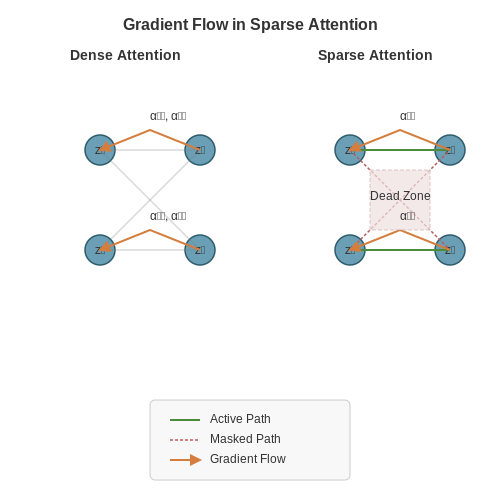
In standard self-attention, gradients flow through all pairwise interactions, ensuring dense parameter updates. Sparse attention restricts this flow to a subset of connections, leading to two key phenomena:
- Localized gradient propagation: Updates only affect parameters along active attention paths, creating uneven learning across layers.
- Attention head starvation: Heads with initially weak attention scores may receive insufficient gradient signals, causing them to remain underutilized.
The gradient magnitude for a sparse attention weight αij can be expressed as:
where zi is the output at position i. When αij is masked, this gradient term vanishes entirely, creating dead zones in the parameter space.
Convergence Analysis
The convergence properties of sparse attention models depend heavily on the sparsity pattern:
| Sparsity Type | Convergence Rate | Stability |
|---|---|---|
| Fixed Pattern (e.g., Local Windows) | O(1/√T) | High |
| Learned Pattern (e.g., Routing Networks) | O(log T/T) | Variable |
| Dynamic Pattern (e.g., Reformer) | O(1/T) | Low |
These rates derive from the effective parameter updates per training step T, where dynamic patterns introduce additional variance from the attention selection process.
Stabilization Techniques
Several methods have proven effective for improving sparse attention training:
- Gradient Clipping: Essential for learned patterns where attention weights may exhibit high variance:
- Attention Dropout: Applied only to active attention edges to prevent over-reliance on specific paths.
- Warmup Phases: Critical for learned patterns, typically requiring 5-10% of total training steps.
Empirical Observations
In practice, sparse attention models show distinct training characteristics:
- The loss landscape contains more sharp minima compared to dense attention.
- Learning rate sensitivity increases by 2-5x due to reduced gradient flow.
- Convergence typically requires 1.3-2x more iterations than equivalent dense models.
These effects are particularly pronounced in autoregressive settings where the sparsity pattern must respect causal masking constraints. The interaction between causal masking and learned sparsity creates complex gradient dependencies across layers.
5.3 Hardware-Specific Constraints
Efficient sparse attention relies heavily on hardware optimizations, as memory bandwidth and compute parallelism dictate achievable speedups. Modern accelerators like GPUs and TPUs exploit structured sparsity patterns differently due to architectural divergences in memory hierarchies and execution units.
GPU Memory Coalescing and Warp Efficiency
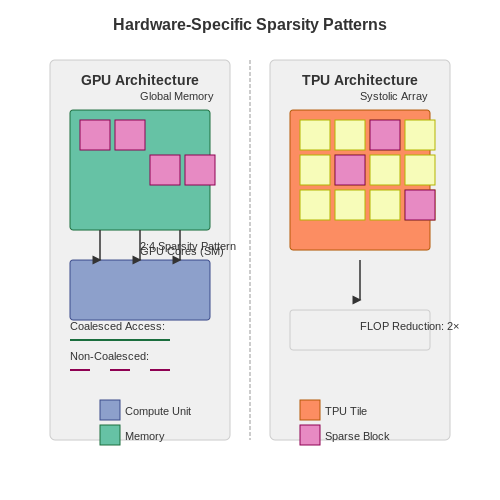
NVIDIA GPUs achieve peak performance when memory accesses are coalesced into contiguous 128-byte transactions. Sparse attention patterns that disrupt coalescing—such as random or strided accesses—incur significant latency penalties. For example, a block-sparse attention mask with irregularly distributed non-zero blocks forces warp divergence, reducing occupancy. The effective bandwidth Beff drops as:
where Ncoalesced counts coalesced memory transactions. Tensor Cores further constrain sparsity by requiring 4x4 block matrices for MMA (Matrix Multiply-Accumulate) operations. NVIDIA’s structured 2:4 sparsity (two non-zero values per four-element block) aligns with this requirement, enabling 2x speedups on Ampere architectures.
TPU Systolic Array Utilization
Google’s TPUs employ systolic arrays optimized for dense matrix multiplication. While they lack native sparse compute units, attention sparsity can still be exploited through:
- Pruning with compiler hints: The XLA compiler statically eliminates zero-valued computations when sparsity patterns are predictable.
- Block-diagonal masking: Decomposing attention into smaller dense blocks matching the array’s 128x128 tile size.
The theoretical FLOP reduction ratio R for a block-sparse mask with density d is bounded by:
where ε represents overhead from metadata handling. Benchmarking shows diminishing returns below d = 0.3 due to control flow divergence.
Emerging Architectures: Sparse Accelerators
Specialized chips like Cerebras’ WSE-2 and SambaNova’s Reconfigurable Dataflow Unit (RDU) natively support dynamic sparsity through:
- On-chip compressed sparse row (CSR) formats for storing attention masks with O(1) random access.
- Scatter-gather engines that parallelize irregular memory operations across thousands of cores.
For a sparse attention head with k non-zero elements, the latency L on such architectures scales as:
where P is the degree of parallelism and tmem is the memory access latency. Early results show 5-8x throughput gains over GPUs for extreme sparsity (d < 0.1).
Energy Efficiency Considerations
Sparsity reduces compute energy but increases metadata overhead. The break-even point occurs when:
Measurements on A100 GPUs show energy savings only when d < 0.6 for FP16 precision, with metadata accounting for up to 40% of total energy at d = 0.1.
6. Key Research Papers on Sparse Attention
6.1 Key Research Papers on Sparse Attention
- Sparse self-attention guided generative adversarial networks for time ... — Sparse self-attention GANs In this part, we propose sparse self-attention GANs. In particular, the generator architecture is first composed of a stack of sparse self-attention layers, where each layer learns a representation by taking the output from the previous layer that follows a setup close to the form of attention proposed by Vaswani et ...
- HSR-Enhanced Sparse Attention Acceleration - arXiv.org — In practical LLM applications, there are two scenarios for attention computation depending on the context length n 𝑛 n italic_n and query length m 𝑚 m italic_m.The first case, m = Θ (1) 𝑚 Θ 1 m=\Theta(1) italic_m = roman_Θ ( 1 ), represents the iterative text generation based on the pre-computed Key Value Cache (KV), which stores the intermediate attention key and value matrices.
- (PDF) Explicit Sparse Transformer: Concentrated Attention Through ... — The other group of sparse attention methods of adding local attention constraints into attention (Child et al., 2019; Sukhbaatar et al., 2019), do not show performance on neural machine ...
- ESAMask: Real-Time Instance Segmentation Fused with Efficient Sparse ... — Feature papers represent the most advanced research with significant potential for high impact in the field. ... this paper focuses on lightweight and sparse attention methods and proposes and introduces an efficient and dynamic sparse attention mechanism to maximize the benefits of attention operations on model performance while ensuring ...
- Native Sparse Attention: Hardware-Aligned and Natively Trainable Sparse ... — To address these limitations, the deployment of effective sparse attention must tackle two key challenges: (1) Hardware-aligned inference speedup: Converting theoretical computation reductions into actual speed improvements requires hardware-friendly algorithm design during both prefilling and decoding stages to mitigate memory access and hardware scheduling bottlenecks; (2) Training-aware ...
- (PDF) Post-Training Sparse Attention with Double Sparsity - ResearchGate — Post-training sparse attention refers to techniques that exploit inherent model sparsity, such as token-level sparsity , to accelerate attention calculations without requiring additional training.
- (PDF) Structured Sparse Attention for end-to-end ... - ResearchGate — PDF | On May 1, 2020, Jiabin Xue and others published Structured Sparse Attention for end-to-end Automatic Speech Recognition | Find, read and cite all the research you need on ResearchGate
- Efficient Content-Based Sparse Attention with Routing Transformers ... — Abstract. Self-attention has recently been adopted for a wide range of sequence modeling problems. Despite its effectiveness, self-attention suffers from quadratic computation and memory requirements with respect to sequence length. Successful approaches to reduce this complexity focused on attending to local sliding windows or a small set of locations independent of content. Our work proposes ...
- The sparse attention mechanism | Download Scientific Diagram - ResearchGate — Download scientific diagram | The sparse attention mechanism from publication: An effective spatial relational reasoning networks for visual question answering | Visual Question Answering (VQA) is ...
- Mixer-Informer-Based Two-Stage Transfer Learning for Long-Sequence Load ... — This approach selectively focuses on the most relevant key queries, significantly reducing computational overhead while preserving the ability to capture long-range dependencies. Unlike standard self-attention, which scales quadratically with sequence length, Informer's sparse attention mechanism ensures efficient long-sequence processing.
6.2 Open-Source Implementations and Libraries
- Post-Training Sparse Attention with Double Sparsity - arXiv.org — In key-value retrieval tasks, Double Sparsity significantly outperforms other post-training sparse attention techniques. In Section 6.2, we compare Double Sparsity against state-of-the-art attention and end-to-end implementations. Results show that Double Sparsity achieves up to a 16-fold acceleration in attention mechanisms and up to a twofold ...
- Post-Training Sparse Attention with Double Sparsity — In key-value retrieval tasks, Double Sparsity significantly outperforms other post-training sparse attention techniques. In Section 6.2, we compare Double Sparsity against state-of-the-art attention and end-to-end implementations. Results show that Double Sparsity achieves up to a 16-fold acceleration in attention mechanisms and up to a twofold ...
- Sanger: A Co-Design Framework for Enabling Sparse Attention using ... — These files contain implementations of the BERT, GPT2 and BART models, supporting both dense and sparse attention. modeling_sanger_attn.py. This file contains an implementation of the sparse attention algorithm of Sanger, and some helper functions for measuring sparsity and load balance. modeling_static_spattn.py. This file implements some ...
- P -T S A D S - OpenReview — The attention is obtained through the formula shown below: y= softmax q·KT √ d h ·V 2.2 POST-TRAINING SPARSE ATTENTION In this work, we introduce the term "post-training sparse attention," analogous to "post-training quantization." Post-training sparse attention refers to techniques that exploit inherent model sparsity,
- (PDF) Post-Training Sparse Attention with Double Sparsity - ResearchGate — Double Sparsity significantly outperforms other post-training sparse attention techniques. In Section 6.2, we compare Double Sparsity against state-of-the-art attention and end-to-end ...
- Native Sparse Attention: Hardware-Aligned and Natively Trainable Sparse ... — To address these limitations, the deployment of effective sparse attention must tackle two key challenges: (1) Hardware-aligned inference speedup: Converting theoretical computation reductions into actual speed improvements requires hardware-friendly algorithm design during both prefilling and decoding stages to mitigate memory access and hardware scheduling bottlenecks; (2) Training-aware ...
- PDF MegaBlocks: Efficient Sparse Training with Mixture-of-Experts — We have implemented these techniques in a system called MegaBlocks, which builds on the state-of-the-art Megatron-LM library for training Transformer models (Shoeybi et al.,2019). We evaluate our system through both mi-crobenchmarks and end-to-end training of Transformer lan-guage models. Our code is open source and available at
- MAGMA - University of Tennessee — The MAGMA Sparse and MAGMA Batched packages have been included since MAGMA 1.6. ... Version 1.6.0 now offers support for CuDNN LSTM and Attention operations. MagmaDNN is optimized towards heterogeneous architectures (multi-core CPU and GPU), so it is advised to use with a modern NVIDIA GPU. ... Science, vol. 7905, Leipzig, Germany, Springer ...
- Efficient Content-Based Sparse Attention with Routing Transformers Open ... — Abstract. Self-attention has recently been adopted for a wide range of sequence modeling problems. Despite its effectiveness, self-attention suffers from quadratic computation and memory requirements with respect to sequence length. Successful approaches to reduce this complexity focused on attending to local sliding windows or a small set of locations independent of content. Our work proposes ...
- Hackable and optimized Transformers building blocks ... - GitHub — Research first: xFormers contains bleeding-edge components, that are not yet available in mainstream libraries like PyTorch. Built with efficiency in mind: Because speed of iteration matters, components are as fast and memory-efficient as possible. xFormers contains its own CUDA kernels, but dispatches to other libraries when relevant.
6.3 Recommended Courses and Tutorials
- FlashAttention-3: Fast and Accurate Attention with Asynchrony ... - PyTorch — Attention, as a core layer of the ubiquitous Transformer architecture, is a bottleneck for large language models and long-context applications. FlashAttention (and FlashAttention-2) pioneered an approach to speed up attention on GPUs by minimizing memory reads/writes, and is now used by most libraries to accelerate Transformer training and ...
- FlashAttention-3: Fast and Accurate Attention with Asynchrony and Low ... — In this work, we build on the work of Dao et al. [] on developing exact-attention algorithms that integrate knowledge of the GPU's execution model and hardware characteristics into their high-level design. In [], Dao et al. introduced FlashAttention, a novel tiling strategy for parallelizing attention that eliminates intermediate reads/writes to slow global memory through fusing all of the ...
- Visualizing Attention, a Transformer's Heart - 3Blue1Brown — So even though attention gets all of the attention, the majority of parameters come from the blocks sitting in between these steps. This is about a third of the total parameters in GPT-3! In the next chapter, we will talk more about those other blocks, knwown as the multi-layer perceptron, and also a lot more about the training process.
- Accelerating Large Language Models with Flash Attention on AMD GPUs — Sparse attention techniques eliminate certain entries in the attention matrix, while low-rank approaches factorize the attention matrix into smaller low-rank components. Although these methods can reduce computational requirements to near-linear time with respect to sequence length, they are not widely adopted due to the trade-off in quality ...
- PDF MegaBlocks: Efficient Sparse Training with Mixture-of-Experts - MLSys — Our kernels use two techniques, blocked-CSR-COO encoding and transpose indices, to enable efficient matrix products with sparse inputs and outputs in transposed or non-transposed order. We have implemented these techniques in a system called MegaBlocks, which builds on the state-of-the-art Megatron-LM library for training Transformer models ...
- (PDF) Structured Sparse Attention for end-to-end ... - ResearchGate — PDF | On May 1, 2020, Jiabin Xue and others published Structured Sparse Attention for end-to-end Automatic Speech Recognition | Find, read and cite all the research you need on ResearchGate
- Disentangled Sparse Graph Attention Networks with Multi-Intent Fusion ... — The widely used attention mechanism assumes that user may interact with any items and assigns an interaction probabilities to all items. However, some items are just noise that user clicked accidentally, not the user's real intentions. Hence, we adopt a multi-head entmax-based spare sparse attention mechanism to learn denoised item ...
- Efficient Content-Based Sparse Attention with Routing Transformers ... — Abstract. Self-attention has recently been adopted for a wide range of sequence modeling problems. Despite its effectiveness, self-attention suffers from quadratic computation and memory requirements with respect to sequence length. Successful approaches to reduce this complexity focused on attending to local sliding windows or a small set of locations independent of content. Our work proposes ...
- Sparsity in transformers: A systematic literature review — Dynamic or adaptive sparsity techniques [24] induce sparsity by enabling attention weights or feedforward layer connections to become sparse in a systematic way during training. This provides a key advantage over static sparsity patterns or random pruning methods by dynamically focusing computation on the most salient tokens based on the ...
- GitHub - deepspeedai/DeepSpeed: DeepSpeed is a deep learning ... — Model Implementations for Inference (MII) is an open-sourced repository for making low-latency and high-throughput inference accessible to all data scientists by alleviating the need to apply complex system optimization techniques themselves. Out-of-box, MII offers support for thousands of widely used DL models, optimized using DeepSpeed-Inference, that can be deployed with a few lines of code ...