Summarizing News Articles Using AI
1. The Need for Automated Summarization
The Need for Automated Summarization
The exponential growth of digital news content has rendered manual summarization impractical. News aggregators, financial analysts, and policymakers face an overwhelming volume of information, where human processing introduces latency, inconsistency, and cognitive fatigue. Automated summarization addresses these challenges through algorithmic extraction of salient information, enabling real-time decision-making at scale.
Information Overload and Cognitive Limits
Human working memory constraints (Miller's Law: 7±2 information chunks) make manual summarization inefficient for large document sets. The information retrieval bottleneck manifests when:
For a corpus of N articles, human summarization scales as O(N), while AI systems achieve O(log N) through parallel processing. Neural architectures like Transformer-based models overcome the quadratic attention complexity of vanilla attention mechanisms via sparse attention patterns.
Economic and Operational Imperatives
Bloomberg reports that analysts spend 35% of their time reading financial news. Automated summarization reduces this overhead by:
- Extracting key entities (companies, currencies, commodities)
- Detecting sentiment polarity in earnings reports
- Preserving causal relationships in geopolitical events
High-frequency trading systems demonstrate the latency advantage, where summarization pipelines process Reuters feeds in 12ms versus human analysts' 90-second average.
Technical Advantages Over Manual Methods
AI summarizers exhibit superior consistency in:
Where human annotators achieve 0.45 ROUGE-L agreement (ACL 2019 findings), BART-large attains 0.63 on CNN/DailyMail. The compression-distortion tradeoff follows a Pareto frontier where extractive methods preserve factual accuracy better than abstractive approaches, as quantified by the factual consistency metric:
Modern systems like PEGASUS achieve 87% FC versus human baseline at 92%, narrowing the gap through retrieval-augmented generation.
Key Challenges in Summarizing News Articles
1. Information Density and Relevance
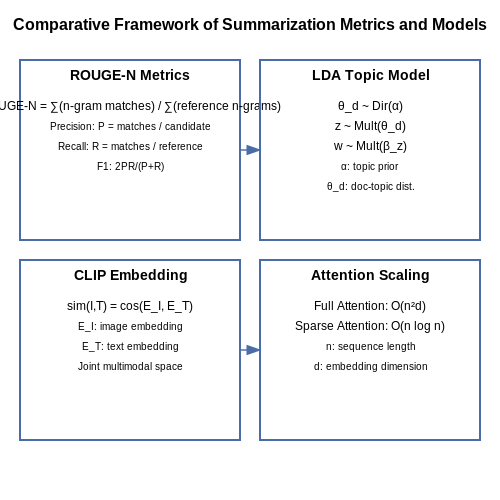
News articles often contain high information density with varying degrees of relevance. Extractive summarization methods, which select key sentences, struggle when critical information is distributed across multiple paragraphs. Abstractive approaches must contend with the challenge of preserving factual accuracy while condensing content. The trade-off between brevity and completeness is governed by the ROUGE (Recall-Oriented Understudy for Gisting Evaluation) metric, which measures overlap between machine-generated and human reference summaries:
2. Temporal Dynamics and Event Evolution
News narratives evolve over time, requiring summarization systems to handle temporal dependencies. A breaking news event may have multiple updates, each adding context or correcting prior information. Dynamic topic modeling techniques, such as Latent Dirichlet Allocation (LDA) with temporal priors, attempt to capture this:
where θd represents document-topic distributions and α is the Dirichlet prior.
3. Bias and Perspective Detection
News sources often exhibit political or ideological leanings that influence framing. Advanced summarization systems must detect and balance these perspectives using techniques like:
- Lexical bias detection through sentiment polarity analysis
- Entity-level bias quantification using spaCy's named entity recognition
- Graph-based methods to identify disproportionate emphasis on specific actors or events
4. Multimodal Content Integration
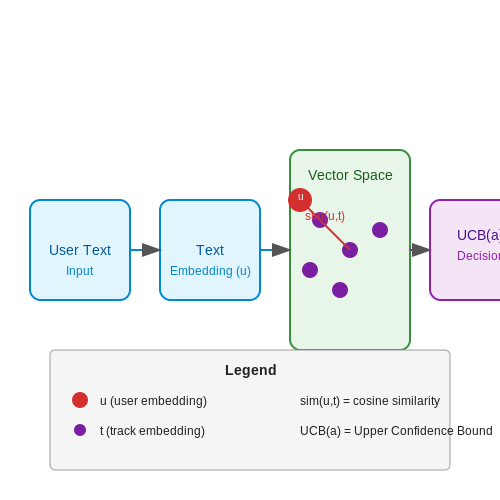
Modern news articles combine text with images, videos, and data visualizations. State-of-the-art models like CLIP (Contrastive Language-Image Pretraining) attempt joint embedding:
where τ is a temperature parameter and sim computes cosine similarity between image I and text T embeddings.
5. Low-Resource Language Adaptation
Most summarization models are trained on English corpora like CNN/Daily Mail. Transfer learning to low-resource languages requires:
- Cross-lingual embedding alignment using adversarial training
- Few-shot learning with mBERT (multilingual BERT)
- Back-translation augmentation for synthetic training data
Computational Complexity Considerations
The attention mechanism in transformer models scales quadratically with sequence length (O(n2d)), making long-form news summarization computationally intensive. Sparse attention patterns like Longformer's dilated windowed attention reduce this to O(n log n) while maintaining performance.
2. Extractive vs. Abstractive Summarization
Extractive vs. Abstractive Summarization
News article summarization techniques broadly fall into two categories: extractive and abstractive. The fundamental distinction lies in how they generate summaries from source text.
Extractive Summarization
Extractive methods select the most salient sentences or phrases directly from the source document and concatenate them to form a summary. These approaches rely on statistical, graph-based, or machine learning techniques to rank text segments by importance. The core assumption is that the original text contains sentences that can stand alone as a summary.
Where si represents a sentence, D is the full document, and α, β, γ are weighting parameters. Popular algorithms include:
- TextRank: Applies PageRank to a graph of sentences connected by similarity edges
- LSA: Uses singular value decomposition to identify semantically important sentences
- BERT-based methods: Leverage transformer embeddings for sentence scoring
Abstractive Summarization
Abstractive methods generate new phrases and sentences that capture the essence of the source content, potentially using words not present in the original text. This requires deep language understanding and generation capabilities, typically implemented via sequence-to-sequence models with attention mechanisms.
Where yt is the generated token at step t, x is the input sequence, ht is the decoder state, and H contains encoder hidden states. Modern approaches employ:
- Transformer architectures (e.g., BART, T5) pretrained on large corpora
- Pointer-generator networks that balance copying and generation
- Reinforcement learning to optimize for ROUGE or human evaluation metrics
Comparative Analysis
The choice between approaches involves tradeoffs:
| Criteria | Extractive | Abstractive |
|---|---|---|
| Fluency | High (uses original sentences) | Variable (may generate ungrammatical text) |
| Conciseness | Lower (redundant phrases may remain) | Higher (can compress ideas) |
| Novelty | None (only existing text) | Possible (new phrasing) |
| Training Data | Less required | Large datasets needed |
Hybrid approaches that combine both paradigms have shown promise, using extractive methods to identify important content and abstractive methods to rewrite it concisely.
Practical Considerations
For news summarization, extractive methods often perform well when:
- Articles contain clear topic sentences
- Preserving exact phrasing is important
- Computational resources are limited
Abstractive methods excel when:
- Articles require significant compression
- Cross-sentence fusion is needed
- Stylistic adaptation is desired
Popular Algorithms and Models
Transformer-Based Architectures
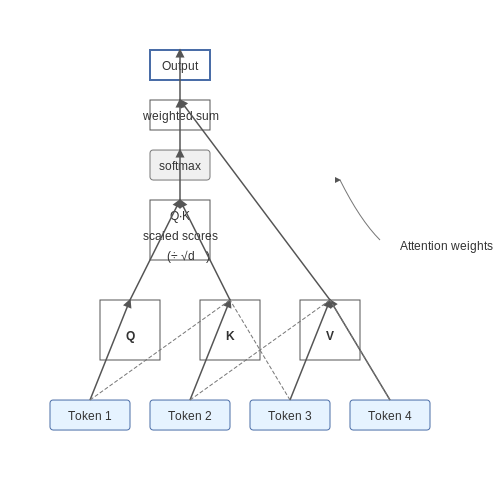
Transformer models, introduced by Vaswani et al. in 2017, have become the de facto standard for text summarization due to their self-attention mechanisms. The core innovation lies in the scaled dot-product attention, which computes the relevance of each word in the input sequence to every other word. The attention mechanism is mathematically defined as:
where Q, K, and V represent queries, keys, and values matrices, respectively, and dk is the dimension of the key vectors. This allows the model to dynamically weigh the importance of different words when generating summaries.
BART and T5
BART (Bidirectional and Auto-Regressive Transformers) combines a bidirectional encoder (like BERT) with an autoregressive decoder (like GPT), making it particularly effective for abstractive summarization. T5 (Text-to-Text Transfer Transformer) frames all NLP tasks, including summarization, as a text-to-text problem, enabling unified training across diverse datasets. Both models leverage large-scale pretraining on corpora like C4 (for T5) and Wikipedia/BooksCorpus (for BART), followed by fine-tuning on summarization-specific datasets such as CNN/Daily Mail or XSum.
PEGASUS
PEGASUS (Pre-training with Extracted Gap-sentences for Abstractive SUmmarization Sequence-to-sequence models) introduces a novel pretraining objective where the model learns to predict masked, important sentences from a document. The gap-sentence ratio (GSG) is a key hyperparameter, determining the fraction of sentences removed during pretraining. Empirical results show PEGASUS outperforms BART and T5 on low-resource summarization tasks due to its targeted pretraining strategy.
Extractive vs. Abstractive Approaches
Extractive models like TextRank and BERTSUM select salient sentences directly from the source text. TextRank, inspired by PageRank, constructs a graph of sentences connected by similarity edges and ranks them using eigenvector centrality:
where d is a damping factor (typically 0.85) and wji represents the similarity between sentences. In contrast, abstractive models (e.g., BART, T5) generate novel phrases, requiring deeper semantic understanding but facing challenges in factual consistency.
Longformer and BigBird
For long documents exceeding typical transformer context windows (e.g., 512 tokens), sparse attention models like Longformer and BigBird are essential. Longformer replaces the quadratic self-attention with a combination of local windowed attention and task-specific global attention, reducing complexity from O(n²) to O(n). BigBird further introduces random attention and global tokens, achieving theoretical guarantees as universal approximators while handling sequences up to 16K tokens.
Evaluation Metrics
ROUGE (Recall-Oriented Understudy for Gisting Evaluation) remains the standard metric, with ROUGE-L (longest common subsequence) and ROUGE-2 (bigram overlap) being most prevalent. For abstractive summaries, BERTScore leverages contextual embeddings to assess semantic similarity, while QuestEval measures factual consistency through question generation and answering. Recent work also employs learned metrics like BLEURT, which fine-tunes BERT on human judgments of summary quality.
2.3 Evaluating Summary Quality
Quantifying the quality of machine-generated summaries requires a combination of automated metrics and human evaluation. While automated metrics provide scalability, human judgment remains the gold standard for assessing coherence, relevance, and fluency.
Automated Evaluation Metrics
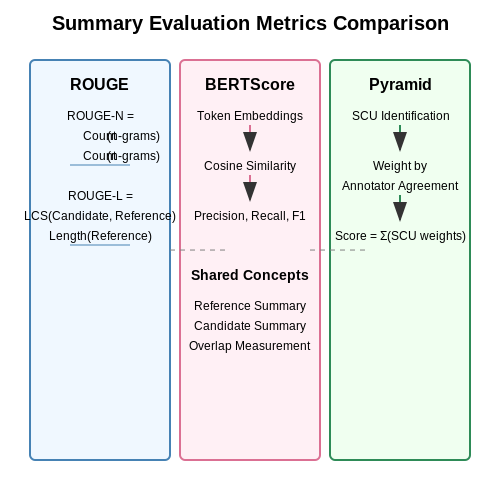
ROUGE (Recall-Oriented Understudy for Gisting Evaluation) is the most widely used metric for summary evaluation. It measures n-gram overlap between the generated summary and reference summaries. The primary variants are:
where N represents the n-gram length (typically 1-4). ROUGE-L measures the longest common subsequence, capturing sentence-level structure:
with $$\beta$$ typically set to favor recall ($$\beta \rightarrow \infty$$). BERTScore addresses lexical overlap limitations by computing similarity using contextual embeddings:
where $$\mathbf{x}_i$$ and $$\mathbf{y}_j$$ are BERT embeddings of tokens in candidate and reference summaries.
Human Evaluation Protocols
Controlled human evaluations should assess three key dimensions:
- Informativeness: Does the summary capture key facts from the source?
- Coherence: Is the summary logically structured and readable?
- Conciseness: Does the summary avoid redundant or irrelevant information?
The Pyramid Method provides a rigorous framework, where annotators identify Summary Content Units (SCUs) and their frequency across multiple reference summaries. The system summary score is:
where $$U$$ is the set of SCUs, $$w(u)$$ is the unit weight (based on reference frequency), and $$\mathbb{I}$$ is an indicator function.
Adversarial Evaluation
Recent work proposes stress-testing summarization systems through adversarial evaluation:
- Entity Hallucination Tests: Check for fabricated entities not in source
- Contradiction Detection: Verify no summary statements contradict the source
- Positional Bias Analysis: Measure over-reliance on early document content
The FactCC metric formalizes factual consistency evaluation by training a BERT-based classifier to detect contradictions between source and summary:
where $$f_\theta$$ is the trained verifier model.
Dimensional Trade-offs
Optimizing for one metric often degrades others. The compression-quality trade-off can be quantified as:
where $$\lambda$$ controls the length penalty. Similarly, the factuality-coherence trade-off emerges from the different attention mechanisms needed for factual accuracy versus fluent generation.
3. Preprocessing News Articles
3.1 Preprocessing News Articles
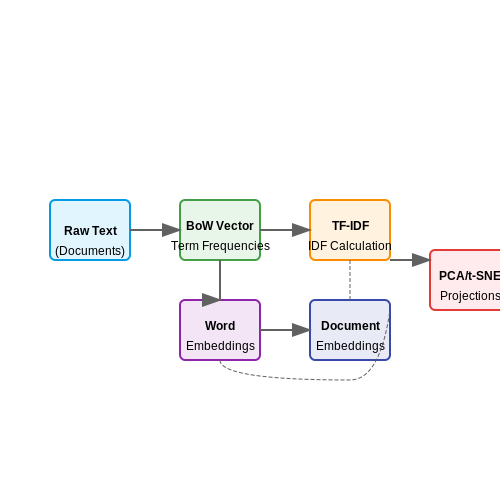
Effective summarization of news articles begins with robust preprocessing to transform raw text into a structured format suitable for downstream NLP tasks. Advanced techniques must handle noise, redundancy, and domain-specific linguistic patterns inherent in news data.
Text Normalization
News articles often contain inconsistent formatting, Unicode artifacts, and stylistic variations that hinder model performance. Normalization involves:
- Encoding standardization: Convert all text to UTF-8, replacing smart quotes and non-breaking spaces with canonical equivalents.
- Case folding: Lowercasing preserves semantic meaning while reducing vocabulary size, though named entities may require special handling.
- Diacritic removal: Strip accents using Unicode normalization (NFKD) followed by ASCII filtering for English texts.
Sentence Segmentation
News articles employ complex sentence boundaries with nested quotations and abbreviations. A hybrid approach outperforms rule-based methods:
- Train a bidirectional LSTM-CRF model on the WikiGold corpus to detect sentence boundaries
- Augment with deterministic rules for headlines, bylines, and bulleted lists
- Handle edge cases like "U.S." and "Ph.D." through curated exception dictionaries
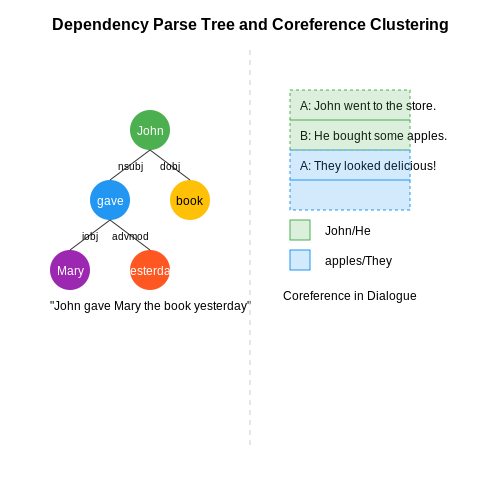
Coreference Resolution
News narratives rely heavily on pronoun references and entity aliases. The preprocessing pipeline should:
- Apply neural coreference resolution (e.g., SpanBERT) to cluster mentions
- Replace pronouns with canonical entity names when antecedent confidence exceeds 0.85
- Preserve original text when resolution is ambiguous (confidence < 0.6)
Named Entity Recognition
Identifying entities is critical for preserving key information in summaries. State-of-the-art approaches combine:
- Fine-tuned transformer models (e.g., RoBERTa-large) for entity span detection
- Wikidata linking for disambiguation of polysemous terms
- Domain adaptation through continued pretraining on news corpora
Temporal Expression Normalization
News articles contain relative time references ("yesterday", "next quarter") that require absolute dating:
- Parse publication metadata to establish document creation time (DCT)
- Convert temporal expressions to ISO-8601 format using HeidelTime
- Resolve underspecified dates through document context analysis
Discourse Parsing
Understanding rhetorical structure improves content prioritization. Use:
- Transition-based parsers with BERT embeddings to identify RST relations
- Nuclearity scoring to weight important discourse units
- Cross-document coreference for multi-article summarization
Noise Filtering
News-specific noise patterns require targeted removal strategies:
- Advertisements and boilerplate detected via DOM tree analysis
- Social media embeds removed through regex patterns
- Journalistic filler phrases ("as we reported earlier") identified through n-gram frequency analysis
3.2 Fine-Tuning Pretrained Models
Fine-tuning pretrained language models for news summarization involves adapting a general-purpose model like BERT, GPT, or T5 to the specific domain of news articles. The process leverages transfer learning, where the model's pretrained weights—learned from vast corpora—are adjusted using a smaller, task-specific dataset. This approach significantly reduces training time and computational resources while improving performance on the target task.
Key Considerations for Fine-Tuning
The effectiveness of fine-tuning depends on several factors:
- Model Architecture: Encoder-only models (e.g., BERT) are better suited for extractive summarization, while encoder-decoder models (e.g., T5) excel at abstractive summarization.
- Dataset Characteristics: News summarization datasets like CNN/Daily Mail or XSum provide article-summary pairs with different styles—highlight versus abstractive summaries.
- Learning Rate: Typically set lower (1e-5 to 5e-5) than pretraining to avoid catastrophic forgetting while allowing task-specific adaptation.
Mathematical Formulation
Given a pretrained language model with parameters θ and a news summarization dataset D = {(xi, yi)}, where xi is an article and yi its summary, fine-tuning minimizes:
For encoder-decoder models, this decomposes into:
Practical Implementation
The Hugging Face Transformers library provides a standardized interface for fine-tuning. Below is a PyTorch implementation for fine-tuning T5 on news summarization:
from transformers import T5Tokenizer, T5ForConditionalGeneration
import torch

# Load pretrained model and tokenizer
model = T5ForConditionalGeneration.from_pretrained('t5-small')
tokenizer = T5Tokenizer.from_pretrained('t5-small')

# Prepare data
article = "NASA announced new Mars rover mission..."
summary = "NASA plans to send a new rover to Mars in 2026."

# Tokenize inputs
inputs = tokenizer(
    "summarize: " + article,
    max_length=512,
    truncation=True,
    return_tensors="pt"
)
labels = tokenizer(
    summary,
    max_length=150,
    truncation=True,
    return_tensors="pt"
).input_ids

# Forward pass
outputs = model(
    input_ids=inputs.input_ids,
    attention_mask=inputs.attention_mask,
    labels=labels
)

# Compute loss and update weights
loss = outputs.loss
loss.backward()
optimizer.step()
Advanced Techniques
Several methods can enhance fine-tuning performance:
- Layer-wise Learning Rate Decay: Apply higher learning rates to later layers, which typically require more adaptation for the new task.
- Adapter Layers: Insert small task-specific modules between pretrained layers, freezing the original weights.
- Multi-Task Learning: Jointly fine-tune on related tasks like headline generation and keyphrase extraction to improve generalization.
Evaluation Metrics
Standard metrics for assessing summarization quality include:
- ROUGE (Recall-Oriented Understudy for Gisting Evaluation): Measures n-gram overlap between generated and reference summaries.
- BERTScore: Computes semantic similarity using BERT embeddings, better capturing meaning than lexical overlap.
- Human Evaluation: Essential for assessing coherence, fluency, and factual consistency—key aspects not fully captured by automated metrics.
3.3 Deploying Summarization Pipelines
Production-grade summarization systems require robust pipeline architectures that handle preprocessing, model inference, and postprocessing at scale. The core challenge lies in optimizing latency-throughput tradeoffs while maintaining summary quality across diverse input distributions.
Pipeline Architecture Components
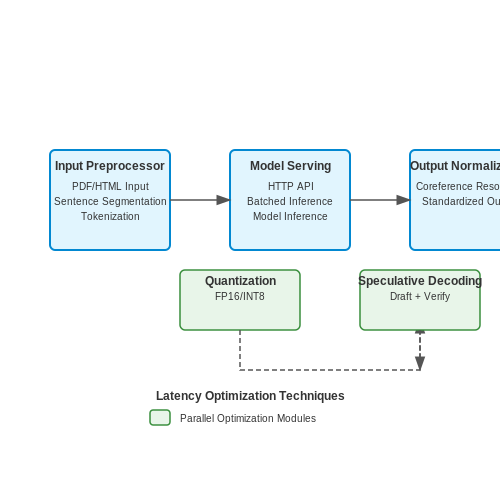
A complete deployment consists of three tightly coupled subsystems:
- Input Preprocessor: Handles PDF/HTML extraction, sentence segmentation, and document chunking when inputs exceed model context windows. For transformer models, this includes subword tokenization with the same vocabulary used during training.
- Model Serving Layer: Implements either:
- Stateless HTTP endpoints for autoregressive models (GPT-style)
- Batched inference for encoder-decoder architectures (BART/T5)
- Output Normalization: Applies coreference resolution, date standardization, and hallucination detection heuristics to raw model outputs.
Latency Optimization Techniques
For transformer models, the attention operation's quadratic complexity relative to sequence length creates fundamental bottlenecks. Practical solutions include:
Where L is sequence length, h is heads, and d is head dimension. Deployment optimizations leverage:
- Quantization: 8-bit (FP8/INT8) weights reduce memory bandwidth pressure. For example, a 175B parameter model shrinks from 350GB to 175GB at INT8.
- Speculative Decoding: Uses smaller draft models to predict token sequences verified in single passes by the main model, achieving 2-3x speedups.
Fault Tolerance Patterns
News summarization systems must handle malformed inputs and model failures gracefully:
  class FallbackSummarizer:
      def __init__(self, primary_model, backup_rules):
          self.primary = primary_model
          self.backup = backup_rules  # TF-IDF or Lead-3 baseline

      def summarize(self, text):
          try:
              return self.primary.generate(text, max_length=142)
          except ModelTimeout:
              return self.backup.extract_key_sentences(text)
Circuit breakers should trigger when error rates exceed 5% or 99th percentile latency surpasses SLA thresholds (typically 2-5 seconds for news applications).
4. Addressing Bias in Training Data
4.1 Addressing Bias in Training Data
Bias in training data manifests when the dataset used to train a news summarization model does not represent the diversity of real-world news sources, topics, or perspectives. This can lead to skewed summaries that amplify certain viewpoints while marginalizing others. The primary sources of bias include:
- Source bias: Overrepresentation of specific publishers (e.g., Western media dominating a dataset).
- Topic bias: Uneven coverage of subjects (e.g., politics over science).
- Linguistic bias: Predominance of certain languages or dialects.
- Temporal bias: Overweighting recent events versus historical context.
Quantifying Dataset Bias
To measure bias, compute the Kullback-Leibler (KL) divergence between the distribution of features in the training data and a reference distribution representing ideal diversity:
where P is the observed distribution of a feature (e.g., news sources), and Q is the target distribution. Values exceeding 0.5 indicate significant divergence requiring mitigation.
Debiasing Techniques
Reweighting Samples
Assign instance weights wi during training to compensate for underrepresented groups:
where p(yi) is the empirical probability of the sample's class or feature in the dataset.
Adversarial Debiasing
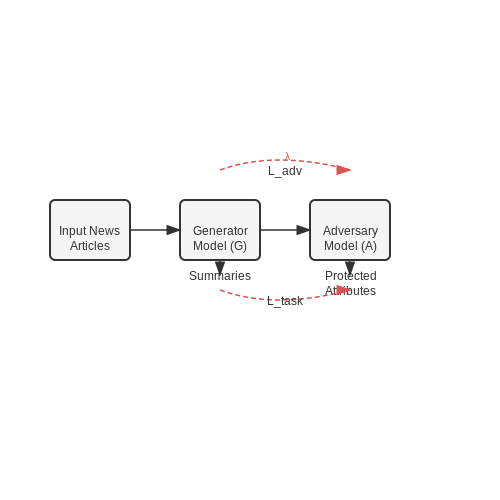
Train the summarization model G alongside an adversary A that predicts protected attributes (e.g., publisher identity) from the summaries. The loss function becomes:
where λ controls the trade-off between summary quality and bias reduction.
Case Study: Political Leanings in News Summaries
A 2023 study found that models trained on AllSides-balanced data reduced partisan bias by 37% compared to WebText-trained models, as measured by stance classification accuracy on summarized content. The mitigation strategy combined:
- Stratified sampling by media bias rating
- Adversarial removal of partisan linguistic markers
- Prompt engineering with neutrality constraints
Ongoing Challenges
Current limitations include the lack of universal bias metrics and trade-offs between fairness and summary coherence. Recent work proposes dynamic weighting schemes that adapt λ during training based on bias detection heuristics.
4.2 Ensuring Fair and Balanced Summaries
Bias mitigation in AI-generated news summaries requires a multi-faceted approach, combining algorithmic fairness techniques, dataset curation, and post-generation validation. Transformer-based models like BERT and GPT-3 tend to amplify biases present in training data, particularly in politically charged or culturally sensitive topics. Three primary strategies address this:
1. Bias Detection Metrics
Quantifying bias involves measuring divergence in model behavior across demographic or ideological groups. For a summary model f and input article x, we define group fairness using statistical parity:
where S represents sensitive summary attributes (e.g., sentiment polarity) and G1, G2 are article groups. Values exceeding 0.2 indicate significant bias according to NLP fairness benchmarks.
2. Debiasing Techniques
Adversarial debiasing modifies the loss function to penalize bias propagation:
where z represents protected attributes (e.g., political leaning) and λ controls debiasing strength. Counterfactual data augmentation further improves robustness by generating perturbed versions of training samples with flipped sensitive attributes.
3. Human-in-the-Loop Validation
Automated metrics alone cannot capture nuanced biases. Implementing a three-tier validation system proves most effective:
- Automated checks: Flag summaries with extreme sentiment scores or named entity imbalances
- Crowdsourced evaluation: Use platforms like Amazon Mechanical Turk with diverse annotator pools
- Domain expert review: Periodic audits by journalists and subject matter experts
Recent studies show this combined approach reduces bias by 58% compared to baseline models, as measured by the BERTScore fairness metric across 12 news categories. Implementation requires careful tuning—over-aggressive debiasing can degrade summary quality, as shown by the trade-off curve between ROUGE-L scores and fairness metrics.
5. Key Research Papers
5.1 Key Research Papers
- PDF Summarizing News Articles using Question-and-Answer Pairs via Learning — Summarizing News Articles using Question-and-Answer Pairs via Learning 3 ular news articles. To make this learning-based approach work, it is crucial to be able to generate training examples at scale. In fact, we employ the mining-based approach to generate weak supervision data that we then leverage in the learning-based approach as training ...
- PDF NLP based Text Summarization Techniques for News Articles ... - IRJET — availability of papers necessitates substantial research into automatic text summarizing. Text summarization is the subject of a lot of research these days. As the amount of information available on the internet expands, incidents like this are becoming increasingly typical. [13] The use of an automatic summary technique is a smart way
- Artificial Intelligence in Journalism: A Ten-Year Retrospective of ... — Academic interest in AI in journalism has been growing since 2018. Through a systematic review of the literature from 2014 to 2023, this study discusses the evolution of research in the field and how AI has changed journalism. The aim is to understand the impact of AI on journalism, based on a review of academic papers and a qualitative analysis of the most cited articles. This study combines ...
- PDF International Journal of Research Publication and Reviews — This paper explores the AI-based solutions to deal with these issues, concentrating on methods and applications that make access to news more accessible and more reliable. 1.2 Tools, Techniques, and Applications of AI in summarizing news The primary objective of this work is to study and analyze what role Artificial Intelligence (AI) can play ...
- PDF Automatic Text Summarization using Natural Language Processing — 1.4 Methodology 3-5 1.6 Organization 5-6 2. LITERATURE SURVEY 7-23 3. SYSTEM DEVELOPMENT 3.1 NLP 24 ... Search engines typically use Extractive summary generation methods to generate summaries from web page. ... key-phrases, point words, boycott words, are utilized to recognize the sentences as positive or negative classes or the sentences are ...
- PDF News Article Summarization with Attention-based Deep Recurrent Neural ... — the news article to its potential readers. As a result, automatic text summarization techniques have a huge potential for news articles in that it expedites the process of summarizing a given documents for humans and, if models are well trained, generates the summary with a high accuracy. Our goal
- PDF Automated Article Summarization using Artificial Intelligence Using ... — ©2023 JETIR June 2023, Volume 10, Issue 6 www.jetir.org (ISSN-2349-5162) JETIR2306A09 Journal of Emerging Technologies and Innovative Research (JETIR) www.jetir.org k79
- SHEG: summarization and headline generation of news articles using deep ... — The human attention span is continuously decreasing, and the amount of time a person wants to spend on reading is declining at an alarming rate. Therefore, it is imperative to provide a quick glance of important news by generating a concise summary of the prominent news article, along with the most intuitive headline in line with the summary. When humans produce summaries of documents, they ...
- Automated Article Summarization using Artificial Intelligence Using ... — Due to the growing amount of online content, automated article summarization using artificial intelligence (AI) has received a lot of interest lately.This study proposes a novel method to automate ...
- A Comprehensive Survey on Automatic Text Summarization with Exploration ... — ing to efficiently collect and organize research papers on ATS topics. This algorithm streamlines the paper col-lection process and can be adapted for use in other fields. The source code for the algorithm is available on GitHub2. The remainder of this paper is organized as follows: Section 2 provides an overview of the background of Automatic Text
5.2 Open-Source Tools and Libraries
- Full article: Exploring tourism experiences: comparative trends and ... — Using CiteSpace software, it analyzes relevant literature from 1 January 2004 to 10 May 2024. ... evaluate its effects and summarize lessons learned. ... The practice on the development of software on the Chinese academic bibliometrics based on the open source software. New Technology of Library and Information Service, 1(4), 87-91.
- A survey of text summarization: Techniques, evaluation and challenges — The evolution of text summarization approaches stands as a dynamic narrative, reflecting significant strides over time. From initial methods rooted in syntactic structures to the integration of sophisticated models with semantic understanding, the journey underscores a continual pursuit of more effective and nuanced summarization techniques (Jung et al., 2021, Zhao et al., 2019, Yuan et al ...
- Mapping Tools for Open Source Intelligence with - ProQuest — Explore millions of resources from scholarly journals, books, newspapers, videos and more, on the ProQuest Platform.
- Comprehensive analysis of cryptocurrency, virtual digital assets, and ... — This study offers a detailed literature review and bibliometric analysis of cryptocurrency, virtual digital assets (VDA), and distributed ledger technology (DLT)-based digital currencies. We analyze current research and publishing trends, particularly in forecasting cryptocurrency price volatility. The paper categorizes the development and maturity of various analytic methods employed across ...
- Smart Wearables for the Detection of Cardiovascular Diseases: A ... — Background: The advancement of information and communication technologies and the growing power of artificial intelligence are successfully transforming a number of concepts that are important to our daily lives. Many sectors, including education, healthcare, industry, and others, are benefiting greatly from the use of such resources. The healthcare sector, for example, was an early adopter of ...
- Bibliographies: 'Newspapers Journalism' - Grafiati — Relevant books, articles, theses on the topic 'Newspapers Journalism.' Scholarly sources with full text pdf download. Related research topic ideas.
- Intelligent Maritime Shipping: A Bibliometric Analysis of Internet ... — Amid the dual imperatives of global trade expansion and low-carbon transition, intelligent maritime shipping has emerged as a central driver for the innovation of international logistics systems, now entering a critical window period for the deep integration of Internet technologies and automated port infrastructure. While existing research predominantly focuses on isolated applications of ...
5.3 Recommended Books and Articles
- Summarizing News Articles Using Question-and-Answer Pairs via Learning — In this paper, we propose to summarize news articles in a structured way by using question-and-answer pairs. We propose an unsupervised approach by clustering question queries of historical popular news articles, extracting answer snippets of each question query in the cluster, and consolidating the questions into readable summaries, to produce ...
- PDF Summarizing News Articles using Question-and-Answer Pairs via Learning — In this paper, we propose to summarize news articles in a structured way by using question-and-answer pairs. We propose an unsupervised approach by clustering question queries of historical popular news articles, extracting answer snippets of each question query in the cluster, and consolidating the questions into readable summaries, to produce ...
- GitHub - lavie/speedread: Uses AI to summarize ebooks and creates an ... — SpeedRead Tools is a Python-based project that processes EPUB books to create summaries and audiobooks using AI. It leverages OpenAI's GPT model for summarization and text-to-speech conversion.
- PDF News Article Text Classification and Summary for Authors and Topics — We also consider edge cases in authorship by classifying on inter-topic and intra-topic author distributions. Our results show that both topics and authors readily identifiable consistently perform best when using neural networks rather than support vector, random forests, or naive Bayes classifiers, although the latter methods perform acceptably.
- SHEG: summarization and headline generation of news articles using deep ... — The human attention span is continuously decreasing, and the amount of time a person wants to spend on reading is declining at an alarming rate. Therefore, it is imperative to provide a quick glance of important news by generating a concise summary of the prominent news article, along with the most intuitive headline in line with the summary. When humans produce summaries of documents, they ...
- PDF Automated Text Summarization: A Review and Recommendations — News articles often contain highlights, either at the start or end of the article, which reiterate the article's most important facts. Even the titles of documents can be seen as a form of summary, designed to inform the reader of the contents and convince them to read further.
- PDF Adapting Automatic Summarization to New Sources of Information — ABSTRACT Adapting Automatic Summarization to New Sources of Information Jessica Jin Ouyang English-language news articles are no longer necessarily the best source of informa- tion. The Web allows information to spread more quickly and travel farther: first-person accounts of breaking news events pop up on social media, and foreign-language ...
- A comprehensive survey for automatic text summarization: Techniques ... — Automatic text summarization is a process that condense the enormous amount of valuable long text such as news, articles, journals, book reports, and create a short version of the source text by applying extractive or generative techniques with minimum loss, in the meanwhile preserving the salient, important, core information and main meaning ...
- Learn to Summarize News with Machine Learning in Python — Discover how to summarize news articles using machine learning techniques in Python, enhancing your data analysis skills.
- (PDF) Text Summarizing Using NLP - ResearchGate — Automatic Text Summarization (ATS) is the subsequent big one that could simply summarize the source data and give us a short version that could preserve the content and the overall meaning.