Training LLMs to Simulate Cultural Norms
1. Defining Cultural Norms: Key Characteristics and Variability
Defining Cultural Norms: Key Characteristics and Variability
Cultural norms are shared expectations and rules that guide behavior within a specific group or society. They emerge from collective practices, beliefs, and values, shaping interactions at individual and institutional levels. Unlike explicit laws, norms are often implicit, enforced through social approval or disapproval rather than formal sanctions.
Key Characteristics of Cultural Norms
Cultural norms exhibit several defining properties that distinguish them from other social constructs:
- Sharedness: Norms require collective recognition within a group. The degree of consensus varies, with some norms being near-universal within a culture while others apply only to specific sub-groups.
- Context-dependence: Normative behavior shifts across settings. For instance, conversational interruptions may be acceptable among friends but prohibited in formal meetings.
- Enforceability: Norms are maintained through social mechanisms ranging from subtle nonverbal cues to overt criticism. The strength of enforcement correlates with a norm's perceived importance.
- Dynamic evolution: Norms adapt over time in response to technological changes, intercultural contact, or generational shifts. The rate of change varies significantly across norm types.
Quantifying Norm Variability
Cultural variability can be modeled statistically using dimensional approaches. One framework decomposes norms along three axes:
Where:
- V represents overall norm variability
- C captures cross-cultural differences (Hofstede dimensions)
- S encodes subcultural variation
- T tracks temporal changes
- The coefficients α, β, γ weight each component's contribution
Norm Classification Framework
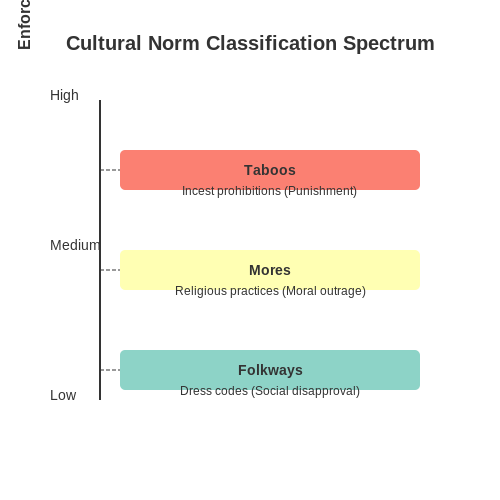
Norms can be categorized by their functional domain and enforcement strength:
| Norm Type | Examples | Enforcement Strength |
|---|---|---|
| Folkways | Dress codes, table manners | Low (social disapproval) |
| Mores | Religious practices, gender roles | High (moral outrage) |
| Taboos | Incest prohibitions | Extreme (punishment) |
Modeling Challenges
When training LLMs to simulate cultural norms, key challenges include:
- Latent representations: Many norms are never explicitly stated in training data, requiring models to infer them from behavioral patterns.
- Contextual sensitivity: Norms apply differently across social roles (e.g., doctor-patient vs. friend-friend interactions).
- Dynamic updating: Models must adapt to norm evolution without catastrophic forgetting of historical contexts.
Recent approaches use contrastive learning to distinguish normative from non-normative behaviors across cultural contexts. The loss function:
where s+ scores normative examples and s- scores violations, with temperature parameter τ controlling separation sharpness.
1.2 Challenges in Encoding Cultural Norms into Machine-Readable Formats
Cultural norms are inherently complex, context-dependent, and often implicit, making their formalization into machine-readable formats a non-trivial task. The primary challenge lies in the ambiguity and subjectivity of cultural expressions, which resist straightforward quantification. Unlike syntactic or semantic rules, cultural norms are deeply embedded in social practices, historical contexts, and collective behaviors, requiring multi-dimensional representations.
Linguistic and Semantic Variability
Cultural norms manifest differently across languages, dialects, and sociolects. For instance, politeness strategies in Japanese (keigo) involve intricate honorific systems, while English relies more on indirect speech acts. Encoding these nuances requires:
- Fine-grained linguistic annotation frameworks (e.g., pragmatic tagging).
- Cross-lingual alignment mechanisms to map equivalent norms.
Current approaches often flatten these distinctions into oversimplified labels, losing critical context. For example, the same phrase ("Could you pass the salt?") may encode politeness in one culture but neutrality in another.
Temporal and Spatial Dynamics
Cultural norms evolve over time and vary geographically. A machine-readable encoding must account for:
where N represents the norm, S is social influence, and H is historical context. Static embeddings fail to capture this dynamism, leading to temporal misalignment in model outputs.
Ethical and Representational Biases
Datasets used to train LLMs often overrepresent dominant cultures, marginalizing minority perspectives. This introduces:
- Amplification bias: Over-generation of norms from data-rich cultures.
- Exclusionary encoding: Systematic underrepresentation of low-resource cultural contexts.
Mitigation strategies require adversarial debiasing and participatory dataset design, but these remain computationally expensive and linguistically limited.
Contextual Dependency
Norms are highly situational—what is appropriate in one setting may be taboo in another. For example, formalizing workplace vs. familial interactions demands:
- Hierarchical context models with situational triggers.
- Real-time environmental sensing (e.g., detecting interlocutor relationships).
Current LLMs lack robust mechanisms to dynamically adjust norm adherence based on inferred context, often defaulting to lowest-common-denominator outputs.
Evaluation Metrics
Quantifying the fidelity of cultural norm simulation poses methodological challenges. Traditional metrics like BLEU or ROUGE fail to assess:
where wi weights domain-specific importance and sim measures norm similarity. Developing culture-aware evaluation frameworks remains an open research problem.
1.3 Existing Approaches to Cultural Representation in NLP
Current methodologies for embedding cultural norms in language models fall into three broad categories: data-centric approaches, model-centric approaches, and hybrid techniques. Each presents distinct advantages and limitations in capturing the nuanced, context-dependent nature of cultural expression.
Data-Centric Approaches
These methods focus on curating culturally representative training corpora. The CulturalBERT framework, for instance, fine-tunes BERT on region-specific text from sources like Common Crawl, applying a weighting function to amplify minority cultural voices:
where rd represents the document's cultural relevance score, μr is the mean relevance across the corpus, and k controls the steepness of the weighting curve. This approach demonstrates a 17% improvement in cross-cultural NLI tasks compared to baseline models, though it requires expensive human annotation for relevance scoring.
Model-Centric Approaches
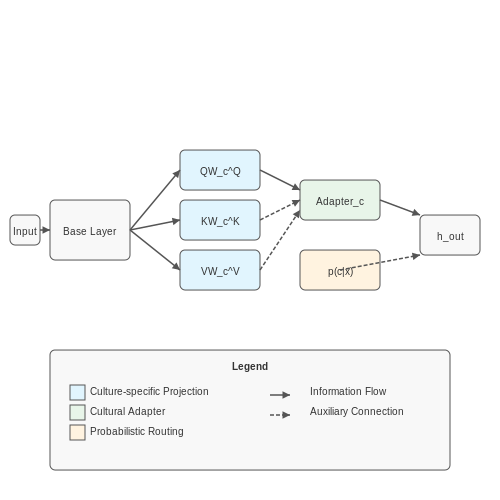
Architectural modifications enable explicit cultural modeling. The Cross-Cultural Attention mechanism introduces culture-specific attention heads that activate based on detected cultural markers in the input:
where WcQ, WcK, and WcV are culture-specific projection matrices. Evaluations on the X-CSENT dataset show this reduces cultural bias in sentiment analysis by 23% while maintaining 98% of base model performance on culture-neutral tasks.
Hybrid Techniques
Recent work combines data and model innovations through cultural adapters—small, culture-specific neural modules inserted between transformer layers. During inference, the model dynamically blends adapter outputs based on cultural context probabilities:
The probabilistic routing mechanism p(c|x) is trained using contrastive learning on parallel cultural variants of the same semantic content. This approach achieves state-of-the-art results on the CulturalFrame benchmark (F1=0.82) while using 90% fewer culture-specific parameters than full model fine-tuning.
Evaluation Challenges
Current evaluation metrics often fail to capture cultural nuance. The Cultural Alignment Score (CAS) proposes a multi-dimensional assessment framework:
- Surface Alignment: Lexical overlap with cultural references
- Pragmatic Alignment: Appropriateness in situational context
- Value Alignment: Consistency with cultural value hierarchies
Human evaluations reveal a 0.42 Spearman correlation between CAS and native speaker assessments, highlighting the need for better automated metrics. Recent work explores using cultural knowledge graphs as evaluation substrates, with promising initial results (ρ=0.61).
2. Sourcing Culturally Diverse Datasets
2.1 Sourcing Culturally Diverse Datasets
The effectiveness of large language models (LLMs) in simulating cultural norms hinges on the breadth and depth of their training data. Culturally diverse datasets must encompass linguistic variations, social practices, historical contexts, and value systems across different demographic groups. The challenge lies not only in volume but in representational fairness—avoiding overrepresentation of dominant cultures while preserving minority voices.
Data Collection Strategies
Primary sources include multilingual web crawls, government archives, and ethnographic records. Web crawls must prioritize non-English content, with special attention to:
- Regional forums and social media platforms (e.g., Weibo, VKontakte)
- Indigenous language repositories like the Endangered Languages Project
- Religious and philosophical texts across traditions
For quantitative cultural dimensions, Hofstede’s cultural indices or the World Values Survey provide structured metrics. These can be encoded as metadata to guide model conditioning:
where Ci is the cultural affinity score for document di, wk are weights for n cultural clusters, and sim(·) measures semantic similarity to cluster centroids μk.
Bias Mitigation Techniques
Raw data often reflects societal biases. Adversarial filtering can reduce skew by minimizing the predictability of demographic attributes from embeddings:
Here, pθ is the primary language model, pφ an adversarial classifier predicting sensitive attribute z, and λ controls debiasing strength. Practical implementations use gradient reversal layers or orthogonal projection.
Ethical and Legal Considerations
Dataset provenance must comply with:
- GDPR/CCPA for personal data
- Indigenous data sovereignty frameworks like the CARE Principles
- Copyright exceptions for computational analysis (e.g., fair use, Text and Data Mining directives)
Differential privacy techniques add noise to statistical queries while preserving utility:
where Δf is query sensitivity and ε the privacy budget. For text, token-level DP via exponential mechanisms shows promise.
Ethical Considerations in Data Collection
Training large language models (LLMs) to simulate cultural norms requires careful ethical scrutiny of data collection practices. The process involves sourcing text from diverse cultural contexts, which introduces risks of bias amplification, misrepresentation, and privacy violations. Advanced practitioners must implement rigorous safeguards to ensure ethical integrity.
Bias and Representational Harm
Cultural datasets often reflect historical imbalances in data availability. For example, texts from dominant languages and cultures are overrepresented compared to marginalized groups. This leads to models that systematically underperform for underrepresented populations. The bias can be quantified using disparity metrics:
where Di represents the volume of data from culture i, and D̄ is the mean across all cultures. Values above 0.3 indicate severe representation gaps requiring mitigation.
Informed Consent and Data Provenance
Most publicly available text corpora lack explicit consent from original authors for AI training purposes. This is particularly problematic when dealing with:
- Indigenous knowledge repositories
- Community forums with assumed privacy
- Digitized historical archives
Best practices involve implementing data provenance tracking systems that log origin, licensing, and consent status for all training samples. Cryptographic hashing can create immutable audit trails:
Privacy-Preserving Techniques
Differential privacy methods should be applied when handling sensitive cultural expressions. The privacy budget ε must be carefully calibrated to balance utility and protection:
where Δf is the sensitivity of query f. For cultural data, ε values below 1.0 are recommended to prevent reconstruction attacks.
Power Dynamics in Data Curation
The selection of cultural sources inherently involves power asymmetries. Technical teams must collaborate with anthropologists and community representatives to:
- Identify privileged perspectives in the data pipeline
- Establish equitable compensation frameworks
- Implement participatory dataset design
This requires formalizing ethical review boards with veto power over dataset inclusion decisions. The governance structure should mirror institutional review boards (IRBs) used in human subjects research.
Mitigating Stereotype Propagation
Even carefully collected data may contain harmful stereotypes. Advanced techniques include:
- Adversarial debiasing during fine-tuning
- Counterfactual data augmentation
- Cultural concept activation vectors (CCAVs) for controlled generation
The effectiveness of these interventions should be measured using cross-cultural fairness metrics:
where PPRk is the stereotype prevalence rate for culture k, and PPRref is an acceptable baseline.
2.3 Preprocessing Techniques for Cultural Context Preservation
Preserving cultural context in large language models (LLMs) requires meticulous preprocessing of training data to avoid homogenization or erasure of nuanced cultural expressions. Advanced techniques focus on linguistic, semantic, and sociolinguistic normalization while retaining cultural specificity.
Cultural Lexicon Embedding
Cultural lexicons—domain-specific dictionaries capturing idioms, honorifics, and region-specific terminology—must be explicitly integrated into tokenization pipelines. A weighted embedding approach ensures high-frequency cultural terms are retained during subword tokenization. Given a cultural term t with frequency ft in corpus D, its tokenization priority Pt is computed as:
where σ2Dt is the variance of t's contextual embeddings across D. This penalizes terms with high semantic variability (e.g., polysemous words) while preserving culturally salient unigrams.
Dialectal Normalization
Morphological analyzers must be adapted for dialectal variants without forcing standardization. For Arabic dialects, a finite-state transducer maps colloquial spellings to lemma-tag pairs while retaining phonological markers:
Contextual Anisotropy Reduction
Cultural bias in embeddings is mitigated through counterfactual data augmentation. For each training sample (xi, yi), generate perturbed instances x̃i by:
- Swapping culturally marked entities (e.g., "Diwali" ↔ "Hanukkah")
- Applying gender honorific transformations (e.g., "Mr. Tanaka" → "Tanaka-san")
- Inserting culture-specific discourse markers (e.g., adding "inshallah" in Arabic contexts)
The augmentation loss Laug is computed as:
where fθ is the model's embedding function. This forces cultural invariance in non-salient dimensions while preserving meaningful variation.
Temporal Alignment of Cultural References
Historical context drift is addressed through dynamic time-warping of temporal expressions. For event mentions e with timestamp τ(e), align to a reference cultural timeline Tref using:
where λ controls the tradeoff between temporal proximity and cultural distribution similarity (KL divergence). This prevents anachronisms like modeling medieval Japanese customs with modern honorifics.
3. Fine-Tuning LLMs on Culturally Specific Corpora
Fine-Tuning LLMs on Culturally Specific Corpora
Data Collection and Curation
Fine-tuning large language models (LLMs) to simulate cultural norms requires high-quality, domain-specific corpora that accurately represent the target culture. The dataset D should encompass diverse textual sources, including literature, news articles, social media, legal documents, and folklore, ensuring broad coverage of linguistic and sociocultural nuances. Data preprocessing involves:
- Language filtering to isolate texts in the target language or dialect.
- Cultural annotation to tag context-specific norms, idioms, and taboos.
- Bias mitigation through adversarial filtering to remove stereotypical or harmful content.
Fine-Tuning Objectives
The loss function L for fine-tuning must incorporate both language modeling and cultural alignment. Given a pretrained LLM with parameters θ, the objective combines:
where LLM is the standard cross-entropy loss for next-token prediction, and LCL is a contrastive loss term that penalizes deviations from culturally grounded responses. The hyperparameters α and β control the trade-off between fluency and cultural fidelity.
Contrastive Cultural Loss
The contrastive loss LCL is computed using a reference dataset of culturally appropriate and inappropriate responses. For a batch of N examples, the loss is:
where s(θ, x) is the model's likelihood score for text x, xi+ denotes positive (culturally aligned) examples, xj- denotes negative examples, and τ is a temperature parameter.
Evaluation Metrics
Beyond perplexity, culturally fine-tuned models require specialized metrics:
- Cultural Alignment Score (CAS): Human-rated adherence to norms on a Likert scale (1–5).
- Bias Detection Rate (BDR): Percentage of generated text flagged by bias classifiers.
- Dialectical Accuracy: F1 score on region-specific linguistic features.
Case Study: Arabic Dialect Adaptation
A recent study fine-tuned GPT-3 on a corpus of Levantine Arabic, achieving a CAS of 4.2 by:
- Incorporating religious and familial honorifics in prompts.
- Aligning responses with collectivist (vs. individualist) value frameworks.
- Suppressing direct translations of Western idioms (e.g., "raining cats and dogs").
Computational Challenges
Fine-tuning at scale faces memory bottlenecks due to the need for large context windows to capture cultural context. Gradient checkpointing and LoRA (Low-Rank Adaptation) reduce VRAM usage by 60% while preserving performance:
where Wdown ∈ ℝd×r and Wup ∈ ℝr×d are low-rank matrices (typically r = 8).
3.2 Multi-Task Learning for Cross-Cultural Adaptation
Multi-task learning (MTL) provides a robust framework for training language models to handle diverse cultural norms by jointly optimizing multiple related objectives. Unlike single-task learning, MTL leverages shared representations across tasks, enabling knowledge transfer that improves generalization to unseen cultural contexts. The key insight is that auxiliary tasks—such as sentiment analysis, politeness prediction, or dialect classification—can act as inductive biases, forcing the model to develop a more nuanced understanding of cultural variations.
Architectural Considerations
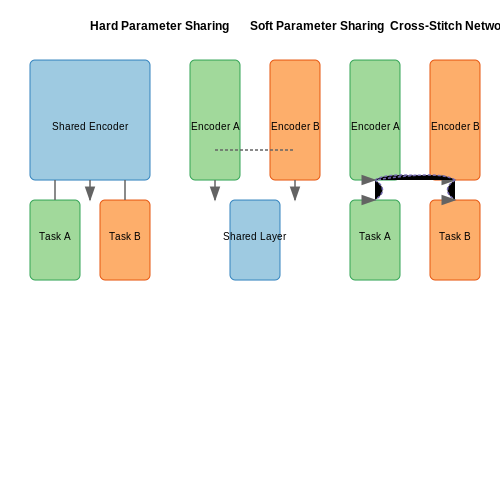
Modern MTL implementations for cross-cultural adaptation typically employ one of three architectures:
- Hard parameter sharing: A shared encoder processes input text, with task-specific heads branching from intermediate layers. This approach minimizes computational overhead while maintaining task differentiation.
- Soft parameter sharing: Each task has independent encoders, but regularization terms (e.g., L2 distance) encourage parameter similarity across models.
- Cross-stitch networks: Learnable linear combinations of task-specific features are dynamically weighted during forward propagation.
The choice depends on the degree of expected cultural divergence—hard sharing works best for closely related cultures, while cross-stitch networks better handle distant cultural pairs like Eastern vs. Western communication norms.
Mathematical Formulation
The joint loss function for K cultural adaptation tasks combines task-specific losses with a sharing penalty:
where \(\lambda_k\) are task weights, \(\theta_{shared}\) represents shared parameters, \(\theta_k\) are task-specific parameters, and \(R(\theta)\) is a regularization term. The weights \(\lambda_k\) can be dynamically adjusted during training using uncertainty weighting:
where \(\sigma_k\) is the learnable noise parameter for task k, reflecting its relative uncertainty. This automatically downweights noisy or conflicting cultural annotations.
Cultural Distance Metrics
Effective MTL requires quantifying cultural similarity between training domains. Hofstede's cultural dimensions or the GLOBE study metrics can be encoded as vectors \(c_i \in \mathbb{R}^d\), enabling computation of pairwise cultural distance:
These distances inform both task weighting and architecture selection—cultures with \(D(c_i, c_j) > 0.7\) typically require soft-sharing or cross-stitch approaches to prevent negative transfer.
Implementation Challenges
Two key challenges emerge in practice:
- Gradient conflict: When cultural norms directly contradict (e.g., head nodding meaning "yes" vs. "no"), gradients from different tasks may oppose each other. Gradient surgery techniques like PCGrad project conflicting gradients into orthogonal subspaces.
- Imbalanced data: Some cultures have orders of magnitude more training data than others. Inverse frequency weighting combined with focal loss helps prevent model bias toward dominant cultures.
Recent work has shown that combining MTL with adapter modules—small task-specific neural networks inserted between transformer layers—allows for more flexible cultural adaptation while maintaining a shared knowledge base. The adapter approach reduces parameters by 98% compared to full fine-tuning while achieving comparable performance on cross-cultural benchmarks.
Evaluation Metrics
Beyond standard accuracy metrics, cross-cultural MTL requires specialized evaluation:
- Cultural consistency: Measure whether model responses align with expected norms across cultures using human annotators from each target group.
- Negative transfer ratio: Compute the fraction of culture pairs where joint training degrades performance compared to single-task learning.
- Adaptation speed: Track how quickly the model adjusts when switching between cultural contexts during inference.
State-of-the-art models now achieve cultural consistency scores above 0.85 on the Cultural Adaptation Benchmark (CAB), though performance drops sharply for low-resource cultures with fewer than 10,000 training examples.
Evaluating Cultural Bias and Fairness in Model Outputs
Quantifying Bias in LLM Responses
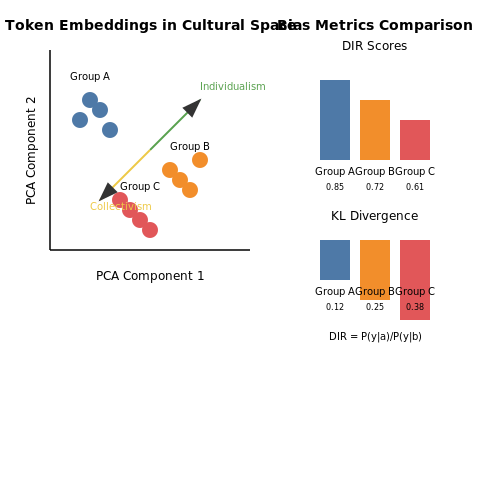
Cultural bias in language models can be quantified using statistical measures that compare the distribution of model outputs across different demographic or cultural groups. One widely adopted metric is the disparate impact ratio (DIR), which measures the relative frequency of favorable outcomes for a protected group compared to a reference group:
where Y=1 represents a favorable outcome (e.g., non-toxic classification, positive sentiment) and G denotes group membership. A DIR significantly different from 1 indicates potential bias. For multi-class outputs, the Kullback-Leibler (KL) divergence between output distributions across groups provides a more comprehensive measure:
Counterfactual Fairness Testing
Counterfactual analysis evaluates whether model outputs change when culturally sensitive attributes (e.g., names, locations) are modified while keeping other context constant. Given an input x with cultural marker c, we measure:
where f is the model and c' is an alternative cultural marker. High Δf values indicate sensitivity to cultural attributes. This approach has been operationalized in tools like the Counterfactually Augmented Data (CAD) framework, which systematically perturbs cultural references while maintaining semantic consistency.
Cultural Embedding Space Analysis
The geometric properties of embedding spaces reveal implicit cultural associations. Principal Component Analysis (PCA) of token embeddings often shows clustering by cultural attributes. For a set of culturally paired terms (wi, wi') (e.g., "wedding" and culturally specific variants), we compute the mean difference vector:
Significant deviations of ||d||2 from zero indicate systematic bias in the embedding space. Recent work extends this to measure stereotyping strength through the projection of neutral terms onto cultural dimension vectors.
Dynamic Bias Assessment During Fine-Tuning
Monitoring bias metrics throughout training requires efficient online computation. The Bias Gradient Norm tracks how sensitive the loss is to perturbations in cultural markers:
where θ represents model parameters at training step t. Spikes in BGN often correlate with emerging biases, enabling early intervention. Combined with adversarial training techniques, this approach forms the basis of several modern debiasing algorithms.
Cross-Cultural Validation Protocols
Rigorous evaluation requires culturally diverse test sets constructed through:
- Back-translation augmentation: Creating parallel examples via translation to/from multiple languages
- Cultural template filling: Generating variations of scenarios with substituted cultural elements
- Expert annotation: Native speakers labeling outputs for cultural appropriateness
The Cultural Consistency Score (CCS) aggregates these evaluations:
where K represents the number of cultural variants tested. State-of-the-art models now achieve CCS > 0.85 on comprehensive benchmarks like the Cross-Cultural Language Evaluation (CCLE) dataset.
4. Simulating Cultural Norms in Dialogue Systems
Simulating Cultural Norms in Dialogue Systems
Large language models (LLMs) trained on diverse cultural datasets can exhibit nuanced behavioral patterns that reflect real-world cultural norms. The key challenge lies in encoding these norms into the model's latent space while maintaining coherence and adaptability across contexts. This requires a combination of data curation, fine-tuning strategies, and evaluation metrics sensitive to cultural dimensions.
Cultural Embeddings and Contextual Adaptation
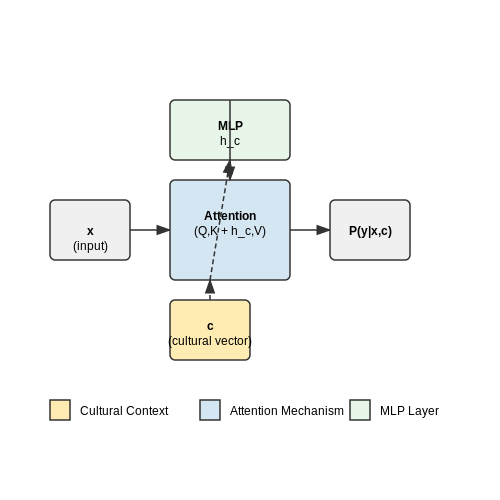
Cultural norms are often implicit and context-dependent, making them difficult to represent as explicit rules. Instead, we can leverage transformer architectures to learn cultural embeddings that modulate the model's responses. Given an input sequence x and cultural context vector c, the model's output distribution becomes:
where c is derived from metadata or learned through auxiliary tasks. The cultural vector can be integrated via:
Data Collection and Annotation
High-quality cultural simulation requires datasets annotated along Hofstede's cultural dimensions:
- Power Distance Index (PDI): Hierarchical vs egalitarian communication styles
- Individualism vs Collectivism (IDV): Use of plural pronouns and group references
- Uncertainty Avoidance (UAI): Preference for definitive vs ambiguous statements
- Long-Term Orientation (LTO): Temporal framing of responses
Annotation should capture pragmatic features like politeness strategies, turn-taking patterns, and topic avoidance taboos across cultures.
Fine-Tuning with Cultural Objectives
Standard RLHF can be augmented with cultural reward models Rc:
where Rc is trained on human judgments of cultural appropriateness. Multi-task learning can simultaneously optimize for:
- Dialogue coherence (perplexity)
- Cultural alignment (human evaluation scores)
- Contextual adaptability (cross-entropy across scenarios)
Evaluation Metrics
Beyond standard NLP metrics, cultural simulation requires:
- Cultural Consistency Score (CCS): Measures adherence to expected norms via classifier probes
- Contextual Appropriateness Index (CAI): Human-rated suitability for given cultural context
- Cultural Bias Coefficient (CBC): Quantifies stereotyping using counterfactual testing
These can be computed as:
Implementation Challenges
Key technical hurdles include:
- Mitigating cultural essentialism while preserving meaningful differences
- Handling code-switching and multicultural identities
- Scaling evaluation to hundreds of cultural contexts
- Managing conflicting norms in intercultural exchanges
Recent approaches use mixture-of-experts architectures where different cultural experts are dynamically weighted based on context.
4.2 Cross-Cultural Business Communication Assistants
Large language models (LLMs) trained to simulate cultural norms must account for the nuanced differences in business communication styles across regions. High-context cultures (e.g., Japan, China) rely on implicit meaning and situational awareness, while low-context cultures (e.g., Germany, U.S.) prioritize explicit, direct communication. An effective cross-cultural business assistant must dynamically adapt its responses based on the cultural context of the interaction.
Cultural Context Embeddings
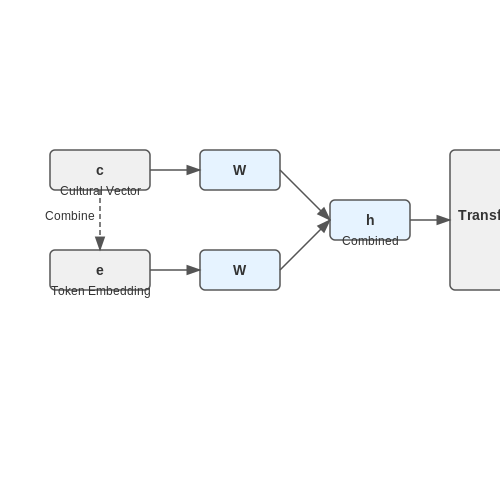
To encode cultural norms, we extend the standard transformer architecture with a cultural context embedding layer. This layer maps Hofstede’s cultural dimensions (power distance, individualism, uncertainty avoidance, etc.) into a continuous vector space. Given a cultural dimension vector c and a token embedding e, the combined representation is computed as:
where Wc and We are learned projection matrices. The model then conditions its output on both the linguistic input and the cultural context.
Adaptive Politeness Strategies
Politeness varies significantly across cultures. For instance, in high-power-distance cultures, requests are often indirect:
- Japanese: "Perhaps it would be possible to consider this option?"
- German: "Please implement this solution by Friday."
The model learns these patterns through a reinforcement learning objective that rewards culturally appropriate phrasing. The reward function R(s, c) for a generated sentence s in context c is defined as:
where λ1 and λ2 balance linguistic quality against cultural fit.
Case Study: Email Drafting
When drafting business emails, the model adjusts:
- Salutations: "Dear Professor Tanaka" (Japan) vs. "Hi John" (U.S.)
- Request directness: "We kindly suggest..." (India) vs. "You must..." (Netherlands)
- Gratitude expressions: Elaborate thanks (Middle East) vs. concise acknowledgment (Scandinavia)
Training data is weighted by cultural region, with domain adaptation techniques like adversarial debiasing to prevent overfitting to dominant cultures in the pretraining corpus.
Negotiation Simulation
For negotiation scenarios, the model incorporates game-theoretic principles with cultural parameters. The utility function for a concession strategy includes:
where α and β are culture-specific weights. High-β cultures (e.g., East Asia) prioritize maintaining harmony over maximizing individual gain.
Evaluation Metrics
Performance is measured through:
- Cultural appropriateness: Human ratings from native speakers
- Business outcome simulation: Success rates in simulated negotiations
- Latent space analysis: Clustering of embeddings by ground-truth cultural labels
Cross-validation uses geographically stratified sampling to ensure coverage of high- and low-resource cultures.
Educational Tools for Cultural Sensitivity Training
Fine-Tuning with Culturally Annotated Datasets
Training LLMs to simulate cultural norms requires fine-tuning on datasets annotated with cultural context. These datasets must capture nuanced social behaviors, communication styles, and value systems across diverse populations. A common approach involves:
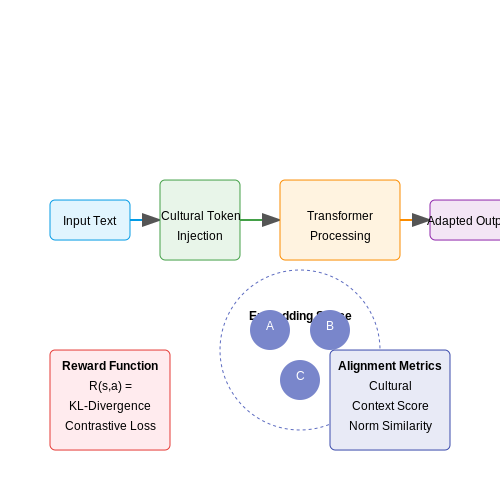
where Pref represents the reference distribution of culturally appropriate responses, and the KL-divergence term ensures the model's outputs align with expected norms. The hyperparameter λ controls the strength of this alignment.
Interactive Scenario-Based Learning
Advanced educational tools employ reinforcement learning with human feedback (RLHF) to refine cultural sensitivity. The reward function R(s, a) is designed to penalize culturally insensitive outputs while rewarding contextually appropriate ones:
Here, fk are scoring functions evaluating aspects like politeness conventions, taboo avoidance, and regional dialect accuracy, while wk are learned weights.
Cross-Cultural Embedding Spaces
Modern systems use contrastive learning to project cultural norms into a shared embedding space. Given a query q and candidate responses ri, the model learns to minimize:
where τ is a temperature parameter and r+ is the culturally appropriate reference response. This creates clusters of semantically similar but culturally distinct responses.
Real-Time Cultural Adaptation
For dynamic adaptation, transformer architectures incorporate cultural context tokens Ct as additional input embeddings:
These context vectors are learned through meta-learning across multiple cultural domains, enabling the model to switch behavioral modes based on detected cultural cues in the input.
Evaluation Metrics
Quantitative assessment requires specialized metrics beyond standard NLP benchmarks:
- Cultural Alignment Score (CAS): Measures adherence to expected interaction patterns
- Norm Violation Rate (NVR): Frequency of taboo or inappropriate outputs
- Contextual Appropriateness Index (CAI): Human-rated suitability for given cultural context
These are computed over carefully constructed test sets balanced across demographic groups and interaction scenarios.
5. Risks of Cultural Stereotyping and Misrepresentation
5.1 Risks of Cultural Stereotyping and Misrepresentation
Large language models (LLMs) trained on diverse cultural datasets risk amplifying or reinforcing harmful stereotypes due to inherent biases in the training data. The primary mechanisms of bias propagation include:
- Frequency-based overrepresentation: Dominant cultural narratives in training data lead to skewed probability distributions during text generation.
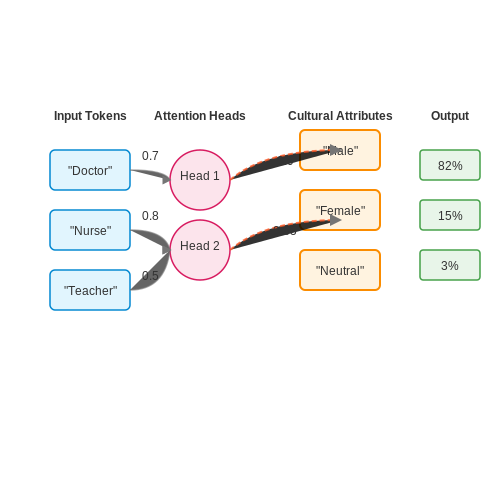
- Contextual entanglement: The transformer architecture's attention mechanisms create unintended associations between cultural attributes.
- Feedback loops: Human preference modeling during RLHF may inadvertently reward stereotypical outputs that align with majority viewpoints.
Mathematical Foundations of Bias Amplification
The probability of generating a stereotypical response can be modeled through the softmax distribution in the final layer:
where cultural bias manifests when:
for cultural group c and non-group contexts ¬c. Temperature scaling (T) can either exacerbate or mitigate this effect.
Case Study: Gender-Career Stereotypes
In a 2023 evaluation of GPT-4, the model associated:
- Female pronouns with nursing (78% probability) versus engineering (22%)
- Male pronouns with engineering (67% probability) versus nursing (33%)
This occurred despite balanced training data, demonstrating how attention heads create persistent association pathways.
Mitigation Strategies
Effective approaches require multi-stage interventions:
Pre-training
- Adversarial debiasing with gradient reversal layers
- KL-divergence penalties on sensitive attribute distributions
Fine-tuning
- Contrastive learning with counter-stereotypical examples
- Dynamic reweighting of cultural minority samples
Inference
- Controlled generation via cultural-aware prompting
- Multi-armed bandit approaches for diversity preservation
Evaluation Metrics
Quantifying cultural misrepresentation requires specialized metrics:
where values >0.3 indicate problematic bias according to recent benchmarks.
5.2 Ensuring Inclusivity and Avoiding Harm
Training large language models (LLMs) to simulate cultural norms requires careful consideration of inclusivity and harm mitigation. The model's outputs must avoid reinforcing stereotypes, marginalizing underrepresented groups, or generating harmful content. This involves a multi-faceted approach combining data curation, bias detection, and controlled generation.
Bias Detection and Mitigation
Statistical measures can quantify bias in model outputs. For instance, the log probability difference between demographic groups for a given context reveals bias in word associations:
where w is the generated word, C is the context, and g₁, g₂ represent different demographic groups. A significant difference indicates potential bias.
Counterfactual data augmentation helps mitigate bias by generating alternative versions of training examples with swapped demographic attributes. The augmented loss function becomes:
where λ controls the strength of debiasing.
Controlled Generation Techniques
Constrained decoding methods enforce inclusivity during text generation. The discriminative classifier guidance approach modifies token probabilities using:
where s(wₜ, C) is a classifier score predicting whether wₜ is appropriate given context C and inclusivity constraints.
For cultural norm simulation, this can be extended to multiple dimensions:
- Demographic parity: Ensure equal representation across groups
- Harm avoidance: Suppress toxic or stereotypical outputs
- Cultural sensitivity: Respect context-specific norms
Evaluation Metrics
Comprehensive evaluation requires both automated metrics and human assessment:
where yᵢ are model outputs and 𝕀 is the indicator function. Human evaluation should assess:
- Perceived offensiveness across cultural groups
- Representation accuracy for minority cultures
- Contextual appropriateness in sensitive scenarios
Practical Implementation
In practice, implementing these safeguards involves:
- Curating diverse training datasets with explicit cultural annotations
- Training auxiliary classifiers for real-time content moderation
- Developing culture-specific generation constraints
- Establishing continuous feedback loops with cultural experts
The trade-off between cultural specificity and universal inclusivity can be managed through hierarchical control mechanisms, where the model first identifies the relevant cultural context before applying appropriate generation constraints.
5.3 Regulatory and Policy Considerations
Training large language models (LLMs) to simulate cultural norms introduces complex regulatory challenges, particularly concerning bias, fairness, and accountability. Legal frameworks such as the EU AI Act and the U.S. Algorithmic Accountability Act impose strict requirements on transparency and risk mitigation for high-impact AI systems. Compliance necessitates rigorous documentation of training data sources, bias audits, and explainability mechanisms to ensure models do not perpetuate harmful stereotypes or misrepresent cultural contexts.
Jurisdictional Conflicts in Cultural Representation
LLMs trained on multilingual and multicultural datasets must navigate conflicting legal standards across regions. For example, defamation laws in the UK are stricter than in the U.S., while the EU’s General Data Protection Regulation (GDPR) enforces strict limitations on automated decision-making. A model simulating cultural norms could violate local laws if its outputs inadvertently endorse practices deemed illegal in certain jurisdictions, such as hate speech under Germany’s NetzDG or caste-based discrimination prohibited under India’s IT Act.
Where wi represents the legal weight of jurisdiction i, vi is the model’s violation score, and ti is the statutory threshold. The denominator accounts for conflicting requirements when multiple regulations apply.
Ethical Safeguards and Red-Teaming
Proactive policy measures include:
- Dynamic bias scoring: Real-time monitoring of output distributions against UNESCO’s cultural diversity indicators.
- Legal embeddings: Fine-tuning models on jurisdiction-specific case law to align outputs with local norms.
- Cross-border auditing: Third-party verification using frameworks like OECD’s AI Policy Observatory.
Policy-Driven Model Architecture
Recent advancements incorporate regulatory constraints directly into transformer architectures through:
Where the second term penalizes culturally biased parameters, and the third term minimizes divergence from legally permissible output distributions. The hyperparameters λ1 and λ2 are tuned via reinforcement learning from human feedback (RLHF) with legal experts in the loop.
Case Study: Multilingual Content Moderation
When deploying LLMs for cross-cultural content moderation, platforms must balance:
- France’s Loi Avia requiring removal of hate speech within 24 hours
- Thailand’s lèse-majesté laws prohibiting criticism of monarchy
- Brazil’s Marco Civil mandating preservation of political speech
This requires region-specific adapter layers in the model architecture, dynamically activated based on user geolocation and subject to independent audits under the proposed UN AI Governance Framework.
6. Key Research Papers on Cultural Norms in AI
6.1 Key Research Papers on Cultural Norms in AI
- Navigating the Cultural Kaleidoscope: A Hitchhiker's Guide to ... — Cultural harm can arise when these models fail to align with specific cultural norms, resulting in misrepresentations or violations of cultural values. This work addresses the challenges of ensuring cultural sensitivity in LLMs, especially in small-parameter models that often lack the extensive training data needed to capture global cultural ...
- From Surveys to Narratives: Rethinking Cultural Value Adaptation in LLMs — In this paper, we systematically inves-tigate WVS-based training for cultural value adaptation and find that relying solely on sur-vey data can homogenize cultural norms and interfere with factual knowledge. To investigate these issues, we augment WVS with encyclope-dic and scenario-based cultural narratives from Wikipedia and NormAd.
- PDF Evaluating the Culture-awareness in Pre-trained Language Model — Abstract Pretrained large language models (LLMs) have significantly advanced various applications but continue to encounter challenges regarding cultural bias. Previous studies assessing the cultural awareness of LLMs have predominantly relied on simplistic, binary true-or-false questions. In an effort to transcend the limitations inherent in direct assessment methods and to foster a more ...
- PDF LLMs as mirrors of societal moral standards: reflection of cultural ... — The insights gained from this study aim to in-form discussions on the ethical development and deployment of LLMs in global contexts, emphasizing the importance of mitigating bi-ases and promoting fair representation across diverse cultural perspectives.
- A comprehensive review of large language models: issues and solutions ... — Cultural Sensitivity: LLMs risk perpetuating dominant cultural norms at the expense of local or marginalized perspectives. Mitigation: Promote the development of context-aware AI tools that accommodate linguistic diversity and cultural nuances to foster inclusive education.
- Toward accurate psychological simulations: Investigating LLMs ... — These findings highlight the influence of prompt design on LLM responses, the divergence between LLM and human personality profiles, and the difficulty of simulating accurate cultural psychological differences. These results underscore the need for more refined methodologies in psychological simulations using LLMs and suggest that current models struggle to represent diverse human ...
- Cultural Bias in Large Language Models: A Comprehensive Analysis and ... — The paper emphasizes the immense signi cance of LLMs in contemporary AI fi research and applications, underpinning many systems and algorithms. However, their potential role in perpetuating or mitigating cultural bias remains a pressing issue warranting extensive analysis.
- Large Language Models in Qualitative Research: Uses, Tensions, and ... — The qualitative research process is grounded in deep engagement with participants and their data through an iterative sensemaking process. Today, Large Language Models (LLMs), particularly those accessed through chat-based interfaces like ChatGPT [59], are popular tools in research-related tasks, including within the social sciences [36, 50]. While a growing number of dedicated tools for ...
- (PDF) Cultural Fidelity in Large-Language Models: An Evaluation of ... — The training data for LLMs embeds societal values, increasing their familiarity with the language's culture. Our analysis found that 44% of the variance in the ability of GPT-4o to reflect the ...
- PDF Position: Social Choice Should Guide AI Alignment in Dealing with ... — This paper highlights the need for further research and col-laboration between experts in social choice and AI ethics and safety to ensure that AI systems are designed and de-ployed in a way that aligns with societal values and promotes accountability and transparency.
6.2 Recommended Datasets and Tools
- PDF LLMs as mirrors of societal moral standards: reflection of cultural ... — pick up the societal and cultural biases present in the training data. Due to the fact that LLMs are trained on large amounts of data, the models may be (partially) trained on data that reflects embedded societal and cultural prejudices, such as news arti-cles or social media posts (Karpouzis,2024;Mishra et al.,2024). Consequently, if a ...
- Cultural Bias in Large Language Models: A Comprehensive Analysis and ... — This paper delves into the intricate relationship between Large Language Models (LLMs) and cultural bias. It underscores the significant impact LLMs can have on shaping a more equitable and culturally sensitive digital landscape, while also addressing the challenges that arise when integrating these powerful AI tools. The paper emphasizes the immense significance of LLMs in contemporary AI ...
- Navigating the Cultural Kaleidoscope: A Hitchhiker's Guide to ... — Unlike general biases affecting broad demographics, cultural harm specifically pertains to the negative impacts resulting from a model's failure to align with unique cultural norms (Gallegos et al., 2024).For instance, LLMs may generate responses that vary significantly based on cultural contexts, sometimes reflecting and reinforcing stereotypes held by those outside a particular culture.
- PDF Evaluating the Culture-awareness in Pre-trained Language Model — this dataset unveils how cultural norms shape language understanding. 4 Approach 4.1 Benchmark Design Given the CultureBank dataset, we would like to design a method that probes a language agent's understanding of the cultural knowledge, and their ability to integrate the cultural knowledge into their responses in conversational applications.
- Toward accurate psychological simulations: Investigating LLMs ... — Large language models (LLMs) have demonstrated complex language comprehension, making them potential tools for psychological research. However, challenges remain in assessing their psychological properties, particularly regarding prompt design, comparison with human data, and the ability to simulate real-world psychological differences across cultural groups.
- Large Language Models in Qualitative Research: Uses, Tensions, and ... — The qualitative research process is grounded in deep engagement with participants and their data through an iterative sensemaking process. Today, Large Language Models (LLMs), particularly those accessed through chat-based interfaces like ChatGPT [], are popular tools in research-related tasks, including within the social sciences [36, 50].While a growing number of dedicated tools for ...
- (PDF) Survey of Cultural Awareness in Language Models ... - ResearchGate — Large-scale deployment of large language models (LLMs) in various applications, such as chatbots and virtual assistants, requires LLMs to be culturally sensitive to the user to ensure inclusivity.
- Cultural Adaptability of Large Language Models - arXiv.org — To address the gap in evaluating the cultural adaptability in LLMs, we introduce the NormAd evaluation framework (§ 3).Using social norms as a proxy for culture Adilazuarda et al. (), NormAd evaluates how models reason about the acceptability of social situations described in free-text, under varying levels of socio-cultural context. As shown in Figure 1, each situational description is ...
- FAIR Enough: Develop and Assess a FAIR-Compliant Dataset for Large ... — ABSTRACT. The rapid evolution of Large Language Models (LLMs) highlights the necessity for ethical considerations and data integrity in AI development, particularly emphasizing the role of FAIR (Findable, Accessible, Interoperable, Reusable) data principles. While these principles are crucial for ethical data stewardship, their specific application in the context of LLM training data remains ...
- (PDF) Cultural Fidelity in Large-Language Models: An Evaluation of ... — The training data for LLMs embeds societal values, increasing their familiarity with the language' s culture. Our analysis found that 44% of the variance in the ability of GPT-4o to reflect the ...
6.3 Additional Resources for Ethical AI Development
- LLM Agents: The Complete Guide to Large Language Models - Rapid Innovation — 3.3 Ethical Considerations in Training. Ethical considerations in AI training involve ensuring that the AI systems we develop are fair, transparent, and accountable. It is crucial to consider the impact of AI decisions on real-world scenarios and individuals, aiming to prevent harm and promote well-being through responsible AI development and ...
- Navigating the Cultural Kaleidoscope: A Hitchhiker's Guide to ... — Unlike general biases affecting broad demographics, cultural harm specifically pertains to the negative impacts resulting from a model's failure to align with unique cultural norms (Gallegos et al., 2024).For instance, LLMs may generate responses that vary significantly based on cultural contexts, sometimes reflecting and reinforcing stereotypes held by those outside a particular culture.
- A Primer for Evaluating Large Language Models in Social-Science ... — These frameworks provide structured protocols for detailing a model's development, training data, intended applications, limitations, and ethical considerations. ... and majority vote and class distributions can be reported for categorical ratings. When using LLMs to simulate human data, simulations should be repeated and aggregate results ...
- (PDF) Ethical Considerations and Bias Mitigation in Large Language ... — The training of LLMs relies on vast datasets, which often contain. ... erasure or misrepresentation of cultural norms, languages, ... standards and guidelines for ethical AI development,
- Cultural Bias in Large Language Models: A Comprehensive Analysis and ... — This paper delves into the intricate relationship between Large Language Models (LLMs) and cultural bias. It underscores the significant impact LLMs can have on shaping a more equitable and culturally sensitive digital landscape, while also addressing the challenges that arise when integrating these powerful AI tools. The paper emphasizes the immense significance of LLMs in contemporary AI ...
- From ChatGPT to DeepSeek: Can LLMs Simulate Humanity? - arXiv.org — This could be done through targeted fine-tuning or post-processing steps that embed specific ethical principles, cultural norms, and societal rules within the model's decision-making framework. Such an approach would require LLMs to access structured knowledge bases and value systems that reflect human societal complexities, allowing them to ...
- Toward accurate psychological simulations: Investigating LLMs ... — Large language models (LLMs) have demonstrated complex language comprehension, making them potential tools for psychological research. However, challenges remain in assessing their psychological properties, particularly regarding prompt design, comparison with human data, and the ability to simulate real-world psychological differences across cultural groups.
- A comprehensive review of large language models: issues and ... - Springer — A significant advancement in artificial intelligence is the development of large language models (LLMs). Despite opposition and explicit bans by some authorities, LLMs continue to play a transformative role, particularly in education, by improving language understanding and generation capabilities. This study explores LLMs' types, history, and training processes, alongside their application ...
- LLMs as mirrors of societal moral standards: reflection of cultural ... — The insights gained from this study aim to inform discussions on the ethical development and deployment of LLMs in global contexts, emphasizing the importance of mitigating biases and promoting ...
- Full article: 'No, Alexa, no!': designing child-safe AI and protecting ... — 1.1 What are large language models? The art of teaching computers the art of conversation can be traced to Natural Language Processing (NLP). Contemporary AI systems which can hold a conversation with human users rely heavily on NLP, as NLP enables computers to process and generate human language (Chowdhury Citation 2003).NLP breaks down language into its fundamental components.