Understanding Self-Attention Mechanism
1. Key Concepts: Query, Key, and Value
Key Concepts: Query, Key, and Value
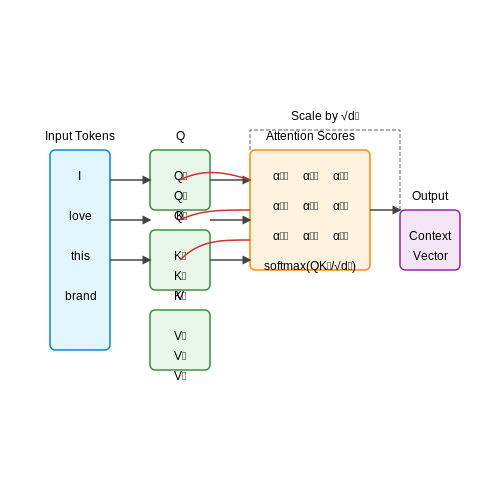
The self-attention mechanism relies on three fundamental vectors: the query (Q), key (K), and value (V). These vectors are derived from the input embeddings through learned linear transformations, enabling the model to dynamically weigh the importance of different parts of the input sequence.
Mathematical Derivation
Given an input matrix X of dimension n × d, where n is the sequence length and d is the embedding dimension, the query, key, and value matrices are computed as:
Here, WQ, WK, and WV are learnable weight matrices of dimension d × dk, d × dk, and d × dv, respectively. The dimensions dk and dv are typically chosen to be equal for simplicity, though they can vary in practice.
Role of Query, Key, and Value
- Query (Q) — Represents the current token's "question" about which other tokens are relevant. It is used to compute attention scores against all keys.
- Key (K) — Acts as an identifier for each token, allowing the model to determine how much a given query should attend to it.
- Value (V) — Contains the actual information that is aggregated based on the attention weights derived from Q and K.
Attention Score Calculation
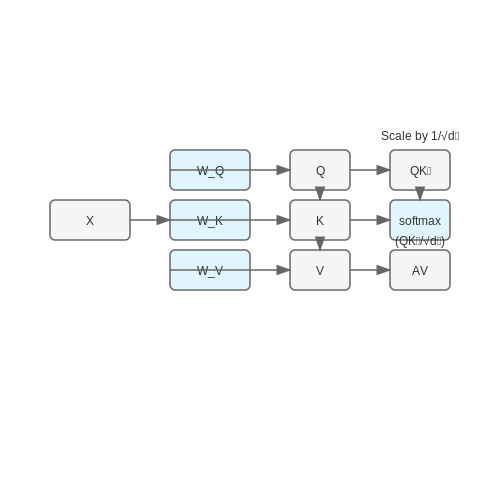
The attention scores are computed as scaled dot-products between queries and keys, followed by a softmax operation:
The scaling factor 1/√dk prevents the dot products from growing too large in magnitude, which would push the softmax into regions of extremely small gradients.
Practical Interpretation
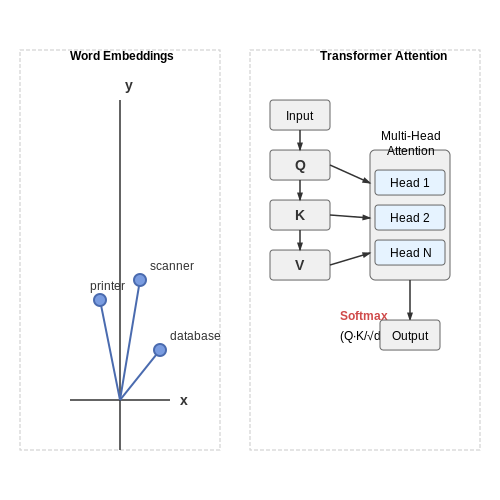
In transformer architectures, multiple attention heads compute these operations in parallel, allowing the model to capture diverse relationships across the sequence. For instance, one head might focus on syntactic dependencies while another captures long-range semantic associations.
This mechanism's efficiency lies in its ability to model pairwise interactions without recurrent computations, making it highly parallelizable and scalable to long sequences.

The Role of Dot-Product Attention
Dot-product attention is the computational core of the self-attention mechanism, enabling transformers to model relationships between all positions in a sequence with a single operation. Given input representations Q (queries), K (keys), and V (values), the attention weights are computed as scaled dot products between queries and keys, followed by a softmax normalization:
The scaling factor 1/√dk (where dk is the dimension of keys) prevents the dot products from growing too large in magnitude, which would push the softmax into regions with extremely small gradients. For high-dimensional keys, the dot product grows with O(√dk), making scaling critical for stable training.
Derivation of the Scaling Factor
Assume q and k are random vectors with components independently drawn from a distribution with mean 0 and variance 1. The dot product q·k has mean 0 and variance dk:
Scaling by 1/√dk ensures the variance remains O(1), preventing gradient saturation in the softmax. This is analogous to the Xavier/Glorot initialization principle applied dynamically to attention scores.
Parallel Computation and Efficiency
Dot-product attention is implemented as batched matrix multiplications, making it highly parallelizable on modern hardware. For a sequence of length n, the attention matrix has O(n²) entries, but the computation can be decomposed into:
This formulation allows efficient computation on GPUs/TPUs by leveraging optimized BLAS routines. The memory complexity, however, remains quadratic in sequence length, motivating research into sparse or linear attention variants for long sequences.
Interpretability and Visualization
The attention matrix P provides interpretable insights into token relationships. For example, in language tasks, rows often exhibit sharp peaks at syntactically or semantically related positions. Visualization tools like BertViz exploit this property to create dependency-style graphs from attention heads.
Multi-Head Extension
Multi-head attention extends the basic mechanism by applying h independent attention operations in parallel. Each head learns distinct projection matrices WiQ, WiK, WiV, enabling the model to jointly attend to information from different representation subspaces:
The output dimension is typically dmodel = h × dv, maintaining total parameter count comparable to single-head attention with dimension dmodel.
Scaling and Normalization in Attention Scores
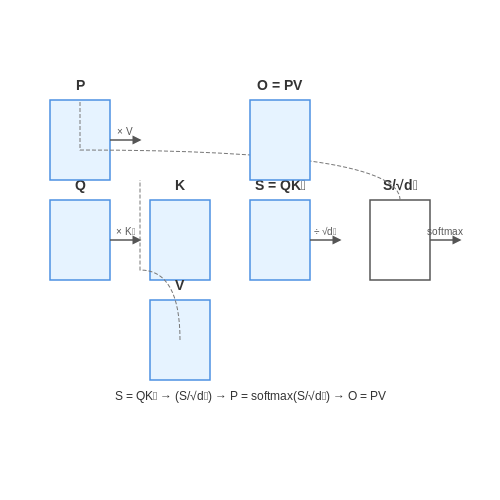
The raw dot-product attention scores computed between queries (Q) and keys (K) in self-attention mechanisms can exhibit high variance, particularly as the dimensionality of the input vectors increases. This variance leads to unstable gradients during training, making optimization difficult. To mitigate this, scaling and normalization techniques are applied to the attention scores before the softmax operation.
Dot-Product Attention Scaling
The standard scaled dot-product attention mechanism introduces a scaling factor of 1/√dk, where dk is the dimensionality of the key vectors. The scaled attention scores are computed as:
This scaling ensures that the dot products grow at a manageable rate with increasing dimensionality. Without scaling, the dot products can become extremely large in magnitude, pushing the softmax function into regions where it has extremely small gradients. The mathematical justification for this scaling factor stems from the variance properties of dot products between random vectors.
Variance Analysis of Dot Products
Consider query and key vectors q and k with components drawn independently from a distribution with zero mean and unit variance. The dot product q·k has mean zero and variance equal to dk:
Scaling by 1/√dk normalizes the variance to 1, maintaining stable gradients throughout the network. This becomes particularly important in deep architectures where attention mechanisms are stacked in multiple layers.
Alternative Normalization Approaches
While scaling by 1/√dk is the most common approach, other normalization techniques have been proposed:
- Layer Normalization: Applied to queries and keys before computing attention scores.
- Scale Norm: A learned scaling factor that adapts during training.
- Softmax Temperature: An additional temperature parameter τ controls the sharpness of the attention distribution: softmax(·/τ).
These alternatives can provide additional stability or flexibility in certain architectures, particularly when dealing with varying input lengths or multi-head attention mechanisms.
Practical Implications
The choice of scaling and normalization significantly impacts model performance. In practice, the standard scaling approach works well for most transformer architectures, but some variants like Reformer or Performer modify these mechanisms to improve computational efficiency while maintaining stable training dynamics. The scaling factor also interacts with initialization schemes - proper initialization of query and key projection matrices must account for the eventual scaling operation.
2. Step-by-Step Computation of Attention Weights
Step-by-Step Computation of Attention Weights
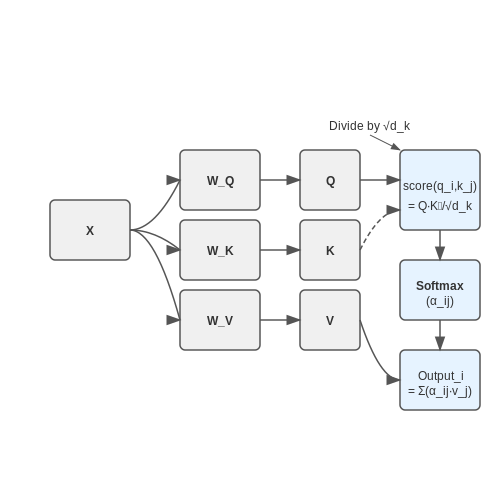
The self-attention mechanism computes attention weights by evaluating the relevance of each input token to every other token in the sequence. This process involves three primary components: queries (Q), keys (K), and values (V), derived from the input embeddings through learned linear transformations.
1. Projecting Inputs into Query, Key, and Value Spaces
Given an input sequence X of dimension n × dmodel, where n is the sequence length and dmodel is the embedding dimension, we compute:
Here, WQ, WK, and WV are weight matrices of dimension dmodel × dk, dmodel × dk, and dmodel × dv, respectively. Typically, dk = dv = dmodel/h, where h is the number of attention heads.
2. Computing Scaled Dot-Product Attention Scores
The attention scores measure the compatibility between queries and keys. For each query qi and key kj, the score is computed as:
The scaling factor 1/√dk prevents the dot products from growing too large in magnitude, which would push the softmax function into regions of extremely small gradients.
3. Applying Softmax for Normalized Attention Weights
The raw attention scores are converted into probabilities using the softmax function:
This ensures that the attention weights αij sum to 1 for each query position i, allowing the model to focus on the most relevant parts of the input sequence.
4. Computing the Output as a Weighted Sum of Values
The final output for each position is a weighted sum of the value vectors:
This step aggregates information from all positions in the sequence, with the weights determining how much each position contributes to the output at position i.
Practical Considerations
In practice, the computations are performed in parallel across all attention heads and then concatenated:
where each head computes its own attention weights independently. This parallel processing allows the model to capture diverse relationships within the input sequence.
For efficient computation, the entire process can be expressed in matrix form, leveraging optimized linear algebra operations on GPUs or TPUs. The self-attention mechanism's ability to model long-range dependencies makes it particularly effective in tasks like machine translation, text summarization, and image recognition.
2.2 Multi-Head Attention Mechanism
The single-head attention mechanism computes a weighted sum of values based on query-key compatibility, but this approach has limitations in capturing diverse relationships within the input sequence. Multi-head attention addresses this by parallelizing the attention computation across multiple attention heads, each with its own learned linear projections of queries, keys, and values.
Mathematical Formulation
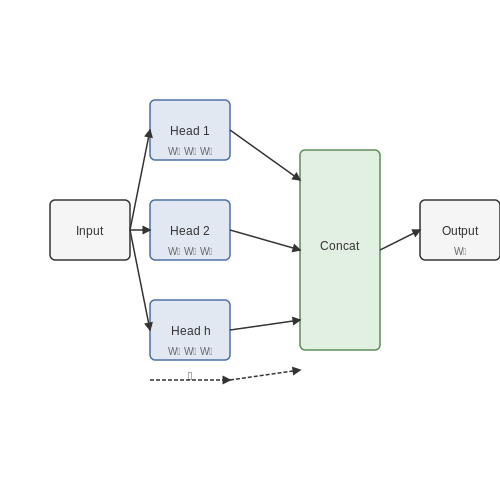
Given an input sequence X, multi-head attention first projects X into h distinct sets of queries, keys, and values using learned weight matrices:
where WiQ, WiK, and WiV are the projection matrices for the i-th head, each of dimensionality dmodel × dk, dmodel × dk, and dmodel × dv, respectively. Typically, dk = dv = dmodel/h to maintain computational efficiency.
Each head computes scaled dot-product attention independently:
The outputs of all heads are concatenated and linearly transformed to produce the final multi-head attention output:
where WO is an output projection matrix of dimensionality h·dv × dmodel.
Advantages of Multi-Head Attention
- Diverse Representation Learning: Each head can focus on different aspects of the input, such as syntactic or semantic relationships, enabling richer feature extraction.
- Parallelizability: Heads operate independently, making the computation highly parallelizable on modern hardware (e.g., GPUs/TPUs).
- Robustness: Reduces the risk of the model being dominated by a single attention pattern, improving generalization.
Practical Implementation Considerations
In practice, multi-head attention is implemented efficiently using batched matrix operations. For example, all heads can be computed simultaneously by reshaping the input projections:
where n is the sequence length. The tensors are then split into h heads along the feature dimension, and attention is computed in parallel.
Real-World Applications
Multi-head attention is a cornerstone of transformer architectures, enabling state-of-the-art performance in:
- Machine Translation: Captures long-range dependencies and alignment between source and target languages.
- Text Summarization: Identifies salient content by attending to different parts of the input document.
- Protein Structure Prediction: Models interactions between distant amino acids in protein sequences.
Visualization of Multi-Head Attention
A typical multi-head attention layer consists of multiple attention heads operating in parallel. Each head produces an attention map (a matrix of softmax scores) that highlights different input relationships. These maps are combined through concatenation and a final linear transformation.
Positional Encoding and Its Importance
The self-attention mechanism in transformers is permutation-invariant, meaning it treats input tokens as an unordered set. To inject sequential order information into the model, positional encoding is added to the input embeddings. This allows the model to leverage both the semantic meaning of tokens and their positions in the sequence.
Mathematical Formulation of Positional Encoding
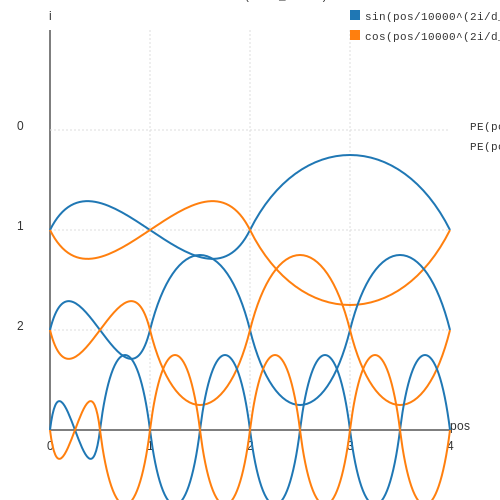
The original transformer paper (Vaswani et al., 2017) uses sinusoidal positional encoding defined as:
where pos is the position in the sequence, i is the dimension index, and dmodel is the embedding dimension. This formulation was chosen because:
- It allows the model to attend to relative positions since any offset k, PEpos+k can be represented as a linear function of PEpos.
- The wavelengths form a geometric progression from 2π to 10000·2π, capturing both short and long-range dependencies.
- Sin/cos functions are bounded between [-1, 1], preventing the encoding from dominating the learned embeddings.
Properties and Advantages
The sinusoidal encoding has several key properties that make it effective:
- Unique representation: Each position gets a unique encoding vector.
- Distance awareness: The dot product between two encodings decays smoothly with increasing distance between positions.
- Generalization: The model can extrapolate to sequence lengths longer than those seen during training.
For sequences longer than those in the training data, the sinusoidal patterns continue to provide meaningful position information, unlike learned positional embeddings which are limited to the maximum sequence length seen during training.
Alternative Approaches
While sinusoidal encoding is most common, other positional encoding schemes exist:
- Learned positional embeddings: Treat position indices as discrete inputs and learn embeddings end-to-end (used in BERT). Works well but doesn't generalize beyond trained sequence lengths.
- Relative position representations: Encode pairwise distances between tokens (Shaw et al., 2018). More computationally expensive but can capture local dependencies better.
- Rotary Position Embedding (RoPE): Applies rotation matrices to incorporate relative position information in attention scores (Su et al., 2021). Used in models like GPT-Neo.
Practical Implementation Considerations
When implementing positional encoding:
- The encoding is typically added (not concatenated) to the token embeddings before the first transformer layer.
- For variable-length sequences, the positional encoding can be computed up to the maximum sequence length needed.
- In some implementations, dropout is applied to the sum of token and positional embeddings.
- The choice between sinusoidal and learned embeddings often depends on whether generalization to longer sequences is required.
Modern architectures sometimes use variations like learned position embeddings that are interpolated for longer sequences or combinations of absolute and relative position information. The optimal approach depends on the specific application and sequence length requirements.
3. Building a Self-Attention Layer from Scratch
3.1 Building a Self-Attention Layer from Scratch
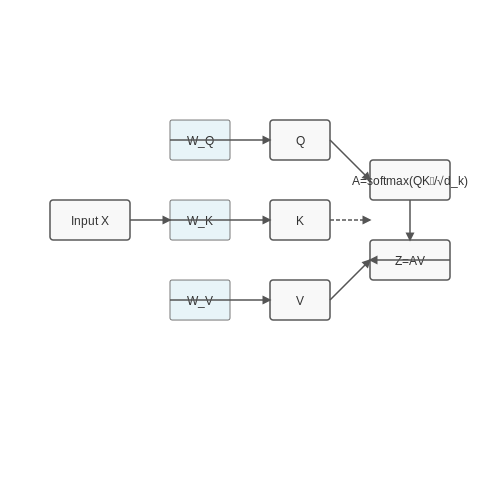
The self-attention mechanism computes a weighted sum of input representations, where the weights are dynamically derived from pairwise interactions between elements. Given an input sequence X ∈ ℝn×d (n tokens, d-dimensional embeddings), we derive query (Q), key (K), and value (V) matrices through learned linear transformations:
where WQ, WK, WV ∈ ℝd×dk are trainable weight matrices. The attention scores A ∈ ℝn×n are computed via scaled dot-products, followed by softmax normalization:
The scaling factor √dk prevents gradient saturation in softmax for large dk. The output Z ∈ ℝn×dv is a convex combination of value vectors:
Step-by-Step Implementation
For clarity, we implement the self-attention layer in PyTorch, highlighting critical steps:
import torch
import torch.nn as nn
import torch.nn.functional as F

class SelfAttention(nn.Module):
    def __init__(self, d_model, d_k, d_v):
        super().__init__()
        self.W_Q = nn.Linear(d_model, d_k)
        self.W_K = nn.Linear(d_model, d_k)
        self.W_V = nn.Linear(d_model, d_v)
        self.d_k = d_k

    def forward(self, X):
        Q = self.W_Q(X)  # (n, d_k)
        K = self.W_K(X)  # (n, d_k)
        V = self.W_V(X)  # (n, d_v)

        scores = torch.matmul(Q, K.transpose(-2, -1)) / (self.d_k ** 0.5)
        A = F.softmax(scores, dim=-1)
        Z = torch.matmul(A, V)
        return Z
Numerical Stability and Masking
For stable training, subtract the maximum logit before softmax to avoid overflow:
For autoregressive tasks (e.g., GPT), apply a causal mask to prevent attending to future tokens:
mask = torch.tril(torch.ones(n, n))  # Lower triangular
scores = scores.masked_fill(mask == 0, float('-inf'))
Multi-Head Extension
Multi-head attention splits computations across h parallel heads, allowing focus on different subspaces. Concatenated outputs are projected back to the original dimension:
where Zi is the output of the i-th head, and WO ∈ ℝhdv×d.
3.2 Integrating Self-Attention into Neural Networks
The self-attention mechanism, as introduced in the Transformer architecture, can be integrated into neural networks through several architectural modifications. The core idea involves replacing or augmenting traditional recurrent or convolutional layers with self-attention blocks, enabling the model to dynamically weigh the importance of different input tokens.
Architectural Integration Strategies
Self-attention can be incorporated into neural networks in three primary ways:
- Standalone self-attention layers: Complete replacement of recurrent or convolutional layers with multi-head self-attention blocks.
- Hybrid architectures: Combining self-attention with convolutional or recurrent layers to leverage both local and global dependencies.
- Attention-augmented networks: Adding self-attention as a parallel pathway to existing architectures.
Mathematical Formulation of Self-Attention Integration
The self-attention operation for an input sequence X ∈ ℝn×d (where n is sequence length and d is embedding dimension) is computed through learnable weight matrices:
where WQ, WK, WV ∈ ℝd×dk are learned projection matrices. The attention scores are then computed as:
Multi-Head Attention Implementation
Multi-head attention extends this by applying h parallel attention heads:
where each head computes independent attention:
Positional Encoding in Self-Attention Networks
Since self-attention is permutation-invariant, positional information must be explicitly injected. The standard approach uses sinusoidal positional encodings:
where pos is the position and i is the dimension. These are added to the input embeddings before the attention computation.
Practical Implementation Considerations
When integrating self-attention into neural networks, several practical aspects must be addressed:
- Computational complexity: Self-attention has O(n²) complexity with respect to sequence length, requiring optimization techniques like memory-efficient attention for long sequences.
- Gradient flow: Residual connections and layer normalization are crucial for stable training.
- Batch processing: Efficient implementation requires careful masking for variable-length sequences.
Case Study: Transformer Encoder Block
A complete Transformer encoder layer combines multi-head attention with position-wise feed-forward networks:
class TransformerEncoderLayer(nn.Module):
    def __init__(self, d_model, nhead, dim_feedforward=2048, dropout=0.1):
        super().__init__()
        self.self_attn = MultiheadAttention(d_model, nhead, dropout=dropout)
        self.linear1 = nn.Linear(d_model, dim_feedforward)
        self.dropout = nn.Dropout(dropout)
        self.linear2 = nn.Linear(dim_feedforward, d_model)
        self.norm1 = nn.LayerNorm(d_model)
        self.norm2 = nn.LayerNorm(d_model)
        self.dropout1 = nn.Dropout(dropout)
        self.dropout2 = nn.Dropout(dropout)

    def forward(self, src, src_mask=None):
        src2 = self.norm1(src)
        src2 = self.self_attn(src2, src2, src2, attn_mask=src_mask)[0]
        src = src + self.dropout1(src2)
        src2 = self.norm2(src)
        src2 = self.linear2(self.dropout(F.relu(self.linear1(src2))))
        src = src + self.dropout2(src2)
        return src
This implementation shows the key components: multi-head attention, residual connections, layer normalization, and position-wise feed-forward networks.
3.3 Common Pitfalls and Debugging Tips
Vanishing or Exploding Gradients in Self-Attention
Despite its advantages, self-attention mechanisms can suffer from vanishing or exploding gradients, particularly in deep architectures. The issue arises from the repeated multiplication of attention weights during backpropagation. The gradient of the loss L with respect to a query vector Q involves a chain of matrix multiplications:
where A is the attention output and S is the softmax-normalized score matrix. If the singular values of these Jacobians are not well-conditioned, gradients may vanish or explode. To mitigate this:
- Use Layer Normalization: Placing layer normalization before and after the attention layer stabilizes gradient flow.
- Scale Dot Products: Scaling the dot products by 1/√d_k (where d_k is the key dimension) prevents extreme values in the softmax input.
- Gradient Clipping: Enforce a maximum norm for gradients during backpropagation.
Over-Parameterization and Overfitting
Self-attention layers introduce a large number of parameters through the query, key, and value weight matrices. For a model with embedding dimension d and h attention heads, the total parameters scale as O(h·d²). Overfitting manifests as:
- High training accuracy but poor validation performance.
- Attention maps that are overly sparse or uniform.
Debugging strategies include:
- Dropout in Attention: Apply dropout to the attention scores (Pdrop ≈ 0.1–0.3) to prevent co-adaptation.
- Weight Decay: L2 regularization (λ ≈ 1e−4) on the projection matrices.
- Head Pruning: Remove low-impact heads via magnitude-based pruning or l1-regularization.
Inefficient Memory Usage
The self-attention mechanism has O(n²) memory complexity for sequence length n, which becomes prohibitive for long sequences (e.g., > 2048 tokens). Common symptoms include:
- Out-of-memory errors during training.
- Severe slowdowns with increased sequence length.
Solutions include:
- Memory-Efficient Attention: Use flash attention or block-sparse attention to reduce memory overhead.
- Chunking: Process the sequence in fixed-size chunks with overlap.
- Linear Attention Variants: Replace softmax with kernel approximations (e.g., Performer, Linformer).
Attention Collapse
In some cases, the attention mechanism fails to learn meaningful patterns, resulting in degenerate behaviors:
- Uniform Attention: All tokens receive equal attention weights (softmax outputs ≈ 1/n).
- Diagonal Dominance: Tokens attend only to themselves (attention matrix ≈ identity).
Debugging steps:
- Inspect Attention Maps: Visualize attention heads to identify collapse patterns.
- Diversify Initialization: Use orthogonal initialization for projection matrices.
- Auxiliary Losses: Add a diversity loss term to penalize uniform or diagonal attention.
Numerical Instability in Softmax
The softmax operation in attention can underflow for large input ranges. Given scores Si, the softmax is computed as:
For Si ≫ Sj, eS_i may exceed floating-point limits. To stabilize:
- Subtract the Maximum: Compute Si - max(S) before exponentiation.
- Log-Space Computations: Use log-softmax for gradient stability.
- Double Precision: Temporarily switch to float64 during softmax.
4. Self-Attention in Transformers and BERT
4.1 Self-Attention in Transformers and BERT
Mathematical Foundations of Self-Attention
The self-attention mechanism computes a weighted sum of input representations, where the weights are dynamically derived from pairwise interactions between elements. Given an input sequence X ∈ ℝn×d (n tokens, d dimensions), three learnable matrices WQ, WK, WV ∈ ℝd×dk project X into queries (Q), keys (K), and values (V):
The attention scores A ∈ ℝn×n are computed as scaled dot-products between queries and keys, followed by softmax normalization:
The scaling factor 1/√dk prevents gradient saturation in softmax for large dk. The output is a convex combination of values V weighted by A:
Multi-Head Attention in Transformers
Transformers extend this mechanism to h parallel attention heads, each with independent projection matrices. This allows the model to jointly attend to information from different representation subspaces. The outputs of all heads are concatenated and linearly projected:
where each head computes attention over reduced dimensions dk = d/h to maintain total computational cost comparable to single-head attention.
BERT's Bidirectional Self-Attention
BERT modifies the standard Transformer architecture by implementing bidirectional self-attention during pretraining. Unlike autoregressive models (e.g., GPT), each token in BERT attends to all other tokens in both directions. This is enabled through:
- Masked Language Modeling (MLM): 15% of tokens are randomly masked, and the model predicts them using bidirectional context.
- Next Sentence Prediction (NSP): The [CLS] token's representation is used to predict if two sentences are consecutive.
The attention patterns in BERT reveal hierarchical feature learning: lower layers focus on local syntax, while higher layers capture long-range semantic relationships.
Computational Complexity and Optimizations
Vanilla self-attention has O(n2d) complexity due to the QKT matrix multiplication. For long sequences, this becomes prohibitive. Common optimizations include:
- Block-Sparse Attention: Restricts attention to local windows (e.g., Longformer).
- Low-Rank Approximations: Factorizes the attention matrix (e.g., Linformer).
- Memory-Efficient Kernels: Computes softmax in chunks (e.g., FlashAttention).
Practical Implementation Considerations
When implementing self-attention in frameworks like PyTorch, key optimizations include:
- Precision: Mixed-precision training (FP16/FP32) reduces memory usage.
- Kernel Fusion: Combines multiple operations (softmax, scaling) into a single CUDA kernel.
- Causal Masking: For autoregressive tasks, applies upper-triangular mask to QKT.
4.2 Efficient Attention Mechanisms (Sparse, Linear)
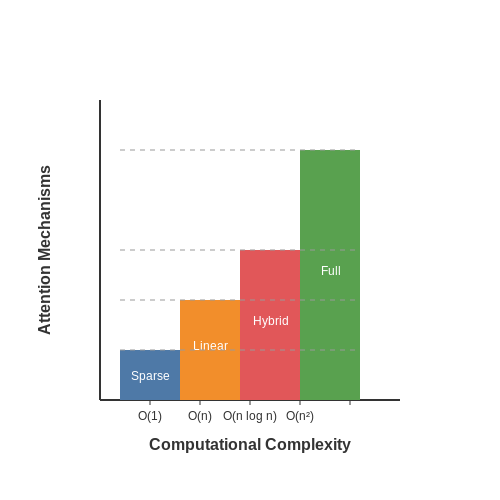
The quadratic complexity of standard self-attention, O(n²) for sequence length n, becomes computationally prohibitive for long sequences. Efficient attention mechanisms address this by introducing sparsity or linear approximations while preserving the expressive power of attention.
Sparse Attention
Sparse attention reduces computation by restricting the attention field to a subset of positions. The general form modifies the attention matrix A with a binary mask M:
Common sparse patterns include:
- Local windows: Each token attends only to its k-nearest neighbors (e.g., Longformer's sliding window attention).
- Strided patterns: Fixed intervals between attended positions (e.g., Sparse Transformer's strided attention).
- Block-sparse: Group tokens into blocks and compute attention only between selected blocks.
The Reformer model combines locality-sensitive hashing (LSH) with sparse attention, reducing complexity to O(n log n) by hashing similar queries and keys into the same buckets.
Linear Attention
Linear attention reformulates the attention operation to avoid computing the n×n matrix explicitly. The key insight is to decompose the softmax operation using the associative property of matrix multiplication:
where φ is a feature map that approximates the exponential kernel. Common choices include:
- Random Fourier features: φ(x) = cos(ωx + b) where ω is sampled from the softmax kernel's Fourier transform.
- Positive orthogonal random features (Performer): φ(x) = exp(-||x||²/2)h(x), where h(x) is a random orthogonal matrix.
- Polynomial kernels: φ(x) = (1 + x)^d for degree d.
The Linear Transformer demonstrates that with careful choice of φ, the approximation error can be bounded while reducing complexity to O(n).
Hybrid Approaches
State-of-the-art models often combine sparse and linear attention. For example:
- BigBird: Uses random, window, and global attention in a fixed sparse pattern.
- Routing Transformer: Dynamically clusters tokens and computes attention only within clusters.
- Linformer: Projects the n×d key/value matrices to k×d (where k ≪ n) using low-rank approximations.
Empirical studies show these methods can achieve 90-95% of the accuracy of full attention while reducing memory usage by 10-100× for sequences of length 4096 or longer.
4.3 Cross-Attention and Its Use Cases
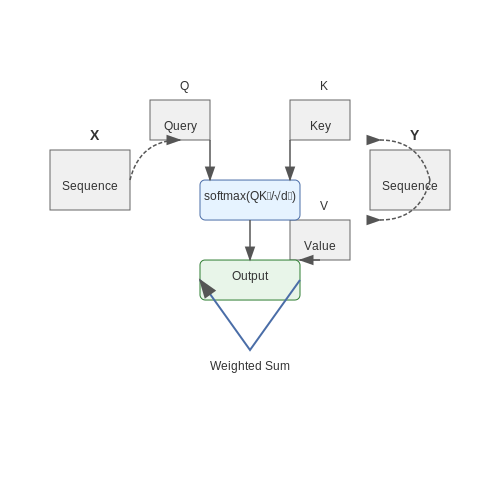
Cross-attention extends the self-attention mechanism by allowing one sequence to attend to another, enabling dynamic information exchange between distinct input modalities or representations. Unlike self-attention, where queries, keys, and values originate from the same sequence, cross-attention computes attention scores between two separate sequences. Given a primary sequence X and a secondary sequence Y, the cross-attention operation is defined as:
Here, Q is derived from X, while K and V are derived from Y. The scaling factor √dk stabilizes gradients during training. This mechanism is pivotal in encoder-decoder architectures, where the decoder attends to the encoder's hidden states.
Mathematical Derivation
Given input matrices X ∈ ℝn×d and Y ∈ ℝm×d, the query, key, and value projections are computed as:
where WQ, WK, WV ∈ ℝd×dk are learnable weight matrices. The attention scores A are then:
The output is a weighted sum of values V, with weights determined by A.
Use Cases and Applications
1. Machine Translation: In transformer-based models like Google's T5, cross-attention enables the decoder to focus on relevant parts of the source sentence during each decoding step, improving translation accuracy.
2. Multimodal Learning: Cross-attention bridges modalities (e.g., text and images) in architectures like CLIP or Flamingo. For instance, a text query can attend to image regions to generate captions or answer visual questions.
3. Memory-Augmented Networks: Systems like Memory Networks use cross-attention to retrieve information from external memory, enhancing context-aware decision-making in dialogue systems.
4. Cross-Document Coreference Resolution: By attending to entity mentions across documents, models can resolve references more accurately, as seen in architectures like Longformer.
Optimization Considerations
Cross-attention introduces computational overhead proportional to O(nm) for sequences of lengths n and m. To mitigate this, techniques like:
- Memory-Efficient Attention: Approximations such as Performer or Linformer reduce complexity to O(n log n).
- Sparse Attention: Restricting attention to fixed or learned sparse patterns, as in BigBird.
- Chunked Processing: Dividing long sequences into smaller chunks for hierarchical attention.
These optimizations are critical for scaling cross-attention to long sequences, such as in genomic data processing or high-resolution image analysis.
5. Key Research Papers on Self-Attention
5.1 Key Research Papers on Self-Attention
- PDF Inductive Biases and Variable Creation in Self-Attention Mechanisms — attention head self-attention layer scalar self-attention output Figure 1. Diagrams of attention modules f tf-head;f tf-layer;f tf-scalar described in Section3: alignment scores (grey edges) determine nor-malized attention weights (blue), which are used to mix the inputs x 1:T. Left: Attention with a general context z. Center: Self-attention
- Structured self-attention architecture for graph-level representation ... — The output tends to focus on the most influential part of input. Self-attention based Transformer [13] abandons the traditional deep architecture based on RNN or CNN and only retains the self-attention mechanism. Meanwhile, Graph Attention Networks (GATs) [18] introduce the self-attention mechanism to node-level classification of graph ...
- UNDERSTANDING ATTENTION MECHANISMS - OpenReview — these matrices as attention parameters. And for both global and self-attention, we jointly learn the network weights(w(1),w(2)) and attention parameters(ain global attention, value/key/query matrices in self-attention) at the same time. Therefore this naive global attention is a good starting point for analyzing attention mechanisms.
- Chapter 8 Attention and Self-Attention for NLP — 8.1.2 Luong-Attention. While Bahdanau, Cho, and Bengio were the first to use attention in neural machine translation, Luong, Pham, and Manning were the first to explore different attention mechanisms and their impact on NMT. Luong et al. also generalise the attention mechanism for the decoder which enables a quick switch between different attention functions.
- PDF SAC: Accelerating and Structuring Self-Attention via Sparse ... - NeurIPS — The self-attention mechanism has proved to benefit a wide range of fields and tasks, such as natural language processing (Vaswani et al., 2017; Dai et al., 2019), computer vision (Xu et al., 2015; ... 4 Sparse Adaptive Connection for Self-Attention The key point in SAC is to use to an LSTM edge predictor to predict edges for self-attention ...
- PDF Why Self-Attention is Natural for Sequence-to-Sequence Problems? A ... — The self-attention mechanism described above consists of one head, in the sense that we have one query, key, and value for each element of X. Similar to the way that we add more neurons to a layer of a fully connected neural network, we can add more heads to a self-attention, which gives a multihead attention. For a multihead attention with m
- arXiv:1906.04284v2 [cs.CL] 18 Jun 2019 — plies multi-head self-attention (see below) in com-bination with a feedforward network, layer nor-malization, and residual connections. The GPT-2 small model has 12 layers and 12 heads. Self-Attention: Given an input x, the self-attention mechanism assigns to each token x ia set of attention weights over the tokens in the input: Attn(x i) = ( i ...
- PDF Self-Attention Network for Skeleton-based Human Action Recognition — Figure 1: An example of self-attention response from the last self-attention layer. Eight frames are uniformly sam-pled from an action with the class 'put on jacket' and il-lustrated as frame 0 to 7. Frame 0 has the strongest cor-relation with the last frame, frame 7, at the fourth head, and attends heavily itself at the second head . Note
- PDF SANVis: Visual Analytics for Understanding Self-Attention Networks - WatVis — Figure 2: How a multi-head self-attention module works. Steps 1 and 2 correspond to the embedding layer, while Steps 3 to 6 correspond to a single-layer multi-head self-attention example. ies [6,7,27] aim to analyze the inner-workings of self-attention models. Such analysis helps users improve the model, such as in
- (PDF) Attention mechanism in neural networks: where it ... - ResearchGate — this mechanism to the self-attention, two variants are pre- sented: The first one, called multi-dimensional 'token2to- ken' self-attention generates context-aware coding for each
5.2 Recommended Books and Tutorials
- Understanding Attention Mechanisms in Deep Learning — In the era of artificial intelligence, understanding and interpreting complex models is crucial. This book delves into the principles and applications of attention mechanisms, exploring their role in enhancing model interpretability and performance. By leveraging attention mechanisms, we can develop more transparent, explainable, and efficient AI systems. Through detailed explanations and ...
- Chapter 8 Attention and Self-Attention for NLP | Modern Approaches in ... — Supervisor: Matthias Aßenmacher Attention and Self-Attention models were some of the most influential developments in NLP. The first part of this chapter is an overview of attention and different attention mechanisms. The second part focuses on self-attention which enabled the commonly used models for transfer learning that are used today.
- 8.5 Understanding Self-Attention - Lightning AI — This lecture introduced the attention mechanism with conceptual illustration. If you prefer a coding-based approach, also check out my article Understanding and Coding the Self-Attention Mechanism of Large Language Models From Scratch.
- PDF Self-Attention — 1 Introduction In this lecture, we will discuss the Self-Attention Mechanism. The di erent types of attention mechanisms have taken the deep learning world by storm; Attention has been found to improve neural network perfor-mance on a variety of tasks. Self-attention is at the heart of some of the latest NLP breakthroughs like OpenAI's GPT-3.
- Exploring Self-attention Mechanism of Deep Learning in Cloud ... - Springer — Self-attention Mechanism. For the sake of better filter out the features to get the network flow volume from the CNN layer, which is helpful to realize more accurate network traffic classification, we leverage the self-attention mechanism.
- 11.6. Self-Attention and Positional Encoding — Dive into Deep ... - D2L — 11.6.3. Positional Encoding Unlike RNNs, which recurrently process tokens of a sequence one-by-one, self-attention ditches sequential operations in favor of parallel computation. Note that self-attention by itself does not preserve the order of the sequence. What do we do if it really matters that the model knows in which order the input sequence arrived? The dominant approach for preserving ...
- 11. Attention Mechanisms and Transformers — Dive into Deep ... - D2L — 11. Attention Mechanisms and Transformers The earliest years of the deep learning boom were driven primarily by results produced using the multilayer perceptron, convolutional network, and recurrent network architectures.
- Speech emotion recognition using recurrent neural networks with ... — This paper tries to use self-attention mechanism and LSTM to explore the autocorrelation of phonemes in utterance. Self-attention mechanism can not only assign different weights to frames with different emotional intensity, but also find the autocorrelation between frames.
- What is the Self-Attention Mechanism in Transformers? - Medium — The self-attention mechanism is the cornerstone of modern NLP. By enabling models to focus on the most relevant parts of a sentence, it has unlocked new levels of performance and scalability.
- Attention Mechanisms and Transformers | SpringerLink — Attention mechanisms have revolutionized the field of natural language processing. Attention helps in focusing the learning process on important parts of the data, so that portions of the data that are most relevant for prediction are emphasized.
5.3 Open-Source Implementations and Tools
- Chapter 8 Attention and Self-Attention for NLP | Modern Approaches in ... — Supervisor: Matthias Aßenmacher Attention and Self-Attention models were some of the most influential developments in NLP. The first part of this chapter is an overview of attention and different attention mechanisms. The second part focuses on self-attention which enabled the commonly used models for transfer learning that are used today.
- 8.5 Understanding Self-Attention - Lightning AI — This lecture introduced the attention mechanism with conceptual illustration. If you prefer a coding-based approach, also check out my article Understanding and Coding the Self-Attention Mechanism of Large Language Models From Scratch.
- Self-Attention LSTM-FCN model for arrhythmia classification and ... — The LSTM takes the role of analyzing the connectivity of patterns to understand global-level relationships, and the self-attention module, consisting of a scaled dot-product attention mechanism, learns the cross-correlation between the LSTM-extracted global features for improved feature understanding.
- From Self-Attention to Markov Models: Unveiling the Dynamics of ... — Abstract Modern language models rely on the transformer architecture and attention mechanism to per-form language understanding and text genera-tion. In this work, we study learning a 1-layer self-attention model from a set of prompts and the associated outputs sampled from the model.
- Hybrid self-attention BiLSTM and incentive learning-based collaborative ... — The model achieves unparalleled accuracy in understanding user sentiments and preferences by integrating collaborative filtering, BiLSTM networks, and a hybrid self-attention mechanism.
- 3 Coding attention mechanisms - Build a Large Language Model (From Scratch) — The causal attention mechanism adds a mask to self-attention that allows the LLM to generate one word at a time. Finally, multi-head attention organizes the attention mechanism into multiple heads, allowing the model to capture various aspects of the input data in parallel.
- 11.6. Self-Attention and Positional Encoding — Dive into Deep ... - D2L — 11.6.3. Positional Encoding Unlike RNNs, which recurrently process tokens of a sequence one-by-one, self-attention ditches sequential operations in favor of parallel computation. Note that self-attention by itself does not preserve the order of the sequence. What do we do if it really matters that the model knows in which order the input sequence arrived? The dominant approach for preserving ...
- Self-Attention and Transformers | SpringerLink — The X and Y matrices have identical size. In this chapter, we will start with the description of attention and the encoder part of transformers and we will outline their implementation with programs in Python. PyTorch has also built-in modules for both attention and encoder layers that are ready to use.
- 11. Attention Mechanisms and Transformers — Dive into Deep ... - D2L — 11. Attention Mechanisms and Transformers The earliest years of the deep learning boom were driven primarily by results produced using the multilayer perceptron, convolutional network, and recurrent network architectures.