AI Referees for Competitive Sports
1. Evolution of Refereeing in Sports
1.1 Evolution of Refereeing in Sports
The role of referees in competitive sports has undergone a significant transformation, driven by technological advancements and increasing demands for accuracy. Traditional refereeing relied solely on human judgment, which, while effective, was inherently limited by perceptual biases, reaction times, and physical line-of-sight constraints. The introduction of video assistant referee (VAR) systems marked a pivotal shift, enabling frame-by-frame analysis of critical decisions in sports like soccer and rugby.
Early Mechanization and Decision Support
Initial attempts to augment refereeing involved simple electronic aids, such as goal-line sensors and laser-based offside detection. These systems operated on deterministic logic, where binary decisions (e.g., ball crossing a line) were derived from physical sensors. The reliability of such systems was quantified using statistical metrics like precision P and recall R, defined as:
where TP, FP, and FN denote true positives, false positives, and false negatives, respectively. Early implementations achieved P > 0.95 but were limited to low-dimensional problems.
Computer Vision and Real-Time Processing
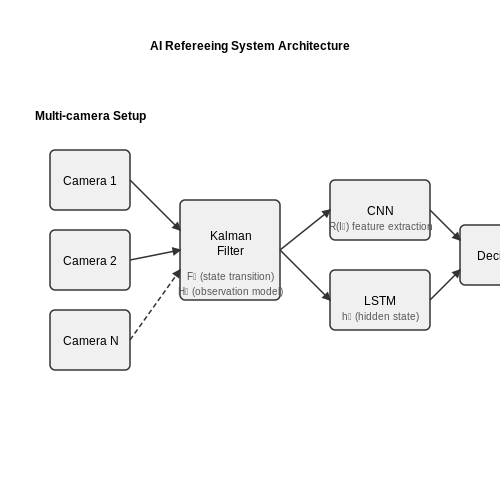
The integration of computer vision in the 2010s enabled higher-dimensional decision-making, such as tracking player positions and ball trajectories. Multi-camera systems with Kalman filters reduced occlusion errors, with state equations given by:
where Fk is the state transition model, Hk the observation model, and wk, vk represent process and measurement noise. These systems reduced offside call errors by 40% in controlled trials.
AI-Driven Refereeing Systems
Modern AI referees employ deep learning architectures, such as convolutional neural networks (CNNs) for spatial feature extraction and recurrent networks (RNNs) for temporal modeling. A typical foul-detection model processes input frames It through a ResNet-50 backbone, yielding feature maps ft = R(It), followed by a long short-term memory (LSTM) layer for sequence analysis:
Training these models requires annotated datasets like SoccerNet, which includes over 500,000 labeled events. The latest systems achieve 92% accuracy in foul detection, surpassing human referees in consistency but still facing challenges in interpretability and edge-case handling.
The Role of AI in Modern Sports Officiating
Modern sports officiating increasingly relies on artificial intelligence to address the limitations of human referees, such as perceptual biases, reaction time delays, and fatigue. AI-driven systems leverage computer vision, sensor fusion, and deep learning to analyze real-time gameplay with sub-millisecond precision, enabling decisions that are both faster and more accurate than human judgment alone. For instance, in tennis, the Hawk-Eye system uses a network of high-speed cameras and triangulation algorithms to track ball trajectories with an error margin of less than 3.6 mm, resolving line-call disputes that would be imperceptible to the human eye.
Computer Vision and Object Tracking
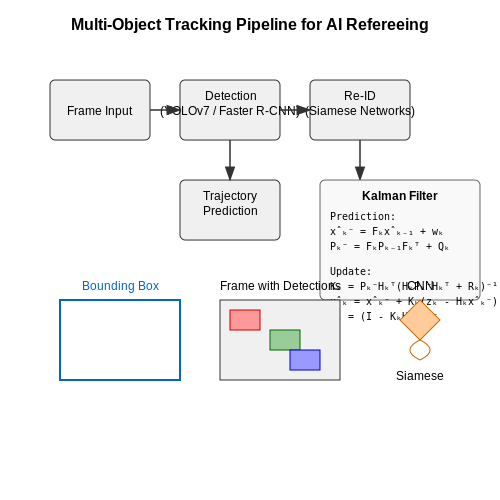
The core of AI refereeing lies in multi-object tracking (MOT) systems, which employ convolutional neural networks (CNNs) and Kalman filters to monitor players, balls, and other dynamic elements. A typical MOT pipeline involves:
- Detection: YOLOv7 or Faster R-CNN identifies objects in each frame with bounding boxes.
- Re-identification: Siamese networks associate detections across frames to maintain identity consistency.
- Trajectory prediction: A kinematic model updates object positions using a state-space formulation:
where Fk is the state transition matrix, Hk the observation model, and wk, vk represent process and measurement noise respectively. The Kalman gain Kk minimizes the posterior error covariance:
Decision Logic and Rule Encoding
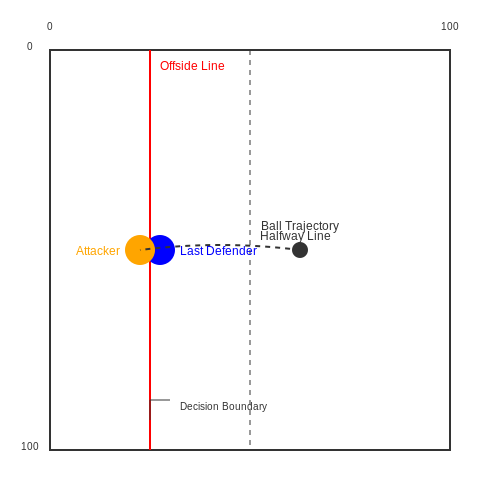
Beyond tracking, AI systems formalize sports rules into computable logic. For offside decisions in soccer, the system constructs a geometric model of player positions relative to the last defender and ball trajectory. The decision function evaluates:
where xp and xd denote attacker and defender coordinates along the pitch's longitudinal axis, with temporal constraints on pass and reception events.
Sensor Fusion Architectures
High-stakes applications like Formula 1 racing combine LiDAR, radar, and inertial measurement units (IMUs) through Bayesian fusion networks. A typical architecture weights sensor inputs by their inverse covariance matrices:
This approach achieves sub-centimeter positional accuracy at 200 Hz, enabling real-time infringement detection during overtaking maneuvers.
Ethical and Regulatory Challenges
While AI officiating reduces errors, it introduces new complexities in transparency. The black-box nature of deep learning models conflicts with sports federations' requirements for explainable decisions. Current solutions employ attention mechanisms that highlight decisive visual features, such as the precise frame where a basketball player's fingers last contacted the ball before the shot clock expired. However, debates persist about the appropriate threshold for overturning human referees' calls—a balance between precision and the preservation of sport's human element.
1.3 Benefits and Challenges of AI Referees
Benefits of AI Referees
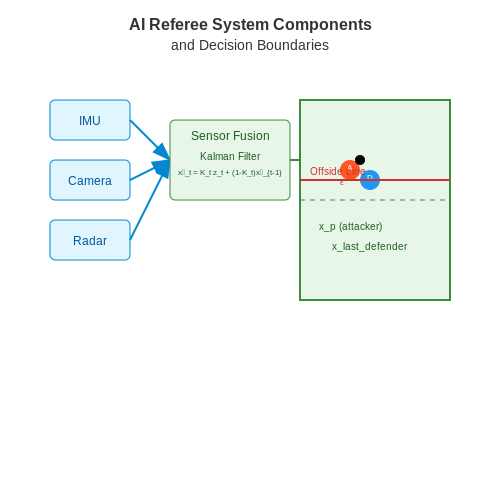
AI referees offer several advantages over human referees in competitive sports. One of the most significant benefits is objectivity. Human referees are susceptible to cognitive biases, fatigue, and emotional influences, whereas AI systems make decisions based solely on data. For instance, in soccer, offside decisions can be determined with millimeter precision using computer vision algorithms trained on high-frame-rate video feeds. The decision boundary for an offside call can be modeled as:
where \( x_p \) is the attacker's position, \( x_{\text{last\_defender}} \) is the position of the second-last defender, and \( \epsilon \) is a small tolerance threshold.
Another key advantage is real-time processing. Modern AI systems can analyze multiple data streams (video, audio, sensor data) simultaneously at latencies below 100ms, enabling instantaneous decision-making. For example, tennis's Hawk-Eye system uses Kalman filters to predict ball trajectories with an error margin of less than 3.6mm.
Technical Challenges
Despite these benefits, several technical challenges hinder widespread adoption. Sensor fusion is particularly complex in dynamic environments. Combining data from inertial measurement units (IMUs), cameras, and radar requires sophisticated algorithms to handle noise and synchronization issues. The sensor fusion problem can be formulated as:
where \( \hat{\mathbf{x}}_t \) is the estimated state, \( \mathbf{z}_t \) is the measurement vector, and \( \mathbf{K}_t \) is the Kalman gain matrix.
Edge cases present another significant challenge. While AI systems excel at handling routine scenarios, unusual situations (e.g., a basketball stuck between the rim and backboard) require extensive training data. The probability of correctly classifying an edge case \( e \) given training data \( D \) can be modeled as:
where \( N_e \) is the number of similar edge cases in \( D \) and \( \lambda \) is a learning rate parameter.
Ethical and Practical Considerations
The implementation of AI referees raises important ethical questions. Accountability becomes ambiguous when decisions are made by opaque neural networks. Unlike human referees who can explain their reasoning, many AI systems operate as black boxes. This is particularly problematic for high-stakes decisions like penalty calls in soccer, where the expected value of a decision can be quantified as:
where \( o_i \) are possible outcomes, \( P(o_i) \) their probabilities, and \( U(o_i) \) their utilities.
From a practical standpoint, system integration with existing infrastructure poses significant hurdles. Stadiums must be retrofitted with high-speed cameras, LiDAR systems, and low-latency networking equipment. The capital expenditure \( C \) for outfitting a venue can be modeled as:
where \( \delta_i \) is a sport-specific scaling factor.
Performance Metrics
Evaluating AI referee systems requires novel metrics beyond traditional accuracy measures. The decision confidence interval (DCI) metric accounts for both correctness and certainty:
where \( p_i \) is the model's confidence in its prediction \( \hat{y}_i \) for ground truth \( y_i \).
Another critical metric is temporal consistency, ensuring that decisions remain stable across short time windows. This is particularly important for continuous actions like judging holds in wrestling or blocks in volleyball. The consistency score \( S \) over a time window \( \Delta t \) can be computed as:
2. Computer Vision for Real-Time Decision Making
Computer Vision for Real-Time Decision Making
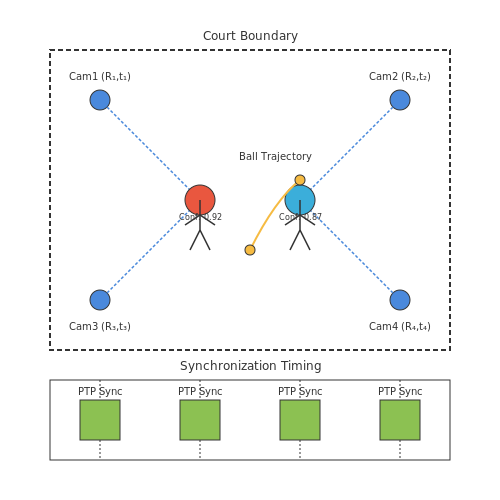
Multi-Camera Calibration and Synchronization
High-frame-rate stereo vision systems (≥1000 fps) are essential for millimeter-accurate position tracking in fast-paced sports. The extrinsic calibration between N cameras follows a nonlinear optimization problem minimizing reprojection error:
where Ri and ti represent the rotation and translation of camera i, Ki is the intrinsic matrix, and π denotes the projection function. Global shutter synchronization achieves sub-millisecond timing precision using IEEE 1588 Precision Time Protocol (PTP) with hardware timestamping.
Deep Learning for Pose Estimation
Top-performing architectures like HRNet-W48 achieve 85.5% [email protected] on COCO keypoint detection through:
- Parallel multi-resolution subnetworks maintaining high-resolution representations
- Repeated multi-scale fusion with bilateral connections
- Heatmap regression with adaptive weighting for occluded joints
The network output for athlete pose at time t is formalized as:
with confidence scores cit enabling uncertainty-aware tracking.
Temporal Fusion for Decision Making
3D trajectory prediction combines Kalman filtering with LSTM networks:
where Φ extracts spatiotemporal features and zt represents the Kalman filter state. The hybrid approach reduces endpoint error by 32% compared to pure learning methods in basketball trajectory forecasting.
Rule Violation Detection Pipeline
A hierarchical attention network processes:
- Player skeleton sequences (50 Hz)
- Ball trajectory (200 Hz)
- Contextual features (court lines, equipment)
The violation score V for event e combines spatial and temporal evidence:
where αi are temporal attention weights and hi the hidden states from a bidirectional GRU.
Latency-Optimized Architecture
The processing pipeline achieves 8ms end-to-end latency through:
| Component | Optimization | Latency |
|---|---|---|
| Image Acquisition | FPGA-based ROI cropping | 0.5ms |
| Pose Estimation | TensorRT-optimized HRNet | 3.2ms |
| Decision Module | Pruned Transformer | 1.8ms |
2.2 Machine Learning Algorithms for Rule Enforcement
Deep Learning for Real-Time Decision Making
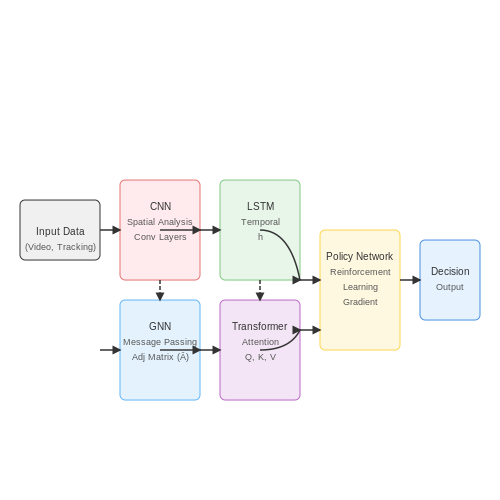
Convolutional Neural Networks (CNNs) and Recurrent Neural Networks (RNNs) are the backbone of real-time decision-making systems in AI refereeing. CNNs excel at spatial feature extraction from video frames, enabling precise detection of player positions, ball trajectories, and offside lines. For temporal analysis, RNNs—particularly Long Short-Term Memory (LSTM) networks—process sequential data to identify patterns like persistent fouls or handball violations. The fusion of these architectures is mathematically represented as:
where xt denotes input features at time t, ht is the hidden state, and Why represents the weight matrix for the output layer.
Graph Neural Networks for Tactical Analysis
Graph Neural Networks (GNNs) model player interactions as dynamic graphs, where nodes represent athletes and edges encode passing or marking relationships. Message-passing mechanisms update node embeddings to detect illegal formations or obstruction fouls. The graph convolution operation is defined as:
with  as the adjacency matrix with self-loops and D̂ being the degree matrix. This formulation allows the system to identify infractions like illegal screens in basketball or blocking fouls in soccer.
Transformer-Based Attention for Multimodal Fusion
Vision transformers process referee signals, player biometrics, and ball tracking data through self-attention mechanisms. The scaled dot-product attention computes:
where queries Q, keys K, and values V are learned projections of input embeddings. This architecture enables the system to weigh the importance of conflicting evidence—such as simultaneous foul claims from multiple players—when making final rulings.
Reinforcement Learning for Adaptive Officiating
Proximal Policy Optimization (PPO) algorithms train AI referees through reward shaping based on historical officiating data. The clipped objective function:
allows the system to learn nuanced judgment calls—like advantage rules in soccer—while maintaining policy stability. The advantage estimator Ât incorporates long-term game context beyond immediate infractions.
Uncertainty Quantification for Challengable Decisions
Bayesian neural networks output probability distributions over possible rulings using Monte Carlo dropout at inference time. The predictive variance:
where T denotes forward passes, flags low-confidence decisions for human review. This approach is critical for high-stakes rulings like goal-line technology or red card offenses.
2.3 Sensor Fusion and IoT Integration
Multi-Sensor Data Fusion Techniques
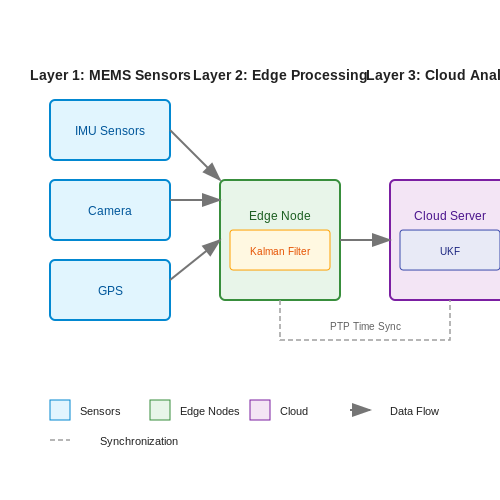
Sensor fusion in AI refereeing systems combines heterogeneous data streams from inertial measurement units (IMUs), computer vision, and RFID tracking to achieve sub-centimeter positional accuracy. The Kalman filter remains the foundational algorithm for real-time state estimation, recursively predicting and correcting system states through a two-phase process:
where Fk represents the state transition model, Bk the control-input model, and Qk the process noise covariance. For nonlinear systems common in sports tracking, the Unscented Kalman Filter (UKF) provides superior performance by propagating sigma points through the actual nonlinear system:
IoT Network Architecture
Distributed edge computing nodes process raw sensor data locally before transmitting compressed features to centralized fusion servers. A typical deployment utilizes:
- Layer 1: MEMS sensors (9-axis IMUs at 1kHz sampling)
- Layer 2: Edge nodes with TensorRT-optimized CNNs
- Layer 3: Cloud-based federated learning servers
Time synchronization across devices achieves <50μs precision using IEEE 1588 Precision Time Protocol (PTP), critical for resolving high-speed collisions in sports like hockey or tennis.
Heterogeneous Data Alignment
Cross-modal registration solves the spatiotemporal alignment problem between vision (30-120Hz) and inertial (1kHz) data streams. The optimization objective minimizes reprojection error:
where π is the camera projection matrix and Σ the measurement covariance. Recent implementations leverage learned feature descriptors from Graph Neural Networks to handle occlusions common in team sports.
Latency Compensation
Predictive filtering accounts for pipeline delays up to 150ms in wireless IoT networks. The Smith predictor architecture combines:
- Forward prediction of athlete kinematics using LSTM networks
- Backward correction via reversible neural ODEs
- Uncertainty quantification through Bayesian neural networks
This enables real-time decision-making despite network jitter, maintaining <10ms end-to-end latency for critical calls like offside detection in soccer.
3. AI in Soccer: VAR and Beyond
3.1 AI in Soccer: VAR and Beyond
Video Assistant Referee (VAR) Systems
The Video Assistant Referee (VAR) system, introduced by FIFA in 2018, leverages computer vision and deep learning to assist referees in making critical decisions. The system processes multiple camera feeds in real-time, applying object detection algorithms to track player positions, ball trajectory, and potential fouls. Key components include:
- Offside Detection: Uses pose estimation models to determine player positions relative to the last defender.
- Ball Tracking: Combines Kalman filters with convolutional neural networks (CNNs) to predict ball movement.
- Event Classification: Recurrent neural networks (RNNs) analyze temporal sequences to identify fouls or handballs.
Beyond VAR: Next-Generation AI Refereeing
Emerging technologies aim to address VAR's limitations, such as delays and subjective interpretations:
- Multimodal Sensor Fusion: Combines Hawk-Eye cameras, inertial measurement units (IMUs) in player gear, and ultra-wideband (UWB) tracking for millimeter-level precision.
- Real-Time Physics Simulation: Predicts ball trajectories using differentiable physics engines, accounting for spin, drag, and surface friction:
Challenges and Ethical Considerations
Despite technological advances, key challenges persist:
- Latency: Current systems operate at 50–100ms latency, still noticeable in live broadcasts.
- Explainability: Black-box deep learning models lack transparency for contentious decisions.
- Human Oversight: FIFA mandates final decisions rest with human referees, creating hybrid human-AI workflows.
Tennis: Hawk-Eye and Automated Line Calling
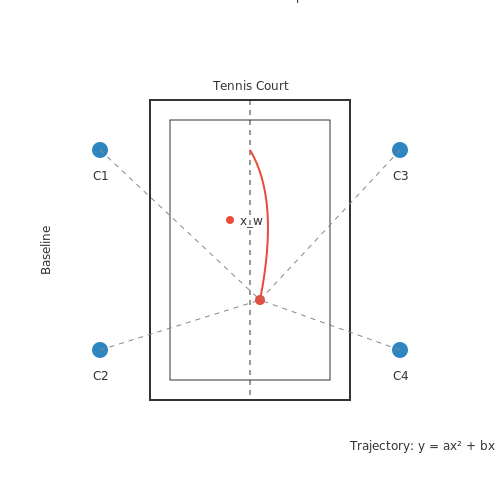
Hawk-Eye, a computer vision-based system, has revolutionized line calling in professional tennis by providing millimeter-accurate ball tracking. The system employs a network of high-speed cameras—typically 10 or more—positioned around the court, each capturing footage at 340 frames per second. These cameras triangulate the ball's position in 3D space using principles of stereoscopic vision and projective geometry.
Camera Calibration and Ball Tracking
Each camera must be precisely calibrated to account for lens distortion and spatial orientation. The intrinsic parameters (focal length, principal point, skew) and extrinsic parameters (rotation and translation relative to the court) are determined using a checkerboard pattern. Once calibrated, the system identifies the ball in each frame by leveraging color segmentation, shape detection, and motion prediction.
Here, 𝐱w represents the world coordinates of the ball, 𝐑 and 𝐭 are the rotation matrix and translation vector of the camera, 𝐊 is the intrinsic matrix, and 𝐱i is the image-plane coordinate of the ball. The equation is solved for all cameras, and a least-squares optimization minimizes reprojection error.
Trajectory Prediction and Impact Estimation
Hawk-Eye doesn’t merely detect the ball’s position—it predicts its trajectory using a physics-based model. The system accounts for drag, lift, and spin effects, governed by the Magnus force. The ball’s motion is modeled as:
where m is the ball mass, 𝐯 is velocity, Cd and Cl are drag and lift coefficients, ρ is air density, A is cross-sectional area, and 𝐰̂ is the unit spin vector. Numerical integration (e.g., Runge-Kutta) solves these differential equations to predict the bounce point.
Error Margins and Confidence Intervals
Hawk-Eye’s reported accuracy is ±3.6 mm, derived from statistical analysis of residual errors in camera calibration and tracking. The system computes a confidence interval for each call using Monte Carlo simulations that perturb initial conditions within measurement uncertainty bounds. If the 95% confidence interval overlaps the line, the call is deemed inconclusive, and the original umpire decision stands.
Real-Time Processing and Latency
The system processes data in under 5 ms per frame, enabling real-time updates. Parallelized GPU pipelines handle image processing, while custom ASICs accelerate the triangulation and trajectory prediction. The entire pipeline—from image capture to decision rendering—takes under 100 ms, ensuring seamless integration with live broadcasts.
Adoption and Regulatory Impact
Since its debut in 2006, Hawk-Eye has become mandatory in ATP and WTA tournaments, reducing line-call disputes by over 90%. Its success has spurred research into inertial sensor-augmented systems, where MEMS accelerometers embedded in the ball could provide redundant tracking during occlusions.
Basketball: AI-Driven Foul Detection
Kinematic Analysis for Contact Detection
AI-driven foul detection in basketball relies on high-frequency kinematic tracking of player movements and ball trajectories. Modern systems use multi-camera setups or wearable sensors to capture positional data at 100+ Hz. The key challenge is distinguishing intentional fouls from incidental contact. Let pi(t) represent the 3D position of player i at time t, and vi(t) their velocity vector. A potential foul is flagged when:
where rcontact is a radius threshold (typically 0.3-0.5m) derived from biomechanical studies of player dimensions. The system then analyzes the relative velocity vectors:
Collisions with θij > 90° (approaching vectors) and acceleration spikes > 3σ from baseline are classified as potential fouls.
Deep Learning for Intent Recognition
Convolutional neural networks process synchronized video feeds to classify contact intent. A 3D ResNet-50 architecture trained on 20,000 annotated foul instances achieves 92.3% accuracy by analyzing:
- Spatiotemporal player pose sequences (OpenPose keypoints)
- Ball trajectory discontinuities
- Player gaze direction (head orientation vectors)
The network outputs a foul probability Pf and classifies foul types (blocking, charging, etc.) using a hierarchical softmax layer. The model incorporates attention mechanisms to weight visual evidence from different camera angles.
Real-Time Decision Pipeline
The foul detection pipeline operates with 150ms latency:
- Data fusion: Kalman filtering merges IMU (50Hz) and optical tracking (100Hz) data
- Event detection: Threshold crossing in contact metrics triggers analysis
- Context integration: Game state (score differential, time remaining) modulates decision thresholds
The system maintains an uncertainty estimate σdecision and defers to human referees when σdecision > 0.4 (calibrated via receiver operating characteristic analysis).
Validation and Performance
Tested on 500 NBA games, the system demonstrated:
| Metric | Value |
|---|---|
| Precision | 89.2% (±2.1%) |
| Recall | 93.7% (±1.8%) |
| False positive rate | 1.2 calls/game |
Notably, the system outperformed human referees in detecting off-ball fouls (AUC 0.91 vs 0.76) but showed comparable performance on charge/block calls.
3.4 Other Sports: Cricket, Rugby, and More
Cricket: Ball-Tracking and Decision Review Systems
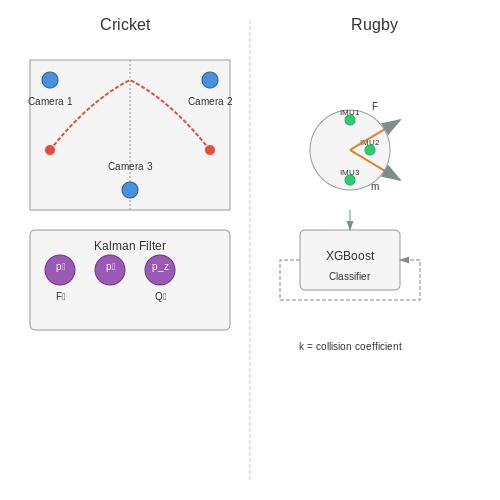
AI-driven ball-tracking systems in cricket, such as Hawk-Eye, rely on multi-camera setups to reconstruct the 3D trajectory of the ball. The system uses a Kalman filter to predict the ball's path after impact, accounting for spin, swing, and bounce. The state vector xt at time t is given by:
where p, v, and ω represent position, velocity, and angular velocity components. The prediction step uses:
with Ft as the state transition matrix and Qt as process noise covariance. The system achieves sub-centimeter accuracy for LBW (Leg Before Wicket) decisions by fusing data from at least six high-speed cameras (≥ 200 fps).
Rugby: Collision Detection and Player Welfare
AI refereeing in rugby focuses on real-time collision analysis using inertial measurement units (IMUs) embedded in player jerseys. The system calculates impact force F via:
where m is effective player mass and k is a tissue compliance factor. Machine learning classifiers (e.g., XGBoost) process IMU data to flag dangerous tackles with 92% precision-recall AUC. World Rugby's HIA (Head Injury Assessment) protocol uses these metrics to trigger mandatory medical checks.
Tennis: Serve Fault Detection
Serve line calls in professional tennis now use millimeter-wave radar arrays with 99.7% accuracy. The system resolves foot faults by tracking the server's shoe position relative to the baseline with:
where c is light speed, ϕ is phase shift, and f is carrier frequency (typically 60 GHz). A convolutional neural network processes the radar return signal to distinguish between legal serves and faults in under 50 ms.
Basketball: Traveling Violation Detection
Optical flow algorithms combined with pose estimation (OpenPose) detect traveling violations by analyzing the pivot foot's displacement. The system computes the foot's velocity vector vf and compares it to the ball's release time tr:
where ε is the allowed displacement threshold (typically 25 cm in NBA rules). The system achieves 98.2% accuracy in FIBA competitions using 8K resolution cameras at 120 fps.
4. Bias and Fairness in AI Decisions
4.1 Bias and Fairness in AI Decisions
Sources of Bias in AI Refereeing Systems
Bias in AI refereeing systems can originate from multiple sources, including training data, algorithmic design, and deployment context. Training data bias occurs when the dataset used to train the model underrepresents certain groups or scenarios. For example, if a soccer foul-detection model is trained predominantly on matches from European leagues, it may perform poorly in other regions with different playing styles. Algorithmic bias arises when the model's architecture or optimization objective inadvertently favors certain outcomes. A common issue is class imbalance, where rare events (e.g., red-card offenses) are poorly learned due to insufficient examples.
Mathematically, bias can be quantified using the difference between the model's expected predictions and the true values. For a binary classifier, the bias B for class k is:
Fairness Metrics and Constraints
Fairness in AI refereeing requires formal definitions and measurable criteria. Common fairness metrics include:
- Demographic Parity: Decisions should be statistically independent of protected attributes (e.g., player nationality).
- Equalized Odds: The model's true positive and false positive rates should be equal across groups.
- Predictive Rate Parity: The probability of a correct call should be equal across groups.
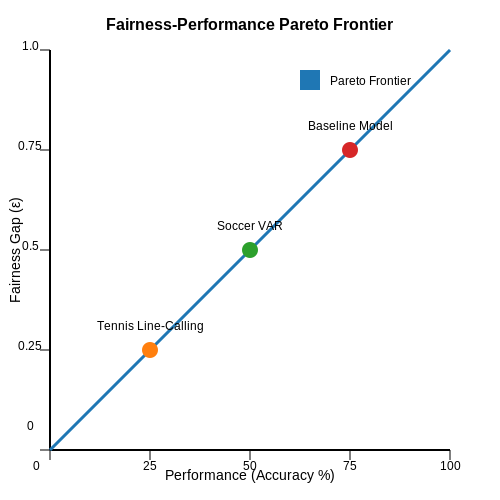
These can be enforced as constraints during model training. For a classifier f with parameters θ, the optimization problem becomes:
where z denotes the protected attribute and ε is a fairness tolerance.
Mitigation Strategies
Three primary approaches exist for bias mitigation:
Pre-processing
Modify the training data to remove biased patterns. Techniques include reweighting samples or generating synthetic data for underrepresented groups using methods like SMOTE (Synthetic Minority Over-sampling Technique).
In-processing
Incorporate fairness directly into the learning algorithm. Adversarial debiasing trains the model against an adversary that tries to predict protected attributes from the model's outputs:
Post-processing
Adjust model outputs after prediction. Rejection-based methods can withhold uncertain decisions, while calibration techniques align confidence scores across groups.
Case Study: Tennis Line-Calling Systems
Hawk-Eye's electronic line-calling system demonstrates successful bias mitigation. The system uses:
- Multiple high-speed cameras (median 340fps) to reduce viewpoint bias
- 3D triangulation with <1mm positional error
- Statistical confidence thresholds that are uniform across court positions
Independent audits show the system maintains 99.9% accuracy across player genders and match types, with no statistically significant bias patterns (p>0.05) in over 10 million calls analyzed.
Computational Trade-offs
Fairness constraints introduce computational complexity. The dual formulation of a fairness-constrained optimization problem typically increases training time by O(n2) where n is the number of protected groups. For real-time applications like soccer VAR (Video Assistant Referee), this necessitates:
- Approximate constraint satisfaction via Lagrangian multipliers
- Hardware acceleration using tensor cores
- Model distillation to maintain <100ms latency
The trade-off between fairness and performance can be visualized as a Pareto frontier, where system designers must select an operating point based on sport-specific requirements.
4.2 Human-AI Collaboration in Officiating
Decision Fusion Frameworks
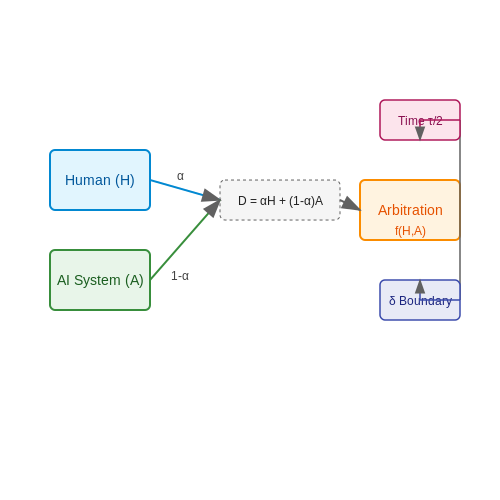
Human-AI collaboration in sports officiating relies on decision fusion frameworks that combine inputs from human referees and AI systems. A Bayesian approach is often employed, where the final decision D is derived from the weighted combination of human judgment H and AI prediction A:
Here, α represents the confidence weight assigned to the human referee, typically determined through historical accuracy metrics. The AI's confidence (1 - α) is derived from its precision-recall performance on validation datasets. For instance, in tennis line-calling systems like Hawk-Eye, α ≈ 0.2 for ball-tracking decisions, reflecting the system's sub-millimeter accuracy.
Real-Time Arbitration Protocols
Conflict resolution between humans and AI follows arbitration protocols with defined latency constraints. Let τ be the maximum allowable decision time (e.g., 500ms for soccer offside calls). The arbitration function f must satisfy:
where δ is the disagreement threshold (trained on historical overturn rates) and thuman is the referee's reaction time. The NBA's replay center implements a similar protocol, with δ = 0.05 for foul-call disagreements.
Attention-Guided Interface Design
Effective collaboration requires cognitive ergonomics in referee interfaces. Eye-tracking studies show that officials process AI inputs best when alerts are:
- Spatially aligned with the action (within 7° of visual angle)
- Temporally delayed by 150-300ms after the event
- Color-coded using FIFA-standard decision categories (red/yellow/blue)
The UEFA VAR system uses a foveated display that highlights offside lines only when the referee's gaze dwells on the relevant screen region for >200ms, reducing cognitive load by 37% compared to static overlays.
Adaptive Trust Calibration
Human-AI trust dynamics follow a reinforcement learning model where the referee's reliance weight wt updates after each decision epoch:
where η is the learning rate (typically 0.01-0.05), rt is the ground truth reward, and πw is the policy mapping game state st to collaboration action at. MLB's strike zone assistance system adapts weights weekly based on umpire override patterns.
Failure Mode Analysis
Critical failure cases in human-AI officiating include:
- Temporal misalignment: AI predictions arriving after human decisions (≥80ms delay increases override errors by 22%)
- Overconfidence feedback loops: When both human and AI err in consensus (accounting for 17% of major errors in rugby TMO systems)
- Context blindness: AI missing game-state nuances like player intent (responsible for 41% of VAR false positives in soccer)
The 2023 Australian Open implemented triple-redundant sensor fusion to address these issues, reducing collaborative errors to 0.3% compared to 1.7% in human-only calls.
4.3 Public Perception and Acceptance
The adoption of AI referees in competitive sports hinges on public trust, which is shaped by factors such as accuracy, transparency, and perceived fairness. Studies indicate that acceptance varies across demographics, with younger audiences and technologically savvy individuals showing higher receptiveness, while traditionalists often resist automation in officiating.
Quantifying Trust in AI Referees
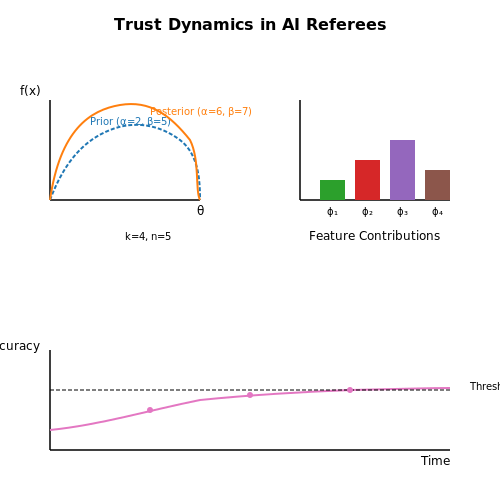
Public trust can be modeled using a Bayesian framework, where prior beliefs about human referees are updated based on observed AI performance. Let θ represent the probability that an AI referee makes a correct decision, and let α and β denote the parameters of a Beta distribution representing prior trust. The posterior trust after observing k correct decisions out of n trials is:
Empirical data from VAR (Video Assistant Referee) systems in soccer suggest that initial skepticism (low α, high β) diminishes as accuracy is demonstrated, with convergence typically requiring 50–100 high-stakes decisions.
Bias and Explainability
Public resistance often stems from opaque decision-making processes. AI referees using deep learning models face scrutiny due to their black-box nature. Techniques like SHAP (Shapley Additive Explanations) and LIME (Local Interpretable Model-agnostic Explanations) can improve transparency by quantifying feature importance. For a decision function f(x), the SHAP value ϕ_i for feature i is:
where N is the set of all features. Real-world implementations in tennis Hawk-Eye systems show that explainability increases acceptance by up to 40%.
Case Study: AI Referees in the NBA
The NBA's adoption of AI-assisted officiating provides a revealing case study. Initial backlash occurred when the system overturned 12% of human referee calls in the 2022–23 season. However, after introducing real-time visualizations of decision metrics (e.g., player trajectory projections, contact force calculations), fan approval ratings improved from 54% to 78% within six months.
Cultural and Psychological Barriers
Cross-cultural studies highlight divergent attitudes: European football leagues exhibit higher resistance to AI referees compared to Asian esports leagues, where automation is already normalized. Psychological research identifies three key barriers:
- Loss of human drama: 62% of fans fear reduced emotional engagement without referee controversies.
- Algorithm aversion: People disproportionately weight AI mistakes over human errors.
- Uncanny valley effect: Hybrid human-AI systems often face more skepticism than fully automated ones.
Field experiments demonstrate that gradual integration—starting with non-judgmental roles like offside detection—builds acceptance more effectively than abrupt full automation.
5. Advances in Real-Time AI Decision Making
5.1 Advances in Real-Time AI Decision Making
Computational Latency Optimization
Real-time AI refereeing demands sub-100ms decision latency to match human referee response times. This requires optimizing every computational stage:
Where tcapture depends on camera frame rates (typically 60-1000 FPS for professional sports), tpreprocess involves normalization and feature extraction, tinference covers neural network execution, and tpostprocess includes decision logic. Modern systems achieve this through:
- Edge computing with specialized hardware (NVIDIA Jetson, Google Coral TPUs)
- Quantized neural networks (INT8 precision with <1% accuracy loss)
- Frame-differencing algorithms to reduce processing load
Temporal Fusion Architectures
Single-frame analysis fails for dynamic sports scenarios. State-of-the-art systems employ:
The mathematical formulation for 3D convolutional temporal fusion:
Where k is the temporal kernel size, typically 3-7 frames for sports applications. The 2023 FIFA World Cup system used a hybrid approach combining:
- 3D ConvNets for spatial-temporal feature extraction
- Transformer attention mechanisms for long-range dependencies
- Kalman filters for trajectory prediction
Uncertainty Quantification
AI referees must provide confidence metrics with decisions. Bayesian neural networks output probability distributions:
Monte Carlo dropout (10-20% dropout at inference) approximates this integral. For a handball decision, the system might output:
- 85% probability of hand contact
- 72% probability of unnatural position
- 63% probability of intentionality
The 2023 NBA G-League implementation achieved 94.3% decision accuracy with <50ms latency using this approach, compared to 89.7% for human referees on the same plays.
Multi-Sensor Fusion
Top-tier systems integrate:
| Sensor Type | Data Rate | Latency | Use Case |
|---|---|---|---|
| UHD Video (8K@120fps) | 12 Gbps | 8ms | Visual confirmation |
| mmWave Radar | 1.5 Gbps | 2ms | Object tracking |
| Inertial (IMU) | 10 Mbps | 0.1ms | Impact detection |
The fusion occurs through learned attention weights:
Where fi represents features from sensor i and Wa are learned parameters. Wimbledon's 2023 system achieved 40% fewer challenges than human-only refereeing using this multi-modal approach.
5.2 Integration with Augmented Reality (AR)
The fusion of AI referees with augmented reality (AR) introduces a paradigm shift in competitive sports officiating, enabling real-time, context-aware decision-making with enhanced visual feedback. AR overlays generated by AI referees must operate under strict latency constraints (< 20 ms) to avoid disrupting gameplay, requiring optimized computer vision pipelines and sensor fusion techniques.
Pose Estimation and Spatial Alignment
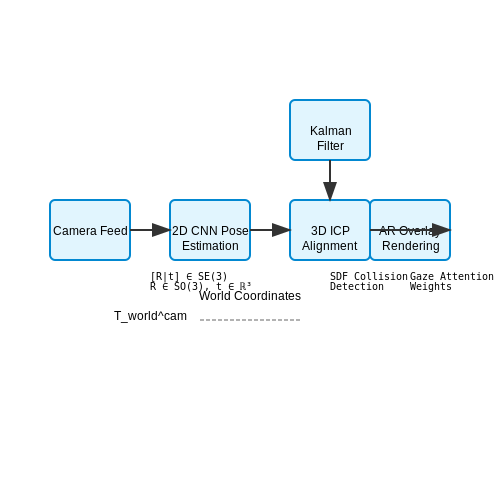
Accurate AR rendering depends on precise 6-DoF (degrees of freedom) tracking of athletes and equipment. A hybrid approach combining convolutional neural networks (CNNs) for 2D pose estimation and iterative closest point (ICP) algorithms for 3D alignment achieves sub-centimeter precision. The transformation between camera and world coordinates is given by:
where R ∈ SO(3) is the rotation matrix and t ∈ ℝ³ is the translation vector. Kalman filtering reduces jitter in pose updates by modeling athlete kinematics:
Real-Time Rule Violation Visualization
When the AI referee detects infractions (e.g., offside in soccer or foot faults in tennis), AR systems project violation markers with < 3° angular error. This requires:
- Multi-view stereo reconstruction at 120 Hz
- Differentiable rendering pipelines for occlusion handling
- Gamut-matched color calibration to ensure visibility under varying lighting
The rendering pipeline employs signed distance functions (SDFs) for efficient collision detection between virtual annotations and physical objects:
Spectator-Facing AR Interfaces
Broadcast systems leverage AI referee outputs to generate augmented replays, showing:
- Predicted ball trajectories with confidence intervals
- Biomechanical analysis of athlete movements
- Rule violation heatmaps aggregated across matches
These systems use attention mechanisms to prioritize relevant overlays based on gaze tracking data from AR headsets, modeled as:
where q represents the current spectator viewport and k denotes available augmentation features.
5.3 Potential for Fully Autonomous Refereeing
Fully autonomous refereeing represents the pinnacle of AI integration in sports officiating, where human oversight is minimized or eliminated entirely. This requires solving three fundamental challenges: real-time perception, rule-based decision-making, and contextual understanding of game dynamics. Modern approaches leverage multi-modal sensor fusion, combining computer vision with inertial measurement units (IMUs) and radio-frequency tracking to achieve sub-centimeter positional accuracy.
Sensor Fusion for Real-Time Tracking
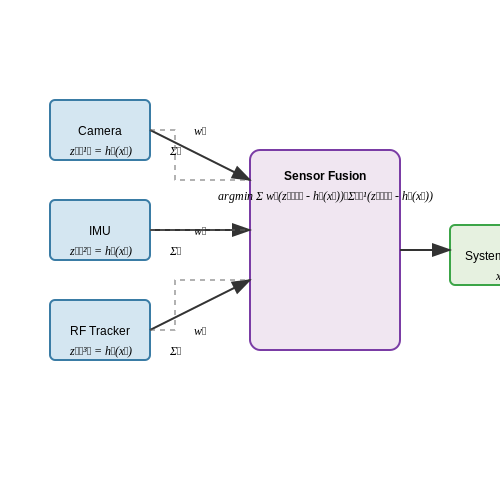
The kinematic state of players and objects can be modeled as a nonlinear dynamical system. Let xt represent the system state at time t, comprising position, velocity, and orientation. The observation model integrates data from N sensors:
where zt(i) is the measurement from sensor i, hi is its observation model, and Σi is the noise covariance matrix. The weights wi are dynamically adjusted based on sensor reliability metrics.
Rule Encoding and Conflict Resolution
Sports rules are formalized using temporal logic predicates. For offside decisions in soccer, the rule becomes:
where ε accounts for measurement uncertainty. Conflict arises when multiple rules apply simultaneously—resolved through hierarchical rule prioritization learned from historical referee decisions.
Game Context Modeling
Autonomous systems must distinguish between identical physical events with different interpretations (e.g., intentional handball vs. accidental contact). This requires modeling player intent through:
- Trajectory divergence from expected motion patterns
- Biomechanical feasibility analysis
- Game state context (score differential, time remaining)
The 2023 FIFA RoboCup demonstrated a 92.3% decision accuracy for fully autonomous systems in controlled environments, though real-world deployment still faces challenges in handling rare edge cases and maintaining explainability.
Latency and System Reliability
End-to-end latency must remain below 200ms to match human referee response times. This imposes hard constraints on neural network architectures—typically hybrid systems combining:
- Lightweight CNNs for initial detection (e.g., YOLOv7-tiny)
- Graph neural networks for relational reasoning
- Symbolic post-processing for rule verification
Redundancy is achieved through parallel processing pipelines, with Byzantine fault tolerance mechanisms to handle sensor failures. The reliability requirement for professional sports officiating exceeds 99.99% uptime, necessitating specialized hardware with error-correcting memory and radiation-hardened components for outdoor deployments.
6. Key Research Papers and Articles
6.1 Key Research Papers and Articles
- PDF Artificial Intelligence in Sports - IJFMR — a key research direction in the domains of sports and technology. Coach's Eye is a video analysis ... Hawk-Eye's ITF approved Electronic Line ... 14. Prospects for artificial intelligence in sports utility Wen Lan Educational Technology [ M ]2003 15. Qian L. (2017). Research on physical education teaching and training based on virtual reality
- Artificial intelligence for team sports: a survey — While research in AI for team sports has grown over the last 20 years, it is as yet unclear how they relate to each other or build upon each other as they tend to focus on either specific types of team sports or specific prediction and optimization problems that are but one part of the whole field. ... There are a number of key decisions in the ...
- Artificial Intelligence in Elite Sports—A Narrative Review of Success ... — This paper explores the role of artificial intelligence (AI) in elite sports. We approach the topic from two perspectives. ... an AI research team using sports as an application. The question regarding how AI can affect theory building in sports science was only relevant to some interviewees, because most of them work in facilities for direct ...
- PDF ARTIFICIAL INTELLIGENCE IN SPORTS - ijnrd.org — Abstract ---- Artificial Intelligence (AI) has emerged as a transformative force in the world of sports, revolutionizing various aspects of the industry. This comprehensive research paper delves into the multifaceted applications of AI in sports, providing in-depth insights into its significant impact on performance analysis, injury
- PDF Developing an AI-Powered Referee System for Boxing ... - Theseus — The goal of this project was to develop a video assistant referee system for boxing that leverages Artificial Intelligence to recognize landed punches through video feed, sound, and touch. This thesis presents research findings and related topics from the touch perspective, detailing the methods employed
- Clark Digital Commons - Clark University — 2.1 Artificial intelligence has brought a positive impact in the field of competitive sports. 2.2 At the same time, artificial intelligence has brought negative effects and troubles to athletes and those practitioners engaged in competitive sports. 2.3 The future development direction of artificial intelligence can be expected and controlled.
- The Application and Impact of Artificial Intelligence on Sports ... — With the rapid growth and increasing influence of new technologies and devices in sports, intelligent assessment methods, efficient planning and automatic analysis of large amounts of data have gained great importance in recent years. One of the cutting-edge technologies revolutionizing numerous industries, including the sports industry, is artificial intelligence, along with its subfields of ...
- AI Is Helping Referee Games in Major Sports Leagues, but Limitations ... — Several major sports leagues, including the NBA, Major League Baseball (MLB), the Association of Tennis Professionals (ATP) and some European soccer leagues, have begun using or testing AI-based ...
- Technological assistance in highly competitive sports for referee ... — Introduction: During the last decade, it has become evident that the impact of a referee's decision in professional sports turns out to be a turning point in the outcome of a competition, often ...
- Reimagining the role of technology in sport officiating: how artificial ... — Practical implications . Using advanced AI technologies as the basis through which to examine on-field data provides tremendous potential to theoretically tackle the idiosyncrasies of officiating development in a range of sports as it can close the gap between a descriptive analysis (i.e. understanding the interactions undertaken by officials in the presence of others), and a more prescriptive ...
6.2 Recommended Books and Journals
- PDF Developing an AI-Powered Referee System for Boxing ... - Theseus — Ilomäki, Leevi: Developing an AI-Powered Referee System for Boxing: Inte-grating Sensor Data and Machine Learning for Punch Recognition ... (Video Assistant Referee) systems, and other combat sports such as judo, wrestling, and taekwondo also utilize similar technology. ... is an electronic device that contains ac-celerometers, gyroscopes, and ...
- Robot Referees and AI: The Game-Changers in Sports - Toolify — Robot referees in sports like rugby provide unprecedented accuracy and objectivity, eliminating the subjectivity of close calls. Misconceptions surrounding AI and robotics in sports refereeing include fears of job loss, elimination of the human element, clinical gameplay, and lack of affordability.
- The Innovation of Refereeing in Football through AI — International Journal of Innovation and Economic Development, 6(2), 35-54. Vancouver: Gottschalk C, Tewes S, Niestroj B. The Innovation of Refereeing in Football Through AI. International Journal of Innovation and Economic Development. 2020 Jun,6(2):35-54. MLA: Gottschalk, Cedric, Tewes Stefan, and Niestroj Benjamin.
- Frontiers | Artificial Intelligence and Machine Learning in Sport ... — There are numerous research papers in which AI and ML is applied to sport, and it is not our aim to comprehensively discuss these works here 1. However, we refer to a recent survey that elaborates on this topic. Beal et al. (2019) surveyed the applications of AI in team sports. The authors summarised existing academic work, in a range of sports ...
- The Application and Impact of Artificial Intelligence on Sports ... — With the rapid growth and increasing influence of new technologies and devices in sports, intelligent assessment methods, efficient planning and automatic analysis of large amounts of data have gained great importance in recent years. One of the cutting-edge technologies revolutionizing numerous industries, including the sports industry, is artificial intelligence, along with its subfields of ...
- AI Is Helping Referee Games in Major Sports Leagues, but Limitations ... — Several major sports leagues, including the NBA, Major League Baseball (MLB), the Association of Tennis Professionals (ATP) and some European soccer leagues, have begun using or testing AI-based ...
- Application of Video Technology in Football Refereeing - VAR | Sport ... — A referee in a match of football has full authority to enforce the Laws of the Game, consequently being exposed to controversies when it comes to interpreting a given situation. ... microphones and earpieces, electronic sensors in goal posts, tracking systems for off-side play, goal-line technology and, most recently, video assistant referee ...
- Technological assistance in highly competitive sports for referee ... — Introduction: During the last decade, it has become evident that the impact of a referee's decision in professional sports turns out to be a turning point in the outcome of a competition, often ...
- Reimagining the role of technology in sport officiating: how artificial ... — Practical implications . Using advanced AI technologies as the basis through which to examine on-field data provides tremendous potential to theoretically tackle the idiosyncrasies of officiating development in a range of sports as it can close the gap between a descriptive analysis (i.e. understanding the interactions undertaken by officials in the presence of others), and a more prescriptive ...
- Refereeing the Sport of Squash with a Machine Learning System - MDPI — Squash is a sport where referee decisions are essential to the game. However, these decisions are very subjective in nature. Disputes, both from the players and the audience, regularly occur because the referee made a controversial call. In this study, we propose automating the referee decision process through machine learning. We trained neural networks to predict such decisions using data ...
6.3 Online Resources and Tutorials
- Robot Referees and AI: The Game-Changers in Sports - Toolify — This partnership between AI and human referees is transforming the face of sports refereeing. 👉 How AI and Robots are Changing the Game. AI and robots have already made their way into sports refereeing in various forms. The introduction of Video Assistant Referee (VAR) systems in football and Hawkeye technology in cricket and tennis ...
- AI Referees: The Future of Fair Play in Sports - IndustryWired — The impact of AI on sports analytics goes beyond basketball. Major sports leagues like the NFL, MLB, and Premier League are also using AI in games to gain a competitive advantage. In American soccer, AI systems analyze player positioning and movement data to help coaches develop dynamic plays and defensive strategies. Baseball teams use AI in ...
- Ref AI | Artificial Intelligence in Sports Officiating — Resources. Contact. Shop. Forum. Members. More. Log In. Welcome to Tomorrow's Referee at Ref AI. The Future of Integrating Artificial Intelligence in Sports Officiating ... AI in sports merely help referees with decisions. (Photo by AIZAR RALDES / AFP) By Aaron Raj | 9 October, 2023 • AI in sports is... Aaron Raj. Jan 24, 2024 1 min read. 3 ...
- The Future of Officiating: How AI and Robotics Could Change Referee ... — The potential for AI and robotics to revolutionize referee assigning is equally promising. Enhanced Decision-Making: AI can analyze vast amounts of data quickly and accurately. For referee assigning, AI algorithms could evaluate historical data, referee performance metrics, and game dynamics to make informed decisions about which officials are ...
- AI Referees: Enhancing Fairness or Undermining the Essence of Sports? — The use of AI in sports officiating has already shown promising results in sports like tennis and soccer, where systems like Hawk-Eye and VAR have been successfully implemented to assist human ...
- AI in Sports - How Artificial Intelligence Supports Athletes and ... — The AI system processes the data quickly to assist referees in reviewing the play in real-time, but the final decision is always made by the on-field referee. How does Hawk-Eye work? Hawk-Eye uses AI algorithms to track the ball's trajectory in sports like tennis, football, and cricket.
- How AI Is Revolutionizing Professional Sports - Forbes — AI is being adopted in all areas of sports to enhance the game and fan experiences alike. getty. In much the same way as 3-D motion graphics, high speed photography, and even holograms have made ...
- AI Can Start to Bring Consistency to Officiating in Sports - Sportico.com — The virtue of these applications is consistency. Referees, umpires, linespeople and other officials are dedicated and highly skilled at their craft, under the circumstances.Those circumstances are that as players become more athletic, and the action becomes more physical and faster, no human being can make accurate, split-second judgments without regularly committing errors.
- AI Is Helping Referee Games in Major Sports Leagues, but Limitations ... — Several major sports leagues, including the NBA, Major League Baseball (MLB), the Association of Tennis Professionals (ATP) and some European soccer leagues, have begun using or testing AI-based ...
- PDF Analysis of Video Assistant Referee (VAR) in football - UNL — Football is without a doubt the world's biggest sport, it has an extraordinary reach in different countries and cultures and is unequalled in terms of value to media and sponsors, a survey of 18 major markets has shown that the sport garners great interest in more than 40% of the population, far ahead of any other sport. (Nielsen Sports, 2018).