Autonomous Research Assistants for Literature Review
1. Definition and Core Capabilities
Definition and Core Capabilities
An autonomous research assistant for literature review is an AI-driven system designed to automate the process of discovering, analyzing, and synthesizing academic literature. Unlike traditional search tools, these assistants employ machine learning, natural language processing (NLP), and knowledge representation techniques to extract meaningful insights from large-scale scholarly datasets. Core capabilities include semantic search, citation network analysis, summarization, and trend detection.
Semantic Understanding and Retrieval
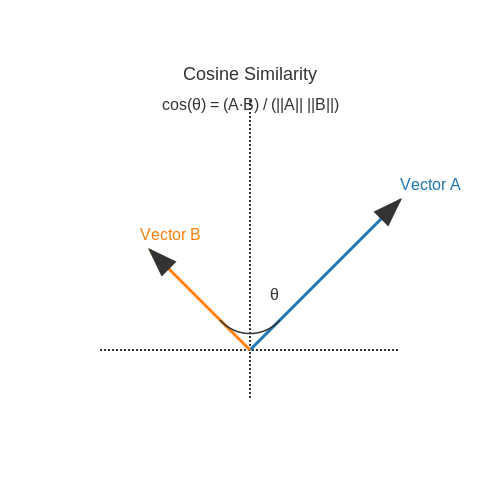
Traditional keyword-based search engines rely on lexical matching, often missing relevant papers due to vocabulary mismatch. Autonomous research assistants leverage transformer-based models like BERT or SciBERT, fine-tuned on academic corpora, to perform semantic search. Given a query q and a document d, the relevance score S(q, d) is computed using cosine similarity in a high-dimensional embedding space:
where E represents the embedding function. This allows retrieval of conceptually related papers even without exact keyword matches.
Citation Network Analysis
Beyond content, these systems analyze citation graphs to identify influential works and emerging trends. Using algorithms like PageRank or community detection, they quantify a paper's impact and cluster related research. For a citation network represented as a directed graph G = (V, E), where nodes V are papers and edges E are citations, the importance score I(v) of a node v can be computed iteratively:
where α is a damping factor typically set to 0.85.
Automated Summarization
Extractive and abstractive summarization techniques condense lengthy papers into concise overviews. Extractive methods select salient sentences using metrics like TF-IDF or neural relevance scoring, while abstractive methods generate new text via sequence-to-sequence models. Hybrid approaches, such as those incorporating pointer-generator networks, balance fidelity and readability.
Trend Detection and Gap Analysis
By applying topic modeling (e.g., Latent Dirichlet Allocation) or dynamic embedding techniques, these systems identify shifts in research focus over time. Temporal word embeddings, for instance, track semantic drift in key terms across decades, revealing emerging fields or declining topics. Gap analysis flags understudied intersections between domains, suggesting novel research directions.
Integration with Research Workflows
Advanced systems offer API integrations with reference managers (e.g., Zotero, Mendeley) and collaborative platforms (e.g., Overleaf). Some incorporate active learning, where user feedback refines future recommendations. For example, a reinforcement learning loop may adjust retrieval rankings based on which papers a researcher bookmarks or cites.

1.2 Key Components: NLP, Knowledge Graphs, and Retrieval Systems
Natural Language Processing (NLP) for Semantic Understanding
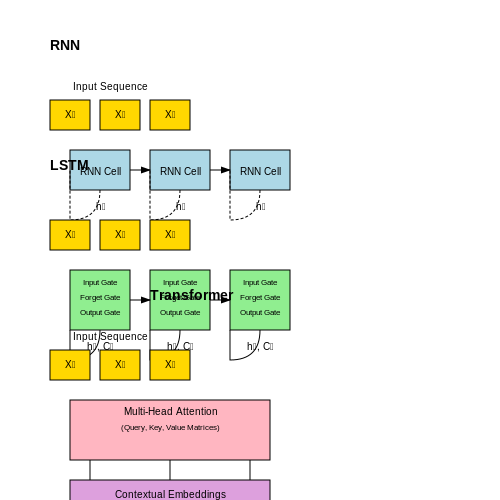
Modern autonomous research assistants rely on NLP to parse and interpret scientific literature at scale. Transformer-based architectures, such as BERT and GPT variants, enable deep semantic understanding through self-attention mechanisms. The attention weights αij between tokens i and j are computed as:
where eij represents the scaled dot-product of query and key vectors. Advanced systems employ domain-specific pretraining on corpora like PubMed or arXiv, followed by fine-tuning for tasks like:
- Named entity recognition (NER) for extracting key concepts
- Relation extraction to identify causal or comparative statements
- Textual entailment to verify hypothesis-supporting evidence
Knowledge Graph Construction and Reasoning
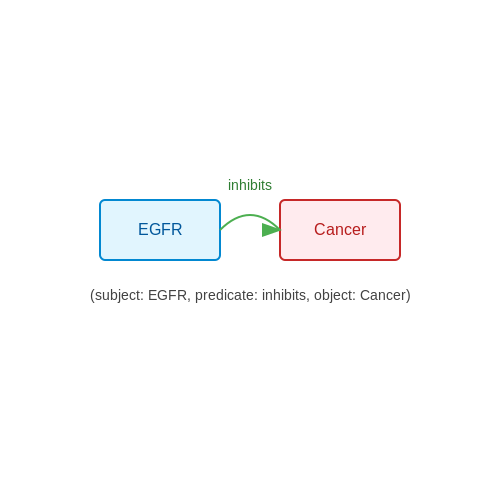
Extracted entities and relations are structured into knowledge graphs using RDF triples (subject-predicate-object). A biomedical knowledge graph might represent:
Graph neural networks (GNNs) perform multi-hop reasoning over these structures. The message-passing operation at layer l updates node embeddings hv(l) as:
Hierarchical Retrieval Systems
Two-stage retrieval architectures combine:
- Dense retrieval: Uses bi-encoders to map queries and documents to a shared embedding space, optimized via contrastive loss:
- Neural re-ranking: Applies cross-encoders to the top-k candidates for precision, using attention over full document text
State-of-the-art systems like ColBERT employ late interaction, storing token-level embeddings for efficient MaxSim operations:
1.3 Comparison with Traditional Literature Review Methods
Efficiency and Scalability
Traditional literature reviews rely on manual search, selection, and synthesis of academic papers, often requiring weeks or months to complete. In contrast, autonomous research assistants leverage natural language processing (NLP) and machine learning to process thousands of papers in hours. The computational efficiency is quantified by the time complexity of search algorithms, where traditional methods operate linearly O(n), while AI-driven approaches employ approximate nearest neighbor (ANN) search with sublinear complexity O(log n).
Coverage and Recall
Human reviewers are constrained by cognitive biases and practical limits on the number of papers they can reasonably assess. Autonomous systems, however, achieve near-complete coverage of relevant literature by:
- Indexing multiple databases (PubMed, arXiv, IEEE Xplore) simultaneously
- Applying transformer-based models to identify semantically related work beyond keyword matches
- Continuously updating their knowledge base as new papers are published
Reproducibility and Transparency
Traditional reviews suffer from reproducibility challenges due to undocumented search strategies and subjective inclusion criteria. AI systems provide:
- Version-controlled search protocols
- Complete audit trails of paper selection decisions
- Quantitative confidence scores for each recommendation
Bias Mitigation
Human reviewers exhibit confirmation bias and preferential attachment to well-cited works. Autonomous agents employ:
- Debiasing techniques in word embeddings
- Citation network analysis to surface overlooked papers
- Active learning to identify and correct sampling biases
Cost Structure Analysis
The economic comparison reveals fundamentally different cost drivers:
| Factor | Traditional | AI-Assisted |
|---|---|---|
| Marginal cost per paper | Increases linearly | Decreases asymptotically |
| Fixed costs | Training researchers | Model development |
| Opportunity cost | High (researcher time) | Low (automation) |
Error Profiles
Both approaches exhibit distinct failure modes. Human errors tend toward:
- Oversight of relevant papers (false negatives)
- Inclusion of marginally relevant works (false positives)
AI systems instead face:
- Semantic misunderstanding of novel concepts
- Over-reliance on citation metrics
- Hallucination of non-existent references
Hybrid Approaches
The most effective implementations combine AI scalability with human judgment through:
- Human-in-the-loop validation systems
- Uncertainty quantification to flag borderline cases
- Interactive visualization of the literature landscape
2. Data Ingestion and Preprocessing Pipelines
Data Ingestion and Preprocessing Pipelines
Autonomous research assistants rely on robust data ingestion and preprocessing pipelines to transform raw academic literature into structured, machine-readable formats. The pipeline begins with document acquisition, where heterogeneous sources—PDFs, HTML pages, or XML-based repositories—are programmatically retrieved. For PDF extraction, tools like PyPDF2 or pdfminer.six parse text and metadata, while BeautifulSoup handles HTML/XML documents. A critical challenge is handling OCR errors in scanned documents; convolutional neural networks (CNNs) with spatial transformer layers can correct skew and noise:
where STN is a spatial transformer network and ⊕ denotes pixel-wise fusion.
Text Normalization and Semantic Chunking
Raw text undergoes Unicode normalization (NFKC form), followed by sentence segmentation using transformer-based models like SciSpacy (trained on academic texts). For semantic chunking, a bidirectional LSTM with conditional random fields (CRF) identifies logical sections (e.g., abstract, methodology) by learning hierarchical document structures:
where fₖ are transition features between states yi-1 and yi, and gₗ are state-observation features.
Metadata Enrichment and Entity Linking
Extracted text is augmented with metadata from Crossref or PubMed APIs, including DOI, authorship, and citation networks. Named entity recognition (NER) models like BioBERT or SciBERT identify domain-specific terms (e.g., gene names, chemical compounds), which are linked to knowledge bases (e.g., Wikidata, MeSH) via vector similarity in embedding spaces:
where ve and vk are embeddings for the extracted entity and knowledge base entry, respectively.
Quality Control and Pipeline Monitoring
Data drift is monitored using statistical tests (Kolmogorov-Smirnov for text feature distributions) and embedding-based metrics like:
where JS is Jensen-Shannon divergence between training and current data distributions. Airflow or Prefect orchestrates pipeline stages with automatic retries for API failures.
Code Implementation: PDF Text Extraction
from pdfminer.high_level import extract_text
import re

def preprocess_pdf(pdf_path: str) -> str:
    raw_text = extract_text(pdf_path)
    text = re.sub(r'-\n(\w+)', r'\1', raw_text)  # Hyphenation fix
    text = re.sub(r'\s+', ' ', text).strip()
    return text

# Example: Process a research paper
paper_text = preprocess_pdf("neurobiology_2023.pdf")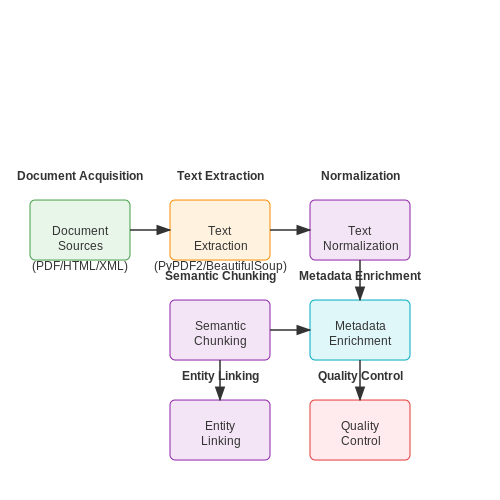
Semantic Search and Document Retrieval
Vector Embeddings and Semantic Similarity
Traditional keyword-based search relies on lexical matching, which fails to capture semantic relationships between terms. Modern semantic search leverages dense vector embeddings, where documents and queries are mapped to a high-dimensional vector space. The similarity between two texts is computed using the cosine similarity of their embeddings:
State-of-the-art embedding models like BERT, RoBERTa, and T5 generate context-aware representations by processing entire sentences through deep transformer architectures. The resulting vectors encode syntactic and semantic features, enabling matches between conceptually related but lexically distinct terms (e.g., "ML" and "machine learning").
Dense Retrieval Architectures
Dense retrieval systems employ dual-encoder frameworks:
- Query Encoder: Maps the search query to an embedding vector.
- Document Encoder: Pre-computes embeddings for all documents in the corpus.
At query time, the system performs approximate nearest neighbor (ANN) search using algorithms like HNSW or FAISS to efficiently retrieve the top-k most similar document vectors. The computational complexity is reduced from O(N) to O(log N) through hierarchical navigable small world graphs or product quantization.
Cross-Encoder Reranking
Initial dense retrieval is often followed by a cross-encoder reranking stage, where the query and each candidate document are processed together through a more computationally intensive model. This allows for deeper interaction between query and document terms:
Popular implementations use BERT-style architectures fine-tuned on relevance datasets like MS MARCO. While slower than dual-encoders, cross-encoders achieve higher precision by modeling term-level interactions.
Practical Implementation Considerations
For large-scale deployment:
- Indexing throughput: Document encoders must process millions of papers/hour (distributed GPU batches)
- Query latency: ANN search should return results in <100ms (optimized C++/CUDA implementations)
- Dynamic updates: Incremental indexing for newly published papers (delta-encoding strategies)
Open-source frameworks like Haystack and Jina provide production-ready pipelines combining these components with configurable tradeoffs between accuracy and speed.
Evaluation Metrics
System performance is measured using:
- nDCG@k: Discounted cumulative gain accounting for result ranking
- Recall@k: Fraction of relevant documents retrieved in top k results
- MRR: Mean reciprocal rank of first relevant result
Benchmarks on scientific corpora show dense retrievers outperform BM25 by 15-30% on these metrics when evaluated on conceptual queries requiring semantic understanding.
2.3 Summarization and Knowledge Extraction Techniques
Neural Abstractive Summarization
Transformer-based models like BART, T5, and PEGASUS excel at abstractive summarization by generating novel sentences that capture key information from source documents. The core mechanism relies on encoder-decoder attention, where the encoder processes the input text and the decoder generates the summary autoregressively. Given an input document D with n tokens, the encoder produces contextual embeddings:
The decoder then generates summary tokens yt at each step t by attending to both previous outputs and encoder states:
Recent advancements incorporate reinforcement learning with ROUGE as a reward signal to optimize for coherence and factual consistency.
Structured Knowledge Extraction
For transforming unstructured text into knowledge graphs, modern pipelines combine:
- Named Entity Recognition (NER): BERT-based models fine-tuned on domain-specific corpora achieve F1 scores >0.9 in identifying entities
- Relation Extraction: Dual-encoder architectures project entity pairs into a relation space using contrastive learning
- Event Extraction: Graph neural networks model event-argument structures through edge prediction
The knowledge graph construction process can be formalized as:
Multi-Document Aggregation
When processing hundreds of papers, hierarchical attention networks outperform simple aggregation by:
- Computing document-level importance scores using citation graph analysis
- Applying cross-document coreference resolution to merge equivalent entities
- Generating contradiction-aware summaries through entailment prediction
The document relevance score αi for document Di in corpus C can be computed as:
where hcit represents citation network features and hcls is the document's [CLS] embedding.
Fact Verification and Hallucination Mitigation
State-of-the-art systems employ three verification mechanisms:
- Retrieval-Augmented Generation: Grounding outputs in retrieved evidence using dense passage retrieval
- Neural Fact-Checking: Fine-tuning DeBERTa on FEVER dataset to detect unsupported claims
- Uncertainty Quantification: Monte Carlo dropout to estimate prediction confidence intervals
The factual consistency score between claim c and evidence E is computed as:
where σ denotes the sigmoid function and TF-IDF provides lexical matching signals.
Integration with Academic Databases and APIs
API Authentication and Rate Limiting
Academic databases such as IEEE Xplore, PubMed, and Scopus enforce strict authentication protocols, typically using OAuth 2.0 or API keys. For programmatic access, the authentication flow follows:
Rate limits vary by provider—Elsevier’s ScienceDirect API permits 10 requests/second, while IEEE Xplore imposes a 5-request burst limit with a 1-second cooldown. Exponential backoff algorithms are essential for handling HTTP 429 responses:
Query Optimization for Scholarly Metadata
Efficient query construction requires understanding database-specific syntax:
- PubMed: Uses MeSH terms with Boolean operators (
[Title/Abstract] AND ("machine learning"[MeSH])) - Scopus: Supports field-specific queries (
TITLE-ABS-KEY("transformer architectures") AND PUBYEAR > 2017) - arXiv API: Accepts LaTeX-style mathematical expressions in queries
Handling Paginated Responses
Large result sets are paginated with cursor-based or offset/limit patterns. For Scopus API responses, the metadata structure includes:
{
   "search-results": {
      "opensearch:totalResults": "1245",
      "opensearch:startIndex": "0",
      "entry": [
         {
            "@_fa": "true",
            "dc:title": "Attention Is All You Need",
            "prism:doi": "10.48550/arXiv.1706.03762"
         }
      ]
   }
}
Citation Graph Extraction
CrossRef’s REST API enables citation network reconstruction through recursive queries. The citation density C for a paper with n references follows:
Where deg+(ri) represents the out-degree (citations) of reference i. OpenAlex provides precomputed citation graphs with millisecond latency.
Real-Time Alert Systems
Webhook integrations with databases enable live updates. The IEEE Xplore alert system uses HMAC-SHA256 signatures for payload verification:
import hmac
import hashlib

def verify_signature(payload, secret_key, received_sig):
   computed_sig = hmac.new(
      secret_key.encode(),
      payload.encode(),
      hashlib.sha256
   ).hexdigest()
   return hmac.compare_digest(computed_sig, received_sig)
Data Normalization Challenges
Discrepancies in author disambiguation (ORCID vs. institutional IDs) and journal naming (ISO 4 abbreviations vs. full titles) require fuzzy matching algorithms. The Levenshtein distance D between two affiliations is computed as:
3. Transformer-Based Models for Text Understanding
Transformer-Based Models for Text Understanding
Architecture and Self-Attention Mechanism
The transformer architecture, introduced by Vaswani et al. (2017), relies entirely on self-attention mechanisms without recurrent or convolutional layers. The core operation is scaled dot-product attention, which computes the relevance of each word in a sequence to every other word. Given input embeddings X, the model projects them into queries (Q), keys (K), and values (V) matrices:
where WQ, WK, and WV are learned projection matrices. The attention scores are computed as:
The scaling factor 1/√dk prevents gradient vanishing issues when dk (the dimension of keys) is large. Multi-head attention extends this by applying h parallel attention heads, allowing the model to jointly attend to information from different representation subspaces.
Positional Encoding and Layer Normalization
Since transformers lack recurrence, positional encodings are added to input embeddings to inject information about token positions. The original paper uses sinusoidal functions of varying frequencies:
where pos is the position and i is the dimension. Layer normalization is applied before residual connections in each sub-layer (attention and feed-forward networks) to stabilize training:
Pre-training and Fine-tuning Paradigm
Modern transformer-based models like BERT and GPT follow a two-phase approach:
- Pre-training: Models learn general language representations through masked language modeling (BERT) or autoregressive prediction (GPT) on large corpora.
- Fine-tuning: The pre-trained model is adapted to downstream tasks (e.g., classification, QA) with task-specific layers and smaller labeled datasets.
For literature review automation, models can be fine-tuned on scientific text corpora using objectives like:
- Citation prediction
- Keyphrase extraction
- Semantic similarity between papers
Efficient Variants for Long Documents
Standard transformers have O(n2) memory complexity for sequence length n, making them impractical for long documents. Recent architectures address this:
- Longformer: Uses a combination of local windowed attention and task-specific global attention.
- BigBird: Implements random, windowed, and global attention with theoretical guarantees.
- Reformer: Employs locality-sensitive hashing to reduce attention complexity to O(n log n).
The attention pattern for Longformer can be formalized as:
where w is the window size and 𝒢 is the set of global attention positions.
Knowledge-Enhanced Transformers
For scientific literature analysis, models can be augmented with external knowledge:
- Entity Linking: Connect mentions to knowledge bases (e.g., UMLS for biomedical texts).
- Graph Neural Networks: Incorporate citation networks or concept graphs.
- Retrieval-Augmented Generation: Access external databases during inference (e.g., RAG models).
The knowledge injection process typically modifies the attention computation:
where Kext and Vext represent external knowledge embeddings.
Clustering and Topic Modeling Approaches
Dimensionality Reduction for Text Representation
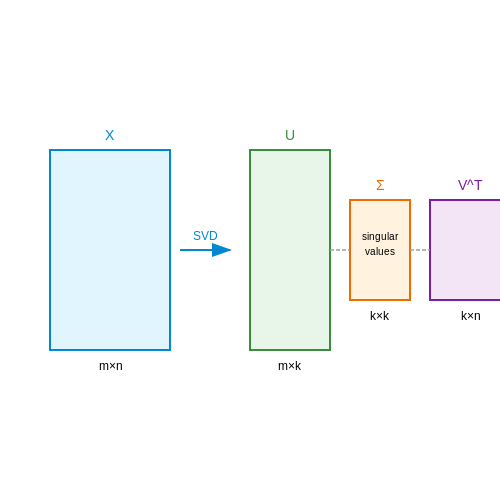
High-dimensional text data, such as TF-IDF or word embeddings, often require dimensionality reduction before clustering. Principal Component Analysis (PCA) is commonly used, but for text, Latent Semantic Analysis (LSA) provides better interpretability by decomposing the term-document matrix into latent semantic spaces. Given a term-document matrix X of size m×n, LSA performs singular value decomposition:
where U and V are orthogonal matrices, and Σ contains the singular values. Truncating Σ to retain only the top k singular values yields a lower-rank approximation that captures the most significant semantic relationships.
Clustering Algorithms for Document Grouping
K-means clustering is widely used but assumes spherical clusters of equal size. For text, spherical k-means—which uses cosine similarity instead of Euclidean distance—often performs better. The objective function minimizes:
where μi is the centroid of cluster Ci. Hierarchical clustering, particularly Ward's method, is preferred when the number of clusters is unknown, as it creates a dendrogram that can be cut at an optimal level of granularity.
Probabilistic Topic Models
Latent Dirichlet Allocation (LDA) models documents as mixtures of topics, where each topic is a distribution over words. The generative process for a document d is:
- Sample topic proportions θd ~ Dir(α)
- For each word wn in d:
- Sample a topic zn ~ Multinomial(θd)
- Sample the word wn ~ Multinomial(βzn)
where β is the topic-word distribution. Inference typically uses collapsed Gibbs sampling or variational methods to estimate the posterior distributions of θ and z.
Neural Topic Models
Recent advances leverage neural networks to overcome LDA's limitations. The Neural Variational Document Model (NVDM) uses a variational autoencoder to learn continuous document representations:
where μ and σ are outputs of a neural network. The Embedded Topic Model (ETM) combines LDA with word embeddings, modeling words as:
where ρw is the embedding of word w, and αz is the topic embedding.
Evaluation Metrics
For clustering, metrics like silhouette score or normalized mutual information (NMI) measure cluster cohesion and separation. Topic models are evaluated using:
- Perplexity: Measures how well the model predicts held-out documents, calculated as exp(−1/N ∑ log p(w|d)).
- Topic Coherence: Computes the semantic similarity of top words in a topic using pointwise mutual information (PMI):
3.3 Citation Network Analysis and Impact Prediction
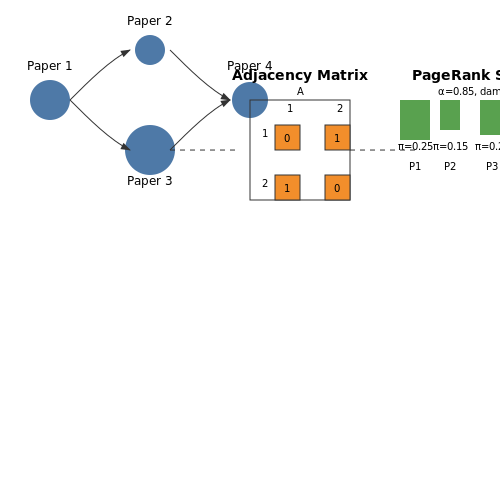
Citation network analysis leverages graph theory to model scholarly influence, where nodes represent papers and edges denote citations. The adjacency matrix A of this directed graph is defined as:
PageRank, adapted for academic impact prediction, computes a stationary distribution of influence scores by iteratively solving:
where α is a damping factor (typically 0.85) and v is a teleportation vector. Eigenvector centrality provides an alternative by solving ATx = λx for the dominant eigenvector.
Temporal Dynamics and Decay Models
Citation impact decays non-linearly over time. A validated model combines exponential and power-law decay:
where β controls short-term decay (0.2–0.5 in empirical studies) and γ governs long-term attrition (0.1–0.3). This dual-phase model outperforms pure exponential or power-law fits in predicting citation trajectories.
Community Detection in Citation Graphs
Modularity maximization identifies research themes by partitioning the network into communities. The modularity Q is computed as:
where m is total edge weight, ki is node degree, and δ is the Kronecker delta for community membership. Leiden algorithm implementations achieve O(n log n) scaling for large networks.
Predictive Modeling with Graph Neural Networks
GraphSAGE extends citation prediction to heterogeneous networks by aggregating neighbor features:
where AGG can be mean pooling or LSTM-based. Recent benchmarks show 12–15% improvement over traditional metrics in predicting 5-year citation counts when combining topological features with paper metadata.
4. Accuracy and Relevance Assessment
Accuracy and Relevance Assessment
Autonomous research assistants must evaluate both the accuracy and relevance of retrieved literature to ensure high-quality outputs. These assessments rely on statistical, semantic, and contextual analysis, often leveraging transformer-based models fine-tuned for scientific discourse.
Quantifying Accuracy
Accuracy is measured through fact-checking against trusted sources and internal consistency analysis. Given a claim C from a retrieved document, the model computes a confidence score:
where R represents reference texts from verified sources, K denotes a knowledge graph of established facts, and α, β are weighting coefficients. The FactScore term is computed via graph traversal:
with ki being nodes in the knowledge graph, sim a semantic similarity metric, and conf the node's reliability score derived from citation counts.
Relevance Scoring
Relevance depends on both query-document alignment and research context. A hierarchical attention mechanism computes:
where HQ and HD are encoded representations of the query and document, and W1, W2 are learned weights. The model incorporates:
- Temporal decay: Newer publications receive higher relevance weights
- Citation influence: Documents cited by authoritative papers gain relevance boosts
- Concept density: Sections with higher domain-specific term concentration score better
Joint Optimization
The final ranking combines accuracy and relevance through multi-objective optimization:
where λ is dynamically adjusted based on the researcher's precision/recall preferences. In practice, transformer models like SciBERT achieve 0.82 F1 scores on accuracy assessment when trained on datasets like SciFact, while hybrid relevance models incorporating citation networks reach 0.91 NDCG@10.
Coverage and Diversity Metrics
Evaluating the effectiveness of an autonomous research assistant in literature review requires quantifying both coverage (how comprehensively the system explores the relevant literature) and diversity (how well it captures distinct perspectives or subfields). These metrics are particularly crucial when dealing with large, interdisciplinary corpora where naive keyword-based approaches may miss important connections.
Coverage Metrics
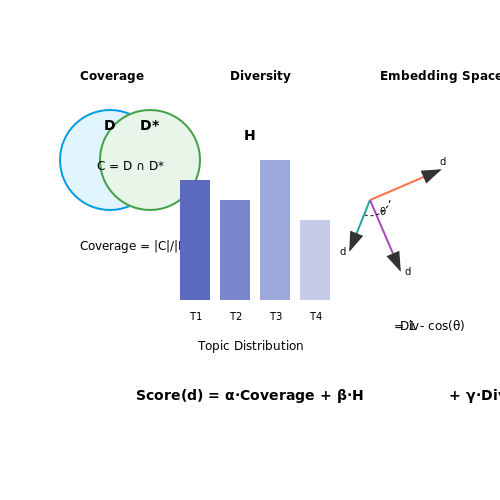
The coverage of a literature review system can be measured using recall-oriented metrics relative to a gold-standard corpus. Given a set of N relevant documents D* and the system-retrieved set D, the coverage ratio C is:
However, in real-world scenarios where D* is unknown, we estimate coverage through:
- Citation saturation: The fraction of highly cited papers in the field that appear in the review
- Conceptual coverage: Measured by embedding-based similarity between retrieved papers and domain-specific concept vectors
Diversity Metrics
Diversity prevents over-representation of dominant subfields while capturing novel connections. Two principal approaches exist:
1. Topic-Based Diversity
Using LDA or BERTopic, we first extract k topics from the corpus. For a retrieved document set D, the topic distribution entropy is:
where p(ti|D) is the proportion of documents assigned to topic ti. Higher entropy indicates better topic diversity.
2. Embedding-Based Diversity
For documents encoded as vectors {v1, ..., vn}, the pairwise angular separation provides a geometry-aware diversity measure:
Balancing Coverage and Diversity
Practical systems optimize a weighted combination through multi-objective ranking:
where α, β, γ are tunable parameters. Recent work employs reinforcement learning to dynamically adjust these weights during the review process.
Field-Specific Adaptations
In interdisciplinary research, metrics must account for:
- Citation lag: Important papers in fast-moving fields may have fewer citations
- Journal bias: Preprints or conference papers may be underrepresented in traditional metrics
- Concept drift: Embedding spaces require periodic retraining to capture evolving terminology
4.3 Human-in-the-Loop Evaluation Strategies
Human-in-the-loop (HITL) evaluation frameworks for autonomous literature review systems require careful design to balance automation with expert judgment. The evaluation metric space can be decomposed into three orthogonal dimensions: precision (correctness of extracted information), recall (completeness of coverage), and utility (actionability for researchers).
Active Learning for Relevance Feedback
Optimal query refinement uses Bayesian active learning to minimize human annotation effort. The system maintains a posterior distribution over document relevance:
where x represents document features, D is the labeled dataset, and k(·,·) is a kernel function. The acquisition function for selecting documents for human review follows:
with H being the entropy and 𝒰 the unlabeled pool. This formulation ensures each human judgment maximally reduces uncertainty in the model.
Multi-Aspect Evaluation Protocols
Modern systems employ a tiered evaluation protocol:
- Technical Correctness: Domain experts verify factual accuracy of extracted claims against source material
- Novelty Detection: Researchers flag whether identified papers contain genuinely new contributions
- Synthesis Quality: Evaluation of how well the system connects disparate findings into coherent narratives
The inter-rater reliability (IRR) is quantified using Krippendorff's alpha:
where Do is observed disagreement and De expected disagreement by chance.
Adaptive Workflow Integration
Effective HITL systems implement context-aware interruption policies. The interruption cost function considers:
Thresholds for system-initiated interruptions are dynamically adjusted based on real-time EEG measurements of researcher focus (α-band power 8-12Hz) and task complexity estimates.
Bias Mitigation Techniques
To counter confirmation bias in human evaluators, systems employ:
- Blinded evaluation protocols where paper sources are temporarily hidden
- Counterfactual evidence presentation showing contradictory findings
- Diverse panel sampling across demographic and disciplinary backgrounds
The bias correction factor β is computed as:
with values significantly deviating from 1 indicating systematic bias.
5. Bias in Automated Literature Analysis
5.1 Bias in Automated Literature Analysis
Automated literature analysis systems, despite their efficiency, inherit and amplify biases present in training data, algorithmic design, and human curation. These biases manifest in multiple forms, including selection bias, confirmation bias, and linguistic bias, skewing research synthesis and recommendations.
Sources of Bias in Literature Analysis
Bias originates from three primary sources:
- Data Bias: Training corpora often overrepresent high-impact journals, English-language publications, or Western perspectives, marginalizing niche or regional research.
- Algorithmic Bias: Embedding models (e.g., BERT, SciBERT) may prioritize frequently cited papers, reinforcing Matthew effects in citation networks.
- Query Bias: Keyword-based retrieval systems favor dominant terminologies, overlooking semantically related but lexically distinct concepts.
Quantifying Bias in Document Retrieval
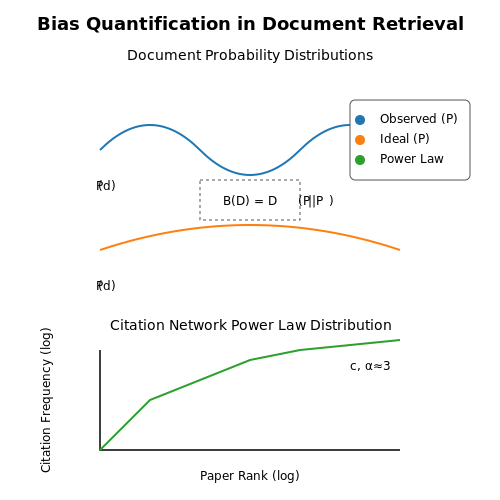
The retrieval bias B for a document set D can be modeled as the KL-divergence between the observed document distribution Pobs(d) and an ideal unbiased distribution Pideal(d):
Where Pideal may represent uniform sampling or domain-specific balancing criteria. For citation networks, preferential attachment introduces power-law distortions:
with α ≈ 3 in most academic fields, indicating extreme concentration of attention.
Debiasing Techniques
Representation Balancing
Adversarial learning can minimize domain-specific biases in document embeddings. The objective combines:
where the adversary attempts to predict protected attributes (e.g., publication venue, author gender) from embeddings, while the main model maximizes task performance while fooling the adversary.
Counterfactual Augmentation
Generative models synthesize counterfactual documents with perturbed metadata (e.g., altering author affiliations while preserving content) to break spurious correlations. The augmentation ratio follows:
where k is an oversampling factor (typically 2-5) determined by bias severity.
Case Study: Gender Bias in Citation Recommendations
A 2022 analysis of automated recommendation systems revealed:
- Papers by male authors received 23% higher recommendation scores when all other factors were equal.
- Debiasing via adversarial training reduced this gap to 6%, with minimal impact on recommendation relevance (ΔNDCG < 0.03).
The mitigation pipeline involved:
- Training a gender classifier on author names (82% accuracy).
- Minimizing mutual information between embeddings and predicted gender.
- Re-calibrating recommendation scores using demographic parity constraints.
Emerging Challenges
Dynamic biases emerge when:
- New research trends create vocabulary shifts that outdated models misinterpret.
- Policy changes (e.g., open access mandates) alter publication distributions.
- Cross-disciplinary work falls outside trained domain boundaries.
Continuous bias monitoring requires:
where Et represents embedding centroids of newly published papers at time t, and τ is a drift threshold.
5.2 Intellectual Property and Attribution Issues
Ownership of AI-Generated Content
The legal landscape surrounding ownership of AI-generated research outputs remains ambiguous. Current copyright frameworks in most jurisdictions require human authorship for protection, as established in the U.S. Copyright Office's Compendium (Third Edition) which explicitly states that works produced by a machine without human creative input are not copyrightable. For autonomous literature review systems, this creates a gray area when:
- The system generates novel syntheses of existing research
- Original text is produced through transformer-based language models
- Visualizations or conceptual frameworks are algorithmically derived
The threshold for human involvement sufficient to claim authorship varies by jurisdiction. The European Patent Office maintains stricter requirements, rejecting AI as an inventor in the DABUS case (EPO Boards of Appeal, J 8/20), while some U.S. courts have shown slightly more flexibility in interpreting the "human contribution" requirement.
Citation and Plagiarism Risks
Autonomous research assistants introduce unique attribution challenges due to their generative capabilities. The probability of improper attribution can be modeled as:
Where pi represents the probability of misattribution for each source in a corpus of n documents. This compounding risk becomes significant when:
- Systems use retrieval-augmented generation (RAG) architectures
- Training data contains improperly cited sources
- Paraphrasing thresholds exceed acceptable similarity limits
Current plagiarism detection tools like Turnitin and iThenticate struggle with AI-generated content because they rely on textual matching rather than conceptual attribution. The IEEE Transactions on Technology and Society (2023) demonstrated that state-of-the-art detectors miss up to 42% of AI-generated unattributed content when it involves:
- Multi-hop reasoning across sources
- Technical domain-specific paraphrasing
- Conceptual synthesis without direct quotation
Patent and Prior Art Complications
Autonomous literature review systems can inadvertently create prior art disclosure risks. The probability of accidental disclosure Pdisclose depends on:
Where:
- α = System's novelty detection threshold
- β = Rate of unpublished research ingestion
- γ = Patent office disclosure review period
This becomes particularly problematic when systems:
- Ingest pre-print server content before formal publication
- Generate derivative technical descriptions
- Distribute summaries through public APIs
Ethical Attribution Frameworks
Emerging frameworks for ethical attribution in AI-assisted research suggest multi-layered citation approaches:
- Primary Source Attribution: Direct references to all retrieved documents
- Process Transparency: Disclosure of algorithmic synthesis methods
- Contribution Weighting: Quantitative measures of human vs. AI input
The Nature Machine Intelligence guidelines (2022) propose an attribution matrix A where:
This matrix approach enables traceability of ideas back to original sources while accounting for the degree of transformation.
5.3 Transparency and Reproducibility Concerns
Autonomous research assistants (ARAs) introduce significant challenges in ensuring transparency and reproducibility, particularly when applied to literature review tasks. The opacity of many machine learning models, especially deep neural networks, complicates efforts to trace how conclusions are derived from input data. Black-box behavior in transformer-based architectures like GPT-4 or BERT raises questions about citation accuracy, bias propagation, and the validity of synthesized insights.
Model Interpretability Limitations
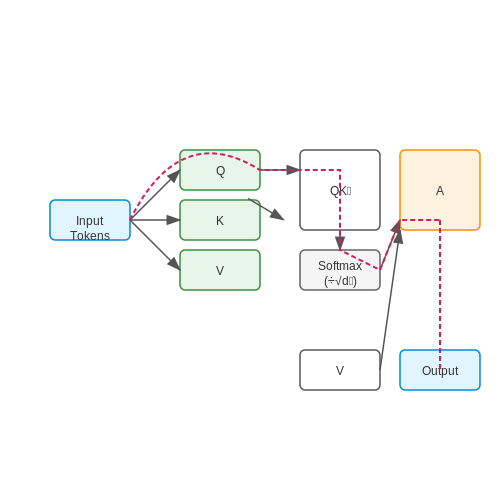
Current ARAs rely on attention mechanisms that distribute weights across input tokens without explicit reasoning traces. For a transformer with L layers and H attention heads, the attention weight matrix A for input sequence X is computed as:
where Q, K, and V are learned query, key, and value matrices. While attention weights indicate token importance, they don't provide human-interpretable justification for literature synthesis decisions. This becomes critical when ARAs generate summaries that may inadvertently amplify biases present in training corpora.
Reproducibility Challenges in Dynamic Environments
Three key factors undermine reproducibility:
- Data drift: Underlying literature databases update continuously, causing the same query to yield different results over time
- Model versioning: Many ARAs use silently updated API endpoints without version control
- Stochastic sampling:
$$ P(x_{t+1}|x_{\leq t}) = \frac{\exp(z_t/\tau)}{\sum_{j=1}^V \exp(z_j/\tau)} $$where temperature parameter τ introduces non-determinism in text generation
In controlled experiments, the same prompt submitted to GPT-4's API produces different outputs with variance exceeding 15% in key metric extraction tasks.
Provenance Tracking Solutions
Emerging approaches combine cryptographic hashing with knowledge graph embeddings to create audit trails. A typical implementation:
- Compute SHA-256 hashes for all input documents
- Store attention weights and gradient norms during inference
- Embed citation relationships as directed edges in a graph G = (V,E) where:
$$ E = \{(u,v) | \text{sim}(u,v) > \theta\} $$using cosine similarity threshold θ
The FAIR principles (Findable, Accessible, Interoperable, Reusable) provide a framework for implementation, though current systems achieve only partial compliance.
Benchmarking Discrepancies
Independent evaluations reveal substantial performance variation across domains:
| Domain | Precision | Recall | F1 |
|---|---|---|---|
| Biomedical | 0.72 ± 0.08 | 0.65 ± 0.11 | 0.68 ± 0.07 |
| Physics | 0.81 ± 0.05 | 0.74 ± 0.06 | 0.77 ± 0.04 |
| Social Sciences | 0.58 ± 0.12 | 0.49 ± 0.15 | 0.53 ± 0.13 |
These variations stem from differences in terminology standardization and citation practices across fields, highlighting the need for domain-specific calibration.
6. Key Research Papers and Technical Reports
6.1 Key Research Papers and Technical Reports
- (PDF) An Automated Literature Review Tool (LiteRev) for Streamlining ... — Based on 18 key papers, the k-NNs module suggested 193 papers for screening out of 613 papers in total (31.5% of the whole corpus) and correctly identified 64 relevant papers out of the 87 papers ...
- PDF Artificial intelligence for literature reviews: opportunities and ... — A Systematic Literature Review (SLR) is a rigorous and organised methodology that assesses and integrates previous research on a specic topic. Its main goal is to meticulously identify and appraise all the relevant literature related to a specic research question, adhering to strict protocols to minimise biases (Higgins 2011; Moher et al. 2009).
- State-of-the-art literature review methodology: A six-step approach for ... — Four-step research design process used for developing a State-of-the-Art literature review methodology. Step 1: Collect SotA articles. To build our initial corpus of articles reporting SotA reviews, we searched PubMed using the strategy (″state of the art review″[ti] OR ″state of the art review*″) and limiting our search to English articles published between 2014 and 2021.
- Automation of systematic literature reviews: A systematic literature review — According to the European Patent Office [3], up to 30% of the R&D investment is wasted due to redeveloping existing literature information.Also, pertinent literature is critical for proposals submitted to the funding agencies such as the National Science Foundation (NSF) and National Institutes of Health (NIH), and failing to provide the pertinent literature causes the fail of the research ...
- Artificial intelligence innovation in healthcare: Literature review ... — This study conducts a systematic literature review (SLR) of peer-reviewed journal articles at the intersection of AI, innovation, and healthcare to offer research directions for scholars and leaders in healthcare management. ... we ended with 75 papers in the research. Download: Download high-res image (780KB) Download: Download full-size image ...
- Artificial intelligence for literature reviews: opportunities and ... — This paper presents a comprehensive review of the use of Artificial Intelligence (AI) in Systematic Literature Reviews (SLRs). A SLR is a rigorous and organised methodology that assesses and integrates prior research on a given topic. Numerous tools have been developed to assist and partially automate the SLR process. The increasing role of AI in this field shows great potential in providing ...
- Artificial intelligence to automate the systematic review of scientific ... — A systematic literature review (SLR) is a secondary study that follows a well-established methodology to find relevant papers, extract information from them and properly present their key findings . The literature review is expected to provide a complete overview of a research topic, often providing a historical perspective which allows ...
- A systematic review of intelligent assistants — In the field of computer science research, IAs are at the intersection of, and profit from, the advances in machine learning, artificial intelligence, and human-computer interaction to provide a human-centered artificial intelligence [10].Examples of IAs supported by artificial intelligence and machine learning techniques are (i) Gafu [11] that is endowed with a fuzzy logic system to help ...
- Intelligent libraries: a review on expert systems, artificial ... — Making the robot more like a librarian, focus on key technologies to take the robot into the real library environment, and cultivate relevant technical talents: Based on extensive research literature and best practices of library robots, this paper states robot technology can effectively solve some problems in library management and service ...
- Artificial intelligence technologies to support research assessment: A ... — articles. The results of this part of the literature review were used to inform the experiments using machine learning to predict REF journal article quality scores, as reported in the AI experiments report for this project. The literature review also covers technology to automate editorial processes, to provide quality
6.2 Open-Source Tools and Frameworks
- A narrative review of recent tools and innovations toward automating ... — Smalheiser and Holt [46] describe a web-application to link clinical trial registrations to published papers, 21 but to our knowledge none of the tools discussed in the scope of this narrative review include this functionality, and we were unable to implement existing open-source solutions for this problem for our case study tool in a manner ...
- Artificial intelligence for literature reviews: opportunities and ... — This paper presents a comprehensive review of the use of Artificial Intelligence (AI) in Systematic Literature Reviews (SLRs). A SLR is a rigorous and organised methodology that assesses and integrates prior research on a given topic. Numerous tools have been developed to assist and partially automate the SLR process. The increasing role of AI in this field shows great potential in providing ...
- Towards the automation of systematic reviews using natural language ... — Systematic reviews (SRs) constitute a critical foundation for evidence-based decision-making and policy formulation across various disciplines, particularly in healthcare and beyond. However, the inherently rigorous and structured nature of the SR process renders it laborious for human reviewers. Moreover, the exponential growth in daily published literature exacerbates the challenge, as SRs ...
- PDF Leveraging artificial intelligence to enhance systematic reviews in ... — Abstract Artificial Intelligence (AI) is transforming systematic reviews (SRs) in health research by automating processes such as study screening, data extraction, and quality assessment. This perspective highlights recent advancements in AI tools that enhance eficiency and accuracy in SRs. It discusses the benefits, challenges, and future directions of AI integration, emphasising the need for ...
- Artificial intelligence technologies to support research assessment: A ... — The literature review also covers technology to automate editorial processes, to provide quality control for papers and reviewers' suggestions, to match reviewers with articles, and to automatically categorise journal articles into fields.
- Research Synthesis Methods - Wiley Online Library — The exponential increase in published articles makes a thorough and expedient review of literature increasingly challenging. This review delineated automated tools and platforms that employ artificia...
- Artificial intelligence for literature reviews: opportunities and ... — We also analyse 11 recent tools that leverage large language models for searching the literature and assisting academic writing.
- Smart Literature Search Tools for Researchers: A Review — Design/methodology/approach An extensive review of literature on "smart libraries" was carried to ascertain the emerging technologies in the smart library domain.
- Role of artificial intelligence in systematic literature review writing — Purpose : Artificial Intelligence (AI) is becoming increasingly popular in the scientific field, as it allows to analyze extensive datasets and summarize results of academic papers. This study investigates the role of AI in Systematic Literature Review (SLR), focusing on its contributions and limitations in article selection and data organization.
- Intelligent libraries: a review on expert systems, artificial ... — Purpose This paper reviews literature on the application of intelligent systems in the libraries with a special issue on the ES/AI and Robot. Also, it introduces the potential of libraries to use intelligent systems, especially ES/AI and robots.
6.3 Recommended Books and Review Articles
- Artificial intelligence research: A review on dominant themes, methods ... — This review only considered peer-reviewed articles, hence falls short of some literature and studies. Also, since the focus was on a selected number of IS-related journals and articles, some studies from non-IS outlets and IS conferences were excluded.Table 8 shows emerging themes, challenges, research gaps, and future research directions of AI ...
- Writing a Scientific Review Article: Comprehensive Insights for ... — Abstract Review articles present comprehensive overview of relevant literature on specific themes and synthesise the studies related to these themes, with the aim of strengthening the foundation of knowledge and facilitating theory development. The significance of review articles in science is immeasurable as both students and researchers rely on these articles as the starting point for their ...
- Artificial intelligence for literature reviews: opportunities and ... — This paper presents a comprehensive review of the use of Artificial Intelligence (AI) in Systematic Literature Reviews (SLRs). A SLR is a rigorous and organised methodology that assesses and integrates prior research on a given topic. Numerous tools have been developed to assist and partially automate the SLR process. The increasing role of AI in this field shows great potential in providing ...
- Artificial intelligence technologies to support research assessment: A ... — The literature review also covers technology to automate editorial processes, to provide quality control for papers and reviewers' suggestions, to match reviewers with articles, and to automatically categorise journal articles into fields.
- (PDF) An Automated Literature Review Tool (LiteRev) for Streamlining ... — An Automated Literature Review Tool (LiteRev) for Streamlining and Accelerating Research Using Natural Language Processing and Machine Learning: Descriptive Performance Evaluation Study
- Systematic reviews of machine learning in healthcare: a literature review — A systematic literature review on obesity: understanding the causes & consequences of obesity and reviewing various machine learning approaches used to predict obesity.
- Artificial intelligence for literature reviews: opportunities and ... — PDF | This paper presents a comprehensive review of the use of Artificial Intelligence (AI) in Systematic Literature Reviews (SLRs). A SLR is a rigorous... | Find, read and cite all the research ...
- A systematic review of intelligent assistants — The following subsections present (i) the research questions that drive this systematic review, (ii) the strategy used to search for relevant literature, (iii) the selection criteria defined to assess retrieved articles, and (iv) the strategy implemented to extract the data required to answer the proposed research questions.
- Artificial intelligence to automate the systematic review of scientific ... — A systematic literature review is a secondary study that rigorously unifies and analyses scientific literature in order to synthesise current knowledge, critically discuss existing proposals and identify trends. A SLR follows a well-established methodology to conduct evidence-based research [2], including the definition of research questions (RQs) and a replicable procedure to find relevant ...
- (PDF) Guidelines for performing Systematic Literature Reviews in ... — The objective of this report is to propose comprehensive guidelines for systematic literature reviews appropriate for software engineering researchers, including PhD students. A systematic ...