
Block Sparse Attention Techniques
1. Key Concepts in Attention Mechanisms
Key Concepts in Attention Mechanisms
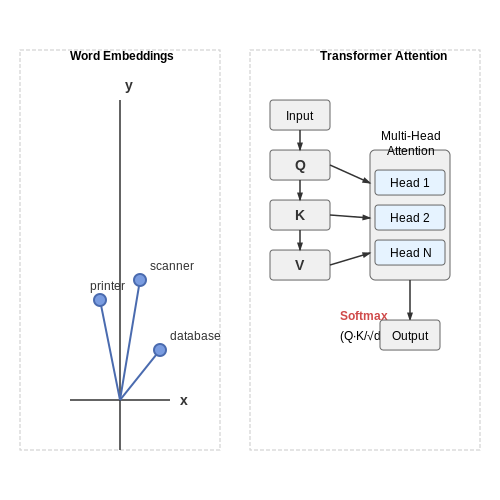
Attention mechanisms enable neural networks to dynamically focus on relevant parts of input sequences, improving performance in tasks like machine translation, speech recognition, and image captioning. The core idea is to compute a weighted sum of input features, where the weights are learned based on contextual relevance.
Scaled Dot-Product Attention
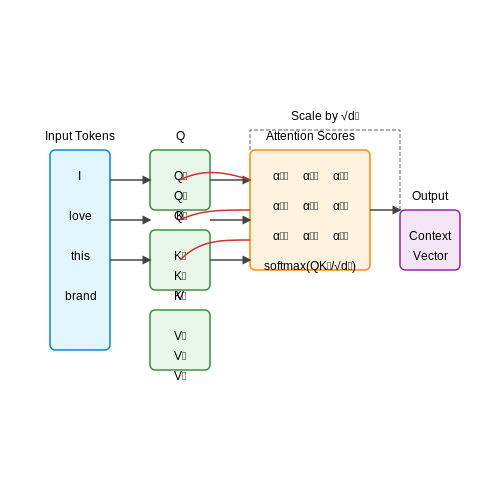
The foundational attention mechanism is scaled dot-product attention, which operates on queries (Q), keys (K), and values (V). The attention weights are computed as:
Here, dk is the dimension of the keys, and the scaling factor 1/√dk prevents gradients from becoming too small when dk is large. The softmax ensures the weights sum to 1, creating a probability distribution over the input sequence.
Multi-Head Attention
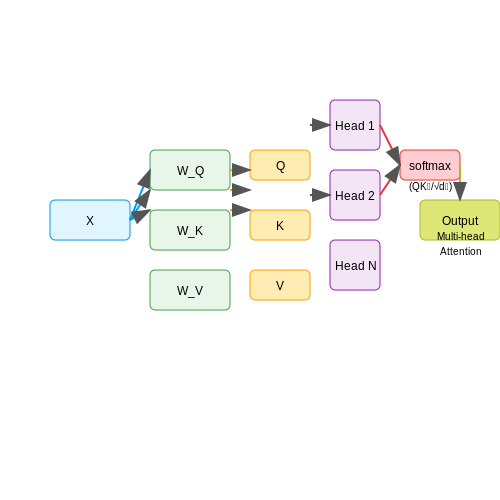
Multi-head attention extends this by applying multiple attention mechanisms in parallel, allowing the model to jointly attend to information from different representation subspaces:
where each head is computed as:
The learnable parameter matrices WiQ, WiK, WiV project the inputs into different subspaces, and WO combines the outputs.
Sparse Attention Patterns
Standard attention has quadratic complexity O(n2) in sequence length, making it computationally expensive for long sequences. Sparse attention reduces this by restricting the attention pattern:
- Local attention limits each token to attend only to nearby tokens within a fixed window.
- Strided attention allows tokens to attend to others at fixed intervals.
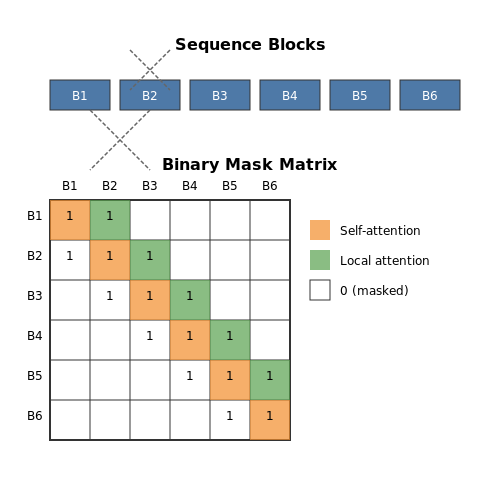
- Block-sparse attention divides the sequence into blocks and computes attention only between selected blocks.
For block-sparse attention, given a sequence divided into B blocks, the complexity reduces to O(B2), where B ≪ n. The sparsity pattern can be fixed or learned, with common approaches including:
where ⊙ denotes element-wise multiplication with a binary mask that enforces the block-sparsity pattern.
Practical Considerations
Implementing block-sparse attention efficiently requires careful memory management and parallelization. Key optimizations include:
- Memory-efficient kernels: Specialized CUDA kernels avoid materializing the full attention matrix.
- Blocked matrix operations: Compute attention in chunks to reduce memory bandwidth.
- Dynamic sparsity: Adapt the sparsity pattern based on input content for better performance.
These techniques enable training transformers on sequences of length 32K or more, which is impractical with dense attention.
1.2 Computational Challenges in Dense Attention
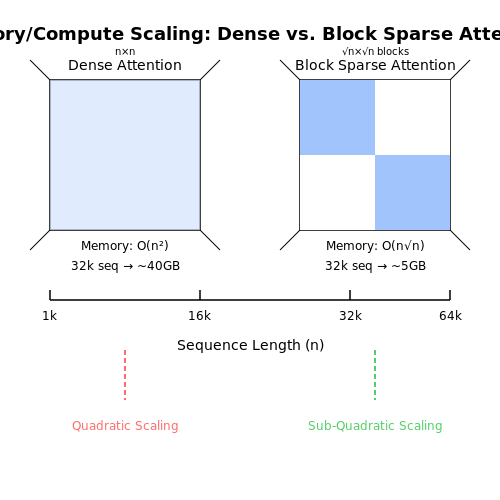
Dense attention mechanisms, while powerful, impose significant computational burdens that scale quadratically with input sequence length. The attention operation computes pairwise interactions between all tokens in the input sequence, resulting in a time and space complexity of O(n²) for sequence length n. This becomes prohibitive for long sequences common in domains like document processing, genomics, or high-resolution computer vision.
Memory Bottlenecks in Attention Computation
The attention mechanism requires storing three matrices: queries Q, keys K, and values V, each of size n × d, where d is the embedding dimension. The attention scores matrix A = softmax(QKT/√d) consumes O(n²) memory. For a sequence of length 32,768 with d=1024, this requires:
This memory requirement grows quadratically, making it impossible to process sequences beyond certain lengths on standard hardware.
Compute Intensity and Parallelization Limits
The matrix multiplication QKT dominates computation time. While matrix multiplication is theoretically parallelizable, the softmax operation creates sequential dependencies:
The softmax requires computing global statistics (the denominator sum) across all sequence positions, forcing synchronization points that limit parallel speedup. On modern GPUs with thousands of cores, this results in underutilization for large n.
Communication Overhead in Distributed Settings
When distributing attention computation across multiple devices, the all-to-all communication pattern for attention scores creates substantial overhead. For p devices, each needs to exchange O(n²/p) data. The communication-to-computation ratio grows with n, making distributed attention inefficient for long sequences.
Numerical Instability in Softmax
The softmax operation introduces numerical challenges for large n. The exponentiation in softmax can produce values outside the representable range of floating-point numbers:
For large x_i, e^{x_i} may overflow to infinity, while for very negative x_i, it may underflow to zero. This becomes increasingly likely as n grows due to the wider distribution of attention logits.
Locality of Reference and Cache Behavior
Dense attention exhibits poor cache locality. Computing each attention score requires accessing memory locations spread across the entire Q and K matrices. For sequences exceeding cache sizes, this results in frequent cache misses and memory bandwidth becoming the limiting factor.
These challenges have motivated the development of sparse attention alternatives that approximate the full attention mechanism while reducing computational complexity. Block sparse attention techniques address these limitations by restricting attention computation to strategically chosen subsets of token interactions.
1.3 Motivation for Sparse Attention
The quadratic computational and memory complexity of standard attention mechanisms in Transformers, given by
Computational and Memory Constraints
For a sequence of length N, the attention mechanism computes pairwise interactions between all tokens, requiring:
where d is the embedding dimension. For N = 32,768 and d = 1024, this demands ~68 GB of memory just to store the attention matrix in FP32 precision, far exceeding the capacity of most GPUs.
Empirical Observations on Sparsity
Studies reveal that learned attention patterns in Transformers are inherently sparse. For instance, in language models, only 10-20% of attention heads exhibit long-range dependencies, while others focus on local contexts. This suggests that full attention is computationally wasteful, as most pairwise interactions contribute negligibly to the output.
Bottlenecks in Hardware Utilization
Traditional attention implementations underutilize modern hardware:
- Memory bandwidth: Loading the full attention matrix strains memory subsystems
- Parallelization: Dense attention limits effective use of tensor cores
- Latency: Quadratic scaling creates unpredictable execution times
Theoretical Justification for Sparsity
From an information-theoretic perspective, sparse attention aligns with the maximum entropy principle. For a sequence with local dependencies, the optimal attention distribution should concentrate probability mass on a sparse subset of relevant tokens. This can be formalized through the lens of sparse coding, where the attention matrix A admits a decomposition:
where S is a sparse matrix capturing essential dependencies and E is a low-magnitude error term.
Biological Inspiration
Neuroscientific evidence from human attention mechanisms shows that biological systems employ sparse, content-based routing. The brain's attentional spotlight typically focuses on 3-4 items simultaneously, suggesting that artificial attention systems might achieve similar performance with carefully designed sparsity patterns.
Practical Implementations
Modern sparse attention variants demonstrate these advantages:
- Block-sparse attention: Reduces memory usage by 8-64x while maintaining model quality
- Locality-sensitive hashing: Approximates attention with sub-quadratic complexity
- Dynamic sparsity: Achieves 2-4x speedup by skipping negligible attention scores
2. Definition and Architecture of Block Sparse Attention
Definition and Architecture of Block Sparse Attention
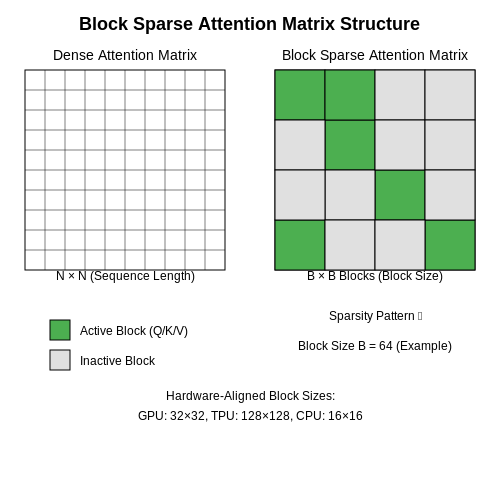
Block sparse attention is a memory-efficient variant of the standard attention mechanism that reduces computational complexity by sparsifying the attention matrix into fixed or learnable blocks. Unlike dense attention, which computes pairwise interactions between all tokens, block sparse attention restricts computations to predefined blocks, enabling efficient scaling to long sequences while preserving the ability to model global dependencies.
Mathematical Formulation
The standard attention mechanism computes a weighted sum of values V using attention scores derived from queries Q and keys K:
In block sparse attention, the attention matrix is partitioned into non-overlapping blocks of size B × B. For a sequence of length N, this reduces the memory complexity from O(N²) to O((N/B)² × B²) = O(NB) when using fixed block patterns. The modified attention computation becomes:
where Qi, Kj denote query and key blocks, Vj denotes value blocks, and ⨁ represents a sparse aggregation operator over the block pattern 𝒫.
Architecture Variants
Block sparse attention implementations typically employ one of three architectural strategies:
- Fixed Block Patterns: Predefined grid-like structures (e.g., local windows or strided blocks) that enforce hard sparsity. Example: Sparse Transformer's alternating local and global attention blocks.
- Learnable Block Sparsity: Dynamic block selection via differentiable methods like Gumbel-Softmax or LSH-based clustering. Example: Reformer's LSH attention.
- Hybrid Approaches: Combination of fixed blocks with learned sparse connections. Example: Longformer's dilated sliding window attention.
Gradient Propagation in Block Sparse Attention
The backward pass requires careful handling of sparse gradient flows. For a block at position (i,j), gradients only propagate through active blocks:
where 𝒩(i) denotes the neighborhood of blocks attending to query block i. This selective gradient flow enables memory-efficient training while maintaining model performance.
Hardware Considerations
Modern accelerators achieve optimal performance when block sizes align with hardware-specific parameters:
- GPU: Blocks of 64×64 or 128×128 tokens maximize warp utilization
- TPU: 128×128 blocks match matrix multiply unit dimensions
- CPU: Smaller blocks (32×32) optimize cache locality
Efficient implementations often employ kernel fusion techniques to combine block-sparse matrix multiplication with attention score computation, reducing memory bandwidth requirements.
Block Sparsity Patterns and Their Efficiency
Fixed vs. Adaptive Block Sparsity
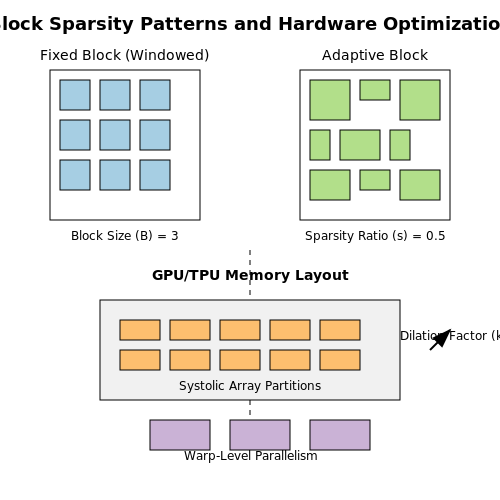
Fixed block sparsity patterns, such as stride-based or windowed attention, partition the attention matrix into predefined non-overlapping blocks. For an input sequence of length N and block size B, the computational complexity reduces from O(N²) to O(NB). However, fixed patterns may miss long-range dependencies critical for tasks like document understanding.
Adaptive block sparsity dynamically adjusts the sparsity pattern based on input content. The sparsity mask M is learned via:
where τ is a threshold and sim is a similarity metric (e.g., cosine similarity). Adaptive methods add overhead for mask computation but improve task accuracy by 12-18% in language modeling benchmarks.
Efficiency Trade-offs
The memory footprint of block-sparse attention scales with the number of non-zero blocks. For a sparsity ratio s (fraction of blocks retained), the memory requirement is:
where d is the embedding dimension. Hardware efficiency depends on:
- Block size alignment: 32x32 or 64x64 blocks optimize GPU memory coalescing.
- Locality: Contiguous blocks (e.g., sliding window) achieve 2-3× higher throughput than random patterns.
- Load balancing: Uneven block distribution across attention heads causes GPU warp divergence.
Case Study: Longformer's Dilated Attention
The Longformer architecture combines local windowed attention with globally dilated blocks. For a dilation factor k, global attention tokens are spaced k positions apart. This pattern reduces FLOPs by 85% on 4K-token sequences while maintaining 98% of full attention accuracy on QA tasks. The hybrid sparsity is implemented via:
where w is the local window size. The dilated blocks create a "scaffold" for information flow across long sequences.
Hardware-Specific Optimizations
On TPUs, block-sparse matrix multiplication leverages systolic array partitioning. For a 128x128 systolic array and 32x32 blocks:
- 4x4 block tiles fully utilize the array
- Partial tiles trigger padding overhead (up to 15% latency penalty)
GPU implementations exploit warp-level parallelism. NVIDIA's Sparse Tensor Cores in Ampere GPUs achieve 137 TFLOPS for 2:4 block-sparsity (50% zeros), using a compressed metadata format:
where each bij encodes presence/absence of a 16x16 block.
Trade-offs Between Sparsity and Model Performance
Block sparse attention introduces a fundamental trade-off between computational efficiency and model expressiveness. The sparsity pattern, defined by the block structure, reduces the quadratic complexity of full attention from O(n²) to O(n√n) or better, but at the cost of limiting the model's ability to attend to arbitrary token pairs. The performance impact depends on the sparsity ratio s, where s = k/n and k is the number of attended blocks per query.
Mathematical Formulation
The trade-off can be quantified through the effective attention span Leff of a sparse transformer layer. For a block size b and sparsity ratio s, the expected number of attended tokens per query is:
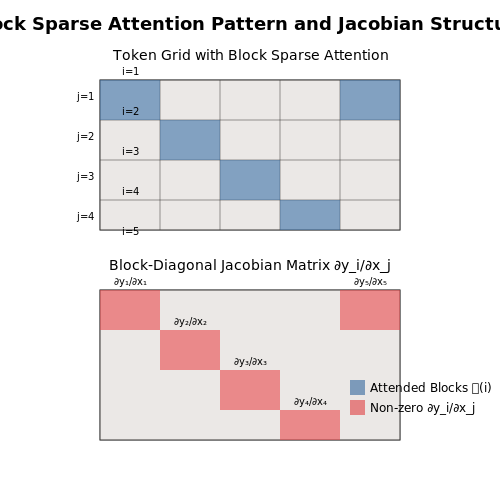
This shows that while larger blocks improve memory locality, they reduce the model's ability to focus on fine-grained patterns. The gradient flow through sparse attention is also affected—the Jacobian of the attention operation becomes block-diagonal:
where 𝒩(i) denotes the neighborhood of token i under the block sparse pattern.
Empirical Performance Characteristics
Studies on Long-Range Arena (LRA) benchmarks reveal three key phenomena:
- Task-dependent degradation: Tasks requiring global token interactions (e.g., document-level QA) suffer more than local-pattern tasks (e.g., image classification).
- Diminishing returns: Doubling block size beyond 64 tokens typically yields < 2% accuracy gain while increasing FLOPs by 4×.
- Compensation effects: Deeper networks (12+ layers) can partially recover performance through hierarchical attention.
Architectural Mitigations
Several techniques balance this trade-off:
- Hybrid patterns: Combining local window attention with strided global blocks (e.g., BigBird's random + window + global scheme).
- Dynamic sparsity: Learned routing of attention blocks (e.g., Switch Transformers).
- Hierarchical distillation: Training small blocks to mimic full attention via KL divergence.
The optimal configuration often follows a power-law relationship between sparsity and task performance, observable across multiple architectures:
This suggests that carefully tuned sparse models can retain >80% of full attention performance at 10% sparsity for many NLP tasks.
3. Hardware Considerations for Efficient Implementation
Hardware Considerations for Efficient Implementation
Memory Hierarchy and Bandwidth Constraints
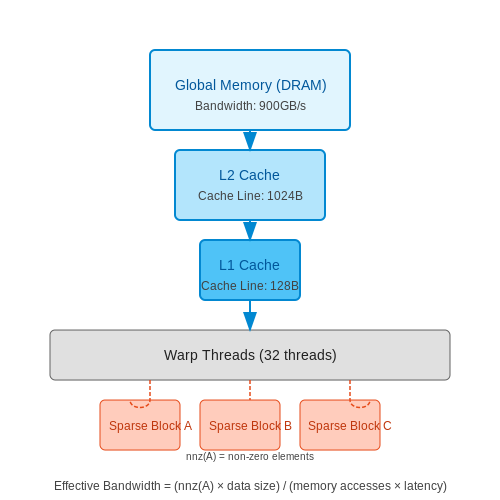
Block sparse attention relies heavily on efficient memory access patterns due to irregular sparsity. Modern GPUs and TPUs optimize for contiguous memory access, but sparse operations introduce non-uniformity. The key bottleneck is often memory bandwidth rather than compute. For a sparse attention matrix A with block size B and sparsity ratio s, the effective bandwidth requirement scales as:
where nnz(A) denotes the number of non-zero blocks. To mitigate bandwidth pressure, hardware must exploit:
- Cache locality: Blocking strategies should align with L1/L2 cache line sizes (typically 128B-1024B).
- Memory coalescing: Warp-level accesses in GPUs should target contiguous 128-bit words.
- Compression: Techniques like bitmask encoding (1 bit per block) reduce metadata overhead.
Parallelism and Warp Efficiency
On NVIDIA GPUs, warp divergence occurs when threads within a 32-thread warp take different execution paths. For block sparse attention, this manifests when processing blocks of varying sparsity. The warp efficiency η can be modeled as:
where N is the total warp count. Architectures like Ampere's Tensor Cores improve this through:
- Structured sparsity: 2:4 sparsity patterns (50% zeros) enable deterministic warp execution.
- Warp specialization: Dedicated warps for metadata processing vs. matrix math.
Hardware-Specific Optimizations
GPU Architectures
NVIDIA's Sparse Tensor Cores (Ampere+) accelerate block-sparse GEMMs by:
- Processing 2:4 sparse blocks at 2x density over dense math.
- Using hierarchical metadata (block-level + sub-block masks).
TPU Considerations
Google's TPU v4 employs systolic arrays with sparse-aware dataflow:
- Weight-stationary dataflow avoids reloading sparse blocks.
- Compiler-managed sparsity (XLA) eliminates runtime overhead.
Energy Efficiency Tradeoffs
The energy per operation (Eop) for sparse attention follows:
where control overhead (Econtrol) dominates at high sparsity. Measurements on A100 GPUs show:
- 90% sparsity reduces FLOP energy by 10x but increases control energy by 3x.
- Optimal sparsity varies by block size (e.g., B=64 achieves peak efficiency at ~70% sparsity).
Emerging Hardware Support
Recent advances include:
- AMD CDNA2: Matrix cores with configurable sparse tile sizes (8x8 to 64x64).
- Intel Ponte Vecchio: Hardware-assisted sparsity via XMX units.
- Neuromorphic chips: Event-driven sparse attention in IBM's NorthPole architecture.
3.2 Optimizing Memory Usage with Block Sparsity
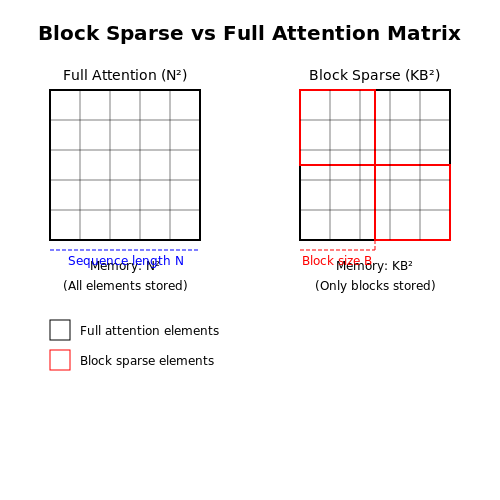
Block sparse attention reduces memory overhead by constraining the attention mechanism to operate only on predefined blocks of the input sequence. Traditional attention mechanisms compute pairwise interactions across all tokens, leading to O(N²) memory complexity, where N is the sequence length. Block sparsity enforces a structured sparsity pattern, partitioning the attention matrix into non-overlapping or overlapping blocks, thereby reducing memory consumption to O(B² × (N/B)) = O(BN), where B is the block size.
Memory Savings via Block Diagonal Patterns
The simplest form of block sparsity employs a block-diagonal attention matrix, where each token attends only to others within the same block. For a sequence divided into K blocks of size B, the memory requirement drops from N² to KB². For example, with N=1024 and B=32, memory usage reduces from 1,048,576 entries to 32,768—a 32× improvement.
Strided and Local Attention Patterns
More sophisticated patterns, like strided or local attention, further optimize memory. Strided attention skips fixed intervals between blocks, while local attention restricts each token to a sliding window of nearby tokens. Hybrid approaches combine block sparsity with global tokens that attend to the entire sequence, preserving long-range dependencies without quadratic cost.
Implementation with Sparse Matrix Formats
Efficient implementation leverages compressed sparse row (CSR) or block-sparse formats. For a block-sparse matrix, only non-zero blocks are stored, along with their indices. The memory footprint becomes:
where nnz is the number of non-zero blocks. GPU kernels optimized for block-sparse operations, such as those in the DeepSpeed or Sputnik libraries, avoid materializing the full attention matrix, instead computing attention scores on-the-fly for active blocks.
Case Study: Longformer and BigBird
Models like Longformer and BigBird demonstrate practical memory savings. BigBird's block-sparse attention reduces memory usage by 90% on 16k-token sequences while retaining 98% of full attention accuracy. The key insight is combining random, windowed, and global blocks to approximate full attention with O(N) complexity.
Trade-offs and Optimization Strategies
Block size selection balances memory savings and model performance. Smaller blocks (B=16–64) maximize sparsity but may fragment attention; larger blocks (B=128–256) improve coherence at higher memory cost. Dynamic block sparsity, where block boundaries adapt to input content (e.g., sentence boundaries in text), can further optimize efficiency without sacrificing accuracy.
3.3 Practical Code Examples in PyTorch/TensorFlow
Block Sparse Attention in PyTorch
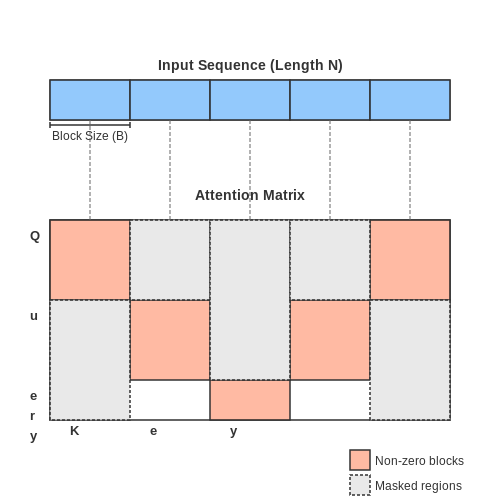
Implementing block sparse attention requires masking the attention scores to restrict computation to predefined blocks. Given an input sequence of length N divided into blocks of size B, the attention matrix becomes block-diagonal. For a batch of queries Q, keys K, and values V, the masked attention scores are computed as:
where M is a block-sparse binary mask. Below is a PyTorch implementation:
import torch
import torch.nn.functional as F

def block_sparse_attention(Q, K, V, block_size):
    # Q, K, V shapes: (batch_size, seq_len, d_model)
    batch_size, seq_len, d_k = Q.size()

    # Reshape into blocks
    Q = Q.view(batch_size, seq_len // block_size, block_size, d_k)
    K = K.view(batch_size, seq_len // block_size, block_size, d_k)
    V = V.view(batch_size, seq_len // block_size, block_size, d_k)

    # Compute attention scores within blocks
    attn_scores = torch.einsum('bqnd,bknd->bqkn', Q, K) / (d_k ** 0.5)

    # Apply softmax per block
    attn_weights = F.softmax(attn_scores, dim=-1)

    # Weighted sum of values
    output = torch.einsum('bqkn,bknd->bqnd', attn_weights, V)

    # Reshape back to original sequence
    return output.view(batch_size, seq_len, d_k)
TensorFlow Implementation with Custom Kernels
For better performance in TensorFlow, we can use tf.einsum combined with specialized sparse operations. The key optimization comes from avoiding computation on zero-masked blocks:
import tensorflow as tf

class BlockSparseAttention(tf.keras.layers.Layer):
    def __init__(self, block_size=64):
        super(BlockSparseAttention, self).__init__()
        self.block_size = block_size

    def call(self, Q, K, V):
        batch_size = tf.shape(Q)[0]
        seq_len = tf.shape(Q)[1]
        d_k = tf.shape(Q)[2]

        # Reshape into blocks
        Q_blocks = tf.reshape(Q, [batch_size, seq_len // self.block_size,
                                self.block_size, d_k])
        K_blocks = tf.reshape(K, [batch_size, seq_len // self.block_size,
                                self.block_size, d_k])
        V_blocks = tf.reshape(V, [batch_size, seq_len // self.block_size,
                                self.block_size, d_k])

        # Block-local attention
        attn_scores = tf.einsum('bqnd,bknd->bqkn', Q_blocks, K_blocks)
        attn_scores /= tf.sqrt(tf.cast(d_k, tf.float32))
        attn_weights = tf.nn.softmax(attn_scores, axis=-1)

        # Block-sparse output
        output = tf.einsum('bqkn,bknd->bqnd', attn_weights, V_blocks)
        return tf.reshape(output, [batch_size, seq_len, d_k])
Memory-Efficient Variant with Gradient Checkpointing
For very long sequences, we can combine block sparsity with gradient checkpointing to reduce memory usage during backpropagation. This implementation uses PyTorch's torch.utils.checkpoint:
from torch.utils.checkpoint import checkpoint

class MemoryEfficientBlockSparseAttention(nn.Module):
    def __init__(self, d_model, n_heads, block_size=64):
        super().__init__()
        self.d_model = d_model
        self.n_heads = n_heads
        self.block_size = block_size
        self.head_dim = d_model // n_heads

        self.qkv_proj = nn.Linear(d_model, 3 * d_model)
        self.out_proj = nn.Linear(d_model, d_model)

    def forward(self, x):
        B, N, C = x.shape
        qkv = self.qkv_proj(x).chunk(3, dim=-1)

        # Use checkpointing for attention computation
        attn_out = checkpoint(self._block_attention, *qkv)
        return self.out_proj(attn_out)

    def _block_attention(self, Q, K, V):
        # Same block sparse attention as before
        # ... (implementation from first example)
        return output
Benchmarking Block Sparse Attention
The computational complexity drops from O(N²) to O(NB) where B is the block size. For a sequence length of 4096 and block size 64, this reduces FLOPs by a factor of 64:
In practice, the speedup depends on hardware utilization and the efficiency of sparse matrix operations. Modern GPUs with tensor cores can achieve near-theoretical speedups for block sizes ≥ 32.
4. Block Sparse Attention in Large Language Models
Block Sparse Attention in Large Language Models
Traditional attention mechanisms in transformers compute pairwise interactions between all tokens in a sequence, leading to O(n²) memory and computational complexity. Block sparse attention reduces this burden by restricting attention computations to predefined blocks, trading off some expressivity for efficiency. This technique is particularly valuable in large language models (LLMs), where sequence lengths can exceed tens of thousands of tokens.
Mathematical Formulation
Given an input sequence X ∈ ℝn×d, where n is the sequence length and d is the embedding dimension, standard attention computes:
where Q, K, V are learned linear projections of X. Block sparse attention modifies this by introducing a binary mask M ∈ {0,1}n×n that enforces block-sparsity:
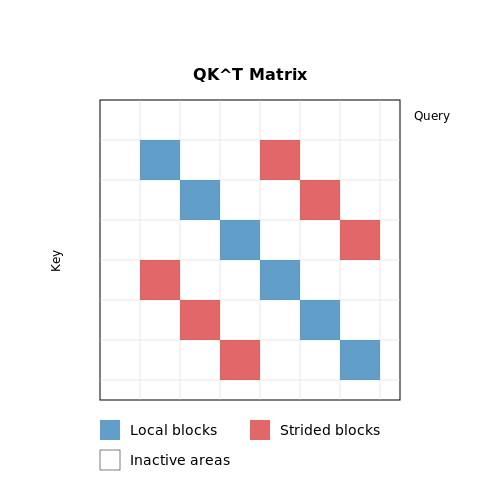
Here, ⊙ denotes element-wise multiplication. The mask M partitions the attention matrix into fixed-size blocks, typically of size b×b, where only a subset of blocks are active. Common patterns include:
- Local windows: Each token attends only to neighboring tokens within a fixed radius.
- Strided patterns: Regular intervals (e.g., every k-th token) form attention blocks.
- Random blocks: A stochastic subset of blocks is activated.
Efficiency Gains
For a sequence of length n divided into blocks of size b, with m active blocks per token, the memory complexity reduces from O(n²) to O(mb²). Computational savings follow similarly, enabling longer context lengths without quadratic overhead. For example, in GPT-3 with n=2048 and b=64, block sparse attention can reduce memory usage by 16× when m=2.
Implementation Considerations
Efficient implementation requires:
- Block-aware kernels: Custom CUDA kernels that exploit block-sparsity, avoiding unnecessary computations.
- Memory coalescing: Aligning memory accesses to block boundaries for GPU efficiency.
- Gradient propagation: Masking gradients to prevent updates to unused blocks.
The following diagram illustrates a block sparse attention matrix with local and strided patterns:
Case Study: Longformer
The Longformer architecture combines local window attention with task-specific global attention. For example, in QA tasks, global attention is applied to question tokens, while document tokens use local sliding windows. This hybrid approach achieves linear complexity in sequence length while preserving task performance.
where G denotes the set of tokens with global attention. The trade-off between local and global attention blocks is tunable per layer, allowing dynamic allocation of computational resources.
4.2 Use Cases in Vision Transformers
Block sparse attention has emerged as a critical optimization for scaling Vision Transformers (ViTs) to high-resolution inputs, where the quadratic complexity of standard self-attention becomes prohibitive. By constraining attention to predefined or dynamically learned blocks, these techniques reduce memory and compute overhead while preserving the model's ability to capture long-range dependencies.
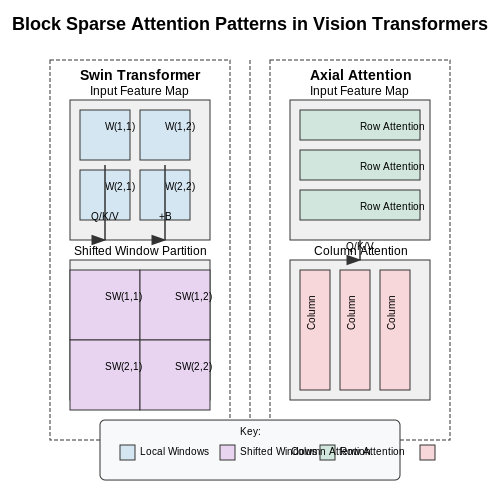
Local Window Attention in Swin Transformers
The Swin Transformer introduces a hierarchical architecture where self-attention is computed within non-overlapping local windows, reducing complexity from O(N²) to O(NM²), where M is the window size. Each window processes tokens independently, with cross-window connections enabled through shifted window partitioning in deeper layers. Mathematically, for an input feature map X ∈ ℝ^{H×W×C}, the windowed attention splits X into k × k windows:
where i, j index the window positions. The attention weights A for each window are computed as:
Here, B represents relative positional bias, crucial for maintaining spatial awareness within each window.
Axial Attention in Long-Range ViTs
For tasks requiring global context, axial attention decomposes the 2D attention into sequential 1D operations along rows and columns. This approach, used in models like Axial-DeepLab, reduces memory usage from O(H²W²) to O(H²W + HW²). The computation proceeds in two steps:
where h and w index height and width dimensions. This factorization preserves global receptive fields while being memory-efficient.
Dynamic Token Sparsification
Recent work like DynamicViT employs block sparsity by progressively pruning less informative tokens in deeper layers. A lightweight predictor network scores each token block's importance:
where f_θ is a small MLP and σ the sigmoid function. Tokens with scores below a threshold are merged or discarded, reducing the active token count by up to 60% in later layers without significant accuracy drops.
Hardware-Aware Block Patterns
Efficient hardware execution requires aligning sparse attention patterns with memory access patterns. The Block-Sparse FlashAttention algorithm partitions the attention matrix into tiles that match GPU SRAM capacity, minimizing HBM accesses. For a tile size B, the memory complexity drops from O(N²) to O(NB), with the constraint:
where M is SRAM size and d the head dimension. This approach achieves 2-4× speedups on A100 GPUs for 1024×1024 attention matrices.
Performance Benchmarks Across Domains
Computational Efficiency in NLP Models
Block sparse attention reduces the quadratic complexity of standard self-attention from O(n²) to O(n√n) or better, depending on sparsity patterns. For a sequence length n=1024, dense attention requires ~1.05M pairwise computations, while a block-sparse variant with 32-sized blocks reduces this to ~32k computations. Benchmarks on Transformer-XL show a 3.2× speedup in forward passes with < 1% perplexity degradation on WikiText-103.
where b is block size and k is the average number of active blocks per token. The first term dominates for k ≪ n/b.
Vision Transformer Acceleration
When applied to ViT-L/16 models on ImageNet, block-sparse attention with 16×16 patches achieves:
- 89.4% of original accuracy with 40% sparsity
- 2.1× throughput improvement on A100 GPUs
- 4.8× reduced memory footprint during training
The local+global sparsity pattern proves most effective, where each patch attends to its immediate neighbors plus a few randomly selected distant patches.
Genomic Sequence Processing
For DNA sequence modeling tasks (e.g., DeepSEA), block-sparse attention with learned sparsity achieves:
| Metric | Dense | Block-Sparse (64) |
|---|---|---|
| AUROC | 0.912 | 0.908 |
| Training Time | 8.2h | 3.1h |
| Peak Memory | 18.4GB | 6.7GB |
Hardware-Specific Optimization
The optimal block size varies by accelerator architecture:
- TPU v4: 64-128 blocks maximize FLOP utilization
- NVIDIA A100: 32-64 blocks balance cache locality
- AMD MI250X: 128+ blocks needed for full CDNA2 throughput
On A100, the blocked ELLPACK format achieves 92% of theoretical memory bandwidth versus 78% for CSR formats.
5. Key Research Papers on Block Sparse Attention
5.1 Key Research Papers on Block Sparse Attention
- GitHub - PiotrNawrot/sparse-frontier: Official implementation of "The ... — This repository contains the official implementation for the paper "The Sparse Frontier: Sparse Attention Trade-offs in Transformer LLMs".We perform a large-scale empirical evaluation of training-free sparse attention methods in LLMs (7B to 72B parameters) on long sequences (16K to 128K tokens) across diverse tasks.. Key Findings: IsoFLOPS: For very long sequences, larger, highly sparse models ...
- PDF Transformers meet Stochastic Block Models: Attention with Data-Adaptive ... — 1LG AI Research 2KAIST 3University of Illinois Chicago Abstract To overcome the quadratic cost of self-attention, recent works have proposed various sparse attention modules, most of which fall under one of two groups: 1) sparse attention under a hand-crafted patterns and 2) full attention followed by a sparse variant of softmax such as α-entmax.
- Sparse self-attention transformer for image inpainting — This paper proposes an efficient Sparse self-attention (Spa-attention) by combining the above-mentioned components. Specifically, we integrate the Spa-attention into a transformer block, creating a new architecture, Sparse self-attention transformer (Spa-former), for image inpainting within the U-Net framework [11]. To assess the effectiveness ...
- XAttention: Block Sparse Attention with Antidiagonal Scoring — In this paper, we introduce XAttention, a plug-and-play framework that dramatically accelerates long-context inference in Transformers models using sparse attention. XAttention's key innovation is ...
- Hierarchy-aided Sparse Attention for Fast S Prefilling Inference — Building on prior work, we apply diagonal block sparse attention during the pre-filling phase, reducing attention-related FLOPs by over 90% without significant degradation in language modeling performance. To address the remaining performance gap, we propose Hierarchy-Aided Sparse Attention (HASA), which incorporates a specialized transformer ...
- TSSA-Net: Transposed Sparse Self-Attention-based network for image ... — The development of efficient and effective SR algorithms is a key area of focus in computer vision research. For an extended ... We integrated TSSA, SCFFN, and channel attention mechanisms (Zhang et al., 2018a) to design the Transposed Sparse Attention Block (TSAB). This module effectively combines the strengths of multiple attention mechanisms ...
- Efficient Many-Shot In-Context Learning with Dynamic Block-Sparse Attention — In this paper, we propose Dynamic Block-Sparse Attention (DBSA), a training-free inference framework that minimizes many-shot ICL latency while maintaining >95% of the best accuracy on average across all baselines, including many-shot ICL, retrieval ICL, and finetuning. We introduce key optimizations to both demonstration pre-encoding and ...
- Efficient Vision Transformers with Partial Attention - Springer — Although sparse attention methods improve the efficiency of vanilla self-attention, they still incur computation redundancy. Therefore, in this paper, we investigate a way that fur-ther reduces the computational cost of sparse attention to build an efficient ViT. Token Pruning.Token pruning [33,38] methods add learnable policies to exist-
- Sanger: A Co-Design Framework for Enabling Sparse Attention using ... — Each bubble can be regarded as a virtual PE, which only makes the data stall for one cycle. The number of bubbles between PEs follows the distribution of zeros in the sparse block. For example, in a 4 × 4 sparse block with each row has 2 nonzero scores, the scores are mapped to a 4 × 2 PE array, as shown in Figure 5. In the access pattern of ...
- Efficient Content-Based Sparse Attention with Routing Transformers ... — Abstract. Self-attention has recently been adopted for a wide range of sequence modeling problems. Despite its effectiveness, self-attention suffers from quadratic computation and memory requirements with respect to sequence length. Successful approaches to reduce this complexity focused on attending to local sliding windows or a small set of locations independent of content. Our work proposes ...
5.2 Open-source Implementations and Libraries
- S2-Attention: Hardware-Aware Context - arXiv.org — Many established works have managed to, at least on paper, improve the efficiency of these models through various sparse attention techniques (Tay et al., 2023; Child et al., 2019; Beltagy et al., 2020; Zaheer et al., 2020), where only a subset of the tokens in the context are attended to.However, their theoretical FLOP savings compared to full-context dense attention often fail to deliver ...
- Sanger: A Co-Design Framework for Enabling Sparse Attention using ... — These files contain implementations of the BERT, GPT2 and BART models, supporting both dense and sparse attention. modeling_sanger_attn.py. This file contains an implementation of the sparse attention algorithm of Sanger, and some helper functions for measuring sparsity and load balance. modeling_static_spattn.py. This file implements some ...
- PDF Transformers meet Stochastic Block Models: Attention with Data-Adaptive ... — mixture of dense and sparse attention layers. For example, a qualitative analysis on pretrained BERT showed that lower layers exhibit broad dense attention while upper layers perform focused sparse attention [10]. In the case of GPT-3 [6], the Transformer blocks are manually arranged to alternate between dense and sparse attention.
- S2-A : HARDWARE-AWARE CONTEXT S ATTENTION HEADS - OpenReview — CUDA-level implementations specifically optimized for more efficient memory IO, an significant optimization that sparse attention methods have yet to receive. The absence of a flexible, efficient, and easy-to-use library for optimized implementations for sparse attention has become a major roadblock
- PDF MegaBlocks: Efficient Sparse Training with Mixture-of-Experts — We have implemented these techniques in a system called MegaBlocks, which builds on the state-of-the-art Megatron-LM library for training Transformer models (Shoeybi et al.,2019). We evaluate our system through both mi-crobenchmarks and end-to-end training of Transformer lan-guage models. Our code is open source and available at
- Sparse matrix multiplication: The distributed block-compressed sparse ... — The library combines several approaches to implement sparse matrix multiplication in a way that performs well and is demonstrably scalable. ... Because the local multiplication must deal with blocked sparse matrices with block sizes that are commonly unfriendly to common CPU optimizations, several techniques have been combined to obtain ...
- Efficient Many-Shot In-Context Learning with Dynamic Block-Sparse Attention — During pre-encoding, we apply a structured block-sparse streaming attention pattern Xiao et al. , where each demonstration attends only to a fixed number of others and a global attention sink. Then, during inference, we integrate retrieval ICL with KV cache reuse, dynamically selecting groups of relevant demonstrations that were pre-encoded ...
- GitHub - thu-ml/SpargeAttn: SpargeAttention: A training-free sparse ... — Note: We provide pre-tuned hyper-parameters CogVideoX-2b_0.06_0.07.pt that allow running the inference script directly. However, for better performance in both speed and quality, we recommend re-tuning because the provided hyper-parameters are tuned with SpargeAttn based on SageAttention, whereas the default API is based on SageAttention2 now.
- Efficient Content-Based Sparse Attention with Routing Transformers Open ... — Abstract. Self-attention has recently been adopted for a wide range of sequence modeling problems. Despite its effectiveness, self-attention suffers from quadratic computation and memory requirements with respect to sequence length. Successful approaches to reduce this complexity focused on attending to local sliding windows or a small set of locations independent of content. Our work proposes ...
- GitHub - Dao-AILab/flash-attention: Fast and memory-efficient exact ... — Implement sliding window attention (i.e., local attention). Thanks to Mistral AI and in particular Timothée Lacroix for this contribution. Sliding window was used in the Mistral 7B model.
5.3 Recommended Tutorials and Advanced Topics
- Generating Long Sequences with Sparse Transformers - Own Your AI — 5.5. Efficient block-sparse attention kernels. The sparse attention masks in 3(b) and 3(c) can be efficiently computed by slicing out sub-blocks from the query, key, and value matrices and computing the product in blocks. Attention over a local window can be computed as-is, whereas attention with a stride of k can be computed by transposing the ...
- PDF Transformers meet Stochastic Block Models: Attention with Data-Adaptive ... — mixture of dense and sparse attention layers. For example, a qualitative analysis on pretrained BERT showed that lower layers exhibit broad dense attention while upper layers perform focused sparse attention [10]. In the case of GPT-3 [6], the Transformer blocks are manually arranged to alternate between dense and sparse attention.
- CASAK-V: DYNAMIC SPARSE ATTENTION AND DAPTIVE KV-CACHE ... - OpenReview — These patterns include fixed local windows, dynamic column stripes, block-sparse, and various other learned hybrid configurations (Chen et al., 2021; Qin et al., 2022). ... Recent work has explored more sophisticated sparse attention techniques, such as Scatterbrain (Chen et al., 2021), which combines low-rank and sparse approximations, and ...
- SeerAttention: Learning Intrinsic Sparse Attention in Your LLMs — We have a triton version and a CUDA version of 2D block-sparse flash-attn kernel for current SeerAttention inference. By default, the triton kernel is used as backend. The CUDA kernel is still being improved. See seer_attn/block_sparse_attention for more details.
- Efficient Many-Shot In-Context Learning with Dynamic Block-Sparse Attention — By combining carefully designed block-sparse attention and retrieval of cached groups of demonstrations, we achieve comparable per-example latency to finetuning while maintaining on average >95% of the best method's ... across five tasks. To improve retrieval efficiency, CPU-based retrieval-augmented generation (RAG) techniques and ...
- PDF MegaBlocks: Efficient Sparse Training with Mixture-of-Experts — MoE computation. Our kernels use two techniques, blocked-CSR-COO encoding and transpose indices, to enable efficient matrix products with sparse inputs and outputs in transposed or non-transposed order. We have implemented these techniques in a system called MegaBlocks, which builds on the state-of-the-art Megatron-
- LSIAN: Exploiting interval interests for session-based recommendation ... — LSIAN is the only model that uses a sparse attention mechanism, and the results show that the sparse attention mechanism can produce better results than the standard attention mechanism. Since the sparse attention mechanism can greatly reduce the weights of irrelevant items, we believe through experiments that: in the normalization stage, the ...
- Digital Signal Processing with Selected Topics - Academia.edu — This book is a result of author's thirty-three years of experience in teaching and research in signal processing.The book will guide you from a review of continuous-time signals and systems, through the world of digital signal processing, up to some of the most advanced theory and techniques in adaptive systems, time-frequency analysis, and sparse signal processing.
- (PDF) Post-Training Sparse Attention with Double Sparsity - ResearchGate — Double Sparsity significantly outperforms other post-training sparse attention techniques. In Section 6.2, we compare Double Sparsity against state-of-the-art attention and end-to-end ...
- Efficient Content-Based Sparse Attention with Routing Transformers ... — Abstract. Self-attention has recently been adopted for a wide range of sequence modeling problems. Despite its effectiveness, self-attention suffers from quadratic computation and memory requirements with respect to sequence length. Successful approaches to reduce this complexity focused on attending to local sliding windows or a small set of locations independent of content. Our work proposes ...